According to the World Health Organization (WHO), about half of the mental disorders are expressed before age 14. Approximately, about 20% of the children and adolescents in the world present mental disorders or difficulties, and similar disorders are seen in every culture (WHO, 2007). Among mental disorders found in children and adolescents, depression is gaining prominence everyday (WHO, 2004).
Depression is a disorder characterized by the alteration of mood, along with behavioral changes at school, home or in the community (Torres, Osorio, & Mejia, Reference Torres, Osorio, Mejía and Torres2007). Among school-aged children, depression might negatively impact academic performance and interpersonal relationships in the short term; in addition, in the long term, depression has been associated with substance abuse and conduct disorders among other negative outcomes (Nixon, Reference Nixon1999; Wagner, Reference Wagner2003). Some researchers have argued that child depression and adult depression are similar though age might moderate the impact of the disorder on individual characteristics (Méndez, Olivares, & Ros, Reference Méndez, Olivares, Ros and Caballo2006). Other authors suggest that manifestations of depression depend on an individual’s level of cognitive, social, and physiological development (Weiss & Garber, Reference Weiss and Garber2003).
Child depression is a heterogeneous phenomenon that includes a cluster of symptoms that characteristically co-occur and are associated with significant levels of discomfort and impairment (Pfeffer, Reference Pfeffer, Jensen, Knapp and Mrazek2006). Studies suggest that when studying child and adolescent depression it is important to acknowledge different symptoms and manifestations, as they can be indicative of sub-clinical levels of depression than can be precursors for full syndrome depressive disorders later in life (Lewinsohn, Solomon, Seeley, & Zeiss, Reference Lewinsohn, Solomon, Seeley and Zeiss2000; Shankman et al., Reference Shankman, Lewinsohn, Klein, Small, Seeley and Altman2009).
To evaluate depressive symptomatology in children and adolescents Kovacs (Reference Kovacs1985) developed The Children Depression Inventory (CDI). Kovacs defined a 19-point cutoff score for discriminating children with depressive symptomatology from non-depressed children; this criterion was used in the current study to discriminate children with and without depressive symptomatology. This instrument also allows evaluating different dimensions of depression. Studies that have used this instrument have demonstrated that the CDI have five factors that group child depression symptoms: negative mood, interpersonal problems, ineffectiveness, anhedonia, and negative self-esteem (Davanzo et al., Reference Davanzo, Kerwin, Nikore, Esparza, Forness and Murrelle2004; Kovacs, Reference Kovacs1992; Samm et al., Reference Samm, Värnik, Tooding, Sisask, Kõlves and von Knorring2008; Steele et al., Reference Steele, Little, Ilardi, Forehand, Brody and Hunter2006).
According to Kovacs (Reference Kovacs1992), Negative Mood reflects feelings such as sadness, feeling like crying, worrying about bad things, being bothered or upset by things, and being unable to make up one’s mind. Interpersonal Problems reflects problems and difficulties in interactions with people, including trouble getting along with people, social avoidance, and social isolation. Ineffectiveness consists of a negative evaluation of one’s ability and school performance. Anhedonia reflects impaired ability to experience pleasure. Also, it can include problems such as suffering from loss of energy and problems with sleeping and appetite. Finally, Negative Self-esteem reflects low self-esteem, self-dislike, and feelings of being unloved.
Violence Exposure and Depression
Exposure to violence is a significant problem for children and youth mental health. Research has shown that being exposed to violence contributes to higher levels of reported mental health issues in both community and clinical samples of children and youth (Flannery, Singer, Van Dulmen, Kretschmar, & Belliston, Reference Flannery, Singer, van Dulmen, Kretschmar, Belliston, Flannery, Vazsonyi and Waldman2007). Additionally, different studies have found a relationship between exposure to violence and depressive symptoms in children and adolescents. For example, Malik (Reference Malik2008) conducted a study in the United States to examine relations between children’s violence exposure at home and in the community, and symptoms of externalizing and internalizing problems among non-risk children between 8 and 12 years old. Findings from the study showed how community violence was related to all measures of children’s adjustment, including children’s internalizing problems and depressive symptoms, whereas exposure to domestic violence was related only to externalizing problems.
Another study conducted in the United States by Kennedy, Bybee, Sullivan, and Greeson, (2010), examined the relationships between witnessing intimate partner violence, community and school violence exposure, family social support, gender, and depression over 2 years within a sample of N = 100 school-aged children (Kennedy et al., Reference Kennedy, Bybee, Sullivan and Greeson2010). Results suggest that ongoing and chronic exposure to violence place children at greater risk to developing depression which they might be able to recover from as long as the violence does not continue. On the other hand, children who reported higher initial support had lower depression levels than children who reported lower initial support. Gender also acted as a moderator in the relationship between witnessing violence and depression, with girls reporting higher depression scores than boys.
Regarding the relationship between violence exposure, depression and socio-demographic characteristics, Flannery, Singer, and Wester (Reference Flannery, Singer and Wester2001) found that adolescent females that were exposed to high levels of violence were at higher risk of reporting clinically significant depression compared to males. Flannery et al., (Reference Flannery, Singer, van Dulmen, Kretschmar, Belliston, Flannery, Vazsonyi and Waldman2007) in another study also found differences among developmental periods in the relationship between exposure to violence and youth self-reported mental health symptoms (Flannery et al., Reference Flannery, Singer, van Dulmen, Kretschmar, Belliston, Flannery, Vazsonyi and Waldman2007). In their sample of urban and non-urban youth from elementary school trough high school, the authors found that 3rd to 5th grader males exposed to higher levels of violence reported higher rates of mental health symptoms than females. However, this trend was reversed in middle school and high school, with females reporting higher rates of mental health symptoms than males.
Despite the evidence presented by the aforementioned studies supporting the relationship between violence exposure and depressive symptomatology, other studies have found that depression is not directly associated with violent exposure (Allwood, Reference Allwood2005; Mazza & Reynolds, Reference Mazza and Reynolds1999). Mazza and Reynolds (Reference Mazza and Reynolds1999) suggest that the relationship between exposure to violence and depression is mediated by symptoms of Post Traumatic Stress Disorder (PTSD). Additionally, Allwood (Reference Allwood2005) found that although violence exposure accounted for 15% of the variance in self-reported depression, structural analyses suggested that much of this variance might have been shared with trauma symptoms and aggressive cognitions.
Prevalence Rates for Child Depression
Studies conducted in the United States show how prevalence rates for depression vary between community and clinical samples. In community samples, the 6-month prevalence of depressive disorders has been shown to be between 1% to 3% in school-age children, and 5% to 6% in adolescents (Klein, Dougherty, & Olino, Reference Klein, Dougherty and Olino2005). These rates tend to increase in clinical samples, in which the estimated rates for prevalence of depression are 8% to 15% in children, and more than 50% in adolescents (Schwartz, Gladstone, & Kaslow, Reference Schwartz, Gladstone, Kaslow, Ollendick and Hersen1998).
Only few studies have been conducted in Latin America to examine the prevalence of depressive symptomatology among children and youth in community samples. In Brazil, a study was conducted to identify the prevalence of depressive symptomatology in two samples of public school basic education students of the city of Campinas (Cruvinel & Boruchovitch, Reference Cruvinel and Boruchovitch2008). The sample consisted of N = 169 children and youth from 3rd, 4th and 5th grades (sample 1), and N = 157, for 3rd and 4th graders (sample 2). The prevalence of depressive symptomatology found was 3.55% for sample 1, and 17% for sample 2. Across both samples, no significant relationships emerged between demographic variables (age, gender, school grade, school retention) and depressive symptomatology.
In Colombia, only a few studies have examined the prevalence of depressive symptoms among community samples of children and youth. A mental health study conducted by Torres and Montoya (Reference Torres and Montoya1997) in the city of Bogota, showed that 13.3% of pre-adolescents and adolescents between 12 and 15 years old presented depressive symptoms, and that this percentage increased to 20.1% in youth between 16 and 19 years. In 2004, in the city of Bucaramanga, another study was carried out with the purpose of establishing the prevalence for this disorder in schooled children between 8 and 12 years of age; they found that one of every ten children presented depressive symptoms with clinical relevance (Mantilla, Sabalza, Díaz, & Campo-Arias, Reference Mantilla, Sabalza, Díaz and Campo-Arias2004). Likewise, in La Ceja Municipality (Antioquia), Vinaccia et al. (Reference Vinaccia, Gaviria, Atehortúa, Martínez, Trujillo and Quiceno2006) carried out a similar investigation, in which they found a prevalence rate for depressive symptoms of 25.2%. The most recent study conducted with Colombian children (8 to 11 years), was carried out in the city of Neiva in 2007, whose results showed a prevalence rate for depressive symptomatology of 17.09% (Herrera-Murcia, Losada, Rojas, & Gooding- Ondoño, 2009).
Regarding the relationship between depressive symptoms and socio-demographic characteristics, the studies conducted in Colombia present mixed results. The studies by Mantilla et al. (Reference Mantilla, Sabalza, Díaz and Campo-Arias2004), and Torres and Montoya (Reference Torres and Montoya1997), found that depression scores tended to increase with age. However, in the study by Herrera-Murcia et al., (Reference Herrera-Murcia, Losada, Rojas and Gooding- Ondoño2009) most of the cases that were identified with depressive symptomatology were found in younger children. Two of the studies also found gender differences, in which girls tended to present higher scores for depressive symptoms compared to boys (Mantilla et al., Reference Mantilla, Sabalza, Díaz and Campo-Arias2004; Vinaccia et al., Reference Vinaccia, Gaviria, Atehortúa, Martínez, Trujillo and Quiceno2006). Finally, only one study (Herrera-Murcia et al., Reference Herrera-Murcia, Losada, Rojas and Gooding- Ondoño2009) found a relationship between depressive symptoms and the child’s socio-economic status, in this case low socio-economic status was associated with depressive symptoms.
In summary, the studies on child and youth depression conducted in Colombia present different results. On one hand, this can be due to measurement differences. Although all of them used the CDI, they used different versions and cutoff scores (e.g., Herrera–Murcia et al., Reference Herrera-Murcia, Losada, Rojas and Gooding- Ondoño2009; Mantilla et al., Reference Mantilla, Sabalza, Díaz and Campo-Arias2004; Vinaccia et al., Reference Vinaccia, Gaviria, Atehortúa, Martínez, Trujillo and Quiceno2006). On the other hand, this might be related to sample differences (rural vs. urban settings, and age considered; e.g., Torres & Montoya, Reference Torres and Montoya1997; Vinaccia et al., Reference Vinaccia, Gaviria, Atehortúa, Martínez, Trujillo and Quiceno2006). These results highlight the importance of conducting further studies that can evaluate child and youth depression in community samples in the country.
The Current Study
Violence rates in Colombia are so high that violence is considered one of the most important public health problems in the country (Duque, Montoya, & Restrepo, Reference Duque, Montoya and Restrepo2006). Medellin (located in the Colombian Andes) is the second largest city in Colombia, with a population of approximately two million inhabitants. As reported by recent studies, in the city of Medellin, one of every four inhabitants perceives that in their neighborhood there are different forms of violence such as conflicts between neighbors, fights among gangs, and property crimes (Duque et al., Reference Duque, Montoya and Restrepo2006). For instance, a study by Duque (Reference Duque2005) showed that 41.4% of Medellin’s inhabitants have witnessed a homicide and that 75% have witnessed an aggressive incident involving a weapon, whereas almost 40% have been victims of threats with weapons, or other types of serious threats (extortion, forced displacement, homicide and others of a similar nature), muggings with a weapon and theft.
Despite increased national and international attention paid to violence in Colombia, the relationship between neighborhood violence and child depression in Colombia continues to be an understudied area of research. Only few studies have examined the prevalence of child depression in Colombia (Herrera-Murcia et al., Reference Herrera-Murcia, Losada, Rojas and Gooding- Ondoño2009; Mantilla et al., Reference Mantilla, Sabalza, Díaz and Campo-Arias2004; Torres & Montoya, Reference Torres and Montoya1997; Vinaccia et al., Reference Vinaccia, Gaviria, Atehortúa, Martínez, Trujillo and Quiceno2006) and no studies have been conducted yet to evaluate the prevalence of non-clinical child depression in Medellin. Additionally, no studies have been conducted to examine the relationship between exposure to community violence and its impact on children and youth’s mental health.
Evaluating early onset of depressive symptoms is particularly important for prevention purposes. Studies with community samples have shown that individuals who present depression symptoms early in life are at higher risk for developing later mental health problems (Dekker et al., Reference Dekker, Ferdinand, van Lang, Bongers, van der Ende and Verhulst2007; Ingoldsby, Kohl, McMahon, & Lengua, Reference Ingoldsby, Kohl, McMahon and Lengua2006; Shankman et al., Reference Shankman, Lewinsohn, Klein, Small, Seeley and Altman2009; Simons, Rohde, Kennard, & Robins, Reference Simons, Rohde, Kennard and Robins2005; Wilcox & Anthony, Reference Wilcox and Anthony2004). Furthermore, in youth, sub-clinical levels of depression (i.e., symptoms below the threshold for clinical diagnosis) have been demonstrated to serve as precursors for full syndrome disorders (e.g., Major Depressive Disorder) over time (Lewinsohn et al., Reference Lewinsohn, Solomon, Seeley and Zeiss2000; Shankman et al., Reference Shankman, Lewinsohn, Klein, Small, Seeley and Altman2009). Therefore, it is important to evaluate different dimensions of depression because this can help identify children and youth who are at risk.
The purpose of the present study was twofold. First, we aimed to examine the prevalence of depressive symptomatology among schooled children between 8 and 12 years in the city of Medellin, Colombia. Second, we aimed to further examine the relationship between depression and exposure to neighborhood violence in children and early adolescents.
Method
Participants
Data were collected from children 8 to 12 years old enrolled in third (3rd) to sixth (6th) grade across different public schools in Medellin during 2009. Sample size was calculated using proportion estimation for finite population. A population of 162844 students enrolled in the public schools in Medellin was used to calculate the sample size needed for the study. Based on Vinaccia et al., (Reference Vinaccia, Gaviria, Atehortúa, Martínez, Trujillo and Quiceno2006) and colleagues’ recommendations, sample size calculations showed that an estimated sample of N = 288 children was needed (sampling error of 5% and a reliability of 95%.). The sample size was enlarged by 10% to avoid potential missing data, thus, a final sample of N = 320 children was obtained.
The sample selection followed a stratified random sampling; initially, one public school was randomly selected from each neighborhood (comuna Footnote 1 ) to ensure that the institutions were uniformly distributed across different areas of the city. Among the selected institutions, grades were taken as strata. The selection of the students from each grade was done trough systematic sampling with a random starting number. Twenty children were selected from each institution, five students for every grade between third and sixth grade.
Procedure
The study was approved by the Institutional Review Board of CES University (Medellin, Colombia). First, selected schools were contacted in order to have the principal’s approval. Parental consent forms were distributed to parents or legal guardians during group meetings conducted at each school. In addition, the study procedures were also discussed with the children before they agreed to participate in the study.
Data from N = 289 children randomly selected from the 16 comunas (neighborhoods) of the city were analyzed. From the initial sample of 320, seven participants were eliminated because they reported difficulty in completing the instrument; other students dropped from the school in the time lapse between the collection of the informed consent and the day when the application of the instruments took place; thus, the response rate was 90.3%. At the end of the study, the results of the Children’s Depression Inventory (CDI) were given to each of the parents or legal guardians of each child that was identified with depressive symptoms. Information about referrals (e.g., early intervention) was also provided.
Measures
Demographic variables
Age, gender and school grade were measured by questions that were included in the instrument administered to the children. A blank space was provided for the child to complete each of these questions.
Neighborhood violence exposure
Neighborhood location was determined based on children’s self-report of the public school they attended. Two groups were created to classify neighborhoods into high and low neighborhood violence exposure. The decision was made based on the Human Rights report for the city of Medellin in 2009 (Personeria de Medellin, 2009) which presents the homicide rates per 100000 population by comunas. Thus, 7 comunas were classified as high violence neighborhoods, and 9 comunas were classified as low violence neighborhoods.
Depression
The 27-item self-report Children’s Depression Inventory (CDI-Kovacs, 1985) was used to assess depressed mood among study participants. The CDI was originally designed by Kovacs (Reference Kovacs1985) in the United States, then translated and standardized for Latin American population by Davanzo et al. (CDI-LA) in 2004; the Latin American version was used in the present study. Respondents were asked to choose one description out of three that best fits how they have been feeling over the past 2 weeks (e.g., “I do most things well”; “I do many things wrong”; “I do everything wrong”). Responses were scored on a scale from 0 to 2, with total CDI scores ranging between 0 and 54. The items are grouped in five subscales: Negative Mood, Interpersonal Problems, Ineffectiveness, Anhedonia and Negative Self- Esteem. Internal consistency reported by Kovacs (Reference Kovacs1985) for the entire instrument was Cronbach’s alpha = .86 whereas Davanzo et al. (Reference Davanzo, Kerwin, Nikore, Esparza, Forness and Murrelle2004) reported a Cronbach’s alpha of .85 using the Latin American sample. Internal consistency of the current study was Cronbach’s alpha = .79 for the total sample (α = .76 for boys and α = .81 for girls). The internal consistency estimates for the CDI subscales were: Cronbach’s alpha = .31 for Interpersonal Problems, Cronbach’s alpha = .60 for Ineffectiveness, Cronbach’s alpha = .49 for Negative Self-Esteem, Cronbach’s alpha = .57 for Anhedonia, and Cronbach’s alpha = .38 for Negative Mood. Although the Interpersonal Problems subscale reported a low internal consistency, this coefficient was similar to the one found by Davanzo et al. (α = .31). Moreover, in the current study the Ineffectiveness subscale reported the highest internal consistency coefficient (α = .60), which is higher than the one found in the study by Davanzo et al. (α = .51).
Factor loadings for the subscales ranged from .09 to .68. NFI values ranged from .883 to .995. The average item-total correlations for the subscales were: Interpersonal Problems r = .17, Ineffectiveness r = .38, Negative Self-esteem r = .26, Anhedonia r = .29, and Negative Mood r = .20.
As established by Kovacs (Reference Kovacs1985), a 19-point cutoff was used for discriminating children with depressive symptomatology from non-depressed children. A total score for each of the subscales (Negative Mood, Interpersonal Problems, Ineffectiveness, Anhedonia and Negative Self- Esteem) was also calculated by adding the scores for each question that composed the sub-scale.
Plan of Analysis
Univariate analyses were conducted to describe sample demographics and the association among study variables. Analyses included frequency distribution of demographics by the total sample (e.g., age, gender, school grade), Pearson correlations, and mean differences across depression subscales. Though Kovacs’ (Reference Kovacs1985) 19-point cutoff was used for determining the prevalence of depression among participants, linear regression models were conducted to examine the relationship among study constructs. More specifically, hierarchical linear regressions were completed for neighborhood violence and depression with demographic variables entered in a first step as control variables, and depression constructs introduced in a second step. The regression models were ran using the total CDI score as a preliminary step, though based on previous evidence (Kovacs, Reference Kovacs1985, Reference Kovacs1992) we expected that no differences might be found across participants using the total depression score. That is why purposely examined the subscales separately in the current study to generate new knowledge on those scales. In addition, given extant literature documenting gender differences in exposure to violence (Flannery et al., Reference Flannery, Singer and Wester2001; Flannery et al., Reference Flannery, Singer, van Dulmen, Kretschmar, Belliston, Flannery, Vazsonyi and Waldman2007; Kennedy et al., Reference Kennedy, Bybee, Sullivan and Greeson2010) the authors further examined if gender would act as a moderator in the relationship between violence exposure and depression subscales.
Results
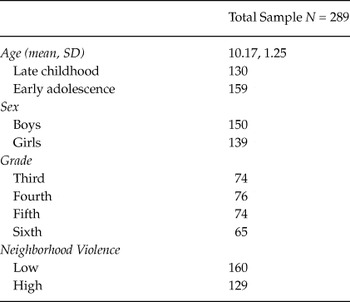
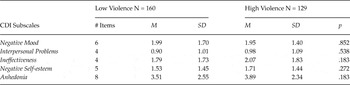
Results of univariate analysis with demographics are presented in Table 1. Regarding age distribution, 10.7 % were 8 years old, 23.2% 9 years old, 21.1% 10 years, 28.7% 11 years and 16.3% 12 years; the average age was 10.17, with a SD of 1.256. Using the19-point cutoff recommended by Kovacs (Reference Kovacs1985) to differentiating depressive and non-depressive children, results showed that only 26 participants reported depressive symptoms for a prevalence of 8.9% (PR = 5.525–12.468) in the total sample which is equivalent to 12% of girls and 7% of boys. Nonetheless, no statistically significant differences among depression total scale scores were found by gender in the total sample, χ2(2) = 2.07; p = .15. Similarly, no significant differences were found by age among participants with and without depression, t(287) = 1.25; p = .21, as well as depressive symptoms by school grade, χ2(3) = 1.50; p = .68. Furthermore, depression sub-scales mean levels were not significantly different by high-low violence neighborhoods (Table 2).
Frequencies of Demographic Variables by Total Sample

Mean Level Comparison of CDI Subscales by Level of Violence

Before proceeding with the hierarchical analyses, developmental characteristics of the sample were examined to determine potential differences in depressive symptoms reported by 8–10 years old (late childhood) versus 10–12 (early adolescents). Results showed that 10% of the 8 -10 years old reported depressive symptoms compared to 8.2% from the 11–12 years old participants. However, no statistically significant differences were found between these two groups and depressive symptoms when the total CDI was examined, χ2 (1) = .29; p = .59.
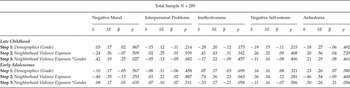
Results from the hierarchical multiple regression with the total CDI score as dependent variable showed that neighborhood violence did not explained a significant proportion of variance in the total CDI scores. This was true for both late childhood, R 2 = .019, F(2, 127) = 1.25, p = .29, and early adolescence, R 2 = .004, F(2, 156) = .34, p = .71. However, results from the hierarchical multiple regression conducted with the subscales scores as dependent variables showed that early adolescent participants reported greater ineffectiveness when exposed to higher levels of violence, b = .74, p = .04, across boys and girls (Table 3).
Hierarchical Regression Analyses by Depression Sub-Scales and Neighborhood Violence in the Total Sample

The last step of the hierarchical regression model included the interaction term Neighborhood Violence Exposure*Gender to examine if gender acted as a moderator in the relationship between violence exposure and depression subscales. To be more rigorous with the analyses, we conducted a Bonferroni correction to counteract the potential problem of multiple comparisons (Cohen & Cohen, Reference Cohen and Cohen1983) using the formula α/n (number of comparisons made).
Thus, we used a corrected alpha of .025 to establish statistical significance for these results (.05/2). As seen in table 3, no statistical significant differences were found for the violence interaction term and depression subscales in any of the groups (late childhood vs. early adolescents).
Discussion
The present study contributes to the scarce literature examining the prevalence of depressive symptomatology among children in Latin America, as well as its association with exposure to neighborhood violence. This work is also one of the pioneering studies in the country that has followed strictly the parameters indicated by international and national regulations regarding ethical issues for research with children and young people; hence, ensuring greater validity and social responsibility with the studied population.
The prevalence of depressive symptomatology in children between 8 and 12 years found in this study was lower than others reported in studies conducted with Colombian children. While in this study the prevalence found was 8.9%, the prevalence found in other municipality of Antioquia was 25.2% (Vinaccia et al., Reference Vinaccia, Gaviria, Atehortúa, Martínez, Trujillo and Quiceno2006) and in the city of Neiva, where the prevalence found was 17.09% (Herrera-Murcia et al., Reference Herrera-Murcia, Losada, Rojas and Gooding- Ondoño2009). Nevertheless, the prevalence found in the present study was similar to the one found in the city of Bucaramanga during 2004, where a prevalence of 9.2% was reported (Mantilla et al., Reference Mantilla, Sabalza, Díaz and Campo-Arias2004). All of the above studies used the same instrument, but different versions; the study carried out in Bucaramanga used the abbreviated version (CDI - S) developed by Kovacs (Reference Kovacs1992) and in the city of Neiva they used the adapted version by Del Barrio (Reference Del Barrio1999) for Spain. Potential explanations for this are, for example, that even though other authors have used the same version of the depression instrument (Vinaccia et al., Reference Vinaccia, Gaviria, Atehortúa, Martínez, Trujillo and Quiceno2006) different cutoff points for identifying children with and without depressive symptomatology were assumed. In addition, sample size and other demographic characteristics of the sample might account for the differences found in this and other studies.
Concerning the incidence of depressive symptomatology among boys and girls, no significant differences were found, thus, supporting the results found by Kovacs (Reference Kovacs1985) and the study recently carried out in the city of Neiva, Colombia by Herrera-Murcia et al. (Reference Herrera-Murcia, Losada, Rojas and Gooding- Ondoño2009). This result further supports what has been reported in the fourth edition of the Diagnostic and Statistical Manual of Mental Disorders -Text Revision (DSM–IV–TR)-, in which it is indicated that the depressive disorder affects both genders equally before puberty, but, after adolescence, the prevalence is twice more frequent in women than in men (American Psychiatric Association, 2000).
In this same line, Hankin, Wetter, and Cheely (Reference Hankin, Wetter, Cheely, Abela and Hankin2008) state that most of the literature that has examined sex differences in depression agrees in that it is only at about age 12 or 13 that gender differences begin to emerge (Hankin et al., Reference Hankin, Wetter, Cheely, Abela and Hankin2008). One of the models that have been developed to explain the gender differences in depression that emerge during adolescence is the Cognitive Vulnerability-Stress Model (Hankin & Abramson, Reference Hankin and Abramson2001). According to this model, females exhibit more cognitive vulnerabilities to depression than boys, such as more negative cognitive style, rumination, negative beliefs and perceptions of physical attractiveness. These cognitive vulnerabilities enhance the likelihood of experiencing depression when they face negative events or stressors (Hankin & Abramson, Reference Hankin and Abramson2001). Accordingly, girls are more likely than boys to have characteristics that put them at risk for depression even before puberty, but it is only when these characteristics interact with certain challenges of early adolescence that girls develop higher rates of depression than boys (Nolen-Hoeksema & Girgus, Reference Nolen-Hoeksema and Girgus1994). For instance, some authors suggest that during early adolescence girls report more interpersonal stressors than boys (Hankin et al., Reference Hankin, Wetter, Cheely, Abela and Hankin2008) and are presented with more biological and social challenges that put them at a higher risk to develop depression (Nolen-Hoeksema & Hilt, Reference Nolen-Hoeksema, Hilt, Gotlib and Hammen2009).
Similarly, no significant differences for age were found when the total depression score was examined, supporting previous evidence reported by Kovacs (Reference Kovacs1985). These results differ from the study carried out by Mantilla and colleagues in Bucaramanga, Colombia, in which a significant association between higher age and depressive symptomatology was found (Mantilla et al., Reference Mantilla, Sabalza, Díaz and Campo-Arias2004); other studies have also provided evidence of the increase of childhood depression with age (Kashani & Schmid, Reference Kashani, Schmid, Shafii and Shafii1992; Torres & Montoya, Reference Torres and Montoya1997).
Regarding the relationship between exposure to neighborhood violence and depression, our study did not find a significant association between the level of violence to which the child was exposed to, and the total depression score. However, when we examined the dimensions separately (Negative Mood, Interpersonal Problems, Ineffectiveness, Anhedonia and Negative Self- Esteem), we found that exposure to higher neighborhood violence significantly predicted ineffectiveness among early adolescents but not late childhood participants. This finding can be explained from a developmental perspective. During the transition to adolescence, there are important changes in the child’s development of self-competence, especially regarding their social relationships. During this period, children are expected to develop more sophisticated social skills, such as peer cooperation, the ability to work in groups, perspective taking, interpersonal communication skills, leadership qualities, social competence with adults, and the acceptance and respect of peers (Obradović, van Dulmen, Yates, Carlson, & Egeland, Reference Obradović, van Dulmen, Yates, Carlson and Egeland2006). If the child has access to the resources needed to adapt to theses demands, this will lead them to a better emotional well-being, particularly as related representations of the self as deserving of care and support, and as having agency and efficacy (Obradović et al., Reference Obradović, van Dulmen, Yates, Carlson and Egeland2006). However, as it has been proposed in previous studies, youth who are exposed to high community violence tend to report lower self-worth (Copeland-Linder, Lambert, & Ialongo, Reference Copeland-Linder, Lambert and Ialongo2010). According to Copeland-Linder et al., a potential explanation for this association is that witnessing violence in the community leads to a sense of helplessness and hopelessness that in turn affects youth’s sense of confidence or self-efficacy. Therefore, as found in our study, youth who are exposed to higher levels of violence might present greater ineffectiveness, which consists of a negative evaluation of one’s abilities (Kovacs, Reference Kovacs1992). However, more research is needed on mechanisms linking community violence exposure and self-perceptions. Furthermore, results from the current study highlights the importance of evaluating depression dimensions separately compared with the total depression scale, which has been predominantly used across previous studies, as it is consistent with the idea of how depression is a multifaceted construct consisting of various symptom clusters reflecting different etiological pathways (Hecht, Inderbitzen, & Bukowski, Reference Hecht, Inderbitzen and Bukowski1998).
One of the limitations of the study is that we did not include individual-level data on violence exposure. Thus, the lack of association between neighborhood violence exposure and depression should be interpreted carefully. On one hand, this null finding might be due to the fact that although children from the same neighborhood can be exposed to similar levels of community violence, individual differences, such as the child coping strategies, might influence both how the child perceives and responds to the situation. On the other hand, the association between neighborhood violence exposure and child depression might be mediated by other disorders that were not measured in the study, such as PTSD as suggested by Allwood (Reference Allwood2005), and Mazza and Reynolds (Reference Mazza and Reynolds1999). Future studies should address this limitation by including children’s self-reports on community violence, as well as instruments that can evaluate other mental disorders. Furthermore, qualitative studies can help elucidate the individual differences on the perceptions and responses that child give to exposure to violence, as well as other situations that might help to explain their depression scores.
Another interesting finding in our study was that we didn’t find evidence for the moderation of gender in the relationship between neighborhood violence and depression sub-scales. Findings in the literature regarding the moderation of gender in the relationship between witnessing violence and depression are mixed. Some studies have found that among youth who are exposed to high levels of violence, girls tend to report higher depression scores than boys (Flannery et al., Reference Flannery, Singer and Wester2001; Kennedy et al., Reference Kennedy, Bybee, Sullivan and Greeson2010), while others have found the reversed tendency, with boys reporting higher depression scores than girls (Flannery et al., Reference Flannery, Singer, van Dulmen, Kretschmar, Belliston, Flannery, Vazsonyi and Waldman2007).
We must note that our results are not consistent with other studies because we examined depression dimensions (i.e., subscales) separately instead of using the total depression scale which has been predominantly used across most of the previous studies. In addition, we conducted a Bonferroni correction to ensure more rigorousness of the results, therefore, reducing the possibility of finding false positive results.
Although the internal consistency for the total scale was acceptable (α = .79) as reported by previous studies, internal consistency estimates for most of the subscales were low (alphas ranging from .31 to .57), and only Ineffectiveness showed an acceptable coefficient (α = .60). These coefficients are similar to the ones reported by other studies examining the CDI subscales (Davanzo et al., Reference Davanzo, Kerwin, Nikore, Esparza, Forness and Murrelle2004). Furthermore, average item-total correlations for our study ranged from .17 to .38, with Ineffectiveness reporting the higher average. Previous studies have reported similar average item-total correlations for the CDI. For instance, Smucker, Craighead, Craighead, and Green (Reference Smucker, Craighead, Craighead and Green1986) reported item-total correlations ranging from .19 to .31 (males and females). Similarly, Ivarsson, Svalander, and Litlere (Reference Ivarsson, Svalander and Litlere2006) report inter-item correlations ranging from .26 to .57. Therefore, the low internal consistency in the subscales found in our study is not necessarily related to the population examined or the translation of the instrument as it has been an issue previously reported by other studies examining the CDI subscales separately (e.g., Ivarsson et al., Reference Ivarsson, Svalander and Litlere2006; Smucker et al., Reference Smucker, Craighead, Craighead and Green1986). Those scholars further commented that perhaps the CDI works better as a full scale and that the use of separate sub-scales should be further examined.
A few years ago García, Aluja, and del Barrio (Reference García, Aluja and del Barrio2008), thoroughly examined the hierarchical of the CDI using a sample of N = 4707 Spanish participants (i.e., children vs. adolescent samples, gender differences, different item composition for scales, etc.) and conducted a thorough review of the extant literature on the inventory. Garcia et al. (2008) raised concern about the variations in item loadings and factors across samples thought they conclude that models of five and six factors fit well for youth and children across studies and recommended further testing the subscales and testing for potential gender differences. We consider that an important strength of our study was to address those two issues discussed by Garcia and colleagues (2008) and to further raise awareness about the importance of further examining the internal consistency of the sub-scales as previously argued by other scholars (e.g., Smucker et al., Reference Smucker, Craighead, Craighead and Green1986; García et al., Reference García, Aluja and del Barrio2008). Perhaps as suggested by Garcia and colleagues (2008) the CDI should be used as a one single factor (full scale) as it has been mostly used across studies due to the variability in internal consistency in the subscales when tested separately. Thus, based on the reliability estimates found in our study, the results for the subscales should be interpreted carefully.
Overall, our findings support the idea that despite similarities on a total depressive symptom score, there are distinct developmental differences in depressive symptoms expression that can be identifiable before mid-adolescence and may be associated with normative development (Bailey, Zauszniewski, Heinzer, & Hemstrom-Krainess, Reference Bailey, Zauszniewski, Heinzer and Hemstrom-Krainess2007). Therefore, our results raise awareness about the importance to further explore the role that developmental (age) as well as demographic characteristics (gender) might play in explaining childhood depression. Similarly important is the need for further understanding on the role of children’s coping strategies that lead youth to react in different ways with many showing remarkable resilient strategies. Finally, our study emphasizes the importance of extending the literature on depression prevention in children among diverse populations and Latin-American children particularly in violent contexts.