The terricolous, often sterile specimens of Candelariella Müll. Arg. are usually difficult to identify. A name that has often been used throughout North America for terricolous, 8-spored or sterile material of varied morphology is C. terrigena Räsänen. However, in a recent revision of Candelariella in western North America, C. terrigena was synonymized with C. citrina de Lesd. (Westberg Reference Westberg2007b). The latter species is a characteristic and common lichen in south-west North America, and its distinctive features include relatively short, ovoid to citriform spores and a squamulose, greenish yellow thallus which grows mainly on soil or mosses in rock crevices or sometimes directly on rock. Candelariella canadensis H. Magn., which was treated as a synonym of C. terrigena by Thomson (Reference Thomson1975), was described from arctic material growing on mosses and soil on the ground. A taxon with a distinct morphology was mentioned as a candidate for the name C. canadensis in Westberg (Reference Westberg2007b), and an investigation of the original material has confirmed this. During the study, type material of C. nepalensis Poelt & Reddi from the Himalayas was investigated and found to be conspecific with C. canadensis. An additional species from the Himalayas, Candelariella himalayana Poelt & Reddi, was found to be a synonym of C. placodizans (Nyl.) H. Magn.
The morphological studies were made in accordance with earlier work in Candelariella (see, e.g., Westberg Reference Westberg2005, Reference Westberg2007a). Spore measurements are given as (min. value observed–) range including 85% of the variation (–max. value observed).
Candelariella canadensis H. Magn
Ark. Bot. ser. 2, 2: 216 (1952); type: Canada, Georgina Island, 13 July 1922, Freucher 1469 (C—lectotype! designated here). [Note: The most well-developed of the three syntypes in C cited in Lynge (Reference Lynge1935) was chosen as the lectotype. The remaining two syntypes, now becoming paralectotypes, are indicated in the specimen citation list below.]
Candelariella hudsonica Hakul., Ann. Bot. Soc. Zool.-Bot. Fenn. “Vanamo” 27: 49 (1954); type: Canada, on earth, North shore of Hudson Strait, August 1897, R. Bell No. 1660 (CANL No. 12961—holotype!) [Note: The specimen contains two species: C. borealis, annotated as C. placodizans by Hakulinen and C. canadensis, named C. hudsonica by Hakulinen].
Syn. nov. Candelariella nepalensis Poelt & Reddi, Khumbu Himal [Universitätsverlag Wagner, Innsbruck-München] 6: 8 (1969); type: Nepal, Himalaya, Mahalangur Himal, Khumbu: Moränen des Khumbu – Gletschers bei Lobuche, c. 5000 m. September 1962, Poelt L441 (M—holotype!).
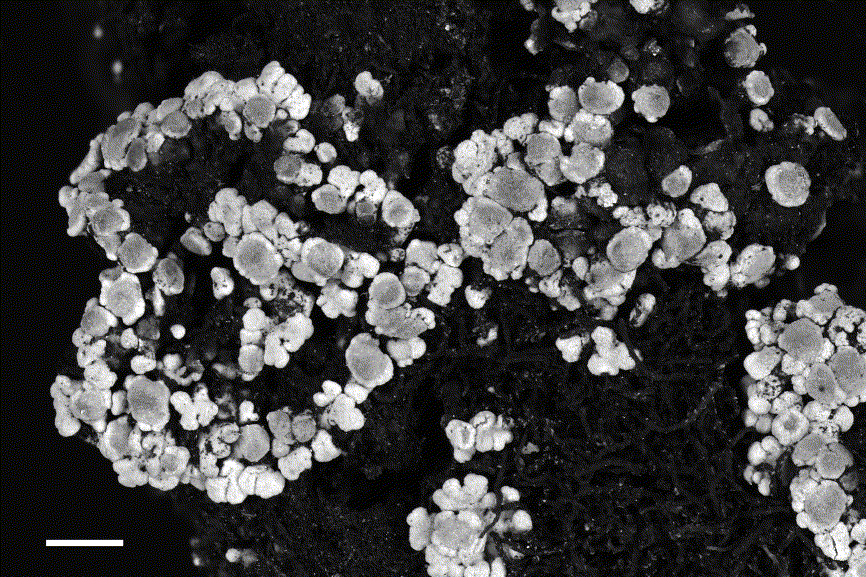
(Fig. 1)
Candelariella canadensis habitus (lectotype). Scale = 1 mm. Photograph by Patrik Frödén.

Thallus mostly composed of scattered 0·2–0·4 mm large granules, becoming irregular as they grow larger and forming lobes with a crenulate margin, lobes up to 1·5 mm long and 0·3 mm wide and usually adpressed to the substratum, when very well-developed forming up to 3 mm wide, ±circular rosettes; surface dark yellow, smooth to pulverulent; pseudocortex very uneven, 10–35 μm thick, of non-gelatinized hyphae with rounded, 2–6 μm wide cells; epicortex above the pigment layer lacking; medulla not developed, algae filling the interior of the thallus below the cortex; algae chlorococcoid.
Apothecia lecanorine, rounded, 0·5–1·2(–1·8) mm diam., thalline margin 0–0·24 mm wide, at first entire, becoming somewhat incised and finally excluded or remaining as a few scattered granules, cortex similar to that of the thallus, 15–20 μm thick; proper margin indistinct from the outside or visible as a thin, smooth ring around the disc, distinct and well-developed in section, to c. 100 μm wide at the surface, composed of radiating hyphae with elongated cells that become wider and shorter towards the upper part, lumina of the outermost cells c. 4–5 × 5–9 μm; disc at first flat, remaining flat or becoming convex to almost subglobose, concolorous with or darker yellow than the thallus, sometimes dark greenish or brownish; epihymenium of small granular crystals, golden yellow to reddish yellow; hymenium 60–80 μm tall; paraphyses simple or sometimes furcate near the tips, 1·5–3·5 μm wide in midhymenium, tips cylindrical to clavate, to 5·0 μm wide; asci clavate, 8-spored, 52–57 × 13–17 μm (n = 8); spores colourless, simple or rarely with a thin septum, narrowly ellipsoid with rounded or more often with attenuate ends, to almost citriform or somewhat teardrop-shaped, (9·0–)11·0–15·5(–17·0) × (4·5–)5·0–6·5(–7·0) μm (n = 95).
Spot tests. Thallus K− or K+ faintly red, KC−, C−.
Habitat and distribution. Candelariella canadensis appears to be a pioneer species, often growing on more or less bare soil with few other lichens or mosses immediately associated. It has often been collected together with C. borealis M. Westb. or C. placodizans. Candelariella canadensis is known from arctic North America, Greenland and the Himalayas but it may prove to be a circumpolar species.
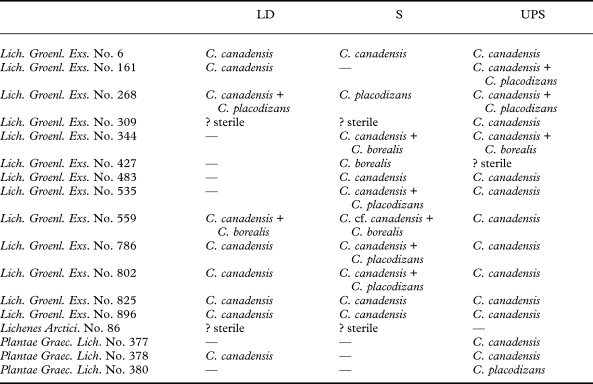
Remarks. Candelariella canadensis is rather easy to recognize through its prominent, often convex apothecia and the well-developed thallus (Fig. 1). The spores are also characteristic in having somewhat attenuate ends. Candelariella citrina has similar spores but has a different thallus and apothecium morphology and a different habitat (Westberg Reference Westberg2007b). The two accompanying species C. borealis and C. placodizans both have polyspored asci. When sterile it is more difficult to identify C. canadensis. It is very similar in colour and often also in surface texture to C. borealis, although the latter species often has a smoother thallus surface. The areoles/lobes usually grow adpressed to the substratum while they are mostly ascending in C. borealis. Candelariella placodizans, on the other hand, has a brighter coloured, greenish yellow thallus with a pruinose appearance and is relatively easy to identify. A key to understanding the morphological variation in these species is provided by the numerous exsiccatae of C. placodizans from Greenland; these mostly contain C. canadensis, often in a mixture with C. borealis or C. placodizans (Table 1).
Identification of some relevant exsiccata in different Swedish herbaria.

There is considerable variation in spore size in C. canadensis. The range of spore size found in arctic material was (9·0–)11·5–16·0(–17·0) × (5·0–)5·5–6·5(–7·0) μm (n = 80). The spore size in the type of C. nepalensis falls within this range, but towards the lower end, 9·0–12·5 × 4·5–6·0 μm (n = 10). The specimen is remarkably similar in morphology and I have found no other differences. Hence I consider C. nepalensis to be a synonym of C. canadensis. Hakulinen gives the range of spore size in C. hudsonica as 14–18 × 6–8 μm. In contrast, my own studies of the type found the spores to be 11–13 × 5·5–6·5 μm but only five spores were seen. The thallus has a rosette-like appearance which is unusual but sometimes seen in well-developed specimens of C. canadensis.
The discovery of the arctic species C. canadensis and C. placodizans (see below) in the Himalayas is another interesting example of the link between the lichen flora of the Himalayas and the Arctic (Jørgensen Reference Jørgensen2003; Poelt Reference Poelt1966).
Additional specimens examined (see also Table 1): Canada: Alberta: Banff National Park, summit of Mt Richardson, alt. 2865 m, Lamb 6341 (MSC). Labrador [Newfoundland and Labrador]: Hebron. 24 July 1937, Hustich (H). Northwest Territories [Nunavut]: Hood River, Gould 2082A (MIN, LD); Mackenzie District, Coppermine, Thomson & Larsen 12456, 12504 (H); Franklin, Danish Island S of Melville Peninsula, Østre fjeld [Eastern Mountain], Mathiassen 1421 (C—paralectotype); Østre fjeld [Eastern Mountain], 6 x 1921 Mathiassen (C); Georgina Island 13 vii 1922, Freucher 1481 (C—paralectotype).—Greenland: Upernivik,1886, Branth (LD); Disko, Blasedalen, 3 vii 1871, Fries (S).—Nepal: Himalaya, Mahalangur Himal, 1962, Poelt L443, L445B, L503 (M).— USA: Alaska: c. 230 km SSW Fairbanks, Thor 8842 (S).
Candelariella placodizans (Nyl.) H. Magn
In Lynge, Rep. Fifth Thule Exped. 1921–24, 2: 23 (1935).—Lecanora vitellina var. placodizans Nyl., Not. Sällsk. Fauna Fl. Fenn. Förh. 5 (new ser. 2): 290 (1861); type: Norway, Oppland, Dovre, Lilla Nystuhøe. 1858. J. E. Zetterstedt (H-NYL 29138—lectotype!, Hakulinen 1954, p. 78).
Syn. nov. Candelariella himalayana Poelt & Reddi, Khumbu Himal [Universitätsverlag Wagner, Innsbruck-München] 6: 8 (1969); type: Nepal, Himalaya, Khumbu: Felsige Hänge südlich Khumzung, 3900–4000 m. Über Gneiss. 9 October 1962, Poelt L428 (M—holotype).
The holotype and additional material of C. himalayana collected by Poelt is similar to C. placodizans in all characters. According to Poelt & Reddi (Reference Poelt and Reddi1969), C. himalayana differs from C. placodizans in spore size. I found the spores in the holotype to measure 8·5–11 × 4·5–5·5 μm, which fits very nicely in the range exhibited by C. placodizans (see Westberg Reference Westberg2007a).
Additional specimen examined. Nepal: Himalaya, Khumbu, Poelt L427 (M); Mahalangur Himal, Khumbu, Dingpoche, Poelt L438 (M).
Erratum
As I noted previously (Westberg Reference Westberg2007b), the type specimen of C. terrigena (a synonym of C. citrina) consists of four separate pieces. Unfortunately, however, the typification of C. terrigena made in that paper was erroneous due to a lapsus. The correct lectotype should be the second piece from the right, which contains only C. citrina, and not the far right piece within the same specimen, which in addition contains C. rosulans (Müll. Arg.) Zahlbr. Thus:
Candelariella terrigena Räsänen, Anales Soc. Ci. Argent. 128: 137 (1939); type: USA, Colorado, Gregory Canyon near Boulder. Ad terram argillaceam. 16 July 1931 [1921?]. C. C. Plitt (the second piece from the right) (H—lectotype! here designated).
This study was supported by The Swedish Taxonomy Initiative (Svenska Artprojektet), administered by the Swedish Species Information Centre (ArtDatabanken). Gratitude is expressed to the curators of the herbaria mentioned for loan of material and to Mats Wedin for comments on the manuscript. Thanks to Patrik Frödén for providing the photograph of the lectotype and to Stephen Clayden (NBM) and Ernie Brodo (CAN) for valuable comments that improved the manuscript.