Introduction
There is ample empirical evidence that women make a greater contribution to the care arrangements of frail older persons than men. Care provided to older relatives is a predominantly female activity (Kahn, McGill and Bianchi Reference Kahn, McGill and Bianchi2011). Women are more often the only care-giver, providing more hours of care and more intensive care (Navaie-Waliser, Spriggs and Feldman Reference Navaie-Waliser, Spriggs and Feldman2002). Men contribute to care-giving less intensively, as they put in fewer hours and less body care (Henz Reference Henz2009), while concentrating on specific ‘manly’ tasks such as home repairs or gardening (Kahn, McGill and Bianchi Reference Kahn, McGill and Bianchi2011). The gender gap is particularly strong among children providing care for older parents, while men's informal care predominantly involves care for older spouses, usually after leaving the labour market (Dahlberg, Demack and Bambra Reference Dahlberg, Demack and Bambra2007; Del Bono, Sala and Hancock Reference Del Bono, Sala and Hancock2009; Kahn, McGill and Bianchi Reference Kahn, McGill and Bianchi2011).
This article aims at contributing to the debate on gender differences in the care that adult children provide to frail older persons by looking at the nature of men's and women's contribution and at how this influences the dynamics of care arrangements. Based on a review of the recent sociological and gerontological literature, we argue for the need to recognise the multifaceted nature of care and to look at the care network beyond the ‘care receiver–primary care-giver’ dyad in order to understand the gender care gap. Compared to the available studies on care networks and on the gendered division of care, we include, next to the care provided by adult children to an older parent, other helpers, namely children-in-law. Moreover, we not only consider the care provided by the care-giver(s) to a care receiver, but also include the support that care-givers receive from other network members, i.e. ‘assistive help’ or indirect care (Sims-Gould and Martin-Matthews Reference Sims-Gould and Martin-Matthews2007). In addition, we contend that a dynamic perspective on the functioning of care networks is needed in order to grasp their gendered nature. We put forward the idea that the gendered configuration of care networks and the specific position and contribution of men and women are not only the result of negotiated social norms and structural constraints but are also crucial conditions for the perpetuation of the gendered nature of care.
By analysing the care networks of three large Dutch families with an older parent in need of considerable amounts of care, we show that men contribute in specific ways to the care arrangements. First they often provide indirect care – i.e. instead of directly helping the older person they often support the (mostly female) care-givers who are in turn intensively providing care to the older person. Second, they act as flexible elements of the care arrangement by filling gaps and taking up temporary care tasks. Men's contribution therefore provides elasticity – i.e. the care arrangement is able to change in response to transformations of needs or of available resources – and sustains the intensive care-giving performed by women. We suggest that this has important consequences for the functioning of the care arrangement and for the perpetuation of the gendered division of care.
Literature review
The recent European and North American sociological and gerontological literature suggests the usefulness of taking a broad definition of care and of considering ‘care networks’ beyond the ‘main’ care-giver in order to grasp the different contribution of men and women to care. To date, far less attention has been paid to the dynamics of care networks and their importance for the gendered nature of care.
Definition of care
Following Fisher and Tronto (Reference Fisher, Tronto, Abel and Nelson1990: 40), informal care not only includes performance of specific care tasks (‘care-giving’) but also recognition of others' needs (‘caring about’), management of care (‘taking care of’) and receipt of care (‘care receiving’).
Care-giving in a broad sense is generally operationalised as support for ‘activities of daily living’ (ADL) (Katz et al. Reference Katz, Ford, Moskowitz, Jackson and Jaffe1963), like washing oneself, getting dressed, getting into and out of bed; help with ‘instrumental activities of daily living’ (IADL) (Lawton and Brody Reference Lawton and Brody1969), like cooking, shopping, cleaning; and social and emotional assistance (SEA) provided through visits, chatting, etc. (Kahn, McGill and Bianchi Reference Kahn, McGill and Bianchi2011). Women, particularly daughters (in-law), are involved in activities ranging from ADL to IADL and SEA support (Brody and Schoonover, Reference Brody and Schoonover1986; Sherman, Ward and LaGory Reference Sherman, Ward and LaGory1988), are far more likely than men to be involved with ADL and to a lesser extent IADL support (Dwyer and Coward Reference Dwyer and Coward1991; Miller and Cafasso Reference Miller and Cafasso1992), and to give more intensive care (Henz Reference Henz2009; Navaie-Waliser, Spriggs and Feldman Reference Navaie-Waliser, Spriggs and Feldman2002). Men, particularly sons (in-law), tend to provide support with specific IADL tasks, such as administrative assistance and odd jobs (Kahn, McGill and Bianchi Reference Kahn, McGill and Bianchi2011; Knijn and Liefbroer Reference Knijn, Liefbroer, Dykstra, Kalmijn, Knijn, Komter, Liefbroer and Mulder2006).
Care management, which encompasses defining care needs, co-ordinating resources and efforts in a relationship with the person in need of care and other informal care-givers, health and care professional and privately hired care-givers, has only recently been recognised as an autonomous dimension of care provision (Rosenthal, Martin-Matthews and Keefe Reference Rosenthal, Martin-Matthews and Keefe2007; Da Roit and Le Bihan Reference Da Roit, Le Bihan, Pfau Effinger and Roostgaard2011). When using a broad definition of care management that includes, for instance, paperwork and administration, there seems to be hardly any difference in the contribution of men and women (Rosenthal, Martin-Matthews and Keefe Reference Rosenthal, Martin-Matthews and Keefe2007). However, qualitative evidence suggests that women tend to take up specific co-ordination tasks more than men (Hequembourg and Brallier Reference Hequembourg and Brallier2005).
Care networks
Early research consistently found that women are prevalent as ‘main’ care-givers and provide the most intensive care (Horowitz Reference Horowitz1985; Stone, Cafferata and Sangl Reference Stone, Cafferata and Sangl1987). It has, however, been claimed that moving beyond care dyads and considering care-giving as embedded in complex family relations would provide us with a better understanding of care arrangements (Keating et al. Reference Keating, Otfinowski, Wenger, Fast and Derksen2003; Matthews Reference Matthews1987; Matthews and Rosner Reference Matthews and Rosner1988). As demonstrated by Hansen's (Reference Hansen2005) work on child care, when looking beyond the nuclear family, if women remain central, the care contribution of, for instance, grandfathers and uncles is more important than expected.
Qualitative research looking at how care for an older parent is shared between siblings suggests that different family care-giving styles are influenced, among other factors, by the size and gender composition of the network. Matthews and Rosner (Reference Matthews and Rosner1988: 188–9) identified five styles of siblings' participation in care-giving: ‘routine’ (regular and extensive help), ‘back-up’ (support given when asked), ‘circumscribed’ (regular but limited help), ‘sporadic’ (irregular help); and ‘dissociation’ (no help). The authors found that networks made up of two sisters only were more likely to see both sisters involved in routine caring and back-up, while other styles (circumscribed) were more likely to appear in larger networks. According to Keith (Reference Keith1995), the size and gender composition of the family are crucial in determining the adoption of ‘primary’, ‘partnership’ or ‘team’ arrangements (where respectively one, two or more siblings take up most of the care).
The available quantitative evidence confirms the gender bias in care-giving. Soldo, Wolf and Agree (Reference Soldo, Wolf and Agree1990) show that daughters are more likely than sons to live with and care for their widowed mothers. Spitze and Logan (Reference Spitze and Logan1990: 427) found that older people with one or two sons received less support than those with one or more daughters. Coward and Dwyer (Reference Coward and Dwyer1990) compared the behaviour of sons and daughters in three sibling network types: only children, one gender-only siblings, and sibling groups made of both brothers and sisters. While the intensity of care-giving was similar between caring men and women among only children and in single-gender networks, daughters in mixed-gender networks were more likely to care more intensively. Wolf, Freedman and Soldo (Reference Wolf, Freedman and Soldo1997) investigated how the contribution of each child is influenced by the care contribution of other children, and found that daughters bear most of the care burden, but that the effort of both daughters and sons is reduced when other siblings' care is available.
Explaining gender differences
What explains the observed gender differences in care provision? The ‘socialisation theory’ contends that men and women internalise personality differences learned during primary socialisation (Coltrane Reference Coltrane1988; Finley Reference Finley1989). The fact that women are taught to take up more care responsibilities and to expect little involvement in care tasks from men would guide their care-related attitudes and behaviour in ways consistent with gendered social norms. This approach, however, fails to explain why some women care less than others and why some men care more than others even in presence of similar socialisation patterns. Alternatively, the ‘structural theory’ explains gender differences through the different position occupied by men and women in society, especially in the labour market (Marks Reference Marks1996; Moore Reference Moore1990). However, it only partly explains the gender gap (Gerstel Reference Gerstel2000; Sarkisian and Gerstel Reference Sarkisian and Gerstel2004; Stoller Reference Stoller1983).
According to Gerstel (Reference Gerstel2000), the division of care work reflects the distribution of power in society. The ability to exercise individual agency in the negotiations of care arrangements is shaped by social inequalities along gender, class and ethnicity lines, and influences how general social norms are translated into practice (Connidis and Kemp Reference Connidis and Kemp2008; Finch Reference Finch1989; Finch and Mason Reference Finch and Mason1993). Following this line of argument, we can argue that the positioning of women and men in care arrangements derives from the interplay of social norms acquired during socialisation, of structural constraints and of individual agency. However, individual agency in the context of a particular adult child's care for an older parent does not occur in an empty space, but is embedded in a family network. Network analysis is a useful instrument in studying care arrangements as it can help bridging between the micro-level of individuals and the macro-level of norms and social structures by valuing social relationships (Wellman Reference Wellman, Wellman and Berkowitz1988). Care networks and their characteristics are a result of interactions and negotiations between individual actors, which in turn are influenced by norms and social structures (Finch Reference Finch1989). However, care networks are also themselves a structure that influences agency. As a consequence, in order to understand the gendered division of care work one should consider how social norms and the way they are transferred from generation to generation and structural constraints (e.g. labour market participation, household situation, family network composition) influence the construction of care networks and their gendered nature. In addition, one should investigate how specific care network characteristics themselves have an influence on the gendered nature of care and its perpetuation, which means, however, taking a dynamic perspective on networks.
Care networks: dynamics and elasticity
The negotiations of relevant actors within the framework of given social norms and structures – key to understanding the gendered nature of care – do not happen once and for all. Zelizer's concept of ‘circuits’ implies networks – ‘bounded sets of relations among social sites’ – but at the same time it includes a dynamic perspective: circuits ‘consist of dynamic, meaningful, incessantly negotiated interactions between the sites’ (Zelizer Reference Zelizer, Nee and Swedberg2005: 292) in the framework of given social norms and structures. The social network literature itself has recently shown increasing interest in the dynamics of social networks (Snijders 2010). To date, however, few studies provide a dynamic view on care arrangements. Those focusing on the care-giving ‘career’ tend to concentrate on individual care-givers and fail to grasp the crises and the transformation of the care arrangement as a whole (Betts Adams Reference Betts Adams2006; Mailick and Wailing Li Reference Mailick and Wailing Li2000; Usita, Hall and Davis Reference Usita, Hall and Davis2004).
The available longitudinal analyses of care networks show considerable change over time of siblings' contribution (Dwyer et al. Reference Dwyer, Henretta, Coward and Barton1992). According to Szinovacz and Davey (Reference Szinovacz and Davey2007), female primary care-givers and female-dominated networks are relatively more stable. Moreover, Ingersoll-Dayton et al. (Reference Ingersoll-Dayton, Neal, Ha and Hammer2003) found that siblings may purposefully vary their care-giving responsibilities and, building on Keith's (Reference Keith1995) idea that care-giving may have a protective function between siblings, they suggest that changes in the care arrangement may play a role in preventing the overburdening of a specific care-giver.
If we take on this suggestion we may hypothesise that networks' elasticity has important consequences for the functioning of the care arrangement. Networks' elasticity has been seen as the change in boundaries through the exclusion of some members and the inclusion of others (Colleen Reference Colleen1992). By extension, care networks' elasticity can be defined as a change – in terms of what and how much is being done, by whom and for whom – in response to a transformation of needs or of available resources.
The elasticity of care networks, however, is not independent from the characteristics of the network's members, as networks and their members co-evolve (Steglich, Snijders and Pearson Reference Steglich, Snijders and Pearson2010). It is linked to the different forms and degrees of its members' flexibility. Atkinson (Reference Atkinson1984) distinguishes between ‘numerical’ and ‘functional’ flexibility within organisations. Numerical flexibility refers to the variable number of hours the personnel is employed, depending on the amount of work at hand at a specific time. Functional flexibility pertains to the employment of personnel to perform different tasks, depending on the type of work at hand at a specific time. In the context of care arrangements, individual members of a care network may be more or less flexible in functional and numerical terms, i.e. they may be available for increasing or reducing their involvement in care and able or willing to take up different tasks. If men and women display specific forms and degrees of flexibility, these differences may have consequences for the functioning of the care arrangements and for its gendered nature.
Based on this literature review, it can be argued that in order to grasp the gendered nature of adult children's care-giving it is necessary to assume a broad definition of care, which not only encompasses different care tasks but also care management and care provided to care-givers (indirect care). Moreover, it is crucial to assume a dynamic network perspective for three reasons: to shed light on care given and received that would otherwise be overshadowed; to analyse how social norms, structural constraints and individual agency interact in negotiating and enacting gendered care arrangements; and to assess the potential role played by care networks themselves and their features as structures that influence the perpetuation of gender. Consistently, the study addresses two questions. (a) How are (changing) configurations of and positioning in care networks of men and women negotiated, justified and experienced by network members? Specific attention is paid to the role played by gender norms and structural constraints, especially labour market participation. (b) How do given gendered network configurations contribute to the perpetuation of gender? We focus especially on whether men's and women's numerical and functional flexibility within care networks has consequences on the functioning of the network itself, its elasticity and on the gendered nature of care arrangements.
Methodology
We chose an explorative research design that is qualitative and limited in scale based on the collection and analysis of in-depth retrospective data on full care networks. This is consistent with the aim of understanding the processes underlying the formation and transformation of gendered care networks over time.
Context of the research
The research was conducted in the Netherlands in 2010. Since the late 1960s, the Dutch welfare state has developed a universal and generous system of social care for people in need of support. Good-quality home and residential care, predominantly provided by female workers, is largely available at relatively low costs for the users, while non-cohabiting family members are generally not expected to provide monetary or in-kind support (Da Roit Reference Da Roit2010, Reference Da Roit2012). Despite increasing pressure on relatives due to financial cutbacks in the past few years, care-giving in the Netherlands, similar to Nordic countries, is more voluntary, less oriented toward intensive personal care, and spread across a higher number of care-givers than in continental and southern Europe (Albertini, Kohli and Vogel Reference Albertini, Kohli and Vogel2007). Women should therefore be less pressured to care, and find themselves in a more ‘equal’ position to men than elsewhere. However, despite the steady growth of the traditionally low female employment, most women work part-time and are still economically dependent on men (Portegijs et al. Reference Portegijs, Cloïn, Keuzenkamp, Merens and Steenvoorden2008).
Research design and selection of respondents
We aimed to select and analyse three mixed-gender large families with an older parent in need of substantial help. Large families are of particular interest as they present more variations in the extent to which network members engage in caring: in larger families we are more likely to find siblings that provide no care or that adopt different caring styles, as well as more exchanges and more changes in primary care-givers (Matthews Reference Matthews1987; Szinovacz and Davey Reference Szinovacz and Davey2007). In the current generation of Dutch older people large families are not unusual. In 1965 (all siblings in our study were born before 1968), almost 20 per cent of all Dutch nuclear families had four or more children (CBS/SISWO 1979: 32). In order to limit the effect of other factors on the definition of the care arrangement, we aimed at including only older people in need of substantial help with ADL and IADL, aged at least 75, living independently and alone (since spouses and co-resident children tend to take up most of the informal care). The families should include both daughters and sons, not belong to an ethnic minority (since expectations about informal care, notably by daughters, tend to be stronger among migrants; De Valk and Schans Reference De Valk and Schans2008), and belong to the middle classes to Dutch standards (De Beer Reference De Beer2008).
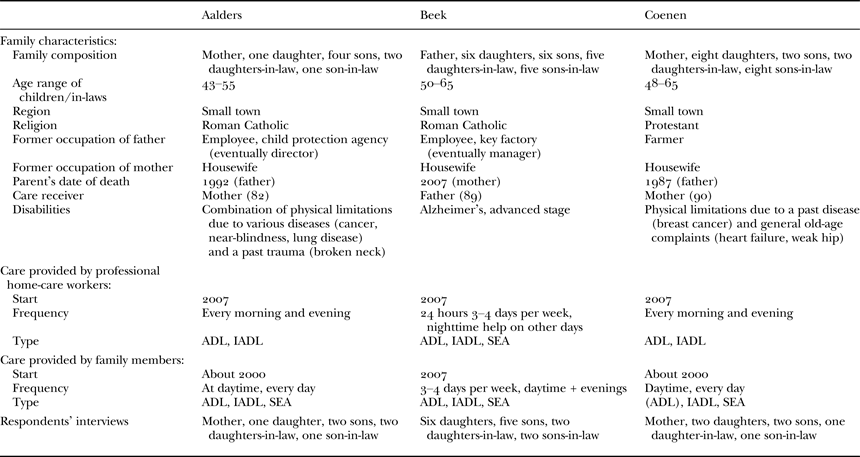
MOVISIE – a Dutch research centre for social development – introduced us to semi-public support centres for informal care-giving (Steunpunten Mantelzorg). We asked these centres to search for informal care-givers belonging to large families in their databases. Out of an anonymised list we selected three cases that met our criteria. The support centres sought permission of one ‘contact person’ per family to be approached by us. All three accepted. After presenting the purposes and methods of our research and having guaranteed full confidentiality, we asked the contact persons to consult with their family members, explore their willingness to participate in the research and to be contacted by us. Having received positive feedback from the contact persons, we approached the parents and their sons (in-law) and daughters (in-law), of whom most agreed to be interviewed (see below). At the beginning of every interview we explained to the interviewee(s) the purposes and methods of our research, we guaranteed full confidentiality and asked permission to tape record the interview. In all cases the permission was granted. The interviewees are listed in Table 1. For the sake of confidentiality, they are renamed. The data collected are exclusively available to the research team and have not been disclosed to MOVISIE or to the support centres.
Overview of the three families, the care provided by professional home-care workers and family members (at the time of the interviews), and the interviewees

Notes: ADL: activities of daily living. IADL: instrumental activities of daily living. SEA: socio-emotional activities.
Data collection and analysis
Few family members refused to participate for practical reasons (work, vacation, etc.) and one due to a family conflict (see below). The Aalders and Coenen parents were also interviewed; in the case of the Beeks this was not possible due to the father's cognitive condition. In each family at least seven persons were interviewed, totalling 27 interviews (one and a half to two hours long) with 29 individuals (two married couples were interviewed jointly). All interviews were conducted at the respondents' homes based on a topics list containing the following items:
1 Background information of the interviewee (gender, age, education, job, residence, family composition).
2 Genesis and description of informal care situation (care needs of parent, organisation of care, contribution of each family member and of professional home-care workers, reason(s) for (non-)care-giving of interviewee and changes in time).
3 Division of labour (types of task performed by family members, hours spent on care-giving, reason(s) for the division of labour, degree of genderedness of division of labour and changes in time).
4 Differences between male and female family members (opinions and expectations concerning care tasks and care styles of parent, interviewee and other family members, fit/misfit between expectations and opinions of the family members, and the consequences of fit/misfit).
To enhance reliability, all interviews were conducted by one of the authors, who also tape-recorded and transcribed them. Member checking was limited to verifying factual information during the interviews and was limited to each participant's material. The interviewees were not asked to comment on others' interviews.
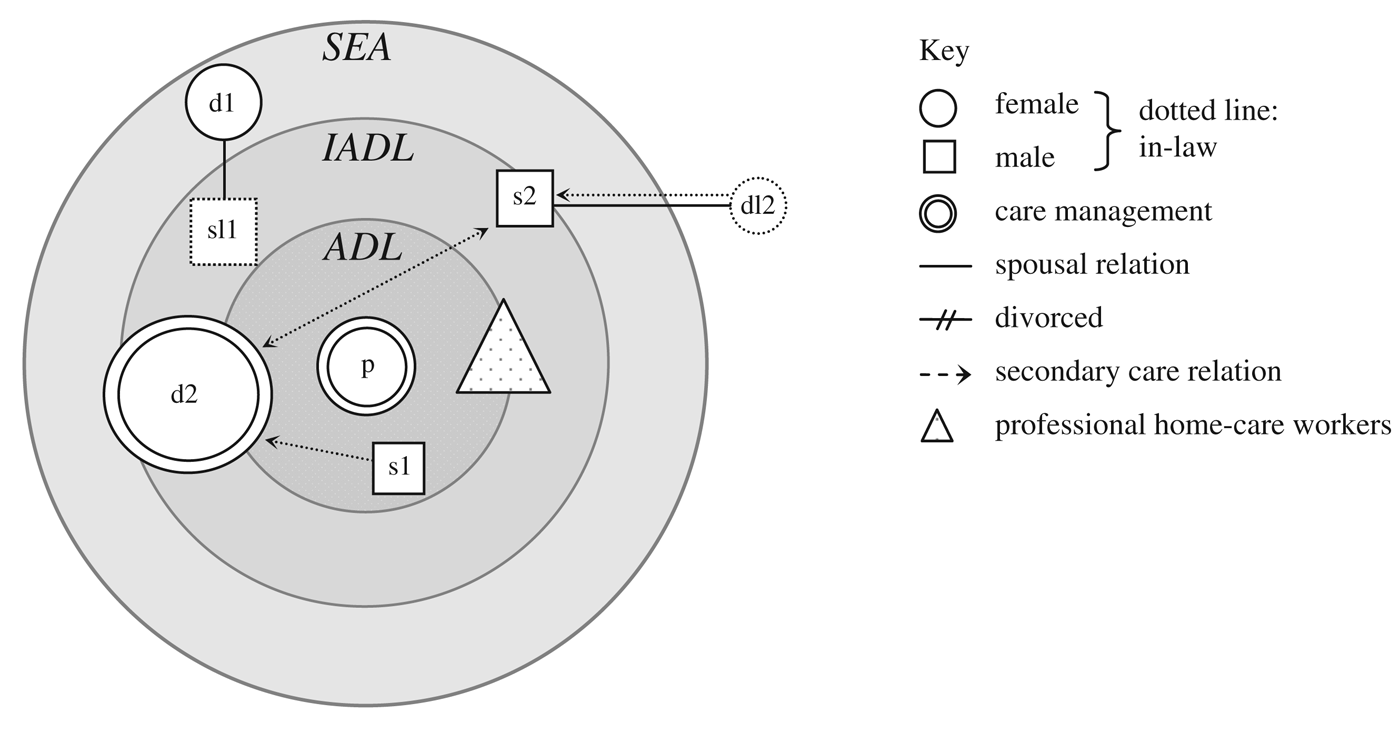
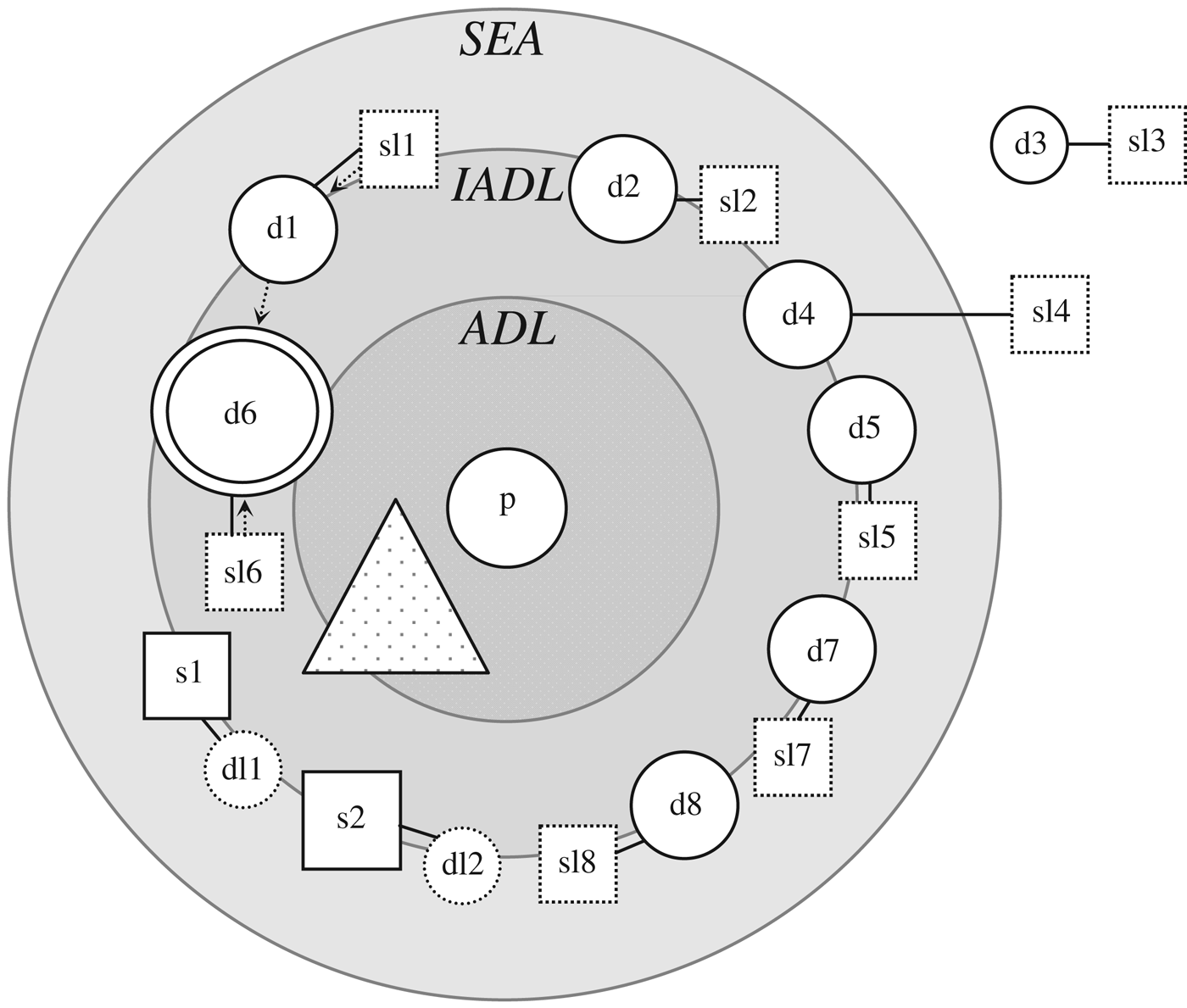
In order to map out and analyse the care networks, we purposely developed a new graphic tool, the ‘informal care map’, since existing tools proved inadequate to demonstrate the various dimensions of the informal care networks we analysed. Our informal care map combines elements of the ‘genogram’, used to map family structures (Watts and Shrader Reference Watts and Shrader1998), and the ‘ecomap’, employed to analyse complex social networks (Rempel, Neufeld and Kushner Reference Rempel, Neufeld and Kushner2007). Our map includes further graphic components. Concentric circles indicate types of informal care provided (ADL, IADL and SEA) to the care receiver. Different sizes of circles and squares (for women and men, respectively) indicate the amount of care given by different network members. A double-lined circle or square designates care management (Figure 1).
An example of an informal care map.
The informal care maps presented illustrate the care network at the time of the interviews. Additional information on its genesis and the changes over time is provided in the text. In order to draw one informal care map per family we compared the accounts of all the interviewees, which were largely similar. In fact, there is evidence that while the reports of the older parents and their children tend to differ (Matthews, Adamek and Dunkle Reference Matthews, Adamek and Dunkle1993; Lin Reference Lin2008; Mandemakers and Dykstra Reference Mandemakers and Dykstra2008), siblings report similarly on the division of care work even if they might disagree on the importance of their contribution (Matthews and Rosner Reference Matthews and Rosner1988). In our research the interviewees were asked to describe their contribution and that of the other family members. They were also aware that the same questions would be asked to every participating family member. This strategy might have further reduced individual biases. The only disagreement of accounts we encountered during the interviews did not concern the division of care work, but the quality of the care provided (the Beek family, see next section).
The interviews were analysed by means of MaxQDA, software for analysis of qualitative data. All the authors read the interviews several times and agreed on the coding system and the interpretative process in the course of several discussion meetings.
In the remainder of this article we first introduce the three families and the (changing) division of labour within each network, and discuss the gendered division of informal care by looking at the genesis of the networks and at the perspective of the actors. Then, we discuss three themes. We focus on how men and women share, refer to and mobilise (a) gender norms and (b) considerations about the employment position of family members in the construction and transformation of care arrangements. Finally, we explore (c) the ‘elasticity’ of the care networks in relation to the gendered division of informal care labour.
Description: the three families and the gendered nature of the care networks
The three families
The Aalders family
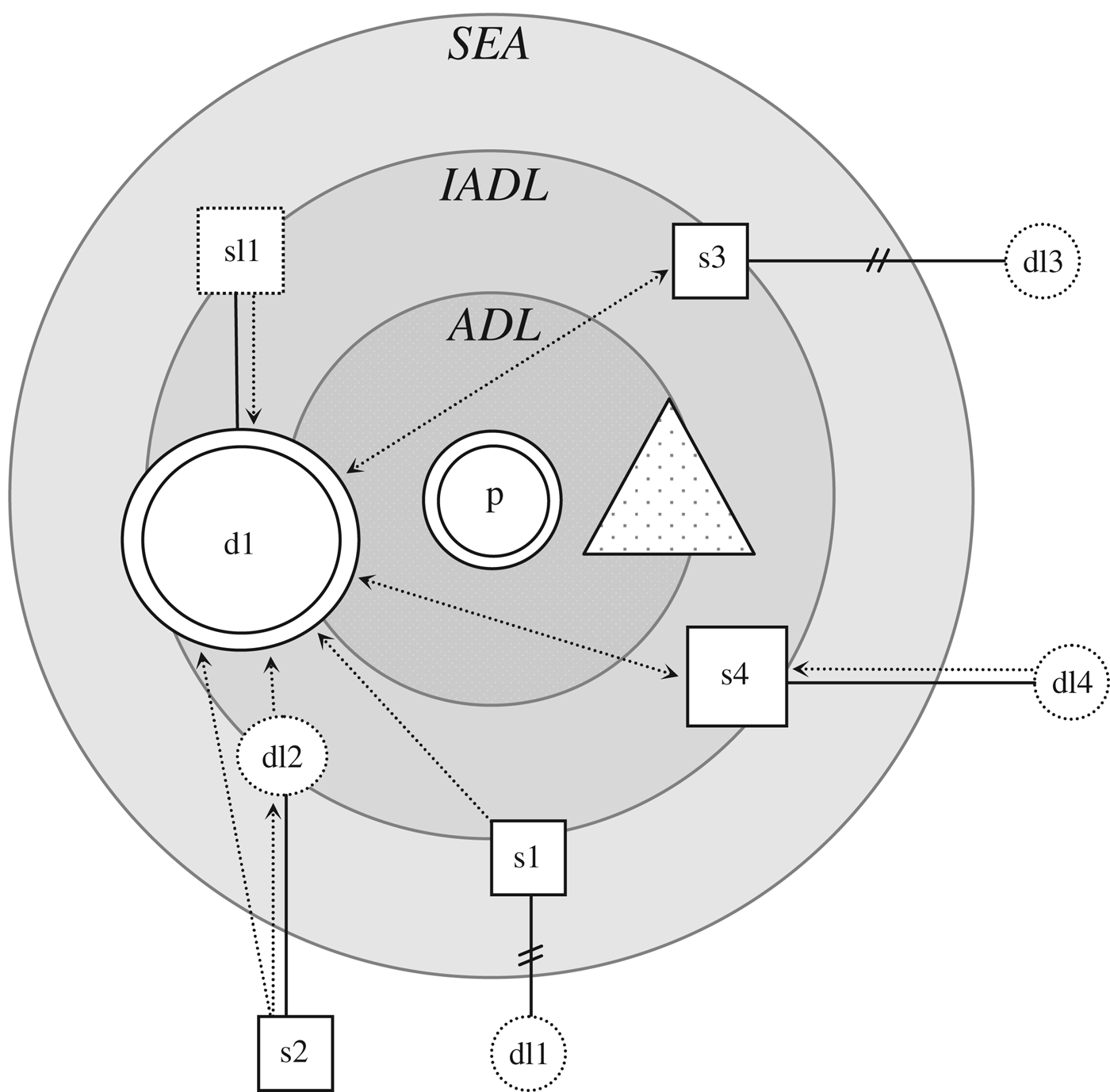
The Aalders family is composed of four sons, two married and two divorced, and one married daughter. At the time of the interviews they had been caring for three years for their 82-year-old mother. Soon after breaking her neck three years ago, the mother got cancer, which necessitated removal of her bladder. She also suffers from near-blindness, transient ischaemic attacks and arterial hardening. In the last half-year her condition has worsened, she has to stay in bed most of the day and needs assistance with virtually all activities. Yet at the start of care-giving three years ago, all family members, including the mother, agreed that she should enjoy her last years in her own house. This consensus has remained, despite the mother's deteriorating health condition, which requires increasing care efforts. Hence most family members have always been involved in caring alongside professionals (Figure 2).
Informal care map of the Aalders family.
Since the beginning of the care-giving, in the Aalders family the only daughter (d1, Figure 2), in close co-operation with the mother, ‘manages’ the care activities by taking vital decisions, co-ordinating tasks and supervising the activities of the other caring relatives. For the last three years, Daughter-1 has also provided the bulk of the care in all three domains. Together with a professional home-care worker she makes her mother ready for the day and for night time, while during the day she alone provides ADL and IADL support and keeps her mother company. Three of the four sons (Son-1, -3 and -4) provide mainly instrumental support (cooking, gardening, etc.) and company for considerably fewer hours than Daughter-1. Their contribution also consists in supporting Daughter-1's activities, like occasionally driving her to her mother's, since she has no driving licence. The same goes for Daughter-1's husband. Son-2 has never been involved in care-giving, but his wife is: she performs various practical tasks and keeps her mother-in-law company occasionally. Since the beginning of care-giving, the mother's increasing care needs were faced by a growing involvement of the main care-giver, Daughter-1, and a growing recourse to formal care. Since care obligations have intensified, the sons sometimes replace Daughter-1 to give her some relief.
In the Aalders family we found the only example of grandchildren contributing to the care arrangement: the two daughters of Daughter-1 and her husband now and then assist their mother in grandmother's care. Given their modest contribution, we have not included them in the care map.
The Beek family
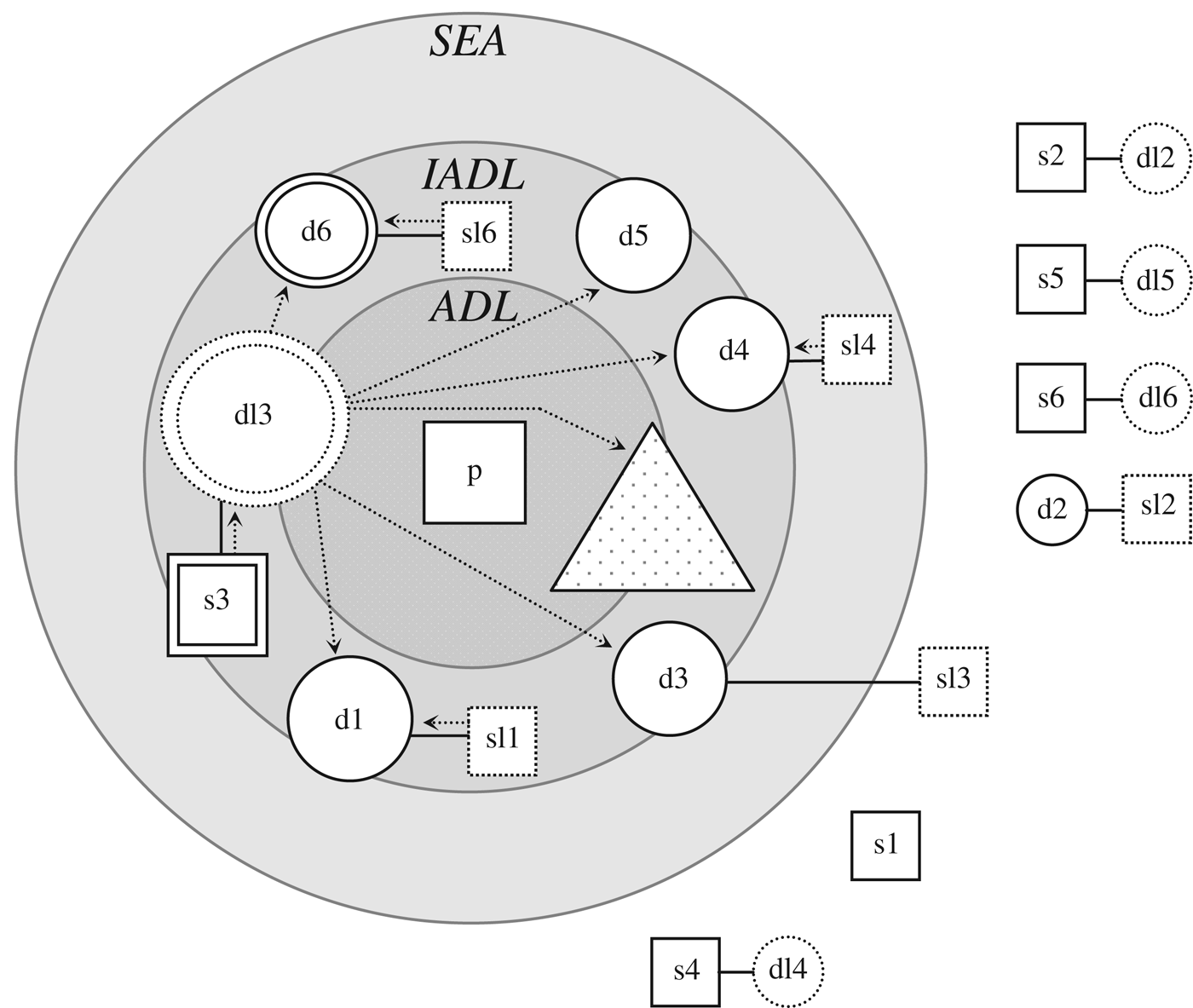
The Beek family is composed of six daughters, six sons and their ten spouses (Figure 3). After the mother passed away in 2007, almost all siblings and their spouses got involved in care of the father, who was already suffering from Alzheimer's disease. Yet as the father's cognitive condition worsened several children stopped caring one after the other, until only six siblings and their spouses remained. Though the father needs round-the-clock care and professional care does not cover all needs, those relatives who are still providing care agree that he should continue living at home with their support.
Informal care map of the Beek family.
The Beek father's mental condition requires a higher care intensity. He receives help from professional home-care workers three to four days a week and for the nights, financed from a state-funded cash-for-care programme and a supplementary mortgage on his house. Days not covered by professionals need to be covered by the relatives who then perform all ADL and IADL support, while on days when professional workers take care of the father, IADL help is the family's responsibility too.
In the course of time a ‘core care team’ has emerged around the pivotal role of Daughter-6 who has increasingly concentrated on tasks needed to keep the care arrangement running, like household management and planning of care schedules (Figure 3). Son-3's wife, who is a professional nurse, apart from her own care efforts also advises the other caring relatives on how to best perform their tasks, and instructs new professional care workers. The only man involved in care management, Son-3, assists his wife and Daughter-6 by organising the regular core care team meetings and keeping notes of all activities.
Even if the core care team provides the bulk of care, Son-3's wife is giving most of the care and directs the professional home-care workers, while Daughter-6 concentrates on care management. Son-3 assists his wife and his sister in these tasks. Four other daughters also provide instrumental help, two of them sometimes assisted by their spouses. While at the moment half of the Beek family is involved in the care, the other half (five sons and Daughter-2) is not. This is the result of a transformation that occurred over time. When the mother – the main care-giver for the father – passed away the children took over. At the beginning, when care needs were limited, all family members were providing instrumental and occasional support, even if Son-3's wife and Daughter-1 were the main care-givers. When the father's mental condition worsened, at first Daughter-6 and Son-3's wife intensified their care involvement, but when the burden became too heavy professional home-care workers were hired for an increasing number of hours. This allowed Daughter-6 to gradually terminate her involvement in personal care and concentrate on the co-ordination of the care network, while Son-3's wife diminished her involvement in personal care and took on the responsibility of directing the professionals. Disagreement about ‘what's best’ for their father has split the family into three camps. The core care team and Daughters-1, -3, -4 and -5 strongly hold on to the ideal of family care while performing all the tasks not done by the professional home-care workers. Non-caring Sons-1 and -4 say they admire the efforts of their caring sisters and brother but are unable to participate in this care, especially because of the intimacy inherent to caring. Son-4 said:
When my mother died I played my part, but I stopped when I felt that father wasn't feeling comfortable with me.
Sons-2, -5 and -6 and Daughter-2 now oppose the informal-care option, believing that their father would be better off in a nursing home, and refuse to perform care tasks. Once every three months the family meets to discuss the situation, but agreement is far from being reached (for Son-2 the disagreements were the reason to refuse the interview).
The Coenen family
The Coenen family, composed of eight daughters and two sons, is taking care of their 90-year-old mother. For the last ten years the mother has needed increasingly intensive care due to physical limitations caused by recurring breast cancer, a weak hip and the consequences of a heart attack. In the last two years she has been confined to her chair, unable to wash and dress and undress herself, and no longer capable of cooking, shopping, etc. All family members have always been involved in caring alongside professional care-givers, with the exception of Daughter-3, who is unable to provide care due to a handicap.
Due to relatively low care needs, professionals perform most of the intensive, personal care, while the informal care-givers concentrate on IADL and SEA. For the last three years, Mrs Coenen has been visited every morning and evening by professionals who wash her, get her dressed, help her into and out of bed, and occasionally perform IADL tasks. Daytime care performed by the children consists mainly of keeping their mother company and helping out with household chores. Mrs Coenen herself, mainly supported by Daughter-6, is in charge of managing the network (Figure 4). Since Mrs Coenen's old age has not affected her mental condition, she has succeeded in maintaining ‘management’ of her daily life. As Daughter-8 puts it:
She sits in her chair and she ‘directs’, I would almost say in the positive sense of the word. She has control, and knows very well what has to be done and what she wants.
Currently, all siblings (with the exception of Daughter-3) are participating in the care arrangement – even though since professional home-care workers took up most of the ADL tasks three years ago they now chiefly give instrumental and emotional support. Apart from Daughter-6, all family members report an equal division of tasks over the years. All children currently have a fixed care day every week or two, during which they prepare warm meals, help with household tasks and keep their mother company. In the course of time several family members have also specialised in certain tasks, like Son-1 who takes care of his mother's taxes and Son-2 who applies his professional gardener skills. Finally, from the start of care-giving the children's spouses have also performed certain tasks, often in collaboration with their partners.
Informal care map of the Coenen family.
The gendered nature of the care networks
In the three care networks the division of work is clearly structured by gender. It is always a daughter who is responsible for managing the care and who takes up the most intensive care tasks. In all three networks the gendered structure of care-giving seems to have a similar starting point: one daughter who had a ‘special relationship’ with the parent took up the care. In the Aalders family it is the only daughter (Daughter-1) who did so. According to several family members, her central position in the care network was stimulated by their mother. As Daughter-1's partner puts it:
My mother-in-law is a traditional woman. She feels that it is specifically her daughter's task to take care of her. She is more open-hearted with her daughter than with her sons … a relationship between mother and daughter is different from a relationship between mother and son.
While in the Aalders case the special relationship conceals the gender bias, due to the absence of alternative daughters, in the other two networks there was a choice between more daughters. As shown in the literature, the designation of the main care-giving daughter can be sustained and justified in several different ways, ranging from practical circumstances to family history (Brody Reference Brody2004). In the Beek family, before her mother's death, Daughter-6 was the only child allowed by her mother to contribute to her father's care. While Mrs Beek kept her husband's growing mental problems hidden from her children, she gradually handed over tasks to her youngest daughter, who, when her mother died, ‘as a matter of course’ (Daughter-6) became the central figure in the care network.
In the Coenen family, before the mother needed care, Daughter-6 used to take her to the market on Fridays. As her mother's health deteriorated, Daughter-6 gradually began to take on care tasks. At first these were limited in scope, but as her mother's health weakened and more help was needed, Daughter-6 started making care schedules that involved the siblings (and for the last three years professionals) and taking care of her mother's administration.
The ‘chosen’ daughter in all three networks takes up the co-ordination and does most of the care. In the Aalders and Coenen families, respectively, Daughter-1 and Daughter-6 play this role alone; in the Beek family, Daughter-6 handed over part of the direct care to Son-3's wife, whose profession – home-care nurse – seems to have made the perfect candidate.
Even if one of the women plays a key role in care management and provision, when other able sisters are available they all contribute to the care (with the sole exception of Beek Daughter-2, see below). With the exception of the ‘central women’ in the network, in our three families all daughters are involved in caring to a similar extent, while sons display more variation in their involvement: similar to that of the ‘helping’ women in the Coenen family; more limited in the Aalders family; none at all in the Beek family, where the sons were initially providing some support and then quit (with the exception of Son-3). The contributions of the caring daughters and sons – and more in general of the caring women and men – differ as well with respect to the types of tasks performed. While the caring women generally concentrate on ADL and IADL on a regular basis over time, the caring men mainly take up SEA and IADL support and indirect care, with greater discontinuity over time.
Thus, the care contributions of the men and women in our three networks are clearly different – and clearly gendered – with respect to the intensity and nature of the support provided. In general, the women are the stable providers of ‘intimate’ support, while the men generally concentrate on the less intimate support tasks and frequently but temporarily function as ‘assistants’ to or ‘stand-ins’ for the caring women. However, the degree to which caring is gendered displays some variability across networks.
Analysis: understanding the gendered nature of the care networks
When explaining the gendered division of informal care labour, the members of the three networks overtly refer to gender norms and socialisation and to the different position of men and women in the labour market. ‘Traditional’ ideas on the role of men and women in caring are said to define their role in the care network. Moreover, one's position in the labour market – which is in turn influenced by gender – influences the ‘objective’ availability for care responsibilities. From the analysis it emerges that these two factors provide men and women with different manoeuvring room in defining their caring role. Men are more able than women to set a limit to their contribution and to back it up with justifications that are also shared by women.
Gender norms and socialisation
Gender is overtly used as a justification of the care gap, coherent with socialisation theory (Coltrane Reference Coltrane1988; Finley Reference Finley1989). First, physical intimacy is seen as problematic for men. Even though the Aalders men see the specific division of labour in their family as an outcome of the mother's and Daughter-1's explicit will, they claim they would have no objections to performing intimate personal caring tasks, up to a point. Son-3, who occasionally takes over Daughter-1's morning and night tasks, says:
I do everything, apart from washing my mother's intimate parts … It is still my mother. I feel a sense of shame on her side and that in turn evokes a sense of shame from my side too.
While the withdrawal of the sons in the Beek family is often justified by disagreement about ‘what's best’, most of the non-caring sons say they feel unfit for personal caring because of unwanted intimacy, even though in this family the care receiver is male. As Son-3 says:
When I feel uncomfortable, he feels uncomfortable too.
On their side, the women in the Beek family agree that the specific distribution of tasks in the care network reflects a ‘natural’ division of labour between the genders, even if it is difficult to clearly distinguish between what is considered to be ‘natural’ and ‘learned’ (Gerstel Reference Gerstel2000). Son-3's wife says:
I think women's inclination to care stems from pregnancy and their caring for children.
This attitude sometimes turns into a claim of superiority of women in caring. Daughter-6 declares:
We girls think that we do a great job and that we don't need the boys to care.
Consistent with Gerstel (Reference Gerstel2000), sons tend not to attribute their limited contribution so much to a ‘natural’ division of labour between the genders, but more explicitly to their ‘traditional upbringing’ and to influences from the social environment, as in the Beek case:
It's what society expects from us. Of course I don't buy that, but what can you do? In the Netherlands it is still common sense that boys work and girls cook. (Son-4)
Also in this ‘emancipated’ Coenen family most men partially attribute the predominant role played by their one sister to their traditional upbringing – or as Son-1 puts it:
Look, we are just a farmer's family that clings to certain traditions.
Thus in all three care networks the gendered division of labour is justified on the basis of norms concerning the expected position and contribution of men and women. However, in the three networks norms are compelling to a different extent. The Aalders do not only embrace gender norms but also underline that challenging them would give rise to conflict. The only daughter, who by far performs the most and most intensive tasks, openly embraces an accommodating attitude. Although she remembers that when they were kids ‘the boys hardly did anything’, which back then annoyed her, she now feels that she ‘should leave [her] brothers free’ to decide what and how much they do for their mother. Her brother, Son-3, confirms that the adherence to the gender norms in managing the mother's care ensures conflict avoidance:
[My sister] says ‘do what you can do and want to do, and if you can't do it or don't want to do it that's fine too, then I will do it’. So, we respect each other's feelings. And I think one should do it this way, or soon you will have conflicts.
Also in the Beek family, norms about who should care seem to be shared by the women of the family. However, in the Beek family the gender gap is not simply accompanied by an uneven distribution of tasks between genders and latent conflict. Here the sons withdrew from caring (with the exception of Son-3) and the positions on ‘what's best’ for their father – living at home or moving to a nursing home – hardened along gender lines. The only daughter (Daughter-2) to withdraw from caring also disagrees on the care arrangement, but claims she would have continued caring had her husband not unexpectedly needed help after a surgery; in other words, she underlines that while disagreement on the care arrangement is a legitimate excuse for men to withdraw from care, women need a further one.
In spite of shared gender norms, the Beek sisters blame their brothers for ‘doing nothing’ and suspect a ‘hidden agenda’ – they feel their brothers’ resistance to informal care results from their fear of the inheritance being wasted on intensive home care. The brothers in turn blame their sisters for taking too many risks with their father's health – they feel their father would be much safer in an institution. At the same time, some of the brothers feel guilty about the situation. Son-5 says:
In fact I feel guilty about all of it. When my colleagues and I talk about our parents at work, I don't dare tell them how we do it. I find that too embarrassing.
By contrast, in the Coenen family gender norms have a more limited impact on the actual configuration of the care arrangement. For instance, while Son-1 stresses the importance of traditional family norms (see above), he also argues that in practice these norms have hardly affected the distribution of tasks between brothers and sisters. Instead, he says the specific distribution is rather coincidental, while his mother ‘doesn't think in terms of men's or women's work’. However, it should be noted that in the Coenen family the informal care-givers provide less personal care than in the other two families, due to relatively more limited care needs of the older parent. This suggests that increasing care needs (which are not covered by professional care) tend to exacerbate the gender gap in caring.
The role of paid employment
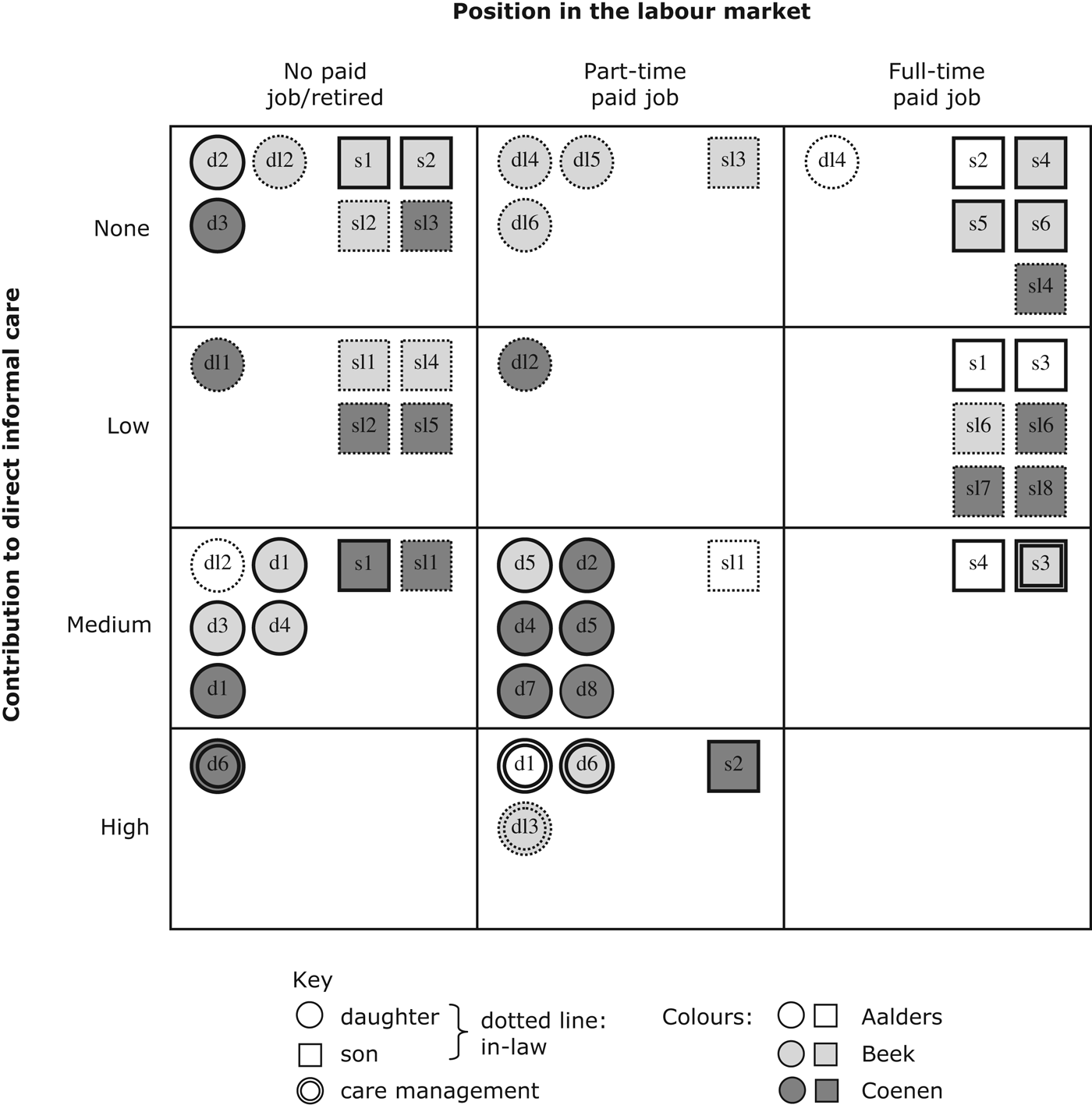
Also one's position in the labour market is overtly used by both men and women in our family networks as a justification for one's contribution to care, coherent with the structural theory (Marks Reference Marks1996; Moore Reference Moore1990). In the Aalders family the sons claim that they do not have time to care (more) due to their jobs. While Daughter-1 is employed part-time, all four sons have full-time jobs (see Figure 5), which according to them makes them less able to care on a regular basis or spend (much) time on caring. Son-4, a full-time teacher, says he cannot do more than he is now doing for his mother.
The Aalders, Beek and Coenen children and children-in-law: position on the labour market and contribution to direct informal care.
My job is too busy and I have my own life.
In the Beek family, three of the four full-time working brothers justify their non-involvement in caring on the grounds of their busy jobs; the fourth (Son-3), however, is involved in care-giving despite his job. Moreover, the two remaining non-caring brothers are not active in the labour market, as they are retired (Figure 5). If we also take the in-laws into consideration, largely the same is true for the Coenen family: four out of five non-retired men work full-time and spend none or relatively little time caring for their mother (Figure 5).
Conversely, only one of the women (Aalders Son-4's wife) in the three families works full-time. All other non-retired women work part-time (13 out of 19) or have no job (the rest). For them, as for most men, the different position of men and women in the labour market is deemed a ‘logical’ explanation for why some care (when working part-time) or care less or not at all (when working full-time). Coenen Daughter-8 argues:
OK, some men have retired, but most of the other men work full-time, while the women work part-time. So it is purely practical.
Also her sister, Daughter-6, the pivot of the Coenen care network, says she fully understands the low contribution of her husband (‘He just has a busy job’), of Daughter-4's partner (‘Yes, but he works full-time’) and of Daughter-7's husband (‘Don't forget he has got a full-time position!’).
Yet for some interviewees the position in the labour market is not just an independent variable. Two women in the Aalders family (Daughter-1 and Son-2's wife) and one in the Beek family (Daughter-5) say that their care obligations and a full-time job were incompatible and decided to work fewer hours; Aalders Son-2's wife even decided to give up her job altogether. Working fewer hours in order to spend more time caring is not seen as a viable option by the men. Two of the 13 men interviewed say they considered special care leave in order to fill ‘gaps’ in the care schedule but abandoned the idea when another – female – family member decided to care more (Aalders Son-2) or when the plan got a cold reception at work (Beek family, Son-4):
When I asked for two months of care leave my colleagues were amazed: ‘You, a man?!’ Those ideas concerning boys and girls – that's not the way I look at it. But in the end it didn't work out: my job, distances – and I'm just not fit for it.
The structural theory (Marks Reference Marks1996; Moore Reference Moore1990) is partly corroborated by our analysis. The individual contributions of men and women to the care arrangements not only are justified by the interviewees in terms of work commitment but also clearly reflect the gender institutional arrangement of the Dutch labour market, at least for the cohorts under study. Men are either employed full-time or retired and women are either not employed or employed part-time. In fact, for this reason, it is difficult to see if working more or less affects women's and men's caring engagement. However, one can note that working part-time or not working for women does not make a great difference in the extent to which they care. And among men being retired does not put additional pressure on care, while retired women do need additional excuses not to care.
Gender and the informal care network elasticity
Our analysis shows that a gendered division of care tasks is justified by both men and women in the networks, and that both men and women think men have ‘good reasons’ to care less or not at all. The importance of men's activities for the functioning of the care network should, however, not be underrated. Through the years most men in the three families concentrated on support with IADL, SEA and on indirect care tasks, displaying in the process both numerical and functional flexibility and giving the care network ‘elasticity’, which does not entail the taking up of intensive care for a prolonged time but the underpinning of the care arrangement as it is.
Since in the Coenen family the most intensive, personal care is provided by professionals, the effect of men's flexibility is most clearly visible in the Aalders and Beek care networks. As for functional flexibility of the men, i.e. their ability to perform different tasks, depending on the type of work at hand at a specific time, mother Aalders’ Daughter-1 says that her central position and hard work were sustained, or at least made tolerable, by the indirect care of most of her family members, first of all her own husband. Next to the things he does for his mother-in-law, he enables his wife to care for her mother intensively by driving her there regularly and by taking up most household tasks at home. Daughter-1's husband explicitly refers to his indirect care contribution:
I am the care-giver of the care-giver. She takes care of her mother, and I take over many tasks at home.
Sons-1 and -2, both physicians, and Son-3, a registered nurse, say that they have also facilitated their sister's (Daughter-1) activities at critical moments by intervening in contacts with doctors when necessary, and sometimes by replacing her for an evening to give her some relief.
Also the numerical flexibility of the men, i.e. their ability to temporarily perform extra tasks and step in at times of (potential) crisis, seems to have contributed to the sustainability of the Aalders care network. Next to their regular care activities and secondary care tasks, in the course of time Sons-1, -3 and -4 say they performed many ad hoc tasks and stepped in for emergencies. As Son-3 says:
In normal times I save holidays in order to be able to spend more time caring when my mother's situation deteriorates.
The Aalders agree that in past years the sons’ ability to occasionally do something extra has prevented the care network from collapsing at critical moments. In case something unexpected or serious happens, Daughter-1 endorses:
I can always call the boys, and then we share responsibilities.
As with the Beek informal care network, the spouses of the caring women say they mostly perform IADL and secondary care tasks, enabling their wives to do the more intimate and intensive tasks. Here too the men's functional flexibility is deemed vital by the women to keep the informal care arrangement running. Yet unlike in the Aalders network, where there are three active sons, in the course of time only one of the Beek sons (Son-3) continued to participate actively in the network. For some years now Son-3 not only spends one day every two weeks caring for his father, but also takes up all sorts of ad hoc tasks, ranging from doing odd jobs about the house to organising the regular core care team meetings. In addition, Son-3 says he also facilitates the caring duties of his wife and Daughter-6 by assisting them when things get tough and keeping notes on all caring activities in order to enable them to ‘direct’ their caring sisters and the professional care workers.
Finally, according to the spouses of caring Daughters-1, -4 and -6, through the years they also have contributed to a smooth functioning of the Beek caring ‘system’ by what Daughter-4's husband calls their ‘supplementary presence’ when their wives perform the actual care tasks. In the case of Daughters-1 and -6's husbands, the supplementary presence pertains to various ‘technical’ jobs like fixing their father-in-law's hoist and lifting him from the toilet. In the case of Daughter-4's husband, he says it literally means ‘being there’ and entertaining his father-in-law in order to create space for his wife to perform her caring tasks, as well as assisting when unforeseeable things happen.
Hence in all three networks the men provide elasticity to the care arrangement by temporarily taking up new tasks (functional flexibility) or spending more time on the tasks they already performed (numerical flexibility). Thereby they relieve the heavy care work of women and prevent the networks from collapsing. Yet their flexibility also sustains the intensive care-giving performed by women and contributes to the perpetuation of the gendered structure of care-giving.
Conclusion
In this paper we investigated how (changing) configurations of and positioning in care networks of men and women are negotiated, justified and experienced by network members, and how given gendered network configurations contribute to the perpetuation of gender. We analysed the care networks of three large Dutch families with an older parent in need of care, applying a broad definition of informal care and a dynamic perspective on the functioning of the care networks. We paid specific attention to the role played by gender norms and structural constraints, especially labour market participation.
Our analysis confirms that combining a broad definition of informal care with a dynamic care network approach has its methodological merits, as it sheds light on to the contribution of non-central network members (sometimes women and more often men) that would otherwise remain largely invisible. The analysis of these three networks substantiates that the division of care is strongly gendered. One ‘chosen’ woman is ‘in charge’ while other women tend to back her up on a continuous basis over time by also performing the more heavy ADL and IADL care tasks. The contribution of the men is generally much more limited. If they contribute to the care arrangement at all, they generally concentrate on SEA and IADL support and indirect care. When explaining this gendered division of informal care labour both men and women overtly refer to shared gender norms and position in the labour market, confirming both the ‘socialisation theory’ (Coltrane Reference Coltrane1988; Finley Reference Finley1989) and the ‘structural theory’ (Marks Reference Marks1996; Moore Reference Moore1990; Sarkisian and Gerstel Reference Sarkisian and Gerstel2004). Nonetheless, the women say their continuous and intensive care work is partly made possible by the numerical and functional flexibility of their brothers and husbands. Moreover, according to the women, by performing indirect care-giving tasks the men enable them to perform the more intensive and intimate care tasks. Hence by being flexible, the men in our networks seem to facilitate the women's performing more and more intensive tasks. In this way the men seem to contribute greatly to ‘elasticity’, i.e. the extent to which the care network can adapt as a reaction to shocks, and to preventing it from collapse.
Yet, one might argue that by doing so the men also perpetuate the gendered division of labour within the care networks and beyond. While in the care networks we studied the women structurally perform heavy tasks and men take up temporary and relatively fewer, shorter tasks, in most cases in the labour market their positions are exactly reversed. In the three families most women work part-time and the non-retired men have full-time jobs, which reflects Dutch society at large. Since the 1980s Dutch women, whose labour market participation was up to then relatively low by European standards, have massively entered the labour market, taking up mostly part-time and temporary jobs, while Dutch men still tend to be employed in steady, full-time jobs (Centraal Bureau voor de Statistiek 2009). Even if the structural explanation cannot entirely account for the gender care gap, our results do suggest that the gendered division of labour in informal care networks and in the Dutch labour market are closely related. The fact that most Dutch women do not occupy full-time positions makes them the first candidates to take up care tasks, and the fact that they spend more time than men caring for their parents/parents-in-law prevents them from accepting full-time jobs. In this respect, in the short run the flexibility of men in care networks relieves the heavy care work of women, but in the long term it prevents the development of a more equal division of labour in the care for relatives.
The above conclusions should be taken as preliminary and as hypotheses for further research, due to the exploratory nature of our research and our specific research design. The limitations of our research pertain to the number of cases we analysed (three networks), the specific character of the cases (large families), and the specific national context of the research (highly socialised care, prevalence of women's part-time work). Further research could focus on smaller multi-gender family networks, in which a more limited number of siblings may influence the functioning of care arrangements. In order to test our hypothesis concerning the elasticity of informal care networks it would be interesting, for instance, to verify if networks with men's flexible contribution are less likely to collapse than others. Finally, to test our hypothesis on the relation between the division of labour in informal care-giving and in the labour market, cross-country comparative research should investigate this relationship.
Acknowledgements
The authors would like to express their gratitude to members of the three families for their co-operation. This research was conducted in accordance with the ethical guidelines of the Professional Code (Beroepscode) of the Dutch Sociological Association (Nederlandse Sociologische Vereniging, NSV, 7 January 2011, www.nsv-sociologie.nl) and the Code of Conduct concerning the use of personal data in scientific research (Gedragscode voor gebruik van persoonsgegevens in wetenschappelijk onderzoek) of the Royal Netherlands Academy of Arts and Sciences (Koninklijke Nederlandse Akademie van Wetenschappen, KNAW, 2003, www.knaw.nl).