Historically, bilingualism has been treated as a special case within the field of psycholinguistics (Kroll, Dussias, Bogulski, & Valdes-Kroff, 2012). Only recently has it been acknowledged that bilingualism is the norm for a majority of individuals and thus that the study of bilingualism should not be considered secondary to investigations of monolingual language processing (Grosjean, Reference Grosjean1998, 2010). The same is true for psycholinguistic studies of signed language usage by deaf individuals. Bilingualism is even more widespread among deaf signers than among hearing speakers. Because of the need to take part in the surrounding society that has no knowledge of signed language, it is nearly inevitable that deaf signers are bilingual users of a signed language and a spoken language, at least in its written form. Despite the prevalence of bilingualism in the deaf community, there is a paucity of literature investigating language use among deaf signers that is situated within a bilingual framework.
The current paper addresses this gap in the literature by investigating word recognition in deaf German adults who are bilingual in German Sign Language (DGS, Deutsche Gebärdensprache) and German. We ask, when bilingual deaf participants read a printed German word, do they activate the translation equivalent in DGS? Studies of hearing bilinguals indicate that information about words in their first language (L1) is active during second language (L2) word recognition (Dijkstra & van Heuven, 2002; Jared & Kroll, 2001; Marian & Spivey, 2003). These studies and others have demonstrated that cross-language activation impacts a wide range of spoken language bilinguals, including Chinese–English, Dutch–English, French–English, Korean–English, Russian–English, Spanish–English, Turkish–Dutch, Italian–German bilinguals, and so on (de Zeeuw, Verhoeven, & Schreuder, 2012; Friesen & Jared, 2012; Guasch, Sánchez-Casas, Ferré, & García-Albea, 2011; Guo, Misra, Tam, & Kroll, 2012; Kim, Wang, & Ko, 2011; Macizo, Herrera, Paolieri, & Román, 2010). The mounting evidence across these studies of hearing bilinguals indicates that lexical access is nonselective regardless of the typological relationship and the orthographies of the languages involved. In other words, bilinguals do not constrain their search of the mental lexicon to a single language. Lexical representations from both languages are simultaneously activated by phonological or orthographic input.
Dijkstra and van Heuven's bilingual interactive activation (BIA) model (1998) provided a connectionist architecture of the bilingual lexicon that could account for nonselective lexical access. They proposed an integrated lexicon in which lexical candidates from both languages compete for selection, but they allowed for selection to be constrained by language nodes that generate top-down inhibition from the activated language to the word level. More recently, Dijkstra and van Heuven (2002) developed this BIA model further (BIA+) to include phonological and semantic representations and to revise their claims about limiting nonselective access through language nodes. The revised model distinguishes phonological and orthographic representations at the lexical and sublexical levels. Lexical-level representations are connected to semantic representations as well as to language nodes. Phonological and orthographic representations are interconnected at both the lexical and sublexical levels. In other words, cross-language activation could occur at lexical and sublexical levels in both visual word recognition or auditory word recognition and be semantically mediated.
Wu and Thierry (2010) recently carried out a study investigating whether L2 word recognition in highly proficient Chinese–English bilinguals activates L1 word forms via phonological or orthographic representations. Bilingual participants completed a monolingual semantic similarity judgment task in their L2, English. Stimulus word pairs were presented visually in one block of the study and auditorily in a separate block while event-related potential data were recorded. Further, Wu and Thierry employed an implicit priming paradigm such that some of the word pairs were phonologically related when translated into Chinese and other word pairs were orthographically related when translated into Chinese. No behavioral evidence of cross-language activation was found. However, the event-related potential record showed a smaller N400 when bilinguals were reading semantically unrelated English word pairs with phonologically related Chinese translations relative to when they read semantically unrelated English word pairs with orthographically related Chinese translations or unrelated Chinese translations. The same pattern of results was found when participants read or listened to the English word pairs. Wu and Thierry conclude that bilinguals activate the native language phonological forms rather than orthographic forms during L2 word recognition.
Despite the overwhelming support for nonselective access in hearing bilinguals, generalizing research results from hearing bilinguals or the BIA+ model to deaf bilinguals is not straightforward because signed languages have little overlap with spoken languages at phonetic, phonological, orthographic, and morpho-syntactic levels due to modality-specific properties (Meier, Cormier, & Quinto-Pozos, 2002). Ormel (Reference Ormel2008; see also Ormel, Hermans, Knoors, & Verhoeven, 2012) has attempted to extend Dijkstra and van Heuven's BIA+ model (2002) to the case of deaf bilinguals. She proposes that letter strings activate sublexical orthographic representations, which in turn activate lexical orthographic representations. Activation subsequently spreads to the semantic network, but it simultaneously spreads directly to lexical sign representations as well. The activated lexical sign representations then activate sublexical sign representations, which in turn can activate other lexical sign representations with similar sublexical structure. While the structure of Ormel's modified BIA+ looks remarkably similar to Dijkstra and van Heuven's model, there is one radical difference in the models. While the BIA+ assumes an integrated lexicon with orthographic or phonological representations from both languages competing for activation, deaf signers do not have orthographic representations in both languages. It is also not clear to what extent spoken phonological representations exist to compete with signed phonological representations. Thus, the locus of effects for deaf bilinguals should not be within the lexical or sublexical phonological representations as proposed for hearing bilinguals but across orthographic and phonological representations.
One possibility is that signed phonological forms are activated after selection of spoken language orthographic forms and thus do not impact the time course of word recognition. An intriguing possibility is that deaf bilinguals may have an integrated lexicon with radically different L1 and L2 representations. Rather than assuming independent phonological and orthographic stores, this view would assume combined lexical storage for L1 signed phonological representations and L2 spoken language orthographic representations. If this is the case, then nonselective lexical access should also be found for deaf bilinguals who have proficiency in a signed language and in the written form of a spoken language.
Two recent studies of deaf bilinguals have provided initial evidence that signs may be activated by print words. Morford, Wilkinson, Villwock, Piñar, and Kroll (2011), employing an implicit priming paradigm, asked deaf bilingual adults in the United States to decide whether two print words in English were semantically related (cf., Wu & Thierry, 2010). They found that participants’ responses were influenced by the (sign) phonological relationship of the American Sign Language (ASL) translation equivalents of the English stimulus words. Phonological analyses of sign forms indicate that signs vary along four parameters: handshape, orientation, location, and movement (for a fuller explanation of sign language phonology, see Brentari, Reference Brentari, Pfau, Steinbach and Woll2012). Morford et al. found that deaf ASL–English bilinguals’ response time was faster to semantically related English words if the ASL translations of the target words were phonologically related, that is, if the translations shared at least two phonological parameters. However, response time to semantically unrelated English words was inhibited when the ASL translations were phonologically related.
Using an alternative methodology, Ormel Hermans, Knoors, and Verhoeven (2012) investigated cross-language activation of print and signs in deaf bilingual school-aged children. They asked participants to complete a picture–word matching task in Dutch. Response time on this task was inhibited in the nonmatching condition (word and picture did not match) if distracter pictures had names in Dutch Sign Language (NGT) that were phonologically related to the NGT translation equivalents of the Dutch target words. For example, the children were shown the word dog in written Dutch and a picture of a chair. The equivalent NGT signs of the pair (implicit factor) only differed in terms of handshape. Both studies indicate that print word processing is influenced by sign language knowledge in deaf readers.
The results of these two prior studies of deaf bilinguals are compelling, but they do not yet provide a substantial base of evidence from which to generalize across the many distinct signed languages used across the globe. No studies have yet investigated lexical processing among deaf bilinguals in Germany. The goal of this study was to add to these findings on nonselective access in deaf bilinguals while also providing the first study to investigate bilingual processing in deaf DGS–German bilinguals. Specifically, we investigated the hypothesis that German word forms activate their DGS translation equivalents.
In order to facilitate comparison of DGS–German bilinguals with ASL–English bilinguals, we used a similar task as in Morford et al. (Reference Morford, Wilkinson, Villwock, Piñar and Kroll2011) to investigate cross-language activation, a semantic similarity judgment task with implicit priming. Implicit priming refers to the fact that participants never directly saw any primes, in this case DGS signs, during the experiment. They were presented only with German words. But we selected stimulus pairs such that if participants were activating the DGS translations during the procedure, the translation of the first target stimulus could prime processing of the second target stimulus. This task was better suited to our goals than the word–picture verification task used by Ormel et al. (Reference Ormel, Hermans, Knoors and Verhoeven2012) for two reasons. First, it did not include pictures in addition to words. Pictures would be likely to activate L1 DGS sign representations even if bilingual lexical access is language selective. Using only German words as stimuli provided a more stringent test of our hypothesis. Second, the picture–word verification task only probes cross-language activation when there is a conflict between the activation of the L1 sign lexical representation and the L2 spoken orthographic representation. In the task we selected, activation of the signed form could potentially facilitate or inhibit a response to the German stimulus words. To be more precise, we hypothesized that cross-language activation would facilitate lexical access of semantically similar German words with phonologically related DGS translations but inhibit lexical access for semantically dissimilar German words with phonologically similar DGS translations.
EXPERIMENT 1: CROSS-LANGUAGE ACTIVATION IN DEAF DGS–GERMAN BILINGUALS
Method
Participants
Nineteen deaf adults (5 male) were selected from a pool of 45 deaf participants. Seven participants had deaf parents and had acquired DGS from birth. Two of the 12 participants with hearing parents had deaf close family members and had also acquired DGS from an early age.
The criteria for selection were the following:
-
1. prelingual hearing loss of 90 dB or greater in the better ear,
-
2. ages 18–45 years (M = 28.25), and
-
3. fluency in DGS and German.
German language competency was assessed with the Test of German as a Foreign Language (onDaf) that is based on the Common European Framework of Reference for Languages (CEFR) guidelines and developed by the Goethe-Institute (Gesellschaft für Akademische Studienvorbereitung und Testentwicklung e. V., TestDaF-Institut, n.d.). A sample test includes 30 multiple choice questions and measures the participants’ comprehension of the German texts, grammatical knowledge, and vocabulary size. A minimum score of 17 is required to achieve the upper intermediate proficiency level awarded by the Goethe Institute.Footnote 1 Participants who scored below this level were eliminated. The selected participants had a mean score of 23.37 (range = 17–30, SD = 3.82).
DGS proficiency was assessed with the DGS Sentence Reproduction Test (DGS-SRT; Rathmann & Kubus, 2014). Traditionally, deaf participants have been selected for participation in psycholinguistic studies on the basis of parental hearing status, assuming that participants with deaf parents are fully fluent in a signed language. We chose not to rely on parental hearing status because it ignores potential individual variability and language disorders, and because this approach prevents the majority of the deaf population who do not have deaf parents from inclusion in scientific study. Instead, we assessed language proficiency in our sample directly. The creation and development of the DGS-SRT is based on the ASL Sentence Reproduction Test (Hauser, Paludnevičienė, Supalla, & Bavelier, 2008), which is adapted from the principles of the speaking grammar subtest of the Test of Adolescent and Adult Language (3rd ed.; Hammill, Brown, Larsen, & Wiederholt, 1994). Participants are asked to repeat 30 DGS sentences exactly immediately after viewing them. Stimulus sentences gradually increase in complexity. Exact repetitions are scored as 1; repetitions with replacements or errors are given a score of 0. Two native deaf signers evaluate the participants’ responses. The reliabilty of these evaluations is high with a Cronbach α reliability coefficient of 0.959. Because the DGS-SRT is a newly developed test and standardization is still in progress, we eliminated participants who did not achieve a score 1 SD below the mean performance on the DGS-SRT by a sample of native signers (M = 21.00, SD = 5.78) The selected participants’ mean score was 22.63 (range = 19–29, SD = 2.87).
Selected participants were defined as balanced bilinguals because they were proficient in both DGS and German. Nineteen participants fit these criteria and their experimental data is analyzed. Note that there were several participants who were proficient in German but not DGS, and others were proficient in DGS but not German. These participants were eliminated from the study.
Materials
A selection of 165 German word pairs were divided into two response conditions. Eighty-two pairs were semantically related, bezahlen (pay)/kaufen (buy) and 83 pairs were semantically unrelated, Puppe (doll)/Löwe (lion). Semantic similarity ratings on a 7-point scale were collected from 15 hearing German native speakers. Items rated between 2.5 and 5.5 were eliminated. Items rated above 5.5 were considered semantically related; items rated below 2.5 were considered semantically unrelated. The reliability of the semantic similarity ratings was evaluated by calculating Cronbach αs, resulting in a reliability coefficient of 0.993. Half of the semantically related pairs had phonologically related translation equivalents in DGS, for example, bezahlen (pay)/kaufen (buy), (see Figure 1).Footnote 2 Half of the semantically unrelated pairs had phonologically related translation equivalents in DGS, Boot (boat)/Buch (book). Phonological relatedness was operationally defined as sign pairs that shared a minimum of two phonological parameters (handshape, location, and/or movement). Semantically related and phonologically related sign pairs included polysemous signs, in which the signs did not differ in any phonological parameters (n = 13). For semantically unrelated but phonologically related pairs, there were three homonyms, where the sign form was identical but the meaning was different. The stimulus items with phonologically unrelated translations had DGS translations that differed in two or more phonological parameters. Stimulus pairs were checked and approved by three deaf native DGS signers in terms of phonological relatedness.
German Sign Language sign translations of German word pairs in each condition.

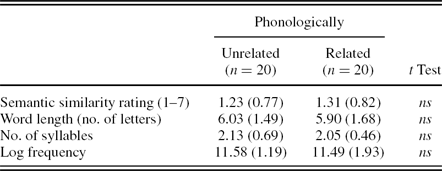
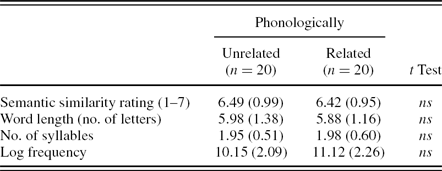
Word length, number of syllables, and frequency of the German stimulus words were obtained from an online corpus (http://wortschatz.uni-leipzig.de). The word pairs were presented within the experimental paradigm to another 15 hearing German native speakers with no knowledge of DGS. Experimental items constituted 20 semantically related and 20 semantically unrelated pairs selected from the larger set of stimulus items such that no reaction time (RT) differences for participants without knowledge of DGS could be detected and such that the items were matched for the word characteristics across the phonological manipulation within each semantic condition (see Table 1 and Table 2).
Lexical characteristics of the semantically unrelated German word pairs

Lexical characteristics of the semantically related German word pairs

Procedure
The experimental procedure was explained in DGS using a video recording. The experiment was conducted using E-Prime 2.0 experimental software (Schneider, Eschman, & Zuccolotto, 2002). A trial began with a 500-ms fixation cross followed by the first stimulus word presented in lowercase letters and centered on the screen for 500 ms. After a 500-ms interstimulus interval, the second stimulus was presented for 2500 ms or until the participant responded. Trials on which there was no response within 2500 ms of the second word were scored as incorrect. Participants responded with their dominant hand when the words were related in meaning by pressing a button labeled “yes.” They responded with the nondominant hand when the words were not related in meaning by pressing a button labeled “no.”Footnote 3 The N-key and the V-key were labeled as needed for right- and left-handed participants. Reaction time was measured from the onset of the second word. Participants first completed 10 practice trials (5 semantically related, 5 semantically unrelated), during which they received feedback on the accuracy of their responses. The practice trials were repeated if participants did not achieve 70% accuracy or better. Six of the 19 deaf DGS–German bilinguals (31.58%) had to repeat the practice session once. None of the participants had to repeat the practice session more than one time. No feedback (accuracy or RT) was provided during the experiment.
After completing the experiment, participants were asked to translate the stimulus words, presented in random order, into DGS. If the signed translations did not meet the condition criteria (phonologically related or unrelated), the trial was eliminated. Forty-five trials, 1.3% of responses, were eliminated for this reason. Reaction times under 300 ms or more than 2.5 SD from the mean were identified as outliers and eliminated as well. Eighty trials, 2.3% of responses, were eliminated for this reason. Inaccurate responses were not included in the RT analysis. After the experiment, the participants completed the language assessment tasks.
Results
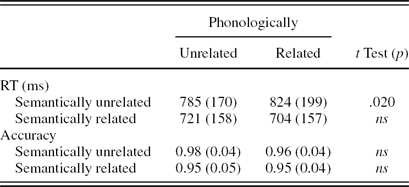
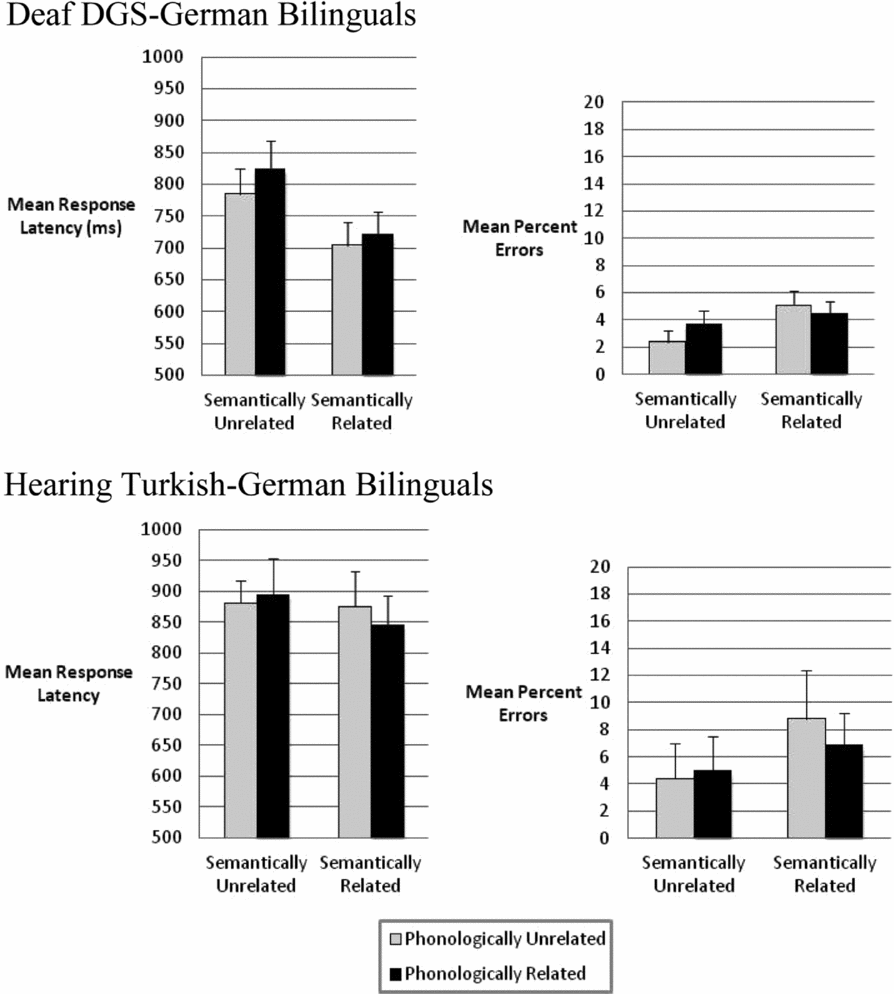
Responses to the semantically related and unrelated stimuli were analyzed separately to determine whether there was an effect of phonological relatedness on response time and accuracy among deaf DGS–German bilingual participants (Table 3). Beginning with the semantically unrelated word pairs, participants’ responses were significantly slower to German words with phonologically related translations in DGS (824 ms) compared to German words with phonologically unrelated DGS translations (785 ms), t (18) = 2.56, p = .020, r = .52 (see Figure 2). The t-test statistics on items revealed a marginally significant result for words with phonologically related translations in DGS (837 ms) versus words with phonologically unrelated translations in DGS (790 ms), t (38) = 1.95, p = .058, r = .30. No significant effects of phonological relatedness on accuracy were found in either subject, t (18) = 1.17, ns, r = .27, or item analyses, t (38) = 1.23, ns, r = .20. This rules out a speed–accuracy trade-off as an explanation for the slower response times to German words with phonologically related DGS translations.
Means (standard deviations) of reaction time (RT) and accuracy in each condition in deaf German Sign Language–German bilinguals

Mean latencies (ms; left) and percentage errors (right) in the semantic judgment task as a function of the semantic relationship and the phonological form of the translation in German Sign Language (DGS) in deaf DGS–German bilinguals (top) and hearing Turkish–German bilinguals (bottom).

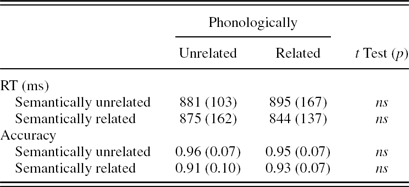
In the semantically related condition, no significant effects of phonological relatedness were found on RT, subject: t (18) = 1.42, ns, r = .32; item: t (38) = 0.82, ns, r = .13, or accuracy, subject: t (18) = 0.41, ns, r = .10; item: t (38) = 0.35, ns, r = .06.
Discussion
The findings indicate that deaf DGS–German bilinguals experience cross-language activation during visual word recognition. If participants’ two languages are accessed independently, then participants should have completed the monolingual decisions about the German words without any influence of the words’ translations in DGS. However, when the words’ translations were phonologically similar, participants’ response was slowed for semantically unrelated words. This result indicates that deaf DGS–German bilinguals’ word recognition of German print words is influenced by knowledge of DGS. Like bilinguals who are proficient in two spoken languages, deaf bilinguals never fully suppress knowledge of the nontarget language even in contexts where it is not required to complete the task at hand.
The cross-language activation effect was only evident in the semantically unrelated condition. In this condition, participants had to respond no to two German words that were semantically unrelated, even though the sign translations look very similar in DGS. The conflict in the semantic and phonological domains presumably generated the inhibition effect. It is not clear why there were no effects of DGS activation in the semantically related condition. DGS differs from ASL along several dimensions that may influence the structure of the bilingual lexicon in deaf bilinguals. These differences are addressed in the general discussion. Additional investigation of the time course of cross-language activation for deaf bilinguals could also elucidate this issue.
EXPERIMENT 2: CROSS-LANGUAGE ACTIVATION IN HEARING TURKISH–GERMAN BILINGUALS
The DGS–German bilinguals in Experiment 1 were completing a monolingual task in German. Although the stimulus words were controlled for frequency and length, there is a small possibility that some other unidentified characteristic of the stimulus words with phonologically related DGS translations differed from the words with phonologically unrelated DGS translations, leading to the effects found in Experiment 1. Several alternative explanations have been proposed, such as differences in “imagability” or in the age that the words were first acquired. We cannot control for every possible factor that might influence recognition of the words in the two conditions by L2 learners of German. Thus, to rule out the possibility that an uncontrolled factor was the source of the RT differences, a second experiment was completed with a participant group that had no knowledge of DGS. We selected hearing bilinguals who also learned German as a L2 but whose L1 was Turkish rather than DGS. If an uncontrolled factor is the source of the RT difference, then this group should also be slower to respond to German print words with phonologically related DGS translation equivalents.
Method
Participants
Ten hearing Turkish–German bilinguals (9 male) were recruited to participate in Experiment 2. The criteria for inclusion were the following:
-
1. no history of speech or hearing disorders,
-
2. ages 18–45 years (M = 29.88), and
-
3. fluency in Turkish and German.
German language proficiency was assessed with onDaf. One participant was eliminated due to a score below the upper intermediate proficiency level of 17 out of 30. The remaining participants had a mean proficiency level of 26.55 (range = 24–29, SD = 1.77). Proficiency in Turkish was assessed with a placement test adhering to CEFR guidelines prepared by Active Languages, a company in Ankara, Turkey. The test was kindly provided to us by Ç. Dilçin (personal communication, March 25, 2009). Proficiency in Turkish was also at a level of upper intermediate proficiency or above with a mean of 23.62 (range = 20–29, SD = 2.83). This test is comparable to the onDAF test in German; the Turkish proficiency test also consists of 30 questions with multiple choice responses.
Materials
The same materials as in Experiment 1 were used.
Procedure
The same procedure as in Experiment 1 was followed, with the exception that participants’ fluency was assessed in Turkish instead of in DGS, and participants were not asked to translate the stimuli into DGS. Further, the experimental procedure was explained in German instead of DGS. The practice trials were also repeated if participants did not achieve 70% accuracy or better. Three of the nine hearing Turkish–German bilinguals (33.34%) had to repeat the practice session once. One of the participants had to repeat the practice session twice. No feedback (accuracy or RT) was provided during the experiment. Reaction times in the experimental task under 300 ms or more than 2.5 SD from the mean were identified as outliers and eliminated. Twenty-seven trials (13.25% of responses) were eliminated for this reason. One participant was eliminated from the analysis due to failure to follow directions.
Since participants did not have any knowledge of DGS, we did not expect to find a cross-language activation effect for the Turkish–German bilinguals. Hence, there should be no effect of phonological relatedness on reaction time or accuracy.
Results
Responses to the semantically related and unrelated stimuli were analyzed separately to determine whether there was an effect of phonological relatedness on response time and accuracy among Turkish–German hearing bilingual participants (Table 4). No significant effects of phonological similarity were found in the semantically unrelated condition on RT, subject: t (7) = 0.42, ns, r = .16; item: t (38) = 0.16, ns, r = .03, or accuracy: subject: t (7) = 0.22, ns, r = .08; item: t (38) = 0.23, ns, r = .04. Similarly, no significant effects of phonological similarity were found in the semantically related condition on RT, subject: t (7) = 1.04, ns, r = .37; item: t (38) = 0.52, ns, r = .09, or accuracy, subject: t (7) = 0.53, ns, r = .20; item: t (38) = 0.54, ns, r = .09.
Means (standard deviations) of reaction time (RT) and accuracy in each condition in hearing Turkish–German bilinguals

Discussion
No effects of phonology on RT or accuracy were found. Since the phonological manipulation was based on properties of DGS, no effects were expected, but the lack of significant effects is a strong indication that the results of Experiment 1 are related to the activation of DGS rather than to other uncontrolled factors. As can be seen in Figure 2, the reaction times of the Turkish–German bilinguals were generally slower than those of the deaf DGS–German bilinguals. Thus, the effects in Experiment 1 are also unlikely to be related to a lower level of proficiency in German.
GENERAL DISCUSSION
The current study results are the first to demonstrate that deaf bilinguals activate DGS signs while reading German words, even in a task that does not require any knowledge of DGS. These results make an important contribution to our current understanding of bilingual lexical processing by demonstrating that the two languages of a bilingual are not accessed selectively even when they share little form similarity. Mounting evidence suggests that bilinguals typically access both languages during word recognition, whether reading, speaking, or listening (Dijkstra, Reference Dijkstra, Kroll and De Groot2005; Kroll, Bobb, & Wodniecka, 2006; Marian & Spivey, 2003), but past studies have relied on cross-language form similarities, such as cognates and interlingual homographs. The current study provides a novel demonstration of cross-language activation in bilinguals whose two languages do not share similar phonological or orthographic forms.
Two prior studies also report evidence of cross-language activation in deaf bilinguals who know a signed language (Morford et al., Reference Morford, Wilkinson, Villwock, Piñar and Kroll2011; Ormel et al., Reference Ormel, Hermans, Knoors and Verhoeven2012). The current study corroborates these studies and extends the conclusions to a new bilingual population, DGS–German bilinguals. Although the results of these studies are largely consistent with one another, there is one interesting difference in the results. While DGS–German bilinguals exhibit the same inhibition effect that was reported for ASL–English bilinguals by Morford et al. (Reference Morford, Wilkinson, Villwock, Piñar and Kroll2011), only the ASL–English bilinguals showed facilitation under certain conditions: ASL–English bilinguals are faster to respond to English word pairs when the ASL translations are phonologically related, but DGS–German bilinguals are not faster when responding to German word pairs with phonologically similar DGS translations.
The simplest explanation for the difference across these studies may be that the type of phonological relationship between the sign translations was not comparable across the two studies. Morford et al. (Reference Morford, Wilkinson, Villwock, Piñar and Kroll2011) selected ASL sign translations that overlapped primarily in movement and location while the DGS sign translations of the stimuli in the current study generally overlapped in handshape and location. Movement is argued to play a central role in the signed syllable (Wilbur, Reference Wilbur, van Oostendorp, Ewen, Hume and Rice2011). This view is supported by psycholinguistic evidence that native signers of ASL judge nonce signs sharing movement to be more similar than nonce signs sharing location or handshape (Hildebrandt & Corina, 2002). In DGS, handshape substitutions are a more common type of language production error than substitutions of movement or location (Hohenberger, Happ, & Leuninger, 2002). Thus, it is possible that the sign translations were phonologically more similar in the Morford et al. (Reference Morford, Wilkinson, Villwock, Piñar and Kroll2011) study than in the current study.
DGS–German bilinguals and ASL–English bilinguals may also differ in terms of the structure of their sign lexicons. Although these differences do not involve the link between their sign representations and their L2 orthographic representations, they may nevertheless impact lexical processing, particularly when the signed language is the dominant language. ASL, for example, tends to have lexical sign families (MOTHER – FATHER – GRANDMOTHER – GRANDFATHER – GREAT-GRANDMOTHER, etc., or GROUP – ORGANIZATION – CLASS – FAMILY, etc.), but their existence is not attested for DGS. Instead, DGS seems to show a higher occurrence of homonyms and polysemous signs than ASL. Furthermore, DGS tends to use much more mouthing in order to differentiate those homonyms and polysemous signs. Mouthings (“Mundbilder”) are stylized mouth movements derivative of spoken translation equivalents of signs that accompany sign production (Boyes-Braem & Sutton-Spence, 2001; Ebbinghaus & Heßmann, 1996). DGS, like many other European signed languages, has a strong tendency to use mouthing (Boyes-Braem & Sutton-Spence, 2001).Footnote 4 Thus, while ASL signers may frequently experience repetition priming of sign morphemes (Fernald & Napoli, 2000) between sublexical and lexical representations, DGS signers may experience more inhibitory priming at the sign lexical level as homonymous or polysemous lexemes compete for activation. Furthermore, there is a great deal of language variation in DGS. This might lead to a diffusion of activation as multiple signs with similar meanings are activated within the DGS lexicon by signers who use one sign but know the dialectal variants used by other signers. Part of this issue was controlled by asking each participant to translate the stimuli after completing the experimental task, but there is no way to completely rule out the possibility of multiple signs being activated by a single print word.
These potential differences in ASL–English and DGS–German bilinguals suggest interesting avenues for future research. However, it is the commonalities between these signing bilinguals that support the central finding of this study that cross-language activation is not restricted to bilinguals whose languages share a single modality. These results provide new and compelling evidence that words of both languages are active during word recognition in bilinguals, irrespective of the form similarity of words in the two languages.
The results also have implications for a recurrent finding in the literature on reading and deafness that has gone unexplained. Many investigators report that deaf students with superior signing skills achieve higher literacy levels than deaf students who have poor signing skills (Chamberlain & Mayberry, 2008; Günther et al., Reference Günther, Wiechel, Thiel-Holtz, Staab, Schäfke and Poppendieker2001; Hennies, Reference Hennies2006; Kubus et al., 2012; Kuntze, Reference Kuntze2004; Padden & Ramsey, 2000). The current results provide a basis upon which to propose a possible mechanism to explain why knowledge of a signed language may support print word recognition in deaf bilinguals. We propose that DGS provides some benefits to deaf readers that are common to all bilinguals and some that are unique to deaf bilinguals. Chamberlain and Mayberry (Reference Chamberlain and Mayberry2008) have proposed that signed language proficiency is correlated with reading ability because reading involves a linguistic component that is independent of the specific language encoded by print. There are also numerous studies showing that vocabulary development in one language promotes vocabulary development in other languages (Kaushanskaya & Marian, 2009; Scheele, Leseman, & Mayo, 2010) and that bilingual children tend to outperform monolingual children on tasks tapping attentional control (Adesope, Lavin, Thompson, & Ungerleider, 2010) and metalinguistic knowledge (Bialystok, Reference Bialystok1988; Galambos & Goldin-Meadow, 1990; Yow & Markman, 2011). Further, Kovelman, Baker, and Petitto (2008) demonstrate that early bilingual exposure has a positive impact not only on language development but more specifically on reading development. Thus, one way to understand the relationship between sign language proficiency and reading proficiency is to recognize that deaf children with sign language proficiency are actually developing bilingual competence during reading acquisition while deaf children without sign language proficiency do not have the linguistic, metalinguistic, and attentional control benefits of a bilingual learner when learning to read.
In addition to these general benefits of bilingual exposure in childhood, proficiency in DGS may also provide deaf readers with specific advantages related to knowledge of DGS. One way that DGS proficiency may impact reading development is by establishing a semantic network that supports acquisition of German orthographic forms for which no prior auditory word form exists in the deaf reader's German vocabulary. In other words, DGS signers have already encoded a large range of semantic contrasts in their L1. When these semantic contrasts are encountered in German orthographic forms, they are mastered more rapidly than they would be if the semantic contrast was not yet established in another language. Furthermore, DGS signers have engaged in lexical processing that is mediated by phonological forms mapped to semantic representations. Deaf individuals without any language exposure in early childhood, spoken or signed, are less efficient at linking phonological forms with meaning in their delayed L1 (Emmorey & Corina, 1990; Mayberry & Eichen, 1991; Mayberry & Fischer, 1989; Morford & Carlson, 2011), and activate larger neural regions in order to complete phonological processing in either their first signed language or a subsequently acquired spoken language (MacSweeney, Waters, Brammer, Woll, & Goswami, 2008). Thus, proficient signers of DGS may also benefit from efficiencies in phonological processing as well as the ability to link form to meaning when acquiring German orthographic forms.
Although we propose that knowledge of DGS may aid in the acquisition and recognition of German print words, we are not proposing that proficient adult deaf readers, like the participants in our study, translate German words into DGS prior to comprehending print. Although we do not rule out this possibility for some words at some stages of acquisition, the results of the current experiment do not support the position that deaf readers generally translate German print words into DGS as a means of comprehension. The proficiency level in German of the DGS–German bilinguals was quite high, suggesting that they did not need to translate the orthographic forms in order to understand them. Thus, rather than interpreting our results as an indication of DGS signs being activated in order to access meaning, we conclude that associations of print and DGS signs are a part of the architecture of the bilingual lexicon and cannot be inhibited during print word recognition in DGS–German bilinguals.
On what basis, then, are DGS signs activated if they are not necessary for German print word comprehension? When we consider the model proposed by Ormel (Reference Ormel2008), the observed inhibition effects can be explained by competition created between lexical sign representations with overlapping sublexical characteristics (Kubus, Morford, & Rathmann, 2010). Alternatively, it is possible that the inhibition is localized outside the lexicon, in the generation of a response with conflicting information from the sublexical sign representations (similar) and from the semantic network (different). These two alternatives might be distinguishable by manipulating the timing of presentation of the stimuli such that the response could preempt the duration needed for activation to spread to sublexical sign representations. Future brain imaging studies of signers processing print words and signs may allow us to distinguish between these alternatives (cf., Capek, Campbell & Woll, 2008; Weisberg, Petrich, McCullough, & Emmorey, 2011).
Additional factors that are not currently captured in Ormel's (2008) model of the bilingual lexicon for deaf bilinguals are mouthing, initialization, and fingerspelling. These three factors are all the result of contact between signed and spoken languages. Signed languages, like other minority languages, have been profoundly influenced by the spoken languages used in their surrounding communities. No two signed languages show the same patterns of influence from language contact. One result of language contact between DGS and German is the widespread use of mouthing. Boyes-Braem and Sutton-Spence (Reference Boyes-Braem and Sutton-Spence2001) distinguish between mouthing and mouth gestures. Mouth gestures are the mouth actions produced with signs that are unrelated to spoken language forms. Here, we refer to mouthing, which is motivated by spoken language articulatory movements but is not equivalent to speech in that mouthing has sign language internal functions (Sandler & Lillo-Martin, 2006) and may only include part of a spoken word (Hohenberger & Happ, 2001). Ebbinghaus and Heßmann (Reference Ebbinghaus, Heßmann, Boyes-Braem and Sutton-Spence2001) have reported that nouns are more often accompanied by mouthing than are verbs in DGS. In ASL, mouthing apparently is less prevalent and does not play a big role in disambiguating homonymous or polysemous signs. However, initialization and fingerspelling are more common in ASL than in DGS.
Initialization refers to a modification of the handshape used in an ASL sign to reflect the first letter of the orthographic form of the English translation equivalent. Some native signs in ASL include initialization, but nonnative signers and educators have introduced additional initialized forms into signing communities in an attempt to highlight the relationship between ASL signs and English print representations. Although these latter initialized forms may be familiar to ASL signers, they are often rejected from typical use as nonstandard or foreign forms. Initialization in DGS is also attested, but it occurs much less frequently than in ASL (Ebbinghaus, Reference Ebbinghaus, Eichmann, Hansen and Heßmann2012; Sandler & Lillo-Martin, 2006). Fingerspelling consists of a sequence of handshapes representing orthographic word forms. Although fingerspelling handshapes were designed to represent orthography, young deaf signers initially acquire fingerspelled lexical items as holistic forms and only later analyze fingerspelled lexical items in such a way to associate individual handshapes with written letters (Padden, Reference Padden, Schick, Marscharck and Spencer2006). Furthermore, fingerspelled lexical items are acquired earlier than and independently of the associated written word forms (Kelly, Reference Kelly and Lucas1995). Frequently fingerspelled words become lexicalized into sign forms that are adapted to phonological constraints of the core lexicon of a signed language (Brentari, Reference Brentari1998). The use of lexicalized fingerspelling in educational settings has been shown to promote print word acquisition (Haptonstall-Nykaza & Schick, 2007). In the absence of comparable corpus studies of the two languages, we cannot report the relative frequency of use of fingerspelling in the two languages, but our observation is that fingerspelling is more commonly used by ASL than by DGS signers. Given that DGS and ASL are historically unrelated languages (see Boyes-Braem & Rathmann, 2010, for DGS; Lane, Reference Lane1984, for ASL), these cross-linguistic differences come as no surprise and are an important reminder that research on a variety of signed language bilinguals is needed to refine our understanding of lexical access in deaf bilinguals. Each of these factors could potentially impact the spread of activation in the bilingual lexicon (Kubus, Morford, Rathmann & Wilkinson, 2010). These factors could also be a potential means for activation to spread between sublexical phonological and orthographic representations. These possibilities await future investigations.
Another factor that may impact cross-language activation in deaf bilinguals that is not captured in Ormel's (2008) model is how the transparency of the L2 orthographic representations impacts word recognition in deaf bilinguals.Footnote 5 A recent study comparing reading proficiency in deaf readers of five languages (Hebrew, Arabic, and English with deep orthographies and German and Turkish with shallow orthographies) suggests that there is no significant effect of orthographic transparency on reading outcomes (Miller et al., Reference Miller, Kargin, Guldenoglu, Rathmann, Kubus and Hauser2012). However, this does not rule out the possibility that the transparency of the L2 orthography could influence the architecture of the bilingual lexicon. The prevalence of mouthing in DGS could be related in part to German orthography being transparent. What has yet to be determined is whether mouthing is acquired prior to or subsequent to the mastery of German orthographic forms by German deaf bilinguals. This question is critical to evaluating effects of orthographic transparency and of mouthing on bilingual lexical access.
In conclusion, deaf bilinguals, like hearing bilinguals, do not fully suppress the nontarget language during L2 written word recognition. This finding is particularly significant given the fact that for these individuals, orthographic and phonological representations are drawn from completely unrelated languages with little form similarity between the two. The results point to the possibility that the bilingual brain can associate meaningful structures regardless of their sensory instantiation and regardless of the design features of the linguistic system that they represent. Future studies are needed to reveal how L2 orthographic forms can become associated with unrelated L1 phonological forms during the course of L2 acquisition.
APPENDIX A
Semantically unrelated German word pairs with phonologically related German Sign Language translations

Semantically unrelated German word pairs with phonologically unrelated German Sign Language translations

Semantically related German word pairs with phonologically related German Sign Language translations

Semantically related German word pairs with phonologically unrelated German Sign Language translations

ACKNOWLEDGMENTS
We thank the participants of our research, as well as Asha Rajashekhar, for help in data collection and coding. Portions of this study were presented at the 10th High Desert Linguistics Society Conference in Albuquerque, New Mexico, at Theoretical Issues in Sign Language Research 10 in West Lafayette, Indiana, and at the 8th International Symposium on Bilingualism in Oslo, Norway. This research was supported by the National Science Foundation Science of Learning Center Program, under cooperative agreement number SBE-0541953. Any opinions, findings, and conclusions or recommendations expressed are those of the authors and do not necessarily reflect the views of the National Science Foundation.