Introduction
Symptoms of deficient emotional self-regulation (DESR), including low frustration tolerance, temper outbursts and mood lability, have long been associated with attention deficit hyperactivity disorder (ADHD) (Wender, Reference Wender1995; Barkley, Reference Barkley1997; Nigg & Casey, Reference Nigg and Casey2005). Understanding the nature of DESR among ADHD patients is consequential, because DESR can be confused with bipolar disorder symptoms that can also be co-morbid with ADHD. DESR differs from pediatric bipolar disorder in several ways. Among ADHD patients, the prevalence of DESR is much higher than the prevalence of bipolar disorder (~60% v. ~15%) (Reimherr et al. Reference Reimherr, Marchant, Strong, Hedges, Adler, Spencer, West and Soni2005, Reference Reimherr, Williams, Strong, Mestas, Soni and Marchant2007; Faraone et al. Reference Faraone, Biederman, Spencer, Mick, Murray, Petty, Adamson and Monuteaux2006; Barkley & Fischer, Reference Barkley and Fischer2010; S. Faraone et al., unpublished observations). In our study of ADHD adults (S. Faraone et al., unpublished observations), DESR was not associated with bipolar disorder and the familial transmission of DESR was independent of mood disorders.
DESR is phenomenologically distinct from bipolar disorder, which is characterized by the experience of strong emotions, not their self-regulation (Rosen & Epstein, Reference Rosen and Epstein2010). Unlike DESR, bipolar disorder requires the presence of non-mood criteria including somatic and behavioral impairments. Bipolar patients show dysregulated mood throughout each episode, not only in response to provoking stimuli. In contrast, ADHD patients with DESR do not have distinct episodes of DESR. Unlike manic episodes, DESR subsides relatively rapidly and does not form a distinct protracted episode of the type that would qualify for a mood disorder. Thus, ADHD patients with DESR frequently enjoy normal moods but can become easily frustrated or angry with unexpected emotional challenges.
In previous work, we and others have examined mood dysregulation among ADHD youth using the anxious/depressed, attention and aggression (AAA) profile from the Child Behavior Checklist (CBCL). Biederman et al. (Reference Biederman, Wozniak, Kiely, Ablon, Faraone, Mick, Mundy and Kraus1995) showed that the attention problems aggressive behavior and anxious/depressed CBCL scales differentiated ADHD youth with bipolar disorder from other ADHD youth. This AAA profile was subsequently replicated by other groups and confirmed by meta-analysis (Mick et al. Reference Mick, Biederman, Pandina and Faraone2003). Hudziak et al. (Reference Hudziak, Althoff, Rettew, Derks and Faraone2005) showed that the CBCL-juvenile bipolar disorder (JBD) profile (which made no distinction between JBD and DESR) was highly heritable (54–68%) and had a population prevalence consistent with epidemiologic studies of bipolar disorder (~1% of boys and girls at ages 7, 10 and 12 years). Using cases referred to pediatric and psychiatric clinics, Faraone et al. (Reference Faraone, Althoff, Hudziak, Monuteaux and Biederman2005) reported that the AAA scale had high sensitivity (92%) and specificity (89%) for predicting bipolar disorder diagnoses. However, the diagnostic accuracy of the AAA profile was low in Youngstrom et al.'s (Reference Youngstrom, Youngstrom and Starr2005) study of community mental health centers and in a comparison of bipolar youth with healthy controls and with patients having major depressive/anxiety disorders, disruptive behavior disorder (Diler et al. Reference Diler, Birmaher, Axelson, Goldstein, Gill, Strober, Kolko, Goldstein, Hunt, Yang, Ryan, Iyengar, Dahl, Dorn and Keller2009).
Taken together, these studies suggest that, at best, the CBCL AAA scale is only an imperfect measure of the emotional dysregulation that is characteristic of bipolar disorder. Because youth with ADHD and other disruptive behavior disorders have been shown to score high on this subscale, it is possible that the AAA scale is sensitive to the DESR that is associated with ADHD. In an initial study of this issue (Spencer et al. in press), we defined DESR if a child had an aggregate cut-off score of >180 but <210 on the AAA scale. We excluded scores >210 because those had previously been used to define the AAA bipolar disorder proxy. This CBCL-DESR definition was associated with elevated rates of anxiety and disruptive behavior disorders and significantly more impairments in emotional and interpersonal functioning. CBCL-DESR was not associated with major depression or bipolar disorder, which led us to hypothesize that it was measuring a type of dysregulation not associated with mood disturbance. This finding was consistent with our study of ADHD adults, which had used emotional dysregulation items from Barkley's Current Behavior Scale to define DESR (S. Faraone et al., unpublished observations).
An improved understanding of the association between ADHD and DESR has important implications. Because DESR is common in children with ADHD, for the purposes of clinical intervention or predicting course and outcome, it is important to understand whether it should be considered as an expression of ADHD, of a co-morbid condition or a separate condition.
Given the high heritability of the CBCL AAA profile, we decided to use family data to further examine the association between CBCL-DESR and co-morbid psychopathology. Consistent with the idea that DESR is heritable, we found that the risk for DESR was elevated in siblings of ADHD+DESR probands, but not in siblings of ADHD probands (Surman et al. Reference Surman, Biederman, Spencer, Yorks, Miller, Petty and Faraone2011). In that study, DESR showed a familial dissociation from other psychiatric disorders because the familial risk for these disorders was not associated with DESR in the proband. We also showed that ADHD and DESR were co-morbid in relatives, which suggests that the co-morbidity of ADHD and DESR in probands was not due to a referral bias (such as Berkson's bias) in which patients with multiple conditions are over-represented in referrals due to the greater severity of their clinical picture.
The main aim of this study was to examine the familiality of ADHD and the CBCL-AAA scale using data from two large-scale family studies of boys and girls with and without ADHD ascertained from pediatric and psychiatric sources. Based on prior work, we hypothesized that CBCL-DESR and CBCL-bipolar (BP) would be familially distinct from ADHD. Alternatively, CBCL-DESR and CBCL-BP may represent different severity groups on the same underlying continuum with each other and ADHD.
Methods
Subjects
Detailed study methodology has been previously described (Biederman et al. Reference Biederman, Faraone, Milberger, Guite, Mick, Chen, Mennin, Marrs, Ouellette, Moore, Spencer, Norman, Wilens, Kraus and Perrin1996, Reference Biederman, Faraone, Mick, Williamson, Wilens, Spencer, Weber, Jetton, Kraus, Pert and Zallen1999). Briefly, subjects were derived from two identically designed longitudinal case–control family studies of ADHD. These studies recruited male and female probands aged 6–18 years with (n=140 boys, n=140 girls) and without (n=120 boys, n=122 girls) ADHD, ascertained from pediatric and psychiatric clinics, and their first-degree relatives (ADHD families: n=280 mothers, n=274 fathers, n=317 siblings; Control families: n=242 mothers, n=235 fathers, n=260 siblings). Potential subjects were excluded if they had been adopted or if their nuclear family was not available for study. We also excluded potential subjects if they had major sensorimotor handicaps (paralysis, deafness, blindness), psychosis, autism, inadequate command of the English language or a full scale IQ <80. Diagnoses of subjects <12 years of age were based on interviews with the mothers. Subjects between 12 and 17 years of age had indirect and direct interviews and a diagnosis was considered positive if either of the interviewees endorsed the disorder. Subjects aged ⩾18 years had direct interviews. Parents provided consent for offspring <18 years. Children and adolescents provided written assent to participate. The Human Research Committee at Massachusetts General Hospital approved this study.
Psychiatric assessments relied on the epidemiologic version of the Schedule for Affective Disorder and Schizophrenia for Children (K-SADSE) (Orvaschel, Reference Orvaschel1994) for subjects <18 years of age and the Structured Clinical Interview for DSM-IV (SCID) (Spitzer et al. Reference Spitzer, Williams, Gibbon and First1990) (supplemented with modules from the K-SADSE to assess childhood diagnoses) for subjects ⩾18 years of age. The interviewers had undergraduate degrees in psychology and were extensively trained and supervised. Based on 500 interviews the median κ coefficient between a trained rater and an experienced clinician was 0.98. The κ coefficients for individual diagnoses included: ADHD (0.88); CD (1.0); major depression (1.0); mania (0.95); separation anxiety (1.0); agoraphobia (1.0); panic (0.95); substance use disorder (1.0). We considered a diagnosis present if DSM III-R diagnostic criteria were unequivocally met.
A committee of board-certified child and adult psychiatrists who were blind to the subject's ADHD status, referral source and all other data resolved diagnostic uncertainties. Diagnoses presented for review were considered positive only when the committee determined that diagnostic criteria were met to a clinically meaningful degree. We estimated the reliability of the diagnostic review process by computing κ coefficients of agreement for clinician reviewers. For these diagnoses, the median reliability between individual clinicians and the review committee assigned diagnoses was 0.87. The κ coefficients for individual diagnoses included: ADHD (1.0); CD (1.0); major depression (1.0); mania (0.78); separation anxiety (0.89); agoraphobia (0.80); panic (0.77); substance use disorder (1.0). All assessment personnel were blind to proband diagnosis (ADHD or Control) and ascertainment site (psychiatric or pediatric). The CBCL (Achenbach, Reference Achenbach1991), completed by a parent for the probands and their siblings, provided dimensional measures of child syndromes. Socio-economic status (SES) was measured using the 5-point Hollingshead scale (Hollingshead, Reference Hollingshead1975).
Children were diagnosed with BP-I disorder according to DSM-IV criteria. The DSM-IV requires subjects to meet criterion A for a distinct period of extreme and persistently elevated, expansive or irritable mood lasting at least 1 week, plus criterion B, manifested by three (four if the mood is irritable only) of seven symptoms during the period of mood disturbance. To ensure that the B criterion symptoms were concurrent with A criterion mood disturbance, subjects were directed to focus on the worst or most impairing episode of mood disturbance while being assessed for the presence of the confirmatory B criterion symptoms. That is, the subject was asked to consider the time during which the screen was at its worst for the purposes of determining whether the remaining symptoms were also evident at the same time as the screening item. Also recorded was the onset of first episode, the number of episodes, offset of last episode and total duration of illness. Any subject meeting criteria for BP-II or BP-not otherwise specified (NOS) was not included in this study. To gauge a distinct episode, our interviewers ask for ‘a distinct period (of at least 1 week) of extreme and persistently elevated, expansive or irritable mood’ and further require that the irritability endorsed in this module is ‘super’ and ‘extreme’.
Defining DESR using scores of the CBCL
Previously (Biederman et al. Reference Biederman, Petty, Monuteaux, Evans, Parcell, Faraone and Wozniak2009), we described the CBCL-pediatric bipolar disorder (CBCL-PBD) profile as a score of ⩾210 on the sum of the AAA profile CBCL scales. In a sample of ADHD youth, the CBCL-PBD profile was significantly associated with a risk for developing bipolar disorder (Biederman et al. Reference Biederman, Petty, Monuteaux, Evans, Parcell, Faraone and Wozniak2009). For this analysis, we defined a measure of DESR (CBCL-DESR) as positive if a subject's sum of the AAA CBCL scales from the baseline assessment was ⩾180 (⩾60 on average on each scale) but <210 (average t score of ⩾60 and <70 on each scale).
Statistical analysis
Comparisons were made between Controls without DESR (Controls), ADHD subjects without DESR (ADHD) and ADHD subjects with CBCL-DESR (AAA scales >180 and <210) and ADHD subjects with the CBCL-BP (AAA scales ⩾210).
Logistic regression was used to compare rates of psychiatric disorders in all relatives and CBCL-findings in school age siblings. Demographic confounders (social class, proband age and relative age) were controlled for in all models. To account for the non-independence of family members, we used the Huber correction (Huber, Reference Huber1967) to produce robust variances for all statistical tests. All tests used Stata (StataCorp, 2007) and were two-tailed and α was set at 0.05.
Results
Comparisons were made between first-degree relatives of ADHD probands with DESR (n=272, from 86 families), relatives of ADHD probands without DESR (n=341, from 111 families), relatives of ADHD probands with CBCL-BP (n=145, from 45 families) and relatives of non-ADHD control probands without DESR (n=675, from 224 families). Consistent with prior reports of co-morbidity between ADHD and DESR, for probands, we found significant correlations between the CBCL-AAA scale score and current ADHD symptoms (r=0.70, p<0.001) and lifetime ADHD symptoms (r=0.69, p<0.001). For siblings, these correlations were 0.60 (p<0.001) and 0.60 (p<0.001), respectively.
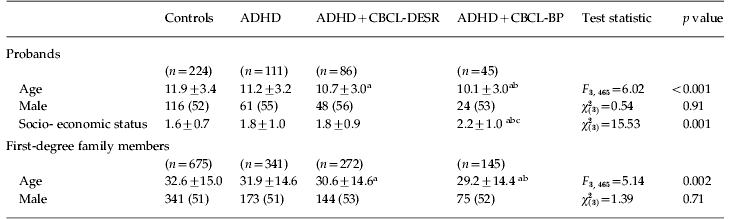
We found no significant differences in the gender distributions of probands or relatives between the three proband groups (Table 1). The groups differed in family SES with ADHD+CBCL-BP probands coming from lower SES families compared with other probands. Probands and relatives in the ADHD+DESR group were significantly younger than Controls. Therefore, we controlled for social class, proband age and relative age in all subsequent analyses.
Demographics

ADHD, Attention deficity hyperactivity disorder; CBCL, Child Behavior Checklist; DESR, deficient emotional self-regulation; BP, bipolar.
a p<0.01 v. Controls.
b p<0.05 v. ADHD.
c p<0.05 v. ADHD+CBCL-DESR.
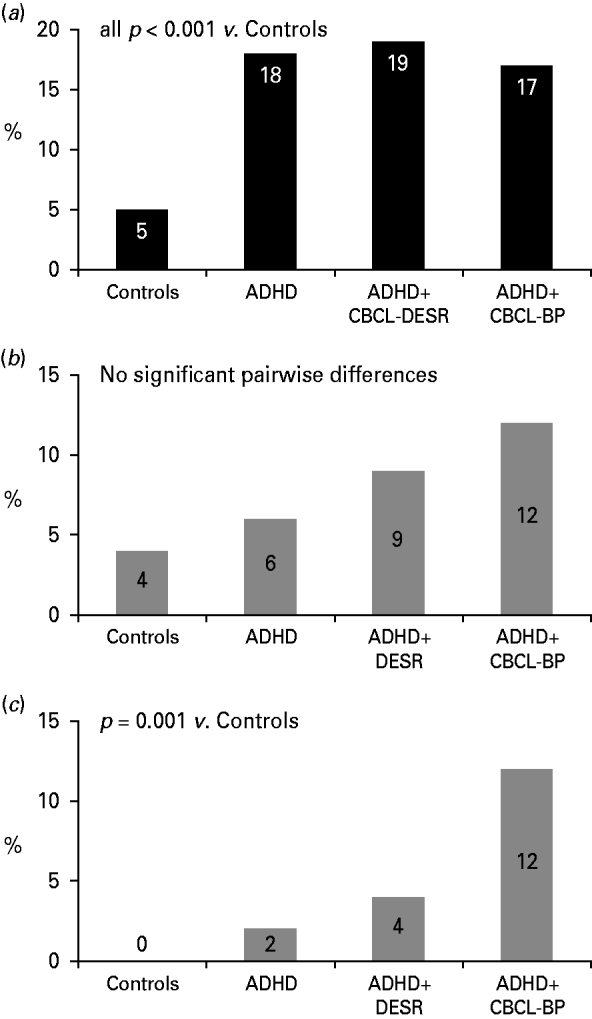
We first assessed rates of ADHD in the relatives of probands. We found that, compared with controls, ADHD was more prevalent in the relatives of probands with ADHD (18% v. 5%, χ2 (1)=29.20, p<0.001) and ADHD+CBCL-DESR (19% v. 5%, χ2 (1)=34.95, p<0.001) and ADHD+CBCL-BP (17% v. 5%, χ2 (1)=17.36, p<0.001). The prevalence of ADHD did not differ among relatives of the three ADHD groups (ADHD: 18% v. ADHD+CBCL-DESR: 19% v. ADHD+CBCL-BP: 17%, χ2 (2)=0.66, p=0.72) (Fig. 1 a).
Familial risk analysis of attention deficit hyperactive disorder (ADHD) and Child Behavior Checklist (CBCL) dysregulation profile. (a) Rates of ADHD in parents and siblings; (b) rates of (CBCL)-deficient emotional self-regulation (DESR) in siblings; (c) Rates of CBCL-bipolar (BP) in siblings.

Figure 1 b shows an increase in the prevalence of CBCL-DESR in school age siblings with an increase in the CBCL-AAA score as indexed by the three ADHD groups. This linear increase was significant by logistic regression (z=2.04, p=0.04). However, we found no pairwise significant differences among the four groups. Fig. 1 c shows a significantly higher rate of CBCL-BP in the siblings of ADHD+CBCL-BP probands compared with siblings of the Control probands (12% v. 0%, exact logistic regression, p=0.001).
Among siblings in the ADHD groups, we assessed the co-morbidity of ADHD with CBCL-DESR and CBCL-BP. The ADHD siblings were at elevated risk for CBCL-DESR compared with non-ADHD siblings (26% v. 4%; z=4.00, p<0.001). The ADHD siblings were also at elevated risk for CBCL-BP profile compared with non-ADHD siblings (19% v. 1%; z=3.56, p<0.001).
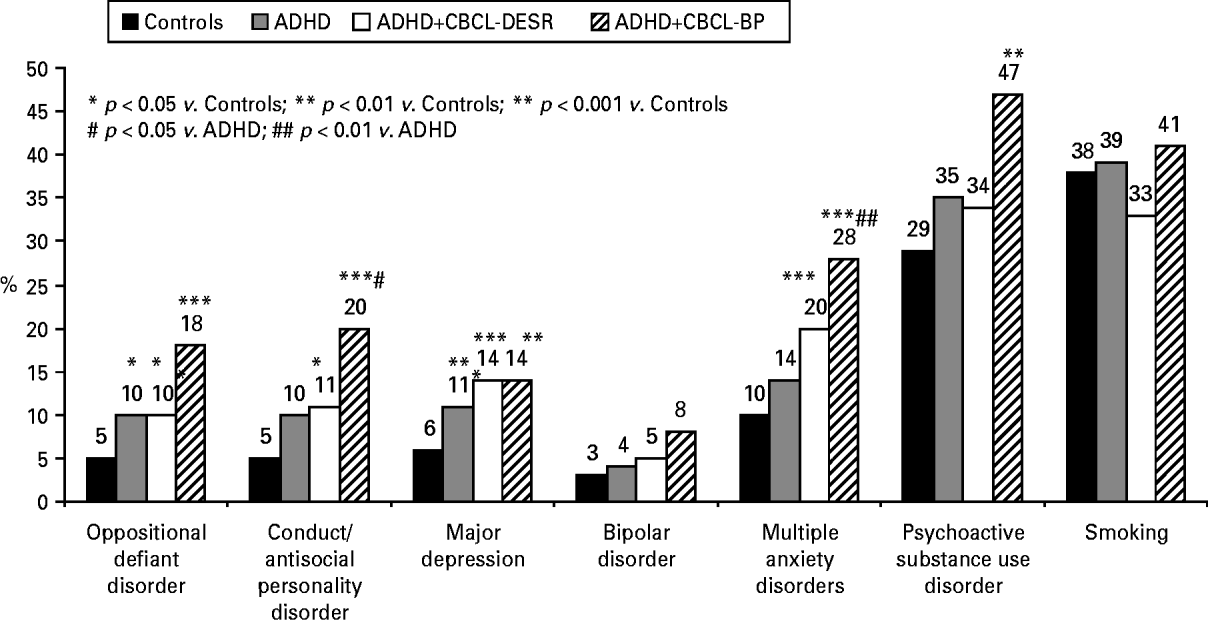
Compared with controls, relatives of all the ADHD groups had significantly higher rates of major depression and oppositional defiant disorder (Fig. 2). Rates of conduct and anxiety disorders were elevated only among relatives of ADHD+CBCL-DESR and ADHD+CBCL-BP probands. Although bipolar disorder was more prevalent among relatives with CBCL-BP, comparisons with other groups did not reach statistical significance.
Rates of psychiatric disorders in first-degree relatives. ADHD, Attention deficit hyperactivity disorder; CBCL, Child Behavior Checklist; DESR, deficient emotional self-regulation; BP, bipolar.

Discussion
In a large sample of children with and without ADHD of both genders ascertained from psychiatric and pediatric sources, we confirmed prior work showing a significant association between ADHD and DESR. The relatives of ADHD probands with and without DESR were at elevated risk for having ADHD, indicating that the familial transmission of ADHD is not influenced by DESR in the proband. Among relatives, we did not find categorical differences in the prevalence of DESR among our four groups. We did, however, find a significant effect indicating that higher CBCL-AAA scores in probands were associated with higher rates of CBCL-DESR in relatives. In contrast, among siblings, CBCL-BP was limited to the siblings of CBCL-BP probands.
We found a significant within subject association between ADHD and DESR in two ways. For both probands and siblings considered separately, both lifetime and current ADHD symptoms were associated with the CBCL-AAA score. Consistent with this, among siblings, those with ADHD had higher rates of CBCL-DESR than those without ADHD. These findings are consistent with prior work, indicating that ADHD is associated with DESR (Reimherr et al. Reference Reimherr, Marchant, Strong, Hedges, Adler, Spencer, West and Soni2005, Reference Reimherr, Williams, Strong, Mestas, Soni and Marchant2007; Barkley et al. Reference Barkley, Murphy and Fischer2008; Barkley & Fischer, Reference Barkley and Fischer2010). Moreover, the co-morbidity among siblings in our sample strengthens these prior findings because it cannot be attributed to artefacts of clinical referral such as Berkson's bias. Notably, we also found co-morbidity of ADHD and DESR in our study of adult ADHD (S. Faraone et al., unpublished observations).
We found similarly elevated rates of ADHD among parents and siblings of each type of ADHD proband. This suggests that DESR does not index a familially severe form of ADHD. When we assessed the prevalence of DESR among siblings, we found increasingly higher rates of CBCL-DESR with increases in the CBCL-AAA scores in our proband groups. Although this linear effect was significant, we could not establish pairwise differences among groups. This could indicate that DESR is best conceptualized as being on a continuum with CBCL-BP. In contrast to these findings, our family data regarding CBCL-BP suggest that it may be a meaningful category because rates of CBCL-BP among siblings were elevated only among siblings of CBCL-BP probands. Taken together, these results cannot determine if DESR and the mood dysregulation of bipolar disorder are distinct entities or on a continuum. Fig. 1 b provides some support for a continuum hypothesis whereas Fig. 1 c suggests that CBCL-BP may be a distinct entity. Furthermore, the familial risks for affective disorders are similar for relatives of CBCL-DESR and CBCL-BP probands, which does not support a distinction between the two conditions. Thus, taken together, our data cannot assert a distinct separation between CBCL-BP and CBCL-DESR. Our inability to resolve this issue could be due to low statistical power for the relevant comparisons. Clearly, further work is needed to address this issue.
If DESR among ADHD probands was an expression of another psychiatric disorder, we would have expected to find a higher prevalence of that psychiatric disorder among relatives of ADHD+CBCL-DESR probands compared with ADHD probands. This idea predicts higher rates of psychiatric disorders among relatives of ADHD+DESR probands compared with ADHD probands. However, we found no significant differences in the prevalence of psychiatric disorders between these two groups. This finding is consistent with our prior report in adult ADHD probands, indicating that the association of ADHD and DESR in the probands was not accounted for by other psychiatric disorders in relatives (S. Faraone et al., unpublished observations).
The relatives of ADHD+CBCL-BP probands showed the highest prevalence of some disorders, notably oppositional defiant disorder, conduct disorder, multiple anxiety disorders and substance use disorders. However, although the families of CBCL-BP probands had the highest rate of bipolar disorder, the differences with other groups were not significant. Thus, our data do not provide strong support for the idea that CBCL-BP indexes the familial risk for bipolar disorder. More work in larger samples is needed to address this issue.
Our results should be interpreted with some limitations in mind. One limitation of our CBCL definition of DESR is that it includes the attention problems scale, which is known to be associated with ADHD. This may have exaggerated our co-morbidity findings. Our sample did not allow exploration of the potential contribution of non-random mating to the pattern of inheritance of ADHD with DESR. Also, we were unable to disentangle the extent to which ADHD among pediatric probands with DESR might be secondary to DESR, which would require a sample of probands with DESR who did not have ADHD. It is also possible that our characterization of the familiality of DESR, and relationships with co-morbidity, are limited by power. Our sample was primarily Caucasian and, thus, our findings may not generalize to other ethnic groups. We cannot tell from our work whether our choice of cut-points to define CBCL-DESR and CBCL-BP are ideal. Future work should clarify this point and determine if different cut-points would be suitable for different applications (e.g. screening for DESR, diagnosing DESR, etc.).
Despite these limitations, we have confirmed prior findings that ADHD is associated with DESR and have shown that, in the presence of DESR, ADHD shows the same degree of familial transmission as it does in the absence of DESR. We have shown that CBCL-BP is associated with the highest levels of DESR and the highest levels of psychiatric co-morbidity. Further work using different approaches to measuring DESR are needed to see if it is possible to better distinguish an ADHD-associated DESR that is independent of the mood dysregulation associated with bipolar disorder.
Acknowledgments
Shire Pharmaceuticals provided support for this analysis.
Declaration of Interest
Dr J. Biederman is currently receiving research support from the following sources: Elminda, Janssen, McNeil, Next Wave Pharmaceuticals and Shire. In 2011, Dr Biederman gave a single unpaid talk for Juste Pharmaceutical Spain, and received honoraria from the MGH Psychiatry Academy for a tuition-funded CME course. He also received an honorarium from Cambridge University Press for a chapter publication. In 2010, Dr Biederman received a speaker's fee from Fundación Dr Manuel Camelo A.C., provided single consultations for Shionogi Pharma Inc. and Cipher Pharmaceuticals Inc. and received honoraria from the MGH Psychiatry Academy for a tuition-funded CME course. In 2009, Dr Biederman received a speaker's fee from the following sources: Fundacion Areces, Medice Pharmaceuticals and the Spanish Child Psychiatry Association. In previous years, Dr Biederman received research support, consultation fees or speaker's fees for/from the following additional sources: Abbott, Alza, AstraZeneca, Bristol–Myers Squibb, Celltech, Cephalon, Eli Lilly and Co., Esai, Forest, Glaxo, Gliatech, Janssen, McNeil, Merck, NARSAD, NIDA, New River, NICHD, NIMH, Novartis, Noven, Neurosearch, Organon, Otsuka, Pfizer, Pharmacia, The Prechter Foundation, Shire, The Stanley Foundation, UCB Pharma, Inc. and Wyeth.
Dr T. Spencer has received research support from, has been a speaker for or on a speaker's bureau or has been an Advisor or on an Advisory Board of the following sources: Shire Laboratories, Inc, Eli Lilly & Company, GlaxoSmithKline, Janssen Pharmaceutical, McNeil Pharmaceutical, Novartis Pharmaceuticals, Cephalon, Pfizer, the National Institute of Mental Health and royalties on adult ADHD scales (research support).
In the past year, Dr Faraone received consulting fees and was on Advisory Boards for Shire Development and received research support from Shire and the National Institutes of Health (NIH). In previous years, he received consulting fees or was on Advisory Boards or participated in continuing medical education programs sponsored by: Shire, McNeil, Janssen, Novartis, Pfizer and Eli Lilly. In previous years he received research support from Eli Lilly, Shire, Pfizer and the NIH. Dr Faraone receives royalties from a book published by Guilford Press: Straight Talk about Your Child's Mental Health.