In the early eighteenth century, two Basque brothers of the Spanish Zangroniz family established a trading house in the Cuban capital. Through the expansion and diversification of their business activities over time, they created a powerful transatlantic commercial network, and in the process became important actors during a period characterized by vastly increased economic integration in the Atlantic world.Footnote 1 Behind this growth were technological innovations. The brothers' shrewd use of them “made it possible to transport more and different kinds of items across great distances.
In charting the development of the Zangroniz family business, a scholarly enterprise that will also involve examination of some of their many partners, this article will address and answer some broader historiographical and theoretical questions pertaining to economic history. It will also examine, more specifically, the modus operandi of transatlantic slave traders. Engaging with the literatures of enterprise and family business in the Iberian Atlantic in the Age of Revolution, the article opens the doors of a merchant house managed from a booming nineteenth-century Atlantic urban center, Havana, to shed light on the importance of diversification as a route to success in a highly risky and competitive environment.Footnote 2 Several studies have examined the business models adopted by European slave trading firms and entrepreneurs in the eighteenth and early nineteenth centuries, the period during which the slave trade was legal throughout the Atlantic world.Footnote 3 However, we still have very limited knowledge about the ways in which some of these firms and entrepreneurs adopted new business models to show what enabled them to continue in the business of human trafficking, even as it was declared illicit by most of the former slave trading nations in the first half of the nineteenth century. And we know even less about the new firms and entrepreneurs themselves, whether Spanish, Portuguese, French, American, Cuban, or Brazilian, who joined the human trafficking business precisely at that time.Footnote 4
I have chosen the Zangroniz clan to shed light on the development of these Atlantic commercial networks for two main reasons. First, the information we have about this commercial family, though by no means abundant, is substantial enough to allow us to map their trajectory throughout the century and across continents. Second, because they were exceptional in the sense that they were constantly in search of new business ventures, it is possible to observe their expanding operations and networks, their strategies of diversification, and the significant risks they took in investing in new markets and businesses, often doing so at the margin of local and international laws. In spite of their obviously important role as international slave dealers throughout the first half of the century, little has been written about this family of human traffickers. Yet, in numerous ways, the Zangroniz generations examined in this article epitomize the astute and pioneering capitalist of the time, flexible, resilient, and eager to take advantage of any opportunity without much regard for anything but the possible margin of profits to be earned. As did many of their contemporaries, they traded human beings across oceans and seas with no second thoughts on the suffering they caused. Their actions, like those of their competitors and partners, resulted in new generations of Africans being enslaved and forced to cross the Atlantic even when the slave trade was illegal. Slavery in Cuba was thereby extended for two generations.
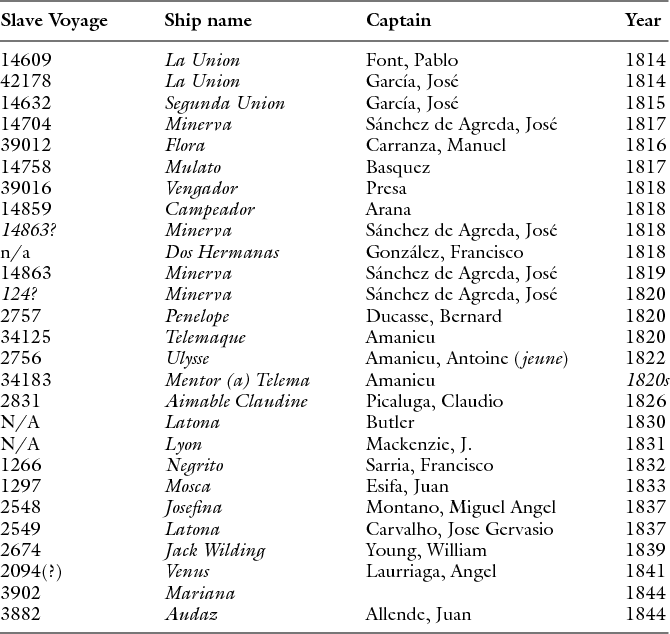
Table 1 lists slave voyages known to have been owned and managed by Zangroniz family members, or consigned to them.
Slave Voyages Owned by or Consigned to Zangroniz Family Members

Over the first half of the nineteenth century these relatively unknown Basque entrepreneurs built a small business on a distant island across the ocean into an extensive transatlantic commercial web. They traded not only in slaves but in a large variety of other products, and even founded their own transatlantic steamship company. However, the Zangroniz firm was known first and foremost for its continued involvement in the traffic of human beings. Much of the family's success was based on extensive kinship connections and a network of correspondents and agents that allowed them to prosper in the face of British policing in the Atlantic basin. They took advantage of every opportunity presented to them, regularly colluding with local governments and the rulers of several countries and territories. In its examination of the Zangroniz family business model, this article also uncovers some of the strategies widely used by slave traders in the Atlantic world during the period of illicit trade to circumvent the abolitionist efforts carried out by Britain and other governments.Footnote 5 It also opens further inquiry into the strategies devised by capitalist entrepreneurs, as exemplified by the Zangroniz, to succeed where others had fallen victim to risk and vicious competition.
Basque Slave Traders in Cuba
When the first pioneers of the Basque migration arrived in Cuba in the late eighteenth century, there was a palpable appetite for free trade among Havana-based merchant and planter elites. This longing for free trade had become patent after the British occupation of Havana in 1762–63, which had stimulated the local economy as would no other event until nearly the final decade of the century.Footnote 6 Although free trade was not officially sanctioned until the 1810s, Cuba-based merchants had been carrying out a de facto trans-imperial trade since the 1790s, notably with the United States, as a result of Spain's own inability to satisfy the demands of the island's expanding economy. To get away with this borderline illegal behavior, the authorities, planters, and merchants of Havana, had over the years and in unison resorted to various excuses and threats to justify the exceptionality and need for these measures. In reality, however, trans-imperial trade had become the rule rather than the exception, in Cuba as well as in other Spanish American colonies.
In this new trading scenario, just as many other merchants across the Iberian Atlantic had done, Havana-based merchants took advantage of new conjunctures to further their business interests. For a combination of political, social, and economic reasons, Cuba in the 1790s was better placed than most other Spanish colonies to take advantage of the events that from 1791 transpired in the neighboring French colony of Saint-Domingue. Although the Spanish colonies in the Americas were all along importing larger numbers of African slaves than historians have previously assumed, the increase in the transatlantic slave trade to Cuba that took place at the very end of the eighteenth century and the beginning of the nineteenth was by any standards a major one.Footnote 7 As the Spanish asiento fell into disuse, Havana-based merchants began taking the reins of the slave trade. In the early 1790s, they sent their first expedition to Africa. The frigate Cometa returned with 227 Africans who now belonged to a Basque merchant and planter, Sebastián de Lasa.Footnote 8 In the following years, Spanish peninsular merchants developed new transatlantic networks based on personal trust, which allowed them to take control of one of the most lucrative businesses of the time.
A number of scholars have studied Iberian Atlantic networks in the eighteenth and early nineteenth century, examining diverse issues such as the role of communications and trust, and also exposing possible pitfalls of such studies. Xabier Lamikiz, for example, has emphasized that interpersonal trust was “crucial to early overseas trade.”Footnote 9 Notably, he has also discussed how this need for trust between merchants and agents (the principal-agent problem) led many merchants to rely first and foremost on family members.Footnote 10 Both Lamikiz and Jeremy Baskes have also pointed out that when family members were not available, common ethnic and regional identities, otherwise known as paisanaje, were the next preferred type of association.Footnote 11 Thus, Basque merchants and traders associated first and foremost with other Basques, creating in Havana something that came to resemble a clique of paisanos.
Although most recent studies of Iberian Atlantic networks focus on a period earlier than the one discussed here, they do raise a number of methodological issues worth exploring. One reason is that they offer potential parallels in studies of the period of the illicit slave trade that followed British abolition in 1807. Sources for studying cases like that of the Zangroniz family firm are scarce, and it is thus not surprising that in spite of the power and affluence of these nineteenth-century slave traders few studies of individuals and closely knit firms exist.Footnote 12 As Lamikiz suggests, this lack of sources may be due to the “canniness of early modern merchants [that] led them to keep their records as secret as possible.”Footnote 13 In addition, the very illicit character of their business, especially after 1820, makes researching their business transactions even more difficult. Christopher Ebert has pointed out in his study of Atlantic contraband, another illegal activity of the early modern period and one fraught with similar problems, that these studies must inevitably be of a qualitative nature due to the almost insurmountable problems associated with quantifying trade that was both unlawful and carefully guarded from the public eye.Footnote 14
The beginning of the Haitian Revolution signaled a unique opportunity for Havana-based planters and merchants to seize control of the sugar and coffee markets by replacing Saint-Domingue's production and exports with their own. As a result, a new wave of emergent capitalist entrepreneurs began arriving in Cuba with the intention of making quick fortunes. Many among them probably migrated as they escaped the wars that engulfed Europe at the time. More broadly, they all benefitted from political events that were then taking place on both sides of the Atlantic and beyond—events of which they were probably scarcely aware. Among them were Bourbon reforms aimed at stimulating trade and manufacturing in Spain and its American colonies and internal wars in African states that led to the thriving of slave markets on the African coast.Footnote 15
Prominent among those who arrived during this period were young Basque, Catalonian, and Galician men, ambitious and eager to get a slice of the profits to be made in the fast-growing sugar and coffee industries.Footnote 16 As some historians have already pointed out, this transatlantic migration took these men to virtually every corner of Hispanic America.Footnote 17 While many ended up owning or working on plantations, others made connections within the well-established Spanish merchant community that existed in Havana and other Hispanic American cities at the time, and embarked on new careers as goods traders.
Although it might seem that these Basque migrants had moved from a European center to the colonial periphery of the island of Cuba, that assumption could not be further from the truth. By the turn of the nineteenth century Cuba had become the fastest growing economy in the Caribbean and a leading exporter of agricultural products, mainly sugar, and one of the most aggressive importers of African slave labor. Havana was a thriving metropolis, with several commercial ships arriving daily from virtually every other Atlantic port. When this first generation of Basque migrants settled there, they unsuspectingly joined a commercial and technological revolution, with sugar at its heart, that would soon turn the island into one of the largest and most prosperous colonies in the Atlantic world.
From the late 1790s onward, many prominent Basque entrepreneurs invested in Cuban sugar, but not sugar alone. According to José Manuel Azcona Pastor, “All of them were slave traders as well as import-exporters.”Footnote 18 Among them were representatives of the Abarzuza, Aldama, Bengoechea, Goicuría, González Larrinaga, Iriarte, Irigoyen, Lasa, Martiartu, Pérez de Urria, Zangroniz, Zavala, and Zulueta clans. Before long, many of them married into wealthy local families, and on occasion they married among themselves, as was the case with the González Larrinaga and Pérez de Urria families. These marriages often offered an added value to already existing corporate alliances, and in the long run, cemented the position of these families within the local elites.Footnote 19 Instead of becoming rivals, these paisanos often came together as business partners, benefitting from their common historical and cultural backgrounds. In this way, for example, Tomás de Irigoyen and Silvestre Iriarte formed a very successful slave trading partnership in the late 1830s and early 1840s, while Julián de Zulueta and Salvador Martiartu often conducted business together in the same period.Footnote 20
Juan José Zangroniz, the patriarch of the family studied in this article, was one of those who arrived in Havana around the turn of the nineteenth century. Juan José was born and came of age in the tiny hamlet of Etxabarría, near the village of Marquina (today Markina-Xiemen), in 1784. Very little is known of his business associations before his move to Cuba, but he left his village to cross the Atlantic in search of better fortunes. Upon his arrival he settled in Havana and immediately began doing business there. Like many of his compatriots, Juan José met and married (in 1808) a local girl, in this case María de los Ángeles Allende y Salazar, from a well-off Basque family. By 1816, Juan José and María de los Angeles had three small children.Footnote 21 Juan José’s business undertakings did not take off right away, but a lucky incident changed his destiny and that of his family in 1805. That year, Juan José won the considerable sum of 20,000 pesos from the royal lottery of Our Lady of Guadalupe of Mexico, and soon afterward a notable increase in his business activity became apparent.Footnote 22
Juan José’s winnings allowed him to travel to his home village of Marquina, near Bilbao, that same year to visit relatives and to close some pending business transactions.Footnote 23 On returning to Havana in 1813, Juan José brought his younger brother Juan Bautista (b. 1791) with him. Working by his side, Juan Bautista soon became an important merchant in the Cuban capital as well.Footnote 24 Over the next few years the names of both Juan José and Juan Bautista appeared more and more frequently in records of trading transactions conducted in Havana. For example, in 1809, Juan José bought a vessel in the United States with the intention of using it for commercial purposes, and between 1811 and 1814 he was involved as a consignee in various mercantile expeditions organized in Cuba.Footnote 25 More to the point, in 1811 he was already doing business with one of the most notorious Basque slave traders of Havana, Juan Magin Tarafa.Footnote 26 Meanwhile, in his shadow, his brother Juan Bautista was also carving out a career as a trader and in 1815 he appeared for the first time in the historical sources, when he was obliged to explain how one of their vessels had been lost at sea.Footnote 27
Around this time, Juan José and Juan Bautista set up the firm of Zangroniz, Hermano y Cía., which would continue to exist in one way or another until the mid 1860s, carried forward by two members of the second generation. These were Juan José’s sons, one also named Juan José and born sometime between 1809 and 1813, and Ignacio María (1816–1881). They would become in their own right two of the most renowned slave traders of the nineteenth-century Atlantic. Upon his death in Dahomey in 1843, Juan José Junior would leave a racially mixed son named Francisco, who was still a respected member of the local elites in Whydah several years after his father's death.Footnote 28 Jean Joseph Joachim (1847–1901), another descendant of the family patriarch, continued to trade in Europe, mostly in France and England, until the dawn of the twentieth century.
Expanding the Network: The Transatlantic Slave Trade
The surviving evidence seems to suggest that Juan José never returned to Cuba on a permanent basis after his visit to Santander in 1815, and instead remained in Spain, eventually moving across the border to Bordeaux and later to Bayonne, where he became one of the main Spanish merchants in both cities. This decision was perhaps a result of political events: the year 1815 signaled the end of the Napoleonic Wars, and thus it was perhaps a propitious moment for Zangroniz to settle in France where he could take advantage of the French commercial links with Africa and its slave trade. When he died almost 30 years later, in 1844, he was still living in Bayonne and fully involved in the operations of the family firm, which by then was in the hands of his son Ignacio María. However, it was during his time in Spain, just before moving to France, that the slave trading ventures of Juan José and his family began.
It is not clear why Juan José did not return to Cuba in 1816. Indeed, there is very little information about him or his close relatives at that time. We know that when he undertook this journey to Spain in 1815, either he, his wife María de los Ángeles Allende, or one of their three children may have been ill.Footnote 29 For whatever reason, Juan José decided not to return to Havana and sent his brother Juan Bautista back across the Atlantic to take his place in the family business in Cuba. By 1819 Juan José, now identified in the documents as Jean Joseph de Zangroniz, had become a naturalized French citizen and was a resident of the Rue du Chapeau-Rouge, in central Bordeaux.Footnote 30
Juan José organized one of his first known slave-trading expeditions from European soil in 1816, teaming up with the firm of Lemonauria and Pérez to send the corvette Flora from Bilbao to Africa to buy slaves and take them to Havana, where his brother Juan Bautista would be waiting for them.Footnote 31 Earlier, while still in Cuba, he had organized at least four other known expeditions to Africa, starting with the successful voyage of the schooner La Unión, which brought 182 Africans to Havana in August 1816.Footnote 32 One year later, Juan José organized another slave trading expedition. This time, the ship Mulato departed from the Galician port of La Coruña in 1817 and a few months later successfully landed 319 Africans in Havana. The next few known voyages were all planned in Bordeaux between 1820 and 1825, and they procured their slave cargoes in places as diverse as Saint Louis, Bonny, and Elmina.Footnote 33
These early slave trade voyages followed the operational patterns exhibited by other Havana-based slave trading firms of the time. Additionally, they may have been spurred by emerging business links with American slave traders.Footnote 34 The expeditions set out for Africa from European ports like Cádiz, Barcelona, or Bordeaux, and once at sea the ship captains acquired their human cargoes from agents already active along the West African coast. As we will soon see, this modus operandi would change in the 1830s when the second generation of Zangroniz took over the family firm, posting their own private agent in one of the largest slave trading ports of West Africa and transforming it into a massively profitable business.
In contrast to his sons' later behavior, Juan José seems to have been averse to taking excessive risks. He ran the family firm along well-defined business parameters, even on those occasions when he financed illegal slave trading expeditions after 1820. Eric Saugera has found that by the mid 1820s “Zangroniz put an end to these ever riskier [slave trading] expeditions, but remained in business. In 1825, he established a regular passenger liner route between Bordeaux and Havana, assuring travelers that they would be perfectly nourished and fed.”Footnote 35 A year earlier, in 1824, Juan José also founded a maritime company in Bordeaux, whose representative in Paris and the rest of France was a certain Monsieur Lataillades, probably a Basque compatriot.Footnote 36
It is at this time that the business model of Zangroniz, Hermano & Cía. began to change. From the mid 1830s, the involvement of both Juan José and Juan Bautista diminished significantly, although both remained active partners. While Juan José focused on his French businesses, which by now included various ventures, Juan Bautista became a planter near Matanzas, where in 1824 he bought extensive lands belonging to the Hacienda La Sagua to found a sugar plantation.Footnote 37 We know that in 1841 Juan Bautista obtained a privilege from the crown to introduce an innovative sugar manufacturing appliance; this leads us to believe that when his nephews took over the slave-trading business, Juan Bautista turned his attention to the Matanzas plantation.Footnote 38 It is possible to conclude that from the 1820s various members of the Zangroniz clan specialized in different but related branches of business, perhaps as a strategy to prevent losses.
The next Zangroniz generation was centered on two of Juan José’s sons, Juan José Junior, and Ignacio María. After taking over the business sometime in the early 1830s, they set out to expand its operations, following the business model established by other large-scale Havana-based slave traders, for example, Blanco & Carvallo. This firm had in the mid 1820s sent one of their own inner circle—the renowned slave trader Pedro Blanco—to West Africa to set up a slave factory (trading center) on the Gallinas River, in what is today the Kerefe region in Sierra Leone and Liberia.Footnote 39 There is little doubt that by this time Zangroniz, Hermano & Cía. was following in the steps of the most successful merchants of the time, those who, as Jeremy Adelman has described them, “operated on a large scale through a network of agents scattered around many trading centers.”Footnote 40
Already in 1830 Zangroniz, Hermano & Cía. was reported to have sent a vessel to Whydah, in the kingdom of Dahomey. Although this voyage seems to have been mostly the work of Juan Bautista, the destination suggests that Juan José Junior, still in his late teens or early twenties, might have been involved too. The British commissioner in Havana, William Sharp Macleay, recorded that American brig Lyon, which eventually sailed under Spanish colors, left for Africa on July 27 of that year, consigned to the house of Zangroniz, Hermano & Cia.Footnote 41 Following the return of the vessel to Havana in March 1831, Macleay wrote that much mystery remained about the ship and its cargo: he thought the vessel had likely been involved in a reported act of piracy off the coast of Africa and suspected it to be a slaver. One thing that made him think so, he added, was the fact that the ship had been dispatched by Zangroniz, Hermano & Cía., “a mercantile house, which, from all I have been able to learn, is fully capable of any iniquity.”Footnote 42
The Whydah connection was soon to blossom. By 1833, Juan José Junior had moved to that African city and begun trading in slaves there, alongside some of the most famous slave traders of the period. As Juan José settled down in Whydah, his brother Ignacio María took the reins of the family firm headquarters in Havana. By this time, the Zangroniz brothers already counted on a vast network of agents and correspondents across the Atlantic, many of whom were close relatives or paisanos. In addition to their father in Bordeaux, there was a cousin named Juan Allende who sailed between Havana and Whydah as the captain of slave vessels. The brothers had also established strong business connections in London, where, according to a British consular officer in Rio de Janeiro, their bills were “well known in many mercantile places.”Footnote 43 These bills were also “readily negotiated at Bahia for produce or British ‘dry goods.’”Footnote 44 We also know that Juan José Zangroniz Junior traveled in January 1835 from Whydah to Salvador, using the Portuguese version of his name (João José) and remaining in the Brazilian city for a couple of months to set up commercial links for the benefit of his family firm.Footnote 45 By the time Juan José Junior returned to Whydah at the end of March he had made some lasting business partnerships. One of the new partners was Vicente Paulo e Silva, a Brazilian resident in Bahia, who according to Pierre Verger had been involved in the transatlantic slave trade since at least 1809 and with whom Juan José Junior conducted business on more than one occasion over the next few years.Footnote 46
The details of one slave trading expedition organized by Juan José Zangroniz from Whydah in 1836 were revealed by him in a letter to the captain of his slave ship Carlota. In this letter, Juan José gave very precise instructions to the captain, Miguel Palau, on how to carry out his commission. He insisted that he should live on good terms with his officers and crew, making sure that they all were paid what they were owed. He then commanded Palau to head for the south coast of Cuba at Cayo Piedras, where he was expected to hoist a blue flag and wait for a medical doctor to come aboard to check the health of the Africans. Next, he was to go to the creek of Majana, where he should disembark the slaves “with the greatest expedition,” sending a man to contact local planter Gregorio Menéndez, who in turn should contact his brother Ignacio María Zangroniz in Havana to come and collect the Africans.Footnote 47
The attention to detail shown by Juan José Junior in this missive is extraordinary and reveals a number of new strategies developed by slave traders to cope with the British patrolling of the Atlantic. Among them was the use of foreign flags to deceive British cruisers and the choice of particular navigation routes along the coastline of Cuba that would allow them to expedite the process of disembarking the Africans.Footnote 48 This attention to detail and their willingness to take ever bigger risks—at least six of their slave ships were seized by British cruisers between 1833 and 1839—transformed the house of Zangroniz into a market-leading transatlantic firm by the second half of the 1830s. The firm counted on partners and correspondents in places as diverse and dispersed as Havana, Salvador da Bahia, Whydah, Bordeaux, and London, among many others.Footnote 49
By the mid 1830s, Juan José Junior had cemented his position as one of the foremost slave traders along the African coast. From this time and until his death in 1843, he was regularly referred to as a leading slave trader in Whydah, second only to Francisco Felix de Souza.Footnote 50 In a letter to Viscount Palmerston in early 1837, the British commissioners in Freetown, H. D. Campbell and Walter Lewis, referred to Zangroniz as one of the most important slave traders in West Africa, along with his partner De Souza, famously known throughout the Atlantic as “King Ghezo's Cha Cha”.Footnote 51 Commenting on a case involving the slave schooner Latona, seized with over 320 Africans on board, the commissioners wrote that the “names of two well-known persons engaged in slave-adventures, De Sowsa, alias Char Char, of Whydah, and Zangroni, appear in the transactions connected with the employment of this vessel.”Footnote 52 In another report produced that same day, Campbell and Lewis gave yet more information about Juan José Junior, reproducing the testimony of the ship's captain, Jozé Gervasio de Carvalho, who on this occasion referred to Zangroniz by his Portuguese name: “The Owner and lader [sic] of the slaves is João José Zangroni, merchant of Havana, but at present trading on the Coast.”Footnote 53
There is very little room for doubt that during this period Juan José Zangroniz Junior was deemed to be almost as important as De Souza, to the point that the British commissioners required former captains of captured slave vessels to swear not to trade again with “De Souza, Zangroni, or . . . any other slave merchant” of that coast.Footnote 54 As a matter of fact, there is sufficient evidence to demonstrate, as Robin Law has already argued, that Zangroniz and De Souza were not enemies but had become business partners. In their report on the case of the schooner Jack Wilding in 1839, the British commissioners in Sierra Leone pointed out that one of the letters confiscated from the ship referred to a previous slave trading voyage, that of the General Manso in 1834. The letter contained “an account of goods delivered to J. T. Zangronis and Francisco Felix de Souza, alias Char-char, at Whydah, from the General Manso in 1834, showing that [ship captain Antonio] Capo's connections with these persons is of old standing.”Footnote 55
In the same vein, while giving testimony before the British parliament's select committee on the west coast of Africa in 1842, the Reverend John Beecham read a letter dated June 4, 1842, written by a Captain Laurence in Sierra Leone and referring to the role of Whydah in the slave trade at the time. When discussing the most important slave merchants in this port, the letter mentioned just two names, arguably placing that of Zangroniz even above that of De Souza: “This, I have no hesitation in saying, is the most formidable [slave trading] place on the whole coast. . . Whydah itself is in charge of the headman Zangroni; the noted slave dealer De Souza resides there.”Footnote 56
Meanwhile in Havana, Ignacio María took care of putting together slave-trading expeditions that sailed from the Cuban port on a frequent basis, often with Basque captains in charge and headed almost exclusively to Whydah. He also took care of receiving these expeditions upon their return, and of selling the Africans sent by his brother. Ignacio María himself attained a reputation as a leading slave trader throughout the Atlantic, and at least among commissioners and judges of the Mixed Commission courts of Havana and Freetown, he was a well-known offender. In 1840, while discussing the case of the Portuguese brig Emprehendedor, the commissioners Macaulay and Doherty referred to the Zangroniz brothers as joint owners of the vessel, together with De Souza. Joaquim Antônio, captain of the captured ship the Casoalidade, told them that he knew “the owners of the vessel, who are the brothers Zangrony, of whom one resides in Havana, and the other at Whydah, and both of whom are Spanish.”Footnote 57
In 1843, as business thrived even in the face of renewed British pressures, the highly profitable Zangroniz operation in human beings received a massive setback. That year Juan José Junior died unexpectedly. The British missionary Thomas Birch Freeman, who visited Dahomey in the early 1840s, mentioned Juan José Zangroniz's death and funeral in his personal diary entries for February 3 and 4, 1843. According to Freeman, Zangroniz, who had been “one of the principal slave dealers at Whydah,” was buried in the Portuguese burial ground of Whydah.Footnote 58 In the face of the loss of his brother and thereby the firm's agent in Africa, Ignacio María resolved to continue to trade in African slaves, often using his cousin Juan Allende to command his slave trading expeditions. According to Joseph T. Crawford, then British consul in Havana, a cargo of more than 300 slaves was landed near the Cuban capital in March 1844, with “all the slaves belonging to Mr Sangronis.”Footnote 59
Nonetheless, the business began to change significantly after Juan José’s death. In September 1844 Juan Allende was caught commanding the Spanish brigantine Audaz off the Congo River, and subsequently put to trial in Sierra Leone.Footnote 60 Even before he was captured, Allende had found himself in Whydah without his cousin to negotiate the cargo on his behalf. Instead, he was forced to engage in a negotiation with Antonio Sanmartí, a Catalonian trader who had been active in Whydah since at least 1838 and who appears to have become the main Spanish slave trader there after Juan José Zangroniz's death.Footnote 61 When Allende requested a slave cargo from Sanmartí, he was advised to continue on to Onim, where Estevão José Bruxedo (or Brochado) had just set up a new factory in partnership with Domingos José Martins and the Ferruja brothers.Footnote 62 Sanmartí also advised Allende to accept any cargo he was given, and to follow Brochado's suggestions, even if these suggestions went against his original aim of taking a slave cargo to Cuba as instructed by his cousin Ignacio María.Footnote 63
Abolition and the Need for Diversification
So far there is no conclusive evidence to support any involvement of Zangroniz, Hermano & Cía. in the slave trade after the mid 1840s. It is unlikely, however, that Ignacio María disengaged from the trade altogether, even after the deaths of his father and brother. Some circumstantial evidence seems to support this view. Particularly telling in this respect is the testimony of the British consul Joseph T. Crawford, who in the mid 1850s still considered Ignacio María's fervor in bringing laborers to Cuba “superior to all considerations of humanity.”Footnote 64
After the death of Juan José Junior in Whydah in 1843, Ignacio María began to trade mostly on his own, although the company kept the name of Zangroniz, Hermano & Cía. at least until the late 1850s, mostly due to the fact that some of his brothers, cousins, and brothers-in-law continued to be involved in the business, albeit in a more marginal way. There is evidence that he remained in touch with his relatives in France, sometimes carrying out joint ventures with them, and that he maintained connections with his nephew Francisco in the Bight of Benin. Nonetheless and perhaps due to the deaths of his brother and a year later (1844) his father, or to the British abolitionist push of the early 1840s, he seems to have recognized that the days of the transatlantic slave trade were numbered. Consequently, Ignacio María, probably after consulting his brother Ramón Anacleto, began to diversify his mercantile operations, gradually moving away from the transatlantic slave trade and into other forms of human trafficking. In this respect, he became a pioneer among those who, like him, had been heavily involved in the traffic of human beings from Africa and now sought alternatives to this trade, which was steadily coming under increasing pressure from the British.
Following this new pattern, Ignacio María attempted a number of fresh and very risky business ventures in human trafficking, most of which were doomed to failure. From the existing sources, it is possible to assert that he was most likely the only one among the main Havana-based slave traders of the period to try his hand at exploiting each of the four major alternative sources for obtaining and marketing cheap or free labor: ‘free’ African laborers, Mexican indigenous workers (both free and war prisoners), Canary Islands colonists, and Chinese indentured laborers. Ignacio María's ventures were often undertaken with business partners, former or new, and some never bore fruit. In late 1853 he presented an official request to the Spanish crown to allow him to introduce into Cuba 5,000 African free “apprentices” to be used in agricultural works.Footnote 65 When a royal order denied this request in April 1854, Ignacio María turned his attention closer to home.Footnote 66 His first step was to take advantage of an opportunity presented to him and his partner house of Goicuría & Hermanos by the Mexican government.Footnote 67
This opportunity seems to have arisen in 1854, when a surplus of prisoners from the Caste Wars that had been raging in Yucatán since 1847 led the Mexican government to consider making a grant to the houses of Goicuría & Hermanos and Zangroniz, Hermano & Cía. to offer the services of these prisoners of war as indentured laborers for a period of five years. The British agents in Mexico City, Veracruz, and Havana successfully challenged such a murky deal early in 1855. The challenge eventually led the Mexican government to admit the illegality of their actions and to cancel the privilege of trafficking war prisoners to Cuba. These changes, however, did not affect the transportation of what they deemed to be free laborers who went to Cuba at will.Footnote 68
As a matter of fact, according to the British consul in Mexico City, Percy W. Doyle, a fresh contract was promptly signed between the Mexican government and Tito Vecino and José Temes, the Yucatán-based agents of the two Havana firms.Footnote 69 Consul Crawford, reporting from Havana, also informed the Earl of Clarendon that the contracts to import Yucatán Indians into Cuba had been signed by the houses of “Messrs. Goicuría Brothers and Zangronis Brothers, of this city” with none other than General Manuel López de Santa Anna—president of Mexico at the time.Footnote 70 In an attempt to justify the legality of this transaction, the Mexican minister of government (Gobernación), Manuel Diez de Bonilla, wrote to Consul Doyle in Mexico City, assuring him that the contract was legal and binding, and that the Goicuría and Zangroniz firms were authorized to transport these laborers “to the Isle of Pines, Porto Rico, St. Thomas, or the Island of Cuba,” where they could be freely engaged in jobs in domestic service [and] in the fields, workshops, roads, or factories.”Footnote 71
In a follow-up letter, Consul Doyle informed Diez de Bonilla that he believed the Mexican government to be engaged in a covert operation of slave trafficking. Consul Doyle pointed out that some of those “Indians” sent to Cuba had been embarked at Sisal and Mérida, where they had been “guarded, and chained together until they were put on board the vessel which was to take them to Havana.”Footnote 72 Simultaneously, in Havana, Consul Crawford blamed both the human-trafficking merchants and the Spanish government for colluding to allow this new sort of human trade to prosper. In his own words, the “anxiety to obtain the introduction of labourers” by the Spanish authorities in particular, was a driving force behind the actions of both commercial houses.”Footnote 73
As it happened, this business venture did not produce the financial benefits anticipated by the Goicuría and Zangroniz firms. Crawford noted that their investment had gone into obtaining the privilege and financing the costs of importing laborers that were not even in demand by Cuban planters, who did not consider them to be strong and fit enough to work on their plantations. Crawford also reported that many had died of cholera, and that others had been left lying on a farm that had been rented to host them until they could be sold. He also stated that maintenance and medical expenses had dented any hopes of achieving a profit from the enterprise.Footnote 74 By early 1856, Crawford had concluded that the business was at an end.Footnote 75
By the time the Yucatán enterprise failed, Zangroniz, Hermano & Cía. also owned a steamship company in San Juan, Puerto Rico, that carried goods and passengers between the Spanish Caribbean and Europe. However, they still sought alternatives that would allow them to take full advantage of the expanding demand for labor in the Cuban sugar industry.Footnote 76 Around 1864, Ignacio María, now acting almost entirely on his own, was one of many entrepreneurs involved in ongoing efforts to introduce white colonists from various regions of Spain, in particular the Canary Islands, into Cuba.Footnote 77 By 1860 the firm had changed its name to Ignacio María Zangroniz y Cía. to reflect the fact that Ignacio María was now its near-absolute owner. During this period, he seems to have focused most of his efforts on the introduction of Chinese indentured laborers, his last undertaking in human trafficking.
The introduction of Chinese laborers into Cuba had been a booming business since the first Chinese arrived on the island in 1847. A number of Cuba-based entrepreneurs, many of them Basque, fostered this trade during the following decades, amassing fortunes in the process.Footnote 78 Between 1863 and 1865 Ignacio María imported large numbers of contracted Chinese workers to work on Cuban plantations, rivaling for a while the other well-established traffickers based in Havana at the time. It is also apparent that Zangroniz connected in this new venture with relatives and friends living in Bordeaux and Bayonne, since the vessels used for this trade were all French.Footnote 79
Conclusion
When Ignacio María Zangroniz died of tuberculosis in the middle of the Atlantic during a return voyage to Cuba from Bordeaux in 1881, most of his family's vast business had already vanished. By 1879 when he wrote his will he had sold most of his assets, barely holding onto a number of properties and New York City bonds, which, in the absence of descendants, he bequeathed to some of his relatives in France, and to an African named Pedro Arará, who had been in his service for over 40 years.Footnote 80 Although the death of Ignacio María also constituted the end of the family firm established by his father and uncle in the 1810s, the legacies of their aggressive commercial model persisted in some of those places where the Zangroniz family conducted business.
In West Africa, Francisco Zangroniz followed the lead of his father and with the renowned slave dealer Yekpé Zinsou established a new slave factory in Cotonou in Dahomey.Footnote 81 His descendants are numerous today in the Republic of Benin, where they have changed their name to Sangronio. In Bordeaux and Bayonne, the Zangroniz also prospered throughout the nineteenth century. One of them, Jean Joseph Joachim, became a renowned grower and distiller of brandy, selling his products across Europe with the cachet of having been officially being appointed to his profession by the royal court of Spain.Footnote 82 Although Jean Joseph Joachim was based in Bordeaux, he was also part of the Birmingham commercial elite at the end of the century and was often present at soirees and receptions, toasting to the health of the queen, dancing, singing, and reciting verses.Footnote 83
The start of the nineteenth century brought enormous political, economic, and technological changes to the modern world, nowhere more so than in the Atlantic basin. As A. G. Hopkins has stated, this was a period of growth for “finance, services, and pre-industrial manufacturing,” a period ripe for those willing to take risks and adopt technological innovations.Footnote 84 These men were not frightened of taking excessive risks or investing in new, unproven markets, often losing capital in the process, nor were they averse to diversifying their operations and investing in new kinds of commercial ventures. Between the early 1810s and the late 1870s, the Zangroniz family firm went from a small commercial operation in Havana to leadership in the illicit traffic of human beings across the Atlantic world. Beyond its central human-trafficking business, the family business also speculated on and invested in sugar plantations, transatlantic transportation of people, and the production and export of ice, wines, hides, and other minor products. To conduct this variety of business, they could count on confirmed interests in the form of bonds and bills of trade in the major business centers of the world at the time, namely London, Paris, and New York.
It was this pioneering spirit of investment, adaptation, and diversification that enabled the Zangroniz to not only survive but thrive under constant and relentless British pressure. Their lack of scruples, their willingness to carry out any sort of business in an effort to succeed where others had failed, and their ability to collude with partners, correspondents, and corrupt authorities across the Atlantic set them apart as classic representatives of what Steven Watts has referred to as the “early capitalist culture” that developed in the West from the 1790s onward.Footnote 85 Like many other transatlantic companies of this period, the Zangroniz success was backed by what Manuel Llora-Jaña has recently defined as necessary: “strong family support.”Footnote 86 This combination of factors made of Zangroniz, Hermano & Cía. a truly transnational family firm in an increasingly globalized world.