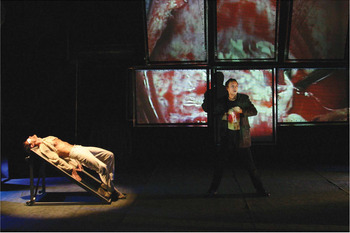
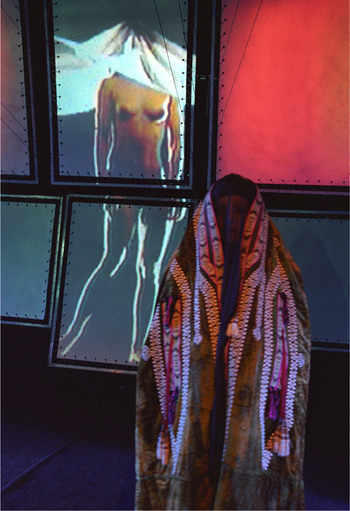
The Poet/Filmmaker recites Pushkin’s “Prophet” as a young man enacting the prophetic awakening lies on an angled plank in front of a video screen projecting open heart surgery. Imitations of the Qur’ an, Ilkhom Theatre, Tashkent, 2002. (Photo by Vitaly Evdokimov; courtesy of Ilkhom Theatre Archive)

Actress and cofounder of Bata, the Almaty, Kazakhstan–based experimental theatre group, Veronika Nassalskaya began a workshop with students at the University of Chicago by calling out a series of concrete and then abstract nouns. I translated from Russian.Footnote 1 “Let’s start with the game we played with you in Tashkent [Uzbekistan],” she said to me. “Translate for the class: I’ll say a word and you translate. You [to the students] close your eyes. When we say the word, you take a pose and embody it.” Many of the students responded to the concrete nouns by either using their bodies to try to mimic the external form of an object, or to stage scenes of the object’s use, while they largely interpreted abstract nouns by embodying a static representation of an emotional response. Then Nassalskaya threw in a twist. To me: “Say liubov [love] but don’t translate.” The students responded variously, some with confusion and amusement, some by trying to interpret the phonic sensation of the word as well as my accented mimicry of Nassalskaya’s original. Coming from the multilingual, multiethnic periphery of the former Soviet empire in post-Soviet Kazakhstan, Nassalskaya has made the problems of cultural, embodied, and linguistic translation central to her practice. Her exercise exposed the students’ uncomfortable struggle to formulate a bodily response to a foreign liubov they couldn’t understand.
The subject of translation in theatre-making was the theme for an experimental collaboration at the Gray Center for Arts and Inquiry at the University of Chicago. The collaboration brought together a small group of actors and musicians from Central Asia and a local electronic musician for a 10-day workshop in the fall of 2018 culminating in a public performance.Footnote 2 I co-organized the visit with Leslie Buxbaum Danzig, Assistant Professor of Practice in the Arts at the University of Chicago and Collaborating Director of the Chicago-based dance-theatre company Lucky Plush Productions. The project brought together the Ilkhom theatre and Omnibus musical ensemble from Tashkent and the Bata theatre from Almaty — including Nassalskaya, as well as Vyacheslav Evstafiev, musician and cofounder of Bata; Boris Gafurov, artistic director of the Ilkhom; and Artyom Kim, founder of Omnibus Ensemble — with Chicago-based electronic musician Brother El (Lional Freeman). Chicago-based sound technician and Tashkent native Gene Nemirovsky also joined the crew to help facilitate sound, tech, and translation. The experimental studio at the Gray Center at the University of Chicago was in an extremely well-organized state of chaos for that week: littered with cords, switches, speaker sets, sonically layered with synth tones against Central Asian strings, and peppered with Russian, Uzbek, and English. In the absence of a common language, Nassalskaya’s opening exercise framed the 10-day collaboration, as the students grasped for the phonic sense between sound and gesture when semantic translation failed. The collaboration began with no plan. The few words of English Nassalskaya and Gafurov knew, they extended with their bodies. They brought texts from Bata and Ilkhom’s repertoires — adaptations of Central Asian mythology and 19th-century Russian poetry — to use alongside Brother El’s improvisational sonic compositions and his reading of the verse of local poet, scholar, and journalist Tara Betts. Brother El read a line about lynching as Gafurov screamed about the police and Nassalskaya mimed the pain of a mother’s loss. They played with different scripts across multiple languages and cultures, as if living in coterminous worlds. In their discontinuous bodily rhythms, they shared a level of attention and degree of sensitivity to one another that underscored their divergent experiences of subjection to state forms of bodily management.
On his first day, Gafurov noticed the women’s prison downtown and the police presence on the South Side of Chicago, particularly noting their presence near the campus, which employs one of the largest private security forces in the US, in addition to the Chicago police department (Eldred Reference Eldred2017a, Reference Eldred2017b; Kartik-Narayan Reference Kartik-Narayan2018; Larson Reference Larson2012).Footnote 3 “Are they here for us?” he asked half-joking as we walked out of the studio late one evening. The location of the performance at the university further marked a tension between normalizing functions of the state’s regulation of bodies through forces of containment and control, exposing in turn the university’s promotion of discourses of diversity. The collaboration in this way made race and ethnicity both ever-present and ever-erased, at once highlighting the dominance of the university’s cultural whiteness and class privilege over the surrounding community. Expensive new dormitories were rising up as surrounding low-income, largely segregated neighborhoods continued to collapse into postindustrial infrastructural deserts where food, medical care, and education are inaccessible while the city’s manufacturing jobs are lost to the proximate right-to-work state, Indiana. Gafurov’s attention to the police also highlights resonances between Chicago’s South Side and post-Soviet Uzbekistan’s authoritarian state. Uzbekistan’s protracted state of collapse — an economy crushed by capitalist corruption, a failed transition from a command economy, and the lingering Soviet political-military apparatus — was compounded by President Islam Karimov’s patriarchal ethnonationalist regime where one’s papers are checked by machine gun–armed militia just to clear an underpass. The Tashkent-Almaty-Chicago collaboration thus highlighted a break in the normalizing function of the university’s staging of diversity as the bodies of the performers sounded translational and gestural dissonance, in turn exposing and complicating the production’s representation of race and ethnicity. As I sat on a second-floor balcony frantically trying to provide projected supertitles translating the performance, with every rehearsal the script changed, as if productively resisting my efforts to pattern some form of homogeneous inscription.
The challenges of translation exposed by the collaboration call for a comparative historical reading that moves between our work on the South Side of Chicago and Brother El’s involvement in the local art scene, the University of Chicago’s gentrification of the neighborhood, and the history of violent regime change amidst the emergence of post-Soviet ethnonationalisms, as well as Ilkhom and Bata’s experimental interventions in Tashkent and Almaty. Registering these conflicting authoritarian and reparative forces, the collaboration staged an embodied translation that reassembled the actor’s and musician’s bodies across temporalities that were at once out of joint yet found themselves in step. They thus highlighted historical, material, and embodied imprints of forms of violent political and economic control over the body in the performance.
Embodied translation, or embodied philology, puts performance in dialogue with semiotic theories of relational subjectivity extending beyond the action at hand, citing a series of previous adaptations, authorial visions, actors’ embodiments of the script, and the histories of their capture on and off the stage. In these ways, embodied philology explores tensions within divergent discourses of race and ethnicity. As the collaboration put in motion improvised gestures and poetry, it made visible the problems of thinking about race in the context of a post–Soviet-US relationship still haunted by Cold War claims to liberationFootnote 4.
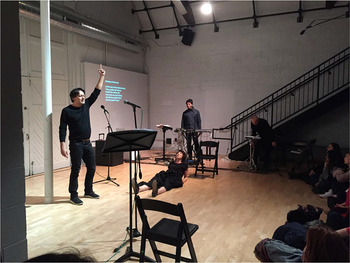
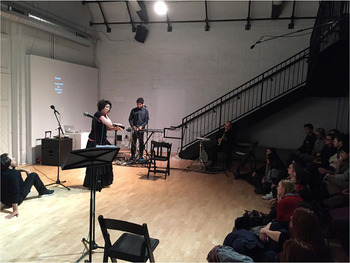
Gafurov as the Poet delivering lines from Imitations as Brother El and Vyacheslav Evstafiev improvise a musical composition. Mobilizing through Improvisation: A Global South and Southside Chicago Collaboration, staged at the Gray Center at the University of Chicago, 2018. Pictured are actors Veronika Nassalskaya and Boris Gafurov, and musicians Brother El (Lional Freeman) and Vyacheslav Evstafiev. (Courtesy of the Gray Center for Arts and Inquiry, the University of Chicago)

Improvising Internationalism in Post-Soviet Uzbekistan
The Soviet empire’s relationship to its “colonies” in Central Asia and the Caucasus, the formerly Russian imperial territories reannexed during the civil war that followed the Bolshevik revolution, was characterized by a complex history of negotiations with local elites, forms of coercion and seizure of local land and resources, political assassinations, and undue juridical process. All this served to modernize, order, regulate, and assimilate under Russian-Soviet authority the non-Russian and specifically “non-Western” Muslim populations. While during the first 5 to 10 years of Soviet rule the administration promoted the work of some native Jadidists (Muslim modernist reformers) who had been working since the 19th century to build new technological, political, and social infrastructure — from electrification to the construction of hospitals and schools — it also subjected the people of Central Asia and the Caucasus to decades of Stalinist violence. The Soviet leadership murdered many local reformers it had relied on to reconsolidate the empire, subjected farmers to forced collectivization, centralized extractive resource production such as cotton, and closed the borders with neighboring countries, crushing cultural and familial ties that had long stretched across the region.Footnote 5
The complexity of annexation during the Civil War (1917–1922) and the subsequent division of Turkestan into the Central Asian republics was further compounded by the competing interests of Jadidist reformers, anti-Soviet Basmachi resistance fighters, and local elites. The main resistance began during WWI when Basmachis organized against drafting Muslims to fight in the war. During the civil war, the Bolsheviks mounted bloody campaigns to annex former imperial territories, including an attack on Turkestani Muslim–led Kokand in the Fergana Valley killing 25,000. Responding to this attack, the Basmachis, under the leadership of Enver Pasha, fought back. However, in 1918 the Bolsheviks succeeded in establishing the Turkestan Autonomous Soviet Socialist Republic, which was then divided by Soviet ethnographers in 1924 into the Uzbek and Turkmen Soviet Socialist Republics (SSR), Tajik Autonomous Soviet Socialist Republic (ASSR), and the Kyrgyz and Kara-Kalpak Autonomous Oblasts according to a system of ethnonational organization devised by Russian and Soviet orientalists (see Cadiot Reference Cadiot2007; Il’khamov Reference Il’khamov2006; Khalid Reference Khalid and Tomohiko2007).
The orientalists categorized the linguistic, cultural, and territorial distinctions that both drew boundaries suppressing minority populations and placed groups on a Soviet progressivist historical-civilizational timeline. This subjected them to a process historian Francine Hirsch calls double assimilation into national categories and the greater Soviet whole (Reference Hirsch2005:63–97).Footnote 6 Soviet modernization policies in the 1920s and 1930s included campaigns to unveil Muslim women known as “the assault” (hujum) as well as promoting local elites to government posts.Footnote 7 Forced unveiling often resulted in the rape and murder of women, while European-Russian outrage at the preferential promotion of locals whom they saw as inferior also brought acts of violence and cases of murder (see Northrop Reference Northrop2004; Khalid Reference Khalid2015:356–62).
While the Soviet government continued to regulate activities in the Central Asian republics, a thaw came after Nikita Khrushchev’s 1956 secret destalinization speech. The policy of “friendship of the peoples” reemerged (following its first appearance in the 1920s; see Kirasirova Reference Kirasirova2014:3). In addition to its own domestic context, Soviet internationalism was a response to the rise of human rights movements across Europe and nationalism in emerging postcolonial states.Footnote 8 Responding to internationalist campaigns such as negritude, pan-Africanism, and the nonaligned movement, the Soviet Union featured their colonies in Central Asia and the Caucasus republics as examples of a commitment to anti-imperialism. The USSR sponsored organizations such as the Afro-Asian Association, which held conferences from Tashkent to Beirut and published multilingual literary journals collecting the work of writers from across the Soviet Union, Middle East, Africa, and Asia. The Soviets also funded the People’s Friendship University, aka Patrice Lumumba University, founded in 1960, focused on drawing students from nonaligned nations (see Djagalov Reference Djagalov2017 and 2020; Djagalov and Salazkina Reference Djagalov and Salazkina2016; Kirasirova Reference Kirasirova2014; Popescu Reference Popescu2014; Popescu et al. Reference Popescu, Tolliver and Tolliver2014).
Ilkhom was founded in 1976 in the wake of this internationalist moment as the Experimental Youth Studio (ESTM, Eksperimental´naia studia teatral´noi molodezhi), which not only served as a youth theatre but like many institutions of the time also hosted Afro-Asian film festivals and conferences featuring nonaligned decolonial nations (see Lisack Reference Lisack2013; Ilkhom Theatre n.d.; Kasimova Reference Kasimova2020). Ilkhom was thus not only tolerated, but indeed funded by Soviet authorities who turned a blind eye to its more experimental projects.Footnote 9 As if an extension of a very Soviet vision of the state as parent — the name Ilkhom means “inspiration” — the theatre draws on a vision of regeneration. By day, the theatre hosted official events that kept Soviet authorities content with its state function, including gatherings of Komsomol (Soviet youth organization) members, international film festivals, and avantgarde agitprop public square performances on the outskirts of Tashkent.Footnote 10 However, by night Ilkhom operated as an underground space for experimental youth productions spread by word of mouth and begrudgingly tolerated by Soviet authorities. Ilkhom’s emphasis on musicality and poetics reflects the influence of contemporary Russian-Soviet experimental theatre, in particular Mark Weil’s training in the 1970s at the Soviet Moscow-based Taganka theatre run by Yuri Liubimov and its emphasis on poetry (see Beumers Reference Beumers1997). While in the post-Soviet years Ilkhom distanced its Soviet underground productions from official politics, the theatre was marked by both this internationalist history and the cosmopolitan city of Soviet Tashkent, home to a multiethnic, multilingual population of Muslims, Bukharan Jews, Eastern Orthodox settlers from the Russian empire, Soviet Jewish writers and thinkers who fled the war, as well as Soviet filmmakers from other republics searching for work and better living conditions. Ilkhom’s former director Weil, himself an Uzbek Jew, spoke often in interviews of his personal commitment to presenting on Ilkhom’s stage the complicated and generative heterodoxical intersections of Tashkent.
The post-Soviet transition, however, brought Soviet regulatory and surveillance tactics in joint forces with a new ethnonationalist agenda. As Laura Adams argues, Uzbekistan’s cultural renewal reappropriated Soviet interpretations of Uzbek national culture and identity while removing their socialist ideological content (2010:7). The post-Soviet Uzbek state, particularly under Islam Karimov who ruled from 1989 until his death in 2016, continued Soviet traditions of relying on mass spectacles of symbolic state power as a means of political control alongside militarization and terror, particularly when the state security apparatus expanded after its deadly repression of the uprising in Andijon in 2005 (7).Footnote 11 Despite ties to Soviet state practices, Karimov’s terror regime contributed to the construction of an ethnically based national identity, which radically diverged from the Soviet multinational model, and ultimately contributed to both xenophobia and state mechanisms for repressing dissent.
Through the collapse of the Soviet Union and rise of Uzbek nationalism, Ilkhom’s repertoire continues to rely on Russophone-dominant multilingual adaptations of European, Russian, and Soviet theatre, film, and literature, thus aligning its repertoire with a lost period of Soviet internationalism that was central to its founding. In the post-Soviet moment, this enduring repertoire crucially became the theatre’s mode of resisting emerging ethnonationalism.
The theatre’s work from the 1990s and early 2000s, which continues to form the backbone of its repertoire, reflects the precarity of the state transition and the central place of the theatre within it. Ilkhom’s adaptations in the post-Soviet moment thus playfully recall Stalin’s cliché, “national in form, Soviet in content,” in which form and content are distinguished by the force of a modernizing mechanism of adaptation as a process of assimilation into the great Soviet whole. Ilkhom’s adaptations however, many of which were staged in the early years of Soviet collapse and the formation of new nationalisms, radically resist the ethnographic dimensions of “national form” in their minimal sets that place much of the plays’ action in a neighborhood square, a collective housing unit, a central courtyard, or a train station. Ilkhom not only cites the earlier tradition of street theatre, from the Central Asian Masharaboz to Soviet agitprop, but crucially calls upon the gestures developed through the shared experience of producing the plays within conditions of economic and political precarity.
A famous adaptation of John Steinbeck’s Tortilla Flat (1935), which Ilkhom debuted in the mid-’90s, presents the California paisanos as multiethnic Soviet residents of a Tashkent mahalla living in a communal apartment. These hybrid identities resisted an emergent post-Soviet nationalist vision of Uzbek purity. Another adaptation from the mid-’90s, of Carlo Gozzi’s 18th-century play The Fortunate Beggars, highlights emergent informal economies and labor migration set against the transience of a train station, itself a potent symbol for Soviet modernity. The actors mediate an attachment to the Soviet past with its communal living and state paternalism by instead envisioning the small space of the theatre and the life of the actors inhabiting it as a site for assembling new forms of community.
The theatre carries on its famed underground tradition of working through the night, both an effort to evade censorship and to keep production costs low, accommodating the young actors (most are 16–25 years old) who balance day jobs with their theatre work. These exuberant young actors, who often rarely have much more than a few coins and a bent slim cigarette in their pockets, transform the narrow halls and rehearsal rooms of the underground theatre into a space for imagining alternative life-worlds beyond the limited opportunities on the street in a precarious economy characterized by ever-growing inequality and limited employment. Ilkhom fights to remain a community-led theatre, training local actors, holding its relatively modest ticket price (higher than the state theatres, but still between US$2–5.00), and resisting recent efforts to sell the old factory building that houses the theatre, a café, and small gallery. It also retains its internationalist ambitions, hosting workshops and festivals for artists across Central Asia, touring and conducting training from Moscow to China, and for a time engaging in a sister-city exchange program training actors from Seattle, WA. Indeed, Weil framed the Soviet and post-Soviet periods as waves of authoritarianism:
For me and my theatre, we completely got the feeling that we crossed the same point in history for a second time. Only, the first time this was the history of the enormous empire, the second time the history of a new country — a fragment of the mirror of empire — in which a more provincial variant, the sores and defects of a nondemocratic system, were reflected. As a nonstate theatre, we are not directly affected by censorship. However, we found ourselves alone nonetheless.
(Weil [2001] 2012)Footnote 12Ilkhom and Omnibus’s Heterodox Improvisation
The post-Soviet extension of elements of Soviet statecraft, which Weil highlights, perhaps most notably included religious practice. While the Soviet administration had largely opposed religious practice, it crucially generated state-sponsored networks to regulate Islamic practice in Central Asia. It created Muslim Spiritual Directorates, appointed Imams, surveyed their sermons, and regulated published materials. These networks sought to realign Soviet-Muslim partnerships in order to regulate minoritarian religious groups. All those who fell outside Soviet state–sponsored networks were considered fundamentalists and placed under KGB surveillance. With the collapse of the Soviet Union, many of these networks, as well as state infrastructure and personnel, remained intact, particularly in the “peripheral” republics of the Caucasus and Central Asia where ex-communist bureaucrats continue to oppose free religious practice, and further contribute to interethnic violence through the consolidation of new nationalisms. Religion in this way is often used as a pretext for political persecution and control. The 1998 law On Freedom of Conscience and Religious Organizations exemplifies the state’s broad regulation of religious assembly, religious publications, and the creation of “social movements” based on religion. It provided Karimov’s government with legal cover for state surveillance and the repression of broadly political and religious dissent, such as its claims that the violent repression of the Andijon revolt was an act of regulating religious extremism.Footnote 13
Ilkhom is known not only as the first independent theatre of Uzbekistan, but also for its production of controversial queer and religious themes despite a series of hardships. In 2007 Ilkhom’s founder and former director Mark Weil was stabbed to death on his doorstep as police stood nearby (Rakhmanova Reference Rakhmanova2009). The details surrounding the murder have led to much speculation about government involvement. As a queer Bukharan Jew, Weil was a controversial figure in the post-Soviet cultural scene. The widely cited motive for the murder was Ilkhom’s 2002 adaptation of Alexander Pushkin’s poetic cycle, Imitations of the Qur’an (1826). Weil’s assailants allegedly described the play’s controversial depiction of Islam through erotic dance and multimedia video projections as an offense against the Prophet.Footnote 14 The alleged violence of Imitations at once rests on Weil’s challenge to an orthodox vision of Islam tied to emerging patriarchal nationalist discourses as it plays on the doubly removed imitation of Pushkin’s imitation of the Qur’an.
Ilkhom’s adaptation of Pushkin in many ways draws on the complex intersecting histories of the Russian and Soviet empires. Pushkin’s poems contributed to an archive of Russian Orientalist writings, many of which were set in the Caucasus.Footnote 15 In Imitations, Pushkin imagines himself as the Prophet Muhammed on the road from Mecca to Medina, self-figuring as the prophet of Russian literature. The poem “The Prophet” within this cycle of alleged Qur’anic “imitations” instead locates a “credibility of feeling,” following Stanislavsky’s description of the actor’s embodiment of a role, in a stylistic evocation of an Old Church Slavonic rendering of Ezekiel’s vision from the Old Testament. In this way, the high register of Old Church Slavonic defamiliarizes the Qur’anic imitation for a Russian readership.Footnote 16 “The Prophet” describes the poet’s spiritual crisis through his violent transfiguration by a six-winged seraphim. Gouging his eyes and replacing his heart with coal, the angel resurrects him from a half-dead state endowing him with prophetic vision. Both civically and erotically charged, the poet is called upon to spread the word of God. Writing after the anti-Tsarist Decembrist revolt, Pushkin passionately supports the poet’s role as defender of the moral and political rights of the people. The poem thus draws on an Orientalist imaginary to sublimate the authority of the poetic word in the service of promoting an anti-Tsarist agenda, by highlighting the individualized aesthetic and spiritual experience of poetic prophesy. Imitation’s “credibility of feeling” thus relies on a civically and erotically charged prophetic word to shape a vision of the power of the Qur’an, and by extension, the poetic cycle’s participation in an Arabic tradition even as it is devoid of Arabic, that is, as a work of “race writing” and unwriting. Pushkin’s Orientalism is further complicated by his framing as the father of modern Russian vernacular literature, a figure of populist Soviet multiculturalism, and as part of a Soviet campaign to return to the classics. Indeed, as scholars such as Anne Lounsbery and Catharine Nepomnyashchy have argued, Pushkin was also hailed as a figure of black internationalism in 20th-century African American scholarship, citing the poet’s lineage as the great-grandson of an African slave.Footnote 17
Drawing on the legibility of Pushkin in post-Soviet Uzbekistan as at once a figure of Soviet internationalism and a reminder of Russia’s imperial past, Ilkhom translates Pushkin’s self-exoticizing Orientalism by challenging religious orthodoxy through a performance of an erotic dance-prayer. The production relies on a relatively bare set consisting of only a few props such as a camera and two chairs to evoke a film studio or a set of towels to recreate a bathhouse. The production includes intense soundscapes that blend recitations of prayer and religious song with electronic mixing and local musical instruments, lengthy dance sequences, and video projections. The first scene opens with the filmmaker, presumably the poet, at work. He breaks the fourth wall, venturing into the sound booth to offer the tech a quick smoke. Locals — from a middle-aged Muslim man in a tubeteika speaking in Uzbek to a nightclub dancer with her chest bared speaking in Russian — speak the lines of Pushkin’s “Prophet,” describing the poet’s journey, thirst, and spiritual and erotic awakening:

(POET: Tormented by a spiritual thirst,
I dragged myself through the gloomy desert,
And a six-winged seraphim
Appeared to me at the crossroads.
With fingers light as a dream
He touched the pupils of my eyes,
Which opened wide in prophesy.)
Redoubling and splitting Pushkin’s lyric subject, the actors repeat lines in Russian and Uzbek, and marked by the inflection and gesture of each role, challenge the poem’s imperial legacy — a romantic exoticism that characterized the Russian imperial poetic canon. The division of the lyric subject through the delivery of a sequence of screen tests for the poet-filmmaker by the multilingual, multiethnic cast also recalls a proletarian Soviet internationalist image of the Tashkent street, as it highlights emergent post-Soviet tensions, such as the shock of the exposed breasts of the nightclub dancer. The distribution of Pushkin’s romantic verse, cleaved across multiple sites of enunciation, generates rhythms of vocal (a)synchronization, bringing the fragmented lyric subjects in concert through eroticized movements and recitations of the Qur’an. The action then moves through the dramatization of the poem as the filmmaker/poet recites the lines now over a young man lying on an angled plank in front of a video screen, whose white clothes and long hair indicate him as the prophet. The filmmaker recites the lines while caressing the prophet’s body as the video screen projects an open-heart surgery. The poet reads the lines “He touched the pupils of my eyes, / Which opened wide in prophesy” as he inverts the erotic seduction, taking on a more active role as he leans over the prophet’s body, pressed against the angled plank.
An early collaboration between Ilkhom and Omnibus Ensemble, this 2002 production of Imitations of the Qur’ an integrated improvisational choreography devised through Omnibus’s method of collective composition. Kim describes this method as a nonhierarchical process in which “the creators are also performers” involving various stages including: “practical techniques, which teach the performers to generate, feel, and control fine creative energies not only as individuals, but more importantly as a collective.” The performers draw on “exercises for physical and emotional relaxation, mental focus and activating a sense of intuition,” generating a “collective information field.” Finally, the group settles on the “selection and fixating (with the use of different ways of notation) [of] the creative ideas” (Kim n.d.). The process of selection and notation distinguishes Omnibus’s practice from other collectives that dissolve individual impulses. Omnibus highlights the individual acts of reading and writing on the part of actors and musicians as they in turn work within the collective information field the performers create.
As Omnibus’s musicians compose for Imitations of the Qur’ an, Ilkhom’s actors formulate tones, rhythms, and harmonies into movements. Instead of awaiting cues from a director, the actors organize collective close readings of the Pushkin verses that form the basis of their production. The actors themselves outline dramatic tensions and highlight important terms before joining together with musicians. After these preparatory readings, Ilkhom’s actors engage with Omnibus’s collective composition, experimenting with meter and inflection, reacting to rhythm, tempo, and other musical cues. As the Ilkhom actors absorb the music through breath, the words grow into forms in their bodies, which through trial and repetition they fix into patterns that eventually assemble into collaborative scenes onstage.Footnote 19 In this way the movement emerges from the word’s birth through music. The role of artistic direction is mediating the musical, physical, and lyrical gestures.
Scene of prophetic awakening, mirror projection of the Prophet on the angled plank. Imitations of the Qur’an, Ilkhom Theatre, Tashkent, 2002. (Photo by Anatoly Rakhimbaev; courtesy of Ilkhom Theatre Archive)

Omnibus and Ilkhom’s collaboration on Imitations shares an interest in improvisation as a radical method that moves away from the central figure of the director to highlight the role of the performer and performance collective in staging embodied translations. Ilkhom and Omnibus work to upend the disjuncture between word and gesture by, as Fred Moten writes of the improvisational aesthetic in the black radical tradition, reclaiming the syntactic “degeneracy” of phonic matter (2003:7). For Moten, an emphasis on the phonic draws on the embodiment of the utterance that brings text and performance into action. He thus recuperates the “material degradations” in language, not only by reimagining philological praxis through the linguistic turn, but through traveling in the break (a phrase he borrows from jazz), improvising here through and against Marx and Saussure.Footnote 20 Being “in the break,” musically, linguistically, affectively, frames the tactic of improvisation as:
located at a seemingly unbridgeable chasm between feeling and reflection, disarmament and preparation, speech and writing […] Improvisation is already an improvisation of improvisation: through the oppositions implicit in the etymology, through the proscriptive and differential temporality of those oppositions; on the one hand, anarchic and ungrounded, opening a critique of traditions and Tradition, and on the other hand, no simple and naïve, unplanned and nonhistorically driven, inscription; on the one hand, the very essence of the visionary, the spirit of the new, an organizational planning of and in free association that transforms the material, and on the other hand, manifest in and as the material.
(Moten Reference Moten2003:64)In the break between speech and writing, Moten reinserts the etymology of the word “improvisation” as “action or speech without provision” that nonetheless calls to us to “look ahead with a kind of torque that shapes what’s being looked at,” a “prophetic” force of remaking, against and through “traditions and Tradition,” and an organized transformation of material through the very unplanned process of assembly. That is, the improvisation gestured at in the break is itself a mode for theorizing improvisation that is transformative in its very material, embodied manifestation.Footnote 21 However, Moten not only offers a performative mode of doing theory, but in staging a historical inscription of the etymology of improvisation, its philological traditions, and a Tradition of reading performance, he exposes the central role of translation and interpretation in shaping the torque of improvisational praxis. Moten’s vision of a “prophetic” embodiment without foresight but with an eye trained on history exposes Ilkhom’s adaptation of Pushkin as a rewriting of Russian imperial messianism that calls for an alternative political assembly through its profane heterodox “imitation” of the Qur’an. The performance’s engagement with the doubling and splitting of the role of the Prophet in the opening screen test casting sequence furthermore emphasizes the rhythms of the phonetic by challenging post-Soviet patriarchal ethnonational piety.
While the script for Ilkhom’s Imitations draws only on Pushkin’s poems, Ilkhom’s collaboration with Omnibus introduced Arabic suras and Uzbek devotional singing.Footnote 22 For example, the scene of the poet’s spiritual and erotic awakening cuts into a brief dance sequence that evokes both a bathhouse and al-wụdū’ ritual ablutions that prepare a clean heart, mind, and body for prayer. The scene engages Islamic practice not present in Pushkin’s Orientalist poetic cycle, infusing the Prophet’s piety with the erotic charge of shirtless male dancers. The scene features a recitation of the isti’ adha — a call to take refuge in the word of Allah — and sura al-Fātiḥa signifying the opening of the Qur’an, here performed to the timbres of the electric dombra. At the end of the play, the figure of the Prophet meets his double, the false prophet. The opening lines of Pushkin’s poem are repeated as the false prophet is stripped to silver hotpants and heels. The scene lays bare the artificiality of the imitation as the false prophet externalizes the Prophet’s desire onto his naked body, evoking both a contemporary queer club scene and the artificiality of the shiny hotpants he wears. This circular process of concealing and revealing the word on the body, articulated in the circular motion of the stripping of the false prophet, itself perhaps a reference to heterodox forms of prayer, is intensified by the projection of Arabic script supertitles, estranging contemporary audiences. These elements of foreignness also paradoxically return the civic and poetic charge of Pushkin’s text through the recitation of sura al-Fātiḥa, which by performing the opening of the Qur’an exposes the palimpsestic historical inscription of the prophetic word. The use of Arabic, which while signaling prayer remains semantically illegible to most of the audience of Uzbek and Russian speakers, externalizes phonic vibrations that are echoed in the instruments pulling the bodies into dance. In this way, the very dissonance created by the symbolically sacred yet indecipherable foreign Arabic incants the actor’s bodies into an imitation of prayer inflected by the eroticized bathhouse scene. Ilkhom’s staging infuses an “original” Arabic that, in turn, highlights its very absence in Pushkin’s text. In the context of the Karimov government’s strict regulation of state-sponsored religious orthodoxy under the 1998 laws, the Ilkhom-Omnibus performance of acts of Islamic devotion in Imitations is politically transgressive. The “profanity” of this scene, its queer dance that navigates between prayer and erotic desire, is thus imbricated in a critique of post-Soviet patriarchal nationalism.
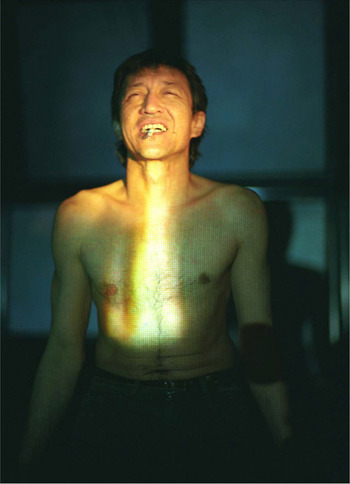
Projection of Arabic script onto the bodies of dancers during a devotional scene. Imitations of the Qurʾan, Ilkhom Theatre, Tashkent, 2002. (Photo by Anatoly Rakhimbaev; courtesy of Ilkhom Theatre Archive)

Ilkhom and Omnibus’s production offers a vision for embodied translation that engages in a textual critique of a Russian Orientalist poetic tradition as much as it offers an alternative portrait of Islamic practice and political assembly through music and dance. The production’s multiethnic multilingual “imitation” of Pushkin’s false prophesy engages the music-dance ensemble alongside the text, challenging emergent ethnonationalism in its eroticized heterodox assemblage of post-Soviet Uzbek bodies. The production in this way calls for an improvisational praxis that recovers poetry and prayer through its phonic and rhythmic “degeneracy.”
Improvising in the Break of the Cold War
Translating embodied performance across this South-South improvisational collaboration thus reframes the question of improvisation around embodied philology as the torque of unforeseen foresight and the sounding of phonic and rhythmic degeneracy. Exposing these intertwining embodied significatory regimes, as Moten reminds us, challenges a disembodied Enlightenment linguistic project with a philology of the gesture. The collaboration’s performance of embodied translations rendered legible the violent history of Soviet colonialism as well as its administrative afterlife as authoritarian ethnonationalism in post-Soviet Uzbekistan — alongside and through its resonance with racialized police violence in its staging on the South Side of Chicago. Indeed, the audience for the Chicago performance, many of whom had emigrated from the Soviet Union in the 1980s or 1990s, said that they related the performance to their own struggle to translate their ethnicity in Chicago, where they were interpolated as white in regard to the color codes of Chicago’s segregated north-south-west divide. The collaboration thus exposed the ways in which the Cold War has largely rendered illegible the multiethnic Soviet south for a US audience, in which a lack of knowledge of the regions’ overlapping colonial histories and emergent post-Soviet Russian nationalism and neofascism has in turn whitened the image of the Soviet Union. In so doing, the collaboration exposed the fault lines of economic inequality and increased policing that connect across the post-Soviet periphery’s authoritarian austerity and US racial capitalism. The performance uncovers the shared history of failed multicultural diversity mandates that in the absence of an international Left continue to conceal the hegemonic whiteness behind global neoliberalism. Exposing this connection across the post-Cold War communist-capitalist ideological divide shows the emergence and persistence of authoritarian structures now haunting Europe, Russia, and the US. These were long hidden beneath the surface of the Cold War.Footnote 23
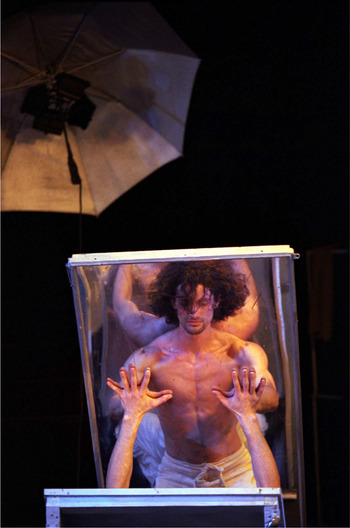
Dancer depicting the Day of Judgment, sura 39:68. Imitations of the Qurʾan, Ilkhom Theatre, Tashkent, 2002. (Photo by Anatoly Rakhimbaev; courtesy of Ilkhom Theatre Archive)

I met Gafurov, Evstafiev, Kim, and Nassalskaya in 2017 at a 10-day laboratory for young directors from Central Asia, sponsored by Ilkhom and held in Tashkent, an example of Ilkhom’s post-Soviet work fostering transnational connections in the region. I attended the workshop alongside musicians, actors, and directors from Dushanbe, Tajikistan, to Almaty, Kazakhstan. Gafurov opened the workshop by framing Ilkhom’s place in Tashkent: “Theatre is the place of communion [obschenie]. Theatre must be a social/public institution [obschestvennyi institut].” Gafurov, who was Weil’s most prominent student and one of the company’s most celebrated actors, took over as artistic director after Weil’s murder. He has continued to honor Weil’s vision of the theatre as community and pushed the work of the theatre further through continued collaborations with Omnibus. An ever-in-character misanthrope, he has a lead actor’s charm, and is tall, dark, and handsome, with tousled locks, dressed always in slim black jeans, a black worn tee, trainers, and an embroidered tubeteika — a traditional Uzbek cap. Gafurov was utterly unapproachable, often chain-smoking, leaning on a doorframe somewhere with the air of some mix between Uzbek lone ranger stoicism and Russian Drama School–style eloquence. As he corrected me once while I struggled to translate his character into an American cinematic idiom: “No not James Dean — I’m Robert De Niro!” Ilkhom’s outlaw and underground lore — always at once an animating part of its mythology and a lived reality — permeated Gafurov’s persona. He expressed amused impatience with my incessant questions about Ilkhom’s method, but begrudgingly agreed to let “America” watch rehearsals. It was perhaps a healthy skepticism of the US coupled with my general foreignness that lent a rightfully protective tone to his explanations. “Yes, we have to know Stanislavsky, but only in order to reject him. The driving principle is that theatre must reflect its place, nature, and people.” Indeed, as he recounted, “Ilkhom has always been more than a theatre; it is a form of life. Actors in the early years came here after work at the state theatre. Ilkhom was a hotel, a restaurant, a public space” (Gafurov Reference Gafurov2017).
Dancers depicting the wives of the Prophet while reciting the second verse from Pushkin’s Imitations describing their modesty and other virtues. Imitations of the Qurʾan, Ilkhom Theatre, Tashkent, 2002. (Photo by Anatoly Rakhimbaev; courtesy of Ilkhom Theater Archive)

Nassalskaya, who was visiting from Almaty to run the main seminar at the workshop, called me into the training one day, and then every day. She heavily distrusted theorizing and didn’t care much for static audiences. Her physical dynamism left an impression. I remember showing friends in Chicago clips of her performances and even in the doubled mediation of a fuzzy recording in a foreign language with no subtitles her energy was captivating. She shares Gafurov’s classical training, but brings to it a tension, always ready to break genre and unravel into fragmented rhythmic tones and plastika, silent, mime-like gestural descriptions, that could swell with drama until they broke into comedic miming. In her one-woman show, Pushkin Stand-up, she highlights a lingering Soviet shared cultural tradition of memorizing Pushkin’s verse as she seamlessly turns from eloquent dramatic readings of his Eugene Onegin to parody. Her performance is at one moment keyed to the drama of Pushkin’s revolutionary Orientalist imaginaries, and in another, transformed into parodic drag comedy–miming a dandy at a disco — exposing the sentimental misogyny bundled in these romantic verses and imperial legacy. In the workshop with Nassalskaya we performed tonal and body work, and trust exercises. Eventually I was cast in a play in the workshop that called for a French character. I rehearsed until 3:00 a.m., slept and showered, and returned at 10:00 a.m., trying to keep pace with the energetic 20-year-olds. I was yelled at and supported. We sang old Soviet songs together, ate hand pies, drank a lot of instant Nescafé, and sometimes slept on the floor, as Ilkhom’s actors had done for 40 years. The theatre’s absorption of the life rhythms of its actors indeed remains a living part of its history.
While the early conversations took place in 2017 in Tashkent when I met Gafurov, Evstafiev, and Nassalskaya, the collaboration took shape a year later over an early video call with Brother El as the group discussed their mutual interest in sampling. I had the chance to meet Brother El through a contact in the Chicago house scene who had expressed admiration for his international collaborations and experimental improvisational projects.
Like Ilkhom and Bata, Brother El’s work scales from local to transnational, drawing on music to shape public space. Intervening in Chicago’s South Side gentrification, Brother El builds on the work of his mentor, sculptor Milton Mizenburg, who inspired him as a youth, cleaning up vacant lots and transforming them into open-air galleries. Brother El’s annual Sandbox Symphonies convert the lakefront Oakwood beach into a gallery for multisensory information, incorporating sandcastle constructions, a food market, art, dance, and of course beats. In a 2019 article, Tara Betts highlights the influence of Augusto Boal’s Theatre of the Oppressed on the Sandbox Symphonies, alongside a series of similar Chicago-based community projects that frame the street as a scene for both political action and community building through multisensorial, sustainable, DIY art (Betts Reference Betts2019). Brother El’s work, from the Symphonies to his numerous transnational collaborations, exemplifies an approach that critically attends to innovation through acts of citation, repetition, and reimagination of text and sound across multiple sonic environments, as well as an engaged openness to transforming and growing his practice through intermedial collaborations with local and international artists and musicians. As he put it, “Art is all a conversation, because there is some discourse you’re getting from someone whether you get a response or not. You put something in the sun and you get shadows; you can pull from that” (Brother El Reference El2020).
Brother El’s “spontaneous composition” draws on electronic keyboards, synthesizers, and drum machines — instruments that mediate feelings and sensations — to compose, as he says, “off the dome.” He works through resonance and reverberation, recalling improvisational freestyle techniques from hip hop to jazz, responding to and transforming a musical history. In his work, the assemblage of notes, tone, and rhythm — mediated through the musician’s body — formulates basic units of composition, and drawing on techniques such as sampling, exposes the break as a site of historical repetition. A tone, chord, or rhythm recalls a key, which intones a riff, song, or entire musical archive. The body of the composer in this way becomes the mediating instrument, drawing these seemingly disparate musical elements to form a chorus. Brother El’s electronic sampling responded rhythmically to Evstafiev’s folk instruments, both in their own ways challenging the hegemony of the notational forms and structures of European and Russian classical music. It was as if folk beats transcended the mechanization of electronic synthesis. Kim served as a mediator, eschewing the authoritarian role of director with a kind of casual formality, and as if charged by the chaos, held to his method of collective composition.
Brother El’s “spontaneous composition” draws on the technique of sampling, but trades record samples for speech. In his track “A Message of Warning” from his album The Enemy Wants Us Dead (2015) he describes sampling a speech by Louis Farrakhan: “I took a speech and made music around the speech. I was influenced by what he was saying and his rhythm,” a practice of making art from other art, which in her interview Betts also frames “as a sort of ekphrastic thing” (Betts Reference Betts2019). Like an adaptation, sampling’s ekphrastic, or rhetorical vividness, which transforms rhythm into a visual and sensuous experience, also foregrounds the role of time. Brother El clarifies:
It’s a fundamental of the hip hop aesthetic, scratching in words. In early hip hop, you scratch the break. Playing with words, I’ve been fond of it, as long as I could do it. Everyone knows the voice is an instrument, but I’m taking the instrument and giving it a whole new function and making a new thing. Sample art is collage based, but what I do with words is not necessarily collage based. The collage creates a new phrase, but I also use words as tones.
(Brother El Reference El2020)Like Ilkhom’s Imitations experiments with role doubling and splitting, “A Message of Warning” samples Farrakhan’s speech to highlight repeated words, drawing on the tones and rhythm of his voice as the very foundations of the musical composition, which for Brother El provides an opportunity for articulating his relation to the history of police brutality that the speech describes, and to the continuation of police violence. Repetition formulates forms of sociality and solidarity in the track. Sensations of rhythm, tone, key, or word, as Elizabeth Freeman writes of sense-methods, “can rearrange the relations between past and present, linking contemporary bodies to those from other times in reformulations of ancestry and lineage” (Reference Freeman2019:15). Brother El’s account of improvisation, working temporally through sampling, and scratching words in the break, also calls up Moten’s recuperation of the phonic, as he draws on the improvisational aesthetic of jazz to challenge the Enlightenment linguistic project by upending its disjuncture between word and gesture, its quest for a universal science of language, and its devaluation of its material phonic dimensions.Footnote 24 Moten’s account of jazz improvisation is a theory of adaptation because being “in the break” is a space in which a defamiliarized repetition starts a new beginning, the very location of the transformation of art through ekphrasis.
Bata specializes in blending folk instruments and electronic music. After their involvement in the more overtly political neoavantgarde troop Artishok, Nassalskaya and Evstafiev recently challenged Bata to explore the ways in which shifting social transformations are exposed through breaks in genre. Bata’s productions blend verse with music sampling that integrates synthesizers and Central Asian folk instruments. Bata’s work draws on adaptation to attack another dimension of post-Soviet myth-making, the turn from an Islamic past to an earlier Central Asian imaginary of mythic, nomadic, shamanistic culture. For example, their play Queen Tomyris narrates the mythic battle between the Central Asian Queen of the Scythians and Cyrus the Great, ruler of the Persian empire in 530 BCE. The performance alternates genres from neoavantgarde in the style of Heiner Müller to a shifting physicality from the stasis of Roman theatre to the dynamism of Greek theatre. Their 2017 production Er-Tostik Groove, an experimental electronic verse adaptation of the journey of Kazakh mythic hero Er-Tostik to the underworld, draws on hybrid sonic forms to challenge the authenticity claims of post-Soviet nationalist imaginaries. In their collaboration with Brother El, Bata planned to explore the relationship between voice and sound as well as new forms of sampling and improvisation.
This newly formed Chicago collective improvised around fragments of Bata and Ilkhom’s productions, Queen Tomyris and Imitations of the Qur’ an, played by Nassalskaya and Gafurov, accompanied by Evstafiev on the electric dombra, with Brother El reading Betts’s verse and mixing. A crucial break in the performance’s embodied translation of these verse fragments focused around a moment in the improvisation that made palpable a rupture in linguistic and genre forms. Nassalskaya as Tomyris laments the kidnapping of her son. She stands center stage and delivers the following lines, meant to imitate the style of Euripides in Russian, breaking through the genre of myth to reveal the immediacy of a mother’s loss of her son, which in turn, drives the force of her rageful revolt.
Nassalskaya as Queen Tomyris with musical accompaniment from Brother El and Vyacheslav Evstafiev. Mobilizing through Improvisation: A Global South and Southside Chicago Collaboration, staged at the Gray Center at the University of Chicago, 2018. Pictured are actors Veronika Nassalskaya and Boris Gafurov, and musicians Brother El (Lional Freeman) and Vyacheslav Evstafiev. (Courtesy of the Gray Center for Arts and Inquiry, the University of Chicago)


(TOMYRIS: I will show Cyrus how the Scythians
Know how to nurse and raise a battle.
Gods, I call your witness —
On the great steppe, we are still masters!)
Gafurov takes over, annunciating Pushkin’s verse in the round timbres and clear articulation of a dramatic monologue:

(POET: Pray to the Creytir…
The merciful, He who opened
Muhammad to the shinning Qur’an.
May we move into the light to know Him
May the mists that blind us lift!)
“Moi Koran” [My Qur’an], Gafurov repeats. “Qur’an…I have one,” Brother El echoes. “Do you know Pushkin?” Nassalskaya interjects. “I know the Qur ’ an,” Brother El says, turning from Pushkin’s imitation to the “original” word. He recites sura 93:1–11 in English; Gafurov echoes in Russian. “No, Pushkin, the poet,” Gafurov insists. “Push-who?” Brother El asks perplexed. Nassalskaya breaks character and joins the conversation, pulling up her costume to reveal a T-shirt printed with an image of Pushkin’s face and the words “Push-King” printed across it. “Push-King,” Brother El repeats smiling, “that’s me,” and strikes a note on his keyboard.
“Pushkin was black,” Nassalskaya states, gesturing at her shirt and her own curls, and then Brother El. He responds to the cue by removing his hat, touching his own hair, and begins to read “Ode to the Rope” by Tara Betts:
BROTHER EL: Into the trees,
Artifact of capital punishment,
Lives are seized
As last energies are spent.
Man on your leash
Kept in place
Until his kicking ceases
The dusk shaded his face.
Almost anonymously
You bind men to murder.
When they reach your end
They cannot go any further.Footnote 26
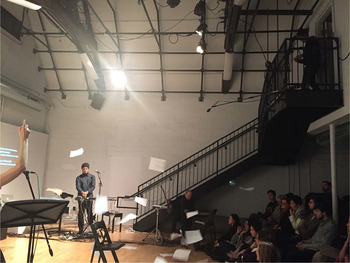
“They cannot go any further,” Gafurov echoes, agitated, and begins to climb the stairs on the outside edge of the stage, hitting the railings as he ascends toward a small loft above the stage. “Fuck the police!” he cries, ascending the stairs while vigorously banging the railing. He exits the stage to the small loft and throws down torn fragments of paper with lines from Pushkin’s Imitations into the crowd.
A series of gestures links otherwise disjointed vignettes. The myth of Tomyris sounds in Nassalskaya’s rage, rising from mother to master. Pushkin’s imitation of prayer turned erotic creation becomes a cue, reminding Brother El of the Qur’an’s resonance as a mode of resistance, carrying in its English translation the traces of a black radical Muslim tradition. Nassalskaya’s play on words and tones — “Push-King” — both tunes a key, echoing a resonance of structural inequality while drawing a visual dissonance between divergent US biologically determined discourses of race and Soviet geographically and historically determined discourses of Muslim ethnicity, both marked by the structural inequalities of empire. This series of movements flows across Russian, English, and electronic keys among Pushkin, Nassalskaya, and Brother El. It tightens in Brother El’s explosive reading of Betts’s verse about lynching. The spectral rope, which is absent in the text but haunts the poem’s title, builds tension until it drives Gafurov up the stairs, confronting the very frame of the stage; entrapment and police surveillance are represented by the boundaries of the stage, the site of torn Imitations, broken mimesis, beyond which “they cannot go any further.”
The improvisation is connected by the breaks between language and genre in the three poems, marked by moments of failure in translation, whether the Russian verse that Brother El (and the audience) cannot understand; the misconstruing of Pushkin’s Imitations for the “real” words of the Prophet; the phonetic rewriting of Pushkin as Push-King through the tones of Brother El’s keyboard; the word black that becomes a thing that can be pointed to and simultaneously becomes a gesture of both self-recognition and misrecognition; or Betts’s verse’s enunciation of the end of the movement embodied in Gafurov’s beating the railings as he destroys the text completely. These failures outline the very possibilities of improvisation to articulate the “unbridgeable chasm between feeling and reflection” (Moten Reference Moten2003:63), from the random, nonhistorical sonance of “Push-King” striking a tone, to the lines of sight that draw a myth imitating Euripides to the Scythian cries of Queen Tomyris and back to an imitation of the words of the Prophet in post-Soviet Uzbekistan. The lines of text resonate among the actors and musicians, a series of exchanges of words for notes, choruses of phonic and tonal play; and they highlight stoppages, unlikenesses, dissonances, the point beyond which solidarity and alignment cannot go, the end of the frame and stage, and the end of the poem. These failures render visible the limits of their own mise-en-scène and, in turn, the histories of the power structures of corporeal optimization that form the boundary around which the police guard the University of Chicago’s campus on the South Side of Chicago. In so doing, they set the stage for the visibility and invisibility of this conversation about race and ethnicity, beyond which “we cannot go any further.”
The torn pieces of Imitations falling on the scene. Mobilizing through Improvisation: A Global South and Southside Chicago Collaboration, staged at the Gray Center at the University of Chicago, 2018. Pictured are actors Veronika Nassalskaya and Boris Gafurov, and musicians Brother El (Lional Freeman) and Vyacheslav Evstafiev. (Courtesy of the Gray Center for Arts and Inquiry, the University of Chicago)

The defamiliarization of the conception of race and ethnicity that this awkward series of gestures invites feels uncomfortable, and yet, it is a process that sounds out a critique of a universal science of language and a prelinguistic ontology. Recuperating a phonic degeneracy in its staging of the intersection between dissonant, multilingual, and heterodoxic verse traditions, Nassalskaya, Gafurov, Brother El, Evstafiev, and Kim translate divergent modes of performance as they improvise an embodied philology. This embodied philology resists a vision of an originary practice by highlighting the historicity of experience as a performance of living through the social materiality of the word in its multisensorial capacities. In this way, the collaboration exposes both the history of intersecting power structures that undergird discourses of sexuality, race, and ethnicity in Uzbekistan and Chicago, as well as the Cold War blockages that render them illegible. This improvisation thus calls too for a displacement of thinking race, ethnicity, and sexuality across a broader plane of comparative anticoloniality that works in and through the historical break of the Cold War, beyond the singular disciplinary structures of late capitalism and Northern hegemony. In so doing it generates a conversation about future solidarities that might be sounded if we consider these failures in translation and the embodied philology they carry as new sites for political assembly.