In the educational linguistics literature, school-relevant language proficiency has long been hypothesized to contribute to academic success, specifically to skills in comprehending school texts throughout the upper elementary school years and beyond (Bailey, Reference Bailey2007; Biancarosa & Snow, Reference Biancarosa and Snow2004; Chamot & O'Malley, Reference Chamot and O'Malley1994; Cummins, Reference Cummins1981, Reference Cummins2001; Scarcella, Reference Scarcella2003; Schleppegrell, Reference Schleppegrell2004, Reference Schleppegrell2012; Shanahan & Shanahan, Reference Shanahan and Shanahan2008; Snow & Uccelli, Reference Snow, Uccelli, Olson and Torrance2009; Valdés, Reference Valdés2004; Wong-Fillmore & Fillmore, Reference Wong-Fillmore and Fillmore2012). However, direct empirical evidence of this relationship has remained elusive, in part because the construct of school-relevant language (or academic language proficiency) has been either imprecisely delineated or too reductively defined to inform educational research, assessment, or pedagogical practice (Nagy & Townsend, Reference Nagy and Townsend2012; National Research Council, 2010; Valdés, Reference Valdés2004). Studies exploring reading comprehension in populations of both bilingual and monolingual students suggest that for large proportions of struggling adolescent readers, one source of reading comprehension difficulty is not necessarily or exclusively decoding the words on the page but understanding the meanings of words and comprehending the syntactic and discourse constructions in which words are embedded (August & Hakuta, Reference August and Hakuta1997; August & Shanahan, Reference August and Shanahan2006; Biancarosa & Snow, Reference Biancarosa and Snow2004; Lesaux, Crosson, Kieffer, & Pierce, Reference Lesaux, Crosson, Kieffer and Pierce2010). Although researchers have often surmised that this comprehension challenge is, in large part, due to the barriers posed by school-relevant lexical, syntactic, and discourse skills, to our knowledge neither a construct to define this wider set of developmental language skills nor an assessment to capture these skills presently exists. Proof of this relationship has resided mostly in indirect evidence (Nagy & Townsend, Reference Nagy and Townsend2012; National Research Council, 2010; Valdés, Reference Valdés2004). For instance, an insightful line of research has documented that among students with equal content-area knowledge, English proficient students in the United States consistently outperform English language learners (Abedi & Herman, Reference Abedi and Herman2010; Martiniello, Reference Martiniello2008).1 These findings have pointed to academic language as an obstacle to students’ demonstration of, or access to, content-area knowledge, but no study has yet directly and comprehensively assessed adolescents’ academic language skills.
In the absence of such a construct, academic language proficiency has often been narrowly operationalized as knowledge of academic words, and occasionally word parts, in developmental research and in intervention studies focused on the relationship between language proficiency and reading comprehension. Developmental studies have consistently reported robust predictive relations between academic vocabulary knowledge and reading comprehension (Dickinson & Tabors, Reference Dickinson and Tabors2001; Mancilla-Martinez & Lesaux, Reference Mancilla-Martinez and Lesaux2010). In contrast, the results of a majority of research-based vocabulary intervention studies so far have shown improvements in students’ vocabulary knowledge but somewhat less satisfactory effects for improving students’ reading comprehension (Proctor et al., Reference Proctor, Dalton, Uccelli, Mo, Snow and Neugebauer2011; Deshler, Palincsar, Biancarosa, & Nair, Reference Deshler, Palincsar, Biancarosa and Nair2007; Lesaux, Kieffer, Faller, & Kelley, Reference Lesaux, Kieffer, Faller and Kelley2010). This contrast between developmental and intervention studies, however, might not be that surprising after all. A highly literate person who has developed an extensive and rich repertoire of academic vocabulary has also learned how to use those words in particular ways (e.g., to pack dense information through subordination and nominalization, to mark conceptual relationships explicitly through precise connectives, and to use various referential strategies to link themes throughout a text). Therefore, in developmental studies, vocabulary knowledge may serve as a proxy indicator of a wider set of language skills that individuals have developed in synchrony. Among other alternatives, we hypothesize that the unsatisfactory outcomes of some intervention studies targeting reading comprehension might be the result of pedagogical practices that miss additional key academic language skills that need to be attended in synchrony with academic vocabulary instruction. Recent definitions of academic language proficiency proposed by different authors support a more comprehensive approach to language and literacy instruction (e.g., see Bailey, Reference Bailey2007; Scarcella, Reference Scarcella2003; Schleppegrell, Reference Schleppegrell2004; or the Understanding Language Initiative website at Stanford University, Stanford University, Graduate School of Education, n.d.). Yet, to date, few researchers have tried to systematically measure a broader set of academic language skills with the goal of informing language and literacy instruction.
In this pilot study, we propose a broader construct of academic language proficiency that includes many of these key academic language skills, and we use a set of innovative tasks to evaluate two hypotheses: that academic language skills are still developing during the adolescence years, and that these skills positively contribute to upper elementary and middle school students’ text comprehension. The endeavor to more precisely define the skills that comprise the broad domain of academic language proficiency began in 2010, when the authors of this article embarked on the design of an instrument that could capture growth in school-relevant language skills within and across Grades 4 to 8. This work is part of a larger, ongoing initiative to investigate the impact of an intervention designed to improve students’ reading comprehension, which is one of the fundamental skills that supports the learning of complex content and ideas from texts in upper elementary school and beyond (Kintsch, Reference Kintsch, Ruddell and Unrau2004). One of the main malleable factors hypothesized to contribute to students’ reading comprehension in this intervention is students’ academic language skills. Thus, it is in the context of this larger research project that the authors of this paper proposed the Core Academic Language Skills (CALS) construct and designed and piloted the CALS instrument (CALS-I) described in this study.2
We define CALS as knowledge and deployment of a repertoire of language forms and functions that co-occur with oral and written school learning tasks across disciplines. While other ongoing research initiatives are investigating the development of discipline-specific academic language skills (e.g., the language of science or history), we focus instead on cross-discipline academic language skills, which we hypothesize to be critical for preadolescent and adolescent students’ participation in the oral learning exchanges of the classroom, the reading of school texts, and the production of school writing assignments across content areas (Bailey, Reference Bailey2007). The CALS-I encompasses a set of theoretically grounded tasks designed to measure a subset of CALS believed to support text comprehension in upper elementary and middle school students. Although we believe that CALS might underlie a host of school-based communicative capabilities (classroom talk, classroom listening, academic writing, and reading comprehension), we acknowledge the long-standing hypothesis that links school-relevant language skills with text comprehension (Biancarosa & Snow, Reference Biancarosa and Snow2004; Kintsch, Reference Kintsch, Ruddell and Unrau2004; Schleppegrell, Reference Schleppegrell2004) and focus in this initial study on exploring reading comprehension as our outcome of interest. Following the RAND report (2002), we define reading comprehension as “the process of simultaneously extracting and constructing meaning through interaction and involvement with written language” (RAND, 2002, p. 11). The most recent theoretical models characterize the process of reading comprehension as complex and multicomponential, with language knowledge as a key contributing factor, among many others, such as reading fluency, world knowledge, or working memory (Kintsch, Reference Kintsch, Ruddell and Unrau2004; Perfetti, Landi, & Oakhill, Reference Perfetti, Landi, Oakhill, Snowling and Hulme2005). In this study, we explore CALS as a particularly relevant subset of language skills hypothesized to be associated with the comprehension of school texts.
An important motivation of our work is to make visible for educators and researchers a repertoire of language skills that might continue to develop throughout adolescence and might play a significant role in academic success. These cross-discipline language skills are particularly relevant because, in contrast to disciplinary academic language, they are rarely considered in instruction (Fang, Reference Fang2012). Mature users of academic language, such as teachers, see language as a transparent medium of communication; yet students, as relatively inexperienced academic language users, struggle not only with the abstract content they need to learn but also with acquiring a language that they often perceive as obscure (Bailey, Burkett, & Freeman, Reference Bailey, Burkett, Freeman, Spolsky and Hult2008). It is important to clarify, though, that we are interested in academic language as a tool for precise communication that supports effective school learning. Consequently, we focus on high-utility language forms across content areas, not on what some have called academic gibberish, that is, rarely used forms and unnecessarily intricate structures widely acknowledged to obstruct instead of facilitate communication (Krashen, Reference Krashen2013).
Three main questions guided this study:
1. Based on fourth- to eighth-grade students’ performances in the CALS-I tasks, does the constellation of CALS function as a unitary or a multidimensional construct?
2. Do fourth- to eighth-grade students’ CALS measured by the CALS-I vary across and within grades?
3. Controlling for reading fluency, are fourth- to eighth-grade students’ CALS assessed by the CALS-I predictive of students’ reading comprehension levels?
Given the limitations of studying development with cross-sectional samples, we are cautious to report our results as between-grade variability instead of referring to developmental trends or developmental trajectories. This study can only offer initial findings relevant to inform future longitudinal research. However, to our knowledge, no study has embarked so far on the direct assessment of a sample of upper elementary and middle school students’ CALS, and thus an initial test of our proposed operational construct seems justified before embarking on more ambitious longitudinal studies.
In the next section, we briefly introduce the sociocultural pragmatics-based view of language that has guided our study. In the subsequent sections, we introduce our operational definition of CALS in more detail, and we briefly describe the CALS-I. After the introductory sections, we move on to explain the study design and the results of exploring the CALS-I's reliability, unidimensionality, and validity, focusing on CALS as a predictor of reading comprehension in a cross-sectional sample of fourth to eighth graders from an urban, public kindergarten through Grade 8 (K–8) school located in the northeastern region of the United States.
A SOCIOCULTURAL PRAGMATICS-BASED VIEW: LATER LANGUAGE DEVELOPMENT AS RHETORICAL FLEXIBILITY
A sociocultural pragmatics-based view of language development entails understanding language as inseparable from social context, and language learning as the result of individuals’ socialization and enculturation histories (Halliday, Reference Halliday2004; Heath, Reference Heath1983, Reference Heath2012; Ninio & Snow Reference Ninio and Snow1996; Ochs, Reference Ochs1993; Ravid & Tolchinsky, Reference Ravid and Tolchinsky2002; Snow & Uccelli, Reference Snow, Uccelli, Olson and Torrance2009). Two key developmental consequences emerge from this framework. First, language development is not seen as complete after the first few years of life but as continuing throughout adolescence and potentially throughout life as language users develop new skills to navigate an increasing number of social contexts (Berman & Ravid, Reference Berman, Ravid, Olson and Torrance2009). Second, this view of language suggests that being a skilled language user in some social contexts does not guarantee adequate language proficiency in other social contexts. Whereas speakers are enculturated at home into the language of face-to-face interaction, which typically prepares them well for colloquial conversations in their respective communities (Heath, Reference Heath1983; Ochs, Reference Ochs1993), participating successfully in academic discourses appears to be challenging for many colloquially fluent students who, inside or outside of school, may not have been granted ample opportunities to be socialized into more academic ways of using language (Cummins, Reference Cummins2000; Schleppegrell, Reference Schleppegrell2004; Snow & Uccelli, Reference Snow, Uccelli, Olson and Torrance2009).3
Needless to say, the goal of later language development is not restricted to school-relevant language discourses. Instead, during the adolescent years, progress in language development entails developing “rhetorical flexibility” (i.e., the ability to use an increasing repertoire of lexico-grammatical and discourse resources appropriately and flexibly in an expanding variety of social contexts; Ferguson, Reference Ferguson, Biber and Finegan1994; Ravid & Tolchinsky, Reference Ravid and Tolchinsky2002). In other words, language learning involves expanding overlapping sets of skills that are deployed to participate in different registers across contexts (e.g., family conversations, youth discourses, or sportscasts). A register is defined as the assemblage of lexical, grammatical, and discourse features prevalent in particular uses of language (Biber, Reference Biber1995; Halliday & Hassan, Reference Halliday and Hasan1976). In the present study, CALS is understood as the knowledge and deployment of language features characteristic of registers that co-occur with learning-related tasks across content areas in the social contexts of school (Bailey, Reference Bailey2007; Chamot & O'Malley, Reference Chamot and O'Malley1994; Halliday, Reference Halliday and Halliday1980; Scarcella, Reference Scarcella2003; Schleppegrell, Reference Schleppegrell2001, Reference Schleppegrell2004, Reference Schleppegrell2012; Snow & Uccelli, Reference Snow, Uccelli, Olson and Torrance2009).
Despite extensive research on early language acquisition, research on school-relevant adolescent language development has received comparably minimal attention (Berman & Ravid, Reference Berman, Ravid, Olson and Torrance2009; Nippold, Reference Nippold2007). A recent and illuminating line of developmental linguistics research, though, points to adolescence as a period of substantial growth in the deployment of register features typically encountered in school texts, for example, the use of more complex noun phrases and more academic discourse markers (Berman & Ravid, Reference Berman, Ravid, Olson and Torrance2009; Derewianka, Reference Derewianka, Simon-Vandenbergen, Taverniers and Ravelli2003; Nippold, Reference Nippold2007; Ravid & Tolchinsky, Reference Ravid and Tolchinsky2002). The present study seeks to extend this research by focusing not on skilled academic language users but rather on a diverse group of preadolescent and adolescent learners presumed to have varying levels of academic language skills. In addition, in contrast to most research on developmental linguistics, instead of analyzing features of texts produced by adolescents, in this study we identified a comprehensive, yet not exhaustive, repertoire of CALS and tested them directly to explore the associations between students’ CALS and their reading comprehension abilities.
CALS: AN INNOVATIVE CONSTRUCT
As stated above, CALS refers to the language knowledge and effective deployment of language forms and functions prevalent in school texts and tasks across content areas. Following Bailey (Reference Bailey2007), we hypothesized the existence of overlapping but distinguishable constructs included under the umbrella term academic language proficiency. By “proficiency,” we refer to both knowledge of language forms and skill in deploying these forms. Discipline-specific academic language skills refer to the different language forms and functions that highlight the key concepts and reasoning moves of specific disciplines. In contrast, CALS refers to language skills that cut across content areas and are used to fulfill similar language goals, such as communicating or understanding precise meanings, concisely packed information, and explicitly marked conceptual relations (Bailey, Reference Bailey2007; Hyland, Reference Hyland2009; Schleppegrell, Reference Schleppegrell2004; Uccelli, Dobbs, & Scott, Reference Uccelli, Dobbs and Scott2013). For the operationalization of the CALS construct proposed in this study, we drew from different research traditions: (a) textual linguistics focused on English academic discourses, (b) educational research focused on the language demands of US classrooms, standards, and assessments; and (c) developmental linguistics focused on adolescents’ skills in text production.
To develop the CALS construct, we first engaged in a comprehensive review of the literature that included different lines of research in textual linguistics, such as empirical studies in contrastive analysis of language corpora (e.g., Biber & Reppen, Reference Biber and Reppen2002; Chafe & Danielewicz, Reference Chafe, Danielewicz, Horowitz and Samuels1987; Hyland, Reference Hyland2004), evolutionary analyses of scientific language (e.g., Halliday & Martin, Reference Halliday and Martin1993), analysis of performances at different levels of expertise or in different disciplines (Schleppegrell, Reference Schleppegrell2001; Schleppegrell, Achugar, & Oteíza, Reference Schleppegrell, Achugar and Oteíza2004), or analysis of genres used for specific purposes (Swales, Reference Swales1990). These extensive linguistic analyses have produced inventories of common features identified in English texts produced by academic writers across different disciplines. A review and integration of such studies provided an initial map of linguistic expectations and textual features characteristic of experts’ academic texts across disciplines. For instance, this literature suggests that academic texts across disciplines are expected to be lexically precise; concise and densely packed; and explicit in the marking of conceptual relations, among other characteristics. These expectations are reflected in texts’ specific and diverse academic vocabulary; the prevalence of complex morphologically derived words (e.g., nominalizations, such as evaporation) and syntactically intricate structures (such as embedded clauses or extended noun phrases); and the ubiquity of a range of contrastive and causal connectives used to mark relations among complex ideas (for a synthesis and more detailed inventory of features, see Snow & Uccelli, Reference Snow, Uccelli, Olson and Torrance2009). By extension, these are the aspects of text that proficient readers must learn to comprehend if they are to have access to the academic content these texts contain.
As a second step, we reviewed the limited educational research on the language demands of reading and learning during the middle school years in the United States. Many of the cross-disciplinary linguistic features that characterize academic texts written by experts are also found in the texts written for student readers. In keeping with the common features derived from our comprehensive literature review of textual linguistics studies, the more limited research on the language demands of US classroom discourse, textbooks, assessments, and educational standards has documented so far “remarkable similarities across disciplinary discourses” during the middle school years (Bailey, Reference Bailey2007, p. 10). For instance, across social science and science disciplines, Bailey and colleagues report an overlap of all-purpose academic vocabulary, clause connectors, and extended noun phrases. They also report the ubiquity of certain expository discourses (i.e., definitions, explanations, and argumentation), which they describe as types of texts that draw from a common linguistic repertoire across content areas (Bailey, Reference Bailey2007; Butler, Bailey, Stevens, Huang, & Lord, Reference Butler, Bailey, Stevens, Huang and Lord2004). Given the existence of common features that characterize school texts across disciplines (Schleppegrell, Reference Schleppegrell2001), in developing the CALS tasks presented here, we reasoned that the language skills that constitute the counterpart of such textual features should be relevant to support the comprehension of school texts. For instance, knowledge of connectives would support the comprehension of conceptual relationships marked through connectives in an academic text. A few studies focused on measuring discrete skills (e.g., knowledge of connectives and syntactic or morphological knowledge) already support the relevance of looking at cross-disciplinary language skills as important contributors to reading comprehension (Crosson, Lesaux, & Martiniello, Reference Crosson, Lesaux and Martiniello2008; Kieffer & Lesaux, Reference Kieffer and Lesaux2008; Mokhtari & Thompson, Reference Mokhtari and Thompson2006). Yet instead of looking at discrete skills subsumed under, and divided by, formal linguistic categories (morphology or syntax), the goal of this study was to explore a set of functionally related language skills hypothesized to be particularly relevant for school reading and learning. On the basis of our literature review, not all types of connective, morphological, or syntactic knowledge seem to be equally relevant for the gradual mastery of academic ways of using language. Thus, we focused instead on a particular subset of school relevant skills, such as knowledge of connectives that are prevalent in academic texts; skills in derivational morphology, particularly skill in nominalizations; and syntactic knowledge of embedded clauses. As discussed below, prior research has identified these skills as particularly relevant in comprehending the precise, densely packed, explicitly connected ways of using language characteristic of academic texts.
In the third step, we reviewed empirical evidence from developmental linguistics focused on adolescent language development (Bailey, Reference Bailey2007; Benelli, Belacchi, Gini, & Lucangeli, Reference Benelli, Belacchi, Gini and Lucangeli2006; Berman, Reference Berman2004; Berman & Ravid, Reference Berman, Ravid, Olson and Torrance2009; Berman & Verhoeven, Reference Berman and Verhoeven2002; Christie & Derewianka, Reference Christie and Derewianka2008; Derewianka, Reference Derewianka, Simon-Vandenbergen, Taverniers and Ravelli2003; Nippold, Reference Nippold2007; Ravid & Tolchinsky, Reference Ravid and Tolchinsky2002; Schleppegrell, Reference Schleppegrell2001, Reference Schleppegrell2004; Uccelli et al., Reference Uccelli, Dobbs and Scott2013). These studies have revealed that adolescence is a period of substantial growth in the production of register features typically encountered in school texts, such as the use of more complex noun phrases and embedded clauses, more academic linking devices, the construction of referential chains, and the gradual learning of the overall organization of expository texts (for a review, see Blum‐Kulka, Reference Blum‐Kulka, Klein and Yablon2008; Berman & Ravid, Reference Berman, Ravid, Olson and Torrance2009; Nippold, Reference Nippold2007). However, these studies tend to focus on spontaneously generated texts usually produced by skilled language users from middle-class environments. In our study, we do not rely on the spontaneous display of these linguistic skills, but instead we focus on directly assessing them in an ethnically and socioeconomically diverse sample of students.
The Common Core State Standards (CCSS), which were recently adopted by the majority of US states, also offered an additional resource to corroborate the relevance of the selection of CALS areas. From the upper elementary grades up, the CCSS place special emphasis on the language demands students face and explicitly refer to the need to prepare students to engage in argumentative discourse and, more specifically, in writing and language proficiency. For instance, the CCSS include “use precise language . . . use words, phrases and clauses to create cohesion and clarify relations among claims . . . establish a formal style . . . organize ideas, concepts and information, using strategies such as definitions” (Common Core State Standards Initiative, 2010, writing standards, pp. 20, 42); “acquire . . . general academic . . . words that signal contrast, addition, and other logical relations,” (Common Core State Standards Initiative, 2010, language standards, p. 29), among others.
Below we offer an overview for six CALS areas, which, based on the prior literature reviews, underlie skilled comprehension of academic texts.
1. Unpacking complex words: Morphological skills, in particular skills in derivational morphology, are essential for understanding and producing complex words used to pack information in academic texts. Recent research has shown that skills in decomposing morphologically complex words (e.g., contribution or cultural) contribute positively to reading comprehension in upper elementary/middle school students (Carlisle, Reference Carlisle2000; Kieffer & Lesaux, Reference Kieffer and Lesaux2007, Reference Kieffer and Lesaux2008, Reference Kieffer and Lesaux2010; Nagy, Berninger, & Abbott, Reference Nagy, Berninger and Abbott2006).
2. Comprehending complex sentences: Even though a few studies have questioned the relationship between syntactic awareness skills and reading comprehension (Cain, Reference Cain2007; Layton, Robinson, & Lawson, Reference Layton, Robinson and Lawson1998), this area was included because numerous studies have provided evidence of later syntactic skills, such as extended noun phrases and complex sentences, positively contributing to reading comprehension in children, adolescents, and adults (e.g., Mokhtari & Thompson, Reference Mokhtari and Thompson2006; Nation & Snowling, Reference Nation and Snowling2000; Taylor, Greenberg, Laures-Gore, & Wise, Reference Taylor, Greenberg, Laures-Gore and Wise2011).
3. Connecting ideas: Academic discourse markers (such as connectives and lexical cue phrases, e.g., although or in other words) constitute prevalent signaling devices that explicitly mark intrasentential conceptual relations and text transitions in academic discourse (Hyland, Reference Hyland2004). Several sources, from lexical databases to corpus linguistics studies, document the most prevalent causal and discourse makers in academic texts at school (Dale & O'Rourke, Reference Dale and O'Rourke1981; Zeno, Ivens, Millard, & Duvvuri, Reference Zeno, Ivens, Millard and Duvvuri1995) and beyond school, in academic texts exchanged by experts across disciplines (Hyland, Reference Hyland2005; Simpson-Vlach & Ellis, Reference Simpson-Vlach and Ellis2010). Although not without some controversy, several studies have provided evidence to suggest that discourse markers affect online processing, text memory, and learning from academic text (Meyer & Rice, Reference Meyer and Rice1982; Hyönä & Lorch, Reference Hyöna and Lorch2004; Meyer & Poon, Reference Meyer and Poon2001).
4. Tracking themes: Anaphors (words or phrases appearing in a text that refer to a prior participant or idea) can be interpreted as instructions to the reader/listener to link a previous idea with an element in the text (Givón, Reference Givón1992). Whereas concrete anaphoric elements are ubiquitous in colloquial language (e.g., “she” refers to “Mary”), one type of anaphor, conceptual anaphora, is particularly characteristic of academic text, where it has been estimated to account for approximately 20% of all anaphoric references (Biber, Conrad, & Reppen, Reference Biber, Conrad and Reppen1998). Conceptual anaphora consists of a demonstrative determiner (e.g., this) with or without a hypernoun, that is, a noun that encapsulates meanings expressed in prior discourse (e.g., The evaporation of water occurs to due to rising temperatures. This process . . .; Flowerdew, Reference Flowerdew2003; Hunston & Francis, Reference Hunston and Francis2000). A positive relationship between skill in resolving conceptual anaphora and reading comprehension has been documented recently for upper elementary school students (Sánchez & García, Reference Sánchez and García2009).
5. Organizing argumentative texts: Research has described later language development as moving along a continuum at the interface of modality and text type (i.e., genre): from the early mastery of oral narrative to gradual progress in written narrative, followed by proficiency in oral expository and subsequently, written expository texts (Berman & Ravid, Reference Berman, Ravid, Olson and Torrance2009). Previous research suggests that narrative organization is well achieved by age 9 to 10, whereas knowledge of the global structure of expository discourse progresses gradually and consolidates only around high school age (Berman & Nir-Sagiv, Reference Berman and Nir-Sagiv2007, p. 96). Skills in structuring narratives have been found to contribute to reading comprehension during the primary school years, when children read mostly narrative texts (Oakhill & Cain, Reference Oakhill and Cain2000). Among the many prevalent nonnarrative text types in school discourses, we selected only the argumentative text to assess knowledge of global discourse structure. Given the argumentative nature of academic language (Rex, Thomas, & Engel, Reference Rex, Thomas and Engel2010; Toulmin, Reference Toulmin1958),4 skills in structuring argumentative texts (i.e., thesis, arguments, examples, and conclusion) were hypothesized to be associated to school literacy during the middle school years.
6. Awareness of academic register: Definitions provide an optimal minimal genre to assess identification and production of short texts that display core academic language features, including those used to achieve lexical precision (i.e., the use of less vs. more precise superordinates, bicycle is a thing vs. bicycle is a vehicle) and concise information packing (complex grammatical structures, such as nominalizations and center-embedded clauses). Prior research has documented the predictive power of productive definitional skills for later academic success (Benelli et al., Reference Benelli, Belacchi, Gini and Lucangeli2006; Kurland & Snow, Reference Kurland and Snow1997). We selected this minimal genre to focus not only on production but also on identification skills (i.e., students’ skill in identifying more academic forms of discourse in comparison to more colloquial alternatives).
We conceive of these proposed areas as an initial selection to begin to delineate an operational construct of CALS. Whereas the particular selection is so far supported by extensive research and widely adopted educational standards, we see this set as only provisional and, most likely, in need of further expansion through future research.
CALS: AN INNOVATIVE ASSESSMENT INSTRUMENT
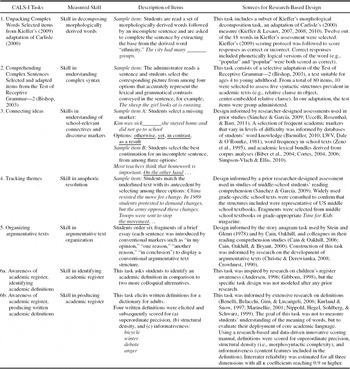
In order to assess students’ CALS, we embarked on the design of a set of tasks to assess the six areas listed above (see Appendix A). CALS-I was the result of a process that included expert linguists, psychometricians, psychologists, educators, and students. The target words, grammatical structures, and discourse structures included in the CALS-I were systematically selected to represent high-utility language forms and functions prevalent in school texts during the upper elementary and middle school years (for more information, see Appendix A).
Once the construct had been defined, the development of the CALS-I followed four phases. First, the task design phase involved designing items to minimize decoding, vocabulary knowledge, prior knowledge, reading comprehension, and productive writing demands.5 In addition, to overcome the logistical difficulties of individual language assessment (a procedure that schools find enormously disruptive), we designed items that could be group-administered.
In the second phase, the pilot phase, all tasks and items were first piloted in individual or small-group interviews with a sample of 32 students (Grades 4–8). The design of items followed an iterative process of generation, testing, incorporation of students’ feedback (obtained through multiparty interviews using a structured protocol), and retesting that resulted in modifying, recalibrating, or discarding individual items and in improving task instructions.
The third phase, Study 1, consisted of an initial full battery of 110 items administered in three 45-min sessions by four native English-speaking research assistants with experience in language testing who used a scripted administration protocol. The data reported in the present study were collected during this phase of data collection. The final set of CALS tasks was the result of selecting 44 items and 4 constructed response definitions identified as tapping developmental differences across grades and individual variability within grade (for a full detailed psychometric report of all items and tasks, please see Uccelli & Barr, Reference Uccelli and Barr2011). To select the 48 items that best captured variability in students’ performance, a Rasch unidimensional measurement model was conducted on students’ item-level performances across the larger pool of 110 items. From this model, we obtained both individual item difficulty estimates and item fit information. Items with substantial misfit (e.g., items the model identified as easy but where many high-performing students endorsed incorrect responses) were eliminated from further consideration in the final item set. Once we had a set of items that demonstrated good model fit, the items were further reduced by eliminating items that had similar difficulty estimates, because items with similar difficulty estimates provide redundant information about student performance at a given point on the academic language ability continuum. Finally, the test information function was examined to determine the number of items that needed to be retained to ensure that student performance on the CALS tasks was a reliable measure of student ability across the entire targeted ability range (2 SD below the fourth-grade mean and 2 SD above the eighth-grade mean). Based on the examination of the test information function and in light of theoretical considerations, the final set of 44 multiple-choice items and 4 constructed-response items provided adequate information at all points of the targeted ability range and, thus, constituted the final selection for the CALS-I. (See Appendix A for a more detailed description of tasks and specific skills measured.)
The fourth phase consisted of an expert panel review solicited to establish content validity. The CALS-I, along with a content validation survey, was sent to five experts in the field of academic language for their independent review. Overall, the team of experts gave the CALS-I a mean score of 3.5 on a 5-point scale, with a median score of 4. Experts’ valuable feedback and recommendations were considered and, to the extent possible, incorporated in the assessment. In this discussion, we report the design and results of Study 1, the third phase in the CALS-I development.
METHODS
Participants
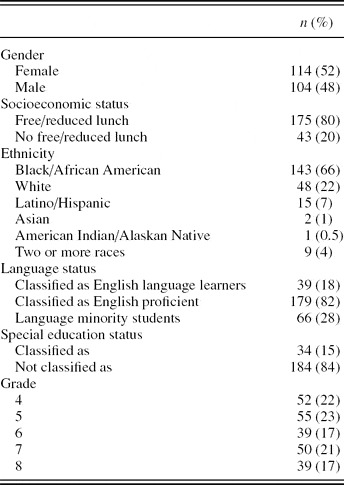
A total of 235 fourth- to eighth-grade students attending one urban K–8 school in the northeast region of the United States participated in this study (see Table 1). The sample was relatively balanced by gender. Substantial portions of the students came from low-income families, with 80% receiving free or reduced-price lunch. Participants were from a diversity of ethnic backgrounds, with 66% African American or black, 22% Caucasian, and 7% Latino/a students, according to school records. Only 18% of students in the sample were officially classified by the school as English language learners (ELLs), but 28% were identified as language minority students with a range of home language resources. From a total of 66 language minority students, the majority came from families with Cape Verdean Creole as a home language (36), followed by Haitian Creole (14), Spanish (5), Portuguese (4), and Somali (3) as home languages. Other home languages, such as French, Swahili, and Vietnamese, were also represented by single students, and for one language minority student, the home language could not be identified. Based on school records, approximately 15% of the sample had a special education designation. The grade-specific sociodemographic distributions closely resembled the distribution of the overall sample for gender, socioeconomic status, home language, and special education. There was a smaller proportion of ELLs in the higher grades (and no ELLs in eighth grade) owing most likely to students being reclassified as English proficient in the later years. In any case, the number of ELLs was relatively small in the overall sample.
Student demographic characteristics (n = 235)

Note: Demographic data were unavailable for 17 students.
Measures
Participants were administered the following three assessments:
1. Reading comprehension: Massachusetts Comprehensive Assessment System—English Language Arts (MCAS-ELA): A criterion-referenced, statewide assessment of English language arts, the MCAS-ELA focused on reading comprehension and contained selected readings followed by multiple-choice and open-response questions. Previous studies have shown the MCAS-ELA to be strongly associated with other standardized measures of reading comprehension (see Proctor, Uccelli, Dalton, & Snow, Reference Proctor, Uccelli, Dalton and Snow2009). Possible scores ranged from 200 to 280. The MCAS-ELA scores are classified into four performance levels (advanced = 260–280, proficient = 240–259, needs improvement = 220–239, and warning = 200–219).
2. Reading fluency: Test of Silent Word Reading Fluency (TOSWRF): A group-administered measure of silent fluency, the TOSWRF (Mather, Hammill, Allen, & Roberts, Reference Mather, Hammill, Allen and Roberts2004), is designed to measure reading fluency, that is, the ability to recognize printed words accurately and efficiently, in students in Grades 1 and above. On this task, students are asked to draw a dividing lead between words (e.g., “inyesgomesee” should be parsed as “in/yes/go/me/see”) and receive 1 point for each word correctly identified. We used Silent Word Reading Fluency standard scores, based on a mean of 100 with a standard deviation of 15.
3. CALS-I: As discussed above, the CALS-I is a researcher-designed group-administered instrument that measures CALS (see Appendix A for a detailed description of tasks and specific skills measured). A total of 44 items and 4 constructed responses comprised the CALS-I used in this study. In order to equally weight the items when creating the total score, the few items that were not scored dichotomously as correct/incorrect were rescaled to be between 0 and 1. Task-specific and total summative CALS-I scores were computed as a percentage metric (i.e., the number of items correct divided by the number of items a given student was administered).6 Reliability for the CALS-I was investigated and found to be robust at 0.92 as indexed by coefficient alpha and at 0.82 by split-half reliability of even- versus odd-numbered items.
Analytic plan
Descriptive statistics were generated for the CALS-I task-specific and total scores, as well as for each administered measure. Subsequently, pairwise correlational analyses were conducted to explore associations among CALS-I scores, reading fluency (TOSWRF), and reading comprehension (MCAS-ELA). In order to investigate the potential multidimensionality of the CALS construct, factor analyses at the task level were conducted using principal components analysis (PCA). Using the factor score generated for each student, we explored the variability of CALS-I student scores within and across grades. Finally, to assess the predictability of the CALS-I scores, multiple regression analyses were conducted with MCAS-ELA scores as outcome and reading fluency (TOSWRF) as a covariate.
RESULTS
A unitary but multifaceted construct of CALS (Research Question 1)
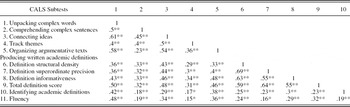
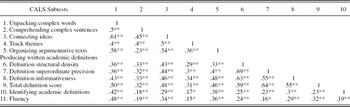
As displayed in Table 2, pairwise correlational analyses revealed that all of the CALS-I task-specific scores were significantly and positively correlated. Across the first five CALS-I tasks displayed in Table 2, all bivariate correlations ranged from moderate to high. The identifying academic register task was positively correlated to all tasks, but it displayed the lowest correlations of all tasks administered. Finally, for the producing academic register task, all within-task dimensions used to score the definition productions were, as expected, highly correlated with each other. In addition, each scoring dimension of this production task displayed mostly positive and moderate correlations with all other CALS-I tasks. Between reading fluency and each CALS-I task, most correlations were moderate. Except for the correlation with decomposing words (morphological skills), correlations did not exceed 0.36.
Pairwise correlations between Core Academic Language Skill (CALS) instrument tasks
*p < .05. **p < .01. ***p < .001.
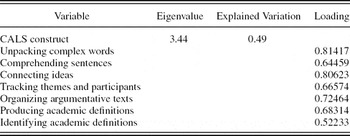
In order to further investigate the potential multidimensionality of the CALS construct, a factor analysis at the task level was conducted using PCA. The seven CALS task-specific scores (unpacking complex words, comprehending complex sentences, connecting ideas, tracking themes, structuring argumentative texts, identifying academic definitions, and producing academic definitions) were entered into the PCA. The results of the PCA indicated that there was one eigenvalue greater than 1. This first principal component (eigenvalue = 3.44) accounted for 49% of the variability in the data (see Table 3). Confirmatory factor analysis results also suggested that the general academic language data supported a single factor solution (comparative fit index = 0.93, Tucker–Lewis index = 0.92, root mean square error of approximation< 0.05). These findings suggest that aggregate core academic language tasks scores load onto a single factor.
Results from principal component analysis for Core Academic Language Skills (CALS) instrument tasks

Variability in the development of CALS (Research Question 2)
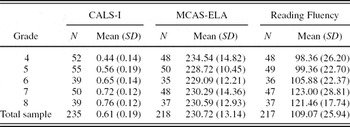
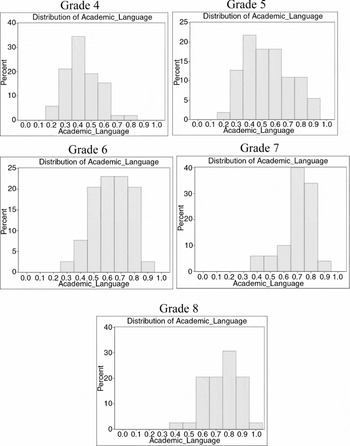
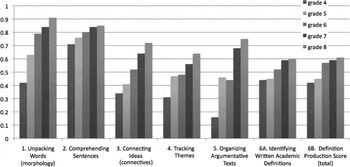
Operationalized as a unitary construct, we examined total CALS-I scores to gain insight into the developmental variability exhibited by this sample. Table 4 displays students’ means and standard deviations for the CALS-I, the MCAS-ELA, and the TOSWRF. Total CALS-I scores displayed evidence of variability across grades and within-grade. The mean CALS-I score across grades was 0.61 with a standard deviation of 0.19. As displayed in Table 2 and in Figure 1, the mean CALS-I total scores per grade revealed that students exhibited higher performances in the higher grades. The mean total CALS-I score was lowest in fourth grade, with a mean of 0.44 (SD = 0.14), and progressively higher across grades, with the highest mean of 0.76 (SD = 0.12) displayed by eighth graders. As displayed in Figure 2, an analogous increasing progression was detected for mean task-specific CALS-I scores per grade, indicating that students in higher grades performed better on average in the CALS-I as a whole, as well as within each specific task. In addition, total CALS-I scores also revealed considerable individual variability, as illustrated by the normal distribution of scores within grade displayed in the bar graphs in Figure 1. Standard deviations fluctuated from 0.12 to 0.19 across grades, displaying approximately normal distributions in each grade with a wide range of scores that progressively moved toward the higher scores in the later grades. A one-way analysis of variance indicated that CALS-I scores differed significantly as a function of grade, F (4, 230) = 40.08, MSE = 0.14, p < .0001. Post hoc Tukey honestly significant difference tests suggested that students in fourth grade and fifth grade had CALS-I scores that were significantly lower than students in higher grades at the .05 level of significance. However, there was no significant difference observed between the performances of fourth graders when compared to their fifth-grade peers. There were also no statistically significant differences between the CALS performance of students in Grades 6, 7, and 8. However, it is important to emphasize that CALS-I scores at each grade displayed considerable individual variability.
Descriptive statistics for CALS-I, MCAS-ELA scaled scores, and fluency scores by grade

Note: CALS-I, Core Academic Language Skills instrument; MCAS-ELA, Massachusetts Comprehensive Assessment System—English Language Arts.
A series of histograms displaying the distribution of total Core Academic Language Skills instrument scores within grade.

The Core Academic Language Skills instrument task-specific mean scores per grade.

As shown in Table 4, reading fluency scores were available for 217 students in the sample and the overall mean was 109.07 (SD = 25.94), indicating that students tended to perform slightly above average on this measure, with fourth, fifth, and sixth graders typically displaying average performances, and seventh and eighth graders performing above average (seventh-grade mean = 123, SD = 28.81; eighth-grade mean = 121.46, SD = 17.74).7
Although MCAS-ELA scores are valuable metrics of within-grade reading performance, this measure was not designed using an equated scale across grades and so cannot be used for cross-grade comparison. Results of MCAS-ELA assessment are reported on a scale (200–280 points) with thresholds that serve to delineate achievement levels. Participants’ distribution across performance levels in the MCAS-ELA indicated a larger proportion of low-performing students in our sample when compared to the overall state distribution: with only 26% of students scoring “proficient or advanced” (compared to 69% for the state), 54% receiving the designation of “needs improvement” (compared to 23% for the state), and 20% with scores that placed them in the “warning” range (compared to 8% for the state).8 Despite the differences with overall state means, this distribution of MCAS-ELA scores is not atypical of urban public schools in the region.
CALS as a predictor of reading comprehension (Research Question 3)
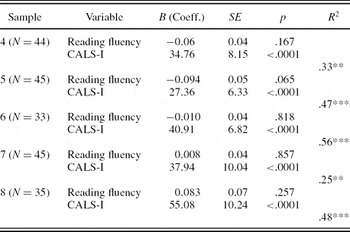
Multiple linear regression models were run at each grade level using the CALS-I total score to predict MCAS-ELA scores, controlling for fluency. Prior to conducting regression analyses, the correlations between students’ MCAS-ELA scores and CALS-I scores were examined. In all grades, correlations were moderate to strong and statistically significant (p < .0001; Grade 4 = 0.54, Grade 5 = 0.61, Grade 6 = 0.77, Grade 7 = 0.41, and Grade 8 = 0.65). At each grade level, students’ CALS-I scores were found to be significant predictors of MCAS-ELA scores, even after controlling for reading fluency. As displayed in Table 5, these regression models accounted for an important amount of variability in MCAS-ELA scores, ranging from explaining 25% of the variability in seventh-grade MCAS-ELA scores to 61% of the variability for sixth-grade students.
Regression models by grade: Contribution of CALS-I scores to MCAS-ELA scores, controlling for reading fluency

Note: CALS-I, Core Academic Language Skills instrument; MCAS-ELA, Massachusetts Comprehensive Assessment System—English Language Arts.
*p < .05. **p < .01. ***p < .001.
To investigate the potential impact of ELL status, the contribution of ELL status was explored within each grade, as was the interaction between ELL and CALS-I scores. No significant contribution of ELL status was detected either as a main effect or as an interaction. This is likely a power issue given the small sample of ELLs in this study. In addition, regression analyses were also conducted with a sample that excluded the students classified as ELLs. We compared these results to those for the full sample and found that the results, with regard to statistical significance, were identical, and the magnitude of the parameter estimates appeared to be quite comparable.9
DISCUSSION
Starting with the premise that knowledge of academic vocabulary constitutes a highly relevant developmental and pedagogical domain, yet only a fragment of a wider repertoire of academic language skills, the goal of this study was to identify additional developmental skills involved in mastering academic language throughout the upper elementary and middle school years. Building from Bailey's (Reference Bailey2007) data-driven conceptualization of academic language, in this study we offer preliminary evidence to support the construct of CALS, defined as knowledge and deployment of an integrated set of prevalent language forms and functions that co-occur with learning-related tasks across content areas at school. On the basis of an extensive integration of different lines of textual, educational, and developmental linguistics research, in this study we measured CALS in the following areas: unpacking complex words, comprehending complex sentences, connecting ideas, tracking themes, organizing argumentative texts, identifying academic register, and producing academic register. We administered the innovative and theoretically grounded CALS-I to 235 fourth to eighth graders in order to answer three main questions. Do CALS-I task-specific performances support a unitary or a multidimensional operational construct of CALS? Do students’ performances in the CALS-I tasks yield evidence of variability within and across the upper elementary and middle school grades? Are students’ CALS-I scores predictive of reading comprehension? Results revealed variability within and across grades in an expanded, but certainly not exhaustive, set of CALS. Results from the PCA offer initial empirical evidence that supports a unitary construct of CALS, as defined in this study. Regression analyses showed that CALS-I total scores predicted reading comprehension, as measured by the MCAS-ELA, at each grade level from fourth to eighth grade, even after controlling for students’ reading fluency levels.
Our results move the field forward by documenting not only a potential developmental progression but also considerable individual variability in a precise set of CALS that expand our understanding of academic language proficiency. At the level of construct building, this study offers promising initial results that support a construct that is worth exploring in future research. At the level of assessment, the CALS-I offers a preliminary tool focused on testable cross-discipline academic language skills that can be highly relevant for the design and development of research and pedagogical instruments. We discuss our findings in more detail below and then consider research and educational implications. We close the article by highlighting the limitations of our study and presenting some new questions raised by the current findings.
CALS as a unitary construct
This study tackled the question of whether CALS as measured by the CAL-I is a unitary or a multidimensional construct. Results offer preliminary evidence pointing to a unitary construct. Scores across the tasks administered revealed positive pairwise associations, and confirmatory factor analyses showed that task-specific scores loaded onto a single factor. These results are in keeping with our view of language use as register participation. Within this perspective, language users expand their resources as they participate in different registers (i.e., a constellation of prevalent language features that occur together to serve particular purposes). Thus, adolescent language learning is viewed, not as a process of learning discrete individual skills independently, but instead as learning a repertoire of language features in synchrony as they are used in particular contexts and for specific purposes. As students are provided with opportunities to participate in the discourses of school, they would learn linguistic forms and functions as a constellation of features that typically occur together in oral or written school texts in response to the particular goals of academic learning. For instance, the morphologically complex words and academic connectives usually employed when constructing academic argumentative texts would be hypothesized to be learned together as students participate in reading and writing such texts.
However, caution should be invoked, given the novel and exploratory nature of this construct. In our CALS construct, the skills assessed represent only a selective repertoire of those involved in reading school texts. In addition, only three highly prevalent school text types are used across the CALS-I tasks: definitions, argumentative text, and fragments of expository texts. The conceptualization of CALS as unitary or multidimensional will depend on how the boundaries of this construct are defined. Thus, more exploration is necessary to investigate the nature of this construct. Some important questions emerge. Are there additional tasks or general cross-content area text types that should be considered as part of this construct? Would the evidence that points to CALS as unitary hold if the boundaries of the construct were slightly expanded, for example, by including additional text types? Only future research can answer these pending questions.
Finally, these results do not imply that the global construct of academic language proficiency entails a single dimension. Given that this larger construct also includes discipline-specific academic language skills, which might not be correlated within individuals (e.g., understanding the structure of a story problem in math vs. that of a literary analysis), we would predict that discipline-specific academic language skills would not be part of a unidimensional construct.
In sum, we interpret the findings pointing toward a unitary construct of CALS as insightful, yet preliminary, and, of course, as a result of the particular construct investigated in this study. These results align with a pragmatics-based view of language development. Instead of viewing development as progress in fragmented or isolated skills, or as divided by traditional linguistic levels (morphology, syntax, and discourse), we view the development of CALS as a synchronous progress that takes place as language users’ participate in oral and written school discourses around learning.
CALS: Development and individual variability
The present results are encouraging because they support an empirically based construct and instrument that appear promising for capturing change over time and variability across individuals. In line with prior developmental linguistics research on adolescent language (Berman & Ravid, Reference Berman, Ravid, Olson and Torrance2009; Nippold, Reference Nippold2007), the current findings support a view of adolescence as a period of substantial growth, in particular in this case, in a specific subset of language skills: those relevant for school-related learning tasks. CALS, as measured by the CALS-I, manifested a general upward trend across both CALS-I total scores and task-specific mean scores. Our findings suggest that repertoires of forms and functions continue to expand throughout development in each of the language-learning areas measured by the CALS-I. Whereas vocabulary knowledge is widely understood as a potentially ever-expanding domain with thousands of words to be learned in a given language (Stahl & Nagy, Reference Stahl and Nagy2006), other language domains are sometimes viewed as fully mastered by the end of primary school (e.g., syntactic or morphological skills). Adding to a recently emerging line of research on adolescent language, our findings clearly point to the continuing expansion of school-relevant language knowledge across all our tested tasks. Statistically significant differences in performance were only evident when comparing the performance of elementary grade to middle grade students. While it is possible that this intriguing lack of difference is an a artifact of the CALS-I or sampling idiosyncrasies, these results may also suggest some interesting patterns in preadolescent and adolescent language development, for example, that school-relevant language growth is more subtle in the period from Grades 6 to 8. Further research needs to carefully examine this issue by studying development in longitudinal samples, with larger and more diverse groups of students and by further refining the CALS-I. Although chronological ages for students were not available to us, future studies may also examine variability in CALS scores, not only by grade, but also by age.
CALS scores revealed considerable variability, not only across grades, but also within grades. The within-grade variability in CALS was considerable, with even a few fourth graders outperforming some eighth graders in this sample. These results might not be surprising in light of prior research that has highlighted considerable individual variability in vocabulary knowledge across and within bilingual and monolingual populations (Biemiller & Slonim, Reference Biemiller and Slonim2001; Graves, Reference Graves2007; Kieffer & Lesaux, Reference Kieffer and Lesaux2007; Stahl & Nagy, Reference Stahl and Nagy2006). Even if not surprising, these results are revealing. Our findings extend the repertoire of academic language skills that seem to be highly vulnerable to individual variability beyond vocabulary knowledge. In addition, while individual differences in language skills have been documented mostly during the early years (Bowers & Vasilyeva, Reference Bowers and Vasilyeva2011; Hart & Risley, Reference Hart and Risley1995), our results indicate that even during the middle school years students are differentially equipped to face the language demands of school.
CALS as predictors of reading comprehension
Our findings suggest that the variability in CALS accounts for a significant variability in students’ academic reading comprehension in each of the grades assessed (fourth–eighth grades). It should be of no surprise that, analogous to academic vocabulary knowledge, a broader set of general academic language skills would be predictive of reading comprehension. The innovation of this study resides in having identified a precise set of cross-disciplinary academic language skills that offer initial evidence that this proficiency can be measured in a way that captures enough variability associated with advanced literacy skills. Prior research has pointed to academic language as a key predictor in reading comprehension mostly indirectly by comparing skilled versus unskilled readers, or English proficient versus ELLs, or by narrowly operationalizing academic language as academic vocabulary. To our knowledge, our study is the first one to directly assess preadolescents and adolescents from Grades 4 to 8 with a comprehensive, even if not exhaustive, set of core academic language tasks.
Limitations of the current study
Adding to other well-documented skills (e.g., prior knowledge, motivation, strategy use, and vocabulary knowledge), this study expands the range of known contributors to reading comprehension and suggests that core academic language proficiency, which is understood as a repertoire of skills, is a relevant construct for understanding students’ academic literacy. Our results are promising but require further research in a variety of directions.
Further research is required to explore if these findings can be replicated with larger groups of diverse students. Caution should be exerted in drawing inferences beyond our sample, which included only 235 students. This is particularly important in light of the fact that our sample comprises a low-performing group of students. Thus, even though our sample's MCAS-ELA performance is representative of urban public schools in the region, understanding cross-disciplinary academic language development requires the inclusion of a sample with a wider range of academic literacy levels.
This study reports variability across grades in a cross-sectional sample. Developmental research, however, requires longitudinal studies. The next step in this research entails following students from fourth to eighth grade to document individual variability in developmental trajectories. Our finding that students in Grades 6, 7, and 8 did not demonstrate a statistically significant difference in CALS performance might suggest also that future versions of this instrument might require further refinement to include items that present greater challenge to older students who are more adept academic language users.
Furthermore, the CALS construct and instrument need to be refined, possibly expanded, and further explored. It is necessary to consider other potentially relevant areas of proficiency, such as epistemic stance (Uccelli et al., Reference Uccelli, Dobbs and Scott2013), or the inclusion of a wider variety of text types, such as explanations or school-relevant paragraph patterns (compare and contrast, classification, etc.; Sánchez & García, Reference Sánchez and García2009).
In addition, in order to further understand the contribution of CALS to reading comprehension, future studies may also examine additional covariates, such as academic vocabulary knowledge or listening comprehension skills. As in the case of vocabulary knowledge and reading comprehension, a reciprocal relationship between CALS and reading comprehension should also be considered. Furthermore, the relationship of CALS to other academic literacy outcomes encompassed in our proposed construct, such as skill in speaking, writing, and comprehending oral language in school contexts should be explored in future studies.
Finally, this study offers evidence of considerable cross-grade and within-grade variation in CALS skills, yet we cannot answer the question of what accounts for such variability because this is beyond the scope of the present study. Some researchers have argued that school-relevant language proficiency is acquired mostly in interaction with academic texts (Ravid & Tolchinsky, Reference Ravid and Tolchinsky2002; Wong-Fillmore & Fillmore, Reference Wong-Fillmore and Fillmore2012); however, there is also evidence to suggest that participation in certain oral exchanges, such as debates and text-based discussions, might support the expansion of school-relevant oral and written language proficiency (Dickinson & Tabors, Reference Dickinson and Tabors2001; Reznistkaya, Anderson, & Kuo, Reference Reznitskaya, Anderson and Kuo2007). From a sociocultural pragmatics-based perspective, we interpret this range of performances as the result of individuals’ histories of socialization and enculturation (i.e., their opportunities to participate in particular forms of language and text interactions). The goal of this research was not to examine the impact of these language experiences or the methods by which CALS is acquired but rather to examine the impact of having acquired CALS on a fundamentally important element of school literacy: text comprehension. Yet we acknowledge that examining the social and pedagogical conditions under which academic language skills develop is a crucial area of study that deserves attention. Only future research can shed light on what in-school and out-of-school opportunities as well as other factors are associated with school language proficiency.
Implications for educational research, assessment, and pedagogy
This set of CALS tasks constitutes a promising tool that can inform the design of research instruments and, ultimately, a pedagogically informative assessment. This study was designed on the premise that academic vocabulary is only a single component of a constellation of academic language skills, and the results provide initial empirical evidence that can help us move beyond the widespread metonymical confusion that equates academic vocabulary knowledge with academic language proficiency.
For research purposes, instruments that directly assess cross-disciplinary academic language skills can further enrich current research programs. For instance, the research conducted by Kintsch (Reference Kintsch, Ruddell and Unrau2004), and also by O'Reilly and McNamara (Reference O'Reilly and McNamara2007), suggests that text features (i.e., level of cohesion) and readers’ characteristics (i.e., background knowledge and comprehension skills) interactively impact reading comprehension. O'Reilly and McNamara found that skilled comprehenders with high background knowledge benefited from a highly cohesive text, whereas a low-cohesion text was beneficial for less skilled readers with high background knowledge. However, in these studies, students’ proficiency in the linguistic features manipulated in texts; in other words, proficiency in certain aspects of core academic language is not directly assessed and is consequently implicitly assumed to be homogenous across students. Measuring students’ academic language proficiency as an additional variable in order to explore interactions between textual and reader's characteristics could be illuminating.
For educational purposes, the CALS-I represents an initial step toward developing a tool that might be useful for making some school-relevant language skills visible to educators, curriculum writers, assessment developers, and students. As stated by Bailey et al. (Reference Bailey, Burkett, Freeman, Spolsky and Hult2008) and Wong-Fillmore and Fillmore (Reference Wong-Fillmore and Fillmore2012), instead of an accessible medium of instruction, the language of school is often opaque to students, while at the same time being often transparent to the teachers. Research that has documented opportunities to learn as significantly contributing to the variability of students’ academic achievement (Abedi & Herman, Reference Abedi and Herman2010) might expand its focus by investigating classroom discourse (exposure and participation) as an additional dimension relevant for assessing the quality of instructional environments.
We should clarify that we see the CALS construct and instrument as complementary to other ongoing efforts focused on discipline-specific language skills. Bailey and colleagues, for instance, have worked on academic language as embedded in disciplinary learning, which subsequently led to the design of assessments used to measure the language skills required to understand typical standardized-assessment questions in fifth-grade math, social studies, or science (Butler et al., Reference Butler, Bailey, Stevens, Huang and Lord2004; Bailey, Reference Bailey2007). CALS, in our view, is an essential common denominator, but it is certainly not sufficient to participate successfully in the increasing variety of discipline-specific discourses that students encounter at school.
The findings of this study seem to be particularly timely in light of the current climate of the CCSS in the United States. The CCSS call for exposing students to more complex texts, which places academic language at the forefront of the pedagogical conversation about how to best prepare students to be successful readers (and writers). In the reading and writing competencies outlined in the CCSS, students are called upon to both understand and use “appropriate transitions” and “precise words and phrases.” Thus, a potential pedagogical application of the CALS-I might be to help make the crucial role of students’ academic language skills visible to educators and researchers and to support them in identifying language features in the complex texts that students must read at school and in designing lessons that incorporate the expansion of students’ academic language skills as an important pedagogical goal. Such cross-disciplinary academic language consciousness might support educators in identifying instructional instances where paraphrasing, unpacking, and paying explicit attention to language structures may support students in reading comprehension, written composition, or oral discussion always in the service of expanding students’ content knowledge and conceptual understandings (for discussion of such pedagogies, see van Lier & Walqui, Reference van Lier and Walqui2012; Wong-Fillmore & Fillmore, Reference Wong-Fillmore and Fillmore2012). The potential malleability of CALS skills and the best ways to scaffold them is an imminent question that emerges from this work. The current results offer a promising construct and instrument, but they constitute only the first step in a journey still filled with numerous questions to be answered.
Core Academic Language Skills instrument (CALS-I)

ACKNOWLEDGMENTS
The research reported here was supported by the Institute of Education Sciences, US Department of Education through Grant R305F100026, which was awarded to the Strategic Education Research Partnership as part of the Reading for Understanding Research Initiative. The opinions expressed are those of the authors and do not represent the views of the institute or the US Department of Education. We express our gratitude to the students and teachers who shared their valuable time and insights with us and to our numerous colleagues for their helpful comments as we conducted this work. Finally, we are thankful for the valuable comments from three anonymous reviewers.