Introduction
Allergic rhinitis is characterised by the immunoglobulin (Ig) E mediated hypersensitivity of nasal airway mucous membranes. It affects between 10 and 40 per cent of the global population.Reference Bousquet, van Cauwenberge and Khaltaev1 Epidemiological evidence suggests that prevalence of the disease is rising. In a study of Danish adults, the prevalence of specific IgE positivity to at least one aeroallergen increased from 26.5 to 33.9 per cent from 1990 to 1998.Reference Linneberg, Nielsen, Madsen, Frølund, Dirksen and Jørgensen2
Although allergic rhinitis is not a severe disease, it can have a detrimental effect on social life, school performance and work productivity. Impaired productivity and medication costs can have a significant economic impact.Reference Blaiss3, Reference Crystal-Peters, Crown, Goetzel and Schutt4 Patients with allergic rhinitis have been reported to have lower quality of life (QoL) scores, a poorer sense of overall well-being, greater feelings of insufficiency, increased somatisation and sleep disturbance, and higher depression scores.Reference Kremer, den Hartog and Jolles5
According to the World Health Organization (WHO) guidelines entitled Allergic Rhinitis and its Impact on Asthma, allergic rhinitis can be classified as mild or moderate to severe.Reference Bousquet, van Cauwenberge and Khaltaev6 For individuals with mild allergic rhinitis, sleep, daily activities, sport and leisure activities, and school and work performance are normal; there are no troublesome symptoms associated with this condition. Moderate to severe allergic rhinitis is characterised by the presence of one or more of the following: abnormal sleep, impairment of daily activities, impairment of sport and leisure activities, problems at work or school, and troublesome symptoms.
Drug therapy and allergen avoidance are crucial in managing allergic rhinitis. Treatment should control allergic rhinitis symptoms without adversely affecting daily activities or cognitive performance, and should prevent sequelae such as asthma exacerbation or sinusitis.
Most currently available oral allergy medication works by blocking histamine. The role of histamine in nasal congestion associated with allergic rhinitis is not well established, as a high concentration is needed to cause significant nasal congestion.Reference Okuda, Watase, Mezawa and Liu7
Cysteinyl leukotrienes have also been implicated: their release after mast cell degranulation is associated with increased vascular permeability, oedema formation, mucus production and cellular infiltration, which are the hallmarks of nasal congestion and rhinorrhoea. Leukotriene D4 was found to be approximately 5000 times more potent than histamine in mediating nasal responses.Reference Okuda, Watase, Mezawa and Liu7 Montelukast, a cysteinyl leukotriene type 1 receptor antagonist, acts by blocking leukotrienes (instead of histamine). It has been reported to be an effective and well-tolerated preventive treatment for asthma in adults and children over two years of age.Reference Storms, Michel, Knorr, Noonan, Shapiro and Zhang8 This supports the important role of cysteinyl leukotrienes in this lower airway inflammatory disease. Interest in the role of cysteinyl leukotrienes in allergic rhinitis has increased in line with the current understanding of the relationship between asthma and allergic rhinitis (one airway, one disease, one approach), as summarised in the WHO guidelines mentioned above.Reference Bousquet, van Cauwenberge and Khaltaev6
Currently, the standard treatment regime for allergic rhinitis involves a combination of antihistamine and intranasal steroids. The introduction of agents that block the inflammatory effects of cysteinyl leukotrienes offers a novel treatment modality for allergic rhinitis. It is hoped that such treatment will reduce symptoms and improve patients' QoL. Indeed, many studies have shown the efficacy of montelukast in treating allergic rhinitis patients.Reference Nayak, Philip, Lu, Malice and Reiss9–Reference Patel, Philip, Yang, Call, Horak and LaForce11
This study aimed to determine the efficacy of montelukast as a treatment for moderate to severe allergic rhinitis. Importantly, all patients included in this study had a positive skin prick test reaction to at least house dust mites. In previous studies conducted in other countries, the study population has included those suffering from a seasonal type of allergic rhinitis, in which pollens and moulds have been identified as the factors triggering their symptoms. In contrast, our study comprised patients suffering from a more persistent, perennial type of allergic rhinitis. All patients in the current study were provided with antihistamine (loratadine 10 mg) tablets as a rescue treatment, to be taken only if their symptoms were severe. The total number of antihistamine tablets taken by the patients was counted at each follow up.
Materials and methods
This study was approved by the Research and Ethical Committee at the Universiti Kebangsaan Malaysia.
Patients
Only those over 12 years old were eligible to participate in this study (those of a younger age may have had difficulties understanding the questionnaires given to them). Participating patients were required to be in good mental and physical health (allergic rhinitis symptoms aside). Patients on oral corticosteroids, or those with asthma, non-allergic rhinitis, chronic nasal diseases, or nasal growths or tumours, were excluded from this study. Pregnant or lactating patients, as well as those females planning to conceive, were also excluded as participants.
All patients had a clinical history of allergic rhinitis and a positive skin prick test reaction (wheal diameter of more than 3 mm) to at least one allergen (tests were manufactured by ALK Abello, Round Rock, Texas, USA). Only patients with moderate to severe allergic rhinitis were included in this study.
Patients were instructed to discontinue their anti-allergic medications two weeks prior to the start of the study.
Study design
This single-centre, prospective, randomised, double-blind, placebo-controlled study was conducted at the Otorhinolaryngology Clinic, Universiti Kebangsaan Malaysia Medical Centre (a tertiary referral centre) between February and November 2009.
The study entailed three patient visits. The first visit involved appropriate screening for enrolment onto the study. Oral and written informed consent was obtained from the patients or parents. Patients were informed that they could withdraw from the study at any time during the treatment.
Those who fulfilled the inclusion criteria were asked to complete the symptoms scales and the Rhinoconjunctivitis Quality of Life Questionnaire during the first visit.Reference Juniper, Thompson, Ferrie and Roberts12 Patients were then randomly assigned into one of two groups. The montelukast group received intranasal steroid spray (100 mcg fluticasone propionate; Glaxo Wellcome SA, Arande De Duero, Spain), to be administered once per day to each nostril, and montelukast tablets (10 mg Singulair; Merck, Whitehouse Station, New Jersey, USA), to be taken once per day. The placebo group received the intranasal steroid spray (as above) and a placebo. All medications were taken once daily at bedtime, irrespective of food. Patients were on each treatment plan for eight weeks.
Patients returned to the clinic at week four (second visit) and week eight (third visit). The symptoms scales and Rhinoconjunctivitis Quality of Life Questionnaire were completed again during these subsequent visits. The pre- and post-treatment scores for the two groups were compared to assess the efficacy of montelukast with intranasal steroid treatment against the placebo with intranasal steroid treatment.
Randomisation
All medications were supplied by the pharmacy in the Universiti Kebangsaan Malaysia Medical Centre. Each patient was given a manual prescription written as ‘Montelukast study’, with a serial number stated on it. The medications (montelukast with intranasal steroid or placebo with intranasal steroid) were randomly assigned to patients according to the stated serial number. A specific staff member was assigned to assist in dispensing the medications. At the end of the study, the serial number of each prescription was checked to verify the type of treatment given to the patients.
Symptom and quality of life assessment
Patients were assessed using symptom scales (primary outcome measure) and the Rhinoconjunctivitis Quality of Life Questionnaire (secondary outcome measure); these were completed at the start, during and at the end of the study.
Daytime nasal symptoms (nasal congestion, rhinorrhoea, nasal pruritus and sneezing) and daytime eye symptoms (tearing, pruritus, redness and puffiness) were rated on 4-point scales as follows: 0 = none (symptom not noticeable), 1 = mild (symptom noticeable but not bothersome), 2 = moderate (symptom noticeable and bothersome some of the time) and 3 = severe (symptom bothersome most of the time). Three night-time symptoms were also scored on 4-point scales. These were: difficulty going to sleep (0 = not at all, 1= little, 2 = moderate and 3 = very), night-time awakenings (0 = not at all, 1 = once, 2 = more than once and 3 = awake all night) and nasal congestion on awakening (scored as for daytime symptoms).
Quality of life was assessed using the Rhinoconjunctivitis Quality of Life Questionnaire, as per Juniper et al.Reference Juniper, Thompson, Ferrie and Roberts12 The questionnaire comprises 6 domains (activity limitations, practical problems, nose symptoms, eye symptoms, non-hay fever symptoms and emotional problems), with a total of 25 questions. The investigator had translated the questionnaire (originally in English) into Malay and validated this version in other studies.
Rescue treatment
The standard treatment for allergic rhinitis is the combination of antihistamine and intranasal steroids. In this study, both groups received the same intranasal steroid (fluticasone propionate). The study did not therefore compromise patients' treatment for allergic rhinitis (and hence no ethical issue was raised by the review board). Both groups were also given antihistamine tablets (10 mg loratadine), to be taken once a day if the symptoms were severe. The total number of antihistamine tablets taken by each patient was counted at each follow-up visit.
Compliance
Patient compliance with the treatment during the study was assessed via tablet counting, at the monthly follow-up visit or by telephone.
Statistical analysis
All data were analysed using the Statistical Package for the Social Sciences version 16.0 software (SPSS, Chicago, Illinois, USA). The paired t-test was used for intragroup comparisons and the t-test was employed for the intergroup comparisons.
Results
Patient data
In total, 128 patients (68 males (53.1 per cent) and 60 females (46.9 per cent)) took part in the study, with 64 patients in each of the two treatment groups. Participants' ages ranged from 13 to 51 years (a mean of 24.5 years). There were 83 Malays (64.8 per cent), 29 Chinese (22.7 per cent) and 16 (12.5 per cent) Indian patients.
Symptom scores at one month
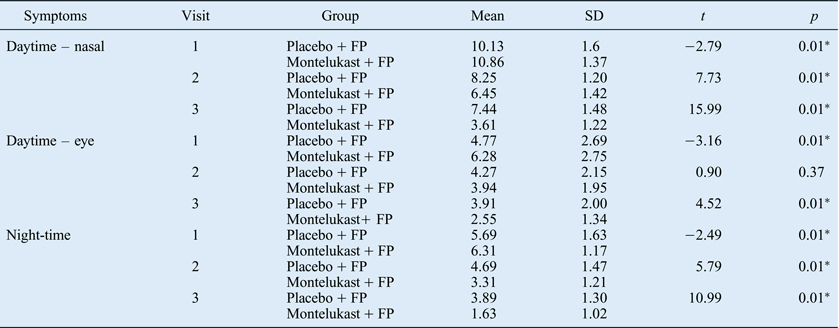
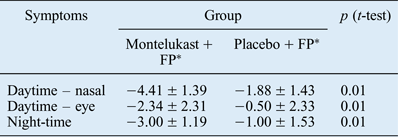
The mean scores for daytime nasal and night-time symptoms (but not daytime eye symptoms) were statistically lower (i.e. better) in the montelukast group than the placebo group (p < 0.05) after one month of treatment (Table I). The mean improvements were significantly greater for the montelukast group, for all symptom scores, compared with the placebo group after one month of treatment (p < 0.05) (Table II).
Comparisons of mean symptom scores at each visit

*Significant difference (p < 0.05). SD = standard deviation; FP = fluticasone propionate
Comparisons of mean symptom score improvements at one month
*Mean difference ± standard deviation. FP = fluticasone propionate
Symptom scores at two months
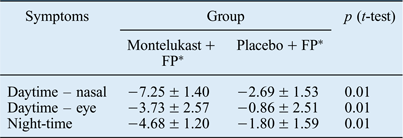
The mean scores for all symptoms were significantly better in the montelukast group than the placebo group (p < 0.05) after two months of treatment (Table I). The mean improvements were significantly greater for the montelukast group, for all symptom scores, after two months of treatment, compared with the placebo group (p < 0.05) (Table III).
Comparisons of mean symptom score improvements at two months
*Mean difference ± standard deviation. FP = fluticasone propionate
Total symptom scores
The improvement in mean total symptom score was greater in the montelukast group than the placebo group after one month and two months of treatment (Figure 1).
Group comparisons of mean total symptom scores at baseline, and after one and two months of treatment. FP = fluticasone propionate
Quality of life scores
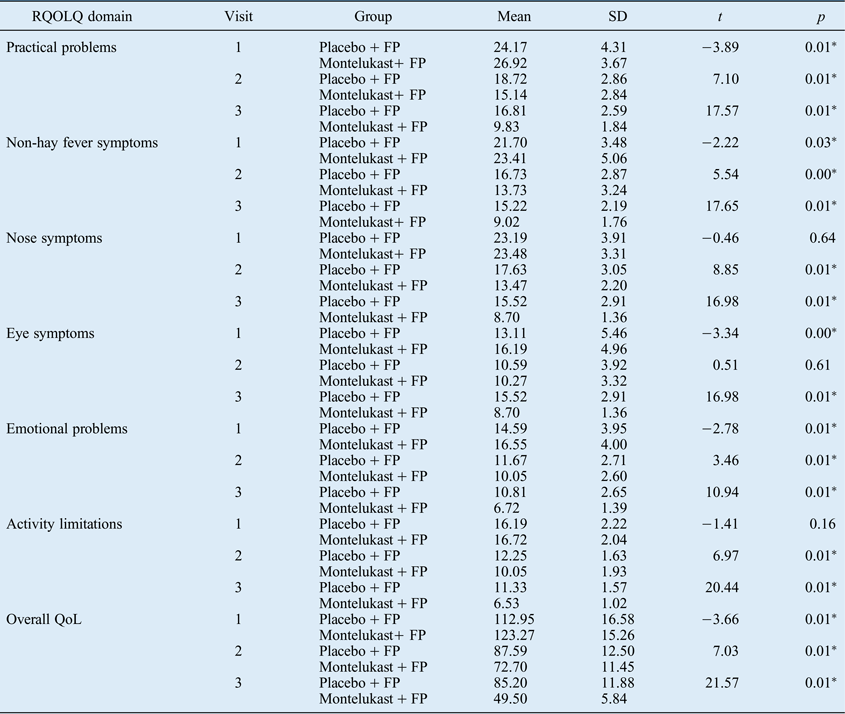
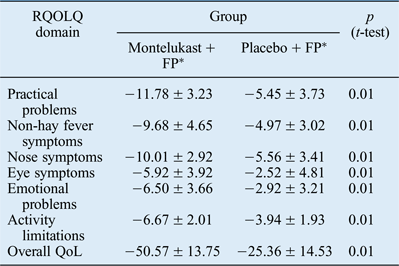
At baseline, the mean overall QoL score was significantly higher (i.e. worse) for the montelukast group than the placebo group (p < 0.05) (123.27 ± 15.26 standard deviation (SD) vs 112.95 ± 16.58 SD). However, after one month of treatment, the montelukast group showed a significantly better (i.e. lower) overall QoL score compared with the placebo group (p < 0.05) (72.70 ± 11.45 vs 87.59 ± 12.50) (Table IV). The mean improvement in overall QoL score (Table V) was significantly greater for the montelukast group than the placebo group after one month of treatment (p < 0.05) (−50.57 ± 13.75 SD vs −25.36 ± 14.53 SD).
Comparisons of mean quality of life scores at each visit
*Significant difference (p < 0.05). RQOLQ = Rhinoconjunctivitis Quality of Life Questionnaire; SD = standard deviation; FP = fluticasone propionate; QoL = quality of life
Comparisons of mean quality of life score improvements at one month
*Mean difference ± standard deviation. RQOLQ = Rhinoconjunctivitis Quality of Life Questionnaire; FP = fluticasone propionate; QoL = quality of life
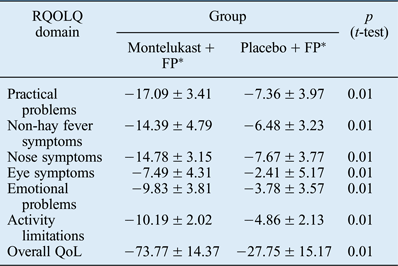
The mean overall QoL score was reduced further for the montelukast group after two months of treatment, compared with the placebo group (49.50 ± 5.84 SD vs 85.20 ± 11.88 SD) (Table IV and Figure 2), which was a statistically significant finding (p < 0.05). Again, the mean improvement in overall QoL score was significantly greater for the montelukast group than the placebo group after two months of treatment (p < 0.05) (Table VI).
Group comparisons of mean overall quality of life scores at baseline, and after one and two months of treatment. QoL = quality of life; FP = fluticasone propionate
Comparisons of mean quality of life score improvements at two months
*Mean difference ± standard deviation. RQOLQ = Rhinoconjunctivitis Quality of Life Questionnaire; FP = fluticasone propionate; QoL = quality of life
Rescue medication usage
The rescue treatment (10 mg loratadine) was only taken by patients if their symptoms were severe during the study. For the placebo group, the mean number of loratadine tablets taken by each patient was 10 for the first month and 8 for the second month (with an overall mean number of 9 tablets taken over the 2-month study period). For the montelukast group, the mean number of loratadine tablets taken by each patient was 1 for the first month and 0.47 for the second month (with an overall mean number of 0.73 tablets taken over the whole 2-month study period).
Side effects
No side effects were reported by patients during the two-month trial period.
Discussion
Allergic rhinitis is a common allergic disease with mild to severe nasal and ocular symptoms. These symptoms can have substantial negative effects on daily activities and sleep, impairing the QoL of those affected. According to the WHO Allergic Rhinitis and its Impact on Asthma guidelines, the most effective treatment for persistent, or moderate to severe allergic rhinitis is intranasal topical corticosteroids.Reference Bousquet, van Cauwenberge and Khaltaev6 However, the maximal effect is observed only after one to two weeks of treatment.
Montelukast, a leukotriene receptor antagonist, which was initially indicated for the treatment of asthma, is now increasingly being used to treat allergic rhinitis. This was partly stimulated by the evolving view that asthma and allergic rhinitis can be described as part of a continuum of inflammation involving the airway; thus, the two diseases might be approached therapeutically as one disease. Montelukast is non-sedating when dosed once daily, and has a safety profile that is similar in adults and children, with approval for use in those as young as six months of age.Reference Virchow and Bachert13 In studies investigating the safety and adverse effects of montelukast, in general no clinical or laboratory differences in adverse experiences have been reported for this treatment versus placebo.
Quality of life assessments are now frequently used as the primary outcome measures in the management of allergic rhinitis. The ultimate goals of allergic rhinitis treatment are to reduce and control symptoms, and to improve QoL for affected patients. Our results showed improvements in symptom scores and QoL scores after one and two months of treatment (compared to baseline) for both treatment groups. However, these improvements were significantly better (with lower mean scores for every item) in the group treated with montelukast and fluticasone propionate, compared with the group treated with a placebo and fluticasone propionate.
Many previous studies have evaluated the efficacy of montelukast as a monotherapy for allergic rhinitis or as a therapy used in combination with other treatment. In a study by Nayak et al., patients were randomly assigned to one of four groups, receiving either 10 mg montelukast, 10 mg loratadine, a combination of 10 mg montelukast and 10 mg loratadine, or a placebo, for 2 weeks.Reference Nayak, Philip, Lu, Malice and Reiss9 They found that both active medications given alone and in combination were more effective than placebo at relieving daytime symptoms, with the combination of montelukast and loratadine not conferring additional therapeutic benefit. Furthermore, both the antihistamine and the leukotriene receptor antagonist demonstrated comparable improvements for nasal congestion compared with the placebo. Statistical differences between montelukast and loratadine monotherapy were not reported, and no clinically relevant differences between the medications given as monotherapy were apparent.
In a study by Virchow and Bachert, treatment with 10 mg montelukast for 4–6 weeks was effective and well tolerated in patients with mild to moderate asthma and allergic rhinitis.Reference Virchow and Bachert13 There was a ‘strong’ or ‘marked’ improvement in day and night-time asthma symptoms, and in allergic rhinitis symptoms. These improvements were associated with a reduction in the use of asthma and rhinitis medication. Adding montelukast to existing maintenance therapy also significantly improved the symptoms of seasonal allergic rhinitis in patients with concomitant active asthma. Furthermore, the authors found that patients who took montelukast needed significantly less rescue medication.
The efficacy of montelukast in the treatment of perennial allergic rhinitis has not been studied as extensively as in seasonal allergic rhinitis. A study by Patel et al. in 2005 showed a statistically significant improvement in perennial allergic rhinitis symptoms, measured primarily in terms of the daytime nasal symptoms score.Reference Patel, Philip, Yang, Call, Horak and LaForce11 Montelukast treatment in particular provided statistically significant relief of nasal congestion, which is the predominant symptom of perennial allergic rhinitis. This symptom is associated with chronic allergic inflammation of the nasal mucosa induced by the release of a mixture of proinflammatory mediators, such as leukotrienes and histamine released from mast cells, eosinophils, or basophils. This greater inflammatory burden makes perennial allergic rhinitis more difficult to treat than seasonal allergic rhinitis. The group treated with montelukast in that study demonstrated a statistically significant reduction in nasal itching, thus demonstrating the efficacy of montelukast over a broad spectrum of rhinitis symptoms.
In this study, montelukast with fluticasone propionate was statistically more beneficial to patients than a placebo with fluticasone propionate. In the group that received montelukast, statistically significant improvements were found in symptom scores (daytime nasal symptoms, daytime eye symptoms and night-time symptoms) and QoL scores (practical problems, non-hay fever symptoms, nose symptoms, eye symptoms, activity limitations and emotional problems) after one and two months of treatment. Statistically significant improvements were also found in the placebo group after one and two months of treatment. However, when the treatment groups were compared, the means for all symptom scores and QoL items were much lower for the montelukast group than the placebo group. These group differences were significant after one month of treatment for all items except the daytime eye symptoms and Rhinoconjunctivitis Quality of Life Questionnaire eye symptoms, and after two months of treatment the difference between groups was statistically significant for all items.
In this study, the efficacy of montelukast was also supported by the fact that a significantly lower number of rescue treatment tablets (10 mg loratadine) were taken by the montelukast group compared with the placebo group.
There are some limitations to this study. The investigation only utilised subjective assessments of treatment-related symptom improvement (i.e. symptom scores and QoL scores). The use of objective measures, such as those obtained from acoustic rhinometry, before and after treatment, might be helpful to assess the symptom of congestion.
• Allergic rhinitis is a common allergic disease with mild to severe nasal and ocular symptoms
• The condition can impact negatively on daily activities and sleep, and impair quality of life (QoL)
• Montelukast with fluticasone propionate treatment resulted in better symptom control and improved QoL
• Montelukast (used with intranasal steroids) is effective in treating moderate to severe allergic rhinitis
In summary, this study showed that the combination of montelukast tablets and fluticasone propionate nasal spray resulted in significantly better symptom control and overall QoL compared with fluticasone propionate treatment with a placebo. It is suggested that 10 mg montelukast may be prescribed as an additional treatment for moderate to severe allergic rhinitis (alongside the standard treatment regime of antihistamines with intranasal steroids).
Acknowledgements
The authors would like to thank Professor Balwant Singh Gendeh for suggesting this study. The study received approval and a fundamental grant (FF-126-2009) from the Research and Ethics Committee Universiti Kebangsaan Malaysia.