Introduction
Cotton (Gossypium hirsutum L.) is a major industrial crop in GreeceReference Avgoulas, Bouza, Koutrou, Papadopoulou, Kosmas, Makridou, Papastylianou and Bilalis1, IndiaReference Blaise2, TurkeyReference Dagdelen, Basal, Yilmaz, Gurbuz and Akcay3, USAReference Nichols, Snipes and Jones4, PakistanReference Parvez, Hussain, Rashid and Nisar5 and AustraliaReference Hulugalle, Nehl and Weaver6. It is one of the most important fiber-producing plants; cotton and synthetic fibers meet most of the world's textile demandReference Dagdelen, Basal, Yilmaz, Gurbuz and Akcay3. Both are associated with major environmental problems: synthetic fibers deplete fossil energy resources, while contemporary cotton cultivation is characterized by high water requirements and use of substantial amounts of fertilizers and pesticides7.
Organic cotton grown by farmers worldwide increased by 152% during the 2007–2008 crop year. As a result, organic cotton production reached 145.872 metric tons (MT), equaling 668.581 bales, grown on 161,000 ha in 22 countries8. Turkey, India, China, Syria, Uganda, Tanzania, Israel, USA and Pakistan are the top ten organic cotton producing countries in the world, according to Organic Exchange. However, there are few references to organic cotton in the literatureReference Blaise2, Reference Moran and Greenberg9, Reference Thomopoulos, Bilalis, Konstantas and Efthimiadou10. A niche market for organic cotton appears to already exist and is constantly growing. Agricultural production has become heavily reliant over the past 50 years on the use of synthetic fertilizers. This reliance on agrochemicals has resulted in the contamination of surface and ground water resources by nutrients in a number of different environments. About 25% of the world's insecticide use and more than 10% of the world's pesticide goes to cotton crops. In 2003, that amounted to about 55 million pounds of pesticides being sprayed on 12.8 million acres of cotton8. Management methods that decrease the requirement for agricultural chemicals are required to reduce adverse environmental impactsReference Bilalis, Karkanis, Efhimiadou, Konstantas and Triantafyllidis11.
The use of green manure is one of the basic cultivation techniques of Organic Agriculture12. Legumes can be used as green manure thanks to their ability to fix atmospheric nitrogen. Vetch is a legume species well adapted to the soil and climate conditions of Greece. It can also be cultivated as plants for green manure, during the period between two major crops (intermediate crop) in the common rotation system of GreeceReference Sidiras, Avgoulas, Bilalis and Tsougrianis13, such as wheat/cotton, wheat/tobacco, etc. Vetch can be seeded at the beginning of October and then cut and incorporated into the soil at the end of April. Data obtained by other researchersReference Sainju, Whitehead, Singh and Wang14–Reference Sangakkara, Liedgens, Soldati and Stamp19 clearly demonstrate the beneficial effects of legumes on the yields of the following crops (cotton, wheat, barley, canola, maize, mustard and rice).
Organic cotton is grown using methods and materials that have a low impact on the environment. From an economic point of view, the organic cotton grown with the use of a cover crop either incorporated in the soil as green manure or even better, cut and sold as animal food for getting a second income, appears to be highly superior to conventional cotton growing, even when a flat price is taken into accountReference Mygdakos, Patsiali and Mygdakos20. In addition Swezey et al.Reference Swezey, Goldman, Bryer and Nieto21 reported that cost of production per bale was on average 37% higher for organic than conventional cotton. This cost differential was due primarily to greater hand-weeding costs and significantly lower yields in organic cotton compared with conventional cotton. Organic cotton fiber is used in everything from personal care items, to home furnishings, children's products and clothes of all kinds and styles. In addition, organic cotton seed is used for animal feed, and organic cotton seed oil is used in a variety of food products. Organic cotton can also be presented as the solution to the current cotton market crisis, because its price can reach more than 20% above marketReference Haynes22.
The aim of this study was to determine the effects of (1) cultural system and (2) cotton varieties on plant growth and fiber quality of cotton crop. Variety selection, a key management component in any cropping system, is even more critical in organic cotton production. Moreover, while high yield potential is the predominant consideration, fiber properties are also major factors to be considered. Limited data are available regarding performance of varieties grown in an organic cropping system.
Material and Methods
Experimental design
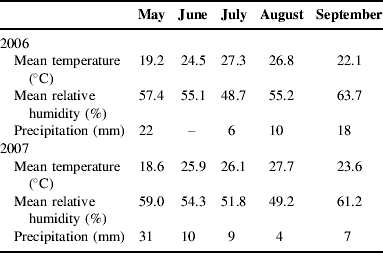
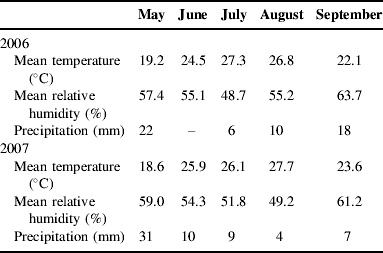
A cotton crop (G. hirsutum L.) was established in the Karditsa (Central Greece), 304 km north of Athens. The soil was a clay loam (28.2% clay, 32.5% silt and 39.3% sand) with pH 7.11, organic matter 1.01%, electrical conductance (EC) 0.45 mS cm−1, NO3-N 16.3 mg kg−1 soil, P 15.8 mg kg−1 soil, K 257 mg kg−1 soil, Fe 77.4 mg kg−1 soil and Mg 1301 mg kg−1 soil. The experimental site has mild rainy winters and hot-dry summers. Some meteorological data of the experimental site are presented in Table 1. The experiment was set up on an area of 2496 m2 according to the split plot design with four replicates, the two main plots (cultural systems: organic and conventional) and the two sub-plots (cotton varieties). The cotton cultivars were Athena and Campo. The sub-plot size was 10×8 m. According to soil analysis (NO3-N 16.3 mg kg−1 soil, P 15.8 mg kg−1 soil and K 257 mg kg−1 soil), in the conventional plots, 400 kg ha−1 of fertilizer (20:10:10 kg ha−1 N:P2O5:K2O) was applied before sowing. In a clay loam soil, Girma et al.Reference Girma, Teal, Freeman, Boman and Raun23 have also reported a high lint yield with application of 90:20:75 kg ha−1 N:P:K. In organic plots, vetch crop as green manure was incorporated into the soil on 11 April 2006 and 2007. Vetch (Vicia sativa L. var Alexandros) was sown at the beginning of October 2006 and 2007 at a rate of 100 kg ha−1. The amount of total N that accumulated on vetch plants in 2006 was 212 kg ha−1, while in 2007 was 203 kg ha−1.
Meteorological data in experimental site during experimental period (May–September).
Planting, irrigation, defoliation and weed control
Cotton was sown by hand in rows of 96 cm apart at a depth of 4 cm. Cotton was planted when soil temperature at a depth of 20 cm reached 15°C, at an approximate density of 156,000 plants ha−1. The field was sown on 30 April 2006 and 2007 at a rate of 28 kg ha−1. Plant emergence started 7 days after planting and was completed within 11 days after planting.
The irrigation was started in mid-June until 20 days before harvest; the field area was irrigated five times. A drip irrigation system was set up on the plots. The drip system consisted of laterals with 20 mm diameter with in-line drippers and at 0.40 m distance. The drippers had a discharge rate of 4 litres h−1 under an operation pressure of 1 atm. The total quantities of water were 203 and 224 mm for 2006 and 2007, respectively.
For defoliation on conventional plots pyraflufen-ethyl was used in the recommended dose 100 ml ha−1.
Finally, weeds in organic plots, were controlled by hand, with two hoeings being carried out. This practice is one of the basic weed control methods of organic agriculture. Hand weed control resulted in an increase in the cost of productionReference Swezey, Goldman, Bryer and Nieto21. In addition, conventional plots received herbicide treatment: fluometuron 50% SC (Cotoran, 50 SC) at the recommended dose of 2.5 kg active ingredient ha−1.
Samplings, measurements and methods
Vegetative traits: plant height (cm), leaf area index (LAI), dry weight of leaves (kg ha−1), dry weight of stems (kg ha−1), 120 days after sowing (DAS). Yield and yield components: seed cotton yield (kg ha−1), lint yield (kg ha−1). Fiber quality: lint was analyzed for micronaire (fiber fineness), length (mm), strength (g tex−1), uniformity ratio (%), reflectance (whiteness, %Rd), yellowness (+b), elongation (%) and leaf trash ratio (%).
For the computation of boll number, leaf area, dry weight of leaves, dry weight of stems and height, 10 plants were randomly selected from each plot. The dry weights of all plant parts were determined after drying for 48 h at 70°C. Leaf area was measured using an automatic leaf area meter (Delta-T Devices Ltd, Burwell, Cambridge, UK). Thus, the measurements of plant basis were converted into a LAI by multiplying by the average crop density of each plot.
The plants were harvested by hand twice. The first harvest took place when approximately 60% of the bolls opened at the end of September. The second harvest followed in the middle of October, approximately 3 weeks after the first. The cotton seed yield was also determined by manually harvesting the open bolls of the cotton plants in the two center rows of each plot.
Τhe High Volume Instrument spectrum (by Zellweger Uster Inc., Uster, Switzerland) system was used to determine lint quality:
1. The fiber length in millimeters was measured as 2.5% span length.
2. The fiber uniformity was determined as the ratio of the mean length to the upper-half mean length expressed as a percentage.
3. The fiber strength was determined as the force (g tex−1) necessary to break the fiber bundle.
4. The micronaire reading was taken as the fineness of the fiber expressed in standard micronaire units.
5. The whiteness was expressed as percentage reflectance (%Rd), and the yellowness (+b) represented the degree of cotton pigmentation.
Statistical analysis
For calculating analysis of variance and comparisons of means the software Statsoft24 was used. The LSD test was used to detect and separate the mean treatment differences. Regression and correlation analyses were used to describe the relationships between growth parameters and fiber characteristics. All comparisons were made at the 5% level of significance.
Results and Discussion
Cotton growth and yield
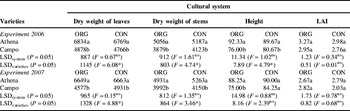
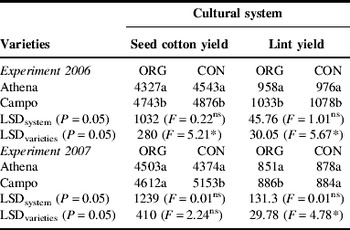
The variety selected determines cotton growth and lint yieldReference Avgoulas, Bouza, Koutrou, Papadopoulou, Kosmas, Makridou, Papastylianou and Bilalis1, Reference Pervez, Ashraf and Makdum25. The lowest dry weight of stems and leaves was found in Campo variety (Table 2). There were statistically significant differences between Campo and Athena varieties. Similar results were observed for both years (2006 and 2007). Moreover, concerning the LAI (Table 2), there were no statistically significant differences between the Athena and Campo varieties under the two cultural systems. The lowest height of stems was found in Campo variety (75 and 76 cm for organic and 80.67 and 84.25 cm for conventional in 2006 and 2007, respectively). Hcritholt et al.Reference Hcritholt, Meredith and Rayburn26 found that modern and obsolete varieties had similar LAI responses to N in early and mid season but by late season, LAI of modern varieties were greater under high N than were those for the obsolete cultivars. Moreover the highest seed cotton yields were found in the Campo variety (under organic: 4743 and 4327 kg ha−1 for Campo and Athena, respectively, for 2006; and 4612 and 4503 kg ha−1 for Campo and Athena, respectively, for 2007, Table 3). Similar results were observed for the conventional system.
Influence of cultural system (organic system: ORG, conventional system: CON) and cotton varieties (Athena and Campo) on dry weight of leaves (kg ha−1), dry weight of stems (kg ha−1), stem height (cm) and leaf area index (LAI) of cotton crop.

Means in each column followed by the same latter are not significantly different. The LSD (P=0.05) for cultural systems and cotton varieties are also shown. F-test ratios are from ANOVA. Significant at
* P=0.05, ns: not significant.
Seed cotton yield (kg ha−1) and lint yield (kg ha−1) for cotton varieties (Athena and Campo) as influenced by organic (ORG) and conventional cultivation system (CON).

Means in each column followed by the same latter are not significantly different. The LSD (P=0.05) for cultural systems and cotton varieties are also shown. F-test ratios are from ANOVA. Significant at
* P=0.05, ns: not significant.
The highest lint yields were found in the Campo variety (under organic: 1033 and 958 kg ha−1 for Campo and Athena, respectively, for 2006; and 886 and 851 kg ha−1 for Campo and Athena, respectively, for 2007, Table 3). Similar results were observed for the conventional system.
There were statistically significant differences in yields between Campo and Athena varieties in all cases (F=5.67, P<0.05 and F=4.78, P<0.05, for 2006 and 2007, respectively), except under the conventional cultural system in 2007 (Table 3).
In contrast, there were no significant differences between the organic and conventional cultural system with regard to cotton growth and lint yield (Tables 2 and 3). Nor was any cultural system×varieties interaction found.
The results suggest that the soil N released from both inorganic (80:40:40 kg ha−1 N:P2O5:K2O) and organic pool (green manure) was sufficient to maintain good growth. The amount of total N that accumulated in vetch plants and was incorporated into the soil in 2006 was 212 kg ha−1, while in 2007 it was 203 kg ha−1. Girma et al.Reference Girma, Teal, Freeman, Boman and Raun23 reported that cotton varieties attained maximum lint yield with the application of 135:30:75 kg ha−1 N:P2O5:K2O. Also, Pettigrew et al.Reference Pettigrew, Meredith and Young27 observed that the application of 112 kg ha−1 K did not increase lint yield in eight out of nine genotypes. In addition GormusReference Gormus28 reported that the application of 160 kg ha−1 K2O produced significant differences in seed cotton yield, lint yield and boll weight compared with untreated control.
Data obtained by other researchers clearly demonstrated the beneficial effects of organic fertilization on cotton growth and yield. BlaiseReference Blaise2 reported that seed cotton yield in organic plots was significantly greater than in plots under modern methods of cultivation. Also, Thomopoulos et al.Reference Thomopoulos, Bilalis, Konstantas and Efthimiadou10 reported that higher seed cotton yield was found in the plots where vetch had been incorporated. Blaise et al.Reference Blaise, Singh, Bonde, Tekale and Mayee29 have also found that seed cotton yield was improved with the addition of farmyard manure. Moreover, Parvez et al.Reference Parvez, Hussain, Rashid and Nisar5 reported that cotton crops grown in organic fertilizer harbor a lower number of insect pests. In addition, Swezey et al.Reference Swezey, Goldman, Bryer and Nieto21 found that average 6-year yields were 4.4, 5.4 and 6.7 bales ha−1 for organic, integrated pest management and conventional treatments, respectively.
Data obtained by other researchers clearly demonstrated the beneficial effects of green manuring on the yields of the following crops. Karkanis et al.Reference Karkanis, Bilalis and Efthimiadou17 found that green manures (vetch and red clover) affected tobacco growth. Previous studies have also shown the benefits of green manures on root growthReference Bilalis, Karkanis, Efhimiadou, Konstantas and Triantafyllidis11, Reference Sangakkara, Liedgens, Soldati and Stamp19. In cotton, Thomopoulos et al.Reference Thomopoulos, Bilalis, Konstantas and Efthimiadou10 reported that the higher values of the root characteristics (dry weight, length density, diameter and surface area) of the cotton were found in the plots where vetch had been incorporated. The favorable effect of green manures on root growth was likely due to increase in organic matter, which led to better physical (bulk density and soil aggregation) and chemical conditions (total soil nitrogen)Reference Sangakkara, Liedgens, Soldati and Stamp19, Reference Mandal, Singh, Victor and Sharma30. Moreover, Mygdakos et al.Reference Mygdakos, Patsiali and Mygdakos20 observed that seed cotton yield of the treatment with legumes incorporation was higher (3780 kg ha−1) than the conventional treatment (3617 kg ha−1).
Maintaining and improving soil quality is crucial if agricultural productivity and environmental quality are to be sustained for future generations.
Fiber quality
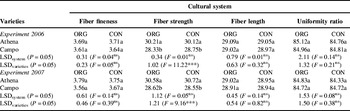
The lowest fiber strength was found in Campo variety (under organic: 28.33 and 30.21 g tex−1 for Campo and Athena, respectively, for 2006; and 28.62 and 30.58 g tex−1 for Campo and Athena, respectively, for 2007, Table 4). There were statistically differences between Campo and Athena varieties (F=11.22, P<0.001 and F=9.16, P<0.001, for 2006 and 2007, respectively). However, there were no significant differences between the organic and conventional cultural systems (F=0.01ns and F=0.05ns for 2006 and 2007, respectively). Moreover, concerning the micronaire, fiber length and uniformity ratio (Table 4), there were no significant differences between the organic and conventional cultural system, or between the Athena and Campo varieties.
Effects of cropping system (organic: ORG and conventional: CON) and cotton varieties (Athena and Campo) on fiber fineness (micronaire), fiber strength (g tex−1), fiber length (mm) and uniformity ratio (%) of cotton lint.

Means in each column followed by the same latter are not significantly different. The LSD (P=0.05) for cultural systems and cotton varieties are also shown. F-test ratios are from ANOVA. Significant at
*** P=0.001, respectively, ns: not significant.
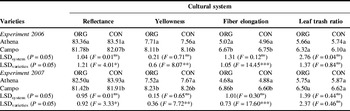
The lowest fiber elongation was found in the Campo variety (under organic: 6.67 and 5.02% for Campo and Athena, respectively, for 2006; and 6.86 and 4.68% for Campo and Athena, respectively, for 2007, Table 5). These differences were statistically significant (F=14.45, P<0.001 and F=17.60, P<0.001 for 2006 and 2007, respectively). In contrast, there were no significant differences between the organic and conventional cultural systems.
Effects of cotton varieties (Athena and Campo) on fiber quality (reflectance (%Rd), yellowness (+b), fiber elongation (%) and leaf trash ratio (%)) under two cultural systems (organic: ORG and conventional: CON) in 2006 and 2007.

Means in each column followed by the same latter are not significantly different. The LSD (P=0.05) for cultural systems and cotton varieties are also shown. F-test ratios are from ANOVA. Significant at
* P=0.05, **P=0.01 and ***P=0.001, respectively, ns: not significant.
There were statistically significant differences in lint reflectance between Campo and Athena varieties (F=4.01, P<0.05 and F=3.33, P<0.05 for 2006 and 2007, respectively). The lint reflectance was lower in the Campo variety (under organic: 81.78 and 83.36%Rd for Campo and Athena, respectively, for 2006; and 81.42 and 82.50%Rd for Campo and Athena, respectively, for 2007, Table 5). In addition, there were no significant differences between the organic and conventional cultural systems.
The highest lint yellowness (+b) was found in the Campo variety (under organic: 8.11 and 7.71 +b for Campo and Athena, respectively, for 2006; and 8.23 and 7.52 +b for Campo and Athena, respectively, for 2007; under conventional: 8.16 and 7.56 +b for Campo and Athena, respectively, for 2006; and 8.26 and 7.67 +b for Campo and Athena, respectively, for 2007, Table 5). These differences were statistically significant (F=8.07, P<0.01 and F=7.72, P<0.01 for 2006 and 2007, respectively). In contrast, there were no significant differences between the organic and conventional cultural systems.
Moreover, concerning the leaf trash ratio there were no significant differences between the organic and conventional cultural systems, or between the Athena and Campo varieties. Finally, in these fiber traits, no cultural×variety interaction was found.
Our results indicate that there were no significant differences between the organic and conventional cultural systems for fiber properties. The results suggest that the soil N released from both inorganic and organic pool was sufficient to maintain good fiber quality. The amount of total organic N incorporated into the soil in 2006 was 212 kg ha−1, while in 2007 it was 203 kg ha−1. Girma et al.Reference Girma, Teal, Freeman, Boman and Raun23 reported that N rates greater than 90 kg ha−1 significantly reduce lint quality variables. This response is in contrast to the result of Attia et al.Reference Attia, Sultan, Said, Zina and Khalifa31, who found that the lowest values of fiber length, micronaire and uniformity ratio were obtained from plots that received organic fertilizer alone. Also, Pettigrew et al.Reference Pettigrew, Meredith and Young27 observed that the application of 112 kg ha−1 K had a positive effect on lint quality. BlaiseReference Blaise2 found that the cotton grown under organic conditions as compared with the modern method of cultivation had significantly better fiber length (25.1 and 24.00 mm, respectively) and strength (18.8 and 17.9 g tex−1). Also, Blaise et al.Reference Blaise, Singh, Bonde, Tekale and Mayee29 reported that uniformity ratio and per cent lint in the seed cotton was greater in farmyard manure plots than in the plots without manure. Moreover, Bilalis et al.Reference Bilalis, Karkanis, Efhimiadou, Konstantas and Triantafyllidis11 have also reported high quality (nicotine content) of a tobacco crop under organic fertilization.
Our results indicate that fiber fineness (micronaire) did not differ between the two varieties tested. Fiber fineness ranged from 3.56 micronaire for the Campo variety to 3.79 micronaire for the Athena variety. There were no significant differences between varieties for fiber length and uniformity ratio. In addition, concerning the fiber strength, the difference between varieties was significant. This trait ranged from 28.55 to 30.81 g tex−1. The strongest fibers were obtained from Athena (30.72 g tex−1).
Fiber strength depends on many factors, with genotype being the most important. Cultivar selection and cultural practices determine fiber property levels. The variety cultivated determines the genetic background for fiber length and strengthReference Nichols, Snipes and Jones4. Growing conditions will affect the expression of the genetic potential. Moreover, fiber strength is more responsive to the growth environment than is fiber lengthReference Avgoulas, Bouza, Koutrou, Papadopoulou, Kosmas, Makridou, Papastylianou and Bilalis1. Hulugalle et al.Reference Hulugalle, Nehl and Weaver6 observed that a change in fiber quality is a consequence of soil and environmental changes. Blaise et al.Reference Blaise, Singh, Bonde, Tekale and Mayee29 reported inferior fiber quality because of delayed planting and early cessation of rain. Less than normal rainfall caused the crop to experience moisture stress during fiber elongation. Also, water stress occurring during the cotton growing season may reduce lint yield and quality. Moreover, Dagdelen et al.Reference Dagdelen, Basal, Yilmaz, Gurbuz and Akcay32 found that fiber quality was significantly affected by drip application rate or water stress. Fiber length and strength generally decreased as water deficit levels increased.
The differences between varieties for yellowness and reflectance (whiteness) were significant. The highest fiber yellowness was found in Campo variety; additionally, the lowest fiber reflectance was also found in Campo variety. Nichols et al.Reference Nichols, Snipes and Jones4 reported that differences in color measurements due to cultivar were not consistent. The difference between varieties for fiber elongation was significant. Athena variety with a mean of 4.76% had the least elastic fibers, while the Campo variety had the most elastic fibers with a mean of 6.73%. In contrast the differences between varieties for leaf trash ratio were not significant. Wrather et al.Reference Wrather, Philips, Stevens, Phillips and Vories33 reported that planting dates significantly affected fiber quality: lint yellowness and leaf trash varied among planting dates and they were greater for the last date than all other planting dates. Discolored cotton is generally associated with weatheringReference Curley, Roberts, Brooks and Knuston34.
Correlations between yield, yield components and fiber properties
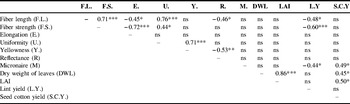
Correlation coefficients among traits are given in Table 6. Plant height correlated with dry weight of shoots and LAI (r=0.84***, P<0.001 and r=0.67***, P<0.001 respectively). Seed cotton yield had positive and significant correlation with LAI and dry weight of shoots (r=0.50*, P<0.05 and r=0.47*, P<0.05, respectively).
Correlation coefficientsFootnote 1 between plant-lint parameters of cotton.

1 r was calculated using the linear equation. Significant at *P=0.05, **P=0.01 and ***P=0.001, respectively. ns: not significant.
In this work, cumulative data showed that Campo, the most productive cultivar, had significantly lower relative fiber strength (Table 4), suggesting a negative correlation (Table 6) between these two characteristics. Smith and CoyleReference Smith and Coyle35 reported that fiber strength and length were negatively associated with the most basic within-boll lint yield components. Lint yield correlated negatively and significant with fiber strength (r=−0.60***, P<0.001). Similar results were obtained by other researchersReference Ulloa and Meredith36. Moreover, seed cotton yield had strongly positive and significant correlations with fiber fineness (micronaire). Lint percentage had both a positive and significant correlation with fiber elongation but a negative and significant correlation with fiber fineness.
The multiple regression analysis indicates that there was a statistically significant relationship between fiber strength (S), elongation (E) and lint yield (Y):



The R 2 statistic indicates that this model explains 67% of the variability in fiber strength.
Fiber strength was positively correlated with fiber length and uniformity ratio (r=0.71***, P<0.001 and r=0.44*, P<0.05, respectively), a result expected, as both traits have a close connection with fiber perimeter. Perimeter had the greatest effect on micronaire (76.5% of total sums of squares), but also affected more than 35% of the variation in models explaining length and strengthReference Kloth37. Other investigators reported that fiber strength and length were positively associatedReference Avgoulas, Bouza, Koutrou, Papadopoulou, Kosmas, Makridou, Papastylianou and Bilalis1. There was a negative correlation between fiber strength and fiber elongation. As the yield increased, the strength was reduced. The correlation was negative and significant between fiber strength and fiber elongation. Finally, fiber yellowness had a strongly negative correlation with fiber reflectance (whiteness).
Conclusions
Our results indicate that there were no significant differences between the organic and conventional cotton for cotton growth, yield and fiber quality. The variety Campo had the lowest fiber fineness (micronaire), strength, length and reflectance. In addition, Campo variety had the highest fiber elongation and yellowness. Also, there were no significant differences between cultivars for uniformity and leaf trash ratio. Positive correlation was observed between fiber strength and length. Finally, negative correlation was found between lint yield and fiber strength. Concerning the organic agriculture system, green manure can affect cotton growth.