



1 Introduction
An abelian category
 $\mathscr {A}$
is called Grothendieck if it has colimits, direct limits are exact, and it possesses a generator (see [Reference Grothendieck25]). The category
 $\mathrm {Qcoh}(X)$
of quasicoherent sheaves over any quasicompact and quasiseparated algebraic scheme and the quotient category
 $\mathscr {G}/\mathscr {T}$
, where
 $\mathscr {G}$
is a locally finitely presented Grothendieck category (see Definition 3.2) and
 $\mathscr {T}$
is a hereditary torsion class in
 $\mathscr {G}$
generated by finitely presented objects, are examples of locally finitely presented Grothendieck categories (see [Reference Grothendieck and Dieudonné26, Section I.6.9.12] and [Reference Estrada and Saorin13, Proposition 2.4]).
A Grothendieck category is called pure semisimple if each of its objects is a coproduct of finitely presented objects (see [Reference Simson39–Reference Simson42]). The category of representations of any quiver of the pure semisimple type, which was studied by Drozdowski and Simson [Reference Drozdowski and Simson11] is one of the important examples of locally finitely presented pure semisimple Grothendieck categories. The pure semisimplicity of the category Comod-C of right C-comodules over a coalgebra C studied by using the right Gabriel quiver
 $Q_C$
of C in [Reference Simson39, Section 7], [Reference Simson42, p. 404], and [Reference Kosakowska and Simson33, Reference Nowak and Simson35, Reference Simson37, Reference Simson43]. Note that the category Comod-C of right C-comodules over a coalgebra C is also one of the examples of locally finitely presented Grothendieck categories.
In [Reference Simson41], Simson showed that there exists a bijection between equivalence classes of pure semisimple (resp., hereditary) Grothendieck categories and equivalence classes of pure semisimple (resp., hereditary) functor categories Mod
 $(\mathscr {C}^{\mathrm {op}})$
, where
 $\mathscr {C}$
has pseudocokernels. In [Reference Garcia and Simson24], Garcia and Simson studied locally finitely presented pure semisimple Grothendieck locally PI-categories. They showed that any locally finitely presented pure semisimple Grothendieck locally PI-category
 $\mathscr {A}$
is equivalent to the category of
 $\mathrm {Mod}\widetilde {\Lambda }$
of unitary right
 $\widetilde {\Lambda }$
-modules over a right perfect ring
 $\widetilde {\Lambda }$
(in general
 $\widetilde {\Lambda }$
has no identity) with a complete set of orthogonal primitive local idempotents when
 $\mathscr {A}$
is equivalent to the category of unitary modules over a ring with enough idempotents (see [Reference Garcia and Simson24, Section 3.3, Theorem 2]). Moreover, they proved that any locally finitely presented pure semisimple Grothendieck locally PI-category
 $\mathscr {A}$
is equivalent to the category of unitary right modules over an artinian PI-ring of finite representation type
 $\Lambda $
when
 $\mathscr {A}$
has only finitely many nonisomorphic simple objects (see [Reference Garcia and Simson24, Section 3.3, Corollary 7]). A left artinian ring
 $\Lambda $
is called of finite representation type if it has, up to isomorphism, only finitely many finitely generated indecomposable left
 $\Lambda $
-modules (see [Reference Auslander, Reiten and Smal7, Chapter VI]). Note that there exist locally finitely presented pure semisimple Grothendieck categories, which are not of finite representation type (see [Reference Drozdowski and Simson11]). Therefore, the class of locally finitely presented pure semisimple Grothendieck categories is bigger than the class of the module categories over pure semisimple rings.
A ring
 $\Lambda $
is called left pure semisimple if the category
 $\Lambda $
-Mod is pure semisimple. Equivalently, every left
 $\Lambda $
-module is a direct sum of finitely generated left
 $\Lambda $
-modules. Fuller and Reiten [Reference Fuller17, Reference Fuller and Reiten19] proved that a ring
 $\Lambda $
is left and right pure semisimple if and only if
 $\Lambda $
is of finite representation type. The problem of whether left pure semisimple rings are of finite representation type, known as the pure semisimplicity conjecture, remains open (see [Reference Auslander4, Reference Simson44, Reference Simson45, Reference Huisgen-Zimmermann, Krause and Ringel51]). Auslander [Reference Auslander4] showed that the pure semisimplicity conjecture is valid for artin algebras. Also, Herzog [Reference Herzog31] showed that if there exists a counterexample to the pure semisimplicity conjecture, then there exists a counterexample R, which is hereditary.
In 1997, Garcia and Simson [Reference Garcia and Simson23] studied locally finitely presented Grothendieck categories by using their (Gabriel) functor rings (we refer the reader to page 24 for the definition of (Gabriel) functor ring). They showed that there exists, up to equivalence, a bijection between the class of all locally finitely presented Grothendieck categories and the class of all left panoramic rings with enough idempotents. In this bijection, the category corresponding to a given ring R is the category of all flat unitary left R-modules. Also, the ring corresponding to a given category
 $\mathscr {A}$
is the functor ring
 $T_{\mathscr {A}}$
of
 $\mathscr {A}$
. The functor rings are an important tool in the study of locally finitely presented pure semisimple Grothendieck categories. As an example, in [Reference Simson39], it was shown that a locally finitely presented Grothendieck category
 $\mathscr {A}$
is pure semisimple if and only if
 $T_{\mathscr {A}}$
is a left perfect ring. In this paper, we study locally finitely presented pure semisimple (hereditary) Grothendieck categories by using this technique. We show that any locally finitely presented pure semisimple (resp., hereditary) Grothendieck category which satisfies the following property
 $$ \begin{align} &\mathrm{Mod}(\mathrm{fp}(\mathscr{A})) \text{ is a QF-3 category (see Definition 4.3) and every }\\ & \text{representable functor in}\ \mathrm{Mod}(\mathrm{fp}(\mathscr{A})) \text{has finitely generated essential socle.} \nonumber\end{align} $$
is equivalent to the category of left modules over a left pure semisimple (resp., left hereditary) ring. Then we provide a bijection between these two classes of categories up to equivalence. To obtain this result, we first study left pure semisimple rings by using Auslander’s ideas. Auslander in his famous theorem [Reference Auslander6], which is called Auslander correspondence, provided a bijection between Morita equivalence classes of rings of finite representation type and Morita equivalence classes of Auslander rings. A left artinian ring R is called Auslander ring if the global dimension of R is less than or equal 2 and the dominant dimension of R is greater than or equal 2. This result plays a crucial role in representation theory of artin algebras (see [Reference Auslander, Reiten and Smal7, p. 209]). Ringel and Tachikawa [Reference Ringel and Tachikawa36] by using QF-3 maximal quotient rings (see Definition 4.8) gave a short proof for the Auslander’s result. It is natural to ask about similar bijection for the class of left pure semisimple rings. In this paper, we extend the Auslander–Ringel–Tachikawa correspondence to the class of left pure semisimple rings. Note that the functor rings that appeared in the proof of the Auslander correspondence are unital, but, in our case, the functor rings are not unital (these are rings with enough idempotents).
Consider the following properties for a ring R with enough idempotents.
-
(i) There is a complete set
 $\lbrace e_{\alpha }~|~\alpha \in J \rbrace $
of pairwise orthogonal local idempotents of R such that
$R=\bigoplus _{\alpha \in J}Re_{\alpha }=\bigoplus _{\alpha \in J}e_{\alpha }R$
and each
$e_{\alpha }Re_{\alpha }$
is a right perfect ring;
-
(ii) R is a left locally noetherian ring (see Definition 3.1) with
$\mathrm {l.gl.dim}R = 0 ~\mathrm {or} ~ 2$
; -
(iii)
$\mathrm {proj}(R)\bigcap \mathrm {inj}(R)= \mathrm {add}(\bigoplus _{l=1}^n E(S_l))$
, where
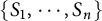
$\lbrace S_1,\cdots ,S_n\rbrace $
is a set of nonisomorphic simple unitary left R-modules; -
(iv) For each
$\alpha \in J$
, dom.dim
$Re_{\alpha } \geq 2$
.







As a first main result of this paper, we prove the following theorem.
Theorem A. (Theorem 3.6)
There exists a bijection between Morita equivalence classes of left pure semisimple rings
 $\Lambda $
and Morita equivalence classes of rings R with the properties
 $(i)$
–
 $(iv)$
.
It is easy to see that any Auslander ring has the properties
 $(i)$
–
 $(iv)$
. It is natural to ask about the converse of this fact. We show that the converse of this fact is equivalent to the pure semisimplicity conjecture (see Corollary 3.8).
Then we prove the following result, which extends the Ringel–Tachikawa correspondence to the class of left pure semisimple rings.
Theorem B. (Theorem 4.7)
There exists a bijection between Morita equivalence classes of left pure semisimple rings
 $\Lambda $
and Morita equivalence classes of left perfect right locally coherent QF-3 rings R with enough idempotents, which have a minimal faithful balanced right ideal and
 $\mathrm {l.gl.dim}R = 0 ~\mathrm {or} ~ 2$
.
We show that there exists, up to equivalence, a bijection between the class of all locally finitely presented pure semisimple Grothendieck categories, which satisfy the property
 $(\ast )$
and the class of rings with the properties
 $(i)$
–
 $(iv)$
(see Theorem 5.3). In this bijection, the category corresponding to a given ring R is the category of all flat unitary left R-modules. Also, the ring corresponding to a given category
 $\mathscr {A}$
is the functor ring
 $R_{\mathscr {A}}$
of
 $\mathscr {A}$
(see the last paragraph of page 12). Next, by using Theorem A, we prove the following result.
Theorem C. (Corollary 5.4)
There exists a bijection between Morita equivalence classes of left pure semisimple (resp., left hereditary) rings
 $\Lambda $
and equivalence classes of locally finitely presented pure semisimple (resp., hereditary) Grothendieck categories, which satisfy the property
 $(\ast )$
.
As a consequence of above theorem and [Reference Herzog31, Theorem 6.9], we have the following corollary, which gives an equivalent statement to the pure semisimplicity conjecture.
Corollary A. (Corollary 5.11)
The following statements are equivalent.
-
(a) The pure semisimplicity conjecture is true;
-
(b) Every locally finitely presented pure semisimple hereditary Grothendieck category, which satisfies the property
$(\ast )$
, is of finite representation type.

We hope these results create a new path to prove or disprove the pure semisimplicity conjecture.
This paper is organized as follows. In Section 2, we prove some preliminary results that will be needed throughout the paper. In Sections 3 and 4, we extend and generalize the Auslander correspondence and Ringel–Tachikawa correspondence to the class of left pure semisimple rings and prove Theorems A and B, respectively. In Section 5, we study locally finitely presented pure semisimple hereditary Grothendieck categories, which satisfy the property
 $(\ast )$
and prove Theorem C.
1.1 Notation
In this paper, we write morphisms in a category
 $\mathscr {C}$
on the right side of the objects. Let
 $\mathscr {C}$
be an additive category. We denote by Mod
 $(\mathscr {C})$
the category of all contravariant additive functors from
 $\mathscr {C}$
to the category
 $\mathfrak {Ab}$
of all abelian groups. We also denote by
 $\mathrm {Flat}(\mathscr {C})$
(resp.,
 $\mathrm {proj}(\mathscr {C})$
) the full subcategory of Mod
 $(\mathscr {C})$
whose objects are flat (resp., finitely generated projective) functors; recall that a functor F in Mod
 $(\mathscr {C})$
is called flat if F is a direct limit of finitely generated projective functors. Let
 $F: \mathscr {C} \rightarrow \mathscr {C'}$
be an additive functor and let
 $\mathscr {D}$
be a full subcategory of
 $\mathscr {C}$
. We denote by
 $F|_{\mathscr {D}}$
the restriction of F to
 $\mathscr {D}$
. Throughout this paper, all rings are associative, not necessary with unit. Let R be a ring. We denote by R-Mod (resp., Mod-R) the category of all left (resp., right) R-modules. Also we denote by R-mod (resp., mod-R) the category of all finitely generated left (resp., right) R-modules and by
 $J(R)$
the Jacobson radical of R. A left R-module M is called unitary if
 $RM=M$
. We denote by RMod (resp., ModR) the category of all unitary left (resp., right) R-modules. Let P be an R–S-bimodule and M be a left R-module. Then by [Reference Hungerford30, Chapter IV, Theorem 4.8],
 $\mathrm {Hom}_R(P,M)$
is a left S-module, but it need not be unitary. We denote by
 $S\mathrm {Hom}_R(P,M)$
the largest unitary left S-submodule of
 $\mathrm {Hom}_R(P,M)$
. By
 $S\mathrm {Hom}_{R}(P,-)$
, we denote the functor from RMod to SMod induced by the mapping
 $N \mapsto S\mathrm {Hom}_{R}(P, N)$
, which is a left exact functor (for more details, see [Reference Ánh and Márki3, p. Reference Ánh and Márki3]). We write
 $\prod _A M$
for the direct product of cardinal A copies of an R-module M. Moreover, we write
 $\widehat {\prod }_B M=R \prod _B M$
for the direct product of cardinal B copies of a unitary left R-module M in RMod. Let N be a unitary left R-module. We denote by
 $E(N)$
,
 $\mathrm {rad}(N)$
,
 $\mathrm {top}(N)$
, and
 $\mathrm {Soc}(N)$
the injective hull of N in RMod, radical of N, top of N, and socle of N, respectively. For a left R-module V, we denoted by
 $\mathrm {Add}(V)$
(resp.,
 $\mathrm {add}(V)$
) the full subcategory of RMod whose objects are all left R-modules that are isomorphic to direct summands of direct sum (resp., finite direct sum) of copies of V. We denote by
 $\mathrm {Proj}(R)$
(resp.,
 $\mathrm {proj}(R)$
) the full subcategory of RMod consisting of (resp., finitely generated) unitary left R-modules, which are projective in RMod. Also, we denote by
 $\mathrm {inj}R$
the full subcategory of RMod consisting of finitely generated unitary left R-modules, which are injective in RMod. Throughout this paper, we assume that
 $\Lambda $
is a ring with identity.
2 Preliminaries
A ring R is called a ring with local units if every finite subset of R contained in a subring of the form
 $eRe$
where
 $e^2 = e \in R$
(see [Reference Wisbauer48, p. 464]). Throughout this section, we assume that all rings are associative with local units.
Let
 $(I, \leq )$
be a quasiordered directed set. A direct system of unitary left R-modules
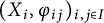 ${(X_i, \varphi _{ij})_{i,j \in I}}$
is called split if for each
 $i \leq j$
in I, there exists an R-module homomorphism
 $\psi _{ji}: X_j \rightarrow X_i$
such that
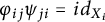 $\varphi _{ij}\psi _{ji}=id_{X_i}$
and
 $\psi _{kj}\psi _{ji}=\psi _{ki}$
for each
 $i \leq j \leq k$
in I (see [Reference Fazelpour and Nasr-Isfahani16, p. 5]). A unitary left R-module P is called locally projective if P is a direct limit of a split direct system
 $(P_i)_{i \in I}$
, where each
 $P_i$
is a finitely generated projective unitary left R-module (see [Reference Fazelpour and Nasr-Isfahani16, p. 6]).
Let R and S be two rings and P be an R–S-bimodule. Assume that P is a locally projective unitary left R-module such that
 $Pf$
is a finitely generated left R-module for each idempotent
 $f \in S$
. By [Reference Fazelpour and Nasr-Isfahani16, Lemma 2.5], the functor
 $R\mathrm {Hom}_S(G_P,-): S\mathrm {Mod}\rightarrow R\mathrm {Mod}$
is a right adjoint of the functor
 $S\mathrm {Hom}_R(P,-): R\mathrm {Mod} \rightarrow S\mathrm {Mod}$
, where
 $G_P=S\mathrm {Hom}_R(P,R)$
. For each unitary left R-module M, we have an R-module homomorphism
 $\gamma _M: M \rightarrow R\mathrm {Hom}_S(G_P,S\mathrm {Hom}_R(P,M))$
defined by
 $(\beta )(m)\gamma _M=(\beta \otimes m)\eta _M:P \rightarrow M$
via
 $x \mapsto (x)\beta m$
for each
 $m \in M$
and
 $\beta \in G_P$
. Therefore, we have a natural transformation
 $\gamma : id_{R\mathrm {Mod}} \rightarrow R\mathrm {Hom}_S(G_P, S\mathrm {Hom}_R(P,-))$
, where
 $\gamma =(\gamma _M)$
(see [Reference Wisbauer48, Proposition 45.5]).
In the following proposition and corollary, we assume that P is a locally projective left R-module, S is a subring of
 $\mathrm {End}_R(P)$
such that P is a unitary right S-module,
 $S\mathrm {End}_R(P)=S$
, and
 $Pf$
is a finitely generated left R-module for each
 $f^2=f \in S$
. Note that the following proposition and corollary are nonunital analogs of [Reference Auslander5, Propositions 5.5 and 5.6].
Proposition 2.1 The following conditions are equivalent for any unitary left R-module N.
-
(a) The canonical morphism
$\gamma _N: N \rightarrow R\mathrm {Hom}_S(G_P,S\mathrm {Hom}_R(P,N))$
is an isomorphism. -
(b) There exists a unitary left S-module
$N'$
such that
$R\mathrm {Hom}_S(G_P,N')\cong N$
as R-modules. -
(c) There exists an exact sequence of R-modules
where
$$ \begin{align*}0\rightarrow N \rightarrow R\mathrm{Hom}_S(G_P,I_0) \rightarrow R\mathrm{Hom}_S(G_P,I_1),\end{align*} $$
$I_0$
and
$I_1$
are injective in SMod.
-
(d) For each
$M \in R\mathrm {Mod}$
, the functor
$S\mathrm {Hom}_R(P,-)$
gives an isomorphism of abelian groups
$$ \begin{align*}\mathrm{Hom}_R(M,N) \rightarrow \mathrm{Hom}_S(S\mathrm{Hom}_R(P,M),S\mathrm{ Hom}_R(P,N)).\end{align*} $$







Proof
 $(a) \Rightarrow (b)$
is clear.
 $(b) \Rightarrow (d)$
. Consider the exact sequence
 $0\rightarrow N' \rightarrow I_0 \overset {t}{\rightarrow } I_1$
, where
 $I_0$
and
 $I_1$
are injective modules in SMod. Then the sequence
 $0\rightarrow N \overset {h}{\rightarrow } R\mathrm {Hom}_S(G_P,I_0) \overset {g}{\rightarrow } R\mathrm {Hom}_S(G_P,I_1)$
is exact, where
 $g=R\mathrm {Hom}_S(G_P,t)$
. This implies that the following sequence is also exact
 $$ \begin{align*}0\longrightarrow S\mathrm{Hom}_R(P,N) &\overset{S\mathrm{Hom}_R(P,h)}{\longrightarrow} S\mathrm{Hom}_R(P,R\mathrm{Hom}_S(G_P,I_0)) \\ &\overset{S\mathrm{Hom}_R(P,g)}{\longrightarrow} S\mathrm{Hom}_R(P,R\mathrm{ Hom}_S(G_P,I_1)).\end{align*} $$
We know that by [Reference Fazelpour and Nasr-Isfahani16, Lemma 2.1], the pair of functors
 $$ \begin{align*} G_P\otimes_R-:R\mathrm{Mod} \rightarrow S\mathrm{Mod}\ \text{and}\ R\mathrm{Hom}_S(G_P,-):S\mathrm{Mod} \rightarrow R\mathrm{Mod,} \end{align*} $$
is adjoint via the isomorphisms (for
 $X \in R$
Mod and
 $Y \in S$
Mod)
 $$ \begin{align*} \psi_{X,Y}:\mathrm{Hom}_R(X,R\mathrm{Hom}_S(G_P,Y)) &\rightarrow \mathrm{Hom}_S(G_P\otimes_RX,Y) \text{via} \\ \beta& \mapsto \left[ \sum_{i=1}^t\alpha_i\otimes x_i\mapsto \sum_{i=1}^t(\alpha_i)(x_i)\beta \right]. \end{align*} $$
Also, by [Reference Fazelpour and Nasr-Isfahani16, Lemma 2.8], for each
 $Y \in S$
Mod there exists an S-module isomorphism
 $$ \begin{align*}\nu_Y:Y \rightarrow S\mathrm{Hom}_R(P,R\mathrm{Hom}_S(G_P,Y)),\end{align*} $$
which determines a natural isomorphism
 $\mathrm {id}_{S\mathrm {Mod}} \rightarrow S\mathrm {Hom}_R(P,R\mathrm {Hom}_S(G_P,-))$
. Moreover by the proof of [Reference Fazelpour and Nasr-Isfahani16, Lemma 2.5], there exists an S-module isomorphism
 $$ \begin{align*}\eta_M: G_P \otimes_R M \rightarrow S\mathrm{Hom}_R(P,M).\end{align*} $$
Set
 $I^{\prime }_i:=S\mathrm {Hom}_R(P,R\mathrm {Hom}_S(G_P,I_i))$
and
 $\delta _i:= \mathrm {Hom}_R(M,R\mathrm {Hom}_S(G_P,\nu _{I_i}))$
, for
 $i=0,1$
and let M be a unitary left R-module. Therefore, the following diagram is commutative

where
 $M'=S\mathrm {Hom}_R(P,M)$
,
 $N'=S\mathrm {Hom}_R(P,N)$
,
 $g'=S\mathrm {Hom}_R(P,g)$
,
 $h'=S\mathrm {Hom}_R(P,h)$
,
 $g"'=\mathrm {Hom}_R(M,R\mathrm {Hom}_S(G_P,g'))$
,
 $h"=\mathrm {Hom}_S(S\mathrm {Hom}_R(P,M),h')$
and
 $g"=\mathrm { Hom}_S(S\mathrm {Hom}_R(P,M),g')$
. By using the proof of [Reference Fazelpour and Nasr-Isfahani16, Lemmas 2.5 and 2.8] and the five lemma, we can see that the functor
 $S\mathrm {Hom}_R(P,-)$
gives the following isomorphism:
 $$ \begin{align*}\mathrm{Hom}_R(M,N) \rightarrow \mathrm{Hom}_S(S\mathrm{Hom}_R(P,M),S\mathrm{Hom}_R(P,N)).\end{align*} $$
 $(d) \Rightarrow (a).$
Put
 $M=R$
and then we can easily see this isomorphism induces asked isomorphism.
 $(b) \Rightarrow (c)$
is clear.
 $(c) \Rightarrow (a).$
It follows from
 $(b) \Leftrightarrow (a)$
and the five lemma.
A unitary left R-module M is called injectively copresented over P if the canonical R-module homomorphism
 $\gamma _M: M \rightarrow R\mathrm {Hom}_S(G_P,S\mathrm {Hom}_R(P,M))$
is an isomorphism. We denote the full subcategory of RMod consisting of all left R-modules, which are injectively copresented over P by
 $R\mathrm {Hom}_S(G_P, S\mathrm {Mod})$
(see [Reference Auslander5, p. 221]). Notice that the category
 $R\mathrm { Hom}_S(G_P, S\mathrm {Mod})$
is closed under direct summands.
As a consequence of [Reference Fazelpour and Nasr-Isfahani16, Lemma 2.8] and Proposition 2.1, we have the following corollary.
Corollary 2.2 The functor
 $S\mathrm {Hom}_R(P,-): R\mathrm {Hom}_S(G_P, S\mathrm {Mod}) \rightarrow S\mathrm {Mod}$
is an equivalence of categories.
A ring R is called semiperfect if every finitely generated unitary left R-module has a projective cover in RMod (see [Reference Harada27, p. 334]). Let R and S be two rings, M be a unitary left R-module, and P be an R–S-bimodule. We denoted by
 $\mathrm {st}_P(M)$
the sum of all R-submodules K of M with
 $S\mathrm {Hom}_R(P,K)=0$
(see [Reference Fazelpour and Nasr-Isfahani16, p. 9]). We need a nonunital version of Proposition 5.7(d) and Corollary 7.4(c) of [Reference Auslander5] for nonunital semiperfect (nonartinian) rings.
Lemma 2.3 Let R be a semiperfect ring and let
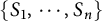 $\lbrace S_1,\cdots ,S_n\rbrace $
be a finite set of nonisomorphic simple unitary left R-modules. Assume that for each i,
 $f_i: P_i \rightarrow S_i$
is a projective cover of
 $S_i$
in RMod,
 $P=\bigoplus _{i=1}^n P_i$
and
 $S=\mathrm {End}_R(P)$
. If E is an injective module in RMod such that
 $\mathrm {Soc}(E)$
is an essential submodule of E, then the following conditions are equivalent.
-
(a)
$\mathrm {Soc}(E) \in \mathrm {Add}(\bigoplus _{i=1}^nS_i)$
. -
(b)
$st_P(E)=0$
. -
(c)
$E \in R\mathrm {Hom}_S(G_P, S\mathrm {Mod})$
.



Proof
 $(a) \Rightarrow (b)$
. Since
 $\mathrm {Soc}(E) \in \mathrm {Add}(\bigoplus _{i=1}^nS_i)$
,
 $st_P(\mathrm {Soc}(E))=0$
. Then
 $st_P(E)=0$
because
 $\mathrm {Soc}(E)$
is an essential submodule of E and
 $st_P(E) \cap \mathrm {Soc}(E) \subseteq st_P(\mathrm {Soc}(E))$
.
 $(b)\Rightarrow (a)$
. Assume that there exists a simple direct summand
 $S'$
of
 $\mathrm {Soc}(E)$
such that
 $S' \ncong S_i$
for each
 $i~(1 \leq i \leq n)$
. Then
 $st_P(S') \neq 0$
since otherwise there is a nonzero morphism
 $g \in \mathrm {Hom}_R(P,S')$
. Then there exists a nonzero R-module homomorphism
 $h: P \rightarrow P(S')$
such that
 $hf=g$
, where
 $f:P(S') \rightarrow S'$
is a projective cover of
 $S'$
in RMod. Hence,
 $S' \cong S_j$
for some j, which is a contradiction. Therefore,
 $st_P(S') \neq 0$
and so
 $st_P(E) \neq 0,$
which is a contradiction. Consequence
 $\mathrm {Soc}(E) \in \mathrm {Add}(\bigoplus _{i=1}^nS_i)$
.
 $(b)\Rightarrow (c)$
. It follows from [Reference Fazelpour and Nasr-Isfahani16, Lemma 2.9].
 $(c)\Rightarrow (b)$
. From E is injectively copresented over P, by Proposition 2.1(d) we get
 $$ \begin{align*}\mathrm{Hom}_R(st_P(E),E) \cong \mathrm{Hom}_S(\mathrm{Hom}_R(P,st_P(E)),\mathrm{Hom}_R(P,E)),\end{align*} $$
as abelian groups. Since
 $\mathrm {Hom}_R(P,st_P(E))=0$
,
 $\mathrm {Hom}_R(st_P(E),E)=0$
and so
 $st_P(E)=0$
.
3 Gabriel rings and left pure semisimple rings
In this section, we study the left functor (Gabriel) rings of left pure semisimple rings. We show that the left functor ring of any left pure semisimple ring has the properties
 $(i)$
–
 $(iv)$
(see Corollary 3.4). Then we show that the properties
 $(i)$
–
 $(iv)$
classify left pure semisimple rings up to Morita equivalence (see Theorem 3.6). This result extends the Auslander correspondence (see [Reference Auslander6, Corollary 4.7]) to the class of left pure semisimple rings. As a consequence, we show that every ring with the properties
 $(i)$
–
 $(iv)$
is Morita equivalent to an Auslander ring if and only if the pure semisimplicity conjecture holds (see Corollary 3.8).
A family
 $\lbrace U_i~|~i \in I\rbrace $
of objects of an abelian category
 $\mathscr {C}$
is a family of generators (resp., cogenerators) for
 $\mathscr {C}$
if for each nonzero morphism
 $f: M \rightarrow N$
in
 $\mathscr {C}$
there exists a morphism
 $h : U_i \rightarrow M$
(resp.,
 $h : N \rightarrow U_i$
), such that
 $hf \neq 0$
(resp.,
 $fh \neq 0$
) (see [Reference Stenström46, p. 94]). We recall that a ring R has enough idempotents if there exists a family
 $\lbrace q_{\alpha }~|~\alpha \in I \rbrace $
of pairwise orthogonal idempotents of R such that
 $R=\bigoplus _{\alpha \in I}Rq_{\alpha }=\bigoplus _{\alpha \in I}q_{\alpha }R$
(see [Reference Fuller17, p. 39]).
Definition 3.1 (See [Reference Stenström46, p. 123])
A Grothendieck category
 $\mathscr {C}$
is said to be locally noetherian if it has a generating set of noetherian objects. Also, a ring R with enough idempotents is called left locally noetherian if the category RMod is locally noetherian.
Let R be a ring with enough idempotents. The dominant dimension of a unitary left R-module X is defined as follows. Let
 $0 \rightarrow X \rightarrow E_1 \rightarrow E_2 \rightarrow \cdots $
be a minimal injective resolution of X. Then the dominant dimension of X is defined to be zero if
 $E_1$
is not projective and defined to be
 $\mathrm {sup}\lbrace n ~|~ E_i ~\mathrm {is ~a~projective~unitary~left}~R$
–
 $\mathrm {module~for}~i=1, \cdots , n\rbrace $
when
 $E_1$
is projective. We denoted by
 $\mathrm {l.dom.dim}R$
the dominant dimension of left R-module R. The left global dimension of R, which is denoted by
 $\mathrm {l.gl.dim}(R)$
, is the supremum of the set of projective dimensions of all unitary left R-modules.
Definition 3.2 (See [Reference Crawley-Boevey10, p. 1642])
Let
 $\mathscr {A}$
be an additive category with direct limits.
-
(a) An object A in
$\mathscr {A}$
is called finitely presented if the representable functor preserves direct limits. We denote by
$$ \begin{align*}\mathscr{A}(A,-)=\mathrm{Hom}_{\mathscr{A}}(A,-): \mathscr{A} \rightarrow \mathfrak{Ab,}\end{align*} $$
$\mathrm {fp}(\mathscr {A})$
the full subcategory of finitely presented objects in
$\mathscr {A}$
.
-
(b)
$\mathscr {A}$
is called locally finitely presented if
$\mathrm {fp}(\mathscr {A})$
is skeletally small and
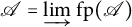
$\mathscr {A}={\underrightarrow {\lim }}~\mathrm {fp}(\mathscr {A})$
(i.e., every object in
$\mathscr {A}$
is a direct limit of finitely presented objects in
$\mathscr {A}$
).




Note that every locally finitely presented Grothendieck category
 $\mathscr {A}$
has a generating set of finitely presented objects. An object C of a Grothendieck category
 $\mathscr {C}$
is called finitely generated whenever
 $C=\sum _{i}C_i$
for a direct family of subobjects
 $C_i$
of C, there exists an index
 $i_0$
such that
 $C=C_{i_0}$
(see [Reference Stenström46, p. 121]). Every finitely presented object in a locally finitely presented Grothendieck category
 $\mathscr {A}$
is finitely generated. By [Reference Stenström46, Chapter V, Proposition 3.4], an object X in a locally finitely presented Grothendieck category
 $\mathscr {A}$
is finitely presented if and only if X is finitely generated and every epimorphism
 $Y \rightarrow X$
, where Y is finitely generated, has a finitely generated kernel.
Let
 $\mathscr {A}$
be a locally finitely presented Grothendieck category and
 $\lbrace U_{\alpha }~|~ \alpha \in J \rbrace $
be a family of finitely presented objects in
 $\mathscr {A}$
. Set
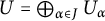 $U=\bigoplus _{\alpha \in J} U_{\alpha }$
and for each
 $\alpha \in J$
let
 $e_{\alpha }=\pi _{\alpha } \varepsilon _{\alpha }$
, where
 $\pi _{\alpha }:U \rightarrow U_{\alpha }$
is the canonical projection and
 $\varepsilon _{\alpha }:U_{\alpha } \rightarrow U$
is the canonical injection. For each object X of
 $\mathscr {A}$
, we define as in [Reference Menini34, p. 242] (see also, [Reference Fuller17, p. 40]),
 $\widehat {\mathrm {{Hom}}}_{\mathscr {A}}(U,X)=\lbrace f \in \mathrm { Hom}_{\mathscr {A}}(U,X)~|~ e_{\alpha }f =0~ \mathrm {for ~almost~ all}~ \alpha \in J \rbrace $
. For
 $X=U$
, we write
 $R:= \widehat {\mathrm {Hom}}_{\mathscr {A}}(U, U)=\widehat {\mathrm {End}}_{\mathscr {A}}(U)$
. Then
 $R=\bigoplus _{\alpha \in J}Re_{\alpha }=\bigoplus _{\alpha \in J}e_{\alpha }R$
is a ring with enough idempotents (see [Reference Menini34, Proposition 2.2(6)]). Fuller [Reference Fuller17, p. 40] (see also [Reference Menini34, Proposition 2.2(5)]) defined a covariant functor
 $\widehat {\mathrm {{Hom}}}_{\mathscr {A}}(U,-): \mathscr {A} \rightarrow R$
Mod as follows. For any morphism
 $f: X \rightarrow Y$
in
 $\mathscr {A}$
, he defined
 $\widehat {\mathrm {Hom}}_{\mathscr {A}}(U,f): \widehat {\mathrm {Hom}}_{\mathscr {A}}(U,X) \rightarrow \widehat {\mathrm {Hom}}_{\mathscr {A}}(U,Y)$
via
 $g \mapsto gf$
. From [Reference Fuller17, pp. 40–41] (see also [Reference Menini34, Proposition 2.2(6)]), we observe that the left exact covariant functor
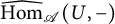 $\widehat {\mathrm {{Hom}}}_{\mathscr {A}}(U,-)$
preserves coproducts and products. Moreover, if
 $\mathscr {A}=\Lambda $
-Mod, where
 $\Lambda $
is a ring with identity, then
 $$ \begin{align} \widehat{\mathrm{{Hom}}}_{\Lambda}(U,-): \mathrm{Add}(U) \rightarrow \mathrm{Proj}(R), \end{align} $$
is an additive equivalence with the inverse equivalence
 $U \otimes _R -$
(see [Reference Fuller17, pp. 40–41]).
We recall that a set
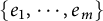 $\lbrace e_1, \cdots , e_m\rbrace $
of idempotents of a semiperfect ring
 $\Lambda $
is called basic in case they are pairwise orthogonal,
 $\Lambda e_i\ncong \Lambda e_j$
for each
 $i\neq j$
and for each finitely generated indecomposable projective left
 $\Lambda $
-module P, there exists i such that
 $P \cong \Lambda e_i$
. Clearly, the cardinal of any two basic sets of idempotents of a semiperfect ring
 $\Lambda $
is equal.
Two rings with enough idempotents R and S are said to be Morita equivalent in case there exists an additive covariant equivalence between RMod and SMod (see [Reference Wisbauer48]).
Proposition 3.3 Let
 $\Lambda $
be a left artinian ring and let
 $\lbrace V_{\alpha }~|~ \alpha \in J \rbrace $
be a family of finitely generated indecomposable left
 $\Lambda $
-modules. Set
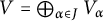 $V=\bigoplus _{\alpha \in J} V_{\alpha }$
and
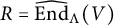 $R=\widehat {\mathrm {End}}_{\Lambda }(V)$
. Then R has the property
 $(i)$
. In particular,
-
(a) If V is a generator in
$\Lambda $
-Mod and
$\mathrm {l.gl.dim}R= 0 ~\mathrm {or} ~2$
, then R is a left locally noetherian ring. -
(b) If V is a generator–cogenerator in
$\Lambda $
-Mod, then R has the properties
$(iii)$
–
$(iv)$
. Moreover,
$S=\mathrm {End}_R(\bigoplus _{i=1}^nP_i)$
is Morita equivalent to
$\Lambda $
, where each
$P_i$
is a projective cover of the simple module
$S_i$
.







Proof It follows from [Reference Wisbauer48, Propositions 32.4 and 51.6] and the fact that
 $\widehat {\mathrm {{Hom}}}_{\Lambda }(V,V_{\alpha }) \cong Re_{\alpha }$
as R-modules, where
 $e_{\alpha }=\pi _{\alpha } \varepsilon _{\alpha }$
,
 $\pi _{\alpha }:U \rightarrow U_{\alpha }$
is the canonical projection and
 $\varepsilon _{\alpha }:U_{\alpha } \rightarrow U$
is the canonical injection.
 $(a)$
. It follows from [Reference Fazelpour and Nasr-Isfahani15, Lemma 2.3].
 $(b)$
. Since V is a generator in
 $\Lambda $
-Mod, by [Reference Wisbauer48, Proposition 51.7], the functor
 $\widehat {\mathrm {{Hom}}}_{\Lambda }(V,-):\Lambda $
-Mod
 $\rightarrow R$
Mod preserves indecomposable modules, injective modules, and essential extensions. Hence, there exists a minimal injective resolution
 $0 \longrightarrow {\widehat {\mathrm {{Hom}}}}_{\Lambda }(V,V_{\alpha }) \longrightarrow {\widehat {\mathrm {{Hom}}}}_{\Lambda }(V,E(V_{\alpha })) \longrightarrow Y$
, where Y is a direct summand of
 ${\widehat {\mathrm {{Hom}}}}_{\Lambda }(V,E(E(V_{\alpha })/V_{\alpha }))$
. Let
 $\lbrace \Lambda e_1/J(\Lambda )e_1, \cdots ,\Lambda e_m/J(\Lambda )e_m \rbrace $
be a complete set of nonisomorphic simple left
 $\Lambda $
-modules, where
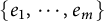 $\lbrace e_1, \cdots , e_m \rbrace $
is a basic set of idempotents of
 $\Lambda $
. Since
 $\Lambda $
is a left artinian ring, the injective hull of any finitely generated left
 $\Lambda $
-module belongs to be
 $\mathrm {add}(\bigoplus _{i=1}^mE(\Lambda e_i/J(\Lambda )e_i))$
. On the other hand, since V is a cogenerator in
 $\Lambda $
-Mod, each
 $E(\Lambda e_l/J(\Lambda )e_l) \in \mathrm {add}(V)$
. Since the functor
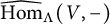 $\widehat {\mathrm {{Hom}}}_{\Lambda }(V,-)$
preserves direct sums,
 ${\widehat {\mathrm {{Hom}}}}_{\Lambda }(V,E(V_{\alpha }))$
and Y are finitely generated projective unitary left R-modules. Hence, R has the property
 $(iv)$
.
Now we show that R has the property
 $(iii)$
. Since V is a generator,
 $\Lambda e_i \cong V_{\alpha _i}$
for some
 $\alpha _i \in J$
. Let
 $\rho _i:\Lambda e_i \rightarrow \Lambda e_i/J(\Lambda )e_i$
be a projective cover of
 $\Lambda e_i/J(\Lambda )e_i$
and
 $\pi _{\alpha _i}: V \rightarrow V_{\alpha _i}$
be the canonical projection. Then
 $\pi _{\alpha _i} \rho _{\alpha _i} \rho _i$
is a nonzero morphism in
 $\widehat {\mathrm {{Hom}}}_{\Lambda }(V,\Lambda e_i/J(\Lambda )e_i)$
, where
 $\rho _{\alpha _i}: V_{\alpha _i} \rightarrow \Lambda e_i$
is an isomorphism. Consider the R-module homomorphism
 $$ \begin{align*}\varphi:=\widehat{\mathrm{{Hom}}}_{\Lambda}(V,\pi_{\alpha_i} \rho_{\alpha_i} \rho_i): \widehat{\mathrm{{End}}}_{\Lambda}(V) \rightarrow \widehat{\mathrm{{Hom}}}_{\Lambda}(V,\Lambda e_i/J(\Lambda)e_i).\end{align*} $$
It is easy to see that
 $\varphi $
is a nonzero morphism. Also
 $J(R)\widehat {\mathrm {{End}}}_{\Lambda }(V) \subseteq \mathrm {Ker}\varphi $
since otherwise there exist
 $t \in J(R)$
and
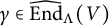 $\gamma \in \widehat {\mathrm {{End}}}_{\Lambda }(V)$
such that
 $t\gamma \pi _{\alpha _i} \rho _{\alpha _i} \rho _i \neq 0$
. It follows that
 $\mathrm {Im}~t\gamma \pi _{\alpha _i} \rho _{\alpha _i} \nsubseteq \mathrm {Ker}\rho _i$
. Since
 $\rho _i: \Lambda e_i \rightarrow \Lambda e_i/J(\Lambda )e_i$
is a projective cover of
 $\Lambda e_i/J(\Lambda )e_i$
, the morphism
 $t\gamma \pi _{\alpha _i} \rho _{\alpha _i}: V \rightarrow \Lambda e_i$
is an epimorphism and so there is a
 $\Lambda $
-module homomorphism
 $h: \Lambda e_i \rightarrow V$
such that
 $ht\gamma \pi _{\alpha _i} \rho _{\alpha _i} = id_{\Lambda e_i}$
. Let
 $\varepsilon _{\alpha _i}: V_{\alpha _i} \rightarrow V$
be the canonical injection. Since
 $\pi _{\alpha _i} \rho _{\alpha _i} ht\gamma \pi _{\alpha _i} \rho _{\alpha _i} {\rho ^{-1}_{\alpha _i}} \varepsilon _{\alpha _i}= \pi _{\alpha _i} \varepsilon _{\alpha _i}$
,
 $\pi _{\alpha _i}\varepsilon _{\alpha _i} \in J(R)$
. By [Reference Wisbauer48, Proposition 49.7], this is a contradiction with the fact that
 $J(R)$
contains no idempotent. Consequently,
 $\mathrm {Im}\varphi $
is a nonzero semisimple submodule of
 $\widehat {\mathrm {{Hom}}}_{\Lambda }(V,\Lambda e_i/J(\Lambda )e_i)$
. It follows that
 $\mathrm { Soc}(\widehat {\mathrm {{Hom}}}_{\Lambda }(V,E(\Lambda e_i/J(\Lambda )e_i))) \neq 0$
and so
 ${\widehat {\mathrm {{Hom}}}_{\Lambda }(V,E(\Lambda e_i/J(\Lambda )e_i))}$
has a simple essential socle. Hence,
 $$ \begin{align*}\widehat{\mathrm{{Hom}}}_{\Lambda}(V,E(\Lambda e_i/J(\Lambda)e_i)) \cong E(R\pi_{\alpha_i} \rho_{\alpha_i} \rho_i),\end{align*} $$
as R-modules. Since
 $R\pi _{\alpha _i} \rho _{\alpha _i} \rho _i \cong R\pi _{\alpha _j} \rho _{\alpha _j} \rho _j$
if and only if
 $\Lambda e_i/J(\Lambda )e_i \cong \Lambda e_j/J(\Lambda )e_j$
, so
 $\lbrace R\pi _{\alpha _i} \rho _{\alpha _i} \rho _i ~|~1 \leq i \leq m \rbrace $
is a set of nonisomorphic simple unitary left R-modules such that
 $\mathrm {add}(\bigoplus _{i=1}^m E(R\pi _{\alpha _i} \rho _{\alpha _i} \rho _i)) \subseteq \mathrm {proj}(R) \cap \mathrm {inj}(R)$
. But because for each finitely generated indecomposable projective unitary left R-module
 $Q, Q \in \mathrm {add}(\bigoplus _{i=1}^m E(R\pi _{\alpha _i} \rho _{\alpha _i} \rho _i))$
when
 $Q \in \mathrm {inj}(R)$
, then
 $\mathrm {proj}(R) \cap \mathrm {inj}(R) \subseteq \mathrm { add}(\bigoplus _{i=1}^m E(R\pi _{\alpha _i} \rho _{\alpha _i} \rho _i))$
and so R has the property
 $(iii)$
.
We know that the mapping
 $R \pi _{\alpha _i}\rho _{\alpha _i} \rightarrow R\pi _{\alpha _i}\rho _{\alpha _i} \rho _i$
defined by
 $r\pi _{\alpha _i}\rho _{\alpha _i} \longmapsto r\pi _{\alpha _i} \rho _{\alpha _i} \rho _i$
is a nonzero R-module epimorphism. Since
 $R\pi _{\alpha _i}\rho _{\alpha _i} = \widehat {\mathrm {{Hom}}}_{\Lambda }(V,\Lambda e_i)$
,
 $R\pi _{\alpha _i}\rho _{\alpha _i}$
is a finitely generated indecomposable projective unitary left R-module. So it is a projective cover of
 $R\pi _{\alpha _i} \rho _{\alpha _i} \rho _i$
. Set
 $e=e_1 + \cdots + e_m$
. Since
 $P= \bigoplus _{i=1}^m\widehat {\mathrm {{Hom}}}_{\Lambda }(V,\Lambda e_i) \cong \widehat {\mathrm {{Hom}}}_{\Lambda }(V,\Lambda e)$
as R-modules and
 $\Lambda e \in \mathrm {add}(V)$
by (3.1), we have
 $$ \begin{align*} S= \mathrm{End}_R(P) \cong \mathrm{End}_R({{\widehat{\mathrm{Hom}}}}_{\Lambda}(V,\Lambda e)) \cong \mathrm{End}_{\Lambda}(\Lambda e) \cong e\Lambda e, \end{align*} $$
as rings. It follows that S is Morita equivalent to
 $\Lambda $
and the result holds.
Following [Reference Simson38, Reference Simson39] (cf. [Reference Crawley-Boevey10]), a locally finitely presented Grothendieck category
 $\mathscr {A}$
is pure semisimple if it has pure global dimension zero. Equivalently, each of its objects is a direct summand of a coproduct of finitely presented objects. A ring
 $\Lambda $
is called left pure semisimple if the category
 $\Lambda $
-Mod is pure semisimple.
Let
 $\mathscr {A}$
be a locally finitely presented Grothendieck category and suppose that every finitely presented object in
 $\mathscr {A}$
is a finite coproduct of indecomposable objects in
 $\mathscr {A}$
. Let
 $\lbrace U_{\alpha }~|~ \alpha \in J \rbrace $
be a complete set of nonisomorphic finitely presented indecomposable objects in
 $\mathscr {A}$
. Following [Reference Yamagata50],
 $\widehat {\mathrm {End}}_{\mathscr {A}}(\bigoplus _{\alpha \in J} U_{\alpha })$
is called functor ring (or Gabriel ring) of
 $\mathscr {A}$
and we denote it by
 $R_{\mathscr {A}}$
. By using [Reference Albu and Wisbauer1, Lemma 1.1], we can see that
 $\widehat {\mathrm {{Hom}}}_{\mathscr {A}}(U,-): \mathscr {A} \rightarrow \mathrm {Flat}(R_{\mathscr {A}})$
is an additive equivalence, which induces an equivalence between
 $\mathrm {fp}(\mathscr {A})$
and
 $\mathrm { proj}(R_{\mathscr {A}})$
, where
 $\mathrm {Flat}(R_{\mathscr {A}})$
is the full subcategory of
 $R_{\mathscr {A}}\mathrm {Mod}$
consisting of flat unitary left
 $R_{\mathscr {A}}$
-modules. By [Reference Fazelpour and Nasr-Isfahani16, Theorem 3.6] (see also the proof of [Reference Garcia and Simson23, Theorem 3.3]), the functor ring of
 $\mathscr {A}$
uniquely determines up to Morita equivalence. Note that if
 $\Lambda $
is a left artinian ring (resp., right artinian), then we denote the functor ring of
 $\Lambda $
-Mod (resp., Mod-
 $\Lambda $
) by
 $R_{\Lambda }$
(resp.,
 $R_{{\Lambda }^{\mathrm {op}}}$
) and we call it left functor ring of
 $\Lambda $
(resp., right functor ring of
 $\Lambda $
).
Corollary 3.4 Let
 $\Lambda $
be a left pure semisimple ring. Then the left functor ring
 $R_{\Lambda }$
of
 $\Lambda $
has the properties
 $(i)$
–
 $(iv)$
.
Proof By Proposition 3.3,
 $R_{\Lambda }$
has the properties
 $(i)$
and
 $(iii)$
–
 $(iv)$
. Also by [Reference Hullinger29, Theorem 2] and [Reference Fazelpour and Nasr-Isfahani15, Lemma 2.2],
 $\mathrm {l.gl.dim}R_{\Lambda } \leq 2$
. Moreover, if we had
 $\mathrm {l.gl.dim}R_{\Lambda } = 1$
, then every finitely generated submodule of a projective unitary left
 $R_{\Lambda }$
-module is projective. By [Reference Wisbauer48, Proposition 52.8],
 $\Lambda $
is a left semisimple ring and so
 $R_{\Lambda }$
is Morita equivalent to
 $\Lambda $
. This yields that every unitary left
 $R_{\Lambda }$
-module is projective, which is a contradiction. This proves that
 $\mathrm {l.gl.dim}R_{\Lambda }$
is either 0 or 2. Also by Proposition 3.3(a),
 $R_{\Lambda }$
has the properties
 $(ii)$
.
Recall that a Grothendieck category
 $\mathscr {A}$
is called perfect if each of its objects admits a projective cover (see [Reference Harada27, p. 334]). A ring R with enough idempotents is called left (resp., right) perfect if the category RMod (resp., ModR) is a perfect category.
Proposition 3.5 Let R be a ring with the properties
 $(i)$
–
 $(iv)$
and
 $S=\mathrm {End}_R(P)$
, where
 $P=\bigoplus _{i=1}^nP_i$
and each
 $P_i$
is a projective cover of
 $S_i$
. Then
-
(a)
$\mathrm {Hom}_R(P,-):\mathrm {Proj}(R) \rightarrow S$
-Mod is an equivalence of categories. -
(b) S is a left pure semisimple ring.

Proof
 $(a)$
. The proof is given in several steps.
Step 1. We show that S is a left artinian ring. First we show that S is a right perfect ring. We know that each
 $P_i \cong Re_{\alpha _i}$
as R-modules for some
 $\alpha _i \in J$
. Also, by the property
 $(iv)$
, there exists a minimal injective resolution
 $0 \rightarrow Re_{\alpha _i} \rightarrow E_0 \rightarrow E_1$
where
 $E_0$
and
 $E_1$
are projective and injective unitary left R-modules. Since for each
 $l \in \lbrace 0, 1\rbrace $
,
 $E_l$
is projective unitary left R-module,
 $E_l \cong \bigoplus _{j \in B_l}Re_{\alpha _j}$
. Since it is injective in RMod, each
 $Re_{\alpha _j} \in \mathrm {proj}(R) \cap \mathrm {inj}(R)$
. By the property
 $(iii)$
, each
 $Re_{\alpha _j} \in \mathrm {add}(\bigoplus _{i=1}^nE(S_i))$
and so
 $E_l \in \mathrm {Add}(\bigoplus _{i=1}^nE(S_i))$
. By Lemma 2.3, each
 $E_l \in R\mathrm {Hom}_S(G_P, S\mathrm {Mod})$
. Because
 $\gamma =(\gamma _M): id_{R\mathrm {Mod}} \rightarrow R\mathrm {Hom}_S(G_P, S\mathrm {Hom}_R(P,-))$
is a natural transformation and
 $0 \rightarrow Re_{\alpha _i} \rightarrow E_0 \rightarrow E_1$
is an exact sequence, the canonical morphism
 $\gamma _{Re_{\alpha _i}}: Re_{\alpha _i} \rightarrow R\mathrm {Hom}_S(G_P,S\mathrm {Hom}_R(P,Re_{\alpha _i}))$
is an isomorphism. Hence, each
 $P_i \in R\mathrm {Hom}_S(G_P, S\mathrm {Mod})$
. Let
 $\pi _i: P \rightarrow P_i$
and
 $\varepsilon _i: P_i \rightarrow P$
be the canonical projection and injection, respectively. Set
 $f_i=\pi _i\varepsilon _i$
. Then it is easy to see that
 $f_1, \cdots ,f_n$
are orthogonal idempotents in S with
 $1_S= f_1 + \cdots + f_n$
. Since
 $\mathrm {Hom}_R(P, P_i) \cong Sf_i$
as S-modules,
 $f_iSf_i \cong \mathrm {End}_S(\mathrm {Hom}_R(P, P_i))$
. For each i,
 $P_i \in R\mathrm {Hom}_S(G_P, S\mathrm {Mod})$
and hence by Corollary 2.2,
 $\mathrm {End}_R(P_i) \cong f_iSf_i$
as rings. Therefore, by the property
 $(i)$
, each
 $f_iSf_i$
is a right perfect ring. By [Reference Wisbauer48, Example 43.12(2)], S is a right perfect ring. Hence, by [Reference Wisbauer48, Proposition 43.9], the descending chain condition for cyclic left ideals of S holds. It follows by [Reference Wisbauer48, Proposition 31.8] that the descending chain condition for finitely generated left ideals of S also holds. This implies that S is a left artinian ring if S is left noetherian. Therefore, it is enough to show that S is a left noetherian ring. Consider the ascending chain
 $I_1 \subseteq I_2 \subseteq \cdots $
of left ideals of S. Then we have an ascending chain
 $PI_1 \subseteq PI_2 \subseteq \cdots $
of R-submodules of P. Since R is a left locally noetherian ring and P is a finitely generated unitary left R-module, the chain of submodules of P becomes stationary after finitely many steps. Since P is a finitely generated projective unitary left R-module, by [Reference Wisbauer48, Proposition 18.4(3)], we can see that the chain
 $I_1 \subseteq I_2 \subseteq \cdots $
becomes stationary after finitely many steps. This yields that S is a left noetherian ring.
Step 2. Let
 $S'$
be a simple unitary left S-module. We show that
 $\mathrm {Soc}(R\mathrm {Hom}_S(G_P,E(S')))$
is nonzero. Let
 $g: \mathrm {Hom}_R(P, Re_{\alpha _i}) \rightarrow S'$
be a projective cover of
 $S'$
. By using [Reference Fazelpour and Nasr-Isfahani16, Lemma 2.8], it is not difficult to see that
 $\varphi := R\mathrm {Hom}_S(G_P,\mathrm {Hom}_R(P,\pi _i))R\mathrm {Hom}_S(G_P,g)$
is a nonzero morphism, where
 $\pi _i:R \rightarrow Re_{\alpha _i}$
is the canonical projection. We can certainly assume that
 $J(R)R\mathrm {End}_S(G_P) \subseteq \mathrm {Ker}\varphi $
, since otherwise there exist
 $\delta \in R\mathrm {End}_S(G_P)$
and
 $r \in J(R)$
such that
 $(r\delta )\varphi \neq 0$
. This yields
 $\mathrm {Im}~r\delta \mathrm {Hom}_R(P,\pi _i) \nsubseteq \mathrm {Ker}g$
and so
 $r\delta \mathrm {Hom}_R(P,\pi _i)$
is a split epimorphism because
 $\mathrm {Ker}g$
is a maximal small submodule of
 $\mathrm { Hom}_R(P,Re_{\alpha _i})$
and
 $\mathrm {Hom}_R(P,Re_{\alpha _i})$
is a projective left S-module. Hence, there is an S-module homomorphism
 $h: \mathrm {Hom}_R(P,Re_{\alpha _i}) \rightarrow G_P$
such that
 $hr\delta \mathrm { Hom}_R(P,\pi _i)=id_{\mathrm {Hom}_R(P,Re_{\alpha _i})}$
. So
 $\mathrm {Hom}_R(P,\pi _i)hr\delta \mathrm {Hom}_R(P,\pi _i\varepsilon _i)=\mathrm {Hom}_R(P,\pi _i\varepsilon _i)$
, where
 $\varepsilon _i:Re_{\alpha _i} \rightarrow R$
is the canonical injection. On the other hand, since
 $R=\bigoplus _{\alpha \in J}Re_{\alpha }$
has the property
 $(iv)$
and R is left locally noetherian, by Lemma 2.3, we can see that R is injectively copresented over P. Hence, by Proposition 2.1, there exists a ring isomorphism
 $R \rightarrow R\mathrm {End}_S(G_P)$
via
 $s \mapsto \mathrm {Hom}_R(P, \rho _s)$
, where the mapping
 $\rho _s \in R\mathrm {End}_R(R)$
defined by
 $(x)\rho _s=xs$
for each
 $x \in R$
. Since
 $r \in J(R)$
,
 $\mathrm {Hom}_R(P, \rho _r) \in J(R\mathrm {End}_S(G_P))$
and so
 $r \delta =\mathrm {Hom}_R(P, \rho _r)\delta \in J(R\mathrm {End}_S(G_P))$
. Therefore,
 $\mathrm {Hom}_R(P,\pi _i\varepsilon _i) \in J(R\mathrm {End}_S(G_P))$
, which is a contradiction. Hence,
 $\mathrm {Im}\varphi $
is a semisimple unitary left R-module and so
 $\mathrm {Soc}(R\mathrm {Hom}_S(G_P,E(S')))$
is nonzero.
Step 3. Let E be an injective left S-module. We show that
 $R\mathrm {Hom}_S(G_P,E)$
is a projective unitary left R-module. By using [Reference Fazelpour and Nasr-Isfahani16, Lemma 2.8] and Proposition 2.1, we can easily see that
 $R\mathrm {Hom}_S(G_P,E)$
is an injective module in RMod. Since R is a left locally noetherian ring, by [Reference Stenström46, Chapter V, Proposition 4.5],
 $R\mathrm {Hom}_S(G_P,E) = \bigoplus _{j \in A} N_j$
, where each
 $N_j$
is an indecomposable injective module in RMod. It is enough to show that each
 $N_j$
is a projective unitary left R-module. We know that each
 $N_j$
is injectively copresented over P. Hence, by Lemma 2.3 and the fact that R has the property
 $(iii)$
, it is sufficient to show that each
 $N_j$
has a simple essential socle. By using [Reference Fazelpour and Nasr-Isfahani16, Lemma 2.8], we can see that
 $E \cong \bigoplus _{j \in A}\mathrm {Hom}_R(P,N_j)$
as S-modules. Since each
 $N_j$
is injectively copresented over P, by Corollary 2.2 and [Reference Stenström46, Chapter V, Proposition 5.1], each
 $\mathrm {Hom}_R(P,N_j)$
is an indecomposable injective left S-module. By Step 1, S is a left artinian ring and so for each
 $j \in A$
,
 $\mathrm {Hom}_R(P, N_j) \cong E(S^{\prime }_j)$
as S-modules for some simple left S-module
 $S^{\prime }_j$
. Since
 $N_j \cong R\mathrm { Hom}_S(G_P, \mathrm {Hom}_R(P, N_j)) \cong R\mathrm {Hom}_S(G_P, E(S^{\prime }_j))$
as S-modules, by Step 2,
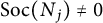 $\mathrm {Soc}(N_j) \neq 0$
for each
 $j \in A$
. Each
 $N_j$
is an indecomposable injective module and hence has a simple essential socle.
Step 4. By Corollary 2.2, the functor
 $\mathrm {Hom}_R(P,-):R\mathrm {Hom}_S(G_P,S\mathrm {Mod}) \rightarrow S$
-Mod is an equivalence of categories. It is enough to show that
 $R\mathrm {Hom}_S(G_P,S\mathrm {Mod})=\mathrm {Proj}(R)$
. Let Q be a projective unitary left R-module. Since R has the properties
 $(i)$
and
 $(iv)$
, we have an exact sequence
 $0 \rightarrow Q \rightarrow E_0 \rightarrow E_1$
where each
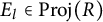 $E_l \in \mathrm {Proj}(R)$
. R is a left locally noetherian ring and so by [Reference Stenström46, Chapter V, Proposition 4.3], each
 $E_l \in \mathrm {Inj}(R)$
. Hence, by using the properties
 $(i)$
and
 $(iii)$
each
 $E_l \in \mathrm {Add}(\bigoplus _{i=1}^nE(S_i))$
. By using Lemma 2.3, it is not difficult to show that each
 $E_l$
is injectively copresented over P and so by the five lemma Q is injectively copresented over P. Now it is enough to show that each object in
 $R\mathrm {Hom}_S(G_P,S\mathrm {Mod})$
is a projective unitary left R-module. Let M be injectively copresented over P. Then
 $M \cong R\mathrm {Hom}_S(G_P, N)$
as R-modules for some left S-module N. Consider the following exact sequence:
 $$ \begin{align*}0 \rightarrow M \rightarrow R\mathrm{Hom}_S(G_P, I_0) \rightarrow R\mathrm{Hom}_S(G_P, I_1),\end{align*} $$
where
 $0 \rightarrow N \rightarrow I_0 \rightarrow I_1$
is the minimal injective resolution of N. By Step 3, each
 $R\mathrm {Hom}_S(G_P, I_i)$
is a projective unitary left R-module. Since
 $\mathrm {l.gl.dim}(R) =0 ~\mathrm { or}~ 2$
, M is a projective unitary left R-module. Therefore,
 $R\mathrm {Hom}_S(G_P,S\mathrm {Mod})=\mathrm {Proj}(R)$
and the result follows.
 $(b)$
. Since R has the property
 $(i)$
, every projective unitary left R-module is a direct sum of finitely generated unitary module with local endomorphism ring. By
 $(a)$
, every left S-module is a direct sum of indecomposable left S-module. Therefore, by [Reference Krause32, Corollary 2.7], S is a left pure semisimple ring.
We are now in a position to prove our main result in this section.
Theorem 3.6 There exists a bijection between Morita equivalence classes of left pure semisimple rings
 $\Lambda $
and Morita equivalence classes of rings R with the properties
 $(i)$
–
 $(iv)$
.
Proof If
 $\Lambda $
is a left pure semisimple ring, then by Corollary 3.4,
 $R_{\Lambda }$
has the properties
 $(i)$
–
 $(iv)$
. Let
 $\Lambda $
and
 $\Lambda '$
be two left pure semisimple rings. If
 $\Lambda $
and
 $\Lambda '$
are Morita equivalent, then by using [Reference Fazelpour and Nasr-Isfahani16, Theorem 3.6], we can see that
 $R_{\Lambda }$
and
 $R_{\Lambda '}$
are Morita equivalent. Also, it is clear that if
 $R_{\Lambda }$
and
 $R_{\Lambda '}$
are Morita equivalent, then
 $\Lambda $
and
 $\Lambda '$
are Morita equivalent. This means that the assignment
 $\Lambda \mapsto R_{\Lambda }$
sends Morita equivalence classes of left pure semisimple rings to Morita equivalence classes of rings with the properties
 $(i)$
–
 $(iv)$
. Moreover, this shows that this map is injective. Now we show that this map is surjective. Let R be a ring with the properties
 $(i)$
–
 $(iv)$
. Then by Proposition 3.5, there exists an additive equivalence between
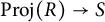 $\mathrm {Proj}(R) \rightarrow S$
-Mod, where S is a left pure semisimple ring. Hence, we have an additive equivalence
 $\mathrm {Proj}(R) \rightarrow \mathrm {Proj}(R_{S})$
, which preserves and reflects finitely generated modules. By [Reference Fazelpour and Nasr-Isfahani16, Theorem 3.6], R and
 $R_S$
are Morita equivalence and so this map is surjective. Therefore, this map is a bijection between Morita equivalence classes of left pure semisimple rings and Morita equivalence classes of rings with the properties
 $(i)$
–
 $(iv)$
.
As a consequence of Theorem 3.6, and [Reference Wisbauer49, Theorem 3.1], we have the following corollaries.
Corollary 3.7 (See [Reference Auslander6, Corollary 4.7])
There exists a bijection between Morita equivalence classes of rings of finite representation type and Morita equivalence classes of left artinian rings R with
 $\mathrm {l.gl.dim}R =0 ~\mathrm {or}~ 2$
and
 $\mathrm {l. dom.dom}{R} \geq 2$
.
Corollary 3.8 The following statements are equivalent.
-
(a) The pure semisimplicity conjecture holds.
-
(b) Every ring with the properties
$(i)$
–
$(iv)$
is Morita equivalent with an Auslander ring.


4 Ringel–Tachikawa Correspondence for left pure semisimple rings
In this section, we extend the Ringel–Tachikawa correspondence (see [Reference Ringel and Tachikawa36, Theorem 4.3]) to the class of left pure semisimple rings. Let
 $\Lambda $
be a basic left pure semisimple ring. We show that the right functor ring of the endomorphism ring of minimal injective cogenerator of
 $\Lambda $
-Mod has nice properties (see Proposition 4.6). Then we show that these properties characterize left pure semisimple rings up to Morita equivalence (see Theorem 4.7). This result extends the Ringel–Tachikawa correspondence to the class of left pure semisimple rings. As a consequence, we provide another equivalent statement for the pure semisimplicity conjecture (see Corollary 4.10).
Let R be a ring and N be a unitary left R-submodule of a module M. Then M is called a rational extension of N if for every module D with
 $N \subseteq D \subseteq M$
and every R-homomorphism
 $f: D \rightarrow M$
, the inclusion
 $N \hookrightarrow \mathrm {Ker}f$
implies
 $f = 0$
(see [Reference Faith14, p. 58]). Assume that R is a subring of a ring Q. Then Q is called a left quotient ring of R if Q is a rational extension of R as left R-modules (see [Reference Faith14, p. 64]).
Let
 $\mathscr {A}$
be a Grothendieck category with a generating set
 $\lbrace P_{\alpha }~|~\alpha \in J\rbrace $
of projective objects. We recall from [Reference Harada28, p. 359] that an object M in
 $\mathscr {A}$
is called faithful if for any nonzero morphism
 $f: P_{\alpha } \rightarrow P_{\beta }$
there exists a morphism
 $g: P_{\beta } \rightarrow M$
such that
 $fg \neq 0$
. Harada in [Reference Harada28] showed that the faithfulness of M dose not depend on generating sets of projectives. Let R be a ring with enough idempotents. It is easy to see that a unitary left R-module M is a faithful object in RMod if and only if
 $\mathrm { ann}_R(M)=0$
(i.e., M is a faithful left R-module).
Lemma 4.1 Let R be a ring with enough idempotents and
 $fR$
,
 $f^2=f \in R$
, be a faithful right ideal of R. Then
-
(a)
$R\mathrm {End}_{fRf}(fR)$
is a left quotient ring of R. -
(b) If
$Re$
,
$e^2=e \in R$
, is an injective module in RMod, then
$R\mathrm {Hom}_{fRf}(fR, fRe) \cong Re$
as R-modules. In particular,
$fRe$
is an injective left
$fRf$
-module.






Proof
 $(a)$
. Since
 $fR$
is faithful, the canonical ring homomorphism
 $\rho : R \rightarrow R\mathrm {End}_{fRf}(fR)$
via
 $r \mapsto [\rho _r: x \mapsto xr]$
is a monomorphism. If
 $d \in R\mathrm {End}_{fRf}(fR)$
and
 $x \in fR$
such that
 $(x)d \neq 0$
, then
 $\rho _xd=\rho _{(x)d} \neq 0$
. Hence, the result holds.
 $(b)$
. It is easy to see that the mapping
 $\varphi : R\mathrm {Hom}_{fRf}(fR, fRe) \rightarrow R\mathrm {End}_{fRf}(fR)e$
via
 $\alpha \mapsto \alpha \varepsilon e$
is an isomorphism of R-modules, where
 $\varepsilon : fRe \rightarrow fR$
is the canonical injection. Also since e is an idempotent of R and
 $fR$
is faithful, we can see that
 $Re \cong \mathrm {Im}\rho |_{Re} = \mathrm {Im}\rho e$
as R-modules. But because
 $R\mathrm {End}_{fRf}(fR)$
is a left quotient ring of R,
 $\mathrm {Im}\rho $
is an essential
 $\mathrm {Im}\rho $
-submodule of
 $R\mathrm {End}_{fRf}(fR)$
. This implies that
 $\mathrm {Im}\rho e$
is an essential R-submodule of
 $R\mathrm {End}_{fRf}(fR)e$
and so
 $\mathrm {Im}\rho e = R\mathrm {End}_{fRf}(fR)e$
because
 $Re$
is injective in RMod. Therefore,
 $R\mathrm {Hom}_{fRf}(fR, fRe) \cong Re$
as R-modules. Since
 $fR$
is a projective unitary right R-module, the functor
 $fR \otimes _R-$
sends R-module monomorphisms to
 $fRf$
-module monomorphisms. Since
 $Re$
is injective module in RMod and the natural transformation
 $$ \begin{align*} \eta: fR \otimes_R R\mathrm{Hom}_{fRf}(fR,-) \rightarrow \text{ id via } fr \otimes \alpha \mapsto (fr)\alpha, \end{align*} $$
for
 $r \in R$
,
 $\alpha \in R\mathrm {Hom}_{fRf}(fR,X)$
, where X is a left
 $fRf$
-module, is an equivalence,
 $fRe$
is an injective left
 $fRf$
-module. Therefore, the result follows.
Let
 $\mathscr {A}$
be a Grothendieck category with a generating set of projective objects. An object M in
 $\mathscr {A}$
is called a minimal faithful if M is faithful and for every faithful object N in
 $\mathscr {A}$
, there exists an object K in
 $\mathscr {A}$
such that
 $N \cong M \bigoplus K$
(see [Reference Harada28, p. 360]). Fuller in [Reference Fuller and Hullinger18, Proposition 3.2] showed that Colby and Rutter’s characterization of the minimal faithful modules over a ring with identity [Reference Colby and Rutter9] generalizes to a ring with enough idempotents. He proved a unitary left R-module M is finitely generated minimal faithful if and only if there are finitely many pairwise nonisomorphic simple left ideals
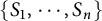 $\lbrace S_1, \cdots , S_n\rbrace $
such that
 $M \cong \bigoplus _{i=1}^n E(S_i)$
is faithful, projective, and injective in RMod.
Thus, the finitely generated minimal faithful unitary left module over a semiperfect ring R with enough idempotents is always isomorphic to a left ideal of the form
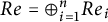 $Re=\oplus _{i=1}^nRe_i$
where each
 $Re_i$
is injective in RMod and it has simple essential socle and for each
 $i \neq j$
,
 $Re_i \ncong Re_j$
as R-modules, where each
 $e_i$
is a local orthogonal idempotent in R and
 $e=e_1 + \cdots +e_n$
.
Proposition 4.2 Let R be a semiperfect ring with enough idempotents and assume that
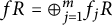 $fR=\oplus _{j=1}^mf_jR$
and
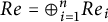 $Re = \oplus _{i=1}^nRe_i$
are minimal faithful right and left ideals of R, respectively. Then
-
(a)
$n=m$
,
$\mathrm {Soc}(Re_i) \cong \mathrm {top}(Rf_{\sigma (i)})$
and
$\mathrm {Soc}(f_{\sigma (i)}R) \cong \mathrm {top}(e_iR)$
as R-modules, where
$\sigma $
is a permutation of
$\lbrace 1, \cdots , n \rbrace $
. -
(b)
$fRe$
is a cogenerator in
$fRf$
-Mod.





Proof
 $(a)$
. Since each
 $Re_i$
has a simple essential socle,
 $\mathrm {Soc}(Re_i)=Ra_i$
for some
 $0 \neq a_i \in R$
. Since R is a ring with local units,
 $a_ie'=e'a_i=a_i$
for some
 $e^\prime 2=e' \in R$
. This implies that
 $a_iR$
is a nonzero submodule of
 $\mathrm {r.ann}_R(\mathrm {l.ann}_R(a_i))$
. Now we show that
 $a_iR$
is a unique simple submodule of
 $\mathrm {r.ann}_R(\mathrm {l.ann}_R(a_i))$
. It is enough to show that
 $a_iR \subseteq xR$
for any
 $0 \neq x \in \mathrm {r.ann}_R(\mathrm {l.ann}_R(a_i))$
. Assume that
 $0 \neq x \in \mathrm {r.ann}_R(\mathrm {l.ann}_R(a_i))$
. Then
 $\mathrm {l.ann}_R(a_i)x=0$
and so
 $\mathrm {l.ann}_R(a_i) \subseteq \mathrm {l.ann}_R(x)$
. Since R is a ring with local units,
 $x, a_i \in e"Re"$
for some
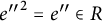 ${e"}^2=e" \in R$
. From
 $e"x=x$
and
 $x \neq 0$
, we conclude that
 $\mathrm {l.ann}_R(x)$
is a proper submodule of R. By using the fact that
 $Ra_i \cong R/{\mathrm { l.ann}_R(a_i)}$
as R-modules and
 $Ra_i$
is a simple module, we can see that
 $\mathrm {l.ann}_R(a_i) = \mathrm {l.ann}_R(x)$
. Hence, we have an isomorphism
 $g: Rx \rightarrow Ra_i$
via
 $rx \mapsto ra_i$
. Since
 $Re_i$
is injective in RMod, there exists a morphism
 $h: R \rightarrow Re_i$
such that
 $(rx)h=(rx)g$
for each
 $r \in R$
. Set
 $y=(e")h$
. Then
 $y \neq 0$
since otherwise for any
 $r \in R$
,
 $(rx)g=(rx)h=(r(xe"))h=((rx)e")h=rx(e")h=rxy=0$
, which is a contradiction. Since
 $xy=x(e")h=(xe")h=(e"x)h=(e"x)g=e"a_i=a_i$
, we have
 $a_iR \subseteq xR$
. This shows that
 $a_iR$
is a unique simple submodule of
 $\mathrm { r.ann}_R(\mathrm {l.ann}_R(a_i))$
. Since
 $a_i \in Re_i$
, the mapping
 $\varphi : e_iR \rightarrow a_iR$
via
 $e_ir \mapsto a_ir$
is well-defined, and it is easy to see that it is an R-module epimorphism. Since
 $a_iR$
is simple and
 $e_i$
is a local idempotent,
 $\mathrm {Ker}\varphi =\mathrm {rad}(e_iR)$
and so
 $\mathrm {top}(e_iR) \cong a_iR$
as R-modules. Similarly, we can see that
 $\mathrm {Soc}(f_jR)=b_jR$
for some
 $b_j \in R$
,
 $Rb_j$
is the unique simple submodule of
 $\mathrm {l.ann}_R(\mathrm {r.ann}_R(b_j))$
and
 $\mathrm {top}(Rf_j) \cong Rb_j$
as R-modules. Now we show that for each
 $i,~(1 \leq i \leq n)$
, there exists
 $1 \leq j \leq m$
such that
 $\mathrm { Soc}(Re_i) \cong \mathrm {top}(Rf_j)$
and
 $\mathrm {Soc}(f_jR) \cong \mathrm {top}(e_iR)$
as R-modules. Since
 $fR$
is faithful, there is an R-module monomorphism
 $R \rightarrow \widehat {\prod }_A fR$
, where A is a set. This implies that there is an R-module homomorphism
 $\beta : R \rightarrow fR$
such that
 $\beta |_{a_iR} \neq 0$
. Since
 $a_iR$
is simple,
 $\beta |_{a_iR}: a_iR \rightarrow fR$
is a monomorphism. Since
 $fR$
is injective in ModR, there is an R-module monomorphism
 $E(a_iR) \rightarrow fR$
. This yields that
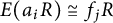 $E(a_iR) \cong f_jR$
for some
 $1 \leq j \leq m$
. Therefore,
 $a_iR \cong \mathrm {Soc}(f_jR)$
as R-modules and so
 $\mathrm {top}(e_iR) \cong \mathrm { Soc}(f_jR)$
as R-modules. Now we show that
 $\mathrm {Soc}(Re_i) \cong \mathrm {top}(Rf_j)$
as R-modules. Since
 $a_iR \cong \mathrm {Soc}(f_jR)=b_jR$
as R-modules,
 $R\mathrm {Hom}_R(a_iR, R) \cong R\mathrm { Hom}_R(b_jR, R)$
as R-modules. It is not difficult to see that the mapping
 $R\mathrm {Hom}_R(a_iR, R) \rightarrow \mathrm {l.ann}_R(\mathrm {r.ann}_R(a_i))$
via
 $\alpha \mapsto \alpha (a_i)$
is an R-module isomorphism. Similarly,
 $R\mathrm {Hom}_R(b_jR, R) \cong \mathrm {l.ann}_R(\mathrm {r.ann}_R(b_j))$
as R-modules. Therefore,
 $\mathrm {l.ann}_R(\mathrm {r.ann}_R(b_j)) \cong \mathrm {l.ann}_R(\mathrm {r.ann}_R(a_i))$
as R-modules. This yields
 $Rb_j \cong \mathrm {Soc}(\mathrm {l.ann}_R(\mathrm {r.ann}_R(a_i)))$
as R-modules. Since
 $Ra_i \mathrm {r.ann}_R(a_i)=0$
,
 $Ra_i \subseteq \mathrm {l.ann}_R(\mathrm {r.ann}_R(a_i))$
. Since
 $Ra_i$
is simple,
 $\mathrm { Soc}(Re_i) \cong \mathrm {top}(Rf_j)$
as R-modules. Consequently, for each
 $i,~(1 \leq i \leq n)$
, there is
 $1 \leq j \leq m$
, such that
 $\mathrm {Soc}(Re_i) \cong \mathrm {top}(Rf_j)$
and
 $\mathrm {Soc}(f_jR) \cong \mathrm { top}(e_iR)$
as R-modules. Similarly, we can see that for each
 $l,~(1 \leq l \leq m)$
, there is
 $1 \leq k \leq n$
such that
 $\mathrm {Soc}(Re_k) \cong \mathrm {top}(Rf_l)$
and
 $\mathrm {Soc}(f_lR) \cong \mathrm {top}(e_kR)$
as R-modules. This shows that the result follows.
 $(b)$
. Since
 $Re=\bigoplus _{i=1}^nRe_i$
,
 $fRe=\bigoplus _{i=1}^nfRe_i$
. By Lemma 4.1,
 $fRe$
is an injective left
 $fRf$
-module and hence each
 $fRe_i$
is an injective left
 $fRf$
-module. Also, by using Lemma 4.1, it is not difficult to see that
 $\mathrm {End}_R(Re_i) \cong \mathrm {End}_{fRf}(fRe_i)$
as rings. Since
 $\mathrm {End}_R(Re_i)$
is a local ring,
 $\mathrm {End}_{fRf}(fRe_i)$
is a local ring and so each
 $fRe_i$
is an indecomposable injective left
 $fRf$
-module. Now we show that
 $\mathrm {Soc}(fRe_i) \neq 0$
. By
 $(a)$
,
 $\mathrm {Soc}(Re_i) \cong \mathrm {top}(Rf_{\sigma (i)})$
as R-modules, where
 $\sigma $
is a permutation of
 $\lbrace 1, \cdots , n \rbrace $
. Hence,
 $f\mathrm {Soc}(Re_i) \cong f\mathrm {top}(Rf_{\sigma (i)})$
as
 $fRf$
-modules. If
 $f\mathrm {Soc}(Re_i)=0$
, then
 $f\mathrm {top}(Rf_{\sigma (i)})=0$
and so
 $f_{\sigma (i)} \in \mathrm {rad}(Rf_{\sigma (i)})$
. Hence,
 $\mathrm { Soc}(Re_i)=0$
, which is a contradiction. Thus,
 $f\mathrm {Soc}(Re_i)\neq 0$
and we can easily see that it is a simple
 $fRf$
-submodule of
 $fRe_i$
. Therefore,
 $\mathrm {Soc}(fRe_i) \neq 0$
. But because
 $fRe_i$
is an indecomposable injective left
 $fRf$
-module,
 $fRe_i$
has a simple essential socle. On the other hand, since
 $\mathrm {Soc}(fRe)=\bigoplus _{i=1}^n\mathrm {Soc}(fRe_i)$
, it is enough to show that
 $\lbrace \mathrm {Soc}(fRe_1), \cdots , \mathrm {Soc}(fRe_n)\rbrace $
is a complete set of nonisomorphic simple left
 $fRf$
-modules. Since
 $\lbrace fRf_1/\mathrm {rad}(fRf_1), \cdots , fRf_n/\mathrm {rad}(fRf_n)\rbrace $
is a complete set of nonisomorphic simple left
 $fRf$
-modules, it is sufficient to show that
 $\mathrm {Soc}(fRe_i) \cong fRf_{\sigma (i)}/\mathrm {rad}(fRf_{\sigma (i)})$
as
 $fRf$
-modules. It is not difficult to see that
 $f\mathrm {top}(Rf_{\sigma (i)}) \cong fRf_{\sigma (i)}/f\mathrm {rad}(Rf_{\sigma (i)})$
as
 $fRf$
-modules. But since
 $f\mathrm {top}(Rf_{\sigma (i)}) \cong f\mathrm {Soc}(Re_i)=\mathrm {Soc}(fRe_i)$
as
 $fRf$
-modules and
 $fRe_i$
has a simple socle,
 $\mathrm { rad}(fRf_{\sigma (i)}) = f\mathrm {rad}(Rf_{\sigma (i)})$
. This implies that
 $f\mathrm {top}(Rf_{\sigma (i)}) \cong \mathrm {top}(fRf_{\sigma (i)})$
as
 $fRf$
-modules. Therefore,
 $\mathrm {Soc}(fRe_i) \cong \mathrm {top}(fRf_{\sigma (i)})$
as
 $fRf$
-modules and the result follows.
Let R be a ring with enough idempotents and M be a unitary right R-module. According to [Reference Ringel and Tachikawa36, p. 50], the module M is called balanced if the canonical ring homomorphism
 $\rho : R \rightarrow R\mathrm {End}_{S}(M)$
via
 $r \mapsto [\rho _r: x \mapsto xr]$
is surjective, where
 $S=\mathrm {End}_R(M)$
. The ring R is called right locally coherent if every direct product of flat unitary left R-modules in RMod is flat (see [Reference Garcia and Simson23, p. 118]).
Definition 4.3 (See [Reference Fuller and Hullinger18, p. 102], [Reference Harada28, Section 3], and [Reference Tachikawa47, Chapter 4])
Let
 $\mathscr {A}$
be a Grothendieck category with a generating set of projective objects.
-
(a)
$\mathscr {A}$
is called QF-3 if it contains a finitely generated minimal faithful object. -
(b) A ring R with enough idempotents is called left QF-3 if the category RMod is a QF-3 category. Right and two-sided QF-3 rings are defined analogously.

Proposition 4.4 Let R be a left perfect right locally coherent QF-3 ring with enough idempotents such that
 $\mathrm {l.gl.dim}R = 0 ~\mathrm {or} ~ 2$
. Assume that
 $fR$
,
 $f^2=f \in R$
, is a minimal faithful balanced right ideal of R. Then
-
(a)
$fRf$
is a left pure semisimple ring. -
(b) The functor
is an additive equivalence.
$$ \begin{align*} R\mathrm{Hom}_{fRf}(fR,-): fRf\text{-Mod} \rightarrow \mathrm{Proj}(R), \end{align*} $$


Proof
 $(a)$
. Let M be a left
 $fRf$
-module and
 $Re$
,
 $e^2=e\in R$
, be a minimal faithful left ideal of R. By Proposition 4.2(b),
 $fRe$
is a cogenerator in
 $fRf$
-Mod. Then there exists an exact sequence in
 $fRf$
-Mod
 $$ \begin{align*}0 \rightarrow M \rightarrow \prod_{I} {fRe} \rightarrow \prod_{J} {fRe},\end{align*} $$
where I and J are two index sets. By using Proposition 4.1, we can see that
 $$ \begin{align*}R\mathrm{Hom}_{fRf}(fR,\prod_{I} fRe) \cong \widehat{\prod_{I}} Re,\end{align*} $$
as R-modules. This gives us the following exact sequence:
 $$ \begin{align*}0 \rightarrow R\mathrm{Hom}_{fRf}(fR,M) \rightarrow \widehat{\prod_{I}}Re \rightarrow \widehat{\prod_{J}}Re,\end{align*} $$
Since R is a left perfect right locally coherent ring and
 $\mathrm {l.gl.dim}R =0 ~\mathrm {or}~ 2$
,
 $R\mathrm {Hom}_{fRf}(fR,M) \in \mathrm {Proj}(R)$
. Since R is a semiperfect ring with enough idempotents, there is a complete set
 $\lbrace e_{\alpha }~|~\alpha \in J \rbrace $
of pairwise orthogonal local idempotents of R such that
 $R=\bigoplus _{\alpha \in J}Re_{\alpha }=\bigoplus _{\alpha \in J}e_{\alpha }R$
. Hence,
 $R\mathrm {Hom}_{fRf}(fR,M) \cong \bigoplus _{\alpha \in A}Re_{\alpha }$
as R-modules. There are
 $fRf$
-module isomorphisms
 $$ \begin{align*}M \cong fR \otimes_R R\mathrm{Hom}_{fRf}(fR,M) \cong fR \otimes_R (\bigoplus_{\alpha \in A}Re_{\alpha}) \cong \bigoplus_{\alpha \in A} (fR \otimes_R Re_{\alpha}) \cong \bigoplus_{\alpha \in A} fRe_{\alpha}.\end{align*} $$
Since
 $fR$
is balanced and faithful, the canonical ring homomorphism
 $\rho : R \rightarrow R\mathrm {End}_{fRf}(fR)$
via
 $r \mapsto [\rho _r: x \mapsto xr]$
is an isomorphism. Hence,
 $Re_{\alpha } \cong R\mathrm { End}_{fRf}(fR)e_{\alpha }$
as R-module. It is easy to see that the mapping
 $\varphi : R\mathrm {Hom}_{fRf}(fR, fRe_{\alpha }) \rightarrow R\mathrm {End}_{fRf}(fR)e_{\alpha }$
via
 $\alpha \mapsto \alpha \varepsilon e_{\alpha }$
is an isomorphism of R-modules, where
 $\varepsilon : fRe_{\alpha } \rightarrow fR$
is the canonical injection. It follows that
 $R\mathrm {Hom}_{fRf}(fR, fRe_{\alpha }) \cong Re_{\alpha }$
as R-modules and so
 $\mathrm { End}_R(Re_{\alpha }) \cong \mathrm {End}_{fRf}(fRe_{\alpha })$
as rings. Since
 $\mathrm {End}_R(Re_{\alpha })$
is a local ring,
 $\mathrm {End}_{fRf}(fRe_{\alpha })$
is a local ring and so each
 $fRe_{\alpha }$
is an indecomposable left
 $fRf$
-module. Therefore, every left
 $fRf$
-module is a direct sum of indecomposable modules. Consequently, by [Reference Krause32, Corollary 2.7],
 $fRf$
is a left pure semisimple ring.
 $(b)$
. By using the proof of
 $(a)$
, we can see that functor
 $R\mathrm {Hom}_{fRf}(fR, -)$
sends
 $fRf$
-Mod to the full subcategory
 $\mathrm {Proj}(R)$
of RMod. The natural transformation
 $$ \begin{align*} \eta: fR \otimes_R R\mathrm{Hom}_{fRf}(fR,-) \rightarrow \mathrm{id}\ \text{via}\ fr \otimes \alpha \mapsto (fr)\alpha, \end{align*} $$
for
 $r \in R$
and
 $\alpha \in R\mathrm {Hom}_{fRf}(fR,X)$
, where X is a left
 $fRf$
-module, is an equivalence. Therefore, it is enough to show that the natural transformation
 $$ \begin{align*} \nu: \mathrm{id} \rightarrow R\mathrm{Hom}_{fRf}(fR, fR \otimes_R -)\ \text{via}\ x \mapsto [fr \mapsto fr \otimes x], \end{align*} $$
for
 $x \in X$
and
 $r \in R$
is an equivalence when X is a projective unitary left R-module. Let P be a projective unitary left R-module. Then
 $P \cong \bigoplus _{\alpha \in A}Re_{\alpha }$
as R-modules. We know that for each idempotent
 $e'$
of R,
 $fRe'$
is a finitely generated left
 $fRf$
-module, because
 $fRf$
is left pure semisimple. This implies that the functor
 $R\mathrm {Hom}_{fRf}(fR,-)$
preserves direct sums and so we have the following isomorphisms:
 $$ \begin{align*} R\mathrm{Hom}_{fRf}(fR, fR \otimes_R P) & \cong R\mathrm{Hom}_{fRf}(fR, \bigoplus_{\alpha \in A} (fR \otimes_R Re_{\alpha})) \\ & \cong \bigoplus_{\alpha \in A} R\mathrm{Hom}_{fRf}(fR, fR \otimes_R Re_{\alpha}) \\ &\cong \bigoplus_{\alpha \in A} R\mathrm{Hom}_{fRf}(fR, fRe_{\alpha}) \cong \bigoplus_{\alpha \in A}Re_{\alpha} \cong P, \end{align*} $$
which imply that
 $\nu _{P}$
is an isomorphism. Therefore, the functor
 $$ \begin{align*} R\mathrm{Hom}_{fRf}(fR,-): fRf\text{-Mod} \rightarrow \mathrm{Proj}(R), \end{align*} $$
is an additive equivalence with the inverse equivalence
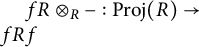 $fR \otimes _R-: \mathrm {Proj}(R) \rightarrow fRf$
-Mod.
A left
 $\Lambda $
-module Q is called minimal injective cogenerator if it is isomorphic to
 $\bigoplus _{i=1}^nE(S_i)$
, where
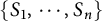 $\lbrace S_1, \cdots , S_n\rbrace $
is a complete set of nonisomorphic simple left
 $\Lambda $
-modules.
Lemma 4.5 Let
 $\Lambda $
be a right artinian ring and
 $\lbrace U_{\alpha }~|~\alpha \in I\rbrace $
be a complete set of nonisomorphic finitely generated indecomposable right
 $\Lambda $
-modules. Assume that W is a minimal injective cogenerator in Mod-
 $\Lambda $
and set
 $U=\bigoplus _{\alpha \in I}U_{\alpha }$
and
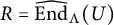 $R=\widehat {\mathrm {End}}_{\Lambda }(U)$
. If W is finitely generated, then
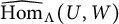 $\widehat {\mathrm {Hom}}_{\Lambda }(U, W)$
is a minimal faithful balanced unitary right R-module.
Proof Since W is finitely generated,
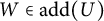 $W \in \mathrm {add}(U)$
and so U is a generator–cogenerator in Mod-
 $\Lambda $
. Hence, by using the proof of Proposition 3.3, we can see that
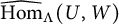 $\widehat {\mathrm {Hom}}_{\Lambda }(U, W)$
is a minimal faithful unitary right R-module. Set
 $\Delta =\mathrm {End}_{\Lambda }(W)$
. Since
 $\widehat {\mathrm {Hom}}_{\Lambda }(U, W) \cong \bigoplus _{\alpha \in I}\mathrm {Hom}_{\Lambda }(U_{\alpha }, W)$
as
 $\Delta $
-modules and the functor
 $\mathrm {Hom}_{\Lambda }(-, W):$
mod-
 $\Lambda \rightarrow \Delta $
-mod is a duality, for each
 $\gamma \in R\mathrm {End}_{\Delta }(\widehat {\mathrm {Hom}}_{\Lambda }(U, W))$
, there exists
 $r \in R$
such that
 $\rho _r=\gamma $
. This implies that the canonical ring homomorphism
 $\rho : R \rightarrow R\mathrm {End}_{\Delta }(\widehat {\mathrm {Hom}}_{\Lambda }(U, W))$
via
 $r \mapsto [\psi \mapsto \psi r]$
is surjective.
An idempotent e of a semiperfect ring
 $\Lambda $
is called basic idempotent in case e is the sum
 $e= e_1 + \cdots + e_m$
of a basic set
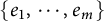 $\lbrace e_1, \cdots , e_m\rbrace $
of idempotents of
 $\Lambda $
. A semiperfect ring
 $\Lambda $
is called basic if
 $1_{\Lambda }$
is a basic idempotent of
 $\Lambda $
(see [Reference Anderson and Fuller2, Section 27]).
Proposition 4.6 Let
 $\Lambda $
be a left pure semisimple basic ring and suppose that W is a minimal injective cogenerator in
 $\Lambda $
-Mod. Set
 $\Delta =\mathrm {End}_{\Lambda }(W)$
. Then the right functor ring
 $R_{{\Delta }^{op}}$
of
 $\Delta $
is a left perfect right locally coherent QF-3 ring with enough idempotents, which have a minimal faithful balanced right ideal and
 $\mathrm {l.gl.dim}R_{{\Delta }^{op}} = 0 ~\mathrm {or} ~ 2$
.
Proof By Corollary 3.4, [Reference Fazelpour and Nasr-Isfahani15, Lemma 2.3] and [Reference Fuller17, Theorem],
 $R_{\Lambda }$
is a left perfect ring with enough idempotents such that
 $\mathrm {l.gl.dim}R_{\Lambda } = 0 ~\mathrm { or} ~ 2$
. Since W is Morita duality
 $\Lambda $
–
 $\Delta $
-bimodule (as discussed in [Reference Anderson and Fuller2, Section 24]), by [Reference Fuller and Hullinger18, Theorem 3.3] and [Reference Fazelpour and Nasr-Isfahani15, Lemma 2.3],
 $R_{\Lambda }$
is a QF-3 ring. Moreover, by [Reference Fuller and Hullinger18, Lemma 3.1] and [Reference Fazelpour and Nasr-Isfahani15, Lemma 2.3],
 $R_{\Lambda }$
is Morita equivalent to
 $R_{{\Delta }^{op}}$
. It is not difficult to see that the direct product of any family of projective unitary left
 $R_{\Lambda }$
-modules is projective. This implies that by [Reference Garcia and Simson23, Proposition 2.4],
 $R_{\Lambda }$
is a right locally coherent ring. Therefore,
 $R_{{\Delta }^{op}}$
is a left perfect QF-3 right locally coherent ring with enough idempotents with
 $\mathrm {l.gl.dim}R_{{\Delta }^{op}} =0 ~\mathrm {or}~ 2$
. On the other hand, since W is finitely generated minimal injective cogenerator in Mod-
 $\Delta $
and
 $\Delta $
is a right artinian ring, by Lemma 4.5,
 $R_{{\Delta }^{op}}$
has a minimal faithful balanced right ideal. Therefore,
 $R_{{\Delta }^{op}}$
is a left perfect right locally coherent QF-3 ring with enough idempotents, which have a minimal faithful balanced right ideal and
 $\mathrm {l.gl.dim}R_{{\Delta }^{op}} = 0 ~\mathrm {or} ~ 2$
.
We are now in a position to prove our main result in this section.
Theorem 4.7 There exists a bijection between Morita equivalence classes of left pure semisimple rings
 $\Lambda $
and Morita equivalence classes of left perfect right locally coherent QF-3 rings R with enough idempotents, which have a minimal faithful balanced right ideal and
 $\mathrm {l.gl.dim}R = 0 ~\mathrm {or} ~ 2$
.
Proof Let
 $\Lambda $
be a left pure semisimple ring. Then there exists a left pure semisimple basic ring
 $\Lambda '$
such that
 $\Lambda $
is Morita equivalent to
 $\Lambda '$
. Assume that W is a minimal injective cogenerator in
 $\Lambda '$
-Mod and
 $\Delta =\mathrm {End}_{\Lambda '}(W)$
. Then by Proposition 4.6, the right functor ring
 $R_{{\Delta }^{op}}$
of
 $\Delta $
is a left perfect right locally coherent QF-3 ring with enough idempotents, which have a minimal faithful balanced right ideal and
 $\mathrm {l.gl.dim}R_{{\Delta }^{op}} = 0 ~\mathrm {or} ~ 2$
. By using [Reference Fazelpour and Nasr-Isfahani16, Theorem 3.6], it is easy to see that the assignment
 $\Lambda \mapsto R_{{\Delta }^{op}}$
sends Morita equivalence classes of left pure semisimple rings to Morita equivalence classes of left perfect right locally coherent QF-3 rings
 $R_{{\Delta }^{op}}$
with enough idempotents, which have a minimal faithful balanced right ideal and
 $\mathrm {l.gl.dim}R_{{\Delta }^{op}} = 0 ~\mathrm {or} ~ 2$
. Also, this map is injective. Now we show that this map is surjective. Let R be a left perfect right locally coherent QF-3 ring with enough idempotents such that
 $\mathrm {l.gl.dim}R = 0 ~\mathrm {or} ~ 2$
. Assume that
 $fR$
,
 $f^2=f \in R$
, is a minimal faithful balanced right ideal of R. By Proposition 4.4,
 $fRf$
is a left pure semisimple ring and the functor
 $R\mathrm {Hom}_{fRf}(fR,-): fRf$
-Mod
 $\rightarrow \mathrm {Proj}(R)$
is an additive equivalence. Let Q be a minimal injective cogenerator in
 $fRf$
-Mod and
 $\Gamma =\mathrm {End}_{fRf}(Q)$
. It is not difficult to show that
 $R_{{\Gamma }^{op}}$
is Morita equivalent to R. Hence, this map is surjective and the result follows.
Definition 4.8 (See [Reference Faith14, p. 66])
Let R be a ring and Q be a left quotient ring of R. The ring Q is called maximal in case given any left quotient ring S of R, there is a ring monomorphism from S to Q, which induces the identity morphism on R.
It is well-known that every ring with enough idempotents has a maximal left quotient ring, which is a ring with identity (see [Reference Faith14, p. 68, Proposition F]). By using [Reference Ringel and Tachikawa36, Proposition 1.8] and [Reference Colby and Rutter8, Theorems 1.2 and 1.3], we can see that a ring with identity
 $\Gamma $
is a semiprimary QF-3 maximal quotient ring with
 $\mathrm {l.gl.dim}\Gamma = 0 ~\mathrm {or} ~ 2$
if and only if
 $\Gamma $
is a left perfect right locally coherent QF-3 ring, which has a minimal faithful balanced right ideal and
 $\mathrm {l.gl.dim}\Gamma = 0 ~\mathrm {or} ~ 2$
. Therefore, we have the following corollaries.
Corollary 4.9 (See [Reference Ringel and Tachikawa36, Theorem 4.3])
There exists a bijection between Morita equivalence classes of rings of finite representation type
 $\Lambda $
and Morita equivalence classes of semiprimary QF-3 maximal quotient rings R with
 $\mathrm {l.gl.dim}R = 0 ~\mathrm {or} ~ 2$
.
Corollary 4.10 The following statements are equivalent.
-
(a) The pure semisimplicity conjecture holds.
-
(b) Every left perfect right locally coherent QF-3 ring R with enough idempotents, which have a minimal faithful balanced right ideal and
$\mathrm {l.gl.dim}R = 0 ~\mathrm {or} ~ 2$
is Morita equivalent to a maximal quotient ring.

5 Pure semisimple Grothendieck categories
In this section, we study locally finitely presented pure semisimple Grothendieck categories. First we show that the functor ring of any locally finitely presented pure semisimple Grothendieck category, which satisfies the property
 $(\ast )$
, has the properties
 $(i)$
–
 $(iv)$
(see Proposition 5.1). Then we show that for any ring R, which has the properties
 $(i)$
–
 $(iv)$
,
 $\mathrm {Flat}(R)$
is a locally finitely presented pure semisimple Grothendieck category, which satisfies the property
 $(\ast )$
(see Proposition 5.2). By using these facts, we give a bijection between Morita equivalence classes of left pure semisimple (hereditary) rings and equivalence classes of locally finitely presented pure semisimple (hereditary) Grothendieck categories, which satisfy the property
 $(\ast )$
(see Corollaries 5.4 and 5.10). Finally, we provide another equivalent statement for the pure semisimplicity conjecture (see Corollary 5.11).
Let
 $\mathscr {A}$
be a locally finitely presented category. Then by [Reference Crawley-Boevey10, Theorem 1.4],
 $\mathrm {fp}(\mathscr {A})$
is a skeletally small additive category with split idempotents, and the functor
 $$ \begin{align*} \mathbb{H}: \mathscr{A} \rightarrow \mathrm{Mod}(\mathrm{fp}(\mathscr{A}))\ \text{via}\ A \mapsto \mathrm{Hom}_{\mathscr{A}}(-,A)|_{\mathrm{fp}(\mathscr{A}),} \end{align*} $$
induces an additive equivalence between the category
 $\mathscr {A}$
and the category
 $\mathrm {Flat}(\mathrm {fp}(\mathscr {A}))$
.
Now let
 $\lbrace V_{\alpha }~|~ \alpha \in I \rbrace $
be a complete set of nonisomorphic finitely presented objects in
 $\mathscr {A}$
. Set
 $T_{\mathscr {A}}= \widehat {\mathrm {End}}_{\mathscr {A}}(V)$
, where
 $V= \bigoplus _{\alpha \in I}V_\alpha $
. It is shown in [Reference Gabriel20, Proposition 2, p. 347] that the additive functor
 $$ \begin{align*} \mathbb{G}: \mathrm{Mod}(\mathrm{fp}(\mathscr{A})) \rightarrow T_{\mathscr{A}}\mathrm{Mod}\ \text{via}\ H \mapsto \bigoplus_{\alpha \in I}H(V_{\alpha}), \end{align*} $$
is an equivalence with the inverse equivalence
 $$ \begin{align*} \mathbb{F}: T_{\mathscr{A}}\mathrm{Mod} \rightarrow \mathrm{Mod}(\mathrm{fp}(\mathscr{A}))\ \text{via}\ M \mapsto \mathbb{F}_M, \end{align*} $$
where
 $\mathbb {F}_M: \mathrm {fp}(\mathscr {A}) \rightarrow \mathfrak {Ab}$
via
 $X \mapsto \mathrm {Hom}_{\mathscr {A}}(X, V) \otimes _{T_{\mathscr {A}}} M$
. It is easy to see that it preserves and reflects finitely generated projective objects and coproducts. By using the composition of the functors
 $\mathbb {H}$
and
 $\mathbb {G}$
, we get an additive equivalence
 $\mathscr {A} \rightarrow \mathrm {Flat}(T_{\mathscr {A}})$
via
 $A \mapsto \bigoplus _{\alpha \in I}\mathrm {Hom}_{\mathscr {A}}(V_{\alpha }, A)$
which induces an equivalence between
 $\mathrm {fp}(\mathscr {A})$
and
 $\mathrm {proj}(T_{\mathscr {A}})$
. This is exactly the functor
 $$ \begin{align*}\widehat{\mathrm{Hom}}_{\mathscr{A}}(V, -): \mathscr{A} \rightarrow \mathrm{Flat}(T_{\mathscr{A}}).\end{align*} $$
Note that if every finitely presented object in a locally finitely presented Grothendieck category
 $\mathscr {A}$
is a finite coproduct of indecomposable objects in
 $\mathscr {A}$
, then by [Reference Fazelpour and Nasr-Isfahani16, Theorem 3.6],
 $T_{\mathscr {A}}$
is Morita equivalent to the functor ring
 $R_{\mathscr {A}}$
of
 $\mathscr {A}$
.
Proposition 5.1 Let
 $\mathscr {A}$
be a locally finitely presented pure semisimple Grothendieck category, which satisfies the property
 $(\ast )$
. Then
 $R_{\mathscr {A}}$
has the properties
 $(i)$
–
 $(iv)$
.
Proof By [Reference Simson40, Theorem 1.9], every finitely presented object in
 $\mathscr {A}$
is a finite coproduct of indecomposable subobjects and
 $\mathrm {Mod}(\mathrm {fp}(\mathscr {A}))$
is a perfect category and so
 $R_{\mathscr {A}}$
is a left perfect ring. Then there is a complete set
 $\lbrace \theta _i~|~i \in I \rbrace $
of pairwise orthogonal local idempotents of
 $R_{\mathscr {A}}$
such that
 $R_{\mathscr {A}}=\bigoplus _{i \in I}R_{\mathscr {A}}\theta _{i}=\bigoplus _{i \in I}\theta _{i}R_{\mathscr {A}}$
. Since
 $\mathbb {H}: \mathrm {fp}(\mathscr {A}) \rightarrow \mathrm {proj}(\mathrm {fp}(\mathscr {A}))$
is an additive equivalence,
 $\mathbb {G}: \mathrm { Mod}(\mathrm {fp}(\mathscr {A})) \rightarrow T_{\mathscr {A}}\mathrm {Mod}$
is an additive equivalence, which preserves and reflects finitely generated projective objects and
 $R_{\mathscr {A}}$
is Morita equivalent to
 $T_{\mathscr {A}}$
. By using [Reference Garcia and Simson24, Corollary 3], it is not difficult to show that each
 $\theta _{i}R_{\mathscr {A}}\theta _{i}$
is a left perfect ring and hence
 $R_{\mathscr {A}}$
has the property
 $(i)$
. Since
 $\mathscr {A}$
is a locally finitely presented pure semisimple Grothendieck category, by [Reference Simson39, Theorem 6.3],
 $\mathscr {A}$
is locally noetherian and every object in
 $\mathscr {A}$
is a coproduct of indecomposable noetherian objects. This implies that by [Reference Simson41, Corollary 2.6],
 $\mathrm {Mod}(\mathrm {fp}(\mathscr {A}))$
is locally noetherian. By [Reference Stenström46, Proposition 4.3],
 $R_{\mathscr {A}}$
is left locally noetherian. On the other hand, since
 $\mathscr {A}$
is locally finitely presented Grothendieck category and
 $R_{\mathscr {A}}$
is a left perfect ring, by [Reference Garcia and Simson23, Theorems 2.7 and 3.3],
 $\mathrm {gl.dim}R_{\mathscr {A}}= 0~ \mathrm {or} ~2$
and
 $\mathrm {dom.dim}R_{\mathscr {A}}\theta _i \geq 2$
for each
 $i \in I$
. Therefore,
 $R_{\mathscr {A}}$
has the properties
 $(ii)$
and
 $(iv)$
. Now we show that
 $R_{\mathscr {A}}$
has the property
 $(iii)$
. Since
 $\mathrm {Mod}(\mathrm {fp}(\mathscr {A}))$
is a QF-3 category,
 $R_{\mathscr {A}}$
is a left QF-3 ring and so there are finitely many pairwise nonisomorphic simple left ideals
 $S_1, \cdots , S_n$
such that
 $M = \bigoplus _{l=1}^n E(S_l)$
is faithful, projective, and injective in
 $R_{\mathscr {A}}$
Mod. We show that
 $\mathrm {proj}(R_{\mathscr {A}})\bigcap \mathrm {inj}(R_{\mathscr {A}})= \mathrm { add}(\bigoplus _{l=1}^n E(S_l))$
. Assume that
 $N \in \mathrm {proj}(R_{\mathscr {A}})\bigcap \mathrm {inj}(R_{\mathscr {A}})$
. Then
 $N \cong \bigoplus _{i=1}^tR_{\mathscr {A}}\theta _i$
. Since M is faithful, for each
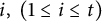 $i,~(1 \leq i \leq t)$
, there is a monomorphism
 $R_{\mathscr {A}}\theta _i \rightarrow \widehat {\prod }_{A} M$
, where A is a set. But since every representable functor has finitely generated essential socle, for each
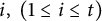 $i,~(1 \leq i \leq t)$
, there is a monomorphism
 $R_{\mathscr {A}}\theta _i \rightarrow \bigoplus _{l \in B_i} E(S_l)$
, where
 $B_i$
is a finite set. Since N is injective in
 $R_{\mathscr {A}}$
Mod and each
 $\mathrm {End}_{R_{\mathscr {A}}}(E(S_l))$
is a local ring,
 $N \in \mathrm {add}(\bigoplus _{l=1}^n E(S_l))$
and so
 $R_{\mathscr {A}}$
has the property
 $(iii)$
. Therefore, the result follows.
Proposition 5.2 Let R be a ring with the properties
 $(i)$
–
 $(iv)$
. Then
 $\mathrm {Flat}(R)$
is a locally finitely presented pure semisimple Grothendieck category, which satisfies the property
 $(\ast )$
.
Proof We know that
 $\mathrm {Flat}(R)$
is a locally finitely presented category and
 $\mathrm {fp}(\mathrm {Flat}(R))$
coincides with the category of all finitely generated projective unitary left R-modules. By the proof of Theorem 3.6, we can see that there exists a left pure semisimple ring
 $\Lambda $
such that
 $R_{\Lambda }$
is Morita equivalent to R. It implies that by the proof of Proposition 4.6, R is a left perfect right locally coherent QF-3 ring. Properties
 $(ii)$
and
 $(iv)$
and [Reference Garcia and Simson23, Theorem 2.7] imply that
 $\mathrm {Flat}(R)$
is a Grothendieck category. Therefore,
 $\mathrm {Flat}(R)$
is a locally finitely presented Grothendieck category. Set
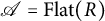 $\mathscr {A}=\mathrm {Flat}(R)$
. Since
 $\mathrm {fp}(\mathscr {A})=\mathrm {proj}(R)$
, there is an additive equivalence
 $\mathrm {proj}(R) \rightarrow \mathrm {proj}(T_{\mathscr {A}})$
. By [Reference Fazelpour and Nasr-Isfahani16, Theorem 3.6], R is Morita equivalent to
 $T_{\mathscr {A}}$
. But because R is a left perfect left QF-3 ring and there is an additive equivalence
 $\mathrm {Mod}(\mathrm {fp}(\mathscr {A})) \rightarrow T_{\mathscr {A}}\mathrm {Mod}$
,
 $\mathrm {Mod}(\mathrm {fp}(\mathscr {A}))$
is a perfect QF-3 category. In particular, by [Reference Simson40, Theorem 1.9],
 $\mathscr {A}$
is a locally finitely presented pure semisimple Grothendieck category. Now we show that every representable functor in
 $\mathrm {Mod}(\mathrm {fp}(\mathscr {A}))$
has finitely generated essential socle. Since R is a left locally noetherian ring with the properties
 $(i)$
and
 $(iii)$
, by using [Reference Stenström46, Example 18, p. 134], we can see that the injective hull of any finitely generated projective unitary left R-module is a finite direct sum of injective hull of simple modules. There is an additive equivalence
 $\mathrm {Mod}(\mathrm {fp}(\mathscr {A})) \rightarrow R\mathrm {Mod}$
, which preserves and reflects finitely generated projective objects and so by [Reference Stenström46, Example 25(ii), p. 134], every representable functor in
 $\mathrm {Mod}(\mathrm {fp}(\mathscr {A}))$
has finitely generated essential socle. Therefore,
 $\mathrm {Flat}(R)$
is a locally finitely presented pure semisimple Grothendieck category, which satisfies the property
 $(\ast )$
.
We are now in a position to prove our main result in this section.
Theorem 5.3 There exists a bijection between Morita equivalence classes of rings with the properties
 $(i)$
–
 $(iv)$
and equivalence classes of locally finitely presented pure semisimple Grothendieck categories, which satisfy the property
 $(\ast )$
.
Proof Let R be a ring with the properties
 $(i)$
–
 $(iv)$
. By Proposition 5.2,
 $\mathrm {Flat}(R)$
is a locally finitely presented pure semisimple Grothendieck category, which satisfies the property
 $(\ast )$
. Let R and T be rings with the properties
 $(i)$
–
 $(iv)$
. If R and T are Morita equivalent, then there exists an additive equivalence
 $\mathrm {Flat}(R) \rightarrow \mathrm {Flat}(T)$
. It implies that the map
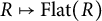 $R \mapsto \mathrm {Flat}(R)$
sends Morita equivalence classes of rings with the properties
 $(i)$
–
 $(iv)$
to equivalence classes of locally finitely presented pure semisimple Grothendieck categories, which satisfy the property
 $(\ast )$
. We show that this mapping is a bijection. In order to show that this map is injective, we suppose that R and T are rings with the properties
 $(i)$
–
 $(iv)$
and there exists an additive equivalence
 $\mathrm {Flat}(R) \rightarrow \mathrm { Flat}(T)$
. Then there exists an additive equivalence
 $\mathrm {proj}(R) \rightarrow \mathrm {proj}(T)$
. By [Reference Fazelpour and Nasr-Isfahani16, Theorem 3.6], R is Morita equivalent to T and so this mapping is injective. It remains to show that this mapping is a surjective. Let
 $\mathscr {A}$
be a locally finitely presented pure semisimple Grothendieck category, which satisfies the property
 $(\ast )$
. Then by Proposition 5.1,
 $R_{\mathscr {A}}$
is a ring with the properties
 $(i)$
–
 $(iv)$
and also there is an additive equivalence
 $\mathscr {A} \rightarrow \mathrm {Flat}(R_{\mathscr {A}})$
. Therefore, the mapping is surjective and the result follows.
As a consequence of Theorems 3.6 and 5.3, we have the following result.
Corollary 5.4 There exists a bijection between Morita equivalence classes of left pure semisimple rings
 $\Lambda $
and equivalence classes of locally finitely presented pure semisimple Grothendieck categories, which satisfy the property
 $(\ast )$
.
We recall from [Reference Dung and García12, p. 202] that a Grothendieck category
 $\mathscr {C}$
is called locally finite if it has a generating set of objects of finite length. A Grothendieck category
 $\mathscr {C}$
is called of finite representation type if it is locally finite and has only finitely many nonisomorphic finitely generated indecomposable objects (see [Reference Dung and García12, p. 216]). Note that every locally finitely presented Grothendieck category of finite representation type is pure semisimple (see [Reference Dung and García12, Proposition 3.3 and Lemma 4.1]).
Lemma 5.5 Let
 $\mathscr {A}$
be a locally finitely presented Grothendieck category of finite representation type. Then
 $\mathscr {A}$
has the property
 $(\ast )$
.
Proof By using [Reference Garcia and Simson24, Corollary 3], [Reference Garcia and Simson23, Theorem 2.7] and the existence of an additive equivalence
 $\mathscr {A} \rightarrow \mathrm {Flat}(R_{\mathscr {A}})$
, the functor ring
 $R_{\mathscr {A}}$
of
 $\mathscr {A}$
is a left artinian ring with
 $\mathrm {dom.dim}R_{\mathscr {A}} \geq 2$
and
 $\mathrm {l.gl.dim}R_{\mathscr {A}}= 0 ~\mathrm {or}~ 2$
and so
 $R_{\mathscr {A}}$
is a QF-3 ring. Since
 $R_{\mathscr {A}}$
is left artinian, every finitely generated projective left
 $R_{\mathscr {A}}$
-module has finitely generated essential socle. The existence of an additive equivalence
 $\mathrm {Mod}(\mathrm {fp}(\mathscr {A})) \rightarrow R_{\mathscr {A}}$
Mod, which preserves and reflects finitely generated projective objects, implies that
 $\mathrm {Mod}(\mathrm {fp}(\mathscr {A}))$
is a QF-3 category and every representable functor has finitely generated essential socle.
Lemma 5.6 Let R be a left artinian ring with
 $\mathrm {l.gl.dim}R = 0~\mathrm {or}~ 2$
and
 $\mathrm {l.dom.dim}{R} \geq 2$
. Then the category
 $\mathrm {Flat}(R)$
is a locally finitely presented Grothendieck category of finite representation type.
Proof Since R has the properties
 $(i)$
–
 $(iv)$
, by Proposition 5.2,
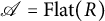 $\mathscr {A}=\mathrm {Flat}(R)$
is a locally finitely presented pure semisimple Grothendieck category. It implies that by [Reference Simson39, Theorem 6.3], every indecomposable object in
 $\mathscr {A}$
is finitely generated. On the other hand, since R is a left artinian ring,
 $\mathscr {A}$
has only finitely many nonisomorphic indecomposable objects. In particular, by [Reference Dung and García12, Theorems 3.2 and 4.2],
 $\mathscr {A}$
is locally finite. Therefore,
 $\mathscr {A}$
is a locally finitely presented Grothendieck category of finite representation type.
Corollary 5.7 (See [Reference Auslander6, Theorem 4.4])
There exists a bijection between Morita equivalence classes of rings of finite representation type and equivalence classes of locally finitely presented Grothendieck categories of finite representation type.
As a consequence of Corollaries 5.4 and 5.7, we have the following result.
Corollary 5.8 The following statements are equivalent.
-
(a) The pure semisimplicity conjecture is true;
-
(b) Every locally finitely presented pure semisimple Grothendieck category, which satisfies the property
$(\ast )$
, is of finite representation type.

We recall that a quiver is a set of points connected together by some directed arrows (see [Reference Gabriel21, Reference Gabriel22]). Let K be a field and Q be a quiver. A representation M of Q over K is given by attaching a K-vector space
 $M_v$
to each point v of Q and a K-linear map
 $M_u \rightarrow M_v$
to each arrow
 $\alpha : u \rightarrow v$
of Q. A morphism
 $\tau : M \rightarrow N$
between two representations consists of K-linear maps
 $\tau _v: M_v \rightarrow N_v$
for each point v of Q such that the obvious diagrams commute. We denote by
 $\mathrm {Rep}_K(Q)$
the category of all representations of Q over K. Note that the category
 $\mathrm {Rep}_K(Q)$
is a Grothendieck category.
The category
 $\mathrm {Rep}_K(Q)$
of representations of a quiver Q of pure semisimple type over a field K, which has been studied by Drozdowski and Simson [Reference Drozdowski and Simson11], is one of the important classes of locally finitely presented pure semisimple Grothendieck categories. In the following example, we show that this class of locally finitely presented pure semisimple Grothendieck categories satisfies the condition
 $(b)$
of Corollary 5.8.
Example 5.9 Let Q be a connected quiver and K be a field. Then by [Reference Drozdowski and Simson11, Theorem 1],
 $\mathscr {A}=\mathrm {Rep}_K(Q)$
is a locally finitely presented pure semisimple Grothendieck category if and only if Q is a subquiver of one of the following quivers:


where  means
 or
 . Let Q be a subquiver of one of the quivers
 $^{\infty }{\mathbb {A}_n}^{\infty }$
and
 ${\mathbb {D}_n}^{\infty }$
. Assume that
 $\mathrm { Mod}(\mathrm {fp}(\mathscr {A}))$
is a QF-3 category. Then there exists a finitely generated projective injective faithful object in
 $\mathrm {Mod}(\mathrm {fp}(\mathscr {A}))$
. Let M be a finitely generated projective injective faithful object in
 $\mathrm {Mod}(\mathrm {fp}(\mathscr {A}))$
. Then
 $M \cong (-, X)|_{\mathrm {fp}(\mathscr {A})}$
for some
 $X \in \mathrm {fp}(\mathscr {A})$
. It is not difficult to see that X is injective in
 $\mathscr {A}$
and for any nonzero morphism
 $f: A_1 \rightarrow A_2$
, there exists a nonzero morphism
 $h: A_2 \rightarrow X$
such that
 $fh \neq 0$
. By using [Reference Drozdowski and Simson11, Corollary 1 and Theorem 4], we can see that the underlying graph of the quiver Q is one of the Dynkin diagrams
 $\mathbb {A}_n$
or
 $\mathbb {D}_n$
. Therefore, the locally finitely presented pure semisimple Grothendieck category
 $\mathscr {A}$
satisfies the condition
 $(b)$
of Corollary 5.8.
In [Reference Simson41], Simson studied purity for locally finitely presented hereditary Grothendieck categories. He showed that there exists a bijection between equivalence classes of locally finitely presented pure semisimple hereditary Grothendieck categories and equivalence classes of pure semisimple hereditary functor categories (see [Reference Simson41, Corollary 2.9]). The proof of Theorems 3.6 and 5.3 shows that we have the following result.
Corollary 5.10 There exists a bijection between Morita equivalence classes of left pure semisimple left hereditary rings
 $\Lambda $
and equivalence classes of locally finitely presented pure semisimple hereditary Grothendieck categories, which satisfy the property
 $(\ast )$
.
Herzog in [Reference Herzog31] showed that, to prove the pure semisimplicity conjecture, it suffices to prove it for hereditary rings. As a consequence of Corollary 5.8 and [Reference Herzog31, Theorem 6.9], we have the following result.
Corollary 5.11 The following statements are equivalent.
-
(a) The pure semisimplicity conjecture is true;
-
(b) Every locally finitely presented pure semisimple hereditary Grothendieck category, which satisfies the property
$(\ast )$
, is of finite representation type.

Acknowledgements
The authors would like to thank the referee for a careful reading of this paper and making helpful comments and suggestions that improved the paper.
 , Representation Theory of Artin Algebras. Cambridge Stud. Adv. Math. vol.


