Introduction
The placenta, a tissue with endocrine and substrate transport function during pregnancy undergoes a physiologic aging process. Disruption of the physiologic aging of the placenta can deter its hormonal and transport function and may lead to several adverse pregnancy outcomes, including preeclampsia and impaired fetal growthReference Chen, Chen and Lee1–Reference Sultana, Maiti, Aitken, Morris, Dedman and Smith5 and later-life cardiometabolic complications.Reference Thornburg, O’tierney and Louey6, Reference Arabin and Baschat7 Investigation of maternal influences on placental development will be key to our understanding of placental markers of future cardiovascular illnesses. Pathological studies suggest that some placentas may show signs of accelerated aging than others.Reference Sultana, Maiti, Dedman and Smith8, Reference Polettini, Dutta, Behnia, Saade, Torloni and Menon9 Premature placental senescence, the most studied trigger of accelerated tissue aging induced by oxidative stress, DNA damage, and epigenomic disruption,Reference Rodier and Campisi10–Reference Horvath12 is associated with fetal growth restriction, preeclampsia, spontaneous preterm birth, and intrauterine fetal death.Reference Chen, Chen and Lee1–Reference Sultana, Maiti, Aitken, Morris, Dedman and Smith5
The epigenetic clock, estimated using DNA methylation levels of CpGs, is demonstrated to be the most promising molecular estimator of biological age.Reference Horvath and Raj13–Reference Boyd-Kirkup, Green, Wu, Wang and Han17 The epigenetic clock method developed by Horvath identified 353 CpG sites from multiple tissues that predicted chronological age with high accuracy.Reference Horvath12 Age acceleration of several tissues, the difference between epigenetic age and chronological age, predicted age-related phenotypes including cancer, cardiovascular diseases, and mortality in adults.Reference Horvath and Raj13, Reference Perna, Zhang, Mons, Holleczek, Saum and Brenner18, Reference Zheng, Widschwendter and Teschendorff19 Accelerated epigenetic age in neonatal cord blood was associated with lower offspring birth weight and Apgar score.Reference Girchenko, Lahti and Czamara20–Reference Knight, Craig and Theda22 In a recent study, an epigenetic tool has been developed for predicting DNA methylation-based placental age using 62 CpGs, and placental epigenetic age acceleration (PAA) is associated with early onset of preeclampsia.Reference Mayne, Leemaqz, Smith, Breen, Roberts and Bianco-Miotto23 DNA methylation-based prediction of fetal developmental maturity using gestational age has the potential to improve epidemiological and clinical research.Reference Knight, Conneely and Smith24
Understanding the factors that influence DNA methylation-based placental aging may provide intervention opportunities to improve pregnancy outcomes by establishing the clinical predictors of placental aging. A study has found that interplays between maternal obesity and offspring sex influence DNA methylation, where methylation percentages were highest in placentas from male offspring born to obese mothers compared with placentas from female offspring born to lean mothers.Reference Yang, Cartier, Drake and Reynolds25 Race/ethnicity and sex are associated with DNA methylation age acceleration in blood.Reference Horvath, Gurven and Levine26 Variations in genetic ancestry influence DNA methylationReference Cappetta, Berdasco and Hochmann27 and gene expression,Reference Zhang and Dolan28 underscoring the importance of considering genetic ancestry in epigenetic aging studies among populations from diverse race/ethnic groups.Reference Zhang and Dolan28, Reference Bryc, Durand, Macpherson, Reich and Mountain29 A histopathological study also suggests male fetuses have higher placental production of endotoxin-induced tumor necrosis factor-response than female fetuses.Reference Yeganegi, Watson and Martins30 Epigenetic clock studies in neonatal cord blood have shown that maternal age, preeclampsia, gestational diabetes mellitus (GDM), neonatal sex, neonatal birth size, and maternal smoking are associated with PAA.Reference Girchenko, Lahti and Czamara20, Reference Knight, Craig and Theda22, Reference Simpkin, Hemani and Suderman31 However, to what extent maternal cardiometabolic factors and genetic ancestry relate to molecular markers of placental aging is unknown. We investigated the overall and offspring sex-specific associations of maternal cardiometabolic traits [prepregnancy obesity, gestational weight gain (GWG), and blood pressure] and ancestry (self-identified race/ethnicity and percentage of genetic ancestry per race/ethnic group) with PAA.
Methods
Study setting and study population
The current study included 312 women who provided placenta samples at delivery as part of the Eunice Kennedy Shriver National Institute of Child Health and Human Development (NICHD) Fetal Growth Studies – Singletons. Women without major preexisting medical conditions from each of four self-identified race/ethnic groups [i.e., non-Hispanic White (White), non-Hispanic Black (Black), Hispanic, and Asian/Pacific Islander (Asian)] were recruited from 12 participating clinical sites in the USA from 2009 to 2013.Reference Grewal, Grantz and Zhang32 Gestational age was determined using the date of the last menstrual period and confirmed by ultrasound between 8 weeks to 13 weeks and 6 days of gestation.Reference Buck Louis, Grewal and Albert33 The study was approved by Institutional Review Boards at NICHD and each of the participating clinical sites.
Placental DNA extraction, measurement, and quality control of DNA methylation
Placental samples were obtained within 1 hour of delivery. Placental parenchymal biopsies measuring 0.5 cm × 0.5 cm × 0.5 cm were taken from the fetal side of the trophoblast, directly below the fetal surface of the placenta. Samples were placed in RNALater and frozen for molecular analysis. Genomic DNA was extracted from the placental biopsies and 500 ng was used to profile methylation data using HumanMethylation450 BeadChip as per the manufacturer’s protocols (Illumina Inc., San Diego, CA, USA) as previously described.Reference Delahaye, Do and Kong34 DNA methylation data were processed using Genome Studio, which calculates the fractional methylation [average beta values calculated by taking the ratio of two fluorescent signals (methylated and unmethylated signals)] at each queried CpG, after background correction, normalization to internal control probes, and quantile normalization. Normalization was performed using the Beta MIxture Quantile dilation (BMIQ) method described by Teschendorf et al.,Reference Teschendorff, Marabita and Lechner35 and modified by Horvath.Reference Horvath12 The method corrected for the probe design bias in the Illumina Infinium HumanMethylation450 BeadChip and achieved between-sample normalization.Reference Horvath12, Reference Teschendorff, Marabita and Lechner35 After BMIQ normalization, missing CpGs were imputed by the k-nearest neighbors method setting k = 10 using the impute.knn function in R as part of the impute library.Reference Troyanskaya, Cantor and Sherlock36 We excluded a total of 11 samples, which included 4 samples showing discrepancies between phenotypic sex and genotypic sex, 6 samples that were outliers from the distribution of the samples’ genetic clusters based on multidimensional scaling plots, and 1 sample with a mismatching sample identifier. In addition, we removed CpG probes with mean detection p value ≥ 0.05 (n = 36), cross-reactive (n = 24,491), non-autosomal (n = 14,589), and CpG sites located within 20 base pairs from known single nucleotide polymorphisms (SNPs) (n = 37,360). After quality control, 301 mothers with placenta sample (with n = 409,101 CpGs) were included in subsequent analyses. Our samples had high probability of prediction for placental tissue when tested using Horvath’s methodReference Horvath12 implemented in glmnet R function.Reference Friedman, Hastie and Tibshirani37
Placental DNA methylation age prediction
We predicted placental DNA methylation age using 62 CpG sites that have previously been found to predict placental epigenetic age with high accuracy.Reference Mayne, Leemaqz, Smith, Breen, Roberts and Bianco-Miotto23 The data can be directly accessed from the supplementary material of Mayne et al. study.Reference Mayne, Leemaqz, Smith, Breen, Roberts and Bianco-Miotto23 DNA methylation age of each of our study samples was determined by conducting a penalized regression model, known as elastic net regression, by regressing the gestational age using mean beta values of the 62 CpG sites in glmnet R function.Reference Horvath12, Reference Friedman, Hastie and Tibshirani37 We estimated the correlation between gestational age and DNA methylation age of the placenta samples in our cohort. Participants in our study, on average, had a term delivery (mean gestational age = 39 weeks), and none had first and second trimester gestational age. Therefore, to assess the correlations using samples with a wider range of gestational ages, we assembled publicly available placental tissue DNA methylation data from NCBI Gene Expression Omnibus (GEO; accession numbers: GSE73375, GSE36829, GSE36829, GSE59274, GSE44667, and GSE74738). We estimated DNA methylation age of the GEO placental samples and additionally assessed the correlation between gestational age and DNA methylation age of a pooled dataset consisting of the GEO samples and our samples. The GSE73375, GSE44667, and GSE74738 data were similarly assayed and normalized as in our data. The GSE36829, GSE36829, and GSE59274 data were assayed using Illumina HumanMethylation27 BeadChip. We observed similar positive correlations between gestational age and DNA methylation age by each GEO data when we evaluated the potential batch and assay differences introduced by each dataset in our assessment of the correlation (data not shown). PAA was defined to be the difference between placental DNA methylation age and gestational age at birth.
Genetic ancestry estimation
Placental DNA samples were genotyped on Illumina HumanOmni2.5 BeadChip, followed by initial data processing using Illumina’s Genome Studio. Mothers’ DNA samples extracted from stored buffy coat specimens were genotyped using the Illumina Infinium Multiethnic Global BeadChip microarray. SNP quality control included removing SNPs with minor allele frequency < 0.05, failing Hardy–Weinberg equilibrium test (p-value > 10e-3) and those with <5% missing data. A total of 41,115 LD-pruned common SNPs were taken forward for admixture analysis. The genetic ancestry proportions of the mothers and their offspring were estimated based on previous data on composition of continental genetic ancestries of the US population.Reference Bryc, Durand, Macpherson, Reich and Mountain29 Reference samples for European, African, East Asian, and Native American ancestries were obtained by combining genotype data on samples from the 1000 Genomes project,Reference Consortium38 and Human Genome Diversity Project.Reference Li, Absher and Tang39 In order to correct for population stratification, the percentage of genetic ancestries was estimated separately for mothers and their offspring using unsupervised clustering analysis implemented in ADMIXTURE version 1.3.Reference Alexander, Novembre and Lange40 ADMIXTURE estimated the percentage of European ancestry in Whites, African ancestry in Blacks, African, European, and Native American ancestries in Hispanics, and East Asian ancestry in Asians was subsequently used as predictors of PAA.
Maternal and offspring cardiometabolic factors
Maternal age and weight at antenatal clinical visits were abstracted from the prenatal records. Maternal age was defined by groups who were <30, between 30–35 and ≥35 to evaluate the associations particularly by advanced maternal age status, rather than a 1-year increment in age. Recalled prepregnancy weight and measured height were used to calculate prepregnancy BMI in kg/m2. Prepregnancy BMI was defined as a continuous variable in kilograms per meter-squared and as a categorical variable (normal weight: <25 kg/m2; overweight: 25–30 kg/m2; and obese: >30 kg/m2). GWG was defined as rate of weight gain (kg/week) in each trimester of pregnancy, first (13 weeks and 6 days), second (27 weeks and 6 days), and third (40 weeks) as previously described.Reference Hinkle, Johns, Albert, Kim and Grantz41 Systolic blood pressure (SBP) and diastolic blood pressure (DBP) repeated measurements in millimeters of mercury (mmHg) were abstracted from prenatal records. Each repeated measurement was averaged to get the blood pressure measurements by trimester. Maternal age was additionally categorized as age <30 years, 30–35 years, and ≥35 years.
Statistical analyses
The Pearson correlation coefficient was used to test for correlations between PAA and maternal and fetal predictors evaluated as continuous variables. Multivariable-adjusted linear regression models were fitted incorporating PAA as the response variable, determinants of PAA as the predictor variables (maternal age, early pregnancy blood pressure, prepregnancy BMI, genetic ancestry, and fetal sex), and potential confounders (parity, health insurance, mode of onset of labor, marital status, educational status, preeclampsia status, and offspring sex). Offspring sex-stratified models were also fitted using linear regression models. We considered each of the tests we conducted independent tests based on a priori observations of the associations between each of the predictor variables and tissue epigenetic aging.Reference Girchenko, Lahti and Czamara20, Reference Knight, Craig and Theda22, Reference Simpkin, Hemani and Suderman31, Reference Roberts, Smith, McLea, Heizer, Richardson and Myatt42, Reference Siveska and Jasovic43 In non-hypertensive pregnant women, blood pressure, most notably DBP, falls steadily until the middle of gestation and then rises again until delivery.Reference Hermida, Ayala and Iglesias44 In addition, longitudinal changes in GWG and its association with intrauterine fetal growth were shown in a previous study.Reference Hinkle, Johns, Albert, Kim and Grantz41 Thus, we used p-value < 0.05 as evidence for statistical significance. Analyses were conducted using SAS 9.4 (SAS Institute, Cary, NC, USA).
Results
Characteristics of study participants and placental DNA methylation age calibration
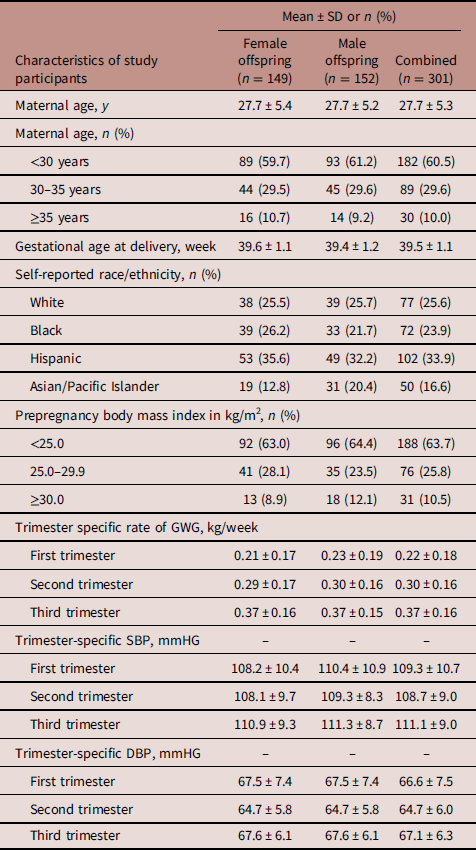
Overall, the mean (SD) of maternal age and gestational age at birth were 27.5 (5.3) years and 39.5 (1.1) weeks, respectively. Characteristics of the study participants are shown in Table 1 and Supplementary Table 1. Approximately, 64% of mothers were normal weight, 26% were overweight, and 11% were obese. The mean (SD) of rates of GWG was 0.22 (0.18), 0.30 (0.16), and 0.37 (0.16) kg/week in the first, second, and third trimester, respectively. The mean (SD) of SBP and DBP at each trimester was 109.3 (10.7), 108.7 (9.0), and 111.1 (9.0), and 66.6 (7.5), 64.7 (6.0), and 67.1 (6.3) mmHG, respectively. The mean fetal ancestry proportions within the self-reported race/ethnicity groups were 78% East Asian ancestry among Asians, 94% European ancestry among Whites, 79% African ancestry among Blacks, and 48% European, 19% African, and 30% Native American ancestries among Hispanics, respectively. The corresponding mean maternal ancestry proportions were comparable with the fetal ones. The gestational age at delivery ranged from 36 to 41 weeks, and its correlation with the estimated DNA methylation age was r = 0.19 (p-value = 0.001). However, the correlation between gestational age and estimated DNA methylation age improved (r = 0.76; p-value < 0.001) after combining our data with the NCBI GEO data samples that had wider range of gestational ages (Supplementary Fig. 1). Mean (SD) placental DNA methylation age and PAA were 35.7 (1.5) and −3.8 (1.7) weeks, respectively. The maternal and offspring characteristics were similar between male and female offspring.
Maternal and fetal characteristics of the study population

GWG, gestational weight gain; SBP, systolic blood pressure; DBP, diastolic blood pressure.
Associations of maternal blood pressure and adiposity during pregnancy with PAA
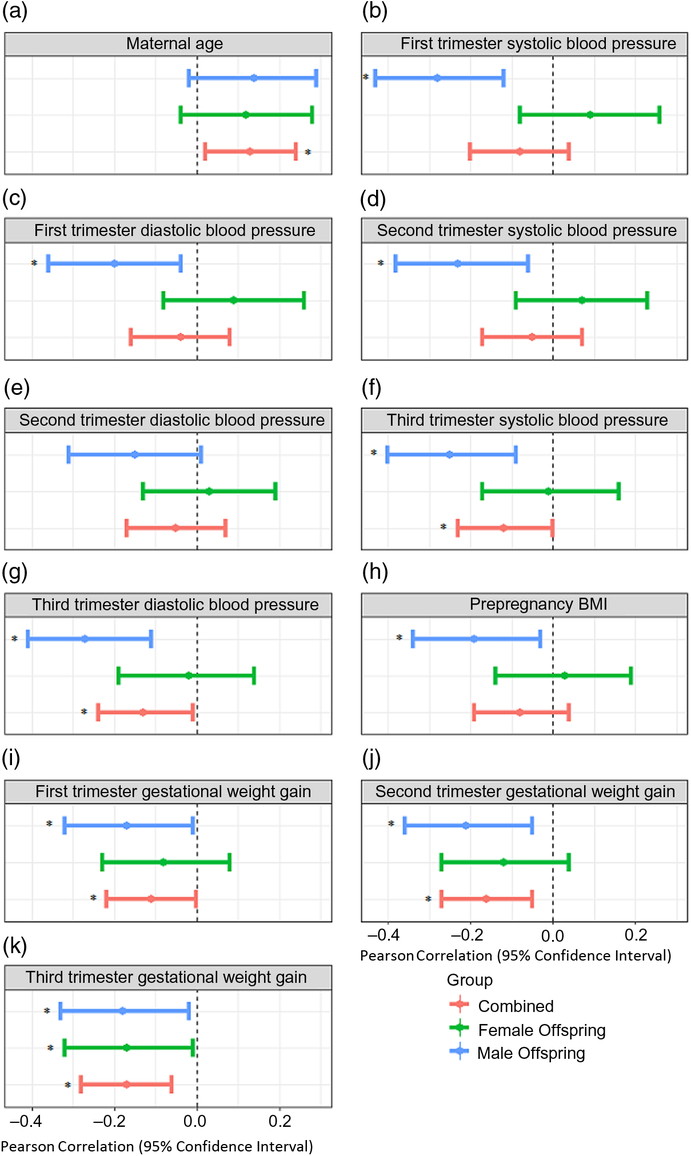
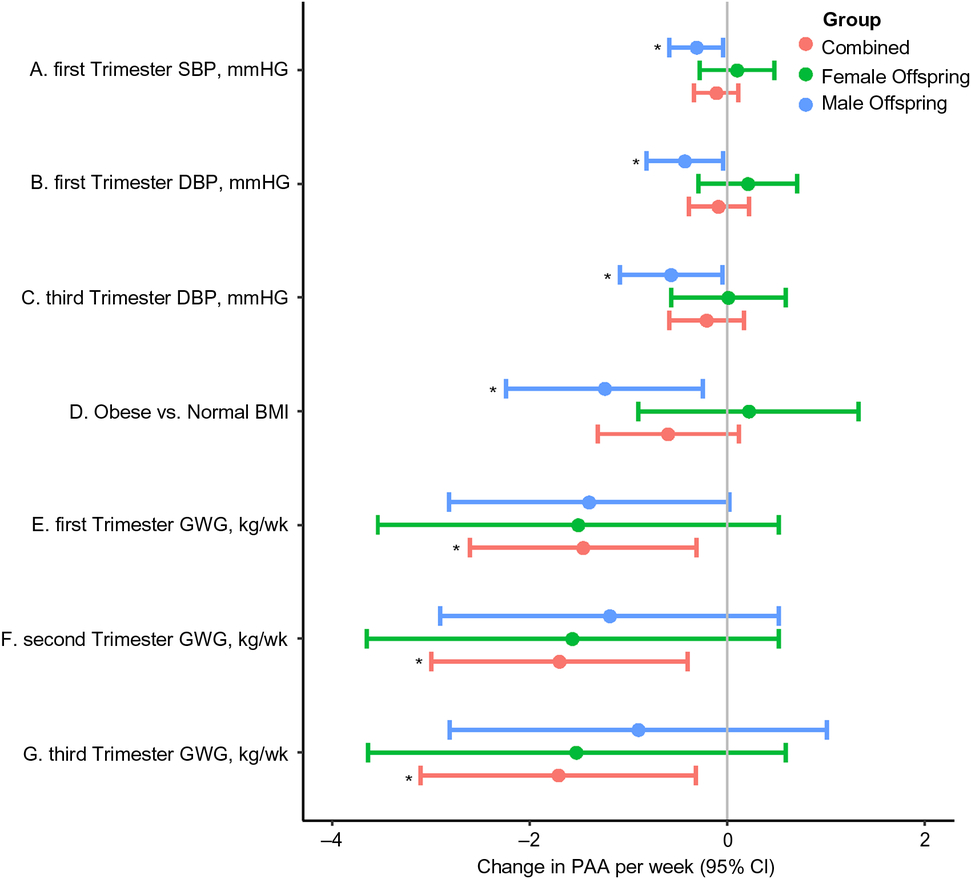
PAA had significant positive correlation with maternal age (r = 0.13 in overall and r = 0.12 in mothers with a female offspring), but significant inverse correlation with maternal prepregnancy BMI (r = −0.19 among those with a male offspring) and maternal blood pressure (range r = −0.20 to −0.28 among those with a male offspring) (Fig. 1, Supplementary Table 2). In multivariable-adjusted models, each 1 kg/week increase in GWG in the first, second, and third trimester was significantly associated with 1.46 (95% CI: −2.61, −0.31), 1.70 (−3.00, −0.40), and 1.71 (−3.11, −0.32) week lower PAA, respectively. Among mothers with a male offspring, prepregnancy obesity compared to prepregnancy normal weight was significantly associated with 1.24 (−2.24, −0.25) week lower PAA. Among mothers with a male offspring, each 10 mmHg increase in first trimester SBP, first trimester, and third trimester DBP was significantly associated with 0.31 (95% CI: −0.59, −0.04), 0.43 (−0.82, −0.04), and 0.57 (−1.09, −0.05) week lower PAA, respectively (Fig. 2, Supplementary Table 3).
Correlations between maternal cardiometabolic factors and placental epigenetic age acceleration.

Multivariable-adjusted significant associations of maternal blood pressure and adiposity with placental epigenetic age acceleration.

Associations of genetic ancestry with PAA
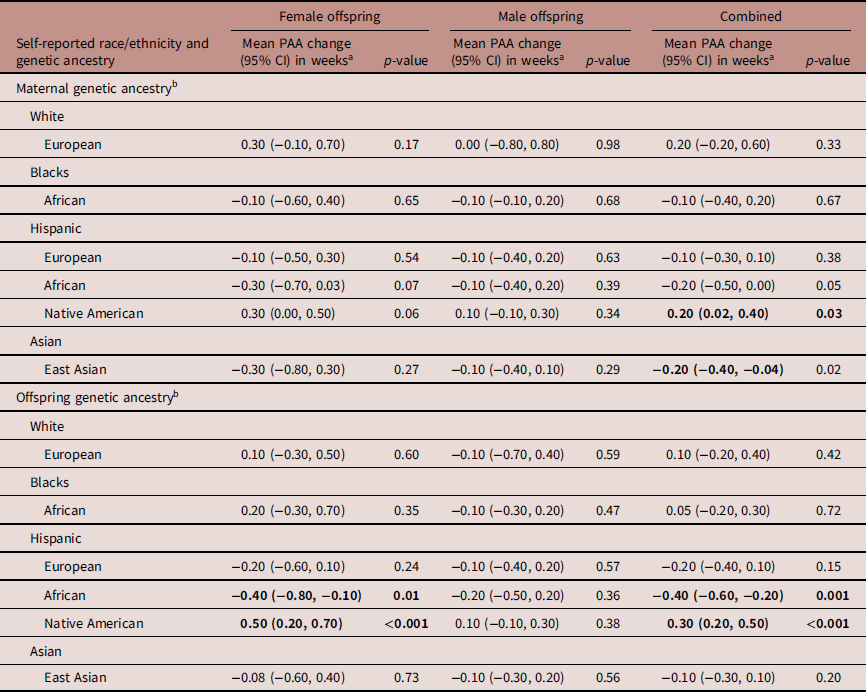
Among Hispanics, each 10% increase in maternal and offspring Native American ancestry was associated with 0.20 (95% CI: 0.02, 0.40) and 0.30 (95% CI: 0.20, 0.50) week higher PAA, respectively; each 10% increase in offspring African ancestry was associated with 0.40 (−0.60, −0.20) week lower PAA, respectively. Among Asians, each 10% increase in maternal Asian ancestry was associated with 0.20 (95% CI: −0.40, −0.04) week lower PAA (Table 2).
Change in PAA per 10% increase in maternal and offspring genetic ancestry component

PAA, placental epigenetic age acceleration.
a Models adjusted for maternal age, prepregnancy BMI, race/ethnicity, parity, health insurance, mode of onset of labor, marital status, educational status, and preeclampsia status; variables were taken out of the model when entered as a predictor; offspring sex was taken out of the model for stratified analyses. Statistically significant estimates are highlighted in bold.
b Per 10% increase in percent ancestry.
Discussion
In this first study of determinants of PAA, we found that maternal cardiometabolic factors and genetic ancestry are associated with epigenetic aging of the placenta. We also found that some of these associations were offspring sex-specific. Specifically, maternal weight gain during pregnancy was associated with lower PAA. Maternal blood pressure during pregnancy, and prepregnancy obesity were associated with lower PAA among mothers with a male offspring. Higher level of Native American ancestry and African ancestry in the offspring genome was associated, respectively, with higher and lower PAA among Hispanics. Higher level of East Asian ancestry in the maternal genome was associated with lower PAA among Asians.
Our findings for associations between higher maternal adiposity (including BMI and weight gain during pregnancy) and lower PAA are supported by findings of histological studies. Using placentas from a group of mothers, a study demonstrated that higher maternal BMI is associated with increased placental nitrative stress but showed no signs of increase in oxidative stress, Reference Roberts, Smith, McLea, Heizer, Richardson and Myatt42 a marker of cellular aging. Reference Rodier and Campisi10 , Reference Van Deursen11 This shift in balance between nitrative stress and oxidative stress may be a potential adaptive mechanism by the placenta to reduce the harmful effects of obesity-induced free radicals. Reference Roberts, Smith, McLea, Heizer, Richardson and Myatt42 Another study carried out in mice using quantitative PCR analysis of oxidative stress primers such as Gpx1, Sod1, and Sod2 showed that there was no evidence of oxidative stress in obese placenta or embryo. Reference Norwood45 A pathological analysis of singleton births demonstrated that the placenta was less mature in obese mothers compared with normal weight mothers. Reference Huang, Liu, Feng, Chen, Zhang and Wang46 Similar to ours, the study found evidence for reduced placental maturity, including maternal origin vascular and villous lesions among obese mothers without obstetrical complications (e.g., chronic hypertension, GDM, and preterm delivery). However, in GDM placentas, another study observed reduced apoptosis, which may contribute to increased placental tissue. Reference Belkacemi, Kjos, Nelson, Desai and Ross47 These data suggest that possibility for maternal obesity to exert adverse in-utero influence on placental pathology, Reference Huang, Liu, Feng, Chen, Zhang and Wang46 explaining the observed inverse associations with PAA in our study. The placenta’s unique ability to trigger an adaptive response if the fetus is not developing well due to hypoxia and oxidative stress was discussed previously. Reference Norwood45 , Reference Myatt48 Even in normal pregnancy, the placenta responds to abnormal maternal nutrient status and hypoxia by altering transporter expression, activity, or epigenetic regulation of placental gene expression to maintain fetal growth. Reference Myatt48
We also found that increase in SBP and DBP in the first and third trimesters was associated with lower PAA among mothers with a male offspring. Using the Grannum classification of four distinct grades of placental maturity, Reference Walker, Hindmarsh, Geary and Kingdom49 a study demonstrated that preeclampsia is associated with maturation of the placenta. Reference Siveska and Jasovic43 Immune genes were found to be expressed at higher level in placentas from mothers with a female offspring compared with those with a male offspring. Reference Sood, Zehnder, Druzin and Brown50 Gene expression of the placenta was shown to respond to maternal inflammatory status in an offspring sex-dependent manner. Reference Scott, Hodyl and Murphy51 A male fetus is more at risk to poor outcomes such as placental insufficiency, Reference Clifton52 which may be a result of observed higher placental TLR4 expression and a greater production of TNFα in response to lipopolysaccharide in males. Reference Scott, Hodyl and Murphy51 A recent study showed higher levels of pro-inflammatory cytokines and cell death (via expressions of hypoxia and apoptotic molecules) in placentas of preeclamptic mothers with a male offspring compared with those with a female offspring. Reference Muralimanoharan, Maloyan and Myatt53 We have also recently showed that low High-density lipoprotein cholesterol in early pregnancy is associated with accelerated epigenetic aging of the placenta in a sex-specific manner. Reference Shrestha, Workalemahu and Tekola-Ayele54
Our study participants were largely composed of mothers without major obstetrical complications (e.g., n = 8 preeclamptics), which may partly explain the observed negative associations between PAA and blood pressure. Early onset preeclampsia was observed to be associated with higher PAA. Reference Mayne, Leemaqz, Smith, Breen, Roberts and Bianco-Miotto23 However, we did not have enough power to detect an association between preeclampsia and PAA in our study; only one mother had high blood pressure during pregnancy and none were taking hypertensive medications. Maternal intrauterine environment could support fetal growth when blood pressure increases in the third trimester through an adaptive mechanism, as both high and low DBPs during pregnancy are associated with small babies and high perinatal mortality. Reference Steer, Little, Kold-Jensen, Chapple and Elliott55 Previous studies have shown low blood pressure in pregnancy is associated with lower birth weight and increased risk of preterm delivery. Reference Ng and Walters56 Third trimester concentration of placental growth factor (P1GF) is decreased as a result of lower maternal serum concentrations of pregnancy associated plasma protein (PAPP)-A. Reference Melo, Araujo Júnior and Helfer57 , Reference Lean, Heazell, Dilworth, Mills and Jones58 Lower PAPP-A was observed in pregnancies with higher placental weight, implicating reduced endocrine function. Reference Lean, Heazell, Dilworth, Mills and Jones58 Future studies are needed to understand whether variations in adverse pregnancy outcomes known to be associated with obesity or higher blood pressure are mediated through accelerated aging of the placenta.
We further demonstrated the associations between genetic ancestry and PAA using estimated global ancestry among the four racial/ethnic groups. Present-day human populations have mixed genetic ancestries that vary even among people from the same self-reported race/ethnicity. Reference Shriner, Tekola-Ayele, Adeyemo and Rotimi59 Self-reported race/ethnicity has been found to be associated with methylation changes driven by both genes and environment, Reference Galanter, Gignoux and Oh60 strengthening the potential utility of genetic ancestry as a modifying factor in epigenetic association studies in admixed populations. Reference Cappetta, Berdasco and Hochmann27 , Reference Zhang and Dolan28 The relatively stronger influence of fetal genetic ancestry than maternal genetic ancestry observed in our study is indicative of direct genetic influence on PAA. Based on this observation and given that heritability of PAA has been previously estimated to be 57.2%, Reference Mayne, Leemaqz, Smith, Breen, Roberts and Bianco-Miotto23 future studies are needed to unravel the molecular genetic basis of PAA.
Our study included diverse study participants with placenta samples that are representative of the US racial/ethnic groups. PAA in our study was estimated based on previously identified 62 placental CpGs that have higher accuracy in predicting epigenetic age of the placenta. Reference Mayne, Leemaqz, Smith, Breen, Roberts and Bianco-Miotto23 We acknowledge that the small sample size limited the study’s power to test interactions of offspring sex and maternal factors on PAA. Absence of reference for placental cell-type composition may result residual confounding by unaccounted cell type in our estimation of placental epigenetic aging.
In summary, we found that maternal adiposity, blood pressure, and genetic ancestry are associated with molecular markers of placental aging. These associations could be male offspring-specific. Reference Tekola-Ayele, Workalemahu and Gorfu61 Investigation of maternal influences on placental physiological development will be key to our understanding of placental markers of pregnancy complications and future cardiovascular illnesses. Together with future biomedical studies, these findings open intervention opportunities to improve pregnancy outcomes by establishing the pathophysiology of placental aging.
Supplementary material
To view supplementary material for this article, please visit https://doi.org/10.1017/S2040174419000801
Acknowledgements
We acknowledge the study participants of the NICHD Fetal Growth Studies. We thank research teams at all participating clinical centers (which include Christina Care Health Systems, Columbia University, Fountain Valley Hospital, California, Long Beach Memorial Medical Center, New York Hospital, Queens, Northwestern University, University of Alabama at Birmingham, University of California, Irvine, Medical University of South Carolina, Saint Peters University Hospital, Tufts University, and Women and Infants Hospital of Rhode Island). The authors also acknowledge the Wadsworth Center, C-TASC, and The EMMES Corporations in providing data and imaging support. This work utilized the computational resources of the NIH HPC Biowulf cluster (http://hpc.nih.gov).
Financial Support
This research was supported by the Intramural Research Program of the Eunice Kennedy Shriver National Institute of Child Health and Human Development, National Institutes of Health including American Recovery and Reinvestment Act funding via contract numbers HHSN275200800013C; HHSN275200800002I; HHSN27500006; HHSN275200800003IC; HHSN275200800014C; HHSN275200800012C; HHSN275200800028C; HHSN275201000009C, and HHSN27500008. Additional support was obtained from the NIH Office of the Director, the National Institute on Minority Health and Health Disparities, and the National Institute of Diabetes and Digestive and Kidney Diseases.
Conflict of Interest
None
Ethical standards
The authors assert all procedures contributing to this work comply with the ethical standards of the NIH on human subject research and have been approved by the Institutional Review Boards at NICHD and each of the participating clinical sites.
Author Contributions
F.T.-A conceived and designed this study; T.W. performed statistical analyses and wrote the draft manuscript. All authors contributed to interpretation of the results, provided critical intellectual content, and approved the final manuscript.