God:
In one of the final scenes of Richard Lee and Stewart Thomas's Jerry Springer: The Opera (2003) God descends onstage, dressed up as an obese Elvis Presley, singing the lines quoted above in an operatic voice, and taking part in the grotesque final judgment of the notorious American TV host Jerry Springer. He sits on a chair that descends from the heavenly sky into a stage that is hell, and like in many twentieth-century and contemporary avant-garde performances that are based on biblical and scriptural themes and texts, abstract concepts such as God and the future are straightforwardly (re)present(ed). This very performance of transcendent realms based on religious iconography and biblical scriptures expresses a contemporary search for, uneasiness about, and perhaps even nostalgia for – or dependence on – the presence of such concepts.Footnote 2
Such theatre performances paradoxically mock and reinscribe biblical religious concepts and I therefore define them as modern mystery plays, or ‘modern mysteries’. This genre has emerged since modernism, in response to and in dialogue with secular culture and philosophy. The theatricality of modern mysteries is complex but a central tenet is the concretization of abstract concepts such as God, extraterritorial spaces such as heaven or hell, and mythical time dimensions that include imaginations of the future. In this paper I first identify the genre of ‘modern mysteries’ by giving a few examples of this deconstructive genre and then move on to examine three theatrical models of the end/the future in such performances.
Jerry Springer: The Opera is one in a long line of modern mysteries. In Vladimir Mayakovsky's Mystery Bouffe (1918), towards the end of the performance the workers enter the Promised Land, after robbing God of his thunderbolts in order to establish an electrified city, the dream-come-true of the futurists.Footnote 3 In Lothar Schreyer's expressionist play Crucifixion (1920), the horrors of the First World War are condensed into the Mother's ironic words, referring to her son, the dead soldier as Christ, while quoting Nietzsche: ‘God is dead’. In Grotowski's Akropolis (1961) the performance reaches its end, or climax, with a parodic version of a Corpus Christi procession, evoking both an image of redemption and its impossibility at one and the same time. In Paul Rudnick's The Most Fabulous Story Ever Told (1998), the metatheatrical idea of creating a world is located in a stage manager, who creates with her word a world/stage in which homosexuality is the norm and then follows the biblical narrative along these lines. In Hanoch Levin's Those who Walk in the Dark – the title being a quote from Isaiah 9:2 – God appears for a moment, and when he explains why there is suffering nobody can hear him because of a loud train passing, creating associations with the Holocaust. In Hermann Nitsch's carnal Mystery Plays, real sacrificial rituals take place, combining Dionysus and Christ into a radical version of the savior. This short list of examples demonstrates the stylistic and ideological variety of avant-garde performances that concretize, lean on and negate, all at the same time, biblical and religious concepts.
Like late medieval mystery plays, modern mysteries are often epic in structure and scale, mixing elements from the present with the mythological past or future in an anachronistic manner. In addition, the a priori power of mystery plays for audiences medieval and modern alike is based on a deep cultural familiarity with the Bible as text, myth and foundational narrative. This familiarity enabled medieval creators of mystery plays to turn biblical episodes into vernacular, often comic, theatre that explored and negotiated social and cultural issues, thereby creating religious theatre that included secular elements.
However, whereas medieval performances were the outcome of a religious cultural context and social milieu, and expressed theological belief and confidence in worldly order, modern mysteries are cultural products of a secular thought system, and can therefore be defined by their deconstructive approach to the biblical texts. Why does avant-garde theatre that negates traditional social and cultural systems of belief insist on reconnecting with religious sources? Beyond exposing contemporary society's secularism and lack of authority by confronting the religious thought system, creators of modern mysteries use the freedom enabled by secularism to open up the Bible in new ways and reload the scriptural texts with new and acute meanings, even if, to use Grotowski's term, it is done via negativa. This simultaneous and even contrary effect fits Ian Almond's understanding of deconstruction as a simultaneous ‘work of both demystification and remystification’.Footnote 4 Accordingly, I argue that performances as diverse as the ones mentioned above simultaneously negate the Bible's religious power and authority and use that very same power as an energetic force for creating a meaningful experience. These performances exist on the threshold of religiosity and secularism, of meaning and absurdity, and create what can be termed ‘sac/religious’ theatre.
Since modern mysteries depend on the narrative structures of the scriptures, such performances are a unique site in contemporary culture where the future is already scripted and can therefore be theatricalized or concreticized within a contemporary context. The time span of the scriptures is translated in their dramatizations into mythological timelessness, from the ultimate past (creation of the world) to the ultimate future. Since this future, however, has in fact not yet occurred, present times are also included in this timeline, linked somehow to the idea of an event that has yet to happen: ‘the End’. Unlike conventional drama, which depicts fictional worlds where the end implies a continuation of that world (Fortinbras and Horatio stay alive), the future in modern mysteries is synonymous with the definitive end of the world as it is known, not only onstage but also in the real world of the spectators: the Last Judgment, the End of Time, the World to Come, the Apocalypse, and so forth.Footnote 5
For religious spectators of a medieval mystery play, the represented future is a matter of fact. Performing the future as in scenes of the Last Judgment, typical of the grand finales of the mystery cycles, can be conceived of as rehearsing the real future, in that these episodes demonstrate for the audience what the futuristic event they believe will come one day will look like. Episodes of the Last Judgment depicting good souls being led into paradise (as opposed to bad ones who are ‘damned to hell full deep’Footnote 6) have a performative function, as through these scenes spectators are guided as to how to fulfil their desired ‘end’: if they wish to be led into paradise and avoid hell they should behave in their real life like the good souls and not the bad ones. Represented is an end with an end. In modern mysteries, however, the question is whether a future can be imaged and imagined through the transgressive and paradoxical act of both profanation and reinscription of scriptural models. And if indeed it can, what are the implications for the spectator?
Aesthetically, the fact that the futuristic event of the end is prescribed in scriptural iconography enables theatre creators of mystery plays (medieval and modern) to image and imagine the future. Like other abstract concepts, the future can be actualized in these performances.Footnote 7 Accordingly in spite of their secularism, scepticism and irony, mythical and symbolic performative patterns are used to actualize ‘the End’ in modern mysteries. I shall now look at a few examples of modern sac/religious theatre that demonstrate three models of ‘the End’ and are related to social and political issues: breakthrough, merger and utopia; descent, disappearance and apocalypse; and a cyclical, bi-directional movement towards both utopia and dystopia.
Utopia: breakthrough and merger
Vladimir Mayakovsky's Mystery Bouffe (1918/1921) ridiculous biblical narratives yet holds on to its very power and conviction in striving to create a ‘new testament’ of a utopian communist future. Based on the story of the flood, it follows medieval theatrical principles in its anachronistic insertion of contemporary events within the biblical story. Here, the flood is an event so powerful that it carries on its (dry) wave the energetic revolutionary force of the ‘unclean’ workers on their way to the futurist Promised Land – an electrified city (of God?).Footnote 8 As the flood is about to immerse everything, Mayakovsky's characters build an ark on which the workers struggle with the ‘clean’ (the bourgeoisie, the rich and the world leaders) and eventually, victoriously, throw them off. Then the workers who have captured the ark go back in time through the celestial spheres, only to discover that in comparison to life on earth hell is a fun place, that paradise is extremely boring, and that a man who walks on water is not Christ but the ‘new man’. The play's comical and blasphemous profanity crosses out the world and starts anew, yet the play moves forward into the future not only by nullifying what came before, but also by reversing the biblical design of time. Whereas the biblical flood comes as a disastrous punishment after the creation of the world, certainly after the primeval chaos (tohu va bohu in the Hebrew original), the workers’ progression into the future can be achieved only by going back through the past. They cannot arrive at the Promised Land until they go through the Land of Chaos itself in order to restart the world.Footnote 9 Thus the dramatic structure of the play demands the total nullification of the world, not only as it is in the present but also as it has been in the past. Mayakovsky's revolutionary energy uses the biblical flood as its point of departure, and finds in it a mythological confirmation of Marxist ideology and historical determinism. The communists, thus, are not the first to erase the world and restart anew. This is what God is said to have done by the flood, and therefore this kind of progression out of total destruction is already built into the Bible's narrative.
Mayakovsky's dramatic repetition of biblical narrative structures is reinforced by the end of the play and by performance. In addition to reinscribing the fundamental myth of growth through destruction, the Promised Land itself is also based on a scriptural concept, a futuristic version of Paradise, which includes ‘a huge gate’; ‘over the top of the gate one can see rainbows, roofs, and huge flowers’.Footnote 10 The image of the garden parallels the idea of Paradise and the rainbow is taken directly from the biblical story of the Flood as a symbol of the renewed covenant after the flood. The workers’/actors’ bursting through the gate towards the end of the play creates a theatrical gestus of entrance and merger that signifies the moment of realizing utopia, entering into a space that is not real, but futuristic. Two mythical structures are brought together in this moment: the biblical idea of being led to Paradise, as is the fate of the good souls in the Last Judgment, and the revolutionary act of breaking through a gate in order to create a new (and better) future.Footnote 11 The workers enter the Promised Land singing; they are ordered to ‘break in’ (130) and then ‘the gate flies open, and the city is revealed’ (130).
The utopian gesture of the workers’ ‘entrance’ into the Promised Land through an arch in the 1918 version,Footnote 12 referencing yet again the biblical origin of the rainbow, is, however, only one form of merger and symbolic crossing of borders. The performativity of the play goes beyond its sac/religious reliance on the biblical myth. In modern mysteries of which the end is utopian, a communal sharing and merging between stage and audience signifies belief in the performativity of this future. Mystery Bouffe ends with the victorious ‘unclean’ calling to ‘let the whole universe sing!’ as ‘Mankind beholds a new spring’ (138–9).
In the 1921 version of the play, the spectators were invited to join the actors onstage during this finale, in order to have the performance spill into the real world.Footnote 13 Like other forms of artistic propaganda (or religious theatre), the end of the end is communal and participatory, signifying fertilization. The merger between stage and audience is utopian because it creates a space that is ‘no-place’. In this ending the actors cease to perform characters and the spectators on the other hand enter the frame of the performance. Like in a medieval mystery play, the performers and spectators collectively take part in imagining the future, thus turning the performance into a rehearsal of a ‘real’ future. Mystery Bouffe's Promised Land comes alive for a moment, as its inhabitants cross its borders safely.Footnote 14
Apocalypse: descent and disappearance
If breakthrough and merger are theatrical mechanisms of utopia, descent and disappearance are theatrical emblems of an apocalyptic end. There are many post-Holocaust modern mysteries, most likely seeking the mythical dimensions of biblical theatre in order to address this historical trauma, but also in order to theatricalize the question, ‘where was God?’ In Jerzy Grotowski's Akropolis (1961) the loftiest literary products of Western culture – episodes from the Bible and Greek mythology – are ritualistically performed in a Nazi death camp as the workers laboriously build a crematorium. As in a medieval mystery play that actualizes hell as a stage machine that looks like a ‘hell mouth’, here the performance is in hell itself, the ‘cemetery of the tribes’.Footnote 15 Towards the performance's climax and end, echoing a Corpus Christi procession, the workers/prisoners carry a body of Christ, portrayed as a doll unable to redeem.
Whereas in conventional depictions of the Last Judgment the ‘bad souls’ are dumped into hell, as in the York cycle, in Akropolis the dichotomy of good and bad loses meaning, and ironically the victims are on their way to die. Throughout the performance the prisoners work intensively, building up to the stunning final moment, in which they all quickly descend into the crematorium they built, their hell-pit. Once the performers have disappeared, they leave the audience in striking silence, actualizing an image of death, and preventing the spectators from relieving themselves by greeting the performers. This is an example of a totalizing and final ending.
But if there is no salvation, if the literary products and scriptures of Western tradition fail to redeem, why echo and perform (and mock) them? It is almost a cliché to talk about Grotowski's ‘holy theatre’, yet, as in the Christian doctrine, his actors are asked, and are willing, to sacrifice their own bodies in order to evoke an experience that could be termed religious. In his theatre Grotowski creates a shift from the textual to the performative, from the icon to the body. The actors’ willingness to endure and to perform such extreme emotional and physical effort in order to resurrect, even momentarily, the figures of the dead prisoners, and thus evoke a tantalizing experience, creates sac/religious theatre.
Cyclical patterns: moving towards both utopia and dystopia
The end of Beckett's Waiting for Godot is the paradigmatic end/implication of the future typical of the third category. The paradoxical combination of Estragon's final words, ‘Let's go’, and the stage direction that reads ‘they do not move’, creates an impossible movement without movement. It is an end that simultaneously expresses belief and despair, a longing for meaning and a realization of absurdity. Another example of this kind of ‘endless end’ is performance artist Sigalit Landau's video art piece, Barbed Hula (2000). In this performance Landau ‘plays’ with a barbed hula hoop that cuts and marks her nude body in a cyclical, unending, pattern. The barbed hula hoop evokes on the one hand a nostalgic memory of a childhood game, and on the other a primeval ritual in which pain is associated with a certain kind of pleasure. On another level, the barbed hula hoop refers simultaneously to the Holocaust and to Jesus’ crown of thorns. Like Vladimir and Estragon, Landau's body becomes a performing site that quests for salvation through sacrifice, pain and memory, and yet at the same time uses the cyclical pattern of the hula hoop to demonstrate an absurd inability to achieve it. As in Godot or in Beckett's other plays, Landau's body creates movement that signifies hope for redemption and release but is in fact stuck in an endless, cyclical pattern that is potentially destructive and terminal.
Finally, in Israeli director Rina Yerushalmi's epic Bible Project (1995–2000), based solely on biblical excerpts in the original Hebrew, the final part, Va Yare (And He Saw), anticipates an end/future which, as in the Bible, combines the exile of the Israelites into Babylon and the return of the exiles and the rebuilding of the temple. The performance builds up to its ending with a long list of biblical kings who ‘did that which was evil in the sight of the Lord’, and who gradually led the Israelites to the biblical exile into Babylon. Based on many connections that the performance makes between the biblical texts and modern Israeli society, this ending implies a possibly dystopian future for contemporary society as well.
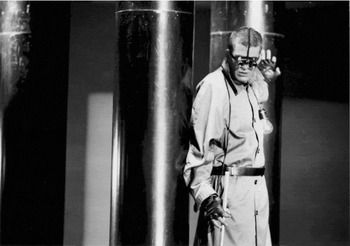
However, paradoxically, as the performance progresses towards this dystopian future, it also builds up towards a utopian ending. Simultaneously with the texts that are recited about the futuristic exile, an actor who performs the figure of the prophet Ezekiel walks in cycles around the stage (Fig. 1). He is dressed up in a long modern beige coat, wears monocles on his eyes that symbolize both vision and blindness, and holds a lit light bulb in his left hand while in his right hand he has a walking cane, with which he constantly measures the stage. ‘Ezekiel’ continuously circles the stage, speaking already from exile (Galut), and reciting the prophet's biblical measurements of the new temple that will be built in the future, when the people of Israel will return yet once again from exile (Ezekiel 41–3). Thus Yerushalmi's Bible Project in fact suggests that starting anew and building the country all over again, as happened after the Exodus and in the twentieth century, is the cyclical and futuristic dynamic of Israeli/Jewish society; it is a recurring mythic structure of exile and redemption (Galut and Geula). Theatrically, the linear development of the performance towards its end is accompanied by the prophet's cyclical movements around the stage, suggesting this third category of a bi-directional, cyclical imagination of the future.
Moisi Shmuel as Ezekiel in Va Yishtachu. Va Yare. (And They Bowed. And He Saw). Directed by Rina Yerushalmi. Itim Theatre Ensemble in affiliation with the cameri Theatre of Tel Aviv. 1998. Photo by Gadi Dagon.

In conclusion, I have only touched upon the complex ways in which modern mysteries perform and theatricalize the future. It is through the transgressive act of deconstruction and sometimes even profanation that creators of these performances can explore the traditional narratives anew. By creating sac/religious theatre that relies on mythical and scriptural models and alludes to modern versions of paradise, hell and ‘limbo’ cyclical patterns, these performances create meaningful experiences that demonstrate how religious thought systems are transformed and used in modern and secularized theatre and its images of the future.