

Introduction
Global warming and thereby melting of sea ice has resulted in an increased possibility and interest from shipping companies for Arctic destinations or transit (Guy Reference Guy2006; Somanathan and others Reference Somanathan, Flynn and Szymanski2009; Verny and Grigentin Reference Verny and Grigentin2009; Schøyen and Bråthen Reference Schøyen and Bråthen2011; Lasserre and Pelletier Reference Lasserre and Pelletier2011). If most shipping companies appear to be more interested in destinational traffic rather than transit (Lasserre Reference Lasserre and Lasserre2010; Lasserre and Pelletier Reference Lasserre and Pelletier2011; Wergeland Reference Wergeland2013; Lasserre and Alexeeva Reference Lasserre, Alexeeva, Lalonde and McDorman2014), ship owners are trying to assess whether new trade opportunities that might arise in the Arctic are profitable or not. As a result, insurance companies receive an increasing number of requests regarding Arctic voyages, and the availability of marine insurance (insurance conditions, cost of premium) could be a key factor in the development of Arctic trade.
A series of accidents triggered continuing reflection on how marine liability should be assessed and risks managed regarding Arctic shipping. From the Eexxon Valdez grounding (1989) that occurred in a sub-Arctic region; to the sinking of the cruise ships Maxim Gorkiy near Svalbard (1989) and MS Explorer in Antarctica (2007); to the grounding of the cruise ship Clipper Adventurer in the northwest passage (August 2010) or of the tanker MV Nanny in Canadian Arctic waters in September 2010 and October 2012; to the collision of the tanker Nordvik with an ice floe along the northern sea route in September 2013 that could have proved fatal, accidents in Arctic waters have already taken place and indicate how risky navigating these waters can be.
The question that thus arises is how do insurers react regarding the challenge of Arctic transportation? This article explores the developing policies of the marine insurance sector regarding Arctic shipping. After defining general marine insurance (cargo, hull and machinery, marine liabilities), we will identify key risks in Arctic shipping, basing ourselves on empirical data from a series of interviews with several insurance companies. Finally, we will examine how these insurance companies assess the insurability of an Arctic voyage: insurance process, risk elements, insurance conditions and premiums.
Considering insurance as a major business factor is not new
A review of literature quickly informs us that considering insurance fares as a major variable in assessing the profitability of Arctic shipping, is not a recent question. As early as 1999, the International Northern Sea Route Programme (INSROP) report and related-articles underlined that shipping companies would have to comply with risk assessment drawn by major insurance companies (Gold Reference Gold and Ragner1999; Musin Reference Musin1999) that appeared to be mainly reactive and not at ease with what definitely was at the time, and still is, a region in which transportation risks are still to be fully assessed (Tamvakis and others Reference Tamvakis, Granberg, Gold and Østreng1999). Several articles have stressed the importance of this business dimension, not only because potentially major costs were at stake depending on the risk assessment insurance companies could produce, but also because the norms the insurance firms would set up would partly condition the profitability potential of Arctic shipping: the stricter their demands would be, the more expensive the adaptation could be for shipping firms (Østreng Reference Østreng2006).
Arctic shipping will not be sustainable without the availability of marine insurance at reasonable commercial rates. Unlike most other areas of shipping, the practice of marine insurance is not regulated in an international convention. A business and private law matter, marine insurance is legislated at national level, and occasionally at sub-national level, for example, in the United States. Insurance practices are driven by international insurance markets. Although most of the risks associated with shipping are well known and understood by insurers and shipowners alike, the risks associated with polar navigation are still not fully assessed or modelled. As a result, the provision of insurance for Arctic shipping tends to be on a case-by-case basis and expensive, with seasonal additional premiums. The availability and cost of marine insurance is a major constraint on Arctic marine shipping (Arctic Council 2009); the risk assessments of classification societies (non-governmental organisations that establish and maintain technical standards for the construction and operation of ships and offshore structures) like the American Bureau of Shipping (ABS), Det Norske Veritas (DNV) or Lloyd's Register (LR)) and the marine insurance industry are likely to be a crucial factor for the economic viability of all Arctic marine shipping (Molenaar Reference Molenaar2008).
INSROP was a six-year (June 1993–March 1999) international research programme designed to assess the economics of the northern sea route (NSR), a project that, besides Russia, interested Japan and Norway. Both INSROP and ARCOP: Arctic Operational Platform (2002–2006, European Union, studying the NSR) programmes concluded that insurance firms were willing to underwrite risks associated with shipping along the NSR (Magnus Eger Reference Magnus Eger and Østreng2013).
A few shipping firms had gathered experience in coverage of shipping in seasonally ice-covered shipping lanes, as in the Baltic, the Barents Sea, the Gulf of St. Lawrence or northern Japan. However, the gradual increase in Arctic shipping, although mainly destinational, and the growing interest by shipping firms trying to assess the profitability of entering the Arctic market, put pressure on insurance firms for them to determine standards rather than assessing on a case-by-case basis. International shipping could then expect consistent rules and standards and provision of services from their insurance providers (Chircop Reference Chircop2009).
Parallel to this risk assessment process by insurance firms working with classification societies, efforts at defining standards were given by states and the IMO. Prompted by the disaster of Exxon Valdez off the coast of Alaska in 1989, the IMO had started working on a code for navigation in polar waters. The intention was clear from the very beginning: rudimentary regulation for Arctic shipping was to be harmonised at the international level, and made mandatory for the sake of environmental protection (Brigham 2007; Jensen Reference Jensen2007, Reference Jensen2008). The negotiations, however, proved more difficult than expected. They produced the IMO Guidelines for ships operating in Arctic ice-covered waters (IMO 2002) and then the IMO Guidelines for ships operating in polar waters (IMO 2009), non-compulsory documents that should give way to a mandatory polar code that is still being negotiated despite regular announcements it will soon be agreed (Choquet Reference Choquet2010). A draft version is indeed being prepared (IMO 2014a) and is circulating among stakeholders (IMO 2014b). At the 93rd Meeting of the Maritime Safety Committee (MSC), held at IMO HQ in London from 14 to 23 May 2014, the committee approved, in principle, the draft polar code and related SOLAS amendments with a view to formal adoption in November 2014 (Longshore and Shipping 2014). The International Union of Marine Insurance (IUMI) issued general guidelines in a recent bulletin (28 October 2013) for its members in which it listed the following risk factors: ice conditions; ship ice class; ship equipment and architecture; remoteness of the planned route; icebreaker availability; search and rescue (SandR) services; crew and master experience and training, and invited member firms to share best practices they noted among themselves in risk assessing (IUMI 2013), thus transferring into the insurance business the results of continuing discussions at both business (insurance and classification societies) and political (negotiations in the frame of the IMO) levels.
Past attempts at assessing the cost of insurance for Arctic shipping
Defining every firm's insurance policy was, and still is, work-in-progress, as confessed by the Lloyd's Market Association executives met by one of us (Lasserre) in 2007 (N. Roberts, personal communication, 23 November 2007). However, as insurance firms gathered a more comprehensive view of this developing business and began harmonising empirically (no negotiation ever took place on this issue officially) their requests, scientists also tried to quantify the cost premiums Arctic insurance could represent, for simulation purposes.
A set of factors became apparent when insurers talked about the process of assessing risks: remoteness and the cost associated with salvage in case of accident; lack of infrastructure for repair or mooring; difficult communications; very rough potential weather and sea conditions; sea ice; poor charting. . . Thus, emerged the mandatory presence of a competent crew; of proper ice-strengthening and equipment to navigate, like de-icing fixtures to counter icing spray; of a good preparedness; of the will to communicate regularly with monitoring authorities (Haahjem Reference Haahjem and Haahjem2012), a movement that again paralleled the efforts by classification societies to define sets of equipment and rules for ships that would make Arctic shipping more secure (Hasholt Reference Hasholt2011; Miura Reference Miura2013).
However, for commercial reasons, insurance firms do not publicly disclose their policies and tariffs, neither for general nor for Arctic shipping insurance. If it reckons insurance costs are an important factor in setting the cost structure of Arctic shipping (European Union 2010), the literature thus reflects uncertainty about insurance premium levels, authors estimating they could be zero (Laulajainen (Reference Laulajainen2009) and other that they could be double the regular insurance costs (Magnus Eger and Mejlænder-Larsen Reference Magnus Eger and Mejlænder–Larsen2013), or even more: ‘the dangers posed by ice will also result in extremely high insurance premiums. In the Canadian Arctic prices remain an unknown quantity, however they have been estimated at 150% to 300% more than blue water traffic’ (Lajeunesse Reference Lajeunesse, Lajeunesse, Russell and Johnston2011:7; also Griffiths Reference Griffiths2004). Thus, trying to quantify these cost premiums implied either directly asking insurance firms, or extrapolating from a few interviews. Several models and simulations have been published trying to assess the profitability of Arctic shipping, some sketchy but others with detailed cost-structures (Lasserre Reference Lasserre2014), several of which explicitly compute insurance costs.
It is a diversity of estimations that one can witness when reviewing cost models for Arctic shipping. Insurance premiums are the object of a wide range of estimates among the 23 models Lasserre reviewed. Three models rely on no particular insurance premiums: as Laulajainen (Reference Laulajainen2009:63) asserts, ‘hull insurance for ice-strengthened and standard vessels is the same’. One simulation mentions a cargo insurance premium of 50% over standard tariffs. Three models suggest global insurance costs may be between 75% and more than 100% higher than regular fees. For PandI (personal and indemnity, insurance protection that covers for third-party liabilities encountered in the commercial operation of vessels), premiums vary from 16,7%, 25% (2), 43% 50% (3) and 100%; for HandM (hull and machinery, insurance protection for damage done to the ship itself or the equipment which forms part of it), premiums display a range between 25% (2), 50% (3) and 100% (3). Arpiainen and Kiili (Reference Arpiainen and Kiili2006) quotes 800 $/day as the average insurance cost for a ship plying Arctic waters year-round, whereas Somanathan (Reference Somanathan, Flynn and Szymanski2009) sets this cost at 1746 $/day, Wergeland (Reference Wergeland2013) at 1150 $/day for a containership along the NSR, and Verny and Grigentin (Reference Verny and Grigentin2009) at 3344 $/day. Clearly, such a wide range of cost estimates underline the degree of uncertainty these models have to cope with, since there is no general portrait of insurance policies regarding Arctic shipping.
One of us built, capitalising on these models, his own simulation (Lasserre Reference Lasserre2014). It is not the purpose of this article to discuss its conclusions. Here, what is relevant is that it appears that modelled insurance costs for transit along the NSR (with a balanced hypothesis for premiums reflecting all the other models) represent about 6,6% of total direct costs (fuel, crew, maintenance, capital costs, transit fees), far less than fuel costs (about 42%), capital costs (about 31%), transit fees (about 13,5%), but more than crew (about 4,7%) despite its being more expensive for Arctic shipping, and maintenance (about 2%). Discussing the level of insurance costs must therefore be replaced in the general context in which insurance costs are an important element, but certainly not a major one.
Assessing insurance policies regarding Arctic shipping
So as to better evaluate how the insurance companies now assess the Arctic shipping risk and how they respond to it, we conducted a survey between May 2012 and February 2013. We contacted insurance firms reportedly active in maritime and shipping insurance and asked them how they saw the evolution of the market, if they were interested in it and if so, how their policies were formatted. We contacted 44 companies; among them, 32 answered and 25 detailed their position (see the list of the firms that answered our questions in Annex 1).
Four companies do not offer Arctic insurance but nevertheless detailed how they saw the market.
Among the 21 companies that replied and that do offer Arctic shipping insurance, 11 offer cargo insurance; 19 hull and machinery (HandM) coverage; 13 cover protection and indemnity (PandI); 16 are insurers; 3 are brokers, and 2 are reinsurer/insurers.
There is a significant discrepancy in the number of Arctic shipping contracts these firms sell, as depicted in Table 1.
Annual number of contracts for surveyed insurance firms

Ten firms declared they signed 10 contracts or fewer per year; seven between 10 and 30; and three firms signed more than 50 contracts per year. Ten firms indicated their business volume was on the rise; 8 said it was stable.
Requirements for the vessel
16 firms insisted that the ship has an ice-class certification for insurance cover to be provided, and 2 considered it was extremely important when considering coverage. 8 firms considered Baltic class 1A to be a minimum; 1 said 1B was acceptable, but 1 said 1AS was a minimum. Most insurance firms make explicit reference to the unified International Association of Classification Societies (IACS) Requirements concerning polar class (2006), a document established by the IACS and drawing from the recommendation of the IMO's Guidelines for ships operating in Arctic ice-covered waters. Although it never occurred through direct coordination, the classification societies, the IMO's workshops and the insurance industry thus gradually standardise requirements for Arctic shipping, despite there being many case-by-case risk assessments (also see Fløistad and Lothe Reference Fløistad, Lothe and Østreng2013). Classification societies are still involved in a continuing effort to define more adapted rules, with for instance the specific Lloyd's Register document setting certification rules for stern-first ice-class ships (usually double-acting ships with azipod/orientable propellers) (Lloyd's Register 2014).
Risk management model
17 firms explicitly mentioned they also had risk management policies that lead them to evaluate criteria such as shipmaster and crew experience; cargo protection; ship safety equipment; specific planned route; time of the year and probable ice concentration/movement at the time; mandatory PandI protection to cover for environmental and human damages.
Operator restriction
7 firms said trust in the shipping company is important, and therefore they might be reluctant to insure firms that do not have experience in Arctic shipping; 12 said they will examine every submission but evaluate the preparedness of the shipping firm; the crew experience; charts accuracy; and contingency planning in case of problems. However, for the 19 firms that answered this specific question, it is clear there is a strict scrutiny of the shipping firm's past behaviour and safety-related policy: the insurance company expects to see the proof the shipping firm is able to perform well in Arctic waters. Seventeen firms also mentioned they have no pre-established operation exclusion; it all depends on ad hoc evaluation.
Cost elements
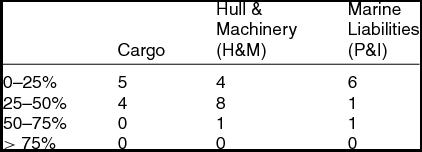
Unsurprisingly, 19 firms said they imposed a higher deductible on Arctic shipping contracts – one mentioned up to 150000 $ for HandM, the value of which depends also of the perceived risk for every voyage. Premium differentials, when disclosed (several declined answering this particular question), appear not to be very high (see Table 2).
Average additional premiums for Arctic shipping, by category of insurance contract.
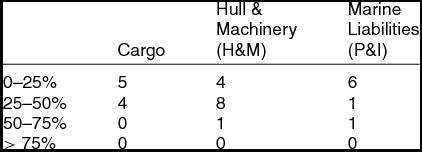
It appears that responding firms demand premiums that are generally inferior to 50% of the regular shipping contract fees. Only one firm said it would demand between 50 and 75% premiums for HandM, and one for PandI protection. Six firms limited their premiums to 25% for PandI, whereas 8 said they would ask for premiums between 25 and 50% for HandM. We therefore do not witness dramatic price increases for Arctic shipping insurance according to this survey. Of course, this pricing policy reflects the fact that a majority of shipping companies offering service in the Arctic now are not newcomers and have gathered experience and credibility in the eyes of insurance firms. It appears that insurance firms can afford to limit premiums because:
Risk assessment has been going on for the past decade and actuaries now have a better view of the nature, probabilities and cost of the risks, although the process is not over.
They ask for a higher deductible.
They severely screen shipping firms before selling insurance protection. By eliminating firms that are considered too risky, they thus reduce their own financial risk and can afford reduced premiums for shipping firms that do comply with their requirements.
From this, two sets of risks may be envisaged. Some shipping companies, willing to enter the growing Arctic shipping market (mainly destinational), but lacking experience and/or the proper equipment, may be faced by rebuttal from established insurance firms. They might then decide to offer a service anyway. This is for now a theoretical risk since few newcomers are interested in the short term (Lasserre and Pelletier Reference Lasserre and Pelletier2011) but that remains to be assessed, since market pressure could change and lead newcomers to try and enter the Arctic shipping market without proper qualifications if requirements from insurance firms are very high. It would then place a security burden on the coastal state that would have to monitor insurance coverage of incoming ships (mentioned twice in the survey). In Russia, the NSR Administration already demands, among the several criteria required for shipping permission, the proof of insurance for PandI (Magnus Eger Reference Magnus Eger and Østreng2013); a similar demand exists with the Canadian Arctic waters pollution prevention regulations, article 12 (Canada 1978). The question is, as always, regulations enforcement.
New players in the insurance sector might also be tempted to enter the market, provide cover to newcomers in the shipping industry with high premiums but low prerequisites, and may lack the technical knowledge or will to assess the risk professionally (mentioned three times in the survey).
Conclusion
The literature on Arctic shipping does underline the fact that insurance costs and requirements are important management dimensions in determining the profitability of commercial shipping along these new routes. However, there was uncertainty regarding practices and price levels. It turns out that insurance coverage for Arctic shipping does not appear to be as expensive as many authors thought; however, insurance companies are demanding and impose on their would-be customers severe requests that indirectly increase the cost of Arctic shipping services. Complying with these demands, besides the insurance premiums, probably represents an important cost for newcomers to the market of Arctic shipping.
Since Arctic shipping was a very marginal market, most insurance firms did not have standard procedures to evaluate risk. As the market is expanding, although it remains small, a growing number of insurance firms brace with the issue of defining risks and premiums, and gradually harmonise their policies. The review of the literature and the analysis of practice by insurance firms underline the weight the 2002 Guidelines for ships operating in Arctic ice-covered waters already have, despite their being recommendations. Insurance firms oriented the work of the IACS in designing a unified set of naval requirements for Arctic shipping, as well as the gradual clarification and harmonisation of insurance criteria and risk-assessment methods.
Acknowledgements
This research was funded by the Canadian Social Sciences and Humanities Research Council (SSHRC), the Fonds québécois de Recherche Société et Culture (FQRSC) and ArcticNet.
Annex 1. Insurance firms that responded to our survey
Alandia, Allianz Global Corporate & Speciality, American Club, American Institute of Marine Underwriters, AON Risk Services, Arch Insurance, AXIS Insurance, Berkshire Insurance, Chartis, Chubb, CNA, GAN Eurocourtage, GroupamaGard AS, Great American Insurance, Markel International, Møretrygd, Norwegian Hull Club, Osborne & Lange, Shipowners Mutual P&I Assoc, Skuld, Swedish Insurance Service, ABSwiss Re international, Travelers, Willis, Zurich Insurance Group