Introduction
Children's acquisition and use of terms expressing non-factual, subjective information, terms that refer to how people think, feel, or take a stance have long been of interest in psychology because these accomplishments are evidence that the children have achieved a hallmark of human cognition: the understanding that language is not only referential, but multi-functional (Halliday & Mathiessen, Reference Halliday and Mathiessen2004; Jakobson, Reference Jakobson1975), and because evaluating is an inescapable human activity, reflected constantly in language use (Shiro, Reference Shiro, McCabe, Bailey and Melzi2008; Voloshinov, Reference Voloshinov1973). Evaluative language serves as a means to convey the participants’ point of view and attitude, by referring to the participants’ internal worlds in the interaction (Shatz, Wellman, & Silber, Reference Shatz, Wellman and Silber1983; Taumoepeau & Ruffman, Reference Taumoepeau and Ruffman2006). According to Thompson and Hunston (Reference Thompson, Hunston, Hunston and Thompson2001), lexis is an important resource used for evaluationFootnote 1 and, as such, the initial achievement of a vocabulary of evaluative terms is significant because it enables children to participate on the interpersonal level of the interaction (Halliday & Mathiessen, Reference Halliday and Mathiessen2004; Wellman & Lagattuta, Reference Wellman and Lagattuta2004). Acquisition and use of evaluative terms, in particular reference to internal states, are also related to the emergence of theory of mind (Astington & Jenkins, Reference Astington and Jenkins1999; Harris, de Rosnay, & Pons, Reference Harris, de Rosnay and Pons2005; Peskin & Astington, Reference Peskin and Astington2004) and to subsequent academic achievement (Degotardi & Torr, Reference Degotardi and Torr2007; Wellman & Lagattuta, Reference Wellman and Lagattuta2004).
Bilingual children's acquisition and use of evaluative terms are relatively unstudied, although they provide an interesting domain in which to address broader questions about the relation between vocabulary development and language use in bilingual children, and about the role of culture in shaping both. Cross-cultural studies have shown that terms expressing internal states vary greatly from one culture to another (Altarriba, Reference Altarriba2003; Besemeres, Reference Besemeres2004; Pavlenko, Reference Pavlenko2002; Wierzbicka, Reference Wierzbicka1999). Children's early vocabularies tend to be made up mostly of concrete nouns, action verbs, modifiers, and words that serve social functions (Caselli et al., Reference Caselli, Bates, Casadio, Fenson, Fenson, Sanderl and Weir1995; Clark, Reference Clark1993; Nelson, Reference Nelson2014; Pine, Lieven, & Rowland, Reference Pine, Lieven and Rowland1996; Tardif, Gelman, & Xu, Reference Tardif, Gelman and Xu1999). The vocabulary used for evaluative language emerges later (Bretherton & Beeghly, Reference Bretherton and Beeghly1982; Dunn, Brown, & Beardsall, Reference Dunn, Brown and Beardsall1991; Shatz et al., Reference Shatz, Wellman and Silber1983), as documented in monolingual children, but little is known about how it develops in bilingual children.
In addition to the challenge of learning two languages that applies across linguistic domains and semantic fields, learning two evaluative lexicons may be particularly challenging because the two lexicons map onto two non-identical sets of meanings. Cross-linguistic studies show that certain internal state words do not have equivalents in another language, and when they do, their meaning does not refer to the exact same experience or state. For example, while the Spanish word perro has very similar intension and extension as the English word dog, the same is not reliably the case for words that refer to internal states: the Spanish word cariño, for instance, has no exact translation equivalent in English (Altarriba, Reference Altarriba2003). Similarly, as Wierzbicka (Reference Wierzbicka1999) and Besemeres (Reference Besemeres2004) point out, even seemingly equivalent internal state terms may mean different things. For example, anger may be equivalent to ira, enojo, enfado, but It makes me angry that you haven't called, could be translated as Me da rabia que no me has llamado, even though rabia can be translated as rage or fury, which refers to a stronger feeling. Thus, the internal state lexicons of monolingual and bilingual children may differ, reflecting cultural differences between particular monolingual and bilingual populations. Pavlenko (Reference Pavlenko2008) points out that:
Some languages, such as Chewong in Malaysia, have but seven emotion words […], others, such as Malay, Indonesian, Filipino, and German, contain about 230–250 emotion words […]. Dutch emotion lexicon was shown to have 1,500 words […] and English more than 2,000, with 1000–1,200 words regularly used by its speakers. (Pavlenko, Reference Pavlenko2008, p. 147)Footnote 2
The acquisition and use of evaluative vocabulary form a domain in which to ask whether cultural differences are reflected in the vocabularies or conversations about internal states that bilingual children have. How do bilingual children, who are also bicultural, differ from monolingual (and monocultural) children in the types of evaluative terms they acquire or the types of internal states they refer to in their speech? This question takes a particularly interesting form in circumstances like those in South Florida, where the children in Spanish–English bilingual homes have parents who migrated from different Latin American countries, in many cases, each parent from a different country. The result, thus, is that the children are exposed to a cultural mix (Dumitrescu, Reference Dumitrescu2015), in which elements of different cultures are combined.
In view of the above, the aim of the present study was to explore the emerging evaluative lexicons of bilingual children as they are used in spontaneous conversation and to ask how they compare with the evaluative lexicons of monolingual children used in similar situations. For the purposes of our study, we define evaluative terms as those referring to cognition, volition, or emotion (Shiro, Reference Shiro, Perera, Aparici, Rosado and Salas2016; Shiro, Hoff, & Shanks, Reference Shiro M., & Shanks, Rojas and Oropeza2018). We address these questions here with data from the spontaneous speech of 30-month-old Spanish–English bilingual and English monolingual children. We begin by reviewing the literature that informs the present study on the development of evaluative lexicons in monolingual English- and Spanish-speaking children and on vocabulary development in bilingual children.
The development of vocabulary in bilingual children
From at least the age of 30 months, bilingual children differ from monolingual children in the size of their single language vocabularies. Children who are simultaneously acquiring two languages have smaller vocabularies in each of those languages than do children acquiring only one language, with the degree of difference depending on the quantity and quality of their exposure to each language (Hammer, Hoff, Uchikoshi, Gillanders, Castro, & Sandilos, Reference Hammer, Hoff, Uchikoshi, Gillanders, Castro and Sandilos2014; Hoff, Core, Place, Rumiche, Señor, & Parra, Reference Hoff, Core, Place, Rumiche, Señor and Parra2012; Marchman, Fernald, & Hurtado, Reference Marchman, Fernald and Hurtado2010; Oller, Pearson, & Cobo-Lewis, Reference Oller, Pearson and Cobo-Lewis2007; Pearson, Fernández, & Oller, Reference Pearson, Fernández and Oller1993, Reference Pearson, Fernández and Oller1995; Place & Hoff, Reference Place and Hoff2016; Silvén, Voeten, Kouvo, & Lundén, Reference Silvén, Voeten, Kouvo and Lundén2014; Vagh, Pan, & Mancilla-Martinez, Reference Vagh, Pan and Mancilla-Martinez2009). When bilingual children's total or conceptual vocabularies are counted, thus including lexical items from both languages, bilingual children's vocabularies are equal to or greater than monolingual children's vocabularies (Core, Hoff, Rumiche, & Señor, Reference Core, Hoff, Rumiche and Señor2013; Hoff et al., Reference Hoff, Core, Place, Rumiche, Señor and Parra2012). In contrast to the large literature on the size of bilingual children's lexicons, there is little work that has addressed whether bilingual children differ from monolingual children in the content of their lexical inventories. Conboy and Thal (Reference Conboy and Thal2006) found that Spanish–English bilingual children looked very similar in both languages to monolingual children in vocabulary composition, where the categories of vocabulary items were social function terms, nouns, predicates, and closed-class terms.
In the present study we ask whether Spanish–English bilingual children differ from English monolingual children in the size of a semantically defined category – evaluative terms – and in the composition of their evaluative lexicons across the semantically defined categories of terms referring to cognition, volition, or emotion. As mentioned earlier, acquiring two vocabularies to refer to internal states may be a particularly challenging aspect of bilingual development because in this domain the two lexicons map onto two non-identical sets of meanings. If bilingual children hear different types of evaluative terms from Spanish and English speakers, their Spanish and English evaluative lexicons may be composed of different words. Among the very few studies on bilingual use of internal state words in spontaneous conversations, Fusté-Herrmann, Silliman, Bahr, Fasnacht, and Federico (Reference Fusté-Herrmann, Silliman, Bahr, Fasnacht and Federico2006) have found that the narratives produced in Spanish by nine- to eleven-year-old Spanish monolingual and Spanish–English bilinguals contain fewer internal state verbs than the narratives produced by English monolinguals of the same age, although the distribution of verbs across semantic domains was similar. In both English and Spanish narratives, experiential verbs (referring to perceptions, emotions, and physiological reactions) were most frequent, followed by motivational verbs (referring to desire, need, and intentionality), and belief verbs (referring to cognitive and verbal activities), which were the least frequent (Fusté-Herrmann et al., Reference Fusté-Herrmann, Silliman, Bahr, Fasnacht and Federico2006).
A previous study (Shiro, Reference Shiro, Perera, Aparici, Rosado and Salas2016) of mothers’ speech in the same conversations analyzed here found that the use of evaluative terms differed between the Spanish–English bilingual mothers whose native language is Spanish, and English monolingual mothers. In child-directed speech, the bilingual mothers referred more to emotions in both English and Spanish, but less to volition and cognition, than the English monolingual mothers (Shiro, Reference Shiro, Perera, Aparici, Rosado and Salas2016). Another study of Spanish–English bilingual adults’ narratives (Schrauf & Durazo-Arvizu, Reference Schrauf, Durazo-Arvizu and Pavlenko2006) found that bilinguals express more emotion when narrating memories in English than when they narrate in Spanish, implying that there may be within-subject differences in how bilingual speakers refer to internal states in each language.
Evaluative lexis in monolingual English- and Spanish-speaking children
Studies on the development of evaluative lexis (mostly referred to as internal state lexis) in typically developing English-speaking children report that children begin to talk about desire around 18 months; want is an early and frequently used term (Bartsch & Wellman, Reference Bartsch and Wellman1995). Reference to emotions in the speech of 18-month-olds has also been reported (Bartsch & Wellman, Reference Bartsch and Wellman1995; Dunn, Bretherton, & Munn, Reference Dunn, Bretherton and Munn1987; Ridgeway, Waters, & Kuczaj, Reference Ridgeway, Waters and Kuczaj1985). Talk about cognitive states – believing and knowing – appears later but is present in children's speech before the age of three years (Bartsch & Wellman, Reference Bartsch and Wellman1995; Harris, Reference Harris1989; Hoff-Ginsberg, Reference Hoff-Ginsberg1997; Nelson, Reference Nelson2014; Shatz et al., Reference Shatz, Wellman and Silber1983), although not all uses of internal state terms necessarily reflect true understanding of internal states (Shatz et al., Reference Shatz, Wellman and Silber1983).
There are few studies of internal state talk in Spanish-speaking children. One study reports that reference to desire using querer ‘want’ appears at the age of two years and increases in frequency between two and three years (Ferres, Reference Ferres2003). Other studies report that querer and saber ‘know’ are used by three- to five-year-old children (Pascual, Aguado, Sotillo, & Masdeu, Reference Pascual, Aguado, Sotillo and Masdeu2008), and that words referring to emotion and volition are among the first internal state words used by two-year-olds, with words referring to other internal states, including cognitive states, appearing later (Alarcón Neve, Reference Alarcón Neve and Barriga Villanueva2014; Bocaz, Reference Bocaz1996). In sum, the research on monolingual children acquiring English and Spanish finds for both languages that reference to internal states begins around the age of two, and that talk about emotions and desires precedes talk about cognitive states. However, these studies did not directly compare the composition of English- and Spanish-speaking children's evaluative lexicons.
Research on English- and Spanish-speaking monolingual adults (Altarriba, Reference Altarriba2003; Goddard & Wierzbicka, Reference Goddard and Wierzbicka2014; Wierzbicka, Reference Wierzbicka1999) has found differences in how they talk about internal states, which raises the possibility that there are cultural differences in how English and Spanish speakers use these terms, including when they talk to children. However, the literature is too sparse to yield any clear predictions with respect to how children's vocabularies might differ as a result.
This summary of the development of evaluative terms in children acquiring Spanish and in children acquiring English suggests that the acquisition and use of these terms is well under way, but still in progress, between the ages of two and three years. That makes this age a potentially informative developmental period for investigating individual and group differences in evaluative lexical items, because children will neither be at zero nor at asymptote in their development in this domain.
The present study
In the present study we catalog the English and Spanish evaluative lexicons used by 30-month-old children based on transcripts of 26 monolingual English-speaking children, each recorded in 30 minutes of interaction with a parent, and 20 Spanish–English bilingual children, each recorded in 30 minutes of interaction with a bilingual parent under the instruction to speak English, and 30 minutes of interaction under the instruction to speak Spanish. We then address the following questions about the size, composition, and use of evaluative words by 30-month-old English monolingual and Spanish–English bilingual children:
1. What is the size and semantic content of evaluative lexis, as evidenced in spontaneous speech for the monolingual children in English and for the bilingual children in English and Spanish?
2. How many different evaluative words (types) do bilingual children use in English-designated conversations and in Spanish-designated conversations, overall and by semantic category, and how does that compare to the number of different evaluative words used by English-speaking monolingual children?
3. How frequently do bilingual children use evaluative words (tokens) in English-designated and in Spanish-designated conversations, overall and by semantic category, and how does that compare to the frequency of evaluative words used by the monolingual children?
Method
Participants
The participants were 20 monolingual English children and 25 Spanish–English bilingually developing children all participating close to the age of 30 months (see Table 1 for mean ages and standard deviation). These children were participants in a larger, ongoing study of language development in English monolingual and Spanish–English bilingual children. The children in the present study were all the monolingual and bilingual children in the larger study for whom video-recordings of mother–child interaction at 30 months were available.
Participant characteristics

Note. The one father who participated in the English interaction with his bilingual child was born in the US and had 14 years of education.
All children were full term and healthy at birth, with normal hearing based on parent report of oto-acoustic emissions tests performed in the hospital. All children were screened for evidence of communicative delay at 30 months. Participants were recruited through advertisements in local magazines and at programs for parents with young children, as well as through word of mouth. All the children were born in the US.
The monolingual participants met the criterion that no language other than English was spoken more than 10% of the time in the home; the bilingual participants met the criterion that both English and Spanish were spoken in the home, with the less-frequently used language constituting at least 10% of the child's exposure, and no other languages were spoken in the home more than 5% of the time. All the bilingual participants had been exposed to English and Spanish from birth and used both languages when speaking with their bilingual parent(s). All families were residents of South Florida, in the US.
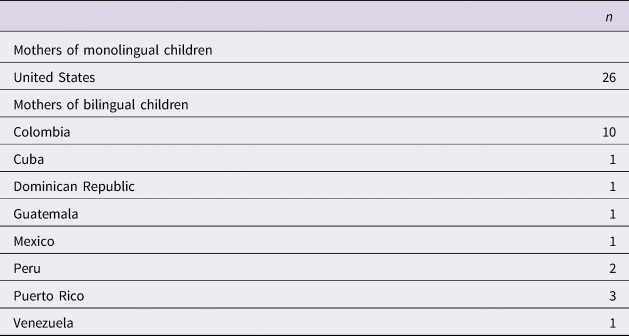
An extensive interview was conducted with each child's primary caregiver to obtain demographic information and information about language use in the home. As part of this interview, caregivers provided estimates of the relative proportion of English and Spanish use in the home. An adult family member completed the MacArthur Bates Communicative Development Inventory (CDI; Fenson, Dale, Reznick, & Bates, Reference Fenson, Dale, Reznick and Bates1994) and El Inventario de Desarrollo de Habilidades Comunicativas (IDHC; Jackson-Maldonado, Thal, Fenson, Marchman, Newton, & Conboy, Reference Jackson-Maldonado, Thal, Fenson, Marchman, Newton and Conboy2003), yielding measures of the children's English and Spanish productive vocabularies. Participant characteristics are described in Tables 1 and 2. Particularly relevant to the present study are the following descriptive facts: (1) the bilingual children's home language exposure was, on average, Spanish dominant; (2) the children were, on average, fairly balanced in their English and Spanish vocabulary scores; the bilingual children's English CDI scores were non-significantly higher than their Spanish IDHC scores (p = .76); and (3) the monolingual English children had substantially higher English scores than the bilingual children (t(45) = 5.436, p < .001). The bilingual children's total scores, combining English and Spanish, were not different from the monolingual children's English scores (p = .94), as is often found in young simultaneous bilingual children (Hoff et al., Reference Hoff, Core, Place, Rumiche, Señor and Parra2012; Pearson et al., Reference Pearson, Fernández and Oller1993).
Parents’ native countries

Data collection procedure
Children were recorded in toy play and book-reading with a parent during 30-minute play sessions consisting of three 10-minute interactions, each with a different examiner-provided set of materials: (1) miniature animals and props to build an outdoor scene; (2) pretend picnic toys; and (3) age-appropriate books. The researcher cued the parents when it was time to switch to the next set of toys or books. The fact that both monolingual and bilingual mother–child dyads interacted in these three very similar contexts enabled us to compare their spontaneous conversations. Furthermore, we did not assume that these three contexts were particularly prone to elicit talk about internal states or evaluative language, and for this reason we considered that the speech produced would be culturally neutral and therefore more ecologically valid. The bilingual children were recorded under the instruction to speak only Spanish or to speak only English on different days, in counterbalanced order. On the Spanish day, the parent and child were told that hoy es el día en español; entonces, vamos a hablar solo en español ‘today is a Spanish day; we are going to speak only in Spanish’, and similarly for the English day. All children, but one, were recorded in Spanish and English with the same native Spanish and Spanish–English bilingual parent (always the mother). These mothers all reported that they interacted with their children in both languages on a regular basis. One child was recorded interacting in Spanish with his native Spanish-speaking mother, and in English with his US-born father. All English monolingual children were recorded in interaction with their native English-speaking mother.
Transcription
The video-recorded interactions were transcribed in the CHAT format used by the CHILDES system (MacWhinney, Reference MacWhinney2000) by trained research assistants. Native Spanish speakers who were also fluent in English transcribed the Spanish-designated conversations; native English speakers transcribed the English-designated conversations with assistance from Spanish speakers for the code-switched utterances. In the transcripts, each utterance was coded as English, Spanish, or Mixed. Any utterance not entirely English or Spanish was coded as Mixed. Utterances that were solely proper nouns, animal sounds, or unintelligible were not coded for language nor analyzed. Utterances to or from individuals other than the mother and target child were also excluded. All transcribers were trained until their transcripts achieved 90% agreement with a standard on a line-by-line basis for utterance boundaries and language assignment of utterances (English, Spanish, or Mixed), and on the particular words appearing in the transcript, using the FREQ output, which lists all word tokens produced.
Identifying evaluative lexis
Our approach to identifying the evaluative lexical items in the children's speech is based on a combination of theories of word meaning including relational semantics (Lyons, Reference Lyons1977), conceptual space (Gärdenfors, Reference Gärdenfors2004), and prototypical theory (Rosch, Reference Rosch1975). Within such a framework we consider that word meaning is multilayered. For the purposes of our study we intend to define evaluative words used for non-factual, expressive language (Thompson & Hunston, Reference Thompson, Hunston, Hunston and Thompson2001), words that express subjectivity as they have an attitudinal meaning (Shiro, Reference Shiro2007, Reference Shiro, McCabe, Bailey and Melzi2008, Reference Shiro, Perera, Aparici, Rosado and Salas2016; Shiro et al., Reference Shiro M., & Shanks, Rojas and Oropeza2018). They can be grouped into three categories, related to three semantic fields or conceptual spaces: (i) cognition words, associated with mental processes, perception, thinking, speaking, understanding; (ii) volition words, associated with intentions, wishes, desires; and (iii) emotion words, associated with feelings, emotions, pleasure, likes, or dislikes. Most studies in this field focus on internal state words which are related to these three semantic fields, but they narrow down the selection of words to only those lexemes that directly refer to internal states. They also tend to add some morphological criteria, as many studies choose to examine only a certain word class (mostly verbs), excluding other classes such as nouns, adjectives, or modals. We adopted a broader approach for several reasons:
1. The boundaries of all semantic fields are fuzzy, but those of evaluative lexis are even less clear-cut, as their meaning is less referential than that of concrete nouns, for example (Hall & Nagy, Reference Hall and Nagy1987).
2. As the large body of work on cross-linguistic comparisons shows us, the semantic fields of attitudinal meaning are built differently in different languages. Working with bilingual children, a broader definition of the semantic field enabled us to limit the bias towards one or the other language by including lexical items that may exist in one language but not in the other (e.g., cariño in Spanish has no equivalent in English; Altarriba, Reference Altarriba2003). Similarly, focusing only on internal state verbs would be counterproductive because equivalent meanings are often expressed with different word classes in each language (e.g., Phantoms are scary would translate as Los fantasmas asustan or Los fantasmas dan miedo where scary is an adjective, asustan is a verb, and miedo is a noun).
3. The list of evaluative words that we present is a product of our study. We did not proceed by choosing beforehand the list of words we were going to analyze. We extracted all the lexical items produced by the children and from these words, we selected those which carried attitudinal meaning and were related to the semantic fields of cognition, volition, and emotion. We understand that some words may be more prototypical within a category (Rosch, Reference Rosch1975) than others, but the criterion of prototypicality could not be applied in the same way in the two languages we were working with, given that a prototypical evaluative term in one language may not be prototypical in the other (e.g., nice in English or cariño in Spanish).
4. Adapting Pavlenko's (Reference Pavlenko2008, p. 148) functional approach to emotion words, we define evaluative words in three ways:
i. Evaluative words: directly referring to the internal states of cognition (know), volition (want), or emotion (happy).
ii. Evaluation-related words: related to cognition (study), volition (try), or emotion (laughter).
iii. Evaluation-laden words: having a connotation related to cognition (seem), volition (going to + verb), or emotion (monster).
5. We decided not to use elicitation contexts specifically aimed at producing evaluative language. To avoid cultural bias, we opted for neutral contexts (free play and book-reading) as we assume that evaluative words are used in any spontaneous conversations and we were interested in detecting how this use played out at an early age, when evaluative words are only starting to emerge. The fact that we found a relatively high number of words in this sample is an unexpected finding in our study.
6. In reference to the multiple meaning of words when used in context (as in the case of mira in Spanish, or know in English, for example), our purpose in this study was to record the lexical items belonging to these semantic fields and not to delve into what could be considered their pragmatic meaning, i.e., the meaning in context, which would require a different kind of study with a different coding system.Footnote 3
In view of the above, we defined the three semantic categories in our study as follows:
a. Cognition: reference to belief, (un)certainty, perceptions, mental, and verbal processes: e.g., creo/think, veo/see, olvido/forget, pregunto/ask, etc.
b. Volition: reference to intentions, desires, wishes, promises: e.g., quiero/want, necesidad/need, promesa/promise, etc.
c. Emotions: reference to psychological states, feelings, physical states, (dis)likes: e.g., triste/sad, cansado/tired, bonito/nice, terms of endearment (hijito/babe), etc.
Using CLAN (MacWhinney, Reference MacWhinney2000), we extracted all the words in each transcript with their respective frequencies of occurrence. The first and third authors worked through the list of all the words produced by the monolingual group and the list of all the words produced by the bilingual group, in English or in Spanish, until consensus was reached in identifying those words, in each list, that fit the definition for evaluative terms. Both researchers are proficient Spanish–English bilinguals and participated in extended discussions and training previous to the final selection of words. Subcategorization of these terms as cognition, volition, or emotion terms was separately done on 20% of the transcripts. Reliability measured as Cohen's kappa = .91. To mitigate the effects of cross-linguistic differences in the richness of morphology, we identified word types ignoring inflectional and derivational morphology, including irregular forms. Thus, think, thinking, and thoughts were counted as instances of a single evaluative word type.
Measures of children's evaluative lexicons
We quantified children's evaluative lexicons and their use with three different transcript-based measures:
1. The size and composition of the internal state lexicons: As a measure of the size of the children's evaluative lexicons in the semantic categories of cognition, volition, and emotion, we counted all the evaluative word types they produced. For the bilingual children, we counted all the English evaluative word types and all the Spanish evaluative word types the children produced, regardless of the conversation in which they produced them.
2. The diversity of the internal state vocabularies (types) in conversation: As a measure of the diversity of the evaluative vocabulary the children used in conversation, we counted the number of cognition, volition, and emotion word types used in conversation. This measure is identical to the previous lexicon size measure for the monolingual children. For the bilingual children, it is different because lexical diversity in each conversation was calculated, including all code-switched words. Thus, each bilingual child has a measure of the number of different word types used in the English-designated conversation and a measure of the number of different word types used in the Spanish-designated conversation, regardless of the language of the word.
3. Amount of evaluative talk in conversation (tokens): As a measure of the amount of evaluative language in childreńs speech, we counted the number of cognition, volition, and emotion word tokens used in conversation. This measure was a count of evaluative word tokens produced, regardless of language for the bilingual children, in each conversation. To control for differences in the amount of talk, this measure was expressed as a percentage of the total number of tokens produced.
In the analyses of bilingual children's language use in conversation ((2) and (3) above), we included all evaluative terms the children produced regardless of language because the purpose of these measures was to capture the richness and frequency of evaluative terms that characterized bilingual children's conversations with their caregivers. In the bilingual community in which these participants lived, code-switching is characteristic of bilingual language use (Toribio, Reference Toribio and Diaz-Campos2011) and thus code-switched utterances must be included to characterize the nature of conversations.
Data analyses
For each measure of the bilingual children's evaluative vocabularies and their use in conversation we made two comparisons to the monolingual children's evaluative vocabularies and use, one comparing the bilingual children's vocabulary in English or language use in the English-designated conversation to the monolinguals’ (English) vocabulary or use and one comparing the bilingual children's vocabulary in Spanish or language use in the Spanish-designated conversation to the monolinguals’ (English) vocabulary or language use. Each of these comparisons was accomplished with a 2 (Language Status) × 3 (Semantic Category) ANCOVA. In all ANCOVAs, the children's MacArthur-Bates inventory score in the outcome language was entered as a covariate, so that any differences in evaluative lexis that we observed were not merely reflections of overall differences in the size of the children's vocabularies. Additionally, in comparing the number of evaluative word types used in conversation, we removed the variance in the total number of word tokens in the conversations. Significant interactions between children's monolingual or bilingual status and semantic domain were followed by univariate ANCOVAs asking in which semantic domain or domains the monolingual and bilingual children differed.
Results
The database
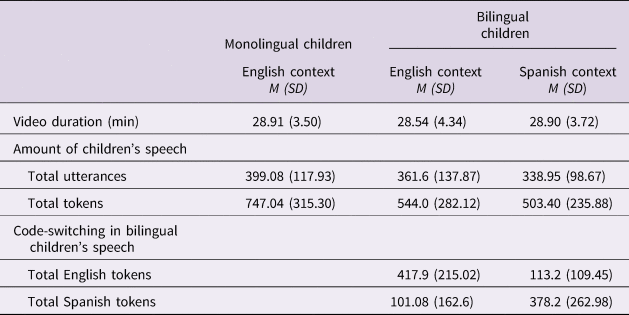
In this section we describe the speech sample used for this study. Table 3 summarizes properties of the transcripts that provided the data for the present analyses. The three types of interactions – monolingual children in the English context, bilingual children in the English context, and bilingual children in the Spanish context – did not differ in duration or in the number of utterances the children produced. There was a significant difference between the monolingual and bilingual children in the overall number of words (tokens) produced in the English contexts (even including in the count the Spanish words that the bilingual children produced in the English context; t(44) = 2.2.27, p = .029) as well as in the overall number of tokens produced in the Spanish conversations (even including the bilinguals’ English words; t(44) = 2.89, p = .006). There was substantial code-switching by the bilingual children in both the English and Spanish contexts. The mothers largely complied with the instruction to speak only English or to speak only Spanish. The children were not so compliant. The bilingual parents produced a mean 3.06 (SD = 2.40) percent of Spanish tokens in the English conversations, and a mean 1.95 (SD = 1.74) percent of English tokens in the Spanish conversations. In contrast, the bilingual children produced a mean 18.01 (SD = 18.59) percent of Spanish tokens in the English conversation, and in the Spanish context they produced a mean 27.26 (SD = 21.63) percent of English tokens. Given this high proportion of code-switching in the children's speech, we expected that code-switched evaluative words would also be high.
Properties of monolingual children's English conversations and bilingual children's conversations in English and Spanish conversational contexts

The lexical inventories
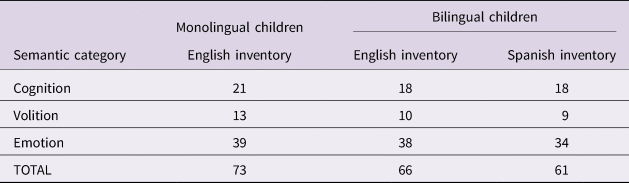
Prior to comparing the bilingual and monolingual children's use of evaluative terms, we describe the total inventories of the evaluative words used by these two groups of 30-month-old children. Table 4 presents the total number of word types in the evaluative lexical inventories by semantic category in English, based on transcripts of all the monolingual children's conversations, and in English and Spanish, based on both conversations recorded and transcribed for the bilingual children. Descriptively, we see that these 30-month-old children made use of an inventory of over 60 evaluative word types in each language. Emotion was the largest single category, followed by cognition and volition. The itemized inventory of evaluative word types used by this group of monolingual and bilingual 30-month-olds is listed in Appendices A, B, and C.
Number of all different evaluative words in English and Spanish used by monolingual and bilingual children as a group

The size and composition of the evaluative lexicons
The mean number of evaluative terms in the English lexicons of the monolingual children and in the English and Spanish lexicons of the bilingual children are presented, by semantic category, in Figure 1. We asked if the monolingual and bilingual children differed in the size and content of their English evaluative lexicons with a 2 (Language Status) × 3 (Semantic Category) mixed ANCOVA with Language Status (monolingual, bilingual) as a between-subjects variable, Semantic Category (cognition, volition, emotion) as a within-subjects variable, CDI score as a covariate, and number of evaluative word types in the children's English lexicons as the outcome measure. There was no main effect of Language Status or of Semantic Category. There was a significant Language Status × Semantic Category interaction (F(2,86) = 4.34, p = .016, η 2 = .09). Univariate comparisons of the monolingual and bilingual children's English vocabularies within each semantic category (removing the effects of CDI score) indicated that the monolingual children had significantly larger lexical inventories only in the domain of volition (F(1,43) = 9.30, p = .004, η 2 = .178).
Mean size of evaluative lexicons by semantic category. Error bars represent 1 standard error.

We conducted a similar analysis, comparing monolingual children's English evaluative lexicon with bilinguals’ Spanish evaluative lexicon. There was a significant main effect of Language Status (F(1,43) = 5.47, p = .024, η 2 = .113); the monolinguals’ English evaluative lexicons were larger than the bilinguals’ Spanish evaluative lexicons, even controlling for differences in overall English and Spanish vocabularies between the two groups. There was no significant effect of Semantic Category. There was a significant Language Status × Semantic Category interaction (F(2,86) = 4.57, p = .014, η 2 = .094). Univariate comparisons of the monolingual children's English evaluative lexicons to the bilingual children's Spanish evaluative lexicons within each semantic category (removing the effects of the monolinguals’ CDI scores and the bilinguals’ IDHC scores) indicated that the monolingual children had significantly larger inventories in the categories of cognition (F(1,43) = 5.73, p = .021, η 2 = .118) and volition (F(1,43) = 10.11, p = .003, η 2 = .190). There was no significant difference between the size of the monolinguals’ English and the bilinguals’ Spanish vocabularies of emotion terms, when overall vocabulary score was held constant.
In sum, the monolinguals did not differ from the bilinguals in the size of their English evaluative lexicons, when differences in overall vocabulary size were held constant, but the monolinguals did have significantly larger evaluative lexicons than the bilinguals did in Spanish. There were also differences between the monolinguals and bilinguals in the distribution of evaluative terms among the three semantic categories; the English monolingual children had more terms for expressing volition than did the bilingual children in English, and more terms for expressing both cognition and volition than did the bilingual children in Spanish. Monolinguals did not differ from bilinguals in either language in the size of their vocabularies for expressing emotion, holding overall vocabulary constant.
The diversity of the internal state vocabularies (types) in conversation
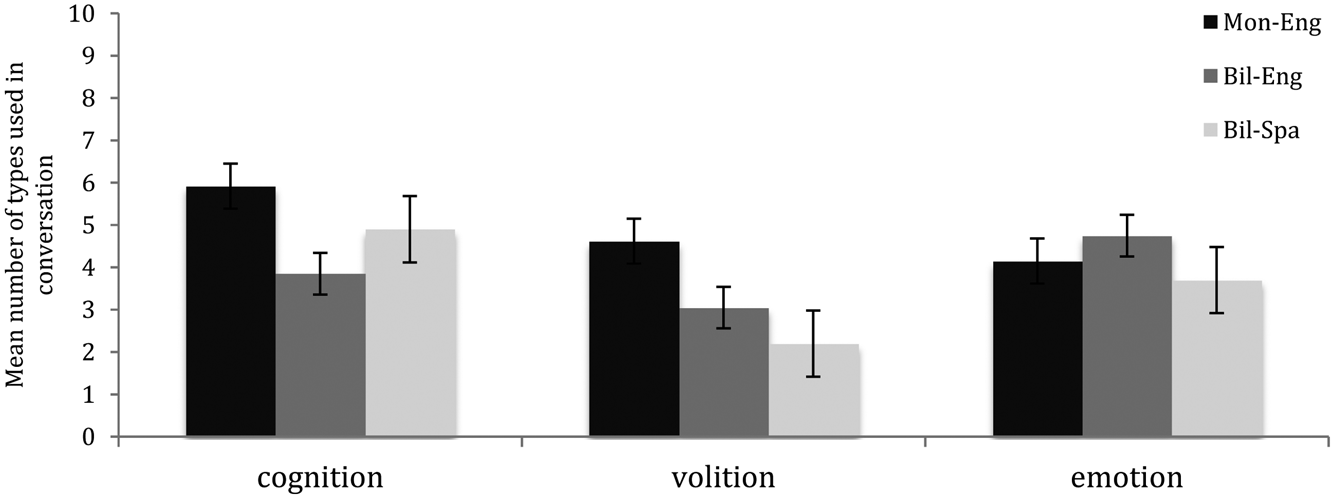
In this section we report how monolingual and bilingual children differed in the diversity of the evaluative lexis they used in their 30-minute conversations. The mean number of evaluative word types used by the monolingual children in their English conversations and by the bilingual children in their English and Spanish conversations is plotted for each semantic category in Figure 2.
Mean number of evaluative word types produced in conversations, by semantic category. Error bars represent 1 standard error.

A 2 (Language Status) × 3 (Semantic Category) mixed ANCOVA with Language Status (monolingual, bilingual) as a between-subjects variable, Semantic Category (cognition, volition, emotion) as a within-subjects variable, CDI score and total number of tokens in the conversation as covariates, and number of evaluative word types in the English conversation as the outcome measure indicated no significant main effect of Language Status and no significant main effect of Semantic Category. There was a significant Language Status × Semantic Category interaction (F(2,84) = 4.82, p = .010, η 2 = .103). Univariate comparisons, retaining both covariates, indicated that the monolingual children used a more diverse vocabulary of evaluative terms in the category of volition terms only (F(1,42) = 4.36, p = .043, η 2 = .094) when overall vocabulary score was held constant.
We conducted a similar analysis comparing the number of evaluative word types children used in the monolinguals’ English and the bilinguals’ Spanish conversations, removing the variance attributable to children's CDI and IDHC scores, respectively, and removing the variance attributable to the number of tokens in each conversation. There were no significant main effects of Language Status or Semantic Category. There was a significant Language Status × Semantic Category interaction (F(2,84) = 7.90, p = .001, η 2 = .158). Univariate comparisons of the number of evaluative word types used by the monolingual children in their English conversations and the bilingual children in their Spanish-designated conversations in each semantic category, retaining both covariates, indicated a significant difference in the category of volition only (F(1,42) = 16.80, p < .001, η 2 = .286); the monolingual children used a richer vocabulary of volition terms than the bilingual children did.
In sum, while there were no significant differences in the overall diversity of evaluative terms used by the monolingual and bilingual children in their 30-minute speech samples, there was a significant difference in one semantic category: the English-speaking monolingual children used a more diverse vocabulary of volition terms in their conversations with a parent than did the Spanish–English bilingual children in either their English or Spanish conversations.
Amount of evaluative talk in conversation (tokens)
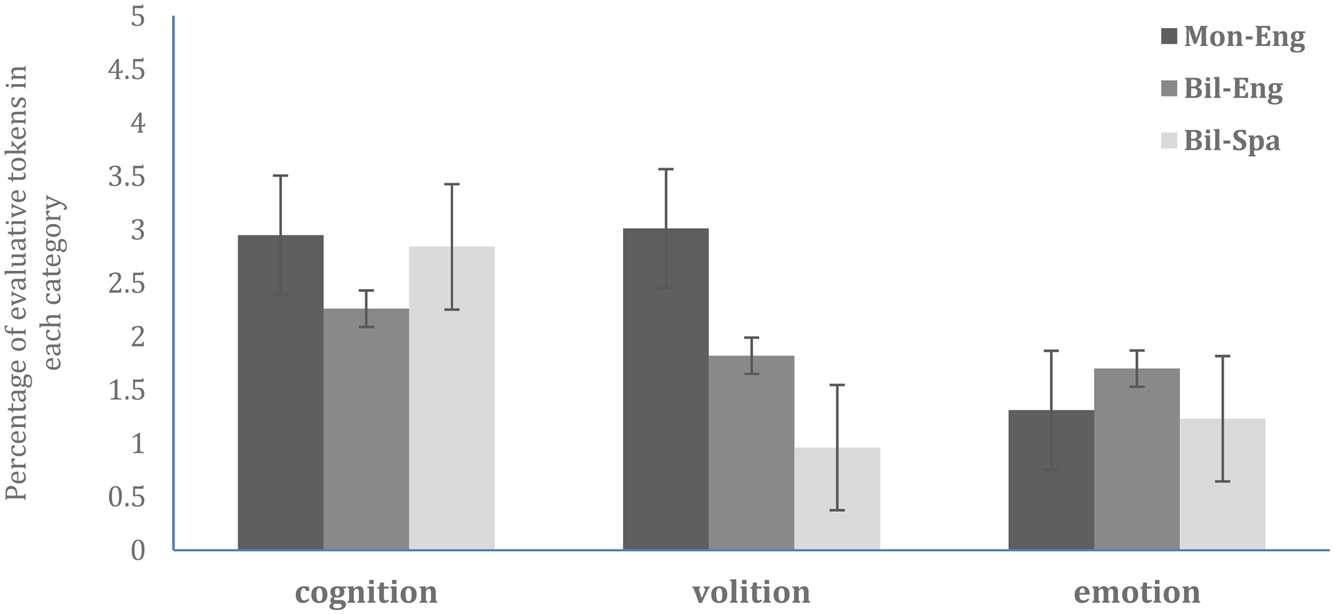
In the next analyses, we asked whether there were differences between the monolingual and bilingual children in how much the children used evaluative language in their speech, using the number of evaluative word tokens produced as the outcome measure. Individual differences among children in the total amount of talk they produced were handled by measuring frequency as a percentage of total tokens produced. On average, children's evaluative words constituted between 5 and 7.7% of the total number of words in the conversation. Figure 3 plots the mean percentages by group and semantic category.
The mean proportion of evaluative word tokens, by semantic category, used in the conversational contexts. Error bars represent 1 standard error.

We asked if the monolingual children differed from the bilingual children in their English-designated conversation in the frequency of use of evaluative terms with a 2 (Language Status) × 3 (Semantic Category) mixed ANCOVA with Language Status (monolingual, bilingual) as a between-subjects variable and Semantic Category (cognition, volition, emotion) as a within-subjects variable, CDI score as a covariate, and percentage of evaluative word tokens as the outcome measure. There was no significant main effect of Language Status. There was a significant main effect of Semantic Category (F(2,86) = 5.93, p = .004, η 2 = .121). There was also a significant Language Status × Semantic Category interaction (F(2,86) = 5.43, p = .006, η 2 = .112). Univariate comparisons within each semantic category between monolingual children and the bilingual children in their English-designated conversations indicated a significant difference in the category of volition terms only (F(1,43) = 5.10, p = .029, η 2 = .106). The English-speaking monolingual children talked more about volition than did the bilingual children in their English conversations. It is worth mentioning that children resorted more frequently to code-switching when using evaluative words than with other types of words. On average, 30% of the evaluative word tokens in the bilinguals’ English designated conversations were in Spanish, whereas only 18% of all the words produced in the conversation were in Spanish.
We conducted a similar analysis, comparing the percentage of word tokens that were tokens of evaluative words between the monolingual English-speaking children in their English conversations and the bilingual children in their Spanish-designated conversations, with vocabulary scores (the monolingual children's English vocabulary and the bilingual children's Spanish vocabulary) as a covariate. There were no significant main effects of Language Status or Semantic Category. There was a significant Language Status × Semantic Category interaction (F(2,86) = 10.39, p < .001, η 2 = .195). Univariate comparisons of the monolingual and bilingual children within each semantic category, retaining the covariate, indicated that the monolingual children talked significantly more about volition in their (English) conversations than their bilingual peers did in their Spanish conversations (F(1,49) = 19.61, p < .001, η 2 = .313). No significant difference was found in the amount of talk about cognition or emotion between the two groups. It is noteworthy again that there was considerably more code-switching of evaluative terms than other words in the Spanish designated conversations, as, on average, 40% of all the evaluative terms were in English, while only 27% of all the words were in English.
In sum, while there was no significant difference in the frequency of use of evaluative terms overall, there was a significant difference in one semantic category: the monolingual children talked more about volition than the bilingual children did in either their English- or Spanish-designated conversations. There were no significant differences between the monolingual and bilingual children in how much they talked about cognition or emotion.
Discussion
The present study identified the words with meanings related to cognition, volition, or emotion used by 30-month-old English monolingual and Spanish–English bilingual children in 30 minutes of parent–child conversation. The purpose was to describe evaluative lexical items and their use by bilingual children at the age when evaluative language is emerging. Given that we had little information about the bilinguals’ emerging evaluative lexicon, we collected comparable spontaneous speech samples from both monolingual and bilingual groups and extracted a list of evaluative words that followed the criteria we mentioned earlier in the paper. Our assumption is that, by doing so, we reduced the risk of cultural bias in favor of either group. Furthermore, we characterized lexical knowledge and use with multiple measures.
Thus, the specific aims of the present study were (1) to identify the inventory of evaluative words that Spanish–English bilingual and English monolingual 30-month-old children use in spontaneous speech; (2) to compare the size and content of monolingual and bilingual children's evaluative vocabulary in parent–child conversation; and (3) to ask whether there are differences in the amount of evaluative words used in interaction, both overall and in each semantic domain, as measured by the proportion of evaluative word tokens produced by English monolingual and Spanish–English bilingual children in conversations with their mothers, as these differences might reflect influences of culture on the uses of evaluation in language. We discuss the findings as they address these aims below.
We found no difference in the measures of evaluative lexicon size, diversity of evaluative terms used in conversation, or frequency of evaluative terms used in conversation, when we compared monolinguals to bilinguals’ English lexicons or language use in English-designated conversations, controlling for differences in their overall vocabulary sizes as assessed via a standardized measure (the MacArthur-Bates inventories). We also found no difference in the diversity or frequency of evaluative terms comparing the bilinguals’ language use in the Spanish-designated conversations to the monolinguals’ English conversations. The only difference we found was that monolingual children had a larger evaluative lexicon than the bilinguals’ Spanish evaluative lexicon.
The fact that there was no language status effect on any of the outcome measures, except for the comparison between the evaluative lexicon in English for the monolingual group and in Spanish for the bilingual group, implies that, when we control for overall vocabulary, 30-month-old monolinguals and bilinguals look very similar in the size and uses of evaluative words. This might seem to suggest that culture has little to do with this type of lexis. However, there was a significant interaction between language status and semantic category for all outcome measures, which suggests just the contrary: 30-month-old monolinguals and bilinguals do not appear similar in the distribution of evaluative words, even after controlling for overall vocabulary. The most outstanding and consistent difference we found is that monolingual children have a larger number of volition words in their lexicon, use more diverse volition words in their interactions, and talk more about volition than their bilingual peers.
As we interpret these findings we should keep in mind that, unlike monolinguals, bilingual children are learning two sets of evaluative words simultaneously. However, they do not use these two sets separately, as in all interactions we found a high percentage of code-switching. In our analyses, we separated (artificially) their English and Spanish evaluative words when we compared their evaluative lexicon size in each language to that of monolinguals. The fact that no major differences were found between monolinguals’ and bilinguals’ overall size and uses of evaluative terms already suggests that 30-month-old Spanish–English bilinguals do not lag behind their monolingual peers in this respect, even though their overall vocabulary, both in English and in Spanish, is smaller than that of monolinguals. Other studies have also found that bilinguals differ from monolinguals in how they develop certain sub-skills (Oller et al., Reference Oller, Pearson and Cobo-Lewis2007, Paradis & Kirova, Reference Paradis and Kirova2014, Peña, Bedore, & Rappazzo, Reference Peña, Bedore and Rappazzo2003). In this case, we observe that bilinguals, who lag behind monolinguals in overall lexical development in each language, show a different profile, more similar to monolinguals, in the development of evaluative vocabulary, particularly in the category of emotion words.
We turn to culture to explain these findings, and child-directed speech is one way of assessing how socio-cultural features are transmitted from generation to generation. A previous study on child-directed speech used with the same population as in this study (Shiro, Reference Shiro, Perera, Aparici, Rosado and Salas2016) found that bilingual mothers (native speakers of Spanish, with an average of 12 years of residence in the US) referred more to emotion and less to cognition and volition than the English monolingual mothers when they interacted with their 30-month-old child in either Spanish or English. Thus, it is possible to assume that these differences are caused by the culturally different child-directed speech to which the children are exposed from early on (Altarriba, Reference Altarriba2003, Reference Altarriba and Pavlenko2006; Dewaele, Reference Dewaele and Pavlenko2006; Pavlenko, Reference Pavlenko2002, Reference Pavlenko2006).
These results are also similar to Fusté-Herrmann et al.'s (Reference Fusté-Herrmann, Silliman, Bahr, Fasnacht and Federico2006) findings in older children: English monolinguals produced significantly more belief verbs (which overlap with cognition words in our study) than bilinguals (and Spanish monolinguals). Furthermore, research in both monolingual English and monolingual Spanish language development finds that young children's most frequent internal state verb is want ‘querer’ (Ferres Reference Ferres2003; Pascual et al., Reference Pascual, Aguado, Sotillo and Masdeu2008). In our study the 30-month-old bilingual children used want/querer Footnote 4 far less frequently than English monolinguals and they used other evaluative words, from a different semantic category, with similar or higher frequencies (e.g., see/look, mira/ve). A qualitative analysis of the particular words used by each group of children and by the bilingual children in each language might shed further light on the linguistic and cultural effects of bilingualism on children's language use.
More broadly, this finding of culture-related differences in the kinds of meanings expressed in parent–child conversation is consistent with other studies (Hall & Nagy, Reference Hall and Nagy1987) and with findings of cultural differences in other domains (e.g., gestures, vocabulary skills; Tamis-LeMonda, Song, Leavell, Kahana-Kalman, & Yoshikawa, Reference Tamis-LeMonda, Song, Leavell, Kahana-Kalman and Yoshikawa2012). The differences in the uses of evaluative words also show that the children exposed to two languages from birth are also exposed to a hybrid cultural experience that is reflected in the ways they develop language in general, and lexical development in particular.
Limitations
In our attempt to address our research questions, we were faced with two challenges. First, vocabulary studies can never give a complete picture of all the words in speakers’ productive lexicon, irrespective of how the data is collected, either as a sample of spontaneous speech, as in our paper, or with other methods. The second difficulty was that, unlike the vast literature on English-speaking children's use of evaluative language and their use of internal state words, little is known about Spanish–English bilingual children's use of evaluative lexis, and even less in the early stages of development. Some studies have used parental report to assess children's lexicons (Bretherton & Beeghly, Reference Bretherton and Beeghly1982, Tamis-LeMonda et al., Reference Tamis-LeMonda, Song, Leavell, Kahana-Kalman and Yoshikawa2012), while other studies have used test situations to examine children's internal state word understanding and production (e.g., de Rosnay, Fink, Begeer, Slaughter, & Peterson, Reference de Rosnay, Fink, Begeer, Slaughter and Peterson2014) A number of studies that have analyzed internal state words in children's language production have focused only on internal state verbs (e.g., Pascual et al., Reference Pascual, Aguado, Sotillo and Masdeu2008; Shatz et al., Reference Shatz, Wellman and Silber1983), and do not account for other word categories that also serve evaluative functions in conversations. Even fewer studies have examined bilingual children's evaluative lexis, given the difficulty of comparing this kind of words in two languages (Fusté-Herrmann et al., Reference Fusté-Herrmann, Silliman, Bahr, Fasnacht and Federico2006). Thus, we consider that the methodological approach that we suggest here, using a broader definition of the semantic field of evaluative lexis and examining children's spontaneous speech with multiple analyses, enables us to better understand how this non-referential lexical domain emerges and how bilinguals can be compared to monolinguals.
In addition to the difficulties with respect to identifying translation equivalents of evaluative terms (which in itself is a sign of how different cultures use these terms), one of the limitations of this approach is that it analyzed these lexical items without their context, and as a result it does not disambiguate the terms with sufficient precision. However, the different senses or connotations that these terms may acquire in context remain mostly in the same domain, as they maintain their evaluative connotation even when acquiring a certain degree of referential meaning (e.g., a kiss, a story). Further research is needed to explore the different functions of evaluative words in language use, and to compare their contextual meanings in monolingual and bilingual children's speech.
Furthermore, we are also aware that the type of activity that prompted the mother–child interaction must have influenced the type of evaluative lexis produced in the conversation. However, controlling for the situational context and making sure that it was similar to what mother and child would do spontaneously at home enabled us to compare the uses of evaluative words in the monolingual and bilingual group in this specific context. Further studies may use other situational contexts where mothers interact spontaneously with their 30-month-old children to find out whether evaluative lexis is used in similar ways.
Conclusions
In this study we identified a broad set of evaluative words and studied their use in spontaneous conversation in order to characterize the evaluative lexicons of young monolingual and bilingual children. Our findings reveal a picture of early and comparable competence in the ability to use evaluative lexis in young monolingual and bilingual children, while also revealing subtle differences between American English-speaking children and American Spanish–English bilingual children in the particular evaluative words they produce, and therefore evaluative meanings they express, while interacting with their parents.
Acknowledgments
This work was supported by NIH grants HD060718 and HD068421 to E. Hoff. We thank Katherine F. Shank, David Giguere, Asli Altan, Melissa Senor, Sonya Yordanova, and Laura Moreno for their contributions to data coding. The authors are grateful to the anonymous journal reviewers for their helpful comments on an earlier version of this paper.
Cognition terms in the evaluative English and Spanish lexicons used by monolingual and bilingual 30-month-olds, all corpora (highlighted in green, words used only by monolinguals, in yellow, English words used only by bilinguals; colour online)

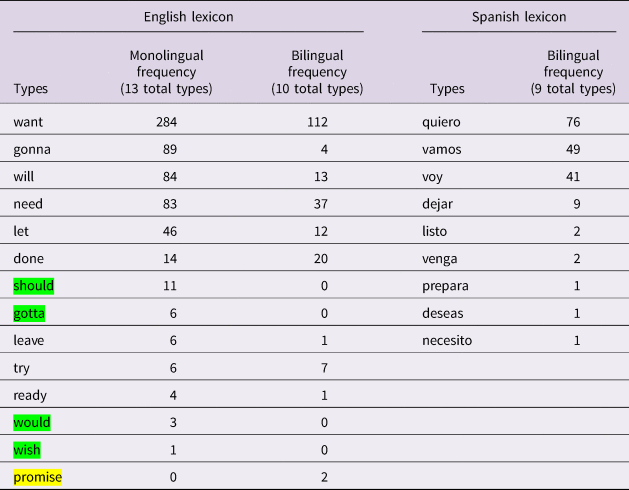
Volition terms in the evaluative English and Spanish lexicons used by monolingual and bilingual 30-month-olds, all corpora (highlighted in green, words used only by monolinguals, in yellow, English words used only by bilinguals; colour online)

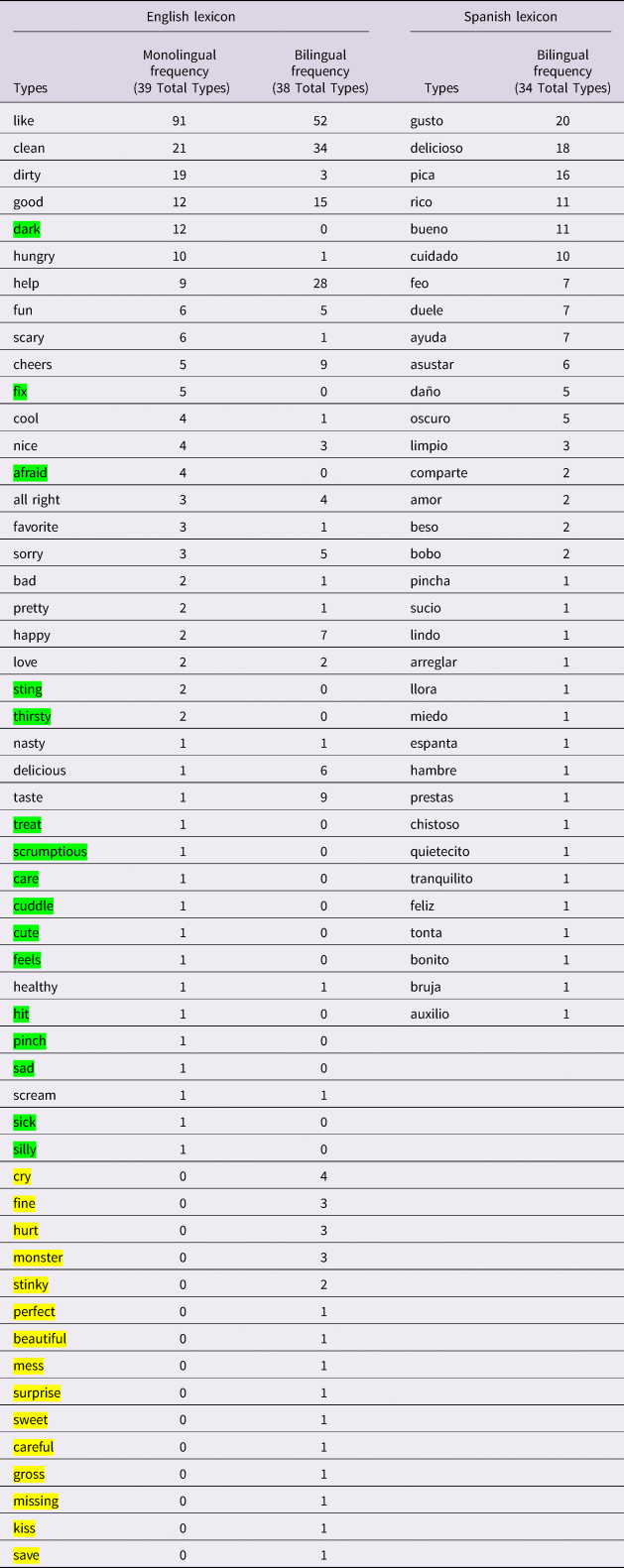
Emotion terms in the evaluative English and Spanish lexicons used by monolingual and bilingual 30-month-olds, all corpora (highlighted in green, words used only by monolinguals, in yellow, English words used only by bilinguals; colour online)