INTRODUCTION
Plants that provide critical resources for frugivores during periods of scarcity are recognized as keystone resources (Bleher et al. Reference BLEHER, POTGIETER, JOHNSON and BÖHNING-GAESE2003, Howe Reference HOWE1984, Peres Reference PERES2000). Several studies point to the importance of zoochorous Melastomataceae for Neotropical bird communities, since these plants provide resources throughout most of the year, during periods of scarcity and/or during breeding seasons for frugivore birds (Galetti & Stotz Reference GALETTI and STOTZ1996, Hilty Reference HILTY1980, Kessler-Rios & Kattan Reference KESSLER-RIOS and KATTAN2012, Levey Reference LEVEY1990, Poulin et al. Reference POULIN, WRIGHT, LEFEBVRE and CALDERÓN1999, Snow Reference SNOW1965). In an attempt to classify such plant resources, Peres (Reference PERES2000) proposed four major parameters to define a keystone plant resource (KPR): low temporal redundancy of the KPR in relation to the combined pool of alternative food resources; low consumer specificity, in the sense that a representative portion of the frugivores assemblage rely on the KPR; high resource reliability, that is, if it will predictably become available through annual periods of scarcity; and KPR abundance.
Considering these parameters proposed, fruiting phenology plays a major role in determining the importance of a plant to frugivorous birds. The phenology of plants is presumed to be shaped by abiotic and biotic factors (Fenner Reference FENNER1998, van Schaik et al. Reference VAN SCHAIK, TERBORGH and WRIGHT1993). Abiotic factors could impose strong constraints on flowering and fruiting time and duration (Fenner Reference FENNER1998). On the other hand, the interaction with dispersers also has a presumed importance on the fruiting phenology, either promoting co-occurrence of plant species that minimize fruiting overlap, providing fruits sequentially (Hilty Reference HILTY1980, Poulin et al. Reference POULIN, WRIGHT, LEFEBVRE and CALDERÓN1999, Snow Reference SNOW1965, Thies & Kalko Reference THIES and KALKO2004), or leading to fruiting aggregation (Kessler-Rios & Kattan Reference KESSLER-RIOS and KATTAN2012, Poulin et al. Reference POULIN, WRIGHT, LEFEBVRE and CALDERÓN1999). Fruit is a type of resource with strong heterogeneity not only in time, but also over space (García & Ortiz-Pulido Reference GARCÍA and ORTIZ-PULIDO2004, Howe Reference HOWE1984, Levey Reference LEVEY1988, Price Reference PRICE2004). In patchy environments like savannas, the seasonal movements of animals among different types of habitats are believed to reflect temporal differences in resource availability (Piratelli & Blake Reference PIRATELLI and BLAKE2006, Price Reference PRICE2004, Tubelis et al. Reference TUBELIS, COWLING and DONNELLY2004). In the particular case of the Neotropical savanna, bird movements along adjacent habitats was previously addressed (Piratelli & Blake Reference PIRATELLI and BLAKE2006, Tubelis et al. Reference TUBELIS, COWLING and DONNELLY2004), but resource use across habitats according to seasonality is poorly documented.
In this study, we evaluated the fruiting phenology and the assemblage of frugivorous birds associated with four Miconia species from the Neotropical savanna of Central Brazil. Miconia is the largest zoochorous genus within Melastomataceae and is associated with frugivorous birds in many Neotropical areas (Galetti & Stotz Reference GALETTI and STOTZ1996, Hilty Reference HILTY1980, Kessler-Rios & Kattan Reference KESSLER-RIOS and KATTAN2012, Poulin et al. Reference POULIN, WRIGHT, LEFEBVRE and CALDERÓN1999, Manhães et al. Reference MANHÃES, ASSIS and CASTRO2003, Renner Reference RENNER1989). Three of the Miconia species studied occur mainly in savanna and fruit during the rainy season whereas M. chamissois occurs mostly in adjacent palm swamps and bears fruits during the dry season. After observing a sequential fruiting pattern in these plants, we tested if the observed fruiting phenology was more segregated than expected by chance. The combined results of fruiting phenology and frugivore bird assemblages are used to discuss the role of M. chamissois as keystone plant resource, as defined by Peres (Reference PERES2000). For this we also evaluated if the diversity of frugivore birds in the palm swamp is affected by the fruiting of M. chamissois, as an indirect support for resource tracking by birds. The primary hypothesis we tested here is that plants from different habitats share their frugivores, thus promoting a link between habitats.
METHODS
Study area and organisms
The Neotropical savanna shows a remarkable physiognomic variation on the vegetation and is characterized by an extremely patchy environment (Oliveira-Filho & Ratter Reference OLIVEIRA-FILHO, RATTER, Oliveira and Marquis2002). Our study was mostly carried out in two of these plant physiognomies, savanna (cerrado) and palm swamp (vereda), which are relatively open vegetation areas (Oliveira-Filho & Ratter Reference OLIVEIRA-FILHO, RATTER, Oliveira and Marquis2002). We conducted the fieldwork at three sites near Uberlândia city, in the state of Minas Gerais, South-East Brazil. Most of the data were collected in the Clube de Caça e Pesca Itororó de Uberlândia, a private natural reserve (CCPIU – 18°59′21″S, 48°18′06″W) which comprises approximately 400 ha of native vegetation. This area has two major plant physiognomies: savanna and palm swamps, this latter comprising about 100 ha. Complementary observations were conducted in Glória Research Farm (Glória – 18°57′23″S, 48°12′29″W) and Panga Ecological Station (Panga – 19°10′27″S, 48°23′51″W). Glória comprises 685 ha, mostly occupied by experimental crops and with small remnants of savanna, palm swamp and forest formations. Panga presents about 400 ha and includes from grasslands and savanna to dense forest formation. The climate is remarkably seasonal with a warm rainy season (October–March) and a cool dry season (April–September).
We studied the four most abundant species of Miconia (Melastomataceae) in the studied region. These species present wide and overlapping distributions, varying from shrubs to treelets (c. 1–3 m tall) and are commonly found in sympatry (Martins et al. Reference MARTINS, SEMIR, GOLDENBERG and MARTINS1996). Miconia albicans (Sw.) Triana, M. fallax DC. and M. rubiginosa (Bonpl.) DC. occur frequently side by side in savanna vegetation while M. chamissois Naud. is restricted to humid areas (mostly palm swamps). Miconia chamissois is one of the most common and abundant zoochorous species found in the palm swamps of Central Brazil (Araújo et al. Reference ARAÚJO, BARBOSA, ARANTES and AMARAL2002, Guimarães et al. Reference GUIMARÃES, ARAÚJO and CORRÊA2002). All species have small fruits (0.5–1.0 cm diameter) which are dark purple or blue (almost black) in M. fallax, M. rubiginosa and M. chamissois or translucent jade green in M. albicans. In CCPIU we studied all four Miconia species. In Glória we studied M. albicans and M. chamissois while in Panga only M. chamissois was observed. These Miconia species are suitable for addressing the importance of dispersers in the phenological pattern since three species from the savanna (M. albicans, M. fallax and M. rubiginosa) are largely independent of pollinators for their reproduction (Goldenberg & Shepherd Reference GOLDENBERG and SHEPHERD1998) and the fruiting pattern observed would be independent of interaction with pollinators.
Fruiting phenology
In CCPIU, we evaluated the phenology from November 2005 to October 2007, monitoring 15 individuals for each Miconia species (individuals were at least 5 m away from conspecifics and of similar height). All these individuals were followed weekly counting the number of ripe fruits. In Glória, we carried out fruit counting every other week, in six individuals for each species from January to December in 2009. To evaluate the importance of Miconia fruits at community level, we recorded the fruiting of other bird-dispersed plants (with at least 10 individuals in the transect) fortnightly in the CCPIU from May 2008 to May 2011, along a transect of 4.0 km crisscrossing the savanna, the palm swamp and a small fragment of gallery forest (of approximately 1 ha). Plants were followed and fruiting was evaluated with attribution of intensity scores (0 – no fruits; 1 – less than 40% of individuals with fruits; 2 – more than 40 % of individuals with fruits). We also attributed a crop size score to these species according to their crop size per individual during the fruiting peak (1: ≤ 50 fruits; 2: > 50 and ≤ 150; 3: > 150 and ≤ 350; 4: > 350).
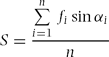
Null-models are commonly used to test for phenological patterns (Pleasants Reference PLEASANTS1990), and we used a modified version of the null model used in Marchinko et al. (Reference MARCHINKO, NISHIZAKI and BURNS2004) to test for evenly displaced fruiting in Miconia. The null-model is based on the index d/w, where d is the difference between peak resource use in two species, and w is the average breadth of resource use of both species. Thus the index was defined as the difference between average fruiting peaks of two adjacent species in the fruiting sequence divided by the average of their fruiting intervals. Analyses were conducted on the CCPIU dataset only, because it was the only site where all four Miconia species were studied. Considering the phenology as a circular variable, timing of annual peaks in fruit production was quantified as mean angles (0–360°, roughly equivalent to days in the year, thus each day is equivalent to approximately 0.98°) and fruiting intervals were quantified as circular standard deviations. Each month i = (January, February . . . December) was associated with an angle from the series αi = (15°, 45° . . . 345°) and the corresponding number of ripe fruits observed, f i. The mean angle of fruit production for each species (μf, i.e. fruiting peaks), was calculated as:
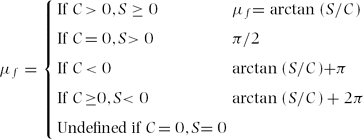 \begin{eqnarray*}
\mu _f = \left\{\begin{array}{ll}
{\rm If }\;C{\rm > 0, }S \ge {\rm 0} & \mu _f {\rm = arctan\; (}S/C{\rm )} \\[6pt]
{\rm If }\;C{\rm = 0, }S{\rm > 0} & \pi /2 \\[6pt]
{\rm If }\;C{\rm < 0 } & {\rm arctan\; (}S/C{\rm ) + }\pi \\[6pt]
{\rm If }\;C {\rm \ge } {\rm 0, }S{\rm < 0} & {\rm arctan\; (}S/C{\rm ) + 2}\pi \\[6pt]
{\rm Undefined\; if\; }C{\rm = 0, }S{\rm = 0}\end{array}
\right.\end{eqnarray*}
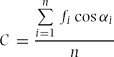 \begin{equation*}
C = \frac{{\sum\limits_{i = 1}^n {f_i \cos \alpha _i } }}{n}\end{equation*}
 \begin{equation*}
S = \frac{{\sum\limits_{i = 1}^n {f_i \sin \alpha _i } }}{n}\end{equation*}
 \begin{equation*}
w = 1 - \sqrt {C^2 + S^2 }\end{equation*}
 \begin{equation*}
d(a,b) = 1 - \cos (a - b)\end{equation*}
The index d/w was calculated for all adjacent species pairs in the annual sequence of fruit availability. The variance of these values was then calculated to obtain a single metric characterizing community-level differentiation in fruit phenologies. To determine whether the observed variance in d/w was lower than what would be expected by chance, the observed variance was compared with the variance calculated for 10 000 simulated assemblages generated in a Monte Carlo simulation. During each iteration of the simulation, the timing of peak fruit production for each species was randomized and the variance in d/w values was recalculated. The fraction of iterations generating values that were less than observed was taken as the probability of obtaining the observed result under the null hypothesis. This fraction was multiplied by two to obtain two-tailed type I error rates (i.e. P values). We used the R statistical framework (R Development Core Team, v. 2.12.2) for the circular null-model analysis.
Frugivorous bird assemblages
Frugivorous birds in Miconia were recorded from November 2005 to December 2007 in CCPIU and from January to December 2009 in Glória and Panga. In CCPIU, we conducted 50 h of focal plant observation on each plant species during their respective fruiting peaks. For Glória and Panga each plant species amounted to 30 h of sampling. Observations ranged from 05h00 to 18h00, the maximum length of each observational session was 3 h, and simultaneous observation was limited to three individuals within the same vision field. The following data were recorded: species, number of fruits consumed and consumption strategy. An event of fruit consumption was characterized by a bird starting to consume fruits until it disappeared from the vision field of the observer. We adopted a simple classification of the consumption strategy based on whether birds swallowed the entire fruit or not, regardless of crushing the fruit. As Miconia seeds are very small (< 2 mm), we believe that the fruit handling would have less effect than the proportion of fruit consumed or the gut treatment in seed dispersal. The similarity in the frugivores assemblages among Miconia species within each site (CCPIU and Glória) was evaluated calculating the abundance-based Sørensen similarity index using SPADE software (http://chao.stat.nthu.edu.tw). This index uses a probabilistic approach that incorporates the estimated effect of unseen shared species, reducing the sample-size bias (Chao et al. Reference CHAO, CHAZDON, COLWELL and SHEN2005, Reference CHAO, CHAZDON, COLWELL and SHEN2006).
In order to evaluate the effect of M. chamissois on the diversity of birds associated with palm swamp, we estimated bird abundance through the point-count method. This method consists in walking along a path and stopping at pre-determined points where bird incidences are recorded (Bibby et al. Reference BIBBY, BURGESS, HILL and MUSTOE2000). In the palm swamp at CCPIU we defined 17 circular points with a radius of 30 m along a path approximately 4.5 km long. Birds were recorded within these points, which were at least 200 m apart. We made observations each month from November 2007 to October 2008, each starting at 07h30 and finishing at 10h30. Sampling lasted for 10 min at each point with intervals of another 10 min between subsequent points. These samplings were conducted over 4 d with similar weather conditions and each point was sampled twice per month, in inversed sequence. The two samples from the same point in the same month were pooled together, so we had 17 points (samples) with their measure of bird diversity for each month (replicate). The richness and abundance of birds were analysed according to season (rainy and dry) and according to fruiting of M. chamissois within the dry season using nested ANOVA after square-root data transformation (√ x + 0.5) to meet statistical assumptions (Zar Reference ZAR1999). In the first analysis we compared the diversity of birds between seasons (group – fixed-effect factor) with months nested (subgroups – random-effect factor). In the second analysis we compared the diversity of birds according to presence of M. chamissois fruits (group – fixed-effect factor) with months nested (subgroups – random-effect factor). Comparisons were made separately for different categories of species: frugivores recorded in Miconia; major frugivores recorded in Miconia, in other words, species with at least 5% of relative record frequency in the frugivore list and species not recorded in Miconia, or non-frugivores.
RESULTS
Fruiting phenology
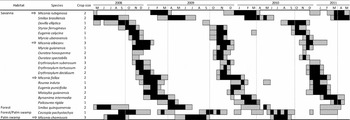
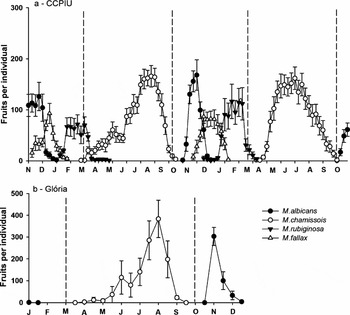
We found 22 plant species bearing bird-consumed fruits in CCPIU and most of these bore fruits during the rainy season (Figure 1). Most plants were found in savanna, and only three species in palm swamp and forest. In CCPIU the three species from savanna (M. albicans, M. fallax and M. rubiginosa) fruited during the rainy season with some overlapping in fruiting period and Miconia chamissois produced fruits during the dry season (Figure 2). The fruiting pattern of M. albicans and M. chamissois in Glória followed an approximately similar pattern to that found in CCPIU (Figure 2). Despite consistently recording a segregated fruiting pattern over years (Figure 2), approximately 5% of randomized assemblages showed more evenly displaced fruiting than the observed one, not providing support for evenly displaced fruit production (P = 0.099).
Fruiting phenology of most abundant bird-dispersed plants at CCPIU, Uberlândia, Brazil. The phenology was evaluated with attribution of intensity scores: 0 – no fruits (white); 1 – less than 40% of individuals with fruits (shaded); 2 – more than 40% of individuals with fruits (black). Crop size score attributed according to crop size per individual during the fruiting peak (1 – ≤ 50 fruits; 2 – > 50 and ≤ 150; 3 – > 150 and ≤ 350; 4 – >350). The two seasons of Neotropical savanna (rainy – October to March and dry – April to September) are separated by vertical lines.

Fruiting phenology of Miconia assemblages (number of ripe fruits, mean ± SE) in two different sites near Uberlândia, MG, Brazil. Rainy and dry seasons are separated by dotted lines.

Frugivorous bird assemblages
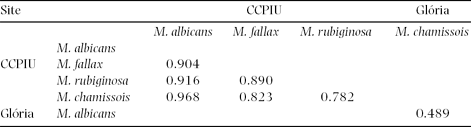
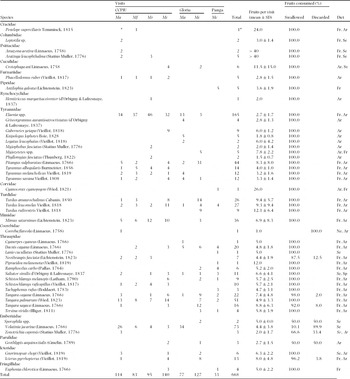
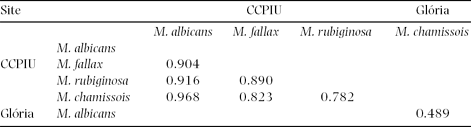
We recorded 668 visits by 47 species of birds to Miconia (Appendix 1). The feeding behaviour of each species did not vary from plant to plant, probably due to fruit similarity among Miconia species, so bird-visit data were pooled across plants. Miconia chamissois was most visited in CCPIU and Glória (Appendix 1) and Miconia species showed considerable similarity in their frugivore fauna within study sites (Table 1).
Abundance-based Sørensen similarity index among frugivorous birds feeding on Miconia species within two sites in Uberlândia, MG, Brazil.
In CCPIU, for all four Miconia the most frequent visitors were Elaenia spp. which were also recorded in Glória. Elaenia chiriquensis, E. cristata and E. flavogaster are commonly found in the study sites (C. Melo, unpubl. data), but we pooled together the data for the genus since specific distinction was difficult while they were feeding on plants. Other species such as Mimus saturninus, Pitangus sulphuratus, Tangara palmarum, Turdus amaurochalinus and Turdus leucomelas were frequently recorded, depending on the plant species and study site (Appendix 1). Birds usually consumed the fruits entirely, and few species were recorded discarding them (Appendix 1).
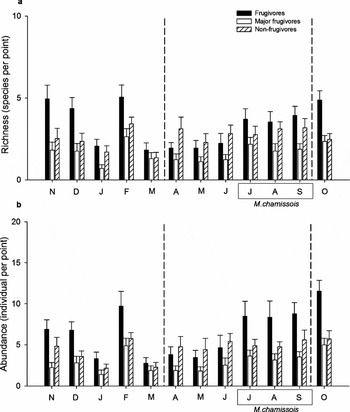
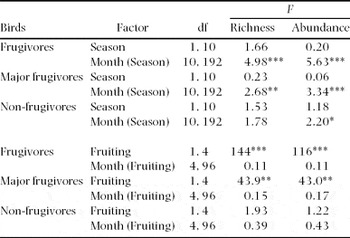
Nested ANOVAs showed that bird diversity in palm swamp seems to vary through the year according to month, but not between the rainy and dry seasons (Table 2). The presence of M. chamissois fruits affected the diversity of frugivores during the dry season since it was consistently higher during M. chamissois fruiting, a pattern not observed for non-frugivores (Figure 3).
Richness (a) and abundance (b), mean ± SE, of different groups of birds in the vereda at CCPIU. Data were collected by point counting method. Rainy and dry seasons are separated by dotted lines. The frame around July to September indicates Miconia chamissois peak fruiting period in 2008.

Results of nested ANOVAs evaluating the changes in richness and abundance of birds at a palm swamp in Central Brazil. In the first group of analyses we compared the diversity of birds between rainy and dry seasons with months nested. In the second group the diversity of birds was compared according to the presence of Miconia chamissois fruits during the dry season, again with months nested as subgroups. Data were analysed after square-root transformation to meet statistical assumptions. *P < 0.05, **P < 0.01, ***P < 0.001.

DISCUSSION
Miconia species from distinct habitats exhibited contrasting fruiting seasons. The phenological pattern highlights the importance of M. chamissois which bears fruits during the dry season, when the overall fruit offer is lower in open habitats of the Neotropical savanna (Batalha & Martins Reference BATALHA and MARTINS2004, Oliveira Reference OLIVEIRA, Sano, Almeida and Ribeiro2008, Piratelli & Pereira Reference PIRATELLI and PEREIRA2002). The fact that only M. chamissois produces fruits during the dry season may be justified considering the different characteristics between habitats. The soil of the palm swamp keeps some moisture during the dry season on the superficial layers in contrast with the savanna, allowing for evergreen vegetation (Furley Reference FURLEY1999). This soil moisture difference among habitats is often evoked as an explanation for contrasting phenological patterns among different plant physiognomies in the Neotropical savanna (Furley Reference FURLEY1999).
Several studies have investigated the existence of non-random phenological patterns in ecological communities (Burns Reference BURNS2005, Pleasants Reference PLEASANTS1990). In some of the most recent studies using the null-model analysis, researchers have found different results either supporting (Kessler-Rios & Kattan Reference KESSLER-RIOS and KATTAN2012, Poulin et al. Reference POULIN, WRIGHT, LEFEBVRE and CALDERÓN1999, Thies & Kalko Reference THIES and KALKO2004) or not (Burns Reference BURNS2005) the non-random fruiting in plant assemblages. The lack of support for evenly displaced fruiting in this study may be credited to higher overlapping in fruiting among Miconia species which occur in savanna, since staggered fruiting could be limited by abiotic constraints, which strongly influence plant phenology (Fenner Reference FENNER1998, van Schaik et al. Reference VAN SCHAIK, TERBORGH and WRIGHT1993).
Species of different foraging guilds and habits consumed Miconia fruits, which characterize their fruit as relatively unspecialized. A large number of species, from specialized frugivores to generalist omnivorous birds consuming fruits of Miconia seems to be a general trend, at least for the species in Brazil (Galetti & Stotz Reference GALETTI and STOTZ1996, Gridi-Papp et al. Reference GRIDI-PAPP, GRIDI-PAPP and SILVA2004, Manhães et al. Reference MANHÃES, ASSIS and CASTRO2003) and can be an interesting strategy for pioneer plants like Miconia. Because of fruit characteristics (i.e. small and numerous seeds with rigid pericarp), bird pre-ingestion fruit handling probably has little impact on their seed dispersal ability (Levey Reference LEVEY1987). Nevertheless, the gut treatment may be important. The majority of birds associated with Miconia were omnivorous and compared with specialized frugivores, which seldom destroy seeds in gut passage, they might impair seed germination (Schupp Reference SCHUPP1993). However, Miconia seeds remain intact and successfully germinate even after being defecated by many of the omnivorous species listed here (Manhães et al. Reference MANHÃES, ASSIS and CASTRO2003, Silveira et al. Reference SILVEIRA, MAFIA, LEMOS-FILHO and FERNANDES2012).
The high similarity among birds consuming Miconia fruits in savanna and palm swamp is evidence of habitat linking and may highlight the importance of landscape supplementation (sensu Dunning et al. Reference DUNNING, DANIELSON and PULLIAM1992). In this sense, the higher diversity of frugivores in palm swamp when M. chamissois bore fruits indicates an important role of this species and this habitat in maintaining birds which primarily dwell in savanna. The connectivity among different habitats for Neotropical savanna birds is often shown between open and forest habitats (Piratelli & Blake Reference PIRATELLI and BLAKE2006, Tubelis et al. Reference TUBELIS, COWLING and DONNELLY2004), but little is known for palm swamps (Tubelis Reference TUBELIS2009). Birds are highly mobile animals with the ability to track fruit resources over time and space (Burns Reference BURNS2004, Levey Reference LEVEY1988, García & Ortiz-Pulido Reference GARCÍA and ORTIZ-PULIDO2004, Price Reference PRICE2004). The match between bird abundance and fruit abundance in time is dependent on the spatial scale of the observation and particular to each system (Burns Reference BURNS2004, García & Ortiz-Pulido Reference GARCÍA and ORTIZ-PULIDO2004), but the contrast in fruit availability between different patches seems to be determinant (García & Ortiz-Pulido Reference GARCÍA and ORTIZ-PULIDO2004). Considering this, the presence of an abundant fruit resource in the palm swamp during low fruit availability in savanna would generate sufficient contrast at the local scale which birds seem to track seasonally.
Miconia chamissois fruits can be considered a keystone resource (Bleher et al. Reference BLEHER, POTGIETER, JOHNSON and BÖHNING-GAESE2003, Howe Reference HOWE1984, Peres Reference PERES2000) in the study area for three reasons. First, fruits became available consistently throughout the years during the period of lowest fruit availability (dry season). Second, a representative portion of the frugivore birds in savanna consume M. chamissois fruits. And third, it is commonly one of the dominant zoochorous species in the palm swamp shrub layer, as shown in studies conducted in the same region and study sites (Araújo et al. Reference ARAÚJO, BARBOSA, ARANTES and AMARAL2002, Guimarães et al. Reference GUIMARÃES, ARAÚJO and CORRÊA2002). Species defined as KPR are those with a pervasive influence on community composition (Peres Reference PERES2000), whose eventual removal would drastically affect the community parameters in the area. Since many birds consuming M. chamissois fruits are not specialized frugivores, one may argue that its removal would not drastically affect the bird community. Nevertheless, it has been shown that many birds consuming Miconia fruits rely heavily on fruits for their diets, even though belonging to omnivorous or insectivorous groups (Marini & Cavalcanti Reference MARINI and CAVALCANTI1998, Piratelli & Pereira Reference PIRATELLI and PEREIRA2002).
Due mostly to their hydrological importance, palm swamps are protected by law in Brazil (Guimarães et al. Reference GUIMARÃES, ARAÚJO and CORRÊA2002). At the same time, they are threatened by and very susceptible to human activities which cause sedimentation, soil moisture loss and changes in plant species composition (Guimarães et al. Reference GUIMARÃES, ARAÚJO and CORRÊA2002, Tubelis Reference TUBELIS2009). The majority of the birds recorded in this habitat are species that primarily inhabit other plant physiognomies and use it as an additional habitat (Tubelis Reference TUBELIS2009). Our study adds information about an important plant resource in palm swamp used by birds and reinforces the importance of embedded moister habitats during some periods of the year for birds in the Neotropical savanna. The Miconia assemblage studied here seems to promote complementarity between two adjacent habitats for many species of birds in the Neotropical savanna, calling attention to an important process which is likely to be common in this naturally patchy ecosystem.
ACKNOWLEDGEMENTS
We thank Amanda F. Cunha, Estevão A. Silva, Paulo E. Oliveira, Mauricio F. Otárola, Jeferson Bugoni, Heraldo L. Vasconcelos and several anonymous reviewers for their comments and suggestions in the earlier versions of the manuscript. FAPEMIG, CNPq and CAPES provided founding for this research. Pietro K. Maruyama is also grateful to CCPIU administration, Dario L. A. Mendonça and Isumi M. Mendonça for valuable fieldwork assistance.
List of frugivorous bird species recorded consuming fruits of Miconia (Melastomataceae) in three different sites near Uberlândia, in Central Brazil. Ma – Miconia albicans; Mf – M. fallax; Mr – M. rubiginosa; Mc – M. chamissois. Diet is based in major food items consumed by these bird species according to Develey & Endrigo (Reference DEVELEY and ENDRIGO2004) and Sigrist (Reference SIGRIST2006). *Record based on faecal sample. Diet abbreviations: Fr – Fruits, Ar – Arthropods, Se – Seeds, Sp – Sprouts, Sv – Small vertebrates and Ne – Nectar. Volatina jacarina consumed fruits partially, often without removing them from the plant and parakeets grabbed the infructescences with their feet when feeding and dropped many fruits in the process.