Introduction
Industrial pollution, as well as natural processes, have increased the exposure to heavy metals in recent years. The effect of heavy metals on public health has been of increasing concern, and in particular the effects on growth and development. During pregnancy, heavy metals may contribute to adverse outcomes including pre-eclampsia, preterm delivery and small for gestational age babies.Reference Jelliffe-Pawlowski, Miles, Courtney, Materna and Charlton 1 , Reference Vigeh, Yokoyama and Ramezanzadeh 2 Pb and Hg are known to be transferred freely though the placenta, although the placenta is thought to be at least a partial barrier for Cd transfer.Reference Osman, Akesson and Berglund 3 The fetus is particularly vulnerable to the effects of heavy metals because of the high rate of cell division and differentiation. Thus, relatively low levels of exposure that do not harm the mother may have a profound effect on the development of the fetus and its growth and development during childhood.
There are no known safe thresholds for levels of heavy metals in pregnancy, and environmental exposure should be kept to a minimum. Low-level lead exposure in children does not cause overt clinical symptoms, but has permanent effects on cognition, behaviour and school performance.Reference Canfield, Henderson and Cory-Slechta 4 , Reference Chandramouli, Steer, Ellis and Emond 5 Other adverse outcomes may include preterm delivery and low birth weight and effects on growth, IQ and neurodevelopment.Reference Andrews, Savitz and Hertz-Picciotto 6 , Reference Shukla, Dietrich, Bornschein, Berger and Hammond 7 Accumulation of Cd has been associated with effects on motor and perceptual behaviour in childhood, and may have effects at an older age that are as yet unknown.Reference Schoeters, Den Hond and Zuurbier 8 Hg has adverse neurodevelopmental effects, including associations with learning and memory deficits, delayed cognitive performance, preterm birth and birth defects. 9
For heavy metals that have any degree of transfer though the placenta to the fetus, there are no identified safe limits for maternal levels. The only means of reducing fetal exposure is to minimise maternal exposure. It is therefore important to have reliable data on blood levels of heavy metals in pregnancy from a range of countries and types of populations, which have a variety of environmental exposures, as well as data on the health effects in the resulting children. There are very few recommendations for levels of concern for Pb, Cd and Hg, and only three recommendations, for Pb levels, relate specifically to pregnancy.Reference Ettinger, Wengrovitz, Portier and Brown 10 – 12 It is therefore difficult to compare levels of Pb, Cd and Hg found in pregnancy worldwide with existing levels of concern as they do not reflect pregnancy, as an especially critical time for the effects of exposure. To illustrate the lack of cohesion, we present data on blood Pd, Cd and Hg levels from pregnant women enroled in the UK Avon Longitudinal Study of Parents and Children (ALSPAC) study in 1991–1992 and compare the values with these levels of concern and recommended cut-off values, and with levels found in other groups of pregnant women worldwide. We discuss the need for clarity of terminology in describing levels of concern and the need for international consensus on levels of concern particularly for children and pregnant women.
Terminology in national recommendations
There is a variety of terminology used in national recommendations. Although ‘reference value’ is used by several bodies to indicate the upper margin of the current background exposure of the general population to a given environmental toxin at a given time (e.g., GermanyReference Schulz, Angerer, Ewers and Kolossa-Gehring 13 ) it implies a degree of normality and an associated physiological requirement – but this is not applicable to Pb, Cd or Hg levels. Other bodies refer to a ‘benchmark dose’ level from which a ‘reference dose’ for daily oral exposure can be derived (e.g., the USA 14 ). The No-Observed-Adverse-Effect Level (NOAEL; the highest exposure level at which there are no biologically significant increases in the frequency or severity of adverse effects between the exposed population and a control population) and the Lowest-Observed-Adverse-Effect Level (LOAEL; the lowest exposure levels at which there are biologically significant increases in the frequency or severity of adverse effects between the exposed population and a control population) would appear to be more helpful in this context.
National recommendations for levels of concern for Pb, Cd and Hg
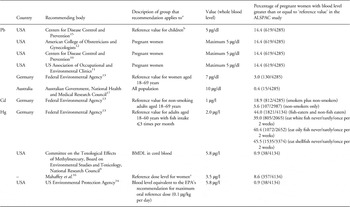
There are few recommendations available nationally for Pb, Cd and Hg levels, and none that relate specifically to pregnant women, with the exception of recommendations for Pb levels in pregnant women by the US Centers for Disease Control and Prevention,Reference Ettinger, Wengrovitz, Portier and Brown 10 the Association of Occupational and Environmental Clinics 11 and the American College of Obstetricians and Gynecologists. 12 Some recommendations focus specifically on health and safety in the workplace and relate to monitoring of individuals rather than populations (e.g., the US Department of Labour Occupational Safety and Health Administration, and the Health and Safety Executive in the UK). A summary of recommendations for Pb, Cd and Hg for children or adults, or women were given specifically, are shown in Table 1. In Germany there is regular monitoring of heavy metal levels in the population,Reference Becker, Schroeter-Kermani and Seiwert 18 as there is in the USA though the National Health and Nutrition Examination Survey (NHANES) programme. There are only three countries that have published levels of concern for heavy metals to our knowledge: Pb (USA, Australia and GermanyReference Schulz, Angerer, Ewers and Kolossa-Gehring 13 , 15 , 17 ), Cd (Germany onlyReference Schulz, Angerer, Ewers and Kolossa-Gehring 13 ) and Hg (both USA and Germany 9 , Reference Schulz, Angerer, Ewers and Kolossa-Gehring 13 , 14 , Reference Mahaffey, Clickner and Bodurow 16 ). There is clearly a need for an international consensus on levels of concern for values for heavy metals, particularly for pregnant women, which should be founded on regular monitoring in this group.
Summary of recommendations for levels of concern for blood Pb, Cd and Hg

ALSPAC, Avon Longitudinal Study of Parents and Children; BMDL, Benchmark dose level; EPA, Environmental Protection Agency.
a Terminology is that used by the recommending body.
b Level at which monitoring in children will be carried out (based on population of children in the USA in the top 2.5% of blood Pb levels).
c Suggested as a revision of US National Research Council recommendation.
Comparison of data from the ALSPAC study with national levels of concern
The ALSPAC study
The data from the ALSPAC study represent the largest cohort on which blood levels of Pb, Cd and Hg in pregnancy have been reported. In addition, they provide the first reported level of blood Hg in pregnancy in the UK, and only the second report of Cd in pregnancy in the UK, to our knowledge.
Methods
For details of the methods of sample collection and analysis, see Supplementary Text S1. In brief, the study sample was derived from the ALSPAC study, a population-based study investigating environmental and genetic influences on the health, behaviour and development of children. Ethics approval for the study was obtained from the ALSPAC Ethics and Law Committee and Local Research Ethics Committees.
Whole blood samples were collected from pregnant women in acid-washed vacutainers and analysed by inductively coupled plasma mass spectrometry in standard mode [R. Jones, Centers for Disease Control and Prevention (CDC), Bethesda, MD, USA]. The analyses were completed on 4285 women for Pb, 4286 women for Cd and 4134 women for Hg.
Results and comparison with national levels of concern
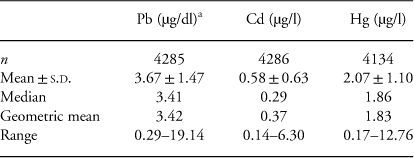
The characteristics of the ALSPAC study population with blood Pb levels have been presented elsewhere.Reference Taylor, Golding and Emond 19 In brief, the subsample was slightly older and better educated that the rest of the ALSPAC sample, but were similar in terms of social class, housing status, rate of cigarette smoking and parity. The mean blood levels of Pb, Hg and Cd in the ALSPAC study are shown in Table 2. As well as showing a summary of the recommendations for levels of concern for blood Pb, Cd and Hg, Table 1 also shows the percentage of pregnant women in the present sample that had blood levels of Pb, Cd or Hg at or above each recommended value. Several values were markedly greater than the recommended values: for example, 14.4% of blood Pb levels were above the value of 5 µg/dl suggested as an upper limit by the US Association of Occupational and Environmental Clinics, the Centers for Disease Control and Prevention and the American College of Obstetricians and Gynecologists,Reference Ettinger, Wengrovitz, Portier and Brown 10 – 12 and 39.0% of blood Hg values were above the reference level of 2.0 µg/l suggested by the German Federal Environment AgencyReference Schulz, Angerer, Ewers and Kolossa-Gehring 13 for adults aged 18–60 years old with fish intake ⩽3 times per month.
Maternal blood levels of Pb, Cd and Hg in the ALSPAC study

ALSPAC, Avon Longitudinal Study of Parents and Children.
a Values reported in Taylor et al. Reference Taylor, Golding and Emond 19
Comparison of blood levels of Pb, Cd and Hg in pregnancy in ALSPAC with previous studies worldwide
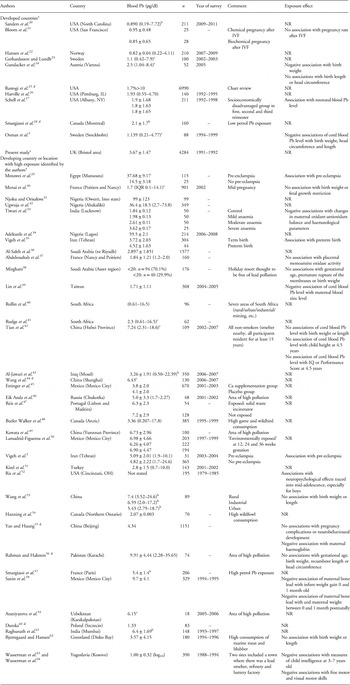
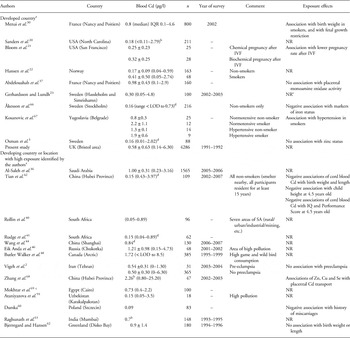
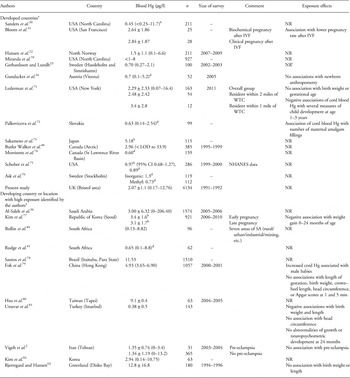
Comparisons of blood levels of Pb, Cd and Hg in pregnancy from the ALSPAC study with previous studies worldwide are shown in Tables 3–5, respectively). In summary, the levels of Pb, Cd and Hg were higher than in similar developed countries. As has been discussed in detail for Pb,Reference Taylor, Golding and Emond 19 there are several factors that should be taken in account when comparing maternal blood levels between studies. (1) The sample sizes in published studies range widely (see Tables 3–5). (2) Several analytical techniques for analysis have been used, with varying levels of accuracy, including commercial kits, atomic absorption spectroscopy and inductively coupled plasma mass spectroscopy (e.g., for Pb, Al-Jawari et al.,Reference Al-Jawadi, Al-Mola and Al-Jomard 43 Al-Saleh et al. Reference Al-Saleh, Shinwari, Mashhour, Mohamed Gel and Rabah 28 and Osman et al.,Reference Osman, Akesson and Berglund 3 respectively). (3) There is a range of gestational ages at which the blood samples have been taken (for Pb for example, at 12 weeks of gestation,Reference Smargiassi, Takser and Masse 57 at birth,Reference Raghunath, Tripathi, Sastry and Krishnamurthy 61 or shortly after birth.Reference Eik Anda, Nieboer, Dudarev, Sandanger and Odland 46 (4) The date that the study was performed is not always reported (see Tables 3–5).
Comparison of blood Pb levels in pregnancy in studies published from 2000 onwards

IVF, in vitro fertilisation; IQR, interquartile range; NR, not reported.
Adapted and extended from Taylor et al.Reference Becker, Schroeter-Kermani and Seiwert 18
Values in parentheses are ranges.
a The classification of a developed/developing country was that of the International Monetary Fund.Reference Wasserman, Musabegovic and Liu 64
b Geometric mean
c Median.
d Abstract only retrieved.
e Reported in Taylor et al.Reference Taylor, Golding and Emond 19
Comparison of blood Cd levels in pregnancy in studies published from 2000 onwards

IQR, interquartile range; LOD, limit of detection; NR, not reported.
Values in parentheses are ranges.
a The classication of a developed/developing country was that of the International Monetary Fund. 65
b Geometric mean.
c Abstract only retrieved.
d Median.
Comparison of blood Hg levels in pregnancy in studies published from 2000 onwards

LOD, limit of detection; NHANES, National Health and Nutrition Examination Survey; NR, not reported; WTC, World Trade Center.
Values in parentheses are ranges.
a The classication of a developed/developing country was that of the International Monetary Fund. 65
b Geometric mean.
c Abstract only retrieved.
d Median.
Lead
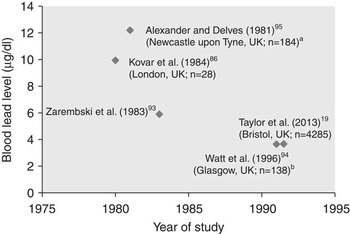
The blood Pb levels reported here from the ALSPAC study (3.67±1.47 µg/dl) are higher than those in similar developed countries at about the same time (e.g., SwedenReference Osman, Akesson and Berglund 3 (median 1.14 µg/dl) and the USA 15 (1.9±1.68 µg/dl); see Table 3).Reference Taylor, Golding and Emond 19 Assuming a fetal:maternal ratio of blood lead of about 0.8,Reference Schell, Denham and Stark 27 , Reference Rudge, Rollin and Nogueira 41 , Reference Amaral, Rezende and Quintana 83 this would result in a mean neonatal blood lead level of about 2.9 µg/dl. The level is, nevertheless, in alignment with a trend for a gradual reduction in values in pregnant women with time in the UK (Fig. 1), in accordance with the eventual complete bans on lead in petrol (in 2000 following gradual withdrawal during the 1990s) and paint (in 1992), replacement of lead water pipes, and a reduction in cigarette smoking levels in the UK. Although these data are the most recent reported levels in pregnancy in the UK, Primatesta et al. Reference Primatesta, Dong, Bost, Poulter and Delves 84 reported levels of 2.0±0.05 µg/dl (geometric mean) in women of childbearing age in 1995 in the UK, which is also in accordance with this downward trend.
Time trend for mean blood lead levels in pregnancy in the UK. (a) Year of study was not reported, so year of publication has been used. (b) Geometric mean value.

Cadmium
To our knowledge there are no studies on blood Cd levels in pregnancy in similar developed countries at about the same time as our study, but the present results for blood Cd in the ALSPAC study (0.58±0.63 µg/l) are slightly higher than more recent studies (e.g., USAReference Sanders, Flood and Chiang 20 (geometric mean 0.18 µg/l) and SwedenReference Gerhardsson and Lundh 23 (0.30 µg/l); see Table 4). As cigarette smoking is one of the main predictors of blood Cd levels,Reference Hansen, Nieboer and Sandanger 22 , Reference Ebert-McNeill, Clark and Miller 85 these disparities may reflect a decline in cigarette smoking in developed countries. The mean level of blood Cd is slightly lower than that reported by Kovar et al.Reference Kovar, Strehlow, Richmond and Thompson 86 in the UK (0.69±0.65 µg/l), although their sample size was very small (n=28).
Mercury
Unlike Pb and Cd, there is no reason to believe that Hg levels are falling with time in pregnant women. Hg bioaccumulates in fish and shellfish, and so in countries where it would be expected that fish consumption would be high, blood Hg levels in pregnancy tend to be higher, for example, 5.18 µg/l (geometric mean) in JapanReference Sakamoto, Kaneoka and Murata 73 and 12.8±16.8 µg/l in Greenland,Reference Bjerregaard and Hansen 62 although conversely levels in northern NorwayReference Hansen, Nieboer and Sandanger 22 were reported as being only 1.5±1.1 µg/l (this level was not remarked on as being unexpectedly low by the authors). In developed countries with an assumption of moderate fish intake, blood Hg levels in pregnancy tend to be lower, for example, AustriaReference Gundacker, Frohlich and Graf-Rohrmeister 24 (median 0.7 µg/l), SlovakiaReference Palkovicova, Ursinyova, Masanova, Yu and Hertz-Picciotto 72 (median 0.63 µg/l) and the USAReference Schober, Sinks and Jones 75 (geometric mean 0.97 µg/l) (see Table 5). As discussed by Golding et al.,Reference Golding, Steer, Hibbeln, Lowery and Jones 87 the median value for Hg in the present study was more than twice that found in the USA in women of child-bearing age based on NHANES data (median values 1.86 v. 0.89 μg/l),Reference Schober, Sinks and Jones 75 as were the 10th (0.81 v. 0.15 μg/l) and 25th (0.99 v. 0.38 μg/l) centiles, respectively. The 90th and 95th centiles, however, were higher in the USA study than in the present study (3.33 v. 4.83 and 4.02 v. 5.98 µg/l, respectively). Golding et al.Reference Golding, Steer, Hibbeln, Lowery and Jones 87 stated that this difference is unlikely to be due to a difference in consumption of seafood as consumption is less in the USA than in the UK, and Hg levels in seafood in the UK are generally higher than those in the USA.Reference Hibbeln, Davis and Steer 88 Similar comparisons can be made with NHANES data from 1999 to 2006.Reference Caldwell, Mortensen, Jones, Caudill and Osterloh 89 The mean level reported in the present study (2.07±1.10 µg/l) is therefore slightly higher than for similar developed countries, although even higher levels have been found in pregnant women following IVF in the USA for women with a clinical (v. a biochemical) diagnosis of pregnancy (2.84±1.86 µg/l)Reference Bloom, Fujimoto and Steuerwald 21 and in pregnant women living or working near the site of the World Trade Center in the USA (levels were not greater than in a control group; overall mean 2.29±2.33 µg/l.Reference Lederman, Jones and Caldwell 71 There are no other published reports of blood Hg levels in pregnancy in the UK to our knowledge.
Summary
The relatively high levels of blood Pb, Cd and Hg found here may reflect the rich industrial history of the UK. With regard to Pb in particular, the final ban on leaded petrol came in force in 2000 in the UK, which is somewhat later than in other developed countries (e.g., Germany 1988, Sweden 1992, Canada 1993, USA 1995). In addition, the Avon area, in which the city of Bristol is located, has relatively high concentrations of Pb and Cd in soil and rock, 90 and there has been Pb mining around the city since Roman times. Industries that could have contributed to local levels of environmental contamination with heavy metals in the Avon area include a tobacco-processing factory, brass works, a hat-making factory and a lead-sheet rolling mill. Indeed, a lead-shot chimney in the centre of the city and a smelting works on the north-west fringe of the city both operated until the early 1990s. Levels of Pb in air samples near the smelting works site in the early 1990s were very close to the maximum European Union directive limit at that time (about 1.7–2.0 µg/m3; EU directive limit 2 µg/m3), although air Cd levels at the same site (about 6–9 ng/m3) complied with the lower limit of the WHO guideline range of 10 ng/m3 at that time. 91 These values are, however, in excess of current WHO recommended air limits of 0.5 µg/m3 for Pb and 5 ng/m3 for Cd. 92
Conclusion
There are thought to be no safe limits for blood levels of heavy metals in pregnancy: the only means of reducing fetal exposure is by minimising maternal exposure. In order to provide background data on which to base recommendations for levels during pregnancy, it is important that data on blood levels of Pb, Cd and Hg in pregnancy are collated with data on adverse health effects in the children to determine levels at which action is warranted. We have collated data from studies published from 2000 onwards. In addition, there are few data available on blood Pb or Cd levels in pregnancy in the UK and none on Hg in pregnancy to our knowledge and so we have provided valuable new data from a large UK sample. The levels of Pb, Cd and Hg that we found were rather higher than for other similar developed countries. The blood levels of Pd, Cd and Hg found in the ALSPAC study are of potential concern for the health of the fetus: further work needs to be done to determine the predictors of levels of toxic metals in this sample and the long-term effects on the fetus and the child. This will provide valuable information to inform levels of concern in pregnancy.
There are very few countries that have published levels of concern, and where these exist, the terminology varies and there is no agreement on levels. There are no recommendations that relate specifically to pregnancy, or even to women of childbearing age, with the exception of a single recommendation on the Pb level in pregnancy. There is therefore a need for international consensus on levels of concern for Pb, Cd and Hg relating specifically to pregnancy. Ideally these levels should be based on ongoing monitoring of levels in pregnant women and the health outcomes in their children. Thought needs to be given to the terminology used to express these levels: the use of levels of concern, or perhaps NOAEL or LOAEL, should be considered.
Acknowledgements
The authors are grateful to all the families who took part in the study, the midwives for their help in recruiting them, and the whole ALSPAC team, which includes interviews, computer and laboratory technician, clerical workers, research scientists, volunteers, managers, receptionists and nurses. They thank to S. Gregory for help with data preparation, and R. Jones for laboratory analyses. The publication is the work of the authors who will serve as guarantors for the contents of the paper.
Financial Support
The UK Medical Research Council and the Wellcome Trust (Grant ref: 092731) and the University of Bristol currently provide core support for ALSPAC. The assays of the maternal blood samples were carried out at the Centers for Disease Control and Prevention with funding from NOAA. CM Taylor was supported by a Daphne Jackson Trust Fellowship sponsored by the University of Bristol.
Conflicts of Interest
The authors have no conflicts of interest to declare.
Ethical Standards
The authors assert that all procedures contributing to this work comply with the ethical standards of the relevant national guidelines on human experimentation and with the Helsinki Declaration of 1975, as revised in 2008, and has been approved by the ALSPAC Ethics and Law Committee and Local Research Ethics Committees.