Keenan and Comrie's (1977) noun phrase accessibility hierarchy (NPAH) posited the availability of relative clauses (RCs) in the order of subject (SU) > object (DO) > dative (IO) > oblique (OBL) gaps for all languages that have RCs. More recently, Comrie and Horie (1995) and Comrie (1998, 2002) revoked this claim and proposed that the grammaticalization of RCs varies from language to language. They classified languages broadly into two groups: one with RCs and the other with attributive clauses, which used to be considered RCs. East Asian languages such as Chinese, Japanese, and Korean belong to those with attributive clauses, on the basis that (a) it is difficult to postulate gaps in RCs given that argument omission is permitted, (b) there is no syntactic difference between putative RCs (e.g., the envoy who arrived) and appositional clauses (e.g., the news that the envoy arrived), and (c) the subjacency condition (i.e., the constraint against a gap in a complex noun phrase, e.g., *the teacher that Sarah heard the rumor that everyone liked) does not apply in these languages. This proposal raises many theoretical and empirical questions about the acquisition of modifying clauses in these languages. If the relativized head and the gap in the RC are not coindexed by syntactic operations but loosely adjoined and pragmatically interpreted as in attributive clauses, would the NPAH still be observed? If the depth of syntactic embedding, invoked to explain the NPAH (Hawkins, 1999, 2004; O'Grady, Lee, & Choo, 2003), is not relevant any more, what other factors affect the processing and acquisition of different types of noun-modifying clauses? Conversely, if the NPAH is not observed in the acquisition of languages with attributive clauses (i.e., East Asian languages), does this constitute evidence that noun-modifying clauses are not relative constructions but attributive clauses?
Recently, a body of research has been emerging to suggest that the NPAH is not observed in the acquisition of some Asian languages, such as Japanese as a first language (L1) (Ozeki & Shirai, 2007), Japanese as a second language (L2) (Ozeki & Shirai, this issue), and Cantonese (Yip & Matthews, this issue). On the other hand, two experimental studies of Korean acquisition (Cho, 1999; O'Grady et al., 2003) reported findings consistent with the NPAH. For instance, Cho's study of the L1 Korean learning of children between 4 and 7 years of age showed that the children comprehended SU better than DO, IO, and OBL RCs and produced more well-formed SU constructions than others. O'Grady et al.'s (2003) study of the interpretation of SU and DO RCs by L2 learners of Korean yielded similar results. The L2 learners performed significantly better on SU than on DO. Individual performances also showed an implicational pattern; most of the participants who correctly interpreted DO also correctly interpreted SU. The findings of both studies support not only the NPAH but also the structural distance hypotheses (O'Grady, 1997); that is, it is the number of syntactic nodes that are traversed to link the head noun and the gap, not the adjacency between the two, that influences the relative ease or difficulty of RC gaps. With the prenominal position of noun-modifying clauses and SOV Korean word order, DO is closer to the head than SU, but it still proved more difficult than SU.
Testing the NPAH with East Asian languages has produced mixed results not only for different East Asian languages but also for individual languages like Japanese, as described in the reviews of acquisition data by Kanno (this issue) and Ozeki and Shirai (this issue). It is plausible that other factors are implicated in processing and acquiring noun-modifying clauses. For instance, semantic characteristics such as the animacy of the relativized noun phrases are suggested as a possible variant that determines the difficulty of various types of RCs. In a corpus study of Dutch and German texts, Mak, Vonk, and Schriefers (2002) found that animacy determined the distribution of SU and DO RCs. In experimental studies of DO RCs with varied animacy of the head noun, Mak et al. found no difference in reading time between SU and DO RCs when the object was inanimate. Testing the possible effects of animacy in the acquisition of RCs in Japanese, Ozeki and Shirai (this issue) observed conversion errors in which L2 Japanese learners changed DO and OBL target items into SU relatives when they involved animate-head nouns. These findings seem to suggest that the effect of animacy should be seriously considered in future studies that explore the processing and acquisition of RCs in various languages.
The current study aims to explore how morphosyntactic aspects of Korean RCs intersect with the NPAH in the acquisition of Korean. Hawkins (2004) observed that varying grammars of relativization involved not only the syntactic distance between the relativized head and the gap but also the morphological structure of the gap itself. The goal of the current study is not to methodically evaluate Comrie's (1998, 2002) broad characterization of Korean noun-modifying clauses as attributive clauses in syntactic terms but, instead, to test Comrie's claim with L2 data to see whether some types of noun-related constructions in Korean are relative constructions. For the sake of empirically verifiable hypotheses, we assume that head-external relative constructions are RCs, whereas head-internal relative constructions in Korean are attributive clauses.
CHARACTERISTICS OF RCs IN KOREAN
Head-External and Head-Internal RCs
The head-external RC in Korean consists of a lexical head noun and a modifying clause; it is similar to RCs found in European languages in this respect. However, it is different from its European counterparts in that (a) the RC is prenominal—that is, it precedes the noun it modifies, (b) there is no relative pronoun, and, instead, (c) relativization is signaled by a set of adnominal verbal suffixes that express the tense of the embedded clause: -(u)n, -nun, and -(u)l. In the RC, the noun coreferential to the head noun is omitted along with the case particle (Sohn, 1999). The examples in (1)–(3) show the trace in the modifying clause for (1) SU, (2) DO, and (3) OBL.

Relativization of the possessive requires a resumptive pronoun, and relativization of an object of comparison is not allowed (Cho, 1999).
In contrast, the head-internal RC is assumed to involve no gap in the modifying clause because the relativized argument or the lexical head remains in the modifying clause. The clause is marked by an adnominal verbal suffix and kes at its right boundary. Kes, which can be translated as “a thing,” is traditionally described as a bound noun and has minimal semantic content. The positions that can be relativized by the head-internal RC are more restricted than the head-external RC: Only the subject and the object can be relativized. Because there is no gap in the modifying clause and there is no marked lexical head, the relativized element can only be identified through the subcategorization or selection features of the matrix verb (Jo, 2002; M. Kim, 2006). For example, the sentences in (4) and (5) both have structurally identical clausal objects. In (4), because the verb “return” requires an entity as its object, the object clause gets interpreted as a head-internal RC that means “the book he borrowed.”

On the other hand, in (5) the matrix verb “forget” requires a proposition as its object; thus, the object clause is interpreted as a nominal clause that means “that he borrowed the book.”

Kes in the RC in (4) has traditionally been considered a bound noun, whereas kes in the nominalizing function in (5) is considered a complementizer. This distinction is challenged and the independent syntactic status of head-internal RCs is debated by new proposals that kes in the head-internal RC should also be considered a complementizer (Jhang, 1994; K. Lee, 1991) or a pronoun (M. Kim, 2006).
If we cast the properties of Korean noun-modifying clauses in Comrie's terms, head-internal RCs fit the characteristics of attributive clauses as he describes them. Comrie (1998), discussing examples from Korean, argued that Korean noun-modifying clauses are attributive clauses, in that an identical structure is used for the RC interpretation and the fact-S interpretation, as illustrated in (4) and (5). Comrie's interpretation would not recognize structural differences of the head-external construction illustrated in (1)–(3). The main argument is that the hypothesized gap in the clause is indistinguishable from the argument deletion that is common in other environments; thus, there is no grammatical ground on which to distinguish the head-external RC (e.g., the fact he knew___) from the fact-S or loosely adjoined construction (e.g., the fact that he left). We propose an opposing view: The missing argument in the RC is structurally different from other missing arguments, in that the overt marking of the missing argument in the RC results in ungrammaticality; that is, a gap is syntactically required in the head-external RC, whereas argument deletion (so-called small pro) in other contexts is governed by discourse-pragmatic principles. Comrie also observed that no morphological distinction is made between object relativization (e.g., the tool he bought __) and instrumental relativization (e.g., the tool he worked with ___); however, the case marker is consistently dropped in SU as well as DO and OBL relativization in Korean, as shown in (1)–(3). Another main argument Comrie raised against Korean RCs is the subjacency violation, which has received much attention in the research literature (Na & Huck, 1993; D. Yang, 1989; H. Yang, 1990). An analysis put forward by generative linguists—although this position is not taken in work on RCs conducted by different approaches such as cognitive grammar or constructional grammar (e.g., Nomura, 2000; Ohara, 1996)—is that the apparent gap in the modifying clause that does not abide by subjacency is not a relative gap but a null pronoun. When a pronoun copy is permitted in the modifying clause (i.e., when subjacency appears to be violated), it is viewed as a case of an adjoined modifying clause or a RC derived from a double nominative construction in which the coreferring argument can be either overt or null (Han & Kim, 2004; K. Lee, 1991; Whitman, 1990).
The Development of Relativization in L1 Korean
In regard to the development of relativization in Korean, L1 acquisition studies have reported similar findings regarding the developmental sequence of RCs (e.g., Y. Kim, 1987; K. Lee, 1991). For instance, Y. Kim used longitudinal data of the spontaneous speech of three Korean children. She observed that the children first produced RCs around their second birthday. The earliest forms of the RC were headless constructions (e.g., acwumma sa-n ke “what Aunt bought”). Later, they produced a juxtaposition of kes and a lexical head noun (e.g., pay tha-nun ke salam “the person, the one who is riding a boat”) before they produced head-external RCs. K. Lee reported findings from a cross-sectional study of L1 Korean children. She examined the natural speech data of 36 children whose age ranged from 16 to 45 months and found a very similar developmental sequence: from headless to head-internal to head-external RCs. Correlation analysis between age and RC type indicated that the occurrence of head-internal RC types emerged earlier than the head-external RC type; the mean age of children who only produced head-internal RCs was 27 months and the mean age of children who produced head-external RCs in addition to head-internal construction was 36.3 months. Juxtaposition of kes and a lexical head was also observed between these two groups of children, around the age of 34 months.
These two studies and Cho's (1999) elicited production data from older children between 4 and 7 years of age yielded similar results with respect to the gap type. Y. Kim (1987) reported that children produced more DO than SU RCs of the head-internal type. In K. Lee's (1991) data, 50% of the RCs were DO relatives and 33% were SU relatives in head-internal relative constructions. In head-external constructions, however, 77% were SU RCs and 23% were DO RCs. Cho also observed that although DO relativization occurred more frequently than SU (36.8% vs. 31.1%) in head-internal constructions, SU was more frequent than DO (48.4% vs. 36.3%) in head-external constructions. The higher frequency of DO in head-internal conditions might occur because DO is more difficult in head-external constructions. However, if no such interaction exists, the contrastive pattern of frequencies of subject and object gaps depending on the RC type suggests that the NPAH is observed differently according to the RC type.
THE CURRENT STUDY
The primary focus of the current study is on whether the development of head-external constructions follows the NPAH in L2 Korean and how the development of the head-external construction relates to that of the head-internal construction. If Comrie's (1998, 2002) view of Korean RCs as attributive clauses is valid, neither construction will confirm the NPAH. If the head-external construction is a RC and the head-internal construction is not, differing patterns will emerge. As summarized previously, O'Grady et al. (2003) tested the comprehension of head-external RCs by L2 learners and found support for the NPAH; that is, learners were more successful in comprehending SU than DO RCs. Similar results were obtained in the oral production of RCs by the same learners (O'Grady, Yamashita, Lee, Choo, & Cho, 2000): The learners produced SU constructions correctly more often than DO (71.1% vs. 55.6%) and produced SU constructions in place of DO more often than the reverse (33.3% vs. 22.2%). It was also observed in free composition data that a majority of the RCs produced by L2 Korean students were SU relatives (Lee, 2001; Ko, 2002 cited in O'Grady et al., 2003).
This study tests the NPAH in head-external constructions in relation to head-internal constructions in L2 Korean development with oral production data and examines whether L2 development follows a similar pattern of development from headless to head-internal to head-external constructions. The following research questions guided the current investigation:
- Do L2 learners of Korean acquire head-internal and head-external relativization in the order predicted by the NPAH?
- Do L2 learners of Korean use head-internal RCs before head-external constructions, similar to the pattern observed in L1 Korean children?
- Do head-internal RCs persist longer for the relativization of objects than subjects?
Research Methods and Data Collection
To address these questions, the current study focuses on SU and DO RCs in experimentally elicited oral production data, with analysis of data from a pretest and a posttest administered 2 weeks after an experimental treatment. The data came from a larger study (Jeon, 2004) that investigated the differential effects of task-based interaction across linguistic forms in L2 development. The targeted linguistic forms included DO RCs, honorific subject-verb agreement, and two sets of vocabulary (nouns and verbs). The participants were recruited from high-beginning- to intermediate-level classes at a university Korean language program in the United States. The participants were 40 native or near-native speakers of English; of these, 34 were heritage speakers of Korean and 6 were nonheritage students. The 24 females and 16 males ranged in age from 18 to 29 years. The study employed a pretest/posttest/delayed posttest design. The first posttest was administered immediately after the instructional treatment and the delayed posttest 2 weeks after the treatment. The instructional treatment was a task-based interaction with a Korean native-speaker (NS) researcher. During the treatment, the NS researcher provided intensive implicit feedback (e.g., recasts) on learner errors in the production of DO RC constructions. The learners participated in two treatment sessions during the first week of the experiment. The total amount of time each participant spent receiving the treatment on all four linguistic targets was 180 min. Out of this total treatment time, 45 min were spent on the treatment of DO RCs. In this study, we report a detailed analysis of the pretest of RCs from all 40 participants and the delayed posttest results from 14 participants to investigate development over time.
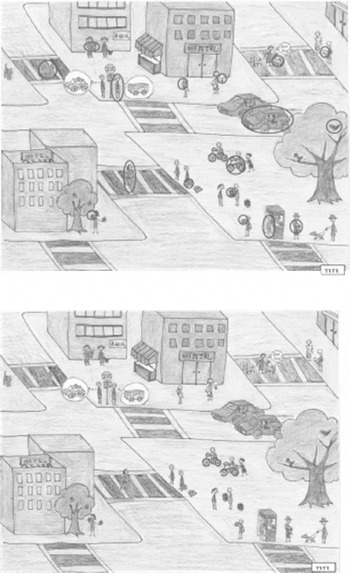
To elicit RC production for the pretest and posttest, a draw circles task was designed. Although the focus of the task was to elicit instances of DO (eight to nine instances), stimuli to elicit SU (two to three instances) and OBL (one to two instances) were also included. The original study (Jeon, 2004) focused on the accuracy of DO constructions. The NS researcher and the learner had similar pictures, but the researcher had a picture without circles drawn on it, whereas the learner had a picture with circles drawn on it (see the Appendix). The learner's task was to describe where the circle was drawn in response to the researcher's description of a certain part of the picture and a question about location of the circle. Three different versions of this task (i.e., pictures depicting a reception at a gallery, an elementary school, and a street scene) were used in random rotation to control for ordering effects.
Coding and Analysis
The elicited oral production was audio-recorded and transcribed orthographically using the morphophonemic Korean script Hangul. Prosody was marked in the transcript to identify phrase boundaries, repetitions, and repairs or, more importantly, to determine the intended utterance and unit of coding analysis. The length of a pause, noticeable vowel lengthening, and pitch change were noted on the basis of impression. A pause or vowel lengthening in the last or penultimate syllable of a word or phrase was interpreted as meaning that the speaker was searching for the ensuing utterance or revisiting what had just been said. Therefore, when the same expression appeared after a pause or vowel lengthening, it was regarded as repetition or self-repair and only the second attempted utterance was included in the analysis. For example, in (6), the first phrase is followed by a long pause, and the second phrase is followed by a shorter pause. Because the second phrase, ku sakwa “that apple,” is rephrased after the pause, it was considered to be abandoned and the repaired part was determined to be the intended speech.

The transcripts were converted to the CHAT transcription and coding format in the CHILDES system (MacWhinney, 1995), and RCs were identified using the protocol described previously. Clauses were then coded for gap status, head and gap marking, and accuracy of the modifying clause, such as adnominal verbal suffixing, argument marking, and case marking.
The elicitation material and procedure established almost an identical matrix sentence pattern—namely “The circle is on ________.” Therefore, there was very little variation of the status of the head noun in the matrix clause, which usually occurred in the locative. The gap status was determined by what was actually produced by the speaker, and if that was ambiguous—the case for most head-internal constructions because the matrix sentence was not giving enough clues—the intended gap was determined based on the information in the elicitation material. For example, in (7), which contains a head-internal construction without kes, the syntactic position of the relativized element could not be identified by the linguistic cues alone but by the contextual cue that, in the picture the speaker was holding, the circle was on the newspaper, not on the woman. This was thus coded as an instance of object relativization.

There were cases of oblique relativization as well as subject and object relativization, as illustrated in (8):

To examine developmental patterns more comprehensively and precisely, not only realized relative constructions but also unrealized contexts were analyzed. For example, alternative expressions such as a single noun (e.g., “man”) or a simple clause (e.g., “man is waiting for a bus”) in place of the referring expression expected in the context (i.e., “the man who is waiting for a bus”) were included and coded as failure or circumlocution.
Head and gap marking included a range of developmental forms that were observed in the L1 Korean acquisition studies (Cho, 1999; Y. Kim, 1987; K. Lee, 1991). Nine coding categories were employed: failure, circumlocution, headless clause without kes, headless clause with kes, head-internal construction without kes, head-internal construction with kes, head-external construction with kes, head-external construction with a resumptive noun, and target head-external RC.
The categories labeled failure and circumlocution were used when participants did not use a RC. A response was coded as failure when the speaker did not succeed in identifying the intended referent at all. A response was coded as circulmocution when the speaker used other constructions such as adjective, possessive, or locative expressions or simple sentences to describe the intended referent.
Another category was for headless clauses with or without kes. When the head of the modifying clause was not explicitly marked, it was coded as headless. Headless modifying clauses might occur with or without kes, as illustrated in (9) and (10). The headless RC with kes is acceptable in many contexts, whereas it is ungrammatical without kes.

The possibility that ce “that” was used as a head noun and thus that the construction in (10) was an instance of a postnominal head-external RC was excluded because the learner frequently used ce “that” as a filler along with e “uh.”
Head-internal construction with or without kes was another coding category. If the relativized head was placed inside the modifying clause, it was coded as head-internal. Some occurred without kes, as shown in (11), and some with kes, as illustrated in (12).

Head-external constructions incorrectly marked with kes made up another coding category. When the head was positioned outside of the modifying clause, it was coded as head-external. Even though the modifying clause should not be marked by kes, such marking occurred in our learner data. Unlike the L1 children who juxtaposed kes and the head lexical noun after the modifying clause (Y. Kim, 1987; K. Lee, 1991), some of our L2 learners placed the lexical head noun to the left of the modifying clause and kes, as in (13).

Finally, head-external construction with a resumptive noun made up the final coding category. This category refers to the case in which learners leave a copy of the head noun in a head-external RC construction, as in (14).

As one anonymous reviewer noted, there is a possibility that this is a hybrid pattern that consists of a blend of the head-internal and head-external patterns.
In addition to these coding categories, actual relative constructions were coded for the accuracy of the modifying clause. We examined only the grammatical features of the RCs that are relevant to relativization, ignoring lexical errors (e.g., yeca-ka *ip-nun kapang “the bag that the woman wears”), errors in allomorphic variations (e.g., salam-*ka pha-nun ice cream “the ice cream that the person sells”), and errors of epenthesis (e.g., sinmwun ilk-*u-nun yeca “the newspaper that the woman reads”). The coding categories for morphosyntactic accuracy of the modifying clause included (a) verb inflection error, (b) tense error, (c) argument omission, and (d) case marker error or omission.
The verb inflection error category involved the use of a nonadnominal verbal suffix in the prenominal position. As illustrated in (15), there were instances in which learners used the verbal suffix/complementizer -ko in place of -nun or -un.

A response was coded as tense error when the adnominal verbal suffix, which indicates relativization, was used in an inaccurate tense. In (16), for instance, the speaker used the past -un, which should be marked as the present tense -nun.

A response was coded as argument omission when an argument other than the relativized element was missing from the modifying clause. As shown in (17) and (18), the object was frequently missing from the SU RC, whereas the subject was frequently missing from the DO RC. Although argument omission is possible in Korean, it is often not acceptable in noun-modifying clauses.

Case marker error or omission was also observed and coded when an incorrect case marker was used in the RC or a case marker was not used at all. In (19), the subject case marker should have been used instead of the topic marker, and, in (20), subject case marking, which is required, was omitted.

The RCs were coded as accurate if none of these errors was committed.
Grouping and Tallying of the Coded Data
As mentioned previously, oral production data from 40 learners who took the pretest were analyzed for a cross-sectional analysis. To examine possible developmental changes, data from 14 learners who took the posttest 2 weeks after the treatment on DO were also analyzed. The first part of the analysis was conducted with the pretest data from 40 learners. These learners were divided into four proficiency groups. The proficiency groupings were determined based on the four different pretest scores from the larger study: accuracy scores of (a) object RC production, (b) honorific subject-verb agreement, and (c) two vocabulary tests. The group average and standard deviation of the individual sums of scores were calculated to divide the participants into four groups. Group 1 consisted of those who scored less than one standard deviation below the average, group 2 scored less than a half standard deviation below the average, group 3 scored more than a half standard deviation above the average, and group 4 scored more than one standard deviation above the average. As a result, group 1 had 12 students, group 2 had 8 students, group 3 had 8 students, and group 4 had 12 students.
The second part of the analysis included the data from 14 learners who took the delayed posttest. Frequency counts of the coding categories of gap type, head and gap marking, and the accuracy of the modifying clause were performed using the CLAN program in the CHILDES system (MacWhinney, 1995).
RESULTS
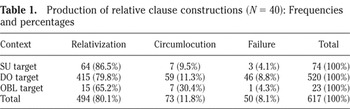
All of the attempted targeted RC contexts were initially identified and then it was determined whether learners actually produced any kind of relativization. Table 1 summarizes the frequencies and percentages of learners' attempts to produce RC constructions. There were a total of 617 RC production targets and there were a total of 494 learner attempts to produce a RC (80.1%). Overall, learners' attempts to produce RCs were proportionally higher in SU contexts (86.5%) than in DO (79.8%) and OBL contexts (65.2%).
Production of relative clause constructions (N = 40): Frequencies and percentages

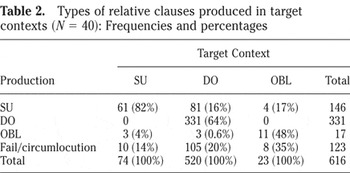
Table 2 summarizes the number of tokens for SU, DO, and OBL productions in different target contexts. As illustrated in Table 2, there were 146 tokens of SU, 331 tokens of DO, and 11 tokens of OBL productions. As expected, DO was the most frequent, as it was the target of the experiment. Interestingly, there were as many as 146 tokens of SU despite the fact that the testing material was designed to elicit DO. Of these 146 tokens of SU, 61 tokens occurred where SU was expected, whereas 81 tokens were produced where DO was targeted.
Types of relative clauses produced in target contexts (N = 40): Frequencies and percentages

In order to use the SU construction instead of targeted DO, the participants placed the object argument in different syntactic positions. The object argument was in the possessive construction (21), in the ergative construction that placed the patient or theme of the verb into subject position (22), or in the locative-existential construction (23).

SU substitutions for DO often failed to identify referents, referring to a related animate entity instead of the target inanimate entity. For example, in (24), the learner stated that the circle in the picture was on the woman who is reading the newspaper when in fact it was drawn around the newspaper she is reading.

It is possible that this kind of error was committed because the learner was more comfortable with SU relativization. Another possibility is that the learner had a preference for an animate referent as head for SU relatives, as illustrated previously in (21) and (24). In (24), this preference even overrode the visual cue that pointed to an inanimate referent.
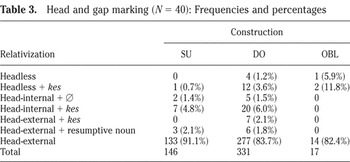
Table 3 shows the frequencies and percentages of the coding categories that represent different kinds of syntactic constructions produced by the learners for each gap type. Note that the sums of the tokens of each gap type are smaller than the K values in Table 1 because failures to relativize and circumlocutions were excluded from this analysis. The SU RCs were used most successfully, with the highest percentage of correct head-external RCs (91.1%), followed by DO clauses (83.7%), and then by OBL clauses (82.4%). Conversely, headless RCs (headless and headless + kes) constituted the highest proportion of OBL clauses and the lowest proportion of SU clauses. Head-internal RCs (head-internal + Ø and head-internal + kes) were used slightly more for DO RCs than for SU RCs.
Head and gap marking (N = 40): Frequencies and percentages

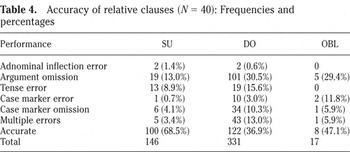
Table 4 shows the accuracy of RC production in different gap conditions. The SU RCs were the most accurate: 68.5% of SU RCs were without errors, whereas 36.9% of DO clauses and 47.1% of OBL clauses were without errors. Argument omission was very frequent in all three conditions, with 13% of the arguments omitted in the SU condition, 30.5% omitted in the DO condition, and 29.4% omitted in the OBL condition. This might suggest that the omission process is overused to shorten and therefore simplify the more difficult patterns (i.e., for DO and OBL). Tense errors, such as use of -(u)n for -nun or vice versa, were more frequent for SU and DO RCs than for case marker errors. Case marker omission, however, occurred very frequently in DO conditions and to a lesser extent in SU conditions.
Accuracy of relative clauses (N = 40): Frequencies and percentages

To ascertain why argument omission errors occur much more frequently in DO and OBL conditions than in the SU condition, the data were examined to determine whether the SU condition was less prone to the process simply because there was no other argument. Logically, omission of a nonhead argument is not possible in the single-argument RC. Of the 146 tokens of SU constructions, only 25 (17%) were single-argument clauses, whereas 121 (83%) were two-argument clauses that required subject and object or subject and locative. In the two-argument SU RCs, argument omission occurred only 16.5% of the time. In comparison, of the 331 tokens in the DO condition, 293 (89%) were two-argument clauses that required subject and object, and 36 (11%) were three-argument clauses that consisted of subject, object, and dative object. In the two-argument DO RCs, the subject was omitted 36.9% of the time. In the three-argument DO RCs, argument omission was more frequent, occurring in 47.2% of all instances. If we just compare two-argument SU and DO RCs, the omission was much more frequent in the DO relative (36.9%) than in the SU relative (16.5%). This suggests that gap type, rather than the number of arguments, is responsible for the different argument omission rates, which might indicate that the DO RC is more cognitively demanding than SU.
To recapitulate, in the aggregate pretest data of 40 participants, the L2 learners in this study seemed most comfortable with SU RCs in terms of (a) frequency of relativization attempts, (b) head and gap marking, and (c) syntactic and morphological accuracy of the RC. There was also some indication that DO RCs were easier than OBL RCs based on the frequency of relativization attempts and head and gap marking. However, due to the small number of tokens in the OBL condition, it would be premature to make any substantial claims at this point.
Cross-Sectional Analysis of the Pretest Data
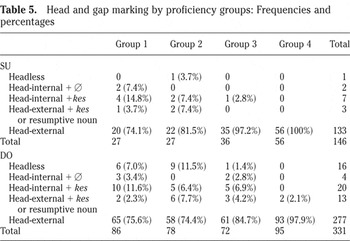
As described previously, the participants were divided into four proficiency groups for cross-sectional analysis. OBL RCs were not included because of the small number of tokens. Table 5 shows that higher proficiency groups used head-external relativization much more frequently than lower proficiency groups. Group 4 used head-external RCs almost exclusively, and group 3 showed the next highest percentages of head-external RC usage. With respect to groups 2 and 1, group 1 used more head-external RCs than group 2. However, if we consider these two lower groups together, there seems to be a correlation between the proficiency and the frequency of head-external RCs. Within each proficiency group, headless constructions were more frequent for DO than for SU (7.0 % vs. 0% in group 1; 11.5% vs. 3.7% in group 2; 1.4% vs. 0% in group 3), with the exception of group 4, whose members never used headless forms.
Head and gap marking by proficiency groups: Frequencies and percentages

As shown in Table 5, the patterns indicate that the learners used more head-external relatives for SU constructions than DO constructions. A developmental pattern of head and gap marking is also detectable in the sequence of headless > zero head-internal > head-internal + kes as well as in the sequence of head-external + resumptive noun or kes > head-external. In group 4, only head-external relatives were used for SU, whereas head-external + resumptive noun was used for DO. In group 3, head-internal + kes and head-external RCs were used for the SU relative, whereas a wider range of forms, including not only the aforementioned forms but also zero head-internal and headless forms, was used for DO relatives. In group 2, the same range of forms was used for both SU and DO, whereas in group 1, headless forms were not used for SU constructions but were used for DO constructions. In the developmental sequence from headless to head-external constructions, head-internal constructions occupy an intermediary place, providing transitional steps for some learners. At the same time, the learners seemed to be at different phases in this developmental sequence with regard to SU and DO RCs; that is, the learners showed the ability to use more advanced forms for the SU relative, suggesting that movement along the suggested developmental sequence happens faster for SU constructions.
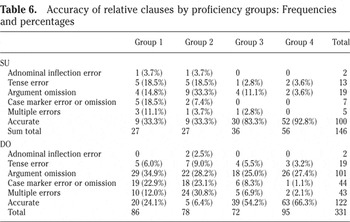
The group data were also examined to determine the grammatical accuracy of the modifying clauses (i.e., verbal morphology, case marking, and argument provision). As Table 6 shows, the morphosyntactic accuracy of RCs was higher for the higher proficiency groups. The RCs produced by group 4 participants were clearly more accurate than those of group 3, which, in turn, were more accurate than those of groups 2 and 1. Group 2, however, showed a lower accuracy rate than group 1, showing a reversal similar to that observed in Table 6. This is likely due to the lack of sensitivity of pretest measures for distinguishing between these two lower proficiency groups. If we treat groups 1 and 2 as a combined group, however, it is rather clear that the higher the proficiency, the more accurate the RCs. If accuracy increases with proficiency, however, it does not apply to both SU and DO relatives to the same extent. At each proficiency level, the accuracy of SU constructions exceeded that of DO constructions: 33% versus 24% in group 1, 33% versus 6% in group 2, 83% versus 54% in group 3, and 93% versus 66% in group 4. Moreover, multiple errors were more likely to be committed in DO than SU constructions. Lower accuracy in DO constructions was likely due to the difficulty associated with DO constructions, and it converges with the previous observation that head-gap marking was harder for DO relatives.
Accuracy of relative clauses by proficiency groups: Frequencies and percentages

Analyses of Posttest Data
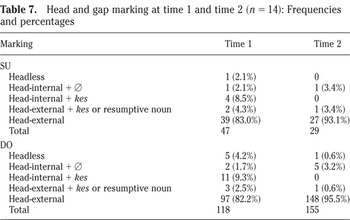
As described previously, subsequent data were collected from 14 participants who took the posttest 2 weeks after the instructional treatment. As shown in Table 7, a comparison of time 1 (pretest) and time 2 (posttest 2) showed that the learners used a higher percentage of head-external constructions at time 2, whereas headless constructions almost disappeared. Uses of head-internal + kes decreased to none, although the use of ungrammatical head-internal construction without kes increased slightly. This puzzling increase was found to be caused by two individual learners: one who stepped up from circumlocutions at time 1 to head-internal relativization at time 2, and another student who regressed from head-internal + kes and head-external + kes to head-internal without kes. On the other hand, six of the seven participants who produced head-internal + kes made a complete transition to targetlike head-external constructions.
Head and gap marking at time 1 and time 2 (n = 14): Frequencies and percentages

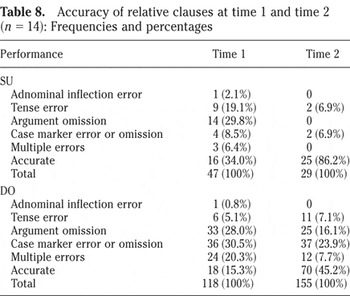
The morphosyntactic accuracy of RCs produced in L2 Korean also increased for both SU and DO relativizations, although the progress was much more remarkable for SU relativization, as shown in Table 8. Argument omission in the modifying clause was not observed at all in the SU RCs at time 2, and the accuracy reached 86%. In comparison, accuracy of DO relativization at time 2 did not exceed 45%, suggesting that DO relativization was still harder for the learners at time 2.
Accuracy of relative clauses at time 1 and time 2 (n = 14): Frequencies and percentages

DISCUSSION AND CONCLUSIONS
The first research question asked whether L2 learners of Korean acquire head-internal and head-external relativizations in the order predicted by the NPAH. The current study demonstrated that SU was favored over DO overall. In the pooled pretest data produced by 40 learners, learners were more likely to use relative constructions in SU target contexts (86.5%) than in DO target contexts (79.8%). Head-internal constructions with kes were used slightly more frequently for DO (6.0%) than SU (4.8%). In contrast, head-external RCs were more frequent for SU (91.1%) than DO (83.7%), and learners produced SU more accurately than DO (68.5% vs. 36.9%). In the cross-sectional analysis comparing proficiency groups, the use of head-external RCs was higher for SU than DO in all groups when the two lower groups were combined. In tandem, head-external RCs increased with increasing proficiency for both SU and DO, with the DO condition increasing similarly to the SU condition, but to a lesser extent. With respect to the change over the 2-week period after the treatment, as observed in the subset of 14 learners, there was little difference in the frequency of head-external constructions between SU and DO conditions at time 1 (83.0% vs. 82.2%), and it was slightly higher for DO at time 2 after focused instruction on object relativization (93.1% vs. 95.5%). However, the accuracy of SU was much higher than DO at both times (34.0% vs. 15.3% at time 1 and 86.2% vs. 45.2% at time 2).
These indications of SU advantage in head-external relativization, however, cannot be attributed solely to the NPAH or interpreted as evidence pointing to Korean external RCs as so-called real RCs. As discussed in the introduction, it is possible that the animacy of the head noun and other involved arguments impact the production of SU, DO, and OBL RCs. Previous studies (e.g., Kanno, this issue; Mak et al., 2002; Ozeki & Shirai, this issue) suggested that learners' use of different types of RCs might be based on the animacy of the head noun. A post hoc analysis was carried out to explore the possibility that SU relatives were easier than DO relatives due to the animacy of their head nouns. The head of 91% of SU relatives was animate and 9% was inanimate. On the other hand, the head of 89% of DO relatives was inanimate and 11% was animate. All of the two-argument relative tokens, except two cases of animal-human combination, involved the pairing of animate with animate or inanimate with inanimate. Although it is not entirely categorical, this shows a clear binary association of SU with an animate head, on the one hand, and DO with an inanimate head on the other. Another interesting trend was that only 7 out of 81 SU RCs produced in the DO target context had inanimate heads. If this reflects the learners' grammar of relativization at all, it is possible that SU is easier not for structural reasons but because of the semantic saliency of animacy. However, the pattern found in our data could be a function of the experimental material we used to elicit RCs. A majority of targeted object relatives were intended to refer to inanimate entities as the head, whereas a small proportion referred to animals. Also, when the learners ignored the experimental design to induce object relativization of a number of inanimate referents and produced SU relatives instead, it was possibly due to the ease of SU relativization as well as a preference for an animate head.
The previous experimental study on L2 Korean (O'Grady et al., 2003) that demonstrated subject-object asymmetry had only one semantically reversible animacy condition: All of the heads as well as other arguments in the RC were animate. Therefore, the learners' success with SU interpretation was not due to typical matching of subject-agent-animate and object-patient-inanimate but due to a structure-based interpretation of the head-gap relationship. Also, Cho's (1999) experiments with L1 Korean included the production of SU and OBL relatives in which both arguments were inanimate, and the results showed that SU relatives were much easier. Therefore, whereas our data alone do not support the NPAH independent of animacy effects, these studies suggest that the development of head-external RCs in Korean follows the NPAH regardless of animacy.
The second research question asked whether L2 learners of Korean use head-internal RCs before head-external constructions, as did L1 Korean children. The current analysis showed a developmental trend: headless > head-internal > head-external RCs. In the pretest data, 45% of learners used headless and head-internal relatives, although tokens of headless and head-internal constructions were few. In the cross-sectional analysis, groups 1 and 2 used headless and head-internal relatives more frequently than group 3 (7.3% vs. 0.9% and 8.2% vs. 7.4%, respectively, when SU and DO are combined), whereas there was not a single occurrence of headless or head-internal relatives in group 4. In the data of 14 learners collected at two different times, 9 used headless and head-internal relatives at time 1, and 7 of those did not use any at time 2, after instructional intervention.
An explanation for this developmental sequence can be found in both discourse-pragmatic constraints and inherent syntactic complexity. The headless RCs result from the deletion of the argument, which is a discursively salient referent and can be dispensed with when the speaker is under duress. The head-internal RC does not involve the extraction of the lexical head to the rightmost position, but, rather, it only requires verb inflection and the addition of the complementizer kes. This would be easier for learners, particularly if they were already familiar with the form, because the same form is also used as the nominal clause. If the identification of the head is determined by the subcategorization of the matrix verb and does not involve any other syntactic operation, there should be no difference in complexity between gap types either. This can explain why DO was more frequent than SU in the head-internal relatives produced in L1 Korean children's speech (Y. Kim, 1987; K. Lee, 1991). In contrast, the head-external relative requires extraction of the lexical head to the right of the RC, leaving a gap and creating a filler-gap dependency that adds burden to the language processor (Hawkins, 2004). Moreover, the prenominal relative is known to be more difficult than the postnominal relative because it is more difficult to process the gap before the filler (i.e., head noun) than vice versa; according to Hawkins, “if the gap comes first, it will be harder to recognize and there may be considerable backtracking when the filler is encountered” (p. 204). We suggest that this might motivate the existence of head-internal relatives in postnominal languages; head-internal RCs are typically found in languages with basic SOV word order (Keenan, 1985), and SOV word order with left-branching noun phrases has been observed to be a property of languages with head-internal RCs (Culy, 1990).
Compared to the L1 Korean data, however, head-internal relatives were less widespread and less frequent in our data even though many of our learners were considered to be at a high-beginner level. There were 12 children (out of 36) who only produced head-internal relatives but not head-external relatives in K. Lee's (1991) study, whereas our data did not include a single learner who exclusively used headless and head-internal relatives without using head-external relatives. Also, headless and head-internal relatives were dramatically reduced in the posttest data, although this was the desired effect of the focused instruction on head-external DO RCs in the original research design. We cannot know whether the limited presence of head-internal relatives is due to the lesser role they play in L2 development or because our data simply did not capture learners at earlier phases of development. We will have to leave this question to future investigations. For such an endeavor, it would be helpful to examine the distributions and constraints of head-internal relatives in corpus data and, particularly, in the kinds of input to which the learner is exposed.
Research question 3 asked whether head-internal RCs persist longer for relativization of the object than the subject. The developmental sequence of headless to head-internal to head-external relatives interacted with the NPAH, in that the earlier forms were more frequently used for DO relatives than SU relatives, whereas head-external forms were more frequent in the subject-gap condition. In the pretest data, headless relatives accounted for 0.7% of SU and 4.8% of DO constructions, whereas head-internal relatives accounted for 6% of SU and 7.5% of DO constructions. Of the 18 learners who used headless and head-internal relatives, seven used them for both SU and DO RCs, one used them only for SU RCs, and 10 used them only for DO RCs. This suggests that head-internal RCs persist longer for DO, until the full-fledged development of the head-external construction.
To conclude, although further investigation is needed, based on our data we put forward that DO constructions are more difficult than SU constructions in head-external RCs in Korean, whereas the asymmetry does not necessarily exist for the head-internal RCs. We attribute the difference to the head-external construction being a RC that involves a syntactic mechanism of coindexing the head and the gap relation despite the lack of a relative pronoun, compared to the head-internal construction, which can be characterized as an attributive clause that is less syntactically constrained. Thus, in the acquisition of Korean as a L2, head-external object relatives develop later than SU relatives, and during the process of development, headless and head-internal relatives perform the function of identifying referents.
APPENDIX A: SAMPLE TESTING MATERIAL: STREET SCENE

SAMPLE TESTING MATERIAL: STREET SCENE
APPENDIX B: TARGET RC CONSTRUCTIONS FOR “STREET SCENE” ACTIVITY
- Pesulul kitalinun namca. “The man who is waiting for a bus.” (SU)
- Nalko issnun say. “The bird that is flying.” (SU)
- Cenhwalul sayonghanun namca. “The man who is using the telephone.” (SU)
- Kilul kennenun yeca (kay). “The woman (dog) who is crossing the road.” (SU)
- Yecaka meknun sakwa. “The apple that a woman is eating.” (DO)
- Aika meknun aisukulim. “The ice cream that a child is eating.” (DO)
- Yecaka ilknun sinmwun. “The newspaper that a woman is reading.” (DO)
- Yecaka minun cacenke. “The bicycle that a woman is pushing.” (DO)
- Yecaka anko issnun kay. “The dog that a woman holds.” (DO)
- Yecaka wuncenhanun catongcha. “The car that a woman is driving.” (DO)
- Yecaka ttaylinun kay. “The dog that a woman is beating.” (DO)
- Namcaka ssuko issnun pyenci. “The letter that a man is writing.” (DO)
- Namcaka dulko issnun kabang. “The bag that a man is holding.” (DO)
- Namcaka yecahanthey cwunun senmwul. “The gift that a man is giving to a woman.” (DO)
- Namcaka mwullul masinun byeng. “The bottle that a man is drinking water from.” (OBL)