Childhood maltreatment is one of the most severe forms of stress exposure that can occur during development, and it is strongly associated with a broad range of negative mental health outcomes throughout the life course (Cicchetti, Reference Cicchetti, Cicchetti and Carlson1989; Cicchetti & Valentino, Reference Cicchetti, Valentino, Cicchetti and Cohen2006; Cohen, Brown, & Smaile, Reference Cohen, Brown and Smaile2001; Collishaw et al., Reference Collishaw, Pickles, Messer, Rutter, Shearer and Maughan2007; Kendler, Kuhn, & Prescott, Reference Kendler, Kuhn and Prescott2004; Putnam, Reference Putnam1997; Widom, Reference Widom1999; Widom, Dumont, & Cjaza, Reference Widom, DuMont and Czaja2007). Child maltreatment frequently disrupts the negotiation of stage-salient developmental tasks, including the formation of secure attachment to caregivers, development of an autonomous self, establishment of effective emotion regulation strategies, and maintenance of healthy peer relationships (Briere, Reference Briere1992; Cicchetti & Lynch, Reference Cicchetti, Lynch, Cicchetti and Cohen1995; Cicchetti & Valentino, Reference Cicchetti, Valentino, Cicchetti and Cohen2006; Lyons-Ruth & Spielman, Reference Lyons-Ruth and Spielman2004; Myers et al., Reference Myers, Berliner, Briere, Hendrix, Jenny and Reid2002; Trickett & McBride-Chang, Reference Trickett and McBride-Chang1995). Through probabilistic epigenetic processes, these psychological disruptions often have significant effects on physiological, homeostatic, and psychiatric functioning throughout development (Cicchetti & Toth, Reference Cicchetti and Toth2005; Cicchetti & Valentino, Reference Cicchetti, Valentino, Cicchetti and Cohen2006).
Child maltreatment is associated with earlier disorder onset, as well as greater persistence and impairment throughout adulthood (Edwards, Holden, Felitti, & Anda, Reference Edwards, Holden, Felitti and Anda2003; Green et al., Reference Green, McLaughlin, Berglund, Gruber, Sampson and Zaslavsky2010; McLaughlin et al., Reference McLaughlin, Green, Gruber, Sampson, Zaslavsky and Kessler2010a, Reference McLaughlin, Green, Gruber, Sampson, Zaslavsky and Kessler2010b). In particular, risk for depressive and dissociative symptoms has been consistently found in reference to childhood traumatic experiences (Cicchetti & Toth, Reference Cicchetti and Toth1998; Macfie, Cicchetti, & Toth, Reference Macfie, Cicchetti and Toth2001b; Toth, Manly, & Cicchetti, Reference Toth, Manly and Cicchetti1992; Widom et al., Reference Widom, DuMont and Czaja2007). Researchers have theorized that unsuccessful resolution of stage-salient tasks during development may cause individuals to develop a depressotypic organization, characterized by dysregulated processes within cognitive, socioemotional, biological, and representational systems (Cicchetti, Rogosch, & Toth, Reference Cicchetti, Rogosch, Toth, Luthar, Burack, Cicchetti and Weisz1997; Cicchetti & Toth, Reference Cicchetti, Toth, Cicchetti and Cohen1995). Deficits stemming from maltreatment may interact across these domains in a transactional manner throughout development to potentiate depressive symptoms. Dissociative symptoms can also be explained through failed attainment of stage-salient tasks, particularly those related to attachment security and self-system development (Macfie et al., Reference Macfie, Cicchetti and Toth2001b; Putnam, Reference Putnam1997). Inability to attain secure attachment to caregivers during infancy due to harsh, inconsistent, and/or insensitive parenting may lead to disjointed representational models of the self in relation to others (Sroufe & Fleeson, Reference Sroufe, Fleeson, Hartup and Rubin1986; Macfie, Cicchetti, & Toth, Reference Macfie, Cicchetti and Toth2001a). Reciprocal interactions among these self-system dysfunctions and difficulties within cognitive and perceptual domains often lead to increased risk for dissociative experiences (Cicchetti & Toth, Reference Cicchetti, Toth, Cicchetti and Cohen1995; Ludwig, Reference Ludwig1983; van der Kolk, ver der Hart, & Marmar, Reference van der Kolk, van der Hart, Marmar, van der Kolk, McFarlane and Weisaeth1996).
Research using latent modeling approaches has found that child maltreatment may induce an overall vulnerability toward internalizing or externalizing symptoms rather than a risk for a specific psychiatric illness. This underlying internalizing or externalizing organization was found to fully mediate associations between childhood trauma and psychiatric disorders (Keyes et al., Reference Keyes, Eaton, Krueger, McLaughlin, Wall and Grant2012). Therefore, research that is focused on clarifying the core liabilities associated with adverse developmental sequelae may be more informative than identifying outcomes at the disorder level. One current challenge within the field is to better understand the ways in which genetic and neurobiological processes interact with the psychological effects of maltreatment to promote overall psychiatric vulnerability (Cicchetti & Toth, Reference Cicchetti and Toth2005). More extensive investigation into the mediators and moderators of these associations may clarify differential pathways leading to resilient as compared to maladaptive outcomes (Cicchetti, Reference Cicchetti2010).
One mechanism by which childhood maltreatment may impact the development of depressive and dissociative outcomes is through its effects on the limbic system. Chronic adversity early in life is associated with a “cascade” of negative consequences for stress sensitivity and responsiveness, as well as limbic system development and functioning (Cicchetti & Tucker, Reference Cicchetti and Tucker1994; Heim et al., Reference Heim, Newport, Heit, Graham, Wilcox and Bonsall2000; Heim, Newport, Bonsall, Miller, & Nemeroff, Reference Heim, Newport, Bonsall, Miller and Nemeroff2001; Lupien, McEwen, Gunnar, & Heim, Reference Lupien, McEwen, Gunnar and Heim2009; Teicher, Andersen, Polcari, Anderson, & Navalta, Reference Teicher, Andersen, Polcari, Anderson and Navalta2002; Teicher et al., Reference Teicher, Andersen, Polcari, Anderson, Navalta and Kim2003). Although activation of stress-responsive systems may initially lead to adaptive changes and contribute to survival, chronic stress exposure during childhood may derail functioning during sensitive periods, thereby contributing to the development of allostatic overload (Teicher et al., Reference Teicher, Andersen, Polcari, Anderson, Navalta and Kim2003). Under these circumstances, prolonged and repeated stress exposure may result in physiological dysregulation, leading to inefficient homeostatic functioning (McEwen, Reference McEwen1998; McEwen & Stellar, Reference McEwen and Stellar1993; McEwen & Wingfield, Reference McEwen and Wingfield2003).
According to the cascade model (Teicher et al., Reference Teicher, Andersen, Polcari, Anderson and Navalta2002), neuroendocrine dysregulation may occur because of the effects of maltreatment on the hypothalamic–pituitary–adrenal (HPA) axis, sympathetic nervous system, and functioning of peptide hormones. Chronic stress exposure is associated with attenuated development of GABA-A, noradrenergic, and glucocorticoid receptors (GRs), leading to changes in feedback loops and resulting in dysregulated release of corticosteroids and noradrenergic hormones in response to stress (Caldji, Francis, Sharma, Plotsky, & Meaney, Reference Caldji, Francis, Sharma, Plotsky and Meaney2000; Caldji et al., Reference Caldji, Tannenbaum, Sharma, Francis, Plotsky and Meaney1998; Liu et al., Reference Liu, Diorio, Tannenbaum, Caldji, Francis and Freedman1997). These alterations may result in significant health consequences and stress-related psychopathology throughout the life course (Evans, Reference Evans2003; Heim & Nemeroff; Reference Heim and Nemeroff2001; Lupien et al., Reference Lupien, Ouellet-Morin, Hupbach, Tu, Buss, Walker, Cicchetti and Cohen2006; Simeon et al., Reference Simeon, Knutelska, Yehuda, Putnam, Schmeidler and Smith2007).
The cascade model is consistent with a developmental psychopathology framework in elucidating the ways by which reciprocal influences within biological and environmental contexts may influence development (Cicchetti & Valentino, Reference Cicchetti, Valentino, Cicchetti and Cohen2006; Teicher et al., Reference Teicher, Andersen, Polcari, Anderson and Navalta2002). Genetic, neurobiological, experiential, and contextual factors may interact collectively to promote adaptive and maladaptive developmental outcomes (Cicchetti & Tucker, Reference Cicchetti and Tucker1994). In understanding the consequences of child maltreatment, developmental considerations such as the timing, chronicity, and severity of stress exposure must be taken into account. Limbic regions of the brain are particularly susceptible to the effects of chronic stress during critical periods of development because of their high density of GRs (Sanchez, Young, Plotsky, & Insel, Reference Sanchez, Young, Plotsky and Insel2000). Delayed development and varied sensitivity based on developmental stage may render these regions additionally vulnerable to the consequences of child maltreatment. For instance, projections to the prefrontal cortex remain unmyelinated until adolescence, and hippocampal gray matter overproduction occurs during discrete periods in early and middle childhood (Crews, He, & Hodge, Reference Crews, He and Hodge2007; Gogtay et al., Reference Gogtay, Nugent, Herman, Ordonez, Greenstein and Hayashi2006; Spear, Reference Spear2000). Preclinical research suggests that repeated exposure to stress hormones during development negatively affects neuronal migration, myelination, and neurogenesis, resulting in reduced dendritic spines, gray matter, and white matter connectivity in affected brain regions (Andersen & Teicher, Reference Andersen and Teicher2004; Meaney, Stewart, & Beatty, Reference Meaney, Stewart and Beatty1981; Schapiro, Reference Schapiro, Sterman and McGinty1971). Therefore, child maltreatment may lead to neurotoxic effects within limbic regions during sensitive periods of development.
Prolonged, stress-induced stimulation of limbic system areas during development may also cause kindling, which is indicated by seizurelike neuronal activity and changes in the excitability and behavior of affected neurons (van der Kolk & Greenberg, Reference van der Kolk, Greenberg and van der Kolk1987; Post, Reference Post1992; Teicher et al., Reference Teicher, Andersen, Polcari, Anderson and Navalta2002). Symptoms of limbic irritability are believed to be manifestations of kindling effects within limbic system regions (Teicher et al., Reference Teicher, Andersen, Polcari, Anderson and Navalta2002). Limbic irritability symptoms include somatic and perceptual distortions, brief hallucinatory events, motor automatisms, and dissociative symptoms and are analogous to symptoms that are seen in patients with temporal lobe epilepsy (TLE; Teicher, Glod, Surrey, & Swett, Reference Teicher, Glod, Surrey and Swett1993). Elevated symptoms of limbic irritability are strongly associated with childhood traumatic stress, as well as structural and functional alterations within corticolimbic regions (Anderson, Teicher, Polcari, & Renshaw, Reference Anderson, Teicher, Polcari and Renshaw2002; Choi, Jeong, Rohan, Polcari, & Teicher, Reference Choi, Jeong, Rohan, Polcari and Teicher2009; Teicher, Samson, Polcari, & McGreenery, Reference Teicher, Samson, Polcari and McGreenery2006; Teicher, Samson, Sheu, Polcari, & McGreenery, Reference Teicher, Samson, Sheu, Polcari and McGreenery2010). Investigations have found attenuated development within the medial prefrontal cortex, medial frontal gyrus, anterior cingulate gyrus, hippocampus, and corpus callosum in individuals who experienced maltreatment during childhood (Andersen et al., Reference Andersen, Tomada, Vincow, Valente, Polcari and Teicher2008; Bremner, Licinio, Darnell, Krystal, & Owens, Reference Bremner, Licinio, Darnell, Krystal and Owens1997; Choi, Jeong, Polcari, Rohan, & Teicher, Reference Choi, Jeong, Polcari, Rohan and Teicher2012; Green, Voeller, Gaines, & Kulsie, Reference Green, Voeller, Gaines and Kulsie1981; Stein, Reference Stein1997; Teicher et al., Reference Teicher, Dumont, Ito, Vaituzis, Gledd and Andersen2004; Tomoda, Navalta, Polcari, Sadato, & Teicher, Reference Tomoda, Navalta, Polcari, Sadato and Teicher2009). There is also evidence of functional impairments within limbic regions for individuals with histories of childhood maltreatment (Anderson et al., Reference Anderson, Teicher, Polcari and Renshaw2002; Ito, Teicher, Glod, & Ackerman, Reference Ito, Teicher, Glod and Ackerman1998; Ito et al., Reference Ito, Teicher, Glod, Harper, Magnus and Gelbard1993; Teicher et al., Reference Teicher, Ito, Glod, Anderson, Dumont and Ackerman1997). These findings highlight the potential neurotoxic effects of chronic stress on the developing brain. They also lend support to the hypothesis that glucocorticoids have organizational effects on the brain, leading to lasting changes that are evident in adulthood (Gilbertson et al., Reference Gilbertson, Shenton, Ciszewski, Kasai, Lasko and Orr2002; Lowy, Wittenberg, & Yamamoto, Reference Lowy, Wittenberg and Yamamoto1995; Lupien et al., Reference Lupien, McEwen, Gunnar and Heim2009; Seckl, Reference Seckl1998; Welberg & Seckl, Reference Welberg and Seckl2001).
Comparable dysfunctions within stress-responsive systems and impairments within corticolimbic regions have been found in individuals with depressive and dissociative symptoms (Fitzgerald, Laird, Maller, & Daskalakis, Reference Fitzgerald, Laird, Maller and Daskalakis2008; Nemeroff & Vale, Reference Nemeroff and Vale2005; Veltman et al., Reference Veltman, de Ruiter, Rombouts, Lazeron, Barkhof and van Dyck2005; Yehuda, Reference Yehuda2009). Volume reductions within the hippocampus and dorsolateral prefrontal cortex are associated with depression and posttraumatic stress disorder (PTSD; Amico et al., Reference Amico, Meisenzahl, Koutsouleris, Reiser, Moller and Frodl2011; Chen, Hamilton, & Gotlib, Reference Chen, Hamilton and Gotlib2010; Gilbertson et al., Reference Gilbertson, Shenton, Ciszewski, Kasai, Lasko and Orr2002; MacQueen & Frodl, Reference MacQueen and Frodl2010). Functional abnormalities within the medial prefrontal cortex, insula, and anterior cingulate cortex are consistent findings in PTSD. Evidence that these impairments are more pronounced for individuals who experienced childhood trauma lends support to the argument that these abnormalities may serve as risk factors for the development of depression and/or PTSD (Frodl et al., Reference Frodl, Reinhold, Koutsouleris, Donohoe, Bondy and Reiser2010; Gilbertson et al., Reference Gilbertson, Shenton, Ciszewski, Kasai, Lasko and Orr2002; Rao et al., Reference Rao, Betancourt, Giannetta, Brodsky, Korczykowski and Avants2010; Vythilingham et al., Reference Vythilingam, Heim, Newport, Miller, Anderson and Bronen2002). These findings collectively support the hypothesis that maltreatment confers psychiatric risk during sensitive periods of development through its effects on the limbic system.
Consistent with a transactional approach to development, the relationship between maltreatment and subsequent psychopathology is not always linear. Although evidence suggests that childhood adversity and trauma are related to limbic system dysfunction, individual differences in developmental pathways and resilience underscore the potential role of genetic factors (Caspi et al., Reference Caspi, Sugden, Moffitt, Taylor, Craig and Harrington2003; Gillespie, Phifer, Bradley, & Ressler, Reference Gillespie, Phifer, Bradley and Ressler2009; Koenen et al., Reference Koenen, Saxe, Purcell, Smoller, Bartholomew and Miller2005). In recent years, there has been a growing emphasis on the importance of gene–environment interactions in contributing to psychopathology in the context of maltreatment (Aslund et al., Reference Aslund, Leppert, Comasco, Nordquist, Oreland and Nilsson2009; Caspi et al., Reference Caspi, McClay, Moffitt, Martin, Craig and Taylor2002; Cicchetti, Rogosch, & Oshri, Reference Cicchetti, Rogosch and Oshri2011; Cicchetti, Rogosch, & Sturge-Apple, Reference Cicchetti, Rogosch and Sturge-Apple2010; Cicchetti, Rogosch, & Thibodeau, Reference Cicchetti, Rogosch and Thibodeau2012; Gillespie et al., Reference Gillespie, Phifer, Bradley and Ressler2009; Karg, Burmeister, Shedden, & Sen, Reference Karg, Burmeister, Shedden and Sen2011; Kim-Cohen et al., Reference Kim-Cohen, Caspi, Taylor, Williams, Newcombe and Craig2006; Rutter, Moffitt, & Caspi, Reference Rutter, Moffitt and Caspi2006). In line with the tenets of developmental psychopathology, this research has emphasized the importance of a multiple levels of analysis approach to examining risk (Cicchetti & Toth, Reference Cicchetti and Toth2009; Cicchetti & Valentino, Reference Cicchetti, Valentino and Masten2007).
Genes that are implicated in the stress-response system have been popular targets for research examining the impact of child maltreatment on psychiatric functioning. The FK506 binding protein 5 (FKBP5) gene is involved in regulating the sensitivity and binding affinity of the GR and therefore has significant implications within the limbic system. FKBP5 is induced by cortisol and acts within a negative feedback loop to promote the transcription of stress-responsive target genes, leading to downstream release of ACTH and plasma cortisol (Davies, Ning, & Sanchez, Reference Davies, Ning and Sanchez2002; Vermeer, Hendriks-Stegeman, van der Burg, van Buul-Offers, & Jansen, Reference Vermeer, Hendriks-Stegeman, van der Burg, van Buul-Offers and Jansen2003). FKBP5 is located on chromosome 6p21 and contains a number of single nucleotide polymorphisms (SNPs) that are associated with differential ability for FKBP5 to be induced by cortisol and bind to the GR. Four of these SNPs (rs3800373, rs9296158, rs1360870, and rs9470080), spanning 103 kb of the FKBP5 gene, contain variants that are associated with functional differences at the GR. Genotypes containing minor “high-induction” alleles (C, A, T, T for rs3800373, rs9296158, rs1360870, and rs9470080, respectively) are associated with greater expression of FKBP5 and increased binding at the GR, whereas those composed of major “low-induction” alleles (A, G, C, C) are linked with weaker induction by cortisol and GR receptor binding (Binder et al., Reference Binder, Salyakina, Lichtner, Wochnik, Ising and Putz2004; Denny, Valentine, Reynolds, Smith, & Scammell, Reference Denny, Valentine, Reynolds, Smith and Scammel2000; Scammel, Denny, Valentine, & Smith, Reference Scammell, Denny, Valentine and Smith2001; Wochnik et al., Reference Wochnik, Ruegg, Abel, Schmidt, Holsboer and Rein2005).
Environmental stress is strongly related to differential functioning and regulation of FKBP5 at the GR level. Individuals homozygous for the minor alleles across rs1360870 and rs3800373 exhibited insufficient normalization of cortisol secretion following exposure to acute psychosocial stress (Ising et al., Reference Ising, Depping, Siebertz, Lucae, Unschuld and Kloiber2008). Under conditions of chronic stress, the minor alleles within these SNPs are associated not only with decreased efficiency within the stress-response system but also with increased risk for depression, PTSD, and other stress-related psychopathology (Appel et al., Reference Appel, Schwahn, Mahler, Schulz, Spitzer and Fenske2011; Binder et al., Reference Binder, Bradley, Liu, Epstein, Deveau and Mercer2008; Koenen et al., Reference Koenen, Saxe, Purcell, Smoller, Bartholomew and Miller2005; Sarapas et al., Reference Sarapas, Cai, Bierer, Golier, Galea and Ising2011; Segman et al., Reference Segman, Shefi, Goltser-Dubner, Friedman, Kaminski and Shalev2005). Given that one of the most common findings in both depression and PTSD is impaired signaling at the GR, FKBP5 may play a crucial role in the pathogenesis of these disorders (Gillespie et al., Reference Gillespie, Phifer, Bradley and Ressler2009; Koenen, Amstadter, & Nugent, Reference Koenen, Amstadter and Nugent2009; Mehta & Binder, Reference Mehta and Binder2012; Pariante & Lightman, Reference Pariante and Lightman2008; Pariante & Miller, Reference Pariante and Miller2001; Roy, Gorodetky, Yuan, Goldman, & Enoch, Reference Roy, Gorodetsky, Yuan, Goldman and Enoch2010; Skelton, Ressler, Norrholm, Jovanovic, & Bradley-Davino, Reference Skelton, Ressler, Norrholm, Jovanovic and Bradley-Davino2012; Xie et al., Reference Xie, Kianzler, Poling, Stein, Anton and Farrer2010). Though associations among maltreatment experiences, structural and functional abnormalities, and limbic irritability have been found, no studies to date have examined variation within FKBP5 in relation to limbic irritability and mental health outcomes.
The present investigation examined the associations among child maltreatment, FKBP5 haplotypic variation, limbic irritability, and symptoms of depression and dissociation within a high-risk sample of women exposed to a number of environmental and psychosocial stressors. The first aim was to examine whether limbic irritability mediated the relationship between maltreatment and psychiatric symptoms. We hypothesize that there will be a significant indirect effect of maltreatment on depressive and dissociative symptoms via elevations in limbic irritability symptoms. The second aim was to investigate whether haplotype across four FKBP5 SNPs (rs3800373, rs9296158, rs1360870, and rs9470080) moderated these indirect effects. We predict that there will be a significant conditional indirect effect based on haplotypic variation such that limbic irritability will mediate the relationship between maltreatment and symptom outcomes for individuals whose possess one or more copies of the minor allele haplotype (CATT), but that these associations will not be significant for individuals with zero CATT copies.
Method
Design and sample
The participants in this investigation consisted of 236 low-income women who were initially recruited as part of a larger study examining the impact of maltreatment on children's functioning. Each woman had a child who was enrolled in a research and recreational summer day camp designed for school-aged maltreated and nonmaltreated children. Mothers of maltreated children were recruited at random through a Department of Human Services (DHS) liaison, who examined Child Protective Services reports to identify children who had been maltreated. The DHS liaison explained the project to identified mothers, who gave informed consent for their contact information to be shared with project staff if they were interested in participating. Consent was also obtained from women to examine DHS records pertaining to the family and for their own participation in completing self-report measures and providing buccal cells for genotyping. Because maltreating families are primarily of low socioeconomic status (National Incidence Study; Sedlak et al., Reference Sedlak, Mettenburg, Basena, Petta, McPherson and Greene2010), demographically comparable mothers of nonmaltreated children were identified and recruited by the DHS liaison from a pool of families receiving Temporary Assistance for Needy Families. Families classified as nonmaltreating did not have any record of child protective services involvement. They were further interviewed to verify lack of maltreatment within their family (Cicchetti, Toth, & Manly, Reference Cicchetti, Toth and Manly2003).
Procedures
In this investigation, adult women were interviewed and administered self-report assessments by trained research assistants. These sessions were held either in research interview rooms or within the participant's home. Buccal cells also were collected from participants at this time (see DNA Collection, Extraction, and Genotyping Section).
Measures
Childhood Trauma Questionnaire—Short Form (CTQ-SF)
The CTQ-SF (Bernstein et al., Reference Bernstein, Stein, Newcomb, Walker, Pogge and Ahluvalia2003) is a 25-item self-report assessment that was used to measure women's accounts of their own childhood maltreatment. The CTQ-SF is the most widely used assessment to retrospectively measure childhood maltreatment. Participants are presented with statements reflecting childhood experiences that occurred before the age of 18, and are asked to rate items on a 5-point Likert scale ranging from 1 (never true) to 5 (very often true). The CTQ-SF measures experiences across five maltreatment domains (physical abuse, physical neglect, emotional abuse, emotional neglect, and sexual abuse). Due to high correlations among the five maltreatment subscales, scores on the CTQ-SF were summed, producing a continuous variable ranging from 25 to 125. The CTQ-SF demonstrates good convergent validity with other self-report and interview measures of child maltreatment and has moderately high internal consistency (α = 0.66–0.92) and test–retest reliability (α = 0.79–0.86; Bernstein et al., Reference Bernstein, Stein, Newcomb, Walker, Pogge and Ahluvalia2003; Bernstein & Fink, Reference Bernstein and Fink1994; Hyman, Garcia, Kemp, Mazure, & Sinha, Reference Hyman, Garcia, Kemp, Mazure and Sinha2005). Internal consistency among items in the current investigation was α = 0.84.
Limbic System Checklist—33 (LSCL-33)
The LSCL-33 (Teicher et al., Reference Teicher, Glod, Surrey and Swett1993) is a self-report measure containing 33 items that assess for lifetime symptoms of limbic irritability. The LSCL-33 was designed to assess for symptoms of TLE in individuals without seizure disorders in order to determine whether trauma may produce comparable symptoms to TLE. Item content includes paroxysmal somatic disturbances (e.g., numbness, flushing sensations), brief hallucinatory events (e.g., hearing a voice calling your name), visual disturbances (e.g., seeing patterns, flashing lights), automatisms (e.g., twitching, stuttering), and mneumonic disturbances (e.g., flashbacks, derealization). Each item is rated on a 4-point Likert-type scale ranging from 0 (never) to 3 (often) with respect to lifetime frequency. To account for any overlapping content between the LSCL-33 and the Dissociative Experiences Scale (DES), the seven items included within the mneumonic disturbances subscale were removed from the total LSCL-33 score, resulting in a total of 26 items. Items across scales were then summed, producing a continuous variable ranging from 0 to 78. The LSCL-33 has demonstrated high test–retest reliability and discriminates between individuals with and without TLE (Teicher et al., Reference Teicher, Glod, Surrey and Swett1993). In this investigation, internal consistency among items was α = 0.92.
DES
The second edition of the DES (Carlson & Putnam, Reference Carlson and Putnam1993) consists of 28 questions that assess the frequency of different dissociative experiences within clinical and normative populations. Each item is scored on a scale of 0% to 100%, referring to how often each dissociative event is experienced. Scores were averaged to provide a total score, adjusted for skipped items, and divided by 10 to produce a continuous variable ranging from 0 to 10. The DES has high internal consistency (α = 0.93) and convergent validity with other measures of dissociation (r = .67; Bernstein & Putnam, Reference Bernstein and Putnam1986; van IJzendoorn & Schuengel, Reference van IJzendoorn and Schuengel1996). In the current investigation internal consistency was α = 0.95.
Beck Depression Inventory (BDI-II)
The BDI-II (Beck, Steer, & Brown, Reference Beck, Steer and Brown1996) is a 21-item self-report assessment that is designed to measure current depressive symptoms. Each item is rated on a scale from 0 to 3 with possible scores ranging from 0 to 63. Total scores of 10–18 indicate mild depression, 19–29 suggest moderate symptoms, and 30 or more represent severe depression. The BDI-II is a widely used assessment of depressive symptoms and has high internal consistency (α = 0.90) and convergent validity with the Hamilton Depression Rating Scale (r = .93; Storch, Roberti, & Roth, Reference Storch, Roberti and Roth2004). Internal consistency in the present investigation was α = 0.88.
DNA collection, extraction, and genotyping
Trained research assistants obtained DNA samples from participants by collecting buccal cells using the Epicentre Catch-All Collection Swabs. If a genotype was undetermined after the first run, then it was repeated up to four times. If the null persisted, then the whole genome amplification reaction was repeated along with genotyping until a genotype was established. The call rate for these SNPs were as follows: rs3800373 = 99.4%, rs9296158 = 99.4%, rs1360780 = 99.4%, and rs9470080 = 98.4%. Any samples with one or more missing genotypes were excluded from analyses.
DNA was extracted and prepared for polymerase chain reaction amplification using the Epicentre BuccalAmp DNA Extraction Kit (Epicentre, Cat. No. BQ090155C). Genotyping was then performed using an established protocol described by Krämer et al. (Reference Krämer, Cunillera, Caàmara, Marco-Pallarés, Cucurell and Nager2007). SNP genotyping was conducted using Applied Biosystems Custom Taqman SNP Genotyping Assays. The products of these analyses were then analyzed using endpoint allelic discrimination. Genotypes were identified and sequenced with the Beckman–Coulter CEQ8000 semiautomated florescent sequencing system, which utilizes Fragment Analysis Application and associated software. All samples were genotyped twice for quality control. Human DNA from cell lines were purchased from Coriell Cell Repositories for each genotype and used as control samples using DTCS chemistry on an ABI 3130xl. These cell lines and a no-template control were run with study samples representing 9% of the total data output. Samples that were not able to be genotyped to a 95% or greater confidence level were repeated under the same procedures.
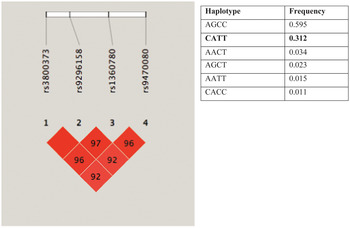
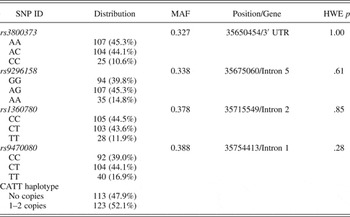
Table 1 presents the location of each SNP within chromosome 6 and the distribution of genotypes within the sample. Haploview software version 4.2 (Barrett, Fry, Maller, & Daly, Reference Barrett, Fry, Maller and Daly2005) was used to determine linkage disequilibrium (LD), Hardy–Weinberg equilibrium, and minor allele/haplotype frequencies within the sample. All four SNPs were in Hardy–Weinberg equilibrium (p ≥ .28, see Table 1), and analyses indicated statistically significant LD (D′ ≥ 0.92; see Figure 1). Over 90% of the sample was represented by either the AGCC or CATT haplotype (see Figure 1).
Linkage disequilibrium across FK506 binding protein 5 single nucleotide polymorphisms (FKBP5 SNPs) and haplotype frequencies within the sample. The FKBP5 haplotype block delineation across the four FKBP5 SNPs is shown on the left. The values within each square represent pairwise lineage disequilibrium (D′). Haplotype blocks were defined using the “solid spine” criteria D′ ≥ 0.80. The frequency of each haplotype is listed on the right, with the minor allele haplotype (CATT) highlighted in bold. [A color version of this Figure can be viewed online at http://journals.cambridge.org/dpp]

Description of FKBP5 SNPs and HWE analyses

Note: FKBP5 SNP, FK 506 binding protein 5 single nucleotide polymorphism; HWE, Hardy–Weinberg equilibrium; MAF, minor allele frequency.
Each participant was then assigned a haplotype using PHASE version 2.1 software, which employs a Bayesian approach to designate haplotypes based upon population data (Stephens & Scheet, Reference Stephens and Scheet2005; Stephens, Smith, & Donnelly, Reference Stephens, Smith and Donnelly2001). All samples were haplotyped with greater than 98% confidence, with the exception of one sample, which was subsequently excluded from analyses. Following haplotype assignment, individuals with one or more copies of the CATT haplotype were grouped together and compared to individuals with zero copies of this haplotype. This dichotomous variable was utilized in subsequent analyses to examine the joint effects of childhood maltreatment and FKBP5 haplotype variation on symptoms of limbic irritability.
Statistical analyses
Path analyses were conducted within a structural equation modeling framework using Mplus Version 6.11 statistical software (Muthén & Muthén, Reference Muthén and Muthén1998–2011; see Figure 1). In the first path analysis, the indirect effects of maltreatment on symptoms of depression and dissociation via limbic irritability were modeled. The total score on the CTQ-SF was entered as a predictor of the LSCL-33 total score, the BDI-II total score, and the average DES symptom score. The BDI-II and DES were entered into the model together as symptom outcomes. Limbic irritability was modeled as an endogenous variable mediating the relationship between maltreatment and the two symptom outcomes. These associations were tested using the product coefficient method, with estimates derived from bootstrapping procedures using 5000 sample replicates (Bollen & Stine, Reference Bollen and Stine1990; MacKinnon, Reference MacKinnon2008; Shrout & Bolger, Reference Shrout and Bolger2002). Race (Black/not Black), age, and total income were entered as covariates for all endogenous variables within the model for these and subsequent analyses.
Haplotype was then examined as a moderator of these indirect effects. The total score on the CTQ-SF, FKBP5 haplotype, and their product term were entered as predictors. Prior to creating a product term, scores on the CTQ-SF were first centered. Interactions were then computed. The total LSCL-33 score was entered as a mediating variable between CTQ-SF total score and symptom outcomes on the BDI-II and DES. Confidence intervals were bootstrapped using 10,000 samples to account for nonnormality. Model fit was determined using the root mean square error of approximation (RMSEA), χ2/df ratio, and the comparative fit index (CFI) as parameters. Adequate fitting models were those in which the RMSEA values were less or equal to 0.08, the χ2/df ratio values were between 1 and 3, and CFI values were greater or equal to 0.90. In the following analyses, the path analytic model was identified and was an excellent fit to the data, χ2 (236) = 204.821, p < .00001, RMSEA = 0.000, CFI = 1.00.
Results
Preliminary results
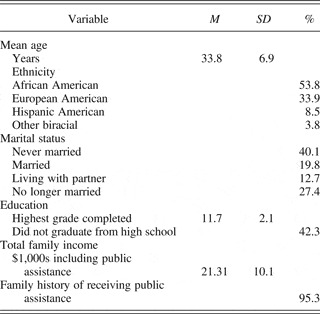
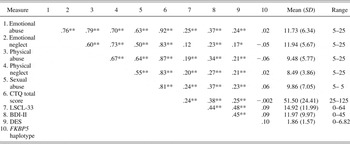
Demographic characteristics of the sample are presented in Table 2. Correlations among the observed variables are listed in Table 3. Seventy percent of participants (n = 166) in this sample surpassed previously established thresholds for severity within at least one subtype of child maltreatment, whereas 30% (n = 70) did not endorse experiencing significant maltreatment in childhood. Prior to running path analytic models, analyses of variance were conducted to examine whether level of limbic irritability, depressive, or dissociative symptoms differed significantly by haplotype. There were no significant effects of the CATT haplotype on symptoms of depression, F (1, 234) = 1.810, p > .05, dissociation, F (1, 234) = 2.600, p > .05, or limbic irritability, F (1, 234) = 1.999, p > .05. The relationship between haplotype and total score on the CTQ-SF also was not significant, F (1, 234) = 0.001, p > .05, indicating that maltreatment experience did not vary significantly as a function of CATT haplotype.
Demographic characteristics of sample

Correlation matrix for observed variables (N = 236)

Note: CTQ total score, Childhood Trauma Questionnaire total score (25–125); LSCL-33, Limbic System Checklist—33 total score; BDI-II, Beck Depression Inventory—II total score; DES, Dissociative Experiences Scale average score; FKBP5, FK 506 binding protein 5 haplotype coded as zero copies compared to one to two copies of the CATT haplotype.
*p < .05. **p < .01.
Effect of child maltreatment on depression and dissociation via limbic irritability
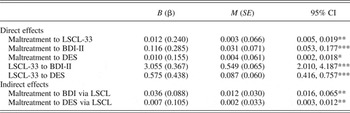
In the first set of analyses, indirect effects were modeled to determine whether limbic irritability mediated the relationship between maltreatment and symptoms of depression and dissociation. Table 4 presents the path coefficients and confidence intervals for the direct (path a: from maltreatment to limbic irritability; path b: from limbic irritability to depressive or dissociative symptoms; path c: from maltreatment to depressive or dissociative symptoms) and indirect paths (a–b path: from maltreatment to depressive or dissociative symptoms via limbic irritability). In reference to depression, results indicate that higher self-reported level of maltreatment was associated with significantly greater symptoms of limbic irritability (path a; β = 0.240, p = .001) and depression (path c; β = 0.285, p < .001). Greater limbic irritability also was related to higher symptoms of depression (path b; β = 0.367, p < .001). Further, there was a significant indirect effect of maltreatment on depressive symptoms occurring through limbic irritability (a–b path; β = 0.088, p < .01; R 2 = 0.289).
Standardized and unstandardized path coefficients for direct and indirect effects with bootstrapped confidence intervals
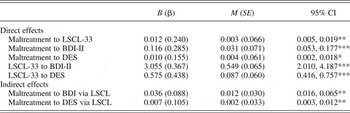
Note: SE, standard error of path coefficients; CI, confidence interval of unstandardized path coefficients; LSCL-33, Limbic System Checklist—33; BDI-II, Beck Depression Inventory—II; DES, Dissociative Experiences Scale.
*p < .05. **p < .01. ***p < .001.
Comparable results were found with respect to dissociative symptoms (see Table 4). Higher dissociative symptoms also were associated with increased symptoms of limbic irritability (path b; β = 0.438, p < .001) and greater symptoms of maltreatment (path c; β = 0.155, p < .05). In addition, the indirect effect of maltreatment on dissociative symptoms via limbic irritability was significant (a–b path; β = 0.105, p < .01; R 2 = 0.293). These results indicate significant indirect associations between maltreatment and depression as well as maltreatment and dissociation via limbic irritability.
Interactive effects of FKBP5 and child maltreatment on limbic irritability
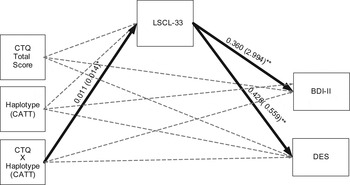
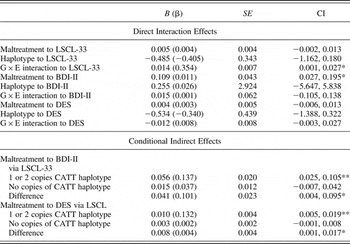
The second set of analyses examined the moderating effect of FKBP5 haplotype on the two established indirect effects. Specifically, we sought to examine whether variation within the CATT haplotype moderated the path from maltreatment to limbic irritability (path a) within the examined indirect-effects model. Paths were modeled from maltreatment, haplotype, and their interaction to symptoms of limbic irritability, depression, and dissociation (see Figure 2). The direct effects within this model are presented in Table 5. Consistent with preliminary analyses, the main effect of haplotype was not significantly associated with limbic irritability (β = –0.405, p > .05). After including haplotype and the interaction term in this model, the main effect of maltreatment on LSCL-33 (β = 0.004, p > .05) was no longer significant. However, the interaction between maltreatment and CATT haplotype was significantly related to symptoms of limbic irritability (β = 0.354, p < .05; Figure 2).
The path analysis model containing direct and indirect effects. CTQ, Childhood Trauma Questionnaire; haplotype coded as 1 or 2 copies CATT or no copies of CATT; CTQ × haplotype is the Gene v Environment interaction term; LSCL-33, Limbic System Checklist—33; BDI-II, Beck Depression Inventory—II; DES, Dissociative Experiences Scale. The solid arrows denote the effects of the interaction term on the mediator (LSCL-33) and outcome variables (BDI-II, DES). Standardized path coefficients (standard errors) are represented for these paths. **p < .01. ***p < .001.

Standardized and unstandardized path coefficients for direct interaction and conditional indirect effects

Note: SE, standard error of unstandardized path coefficients; CI, confidence interval of unstandardized path coefficients; LSCL-33, Limbic System Checklist—33; G × E, Gene × Environment interaction; BDI-II, Beck Depression Inventory—II; DES, Dissociative Experiences Scale.
*p < .05. **p < .01. ***p < .001.
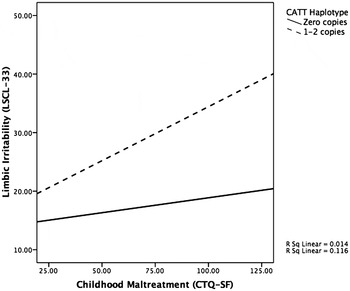
Simple slopes were conducted to clarify this interaction (see Figure 3). These analyses revealed a significant conditional indirect effect of CATT haplotype on the association among maltreatment, limbic irritability, and depression. The indirect path from maltreatment to depression through limbic irritability was significantly different for individuals with one or two copies of the CATT haplotype compared to individuals with no copies (β = 0.101, p < .05, Table 5). Specifically, this mediational path was significant for individuals with one or two CATT copies (β = 0.137, p = .005), whereas this path was not significant for individuals with no CATT copies (β = 0.037, p > .05). Therefore, variation within the FKBP5 haplotype moderated the indirect effect of maltreatment on depression via limbic irritability.
Simple slopes analyses showing the interaction effect of haplotype and child maltreatment on limbic irritability.

Moderation by the CATT haplotype was also found with respect to the indirect effect of maltreatment on dissociative symptoms through limbic irritability. Limbic irritability mediated the association between child maltreatment and dissociation for individuals with one or two copies of the CATT haplotype (β = 0.132, p = .004), but this pathway was not significant for those with no copies of CATT (β = 0.002, p > .05, see Table 5). The indirect relationship between maltreatment and dissociation via limbic irritability was significantly different for individuals with one or more copies of CATT compared to individuals without any copies of CATT (β = 0.004, p < .05). These results indicate that the FKBP5 haplotype also moderated the indirect effect of maltreatment on dissociation through limbic irritability.
There were no significant direct effects of the haplotype by maltreatment interaction term on either depressive or dissociative symptoms within this model (β = 0.001, p > .05; β = 0.008, p > .05, see Table 5). Therefore, the conditional indirect effect of haplotype was observed specifically for the path between maltreatment and limbic system functioning (path a). Overall, these results indicate a significant conditional indirect path of maltreatment to depression and dissociation via limbic irritability that occurs only in individuals with one or more copies of the CATT haplotype.
Discussion
In the present study, limbic irritability symptoms mediated associations between childhood history of maltreatment and symptoms of depression and dissociation in adulthood. In addition to delineating the role of limbic irritability, we examined the impact of FKBP5 on these significant indirect effects. Consistent with prior research, the main effect of haplotype on symptom outcomes was not significant (Binder et al., Reference Binder, Bradley, Liu, Epstein, Deveau and Mercer2008; Roy, Gilman, Brslau, Breslau, & Koenen, Reference Roy, Gilman, Brslau, Breslau and Koenen2010; Xie et al., Reference Xie, Kianzler, Poling, Stein, Anton and Farrer2010; Zimmerman, Bruckl, Nocon, Pfister, & Binder, Reference Zimmermann, Bruckl, Nocon, Pfister and Binder2011). Analyses revealed a signification interaction between the FKBP5 haplotype and exposure to child maltreatment on limbic irritability symptoms. Further, FKBP5 moderated the indirect effects between maltreatment and symptoms of depression and dissociation, as these associations were significant only for women who possessed one or more copies of the CATT haplotype. Although past research suggests that maltreatment is strongly related to greater symptoms of limbic irritability (Anderson et al., Reference Anderson, Teicher, Polcari and Renshaw2002; Choi et al., Reference Choi, Jeong, Rohan, Polcari and Teicher2009; Teicher et al., Reference Teicher, Samson, Polcari and McGreenery2006, Reference Teicher, Samson, Sheu, Polcari and McGreenery2010), the indirect relationship between these variables was not significant for women with no copies of the CATT haplotype. Our results are the first to formally examine limbic irritability as an explanatory factor in the relationship between maltreatment and symptom outcomes and to find differential effects within these associations based upon variation across FKBP5 SNPs.
The results of this investigation are consistent with a number of studies examining Gene × Environment interactions involving childhood trauma, FKBP5, and adverse outcomes in adulthood. Minor alleles within FKBP5 have been associated with increased symptoms of anxiety and depression following prolonged stress exposure in cancer patents, greater depressive symptoms in individuals who experienced physical abuse, and increased incidence of major depressive disorder over a 10-year period in individuals exposed to childhood trauma (Appel et al., Reference Appel, Schwahn, Mahler, Schulz, Spitzer and Fenske2011; Kang, Chung, Jeung, Kim, & An, in press; Zimmerman et al., Reference Zimmermann, Bruckl, Nocon, Pfister and Binder2011). In addition, dose-dependent relationships have been revealed with respect to PTSD symptoms, with exposure to greater levels of maltreatment associated with increased symptoms based upon genotype across rs3800373, rs9296158, rs1360870, and rs9470080 (Binder et al., Reference Binder, Bradley, Liu, Epstein, Deveau and Mercer2008). In particular, among individuals who were exposed to two or more forms of maltreatment, PTSD symptoms were greatest for minor allele homozygotes, followed by minor allele heterozygotes and major allele homozygotes, respectively. Minor allele status across these SNPs has also predicted heightened PTSD severity in an adult sample of 9/11 survivors and peritraumatic dissociation in children following hospital admission (Koenen et al., Reference Koenen, Saxe, Purcell, Smoller, Bartholomew and Miller2005; Sarapas et al., Reference Sarapas, Cai, Bierer, Golier, Galea and Ising2011).
Few studies to date have examined FKBP5 SNPs using haplotype analyses. Significant main effects have been found for haplotypes containing the minor alleles of rs3800373 and rs1360870 in predicting completed suicide and unipolar depression (Suprianto et al., Reference Suprianto, Sasada, Fukutake, Asano, Ueno and Nagasaki2011; Zobel et al., Reference Zobel, Schuhmacher, Jessen, Hofels, von Widdern and Metten2010). However, only two investigations have found significant Gene × Environment interactions using a haplotype composed of the four FKBP5 SNPs examined in the current study. In a recent investigation, the presence of two CATT haplotype copies predicted aggressive and violent behavior in prison inmates exposed to childhood trauma (Bevilacqua et al., Reference Bevilacqua, Carli, Sarchiapone, George, Goldman and Roy2012). These findings are consistent with the results of the present investigation, albeit elucidating risk for externalizing rather than internalizing symptomatology. In addition to these findings, Roy et al. (Reference Roy, Gilman, Brslau, Breslau and Koenen2010) examined interactions between childhood trauma and the yin–ying GACC and CATT haplotypes in predicting suicide attempts in a sample of primarily substance-dependent African American individuals. Analyses revealed that the GACC haplotype, which contained the major alleles across all four FKBP5 SNPs, conferred the greatest risk for suicide (Roy et al., Reference Roy, Gilman, Brslau, Breslau and Koenen2010). The inconsistency of these results with past research and findings within the present investigation may be due to differences in the sample. The authors state that the level of substance dependency within this sample was severe and may have contributed to HPA vulnerabilities opposite those associated with PTSD (Roy et al., Reference Roy, Gilman, Brslau, Breslau and Koenen2010).
Molecular evidence suggests that traumatic experience and FKBP5 genotype influence depressive and posttraumatic symptoms in different ways. For depressed individuals exposed to trauma, minor alleles predict heightened FKBP5 mRNA expression in lymphocytes, FKBP5 induction by cortisol, and blunted cortisol suppression to dexamethasone (Binder, Reference Binder2009; Binder et al., Reference Binder, Salyakina, Lichtner, Wochnik, Ising and Putz2004). These impairments reflect GR hypersensitivity, which is indicated by underactive negative feedback of cortisol and excessive cortisol release. Alternatively, individuals with PTSD who experienced trauma exhibit opposite impairments, with minor alleles associated with lower FKBP5 expression and induction by cortisol, enhanced negative feedback, and decreased plasma cortisol (Sarapas et al., Reference Sarapas, Cai, Bierer, Golier, Galea and Ising2011; Yehuda, Golier, Yang, & Tischler, Reference Yehuda, Golier, Yang and Tischler2004). The impact of substance dependence on GR functioning may mimic patterns similar to those seen in depression, particularly blunted responsivity of the HPA axis to stress (Roy et al., Reference Roy, Gilman, Brslau, Breslau and Koenen2010). However, further research is necessary to elucidate the relationships among childhood traumatic experiences, FKBP5 genotype, and substance dependency to understand these interactions. These results highlight the need for continued investigation into the differential effects of chronic stress and genotype on psychiatric functioning, while accounting for physiological alterations owing to existing psychopathology and comorbidities.
Our findings revealed a potential protective effect for individuals with no copies of the CATT haplotype. These individuals did not exhibit a significant association between maltreatment experience and symptoms of limbic irritability. Binder et al. (Reference Binder, Bradley, Liu, Epstein, Deveau and Mercer2008) also found protective effects of the major alleles within rs3800373, rs9296158, rs1360870, and rs9470080. Individuals who experienced severe maltreatment and were homozygotes for the major alleles across these SNPs exhibited PTSD symptoms comparable to nonmaltreated individuals. Preclinical research has identified physiological changes that may underlie these protective effects. Under stressful conditions, FKBP5 knock-out mice exhibit decreased HPA reactivity and changes in GR expression, which result in enhanced coping behavior (Touma et al., Reference Touma, Gassen, Herrman, Cheung-Flynn, Bull and Ionescu2011).
Evidence suggests that there may be differential protective effects for both minor and major alleles depending on stress exposure. In one investigation, the minor homozygous genotype within rs9470080 conferred the lowest risk for PTSD symptoms in individuals with no exposure to childhood trauma but was associated with the highest risk for those who did experience childhood adversity (Xie et al., Reference Xie, Kianzler, Poling, Stein, Anton and Farrer2010). Similarly, rs3800373 minor allele homozygotes with trauma exposure exhibited greater risk for developing a major depressive episode, whereas this genotype was protective for individuals who did not experience trauma (Zimmerman et al., Reference Zimmermann, Bruckl, Nocon, Pfister and Binder2011). It may be that the minor alleles are adaptive in allowing for a hyperresponsive and efficient HPA axis in the context of mild stress but pose significant consequences for dysfunction when stress is chronic or occurs early in development.
Research has consistently identified emotional memory, processing, and regulation as areas of functioning that are adversely affected by child maltreatment (Kim & Cicchetti, Reference Kim and Cicchetti2010; Kim-Spoon, Cicchetti, & Rogosch, in press; Shields & Cicchetti, Reference Shields and Cicchetti1997, Reference Shields and Cicchetti1998, Reference Shields and Cicchetti2001; Shields, Ryan, & Cicchetti, Reference Shields, Ryan and Cicchetti2001; Teicher et al., Reference Teicher, Andersen, Polcari, Anderson and Navalta2002). Several lines of research have revealed that children and adults with maltreatment histories display exaggerated defensive responding and hypervigilance to threat-related emotional stimuli (Cicchetti & Curtis, Reference Cicchetti and Curtis2005; Ito et al., Reference Ito, Teicher, Glod, Harper, Magnus and Gelbard1993, Reference Ito, Teicher, Glod and Ackerman1998; Jovanovic et al., Reference Jovanovic, Blanding, Norrholm, Duncan, Bradley and Ressler2009; Orr et al., Reference Orr, Lasko, Metzger, Berry, Ahern and Pitman1998; Pollack, Klorman, Thatcher, & Cicchetti, Reference Pollak, Klorman, Thatcher and Cicchetti2001). These findings may highlight a tendency toward negative emotional processing and attentional biases (Dannlowski et al., Reference Dannlowski, Ohrmann, Bauer, Kugel, Arolt and Heindel2007). Most recently, investigators using functional imaging have found that adults who experienced childhood maltreatment exhibited decreased hippocampal volume and hyperresponsive amygdala activation to angry and fearful facial expressions compared to individuals without maltreatment histories (Dannlowski et al., Reference Dannlowski, Stuhrmann, Beutelmann, Zwanzger, Lenzen and Grotegerd2012). McCrory and colleagues (Reference McCrory, De Brito, Sebastian, Mechelli, Bird and Kelly2011) also found that nonsymptomatic children with documented histories of family violence exposure exhibited greater activation within the right amygdala and anterior insula in response to viewing angry versus neutral faces compared to children who were not exposed to violence.
Therefore, research suggests that child maltreatment may lead to lasting structural and functional consequences within neurobiological systems that are crucial for emotional functioning. Abnormal activation patterns within limbic structures following maltreatment are consistent with those seen in major depressive disorder and PTSD, again suggesting a potential mediational role of limbic system impairments in the relationship between child maltreatment and psychiatric illness (Etkin & Wagner; Reference Etkin and Wagner2007; Dannlowski et al., Reference Dannlowski, Ohrmann, Bauer, Kugel, Arolt and Heindel2007, Reference Dannlowski, Stuhrmann, Beutelmann, Zwanzger, Lenzen and Grotegerd2012). Limbic system impairments may be present in childhood, persist into adulthood, and serve as an indication of risk for developing depressive and/or posttraumatic symptoms (Gibb, Uhrlass, Grassia, Benas, & McGeary, Reference Gibb, Uhrlass, Grassia, Benas and McGeary2010). Research examining genetic moderation of emotional processing in stress-exposed populations has also revealed differences as a function of genotype, highlighting the importance of examining these associations from multiple levels of analyses (Bradley et al., Reference Bradley, Westen, Mercer, Binder, Jovanovic and Crain2011; Johnson, Gibb, & McGeary, Reference Johnson, Gibb and McGeary2010). The results within the present investigation provide a bridge between molecular and functional studies by showing a means by which maltreatment may affect stress sensitivity and brain development through its impact on limbic circuits.
This study has several strengths. The use of a haplotype enabled us to examine interactions across four FKBP5 SNPs that were in high LD. We utilized rigorous statistical methods by which to model the effect of haplotype on symptom outcomes and formally tested for each conditional indirect effect using bootstrapping procedures. In addition, we used a noninvasive self-report checklist to measure limbic irritability. Although functional imaging research is useful in understanding the impact of maltreatment on the brain, the LSCL-33 provides a reliable and valid means by which to measure these effects in adults (Teicher et al., Reference Teicher, Glod, Surrey and Swett1993). Our results show that this measure may be useful within community clinics and primary care facilities to assess for potential limbic system abnormalities and risk for psychopathology. A significant strength of this study was that we used a high-risk, underserved sample of women in which to examine these interactions. Over 65% of participants in this investigation were of racial/ethnic minority status and all were low income. Depressive and dissociative outcomes are highly prevalent in women, particularly among individuals who experienced child maltreatment. Given that 70% of the women in our sample reported significant experiences of child maltreatment, these results underscore the importance of investigating these associations in a female sample (Cicchetti & Valentino, Reference Cicchetti, Valentino, Cicchetti and Cohen2006; Kessler, Chiu, Demler, & Walters, Reference Kessler, Chiu, Demler and Walters2005).
Half of the women in this investigation were involved with child protective services with their own children. Intergenerational transmission of maltreatment is associated with poverty, unemployment, and mental illness, and poses serious public health concerns (Cicchetti & Valentino, Reference Cicchetti, Valentino, Cicchetti and Cohen2006; Dixon, Browne, & Hamilton-Giachritsis, Reference Dixon, Browne and Hamilton-Giachritsis2005). Therefore, understanding the impact of maltreatment and genotype on limbic irritability in this sample may clarify means by which to identify individuals who are at risk for perpetuating this cycle. Mothers who exhibit elevated symptoms of limbic irritability may benefit from services that particularly address difficulties in emotion regulation (Kim & Cicchetti, Reference Kim and Cicchetti2010; Kim-Spoon et al., in press; Shields & Cicchetti, Reference Shields and Cicchetti1997, Reference Shields and Cicchetti1998, Reference Shields and Cicchetti2001). Further, research has indicated that the minor allele genotypes within FKBP5 SNPs are associated with greater response to antidepressant medication and increased remission of depression (Binder et al., Reference Binder, Salyakina, Lichtner, Wochnik, Ising and Putz2004; Horstmann et al., Reference Horstmann, Lucae, Menke, Hennings, Ising and Roeske2010; Lekman et al., Reference Lekman, Laje, Charney, Rush, Wilson and Sorant2008). Therefore, these women may respond differentially to pharmacological treatment. Continued work in this area is crucial for understanding ways in which to intervene for individuals who experienced childhood trauma and evidence symptoms of limbic irritability.
This investigation was limited by the use of a cross-sectional design, mono-informant measurement strategy, and retrospective assessment to measure child maltreatment. The CTQ-SF assesses for perceptions of maltreatment that occurred prior to age 18. Therefore, we did not take into account any other traumatic events during late adolescence or adulthood that may have impacted limbic system functioning. We attempted to control for any covariation among self-reports by removing seven LSCL-33 items from analyses that overlapped in content with those on the DES. However, additional investigations using longitudinal designs and better controls for other environmental stressors are crucial to decrease possible respondent bias and elucidate the effects of different types of traumatic experiences. Longitudinal studies also could reveal the developmental stage at which limbic irritability symptoms emerge, as findings have been inconsistent regarding whether impairments are detectable in childhood (Bremner et al., Reference Bremner, Licinio, Darnell, Krystal and Owens1997; DeBellis et al., Reference DeBellis, Keshavan, Clark, Case, Giedd and Boring1999; Stein, Reference Stein1997). The consensus is that these symptoms appear after the age of 18 because of delayed maturation within limbic system regions (Andersen et al., 2009; Teicher et al., Reference Teicher, Andersen, Polcari, Anderson and Navalta2002). However, evidence of electroencephalograph and functional magnetic resonance imaging abnormalities in childhood following maltreatment support the potential for earlier detection (Ito et al., Reference Ito, Teicher, Glod, Harper, Magnus and Gelbard1993, Reference Ito, Teicher, Glod and Ackerman1998; McCrory et al., Reference McCrory, De Brito, Sebastian, Mechelli, Bird and Kelly2011; Teicher et al., Reference Teicher, Ito, Glod, Anderson, Dumont and Ackerman1997, Reference Teicher, Dumont, Ito, Vaituzis, Gledd and Andersen2004). Though robust mediational associations and interactive effects were found in the present study, analyses were limited by the sample size. It is also unclear whether gender could play a role in these associations, as the present sample was exclusively female. In addition, interactions between child maltreatment and FKBP5 may differ in a clinical population, in which symptoms are more severe. However, the utilization of a less symptomatic community sample is helpful in disentangling neurobiological risk factors from impairments resulting from the disorder itself.
This is the first study to date examining the differential impact of maltreatment on limbic irritability with respect to FKBP5 haplotype. These findings emphasize the effects of chronic stress, haplotypic risk, and subsequent GR inefficiency on limbic system circuits. Further, they suggest that dysregulation at the GR level may have lasting effects within temporal-limbic regions; lead to bizarre sensory, somatic, and behavioral symptoms of limbic irritability; and increase risk for development of depressive and dissociative symptoms. Understanding these associations has significant implications, given that symptoms of limbic irritability are believed to be manifestations of the effects of early stress on the developing brain. These findings highlight the potential for both preventative and therapeutic effort at the GR level for women who experienced trauma during childhood.