




No CrossRef data available.
Through the Japanese field research in Greenland: A changing natural environment and its impact on human society
Published online by Cambridge University Press: 01 April 2020
Abstract
Under the influence of a rapidly warming climate, abrupt changes have been observed along the coast of Greenland. This commentary is based on a Japanese research project initiated in 2012, in which we examined the recent changes in the coastal environment and their impacts on human society in Qaanaaq, a village in northwestern Greenland. Initially, our research sought to quantify the mass loss of glaciers and its interaction with the ocean in the Qaanaaq region. Over the course of the project in collaboration with local communities, we soon realised that the changes in glaciers and the ocean directly impacted the ~600 residents of Qaanaaq. We observed natural disasters triggered by climate change. Environmental changes are also important for local economy and industry because loss of sea ice may lead to growth in transportation, tourism and mineral resource exploration. In order to share the results of our study with the Qaanaaq community, and to gain understanding of local and traditional knowledge, we organised an annual meeting in the village every summer since 2016. Our experience demonstrates the critical importance of performing a long-term multidisciplinary study, including participation of the local communities to understand the changing environment, and to contribute to a sustainable future in Qaanaaq.
Information
- Type
- Commentary
- Information
- Copyright
- © The Author(s) 2020. Published by Cambridge University Press
References
Asaji, I., Sakakibara, D., Yamasaki, S., & Sugiyama, S. (2018). Rapid retreat of Bowdoin Glacier in northwestern Greenland controlled by the ocean and glacier bed geometry. American Geophysical Union, Fall Meeting 2018, abstract C21B-1323.Google Scholar
Arendt, K. E., Agersted, M. D., Sejr, M. K., & Juul-Pedersen, T. (2016). Glacial meltwater influences on plankton community structure and the importance of top-down control (of primary production) in a NE Greenland fjord. Estuarine, Coastal and Shelf Science, 183, 123–135. doi: 10.1016/j.ecss.2016.08.026.CrossRefGoogle Scholar
Bolch, T., Sandberg Sørensen, L., Simonsen, S. B., Mölg, N., Machguth, H., Rastner, P., & Paul, F. (2013). Mass loss of Greenland’s glaciers and ice caps 2003-2008 revealed from ICESat laser altimetry data. Geophysical Research Letters, 40(5), 875–881. doi: 10.1002/grl.50270.CrossRefGoogle Scholar
Böning, C. W., Behrens, E., Biastoch, A., Getzlaff, K., & Bamber, J. L. (2016). Emerging impact of Greenland meltwater on deepwater formation in the North Atlantic Ocean. Nature Geoscience, 9(7), 523–527. doi: 10.1038/ngeo2740.CrossRefGoogle Scholar
Bendixen, M., Lønsmann Iversen, L., Anker Bjørk, A., Elberling, B., Westergaard-nielsen, A., Overeem, I., & Kroon, A. (2017). Delta progradation in Greenland driven by increasing glacial mass loss. Nature, 550(7674), 101–104. doi: 10.1038/nature23873CrossRefGoogle ScholarPubMed
Enderlin, E. M., Howat, I. M., Jeong, S., Noh, M. J., Van Angelen, J. H., & Van Den Broeke, M. R. (2014). An improved mass budget for the Greenland ice sheet. Geophysical Research Letters, 41(3), 866–872. doi: 10.1002/2013GL059010.CrossRefGoogle Scholar
Fettweis, X., Box, J. E., Agosta, C., Amory, C., Kittel, C., Lang, C., & Gallée, H. (2017). Reconstructions of the 1900–2015 Greenland ice sheet surface mass balance using the regional climate MAR model. The Cryosphere, 11(2), 1015–1033. doi: 10.5194/tc-11-1015-2017.CrossRefGoogle Scholar
Fuse, T., Kanehara, Y., & Sato, R. (2015). Petroleum exploration in ice-covered sea — The case of Greenland and Kanumas project. Journal of the Japanese Association for Petroleum Technology., 80(1), 27–37.CrossRefGoogle Scholar
Hanna, E., Mernild, S. H., Cappelen, J., & Steffen, K. (2012). Recent warming in Greenland in a long-term instrumental (1881–2012) climatic context: I. Evaluation of surface air temperature records. Environmental Research Letters, 7(4), 045404. doi: 10.1088/1748-9326/7/4/045404.CrossRefGoogle Scholar
Howat, I. M., & Eddy, A. (2011). Multi-decadal retreat of Greenland’s marine-terminating glaciers. Journal of Glaciology, 57(203), 389–396, doi: 10.3189/002214311796905631.CrossRefGoogle Scholar
Kanna, N., Sugiyama, S., Ohashi, Y., Sakakibara, D., Fukamachi, Y., & Nomura, D. (2018). Upwelling of macronutrients and dissolved inorganic carbon by a subglacial freshwater driven plume in bowdoin fjord, Northwestern Greenland. Journal of Geophysical Research: Biogeosciences, 123(5). doi: 10.1029/2017JG004248.Google Scholar
Khan, S. A., Wahr, J., Bevis, M., Velicogna, I., & Kendrick, E. (2010). Spread of ice mass loss into northwest Greenland observed by GRACE and GPS. Geophysical Research Letters, 37, L06501. doi: 10.1029/2010GL042460.CrossRefGoogle Scholar
Kondo, K., Sakaibara, D., Fukumoto, S., & Sugiyama, S. (2019). Meltwater discharge and flooding of the outlet stream of Qaanaaq Glacier, northwestern Greenland. Geophysical Research Abstracts, 21. EGU2019-11919.Google Scholar
Luo, H., Castelao, R. M., Rennermalm, A. K., Tedesco, M., Bracco, A., Yager, P. L., & Mote, T. L. (2016). Oceanic transport of surface meltwater from the southern Greenland ice sheet. Nature Geoscience, 9(7), 528–532. doi: 10.1038/ngeo2708.CrossRefGoogle Scholar
Lydersen, C., Assmy, P., Falk-Petersen, S., Kohler, J., Kovacs, K. M., Reigstad, M., Steen, H., Strøm, H., Sundfjord, A., Varpe, Ø., Walczowski, W., Weslawski, J. M. & Zajaczkowski, M. (2014). The importance of tidewater glaciers for marine mammals and seabirds in Svalbard, Norway. Journal of Marine Systems, 129, 452–471. doi: 10.1016/j.jmarsys.2013.09.006.CrossRefGoogle Scholar
Murray, T., Scharrer, K., Selmes, N., Booth, A. D., James, T. D., Bevan, S. L. & McGovern, J. (2015). Extensive retreat of Greenland tidewater glaciers, 2000–2010. Arctic, Antarctic, and Alpine Research, 47(3), 427–447. doi: 10.1657/AAAR0014-049.CrossRefGoogle Scholar
Naito, A., Abe, Y., Matsuno, K., Nishizawa, B., Kanna, N., Sugiyama, S., & Yamaguchi, A. (2019). Surface zooplankton size and taxonomic composition in Bowdoin Fjord, north-western Greenland: A comparison of ZooScan, OPC and microscopicanalyses. Polar Science, 19, 120–129. doi: 10.1016/j.polar.2019.01.001.CrossRefGoogle Scholar
Nielsen, T. F. D., Kokfelt, T. F., & Weatherley, S. M. (2019). Evaluation of contained ilmenite in the Franklin sills and dykes of the Steensby Land and Moriusaq. GEUS Report 2017/2018.Google Scholar
Rignot, E., & Kanagaratnam, P. (2006). Changes in the velocity structure of the Greenland ice sheet. Science, 311, 986–990. doi: 10.1126/science.1121381.CrossRefGoogle ScholarPubMed
Ryan, J. C., Smith, L. C., Van As, D., Cooley, S. W., Cooper, M. G., Pitcher, L. H., & Hubbard, A. L. (2019). Greenland Ice Sheet surface melt amplified by snowline migration and bare ice exposure. Science Advances, 5(3), eaav3738. doi: 10.1126/sciadv.aav3738CrossRefGoogle ScholarPubMed
Saito, J., Sugiyama, S., Tsutaki, S., & Sawagaki, T. (2016). Surface elevation change on ice caps in the Qaanaaq region, northwestern Greenland. Polar Science, 10(3), 239–248. doi: 10.1016/j.polar.2016.05.002.CrossRefGoogle Scholar
Sakakibara, D., & Sugiyama, S. (2018). Ice front and flow speed variations of marine-terminating outlet glaciers along the coast of Prudhoe Land, Northwestern Greenland. Journal of Glaciology, 64(244). doi: 10.1017/jog.2018.20.CrossRefGoogle Scholar
Sugiyama, S., Sakakibara, D., Matsuno, S., Yamaguchi, S., Matoba, S., & Aoki, T. (2014). Initial field observations on Qaanaaq ice cap, Northwestern Greenland. Annals of Glaciology, 55(66), 25–33. doi: 10.3189/2014AoG66A102.CrossRefGoogle Scholar
Takahashi, M. (2019). EU’s management of the life and death of whales and its political implications. In Kishigami, N. (Ed.) Whaling cultures in the world―current status, history and locality. Senri Ethnological Reports, 149, pp. 175–193. (In Japanese) doi: 10.15021/00009435CrossRefGoogle Scholar
Tedesco, M., Doherty, S., Fettweis, X., Alexander, P., Jeyaratnam, J., & Stroeve, J. (2016). The darkening of the Greenland ice sheet: Trends, drivers, and projections (1981–2100). The Cryosphere, 10(2), 477–496. doi: 10.5194/tc-10-477-2016.CrossRefGoogle Scholar
Yamasaki, S., & Watanabe, T. (2019). Landslide and flash flood caused by the 2016-17 heavy rain events in Siorapaluk, north Greenland. Geophysical Research Abstracts, 21. EGU2019-3516-2.Google Scholar
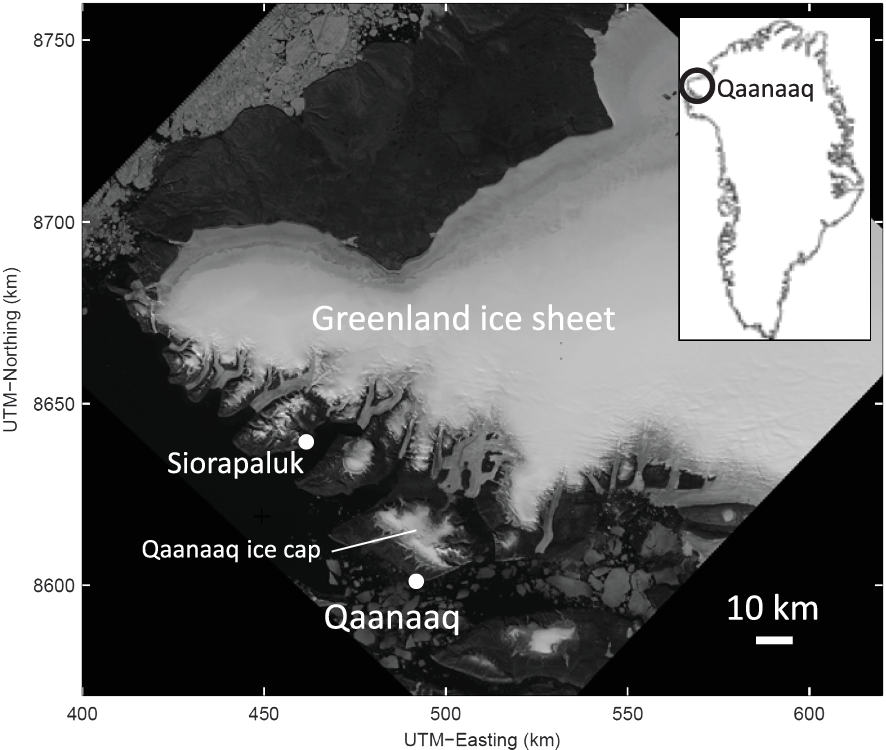
Fig. 1. Satellite image (Landsat 7 on 24 July 1999) of the study site. The inset shows the locations of Qaanaaq in Greenland (circle).
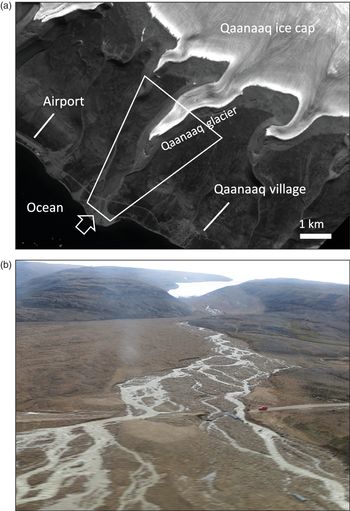
Fig. 2. (a) Satellite image (ALOS PRISM on 25 August 2009) showing an area including Qaanaaq Village and Qaanaaq Airport. The trapezoid shows the approximate area covered by the photograph shown in (b). (b) Photograph taken on 3 August 2016 showing the flood of a glacial stream and destruction of the road connecting Qaanaaq Village and Qaanaaq Airport. The stream is fed by the Qaanaaq Glacier at the top.
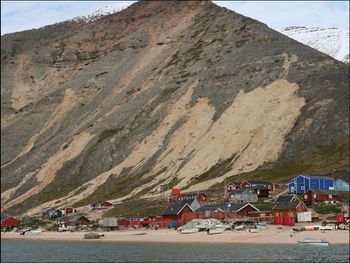
Fig. 3. Landslides occurred on the slope behind Siorapaluk Village. The photograph was taken on 27 July 2018.
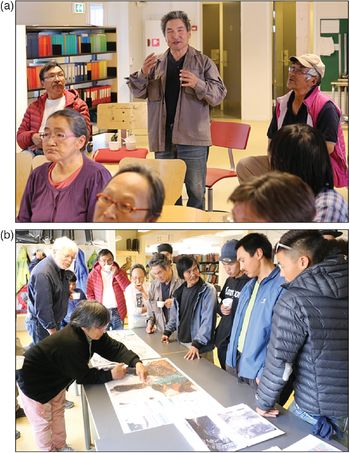
Fig. 4. Photographs showing a workshop with residents held in Qaanaaq on 30 July 2017. (a) A hunter explains his experience of changes in ocean conditions. (b) Researchers and residents discuss environmental changes observed in the region, using satellite images and ocean bathymetry maps.
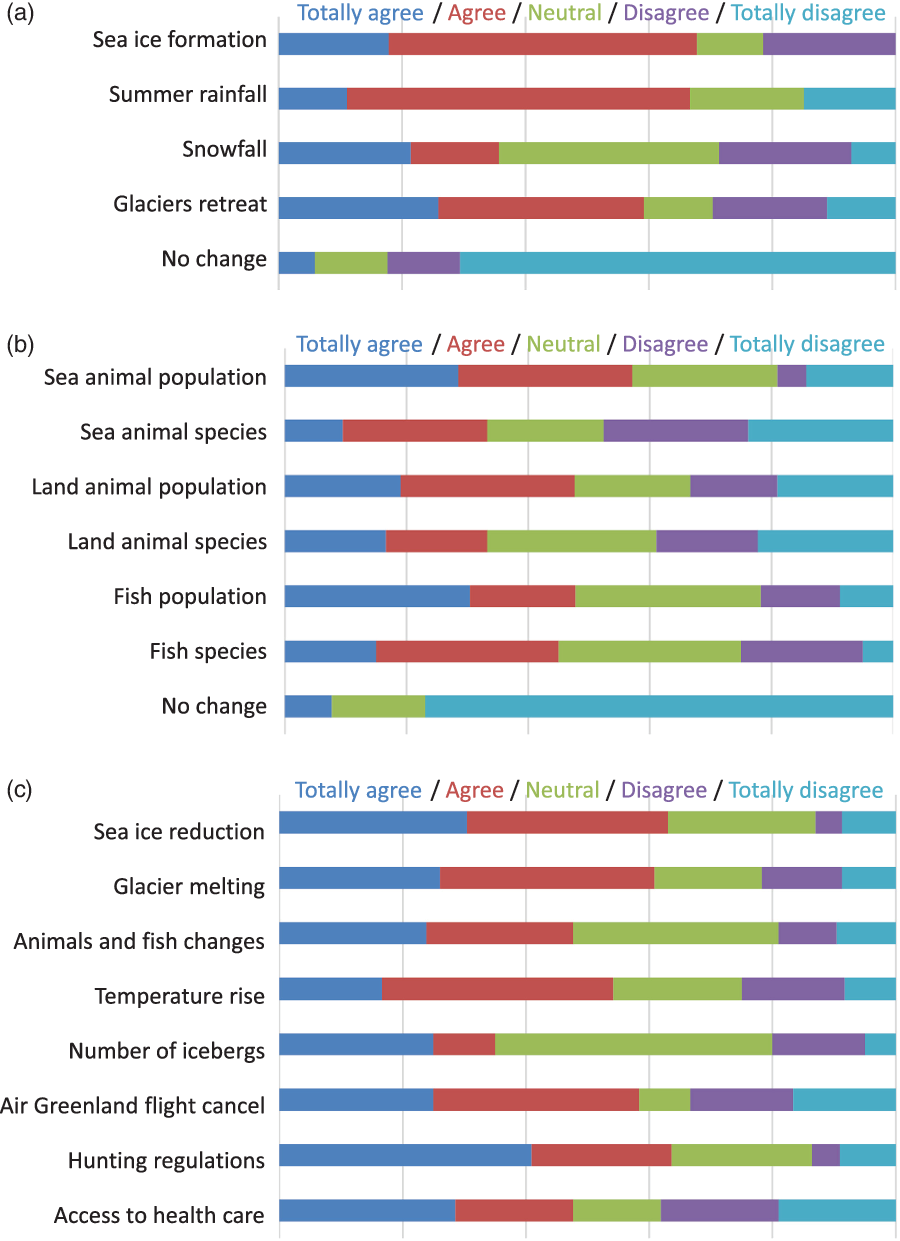
Fig. 5. Results of the questionnaire survey performed in Qaanaaq in July and August 2018. Answers to the questions (a) “What kinds of seasonal and environmental changes have you observed in Qaanaaq?”, (b) “What kind of change do you notice about animals and fish?”, and (c) “To what extent do they negatively impact your daily life?”. The summary is based on answers from 29 local residents.
 You have
Access
- 10
- Cited by
Changing glaciers and the ocean
Greenland’s coastal environment has been rapidly changing over recent decades. For example, outlet glaciers of the Greenland ice sheet and peripheral glaciers and ice caps are rapidly melting and losing mass (e.g. Bolch et al., Reference Bolch, Sandberg Sørensen, Simonsen, Mölg, Machguth, Rastner and Paul2013; Howat & Eddy, Reference Howat and Eddy2011; Murray et al., Reference Murray, Scharrer, Selmes, Booth, James, Bevan and McGovern2015). The loss of ice has a significant impact not only on rising sea levels but also on ocean circulation and the global climate (e.g. Böning, Behrens, Biastoch, Getzlaff, & Bamber, Reference Böning, Behrens, Biastoch, Getzlaff and Bamber2016; Luo et al., Reference Luo, Castelao, Rennermalm, Tedesco, Bracco, Yager and Mote2016). Atmospheric warming is the main driver of rapidly melting ice (Enderlin et al., Reference Enderlin, Howat, Jeong, Noh, Van Angelen and Van Den Broeke2014; Fettweis et al., Reference Fettweis, Box, Agosta, Amory, Kittel, Lang and Gallée2017; Hanna, Mernild, Cappelen, & Steffen, Reference Hanna, Mernild, Cappelen and Steffen2012). However, acceleration of tidewater outlet glaciers and a darkening ice surface are additional processes that increase the rate of ice loss (Rignot & Kanagaratnam, Reference Rignot and Kanagaratnam2006; Ryan et al., Reference Ryan, Smith, Van As, Cooley, Cooper, Pitcher and Hubbard2019; Tedesco et al., Reference Tedesco, Doherty, Fettweis, Alexander, Jeyaratnam and Stroeve2016). The ocean environment and marine ecosystems are being affected by the glaciers, because an increasing amount of freshwater and sediments has been carried into the ocean in recent years (e.g. Arendt, Agersted, Sejr, & Juul-Pedersen, Reference Arendt, Agersted, Sejr and Juul-Pedersen2016; Bendixen et al., Reference Bendixen, Lønsmann Iversen, Anker Bjørk, Elberling, Westergaard-nielsen, Overeem and Kroon2017).
To improve our understanding of the changing glaciers and the ocean in and around Greenland, we initiated our research in 2012 in Qaanaaq (77°28' N, 69°14' W), a small village in northwestern Greenland (Fig. 1). Studying the Qaanaaq region is particularly important because it is an area in northwestern Greenland, where loss of ice mass has recently been increasing (Khan, Wahr, Bevis, Velicogna, & Kendrick, Reference Khan, Wahr, Bevis, Velicogna and Kendrick2010), but observational data is sparse compared to regions in the south. This research was carried out with contributions from the Japanese interdisciplinary Arctic research initiatives, the GRENE (Green Network of Excellence) and ArCS (Arctic Challenge for Sustainability) Projects.
Satellite image (Landsat 7 on 24 July 1999) of the study site. The inset shows the locations of Qaanaaq in Greenland (circle).
From 2012 to 2019, we made repeated field observations in the Qaanaaq region, as well as performing analysis of satellite data and numerical model experiments. The study results clearly show that ice caps in this region have been thinning because of elevated air temperature and reduced ice surface albedo (Saito, Sugiyama, Tsutaki, & Sawagaki, Reference Saito, Sugiyama, Tsutaki and Sawagaki2016; Sugiyama et al., Reference Sugiyama, Sakakibara, Matsuno, Yamaguchi, Matoba and Aoki2014). Marine-terminating outlet glaciers of the Greenland ice sheets are retreating, thinning and accelerating (Sakakibara & Sugiyama, Reference Sakakibara and Sugiyama2018). In addition to the warming climate, changing ocean temperature and bed geometry play crucial roles in the recession of the outlet glaciers (Asaji, Sakakibara, Yamasaki, & Sugiyama, Reference Asaji, Sakakibara, Yamasaki and Sugiyama2018). Our study revealed the critical impact of glacial meltwater discharge on the marine ecosystem. Meltwater transports nutrient-rich water from the bottom to the surface of fjords when it upwells along the fronts of marine terminating outlet glaciers (Kanna et al., Reference Kanna, Sugiyama, Ohashi, Sakakibara, Fukamachi and Nomura2018; Lydersen et al., Reference Lydersen, Assmy, Falk-Petersen, Kohler, Kovacs, Reigstad, Steen, Strøm, Sundfjord, Varpe, Walczowski, Weslawski and Zajaczkowski2014), and therefore, changes in meltwater discharge create new environments affecting the current ecosystems. Other studies have indicated meltwater discharge in marine environments influences the distributions of zooplankton and sea birds living in the fjords (Naito et al., Reference Naito, Abe, Matsuno, Nishizawa, Kanna, Sugiyama and Yamaguchi2019).
Impact on human society
The environmental changes observed in the GRENE and ArCS Projects have an impact on the human society and economy in Qaanaaq. The melting glaciers are affecting the ecosystems of glacial fjords, which have a critical influence on hunting and fishing. Such influence was evident from conversations with local collaborators who assisted with our field research activities in Qaanaaq. Fishermen know that fish species are changing in the warming ocean, and hunters are suffering from sea-ice reduction because it shortens the period of dog sledge use.
Furthermore, the changing environment poses risks to the infrastructure of Qaanaaq and nearby areas. For example, a road connecting Qaanaaq Village and the nearby airport was destroyed by water in July 2015 and August 2016 (Fig. 2). This disaster was caused by flooding due to meltwater streams flowing from the Qaanaaq Ice Cap (Kondo, Sakaibara, Fukumoto, & Sugiyama, Reference Kondo, Sakaibara, Fukumoto and Sugiyama2019). Most likely, flooding has occurred more frequently in recent years because of the increasing amounts of meltwater, as well as the rising number of heavy rain storms. Another risk is the instability of the current land formations and terrain. A nearby smaller village Siorapaluk (77°47' N, 70°38' W) (Fig. 1) was hit by landslides and flash floods in the summers of 2016 and 2017, which destroyed hunting lodges (Fig. 3). Field surveys indicated that the landslides were triggered by heavy rain, which destabilised a steep slope, also possibly weakened by thawing permafrost (Yamasaki & Watanabe, Reference Yamasaki and Watanabe2019).
(a) Satellite image (ALOS PRISM on 25 August 2009) showing an area including Qaanaaq Village and Qaanaaq Airport. The trapezoid shows the approximate area covered by the photograph shown in (b). (b) Photograph taken on 3 August 2016 showing the flood of a glacial stream and destruction of the road connecting Qaanaaq Village and Qaanaaq Airport. The stream is fed by the Qaanaaq Glacier at the top.
Landslides occurred on the slope behind Siorapaluk Village. The photograph was taken on 27 July 2018.
In contrast with these negative impacts, the warming climate and recession of ice provide opportunities in terms of improving transport and access to natural resources. Sea ice in front of Qaanaaq now melts earlier in the summer season, which enables earlier access for supply ships to the village. With a strong interest in mineral resources, survey activities are now carried out more frequently in the region. One example of mineral resources available in the region is titanium contained in black sand (ilmenite) discovered at Moriusaq, an abandoned settlement located ~80 km south from Qaanaaq (Nielsen, Kokfelt, & Weatherley, Reference Nielsen, Kokfelt and Weatherley2019). After preliminary surveys, sampling began in 2015, and a small-scale titanium mining facility has been established (Government of Greenland, 2017). Our research activity has the potential to assess the possible access to mineral resources and the environmental impact of mining. The study of sea ice is particularly relevant and important for mineral resource exploration in the Arctic, as represented by a case of offshore oil and gas exploration in eastern Greenland (Fuse, Kanehara, & Sato, Reference Fuse, Kanehara and Sato2015).
Collaboration with the Qaanaaq community
Since the ArCS project was launched in 2015, we have collaborated with social scientists to investigate the impact of climate change on human society in Qaanaaq. For example, a team consisting of an anthropologist and a political scientist visited Qaanaaq in 2016 to study local whale (narwhal) hunting, which is a traditional and popular summer activity in Qaanaaq. The team investigated how this tradition has been maintained in the region and also how the tradition is affected by recently changing society and social systems. For example, there is a quota regulating the annual narwhal catch. While the quota is agreed upon by Greenlandic and international commissions, local narwhal hunters voice their disagreement (Takahashi, Reference Takahashi and Kishigami2019). As a part of our research activity in Qaanaaq, oceanographers and marine biologists are collecting data from narwhal habitats. Such scientific data should contribute to finding a better solution to maintain traditions while preserving natural resources.
We will continue to study the Greenland glacial and ocean environment, but with increasing emphasis on their relation to society. Such a study would not be possible without the input and collaboration from the Qaanaaq community. In 2016, we organised the first workshop in the village to explain our research project, share scientific data, and exchange ideas about how life is affected by the changing environments. Through repeating the workshops in 2017 and 2018 (Fig. 4), we learned local and traditional knowledge which is relevant to environmental changes in Greenland. For example, an experienced local hunter explained that retrieval of a seal body after hunting is harder than before because the body sinks deeper into the ocean. Presumably, this observation indicates that the body is less buoyant in the ocean due to changes in the salinity of near-surface sea water caused by increasing amounts of freshwater from melting glaciers.
Photographs showing a workshop with residents held in Qaanaaq on 30 July 2017. (a) A hunter explains his experience of changes in ocean conditions. (b) Researchers and residents discuss environmental changes observed in the region, using satellite images and ocean bathymetry maps.
We continue to work with such local hunters and fishermen to obtain ocean measurements and data. Their traditional and local knowledge benefits our research greatly. For example, through their experience of fishing benthic fish (halibut), local fishermen have accurate knowledge about the depths of fjords, where outlet glaciers terminate. This is crucial information when studying glaciers because the recent retreat of glaciers in Greenland is highly influenced by sea bed geometry as mentioned above (Asaji et al., Reference Asaji, Sakakibara, Yamasaki and Sugiyama2018). In turn, the continued addition of data furthers the ocean depth survey and the marine ecosystem study and helps the indigenous communities understand the changing fish habitat and availability of fishery resources. Our goal is to provide residents with data, enabling the sustainable development of society and the economy in the future.
To learn more about regional and traditional knowledge, we conducted a questionnaire survey on recent environmental changes in Qaanaaq. More than 80% of the respondents observed changes in the environment (Fig. 5(a)). Sea-ice reduction and an increasing amount of summer rainfall were the most significant changes according to their observations (Fig. 5(a)). Changes in the populations and species of sea/land animals and fish were observed by 30–60% of the respondents (Fig. 5(b)). More than 50% reported negative impacts on their lives from environmental changes (sea-ice reduction, glacier melting, and temperature rise), and social environmental factors (irregular flight operation and hunting regulation) were also of great concern (Fig. 5(c)).
Results of the questionnaire survey performed in Qaanaaq in July and August 2018. Answers to the questions (a) “What kinds of seasonal and environmental changes have you observed in Qaanaaq?”, (b) “What kind of change do you notice about animals and fish?”, and (c) “To what extent do they negatively impact your daily life?”. The summary is based on answers from 29 local residents.
The next step in our research is to continue to provide Qaanaaq community with useful data and measurements to enable a sustainable future. Accurate data and knowledge from our research may help them to adjust their lives to the changing environment.
Acknowledgements
The author would like to thank the GRENE and ArCS Greenland project members for their contributions to research in Qaanaaq. Matthew Walls, Pauline Knudsen, and Pivinnguaq Morch contributed to the questionnaire survey in Qaanaaq. Toku Ohshima, Kim Petersen, and Sakiko Daorana provided assistance with field activities in Qaanaaq. Akiho Shibata provided the opportunity to present at the PCRC 4th International Symposium in Kobe and to contribute this manuscript to the special issue. This study was funded by the Japanese Ministry of Education, Culture, Sports, Science and Technology through the GRENE Arctic Climate Research Project and the ArCS Arctic Challenge for Sustainability Project (Program Grant Number JPMXD1300000000).