Introduction
When patients are referred to the otolaryngology department with balance symptoms, the most important step towards reaching a diagnosis is a full clinical history.Reference Kerr1 Clinical otological and vestibular examinations are also important in the formulation of a diagnosis, especially to differentiate between central and peripheral vestibular disorders.Reference Brandt and Strupp2 Vestibular tests provide limited information, but can provide extra data in specific circumstances.
Patients often find it difficult to describe their balance symptoms, so a clear and detailed history is necessary in order to extract the information which the clinician requires, in order to formulate a diagnosis and to consider treatment options. There are several well recognised barriers to obtaining a clear and detailed clinical history from patients with balance symptoms, and these barriers are difficult – if not impossible – to completely eliminate.
It is not unknown for patients to be reluctant to describe their symptoms for fear of being considered foolish or insane by the consulting clinician.Reference Kerr1 Additionally, it is common for patients to change their history as the consultation progresses, or to describe a different history during a subsequent consultation. The reasons for this are probably more related to patients' abilities to describe their symptoms, rather than to their desire to confuse or mislead the consulting clinician.
Some patients use medical jargon when describing their symptoms, and often admit to using information from the internet for self-diagnosis. This group may have preconceived ideas and incorrect information about their symptoms, relevant diagnoses and potential treatments, because of inaccurate online information.Reference Roberts and Copeland3, Reference Zun, Blume, Lester, Simpson and Downey4 This can make the clinician's history-taking even more challenging.
The interview technique of the consulting clinician has an inevitable effect on the accuracy and clarity of the clinical history obtained. Its variability has many influences, but centres on the fact that different interview techniques can encourage interviewees to respond differently to the same question, depending on the wording of the question and the manner in which it is asked.Reference Houtkoup-Steenstra5
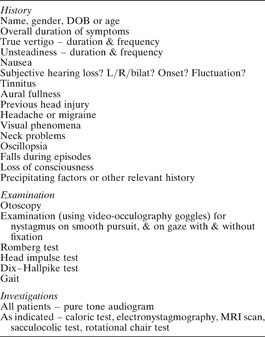
There are a number of standardised vestibular questionnaires in use, although these vary from department to department and there is currently no universally accepted format or gold standard method. In the Edinburgh Balance Clinic, a set of questions and clinical tests has been developed in order to capture all relevant information consistently. This has been progressively refined over the years of the clinic's existence. Every new patient has a proforma completed during a face-to-face consultation with a consultant neuro-otologist (Table I).
Edinburgh balance clinic standardised patient proforma

DOB = date of birth; L = left; R = right; MRI = magnetic resonance imaging
The challenge of taking an adequate history from a patient with balance symptoms and the inevitable use of specific, closed questions can lead some patients to feel pressurised into giving untrue or inaccurate responses. It has been demonstrated that small changes in wording can produce large changes in response distribution.Reference Houtkoup-Steenstra5
The aim of any questionnaire is to gather valid, reliable, unbiased and discriminatory data.Reference McColl, Jacoby, Ihomas, Soutter, Bamford and Steen6 With these qualities in mind, the aim of this study was to consider the value of open-ended questions in patients with balance symptoms, by using an open-ended questionnaire to obtain unbiased data, prior to a direct and specific interview based on a standardised history proforma, and to compare the clinical history obtained using the two different methods.
Using recognised methods of qualitative data analysis,Reference Houtkoup-Steenstra5 the results from the two methods of history-taking could also be used to assess the relative value of open-ended questions, in terms of whether the patients were able to make use of them; whether they could be used to make a diagnosis, and whether they revealed any additional information which altered the management of the patients in the study.
Methods
Over a six-month period, 55 consecutive new patients attending the Edinburgh Balance Clinic were asked to take part in the study. In order to minimise bias arising from patients' documentation of their clinical history based on questions they may have been asked during a previous consultation, patients returning to the balance clinic for review were excluded from the study, as were patients who were new to the balance clinic but had been previously assessed by an otolaryngologist. One new patient declined to take part; it was later discovered that he was unable to read and write. On arrival for their appointments, the 54 new patients (age range 16–77 years, mean age 51.2 years) who consented to take part in the study were given a clipboard, a pen, and a sheet of A4 paper with the following text at the top:
‘Please make a list of the difficulties which you have as a result of your balance trouble. Write down as many as you can think of.’
The patients were seated outside the consultation room, and were asked to fill in the form prior to their consultation with the consultant neuro-otologist. Every consultation in the study was conducted by the same consultant, and the consultation observed by the same research fellow. On entering the consultation room, each patient's open-ended questionnaire was filed away, and the consultation commenced.
Each consultation began with patients having the opportunity to express their symptoms in their own words. The consultant listened actively, and clarified points with the patient where necessary. For example, if a patient used the words ‘vertigo’ or ‘dizziness’, clarification was sought as to whether they were referring to a sensation of spinning or motion, or to a feeling of imbalance.
Once patients had described and explained their symptoms, the standardised proforma was used to complete the required data set. Each issue in the clinical history was addressed and clarified in turn, and the data entered into an electronic database during and immediately after each consultation.
The aim of the completed proforma was to provide an accurate and discriminatory set of data for each patient. The clinician could use this data to formulate a diagnosis and to plan treatment options for the patient. It was also useful for retrospective analysis of the clinical profiles of patients attending the balance clinic, and for auditing and reviewing the clinical methods by which patients with balance symptoms were assessed.
The wording of the text on the questionnaire was composed by choosing words which would be understood by all patients, which would avoid misinterpretationReference Boynton, Wood and Greenhalgh7 and which would leave the question open, allowing the patients to provide information freely. Similarly worded questionnaires had been previously used to gather information about hearing loss.Reference Stephens, Kerr and Jones8
Once collected, the open questionnaires were analysed according to recognised methods of qualitative data analysisReference Houtkoup-Steenstra5, Reference Graneheim and Lundman9 by the research fellow who had observed the consultations. Following careful analysis of the qualitative data, the patients' comments on their open-ended questionnaires were categorised into three exhaustive, exclusive categories.Reference Graneheim and Lundman9 The three categories were: circumstances which brought on the episodes of balance symptoms; symptoms experienced during the episodes; and consequences of the episodes. Every comment was allocated to one of these three categories. All comments were suitable for categorisation into one of these three groups.
Comments were grouped together when the implication was clear (e.g. patients describing episodes brought on by ‘neck extension’ described this variously as ‘tilting my head back’, ‘looking up at the sky’ and ‘looking up to the highest shelf in the kitchen/supermarket’). For patient comments which had a variety of interpretations, or a number of ways in which the given circumstance might have precipitated symptoms (e.g. showering, being in busy places or crossing roads), the comments were left unchanged.
These categorised, qualitative data were then coded onto the database holding the patients' standardised clinical information, and the data provided on the open questionnaire compared with the data obtained using the standardised proforma. Comparisons were made between both the complete data sets, and between the two sets of data provided by individual patients. No formal statistical comparisons were performed due to the small patient cohort and the qualitative nature of the data obtained.
Results
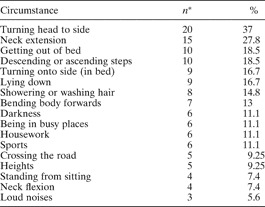
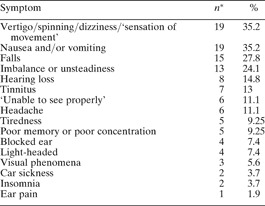
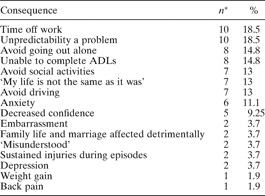
Of the 54 patients completing the open questionnaires, 42 patients (77.8 per cent) described circumstances bringing on their symptoms, 42 (77.8 per cent) described their symptoms during episodes, and 25 (46.3 per cent) described the consequences of these episodes (Tables II to IV).
Patient open questionnaire responses: circumstances bringing on episodes

* Total n = 54.
Patient open questionnaire responses: symptoms experienced during episodes

* Total n = 54.
Patient open questionnaire responses: consequences of episodes

* Total n = 54. ADL = activities of daily living
Circumstances inducing balance symptoms
A total of forty-two patients (77.8 per cent) used the open-ended questionnaire to describe circumstances bringing on their episodes of balance trouble. When asked directly whether anything specific brought on their symptoms, only 13 patients (24.1 per cent) provided a positive response. Only one patient described a precipitating factor on direct questioning, whilst not mentioning any precipitating factors on the open-ended questionnaire. Of the other patients giving a precipitating factor on direct questioning, six gave responses which were consistent with the information they had chosen to write in the open-ended questionnaire, and the remaining six patients gave responses which appeared to contradict the responses given in their open-ended questionnaire. Thirty patients (55.6 per cent of total) described factors precipitating their symptoms on their open-ended questionnaire, but denied any precipitating factors when questioned directly during their face-to-face consultation.
Symptoms experienced during episodes
Forty-two patients (77.8 per cent) described symptoms which they had experienced during episodes. When questioned directly, however, all patients (100 per cent) described symptoms they had experienced. Nineteen patients (35.2 per cent) described true vertigo on their open questionnaires, although this was interpreted from various responses (vertigo, dizziness, spinning, feeling of movement). When questioned directly, 45 patients (83.3 per cent) said that they suffered from true vertigo. Of those describing vertigo on the open-ended questionnaire, 16/19 (84.2 per cent) also admitted to having true vertigo when questioned directly. Of all patients admitting to having true vertigo when questioned directly, only 16/45 (35.6 per cent) had documented this on their open-ended questionnaire. No patient had documented the duration or frequency of their vertigo episodes on the open questionnaire.
Thirteen patients (24.1 per cent) described unsteadiness (or imbalance) on their open-ended questionnaire. When questioned directly, 32 patients (59.3 per cent) admitted to having this symptom. Of those describing unsteadiness on the open-ended questionnaire, 11/13 (84.6 per cent) also admitted to having this symptom when questioned directly. Of all patients admitting to unsteadiness when questioned directly, 11/32 (34.4 per cent) had documented this on their open-ended questionnaire.
Nineteen patients (35.2 per cent) described nausea and/or vomiting on their open-ended questionnaire. When questioned directly, 40 patients (74.1 per cent) admitted to having this symptom. Of those describing nausea and/or vomiting on the open-ended questionnaire, 18/19 (94.7 per cent) also admitted to having this symptom when questioned directly. Of all patients admitting to nausea and/or vomiting when questioned directly, 18/40 (45 per cent) had documented this on their open-ended questionnaire.
Seven patients (13 per cent) described tinnitus on their open-ended questionnaire. When questioned directly, 37 patients (68.5 per cent) admitted to having this symptom. Of those describing tinnitus on the open-ended questionnaire, seven out of seven (100 per cent) also admitted to having this symptom when questioned directly. Of all the patients admitting to tinnitus when questioned directly, seven out of 37 (18.9 per cent) had documented this on their open-ended questionnaire.
Eight patients (14.8 per cent) described hearing loss on their open-ended questionnaire. When questioned directly, 32 patients (59.3 per cent) admitted to having this symptom. Of those describing hearing loss on the open-ended questionnaire, seven out of eight (87.5 per cent) also admitted to having this symptom when questioned directly. Of all patients admitting to hearing loss when questioned directly, seven out of 32 (21.9 per cent) had documented this on their open-ended questionnaire.
Six patients (11.1 per cent) described headache on their open-ended questionnaire, whilst six (11.1 per cent) described loss of vision during episodes (three with headache, three without headache) and three (5.6 per cent) described visual disturbances (without headache). When questioned directly, 12 patients (22.2 per cent) admitted to headache, whilst three (5.6 per cent) admitted to visual disturbances without headache. Of those describing headache on the open-ended questionnaire, six out of six (100 per cent) also admitted to having this symptom when questioned directly. Of all patients admitting to headache when questioned directly, six out of 12 (50 per cent) had documented this on their open-ended questionnaire. There was a 100 per cent correlation (three out of three patients) for the documentation of visual phenomena experienced during episodes, between the open-ended questionnaires and direct questioning using the standardised proforma.
Consequences of episodes
At the time of the study, there were no questions in the standardised proforma regarding the consequences of patients' episodes of balance trouble. However, this category was clearly important to the patients, as 25 (46.3 per cent) reported these consequences in their open-ended questionnaire.
Discussion
In isolation, the open-ended questionnaire appears to have limited usefulness in the care of patients with balance symptoms, as it is not appropriate as an isolated tool for the formulation of a diagnosis, and is unlikely to reveal information which alters the clinical management. However, this study showed several interesting discrepancies between the answers given by patients to the open questionnaire and those elicited by the structured history proforma. These discrepancies may be able to point towards more reliable and accurate methods of history-taking for such patients in the future.
The most obvious difference between the two was the emphasis of the structured proforma in gleaning information essential to formulating a diagnosis (i.e. doctor-centred data), whilst the open questionnaire captured information which was of importance to the patient (i.e. patient-centred data). This effect was particularly notable when considering the third category of information voluntarily provided by the patients; 46.3 per cent of the patients described the consequences of their episodes of balance trouble, an area which was not covered by the standardised proforma, as it was not essential to the formulation of a diagnosis.
On observation of the fact that the open-ended questionnaires elicited patients' concerns regarding the effect of the attacks upon their lives, it becomes clear that this is valuable information as it gives insight into patients' experiences and may well influence treatment decisions. In future, therefore, the standardised proforma should include questions which address this issue.
The structured interview repeatedly encouraged the patient to admit to a higher number of symptoms than they had described in the open questionnaire, suggesting one of two things. Firstly, patients may have been experiencing symptoms which they did not feel were appropriate or necessary to mention in their open questionnaire, but which were successfully elicited on direct questioning. Secondly, patients may have felt under pressure to give a response to the direct question, and therefore may have admitted to a symptom that they did not actually suffer.
The open questionnaire text (‘Write down as many as you can think of …’) was chosen to minimise the risk of the wording itself being a source of inaccuracy. This is a well recognised phenomenon in structured interviews;Reference Houtkoup-Steenstra5 people are more likely to give a positive response than a negative or neutral response or an admission of ignorance, when probed on an issue.
However, this effect appears to be reversed in the patients' responses with regard to factors precipitating episodes. When presented with a direct question concerning this, far fewer patients were able to give a response.
Another notable discrepancy was that the open-ended questionnaire failed to inform the clinician of symptoms which the patient did not have. In describing symptom patterns which seemed important from their points of view, the patients do not provide the clinician with all the information required for the recognition of known symptom patterns. Additionally, no patient described the duration or frequency of their symptoms. This is often the most valuable information available to the clinician when formulating a diagnosis for a patient with balance symptoms. Likewise, in the open-ended questionnaire, there was no suggestion by any patient of symptom lateralisation.
It is difficult to analyse the accuracy of either questionnaire style, as both have potential sources of error. In analysing the symptoms reported in the different questionnaire styles, it appears that the structured questionnaire had a higher likelihood of eliciting the reporting of a symptom. Of the patients reporting symptoms on the open-ended questionnaire, 84.2 to 100 per cent gave a consistent response in the structured interview. However, of patients reporting symptoms in the structured interview, only 18.9 to 50 per cent had given a consistent response in the open-ended questionnaire.
• A clear and detailed clinical history is essential in the assessment of patients with balance symptoms. The aim of this study was to assess the usefulness of open-ended questionnaires in the specialist balance clinic
• Open-ended questionnaires provided patient-centred data and did not provide clinicians with sufficient data for diagnosis
• Patients were more likely to respond in the affirmative when asked about symptoms directly than to report the same symptoms spontaneously on an open-ended questionnaire
The reporting of symptoms in response to direct questions (in its simplest form) involves a forced choice between ‘yes’ and ‘no’. When we assess patients' reports of factors which brought on their episodes of balance trouble (for which there is more variability in response options), the comparison between the open and structured questionnaires is somewhat different.
It appears that, with regard to precipitating factors for episodes, some patients were able to describe these on the open-ended questionnaire but were unable to produce the same information when asked a direct question. This indicates the potential for missing some information by relying on rigid, direct questions and not allowing the patients to talk freely about their symptoms. It also raises concerns about the accuracy and consistency of the history obtained from some individuals, which is important as the diagnosis in cases of vestibular problems relies heavily on the history.
Qualitative data analysis carries inherent limitations. In this study, it is apparent that patients' interpretation of questions (both direct and open) was variable. There is also a potential source of error in researcher interpretation of patients' written and spoken responses to questions. Although the patients' words can be clarified during a direct consultation, this is not possible when analysing a written questionnaire.
In order to minimise the latter as a source of error in future work, the meaning of misinterpretable words or statements could be clarified with each patient prior to analysis of the data presented in their open-ended questionnaire.
Another possible source of error could be the timing of questionnaire administration. It has been hypothesised that our results may have been different had there been more time between completion of the open-ended questionnaire and the direct consultation. Additionally, it has been suggested that randomisation of the open-ended questionnaire (to before or after the direct consultation) might have eliminated this bias. In this study, patients who had previously consulted an otolaryngologist regarding their balance symptoms were excluded, as it was considered that their previous consultation may have influenced the data they provided on their open-ended questionnaire. However, the above factors could all be addressed in future work.
Further research aimed at discovering an accurate and reliable method of history-taking in patients with balance symptoms could be extremely valuable. It has been estimated that, in 75 per cent of patients presenting with dizziness, a diagnosis is revealed by the clinical history alone.Reference Boynton and Greenhalgh12 At present, there is no gold standard method of history-taking for patients with balance symptoms, and there are no published studies regarding the repeatability of data collection from these patients, using different methods.
Having a gold-standard method of history-taking might be of particular importance in the light of current changes to service provision in the UK National Health Service, whereby patients in the primary care setting, and those attending emergency departments, may well be assessed by a health professional other than a doctor.
If it is possible to formulate a gold-standard history-taking method, this might allow non-medical professionals to safely assess patients with balance symptoms. However, highly respected and experienced consultants have noted the difficulties clinicians experience when assessing patients with balance symptoms (see Appendix 1). Therefore, it might be more realistic, in the first instance, to hope for a small improvement in history-taking amongst specialists.
Conclusion
Open-ended questionnaires have limited usefulness in the assessment of patients with balance symptoms. They encourage a patient-centred response, which is not always appropriate for the formulation of a diagnosis.
This study showed that patients appeared to be much more likely to respond in the affirmative when asked directly whether they suffered from any specific symptom than to report that same symptom on an open-ended questionnaire.
Conversely, when a question had a number of different possible answers, the patient was much more likely to provide an account on an open questionnaire, whilst being unable to give any response when faced with a direct question about the same issue.
This preliminary study suggests that a tailored combination of both direct and open questions might be the most effective way to glean valid, reliable, unbiased and discriminatory information when assessing patients with balance symptoms. A robust clinical trial is required to determine if a combination of both direct interview and open-ended questionnaire would yield information that was more valid and reliable than that obtained by interview alone.
Acknowledgements
We thank Dr Daffyd Stevens for his advice about the design of the study.
Appendix 1
‘There can be few physicians so dedicated to their art that they do not experience a slight decline in spirits when they learn that their patient's complaint is giddiness. This frequently means that after exhaustive enquiry it will still not be entirely clear what it is that the patient feels wrong and even less so why he feels it.’Reference Boynton13
‘Vertigo has been said to be the greatest heartsink symptom in medicine. That certainly is a possibility but every specialty has its similar conditions, and vertigo is no worse than low back ache or nocturnal cramps. However, the main reason for this problem is not the symptom but the doctor. It has been said that labyrinthine vertigo can change, in seconds, a healthy and active individual into a helpless invalid, and a rational physician into a babbling idiot.’Reference Kerr1