1. Introduction
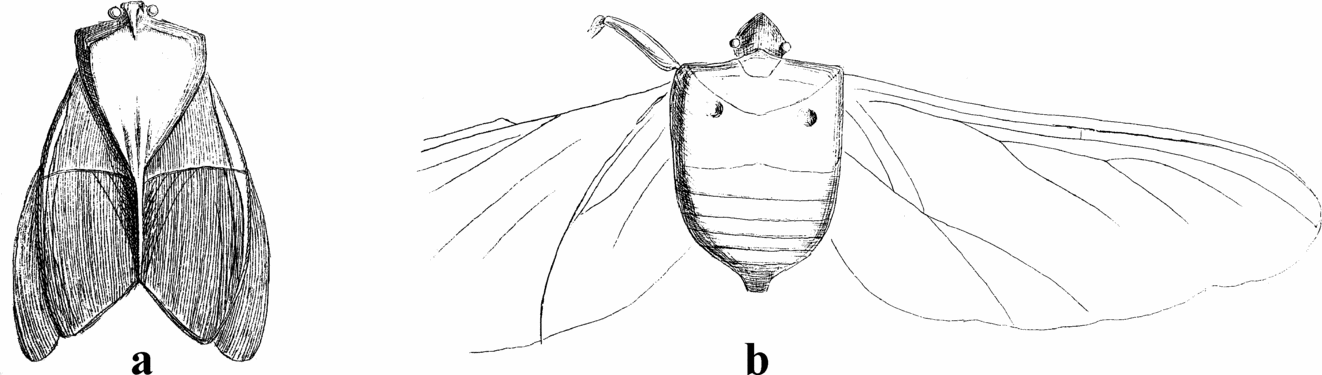
The Solnhofen Limestone of Bavaria, southern Germany, is one of the most famous Jurassic Fossil-Lagerstätten. It was deposited in the Tithonian stage of the Late Jurassic epoch, and represents a lagoonal environment located in the semi-arid subtropical belt (Barthel, Swinburne & Morris, Reference Barthel, Swinburne and Morris1990). The limestone yields abundant marine fossils, such as fishes, crinoids and ammonites (Barthel, Swinburne & Morris, Reference Barthel, Swinburne and Morris1990). Terrestrial organisms are much rarer and are represented by two theropod dinosaurs (Compsognathus and Juravenator) and some lizards, and species capable of flight, including the earliest bird Archaeopteryx, numerous pterosaurs and insects (Barthel, Swinburne & Morris, Reference Barthel, Swinburne and Morris1990; Kemp, Reference Kemp2001; Göhlich & Chiappe, Reference Göhlich and Chiappe2006). Of the terrestrial fossils, insects are undoubtedly the most diverse group. Eleven orders have so far been described, although some taxa still await further investigation and interpretation (Frickhinger, Reference Frickhinger1994, Reference Frickhinger1999). As the only representative of Cicadomorpha within Hemiptera from Solnhofen, Palaeontinidae were first described by Weyenbergh (Reference Weyenbergh1874) as cicadas, and later some new specimens were added by Oppenheim (Reference Oppenheim1888) and Haase (Reference Haase1890). Since Handlirsch's (Reference Handlirsch1906) synopsis of all Solnhofen Palaeontinidae comprising eight species within six genera, no detailed research has been made on these giant insects. However, because of poor preservation, the Solnhofen Palaeontinidae were misinterpreted with respect to their body morphology and wing venation by early researchers, although their outline was sometimes figured properly (Fig. 1). Therefore, the poor preservation and fallacious descriptions make the earlier systematic assignments of these specimens questionable: included in Lepidoptera by Handlirsch (Reference Handlirsch1906); placed in Palaeontinidae by Carpenter (Reference Carpenter1932) and Hamilton (Reference Hamilton1992); excluded from ‘Homoptera’ by Evans (Reference Evans1956); and attributed to uncertain ‘Homoptera’ in the Treatise on Invertebrate Paleontology by Carpenter (Reference Carpenter, Moore and Kaesler1992). Up to now, the Solnhofen group is the best fossil record of Late Jurassic Palaeontinidae and the most important clue for understanding their diversification in the Cretaceous (Wang, Zhang & Szwedo, Reference Wang, Zhang and Szwedo2009). Therefore, an exhaustive reinvestigation and modern reinterpretation of their phylogenetic relationship and evolutionary significance is announced in the present work. Recently, some Middle Jurassic and Early Cretaceous palaeontinids from China and Brazil provided some new insights into important morphological structures and the evolution of Palaeontinidae (Menon, Heads & Martill, Reference Menon, Heads and Martill2005; Wang, Ren & Shih, Reference Wang, Ren and Shih2007; Wang, Zhang & Szwedo, Reference Wang, Zhang and Szwedo2009). These advancements paved the way for the present study of Solnhofen Palaeontinidae.
Drawings by Oppenheim (Reference Oppenheim1888). (a) Holotype of Prolystra lithographica. (b) Holotype of Eocicada microcephala.

2. Material and methods
‘Solnhofen fossil’ represents any specimen from the Upper Jurassic Limestone of the Solnhofen area, Bavaria, southern Germany (Burnham, Reference Burnham2007). All fossils are preserved in lithographic limestones (‘Plattenkalk’), which is a special type of fine-grained, flat-cleaving limestone (Barthel, Swinburne & Morris, Reference Barthel, Swinburne and Morris1990). Although the fossils are from different outcrops and may be of slightly different ages, their general age is confined to the Early Tithonian, around 151 Ma (Kemp, Reference Kemp2001; Göhlich & Chiappe, Reference Göhlich and Chiappe2006; Ogg, Ogg & Gradstein, Reference Ogg, Ogg and Gradstein2008).
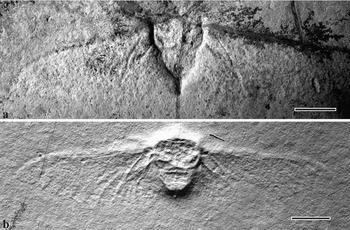
Up to now, almost all Solnhofen Palaeontinidae are preserved with body and wings (e.g. Figs 1, 2), even though some of them are strongly deformed. The preservation of articulated Palaeontinidae supports the previous conclusion that Solnhofen insects have relatively short drifting periods (Tischlinger, Reference Tischlinger2001), and that the bottom environment of the lagoon was very calm (Barthel, Swinburne & Morris, Reference Barthel, Swinburne and Morris1990). However, most of the Solnhofen Palaeontinidae lost morphological details during diagenesis: wing colour patterns are invisible; the outer margin and apex of the forewings are sometimes destroyed; the wing venation, particularly the shape of the discal cell, is often unclear; and their bodies are sometimes strongly deformed.
Eocicada microcephala Oppenheim, Reference Oppenheim1888. (a) JME SOS2050. (b) A well-preserved specimen deposited at the Museum Bergér. Scale bars represent 20 mm. For a colour version of this figure see online Appendix at http://journals.cambridge.org/geo.

Handlirsch (Reference Handlirsch1906) listed eight species of Solnhofen Palaeontinidae. These holotypes, except for three probably lost specimens, are still accessible. We examined several poorly preserved types using photographs, because detailed photos are clear enough to show the diagnostic characters. The holotypes of Prolystra lithographica and Eocicada microcephala (Fig. 1) were originally stored at the Bayerische Staatssammlung für Paläontologie und Geologie, Munich (BSPGM). In 1934, these two specimens, together with some other German fossil insects were borrowed by Friedrich E. Zeuner, when he worked at the British Museum of Natural History in London (BMNH). After World War II, some of Zeuner's specimens were returned to Germany by Walter G. Kühne, who deposited them at the Natural History Museum of Humboldt University in Berlin (ZMB). Unfortunately, we have not found these two holotypes in the collections above and perhaps they were lost in Germany or Britain during World War II. The holotype of Beloptesis gigantea is deposited at the Teylers Museum in Haarlem, Netherlands. It is poorly preserved and only a sketchy shape of body and wings is distinguishable. This specimen was examined for the present study via the photograph in Frickhinger (Reference Frickhinger1994). The holotype of Limacodites mesozoicus and another poorly preserved palaeontinid specimen (BaJ1591 and BaJ1592) are housed at the Senckenberg Naturhistorische Sammlungen Dresden (SNSD). They were examined with help of detailed photos. Three holotypes (separately of Archipsyche eichstattensis, Protopsyche braueri and Beloptesis oppenheimi) from the Museum of Natural History, Vienna, Austria (NHMW) were also re-examined. The holotype of Eocicada lameerei was originally deposited at the ‘Geological Institute of the Brussels University’, but it has not been found yet. A poorly preserved specimen mentioned by Handlirsch (Reference Handlirsch1906) was housed at the National Museum, Prague (NM), and was re-examined using detailed photos. Furthermore, eight new Solnhofen specimens, of which six are housed at the Jura Museum Eichstätt (JME), one at the Staatliches Museum für Naturkunde Stuttgart (SMNS), and one in a private collection (Museum Bergér in Eichstätt), were examined.
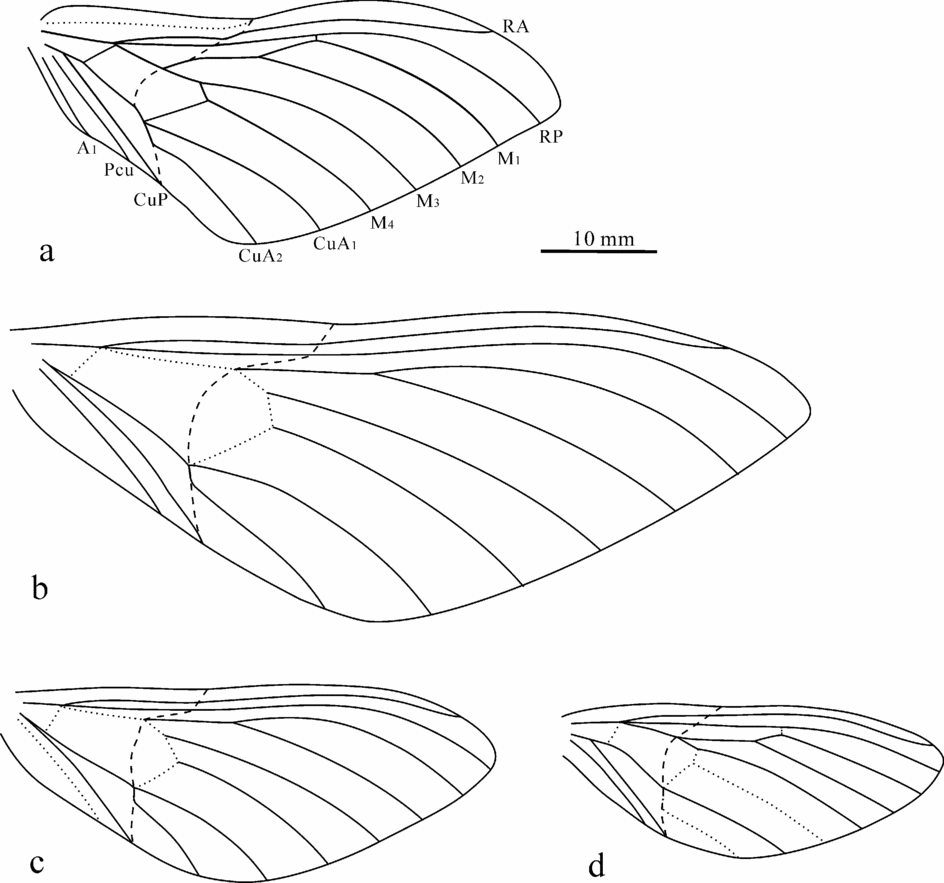
Each forewing reconstruction is based on several specimens. In drawings, dashed lines denote the nodal line in the forewing, and dotted lines indicate faintly seen and hypothesized missing veins. Considering that the nomenclature espoused by Becker-Migdisova (Reference Becker-Migdisova1949) has been used in most of the literature on palaeontinids, and in order to avoid taxonomic confusion, we followed the traditional terminologies with slight modifications (Wang, Zhang & Szwedo, Reference Wang, Zhang and Szwedo2009).
3. Systematic palaeontology
Order HEMIPTERA Linnaeus, Reference Linnaeus1758
Infraorder CICADOMORPHA Evans, Reference Evans1946
Superfamily palaeontinoidea Handlirsch, Reference Handlirsch1906
Family palaeontinidae Handlirsch, Reference Handlirsch1906
Key to the species of Palaeontinidae from the Upper Jurassic of Germany:
(1) Body slender; mesonotum almost as wide as abdomen; forewing small (length 33–36 mm): Archipsyche eichstattensis
– Body sturdy; mesonotum wider than abdomen; forewing medium-sized or large (length > 40 mm)
(2) Wings commonly folded; forewing medium-sized (43–46 mm): Prolystra lithographica
– Wings commonly spread out; forewing large (65–75 mm): Eocicada microcephala
Genus Eocicada Oppenheim, Reference Oppenheim1888
Type species. Eocicada microcephala Oppenheim, Reference Oppenheim1888; by original designation and monotypy.
Type horizon and locality. Solnhofen Formation, Upper Jurassic (Early Tithonian); Eichstätt, Bavaria, Germany.
Revised diagnosis. Body robust. Mesonotum wider than abdomen. Forewing triangular, length 65–75 mm, maximum width (at the middle of wing) about 30 mm; vein Sc unbranched; veins RA, RP and M separating at one point; branch RP subparallel to branch RA; antenodal region trapezoid; postnodal region reduced; clavus narrow, less than one-third of wing length. Hindwing small, about half as long as forewing.
Eocicada microcephala Oppenheim, Reference Oppenheim1888
Figures 2, 3b
1888 Eocicada microcephala: Oppenheim, p. 229, plate 31, fig. 30.
1890 Eocicada microcephala: Haase, p. 16, fig. 6.
1898 Eocicada microcephala: Meunier, plate 6, fig. 6.
1906 Eocicada microcephala: Handlirsch, pp. 626–7, plate L, figs 7–9.
1906 Eocicada lameerei: Handlirsch, p. 627, plate L, figs 10–12.
1932 Eocicada microcephala: Carpenter, p. 121.
1994 Limacodites mesozoicus: Frickhinger, pp. 152, fig. 303.
1994 Protopsyche braueri: Frickhinger, p. 153, fig. 305.
1999 Limacodites mesozoicus: Frickhinger, p. 60, fig. 107.
Reconstruction of forewings. (a) Ilerdocossus fengningensis (Ren, Yin & Dou, Reference Ren, Yin and Dou1998) from the Early Cretaceous Yixian Formation of China. (b) Eocicada microcephala. (c) Prolystra lithographica. (d) Archipsyche eichstattensis. All to scale.

Examined material. JME SOS2050, a poorly preserved specimen, part and counterpart. A well-preserved specimen without collection number, part and counterpart, deposited at the Museum Bergér (private collection).
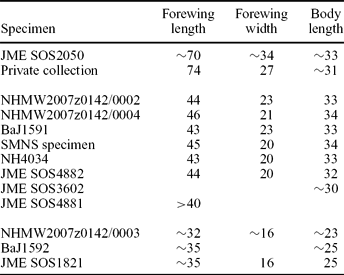
Description. Body length 31–33 mm (Table 1). Head small and subtriangular. Mesonotum length about 13 mm, width about 23 mm, without distinct longitudinal carinae. Abdomen pointed posteriorly. Forewing large. Nodal indentation clear, at basal 0.4 wing length. Branch RA departing from stem R+M at the same level of cross-vein r+m-cua, slightly recurved at nodal line, subparallel to costal margin beyond nodal line. Branch RP dividing from stem R+M at vein RA departing from stem R+M, arched anteriorly for remaining part. Stem M slightly bifurcating basal of nodal indentation. Stem M1+2 branching into veins M1 and M2 at about the middle of wing. Branches M1 and M2 recurved posteriorly. Branch M3 subparallel to branch M2. Branch M4 directed posteriorly, geniculate at junction with cross-vein m4-cua, and then subparallel to vein M3. Branch CuA nearly straight, straight between cross-veins r+m-cua and m4-cua, recurved at junction with cross-vein m4-cua, and then branching into veins CuA1 and CuA2 at about the same level of initial division of stem M. Discal cell large; antenodal region trapezoid, about twice as long as postnodal region. Branch CuP thick, dividing from stem Cu near base. Vein Pcu slightly arched.
Measurements of Solnhofen Palaeontinidae (in mm)

Discussion. All the reported specimens of E. microcephala retain the same embedding position, in which the wings are spread out on each side of the body. These specimens with the ‘butterfly’ position allow a detailed examination of wing size and wing venation. E. microcephala was erected and placed in the ‘Homoptera’ by Oppenheim (Reference Oppenheim1888) on the basis of a poorly preserved specimen with forewings and hindwings spread. Later, Handlirsch (Reference Handlirsch1906) erected E. lameerei based on a better preserved specimen, and distinguished it from the type species by the different forewing venation and the much smaller hindwing. Judging from the original description and photos, however, the forewing venation of E. lameerei is not distinctly different from that of E. microcephala. Furthermore, the hindwings of E. microcephala had not been correctly outlined by early researchers (see detailed discussion below). In fact, both E. lameerei and E. microcephala possess small hindwings which are about half as long as their respective forewings. The variation in the wing size probably demonstrates intraspecific differences, a common phenomenon in Mesozoic Palaeontinidae (Wang et al. Reference Wang, Zhang, Fang and Zhang2008). Therefore, E. microcephala and E. lameerei are considered herein to belong to the same species, and E. lameerei is a junior synonym of E. microcephala.
Two well-preserved specimens were earlier attributed to Limacodites mesozoicus by Frickhinger (Reference Frickhinger1994, fig. 303; Reference Frickhinger1999, fig. 107). However, judging from the original photograph and description, the large and triangular forewings (70–80 mm) indicate that the above two specimens belong to E. microcephala. Additionally, the specimen placed in Protopsyche braueri by Frickhinger (Reference Frickhinger1994, fig. 305) is most probably attributed to E. microcephala by its wide body, large mesonotum and triangular forewings. This specimen is very similar to two specimens (JME SOS2050 and the specimen deposited at the Museum Bergér) described in the present work. The estimated length of its wing span by Frickhinger (100 mm; in Frickhinger, Reference Frickhinger1994, p. 152) was probably erroneous.
Genus Prolystra Oppenheim, Reference Oppenheim1888
1888 Prolystra Oppenheim, p. 228.
1890 Cicadite Haase, p. 18.
1906 Protopsyche Handlirsch, p. 623.
1906 Beloptesis Handlirsch, p. 625.
Type species. >Prolystra lithographica Oppenheim, Reference Oppenheim1888; by original designation and monotypy.
Type horizon and locality. Solnhofen Formation, Upper Jurassic (Early Tithonian); Eichstätt, Bavaria, Germany.
Revised diagnosis. Body robust. Mesonotum width about 20 mm, clearly wider than abdomen. Forewing triangular, length 43–46 mm; vein Sc unbranched; veins RA, RP and M separating at one point. Hindwing small; vein M 4-branched.
Discussion. The genus is similar to Eocicada by the robust body and wide mesonotum, but differs from the latter in having the medium-sized forewing.
Prolystra lithographica Oppenheim, Reference Oppenheim1888
Figures 3c, 4
1874 Cicada gigantean: Weyenbergh, p. 101, plate 3, fig. 4.
1888 Prolystra lithographica: Oppenheim, pp. 228–9, plate 31, fig. 1.
1890 Cicadites gigantea: Haase, p. 18, fig. 7.
1906 Protopsyche braueri: Handlirsch, pp. 623–4, plate XLIX, figs 17, 18.
1906 Prolystra lithographica: Handlirsch, pp. 624–5, plate XLIX, figs 20–23.
1906 Beloptesis oppenheimi: Handlirsch, pp. 625–6, plate L, figs 3–5.
1906? Beloptesis gigantea: Handlirsch, p. 626, plate L, fig. 6.
1994 Beloptesis gigantea: Frickhinger, p. 152, fig. 301.
1994 Eocicada lameerei: Frickhinger, p. 152, fig. 302.
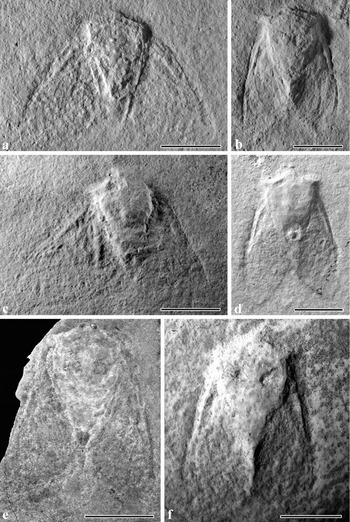
Prolystra lithographica Oppenheim, Reference Oppenheim1888. (a) NHMW2007z0142/0002. (b) NHMW2007z0142/0004. (c) BaJ1592. (d) NH4034. (e) JME SOS4882. (f) A poorly preserved specimen deposited at SMNS. Scale bars represent 20 mm. For a colour version of this figure see online Appendix at http://journals.cambridge.org/geo.

Examined material. NHMW2007z0142/0002 (holotype of Protopsyche braueri); NHMW2007z0142/0004 (holotype of Beloptesis oppenheimi); BaJ1592, NH4034, JME SOS4882, complete but poorly preserved; JME SOS3602 (part and counterpart) and JME SOS4881, both incomplete and strongly deformed; and a poorly preserved specimen without collection number deposited at SMNS.
Description. Body length 30–34 mm (Table 1). Head small and subtriangular. Mesonotum without distinct longitudinal carinae. Abdomen pointed posteriorly. Forewing medium-sized. Branch RA departing from stem R+M at the same level of cross-vein r+m-cua. Stem M slightly bifurcating basal of nodal indentation. Stem M1+2 branching into veins M1 and M2 at about the middle of wing. Discal cell large and antenodal region trapezoid. Branch CuP thick, dividing from stem Cu near base.
Discussion. P. lithographica is the most common palaeontinid from Solnhofen. Contrary to E. microcephala, most of the P. lithographica specimens possess the wings folded at the body. Handlirsch (Reference Handlirsch1906) erected four species based on the poorly preserved specimens with wings folded, but at the same time he suggested that Prolystra lithographica, Beloptesis oppenheimi and ?Beloptesis gigantean were probably the same species. After re-examining the holotype, Frickhinger (Reference Frickhinger1994) also regarded ?Beloptesis gigantea as an invalid species. Furthermore, because Handlirsch (Reference Handlirsch1906) regarded them as Lepidoptera, he misinterpreted the wing venation, and even added some veins in his reconstructions (such as Handlirsch, Reference Handlirsch1906, plate XLIX, figs 15, 23). Evidently, the diagnostic characters showed by Handlirsch (Reference Handlirsch1906) are not valid. Based on our re-examination, it is impossible to assign these specimens to different taxa and, therefore, they are regarded now as members of only one species.
A specimen with deformed forewings was originally placed in E. lameerei by Frickhinger (Reference Frickhinger1994, fig. 302). However, the wing size (about 50 mm in Frickhinger, Reference Frickhinger1994) indicates that the individual belongs to P. lithographica.
Genus Archipsyche Handlirsch, Reference Handlirsch1906
1906 Limacodites Handlirsch, p. 622.
Type species. Archipsyche eichstattensis Handlirsch, Reference Handlirsch1906; by original designation and monotypy.
Type horizon and locality. Solnhofen Formation, Upper Jurassic (Early Tithonian); Eichstätt, Bavaria, Germany.
Revised diagnosis. Body slender, length about 25 mm. Mesonotum almost as wide as abdomen. Forewing triangular, length about 33–36 mm, width about 16 mm; vein Sc unbranched; veins RA, RP and M separating at one point; branch CuA bifurcating basal of the level of nodal indentation.
Discussion. Archipsyche is different from other Solnhofen genera by the smaller forewing (Handlirsch, Reference Handlirsch1906; Carpenter, Reference Carpenter1932). Because of the lack of detailed venational characters, a thorough comparison is currently impossible.
Archipsyche eichstattensis Handlirsch, Reference Handlirsch1906
Figures 3d, 5
1906 Archipsyche eichstattensis: Handlirsch, p. 624, plate L, figs 1, 2.
1906 Limacodites mesozoicus: Handlirsch, pp. 622–3, plate XLIX, figs 12–15.
1999 Eocicada lameerei: Frickhinger, p. 61, fig. 106.
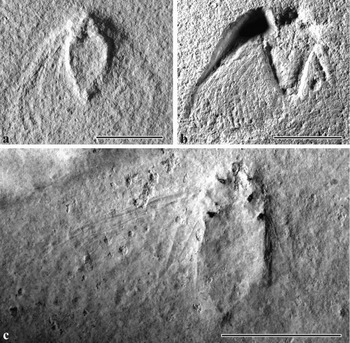
Archipsyche eichstattensis Handlirsch, Reference Handlirsch1906. (a) Holotype, NHMW2007z0142/0003. (b) BaJ1591. (c) JME SOS1821. Scale bars represent 20 mm. For a colour version of this figure see online Appendix at http://journals.cambridge.org/geo.

Examined material. NHMW2007z0142/0003, holotype, poorly preserved, part and counterpart; BaJ1591 (holotype of Limacodites mesozoicus), wings unclear and body strongly deformed, part and counterpart; JME SOS1821, wings and body clear, part and counterpart.
Description. Body slender, length about 25 mm (Table 1). Mesonotum width about 10 mm. Forewing small, with distinct nodal indentation. Branch RA departing from stem R+M at the same level of cross-vein r+m-cua. Stem M slightly bifurcating basal of nodal indentation. Stem M1+2 branching into veins M1 and M2 at about middle of wing. Branch CuA branching into veins CuA1 and CuA2 at about the same level of initial division of stem M. Discal cell large. Branch CuP thick, dividing from stem Cu near base. Vein Pcu slightly arched.
Discussion. The specimen attributed to A. eichstattensis by Frickhinger (Reference Frickhinger1994, fig. 300) is an alder fly (Neuroptera). The specimen placed in E. lameerei by Frickhinger (Reference Frickhinger1999, fig. 106) probably belongs to A. eichstattensis, with its narrow body and small, short forewings.
4. Discussion
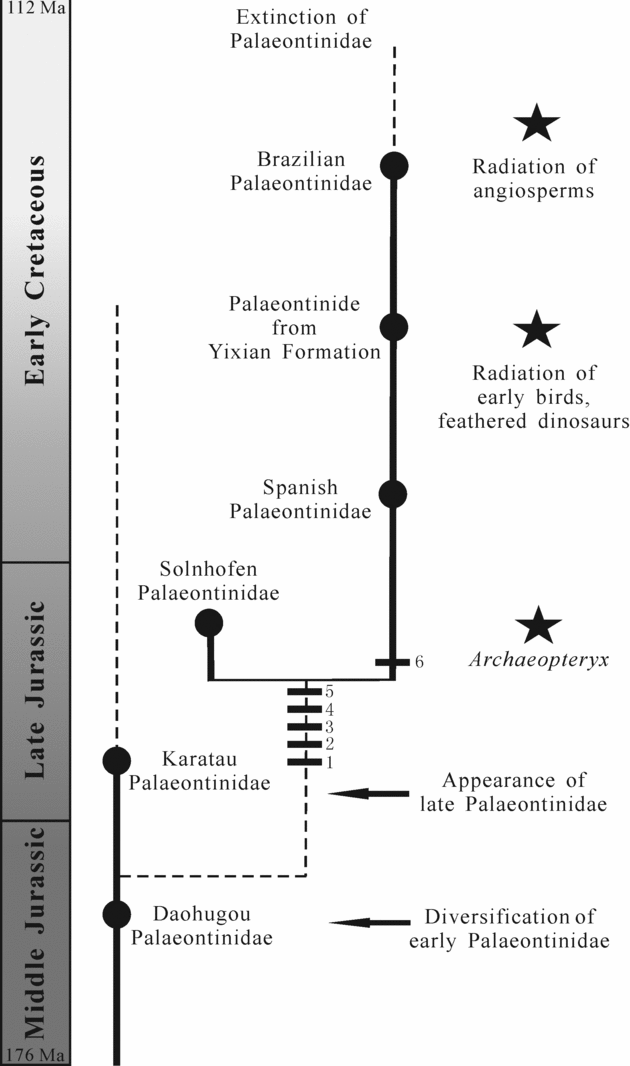
Based on forewings and hindwings, Mesozoic Palaeontinidae are divided into two groups: early Palaeontinidae (most living in the Jurassic) and late Palaeontinidae (most living in the Cretaceous) (Wang, Zhang & Szwedo, Reference Wang, Zhang and Szwedo2009). Solnhofen Palaeontinidae are clearly more closely related to the late Palaeontinidae, and together with the Cretaceous taxa they most probably form a monophyletic group based on the following characters (Figs 3, 6): 1, forewing with costal area narrow; 2, vein RA branching from stem R basally; 3, vein ScP not fused with vein RA; 4, clavus much reduced; 5, hindwing smaller. A definite result awaits a future cladistic analysis.
The evolution of late Mesozoic Palaeontinidae. Five synapomorphies of Late Palaeontinidae and one synapomorphy of Cretaceous Palaeontinidae. 1, forewing with costal area narrow; 2, vein RA branching from stem R basally; 3, vein ScP not fused with vein RA; 4, clavus largely reduced; 5, hindwing smaller, about half length of its forewing; 6, mesonotum with distinct longitudinal carinae. The time scale is from Ogg, Ogg & Gradstein (Reference Ogg, Ogg and Gradstein2008).

Palaeontinidae possesses both a narrow pronotum and a large mesonotum (Fig. 2; Ren, Yin & Dou, Reference Ren, Yin and Dou1998; Wang, Zhang & Fang, Reference Wang, Zhang and Fang2008). Cretaceous Palaeontinidae possesses a particular mesonotum with some longitudinal carinae. For example, Ilerdocossus from the Lower Cretaceous of Spain and China have a mesonotum with about 15 longitudinal carinae (Wang, Zhang & Fang, Reference Wang, Zhang and Fang2008). Brazilian Palaeontinidae also preserve some longitudinal mesonotal carinae (Menon & Heads, Reference Menon and Heads2005, fig. 1B; Menon, Heads & Martill, Reference Menon, Heads and Martill2005, fig. 5a). However, these carinae are completely absent or only weakly developed in Jurassic Palaeontinidae. In addition, no trace of longitudinal carinae has been discovered from well-preserved Solnhofen Palaeontinidae (e.g. Figs 2b, 4b). Therefore, the presence of distinct longitudinal mesonotal carinae is probably a synapomorphy of Cretaceous Palaeontinidae (character 6 in Fig. 6) and Solnhofen Palaeontinidae are basal to the Cretaceous taxa because their mesonotum is lacking distinct longitudinal carinae.
Triassic Dunstaniidae and early Palaeontinidae retain large hindwings (Wootton, Reference Wootton2003; Wang, Zhang & Szwedo, Reference Wang, Zhang and Szwedo2009). For example, the ratio of forewing/hindwing length of most Middle Jurassic Palaeontinidae is about 1.5 (Fig. 7d; Wang et al. Reference Wang, Zhang, Fang and Zhang2008). However, late Palaeontinidae (including Solnhofen representatives) possess small hindwings about only half the length of their forewings. Due to the decrease of the hindwing size, the forewing and hindwing jointly form a distinct triangular shape when coupled together (Fig. 2). In Solnhofen Palaeontinidae, the forewing and hindwing are sometimes so closely coupled that they look like a single wing (Fig. 2). This is the reason why early researchers did not distinguish them correctly when they drew some poorly preserved Solnhofen specimens (Fig. 1b).
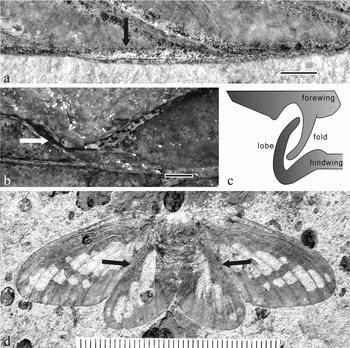
The wing-coupling structures of Palaeontinidae. For a colour version of this figure see online Appendix at http://journals.cambridge.org/geo. (a) The longitudinal groove (wing-coupling fold) on the hind margin of the clavus of the forewing (Palaeontinodes cf. shabarovi Martynov, 1937, NIGP140541). (b) The hook (wing-coupling lobe) on the anterior margin distal of the nodal indentation of the hindwing (Suljuktocossus coloratus (Wang, Zhang & Fang, Reference Wang, Zhang and Fang2006), NIGP140539). Scale bars represent 1 mm in (a) and (b). (c) Diagrammatic explanation of the functioning of wing-coupling mechanism. (d) The hindwing is locked with the forewing by the wing-coupling apparatus (Sinopalaeocossus sp., NIGP150277). All fossils are from the Middle Jurassic of Daohugou, Inner Mongolia, China. Each tick on scale bar is 1 mm.

The hindwings in the Hemiptera are held together with forewings by a wing-coupling apparatus during flight (Gorb & Perez-Goodwyn, Reference Gorb and Perez-Goodwyn2003). In singing cicadas, forewing and hindwing are locked together by the wing-coupling fold of the forewing and the wing-coupling lobe of the hindwing (Ossiannilsson, Reference Ossiannilsson1950; D'Urso & Ippolito, Reference D'Urso and Ippolito1994). This type of wing-coupling apparatus was found in most extant Cicadomorpha (J. Chu, unpub. Master thesis, Univ. Wyoming, 1971; Dworakowska, Reference Dworakowska1988), and was also clearly observed in excellently preserved palaeontinids from the Middle Jurassic of Daohugou (Fig. 7). This apparatus consists of a longitudinal groove (wing-coupling fold) on the hind margin of the forewing clavus, situated near the junction of vein Pcu and hind margin, and of a hook (wing-coupling lobe) on the anterior margin of the hindwing, situated somewhat distally of the nodal indentation of the latter. The wing-coupling fold represents a deflexed part of the hind margin of the forewing, and the wing-coupling lobe is an upwards retroflexed part of the anterior margin of the hindwing. During flight, the wings were held together by the wing-coupling lobe catching the wing-coupling fold. In the forewing, vein Pcu thickens and veins A1 and A2 end in the hind margin to strengthen the structure of the wing-coupling fold. In the hindwing, veins Sc and RA1 terminate in the anterior margin basal and distal of the wing-coupling lobe, respectively, to strengthen the structure of wing-coupling lobe as well. The connection between the hindwing and the forewing can also be observed in some palaeontinids which retain the original buoyant position (Fig. 7d; Menon, Heads & Martill, Reference Menon, Heads and Martill2005). The cicada-like coupling apparatus was probably present in all palaeontinids. These structures probably provide some useful information for the phylogenetic system of hemipterous insects (D'Urso & Ippolito, Reference D'Urso and Ippolito1994). However, detailed structures of the coupling apparatus were not observed in Palaeontinidae so far. Besides the cicada-like coupling apparatus, the Triassic Dunstaniidae (represented by Fletcheriana triassica Evans, Reference Evans1956) and most Jurassic Palaeontinidae possess another type of wing-coupling mechanism. They retain an elliptical or subtriangular forewing overlapped with a round hindwing, showing a butterfly-like overlap (amplexi-form): the wide clavus of the forewing is overlapped by the wide costal area of the hindwing by air pressure during flight (Wootton, Reference Wootton2003). The amplexi-form was modified in latest Jurassic Palaeontinidae because Solnhofen Palaeontinidae possessed a forewing with a narrow clavus (character 4 in Fig. 6) and a smaller hindwing (character 5 in Fig. 6).
The evolution of wing structures and flight performance of Palaeontinidae was analysed by Wootton (Reference Wootton2003), whose conclusion was further supported by the newly discovered Palaeontinidae from the Middle Jurassic and Early Cretaceous (Wang, Zhang & Szwedo, Reference Wang, Zhang and Szwedo2009). The triangular forewings, reduced hindwings and modified amplexi-form show that late Palaeontinidae evolved from moderately versatile to highly versatile flyers (Wootton, Reference Wootton2003). Furthermore, the presence of a reduced costal area and the rigid basal leading edge of the forewings of late Palaeontinidae also indicate an improvement of the flight ability (Wang, Zhang & Szwedo, Reference Wang, Zhang and Szwedo2009). The so-far last known assemblage of early Palaeontinidae occurred in the Middle–Upper Jurassic Karabastau Formation (Callovian to Oxfordian–Kimmeridgian) of Karatau, southern Kazakhstan (Polyansky & Doludenko, Reference Polyanskii and Doludenko1978; Kirichkova & Doludenko, Reference Kirichkova and Doludenko1996; Wang, Zhang & Fang, Reference Wang, Zhang and Fang2007). After the Late Jurassic, the fossil record of early Palaeontinidae is very poor. Only one probable specimen was found in the Lower Cretaceous Yixian Formation (Wang, Zhang & Fang, Reference Wang, Zhang and Fang2010). Late Palaeontinidae probably originated in the Middle or Late Jurassic (Menon & Heads, Reference Menon and Heads2005; Menon, Heads & Szwedo, Reference Menon, Heads, Szwedo, Martill, Bechly and Loveridge2007). Given the correct age of the Karabastau Formation, a rapid succession of palaeontinid assemblage occurred during Late Jurassic times. Interestingly, this evolutionary event was almost coeval with the appearance of earliest birds (Fig. 6). Archaeopteryx from Solnhofen was an insectivorous predator with weak or moderate flight ability (Chiappe & Dyke, Reference Chiappe and Dyke2006; Burnham, Reference Burnham2007; Mayr et al. Reference Mayr, Pohl, Hartman and Peters2007). A Late Jurassic ‘flight race’ may have taken place between Palaeontinidae and early birds like Archaeopteryx. The sharp decline of early Palaeontinidae was probably due to intense predation pressures of newly evolved insectivorous animals like early stem lineage representatives of birds (e.g. Archaeopteryx), or small, short-tailed, manœuvrable pterosaurs (Unwin, Reference Unwin2003), or early mammals which already passed through major radiations in the Mid- and Late Jurassic (e.g. Luo, Reference Luo2007). Solnhofen fossils indicated that late Palaeontinidae with better flight ability survived and became a dominant insect group during latest Jurassic times.
Acknowledgements
We are grateful to Barbara Gränz and Pino Völkl (JME), Günter Schweigert and Günter Bechly (SMNS) for access to Solnhofen specimens; Markus Wilmsen (SNSD), Jan Sklenář (NH) and Thomas Nichterl (NHMW) for providing detailed photos; Georg Oleschinski (University of Bonn) for photographing some specimens; Sandra Kaiser (University of Bonn) for carrying some specimens to Bonn; Claire Mellish (BMNH), Christian Neumann (ZMB), Martin Röper (BSPGM) for providing some information on Solnhofen fossils. This research was supported by the Knowledge Innovation Program of the Chinese Academy of Sciences (KZCX2-YW-154), the National Natural Science Foundation of China (40872015) and the National Basic Research Program of China (2006CB806400). The work at the University of Bonn was made possible by the Deutscher Akademischer Austausch Dienst (DAAD) Fellowship to Bo Wang. Many thanks go to Robin Wootton and Sam Heads for reviewing the manuscript and providing some constructive suggestions.