INTRODUCTION
Dual legitimacy systems appear worldwide, in diverse socio-economic settings and distinct political regimes (Van Cott Reference Van Cott2010; Koter Reference Koter2013; Baldwin Reference Baldwin2014; Díaz-Cayeros et al. Reference Díaz-Cayeros, Magaloni and Ruiz-Euler2014; Beath et al. Reference Beath, Fotini and Enikolopov2017). Systems with dual legitimacy maintain parallel structures that can encompass the full spectrum of legislative, executive and/or judicial prerogatives and be constituted by traditional (tribal), religious or other mechanisms outside of, and alternative to, constitutional authorities. We label such structures and their corresponding political processes as pillars of authority (shortened, pillars) and for theoretical purposes assume that two pillars exist in a given country: a constitutional, e.g. elective, pillar; and a traditional, typically non-elective and hereditary pillar. This assumption of two pillars suffices for our purposes, because our immediate focus is on the dynamics between the constitutionally defined structures, on the one hand, and, on the other, the traditional authority structures that function outside of and independent from constitutional authorities in Southern Africa.Footnote 1
The traditional pillar is extra-constitutional, whatever the formal (democratic or autocratic) constitution proclaims. The traditional pillar and the constitutional pillar together form the larger meta-constitutional space. We argue here that the balance of authority in that meta-constitutional space is achieved, maintained and redefined via the ongoing dynamic interaction between agents in the two pillars, which we call meta-constitutional bargaining. This kind of bargaining differs from the policy bargaining on which extant literature focuses. On policies (e.g. land, local public goods), actors across pillars often interact, and sometimes agree and at other times disagree (Baldwin Reference Baldwin2014, Reference Baldwin2018; Zenker Reference Zenker2015; Honig Reference Honig2017). In meta-constitutional bargaining, the pillars are always in opposition, as they are dividing a single proverbial ‘pie’ of authority legitimacy.
This article investigates the quest for legitimacy conducted by traditional leaders in dual legitimacy systems. We examine the endogenous processes of defining and redefining the institutional balance between traditional and constitutional authorities in dual legitimacy systems, where actors in those two structures of power share rule over the same set of people. To preview, we contend that traditional leaders engage in meta-constitutional bargaining that puts them in an adversarial relationship with the actors in the constitutional pillar. Because the sides in dual legitimacy systems engage in institutional balancing, the balance between the two pillars is a non-equilibrium process – is incapable of equilibrating. It is precarious and always under ongoing redefinition, even if it appears stable for a moment. Efforts to upset the balance are subject to complex strategic incentives of the agents involved. This process bears theoretical similarities to that analysed in the literature on federations, over the institutional balance between the members and the centre, as well as among the members (Riker Reference Riker1964).
The paper contributes to scholarship on political economy, federalism and traditional authority. Its argument is related to yet distinct from extant models in political economy designed to capture interactions between players in elective institutions who jockey for advantage or coordinate for mutual gain (Gamm & Shepsle Reference Gamm and Shepsle1989; Aldrich Reference Aldrich1995; Mershon Reference Mershon2001, Reference Mershon, Shane, Saalfeld and Strøm2014; VanDusky-Allen & Heller Reference VanDusky-Allen and Heller2014). The paper extends the theory of federal bargaining to accommodate institutional balancing between constitutional and traditional authority in dual legitimacy systems (Filippov Reference Filippov2005). The paper thus brings insights from political economy and federalism into the growing political science literature on chiefly authority.
We next lay out our argument and expectations. We then outline our research design for appraising expectations and move to narratives of the processes by which actors within the constitutional and traditional pillars in South Africa and Zimbabwe engage in meta-constitutional bargaining. The discussion of narratives draws out the implications that emerge from tracing the evidence as structured by our framework.
ARGUMENT: META-CONSTITUTIONAL BARGAINING IN DUAL LEGITIMACY SYSTEMS
As noted, dual legitimacy systems maintain parallel government structures with either some or the full measure of legislative, executive and/or judicial prerogatives vested in each (Cornell & Kalt Reference Cornell and Kalt2000; Williams Reference Williams2004; Holzinger et al. Reference Holzinger, Kern and Kromrey2016). Dual legitimacy, with both a constitutional pillar and a traditional one, can exist at local, sub-national and even national levels. The exact institutional balance between disjointed authorities operating over the same body of citizens, while often purported to be guided by constitutional documents, is endogenously maintained in the political process and is not constant.
Clarifying pillars of authority
The concept of pillars of authority introduced here requires a nuanced interpretation. To begin, some contemporary constitutions acknowledge traditional structures, and either delineate their role in general terms or even link with them by offering an explicit place for traditional leaders in representative bodies (Buur & Kyed Reference Buur and Kyed2007; Baldwin Reference Baldwin2015). In our view such provisions do not eliminate the distinctiveness of pillars, nor do they somehow manage to ‘absorb’ the traditional structures under the umbrella of the constitution that sets up the government. What such constitutional language does is, at best, ensure linkages and communication among officials across and between pillars. In a charitable interpretation, a nod from the constitution protects traditional structures from being completely eliminated by the constitutional government should it have enough strength to do so. At worst, however, the constitution could contain language that would pave the way for future attempts of the constitutional government to deploy its coercive apparatus against the traditional pillar. Whatever the scenario, each side will attempt to acquire an upper hand by proclaiming some degree of control over the other; agents in both pillars will manoeuvre to stake out an advantageous position for their own pillar as meta-constitutional bargaining unfolds.
Second, while authority requires coercive capacity, an uneven distribution of coercive capacity or even an erosion of coercive capacity in some pillars does not imply that coercive capacity cannot be recovered, as long as the pillar itself is intact. The two pillars of authority are thus equal in principle. The pillars both belong in the meta-constitutional space. Given the dynamics inherent in the non-equilibrating process of meta-constitutional bargaining, the side that has relatively weak coercive capacity today could well bolster its coercive power tomorrow. Even so, in practice the coercive capacity of the constitutional pillar dominates in most contemporary dual legitimacy systems.
Discussing coercive capacity leads to a third point. We exclude gangs and rebels from our definition of pillars of authority, despite their evident possession of coercive powers. Gangs inflict suffering, even terror, on citizens, and fail to serve them or generate positive net surplus for them. Rebels refuse to share territory and authority with governments, rather than accept overlapping authority with them. We consider these two criteria necessary to characterise a system as dual legitimacy: net positive governance and overlap of multiple authority structures over the same territory.
Assumptions about actors and their goals in systems with multiple pillars of authority
To articulate our argument about how the bargaining process between the traditional and the constitutional pillars unfolds, we must make transparent our assumptions about the goals and behaviour of elites in both pillars. It is sensible to assume that political incumbents on both sides care about maintaining and advancing their leadership status within their own pillar. They have power: they should want to retain it. Their reasons for doing that can be to implement their preferred policies for society or just to enjoy the prestige and perks of the office, but to us their reasons are immaterial. The key is to assume office-seeking behaviour on the part of incumbents, as is routine in the political economy literature. (Note that on these and other points the political economy approach is distinct from work on neo-patrimonialism; DeGrassi Reference DeGrassi2008; Pitcher et al. Reference Pitcher, Moran and Johnston2009).Footnote 2
The second consideration in political elites’ behaviour that we assume is to maximise the weight of their own pillar in the meta-constitutional balance. This imperative derives from the first: whatever the underlying goal of an incumbent, that agenda is better served with the power inherent in her office maximised, via the maximisation of the weight of her pillar.
We assume that, for agents in both pillars, obtaining office in one's own pillar has primacy over the second, and secondary, goal of shifting the balance of legitimacy to one's pillar. To rephrase, an actor must achieve the first goal of office for the other to become a concern. Yet once actors hold office, their power in office is enhanced by the legitimacy of their pillar. Not only does this connection bind the two goals but also elites in both pillars should be aware of it and behave accordingly.
Balancing as a non-equilibrating process
Our argument is informed by, though distinct from, political economy research on federalism. Filippov et al. (Reference Filippov, Ordeshook and Shvetsova2004), as they analyse bargaining in federations, place constitutions at the top level of formal political institutions, which they label Level 1. Yet they position another level of institutions, what they call Level 0, above constitutions in their conceptual ladder and imbue it with supremacy over constitutional-level institutions. They contend in doing so that constitutions are valid, implemented and enforceable, i.e. legitimate, only insofar as they do not conflict irreconcilably with pre-existing rules and norms that pervade their host society. This article, focusing on traditional authority in interaction with constitutional authority, probes the mechanisms by which Level 0 meta-institutions are decided.
The mechanism identified is that of balancing. Riker (Reference Riker1964) first described this mechanism in connection with the non-equilibrium maintenance of the jurisdictional division in federations. Filippov (Reference Filippov2005) and Filippov et al. (Reference Filippov, Ordeshook and Shvetsova2004) develop that framework, and conceive of federal balancing as residual constitutional bargaining. They contend that such a non-equilibrating process can result in an observationally stable balance – via the agency of actors who maintain partisan coalitions spanning bargaining entities. Our argument resembles what they identify for federations, though it accounts for balancing at a higher, by definition non-formal, level, above the constitutional framework. We suggest, among other things, that when dual legitimacy systems manage to maintain their balance, they do so via exposure to internal political competitive pressures within their pillars. Instances of internal political competition push individual actors, in their struggle to succeed within their own pillar, to seek allies in the other pillar. The result is akin to coalitions across pillars (cf. Gibbs Reference Gibbs2014; on dual polities, without discussion of balancing, Holzinger et al. Reference Holzinger, Kern and Kromrey2016; on South African federalism, omitting dual legitimacy, Simeon & Murray Reference Simeon and Murray2001; Tafel Reference Tafel2010).
Our argument thus implies that complex strategic incentives drive elite manoeuvres in meta-constitutional bargaining. While competing for office within their own pillar, elites can be induced to reach out to their counterparts in the other pillar for assistance in mobilising support. Specifically, traditional elites can mobilise their subjects to favour candidates in elections or participate in protests (for relevant evidence on elections, without our argument on balancing, see de Kadt and Larreguy Reference de Kadt and Larreguy2018; evidence on protests omitting balancing, Baldwin Reference Baldwin2015). For their part, elites on the constitutional side can interfere by backing rival contenders for the throne or even appointing traditional leaders (pertinent Zimbabwean evidence omitting balancing, Mapedza Reference Mapedza, Buur and Kyed2007). As elites on both sides jockey for advantage within their own pillars, they can blur the lines between pillars and make concessions to the opposing pillar in the meta-constitutional space. When they push for their pillar's power against the other, they on the contrary polarise meta-constitutional conflict. Their strategic behaviour, then, can produce either ‘cross-contamination’ or polarisation between pillars – depending on timing and circumstances in the political process.Footnote 3 We thus expect to see a non-uniform and non-monotonic pattern of balancing between the two pillars.
RESEARCH DESIGN: ANALYSING TRADITIONAL KINGDOMS AND CONTEMPORARY CONSTITUTIONS
Our selection of cases and of sources for narratives enables us to conduct a plausibility probe of our theoretical argument.Footnote 4 We compare the amaXhosa and the amaNdebele as two traditional pillars confronting the same constitutional pillar in South Africa. Reversing the view, we study the amaNdebele in Zimbabwe and the amaNdebele in South Africa as similar traditional structures facing different constitutional pillars with distinct institutional features. Our case selection allows us to construct two sets of comparisons, with a pair in each set.
Our neighbouring country cases, Zimbabwe and South Africa, present institutional variation and similarity.Footnote 5 An autocracy since independence, Zimbabwe has a constitutional pillar in which the president exerts overweening power, manipulates elections and deploys the security apparatus against the citizenry (Jafari Reference Jafari2003; Bratton & Masunungure Reference Bratton and Masunungure2006; Mapedza Reference Mapedza, Buur and Kyed2007; Polity IV 2018). South Africa, in contrast, has experienced a quarter-century of functioning democracy, albeit not partisan alternation in national office (Ferree Reference Ferree2010). Yet both Zimbabwe and South Africa accord legal status to traditional authority in local governance (Mapedza Reference Mapedza, Buur and Kyed2007: 189–92; Baldwin Reference Baldwin2015: 168–9, respectively). While Zimbabwean chiefs have representation in the national Council of Chiefs as of 1997 and in the Senate as of 2005 (Mapedza Reference Mapedza, Buur and Kyed2007), South Africa since 1997 features a national House of Traditional Leaders (Williams Reference Williams2010). In both countries, the constitutional side grants remuneration to high-ranking traditional leaders (Williams Reference Williams2010, on South Africa; Mapedza Reference Mapedza, Buur and Kyed2007, on Zimbabwe). In both countries, traditional leaders have an important role in society (Logan Reference Logan2009, Reference Logan2013; Matyzak Reference Matyszak2010). Mapedza (Reference Mapedza, Buur and Kyed2007: 190) reports 177 senior (‘substantive’) chiefs in Zimbabwe. Williams (Reference Williams2010: 233) gives 774 South African chiefs as of 2002.
In each country, we study the second largest ethno-linguistic group, in view of the theoretical possibility of state capture by the dominant group. Notably, the largest groups (amaZulu in South Africa, vaShona in Zimbabwe) generate ample evidence of elite strategic behaviour. It is, however, difficult to judge whether that behaviour regards meta-constitutional bargaining or ‘plain old’ party politics.
We highlight cross-country variation in the degree of heterogeneity of traditional authority. Political alliances across pillars would logically be easier to forge where the traditional pillar is more fragmented. In the fragmented ethnic landscape of South Africa, primary isiXhosa speakers constitute 16% of the population, the second largest group after the amaZulu (Statistics South Africa 2012).Footnote 6 Leaders both of the larger amaXhosa and the smaller amaNdebele are often found in amiable relationships with constitutional political actors.
In Zimbabwe, the amaNdebele people are the second in size after the vaShona, and predominate in the Mthwakazi area, which amounts to the bulk of Zimbabwe's land mass (CIA World Factbook 2018). The Zimbabwean amaNdebele are a much larger presence as far as their territorial control and claims, and so a more significant potential threat in the political process than any single South African counterpart. The state-sponsored mass killings of the Zimbabwean amaNdebele under Mugabe in the 1980s reinforced this threat, as they buttressed the amaNdebele particularistic identity and have since fed efforts at secessionist mobilisation (e.g. Ndlovu-Gatsheni Reference Ndlovu-Gatsheni2008; Sguazzin et al. Reference Sguazzin, Latham and Marawanyika2018).
We rely on narrative as our mode of presenting evidence (cf., among many, Acemoglu et al. Reference Acemoglu, Johnson, Robinson and Rodrik2003). As the basis for narratives, we use news items from online media sources, identified with such search terms as Xhosa, Ndebele, South Africa, Zimbabwe, king, throne, traditional, and selected based on whether they pertained to interpillar relations. While these criteria would not suffice for constructing a quantitative dataset, we deem them adequate for generating inputs for building case narratives. We identify a total of 41 events from media sources, complemented by scholarly and official sources.
NARRATIVES ON TRADITIONAL KINGDOMS AND CONTEMPORARY CONSTITUTIONS
In the narratives we present, we stake, and support, the theoretical claim that a balance between the two pillars exists, is dynamic, and shifts as the product of the purposeful action of strategic elites who interact within and across their pillars. Our evidence-based narratives suggest that actors’ strategies in both traditional and constitutional structures align with the framework we propose. Specifically, Tables I and II nicely illustrate a non-uniform, non-monotonic pattern of balancing between pillars. Our discussion of the narratives, as distilled in the tables, highlights that actors often behave in line with posited complex strategic incentives.
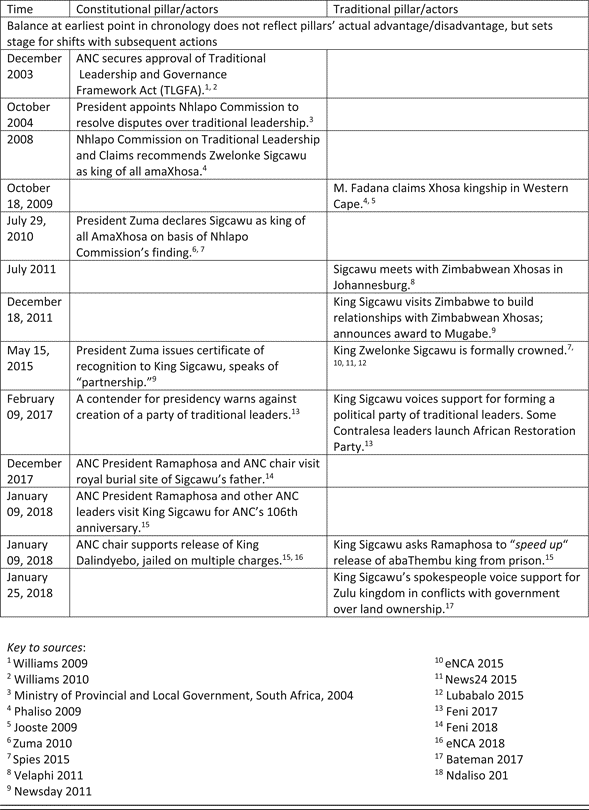
Constitutional and Xhosa traditional actors in meta-constitutional bargaining in South Africa.

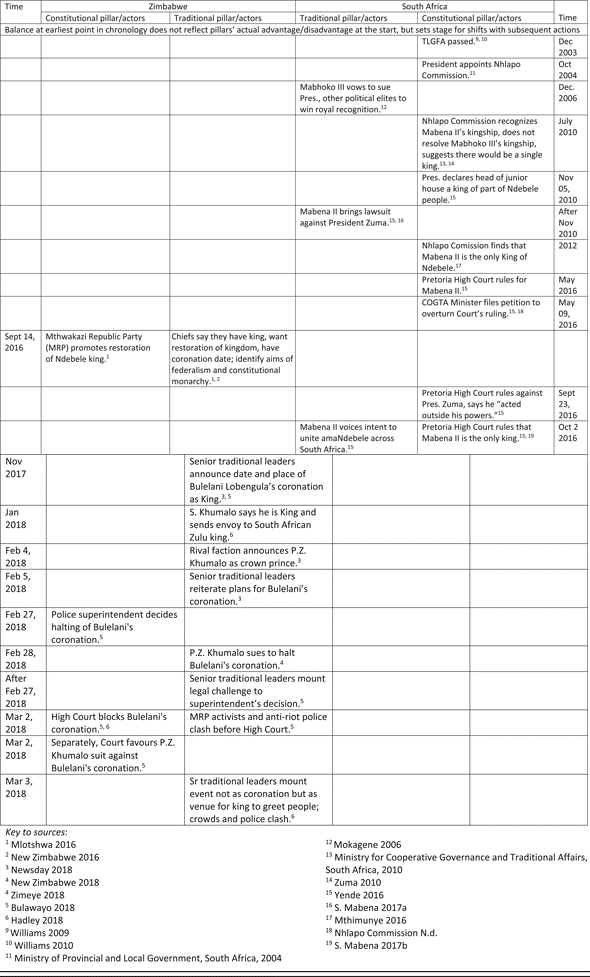
Ndebele traditional actors in meta-constitutional bargaining with constitutional actors in Zimbabwe and South Africa.

The amaXhosa Kingdom and South African constitutional actors
We choose to begin this narrative in December 2003, when the ANC secured approval of the Traditional Leadership and Governance Framework Act, or TLGFA (Ministry of Cooperative Governance and Traditional Affairs (COGTA) 2003; Williams Reference Williams2009). This is the first entry in Table I. This and the next table track events in chronological order, with columns representing pillars. As the ANC entry suggests, we place an event in one column or another according to the pillar to which the actor initiating the event belonged. A change in the widths of columns from one row to the next reflects our subjective assessment of which pillar in the meta-constitutional balancing has attained relative advantage in the wake of a particular event. Enactment of the TLGFA represents the ANC's strategic move made in advance of the April 2004 parliamentary election: the ANC augmented the authority of traditional hierarchies to boost support of Black South Africans from all ethno-linguistic groups (cf. Ferree Reference Ferree2010; De Kadt and Larreguy Reference de Kadt and Larreguy2018). Nonetheless, we identify the initial balance in Table I as in favour of the constitutional pillar.
In October 2004, as the second row in Table I exhibits, the national government under then-President Mbeki established the Commission on Traditional Leadership Disputes and Claims (the Nhlapo commission), which was charged with adjudicating conflicts over chiefly authority. The Commission's purview included discerning the rightful heirs to positions in the chiefly hierarchy (Ministry of Provincial and Local Government 2004; on the Commission's judicial status, with critical analysis of its work, Peires Reference Peires2014; Buthelezi & Skosana Reference Buthelezi, Skosana, Comaroff and Comaroff2018). The Commission was established under the auspices of the 2003 TLGFA and when created represented a further assertion of constitutional supremacy over the traditional pillar. Table I denotes this change via expansion of the constitutional column.
In 2008, the Nhlapo Commission recommended that Zwelonke Sigwacu be ‘the only recognised king’ of the amaXhosa throughout South Africa (Phaliso Reference Phaliso2009). Despite the Commission’s demonstrated power to adjudicate conflicts within the traditional pillar, we view this event as an expansion of power for the traditional pillar and a corresponding contraction of power of the constitutional one.
The fourth row in Table I registers an instance of contestation over the amaXhosa throne. In October 2009, Michael Fadana claimed the amaXhosa throne in the Western Cape province. Zwelonke Sigcawu publicly rebutted Fadana's claims (Jooste Reference Jooste2009; Phaliso Reference Phaliso2009). In 2010, President Zuma declared Sigcawu the king of all amaXhosa on the basis of the Nhlapo Commission's finding (Zuma Reference Zuma2010; Spies Reference Spies2015). We consider this latter development a gain for the traditional pillar, though the King was not formally crowned until 2015 (Lubabalo Reference Lubabalo2015; Spies Reference Spies2015). The long-term impact of the creation of the Nhlapo Commission was thus at odds with its short-term advantage for the constitutional side.
Why would the Nhlapo Commission issue a report containing a clear determination of kingship – a move that we claim favoured the traditional pillar in bargaining over legitimacy – if the Commission itself was the creature of the constitutional pillar? In our judgement a body, once established and charged with a task, eventually must justify its existence and produce some result pertinent to its mission. The Nhlapo Commission took roughly six years to decide this specific issue (cf. Buthelezi & Skosana Reference Buthelezi, Skosana, Comaroff and Comaroff2018).
In 2011, Zwelonke Sigcawu reached outside South Africa for recognition and support. He first met in July with a delegation of Zimbabwean amaXhosas in Johannesburg (Velaphi Reference Velaphi2011), and then in December travelled to Zimbabwe, drawing crowds in the tens of thousands, including amaNdebele and vaShona (Newsday 2011). According to a member of the amaXhosa royal council, the visit showed that Sigcawu was the ‘king’ and ‘spiritual leader’ of Zimbabwean Xhosas as well as South African (Newsday 2011). Moreover, Sigcawu announced that he would bestow an award on President Mugabe (Newsday 2011), signalling a threat to South African constitutional authorities. These moves made by Sigcawu were not only significant within the traditional pillar but also endowed him with supra-constitutional legitimacy, for he portrayed himself as not bound by either South African borders or government. Sigcawu's Johannesburg gathering marked one expansion of the traditional pillar's legitimacy, and his Zimbabwe trip, still another.
In May 2015 came the coronation ceremony of Sigcawu as amaXhosa King (eNCA 2015; News24 2015; Spies Reference Spies2015). Speaking to the throngs at the ceremony, President Zuma issued a formal certificate of recognition to King Sigcawu and called for ‘partnership’ linking the South African government ‘with the [amaXhosa] royal family’ (News24 2015). President Zuma used his speech to assert that land claims advanced by traditional leaders would be negotiated ‘within the Constitution's boundaries’ (News24 2015). Despite Zuma's moves to buttress the constitutional pillar's power, we deem Sigcawu's coronation on balance as a gain for the traditional pillar and a loss for the constitutional one, as Table I exhibits. The historic coronation of King Sigcawu secured his royal status and removed contestation for the amaXhosa throne within the traditional pillar, thus strengthening its legitimacy vis-à-vis the constitutional one.
The next set of events we observe further extended the legitimacy of the amaXhosa traditional pillar. In February 2017, as rival elected politicians competed to replace the beleaguered President Zuma, King Sigcawu demonstrated both the willingness and capacity to influence politics in the constitutional domain: he endorsed the creation of the new African Restoration Party (ARP) to represent traditional leaders and serve as a vehicle for their interests directly within the constitutional pillar (Feni Reference Feni2017). In doing so, Sigcawu cited the ‘negative attitude and arrogance of ANC leaders’ and the party's ‘sidelining’ of traditional leaders (Feni Reference Feni2017). Striving to retain support, one ANC contender for the presidency warned that severing the longstanding links between traditional leaders and the ANC would prove ‘detrimental to rural poor communities’ (Feni Reference Feni2017). While a group of leaders from the Contralesa (Congress of Traditional Leaders) were behind the ARP, the Contralesa as a body actively sought to remain outside the constitutional pillar and firmly within the traditional one (Feni Reference Feni2017). The Contralesa general council, in particular, affirmed that it would remain above party politics and voted that its leaders within the new party should surrender their Contralesa positions.
With amaXhosa kingship issues settled on the traditional side, we next observe public expressions of respect for Sigcawu and his authority by party and government leaders.Footnote 7 In December 2017, ANC President Ramaphosa and ANC Chair Mantashe visited the royal burial site of King Sigcawu's father (Feni Reference Feni2018). In early January 2018, ANC President Ramaphosa and other ANC leaders visited King Sigcawu as part of the party's celebration of its 106th anniversary (eNCA 2018).
In January 2018, Sigcawu raised the issue of the release from prison of the abaThembu king, Dalindyebo, jailed on multiple criminal charges (Bateman Reference Bateman2017; Feni Reference Feni2018). Tellingly, Sigcawu asked Ramaphosa to speed up the release of Dalindyebo, signalling royally that no question should exist as to the need for the release. On the same day, as Table I records, the ANC chairman suggested that Dalindyebo's release amounted to a fait accompli (Feni Reference Feni2018).
This narrative closes with a statement of intent on an alliance among royal houses on the subject of land ownership. In late January 2018, as shown in the bottom row of Table I, spokespeople for Sigcawu declared the King's support for the amaZulu kingdom in its conflicts with the government over land ownership.Footnote 8 Having secured the throne, Sigcawu continued to strive to protect and expand the sphere of traditional influence. We infer that, as compared to the narrative's start, by late January 2018 the balance of legitimacy had shifted to favour the traditional pillar.
AmaNdebele kings, kingdom and balancing in South Africa
The KwaNdebele bantustan, one of the 10 homelands under the South African apartheid regime, created two kings for the two enclaves of the amaNdebele people in 1984, thus establishing a lasting rivalry that serves as a backdrop for our narrative (Griggs Reference Griggs1995; Lekgoathi Reference Lekgoathi2003). (This narrative for the amaNdebele also starts with the 2003 approval of the TLGFA. As shown at the top right row of Table II (and consistent with the top row of Table I), the balance favours the constitutional pillar. The 2004 creation of the Nhlapo Commission advantages the constitutional pillar further. The traditional pillar loses again in December 2006 when Mabhoko III, descendant in one of the royal houses, threatens to sue President Mbeki and other political elites so as to gain official recognition – from the constitutional pillar – for his claim to the amaNdebele throne (Mokagene Reference Mokagene2006).
We observe that seeds planted in 2004 begin to bear fruit for the traditional side in 2010, when the Commission issued a report that recognised Mabena II as the king of the amaNdebele (Ministry for COGTA 2010; Zuma Reference Zuma2010). The Commission, however, did not finalise the seniority of his ruling house over that of Mabhoko III until two years later (Mthimunye Reference Mthimunye2016; Nhlapo Commission n.d.: 116). In its 2010 report, the Commission reduced competition within the traditional pillar generally, and thus restricted the range of rulings and interpretation for subsequent judicial decisions. We regard all these aspects of the Commission's 2010 report as a gain for the traditional pillar and a loss for the constitutional one.
Despite the Nhlapo Commission's ruling and his own July proclamation not granting Mabhoko III recognised status, in November 2010 President Zuma endorsed him as a king in the official Government Gazette (Yende Reference Yende2016), further fragmenting South African Ndebele. Mabena II in turn sued the President in the constitutional pillar's own court (S. Mabena Reference Mabena2017a; Yende Reference Yende2016). As a constitutional actor, the Pretoria High Court, a provincial-level appellate court, took six years before it in May 2016 ruled in Mabena II's favour. In October 2016, the Pretoria High Court issued a further ruling that ‘entrenched’ the power of King Makhosonke Mabena II over the amaNdebele people, while simultaneously removing Mbusi Mahlangu from the throne he claimed (Yende Reference Yende2016).
Despite this ruling for Mabena, the COGTA Ministry (together with the dethroned rival) filed a petition to overturn the Court's order (S. Mabena Reference Mabena2017b; Yende Reference Yende2016). Given the ongoing competition within the constitutional pillar between the Court and the President over interpretation of the Constitution, unsurprisingly the Court found that the President ‘acted outside his powers’ by asserting supremacy over a traditional issue. The Court thus gave a huge advantage to the traditional pillar. Once again, internal competition within one pillar yielded the meta-constitutional legitimacy benefit to the other pillar.
AmaNdebele kings and constitutional courts in Zimbabwe
Shifting attention to the amaNdebele in Zimbabwe, note the difference in context for our narrative. The contrasts between Zimbabwe and South Africa emphasised earlier help explain why the intensity and outcomes of meta-constitutional bargaining for the amaNdebele in the two countries have differed so starkly. As the Mugabe regime has evolved, so have its efforts to co-opt chiefly authority (e.g. Mapedza Reference Mapedza, Buur and Kyed2007; Pindula 2018). The traditional pillar under Mugabe's dictatorship was quiescent in meta-constitutional bargaining until around 2016. The president of the National Chiefs’ Council has thus explained the dearth of evidence on interpillar bargaining: ‘the pressure … the traditional leaders have been subjected to from political parties of all persuasions over the past years, various segments of society – social and economic – saying why are chiefs not asserting themselves … We waited for a long time deliberately until the conditions were conducive’ (as quoted in Manayiti Reference Manayiti2018).
Table II captures the differences, summarising our narratives of recent meta-constitutional bargaining between the amaNdebele traditional pillar and constitutional actors in Zimbabwe (on the left side of Table II) and in South Africa (right side). Overall, the evidence suggests that, in Zimbabwe, actors in the constitutional pillar score greater encroachments into the traditional pillar, whereas in South Africa the reverse more often occurs.
The first events observed for the amaNdebele in Zimbabwe (on the left side of Table II), in September 2016, result in a clear gain for the traditional pillar's legitimacy. On the traditional side, amaNdebele senior traditional leaders announced that a king had been identified within a particular house, without naming the king; they linked that announcement with proclaiming the broad goal of federalism and a constitutional monarchy (Mlotshwa Reference Mlotshwa2016). On the constitutional side, the opposition Mthwakazi Republic Party, a partisan vehicle for amaNdebele interests, embraced the notion of restoring the kingdom, specifying that the new king must not be ‘a puppet … who will derail our course’ (Mlotshwa Reference Mlotshwa2016; cf. MRP 2017). We also regard as a gain for the traditional pillar the September 2016 announcement that the amaNdebele royal coronation would occur in 2017 (New Zimbabwe 2016; cf. Newsday 2018). In November 2017, amaNdebele senior traditional leaders clarified the date and place of the coronation of their king, Bulelani Collens Lobengula Khumalo, thus further buttressing the legitimacy of the traditional pillar (Newsday 2018; Zimeye 2018).
We next witness, however, a sequence of shifts in the balance of power favouring the constitutional pillar. In January 2018 ‘self-appointed’ amaNdebele king Stanley Raphael Khumalo sent a representative to South Africa to meet with the amaZulu king there (Bulawayo24 2018). On 4 February 2018, still another rival faction within the amaNdebele instead identified Peter Zwide Kalanga Khumalo as the crown prince (Newsday 2018). The very next day, amaNdebele senior traditional leaders reiterated their plans for the early March 2018 coronation of Bulelani as King and denied the rumour that Bulelani had declined the throne (Newsday 2018). Zwide Khumalo then sought a court order to prevent Bulelani's coronation (New Zimbabwe 2018).
In our analytic framework, the emergence of additional contenders for the throne diminishes the traditional pillar's legitimacy and thus marks gains for the constitutional pillar. Rivals further damage their own pillar when they use constitutional resolution mechanisms such as courts as the presumed authority to support their claims to the throne. For their part, the courts expand the constitutional pillar's legitimacy when they rule in favour of weaker contenders.
Even before the judiciary within the constitutional pillar moved on the issue of Bulelani's coronation, the security apparatus acted. In late February 2018, a police superintendent, empowered by Zimbabwe's Public Order and Safety Act (POSA), proclaimed the coronation ‘illegal and unconstitutional’ and prohibited it (Zimeye 2018; on POSA as restricting freedoms of assembly and expression and other basic rights, Jafari Reference Jafari2003). AmaNdebele senior traditional leaders mounted a legal challenge (Zimeye 2018). The High Court moved swiftly, ruling on 2 March to block the coronation of Bulelani (Hadley Reference Hadley2018; Zimeye 2018). The Court's finding, handed down one day before the planned coronation, cited the ‘grounds that there was no law in the country allowing the establishment of a monarch’ (Zimeye 2018).
Ruling separately, also on 2 March, the Court sided with Zwide Khumalo's suit, brought against Bulelani, his supporters, and their push for coronation (Zimeye 2018). Zwide Khumalo's lawsuit and its resolution could have weakened his pillar, as captured via its contraction in the table. Yet the judicial preference for him over his rival could have served to strengthen his ‘candidacy’ within his own pillar.
Senior traditional leaders backing Bulelani went ahead with an event on 3 March, labelling it not a coronation but what the chair of the amaNdebele Crown Council termed an opportunity for the king ‘to just greet the people and tell them to disperse’ (as quoted in Hadley Reference Hadley2018). Although the capacity to mount the assembly scored a gain for the traditional pillar over the constitutional one, we highlight the fragility of this meta-constitutional balance.
Indeed, when the government and courts asserted the supremacy of the constitutional pillar, on two occasions, the confrontations that erupted between supporters of the traditional pillar and government forces devolved into what media sources termed ‘running battles’ with state police. Strikingly, two media sources, describing these two events on 2 and 3 March 2018, applied the same label to the clashes (Hadley Reference Hadley2018; Zimeye 2018). Champions of the traditional pillar's legitimacy not only remained unconvinced by arguments for constitutional supremacy but also risked violent state repression to express support for traditional authority.
DISCUSSION OF NARRATIVES
Our narratives now enable us to draw comparisons of, and distil patterns shared by, the cases of meta-constitutional bargaining. Though very stylised, the portrayal of bargaining dynamics among meta-constitutional actors in Tables I and II indicates a back-and-forth process, with legitimacy gains for a pillar followed in time by setbacks for its legitimacy and gains for the opposite side. What we narrate, and depict in Tables I and II, reflects the non-equilibrating nature of the meta-institutions that we theorise. Granted, our rendition is inherently incomplete, as any study in social science perforce selects from observed reality. Likewise, we and indeed no one can grasp fully the true intentions behind players’ actions (cf. Gamm & Shepsle Reference Gamm and Shepsle1989). Some insights from our narratives echo and reinforce the logical implications emerging from our theoretical argument. Others arise from observing the logic connecting sequences of actors’ moves, and contribute to our theoretical understanding, opening new possibilities for testable propositions.
Fragmentation weakens bargaining leverage
The first clear lesson is that competitiveness within one's own pillar inflicts a bargaining disadvantage on that pillar. Manoeuvres against an agent's rival within her own pillar lead to trades with the opposing pillar. We observe politicians who compete in elections in the constitutional pillar moving to please their traditional counterparts, for example by joining traditional ceremonies or making concessions on property rights and the rule of law. (Recall in Table I, items in February and December 2017, and two events, 9 January 2018; in Table II, September 2016 in Zimbabwe). Likewise, traditional leaders in competitive circumstances turn to courts and government officials for support (in Table I, an item in October 2009; in Table II, items in December 2016 in South Africa, and 28 February 2018, in Zimbabwe).
Actors are myopic, institutional outcomes are long-term
The second lesson regards trade-offs between short-term gains and long-term losses in the relative legitimacy of an actor's pillar. Moves that give, for example, the constitutional pillar a temporary advantage in legitimacy may, down the line, cement gains for the traditional pillar and give the latter a secure foothold for expansion. Consider the creation of the South African Nhlapo Commission (Tables I, II in October 2004), which at first seemed to have asserted the constitutional side's supremacy in deciding issues of overarching importance in the traditional pillar, including royal succession. In establishing the Commission, agents in the constitutional pillar brought immediate and tangible legitimacy gains for their own pillar. Yet in so doing, they reduced their successors’ room for manoeuvre, and enhanced the future stability and thus legitimacy of the traditional pillar. Another short-term legitimacy boost may have occurred for President Zuma in King Sigcawu's coronation (Table I, May 2015), which Zuma used to stress the constitutional path to adjudicating land issues. The staying power of forward-looking assertions of supremacy was put into doubt when the same King to whom Zuma gave official recognition later supported the Zulu challenge of the government's resolution on land ownership (Table I, 25 January 2018).
The outside world can weigh in during meta-constitutional bargaining
Observe in the narratives the cross-national leverage exerted by actors in meta-constitutional bargaining. Because traditional boundaries often cross-cut national boundaries, or, as in the case of the amaNdebele, the group resides in multiple areas due to the history of migration, interesting cross-national externalities can arise when constitutional pillars of two countries stake out different positions in bargaining with traditional authorities speaking on behalf of the same ethno-linguistic group (Table I, July and December 2011; Table II, January 2018 in Zimbabwe). On the historical ties among the amaNdebele people across the boundaries of Zimbabwe and South Africa, see Ndlovu-Gatsheni (Reference Ndlovu-Gatsheni2008).
Political regimes matter: democratic constitutional pillars are at a disadvantage
The nature and institutional specifics of the political regime on the constitutional side influences balancing outcomes. The design of any democracy incorporates ongoing contestation, crystallised in, but not confined to, the recurring, free and fair elections that distinguish democracies from autocracies. As a result, and as in South Africa, the constitutional pillar yields power repeatedly to the traditional side, when seeking help in electoral mobilisation (Table I, items in February and December 2017, two events on 9 January 2018). In contrast, in autocratic Zimbabwe, the constitutional pillar is relatively free from popular pressure and tends to impose itself on the traditional. Indeed, in an autocracy, other things being equal, the constitutional pillar is more likely to overwhelm the traditional pillar. Institutional variation under democracy can also count. For example, future research might inquire whether federalism could reconcile traditional actors with the notion of constitutional supremacy.
Courts are called upon to transcend pillar boundaries
A final insight from the narratives is that the judiciary is universally important for actors across pillars (in Table II, in South Africa, all five items in 2016; in Zimbabwe, 28 February and three items on 2 March 2018). Actors’ willingness to take to court their issues with each other, whether those arise within or across pillars, is clear in both countries. Why do diverse actors trust the courts?
The evidence here thus encourages revisiting the conventional interpretation that courts act within the constitutional framework. True, in both Zimbabwe and South Africa, all judicial bodies referenced in our narratives technically form part of the constitutional pillar and may not be neutral. Nonetheless, the behaviour of actors who participate in meta-constitutional bargaining indicates that they occasionally perceive the judiciary as if it also occupies a position above the constitution, particularly in South Africa, and is thus capable of transcending the pillars’ boundaries. That we see evidence of the informal perception of the role of the courts departing in this way from their formal legal origin is a potential research question in its own right. This intuition resonates with the fact that conflict and dispute resolution mechanisms in the wake of deep societal schisms tend to rely on supra-constitutional and quasi-judicial forms (Nalepa Reference Nalepa2010). Admittedly, our observations raise rather than answer these fundamental questions about the placement of the courts in the hierarchy of institutional forms. We leave to future research to inquire as to whether and when judicial bodies can be Level 0 institutions (cf. Filippov et al. Reference Filippov, Ordeshook and Shvetsova2004).
Thus, narratives built with available media sources align with our theoretical expectations, and spotlight the types of elite behaviour we posit: attempts to compete within one's own pillar as well as to achieve advantage for one's own pillar at the expense of the other. Moreover, the narratives disclose, as expected, complex strategic moves and irregular, non-monotonic patterns of gains and losses in bargaining between pillars.
CONCLUSIONS
To recapitulate the argument, we theorise that dual legitimacy systems rely on an active balancing of institutional legitimacy between the pillars, and that such balancing occurs in the meta-constitutional space via the actions of their respective political incumbents and challengers. The narratives we build exhibit dynamics consistent with such ongoing institutional bargaining. We thus demonstrate the plausibility of our theoretical argument.
The empirical evidence enriches our initial theoretical understanding. Specifically, while the balance of authority between pillars as traced in the narratives (and tables) does not equilibrate, sliding back and forth, we discern the potential for long-term trends – expansion on the constitutional side in Zimbabwe, and on the traditional side in both South African cases. Observe also the potential for strategic ‘cross-contamination’, when actors involved in one interaction learn from the experiences of their counterparts in another interaction (e.g. constitutional actors in Zimbabwe may have witnessed the growing influence of the traditional pillar in South Africa). This insight is only possible from chronologically aligning multiple narratives and taking into account that actors’ beliefs may be influenced by observations of events taking place outside of their own situation.
Another refinement to our theoretical argument regards the strategic calculi that help maintain the balance. We expect, in parallel to the Filippov et al. (2004) argument, that actors can form coalitions across pillars for opportunistic reasons. We see that competition for office in one's own pillar drives at least some agents to seek support from the opposite pillar. Extending this logic, competitiveness on both sides would yield the greatest stability in institutional balancing. Competitiveness on only one side would produce a slide towards the opposite side's empowerment. The outcome if neither side were competitive stands as an open question. Further research could thus explore whether the growing strength of a traditional pillar in a country may prompt authoritarian sentiments among progressive elites.
Of particular importance for the potential for cross-pillar political coalition-building is variation in how heterogeneous (fragmented vs. dominated) the traditional side is. For the sake of tracing coherent narratives, we have represented the traditional pillar as just one traditional entity in each case. The constitutional pillar, however, confronts multiple traditional authorities at once, and these interactions influence each other. The comparative success of the traditional pillar in South Africa as opposed to the constraints on its Zimabwean counterpart can in part be attributed to the heterogeneity of South African traditional authority (Williams Reference Williams2010). We thus conclude that traditional authority poses a lesser threat to the constitutional side when it is relatively fragmented.
We see the complex role that the short-term incentives driving political actors play in meta-constitutional balancing. Beyond incentives to form cross-pillar alliances for immediate gain, there is also the potential for moves that enable short-term authority grabs to lead to unintended long-term gains for the opposing pillar.
The shifting balance of authority is made most evident over time when a pillar's actors find that a decision that was easy and implementable for them in the past becomes entirely impossible, out of the question, just a few years down the road. The reverse could obviously also hold true: actors who were quite constrained early on might later see a drastic expansion of their options in decision-making.
Narratives presented by other scholars on countries beyond our purview here fit with our argument. For instance, accounts of the Botswanan one-party dominant democracy, though not guided by our argument on institutional balancing, comport with our theoretical framework (Acemoglu et al. Reference Acemoglu, Johnson, Robinson and Rodrik2003; Pitcher et al. Reference Pitcher, Moran and Johnston2009). Both studies emphasise the capacity of the long-ruling Botswana Democratic Party to reach out to traditional chiefs.
In sum, we have used the lens of our theory together with media sources to construct narratives of how and how much traditional authorities wield power in modern states. The lens, in particular, is the focus on bargaining between pillars of authority in dual legitimacy systems, parallel to bargaining in federal systems. Meta-constitutional bargaining counts precisely because in it actors strive to redefine institutions to empower themselves or their pillar, or to fend off institutional incursions on their and their pillar's power. The balance between pillars is always subject to change, as actors within one pillar or another manoeuvre for power, advantage and supremacy.