INTRODUCTION
More children die during the neonatal period (infants aged less than 28 days) or immediately prior to birth than at any other point in childhood (IOM, 2003; Sumner et al., Reference Sumner, Kavanaugh and Moro2006). The presence of a neonatal palliative care service, which would provide holistic care for infants and their family members, has been found to optimize healthcare for those facing end-of-life decisions, offering comfort, providing medical care, and strengthening psychosocial support (Balaguer et al., Reference Balaguer, Martin-Ancel and Ortigoza-Escobar2012; Ambalavanan et al., Reference Ambalavanan, Carlo and Bobashev2005; Catlin & Carter, Reference Catlin and Carter2002). Although a need exists for holistic care of infants with serious or life-threatening conditions, access to integrated curative and palliative care is limited due to attitudinal, educational, and institutional issues (Carter, Reference Carter2004; Carter & Levetown, Reference Carter and Levetown2004; d'Apolito, Reference d'Apolito2006; Moro et al., Reference Moro, Kavanaugh and Okuno-Jones2006). In order to better understand the institutional challenges of implementing a palliative care program, clinician skills and attitudes, operational processes, and financial aspects must be explored (Kobler & Limbo, Reference Kobler and Limbo2011; Liben et al., Reference Liben, Papadatou and Wolfe2008). The purpose of this focused ethnography was to gain insight into issues that impacted the implementation of a formal palliative care program at a major regional medical center. At the time of the study, a formal palliative care program was in the planning stages.
The interdependence of three dimensions of healthcare — clinical, operational, and financial — can be understood through the “three-world view” proposed by C.J. Peek (Peek, Reference Peek, Kessler and Stafford2008), according to which a successful health-related program of any kind, including neonatal palliative care, requires consideration of the interplay among the clinical, operational, and financial dimensions of healthcare. While the clinical world is based on providing quality patient care, the operational world is focused on administrative and policy factors that contribute to an efficient healthcare system, and the financial world is focused on ensuring appropriate price and good value for healthcare activities. The researchers used Peek's three-world view as a framework to guide the exploration of neonatal palliative care concepts within a multidisciplinary group of professionals.
While existing research had investigated physicians' and nurses' attitudes regarding the clinical aspects of neonatal palliative care (Burns et al., Reference Burns, Mitchell and Griffith2001; Kain, Reference Kain2006; Kain et al., Reference Kain, Gardner and Yates2009; Wright et al., Reference Wright, Prasun and Hilgenberg2011), at the time of our study the researchers identified no published research that explored healthcare professionals' views about palliative care from a systemic perspective that also included individuals who held operational and financial roles in the healthcare system of interest. The significant contribution of our study is to further understand the interaction among these three worlds in implementing a neonatal palliative care program.
METHOD
Using a focused ethnographic approach (Knoblauch, Reference Knoblauch2005; Morse & Richards, Reference Morse and Richards2002) the primary investigator conducted in-depth semistructured interviews between September 2009 and July 2010 to explore the barriers and facilitators experienced by professionals who were involved in the clinical, operational, and financial aspects of palliative care for the neonatal population at a regional tertiary healthcare institution in the southeastern United States. At the time of the study, the medical center offered no formal neonatal palliative care program.
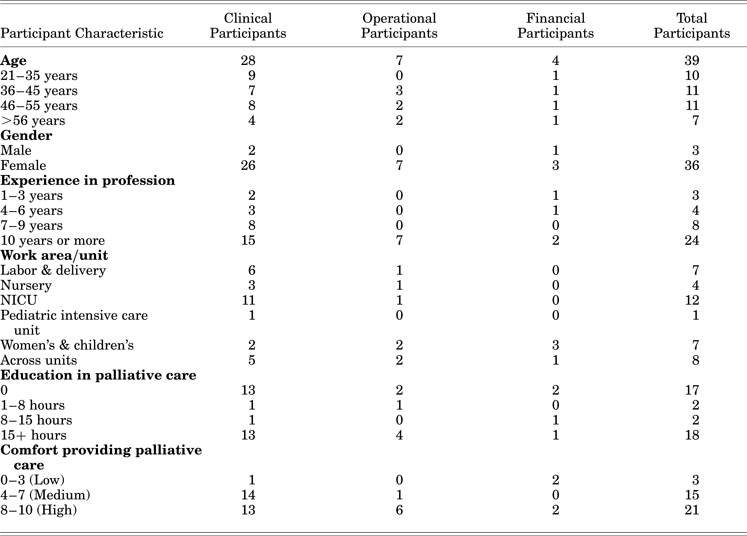
Purposive sampling was employed to recruit 39 health professionals from the medical center's administration, finance, and clinical units that provided direct care to neonates. We emailed individual unit nurse managers, administrators, and other selected professionals in relevant departments of the hospital to find referrals for eligible participants. We then utilized snowball sampling to identify additional participants (Table 1).
Participant demographic characteristics

Participant Demographic Characteristics
The primary investigator queried interviewees about their perceptions regarding the resources and challenges related to the clinical, financial, and operational aspects of neonatal palliative care in their medical center. The interviewing process invited participants to define palliative care, describe their training and experience in supporting or providing palliative care, and provide insights into additional elements that were needed to have a successful neonatal palliative care program. Individual interviews and focus groups lasted between 60 and 90 minutes.
The primary researcher transcribed the audio-recorded interviews verbatim and repeatedly reviewed each transcript before importing them into NVivo 8 (2008) for coding. Two researchers from the project team independently analyzed three randomly selected transcripts during the data collection process and generated codes to identify clusters of information that represented the respondents' statements (Miles & Huberman, Reference Miles and Huberman1994). These codes were compared between the two researchers, and discrepancies were negotiated in order to achieve consensus on a preliminary coding template. A codebook was then developed and reviewed by co-investigators and used to code the transcribed data into NVivo. Codes were visually displayed in a table to help organize them according to emerging patterns and create final themes (Miles & Huberman, Reference Miles and Huberman1994).
RESULTS
Themes were identified and aligned with their corresponding “world.” Primary themes included: (a) uniqueness of neonatal palliative care, (b) communication and conflict among providers, (c) policy and protocol discrepancies, and (d) lack of administrative support.
Clinical World
Uniqueness of Palliative Care in Neonatal Care
In this institution, staff typically agreed on an overall definition of palliative care as holistic care for patients and their families who faced a life-threatening illness. An allied health professional offered a definition that was echoed by the participants in the study:
It involves the spiritual care, the physical care, the emotional care, the medical care, all of it wrapped into care for the whole person. And all of the people who are involved with that person.
While the majority of staff knew that palliative care could be offered early in an illness trajectory, they also discussed how the operationalization of this definition was complicated by the unique characteristics of the neonatal population. An allied health professional stated,
I think you hear so much in a definition that it's not supposed to be “just” end-of-life; however, I feel like a lot of times it [palliative care] typically starts occurring at the end of life. I mean, there are definitely some things associated with palliative care that could be started right after the time of diagnosis, or right after the time of birth (. . .) But I think, typically, the majority of it is focused at (. . .) end of life, when that is closer in sight.
A physician and nurse also provided insight into the distinctive characteristics of neonatal palliative care:
It's very different in our area [of neonatal care]. For us, it's often immediate death in the next few hours. [physician]
I think that it's kind of unique in our area because sometimes it's [palliative care] at the beginning of life. [nurse]
The unique aspect of neonatal palliative care, especially blurring the beginning and end of life in the case of neonates with life-threatening conditions, affected the ways in which staff members felt supported in their current palliative care efforts at the institution. While some palliative care was available at the institution, those working with neonates felt that their situation and that of the neonates and their families was unique and not being addressed.
Communication and Conflict Among Providers
Communication among healthcare providers was highlighted throughout the interviews as a significant challenge, specifically communication between nurses and physicians and physicians and neonates' family members. Nurses believed that communication between physicians and family members could be ill timed or inadequate. Poor communication or disagreement with how physicians communicated with families about end-of-life treatment presented a source of conflict and distress for many of the nurses interviewed:
I think the doctors can be, in my opinion, can be kind of cold and cut off of the emotional aspect. They see the clinical aspect, but they don't see the emotional aspect. A lot of the times we're left to pick up the pieces. [nurse]
Physicians were aware of this conflict with nurses regarding such issues as the timing of stopping curative treatment:
Yeah, sometimes we think they're [nurses] perhaps thinking about it a little too soon and sometimes they think we're thinking about it a little too late. [physician]
Differences between doctors' and nurses' concerns were primarily related to two issues: their sense of responsibility regarding care decisions and an appreciation of and sensitivity to the emotional aspects of palliative care. Physicians discussed struggling internally with the responsibility they felt in designating care as “end of life” and sharing that information with the families; however, the nurses tended to be unaware of the physicians' internal struggle and how it impacted their efforts to openly acknowledge the futility of life-sustaining measures versus continuing life-sustaining efforts:
Sometimes the nurses do come to this decision sooner than we do (. . .) but again the decision rests with the attending [physician]. It's a big decision. [physician]
Yeah, we [physicians and nurses] have collective responsibility, but at the end it's the attending [physician] who's responsible for the patient (. . .) We have to put the DNR [do not resuscitate] order in the chart, and we order to stop the ventilator. So yes, it is a burden that stops with us. [physician]
These statements by physicians illustrate their perceived sense of responsibility for end-of-life decisions. Even though family members make the final decision to halt life-sustaining measures, the physician is responsible for acknowledging to the family that such a decision may need to be made. While both physicians and nurses were concerned with the decision-making process for neonates' palliative care management, nurses tended to question attending physicians and cite misunderstandings and conflict with the physicians related to designating end-of-life care. In contrast, physicians did not mention conflict with nurses, but rather questioned themselves regarding the decisions they had to make.
Despite differences in decision-making roles for nurses and physicians, findings from this study clearly revealed that both physicians and nurses held deeply felt concerns about the suffering of patients and families and shared a desire to minimize such suffering. While physicians struggled with the burden of responsibility for end-of-life care decisions, nurses struggled with the fact that treatment decisions were beyond their control. In both cases, family members had ultimate responsibility in making end-of-life decisions, but it was clear that both physicians and nurses felt a sense of burden and responsibility as they worked with patients and families concerning these issues.
Operational World
Participants discussed challenges they had experienced with regard to the hospital's operations, particularly in relation to offering the best palliative care possible to patients and families. The challenges experienced by participants tended to be associated with a perceived lack of collaboration, but upon further investigation it was found that a lack of adequate information related to protocols was often more to blame. In addition, education was commonly suggested as an appropriate answer to protocol issues; however, when speaking with administrators, the lack of attendance at proposed educational events was discouraging.
Policy and Protocol Discrepancies
Part of the planning for a formal program of palliative care was the formulation of and adherence to policies and protocols for care. As an example, neonatal intensive care unit (NICU) nurses suggested that parents and infants should be able to stay together and be cared for together following the delivery, unless the parents had different wishes. A nurse shared the following perspective:
If we can just get someone in the other units of our children's hospital to be on board, because if it's a known anomaly, and it's incompatible [with life]; we [the NICU] should not even be called to those deliveries.
Throughout interviews, nurses discussed the complications this policy caused for their palliative care efforts, including disallowing the mother and baby to stay together during the final hours of a neonate's life. As interviews continued, however, the primary investigator uncovered additional information indicating that the four-hour policy had been changed. Interviews with hospital administrators initially revealed conflicting statements regarding whether or not the stated policy was in effect, but one administrator finally determined that Labor and Delivery unit administrators had revised the policy. Although it had “been about a year since they changed that,” an unknown proportion of hospital personnel at all levels remained uninformed.
The aforementioned finding illustrated the significance of a failure to communicate and apply operational process results across units and staff. While study participants requested concentrated educational efforts regarding palliative care delivery as a way to address these gaps, discussions with the educational coordinators at the hospital suggested that a more complex solution was needed:
I think everybody's wish is always education. I'll sit down and a lot of times, education is the answer and that they want more education or they need more education. But when that education is put out there, you have a hard time getting people to that education. And from a staff perspective, it's hard getting to — potentially taking a day off (. . .) Even from an administrative perspective — education, education, education, is the answer to everything. But when we talk within a budget, education is the first thing that is going to be cut. [administrator]
As the above comment and Peek's three-world view suggest, addressing both clinical and operational processes would not be successful without also addressing financial processes.
Financial World
Throughout the interviews, participants expressed concern about the availability of resources for neonatal palliative care. Many clinical personnel stated that the administrative support needed to provide quality care was lacking. A unique finding, however, suggested that administrators were not aware of the concerns of clinical personnel. In addition, clinical personnel demonstrated their naiveté regarding financial aspects of care. These discrepancies found between the clinical and financial worlds again show the importance of integrating perspectives from all worlds in order to achieve understanding and coordination.
Lack of Administrative Support
When nurses and allied health personnel were asked about what it would take to have a successful neonatal palliative care program at the medical center, a common response was administrative support to initiate a formal program and the availability of a coordinator whose time would be dedicated to the program.
I don't necessarily think that we currently have the support leadership-wise. And I think that we've got to have leadership. Like, I feel like there's a couple other nurses that really want it [a palliative care program], and they continue to get roadblocks, and I don't know what those roadblocks are, but I just feel like, you know, that that's what's happening. That this is something that has got to come from the top. [nurse]
While some felt that the medical center administration was supportive of initiating a neonatal palliative care program, their concern was that the support did not include the needed resources such as a program budget, staffing, or overall focus and support. A health professional and administrator highlighted these issues in their comments:
How do you excuse yourself but still come across as caring and supportive of the family when you have your beeper going off? They tell you to turn the beeper off, but you can't because you have other responsibilities to attend to. I think those are definitely some barriers we're going to face — staffing issues. [allied health professional]
Well, we don't even have a palliative care budget. It's pieces and parts that are funded through multiple sources. So, it's little things like that that you have to say, “Are you really giving a concentrated effort?” [administrator]
Many study participants pointed to medical center administration as needing to be convinced that the implementation of a palliative care program was “worth it” in order to receive needed resources. However, when asked, no participant acknowledged making a prior attempt to approach the administration with palliative care requests or to share concerns. Interviews with administrative personnel verified that clinical personnel and others had not communicated the need for additional palliative care support. Since they had never heard a complaint, administrators assumed that care for the neonatal population was sufficient in terms of palliative care measures:
What part of what we're doing now is not meeting our families' needs? That information has not been provided to me. [administrator]
Another gap in understanding between the three worlds was revealed when the primary investigator asked clinical staff about the financial elements involved in providing neonatal palliative care. Their typical response to the query was, in the words of one nurse participant, “Wow. I've never thought of what it costs before.” The lack of awareness demonstrated between the three worlds lent support to the need for interdisciplinary communication and efforts to address clinical, operational, and financial considerations during the palliative care program planning process.
DISCUSSION
The purpose of our study was to understand the intersection of the clinical, operational, and financial worlds that impacted the implementation of a formal palliative care program. Research results confirmed that, while a strong commitment to implementing the neonatal palliative care program was present at all levels, improved communication and collaboration between the three worlds was necessary. Each worldview on its own was lacking in important information that was needed to provide coordinated and appropriate care.
Clinical
Definitions and understandings of palliative care often vary among healthcare professionals (Claxton-Oldfield et al, Reference Claxton-Oldfield, Claxton-Oldfield and Rishchynski2004; Meghani, Reference Meghani2004; Morstad Boldt et al., Reference Morstad Boldt, Yusuf and Himelstein2006; Pastrana et al., Reference Pastrana, Jünger and Ostgathe2008). Our study further demonstrated how the definition of palliative care for the neonatal population may be complicated by a shortened lifespan in general and the need to begin palliative care within the first few moments of life. According to past research, the timing of when to introduce neonatal palliative care caused moral distress for both nurses and physicians (van Zuuren FJ & van Manen E., Reference van Zuuren and van Manen2006). The nurses' experience was defined by the perceived suffering of the newborn, while physicians were more impacted by uncertain treatment outcomes. This finding was also reflected in our study, which revealed a lack of communication and understanding between nurses and physicians as they collectively dealt with the difficult issue of neonates at imminent risk of dying. For health professionals caring for neonates and their families, the transition from providing life-sustaining treatment to supportive end-of-life care was a difficult one.
Operational
One of the operational outcomes from our study was also documented in past literature, in relation to the lack of coordinated care and communication among team members involved in pediatric palliative care (Burns et al., Reference Burns, Mitchell and Griffith2001; Tolle et al., Reference Tolle, Tilden, Rosenfeld and Hickman2000). Parents themselves have identified the operational challenges they have faced as a consequence of being the recipients of a fragmented healthcare delivery system and experiencing a lack of communication among healthcare professionals (Cote-Arsenault & Denney-Koelsch, Reference Cote-Arsenault and Denney-Koelschm2011; Widger & Picot, Reference Widger and Picot2008). Our study, perhaps more than any other in the literature, punctuated the struggles and significance of appropriate documentation and protocols for neonatal palliative care, including clear communication pathways between institutional administration and clinical staff.
Financial
While the physical and emotional benefits of palliative care are well founded, financial resources are needed to support neonatal palliative care. In the United States, the daily cost of care can exceed $3,500 per infant, with a prolonged stay often costing upwards of $1 million (Muraskas & Parsi, Reference Muraskas and Parsi2008). Reimbursement issues pose challenges to providing palliative care services (Gilmer, Reference Gilmer2002). which are often financed by grants, donations, and various means of internal support (Manfredi et al., Reference Manfredi, Morrison and Morris2000). The unique finding at the institution participating in this study was that, while many staff were dedicated to improving palliative care for neonates, their concerns had not been received by the financial administrators responsible for addressing such concerns. In addition, clinicians did not have a clear understanding of the financial challenges related to providing neonatal palliative care. The lack of understanding and communication regarding financial implications seemed to contribute to the discouragement experienced by the clinical team regarding the existence of insufficient resources to implement a palliative care program.
Overall, this study revealed the gaps in communication and understanding among clinical, operational, and financial professionals. By including the voices of all three groups in this study, the intersections of the three worlds were revealed. In the following section, the authors outline recommendations that could help health professionals navigate these issues in order to plan and sustain neonatal palliative care programs.
RECOMMENDATIONS
To provide appropriate clinical care to the neonatal population, attention to continuity of care and communication regarding infant diagnosis and decision-making is critical (van Zuuren & van Manen, Reference van Zuuren and van Manen2006; Tolle et al., Reference Tolle, Tilden, Rosenfeld and Hickman2000). A lack of education regarding palliative care not only compromises care for patients but can also impact the way in which staff members cope with decision making involved in care (Romesburg, Reference Romesberg2004) or deliver neonatal palliative care services (Burns et al., Reference Burns, Mitchell and Griffith2001). Considering the findings from our study about provider education, administrators and clinicians may choose to educate health professionals in new ways. Strategies that might be considered include providing incentives for staff to attend training or creating leadership teams and mentoring programs where well-trained staff can extend support to clinical staff who are less experienced in palliative care (Mancini et al., Reference Mancini, Kelly and Bluebond-Langner2013).
Neonatal palliative care relies on administrative personnel from the clinical, operational, and financial worlds in healthcare who collaborate with providers, care about families, and understand the financial complexities of care when developing policies and procedures. Although healthcare professionals and administrators may be committed to providing quality care, the provision of quality care is difficult to achieve when standards of care are not known or policies are out of date or not implemented as intended. For this reason, it is crucial that palliative care standards, protocols, and competencies be co-constructed with clinicians, administrators, billing specialists, and family members and then reinforced through consistent training and scrutinized frequently in order to adjust to changing needs. This type of policy making would enhance both the clinical and operational worlds as well as impact financial elements as care is streamlined and more effectively delivered.
With any change in the implementation of clinical care and policy comes a change in the financial world. Funding for pediatric palliative care services poses significant challenges, and more research is needed regarding the estimated costs of providing palliative care to neonates. On an institutional level, bringing financial experts, organizational leaders, and clinicians together to discuss monetary challenges and resource management is advisable in order to promote mutual understanding and provide an opportunity for all members of the healthcare team to brainstorm about creative ways to provide neonatal palliative care that is high in quality, efficient, and feasible.
LIMITATIONS
In the present study, the perspectives of healthcare professionals from varied disciplines enhanced understanding and highlighted the complexity of providing neonatal palliative care. In this study of 39 participants, data saturation was reached, but the themes reported may not represent the full range of perspectives present at this institution. In addition, not all perspectives regarding palliative care could be addressed. Future research is needed that continues to elucidate successful pathways to ensure that the partnership and collaboration of professionals from the three worlds can be attained and utilized to address the areas of greatest impact in providing quality neonatal palliative care.
CONCLUSIONS
Clinical, operational, and financial issues related to pediatric palliative care converge to create a complex, dynamic process of care provision. Without acknowledging and responding to the needs of all impacted individuals, systems, and processes in providing such care, the likelihood of program implementation failure is high. The findings from our study will potentially assist healthcare professionals in meeting the need to develop innovative and collaborative educational strategies for providers, the creation and communication of operational guidelines for care, and increased transparency regarding the financial challenges and resources that will promote high-quality care for neonates in need of palliative care services.
CONFLICT OF INTEREST
No author reports any conflict of interest. No funding support was received in terms of grants, equipment, drugs, or some other form.