INTRODUCTION
In Western countries, between 20 and 40% of older adults (aged 65+) have reported experiencing loneliness (Theeke, Reference Theeke2009; Savikko et al., Reference Savikko, Routasalo and Tilvis2004; Nyqvist et al., Reference Nyqvist, Cattan and Anderson2013), and this prevalence increases with advancing age, whereby 40–50% of individuals 80 years and older have often reported feeling lonely (Dykstra, Reference Dykstra2009). Loneliness is associated with adverse health consequences in older adults, such as impaired sleep (Hawkley et al., Reference Hawkley, Preacher and Cacioppo2010) and cognitive decline (Luanaigh & Lawlor, Reference Luanaigh and Lawlor2012; Wilson et al., Reference Wilson, Krueger and Arnold2007). Moreover, there is an apparent connection between loneliness and physical health, since loneliness has been associated with hypertension (Cacioppo et al., Reference Cacioppo, Hawkley and Crawford2002) and is a predictor of mortality in older people (Luo et al., Reference Luo, Hawkley and Waite2012; Tilvis et al., Reference Tilvis, Laitala and Routasalo2011).
Feelings of loneliness can also exist for those with a serious advanced illness. Among a group of dying cancer patients in a hospice, 46% reported feeling lonely (Rokach et al., Reference Rokach, Matalon and Safarov2007), which is somewhat higher than what has been reported among older adults in general (Theeke, Reference Theeke2009; Savikko et al., Reference Savikko, Routasalo and Tilvis2004; Nyqvist et al., Reference Nyqvist, Cattan and Anderson2013). Few studies have explored loneliness among dying people receiving home care services; however, loneliness is highlighted as an important issue in qualitative investigations of the lived experience of these individuals. Loneliness emerged as a main theme in two studies examining the experience of those dying of cancer and heart failure receiving home care (Brannstrom et al., Reference Brannstrom, Ekman and Norberg2006; O'Connor, Reference O'Connor2014). This evidence suggests that feelings of loneliness among this population are linked to the gradual decline in their ability to perform the basic activities of daily living (ADLs) (Brannstrom et al., Reference Brannstrom, Ekman and Norberg2006) and due to a communication breakdown within the family (Hughes & Arber, Reference Hughes and Arber2008).
Loneliness in seriously ill adults has been associated with such adverse consequences as depression and a desire for hastened death (Cacioppo et al., Reference Cacioppo, Hawkley and Thisted2010; Mishara, Reference Mishara1999). Palliative care aims to address the needs of patients and their families that go beyond pain and symptom control (Canadian Hospice Palliative Care Association, 2002). Providing patients with psychological, social, and spiritual support is an important dimension of such care. The goals of palliative care also include the patient's quality of life, spirituality, loss and grief, and family bereavement (Kaasa & Loge, Reference Kaasa and Loge2003). As such, in assessing such issues as loneliness, which relate to the psychosocial well-being of a person in a palliative population, it is important to identify those at risk in order to optimize their quality of life and the quality of care they receive (National Consensus Project for Quality Palliative Care, 2013).
There is an important distinction to be made between loneliness and social isolation. Loneliness is a negative subjective experience, whereas social isolation is objective and refers to the case of not having ties with others (Dykstra, Reference Dykstra2009). Individuals may experience loneliness even though they are surrounded by other people (Victor et al., Reference Victor, Scambler and Bond2002). The use of a single question asking about one's perceived feelings of loneliness is a simple and effective way to measure loneliness and has been shown to be highly correlated with two of the most widely used loneliness assessment tools—namely, the UCLA Loneliness Scale (Russell, Reference Russell1996) and the DeJong Gierveld Loneliness Scale (van Baarsen et al., Reference van Baarsen, Snijders and Smit2001).
To our knowledge, no quantitative studies have focused on loneliness in older adults with advanced illness who were receiving home care services. The present project involved a longitudinal analysis among a cohort of seriously ill older adults (aged 65+) receiving home care in Ontario. Our objective was to examine the occurrence of new cases of loneliness in this group and to identify the key predictors of this important outcome.
METHODS
In Ontario, home care services are publicly funded and financed through the provincial government. Community Care Access Centers (CCACs) are agencies that deliver healthcare in the home and community. Home care eligibility, as determined by a CCAC, is based upon a person's need for nursing care or personal support services (Ontario Ministry of Health and Long-Term Care, 2006). The Resident Assessment Instrument for Home Care (RAI–HC) is a standardized tool that guides comprehensive care planning in home- and community-based settings. The RAI–HC is a copyrighted instrument (visit www.interrai.org) that is mandated in Ontario for all long-stay home care clients (estimated length of stay of 60+ days) (Ontario Ministry of Health and Long-Term Care, 2007). Moreover, it has been mandated in many Canadian provinces/territories and in multiple U.S. states. It contains ~300 items capturing such domains as physical functioning, social functioning, and mood and behavior. The RAI–HC is conducted by trained assessors (typically registered nurses) in the client's home. The assessors complete the RAI–HC based on information provided by the client, their caregivers, and clinicians, as appropriate. RAI–HC assessment is done when an individual is initially referred to home care and typically repeated every six months, or following a significant clinical change (e.g., hospitalization). The Canadian Institute for Health Information (CIHI) has created a pan-Canadian data repository that contains RAI–HC and other home care data from multiple regions in Canada. The CIHI makes these data available for both students and researchers.
Study Design
The present study was a retrospective cohort study of new-onset loneliness in a sample of seriously ill older adults receiving home care in Ontario, Canada. It represents a secondary analysis of a database containing RAI–HC assessments completed between 2009 and 2011 for all home care clients in Ontario, which was made available to us by the CIHI. The study sample included clients (N = 2,499) aged 65 and older who had completed two consecutive RAI–HC assessments within the database. All types of assessments (e.g., initial assessment, routine follow-up assessment) were included in the analysis.
Individuals were included in the sample if they met the following inclusion criteria:
• 65 years of age or older
• had two consecutive RAI–HC assessments in the database
• did not report being lonely at the time of their first assessment (time 1, or T1)
• did report being lonely at the second assessment (time 2, or T2)
• were seriously ill (had a documented prognosis of less than 6 months to live or a Changes in Health, End-Stage Disease, and Signs and Symptoms (CHESS) Scale score of 4 or higher)
• were not severely cognitively impaired (Cognitive Performance Scale [CPS] score ≤ 3).
Clients with severe cognitive impairment (CPS score 4+) were eliminated from the study sample because of the concern that they would not be able to reliably self-report loneliness.
Study Sample
Individuals were included in the study sample if they: had a prognosis of less than 6 months to live (yes/no) or a CHESS score of 4 or higher. The client's prognosis was determined from a single dichotomous item in the RAI–HC assessment that designates individuals as having less than 6 months to live based on a physician's clinical judgment. The CHESS Scale was developed to detect health instability and identifies individuals at risk of serious health decline (Hirdes et al., Reference Hirdes, Frijters and Teare2003). This scale utilizes items within the RAI–HC that measure physical symptoms (e.g., vomiting, dehydration, and shortness of breath). CHESS Scale scores range from 0 (no instability) to 5 (highest level of instability), and higher scores are associated with a higher mortality among older adults in the community. A cutoff of 4 points or higher was chosen because of its strong ability to predict mortality (Hirdes et al., Reference Hirdes, Frijters and Teare2003).
Measures
All variables analyzed in our project were collected using RAI–HC assessment. The RAI–HC has been shown to have good validity and reliability (47% of items have a kappa [κ] value above 0.70) (Hirdes et al., Reference Hirdes, Ljunggren and Morris2008; Morris et al., Reference Morris, Fries and Steel1997). Our main outcome was loneliness, a single dichotomous item that captures the presence of self-reported loneliness (“client says or indicates that he/she feels lonely”). The social functioning items within the RAI–HC, which include the loneliness item, have shown good interassessor reliability (mean κ = 0.68) (Morris et al., Reference Morris, Fries and Steel1997). The potential predictors of loneliness included demographic characteristics, clinical and functional characteristics (e.g., cognitive impairment), indicators of social functioning (e.g., time the client is alone during the day), disease diagnoses, and presence of caregiver distress.
Health index scales, generated automatically using computerized software, are embedded within the RAI–HC and were used to examine participants' clinical and functional characteristics. The CPS is created using four items measuring memory, independence in eating, communication, and decision making, forming a score that ranges from 0 (cognitively intact) to 6 (very severe impairment). It has been validated against both the Mini-Mental State Examination and the Test for Severe Impairment (Morris et al., Reference Morris, Fries and Mehr1994). The Depression Rating Scale (DRS) is a screen for depression and uses seven items related to mood and behavior (e.g., anger, tearfulness) to form a score from 0 to 14. The DRS has established criterion validity through comparisons with the Hamilton Depression Rating Scale and the Cornell Scale for Depression (Martin et al., Reference Martin, Poss and Hirdes2008; Burrows et al., Reference Burrows, Morris and Simon2000) and has been shown to be an adequate measure within the palliative population (Martin et al., Reference Martin, Poss and Hirdes2008; Burrows et al., Reference Burrows, Morris and Simon2000; Fisher et al., Reference Fisher, Seow and Brazil2014). The Instrumental Activities of Daily Living (IADL) Difficulty Scale measures a client's level of difficulty in completing three activities: ordinary housework, meal preparation, and telephone use. Scores on the IADL Difficulty Scale range from 0 (no difficulty) to 6 (great difficulty). The ADL Self-Performance Hierarchy Scale measures four ADLs (personal hygiene, toilet use, locomotion, and eating) and creates a score that ranges from 0 (independent) to 6 (total dependence) and has been shown to be a reliable measure to assess changes in ADLs (Morris et al., Reference Morris, Fries and Morris1999). The Pain Scale captures the frequency and intensity of pain on a 4-point scale and has established criterion validity for the visual analogue scale (Fries et al., Reference Fries, Simon and Morris2001).
Analysis
To determine the best predictors of incident loneliness, multivariate logistic regression was employed, which generates odds ratios (ORs) that were used to estimate the relative risk. This was appropriate given that the incidence of loneliness was less than 10% (Zhang & Yu, Reference Zhang and Yu1998). We used ORs in addition to p values in our analysis, since the size of the OR, and the accompanying confidence interval, provided information in determining the importance of each covariate. For instance, an OR representing a 20% difference in the probability of being lonely was chosen to determine a clinically relevant change in odds (0.80 ≥ OR ≥ 1.2). Decision making regarding statistical significance was primarily determined based on a two-tailed α value of 0.05. Chi-square analyses were utilized for categorical variables and an independent-samples t test for continuous measures, at the bivariate level. The Cochran–Mantel–Haenszel chi-square test was also employed, with the Breslow–Day test used to assess for the presence of confounding variables.
A multivariate logistic regression model was created using incident loneliness at T2 as the dichotomous dependent variable and the health index scales and other items from the RAI–HC at T1 as independent variables. A change in health index scale scores from T1 to T2 (i.e., improvement, no change, decline) was also calculated. For each scale, a single-point increase or decrease in score from T1 to T2 was considered a decline or improvement, respectively. Variables that were significantly related to incident loneliness at the bivariate level, or were considered important based on the literature, were retained as potential predictors during the model-building process. Forward selection, backward elimination, and stepwise procedures were employed to identify a preliminary subset of important variables to be considered for inclusion in the final model. Logit plots were created for continuous measures, and if the variable displayed a nonlinear relationship, it was recoded and entered into the model as a categorical measure. Variables that were not retained following the various stepwise procedures were then forced into the model, individually, in order to minimize order-entry effects. Model fit was determined by comparing values across competing models (e.g., the c statistic as an indicator of discrimination and Hosmer and Lemeshow's goodness-of-fit statistic as an indicator of calibration—Hosmer & Lemeshow, Reference Hosmer and Lemeshow2000; Cook, Reference Cook2008).
Possible multicollinearity was assessed using poly- and tetra-choric correlations, which are used for ordinal and dichotomous variables (Gadermann et al., Reference Gadermann, Guhn and Zumbo2012; Flora & Curran, Reference Flora and Curran2004). Multicollinearity was present if the correlation coefficient between the two variables was greater than 0.40. The variable that showed the greatest predictive ability, based on the goodness-of-fit statistics, remained. All data were analyzed using SAS software (v. 9.2; SAS Institute Inc., 2001). The study protocol was approved by the research ethics board at Wilfrid Laurier University. Consent from participants was not obtained directly because they were assessed with a government-mandated tool that is used as part of normal clinical practice, and the data were stripped of all personal identifiers prior to being made available by the CIHI.
RESULTS
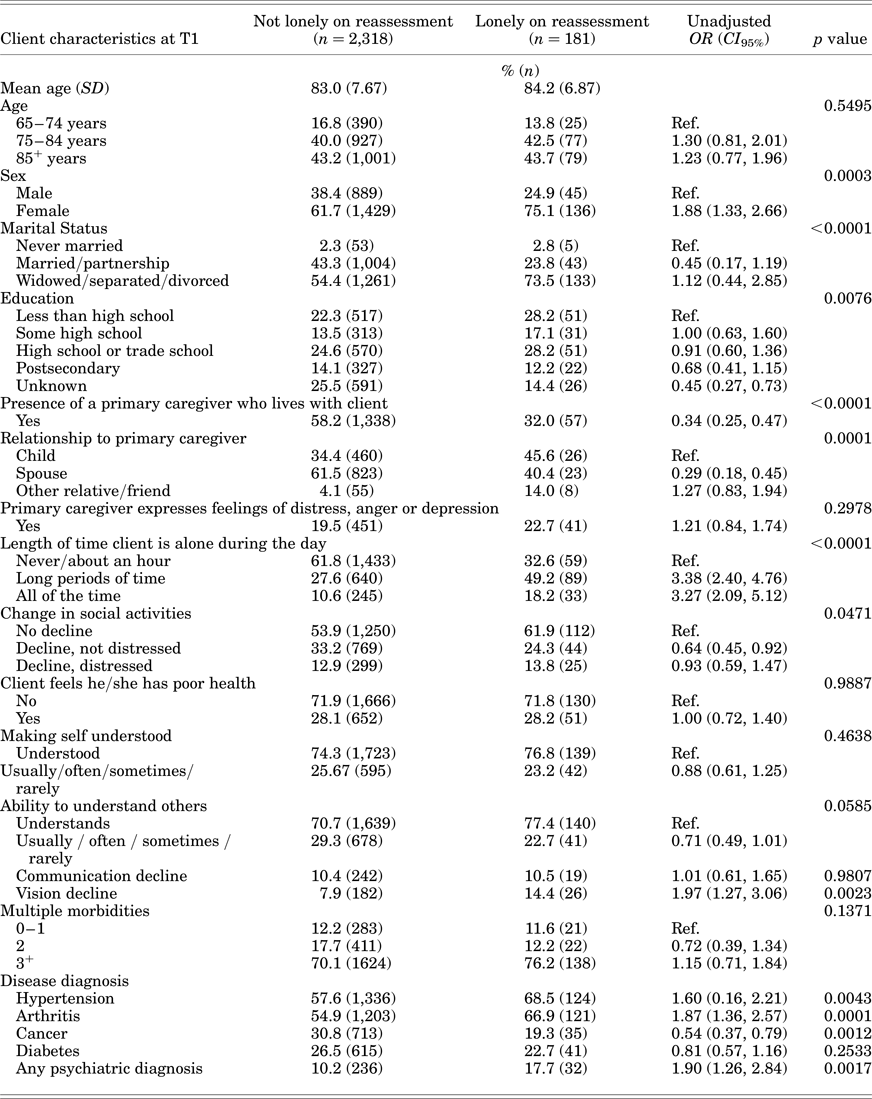
At T1, for the overall sample, the mean age was 83 years (standard deviation [SD] = 7.67), 61.7% were female, and 43.3% were married. The average length of time between T1 and T2 was 5.9 months (SD = 4.10). Between T1 and T2, 7.8% (n = 181) of clients developed loneliness. Loneliness was more common in females (75.1%) and increased with age, with 13.8% of those between the ages of 65 to 74 reporting loneliness compared with 42.5% for those 75 to 84 years, and 43.7% for those 85+. Among those who reported loneliness upon reassessment, 73.5% were widowed/divorced/separated compared to 2.8% among those who were never married, resulting in an OR of 1.12 (CI 95% = 0.44, 2.85) (Table 1).
Demographic and health-related characteristics of the sample at T1 and their relationship to incident loneliness

CI 95% = 95% confidence interval; OR = odds ratio; Ref. = reference value; SD = standard deviation.
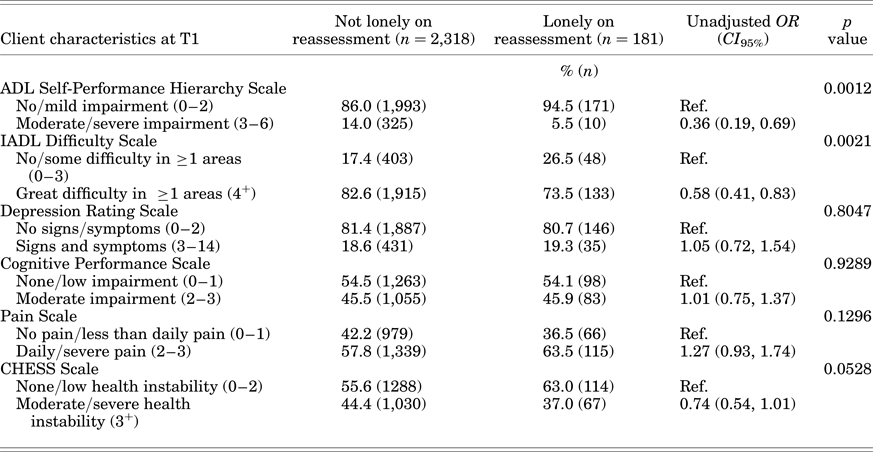
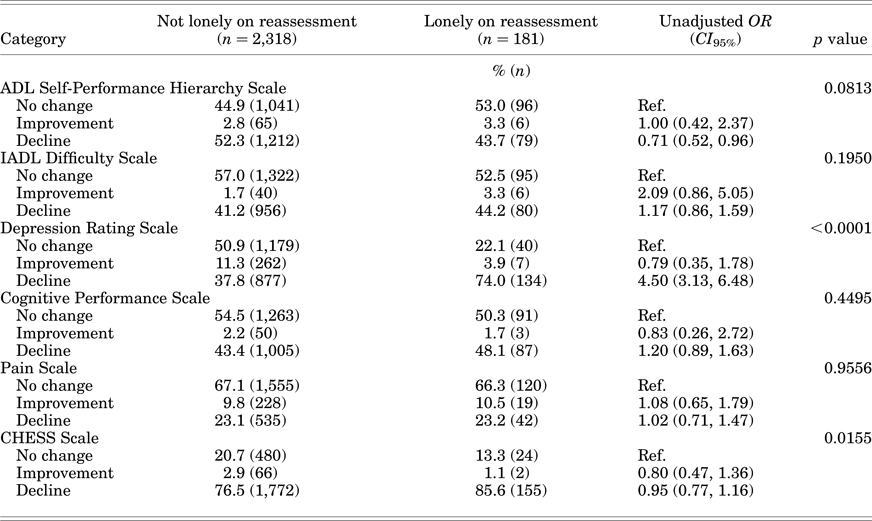
The primary caregiver was found to be influential in the development of loneliness, such that if the caregiver lived with the client there was a 66% (OR = 0.34, CI 95% = 0.25, 0.47) reduction in the risk of loneliness. Clients who were left alone for long periods of time were more than three times as likely to develop loneliness (OR = 3.38; CI 95% = 2.40, 4.76). Being diagnosed with cancer (0.54; 0.37, 0.79) and having a psychiatric diagnosis (i.e., anxiety, depression) (1.90; 1.26, 2.84) were related to the risk of loneliness. At T1, impairment on the ADL Self-Performance Hierarchy Scale (0.36; 0.19, 0.69) and the IADL Difficulty Scale (0.58; 0.41, 0.83) were protective of developing loneliness (Table 2). The change in DRS score from T1 to T2 was significantly related to loneliness, such that clients who experienced a decline were more than four times as likely to develop loneliness (4.50; 3.13, 6.48) (Table 3).
Health index scale scores of the sample at T1 and their relationship to incident loneliness

CHESS Scale = Changes in Health, End-Stage Disease, and Signs and Symptoms Scale; CI 95% = 95% confidence interval; IADL Difficulty Scale = Instrumental Activities of Daily Living Difficulty Scale; OR = odds ratio; Ref. = reference value.
The change in health index scale scores of the sample from T1 to T2

ADL = activities of daily living; CHESS Scale = Changes in Health, End-Stage Disease, and Signs and Symptoms Scale; CI 95% = 95% confidence interval; IADL = Instrumental Activities of Daily Living Difficulty Scale; OR = odds ratio; Ref. = reference value.
The final model included three covariates—namely, a change in DRS score, living with the primary caregiver, and a change in social activities (Table 4). This model was the most parsimonious and had good discrimination (c statistic = 0.75) and adequate fit (Hosmer and Lemeshow's χ2 = 5.11, p = 0.53). A decline in DRS score and a distressing decline in social activities increased the risk of loneliness (p < 0.05 in both cases). However, living with the caregiver reduced the risk of loneliness by 66% (p < 0.0001), after adjusting for the other variables in the model. There was no multicollinearity between any of the predictors in the final model. A change in social activities was found to be a confounder of the relationship between living with the primary caregiver and loneliness; therefore, this variable was included in the final model. Several other variables (e.g., age, sex, marital status) were considered but not shown to be confounding variables.
The final multivariate model for predicting incident loneliness at T2
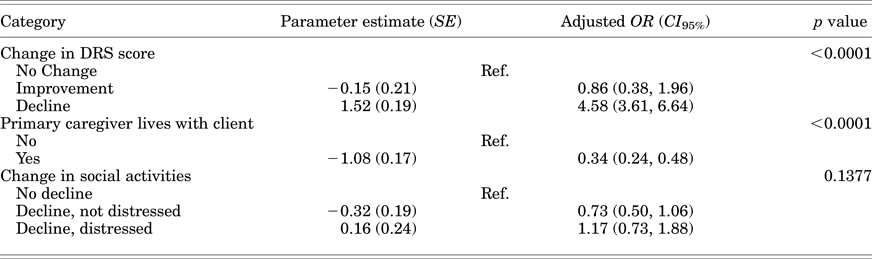
CI 95% = 95% confidence interval; DRS = Depression Rating Scale; Ref. = reference value; SE = standard error.
DISCUSSION
To the best of our knowledge, the present study is the first to examine incident loneliness in seriously ill older adults receiving home care in Ontario. Individuals who are near the end of life may be vulnerable to loneliness, which has been associated with numerous adverse health consequences. In our study, roughly 8% of the sample developed new feelings of loneliness over an average follow-up of 6 months. In the multivariate model, the most important predictors of loneliness were psychosocial factors: worsening symptoms of depression, client lives with a primary caregiver, and distressing feelings about a reduction in their level of social involvement.
Previous research has established a strong association between the depressive symptoms and loneliness experienced by older adults (Cacioppo et al., Reference Cacioppo, Hawkley and Thisted2010; Luanaigh & Lawlor, Reference Luanaigh and Lawlor2012; Cacioppo et al., Reference Cacioppo, Hawkley and Crawford2002). Most researchers agree that the two phenomena are distinct yet interactive, such that loneliness can contribute to depression and depression can lead to loneliness (Han & Richardson, Reference Han and Richardson2010). Although the literature suggests that loneliness and depression are related, in our study we focused solely on loneliness as the primary outcome of interest. However, it would be worthwhile in future studies to examine whether loneliness is predictive of incident depression.
Individuals in our study who experienced worsening symptoms of depression were significantly more likely to experience loneliness, compared to those who experienced no change. Moreover, these individuals also experienced other changes over time, which may have also contributed to their new-onset loneliness. For instance, those who had worsening symptoms of depression from T1 to T2 also experienced a decline in their level of independence on ADLs and IADLs, as well as a worsening of health instability (data not shown). One Swedish longitudinal study of community-dwelling older adults also found that worsening depression was a significant predictor of loneliness (Dahlberg et al., Reference Dahlberg, Andersson and McKee2015). This suggests that home care professionals need to be aware not only of an individual's current risk of depression, but also of how their situation is changing over time.
An older adult's level of social involvement is another important predictor of loneliness (Savikko et al., Reference Savikko, Routasalo and Tilvis2004; Tiikkainen & Heikkinen, Reference Tiikkainen and Heikkinen2005; Cornwell & Waite, Reference Cornwell and Waite2005). Seriously ill older people are at increased risk of experiencing changes in their social ties because of such life-course factors as loss of a partner, worsening health, and declining functional capacity (Brummett et al., Reference Brummett, Barefoot and Siegler2001). Individuals in our study who reported having a decline in their social activities, and who were distressed about it, were significantly more likely to experience loneliness. It is worth noting that individuals who were not distressed about their decline in social activities were not more likely to be lonely. Although we found the same association as several other studies (Savikko et al., Reference Savikko, Routasalo and Tilvis2004; Han & Richardson, Reference Han and Richardson2010; Dahlberg et al., Reference Dahlberg, Andersson and McKee2015; Tiikkainen & Heikkinen, Reference Tiikkainen and Heikkinen2005), these previous studies failed to capture an important nuance, which is the person's perception about their level of social engagement. Previous research has typically measured social involvement objectively—for instance, an individual's mean number of social contacts (Han & Richardson, Reference Han and Richardson2010). This is a unique contribution of the current study, because we were able to capture both the objective decline in social activities as well as the subjective distress caused by it and how both these factors influenced self-reported loneliness.
Previous studies have identified that living with someone is protective of loneliness among older adults (Theeke, Reference Theeke2009; Savikko et al., Reference Savikko, Routasalo and Tilvis2004). We found this to be true as well, since clients who were living with their primary caregiver were 66% less likely to experience loneliness. In the general home care population, informal caregivers provide an important part of the social support and care required by clients (Hirdes et al., Reference Hirdes, Freeman and Smith2012). Thus, individuals who live with their caregiver have a consistent support system present, which appears to substantially reduce a person's risk of loneliness.
In the present study, various factors were associated with new-onset loneliness in the bivariate analysis. Being female, being single, and spending long periods of time alone were associated with an increased risk of loneliness, and similar relationships have been identified in previous research studies (Victor et al., Reference Victor, Scambler and Bond2002; Theeke, Reference Theeke2009; Savikko et al., Reference Savikko, Routasalo and Tilvis2004). Beyond demographic characteristics, associations between clinical factors and loneliness were also found—for instance, vision decline was associated with an increased risk of loneliness. One possible explanation for this is the client's capacity to function independently (e.g., leave their home alone, use public transit) may be hindered, which may impact their ability to socialize with family and friends. Savikko et al. (Reference Savikko, Routasalo and Tilvis2004) also found that poor vision was associated with an increased prevalence of self-reported loneliness in older adults. This finding may help home care clinicians to develop strategies to treat clinical factors in hopes of preventing new-onset loneliness. As a result of the complex health issues that the seriously ill home care population are faced with, further investigation of how clinical and physical functioning impact loneliness is required.
One potential limitation of our study was that we relied on a single self-reported measure of loneliness. Although considered to be an appropriate measure, this method of assessing loneliness fails to differentiate between emotional and social loneliness, which can be important to ensure successful intervention (Luanaigh & Lawlor, Reference Luanaigh and Lawlor2012). Moreover, the single item assessing loneliness in the RAI–HC has not been validated individually. In addition, we did not know the client's date of death, which is not included on the RAI–HC, so we were unable to know if all clients were near the end of life. Through the use of the validated CHESS Scale, and the item related to the client's prognosis, we are confident that our sample truly represents a group of seriously ill older adults. Moreover, the level of physical functioning and cognitive impairment in our sample is comparable to that of another study in Ontario of home care clients who were receiving specialized palliative home care services (Burrows A.B. et al., Reference Burrows, Morris and Simon2000), providing further evidence that our cohort represents a seriously ill group. We chose to limit the study sample to individuals with two consecutive RAI–HC assessments. This approach may have biased our sample toward individuals who were less acutely ill and/or with a better prognosis, which in turn may have limited the generalizability of the results. Lastly, as part of our inclusion criteria, we eliminated individuals with severe cognitive impairment from the study sample since the main outcome was self-reported loneliness. This may have resulted in an underestimate of the true incidence of loneliness. Moreover, this may limit the generalizability of our results to older adults with no or only minimal cognitive difficulties, and we felt that it was appropriate given the way our main outcome was defined. Despite these limitations, our study had strengths related to its design. The use of the RAI–HC assessment allowed us to analyze a multitude of covariates covering a wide range of domains related to loneliness. The use of a longitudinal design allowed us to examine changes over time, and so we were able to truly explore the risk of loneliness in a way that could not be done with a cross-sectional design.
Both psychological and social factors contributed to incident loneliness in the seriously ill home care clients in our sample. The results also highlight how changes in functioning over time influence loneliness. Home care clinicians should therefore be aware of both current health status and worsening health and declining social engagement, because these factors could serve as a flag for identifying clients who may become lonely and go on to experience the associated adverse health consequences. Palliative care is holistic, and one of its many aims is to address the psychological and social needs of patients (Canadian Hospice Palliative Care Association, 2002). As such, interventions aimed at addressing loneliness in seriously ill home care clients may be of direct benefit. Since little is known about this particular group, more research is required to better elucidate the relationships between the predictors identified and loneliness. Overall, loneliness can lead to serious health consequences for older adults, and a clearer understanding of the factors that contribute to this outcome is an important step toward providing optimal quality of care to clients and their families.
ACKNOWLEDGMENTS
This research was supported by the Tri-Council Research Support Fund and an internal grant provided by Wilfrid Laurier University. The authors acknowledge the Canadian Institute for Health Information for providing the data for our study.