1. Introduction
In this paper, we present results from a framed field experiment with Ethiopian farmers who experience the exploitation of common pool resources in their daily life. In Ethiopia, a long period of institutional change ranging from feudalism and centralized socialism to democracy and decentralization was combined with large-scale resettlement and incoherent environmental policies to create many quasi open-access areas. The formerly abundant mountain rain forests in South-West Ethiopia represent one such area. The absence of an efficient system for regulating access and use has resulted in high rates of deforestation, over-harvesting of non-timber products, and biodiversity loss (FAO, 2003).
To regulate this kind of overuse is difficult, largely because the individual behavior of the subjects involved can only be monitored at a prohibitively high cost. By contrast, the total result of forest use is readily observable. This state of affairs is reminiscent of a non-point source pollution problem, where only the ambient pollution level can be identified, but not the individual emissions.
The particular aim of our study is to apply mechanisms known from the theory of non-point source pollutionFootnote 1 to the problem of harvesting non-timber products in the rain forests. The idea behind these mechanisms is that observation of a deviation from the total harvesting levels considered to be socially optimal will trigger some punishment or reward. Segerson (Reference Segerson1988) has proposed a mechanism where a fixed penalty and a collective tax (subsidy) proportional to the difference between the actual and the targeted ambient pollution level is charged (paid) when the actual pollution lies above (below) the targeted level. Transferred to our problem, the tax (subsidy) would be charged (paid) if the aggregate harvest level of forest products exceeds (falls short of) the aggregate standard set by the regulator.
We then want to test whether a collective tax mechanism with a high (theoretically incentive compatible) tax rate, a mechanism with a low (more symbolic) tax rate, and finally a mechanism combining a tax with a subsidy can solve the problem of over-exploiting forest resources. The mechanisms are designed in such a way that the social optimum is the outcome of a symmetric Nash equilibrium for both the high collective tax and the tax-subsidy mechanism, while with the low collective tax the socially optimal outcome does not constitute a Nash equilibrium of the one-shot game.Footnote 2
In addition to the aggregate efficiency rates, we include also an analysis of compliance at the individual level. In order to do so we use the framework proposed by Cárdenas and Ostrom (Reference Cárdenas and Ostrom2004) regarding the different layers of information subjects use when deciding about cooperation within a group context: subjects' individual characteristics, material incentives, and group behavior. Since we conduct a field experiment, subjects are already familiar with the task and social context in which the decision is made. Therefore, the social environment may influence the subjects' behavior under certain control mechanisms. This effect can be even more important in a setting like ours where subjects interact during several periods being able to learn about the group behavior under the different mechanisms.
We find that the subjects' decision in the first period determines to a great extent the behavior in the following periods. Moreover, subjects who initially harvest more than the desired amount tend to do so even after punishment and reward, while those subjects initially complying tend to continue doing so after reactions by the others and reactions through the mechanisms. Thus, there appear to be some features in the subjects' individual characteristics that drive their decisions independently of which mechanism is applied.
Economists have studied the effectiveness of this and similar mechanismsFootnote 3 in a variety of economic laboratory experiments.Footnote 4 In all these studies, the socially optimal outcome has been implemented by Nash equilibrium. A number of studies have established that a collective tax as suggested by Segerson (Reference Segerson1988) is effective for small groups of homogeneous agents. The relative efficiency of the mechanisms studied varies for the different experiments. In this context, the existence of multiple equilibria has been a common concern since the effectiveness of mechanisms is reduced if subjects coordinate on suboptimal equilibria.Footnote 5
Following the taxonomy proposed by Harrison and List (Reference Harrison and List2004) our experiment can be considered as a framed field experiment as our subject pool consists of Ethiopian farmers and we drew upon the field context when explaining our experiments to the subjects. There are very few similar studies up to this point. Ostrom (Reference Ostrom1990) provides a body of empirical data to explore conditions under which common pool resource problems have been solved in a satisfactory or in an unsatisfactory way.
Vélez et al. (Reference Vélez, Stranlund and Murphy2005) conduct a framed-field experiment in three regions of Colombia to test several models of pure Nash strategies when subjects are motivated by a mix of self-interest and altruism, reciprocity, inequity aversion, or conformism. Alpizar et al. (Reference Alpízar, Requate and Schram2004) compare the collective and the random fining mechanism using a non-budget-balancing version of the mechanisms proposed by Xepapadeas (Reference Xepapadeas1991). Running the experiments with two different subject pools, Costa Rican students and CEO's of Costa Rican coffee mills, they find that both fining schemes perform relatively well in achieving the optimal pollution level when applied to groups of two.
So far, experiments on collective enforcement mechanisms have been framed in terms of the control of non-point pollution from industrial or agricultural sources. The framework of our experiments is biodiversity conservation and the harvesting of honey from the forest. Apiculture is an important livelihood factor in the forest areas of south-western Ethiopia. Households usually own between ten and 100 traditional beehives. In the areas studied here, lianas are the major raw material for making traditional beehives. As farmers have a preference for certain species of liana, over-exploitation of these species has resulted in a severe reduction of liana diversity (Senbeta et al., Reference Senbeta, Schmitt, Denich, Demissew, Velk, Preisinger, Woldemariam and Teketay2005).
The imposition of a collective punishment mechanism in such an environment is not as far-fetched as it might seem. For example, several forests areas in developing countries are currently undergoing a process of certification for the production and sale of biodiversity-friendly forest products, such as honey. Prices for certified products are higher than those paid for conventional commodities. These certificates contain provisions on maximum harvesting. In the case of over-harvesting, the certificate can be withdrawn, which immediately reduces returns for all farmers, irrespective of their individual harvests. This withdrawal option can be regarded as a collective enforcement mechanism.
Another real world example for a group reward or group punishment mechanism is a region in Costa Rica where farmers participating in the Payments for Environmental Services program receive cash from the state if they agree to protect the forests in their vicinity. Originally, farmers were punished collectively if deforestation was observed in an area covered by such a contract. However, this mechanism was perceived as unfair by farmers penalized on the basis of these contracts. As a consequence, collective punishment was abolished in 2003.Footnote 6
Both examples indicate that collective punishment may be difficult to implement, especially in developing countries where farmers are more vulnerable to financial risks. Accordingly, we further tested whether the desired outcome can also be induced by a tax that is lower than theoretically necessary to implement the social optimum by Nash equilibrium. As mentioned, this has not been the case. By contrast, the effectiveness of the theoretically incentive compatible enforcement mechanisms was remarkable. We find that with a relative efficiency of around 99 per cent the high collective tax and the tax-subsidy mechanism perform surprisingly well. The low collective tax performs much worse. But as 40–50 per cent of the decisions comply with the socially desired outcome, the low tax is still remarkably effective, although its efficiency further decreases with repetition. The results show that the Segerson mechanism, although often criticized for being impracticable but also unfair, may be reconsidered as a viable regulatory alternative if observation of individual behavior is difficult. We also believe that the field character of our study enriches experimental research on collective enforcement mechanisms and also provides a new perspective on the applicability of such mechanisms.
The remainder of the paper is organized as follows. In the next section, we describe the environment of the experiment. In section 3, we present the theoretical predictions we use as benchmark. In section 4, we describe the subject pool and experimental design, before reporting on our main findings in section 5. Finally, in section 6, we draw some conclusions.
2. The environment of the experiment
Our experimental sessions were conducted in the villages of Kayakela, Yehebito, and Ermo, located near Bonga, the capital of the region of Kaffa in the south-west of Ethiopia. In these villages, the main source of income for the inhabitants is subsistence farming. On average, the farmers own 1 hectare of land on which they produce staple crops like maize and ensete.Footnote 7 One important feature is that all three villages have access to the forest. The forest is used by the communities for harvesting forest-coffee and other non-timber forest products, such as honey, but also for apiculture and as a source of fire-wood. As no property rights have been defined for the forest resources, the forest can be considered an open-access system.Footnote 8
The four main pillars of the social infrastructure in the villages are the family, an informal organization called idir, ethnicity, and religion. One village comprises between ten and 20 idirs, and each idir is made up of some 30 households that are usually close neighbors and often related to one another. These organizations are governed by the elderly, and they play important social and economic roles in the villages.Footnote 9
As mentioned above, one of the resources taken from the forest is honey. Farmers put up their beehives twice a year and harvest the honey about six months later. This harvesting activity, however, causes non-negligible damage to the forest, and as the farmers earn part of their living from the forest, it also causes a negative social externality. For instance, lianas are cut down to obtain raw material for the beehives (bark and stems). Moreover, farmers light fires next to the beehives in order to drive the bees out of them when it is time to harvest the honey. As a result, scientists have observed a serious reduction of liana diversity.Footnote 10
A difficult problem in controlling and reducing harvesting activity consists in the fact that it is extremely costly to identify the owner of a particular beehive found in the forest. By contrast, it is relatively easy to count the total number of beehives put up in the forest by all the members of the villages nearest to the forest. As a consequence, controlling total harvesting activity displays typical features of a non-point pollution problem (see Segerson, Reference Segerson1988).
3. Theoretical benchmark
In this section, we describe the theoretical basis for the experiments we have conducted. The predictions from the theoretical model serve as a benchmark to evaluate the farmers' behavior observed in the experimental treatments.
Consider a group of n identical farmers who put up  beehives, where
 denotes the number of beehives owned by each farmer. The honey harvested is proportional (for simplicity identical) to the number of beehives put up in the forest. The farmers sell the honey at the local market, earning a market price of p per unit. For simplicity, we assume that harvesting incurs no cost to the farmers. In the absence of regulation, a typical farmer's profit is then equal to the revenue obtained by selling the honey, and he wants to operate at full capacity, i.e. he chooses
 .
The negative externality caused by the harvesting activity is denoted by D(B), where B = ∑ni = 1bi is the total number of beehives harvested by the whole community. We assume that D(B) is increasing and convex, i.e. D′(B) > 0, and D″(B) > 0.
In this partial model, the social planner's objective is to maximize social welfare (SW) defined as the sum of the farmers' profits minus the social damage resulting from the degradation of the rain forest due to harvesting activity: SW = p · B − D(B).
The socially optimal allocation is then simply characterized by the first-order condition p = D′(B), where we use B* to denote the socially optimal level. If the conservation effort is distributed equally among the farmers, the optimal number of beehives to be put up and harvested by each farmer is b* = B* / n.
Further, we assume that monitoring the harvesting activities of each individual farmer is prohibitively costly, whereas the total number of harvested beehives, B, can easily be observed.
To induce farmers to comply with the socially optimal aggregate standard, a regulator can employ different economic incentive schemes. In the following, we describe the control instruments that are the subject of our experimental investigation: (a) a collective tax and (b) a tax-subsidy scheme.
Under the collective tax mechanism, the farmers will be charged a tax t > 0 if the aggregate number of beehives harvested exceeds the number considered to be socially optimal. For each farmer, the tax bill is proportional to the total harvest exceeding the socially optimal level. Under the tax-subsidy mechanism suggested by Segerson (Reference Segerson1988), farmers additionally receive a subsidy s > 0 compensating them for additional conservation effort whenever B < B* holds. Thus for both mechanisms a typical farmer's profit can be written as

where b −i denotes the vector of decisions of the other farmers in the community except farmer i. Note that the total tax bill is the same for each farmer. In case of the pure tax mechanisms, we have s = 0.
For the pure tax mechanisms, it is easy to see that if t ≥ p, then the symmetric efficient outcome b* = (b*, . . ., b*) is a Nash equilibrium. In addition to this symmetric equilibrium, any strategy profile b = (b 1, . . ., bn) satisfying ∑ni = 1bi = B* is also an (possibly asymmetric) equilibrium. If t < p, then the only equilibrium of the game is  .
Under the tax-subsidy mechanism, the symmetric efficient outcome b* = (b*, . . ., b*) is a Nash equilibrium if

holds, i.e. the tax rate must be no smaller than the marginal profit the farmers obtain per beehive harvested, p, and, at the same time, the subsidy must be no greater than p. Under this mechanism too, any strategy profile b = (b 1, . . ., bn) satisfying ∑ni = 1bi = B* is an efficient equilibrium.
Note that, depending on the values of the parameters, the farmers can improve upon the one-shot Nash equilibrium under both mechanisms by engaging in explicit or tacit collusion. Under the collective tax mechanism, bi = b* is a collusive outcome, i.e. it maximizes the joint profits of the n farmers if pb* ≥ pb − t[nb − nb*] holds for any b > b*.Footnote 11 The last inequality, however, is equivalent to nt ≥ p. Thus even if t < p, for the whole group, the only equilibrium is Pareto-dominated by the efficient symmetric strategy profile b* = (b*, . . ., b*) if nt > p.
The tax-subsidy scheme is not collusion-proof if p < ns. If this condition holds, the whole group is better off by reducing the harvest level below b* since pb* < pb + s[nb* − nb], which is equivalent to p < ns. In this case, joint profits are maximal for b = (0, . . ., 0). Thus for the tax-subsidy mechanism to be collusion-proof we require

to hold.Footnote 12
4. The experiment
4.1. Frame and subject pool
Because our experiments were conducted in the field and the subjects participating were largely illiterate, we tested and adjusted our experimental design and procedure in the course of four weeks of pilot experiments conducted in the area.Footnote 13 To enhance external validity and to facilitate comprehension among the subjects, we tried to keep the experiment as close as possible to the Ethiopian farmers' daily life. In this way, the farmers were familiar with the context used and the tasks demanded. We framed our experiment as the harvesting of beehives for several reasons. First, the harvesting of honey constitutes an integral part of the farmers' subsistence in the forest areas. Second, as described above, harvesting honey satisfies two crucial conditions of our theoretical model: (a) it causes an externality, and (b) only total harvesting can be observed, not individual harvesting levels.
In recruiting our subjects, we took account of the organization of the farmers into idirs. In each village we contacted the head of the community and asked him to select, for each session, groups of farmers (or ‘heads of households’) living in the same idir.Footnote 14
4.2. Design
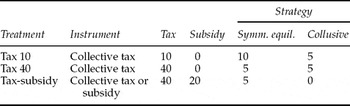
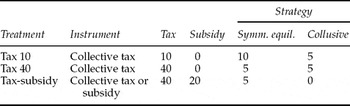
In our specification of the theoretical model described above, we fixed the parameters as n = 5,  , b* = 5, and p = 30 cents. Moreover, we specify the damage function as D(B) = (B − 24.85)2, where units are measured in Euro.Footnote 15 Then we chose two different versions of the tax mechanism, one with a low tax rate of t = 10 cents, and a second with a high tax rate of t = 40 cents. We refer to the corresponding treatments as Tax10 and Tax40, respectively. For the tax-subsidy mechanism, we chose t = 40 cents and s = 20 cents. We refer to the corresponding treatment as Tax-Subsidy.
For Tax10 we have t < p, therefore the unique one-shot Nash equilibrium is  , yielding a payoff of 50 cents per subject.Footnote 16 However, since nt > p, subjects could increase their payoffs by colluding and coordinating on the social optimum b* = 5, yielding a payoff of 150 cents per subject.
For Tax40 and Tax-Subsidy, the symmetric one-shot Nash equilibrium is bNi = b* = 5, yielding a payoff of 150 cents per subject. Since for Tax40 the right-hand inequality of (3) is satisfied, subjects cannot improve upon the Nash payoff by colluding.
Under the Tax-Subsidy, by contrast, the left-hand inequality of (3) is violated. Therefore, the group could increase their payoff to 500 cents per subject by colluding and coordinating on b C,Tax − Sub i = 0.Footnote 17
A total of 23 experimental sessions, lasting about two hours each, were conducted in local schools during the summer holidays.Footnote 18
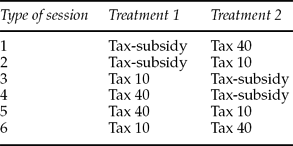
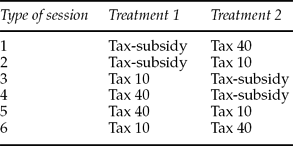
For each session, we recruited five farmers participating in two of the three treatments. Table 1 indicates both the different types of sessions and the order of the treatments conducted in each type of session. Each type of session was played with at least two different groups.
Sequence of the treatments conducted in each type of session
When the farmers arrived at the place where the experiment was being conducted, they were each assigned a desk. The instructions were explained orally and translated into the local language by an assistant.Footnote 19
Table 2 summarizes the parameters used for each treatment, the resulting symmetric equilibrium play, and the symmetric collusive strategy.
Experimental design and symmetric equilibria
At the beginning of the session, each farmer randomly received an envelope containing several decision cards. Each card displayed ten empty boxes representing the ten beehives owned. Since most of the farmers were illiterate, the decision cards also displayed symbols (e.g. flower, tree, sun, etc.) indicating the identity of the farmer in the session. To preserve anonymity, the farmers were not allowed to show their cards to the others.
For every period representing a harvesting season, each subject was asked to decide on the number of beehives he wanted to put up for later harvesting. To indicate their decisions, subjects were told to cross the number of boxes corresponding to their decision on one of their decision cards. Then the participants put the cards into a box. Once all the cards had been collected, the individual number of harvested beehives was displayed on the board next to the corresponding symbol. Although the participants could observe individual decisions, anonymity was guaranteed as they could not match the decisions to the individuals. The revelation of individual decisions made clear to the farmers what impact their actions had on the other group members' payoffs. It also facilitated coordination of actions. Furthermore, this design feature reflects the subjects' real situation, as in the forest the farmers themselves are often able to observe individual behavior of the members of their community.Footnote 20
Finally, the total number of beehives harvested was announced, and the rules governing the corresponding control mechanism were applied. Then the payoffs were calculated and put into (or in case of a negative payoff were removed from) the plates displaying the different symbols used to identify the subjects (i.e. flower, tree, sun, etc.).Footnote 21
The transparent procedure used here enabled us to gain the trust of the farmers and helped them not to forget the rules during the game itself. Moreover, the distribution of the money at the end of each period fascinated them and incited them to continue for a further round.
After explaining the procedure to the participants we conducted three trial periods using the board. The first treatment was then repeated for 12 periods. Then the second treatment was explained, following the same procedure, and it was also repeated for 12 periods. The farmers were not allowed to communicate.
At the end of the session, the subjects received the money accumulated in the respective plates.Footnote 22
As the farmers were reluctant to reveal the truth when asked directly about the motivation for their decisions, we refrained from systematic interviews after the sessions.
5. Results
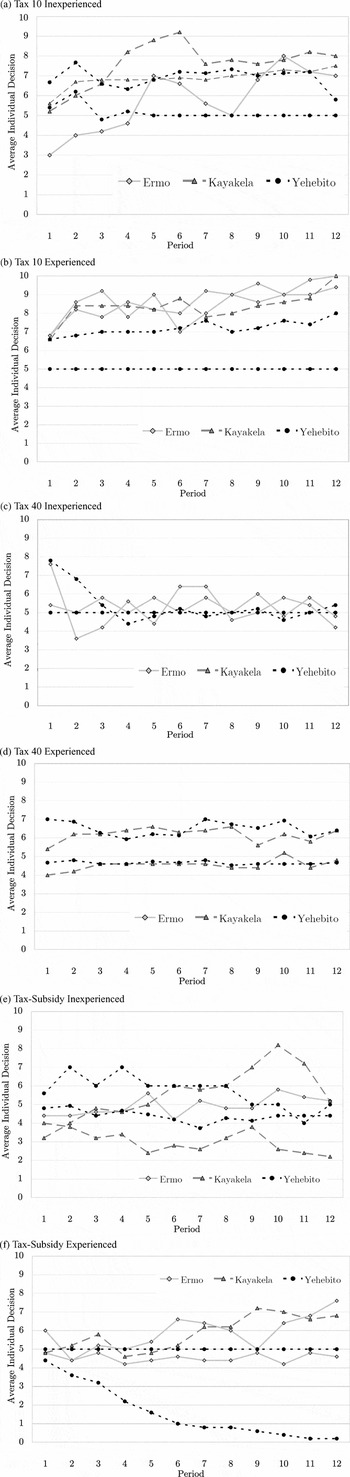
Our data set covers decisons of 115 subjects in the 23 sessions conducted. A Kruskal–Wallis test indicates differences among villages for all treatments but Tax40. These differences, however, do not reveal any distinctive pattern depending on the village as can be seen from figure 1. Instead, they may be the result of specific conditions prevailing during the experiments.Footnote 23 We therefore abstain from separate presentation of the three villages in the following. Each subject only participated in one session.Footnote 24 In describing our results, we distinguish between inexperienced and experienced subjects. Inexperienced subjects are those who participated in ‘treatment 1’ of each session, that is those who were taking part in a particular treatment for the first time. Experienced subjects are those who had already participated in a different treatment during one session, i.e. those participating in ‘treatment 2’ of a given session.
Dynamics of the mean individual decision per village

5.1. Aggregate behavior
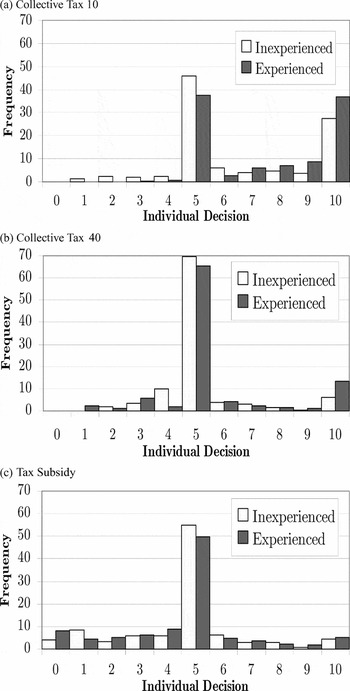
Figure 2 gives an initial impression of the performance of all three mechanisms.
Frequency distribution of individual decisions
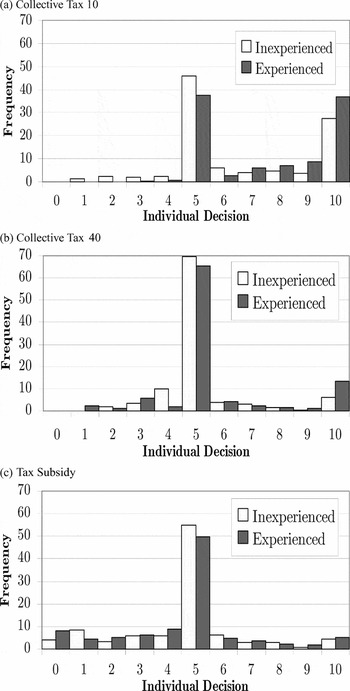
Taking the distribution of decisions for Tax10 displayed in figure 2(a), we observe a bimodal distribution in the harvesting decisions. Fewer than one-third of the inexperienced and about one-third of the experienced participants play the one-shot Nash equilibrium, whereas almost half of the inexperienced and almost 40 per cent of the experienced participants comply with the desired harvesting level of five units. There are two possible explanations. Either a significant number of the subjects had realized that compliance through collusion would yield a higher payoff than non-cooperative payoff maximization, or some of the subjects harvesting only five units believed that compliance was socially desirable. Since all subjects within one group belong to the same idir, we believe that the group context had a strong influence on their behavior and that it is mainly responsible for the deviation from the Nash equilibrium.Footnote 25
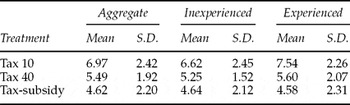
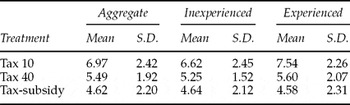
If we look at the evolution of the aggregate harvest over time, displayed in figure 1, we observe that it increases slightly over time and that the small number of inexperienced subjects deciding to harvest fewer than five beehives no longer pursue this course after having gathered experience; a typical behavior also been observed in many other experiments. Using the terminology of Cárdenas et al. (Reference Cárdenas, Stranlund and Willis2000), cooperative behavior is crowded out by short-term individual payoff maximization. Nevertheless, table 3 confirms that in Tax10, on aggregate, both inexperienced and experienced farmers harvest fewer beehives than predicted by applying the concept of a one-shot Nash equilibrium.Footnote 26
Summary statistics per treatment and experience condition
When we apply the high-tax mechanism Tax40 (figure 2(b)), the frequency of compliance increases significantly, reaching 70 per cent and 65 per cent for inexperienced and experienced subjects, respectively.
However, looking at table 3, we observe a surprisingly high share of participants still harvesting more than five units.Footnote 27 Note that, from a rational viewpoint, harvesting more than five units is only profitable if one expects the other participants to harvest fewer than five units.
Indeed, for inexperienced subjects, over-harvesting and under-harvesting can be observed with approximately equal frequency. For experienced subjects, however, we observe over-harvesting more often. Since harvesting five units is the only equilibrium, and the equilibrium is Pareto-efficient for the players, there seems to be no rational explanation for this at first glance. However, consideration of the relative position of payoffs in the case of excess harvesting offers an explanation. Look at the following example:

In total, the whole group harvests 35 units, i.e. ten more than ‘required by the regulator’. Player E, the only one employing a compliance strategy, gets the lowest payoff. If he increases his harvest to, say, eight units, the outcome changes as follows:

Since −280 is less than −250, it does not seem to be rational to increase harvesting from five to eight. However, player E clearly improves his relative position compared with the other players, while worsening the payoffs for the others at the same time. This behavior might be explained by inequality aversion, but also by a certain degree of reciprocity through retaliation.
Finally, under Tax-Subsidy, we observe a uni-modal distribution of the decisions with a peak at the Nash equilibrium (see figure 2(c)). However, a considerable number of the subjects harvest fewer than five units. This behavior may be induced by tacit collusion since the joint profit maximum would be achieved if each subject harvested nothing.Footnote 28
Looking at the dynamics of the harvest over time (see figure 1), there is no obvious time trend. Moreover, we observe that for Tax-Subsidy, experience has no impact.Footnote 29
Let us now turn to the crucial question of which mechanism performs best. If we look at the frequencies of socially optimal outcomes, i.e. harvesting 25 beehives altogether, we find that under Tax40 about 30 per cent of all outcomes lead to 25 beehives, while under the other two mechanisms around 19 per cent of the outcomes are socially optimal. However, to evaluate overall efficiency, we also have to study the overall outcome. For this purpose, we apply Spraggon's (2002) efficiency measure, defined as the ratio of the difference between actual welfare and the welfare in the status quo to the difference between welfare in the socially optimal state and the status quo

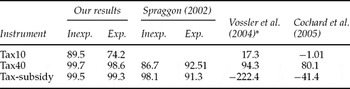
Table 4 illustrates the efficiency of each mechanism in terms of the experience of the subjects. We see that, although Tax40 induces more outcomes that are socially optimal, Tax-Subsidy performs equally well and even slightly better for experienced subjects, whereas Tax10 performs considerably worse.
Efficiency comparison (in %). [*average rounds 21–30 with cheap talk]
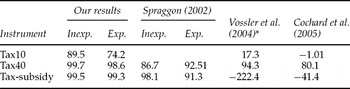
Table 4 also includes the efficiency results obtained in similar experimental studies conducted in the laboratory with students as subject pool. Note that in Tax 10 the gains from harvesting (p = 30) exceed the fine (t = 10), i.e. the fine is one-third of the harvesting gains. Therefore, we can compare this setting to the status-quo treatment in Cochard et al. (Reference Cochard, Willinger and Xepapadeas2005a) and the no-instrument treatment in Vossler et al. (Reference Vossler, Poe, Segerson and Schulze2006). From table 4 we observe that the efficiency under Tax 10 is significantly higher than that of the laissez-faire situation implemented in the other studies, even though the implemented tax is not incentive compatible. Regarding the efficiency under Tax 40, our results regarding efficiency are in line with the other papers. Note that the tax rate applied is 1.33 times the minimum tax necessary to induce compliance, i.e. t = p = 30. Finally, the efficiency results obtained under Tax-Subsidy are in line with Spraggon (2002), although we do not observe that experience reduces efficiency.
We summarize our observations on aggregate behavior as follows:
Result 1:
(i) Tax40 induces the highest frequency of socially optimal outcomes among the three mechanisms tested.
(ii) With respect to efficiency, Tax40 and Tax-Subsidy perform equally well. Tax10 performs considerably worse.
(iii) Under Tax10 a relatively high number of subjects comply with the optimal outcome in the first rounds. Compliance breaks down as subjects gather experience.
5.2. Individual behavior
Due to the panel structure of our data set (with observations on each individual over time) we can use panel data analysis to account for the heterogeneity across individuals, in particular the dynamics of individual behavior over time.Footnote 30
As mentioned above, Cárdenas and Ostrom (Reference Cárdenas and Ostrom2004) propose that subjects may use different levels of information when deciding about cooperation within a group: the dynamics of the game, material incentives, and the composition of the group. Moreover, they emphasize the importance of the subjects' individual characteristics. In the following analysis, we control for these aspects.
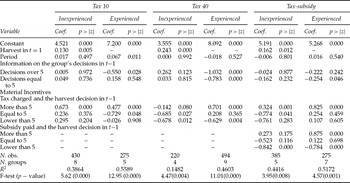
Table 5 shows how the subjects react to both the behavior of the group in the past and to the material incentives provided by each mechanism. The dependent variable is the individual decision per period. The independent variables are:
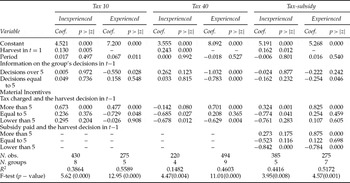
Group fixed effects regression to explain the dynamics of the decisions in terms of the group's behavior and material incentives. F-test for the H0: group fixed effects = 0
• Harvest in t = 1: harvesting decision in the first period used as a proxy to measure the subjects' individual initial willingness to comply with the regulation independently of the group dynamics. We therefore include this variable only in the case of inexperienced subjects.
• Period: period number accounting for the time trend in the decisions normally observed in public goods experiments.
The second group of explanatory variables identifies the effect of the material incentives (tax or subsidy) resulting from the mechanisms in the case of over- or under-harvesting, respectively.
• Tax charged in t − 1: dummy variable taking the value of 1 if the group was charged a tax in the previous period, and 0 otherwise. Additionally, we multiply this variable by a dummy variable (characterizing the individual harvesting decision in t − 1), taking the value 1 if the subject's past decision was equal to (lower than, more than) 5, and 0 otherwise.
• Subsidy paid in t − 1: dummy equal to 1 if a subsidy was paid to the group in the previous period, and 0 otherwise. Following the same procedure as above, we then use dummies to account for the subjects' reaction to the monetary incentives, depending on their decisions in the past period.
As the farmers could observe the individual decisions of the other group members, we also include a group of independent variables accounting for the subjects' reaction to the decisions of the other group members in the previous period:
• decisions over (equal to) 5: number of group members whose harvesting decision in the previous period was higher than (equal to) 5. This variable accounts for the subjects' reaction to free-riding. With the variable ‘equal to 5' we capture the farmers’ response in the presence of group members who are compliant.
Regarding the time trend in Tax10, we observe a positive and significant coefficient for the ‘period’ variable with experienced farmers. This result is consistent with observations made in other public goods experiments where contributions tend to decrease over time. However, when subjects are inexperienced, no significant decreasing trend is observed.Footnote 31
As to the effect of material incentives in the panel data analysis, we observe similar patterns for all the mechanisms applied. When a tax has been charged in the previous period, participants who over-harvested in that period tend to increase their harvest in the following period, while those who harvested five units or less tend to reduce their harvest in the next period. The same pattern can be observed with the tax-subsidy mechanism.
We see from table 5 that the harvesting decision in the first period significantly determines the harvesting strategies in the following periods (see line 2: variable ‘Harvest in t = 1’).Footnote 32 Moreover, those who harvested fewer than five units in the last period reduce their harvest level further if a sanction or reward has been applied by the regulator in the last period (see coefficient of variable ‘Lower than 5’). By contrast, those who harvested more than five units in the last period tend to increase their harvesting level (see coefficient of variable ‘More than 5’).
Concerning the distribution of the harvesting decisions in period 1 for each of the applied treatments, we can observe that in the first period of all three treatments between 50 per cent and 60 per cent of the subjects' decisions correspond to the social optimum, that is harvesting exactly five beehives. Regarding those subjects that deviate from the social optimum in the first period, we find differences between the Tax and Tax-Subsidy treatments, whereas in both tax treatments (Tax10 and Tax40) over-harvesting corresponds to approximately 25 per cent of subjects' decisions and under-harvesting represents only around 12 per cent; the opposite is observed under Tax-Subsidy. We summarize these findings as follows:
Result 2: The subjects' individual characteristics, represented by the decision in the first period, significantly determine their behavior under the different control mechanisms.
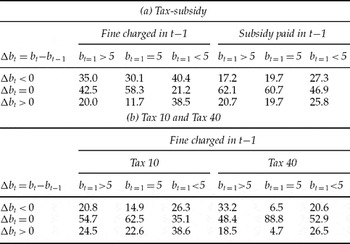
These findings led to initial compliers and initial non-compliers being defined as subjects that harvest five units or less, or more than five units, respectively, in the first period. Table 6 shows the proportion of initial compliers (i.e. b t = 1 ≤ 5) and initial non-compliers (i.e. b t = 1 > 5) observed in each treatment. We observe that in most cases subjects' decisions are not affected by the tax (subsidy) being charged (paid) in the previous period (see row Δbt = 0 in table 6).
Distribution of the change in the subjects' decisions when a fine (subsidy) was charged (paid) the previous period
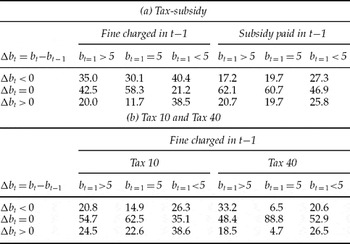
Focusing now on the behavior of initial compliers we find that, in most cases, their behavior is not affected by the fine and/or subsidy. This is in particular true for those subjects choosing exactly b t = 1 = 5. However, those subjects that start under-harvesting (b t = 1 < 5) tend to revise their decision (with decreasing and increasing their harvest equally likely) when a fine (subsidy) was charged (paid) in the previous period.
Regarding the behavior of initial non-compliers, we observe that a high tax rate (as in Tax40 and Tax-Subsidy) is effective to reduce harvesting in the next period (Δbt < 0) as compared to the low tax rate and the subsidy. The fact that initial non-compliers tend to be more sensitive to the punishment for over-harvesting (tax) than to the reward for under-harvesting (subsidy) might explain why no significant collusion is observed in the Tax-Subsidy. We summarize these results as follows:
Result 3: Based on their reaction to monetary incentives, different strategy patterns can be observed if any sanction or reward has been executed in the last period:
(i) The initial compliers tend to further reduce their level of harvesting.
(ii) The initial non-compliers tend to further increase their level of harvesting.
We now turn to the subjects' feedback on the individual decisions of the other group members. Generally speaking, we find a significant effect only among experienced participants. The coefficients for both variables ‘decisions over 5’ and ‘decisions equal to 5’ are negative. This indicates that the higher the number of subjects harvesting five units or more in the previous period, the more likely it is for an experienced individual to decrease his or her own harvest in the next period. The first effect is only observed if a collective tax is charged. The second effect is only significant for Tax40 and Tax-Subsidy where a high fine is charged in the case of over-harvesting.
In fact, the subjects' response to an increase in the number of non-compliances in the group is to reduce their own harvest in the collective tax treatments. Conversely, when the number of compliers in a certain period increases, the subjects on average respond by reducing their harvest. In case of punishment (taxation), the reason might be reciprocity, while in the Tax-Subsidy, tacit collusion might be the motive.Footnote 33 We summarize our final result as follows:
Result 4: Regarding group composition, i.e. the frequency of complying and non-complying in the group, only experienced subjects react significantly to over- and under-harvesting by the group. In particular:
(i) Under Tax10 and Tax40 the frequencies of non-compliances in one period increases the likelihood of reducing total harvest in the next period.
(ii) Under Tax40 and Tax-Subsidy an increase in the frequency of compliances also increases the likelihood of reducing total harvest in the next period.
6. Conclusion
In this study, we have presented the results of a framed field experiment conducted in south-west Ethiopia where the remaining rain forest can be considered a quasi-open-access common pool resource. Our main objective was to test whether a collective tax with either a high or a low tax rate, respectively, and a collective tax-subsidy mechanism, originally proposed by Segerson (Reference Segerson1988), can solve the problem of over-exploiting forest resources. The experiment was related to honey production, thus enabling the subjects to identify with the situation easily.
The bottom line of our research is, first, that the Pigouvian tax turns out to be an efficient instrument to regulate problems of over-exploiting common pool resources. Secondly, our experimental design allows us to shed some light on the role of experience on both subjects being already familiar with a similar control mechanism and having learnt something about the behavior of other group members. Thirdly, we conclude that the low fine could possibly be used as an initial regulation mechanism in order to introduce collective punishment in rural communities in developing countries. Since, however, experience significantly reduces its efficiency, Pigouvian levels have to be implemented in the long run. By contrast, subsidies on the reduction of harvest might result in inefficiently low harvest rates, since people take advantage of the mechanism by colluding. The likelihood of this effect, however, goes down as the number of non-compliers within the group increases, though in real situations collusion might be facilitated through coordination by cheap talk.
It would be an interesting question for future research to investigate how the strategies pursued by the two types of subjects relate to their actual societal position in their respective groups. A further step of research would be to conduct a controlled real field experiment.