le fantôme de pierre s'empare de vous pendant quelques minutes, et vous commande, au nom du passé, de penser aux choses qui ne sont pas de la terre.
Tel est le rôle divin de la sculpture.
Charles BaudelaireOn 18 November 1859 a new production of Gluck's Orphée opened at the Théâtre-Lyrique in Paris; the abbreviated title was one of many changes made in a new version of the opera by Hector Berlioz.Footnote 1 The work had not had a major Parisian outing since the Opéra's revival with the tenor Adolphe Nourrit in February 1824. Since that time, taste and vocal technique had changed: the star of the Lyrique's revival was the mezzo-soprano Pauline Viardot (1821–1910), who performed the title role en travesti. Viardot was a singer who had always attracted attention; her 1839 début (in London, as Desdemona in Rossini's Otello) had taken place under scrutiny intensified by the notoriety of her late, great older sister, Maria Malibran. By 1859, however, Viardot had achieved celebrity in her own right, having created Fidès in Meyerbeer's Le Prophète (1849) and the eponymous protagonist in Gounod's Sapho (1851), as well as singing a variety of other roles to great acclaim.Footnote 2 Orpheus, as it turned out, only briefly preceded her official retirement from the stage in 1863.Footnote 3 It was declared one of her finest roles and has continued to be described as the culmination of a distinguished career – the moment at which her reputation and public image were sealed for posterity.Footnote 4
Such is one, often-repeated story about a night at the theatre in 1859 Paris, and in facts as bare as the writing of history allows. But there is another with a longer reach: for all the biographical import attributed to Viardot's Orphée, the production was one of a series of revivals of older operatic works that gathered pace during the ‘good years’ of the Second Empire.Footnote 5 At the same time (and in obvious symbiosis) a gradual change was taking place in Paris's operatic culture, from an industry based on the manufacture of new works to one centred on established masterpieces, revivals of which were increasingly understood as part of a ‘canon’. The Théâtre-Lyrique's Orphée was neither the first of these revivals nor the final marker en route to our operatic present. Indeed, it is fascinating precisely because it is located within a transitional grey area – an obscure midpoint on the path trodden by operatic history. Far from an instance of absolute novelty to be scrutinised for unique historical agency or impact, the Gluck revival (at least as read along and between the lines of its enthusiastic reception) was heard by many as a premiere, yet was characterised by its pastness, even datedness. Nonetheless, with critical attention trained particularly on Viardot's performance, her Orpheus emerges as a fixed point in an operatic landscape on the move; as a discursive nexus in a shifting configuration of old and new; as resonant, legible, worthy of preservation.
When she performed Orpheus in 1859, Viardot thus gestured into the operatic future – a future that is largely our own present. This is not to make a claim for a previously unnoticed prophetic quality in the singer's performance. Nor do I want to assert that operatic modernity began at the Théâtre-Lyrique one night in November 1859. What concerns me here is how and why a revival of an ancien-régime opera at the height of the Second Empire was seen both as a sign of progress and of decline, ill-omen and artefact.Footnote 6 To put this another way, I want to ask to what extent this Gluck revival – and Viardot's performance within it – was experienced as old or new at a time when the relative values attached to those historical terms were in flux: when their material manifestations in Paris seemed to be simultaneously under threat and under construction.
Ancient histories
It goes almost without saying that in the three decades since 1824, when Nourrit, lyre in hand, had paced the boards of the Opéra, much else besides vocal practice had changed. Indeed, in a political climate that continued to experience severe revolutionary aftershocks, it is not surprising that an isolated revival of Orphée in July 1848 went more or less unnoticed, obscured by other events of that notorious year. By 1859, though, the context was more peaceful: Napoléon III was at the head of a comparatively stable Second Empire, his 1851 coup d'état having marked the start of a period of cooperation from the relatively enfranchised (if carefully manipulated and, of course, censored) populace. The Prefect of the Seine, Baron Georges Haussmann, was in the midst of creating a new, modernised urban order, his first wave of public works already complete and his second under way. Bourgeois Paris, at least according to Siegfried Kracauer's still influential account, could now dedicate itself – in the absence of imminent revolution and the vacuum created by political censorship – to hedonistic delights.Footnote 7 For Kracauer, the epitome of Second Empire culture was another, rather more famous late 1850s Orpheus: that created by Jacques Offenbach. Gluck's ancien-régime Orphée had, after all, remained for the most part disengaged from the political and social upheavals of the mid-nineteenth century, surviving only within the confines of the Paris Conservatoire.Footnote 8 Even there, it was an opera known principally through the handful of excerpts performed in concert – public airings that Berlioz (ever the champion of Gluck's cause) thought did more harm than good to the composer's reputation, reinforcing his image as a composer of primarily academic interest, preventing his work from gaining wider popularity and, more to the point, discouraging complete staged performances.Footnote 9
In 1859 at the Théâtre-Lyrique Berlioz (and Gluck) of course got just such a performance – one generally considered a huge critical success, laying the foundations for the later nineteenth-century revival of Gluck's operas in France.Footnote 10 Viardot predictably enjoyed the lion's share of the critical attention. Clichés flourished in all quarters as writers scrambled for suitably Orphic metaphors with which to express enthusiasm for the production; barely a review was without some reference to immortality or to résurrection.Footnote 11 Even the Lyrique's director, Léon Carvalho, was celebrated in one bizarre turn of critical phrase as a ‘Nouvel Orphée’, bringing Gluck's work back from the dead.Footnote 12 If further confirmation of Carvalho's inspired speculation were required, Paul Scudo wrote that this staging of such an unlikely commercial proposition, one that placed the demands of great art above those of financial success, made the Lyrique ‘the only opera house in Paris worth going to’.Footnote 13 The Opéra, with its ponderous succession of grands operas, was – at least according to Scudo – no longer worth the effort of waking the coachman.
Over-determined metaphors aside, the fact that such a performance was mounted at the Théâtre-Lyrique rather than the Opéra is significant. In a city whose dramatic endeavours continued to be regulated by imperial decree, the Lyrique had been intended as a preparatory stage for composers before they approached the Opéra. It was, in other words, an institution with strong educational imperatives, albeit one set up to run (in principle at least) at no cost to the state.Footnote 14 Thus while the director's official responsibility was to composers whose careers his theatre had the potential to launch, the Lyrique's finances demanded particular attention. Indeed, from its earliest incarnation in 1847, some commentators recognised that revivals of established repertory, rather than new works by unknown composers, were likely to keep the theatre solvent.Footnote 15 The fact that such revivals were also instructive – not only in their edification of a listening public but also in presenting old masterpieces as models from which the inexperienced composer could (and should) learn – created a succession of administrative regimes that juggled past and future repertories with varying degrees of panache. This cultivation of the Lyrique as a ‘neo-classical finishing school’ (Katharine Ellis's phrase) was epitomised by Carvalho, whose ‘système d'exhumations’ attracted widespread attention.Footnote 16
Orphée was, in this context, merely the latest in a series of revivals, following Weber's Obéron and Euryanthe (both 1857) and Mozart's Les Noces de Figaro (1858) and L'Enlèvement au sérail (1859).Footnote 17 But its sweeping success (despite its potentially unprofitable step further back into the musical past, beyond the relatively assured popularity of Mozart) brought into tighter focus the critical schism over old works versus new. Some praised the archaeological endeavour, the unearthing of past treasures and their subsequent display for public edification and imperial glory; many, though, took issue with the fact that, in his increasing preoccupation with music of earlier periods, Carvalho was promoting composers long dead and buried. These old works, however illustrious, were staged at the expense of living composers, who were – so it was thought – being squeezed out of the Théâtre-Lyrique's programming. Thus, although the Lyrique was Paris's newest opera house (a modern and modernising alternative to the Opéra), it was also, as one critic described it in the wake of the Orphée revival, a ‘museum of old composers’.Footnote 18
The Théâtre-Lyrique, in other words, staged precisely the sort of incursions of the distant (often pre-revolutionary) past that have been seen as one of the hallmarks of the Second Empire's particular modernity.Footnote 19 Haussmann's contribution to the creation of modern Paris was not limited to monumental boulevards and decorative public toilets; he also strove to assemble and catalogue what was being lost of the old city. Indexes of renamed streets and guides to the new urban environment – for the disorientated inhabitant as well as the visitor – abounded during the Second Empire. Some, such as Émile de Labédollière's 1860 Le Nouveau Paris, saw the widespread destruction as a necessary step in the name of progress (although its ghoulish frontispiece by Gustave Doré, showing old Paris being dismantled as the devil looks on from above, seems to suggest otherwise). For many others, though, the erasure of ‘Vieux Paris’ represented a great loss, if not a downright – in some cases, personal – tragedy. But while traces of the city's past were banished unceremoniously from Haussmann's new architectural regime of straight lines, building regulations and sanitised covered sewers, its history was simultaneously reinvented under the glass cases of institutions such as the Bibliothèque Historique de la Ville de Paris, or fixed by chemical process in the photographs of Charles Marville, who was employed officially to record changes in the city's landscape.Footnote 20 The gradual institutionalisation of the Parisian past at this time was, of course, not only a local symptom of Haussmannisation: it coincided directly with the increasingly professionalised status of history as a discipline. The Second Empire fell, after all, across the middle of what Hayden White called the ‘second, “mature” or “classic” phase’ of historical thinking – a period characterised by a widespread preoccupation with historical theory and manifested in the production of ambitiously vast narrative histories, not least of France.Footnote 21 Paradoxically, then, at the same time that Napoléon and Haussmann proclaimed the progress embodied in the newly modernised centre of Paris, history itself was becoming an increasingly visible and valued part of the present.
Timing is everything
In this context of ever-growing consciousness of the past, it is hardly surprising that Carvalho's Orphée produced a journalistic flurry of historical articles. A multi-part study of the genesis and reception of Gluck's opera appeared in La France musicale,Footnote 22 while in Le Constitutionnel, a ‘Dialogue of the Dead and the Living’ was offered in place of a conventional review, with Gluckistes and Piccinnistes (and even a cameo by Gluck himself) transported to the Paris of 1859 to find themselves in conversation with the director of the Théâtre-Lyrique.Footnote 23 Most ambitious of all, a series of fourteen articles on the history of French opera was published in Le Ménestrel, tracing shared cultural origins in Italy, through the various querelles between national and aesthetic factions, to a climax in the French works of Gluck – a composer touted in the editorial introduction as ‘the illustrious creator of French dramatic music’.Footnote 24 The author (named only as K***) attempted a slightly more nuanced reading of French opera's multi-nationalism, insisting that there was such a thing as French music, but that it had generally been written by Italians or Germans. The all-important rabbit pulled from the rhetorical hat was the uniquely French esprit guiding such foreigners in the creation of their Gallic masterpieces.
It was as such a chef d'œuvre that critics felt Orphée should be welcomed back to the stage. Writing in La Presse, Paul de Saint-Victor exhorted his readers to
imagine a masterpiece by Corneille being put on at the Comédie Française, having been forgotten for half a century, and being brought back to life through the voice of an admirable interpreter; that is the effect currently produced by the revival of Gluck's Orphée at the Théâtre-Lyrique.Footnote 25
In language that figures the revival once more in Orphic terms, of a literal return to life from beyond the grave, Saint-Victor's insistence on Orphée's status as a specifically French masterpiece is striking: the Lyrique was, after all, no Comédie- Française. But the direct comparison to Corneille – a by-word for France's most prestigious art form – rendered Gluck's inconvenient national origins irrelevant in light of the revival's implied significance for French culture. Paul Scudo, writing along similar lines, brought to a close his review in the Revue des deux mondes with an even bolder claim. Gluck's opera combined the ‘vigueur héroïque’ of Corneille, the grace and melancholy of Virgil, and the ‘calme philosophique’ of Poussin: a triumvirate that Scudo described as ‘proud and sober geniuses fully worthy of representing the ideal of French art’.Footnote 26 Gluck is not only the equal of such luminaries, but surpasses them in his synthesis of their individual styles and qualities.Footnote 27
The belief that Gluck and his Orphée should be admitted to this French pantheon – indeed, the fact that such a pantheon, spanning so many centuries, was felt to exist – requires further investigation. The Second Empire is, as already mentioned, an era often characterised by a heightened interest in its own relationship to the past and future. An important element of this trope in the present context is the widespread perception of an acceleration of urban life, which Napoléon III and Haussmann were keen to attribute to empire-driven ‘progress’. This notion is tackled head-on, and with some concern, in several reviews of Orphée: as Philippe Martin wrote in L'Univers musical, ‘the question arises of whether, since Gluck, music … has actually made any progress. I beg to doubt that it has.’Footnote 28 Such worries only added to anxieties about the role of the Théâtre-Lyrique and, in particular, its perceived abandonment of living composers in favour of past works. This question of progress was obviously not peculiar to musical criticism: in his report on the 1859 Salon, art critic Louis Jourdan noted with frustration that his colleagues were fixated on whether modern art was making progress or about to fall off its increasingly splintered perch. He paraphrased the debate by asking: ‘Is modern art genuinely drained of power and inspiration, and must it cover its head and prepare to die; or does it still have enough youth and energy to hope for new triumphs?’Footnote 29 The notion of progress is fundamental here; a lack of it would lead to nothing less than the death of art.
But traces of an alternative configuration of the work of art's relationship to time can also be found in reactions to Orphée. Léon Escudier, for instance, reacted to the revival's success with palpable surprise, asking (as did others), ‘Who could have claimed that after eighty-six years, the music of Orphée would produce a deep impression on the current generation?’Footnote 30 Berlioz himself – albeit with an air of self-satisfaction rather than shock – noted from the pulpit of his feuilleton in the Journal des débats that
Orphée is almost a hundred years old, and after a century of evolutions, of revolutions, of various disturbances in art and in everything, this work profoundly moved and charmed the select assembly …Footnote 31
Both Escudier and Berlioz were preoccupied with the distance between the composition and revival of Gluck's opera, or, rather, between the original audience and the contemporary one. What made this distance significant, though, was not simply the sheer length of time; it was, as Berlioz suggested, that the intervening period encompassed a series of regime-changing revolutions, which had – famously – wrought their own temporal havoc. That Orphée was thought capable of communication across the various revolutionary caesurae is clearly related to the rhetorical gestures made by Scudo and Saint-Victor, their positioning of Gluck as the latest in a long genealogy of ‘French’ artistic geniuses. These moves presuppose an understanding of the work of art, and of time itself, that could allow an opera to communicate in a period far removed from that of its creation. As Escudier's surprise indicates, though, such a conception could not be taken for granted in 1859. Underlying this ambivalent situation – in which apparently contradictory beliefs in both progress and timeless masterpieces co-exist – is, of course, an ideological divide. We are returned yet again to the question of the past's place in the present; or, more broadly, of how the relationship of the present, past and future ought to be configured.
Occupying a central position in these debates is the term classique. The word surfaces repeatedly in reviews of Orphée, both as a means of categorising Gluck's opera (under the assorted taxonomic umbrellas of ‘œuvres classiques’, ‘créations classiques’ or ‘art classique’Footnote 32) and of describing the cultural work done in its revival by the Théâtre-Lyrique, which Philippe Martin (the same critic who had worried over the lack of tangible progress in music) named the ‘théâtre classique par excellence’.Footnote 33 The term's power in this context is rooted in a fundamental and persistent tension between its two principal etymological derivations: as an evaluation of rank (social or artistic); and as a classification according to historical origin, whether in Greek or Roman antiquity or (later) of the French Grand Siècle.Footnote 34 That Scudo could give Virgil a place in his pantheon of geniuses representing ‘the ideal of French art’ is entirely symptomatic of the complex semantics of le classique in mid-nineteenth-century France: critics increasingly drew together both senses of the term in conceiving of a French literary tradition in which Latinity (and, above all, Virgil) was central. For all that Virgil might have stood for Roman antiquity, however, it was as an embodiment of tradition – of the timelessness of genius – that he was seized upon; in this French mid-century discourse, tradition was understood as a ‘continuous past’.Footnote 35
Such shifting hierarchies of meaning did not go unremarked. The famous 1850 essay, ‘Qu'est-ce qu'un classique?’, by eminent literary critic Charles Sainte-Beuve was a result of the same preoccupations and provided a benchmark ruling: ‘A classic, according to the ordinary definition, is an author of the past with an already established reputation, who is accepted as an authority in his genre’.Footnote 36 Any primary, literal reference to works of antique or Enlightenment pedigree has been overwritten here by value judgement; the classic is defined by prior critical opinion, by merit perceived by scholars past. The exact historical location of that past is of little consequence – and it is clearly this sense of le classique's ability to transcend historical boundaries (or even render them irrelevant) that underpins the reactions of Escudier and Berlioz to Orphée's success, almost a century and several revolutions after its premiere.Footnote 37 These claims for timelessness were nonetheless products of a particular cultural milieu: adding to the pre-existing complexities of the term classique, the neologism classicisme spread during the century's early decades as an antonym for Romanticism, rendering interest in the cultural past at once politically and ideologically charged. If, as Christopher Prendergast has proposed, the Romantic/classic debates of the early nineteenth century are understood in terms of the previous century's querelle between the Anciens and the Modernes, with Romantic as the new Moderne and the nationalist Anciens reborn as defenders of le classique, then the Lyrique's Orphée strongly suggests a public staging of operatic conservatism. Such conservatism is obviously connected intimately with the use of classique by music critics (as well as their literary counterparts): to bestow – in the absence of our modern term or indeed modern conception of ‘canon’ – precisely the canonic status central to Sainte-Beuve's characterisation.Footnote 38
A temporal kink nonetheless emerges here: while Carvalho's staging of Orphée and other such anciens chefs-d'œuvre at the Théâtre-Lyrique was undoubtedly a classicising (and, by implication, conservative) turn to the past, that turn itself represented a glance to the operatic future. As Émile Perrin wrote pithily in response to the Orphée revival, ‘to familiarise [the public] with the great works of times past is to reinforce its movement towards the future, to open its eyes to the present’.Footnote 39 For Perrin, the music of the past unleashed the power of history itself, allowing access to that ‘continuous past’ of tradition. But, as mentioned earlier, when Orphée was performed at the Théâtre-Lyrique on 18 November 1859, it was heard by many for the first time – as a premiere. The music of the past had become, in performance, the music of the present: a resonant conflation embodied, at the centre of the discursive short-circuit, in the figure of Pauline Viardot.
Visualising Viardot
‘To be a singer it is not enough merely to sing; one must express emotion in visible form … An opera is not a concert.’ Louis Ulbach, writing in response to Viardot's Orpheus, intended this a compliment to an artist already famed for her acting skills.Footnote 40 In a vein of critical ecstasy mined by many others, he continued by observing that Viardot ‘has applied herself to putting as much truth into the plastic side of her role as she put of the ideal into her musical interpretation’.Footnote 41 Ulbach here was part of a critical faction for whom Viardot's dramatic talents were an ideally realised element of the array of skills required of any true prima donna. His colleague G. W. Barry enthused along similar lines: ‘Mme. Viardot has proven herself as great an actress as she is a singer. Poses [attitudes], movements [gestes], diction, singing: all are truly admirable in her.’Footnote 42 Her acting impressed, reaching beyond the level necessary for a singer and into a realm traditionally inhabited by famous actresses of the day. Rachel herself is mentioned by many as a suitably eminent (recently deceased) tragédienne with whom to compare Viardot.Footnote 43 For others, the singer's movements, gestures and attitudes were sufficiently absorbing as almost to overtake her singing in importance and column-inches.
Writing about the Lyrique's Orphée in her journal, Marie d'Agoult exclaimed:
The singing and the acting of Mme. Viardot surpassed all my expectations. I have seen nothing, not even Rachel, that came close to this plastic beauty, and to this freedom, in feeling for the antique. You feel there is nothing planned, nothing contrived, nothing that recalls the classroom. She made me think constantly of the most beautiful bas-reliefs and Greek vases.Footnote 44
The English critic Henry Chorley, who saw Viardot as Orpheus in July 1860 at a private performance in London, was similarly moved: he marvelled that ‘the supple and statuesque grace of her figure gave interest and meaning to every step and attitude. Yet, after the first scene … there was not a single effect that might be called a pose or a prepared gesture.’Footnote 45 Back in Paris, Viardot inspired more florid description still from Saint-Victor: her pantomime in the Elysian Fields ‘has the beauty of a statue that has been moved with emotion, of a sculpture that started to come to life’.Footnote 46 Viardot was not seen as simply, classically, statuesque. For Chorley, she was so in a manner that seemed to resist stasis. For Saint-Victor, she stretched the notion of the statuesque even further, recalling statuary and sculpture of a kind that promised at any moment to step from its plinth, to become animated flesh and blood.Footnote 47
These images, however widespread or heartfelt, were not new. On the contrary, to describe a female singer in 1859 as in some way statuesque was a cliché on either side of the Channel, the metaphor having been liberally applied to great sopranos in the generation preceding Viardot – perhaps especially to Giuditta Pasta.Footnote 48 In literature, too, reference to similar instances of metamorphosis in female statuary was at least as established in 1859 as was the idea of women as statuesque: the poetry of Gautier and Baudelaire, for instance, is populated by women who actively blur the boundary between flesh and marble.Footnote 49 Whether in poetry or criticism, these images call into question the phenomenological status of the female figures they describe, raising the question of who is animating what. Maribeth Clark's comments on Gautier's dance criticism are particularly suggestive here. She traces how his use of the statuesque trope when writing about dance acts as a distancing (and, by implication, dehumanising) technique, one that replaces direct enjoyment of a dancer's sensuality with the morally more defensible appreciation of a work of art. Yet, as Clark writes, Gautier ‘held dancers responsible for being beautiful, as well as creating the effect of beauty. A female dancer was at once art and artist, object and agent.’Footnote 50 Essential to such aesthetic multitasking was genius – if sufficiently great, it was no less than a revivifying force.Footnote 51
The question of stage genius (and agency in exercising it) is similarly at stake in the case of Viardot's Orpheus. The repeated references to her statuesque qualities – even her ability to keep static gesture and fluid movement in constant flux – further emphasised those famous dramatic talents by binding her into the explicitly Orphic and mythological rhetoric that pervaded so much writing on the 1859 revival. In this myth-inflected discourse, though, Viardot's particular skills endow her with the power to reanimate: as Orpheus, she could bring not only Eurydice but also Gluck's opera back from the dead; as one critic put it, ‘At the sound of her voice, antiquity comes out of oblivion’.Footnote 52 Figuring Viardot as controlling time itself, this last is an outrageously daring claim. No longer simply straddling the divide between past and present as she participates in the résurrection of Orphée, Viardot is imagined here to possess the power to reconfigure that relationship. She calls history – whether ancient or operatic – into full-bodied presence, while simultaneously envoicing a continuation of the past.
Viardot had not always been thought to wield such extraordinarily hyperbolic and wide-reaching agency. Indeed, up to Le Prophète (even, arguably, up to Orphée), her performances tended to receive a more enthusiastic reception abroad than in Paris. Her creation of Fidès in 1849 seems to have been a turning point in her Paris reception: Berlioz observed that, although ‘the extreme skill of her vocalisation … her musical assurance are things known and valued by everyone, even in Paris’, Viardot ‘has displayed a dramatic talent with which no one (in France) believed her to be so highly endowed’.Footnote 53 That Fidès epitomised Viardot's dramatic coming-of-age for Berlioz is interesting, given that it was in this role (albeit as performed in the sunnier critical climate of London in 1854) that the singer attracted one of the most immediately striking of any responses to her stage presence. The self-styled ‘London Playgoer’ Henry Morley wrote:
Daguerreotype Madame Viardot suddenly at any moment and though she may be only passing at that moment from one gesture to another, you will fix upon the plate a picturesque and expressive figure, which is moreover a figure indicating in its face and in its attitude that precise feeling which belonged to the story at the moment chosen.Footnote 54
Here, Morley betrays the same fixation on the visual that is apparent elsewhere, but with one essential modification: he engages with the act of seeing itself. To take a daguerreotype of Viardot ‘suddenly’ during her performance was beyond current technology in 1854; but Morley's idea of an instant daguerreotype is eye-catching precisely because it is impossible. His fantasy of capturing a snapshot of Viardot implies an understanding of movement as reducible to an infinite number of static gestures. The same blurring of movement and stasis that Saint-Victor and others invoked in the Pygmalion image of Viardot as a moving statue is, in other words, formulated by Morley in reverse. In his imagining, human movement can be returned suddenly to stasis by the visual technology of the near future.Footnote 55 Nevertheless, to interpret Morley's comment about Viardot as evidence of an explicitly modern form of seeing would be to overlook traces of the opposite tendency. His invocation of a picturesque portrait of the singer is, daguerreotype notwithstanding, firmly anchored in the visual protocols of the past. The entire passage might in fact be most productively read as praise for Viardot, clothed (fashionably) in language inspired by recent technological developments. Understood thus, the focus is thrown back onto the animated grey area between individual gestures (a potential blurring that Viardot's skills rendered legible, and meaningful, to the almost-naked eye) and to the temporal machinations behind the singer's re-presentation of the operatic past. For just as a determinedly non-futuristic reading of Morley's fantasy uncovers the unsurprising, the conventional and, ultimately, the old-fashioned, at its core, a further possibility arises: that both the critics and Viardot herself – perhaps even Second Empire operatic production as a whole – were engaging more or less self-consciously not only with the past, but with their own future pastness.
Old ways of seeing
Where Morley reached for the daguerreotype to express admiration for Viardot's performance, others enlisted the assistance of much more venerable representational means. Berlioz, for example, observed that ‘Painters and sculptors admire her no less than critics and musicians. On one of the previous nights, next to certain spectators who were reading Gluck's score, I noticed artists busy copying down the poses, the sculptural attitudes of the actress.’Footnote 56 The idea that Viardot's Orpheus appealed specifically to visual artists is yet another trope of the revival's reception. It was an easy way, once again, to emphasise her dramatic talents and thus place her performance within the long and illustrious history of star singers deemed worthy of pictorial representation, supposedly in medias res. It is significant, though, that Berlioz's artists, copying down Viardot's ‘sculptural attitudes’, are placed alongside other opera aficionados buried in their scores: the visual artists inhere, fundamentally, to the same processes of textualisation and canonisation – of Gluck's work, of its performance at the Théâtre-Lyrique, of Viardot herself – manifested in and around those listeners and their heavy musical tomes.Footnote 57 More to the point, just as we still have access to those musical texts, bound in leather and board and deposited in the library for safekeeping, the images we have of Viardot are not only discursive but in some cases materialised in pencil, ink, paint or photographic chemicals. Various depictions of her as Orpheus circulated during the revival: the products, one might imagine, of ‘live’ artistic endeavour such as that described by Berlioz.
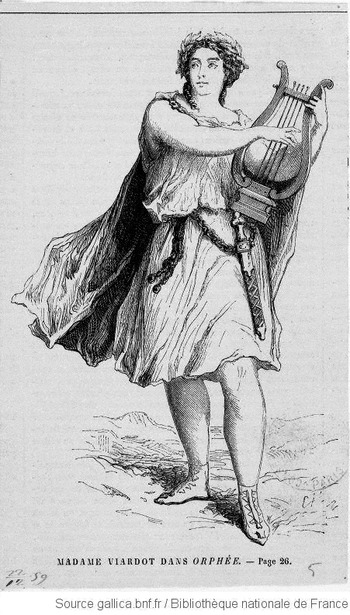
The Bibliothèque nationale de France holds a small gallery of Viardot in the role of Orpheus: two sketches of Viardot on stage at the Théâtre-Lyrique, complete with scenic environs; a photographic reproduction of a painted portrait by D. Philippe; a decorative cameo portrait of her head and shoulders; and a full-length sketched portrait.Footnote 58 In each, and in a sketch printed alongside Ulbach's review in the Gazette des beaux-arts, Viardot is depicted with the same attributes: the crown of laurels, the white tunic and cape, and the inevitable lyre. This is no coincidence. Not only were such features absolutely standard in portrayals of Orpheus, but each image shows Viardot attired exactly as she described her costume in the revival.Footnote 59 In Figure 1, Viardot – fingers poised to pluck the lyre – steps forward, her cloak flying behind her. Indeed the responsibility for conveying movement is carried almost entirely by the fabric of her skirt and cloak; her limbs have an unforgiving solidity that makes the ‘statuesque grace’ described by Henry Chorley hard to imagine. The sketch's perspective, too, is slightly odd: the singer's head is improbably small for such a frame – and yet, read as the product of exaggerated perspective rather than mediocrity, the effect is to bring Viardot's moving body parts (her left leg and right arm) even further out of the image, towards the viewer.
Sketch from an unidentified periodical of Pauline Viardot as Orpheus, dated 22 December 1859

This portrait and others seem to foreground a sense of movement largely absent from the more conventional, static images of her other roles. Such movement also runs counter to a trend in academic portraiture of the eighteenth and nineteenth centuries – a gradual shift away from the depiction of the meaningful gestures that a model, idealised according to the artist's proper training, might embody. Thus, as the nineteenth century progressed, the active, significant poses adopted by models were replaced by an increased attentiveness to the idiosyncrasies of a particular physique; as the body itself came under closer scrutiny, the portrait necessarily became more static.Footnote 60 However, the visual terrain of Viardot's Orpheus, emerging not only from the responses already discussed but also from this pictorial image, does not insert neatly into such a schema: the sketch in Figure 1, a distinctly ‘lively’ depiction, seems indeed to be the product of an older, eighteenth-century visual economy. Furthermore, the mid-nineteenth-century Pygmalion trope mentioned earlier, in which animation was seen as a function of genius, is explicitly complicated here by two competing sources of animating agency – portrait artist and singer. Like the mobile subjects of Gautier's dance criticism, Viardot was not a model, paid by the hour to provide an anonymous body from which the artist might draw inspiration; she was an artist in her own right, and would always already have sung prior to being portrayed. Two related tensions emerge, then, from portraits of Viardot as Orpheus: one is between competing expressive agencies at work in their production; the other is between the particular, apparently dated mode in which she was represented and the visual regime predominant in contemporary portraiture. The notion of technique may be helpful in dealing with these tensions, while in addition resonating productively with classique in all its evaluative force. What is more, technique – not least in its etymological and associative proximity to technology, another nascent concept at this time – leads me to some final, quite different images of the singer.
Technique was a critical pedagogical element at the École des Beaux-Arts, as it was at the Paris Conservatoire; it was, arguably, what separated the professional from the amateur; and it was therefore crucial to any assessment of aesthetic worth, any distinction between the boulevard and the salon. But even with such positive connotations, the notion remained ambivalent in the hands of the critics. Its association with the mechanical and the inhuman meant that, in mid-nineteenth-century writing on both music and art, too much technical prowess attracted the charge of academicism or lack of inspiration. Recall that Marie d'Agoult praised Viardot explicitly for the fact that ‘there is nothing planned, nothing contrived, nothing that recalls the classroom’ in her performance. Precisely because technique was thought essential to great art, it was to be kept well concealed, sublimated deep within the masterpiece.Footnote 61 When concealment failed – when technique was seen to overwhelm art – the resulting displays of mechanical prowess attracted harsh condemnation. Yet for all their long history in art and music, such old arguments about the proper role of technique in artistic creation came into sharper focus at mid-century. Indeed, they had gained a new focal point: the developing, contested field of photography. As its acolytes sought to have it recognised as an artistic medium, its products as worthy of critical attention alongside painting and sculpture, photography became a prime site for airing broader anxieties. These were about the place of technique in art and the relationship between artistic and technological endeavour in general; but also (albeit more implicitly) about the status of reproduction and preservation as artistic or technological acts.
The art critic Philippe Burty, writing about an exhibition held by the Société Française de Photographie in 1859, is typical in his stance. He bemoaned the fact that
Photography is impersonal; it doesn't interpret, it copies; therein lies its weakness as well as its power, since it captures with the same indifference the meaningless detail and the slightest thing, barely visible, barely noticeable, that endows soul and completes the likeness.Footnote 62
Photography is seen here to afford an entirely mechanical visual experience, seeing everything yet discerning nothing. For Burty and others, the photographer's gaze was scientific and analytical, producing autopsies rather than works of art. Such arguments continued when the 1859 Salon included a selection of photographic portraits – a development that prompted Baudelaire's notorious diatribe against the medium. Responding to the same apparently unseeing objectivity of the photograph that Burty had perceived, Baudelaire fumed that ‘the exclusive taste for the True … oppresses and stifles the taste of the Beautiful’; ‘Poetry and progress’, he reminded his reader, ‘are like two ambitious men who hate one another with an instinctive hatred, and when their paths cross, one of them must be slave to the other.’Footnote 63 Baudelaire thus depicted photography as a crass manifestation of the industrial and technological progress of which Napoléon III was so proud; and, more to the point, he saw such progress as fundamentally antithetical to the (implicitly timeless) work of art.Footnote 64 The medium of Morley's fantasy image of Viardot resurfaces here in less benign form: no longer imaginatively impossible, no longer safely metaphorical, photography is a dangerous mingling of high-art aspirations and modern technology. As a material, visible incarnation of technological progress, the photograph was for Baudelaire a means of preserving ‘the languishing ruins, the books, prints and manuscripts which time is devouring’.Footnote 65 It was an archival tool, not an art form. But while such refusal to engage with photography as art has long since become obsolete, the material products of the medium's preservational capacities are with us today: still tangible and, most importantly here, still visible.
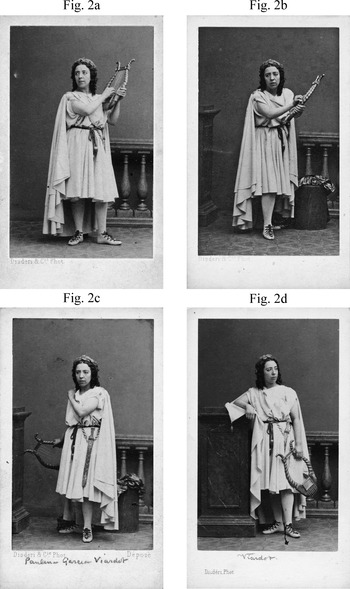
The four photographs in Figure 2 below are from a selection of cartes de visite images of Viardot as Orpheus taken, so far as I can tell, at the same studio session by the great nineteenth-century portrait photographer André-Adolphe-Eugène Disdéri. They share many features with Figure 1. It would not, in fact, be difficult to imagine the sketch being taken from such photographs, rather than created ‘live’ by one of Berlioz's artists in the theatre audience. Here, finally, we see the ‘real’ Viardot: limbs barely more delicate than those in the sketch; facial expression shifting between blank, pained and poised; feet always balletic when body, perhaps, is not. Arranged thus in sequence, it is hard to resist supplying the four photographs with a connecting narrative, joining up a few long moments of an otherwise vanished past. In Figure 2a, Viardot first strikes a pose that one could certainly term ‘statuesque’, lyre raised but balanced by the position of her left foot and the baroque folds of her cloak at her right-hand side: the photograph gives every impression of stasis. In Figure 2b, Viardot steps directly towards the camera, right foot first and with her knee slightly bent, a position that perhaps explains the pained concentration on her face; the lyre, now held lower, is also proffered to the viewer, while her fingers are in mid-pluck. By contrast, in Figure 2c she appears to have just moved: the lyre is now thrown out behind her right-hand side and compositionally balanced, once again, by the mass of elaborate pleats at the base of her cloak on the opposite side of her body. Finally, in Figure 2d, Viardot is static once more, a strong diagonal emerging across her body to join her carefully positioned right elbow to the strings of the lyre.
Cartes de visite photographs of Pauline Viardot as Orpheus by André-Adolphe-Eugène Disdéri

Of these images, Figure 2b is the most immediately striking: Viardot seems to lunge towards the viewer, her movement captured in a focus sufficiently clear that one might imagine Morley's envy.Footnote 66 The photograph certainly seems to encapsulate – or at least gesture at – the dynamics of stillness set into motion, that idea explored in many responses to Viardot's Orpheus. But in the end it is the resolutely static final pose (Figure 2d) that remains in the memory. Viardot, in presumably much greater comfort, leans gently on the marble lectern or column that appears in so many Disdéri portraits: its dual function was as a prop for the weary subject and a means by which to hold her exactly in position for long enough to take a clear exposure. As an object, then, it is entirely proper to the photograph – generic, mundane, an expected element of the apparatus. Yet it becomes a symbol of the very stasis it works to produce. To borrow Barthes's famous terms, Disdéri's column is a punctum, a ‘blind field’ signalling to external life while nonetheless participating in the formal construction or studium.Footnote 67 What is more, placed alongside this photographic Viardot, equipped with Orpheus's white tunic and lyre, the benign column that appears on so many of Disdéri's cartes de visite is cast in a different, darker light; it is out of place in the myth gestured at in this photograph and elsewhere. The central, catalytic object in that narrative is instead a tombstone: an image of ultimate stasis – of death itself.
Colloque sentimentale: the scriptural tomb
In the same review of the 1859 Salon in which he condemned photography as an overtly technologised medium, fit only for preserving and recording ‘true’ art works, Baudelaire extolled the virtues of sculpture. A brief rhapsodic quotation from his review features as my epigraph. The poet reports that, when contemplating a statue,
the stone phantom possesses you for several minutes, and orders you, in the name of the past, to think of things which are not of this earth.
Such is the divine role of sculpture.
In Baudelaire's dense formulation, we are haunted by stone touched and worked by human hands: stone figured not as inanimate, but as (un)dead – even divine; stone that transports its present addressee, via the past, towards some sort of transcendence.Footnote 68 The uncanny image might be pressed into service here as a spirit medium in its own right, gathering the threads of my discussion in terms that once again echo those of the Orpheus myth.
I have thus far taken for granted the fleshy, bodily nature of Pauline Viardot's performances on stage. I have assumed that, in any discursive tussle between present and past, performance and representation, real and imagined, living and inanimate, Viardot's resonant body at the Théâtre-Lyrique in 1859 must have remained rooted in the present, the real, the living. Yet reading between the lines of the response to Viardot's performances – and against the grain of much critical pedestrianism – repeatedly suggests an experience that was altogether less mundane. Like Baudelaire's stone phantom, a statuesque Viardot also seems to have called forth something more unsettling – in the poet's words, ‘not of this earth’. This uncanny effect surfaces in what Henri Blaze de Bury (under the pseudonym F. de La Genevais) described as the ‘antique side of Mme. Viardot's talent’, identified as though an accepted trait years before Orphée, in response to her turn as Sapho in 1851.Footnote 69 Not only, then, was Gluck's work embedded and implicated within the complex and shifting meanings of le classique outlined above; Viardot herself was already seen as an embodiment of classical values.
One might argue that this is simply evidence of an association between a singer and the repertory for which she was known. Indeed, following Orphée, Viardot was asked to edit an École classique du chant – a collection of ‘morceaux choisis dans les chefs d'œuvre des plus grands maîtres classiques’. The preface describes how Viardot, ‘commissioned to rediscover and to indicate the thinking of these masters … felt herself borne towards this task by her entire life's work, by her daily practice of the art of singing, whether on stage or in teaching’.Footnote 70 But while Viardot was undoubtedly considered one of the great exponents of la musique classique, the idea that she was herself classical is more fundamental than such a rhetorical collapse of repertory and person suggests. Émile Perrin described Viardot as ‘the artist who best represents the tradition of the grand style’; ‘the daughter of García, the sister of Malibran, the last descendent of this noble family of artists’.Footnote 71 Here, Viardot's own classicism emerges in a slightly different sense: from the idea that she belongs to a particular vocal tradition, the acknowledged status of which she embodies and – as the last in the dynasty – preserves. Similarly, Scudo's review of Viardot's performance recalled previous great renditions of ‘J'ai perdu mon Eurydice’ (by Garat and Duprez in French, by Pasta in Italian) before concluding that ‘The talent of Mme. Viardot has awoken in me these wonderful memories’.Footnote 72 The singer is understood as a resonant tomb (to borrow Jonathan Sterne's phrase) avant la lettre: at once an open channel to voices from the past, and the only surviving remains of a dying vocal tradition.Footnote 73 In this context, the desire to keep and maintain becomes essential. Baudelaire's suggestion that photography ought to be used to safeguard great art works for posterity is symptomatic of a situation in which ‘classic’ might simply mean ‘worthy of being preserved’.Footnote 74
In order to require such preservation, one must of course be on the brink of extinction, or at least tinged with mortality. Embodying le classique – whether in this sense of providing a direct conduit to an already interred past or, allegorically, as a statuesque figure treading the line between flesh and marble – could be dangerous. The perils are fully manifest in the Literary Gazette's review of Viardot's performance in Fidélio, staged at the Théâtre-Lyrique one year after Orphée:
[Viardot] has, perhaps, a finer, truer conceptive faculty of really classical art than any artist, male or female, now in existence, and this makes her ‘Orphée’ one of the most perfect performances ever seen on any stage, or at any time … But this will not help her when she has to render such a truly living character as ‘Fidelio’.Footnote 75
In being so perfectly ‘classical’, then, Viardot surrendered her ability to be ‘truly living’. Just as the positive associations of le classique could migrate from the singer's repertory to personal worth as a performer, so could its negative side-effects. Gautier, moreover, had famously criticised the wave of revivals of such ‘classic’ composers as Gluck in his 1859 Histoire de l'art dramatique en France:
However great an admirer of the past one might be, one is left somewhat cold by the performance of an ancient masterpiece; one feels that these are dead words, dead melodies. Their soul has fled; they no longer have the sense of life that an audience in communion with the author imparts to a piece.Footnote 76
The classic may be great, and even timeless; but nothing can remain both timeless and alive. Perhaps the ultimate ‘stone phantom’, the classic, is also haunted: by its own pastness and, by extension, by the fact that it is always already dead. Pauline Viardot, a singer at once imagined (in an ancient trope) as a statue coming to life, as the embodiment of a tradition receding into the past, appears as a figure of ambivalence and connection, a figure similarly haunting and haunted. Perhaps this is only to be expected. There is, as Barbara Johnson suggests, a ‘latent threat in any animation of the inanimate’: the process may be reversed and the living turned to stone.Footnote 77
To put this one final way: on 18 November 1859 at the Théâtre-Lyrique in Paris, Gluck's opera met its match. The œuvre classique, which fitted so neatly into Gautier's description of such pieces as the dead shell of a once-vital composition, was brought back to life by a star performer herself seen as classic, as commanding an authority originating in and bestowed by the past. Viardot as Orpheus possessed the power of animation: to repeat Philippe Martin's comment, ‘At the sound of her voice, antiquity comes out of oblivion’; she descended into the underworld and returned to tell the tale. But she did so with one foot already in the grave. What is strange is that such essential mortality did not, in the end, prove fatal. Neither Viardot nor Gluck's Orphée are in urgent need of a scriptural tomb; my ‘dead who still haunt the present’, to speak in Certeauvian terms, are rather the operatic works that now comprise ‘the canon’ – a repertory still in the process of solidifying, of turning to stone, when Viardot created her Orpheus.Footnote 78 The ‘système d'exhumations’ for which Carvalho was famed is now effectively the system in which opera houses function and in which performances are produced. His 1859 Orphée provided a discursive battleground on which the relative values of the past, present and future, the notion of the classic and, finally, the question of opera's vitality were fought out.
There is little question that, as perceived in 1859, Viardot epitomised the Sainte-Beuvian classic – ‘of the past, with an already established reputation … accepted as an authority in his genre’. Imagined in Orphée's reception as a nexus of stillness and movement, past and future, life and death, the power of her talent for the ‘classical’ was located precisely in its a priori pastness. More surprising than the fact that she was perceived to have something dead about her is that she was alive at all: she channelled the authority of the long dead while still sonorously extant, figured as the final trace of a receding past. Accorded such a status, Viardot had exceeded the bounds of the living. While her Orpheus was declared immortal, her own reputation was couched in the terms of the already-dead, as though her performances at the Lyrique were addressed to a future from which the revival would itself be preserved as a memory of the distant past. And, of course, despite her own apparent powers of animation and vocal enchantment, the singer's mythological incarnation was indeed finite. However statuesque, classic or temporally complex Viardot's discursive existence in the wake of the 1859 Orphée, she remained, inevitably, mortal. She retired from the stage shortly after the revival, but survived it by over half a century; by the time she died in 1910, Viardot's Orpheus was indeed ancient history.
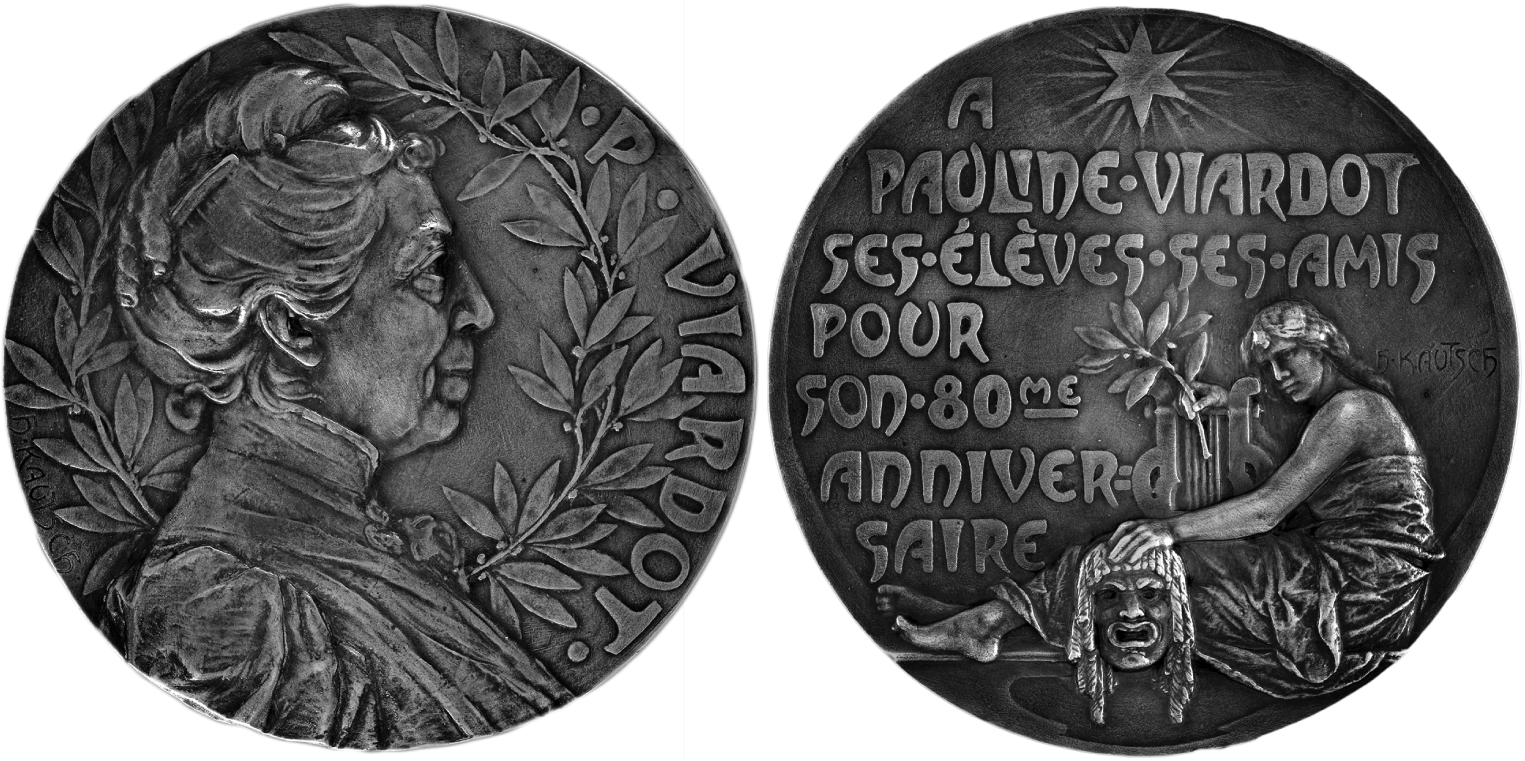
On 18 July 1901, on the occasion of her eightieth birthday, Viardot's friends and pupils presented her with a commemorative medal (Fig. 3). On one side is a relief profile of the famous singer, unmistakeably an éminence grise, framed by a crown of laurels. On the reverse, aside from the inscription, is a portrait (again, in relief) of her younger shade. She reclines in a significantly more fluid position – her right foot dipping slightly below the clean horizontal line of the plank on which she is seated, the fabric of her garment almost exceeding the medal's rim – holding an olive branch, a lyre and a mask. It is hard to resist seeing the image as in some sense Orphic and thus related specifically to Viardot's role in the 1859 revival. Although the ensemble clearly implies that this is an allegorical figure symbolising opera or dramatic art, the soft jaw-line and general likeness to photographs and portraits of the singer earlier in life suggest a figure indeed modelled on Viardot herself. More eye-catching, though, is the mask: a standard signifier of Greek tragedy (and thus of drama in general) but also redolent of the death mask, that ancient ritual object phased out during the nineteenth century, gradually replaced by the deathbed photograph. Death once again seems to haunt the image; the object itself is sombre and weighty, to be handled only in the reverential quiet of the archive.
Commemorative medal (1901) by H. B. Kautsch, presented to Pauline Viardot on her eightieth birthday
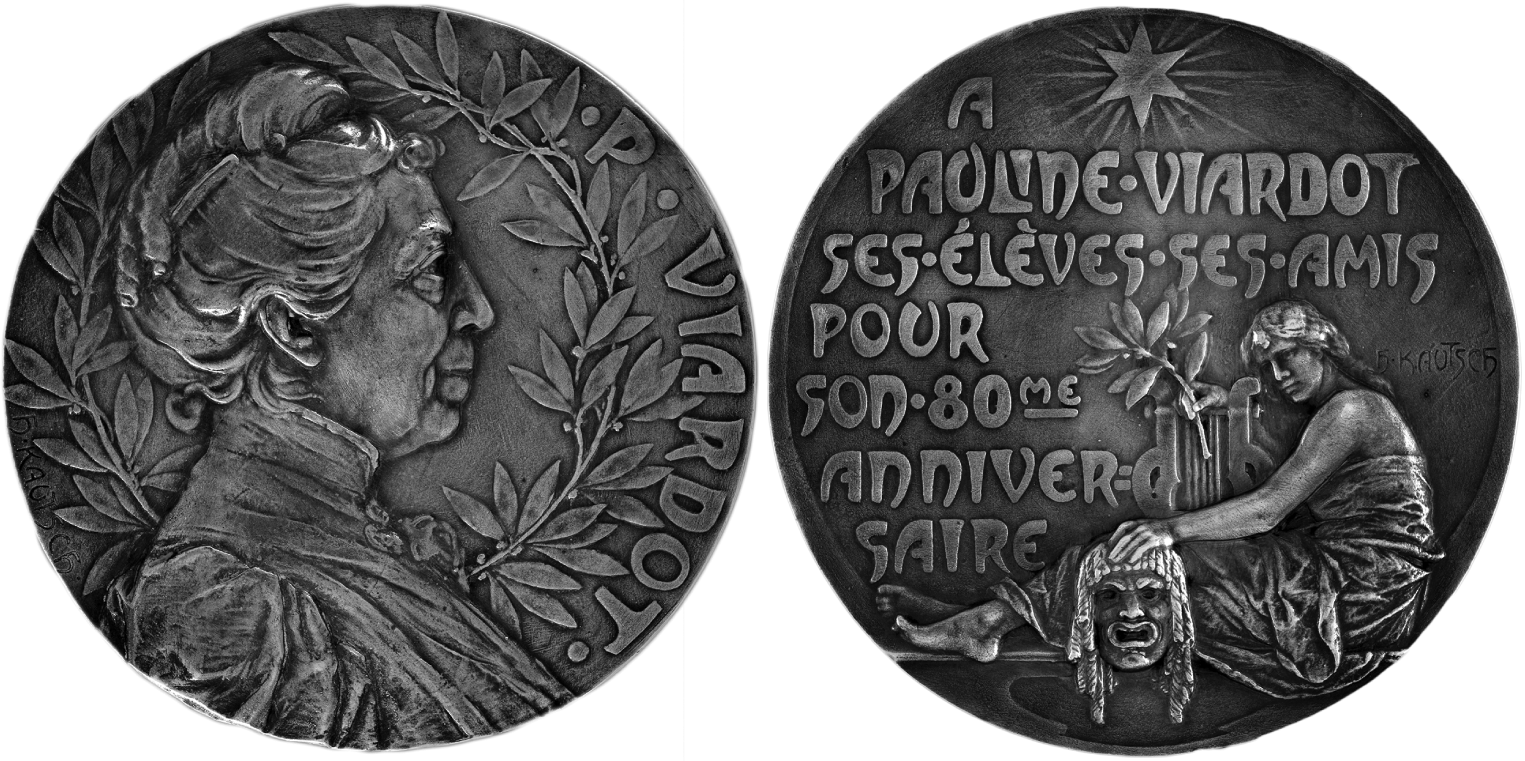
Its form – essentially that of a large metal coin – gestures unequivocally towards the currency (both literal and historic-cultural) that the object continues to wield. The medal's value is tied not only to its materiality (what its particular mass of metal is worth) but also to its commemorative qualities and, above all, to its association with Viardot, on whose prestige the object's existence relies. In the end, what is striking is the fact that it was presented to Viardot during her lifetime – indeed, in celebration of its continuation – but nonetheless materially embodies the threat of ‘the living turned to stone’. While the visual language of its memorialisation seems recognisable from the reception of Viardot's Orpheus half a century earlier, the medal's particular immortalisation of the singer is captured in metal. It is an artefact cold to the touch: as cold as Gautier had found Gluck's music. Yet, like Baudelaire's stone phantom, it acts in the name of the past; it continues to speak, addressing us still from an undiscovered country.