Introduction
Coronavirus disease 2019, more commonly known as Covid-19, is an infectious disease composed of single-stranded RNA viruses that can lead to respiratory, enteric, hepatic and neurological diseases.Reference Zumla, Chan, Azhar, Hui and Yuen1 Most patients diagnosed with coronavirus had decreased pulmonary function and possible respiratory failure, thus leading to physicians utilising alternative methods like supplemental oxygen, tracheostomy and ventilators to protect the airway and ensure proper oxygenation. Data collected from the pandemic show that up to 15 per cent of Covid-19 positive patients required mechanical ventilation.Reference Guo, Cao, Hong, Tan, Chen and Jin2–Reference Möhlenkamp and Thiele4
Critically ill patients who require prolonged mechanical ventilation will normally undergo a tracheostomy to facilitate ventilation weaning and increase the availability of intensive care unit beds.Reference Mishra, Jedge, Kaushik, Artham and Kumari5 The two current methods to perform a tracheostomy are the percutaneous tracheostomy and the open surgical tracheostomy. A percutaneous tracheostomy involves a small incision in the neck to insert a tracheostomy tube with the use of a bronchoscope, leading to a lower risk of major bleeding and a quicker recovery. While the surgical tracheostomy requires a larger incision, more tissue dissection and a higher risk of major bleeding, it also provides better visualisation of the trachea, reducing the risk of tracheal injury during the procedure, and can be ideal for patients with complex anatomical considerations.
During the outbreak of Covid-19 and the subsequent pandemic, both methods of tracheostomy were utilised to treat patients with decreased pulmonary function. This study aims to demonstrate the effectiveness of both types of tracheostomies in reducing the mortality rate from Covid-19 in the hope of optimising patient outcomes during future pandemics, and providing a better understanding of the two procedures to improve patient guidelines and protocols when dealing with respiratory illnesses or diseases.
Methods and materials
Database selection
This study used the 2020 National Readmissions Database (NRD) produced by the Agency for Healthcare Research and Quality. The database gives a sample of 17 million discharges of in-patient hospital visits, comprising of 60.8 per cent of total US hospitalisations.6
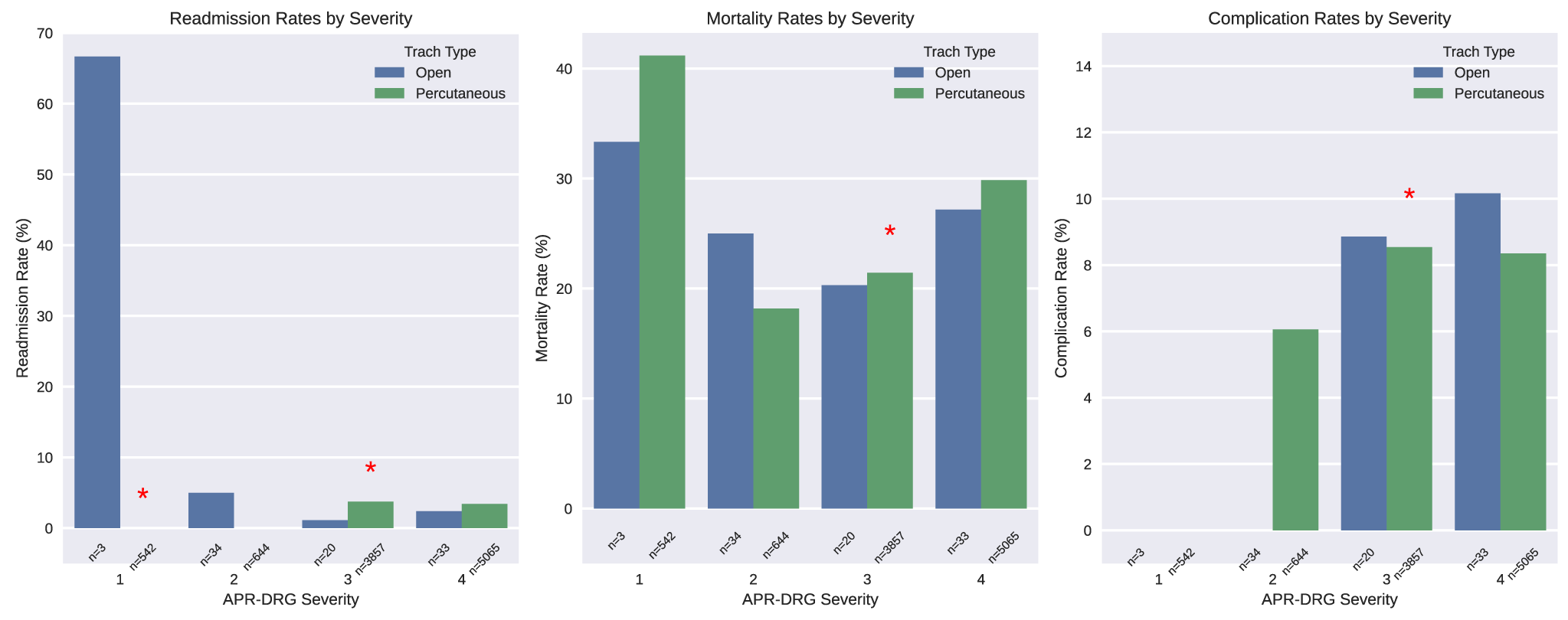
Rates with severity adjustments and counts. *Indicates p-value < 0.05.

Patient selection
Based on the International Statistical Classification of Diseases and Related Health Problems 10th Revision (ICD-10) coding in the 2020 NRD database, we selected patients with ICD-10 code U071 in the data column I10-_DX1, indicating that the primary purpose of the visit was to address a Covid-19-related issue. Patients with tracheostomies were identified using ICD-10 Procedure Coding System (PCS) codes starting with 0B110 and 0B113, corresponding to the open and percutaneous approach. Patients with both a Covid-19 and a tracheostomy code totalled 4810 patients, 2061 for open and 2749 for percutaneous tracheostomy.
Data analysis
Multiple variables in the NRD were used in our analysis, including age (AGE), elective admission (ELECTIVE) and presence of an ER record, which was calculated by values not equal to zero in the variable HCUP_ED. Readmission was defined as a duplicate value in the NRD_Visitlink. Mortality rate was calculated using the DIED variable. Complication rate is defined as presence of any of the following ICD-codes: J9500 Unspecified tracheostomy complication, J9501 Haemorrhage from tracheostomy stoma, J9502 Infection of tracheostomy stoma, J9503 Malfunction of tracheostomy stoma, J9504 Tracheo-oesophageal fistula following tracheostomy, J9509 Other tracheostomy complication. Chi-squared analysis was used in Table 2 to calculate p-values for differences in readmission, mortality and complication rates. Severity rankings were assigned using the data field “All Patient Refined DRG” (APR-DRG). The numbers correspond to the following severities: (0) No class specified, (1) Minor loss of function (includes cases with no comorbidity or complications), (2) Moderate loss of function, (3) Major loss of function, (4) Extreme loss of function.
A non-elective admission due to Covid-19 (Table 1) refers to a hospital admission that is unplanned.
Discussion
Despite similarities in patient demographics and clinical characteristics (Table 1), analysis revealed significant differences in outcomes between open and percutaneous tracheostomies performed on Covid-19 patients. This adds to the current debate surrounding the advantages and disadvantages of open and percutaneous tracheostomy. Previous research has described open tracheostomies as having higher rates of peristomal infections than percutaneous tracheostomies (p < 0.05),Reference Maheshwaran, Thomas, Raman and Pookamala7 but also lower rates of accidental decannulation and obstruction likely due to the greater amount of tissue dissection involved.Reference Cheung and Napolitano8 Open tracheostomies are also considered to be more expensive because of the added operating theatre cost and longer procedural times.Reference Cipriano, Mao, Hon, Vazquez, Stawicki and Sharpe9
Age and demographics of population

From Table 2, there was found to be a higher non-severity adjusted Covid-19 mortality rate in percutaneous tracheostomies (29.25 per cent) compared to open tracheostomies (26.35 per cent) at the alpha = 0.05 significance level. This differed from González-Muñoz et al.’sReference González-Muñoz, Ramírez-Giraldo, Peña Suárez, Lozano-Herrera, Vargas Mendoza and Rodríguez Lima10 retrospective cohort analysis, which reported lower percutaneous tracheostomy mortality rates (25.0 per cent) compared to that of open tracheostomies (65.7 per cent). This difference is likely due to the large contrast in sample sizes used in the two studies. Our study utilised data from 4810 patients, while González-Muñoz et al. used data from 113 patients. Moreover, differences in patient demographics and hospital protocols in Colombia and the United States are likely to contribute to the differences in results.
Comparing tracheostomy techniques without risk adjustment

In patients were stratified by APR-DRG for Covid-19 severity. It shows that in patients with a severity rating of 3, those who received open tracheostomies were readmitted less often than those who received percutaneous tracheostomies at the alpha = 0.05 significance level. These results were consistent with patients with a severity rating of 4, where those who received open tracheostomies had fewer readmissions, complications and lower mortality rates than those who received percutaneous tracheostomies at the alpha = 0.05 significance level. However, prior research from Rovira et al.,Reference Rovira, Tricklebank, Surda, Whebell, Zhang and Takhar11 Long et al.Reference Long, Chern, Feit, Chung, Ramaswamy and Li12 and Staibano et al.Reference Staibano, Levin, McHugh, Gupta and Sommer13 reported no significant differences in outcomes between open and percutaneous tracheostomy in terms of complications and mortality but did not include severity stratification in the studies.
From Table 2, percutaneous tracheostomies seem inferior with respect to outcomes (still superior from a resource perspective potentially, so these things need to be weighed when making decisions) to open tracheostomies. Metrics between the two types of tracheostomies tend to be similar in mild disease but diverge greatly in severe disease. One possible explanation could be that severe Covid-19 patients are likely to have multiple comorbidities, which are better handled by open tracheostomy procedures. Some of these comorbidities include distorted neck anatomies from enlarged thyroid glands or obesity, which make cannulation through a small incision more difficult in percutaneous tracheostomy.Reference Cheung and Napolitano8 Additionally, percutaneous tracheostomies are generally not the standard protocol in emergency situations such as acute respiratory distress syndrome (ARDS) which is a common cause of respiratory failure in severe Covid-19 patients.Reference Tzotzos, Fischer, Fischer and Zeitlinger14 While percutaneous tracheostomies are quicker than open tracheostomies if done successfully, there is a higher insertion success rate associated with open tracheostomies. Thus, the risks of failed tracheostomies are amplified in emergency situations.Reference Cheung and Napolitano8
Conclusion
This study highlights the significant differences in outcomes between open and percutaneous tracheostomies in Covid-19 patients. While percutaneous tracheostomies are generally less invasive and associated with quicker recovery times, our data indicate that open tracheostomies are associated with lower mortality and readmission rates in more severe Covid-19 cases. These findings suggest that open tracheostomies may be more suitable for patients with severe disease and complex anatomical considerations. Our results underscore the importance of considering patient severity and comorbidities when choosing the type of tracheostomy. Further research with larger and more diverse cohortss is needed to refine guidelines and optimise tracheostomy protocols for future respiratory pandemics.
Financial support
The authors have no financial conflicts of interest to disclose. This research did not receive any specific grant from funding agencies in the public, commercial, or not-for-profit sectors.
Competing interests
The authors declare none.
Ethical statement and informed consent
The study was conducted in accordance with the Declaration of Helsinki and was approved by the Institutional Review Board of. The requirement for informed consent was waived because of the retrospective design.