Introduction
A small change in something we do routinely in our daily lives can sometimes lead to great improvements. Imagine that we are trying to teach young children a discrimination problem – to stop when the traffic light is red and to cross the street if the light is green. A usual way to encourage this sort of discriminative learning is to provide a reward after each correct response is emitted – for example, saying “well done”. But what would happen if we instead provided the child with a specific outcome for each correct response – for instance, a kiss when he/she correctly chooses to cross the street and a verbal “well done” when he/she correctly chooses to stop? Trapold (Reference Trapold1970) answered this question in a conditional discrimination study using animals. He exposed rats to a discrimination problem that required a response to one lever (e.g. the right lever) in the presence of one stimulus (e.g. a tone), and a different response to a second lever (e.g. the left lever) in the presence of another stimulus (e.g. a click). Trapold observed an increased rate of acquisition and greater accuracy when the correct choice of the right lever was followed by pellets and the correct choice of the left lever was followed by sucrose, than when both correct responses produced the same reinforcer. This enhancement in performance and/or terminal accuracy was termed the differential outcomes effect (see Goeters et al., Reference Goeters, Blakely and Poling1992, for a review).
Further studies demonstrated that the differential outcomes procedure (DOP) is effective in improving symbolic relation learning in children ranging in age from four years to eight-and-a-half years (Maki et al., Reference Maki, Overmier, Delos and Gutman1995; Estévez and Fuentes, Reference Estévez and Fuentes2003; Estévez et al., Reference Estévez, Fuentes, Mari-Beffa and Álvarez2001; Reference Estévez, Overmier and Fuentes2003b) as well as in adults without mental handicaps (Miller et al., Reference Miller, Waugh and Chambers2002; Estévez et al., Reference Estévez, Vivas, Alonso, Marí-Beffa, Fuentes and Overmier2007; Mok and Overmier, Reference Mok and Overmier2007). Moreover, several studies have shown the beneficial effects of DOP to improve conditional discrimination learning in a wide range of clinical conditions, such as children with mental retardation (Janssen and Guess, Reference Janssen and Guess1978; Saunders and Sailor, Reference Saunders and Sailor1979), children with autism (Litt and Schreibman, Reference Litt and Schreibman1981), adults with Prader-Willy syndrome (Joseph et al., Reference Joseph, Overmier and Thompson1997) and in children and adults with Down's syndrome (Estévez et al., Reference Estévez, Fuentes, Overmier and González2003a).
Differential outcomes and memory
The benefits of DOP extend to those tasks that require holding information about the sample stimuli in memory. Thus, Brodigan and Peterson (Reference Brodigan and Peterson1976) used a delayed matching-to-sample (DMTS) task with pigeons. Subjects were presented with a sample stimulus that could be either a red or a green light. After a variable delay (0, 3 or 15 seconds), subjects were required to choose between two comparison stimuli, a horizontal or a vertical line stuck on two response levers. If the sample was the red light, the vertical line was the correct choice, and conversely if the sample was the green light, the correct choice was the horizontal line. Results showed that in the non-differential condition, performance was reduced to chance after a delay of a few seconds between the sample and the comparison stimuli; the application of differential consequences improved the participants' performance even at the longer delays. Similar results were reported in other studies that compared delayed matching-to-sample performance of pigeons under conditions involving differential and non-differential outcomes (e.g. Linwick et al., Reference Linwick, Ovemier, Peterson and Mertens1988). Recent animal studies have also demonstrated that DOP can reverse working memory deficits in animal models with Wernicke-Korsakoff syndrome (Savage and Langlais, Reference Savage and Langlais1995) and on older rats (Savage et al., Reference Savage, Pitkin and Careri1999). Rats were treated with pyrithiamine until toxicity caused central nervous system lesions that parallel those seen in patients with Korsakoff's syndrome and, in addition, showed performance impairments on tasks that assessed working memory (e.g. delayed conditional discrimination tasks). Savage and Langlais (Reference Savage and Langlais1995) observed an enhancement of both acquisition and delayed matching-to-position performance in rats treated with pyrithiamine receiving differential outcomes. In fact, their memory performance was comparable to that of normal control rats. Using a similar procedure, Savage et al. (Reference Savage, Pitkin and Careri1999) also found that DOP enhanced memory performance in aged rats on a delayed matching-to-position task for which they were normally impaired. Moreover, these rats did not display the typical age-related decline in spatial working memory when differential outcomes were arranged.
Despite the potential benefit of DOP to ameliorate memory deficits seen in animals, to our knowledge only one study has addressed this issue in humans. Hochhalter et al. (Reference Hochhalter, Sweeney, Bakke, Holub and Overmier2000) trained four patients with alcohol dementia to recognize which of two faces matched a previously seen face, a task that these patients found difficult to solve. One patient did not show any difference in matching accuracy when trained with differential and non-differential outcomes, and his data were not included in the statistical analyses. The other three patients with memory impairments carried out the task more accurately when differential outcomes were arranged, although the effect was mainly evident at the 5 second delay. In fact, their performance did not differ from that of controls at that delay. At longer delays, however, patients showed low accuracy regardless of the type of training used. These results along with those obtained in the aforementioned animal studies strongly suggest the potential for DOP to aid memory disorders (Overmier et al., Reference Overmier, Savage, Sweeney, Haug and Whalen1999). As Overmier et al. (Reference Overmier, Savage, Sweeney, Haug and Whalen1999) point out, the application of the differential outcomes training protocol can help clinical patients to overcome their learning and memory limitations. However, although the results from Hochhalter et al. (Reference Hochhalter, Sweeney, Bakke, Holub and Overmier2000) are very promising, the small sample of the study and the large variability showed by patients' responses do not allow a clear assessment of the relevance of DOP to improve memory in humans, and further research is needed.
Differential outcomes and normal aging
Memory decline is a typical feature in normal aging. However, not all types of memory are affected to the same degree with aging. Whereas implicit, autobiographical, semantic and emotional memories are well preserved, explicit memories, working memory or encoding of new episodic events decline with aging (Hedden and Gabrieli, Reference Hedden and Gabrieli2004). In particular, deficits in memory are evident on visual recognition tasks in which the participant is required to hold visual information over the time. For example, in the study by Flicker et al. (Reference Flicker, Bartus, Crook and Ferris1984) the participants were presented with a display of a house with one of 25 possible rooms illuminated. After a variable delay, the participant was instructed to point out which room had been previously illuminated. No differences were found in performance on immediate recall between the young and elderly groups. There was, however, a larger decline in recall accuracy in the normal elderly compared with the young group when the delay intervals were increased. Similar deficits on visual recognition memory tasks are found with several other types of visual stimulus, such as unfamiliar faces (Bartlett et al., Reference Bartlett, Leslie, Tubbs and Fulton1989).
An accumulating wealth of evidence points to the usefulness of DOP to alleviate memory problems on normal aging. First, aged rats trained with differential outcomes not only displayed enhanced working memory but also performed at the same level as young rats (Savage et al., Reference Savage, Pitkin and Careri1999). Second, a two-memory system account has been proposed to account for the beneficial effect of DOP on memory tasks (Savage et al., Reference Savage, Pitkin and Careri1999). This account states that the explicit memory system is engaged under non-differential outcome conditions, whereas the implicit memory system is tapped by DOP. According to this perspective, differential outcomes application will be useful in those cases in which the implicit, but not explicit, memory system is preserved, as in normal aging (see above). Lastly, animal studies have shown that the cholinergic system appears to be engaged when non-differential outcomes are arranged, whereas glutamatergic mechanisms are engaged under DOP. Thus, administration of scopolamine, a cholinergic muscarinic antagonist, disrupted performance under non-differential but not under differential conditions; the reverse pattern was found for the glutamate antagonist MK-801 (Savage and Parsons, Reference Savage and Parsons1997). These results not only provide evidence in favor of the hypothesis that there are different neurobiological systems for DOP and non-DOP, but also highlight the usefulness of DOP in overcoming memory deficits in those populations in which the cholinergic system has deteriorated, as in normal aging (Schliebs and Arendt, Reference Schliebs and Arendt2006).
Given the dramatic consequences that memory loss has for normal performance in daily activities, it is clear that more research is needed to assess the potential utility of DOP as a therapeutic method. In the present study we assessed this procedure as an instrument to improve memory loss in normal aging. For this purpose, we used a DMTS task that is easily solved by young adults (to be reported in a future paper). We hypothesize here that relative to younger adults, older people will present deficits on the DMTS task but the application of DOP will be able to overcome these deficits.
Methods
Participants
Eighteen younger adults (6 males and 12 females) and 24 older adults (6 males and 18 females) participated in the study. Younger adults (mean age = 21.8, SD = 2.4) were undergraduate students from the universities of Murcia and Almería, and they received course credits for their participation. Older adults (mean age = 61.6, SD = 7.2) were students from a course for the elderly at the University of Murcia who volunteered to participate in the experiment. All participants had attained at least a high school degree. All of them had normal or corrected-to-normal vision. The older adults did not present evidence of cognitive impairment as assessed by the Mini-mental State Examination (Folstein et al., Reference Folstein, Folstein and McHugh1975).
Stimuli and materials
The stimuli consisted of six photographs of faces of Spanish men in suits (for the sample and the comparison stimuli) and six pictures showing different objects as prizes (for outcomes). Men's faces were used as stimuli since several studies points to impaired face recognition in older adults without dementia (Bartlett et al., Reference Bartlett, Leslie, Tubbs and Fulton1989). All stimuli were displayed on a 15 inch (38 cm) color monitor laptop with a Pentium processor. The experimental task was created using E-Prime 1.1 (Psychology Software Tool, Pittsburgh, PA).
The photographs of men measured 5.5 × 6.5 cm and could be displayed either individually in the center of the screen (sample stimulus), or grouped in a 3 × 2 grid (comparison stimuli) equidistant from the borders. The position of the photographs on the grid was randomly arranged. Six photographs of prizes (an umbrella, a scarf, a massage apparatus, a perfume, a mug and a keyring) measuring approximately 10 × 13 cm were used as secondary reinforcers. They were presented individually along with the text “You may win a:” above the photograph. The prizes (primary reinforces) were raffled off at the end of the experiment. The procedure of presenting photographs along with a prize raffle was introduced previously by Miller et al. (Reference Miller, Waugh and Chambers2002), who showed that participants whose correct responses led to a specific photograph and prize were more accurate than participants whose correct answer led to specific photographs and random prizes, or participants whose correct responses led to a random picture and a random prize entry. Although the prizes were not used directly as compensation for study participation (younger adults participated for credit courses and older adults were volunteers), they were used to encourage the accuracy on the task since the participants were told that the more accurate were on their response, the more tickets for the raffle they would win and the higher probability they would have of winning one of the prizes. All the prizes were selected as being attractive to both younger and older adults.
Procedure
Participants were tested individually in a quiet room. The instructions for the experiment were provided both by a written text on the computer screen and verbally by the experimenter, to ensure the participants fully understood the procedure. After reading the written instructions, each participant was required to make a correct response in a trial run; accuracy and speed in responding were emphasized.
The experiment consisted of a six-choice “yes/no” recognition task comprising 72 trials grouped in two blocks of 36 trials each. The trial sequence (see Figure 1) began with the fixation cross presented for 1000 ms. The cross was replaced by a white screen for 500 ms and then a photograph of a man (the sample stimulus) appeared on the centre of the screen for 1500 ms. Each sample stimuli was repeated six times per block (12 times in total). A white screen lasting 5 or 30 sec., randomly selected, replaced the sample stimulus and served as the delay. Only two delays were used since the main objective of the study was not to trace the time-course of the decay of information on memory but to find two time points, one in which there are no differences between young and adults and one in which there are clear differences between the two age groups. After the delay, a set of six photographs were presented (the comparison stimuli). The comparison stimuli lasted until the participant responded or until 10 seconds had elapsed, whichever occurred first. The participants had to decide whether the face they saw previously was or was not presented as a comparison stimulus. On half of the trials the sample stimulus was presented as a choice stimulus and on the remaining half six new faces served as choice or comparison stimuli. For affirmative responses, participants were required to press the key “N” on the keyboard; for negative responses, they had to press the key “C”. Correct responses led to the presentation of the corresponding outcome and a text message indicating the corresponding prize. The outcome presentation lasted 2500 ms. Incorrect responses were followed by a blank screen for the same length of time as the outcome presentation.
Stimuli sequence (from left to right).

Participants were randomly assigned to one of two conditions. For participants in the differential outcomes condition, each sample stimulus was always associated with a specific outcome and correct responses to a particular stimulus led only to its associated outcome. For instance, correct recognition of the man with the beard was always associated with the photograph of an umbrella (to be raffled at the end of the study), correct recognition of the man with the glasses was always paired with the photograph of a mug (also to be raffled at the end of the study), and so on. Correct responses by participants in the non-differential condition were followed by a random presentation of one of the six possible outcomes. For instance, correct recognition of the man with the beard could be paired with the photograph of an umbrella in one trial, the mug in the next trial, and so on.
Statistical analyses
Percentages of correct responses and median correct response times were submitted to a 3 × 2 mixed ANOVA with the condition (differential and non-differential outcomes) and age group (younger adults and older adults) as between-subjects factors, and the delay (5 and 30 seconds) as the within-subjects factor. Where necessary, post hoc comparisons were calculated by Newman-Keuls' test. All analyses were computed by the Statistica software package. The significance level was set at p ≤ .05.
Results
Accuracy analysis
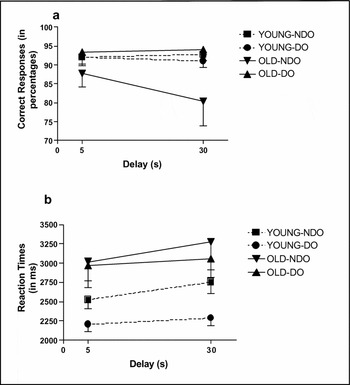
The analysis conducted on percent of correct responses showed no main effects of condition (F(1,38) = 3.06), age group (F(1,38) = 1.60) or delay (F(1,38) = 2.69) (all p > 0.05), but the condition × age group interaction reached statistical significance (F(1,38) = 4.34, p < 0.5). Importantly, the condition × age group × delay interaction also reached statistical significance (F(1,38) = 4.74, p < 0.05). To further examine the three-way interaction we conducted separate ANOVAs for each age group. Figure 2a shows the mean correct responses as a function of condition and delay for younger and older adults. For younger adults, neither the main effects of condition and delay, nor the condition × delay interaction reached statistical significance (all F < 1, ps = 0.70, 0.74 and 0.47 respectively). For older adults, the condition × delay interaction was significant (F(1,16) = 4.86, p < 0.05). In general, the mean percent of correct responses was higher in the differential than in the non-differential condition at both 5-second (p < 0.05) and 30-second (p < 0.001) delays. Under the non-differential condition correct responses decreased dramatically when the delay was increased from 5 to 30 seconds (p < 0.001); however, under the differential condition correct responses were identical at both delays (p > 0.1). Additional analyses showed that older adults' performance differed from that of younger adults only in the long delay under the non-differential condition (p < 0.001).
(a) Mean percent of correct responses (+SEM) for younger and older adults at 5 and 30 second delays under differential and non-differential conditions. (b) Median correct response times (+SEM) for younger and older adults at 5 and 30 second delays under differential and non-differential conditions. DO = differential outcomes; NDO = non differential outcomes.

Reaction time analysis
The analysis conducted on mean correct response times (see Figure 2b) showed the main effects of age group (F(1, 38) = 10.42, p < 0.01), since overall reaction times (RTs) were longer for older adults (3080 ms) than for younger adults (2442 ms), and delay (F(1,38) = 18.64, p < 0.001). The main effect of condition was not significant (F(1, 38) = 1.81, p > 0.1) but the condition × delay interaction reached statistical significance (F(1,38) = 4.35, p < 0.05). Post-hoc analyses showed that RTs were longer in the non-differential than in the differential condition at both 5 second (p < 0.005) and 30 second (p < 0.001) delays (2771 and 2585 ms, for the 5-second delay, respectively; and 3017 and 2671 ms, for the 30 second delay, respectively). Increasing the delay from 5 to 30 seconds resulted also in increased RTs for the non-differential condition (p < 0.001) but not for the differential condition (p > 0.1). No other interactions were statistically significant.
Discussion
The purpose of the present study was to assess whether the application of the differential outcomes procedure could ameliorate the memory loss comm- only seen in older people. To explore this issue, we used a delayed matching-to-sample task under conditions in which outcomes were randomized (non-differential) compared with conditions in which each sample stimulus was always paired with its own and unique outcome (differential). Two delays (5 seconds and 30 seconds) between the sample and the comparison stimuli were used.
An age-dependent differential outcomes effect was observed in terms of accuracy of performance. Younger adults did not take advantage of the differential outcomes procedure; that is, their accuracy was high and identical under both differential and non-differential conditions at both the 5 and 30 second delays. A different pattern was found in older adults: not only did their accuracy increase under the differential outcomes condition but DOP was able to prevent the detrimental effect of an increased delay between the sample and the comparison stimuli. In fact, under the non-differential condition, the accuracy level of older adults decreased when the delay was increased from 5 to 30 seconds; however, when differential outcomes were arranged their accuracy at the 30 second delay remained at the same high level as at the 5 second delay. Therefore, in agreement with the results previously described with animals (Savage et al., Reference Savage, Pitkin and Careri1999), the use of DOP helped older adults to improve their performance on the present memory task.
The differential outcomes effect was also found on RTs at both delays in the two age groups. Under non-differential outcomes, RTs of both young and older adults increased with the 30 second delay. However, under differential outcomes RTs remained at the same level at both delays. Thus, the differential outcomes procedure was able to reverse the detrimental effect of an increased delay in both groups when latencies in responses were taken into consideration.
Previous studies have demonstrated a modulation of the differential outcomes effect by task difficulty in children and adults (Estévez et al., Reference Estévez, Fuentes, Mari-Beffa and Álvarez2001; Reference Estévez, Vivas, Alonso, Marí-Beffa, Fuentes and Overmier2007). When the task is very easy the effect is not observed (Estévez et al., Reference Estévez, Fuentes, Mari-Beffa and Álvarez2001); when it is relatively easy the effect is found only with latency data (Estévez et al., Reference Estévez, Vivas, Alonso, Marí-Beffa, Fuentes and Overmier2007), and it is only found with accuracy data when a more difficult task is employed (Estévez et al., Reference Estévez, Vivas, Alonso, Marí-Beffa, Fuentes and Overmier2007). In a recent study, not yet published, we explored the effects of task difficulty on the performance of young adults on a delayed matching-to-sample task similar to that described on this study. In accordance with the results obtained by Estévez et al. (Reference Estévez, Fuentes, Mari-Beffa and Álvarez2001; Reference Estévez, Vivas, Alonso, Marí-Beffa, Fuentes and Overmier2007), participants showed faster response times or higher accuracy as a function of the difficulty of the task when differential outcomes were arranged. It is worth noting that in the present study the differential outcomes effect was observed in young adults only when latency data were analyzed. Importantly, they exhibited high levels of accuracy (around 90% of correct responses) indicating that the task used was relatively easy for them, replicating the findings of the aforementioned studies.
The different memory systems activated by differential and non-differential outcomes might account for the improvement observed in memory performance in the former compared to the latter condition. Savage (Reference Savage2001) and Overmier et al. (Reference Overmier, Savage, Sweeney, Haug and Whalen1999) have argued that with non-differential procedures the only source of information to solve the task is the recall or recognition of the sample stimulus, which is characteristic of explicit memory systems. However, with differential outcomes procedures the participant has an additional source of information: the expectancies of reward. These expectancies are formed via classical conditioning associations (i.e. sample stimulus-outcome) in such a way that after several pairings the presentation of the sample stimulus activates the representation of its own and unique outcome. This is an unintentional process characteristic of implicit memory systems, and it is precisely implicit – but not explicit – memory which is preserved in normal aging (Craik et al., Reference Craik, Morris, Morris and Loewen1990; Moscovitch and Winocur, Reference Moscovitch, Winocur, Grafman, Holyoak and Boller1995). Moreover, basic research with laboratory animals has led to different neurobiological systems being proposed for subserving the different memory systems engaged in differential vs. non-differential outcomes (Overmier et al., Reference Overmier, Savage, Sweeney, Haug and Whalen1999; Savage, Reference Savage2001). These studies have shown that performance under non-DOP conditions can be disrupted by a cholinergic antagonist, whereas performance DOP is disrupted by a gutamatergic antagonist (Savage and Parsons, Reference Savage and Parsons1997). This, in those populations in which the cholinergic system is compromised, as in older people (Schliebs and Arendt, Reference Schliebs and Arendt2006), poor performance under non-differential conditions is expected. However, arrangement of differential outcomes allows older adults to take advantage of these preserved capacities and intact neurobiological systems to solve a task more efficiently than with non-differential outcomes.
In summary, this paper presents evidence showing that a small procedural change such as the arrangement of differential outcomes after each correct response can lead to great improvements in a memory task in elderly people. The advantages of DOP are diverse: it is a simple method, easy to implement by families and caregivers, and does not require the use of technical aids. All these reasons lead us to consider that DOP might well be used to assist those people who complain of memory loss.
Conflict of interest
None.
Description of authors' roles
G. López-Crespo contributed to the design of the study, was responsible for data collection, analyzed the data and wrote the paper. V. Plaza helped to design the study. L. J. Fuentes contributed to data interpretation and assisted with writing the paper. A. F. Estévez designed the study, contributed to data interpretation and assisted with writing the paper.
Acknowledgments
This research was supported by grants SEJ2006-14723, CSD2008-00048 and PSI2008-00464 from Spanish Ministerio de Ciencia e Innovación.