


INTRODUCTION
How does public goods provisionFootnote 1 relate to ethnoracial demography? Political scientists and economists seemed to have reached a consensus regarding the existence of a robust association between diversity and a variety of negative social outcomes (i.e., “diversity deficit”). Despite the scarcity of support for a causal link, the sheer number of studies showing diversity to harm provision sufficed to convince the most skeptical of readers. More recently, however, these earlier findings have been challenged both empirically and theoretically.
This paper contributes to this ongoing debate by demonstrating that the previously uncovered effects of diversity can often be confounded with those of particular group shares. We thus argue that, to properly identify the relationship of ethnic diversity and public outcomes, one needs to compare diverse communities to homogeneous communities of all groups rather than of a single (usually dominant) group in society, which is nonetheless impossible in many previously studied contexts. To overcome this limitation, we focus on the empirically relevant—yet largely overlooked—case of Brazil, which allows us to distinguish between homogeneous local populations composed of either dominant or disadvantaged groups.Footnote 2 When the appropriate group share measures are taken into account, results show that diversity has no discernible effect on public goods provision.
In what follows, we first discuss the limitations of previous tests of the diversity hypothesis and emphasize the distinction between the use of group share and diversity measures (e.g., fractionalization). To tackle these issues, we make the case for the analysis of municipal outcomes in the racially diverse and highly decentralized case of Brazil. We then show that, when we use the model specifications adopted in previous studies, diversity seems to be negatively correlated with public goods, even after controlling for a variety of confounding factors. While this result can be seen as supporting the standing hypothesis, a closer examination of the evidence reveals that diversity is not detrimental per se, but only insofar as it reflects an increase in the share of the disadvantaged group in the local population. Thus, after re-examining the data and including group share measures, we find that, in fact, more homogeneous Afro-descendant municipalities have worse public goods provision than more diverse communities and than homogeneous white majority municipalities.
Overall, this paper challenges the “diversity deficit” hypothesis by showing that previous subnational analyses have often relied on contexts with “truncated” population distributions where disadvantaged groups never reach a local demographic majority (i.e., where ethnic homogeneity is only defined for one group). In this sense, our results draw attention to the limited applicability of some of the mechanisms proposed in the literature that link diversity to negative social outcomes. In particular, we highlight that the failure to differentiate between diversity and relevant group shares may cast doubt on the reliability of previous findings related to the “benefits” of ethnoracial homogeneity.
ETHNORACIAL DEMOGRAPHY AND PUBLIC GOODS
The “diversity deficit” hypothesis has been investigated and confirmed across a wide variety of regions and settings (for a review, see Stichnoth and Van der Straeten Reference Stichnoth and Van der Straeten2013). However, some of the seminal studies in this literature have been criticized for neglecting the heterogeneous effects of diversity across various public goods and for failing to address omitted variable bias concerns (Gisselquist Reference Gisselquist2014; Wimmer Reference Wimmer2016). The standard variable used to measure diversity, the fractionalization index,Footnote 3 has also sparked considerable criticism (e.g., see Abascal and Baldassarri Reference Abascal and Baldassarri2015). Most important, as a summary statistic, it treats groups as equivalent and fails to indicate which ones are represented in what proportions in the population (Vigdor Reference Vigdor2002; Rushton Reference Rushton2008).
However, given divergent histories of conflict and migration, there are strong reasons to believe that ethnic groups are rarely interchangeable (e.g., see Horowitz Reference Horowitz1985; Sidanius and Pratto Reference Sidanius and Pratto2001). In fact, between-group disparities tend to be rather ubiquitous, strikingly persistent and often multidimensional (Tilly Reference Tilly1999; Stewart Reference Stewart2005). This is important because the overlap of ethnicity and individual socioeconomic characteristics may produce an apparent negative association between diversity and social outcomes even if it is, in fact, a result of individual and contextual indicators of well-being (e.g., Abascal and Baldassarri Reference Abascal and Baldassarri2015). Due to such “compositional effects,” for instance, “majority black and minority white” communities may systematically underperform “majority white and minority black” communities in terms of public outcomes, despite having the same level of diversity.
Nonetheless, the most commonly used mechanisms in the literature to elucidate how diversity affects social outcomes also assume that ethnic groups are analogous and behave in the same manner. According to the “in-group bias” mechanism, for instance, individuals benefit from the well-being of a fellow group member and attach lower (or even negative) utility to the welfare of the out-group (Alesina and Glaeser Reference Alesina and Glaeser2004). Although this channel helps to explain why more diverse communities contribute less to the public welfare, it fails to clarify why homogeneous localities may achieve even poorer outcomes. Likewise, mechanisms such as preference homogeneity, expanded technical capabilities, and facilitated social sanctions (e.g., see Habyarimana et al. Reference Habyarimana, Humphreys, Posner and Weinstein2007) elucidate the improved ability of more homogeneous localities to work collectively. Yet, if groups are not interchangeable and homogeneous communities diverge in a systematic way, it might be the case that these mechanisms do not operate in the same manner across groups.
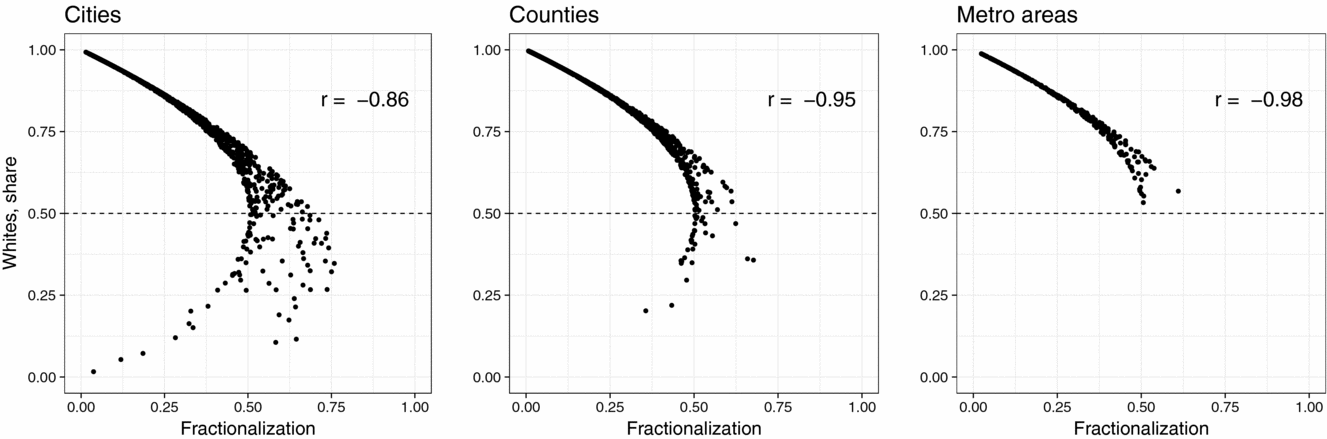
The classic US study by Alesina et al. (Reference Alesina, Baqir and Easterly1999) acknowledges the theoretically-relevant distinction between racial fractionalization and group shares. However, the US has only a small number of white-minority localities and, among them, few are racially homogeneous (i.e., exhibit low fractionalization levels, see Figure 1). As a result, it may be empirically difficult, or even unfeasible, to distinguish between the effects of these two variables in this or similar contexts. Similarly, Schaeffer (Reference Schaeffer2013) shows that, in Europe, most competing indices of ethnic diversity are indistinguishable from the mere percentage of immigrant shares. In fact, disadvantaged ethnic groups rarely constitute local demographic majorities in most democratic, developed countries. Since diversity and group share measures move together, in such contexts, their effects can be confounded.
The Distribution of Racial Demography across US Localities.

EMPIRICAL STRATEGY
Brazil is known for being one of the most racially diverse and economically unequal democracies in the world. Despite this fact, the influence of ethnic demography on public goods provision has not yet been investigated within the country’s territory.Footnote 4 We contend that the study of Brazilian municipalities can greatly contribute to our understanding of the link between ethnoracial demography and social outcomes for several reasons.
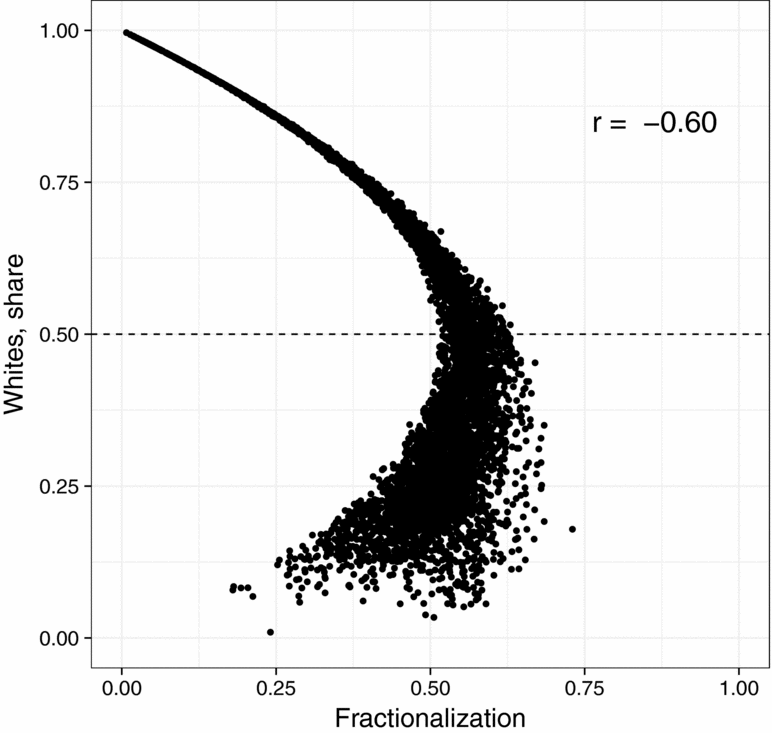
First, municipalities in Brazil provide a large number of comparable cases that reflect consistent political jurisdictions, share the same electoral rules, and exhibit wide variation in the dependent variables of interest. Second, and related, the country’s high level of political decentralization implies that the responsibility for providing public goods is in the hands of municipal governments. This, in turn, guarantees that our outcomes are tightly linked to political decisions at the local level rather than at other levels of government.Footnote 5 Finally, and most important, Brazil offers enough variation in the local predominance of racial groups to allow for a clear empirical differentiation between this variable and diversity. The country has a near equal proportion of African and European descendants (50.74% negros Footnote 6 and 47.73% brancos), and almost as many majority white as majority black municipalities—which may display the same level of diversity despite having a rather different population composition (Figure 2).
The Distribution of Racial Demography across Brazilian Municipalities.

Our model specification builds on the classic US study of Alesina et al. (Reference Alesina, Baqir and Easterly1999) and its subsequent replication and extension by Gisselquist (Reference Gisselquist2014). We regress a set of public outcomes related to local service provision on different racial demographyFootnote 7 measures and control for the most relevant confounders identified in the literature. In particular, our analysis differentiates between the three most relevant “dimensions of disadvantage” recognized in the case of Brazil: race, class, and geographic location. By controlling for the average income, proportion of poor population, regional location, and geographic characteristics of municipalities, we thus distinguish between the effects of these different local features on provision, but also minimize the concern that group shares or diversity may be merely proxying for other types of group disadvantage.
Data
We use a new purpose-built dataset of 5,505 Brazilian municipalities (2010), including a variety of racial demography, public goods, and economic geography variables (for more details, see Appendix). Individual-level census data are used to construct the indices of racial fractionalization and group shares at the smallest politically relevant administrative unit (municipalities).Footnote 8 Additionally, we examine a range of dependent variables to identify the (potentially) diverging effects of racial divisions on different types and aspects of service provision. These variables include the total amount of public resources allocated to social spending, disaggregated spending indicators, and two different measures of public goods quality. Our covariates incorporate a set of other municipal characteristics that influence the capacity of local governments to provide public services, such as size of the locality, age, education, urbanization rate, local GDP, interpersonal inequality (GINI), poverty rate, as well as geography (Naritomi et al. Reference Naritomi, Soares and Assunção2012) (for summary statistics, see Table A1).
ANALYSIS AND RESULTS
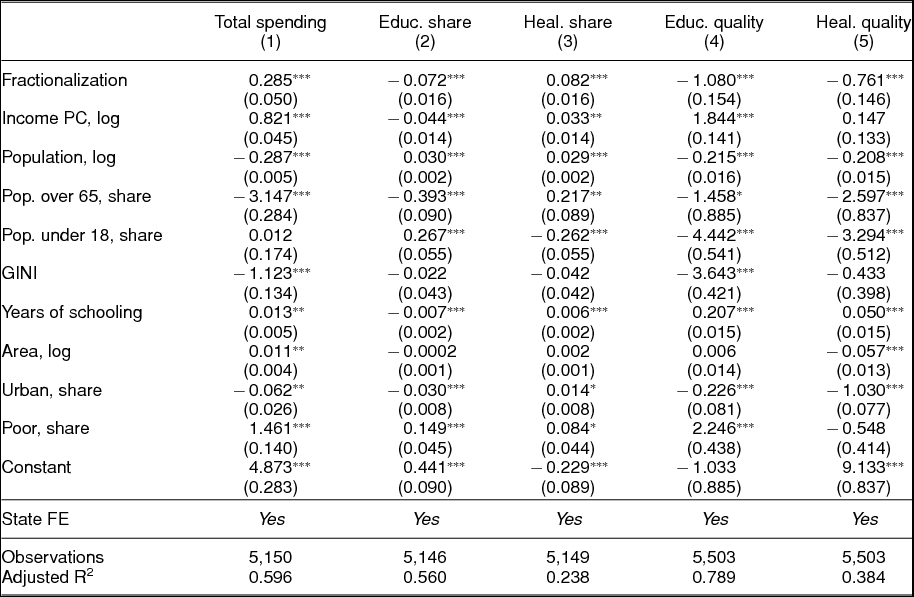
Our analysis is divided into two steps. First, we replicate the model used in the seminal US study of Alesina et al. (Reference Alesina, Baqir and Easterly1999) using municipal-level data from Brazil in 2010. Results from this estimation, shown in Table 1, suggest that the relationship between racial fractionalization and public goods provision in Brazil is very similar to the one observed in the US. More specifically, higher diversity seems to be related to higher overall government expenditure, but lower education spending.Footnote 9 Additionally, we find a strong negative association between fractionalization and the quality of health care and education across Brazilian municipalities. Overall, this is precisely the pattern we would expect to see where diversity is associated with the underprovision of public goods.
Racial Diversity and Public Goods Provision

All specifications include “state fixed effects” based on 26 Brazilian states. For variable descriptions, see Appendix.
The standard errors are given in parentheses, +p < 0.1; *p < 0.05; **p < 0.01; ***p < 0.001.
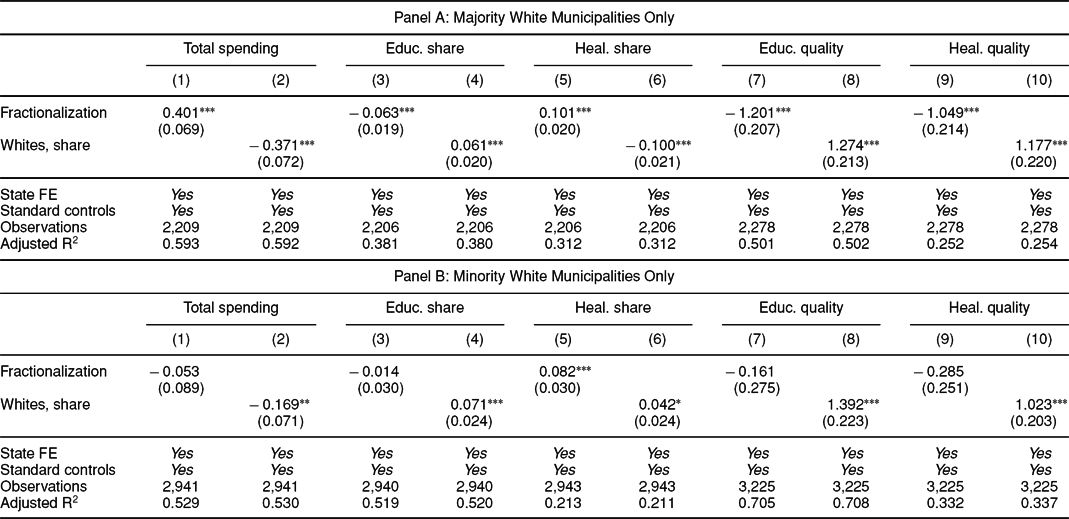
The same (and even stronger) relationship, however, can be observed using the white group share as a measure of ethnic demography (see Table A4). To better understand these findings, in the second portion of the analysis we divide our sample into majority white and minority white municipalities (Table 2) and re-examine the effects of fractionalization and group shares.Footnote 10 Results from these estimations show that the diversity coefficient remains negative only in the models using the first sample of municipalities—that is, those where the majority of the population is classified as white according to the Census. In the sample of minority white localities, however, the diversity variable has no effect. Conversely, the relationship between the “white share”Footnote 11 variable and the various provision measures remains consistent across both samples, and mostly positive and significant with respect to the different dependent variables.Footnote 12
Racial Demography and Public Goods Provision

All specifications include “state fixed effects” based on 26 Brazilian states. For variable descriptions, see Appendix.
The standard errors are given in parentheses, +p < 0.1; *p < 0.05; **p < 0.01; ***p < 0.001.
Finally, explaining public outcomes may require taking into account the uneven distribution of groups across the country’s territory (Naritomi et al. Reference Naritomi, Soares and Assunção2012). Some groups may be overrepresented in areas with unfavorable geographic characteristics, which may in turn hinder service provision. As a result, the relationship between racial demography and public goods provision may itself be confounded by economic geography. As Table A5 indicates, however, the significant relationship between group shares and public goods provision largely withstands the inclusion of geographic controls.Footnote 13
Together these findings illustrate that our initial results on the negative effects of diversity are misleading. In fact, more diverse communities outperform homogeneous nonwhite localities in terms of service provision–and are thus found to have poorer outcomes only when compared to homogeneous white municipalities. In other words, racial fractionalization is detrimental to the provision of public goods only to the extent that it reflects an increase in the nonwhite population share. That is, when we restrict our analysis to the sample of majority nonwhite localities—where diversity’s increase represents a higher proportion of white population—fractionalization ceases to be associated with worse outcomes.
These findings seem to suggest that diversity may have heterogeneous effects in different contexts. Before we can make this statement, however, we have to consider that the very reason why fractionalization is associated with public goods outcomes in ‘majority white’ but not in ‘minority white’ municipalities may be due to its higher correlation with white group shares in the former subsample (−0.98 versus 0.58). To examine the independent effect of diversity on provision, we thus restrict our analysis to the interval within which the correlation between fractionalization and the group share measure is minimized.Footnote 14 Within this artificially restricted sample, fractionalization does not robustly relate to any provision measure after controlling for group shares. At the same time, as before, municipalities with a greater proportion of white population exhibit consistently better public goods regardless of fractionalization levels.
DISCUSSION
In our analysis of Brazilian municipalities, we find that the prima facie negative relationship between diversity and public goods provision stems from the fact that higher levels of fractionalization reflect a larger proportion of disadvantaged ethnic groups in the local population. Our case and data allow us to measure the effect of diversity in localities where either dominant or disadvantaged groups constitute a demographic majority. Yet, this may not always be feasible in other settings. In fact, in cases where fractionalization is almost indistinguishable from group share measures, diversity’s independent effect may be difficult (or even impossible) to identify.Footnote 15
How common are the patterns described here? We recognize that the problem of confounding the effects of diversity with that of group shares at the subnational level may be more severe in some settings than in others. In particular, two main features set the Brazilian case apart from other scenarios and may limit the generalizability of our findings. First, the Brazilian society is characterized by entrenched racial or color stratification, an empirical reality that contradicts the country’s myth of racial democracy (Bailey et al. Reference Bailey, Loveman and Muniz2013), and has led some scholars to refer to racial groups as castes (Telles Reference Telles1996; Guimarães Reference Guimarães2004). In other words, in Brazil, salient race and class cleavages overlap—a consequential factFootnote 16 that is clearly reflected in the country’s remarkably high between-group inequality level (Baldwin and Huber Reference Baldwin and Huber2010). Second, Brazil is a federal country where regional divisions are significant and deep-seated. As argued by Lieberman (Reference Lieberman2003), this feature of the Brazilian case created the conditions for the institutionalization of uneven state authority across the national territory. To the extent that underprivileged groups concentrate precisely in the geographical areas where the state is scarcely present, the patterns observed here are more likely to emerge. However, these particularities are far from making Brazil a unique case. In fact, a variety of historical legacies incite the emergence of rank-based societies. Aristocratic, colonial, or caste-system pasts often produce hierarchical distinctions among ethnic groups that are multidimensional and highly persistent over time (Tilly Reference Tilly1999). Similarly, cases of salient regionalism are not uncommon (Singh Reference Singh2015; Soifer Reference Soifer2016).
This paper’s findings thus draw attention to the fact that alternative theories are necessary to explain why more homogeneous Afro-descendant communities experience worse public outcomes than diverse ones, even after we take into account their more severe environmental conditions, disproportionate poverty, and general underdevelopment. In fact, our results point to the limited applicability of some of the micro-level mechanisms previously proposed in the literature. Hypotheses based on “unfavorable intergroup dynamics” do not elucidate how ethnic homogeneity, rather than diversity, is related to worse public outcomes.
Although it is beyond the scope of this paper to build a novel theoretical framework that fully elucidates the association of racial demography and public outcomes, we highlight two potential explanations for the patterns we observe. First, our results indicate that suboptimal outcomes are less a product of adverse intergroup relations than of path-dependent processes of state development. Insofar as the distribution of ethnic groups across the national territory overlaps with areas of historically low state presence, some groups are more likely to be systematically tied to worse provision (Soifer Reference Soifer2016; Wimmer Reference Wimmer2016; Singh and vom Hau Reference Singh and Hau2016).Footnote 17 A second possibility is that part of the observed effect of racial demography stems from the compositional characteristics of local populations—such as those related to wealth or the level of interpersonal trust (Abascal and Baldassarri Reference Abascal and Baldassarri2015; Bertocchi Reference Bertocchi2016)—which might themselves lead to suboptimal public outcomes.
In all, while our study does not rule out that ethnic heterogeneity may be consequential in certain contexts, it challenges the empirical findings of a vast body of work on the effects of diversity at the local level. Specifically, previous results show an association that may simply be an artifact of a close correlation between diversity and the share of disadvantaged groups across localities. Taking these findings into account can thus aid researchers in elaborating a novel theoretical framework that delineates the scope conditions of previous theories and identifies the specific mechanisms that might operate in different demographic contexts.
SUPPLEMENTARY MATERIAL
To view supplementary material for this article, please visit https://doi.org/10.1017/S0003055418000308.
Replication materials can be found on Dataverse at: https://doi.org/10.7910/DVN/AY32JZ.




Comments
No Comments have been published for this article.