Introduction
Sharps injuries or percutaneous injuries are defined as an incident that causes a needle, blade (such as a scalpel) or other medical instrument to penetrate the skin. 1 It has been noted as the second commonest occupational injury within the National Health Service (NHS).Reference Adams, Stojkovic and Levenson 2 Surgeons have been shown to be particularly at risk,Reference Vijendren, Yung and Sanchez 3 with the operating theatre environment being a common setting for such injuries to occur.Reference Thomas and Murray 4
The main risk from sharps injuries is potential exposure to blood-borne infections. 1 In 2006, two cases of hepatitis C virus (HCV) seroconversion were reported, with one of the cases occurring in an operating theatre.Reference Thomas and Murray 4 In addition, the 2012 ‘Eye of the Needle’ report, published by the Health Protection Agency, noted five HCV transmissions from patients to healthcare workers between 2008 and 2011 following percutaneous exposure injuries. 5 The risk of transmission through such injuries has been estimated at 1 in 3 for the hepatitis B virus, 1 in 30 for HCV and 1 in 300 for human immunodeficiency virus (HIV), whilst risk of transmission via mucocutaneous injuries is significantly lower. 5 Other concerns include the psychological effects of sharps injuries, particularly the risk of developing post-traumatic stress disorder.Reference Naghavi, Shabestari and Alcolado 6
The Health and Safety (Sharps Instruments in Healthcare) Regulations were enacted in 2013 to address such hazards. 7 Based on the European Council Directive on the prevention of sharps injuries, these regulations outline the responsibilities and training needs of both employers and employees within healthcare institutions dealing with sharp instruments. The information sheet also describes a standardised action plan for healthcare workers afflicted with sharps injuries, including out-of-hours occurrences. 7
Worryingly, the incidence of sharps injuries amongst surgeons is noted to be on the rise, whilst reporting rates are dwindling. 5 , Reference Au, Gossage and Bailey 8 Coupled with an increasing prevalence of blood-borne viruses in the general community,Reference Thomas and Murray 4 surgeons may be placing themselves at great risk on a daily basis. Limited work has been conducted on this common occupational hazard within the ENT community. Hence, we aimed to investigate how commonly sharps injuries are reported by ENT surgeons. In addition, we conducted a national survey to identify the incidence, reporting rates and effects of sharps injuries on UK otolaryngologists.
Materials and methods
A literature search was conducted of peer-reviewed articles published in the English language between 1990 and 2014. PubMed, Embase, Google Scholar, Medline and PsycInfo databases were searched using the following keywords in varying combinations: ‘ENT’, ‘ear, nose and throat’, ‘otorhinolaryngologist’, ‘otorhinolaryngology’, ‘otolaryngologist’, ‘occupational health’, ‘occupational disease’, ‘occupational illness', ‘work-related illness', ‘work-related disease’, ‘needle stick’, ‘sharps injuries', ‘percutaneous injuries' and ‘otorhinolaryngologic surgical procedures'.
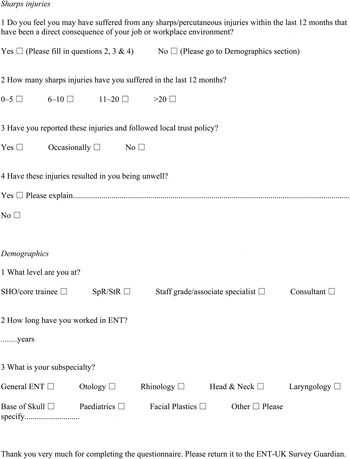
A survey containing questions on sharps injuries was distributed electronically to the entire membership of ENT-UK (the official society of otolaryngologists within the UK). A literature search did not reveal any existing validated questionnaires on this topic; hence, the authors designed the survey with guidance from the ENT-UK Survey Guardian. The survey incorporated questions on: the occurrence of sharps injuries within the last 12 months, the number of injuries (tick box options of 0–5, 6–10, 11–20 and more than 20 incidences), the frequency of reporting and adherence to trust policy, and any resultant illness from the sharps injuries (Figure 1). Demographic data on grade of respondent, subspecialty interest and years spent in ENT were also collected.
Questionnaire on sharps injuries distributed to ENT-UK members. SHO = senior house officer; SpR = specialist surgical registrar; StR = specialty surgical registrar

The questionnaire was distributed to 1344 ENT-UK members. This included: 796 consultants, 253 specialist trainees or specialist registrars, 105 junior doctors or senior house officers, 35 fellows and staff grade doctors, 70 associate specialists, 20 affiliated members (general practitioners, speech therapists, audio vestibular physician and so on) and 61 retirees.
All results were recorded on a Microsoft Excel™ spreadsheet and tabulated. A combination of chi-square and Fisher's exact tests were employed for all categorical data analyses. Ethical approval was not required as members of the aforementioned charitable organisation completed the survey on a voluntary basis.
Results
Literature search
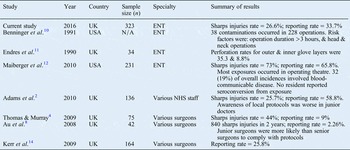
Our literature search identified four studies. One of these was excluded as it pertained to mucocutaneous transmission rather than sharps injuries.Reference Lakhani, Loh, Zhang and Kothari 9 Two studies were carried out in the early 1990s. A study by Benninger et al., conducted in Detroit, USA, found that exposure to blood-borne infections was likelier in operations lasting longer than 3 hours, in head and neck operations, and during emergency surgery.Reference Benninger, Gupta and Gilmore 10 A UK study by Endres et al. found that double gloving (wearing two sets of gloves) helped maintain an intact barrier between medical staff and patients: sharps injury perforation rates for the outer and inner layers were 35.3 per cent and 8.8 per cent respectively.Reference Endres, Alun-Jones and Morrissey 11 More recently, a poster presented at a 2010 Triological Society meeting showed that 72 per cent of 231 US otolaryngology residents experienced at least 1 sharps injury during their post-graduate training, with most injuries occurring in the operating theatre and during head and neck operations. Fortunately, no seroconversions were noted, although 75 of the residents did not report their injuries appropriately.Reference Maiberger, Peng and Reiter 12 Table I shows a summary of the papers reviewed.
Summary of studies on sharps injuries

N/A = not available; NHS = National Health Service
National survey
We received a total of 323 completed questionnaires (24 per cent response rate); 224 responses were from consultants (28.1 per cent out of a total of 796 consultants). Eighty-six respondents reported having experienced sharps injuries within the last year, giving an incidence rate for respondents of 26.6 per cent.
Demographics
Grade of respondents
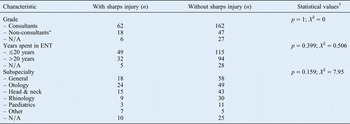
Sixty-two of the affected ENT surgeons were consultants, 10 were specialist registrars or specialty trainees, and 8 were a combination of associate specialists and staff grades. There were no details from six respondents. No statistical differences were seen in terms of the occurrence of sharps injuries between consultants and non-consultants (p = 1; Table II).
Characteristics of respondents with and without sharps injury experience

* Non-consultants include specialist trainees, specialist registrars, associate specialists and staff grade doctors. †Analyses performed with chi-square (X 2) tests. N/A = not available
Years in ENT
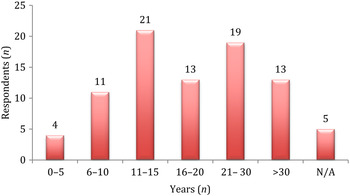
Most ENT surgeons with sharps injuries had spent between 11 and 15 years in the specialty (Figure 2). The afflicted cohort had spent a mean time of 18.73 years and a median of 19 years working in ENT. No statistical differences were seen in the occurrence of sharps injuries between respondents who had spent 20 or fewer years in ENT and those with more than 20 years of experience (p = 0.399; Table II).
Number of years that respondents with sharps injuries had spent in ENT. N/A = not available

Subspecialties
Of those respondents with sharps injuries, 24 specialised in otology, whilst 18 were general ENT surgeons, 15 were head and neck surgeons, 9 were rhinologists, and 3 were paediatric ENT surgeons. Seven respondents with sharps injuries had varying subspecialist interests (dual specialties, sleep medicine, community ENT, and working in general practice with a special interest in ENT). There were no details from 10 respondents. No statistical differences were seen between the individual subspecialties (p = 0.159; Table II).
Number of injuries
Sixty respondents with sharps injuries (69.7 per cent) had experienced between zero and five injuries in the last year. There were no responses from 26 clinicians.
Reporting of injuries
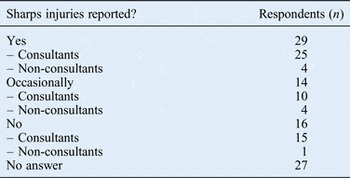
Twenty-nine respondents (33.7 per cent) reported their sharps injury as per local policy at every single occurrence, 14 (16.3 per cent) reported them on occasion, whilst 16 (19 per cent) never reported their injuries. No details on this matter were available for 27 respondents (31.4 per cent). There were no differences in the reporting of sharps injuries between consultants and non-consultants (p = 0.279; Table III).
Comparison of sharps injury reporting between consultants and non-consultants

Analyses (for respondents who answered question) performed using Fisher's exact test; p = 0.279.
Blood-borne virus transmission
Fortunately, none of the respondents suffered any blood-borne virus transmissions that seroconverted. One respondent felt unwell from taking HIV prophylaxis.
Discussion
In the first ever UK study investigating sharps injuries within ENT surgeons nationally, we found an incidence rate of 26.6 per cent amongst 323 respondents. The vast majority of respondents (69.7 per cent) had experienced between zero and five incidences over the last year. Although no seroconversions were reported, worryingly only 33.7 per cent of afflicted clinicians had reported all their injuries and followed their local institution policies. We were also surprised to find a severe lack of publications on this topic worldwide, with most of the studies conducted more than 20 years ago.
The incidence of sharps injuries amongst our cohort appeared to be lower when compared to other studies conducted in the UK. A survey by Thomas and Murray on 75 surgeons in varying specialties, working within a 687-bedded large district general hospital, found that 44 per cent of respondents had suffered from sharps injuries within a 6-month period.Reference Thomas and Murray 4 Similarly, a paper by Au et al., published in 2008, revealed 840 sharps injuries amongst 42 surgeons in Kent, with general surgeons experiencing 60 per cent of the injuries (Table I).Reference Au, Gossage and Bailey 8
There are several possible reasons for the differences in incidence between our study and the aforementioned previous studies. Being a predominantly out-patient based specialty, ENT surgeons may be less likely to encounter sharp instruments as frequently as some of the other surgical specialties. Most of our clinic-based procedures involve the use of a microscope and suction device, flexible nasoendoscope, and silver nitrate cautery sticks, which are unlikely to cause sharps injuries. In addition, many of our surgical procedures are conducted inside narrow orifices where blunt dissection is commonly preferred (e.g. cold steel dissection during tonsillectomy, elevation of tympanomeatal flap during middle-ear surgery and removal of inflammatory tissue in sinus surgery). Furthermore, we cannot discount the fact that the injuries may have been underreported, influencing our incidence rates.
A lack of reporting and poor adherence to local policy seems to be a recurrent finding in most studies conducted on this topic, and actual numbers may be up to 10 times higher.Reference Elder and Paterson 13 Four UK studies on sharps injuries amongst surgeons found that documented reported rates were less than 60 per cent, with one study quoting figures as low as 2.26 per cent (Table I).Reference Adams, Stojkovic and Levenson 2 , Reference Thomas and Murray 4 , Reference Au, Gossage and Bailey 8 , Reference Kerr, Stewart, Pace and Elsayed 14 Commonly cited reasons for this include a cumbersome reporting process, a lack of user-friendly instructions, inadequate time and out-of-hours access, and the perceived low risk of blood-borne virus transmission.Reference Thomas and Murray 4 , Reference Au, Gossage and Bailey 8 , Reference Maiberger, Peng and Reiter 12 Although not directly assessed, it is possible that the low percentage seen within our cohort may be based on similar grounds.
Whilst we found no differences in terms of reporting rates between varying grades of ENT surgeons (Table III), Au et al.Reference Au, Gossage and Bailey 8 and Adams et al.Reference Adams, Stojkovic and Levenson 2 noted that junior doctors were more likely to follow local policies and advice in comparison to senior surgeons. A similar finding was observed in a survey by Maiberger et al. of US ENT residents, where the reporting rate was 65.8 per cent.Reference Maiberger, Peng and Reiter 12 This is somewhat encouraging as it may signify a more occupational health conscious and adherent future workforce, which can only bring positive effects to themselves and the healthcare sector.
Within the NHS, awareness and training on sharps injuries has been made a mandatory aspect of staff continual professional development, in line with the Health and Safety (Sharps Instruments in Healthcare) Regulations. 7 In addition, clinicians who are new to a trust are required to undergo various induction programmes to ensure they are familiarised with the local sharps safety policy and reporting process. 15 However, with each healthcare organisation having variations in their policy, trainees who rotate frequently can find this confusing and may be deterred from complying with local regulations.Reference Adams, Stojkovic and Levenson 2 One possible way forward is to streamline the reporting process across the NHS, making it effortless for both senior and junior clinicians. Such a system could be made available online, with the involvement of the various royal colleges and linked to local occupational health departments. Aside from addressing low reporting rates, this would help to create an efficient audit trail, which may serve the Health Protection Agency well.
Efforts to reduce the incidence of sharps injuries are ongoing. Since the 1980s, the concept of ‘workplace safety climate’ has been one focus of intervention.Reference Smith, Zhao, Wang and Ho 16 This involves addressing the perceptions that employees share about the safety of their working environment, which is critical to help elucidate the underlying safety culture of a work unit.Reference Smith, Zhao, Wang and Ho 16 In 2000, Gershon et al. developed a validated set of questions to investigate the association between hospital safety climate and exposure to blood-borne pathogens.Reference Gershon, Karkashian, Grosch, Murphy, Escamilla-Cejudo and Flanagan 17 The questionnaire, the Hospital Safety Climate Scale, comprises six dimensions: (1) senior management support for safety programmes, (2) absence of workplace barriers to safe work practices, (3) cleanliness and orderliness of the work site, (4) minimal conflict and good communication amongst staff members, (5) frequent safety-related feedback and training by supervisors, and (6) availability of personal protective equipment and engineering controls.Reference Gershon, Karkashian, Grosch, Murphy, Escamilla-Cejudo and Flanagan 17 Further studies conducted by Smith et al. using the Hospital Safety Climate Scale found strong associations between hospital safety climate and sharps injuries amongst healthcare professionals in China and Japan. The authors concluded that attention to the aforementioned dimensions is critical in reducing sharps injuries in a hospital environment.Reference Smith, Zhao, Wang and Ho 16 , Reference Smith, Muto, Sairenchi, Ishikawa, Sayama and Yoshida 18
More specifically, there is good evidence to show that the introduction of blunt suture needles and safety cannulas has had great impact in advancing sharps safety. 7 , Reference Elder and Paterson 13 Additionally, the provision of sharps containers, regulations to avoid the recapping of needles and the use of personal protective equipment are equally vital feats. 7 Although double gloving is recommended, we found insufficient and conflicting evidence on its role in reducing instrument penetration of skin during surgical procedures.Reference Adams, Stojkovic and Levenson 2 , Reference Endres, Alun-Jones and Morrissey 11 Other common culprits of sharps injuries include butterfly needles, glass ampoules, hollow-bore needles and insulin needles.Reference Smith, Muto, Sairenchi, Ishikawa, Sayama and Yoshida 18
-
• The incidence rate of sharps injuries amongst 323 UK ENT surgeons was 26.6 per cent
-
• The reporting rate of such injuries is poor, as noted in other surgical specialties, and measures to improve this are needed
-
• Limited studies have been conducted on this topic worldwide
-
• Our findings serve as a stepping stone for future work, and increase awareness on the importance of appropriate sharps handling and reporting within ENT
We acknowledge that the robustness of our questionnaire could have been improved to gather more focused information. Specifically, questions on the individual number of sharps injuries amongst respondents, and the resultant consequences on both staff (physical and psychological) and healthcare institutions may shed further light on the effects on ENT as a specialty. As our questionnaire was part of a wider survey, we were keen to keep it as short and simple as possible to encourage a better response rate. We were, however, pleased that we successfully acquired most of the vital information comparative to other UK studies on sharps injuries. In addition, we were fortunate to gather a much larger number of respondents in contrast to these studies.
Acknowledgements
We are very grateful to Mr David Lowe and the ENT-UK Survey Guardian team for their assistance in designing and distributing this survey, and to the librarians of Colchester University Hospital Trust for their help conducting the literature search.