




The participation of twins in social and biomedical research has improved our understanding of the causes and consequences of many health and social issues of interest to researchers. This includes health, illness, wealth, education, and personality (Hagenbeek et al., Reference Hagenbeek, Hirzinger, Breunig, Bruins, Kuznetsov, Schut, Odintsova and Boomsma2023).
Twin research has predominantly relied on participants voluntarily opting into a study or registry, with longitudinal research requiring repeated participation in subsequent waves of data collection (Hur et al., Reference Hur, Bogl, Ordonana, Taylor, Hart, Tuvblad, Ystrom, Dalgard, Skytthe and Willemsen2019). While opt-in studies generate high quality and granular data, they are time consuming and expensive (Chulada et al., Reference Chulada, Corey, Vannappagari, Whitehead and Blackshear2012). They can also be burdensome on participants, and the sample size, frequency of data collection, and length of the study are limited by practical or financial constraints. Opt-in twin studies have also historically had limited representation from sociocultural groups that researchers are less able to recruit and retain. This has led to under-representation of non-Europeans, older age groups, and people from lower socioeconomic strata in twin research (Hagenbeek et al., Reference Hagenbeek, Hirzinger, Breunig, Bruins, Kuznetsov, Schut, Odintsova and Boomsma2023).
To address these issues, twin research is increasingly using administrative data linkage (Baird & Hysi, Reference Baird and Hysi2019). Administrative data is information that is routinely collected by organizations for nonresearch purposes. The data collected in administrative datasets includes demographic information, like age, sex, area of residence, and level of education, as well as more specific information such as disease diagnoses, socio-economic status, education, and exposome (Harron, Reference Harron2022). Administrative data linkage involves linking observations from the same individual across or within datasets (Bohensky et al., Reference Bohensky, Jolley, Sundararajan, Evans, Pilcher, Scott and Brand2010). The process of linking these observations can be performed deterministically or probabilistically. Deterministic linkage uses a unique identifier for each person (such as the Swedish Personal Identity Number) to identify different observations for the same person (Bohensky et al., Reference Bohensky, Jolley, Sundararajan, Evans, Pilcher, Scott and Brand2010). Probabilistic linkage is used when there is no unique identifier, so a pseudo-unique identifier (e.g., a combination of name, address, and date of birth) is used to probabilistically identify observations belonging to the same person. Data linkage errors can occur in deterministic and probabilistic linkage through system errors (e.g., twins erroneously given same Unit Record Number in a hospital) or if pseudo-unique identifiers are not specific enough (e.g., using surname, date of birth, and address to try to distinguish twins; Eisinger-Mathason et al., Reference Eisinger-Mathason, Leshin, Lahoti, Fridsma, Mucaj and Kho2025).
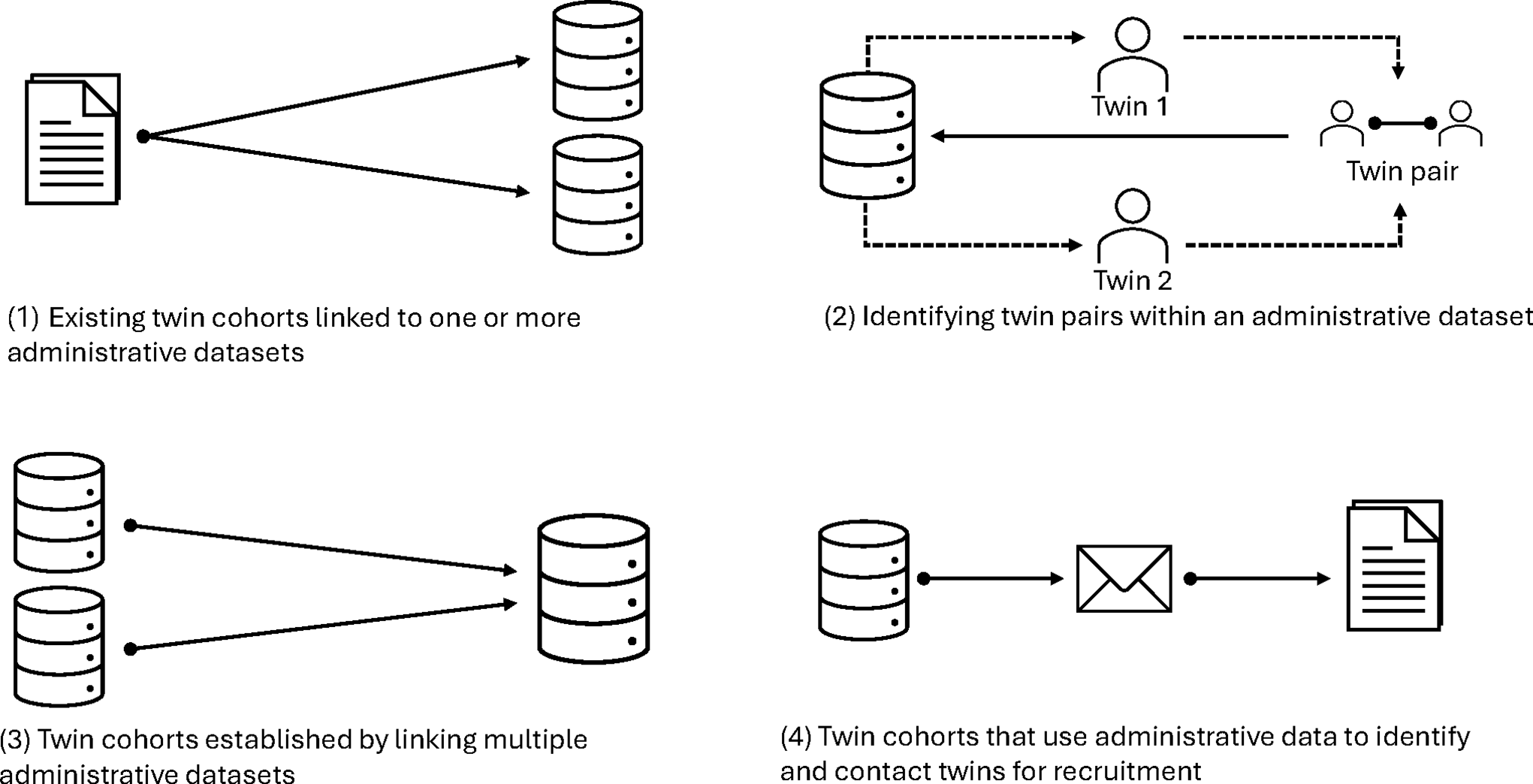
There are at least four ways in which administrative data are commonly collected in twin research (Figure 1). These are: (1) linking administrative data to pre-existing twin studies to augment available information; (2) identifying twin pairs within administrative datasets by linking records; (3) establishing twin cohorts composed entirely of linked administrative datasets; and (4) using administrative data solely to identify potential twins for recruitment, without linking those data into the research dataset. This fourth approach does not constitute data linkage because the administrative data used to identify twins typically are not linked into the study datasets for use in research.
Approaches to linking and using administrative data in twin research.

Data linkage is more challenging for data from twins compared to individuals (Tromp et al., Reference Tromp, Ravelli, Meray, Reitsma and Bonsel2008). Administrative datasets typically lack identifiers of family relationships that are found in research cohorts. Data linkage is also more susceptible to failing to accurately identify a twin relationship or erroneously attributing records for both twins to one identity or to the wrong twin, than cohort studies (Bohensky et al., Reference Bohensky, Jolley, Sundararajan, Evans, Pilcher, Scott and Brand2010). This means data linkage must both identify twin pairs and avoid identifying duplicate entries for a single person as a twin pair (Vinberg et al., Reference Vinberg, Bech, Kyvik and Kessing2007). Other challenges of data linkage with twins include ‘cross-over’, where data are misattributed to the wrong twin in a twin pair (Johansson-Kark et al., Reference Johansson-Kark, Rasmussen, De Stavola and Leon2002). These linkage errors can bias analyses if exposed twins are misclassified as unexposed or if the reasons twin pairs are not identified are associated with the exposure and outcome. Despite these difficulties, administrative data linkage provides the opportunity to identify large samples that include participants researchers might be unable to recruit into opt-in twin studies, retain those who would be lost to follow-up from survey studies, and to gather detailed data on participants through their lifecourse (Green et al., Reference Green, Ritchie, Mytton, Webber, Deave, Montgomery, Woolfrey and Chowdhury2015).
We conducted a rapid review to provide an overview of twin studies using linked administrative data. Rapid reviews are similar to systematic reviews, but streamline or omit parts of the systematic review methodology to synthesise evidence more efficiently (Hamel et al., Reference Hamel, Michaud, Thuku, Skidmore, Stevens, Nussbaumer-Streit and Garritty2021). Therefore, our review is neither an exhaustive nor a comprehensive catalogue of twin cohorts and registries augmented with linked administrative data. Instead, this review provides a focused sample of twin studies using linked administrative data. We use data from the review as a starting point to demonstrate the ways in which linked data have been used to generate and extend twin cohorts. We have included an expansive discussion section where we draw on data from the review and our own experiences as twin researchers using linked administrative data to discuss opportunities, scientific problems, and ethical considerations that will be important as more twin researchers use linked administrative data.
Methods
We conducted a rapid review to identify twin cohorts that either (1) linked administrative data to cohort data or (2) by linking two or more administrative datasets, or (3) generated a twin cohort by identifying twin pairs in a single administrative dataset. We included cohorts described in original research studies or in cohort profiles published in peer-reviewed journals.
We used two methods to identify relevant cohorts: (1) a targeted search of the Medline (Ovid) database and (2) a search of the Atlas of Longitudinal Cohort Studies (2024).
Database Searches
Medline
We searched the Medline (Ovid) database for papers that featured the terms ‘twin’ and any of ‘linked data’, ‘data linkage’, ‘administrative’, ‘health’, ‘record linkage’ or ‘medical’ in the title, abstract, or subject heading fields. We used a limited number of search terms to maximise specificity, thereby reducing sensitivity. The final search was performed on February 13, 2026.
Atlas of Longitudinal Cohort Studies
To supplement our Medline search, we searched the Atlas of Longitudinal Cohort Studies. The Atlas is a curated database of global cohort studies (Atlas of Longitudinal Cohort Studies, 2024). We searched for the term ‘Twin’ and then applied the platform’s internal filtering tool to identify cohorts tagged with ‘Linkage data’ in the ‘Data type’ category. We downloaded the peer-reviewed cohort profile listed on the Atlas for each relevant cohort on February 13, 2026.
Eligibility Criteria
We included cohort profiles or original research describing a twin cohort that analyzed linked administrative data. We included studies that featured samples that consisted only of twins or included subsamples of twins. We focused our search and screening criteria on twins and not on higher order multiples (e.g., triplets).
For the purposes of this review, data linkage was combining at least one administrative data source with at least one other administrative data source or research study data. Studies that linked participant data from two research studies (e.g., survey data and biobank data) were not included. We also did not include studies that used administrative data to identify participants to contact for recruitment, but did not include the administrative data in their research datasets. We included studies that combined data from research studies with administrative data (e.g., survey data and hospital records), generated cohorts by identifying twin pairs within a dataset, and studies that used multiple administrative sources (e.g., births and deaths). We excluded studies where administrative data were acquired only through retrieving a participant’s file (e.g., from a hospital archive). We also excluded studies in which participants provided administrative data directly (e.g., providing pictures of their birth records) or where researchers received participant data after directly requesting it from an administrative source (e.g., mailing a hospital to ask for a participant’s medical records). Finally, to be included, studies needed to identify samples of twin pairs, not samples with individuals who are twins. This last point was to exclude studies where there may be a marker of twin status in an administrative dataset, but no information that matches twins in pairs.
Screening and Data Extraction
We uploaded articles identified in the Medline search and cohort profiles identified on the Atlas of Longitudinal Cohort Studies to the review platform Covidence (Covidence, 2026). One reviewer (A.C.C) screened titles and abstracts for the Medline papers based on the eligibility criteria above. We then undertook full-text screening using the same criteria. We then extracted data from the screened-in texts from Medline and the Atlas of Longitudinal Cohort Studies on the characteristics of the linked twin cohorts.
As we were interested in identifying distinct twin cohorts, if multiple included texts described the same cohort, we preferentially extracted data from (1) cohort profiles (the most recent if there were multiple cohort profiles), (2) the article reporting characteristics on the greatest number of twins from the sample, (3) the most recent article.
Data extracted were cohort name, country where the cohort was based, year of first data collection, age at baseline, whether they collected survey data, and types of linked data used, and the number of twins in complete twin pairs (i.e., both twins in the sample). If a study did not report the number of complete pairs, we extracted the number of individual twins.
We generated summary tables in Stata version 19.0 (StataCorp LLC, 2025) and figures using Microsoft PowerPoint.
Results
We received 269 hits through our dual-search strategy, including 188 publications from Medline and 81 different studies from the Atlas of Longitudinal Cohort Studies. We removed 7 duplicates and excluded 76 studies in title and abstract screening. We excluded a further 69 papers in full-text screening, giving us a total of 117 different cohort profiles or original research papers that used twin cohorts and linked administrative data. These articles presented data from 48 distinct cohorts, including 14 subcohorts (i.e., studies within the 48 cohorts), and two multicohort consortia that combined some of the 48 cohorts (Figure 2).
Flow chart of how cohorts were identified, evaluated for relevance, and included or excluded from the review.

Among the 34 papers we excluded in the full-text screening of papers identified in the Medline search, the most common reasons for exclusion were because a paper did not identify twin-pairs (n = 9, 26.5%), were single centre/health network medical reviews (n = 9, 26.5%), or did not use administrative data (n = 8, 23.5%) (Figure 2). Cohorts from the Atlas were primarily excluded because they did not use linked administrative data (n = 22, 64.7%) or only used administrative data to identify participants for recruitment (n = 5, 14.7%) (Figure 2). Two US studies undertook data linkage of births to deaths to identify twins to approach for recruitment (Krueger & Johnson, Reference Krueger and Johnson2012; Whitfield, Reference Whitfield2013). These data were not used in the subsequent survey studies, but we did include them in this review. This is because the authors had undertaken a data linkage study that could be used in research.
All of the cohorts we identified were observational, except for one randomized control trial. The randomized control trial used death and hospital records to ascertain secondary outcomes on child mortality and developmental outcomes in a trial of progesterone to prevent preterm birth in twin pregnancies (McNamara et al., Reference McNamara, Wood, Chalmers, Marlow, Norrie, MacLennan, McPherson, Boachie and Norman2015).
The 48 independent cohorts were from 19 different countries, most were from the United States (n = 12, 25.0%), United Kingdom (n = 9, 18.8%), and Australia (n = 8, 16.7%), with two each from China, Denmark, Finland, and Norway, and one from all other countries.
Thirty-two cohorts (66.7%) specifically recruited twins, whereas 16 (33.3%) recruited general samples with twin subsamples. The number of twins in included studies ranged from 314 to 260,748 twins (median 7,498). The year of first data collection ranged from 1870 to 2017. The data included in these studies often predated their establishment, for example the Danish Twin Registry includes births from 1870 but was established in 1954 (Skytthe et al., Reference Skytthe, Christiansen, Kyvik, Bodker, Hvidberg, Petersen, Nielsen, Bingley, Hjelmborg, Tan, Holm, Vaupel, McGue and Christensen2013).
In terms of the types of data used among included cohorts, 31 (64.6%) linked administrative data to survey data, 16 (33.3%) cohorts used only linked administrative data (two of which used linkage of adminisrative data only as a precursor to nonlinked surveys), and one cohort identified twin pairs within a single linked dataset. Among studies that included only administrative data, the number of twins ranged from 706 to 208,044 (median 10,365) and among studies that linked administrative data to surveys the number of twins ranged from 314 to 216,258 (median 5,973). None of the 16 studies that had only linked administrative data had information on zygosity, whereas 24 of the 31 studies that had survey and linked administrative data had information on zygosity.
The types of linked administrative data used included birth or perinatal (n = 29, 60.4%), death (n = 21, 43.8%), hospital or medical (n = 32, 66.7%), education (n = 10, 20.8%), military service or conscriptions (n = 4, 8.3%), or other administrative data sources (n = 7, 14.6%).
Discussion
Our rapid review of twin studies that used linked administrative data identified 64 cohorts, including 47 distinct cohorts, two multicohort consortia, and 14 subcohorts of the distinct cohorts. We found that there were large and small cohorts from all regions of the world, yet Europe, North America, and Oceania had the greatest number of cohorts and Africa, the Middle East, and South America had only one each. There was considerable variability across cohorts in terms of size, whether they linked administrative data to survey data or only used administrative data, and the age of their cohorts. However, cohorts that linked survey data to administrative data were the only ones to have information on zygosity.
Below, we draw on data from the review and our own experiences as twin researchers and users of linked administrative data to discuss challenges, opportunities, and potential hazards for twin cohorts using linked administrative data.
Twin-Specific Challenges of Using Linked Administrative Data
As mentioned in our results, the only studies that included data on zygosity were those that linked administrative data to survey data and used surveys or genetic testing to ascertain zygosity. While using cohorts derived solely using administrative data permit greater coverage of populations at lower costs than traditional opt-in studies, identifying zygosity from administrative data alone remains a significant scientific problem. As zygosity is rarely included in medical data, all the studies in our review that measured zygosity had used linked survey or biobank data to acquire this information. But this does not preclude the development of novel methods for identifying zygosity from administrative data. While administrative health data contains information that can help predict zygosity, including whether the twins are the same sex, whether they are conjoined, and the number of amniotic sacs, for many twins, zygosity is difficult to ascertain and it is not routinely recorded in perinatal records.
One approach to address this limitation is to link twins from existing volunteer twin registries to administrative databases to create a reference dataset. Machine learning techniques can then be applied to this reference dataset to develop zygosity prediction algorithms, which can subsequently be used to infer zygosity for twins inferred solely through administrative data.
Opportunities in Twin Data Linkage
There is a large variety of different administrative data that have been collected. Consequently, vigilance and awareness of twin and family methods help to identify opportunities where specific datasets allow novel methods to be deployed. For example, Australia and New Zealand have an assisted reproductive technology administrative database that is currently used for monitoring the long-term safety of assisted reproductive technology (ART). However, high rates of twinning in babies conceived using ART and the use of sperm donation or egg donation means that these data could be used in twin comparison designs where one or both parents are not genetically related to their children (Newman et al., Reference Newman, Paul and Chambers2022). This can facilitate novel causal methodologies and has previously been conducted using actively recruited participants in ART clinics, but the capacity for large-scale data linkage projects has not been realized (Rice et al., Reference Rice, Harold, Boivin, Hay, van den Bree and Thapar2009).
While not specific to twins, many of the twin cohorts that combine survey and administrative data are among the largest, most comprehensive, and most deeply phenotyped studies globally. This permits opportunities to evaluate linkage quality and the accuracy of administrative data, as well as to develop and validate improved methods for data linkage for twins. For example, a study included in our review validated bipolar diagnoses in medical records using survey data from the Finnish Twin Cohort (Kieseppa et al., Reference Kieseppa, Partonen, Kaprio and Lonnqvist2000). Studies using the Swedish and Danish Twin Registers have generated algorithms to identify twins for linkage and identify cases where health outcomes are attributed to the wrong twin in a pair (Johansson-Kark et al., Reference Johansson-Kark, Rasmussen, De Stavola and Leon2002; Webbink et al., Reference Webbink, Roeleveld and Visscher2012).
Linked data also permits observant researchers to take advantage of data stored in new or unutilized data sources that can be used to ask novel research questions. For example, because marriage of cousins required approval from the Catholic church, an Irish study was able to link cousin marriages in Catholic marriage registries to hospitals to identify the risk of mental illness associated with cousin marriages (Maguire et al., Reference Maguire, Tseliou and O’Reilly2018). In an American study, the familial relationships in obituaries were used to generate multi-generation pedigrees in a health system (Mayer et al., Reference Mayer, Delgoffe and Hebbring2025). A US study generated pedigrees by using free-text information on next of kin that was extracted from medical records, and was able to validate their methods using genomic data from a linked biobank (Lakhani et al., Reference Lakhani, Tierney, Manrai, Yang, Visscher and Patel2019). There are many other unique ways in which administrative data from different sources can be integrated into research, but these also require legislative approval and a responsibility to preserve privacy of participants.
Limitations in Linked Administrative Data
Because the administrative data used in data linkage are not collected for research purposes, they have biases that are not present in data that is explicitly collected for research. Identifying these issues often involves collaboration with the organizations that are producing the data to understand biases in how information is collected and coded. For example, Indigenous status is under-identified in Australian linked administrative data (Gibberd et al., Reference Gibberd, Simpson and Eades2017; Lawrence et al., Reference Lawrence, Christensen, Mitrou, Draper, Davis, McKeown, McAullay, Pearson and Zubrick2012). This has been attributed to health workers not asking about Indigenous status, or asking in a way that deters identification in Indigenous Australians. But there have been considerable improvements of ascertainment of Indigenous status when there is wide-scale public and political support for Indigenous Australian health, wellbeing, and self-determination (Thompson et al., Reference Thompson, Woods and Katzenellenbogen2012).
Similar problems can occur when trying to accurately ascertain disease status. For example, increased awareness for specific medical conditions can lead to increases in diagnosis in administrative records despite the prevalence remaining constant. For example, the prevalence of autism spectrum disorders and attention deficit hyperactivity disorder have increased significantly over the past 30 years. There is considerable debate about whether there has been a true increase in prevalence, or whether greater awareness has led to greater case ascertainment or overdiagnosis (Abdelnour et al., Reference Abdelnour, Jansen and Gold2022; Liu et al., Reference Liu, King and Bearman2010). A study using data from the Child and Adolescent Twin Study in Sweden demonstrated that, while symptoms in survey measures had remained relatively constant, there had been an increase in the prevalence of both disorders in linked health records (Arvidsson et al., Reference Arvidsson, Brikell, Larsson, Lichtenstein, Kuja-Halkola, Johnson, Gillberg and Lundstrom2025). While this study was able to compare diagnoses from multiple data sources, studies using only linked administrative data will be less able to validate the accuracy of diagnoses in their records. This reiterates the importance of working with data custodians to understand the social and administrative processes that generate administrative data.
Ethical Issues in Twin Data Linkage
The use of linked administrative data in research raises important ethical questions regarding health equity and the extent to which participants can and do consent to participate in studies using linked data.
While administrative data linkage can increase the representation of ethnic minority groups in research, it can also generate new biases. Because data linkage algorithms have overwhelmingly been developed in European and non-European English-speaking countries, the actual linkage of records tend to have lower accuracy when using non-European naming conventions or non-Latin text (Grath-Lone et al., Reference Grath-Lone, Libuy, Etoori, Blackburn, Gilbert and Harron2021). This means that the under-representation of some ethnic minorities can be perpetuated by data linkage. However, methods have been developed to rectify linkage errors associated with non-European names (Lam et al., Reference Lam, Cortina-Borja, Aldridge, Blackburn and Harron2026) and in countries that do not use Latin script (Ghafour et al., Reference Ghafour, El-Bastawissy and Hegazy2011; Sorsavanh et al., Reference Sorsavanh, Liu, Yamamoto, Mori, Kobayashi and Kuroda2025). These issues are particularly salient for twin cohorts, where mislinkage can affect two individuals simultaneously and may distort inferences about (not) shared environments and heritability.
Public acceptability is another key dimension. Surveys in healthcare settings show that many patients, carers and staff have limited awareness of data opt-out mechanisms, and that trust in anonymization and governance strongly shapes their support for secondary data use (Atkin et al., Reference Atkin, Crosby, Dunn, Price, Marston, Crawford, O’Hara, Morgan, Levermore and Gallier2021). This can be a problem even in health systems where individuals have the option to opt out of studies using linked administrative data, if those options are poorly understood or unevenly communicated.
Scientists also need to be aware of the downstream uses of the data we produce and share from large-scale studies combining genetic, genomic, and linked data. This includes ensuring participants can easily find, or are explicitly provided with, information on the downstream uses of their data. For example, summary statistics generated using genomic data and electronic health records are often shared in line with the principles of open science. But profit-seeking companies using these summary statistics for embryo screening services represents behavior that could be considered ethically and empirically dubious, as well as potentially distressing or objectionable to participants whose data are used by these companies (Furrer et al., Reference Furrer, Barlevy, Pereira, Carmi, Lencz and Lázaro-Muñoz2024; Haining et al., Reference Haining, Savulescu, Keogh and Schaefer2025).
The information in administrative data is often deeply personal and participants do not explicitly consent for their use. Therefore, maintaining the anonymity of participants in administrative datasets is a major concern for ethical research and public trust in scientific institutions. However, the increasing number of researchers using linked administrative data, matched with an increasing number of skilled cyber-security threats and sophisticated methods for reidentifying participants, means there is a significant risk of participants being reidentified or data leaks (Narayan et al., Reference Narayan, Kohli and Martin2025). Privacy engineering approaches, such as differential privacy, secure data enclaves and rigorous access controls are therefore becoming critical components of ethical data linkage infrastructures (Narayan et al., Reference Narayan, Kohli and Martin2025). Future work in twin research using administrative data must balance preservation of privacy with ready access to data and open science frameworks, supported by transparent communication with participants and robust oversight by ethics committees and data governance bodies. In addition, administrative and data linkage systems could implement or improve methods to identify twin pairs, which would enhance possibilities of twin research with data linkage while resolving issues related to misclassification of twins in these datasets.
Strengths and Limitations of the Review
Our rapid review relied on multiple sources to identify relevant cohort studies via linked administrative data, providing a first global overview of twin studies linked to administrative data. Limitations include that only one reviewer conducted the search, screening, and data extraction. We did not assess the reporting quality of included studies, such as their alignment with reporting guidelines (Benchimol et al., Reference Benchimol, Smeeth, Guttmann, Harron, Moher, Petersen, Sorensen, von Elm and Langan2015) and the search strategy prioritized specificity over sensitivity. Therefore, it missed some twin cohorts that the authors are aware of (e.g., FinnTwin16, a subcohort of the Finnish Twin Cohort) and likely may have missed others, including, for example, studies in languages other than English.
However, this rapid review is the first synthesis of twin studies with linked administrative data. Our review aimed to inform a discussion of promise and scientific challenges and opportunities that will become more prominent as more twin researchers turn to linked data in twin studies.
Conclusions
The use of linked administrative data represents a significant opportunity for advancing twin research. It is already being used across regions to augment existing twin cohorts and to generate new ones. Importantly, data from twin studies can also benefit the quality of data linkage. Researchers who are knowledgeable of twin analyses and data linkage will become increasingly important in taking advantage of pre-existing datasets, developing new datasets, and exploring ethical and broader social issues related to twin research and data linkage.
World map of data linkage in twin cohorts and number of twins in each cohort, if cohort was national or regional, and if the cohort used survey and administrative data or only administrative data (key in bottom left). Further detail on all cohorts in this figure is in Table 1. Note that number of twins is on a log scale. the United Kingdom is shown in the magnified box.

Characteristics of twin cohorts and their administrative data

Note: *Other: Two studies undertook data linkage of birth and deaths to identify twins who were alive for recruitment, but did not include these data in future analyses. Because this constituted data linkage that could have been used in research, we included these studies.
Financial support
DIB and VO were supported by Royal Netherlands Academy of Science Professor Award (PAH/6635) to DIB; SL is an NHMRC Emerging Leadership Fellow (GNT2017373), AC was supported by an Australian Government Research Training Program Scholarship https://doi.org/10.82133/C42F-K220.
Competing interests
None.


 Open access

