Introduction
Neuroendocrine tumours of the larynx are rare, accounting for only 0.6 per cent of all laryngeal neoplasms. They consist of two major types, carcinomas of epithelial origin and paragangliomas of neural origin, and include well differentiated typical laryngeal carcinoid, moderately differentiated atypical laryngeal carcinoid and undifferentiated small cell carcinoma.Reference Wenig, Hyams and Heffner1
Of the different neuroendocrine tumours occurring in the larynx, small cell carcinoma has the worst prognosis.Reference Ferlito, Barnes, Rinaldo, Gnepp and Milroy2 This carcinoma can originate on any mural surface of the larynx and, in rare cases, can also develop as a primary tumour in the tracheal wall.Reference Renner3 In the larynx, it tends to develop most often in the supraglottis.Reference Renner3 Small cell carcinoma has a male preponderance, and an association with a history of heavy smoking. Patients' median age is approximately 64 years, and cases arising in patients younger than 40 years are rare.Reference Renner3
Surgery, radiation therapy and chemotherapy appear to be effective therapeutic modalities for small cell carcinoma, depending on the stage and primary site. However, small cell carcinoma of the larynx is usually poorly differentiated with an aggressive course, and the prognosis is therefore often poor.Reference Gnepp4, Reference Baugh, Wolf and McClatchey5
Therefore, new treatments for small cell carcinoma are required, both to improve survival in the long term and to obtain worthwhile, less toxic palliation in the short term. Recent progress in molecular biological techniques has made it possible to develop novel therapeutic strategies, such as molecular targeted therapy, for previously intractable cancers. Molecular targeted therapy has been clearly demonstrated to improve the results of breast, lung, and head and neck squamous cell carcinoma (SCC) treatment.Reference Piccart-Gebhart, Procter, Leyland-Jones, Goldhirsch, Untch and Smith6–Reference Bonner, Harari, Giralt, Azarnia, Shin and Cohen8 However, biomarkers for molecular targeted therapy of small cell carcinoma of the larynx have not yet been investigated.
In this paper, we report two patients with small cell carcinoma of the larynx treated with surgery, post-operative irradiation and chemotherapy; KIT gene expression was found in both cases, and platelet-derived growth factor receptor α gene expression in one case.
Case reports
Case one
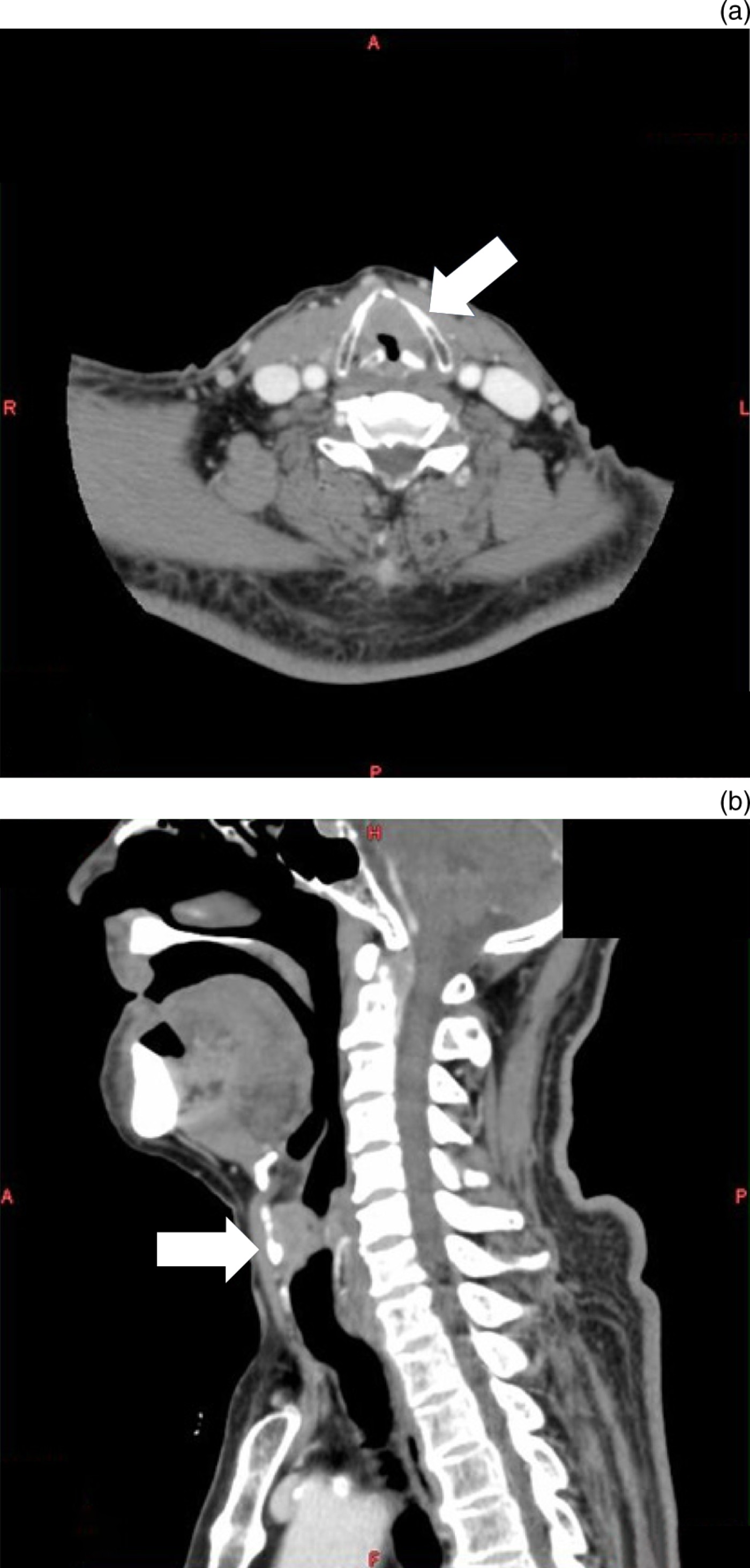
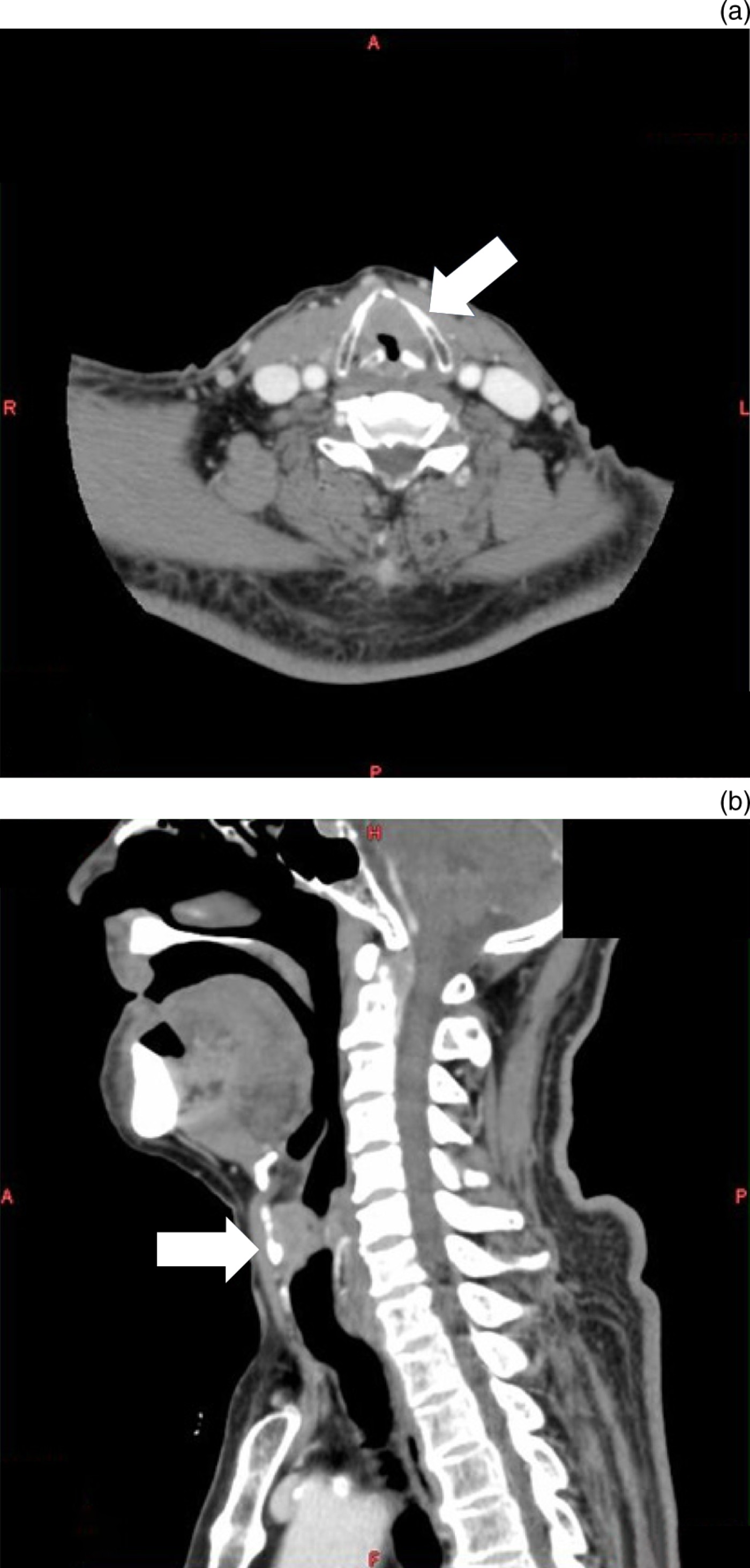
A 70-year-old Japanese man presented complaining of hoarseness. Laryngoscopic examination showed a submucosal mass arising from the left true vocal fold and extending to the right true vocal fold, with additional supraglottic and subglottic lesions. Biopsy under local anaesthesia was performed, and histopathological examination revealed small cell carcinoma. Computed tomography (CT) confirmed that the submucosal mass was derived from the left vocal fold and extended into the submucosal space of almost the entire larynx (Figure 1).
(a) Axial and (b) sagittal computed tomography findings for patient one, confirming the presence of a slightly enhancing, submucosal mass arising from the left vocal fold and extending into the submucosal space of almost the entire larynx (arrows). A = anterior; P = posterior; R = right; L = left; H = head; F = foot
No chemotherapy was administered because of severe renal failure. Thus, total laryngectomy with neck dissection and post-operative radiotherapy were performed.
After one year of follow up, the patient died of pulmonary metastases.
Case two
This patient's clinical history has been described previously.Reference Yamamoto, Hosokawa, Yamatodani, Morita, Okamura and Mineta9 In brief, a 73-year-old Japanese man presented with a rapidly enlarging neck mass. Laryngoscopic examination revealed a submucosal mass with an associated subglottic lesion. Computed tomography indicated massive regional lymph node metastases but no distant metastasis. Histopathological examination of biopsy material revealed small cell carcinoma.
The patient was treated with chemotherapy (a combination of cisplatin and etoposide) and radiotherapy.
After 10 months' follow up, he died of metastasis to the brain.
Materials and methods
Surgical specimens were embedded in a paraffin block. Several 6-μm thick sections were cut, and one stained with haematoxylin and eosin (H&E). In addition, the following biomarkers for molecular targeted therapy were immunohistochemically analysed using specific antibodies for: epidermal growth factor receptor (Dako Denmark A/S, Glostrup, Denmark), human epidermal growth factor receptor related 2 (Dako), vascular endothelial growth factor receptor 2 (Cell Signaling Technology, Beverly, Massachusetts, USA), KIT (Dako), and platelet-derived growth factor α (Santa Cruz Biotechnology, Santa Cruz, California, USA). Molecular genetic analysis of the KIT gene (exons nine, 11, 13 and 17) and the platelet-derived growth factor receptor α gene (exons 12 and 18) was performed using paraffin microdissection and the polymerase chain reaction direct sequencing method, as previously reported.
Results
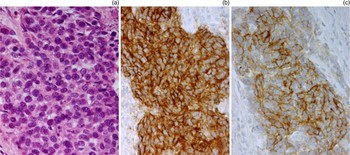
In case one, H&E staining revealed that the tumour comprised a smaller area of SCC together with a larger region of small cell carcinoma; the latter region had small, undifferentiated cells with relatively large, hyperchromatic oval, round or spindle-shaped nuclei and scant cytoplasm (Figure 2a).
Photomicrographs for patient one. The tumour is composed of a small squamous cell carcinoma (SCC) region and a larger small cell carcinoma region (a); the latter has small, undifferentiated cells with relatively large, hyperchromatic oval, round or spindle-shaped nuclei and scant cytoplasm (H&E; ×100). Immunohistochemical analysis shows positivity for KIT (×100) (b) and platelet-derived growth factor receptor α (×100) (c) in the small cell carcinoma region, but not in the SCC region.

In case two, H&E staining revealed aggregates of small carcinoma cells with hyperchromatic nuclei.
Immunohistochemical study revealed positive reactions for cluster of differentiation 56 glycoprotein and cytokeratin 7 in patient one, and for epithelial membrane antigen and neuro-specific enolase in patient two. In both cases, the diagnosis was small cell carcinoma. Further immunohistochemical analysis showed a positive reaction for KIT and platelet-derived growth factor receptor α in the small cell carcinoma region of patient one's tumour (Figures 2b and 2c), and a positive reaction for KIT in patient two. However, there was no immunoreactivity for platelet-derived growth factor receptor α in the SCC region of patient one's tumour, nor in any part of patient two's tumour. Both cases showed negative reactions for epidermal growth factor receptor, human epidermal growth factor receptor related 2 and vascular endothelial growth factor receptor 2.
Molecular genetic analysis using polymerase chain reaction direct sequencing showed no mutations of the KIT or platelet-derived growth factor receptor α genes in either patient.
Discussion
The presented laryngeal tumours were identified histologically as small cell carcinomas. No primary tumour formation was recognised in other locations; therefore, these laryngeal tumours represent extremely rare primary small cell carcinomas of the larynx.
Small cell carcinoma can arise in any organ, although the vast majority occurs in the lung. Primary small cell carcinoma of the head and neck occurs most frequently in the larynx.Reference Ferlito, Barnes, Rinaldo, Gnepp and Milroy2 At present, small cell carcinoma is considered to make up less than 0.5 per cent of all primary laryngeal malignancies.Reference Renner3
In general, small cell carcinoma is a very aggressive tumour with a poor prognosis. Two- and five-year survival rates of only 16 and 5 per cent, respectively, have been reported.Reference Gnepp4
The results of treatment with surgery alone have been poor, with few patients surviving beyond 12 months.Reference Baugh, Wolf and McClatchey5 In one study, radiation therapy was successful in controlling local primary laryngeal small cell carcinoma in 13 of 15 cases when used alone or in combination with systemic chemotherapy.Reference Baugh, Wolf and McClatchey5 Many studies have indicated that treatment with systemic chemotherapy should be considered in all patients with laryngeal small cell carcinoma, unless there are compelling reasons contraindicating its use; however, the effect of such treatment is limited.Reference Baugh, Wolf and McClatchey5, Reference Aguilar, Robbins, Stephens, Dimery and Batsakis10–Reference Galanis, Frytak and Lloyd12 Both our patients died within one year of presentation, despite treatment with systemic chemotherapy and radiotherapy.
New therapeutic approaches are therefore required to improve the survival rate of patients with laryngeal small cell carcinoma.
Recently, molecular targeted therapy has been developed as a new therapeutic strategy for intractable cancers. This treatment blocks the growth of cancer cells by interfering with specific molecules required for carcinogenesis and tumour growth. The use of molecular targeted therapy for laryngeal small cell carcinoma has not been reported; thus, the identification of appropriate biomarkers for such therapy would be beneficial.
In the current report, we studied several biomarkers which may represent potential targets for molecular targeted therapy. We found immunoreactivity for KIT gene expression in both our patients, and immunoreactivity for platelet-derived growth factor receptor α gene expression in patient one. The expression of both these genes acts as a biomarker for a small molecule, imatinib mesylate.Reference Cassier, Dufresne, Arifi, El Sayadi, Labidi and Ray-Coquard13 KIT and platelet-derived growth factor receptor α are cytokine receptors.Reference Fletcher14 The KIT gene is expressed by various cell types, including gastrointestinal stromal tumour, mast cell neoplasm, melanoma, germ cell tumour and haematopoietic malignancies.Reference Cassier, Dufresne, Arifi, El Sayadi, Labidi and Ray-Coquard13–Reference Terada16 The reported degree of KIT gene expression in small cell carcinoma of the lung varies among researchers, from 30 to 100 per cent; in contrast, platelet-derived growth factor receptor α gene expression has not previously been reported in small cell carcinoma.Reference Terada16
In gastrointestinal stromal tumour treatment, it is well known that the therapeutic effect of imatinib mesylate depends on the presence of KIT and platelet-derived growth factor receptor α gene mutation.Reference Benjamin, Debiec-Rychter, Le Cesne, Sleijfer, Demetri and Joensuu17 Mutations of the KIT gene and/or platelet-derived growth factor receptor α gene are frequently observed in gastrointestinal stromal tumours, but seem to be uncommon in most other malignant solid tumours. Boldrini et al. reported two KIT gene mutations at exon nine and three KIT gene mutations at exon 11 in 60 cases of lung small cell carcinoma.Reference Boldrini, Ursino, Gisfredi, Faviana, Donati and Camacci18 In contrast, Sihto et al. found no mutations of either gene in 31 cases of lung small cell carcinoma.Reference Sihto, Sarlomo-Rikala, Tynninen, Tanner, Andersson and Franssila19 Our patients had strong KIT gene and platelet-derived growth factor receptor α gene expression, and no mutations of either gene.
• Neuroendocrine tumours of the larynx are rare, accounting for only 0.6 per cent of all laryngeal neoplasms
• This paper reports two extremely rare cases of primary small cell carcinoma of the larynx, and reports results for KIT and platelet-derived growth factor receptor α gene expression
• Both patients had strong KIT and platelet-derived growth factor receptor α gene expression, but no mutations in either gene
The roles of KIT and platelet-derived growth factor receptor α in the molecular pathogenesis of small cell carcinoma are currently unknown. Sihto et al. demonstrated that, in the absence of KIT gene and platelet-derived growth factor receptor α gene mutation, marked protein expression is frequently associated either with amplification of these genes or with the presence of multiple copies of chromosome four.Reference Sihto, Sarlomo-Rikala, Tynninen, Tanner, Andersson and Franssila19
At present, there is no effective molecular targeted therapy for laryngeal small cell carcinoma. However, expression of the KIT and platelet-derived growth factor receptor α genes within laryngeal small cell carcinoma (as noted in patient one's tumour in the small cell carcinoma region but in not the SCC region) may be sufficiently characteristic to facilitate the development of new drugs for molecular targeted therapy of this tumour.
As a result of our findings, we believe it important to undertake further investigation of KIT and platelet-derived growth factor receptor α gene expression in laryngeal small cell carcinoma, in order to facilitate the development of effective therapeutic approaches.