Introduction
Knowledge about the parasites of indigenous fish has been described to be of major importance for both the health of the fish and the understanding of ecological problems (Sures et al., Reference Sures, Knopf, Würtz and Hirt1999; Schludermann et al., Reference Schludermann, Konecny, Laimgruber, Lewis, Schiemer, Chovanec and Sures2003). Furthermore, fish parasites have been recognized as useful indicators for habitat quality and ecosystem health (Sures, Reference Sures2004; Marcogliese, Reference Marcogliese2005; Vidal-Martinez et al., Reference Vidal-Martinez, Pech, Sures, Purucker and Poulin2010). The cyprinid fish species nase Chondrostoma nasus (L. 1758) is one of the three key-species for the epipotamal zones of middle-sized and large rivers in Austria (Haunschmid et al., Reference Haunschmid, Wolfram, Spindler, Honsig-Erlenburg, Wimmer, Jagsch, Kainz, Hehenwarter, Wagner, Konecny, Riedmüller, Ibel, Sasano and Schotzko2006). Nase populations have been reported to be declining during the past decades due to the loss of spawning habitats and feeding grounds caused by severe anthropogenic changes of aquatic ecosystems (Keckeis, Reference Keckeis2001). The nase belongs to the group of rheophilic fish, which spend their entire life cycle in and along the banks of rivers (Schiemer, Reference Schiemer1988). It is a highly specialized feeder, initially feeding mainly on zooplankton in early ontogeny, and later almost exclusively on algae, which are abraded from the surface of rocks and stones (Reckendorfer et al., Reference Reckendorfer, Keckeis, Tiitu, Winkler, Zornig and Schiemer2001). Due to this specialized feeding behaviour, C. nasus is found in rivers with gravel and rocky grounds, mostly in the grayling and barbel zones (Gerstmeier & Roming, Reference Gerstmeier and Roming2003). The special diet of the nase, avoiding potential parasite intermediate hosts like amphipods and aquatic insect larvae, seems to be the main reason for the low diversity of their helminth parasite community, which has been reported by Lawrynowicz (Reference Lawrynowicz1968), for example. Although the ontogeny and biology of the nase has been studied intensively over the past few years, by Bartl (Reference Bartl2001), Hirzinger (Reference Hirzinger2001), Keckeis (Reference Keckeis2001) and Ratschan (Reference Ratschan2003) amongst others, there are no reports on the parasite community from the Austrian populations.
Therefore, the aim of this study was to give a description of the parasitofauna of C. nasus from different river sites in Austria.
Materials and methods
Study sites
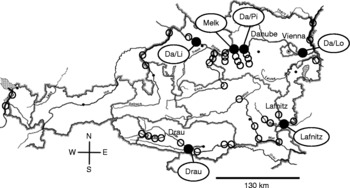
Sampling sites (fig. 1) represent the most frequent sites of occurrence of C. nasus in central, south and eastern Austria (Tabernig, Reference Tabernig2003). The most important nase-populated river is the Danube, which is one of the largest river systems in Europe. Accordingly, four sampling sites were chosen along the river Danube (‘Danube-Lobau’, ‘Danube-Pielach’, ‘Melk River’ and ‘Danube-Linz’), two sites were further apart from the main stream of the Danube (Lafnitz, Drau).
Chondrostoma nasus in Austria: Open circles, sites of occurrence (after Tabernig, Reference Tabernig2003); closed circles, sampling sites for this survey: Da/Lo, Danube-Lobau; Da/Pi, Danube-Pielach; Melk; Da/Li, Danube-Linz; Drau; Lafnitz.

The ‘Danube-Lobau’ site (approximately 48°07′N, 16°43′E) is located at the main course of the Danube river within The Donau Auen National Park east of Vienna, the largest natural riparian wetland in central Europe, which remains, to the most possible degree, ecologically intact (National Park Donau Auen, 2007). The ‘Danube-Pielach’ site (approximately 48°14′N, 15°21′E) is situated approximately 80 km west of Vienna, within the mouth of the Pielach River. The Pielach River itself is one of the few rivers in Lower Austria that has been left almost in its natural state throughout its course, showing only minor anthropogenic alterations. The ultimate 2.5 km of the river and its mouth have been described as the most important region for the natural maintenance of the nase population in the Danube (Jungwirth et al., Reference Jungwirth, Schmutz and Zitek2001). The sampling site ‘Melk River’ (approximately 48°11′N, 15°16′E) is a tributary which flows approximately 1 km upstream of the Pielach into the Danube. Fish populations in the Melk had been isolated from the Danube by a 4 m high dam, which had been blocking migration into and from the Danube for several decades, until a fish ladder was built in spring 2003. However, during our sampling period in the summer of 2003, no significant migration of nase from the Danube into the Melk river was observed (Jirsa, Reference Jirsa2004; Zitek et al., Reference Zitek, Schmutz and Jungwirth2004), which leads to the assumption that most fish originate from the Melk River. The ‘Danube-Linz’ site (approximately 48°19′N, 14°10′E) is located at the main stream approximately 170 km upstream from Vienna, between Wilhering and Linz, where a part of the stream flows through a heavily industrialized landscape.
Fish from the Drau River were caught at a 6.5 km segment of the river at Rosegger Schleife (approximately 46°35′N, 14°01′E), the only free-flowing stretch of this river in Austria. Although free flowing, water levels are controlled by the Draukraftwerke AG, an agency that operates ten hydroelectric power stations along the Drau River in Austria. The site is flooded regularly with spates from the hydroelectric power plant upstream at Rosegg. It is connected to the downstream reservoir of Feistritz-Ludermannsdorf by a fish ladder. Chondrostoma nasus uses the Rosegger Schleife as a spawning ground, in which the fry remain for a period of 1 or 2 years. Fish then migrate into the downstream reservoir, where they stay until maturation, before returning to the Rosegger Schleife (Kerschbaumer et al., Reference Kerschbaumer, Prochinig, Gross, Hradetzky, Konar and Prochinig2002).
The Lafnitz site is located near Dobersdorf, approximately 12 km upstream of the Hungarian border (approximately 47°01′N, 16°08′E). The river there is described as a close-to-nature epipotamal and is inhabited by approximately 40 fish species (Woschitz, Reference Woschitz1996), with barbel Barbus barbus (L. 1758) and nase being dominant (Lang, Reference Lang1993).
The water quality of all the Danube sites as well as the Lafnitz site is rated II, whereas the water quality of the Drau site is rated II–III on a scale of five possible saprobial classes. No measurements have been officially advised to improve the water quality (BMLFUW, 2003). Mean values for important physico-chemical parameters for the sampling sites are listed in table 1. Regarding heavy metal pollution, all sites are reported to be unpolluted, except the Drau site, which is moderately polluted with lead, cadmium and zinc (BMFLUW/WWK, 2008; Jirsa et al., Reference Jirsa, Leodolter-Dvorak, Krachler and Frank2008a).
Mean values±standard deviation for chemical parameters from sample sites calculated from results of 2003–2006; data for the Melk site was only available for 2003 (BMFLUW/WWK, 2008). BOD5, Bacterial oxygen demand during 5 days; AOX, adsorbable organic halogen compounds.

Fish sampling
A total of 191 medium and large-sized individuals of C. nasus were caught by electro fishing between April and November from 2003 to 2006, and were transported to the laboratory. Subsequently, fish were maintained for a maximum of 24 h in aerated tanks and killed by cervical dislocation prior to the parasitological examination using conventional techniques described by Schäperclaus (Reference Schäperclaus1990) and Amlacher (Reference Amlacher1992). For protozoan parasites which were not detectable with a binocular microscope, scratches from the gills and skin were made. The categories to assess the intensity of infections were defined as: ‘low’ for 1–10 parasites per field of view (at 100-fold magnification), ‘medium’ for 11–100 parasites, and ‘high’ for more than 100 parasites. The total length, weight, sex and age of each fish were recorded, and Fulton's condition factor was calculated. The parasitological terms used are those defined by Bush et al. (Reference Bush, Laferty, Lotz and Shostak1997). Measures of the helminth community structure were the Shannon–Wiener index and evenness, the Brillouin index, the Simpson's index and the Berger–Parker index as proposed by Magurran (Reference Magurran1988). For these calculations only fish caught in June and July were considered to avoid the effects of seasonality of parasite occurrence. For statistical analyses the Kruskal–Wallis and an ANOVA test were applied.
Results
Composition of the parasite community
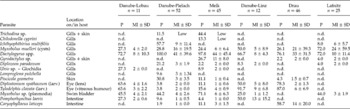
Data on C. nasus from the sampling sites are summarized in table 2, while data on their parasites are displayed in table 3. Gills were infected with Dactylogyrus vistulae, D. chondrostomi and two other unidentified species of the genus Dactylogyrus as well as with cysts of Myxobolus muelleri from all sampling sites. Due partly to the high number of parasites, it seemed neither possible to count the numbers of each Dactylogyrus species, nor to discriminate between the species for individual fish. Therefore, prevalence and mean intensity given in table 3 summarize the data for either one, two, three or four Dactylogyrus species. Additionally, the protozoans Trichodina sp., Chilodonella piscicola (syn. C. cyprini) and Ichthyophthirius multifiliis were usually recovered in low numbers from skin and gills, but not from all sampling sites. Two species of eye flukes, Diplostomum spathaceum (larv.) and Tylodelphis clavata (larv.) were found in fish from all sampling sites except the Lafnitz River. No other digeneans were detected during this survey. Two intestinal helminth species were found: the acanthocephalan Pomphorhynchus laevis and the cestode Caryophyllaeus laticeps, neither being present in all sampling sites. Infection levels with P. laevis stayed low, and reached the highest prevalence at Danube-Linz, whereas levels for C. laticeps had the highest prevalence at the Drau site, where the highest intensity (106 worms) was also reached. Furthermore, Myxobolus sp. (plasmodia) was detected in the connective tissue of the posterior part of the swim bladder from all sites except the Drau River. Larvae from the river mussel Unio sp. were only recovered from two sites, the Danube-Lobau and the Melk site. The crustacean Lamproglena pulchella was recovered only from the Danube-Pielach site.
Data of Chondrostoma nasus from different sites. Cond., condition; n.d., not determined; *, significantly different from other sites (P<0.05).

Parasites of nase from different sampling sites: prevalence (P) and mean intensity (MI) (±SD). n.d., Not detected.

Diversity characteristics of parasite communities
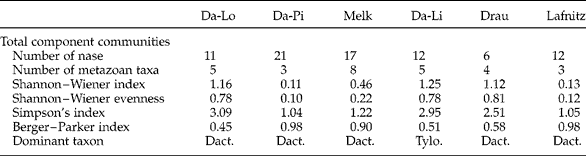
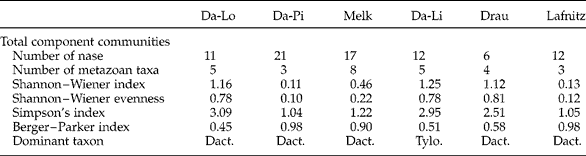
To analyse the component community structure only helminths were included and results are shown in table 4. Clear differences in richness and diversity of species between the sampling sites could be detected. Highest species richness occurs at the Melk site. Highest parasite diversity (Shannon–Wiener and Simpson's index) was found at the Danube-Lobau and the Danube-Linz site followed by the Drau, being lowest at the Danube-Pielach and the Lafnitz site. The Shannon–Wiener evenness is highest at the Drau site, followed closely by the Danube-Lobau and Danube-Linz site, being lowest again at the Danube-Pielach and the Lafnitz site. Berger–Parker dominance indices follow the same pattern, being lowest at the Danube-Lobau, Danube-Linz and Drau sites and reaching the highest value for the Lafnitz River and the Danube-Pielach site.
Comparison of the diversity characteristics of the parasite community of the nase from Austrian rivers: Da-Lo, Danube-Lobau; Da-Pi, Danube-Pielach; Da-Li, Danube-Linz; Dact., Dactylogyrus spp.; Tylo., Tylodelphis clavata.
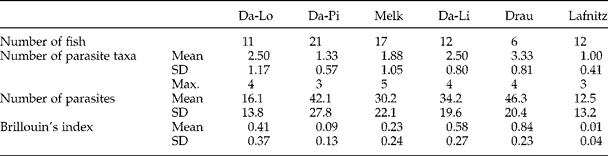
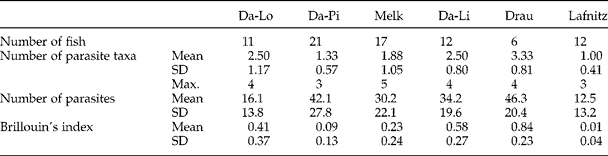
The composition of the infracommunity was analysed and the results are presented in table 5. Clear differences among the sampling sites are obvious for the Brillouin's index, indicating a similar trend as for the component community diversity. Again, lowest values were calculated for the Lafnitz site and highest for the Drau River. Also, the number of parasite taxa as well as the number of individuals was lowest at the Lafnitz site.
Comparison of the diversity characteristics of the infracommunity of parasites of the nase from Austrian rivers. Da-Lo, Danube-Lobau; Da-Pi, Danube-Pielach; Da-Li, Danube-Linz. SD, standard deviation.
Discussion
The parasitological examination of C. nasus from six different sites in Austria revealed a parasite community which is well comparable to that of other cyprinid species, when protozoan and myxozoan taxa are included. Infections of cyprinid fishes with the protozoans C. cyprini and I. multifiliis have been reported from all over the world and they are known to be responsible for significant economic losses to the aquaculture industry, including the ornamental fish trade. Epizootics in wild fish populations can result in mass mortalities, occurring predominantly in fish fry or fish with a weakened immune system (Schäperclaus, Reference Schäperclaus1990; Hoole et al., Reference Hoole, Bucke, Burgess and Wellby2001; Matthews, Reference Matthews2005). An acquired immunity against new infections with I. multifiliis has been reported by Xu & Klesius (Reference Xu and Klesius2003) amongst others; hence, the parasites usually occur in adult fish in low prevalence and intensities. Our results are in good accordance with this description, as high infection rates did not occur, and infected fish were not recovered from all sampling sites. Another well-known parasite of up to 79 fish species (Shulman, Reference Shulman1984), mainly cyprinids, and described from gills and fins of chub Squalius cephalus (syn. Leuciscus cephalus), is the myxosporidian M. muelleri, forming cysts in the gill tissue and some other organs (Lom & Dykova, Reference Lom and Dykova1992). Molnar et al. (Reference Molnar, Marton, Eszterbauer and Szekely2006), amongst others, believe that most of the myxosporidian species identified as M. muelleri, from fish species other than chub, are misinterpretations. Morphologically, the spores of the cysts of nase are indistinguishable from the spores of S. cephalus from the Melk and Pielach rivers (Jirsa, Reference Jirsa2004); therefore the name M. muelleri is used here for species identification until DNA sequencing helps to certify its identity.
Large plasmodia of myxosporidians in the connective tissue of the posterior part of the swim bladder have been described from chub by Holzer & Schachner (Reference Holzer and Schachner2002) from Austrian rivers, and Molnar et al. (Reference Molnar, Marton, Eszterbauer and Szekely2006) from Hungary. Both identified the species as Myxobolus cycloides. Although Holzer & Schachner did not find myxocysts on the wall of the swim bladder in any other cyprinid species, our results clearly show that such cysts regularly occur in C. nasus, as they were found in all sampling sites but the Drau River, albeit in lower prevalences and intensities than in chub. Although species identification for plasmodia found on the wall of the swim bladder is not completed yet, the morphological features and the very distinct location point to, at least, a closely related species to M. cycloides.
Infection rates for P. laevis from our survey are in good accordance with earlier results by Žitňan (Reference Žitňan1960, Reference Žitňan1965, Reference Žitňan1966) from Slovakia, where similar prevalences (10–50%) and intensities (1–7) were reported. Comparison of infection rates of the sympatric barbel from the Danube, where prevalences of 100% and mean intensities of 111 individuals are reported (Laimgruber et al., Reference Laimgruber, Schludermann, Konecny and Chovanec2005; Nachev & Sures, Reference Nachev and Sures2009), to the results from nase, demonstrates the influence of food selection for the appearance of P. laevis. It is transmitted orally via gammarids as intermediate hosts. Considering that C. nasus takes up invertebrates only in small numbers (Reckendorfer et al., Reference Reckendorfer, Keckeis, Tiitu, Winkler, Zornig and Schiemer2001), it gets infected with this acanthocephalan to a much lower degree. The only other intestinal helminth species reported here is C. laticeps. Žitňan (Reference Žitňan1960, Reference Žitňan1965, Reference Žitňan1966) does not report it from C. nasus, only the closely related Caryophyllaeides fennica was identified, with intensities of 1–3 worms, from East Slovakia. Macko et al. (Reference Macko, Ryšavy, Špakulova and Kralova1993) list C. nasus as host for C. laticeps in Slovakia, without giving intensities, but C. fennica is missing from this list, which might indicate some confusion between species. Anyway, the strong appearance of C. laticeps in one of the examined rivers during our survey seems most striking. At the Drau site the infection with the tapeworm reaches values which up to now have only been reported for its natural major host, the bream Abramis brama, by Anderson (Reference Anderson1974), Evlanov & Kolokolnikova (Reference Evlanov and Kolokolnikova1991) and Karanis & Taraschewski (Reference Karanis and Taraschewski1993) amongst others. The reasons for the successful establishment of this parasite in the nase population seem to be anthropogenic, as described in detail by Jirsa et al. (Reference Jirsa, Konecny and Frank2008b). The alteration of the river morphology, such as slowing down the current and the subsequent sedimentation, might have had two consequences: first, it allowed the establishment of a new tubificid population, which acts as intermediate host for C. laticeps in parts of the river, where there had been none before; and, secondly, C. nasus was forced to feed in muddy grounds taking up much more of the tubificids than usual. Effects of this strong establishment of C. laticeps on the nase population are not known. Although heavy infections, with a maximum intensity of 106 worms per fish, occurred, there was no significant (P < 0.05) difference in the condition of uninfected and infected fish. For juvenile fish the situation might be different: the mortality of juvenile carp due to blockage of the intestine with caryophyllids has been well documented (Schäperclaus, Reference Schäperclaus1954; Kanaev, Reference Kanaev1956). Therefore, infections with C. laticeps may be a major factor in contributing to the mortality of the juvenile nase population in these rivers. This, however, requires further investigation.
Furthermore, relating to the results of Žitňan (Reference Žitňan1965) from Slovakia are infection rates found for D. spathaceum and T. clavata in the eye lens and the vitreous humour of the eye, respectively, from most of our sampling sites. These eye flukes are ubiquitous parasites and occur in a range of fish species (Schäperclaus, Reference Schäperclaus1990; Hoole et al., Reference Hoole, Bucke, Burgess and Wellby2001). The absence of the digenean larvae from the Lafnitz site stands in contrast to the well-established populations of these helminths in the other sampling sites. The Lafnitz River is described as close to nature, embedded in a well-maintained riparian wetland and inhabited by birds and water snails, suitable as final and intermediate hosts, respectively, for digeneans (Woschitz, Reference Woschitz1996). However, Jirsa et al. (Reference Jirsa, Leodolter-Dvorak, Krachler and Frank2008a) reported acute copper pollution in the Lafnitz River in June 2005. Evans (Reference Evans1982) showed a reduced survival of cercariae with elevated copper levels in water, thus the copper pollution of the Lafnitz River could be a possible explanation for the absence of digeneans.
Generally, all sampling sites exhibit a low component and infracommunity diversity combined with a high dominance of a single species. According to Kennedy et al. (Reference Kennedy, Bush and Aho1986) such a pattern is typical for freshwater fish. In our study dactylogyrids are the dominant taxon, showing high dominance values with Berger–Parker indices between 0.90 and 0.98 for the Danube-Pielach, Melk and Lafnitz sites. At these sites evenness and diversity indices show the lowest values. Tylodelphis clavata is dominant only at the Danube-Linz site. Diversity characteristics at infracommunity level generally show low values for the Brillouin index, but significant differences do occur: lowest values were calculated for the Lafnitz River, highest for the Drau River, although it has to be remarked that the result obtained for the Drau River has to be interpreted with caution due to the small sample size.
Comparing diversity characteristics between component and infracommunities, similar trends can be observed: Sites at which the component community shows a relatively high diversity and a high evenness, such as the Danube-Lobau, the Danube-Linz and the Drau site, also show a high diversity on the infracommunity level. Similarly, parasite diversities on the infracommunity and component community levels were poorest at the Lafnitz River, due to the complete absence of eye flukes and intestinal helminths. Generally, it is assumed that parasite diversity reflects the ecological conditions in a habitat (Hudson et al., Reference Hudson, Dobson and Lafferty2006). There is evidence from field studies that parasite diversity is often positively correlated with eutrophication (e.g. Valtonen et al., Reference Valtonen, Holmes and Koskivaara1997; Zander, Reference Zander2007) or anthropogenic disturbance (Hernandez et al., Reference Hernandez, Bunnell and Sukhdeo2007). Eutrophication seems to be of less importance at our sample sites, given that the values for nitrate and phosphate are low, which indicates a chemical water quality varying from very good to good according to the EU water frame directive (BMLFUW, 2008), with the Drau River even showing significantly lower values than the other sites. With respect to saprobic classes, all sampling sites along the river Danube as well as the sampling site Lafnitz show a similar water quality (class II of five possible saprobic classes), whereas the Drau has quality II–III. Additionally, the rivers Pielach, Melk and Lafnitz are considered to be relatively close to nature. The lower diversities at the latter sites could be seen as an indication of better ecological conditions. In contrast, our sampling site at the river Drau is characterized by a strong anthropogenic disturbance and pollution with heavy metals, resulting in sedimentation processes and subsequent changes of the invertebrate communities. Also the main stream of the river Danube has been subjected to severe anthropogenic changes during its history (Schiemer & Spindler, Reference Schiemer and Spindler1989). Again, a higher degree of changes of the river's morphology results in a higher parasite diversity than at adjacent and less disturbed sites. Therefore, our results provide further evidence for a positive correlation between anthropogenic disturbance and parasite diversity for river systems.
Acknowledgements
Our sincere thanks go to Mag. Gerald Kerschbaumer, Mag. Nikolaus Schotzko, Gerhard Woschitz, Dr Gerald Zauner and Dr Andreas Zitek and their crews for their effort in providing the fish samples, as well as to the local fishery authorities for authorizing the catch. We kindly thank Dr Tomáš Scholz for confirming the identification of C. laticeps.