1. Introduction
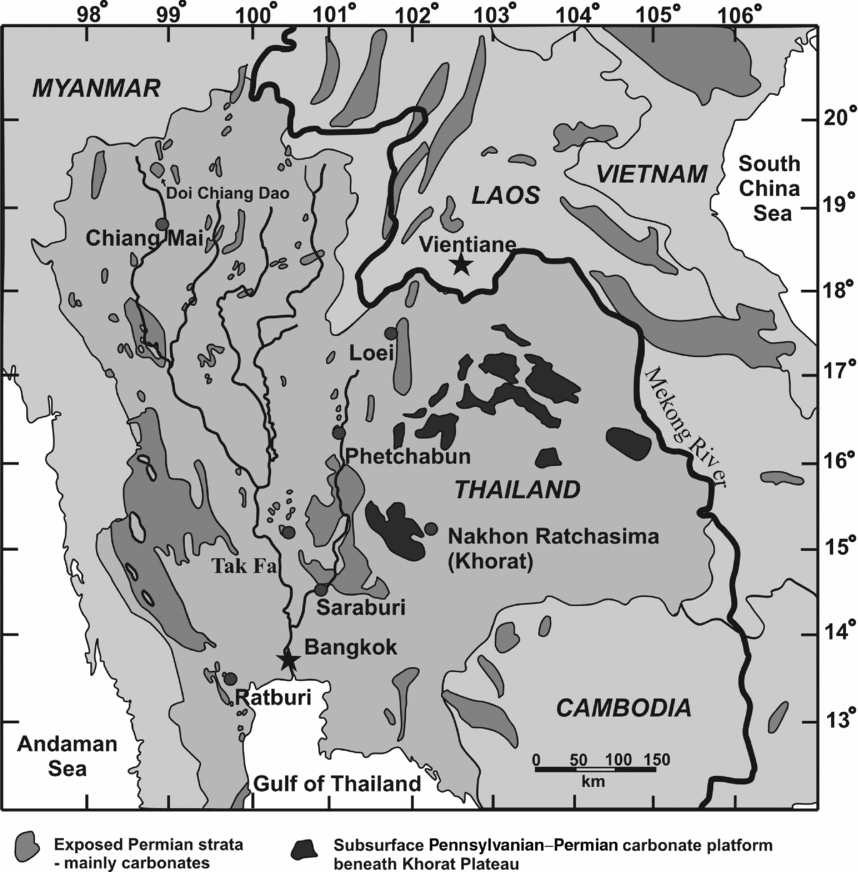
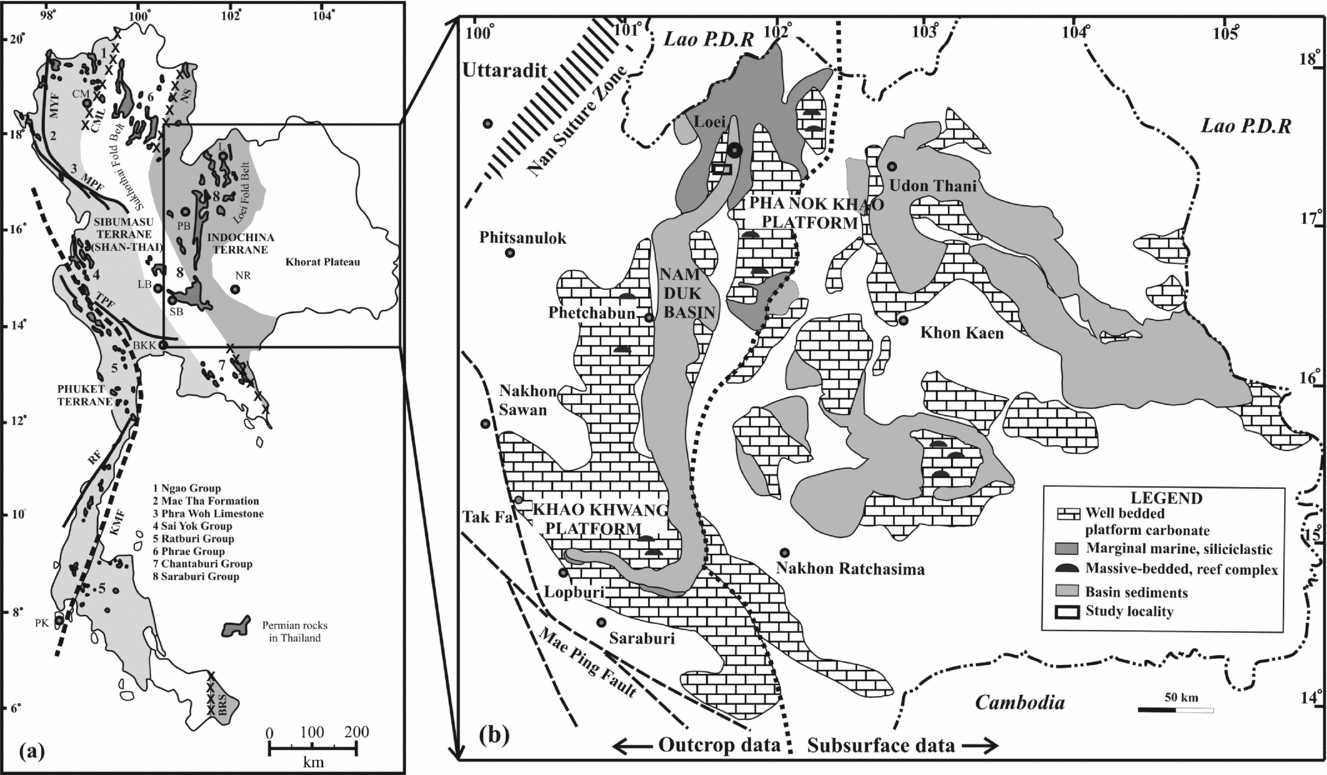
Pennsylvanian – Permian limestones are widespread in outcrop and subcrop in Thailand and adjacent countries (Fig. 1) and provide important hosts and reservoirs for both metal and petroleum deposits (Booth & Sattayarak, Reference Booth, Sattayarak, Ridd, Barber and Crow2011; Khin Zaw et al. Reference Khin Zaw, Meffre, Lai, Santosh, Burrett, Graham, Manaka, Salam, Kamvong, Cromie and Makoundi2014). The Permian Ratburi Group limestone of the Sibumasu Terrane (or Shan–Thai Terrane in part) conformably overlies glaciomarine siliciclastics of the Kaeng Krachan Group. The Ratburi limestones are cool-water deposits in the Artinskian and contain an increasing percentage of warm-water elements through the Guadalupian and range up to the Lopingian (J. W. Hills, unpub. thesis, University of Tasmania, 1989; Ueno & Charoentitirat, Reference Ueno, Charoentitirat, Ridd, Barber and Crow2011). In contrast, Carboniferous–Lopingian limestones of the Inthanon and Indochina terranes (Doi Chiang Dao Limestone and Saraburi Group, respectively) contain diverse tropical faunas (Ueno & Charoentitirat, Reference Ueno, Charoentitirat, Ridd, Barber and Crow2011). It was mainly this palaeoclimatic dichotomy that first led Ridd (Reference Ridd1971) and Bunopas (Reference Bunopas1982) to suggest that the Sibumasu Terrane was part of Gondwana until Guadalupian time. Indochina separated from the Himalayan sector of Gondwana possibly during Devonian time (Burrett et al. Reference Burrett, Khin Zaw, Meffre, Lai, Khositanont, Chaodumrong, Udchachon, Ekins and Halpin2014) and a collision of these SE Asian terranes occurred during Late Triassic time (Bunopas, Reference Bunopas1982). During Permian time, carbonate platforms and basins probably covered most of the Sibumasu and Indochina terranes and were deformed during terrane suturing events during the late Permian and Triassic fusion of the Asian tectonic collage (Bunopas, Reference Bunopas1982; Burrett, Reference Burrett1974; Burrett et al. Reference Burrett, Duhig, Berry and Varne1991, Reference Burrett, Khin Zaw, Meffre, Lai, Khositanont, Chaodumrong, Udchachon, Ekins and Halpin2014; Metcalfe, Reference Metcalfe2013; Morley et al. Reference Morley, Ampaiwan, Thanudamrong, Kuenphan and Warren2013; Khin Zaw et al. Reference Khin Zaw, Meffre, Lai, Santosh, Burrett, Graham, Manaka, Salam, Kamvong, Cromie and Makoundi2014). The Loei–Petchabun Fold Belt wraps around the western and probably southern margin of the Indochina Terrane (Fig. 2) and was deformed during late Permian time by collision with south China and during Late Triassic time by collision with the Sibumasu and other terranes (Kamata et al. Reference Kamata, Shirouzu, Ueno, Sardsud, Charoentitirat, Charusiri, Koike and Hisada2013; Morley et al. Reference Morley, Ampaiwan, Thanudamrong, Kuenphan and Warren2013; Khin Zaw et al. Reference Khin Zaw, Meffre, Lai, Santosh, Burrett, Graham, Manaka, Salam, Kamvong, Cromie and Makoundi2014). A generalized cross-section of part of the Permian limestones of the Loei–Petchabun Fold Belt shows seven folded and thrust fault-bounded blocks within the Saraburi Group near Saraburi (Dawson & Racey, Reference Dawson and Racey1993). However, other than the recent work of Morley et al. (Reference Morley, Ampaiwan, Thanudamrong, Kuenphan and Warren2013), there has been very little detailed structural work carried out on the Loei–Petchabun Fold Belt and the palinspastic relationship between the Permian palaeogeographic elements has yet to be established.
Map of part of SE Asia showing generalized distribution of Pennsylvanian–Permian mainly carbonate sequences in Thailand, Laos, Cambodia and Vietnam, based on Pitkapaivan (Reference Pitkapaivan1965). Permian subcrop beneath Khorat Plateau after Booth & Sattayarak (Reference Booth, Sattayarak, Ridd, Barber and Crow2011).

Generalized Cisuralian–Guadalupian palaeogeographic map of NE Thailand modified from Wielchowsky & Young (Reference Wielchowsky, Young, Thanavarachorn, Hokjaroern and Youngme1985) (outcrops) and Chantong et al. (Reference Chantong, Srisuwan, Kaewkor, Praipipan, Ponsri, Senebouttalath and Roibang2013) (subcrops).

The current palaeogeographic model for Permian time of the Loei–Petchabun Fold Belt, as developed by Wielchowsky & Young (Reference Wielchowsky, Young, Thanavarachorn, Hokjaroern and Youngme1985), has the Saraburi Group limestones being deposited on the Pha Nok Khao and Khao Khwang carbonate platforms separated by the deep-water Nam Duk Basin containing mainly siliciclastic and volcaniclastic sequences with minor limestones (Fig. 2).
Thrusted-and-folded Permian carbonates extend as discontinuous but extensive subcrops eastwards under the Mesozoic siliciclastic cover (Khorat Group) of the Khorat Plateau region of NE Thailand and Laos to crop out in Laos as the Khammouan Limestone (Booth & Sattayarak, Reference Booth, Sattayarak, Ridd, Barber and Crow2011) and in Cambodia as the Sisophon Limestone and correlates (Ishii, Kato & Nakamura, Reference Ishii, Kato and Nakamura1969; Waterhouse, Reference Waterhouse1976). The E-Lert Formation is interpreted as having been deposited in deep water on the western side of the Pha Nok Khao Platform and possibly grading westwards into the siliciclastic turbidites of the Nam Duk Basin and eastwards into the shallow-water formations of the Pha Nok Khao Platform (Chonglakmani & Sattayarak, Reference Chonglakmani, Sattayarak and Nutalaya1978; Ueno & Charoentitirat, Reference Ueno, Charoentitirat, Ridd, Barber and Crow2011, fig. 5.11). Although Ueno & Charoentitirat (Reference Ueno, Charoentitirat, Ridd, Barber and Crow2011, fig. 5.10) show the E-Lert deep-water sediments deposited in or on the margins of a northern continuation of the Nam Duk Basin, an alternative model has the E-Lert sediments as flanking isolated carbonate platforms and not connected to the Nam Duk Basin (Chantong et al. Reference Chantong, Srisuwan, Kaewkor, Praipipan, Ponsri, Senebouttalath and Roibang2013, fig. 6). Based on interpretations of seismic profiles across the Khorat Plateau, Chantong et al. (Reference Chantong, Srisuwan, Kaewkor, Praipipan, Ponsri, Senebouttalath and Roibang2013) show that the Permian palaeogeography of NE Thailand consisted of small carbonate platforms separated by deep-water basins (Fig. 2).
Although the Saraburi Group limestones and correlatives contain horizons with abundant fusulinids, corals and other fauna (e.g. Dawson & Racey, Reference Dawson and Racey1993; Fontaine et al. Reference Fontaine, Salyapongse, Suteethorn, Tian and Vachard2005; Chitnarin et al. Reference Chitnarin, Crasquin, Chonglakmani, Broutin, Grote and Thanee2008, Reference Chitnarin, Crasquin, Charoentitirat, Tepnarong and Thanee2012; Udchachon et al. Reference Udchachon, Burrett, Thassanapak, Chonglakmani, Campbell and Feng2014), very few conodont faunas have been recovered and published. The Cisuralian conodonts described from the Nam Mahoran Formation in Loei province (Igo, Reference Igo1974) were re-identified as Pennsylvanian species by Mei & Henderson (Reference Mei and Henderson2002 b). Metcalfe & Sone (Reference Metcalfe and Sone2008) described the Cisuralian (early Kungurian) conodonts Sweetognathus subsymmetricus and Pseudosweetognathus costatus from shallow-water limestone of the Tak Fa Formation of the Khao Khwang Platform, 275 km SSW of Loei (Fig. 1). Here we describe conodonts and ostracodes from thinly bedded limestone and radiolarians from overlying chert and silicified shale of the E-Lert Formation.
2. E-Lert Formation
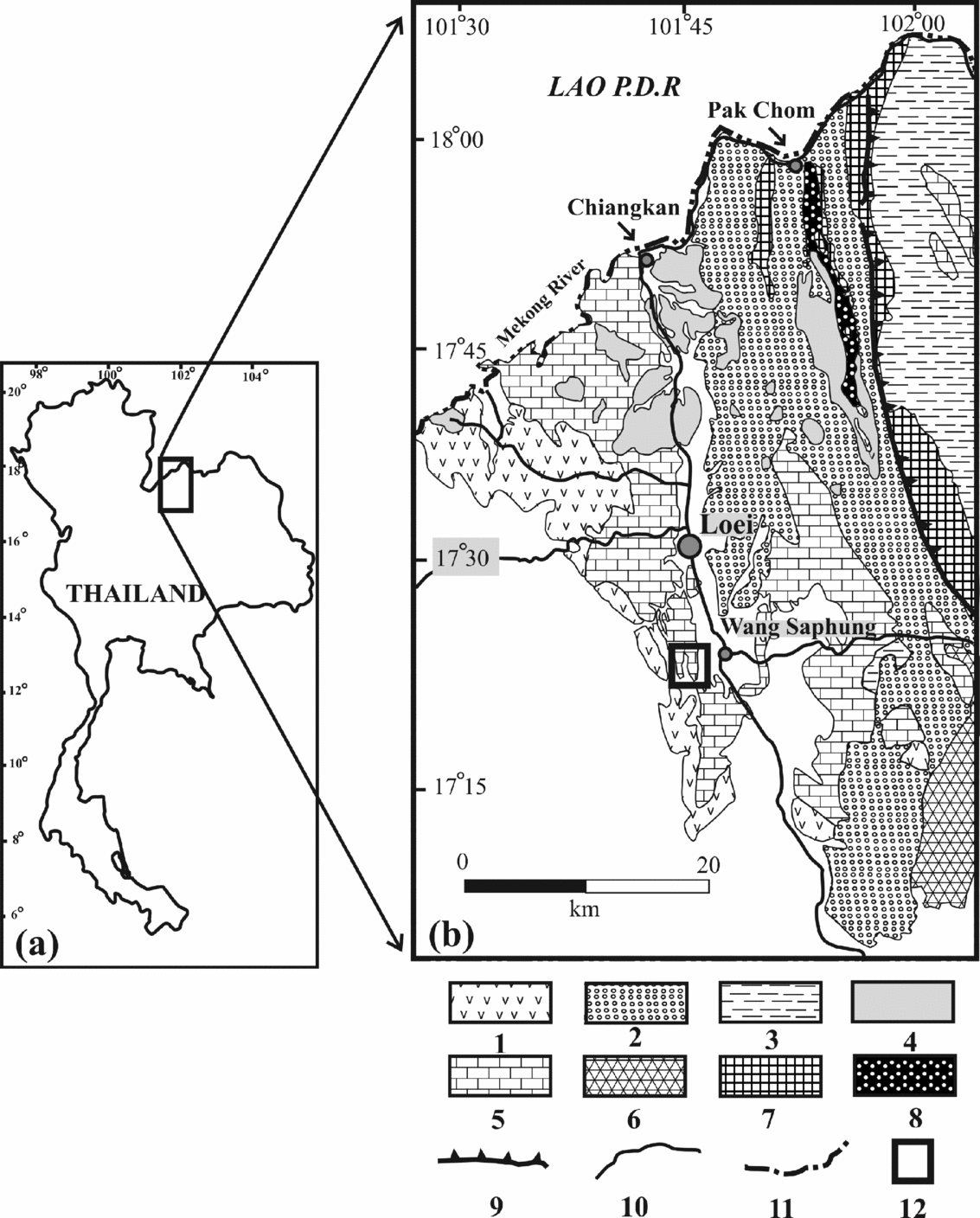
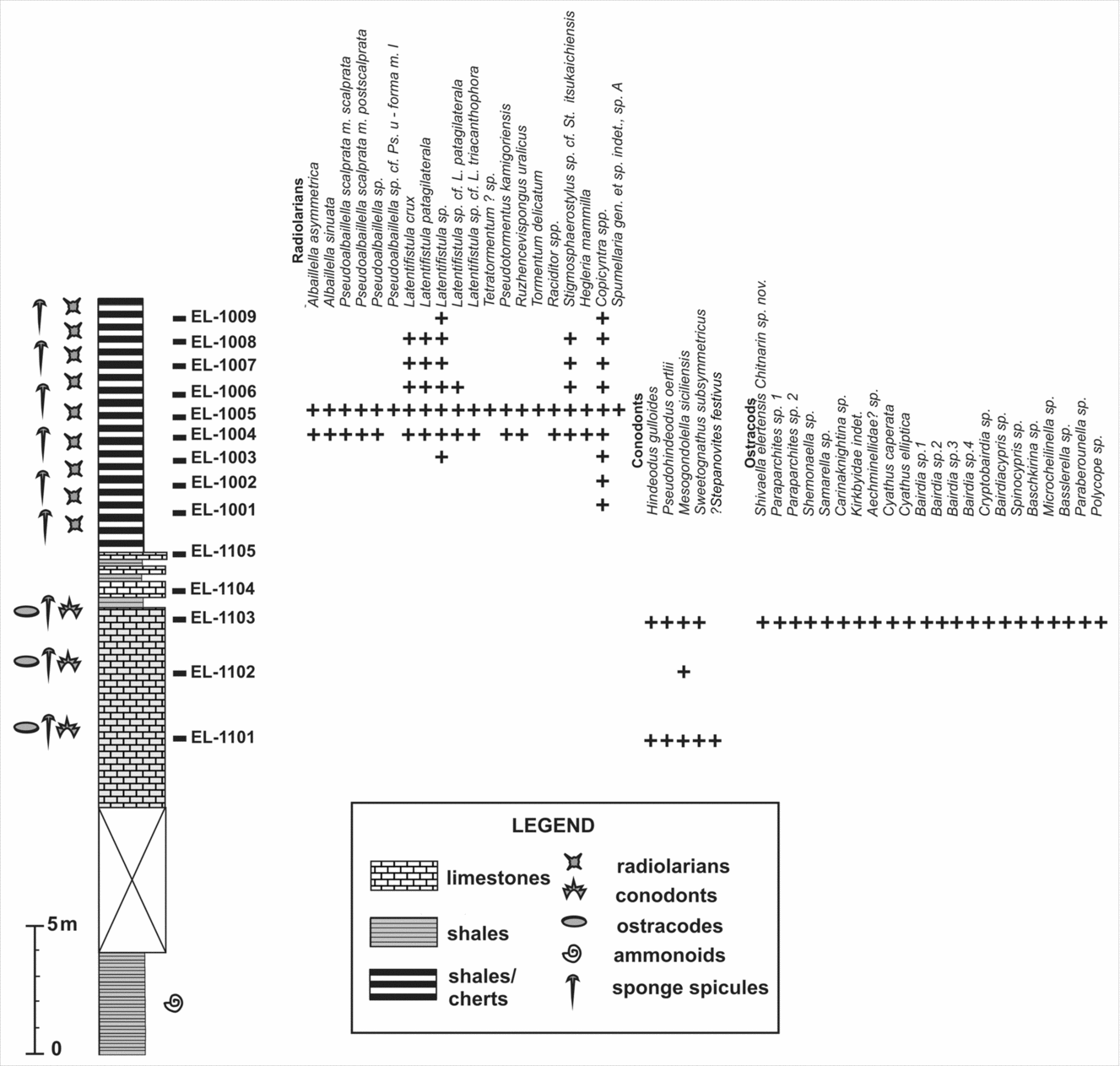
The E-Lert Formation of Loei Province (Fig. 3) crops out along a belt of over 80 km on the western limb but close to the axis of an anticline, and consists of c. 70 m of shales, thinly bedded limestones and interbedded cherts and silicified shales (Fig. 4) (Charoenpravat & Wongwanich, Reference Charoenpravat and Wongwanich1976). The type section is at Huai E-Lert (E-Lert Creek, also translated as Haui I-Lert and also known as Huai Sampod, Huey Sampod or Huai Sam Pot) around the Huai E-Lert Reservoir (at 101°43′35″E, 17°18′29″N and grid reference 47Q 0789502, 1915622, c. 24 km south of Loei City). The E-Lert Formation is overlain, with possible conformity, by sandstones and shales of the Lopingian Pha Dua Formation and interdigitates eastwards with the shallow water, sandstones and shales of the Wang Saphung Formation and the carbonates of the Nam Mahoran Formation which were deposited on the Pha Nok Khao Platform (Ueno & Charoentitirat, Reference Ueno, Charoentitirat, Ridd, Barber and Crow2011, fig. 5.11). Based on previous data and on our preliminary studies, the E-Lert Formation is contemperaneous with the basinal turbiditic siliciclastics and volcaniclastics of the Nam Duk, Khao Luak, Nong Pong and Pang Asok formations which are the constituent formations successively from north to south of the Nam Duk Basin and its margins (Altermann et al. Reference Altermann, Grammel, Ingavat, Nakornsri, Helmcke and Bunopas1983; Malila et al. Reference Malila, Chonglakmani, Feng and Helmcke2008; Ueno & Charoentitirat, Reference Ueno, Charoentitirat, Ridd, Barber and Crow2011).
Geological map of the Loei region, NE Thailand. Adapted from Charoenpravat & Wongwanich (Reference Charoenpravat and Wongwanich1976). 1, Permo-Triassic volcanic rocks including rhyolite, andesite, tuff and agglomerate; 2, Carboniferous rocks including conglomerate, sandstone, shale, chert and limestone; 3, Permo-Trassic rocks including sandstone, argillaceous limestone, rhyolitic tuff, shale, limestone and chert; 4, Permo-Trassic granite; 5, Permian rocks including limestone, shale and sandstone; 6. Triassic rocks including sandstone, siltstone and mudstone; 7, Devonian rocks including chert, shale and tuff; 8, Devonian–Carboniferous volcanic rocks including basalt, andesite and tuff; 9, thrust fault; 10, road; 11, country boundary; 12, study locality.

Preliminary stratigraphic column for the E-Lert Formation based on Ishibashi et al. (Reference Ishibashi, Fujiyama and Nakornsri1996) and the authors showing ranges of radiolarians, conodonts and ostracodes. Ammonoids studied by Zhou & Liengjarern (Reference Zhou and Liengjarern2004) come mainly from a lower shale sequence at Ban Na Pong which is 7 km north of the Huai E-Lert (reservoir) locality; structural and stratigraphic relationships between these two localities have not yet been established.

Very few microfossils have previously been found in the type section of the E-Lert Formation (Fontaine et al. Reference Fontaine, Salyapongse, Suteethorn, Tian and Vachard2005) and radiolarians, ostracodes and conodonts have not previously been described or figured. Ishibashi, Fujiyama & Nakornsri (Reference Ishibashi, Fujiyama and Nakornsri1996) and Fujikawa & Ishibashi (Reference Fujikawa and Ishibashi2006) described and identified ammonoids from mudstones from the lower part of the E-Lert Formation (at Ban Na Pong, 13 km north of the type section) and suggested a Bolorian age. The Bolorian is correlated with the Kungurian by Jin et al. (Reference Jin, Wardlaw, Glenister and Kotlyar1997). Zhou & Liengjarern (Reference Zhou and Liengjarern2004) examined and re-identified the previously described ammonoids, collected many more specimens and assigned all of the identifiable E-Lert fauna to the upper Artinskian Metaperrinites Zone. This ammonoid fauna is discussed in more detail in the biostratigraphy section (Section 4.1).
2.a. Lithology of the E-Lert Formation
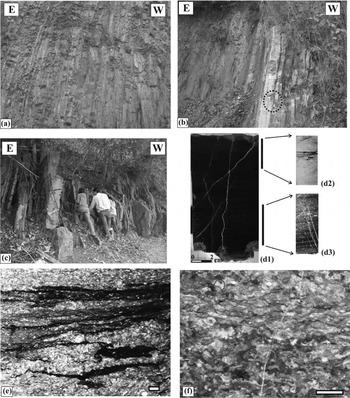
We have collected specimens from the limestone section at Huai E-Lert reservoir and from overlying silicified shales and cherts (Figs 4, 5). The limestone beds are between 10 cm and 26 cm thick and are overlain by c. 5 cm thick interbeds of silicified shale (Fig. 5). The limestones have often been described as turbidites (e.g. Ueno & Charoentitirat, Reference Ueno, Charoentitirat, Ridd, Barber and Crow2011). They show ripple cross-lamination representing Bouma division C which indicates that the sequence is not overturned and is younging to the east. The A division has an irregular base and the B division is graded and is succeeded by a ripple cross-laminated C division, which in turn is succeeded by a shale E division. In thin-section, the matrix is mostly micritic with concentrations of bioclasts just below the middle of the beds, consisting mainly of simple foraminiferans with some echinodermal debris (Fig. 5f). Ostracodes with complete carapaces are scattered through the micritic matrix. There is no obvious detrital quartz. Wispy pelitic intraclasts are present in the upper part of division C (Fig. 5e).
Photographs of E-Lert Formation. (a) Cherts and silicified shales, upper part of sequence dipping steeply east. Field of view is 3 m wide. (b) Contact between cherts (to east) and silicified shales of upper sequence and turbiditic limestones (to west). Outcrop is along track above reservoir at Huai E-Lert. Geological hammer is circled and rests on 20 cm thick limestone bed sampled as EL-1103. (c) Sequence below (b) seen only during dry season. (d) Slab of turbiditic limestone from sample EL-1101, showing position of thin-sections d2 and d3. (e) Wispy cross-lamination from near top of turbiditic unit in d2. Scale bar 500 μm. (f) bioclastic limestone near centre of unit (in d3) consisting mainly of small foraminifera and some ostracodes. Scale bar 500 μm.

The acetic acid insoluble residues contain rare rock fragments of mafic and ultramafic composition that are not obvious in thin-section. These range up to 1.5 mm in diameter, are irregular and not obviously weathered and contain abundant pyrite. Clasts such as these are very unusual in residues of dissolved limestones and their abundant pyrite and unweathered appearance suggest relative proximity to a source region such as an older uplifted mafic igneous body or a contemporaneous active and uplifting volcanic arc. The Devonian–Carboniferous mafics and ultramafics of the Eastern Loei Fold Belt (e.g. Intasopa & Dunn Reference Intasopa and Dunn1994; Khositanont et al. Reference Khositanont, Khin Zaw, Meffre, Panjaswatwong, Ounchanum, Thanasuthipitak, Senebouttalath and Roibang2013) represent the first possibility and suggest an eastern provenance; the Permian volcanism of the western Loei Fold Belt (e.g. Khositanont et al. Reference Khositanont, Khin Zaw, Meffre, Panjaswatwong, Ounchanum, Thanasuthipitak, Senebouttalath and Roibang2013; Khin Zaw et al. Reference Khin Zaw, Meffre, Lai, Santosh, Burrett, Graham, Manaka, Salam, Kamvong, Cromie and Makoundi2014) represents the second possibility and suggests a western source.
3. Taxonomic notes
In the following sections, Anisong Chitnarin is responsible for the ostracode taxonomy and palaeoecology sections and is the author of a new species of ostracode. Clive Burrett is responsible for conodonts and Hathaithip Thassanapak for radiolarians.
The acid-insoluble conodont residues yielded numerous silicified but highly corroded ostracode specimens. The same limestone samples were then processed using the acetolysis technique (Lethiers & Crasquin-Soleau, Reference Lethiers and Crasquin–Soleau1988; Crasquin–Soleau, Vaslet & Le Nindre, Reference Crasquin–Soleau, Vaslet and Le Nindre2005), which allowed the recovery of well-preserved identifiable specimens. Ostracodes recovered by both methods are described here.
All ostracode specimens are deposited in the collections of Suranaree University of Technology (Nakhon Ratchasima) and given SUT collection numbers. Conodonts and radiolarians are deposited in the collections of the Palaeontological Research and Education Centre, Mahasarakham University and given PRC numbers.
3.a. Conodonts
All conodonts are reasonably well preserved but are often fractured. They have a Color Alteration Index of about 3, indicating minimum and maximum heating of 190°C and 300°C (Epstein, Epstein & Harris, Reference Epstein, Epstein and Harris1977).
Phylum CHORDATA Bateson, Reference Bateson1886
Class CONODONTA Eichenberg, Reference Eichenberg1930
Subclass CONODONTI Branson, Reference Branson1938
Order OZARKODINIDA Dzik, Reference Dzik1976
Family ANCHIGNATHODONTIDAE Clark, Reference Clark1972
Genus Hindeodus Rexroad & Furnish, Reference Rexroad and Furnish1964
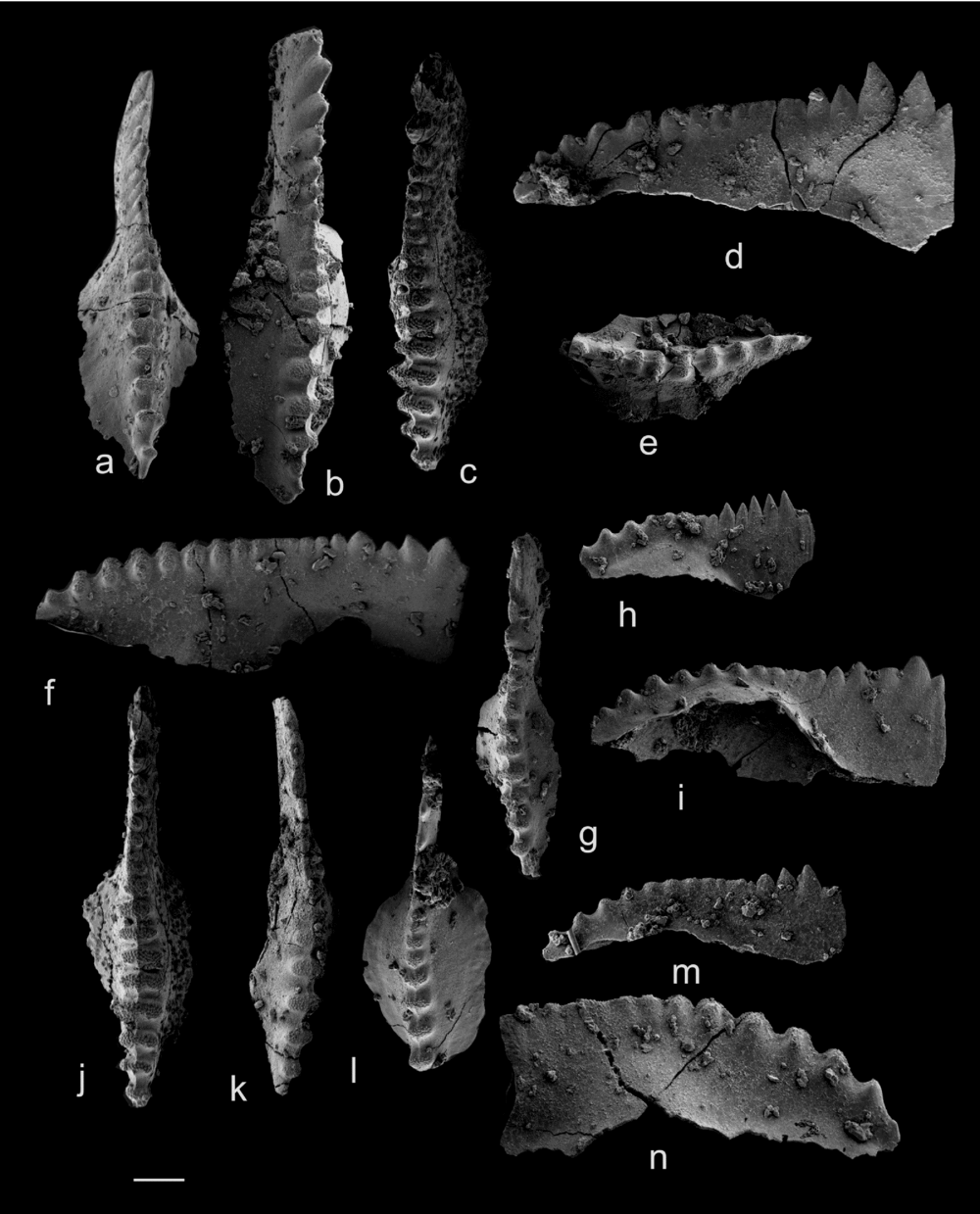
Hindeodus gulloides (Kozur & Mostler, Reference Kozur and Mostler1995)
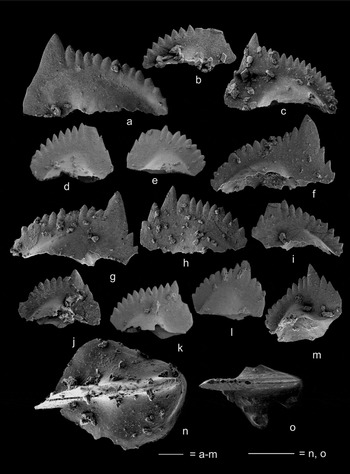
Figure 6a–m
1995 Hindeodus gulloides Kozur and Mostler, Reference Kozur and Mostler1995, plate 1, fig. 2.
Conodonts from the E-Lert Formation. (a–m) Hindeodus gulloides (Kozur & Mostler, Reference Kozur and Mostler1995). All Pa elements from sample EL-1101. Lateral views except for (m). (a) PRC 117; (b) PRC 118; (c) PRC 119; (d) PRC 120; (e) PRC 121; (f) PRC 122; (g) PRC 123; (h) PRC 124; (i) PRC 125; (j) PRC 126; (k) PRC 127; (l) PRC 128; (m) oblique lateral basal view, PRC 129; (n, o) Pseudohindeodus oertlii (Kozur, Reference Kozur1975); (n) upper view, PRC 130; (l) upper view, PRC 131. Scale bars 100 μm.

?2008 Hindeodus excavatus (Behnken, Reference Behnken1975); Sun et al. Reference Sun, Lai, Jiang, Luo, Sun, Yan and Wignall2008, plate 1, fig. 21.
Diagnosis. (Modified from Kozur and Mostler, Reference Kozur and Mostler1995.) Spathognathodiform Pa (P1) element with a short anterior blade with none–three mainly separated, triangular denticles and a much larger cusp and with a posterior blade with between 9 and 15 (average 11) triangular, partially fused denticles. On those forms that have three denticles on the anterior blade the most anterior third denticle is small compared to the other, much larger and broader denticles. The anterior part of the posterior blade is almost straight, with erect denticles and the posterior part is curved downwards, with slightly inclined denticles. All denticles are striated with striae sometimes extending onto a wide flared cupola which is widest beneath the third–fifth denticle on the posterior blade and narrows to the ends of both blades. Kozur & Mostler (Reference Kozur and Mostler1995) note that the cusp in Gullodus is either very indistinct or, in typical forms, missing and therefore the relatively large cusp of the E-Lert specimens differentiates this species from the Gullodus species G.catalonoi, G.siciliensis, G.hemicircularis and G.duani which have cusps only slightly higher or the same height as adjacent denticles.
Remarks. Kozur & Mostler (Reference Kozur and Mostler1995, p. 114) erected Hindeodus gulloides and named it gulloides because of its ‘. . .transitional character to Gullodus’. Our material suggests a transition within this species from a Hindeodus morphotype (Fig. 6a) through to a gulloides morphotype (Fig. 6m).
Kozur (Reference Kozur1993 a) noted the similarity of Gullodus to Hindeodus. This is clear in our specimens that grade from a Hindeodus morphotype through to elements with an increasing number of denticles on the anterior blade (Fig. 6a–m). Several Permian species of Hindeodus Pa (P1) elements have anterior denticles but these are always small (e.g. Nicoll, Metcalfe & Wang, Reference Nicoll, Metcalfe and Wang2002; Wardlaw, Reference Wardlaw, Wardlaw, Grant and Rohr2000). The Hindeodus morphotype (Fig. 6a) could be a separate species within Hindeodus but is included here in the apparatus of H. gulloides because of its general morphological and micromorphological similarity.
A possibly broken specimen assigned to Hindeodus excavatus by Sun et al. (Reference Sun, Lai, Jiang, Luo, Sun, Yan and Wignall2008, plate 1, fig. 21) from the Wordian–Capitanian of Sichuan, south China may belong to this species.
Occurrence. Texas, south China, Sicily and NE Thailand. 22 specimens from EL-1101, EL-1103.
Genus Pseudohindeodus Gullo & Kozur, Reference Gullo and Kozur1992
Pseudohindeodus oertlii (Kozur, Reference Kozur1975)
Figure 6n, o
Type species. Diplognathodus oertlii Kozur, Reference Kozur1975.
1965 Gnathodus siciliensis Bender & Stoppel, Reference Bender and Stoppel1965, p. 34, plate 14, fig. 2a, b.
1975 Diplognathodus oertlii Kozur, Reference Kozur1975, p. 11.
?1981 Diplognathodus oertlii Kozur; Igo, Reference Igo1981, p. 32, plate 8, figs 9–16.
1987 Diplognathodus oertlii Kozur; Van den Boogaard, Reference Van Den Boogard1987, pp. 22–23, fig. 6C, D.
2010 Pseudohindeodus oertlii (Kozur); Zhang et al. Reference Zhang, Henderson, Xia, Wang and Shang2010, Fig. 5N.
Diagnosis. ‘Small conodont with relatively high blade and greatly expanded basal cavity. Anterior part of the blade consists of 5–6 fused denticles with free tips which become gradually smaller in posterior direction up to about mid-length. The posterior part of the blade is a smooth ridge which gently slopes towards the posterior and then falls off steeply, more or less vertical to the upper side of the basal cavity’ (Van den Boogard, Reference Van Den Boogard1987).
Remarks. Our Thailand specimens agree well with this diagnosis. This species is very close to D. nassichuki Kozur but differs in that the posterior part of the blade slopes down to the posterior end of the posterior cavity. For that reason, Van den Boogard (Reference Van Den Boogard1987) refers the D. oertlii of Igo (Reference Igo1981, plate 8, figs 9–16) to D. nassichuki. P. augustus (Igo, Reference Igo1981) differs from P. oertlii in having ‘. . .much more discrete and less compressed denticles’ (Shen et al. Reference Shen, Yuan, Henderson, Tazawa and Zhang2013, p. 512).
Occurrence. South China, Timor, Central Asia, ?Japan, Sicily and NE Thailand. 25 specimens from EL-1101, EL-1103.
Order OZARKODINIDA Dzik, Reference Dzik1976
Superfamily GONDOLELLACEA Lindström, Reference Lindström1970
Family GONDOLELLIDAE Lindström, Reference Lindström1970
Genus Mesogondolella Kozur, Reference Kozur1989
Smooth Pa (P1) specimens from the E-Lert Formation are similar to several species of Mesogondolella, including M. gujioensis, M. idahoensis, M. intermedia, M. lamberti, M. omanensis, M. gracilis, M. szuzsannae, M. phosphoriensis, M. saraciniensis and M. siciliensis. General means for discrimination of Mesogondolella species are provided by Lambert, Wardlaw & Henderson (Reference Lambert, Wardlaw and Henderson2007), Mei & Henderson (Reference Mei and Henderson2002 b), Wardlaw (Reference Wardlaw2001) and Zhang et al. (Reference Zhang, Henderson, Xia, Wang and Shang2010) but substantial disagreement exists on the assignment of specimens. Our Pa (P1) specimens consist of forms with a small cusp and a platform usually widest around the middle part, and which are assigned to M. siciliensis.
Mesogondolella siciliensis (Kozur, Reference Kozur1975)
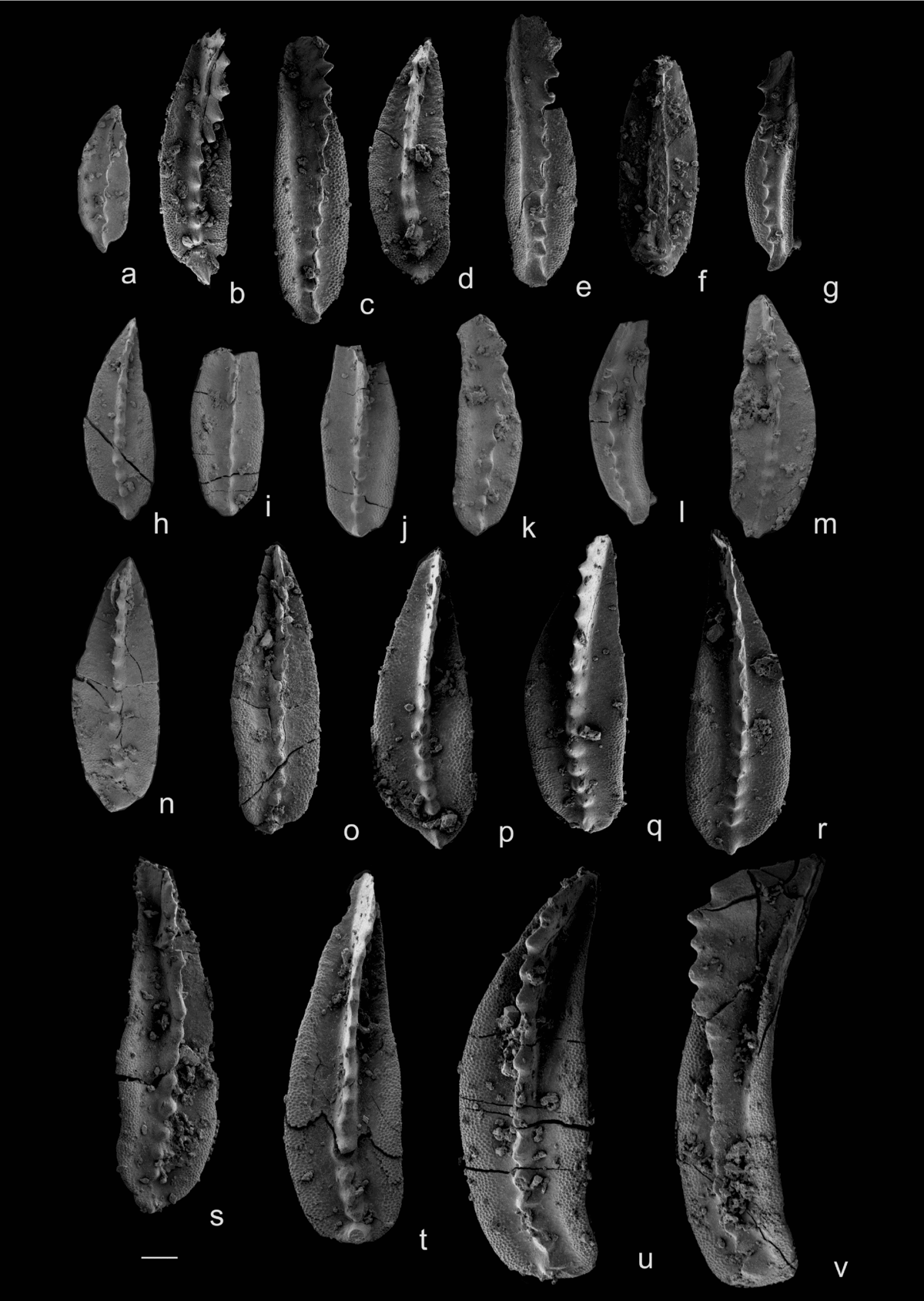
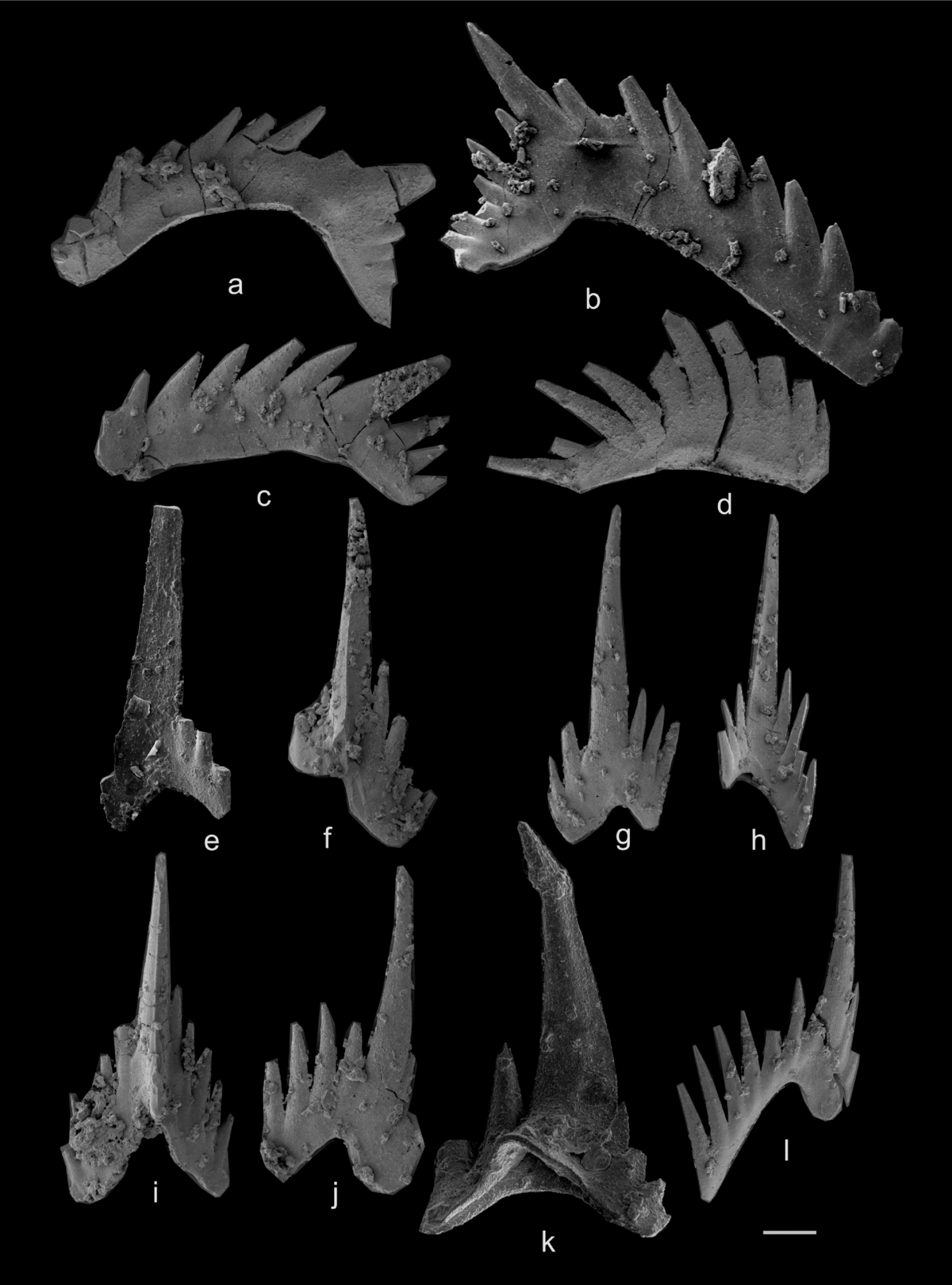
Figure 7a–v, Figure 8a, c–j, l
Synonymy. See Zhang et al. (Reference Zhang, Henderson, Xia, Wang and Shang2010).
Conodonts from the E-Lert Formation. (a–v) specimens PRC 132–153, Pa (P1) elements of Mesogondolella siciliensis (Kozur) all from sample EL-1101. All upper views or oblique upper views except for basal view in (h). (a) upper view, PRC 132; (b) upper view, PRC 133; (c) oblique upper view, PRC 134; (d) oblique upper view, PRC 135; (e) upper view, PRC 136; (f) oblique upper view, PRC 137; (g) upper view, PRC 138; (h) basal view, PRC 139; (i) upper view, PRC 140, note slight striations on anterior platform; (j) upper view, PRC 141; (k) upper view, PRC 142; (l) upper view, PRC 143, broken blade; (m) oblique upper view, PRC 144; (n) oblique lateral view, PRC 145; (o) upper view, PRC 146; (p) upper view, PRC 147; (q) slightly oblique upper view, PRC 148; (r) upper view, PRC 149; (s) slightly oblique upper view, PRC 150; (t) upper view, PRC 151; (u) slightly oblique upper view, mature specimen, PRC 152; (v) oblique upper view, mature specimen, PRC 153. Scale bar 100 μm.

Conodonts from the E-Lert Formation. (a–l) non-Pa elements from sample EL-1101. (a) Pb (P2) element, outer lateral view, possibly M. siciliensis, PRC 154; (b) Pa (P1) or Pb (P2) element, possibly Xaniognathus sp., or Jinogondolella sp., PRC 155; (c) Pb (P2) element of M. siciliensis, PRC 156; (d) Sc (S3) element of M. siciliensis? PRC 157; (e) Sb (S2) element, M. siciliensis, compares with Lonchodina mulleri Bender & Stoppel, Reference Bender and Stoppel1965, plate 15, fig. 13, PRC 158; (f) ?Sb (S2) element, M. siciliensis? PRC 159; (g) M element, M. siciliensis? PRC 232; (h) M element, M. siciliensis? PRC 233; (i) Sa (S0) element, M. siciliensis, PRC 234; (j) M element, M. siciliensis, PRC 235; (k) M element, similar to Sweetina festiva (Bender & Stoppel, Reference Bender and Stoppel1965, plate 15, fig. 9), PRC 236; (l) M element, M. siciliensis, PRC 237. Scale bar 100 μm.

Diagnosis. ‘A species of Mesogondolella in which the Pa (P1) element of juvenile and adult specimens has a small cusp that is equal to or only slightly larger than the posterior denticles, a brim that is narrow or absent, and high largely fused denticles on the anterior blades. It has a platform that is usually widest around the middle part. The posterior denticles are more discrete than the anterior ones’ (Zhang et al. Reference Zhang, Henderson, Xia, Wang and Shang2010, p. 151).
Remarks. The type specimens of this species are from Sicily and were placed in their new species Gondolella rosenkrantzi by Bender & Stoppel (Reference Bender and Stoppel1965) with a holotype from Greenland. Kozur (Reference Kozur1975) placed only the Sicilian specimens of G. rosenkrantzi into his new species G. siciliensis. Mei & Henderson (Reference Mei, Henderson, Hills, Henderson and Bamber2002a ) and Zhang et al. (Reference Zhang, Henderson, Xia, Wang and Shang2010) placed several selected, previously figured specimens of M. zsuzsannae, M. idahoensis, M. phosphoriensis and M. slovenica into synonymy with M. siciliensis which indicates the difficulty of confident identification of this species. Zhang et al. (Reference Zhang, Henderson, Xia, Wang and Shang2010, p. 152) note that M. lamberti is very similar to M. siciliensis but that the anterior blade is always slightly higher and more fused in M. siciliensis, and that ‘the platform is usually widest in the middle part in M. siciliensis but in M. lamberti, parallel-sided in the middle and the posterior part, rarely in the middle part’ (Zhang et al. Reference Zhang, Henderson, Xia, Wang and Shang2010, p. 152). Although the diagnosis of Zhang et al. (Reference Zhang, Henderson, Xia, Wang and Shang2010) states that juvenile forms have small cusps, Henderson & Mei (Reference Henderson and Mei2003, p. 307, plate 1, fig. 14b) state that ‘. . .cusps are generally small, but they are higher than posterior denticles in juveniles’. Our specimens are very similar to and have a similar morphological range to those illustrated from Luodian, south China, Sicily, Texas and Oman (Wang, Reference Wang1994, plates 3, 9–12; Kozur, Reference Kozur1995, plate 4, fig. 21; Henderson & Mei, Reference Henderson and Mei2003, plates I–III; Kozur & Wardlaw, Reference Kozur and Wardlaw2010, plates 3–4). A very small percentage of our specimens have a very weak striation on the anterior platform (Fig. 7i).
The non-Pa elements of M. siciliensis have been rarely determined Bender & Stoppel (Reference Bender and Stoppel1965) and Mei & Henderson (Reference Mei, Henderson, Hills, Henderson and Bamber2002a ) provide a few figures. Because of the potential problem of sorting and reworking in carbonate turbidites we have tentatively assigned some of our non-Pa elements to M. siciliensis (Fig. 8). The Pb (P2) element is shown in Figure 8c and possibly in Figure 8a and the former is closely comparable to the M. siciliensis Pb element illustrated by Henderson & Mei (Reference Henderson and Mei2003, plate 1, fig. 13). The Sa (S0) element (Fig. 8i) is also comparable to that illustrated by Henderson & Mei (Reference Henderson and Mei2003, plate 1, fig. 11). Some or all M elements shown in Figure 8g–j and l may belong to the M. siciliensis apparatus. Further studies are needed in order to clarify the full apparatus of M. siciliensis, its ontogeny, intraspecific variation and geographic and stratigraphic range.
Pa elements from the deep-water Permian of Rustaq and Wadi Wasit in Oman have been studied by Mei & Henderson (Reference Mei, Henderson, Hills, Henderson and Bamber2002a ), Henderson & Mei (Reference Henderson and Mei2003) and by Kozur & Wardlaw (Reference Kozur and Wardlaw2010). The first two authors identified M. siciliensis co-occurring with their new species M. rustaquensis, plus Sweetoganthus subsymmetricus and Waagenoceras and succeeded by M. idahoensis lamberti and argued for a latest Kungurian age. However, Kozur & Wardlaw (Reference Kozur and Wardlaw2010) re-identified the Omani M. rustaquensis and M. idahoensis lamberti as either their new species M. omanensis or as Jinogondolella aserrata. Globally, the first appearance datum (FAD) of J. aserrata is taken as the base of the Wordian (Henderson, Davydov & Wardlaw, Reference Henderson, Davydov, Wardlaw, Gradstein, Ogg, Schmidt and Ogg2012). Henderson & Mei's (Reference Henderson and Mei2003) M. idahoensis lamberti Pa specimens referred to J. aserrata by Kozur & Wardlaw (Reference Kozur and Wardlaw2010) are similar to some of our Pa specimens. Most J. serrata specimens have a low blade but the specimen of Henderson & Mei (Reference Henderson and Mei2003, plate IV, fig. 4) has a high blade and a moderate height cusp with a platform outline similar to some of our specimens shown in Figure 8 (o, s) whereas the smaller specimen illustrated by Henderson & Mei (Reference Henderson and Mei2003, plate IV, fig. 6) has a small cusp and a very low blade. If Kozur & Wardlaw's (Reference Kozur and Wardlaw2010) wide definition of J. aserrata is accepted then some of our Pa specimens may belong in J. serrata and a Wordian age for the E-Lert section would then be indicated.
Occurrence. ?Texas, South China, Oman, Central Asia and NE Thailand. 86 specimens from EL-01101 to EL-1103.
Family SWEETOGNATHIDAE, Ritter, Reference Ritter1986
Genus Sweetognathus Clark, Reference Clark1972
Type species Sweetognathus whitei (Rhodes)
Discussions of this genus are found in Ritter (Reference Ritter1986), Wang, Ritter & Clark (Reference Wang, Ritter and Clark1987), Mei, Henderson & Wardlaw (Reference Mei, Henderson and Wardlaw2002) and Boardman, Wardlaw & Nestell (Reference Boardman, Wardlaw and Nestell2009). Boardman, Wardlaw & Nestell (Reference Boardman, Wardlaw and Nestell2009, p. 140) note that Sweetognathus species are ‘. . .very plastic, showing a lot of variability’.
Sweetognathus subsymmetricus Wang, Ritter and Clark Reference Wang, Ritter and Clark1987, fig. 6.1–6.7
Figure 9a–n
Synonymy. See Metcalfe & Sone (Reference Metcalfe and Sone2008).
Conodonts from the E-Lert Formation. (a–n) Pa (P1) elements of Sweetognathus subsymmetricus Wang, Ritter & Clark, Reference Wang, Ritter and Clark1987, all from sample EL-1101: (a) upper view, PRC 238, ×55; (b) oblique upper view, PRC 239, ×52; (c) oblique upper view, PRC 240, ×53; (d) lateral view, PRC 241, ×49; (e) upper view, PRC 242, ×87; (f) lateral view, PRC 243, ×45; (g) slightly oblique upper view, PRC 244, ×65; (h) lateral view, PRC 245, ×84; (i) oblique lateral-lower view, PRC 246, ×58; (j) upper view, PRC 247, ×54; (k) upper view, PRC 248, ×62; (l) slightly oblique upper view, PRC 249, ×62; (m) lateral view, PRC 250, ×61; (n) lateral view, PRC 251, ×58. Scale bar 100 μm.

2010 Sweetognathus subsymmetrica [sic] Wang, Ritter & Clark (Reference Wang, Ritter and Clark1987); Zhang et al. Reference Zhang, Henderson, Xia, Wang and Shang2010, fig. 5M.
Pa (P1) elements that may be assigned to Sweetognathus whitei or to S. subsymmeticus morphotypes are found in our samples. A full discussion of these two species is provided by Wang, Ritter & Clark (Reference Wang, Ritter and Clark1987) and updated diagnoses and a synonymy list of S. subsymmetricus can be found in Mei, Henderson & Wardlaw (Reference Mei, Henderson and Wardlaw2002) and Metcalfe & Sone (Reference Metcalfe and Sone2008). S. subsymmetricus is defined as having a ‘. . .Pa element possessing a discrete carina on which the anterior ridges reduce in width anteriorally, but distinctly more on one side than the other in the asymmetrical morphotype’ (Mei, Henderson & Wardlaw, Reference Mei, Henderson and Wardlaw2002, p. 86). This anterior reduction is clear in our specimens shown in Figure 9g, j. Other nearly symmetrical morphotypes in our collections are closer to S. whitei (e.g. Fig. 9e). A similar co-occurrence of forms close to S. whitei and to S. subsymmetricus was found in the shallow-water lower Kungurian Tak Fa Formation, Central Thailand, 275 km SSW from our collections by Metcalfe & Sone (Reference Metcalfe and Sone2008, p. 150) who suggested that their ‘. . .population represents an early development of S. subsymmetricus (post S. whitei)’. However, Wang (Reference Wang1994, fig. 1) notes that in the Nashui section in Guizhou, south China, S. whitei ranges from just above the M. bisselli Zone to the M. idahoensis Zone (sensu lato) but that S. subsymmetricus has an overlapping but restricted distribution in the middle of this range. Wang (Reference Wang2002) also records the co-occurrence of S. whitei and S. subsymmetricus in Guangxi, south China. Co-occurrences of S. whitei and S. subsymmetricus morphotypes in several sections, such as in south China and Thailand, suggest that both these morphotypes are found in S. subsymmetricus. Shen et al. (Reference Shen, Yuan, Henderson, Tazawa and Zhang2013) note that S. subsymmetricus is highly likely a synonym of S. paraguizhouensis Wang et al. Reference Wang, Ritter and Clark1987.
Occurrence. South China, USA, Oman, Sicily, Central Asia, Central and NE Thailand. 28 specimens from EL-1101, EL-1103.
Family ELLISONIIDAE Clark, Reference Clark1972
Genus ?Stepanovites Kozur, Reference Kozur1975
?Stepanovites? festivus (Bender & Stoppel, Reference Bender and Stoppel1965)
Figure 8k
Type specimen. Lonchodina festiva Bender & Stoppel, Reference Bender and Stoppel1965, plate 15, fig. 9.
Synonymy. See Kozur & Wardlaw (Reference Kozur and Wardlaw2010). Also
1990 Sweetina festiva (Bender & Stoppel, Reference Bender and Stoppel1965), Wardlaw & Grant Reference Wardlaw and Grant1990, plate 3, figs 18–25.
Remarks. Only one M element has been found but appears to be characteristic of this species.
The type specimens come from the limestone olistoliths of the Rupe del Passo di Burgio, Sicily.
Occurrence. Wordian–Capitanian. Sicily, Oman, Texas, NE Thailand. 1 specimen from sample EL-1101, E-Lert Formation.
3.b. Ostracodes
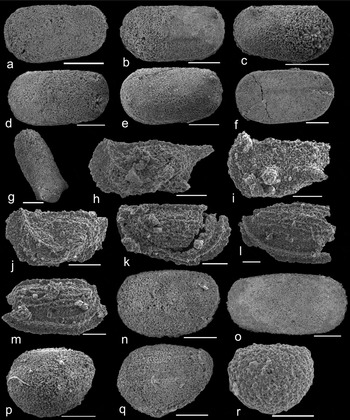
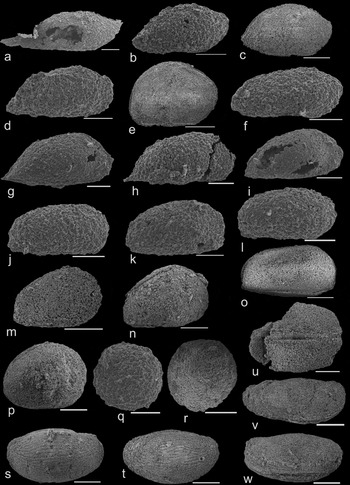
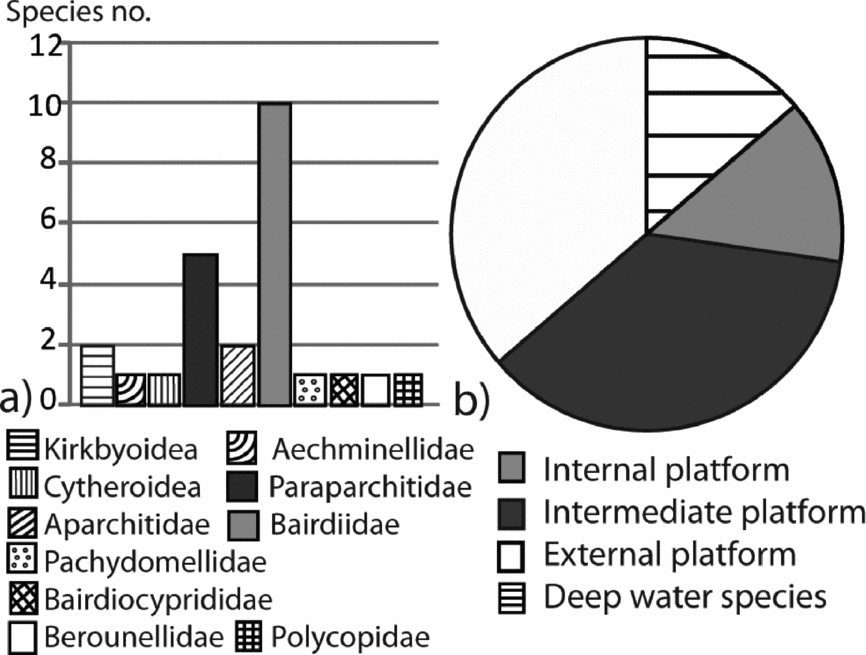
The E-Lert Formation ostracodes belong in three orders, four superfamilies, ten families, 16 genera and 23 species consisting of Bairdia, Cryptobairdia, Bairdiacypris?, Spinocypris, Baschkirina, Pseudobythocypris, Microcheilinella, Basslerella, Paraberounella, Cyathus, Paraparchites, Samarella, Shemonaella, Shivaella, Carinaknightina, Polycope, Aechminellidae? and Kirkbyiidae indet. (Figs 10–12). Among them, Shivaella elertensis Chitnarin sp. nov. is newly described (Figs 10, 11). The ostracode fauna is found in field sample EL-1103. Ostracodes and conodonts are absent from EL-1104 and EL-1105 (Fig. 4).
Ostracodes from the E-Lert Formation. All ostracode specimens are deposited in the Suranaree University of Technology collections (Nakhon Ratchasima, Thailand). (a–g) Shivaella elertensis Chitnarin sp. nov. (see Fig. 11): (a) holotype, left lateral view of the complete carapace, SUT-12-036; (b) paratype, left lateral view of the complete carapace, SUT-12-037; (c) paratype, right lateral view of the complete carapace, SUT-12-038; (d) left lateral view of the complete carapace, SUT-12-039; (e) left lateral view of the complete carapace, SUT-12-040; (f) left lateral view of the complete carapace, SUT-12-043; (g) dorsal view of the complete carapace, SUT-12-042; (h) Paraberounella sp., left lateral view of the complete carapace, SUT-12-052; (i) Aechminellidae? sp., left lateral view of the complete carapace, SUT-12-053; (j) Kirkbyidae indet. left lateral view of the complete carapace, SUT-12-054; (k–m) Carinaknightina sp. (k) left lateral view of the incomplete carapace, SUT-12-063; (l) left lateral view of the incomplete carapace, SUT-12-065; (m) left lateral view of the incomplete carapace, SUT-12-064; (n) Paraparchites sp.1, left lateral view of the complete carapace, SUT-12-072; (o) Paraparchites sp. 2, right lateral view of the complete carapace, SUT-12-058; (p, q) Samarella sp.; (p) left lateral view of the complete carapace, SUT-12-067; (q) left lateral view of the complete carapace, SUT-12-070; (r) Shemonaella sp., left lateral view of the complete carapace, SUT-12-073. Scale bars 100 μm.

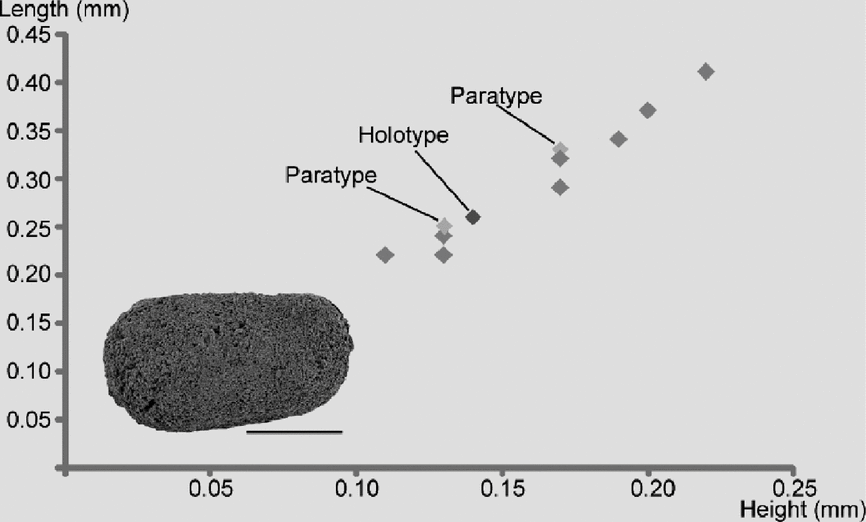
Relationship of height and length of Shivaella elertensis Chitnarin sp. nov.

Ostracodes from the E-Lert Formation. All ostracode specimens are deposited in the Suranaree University of Technology Collections (Nakhon Ratchasima, Thailand). (a) Bairdia sp. 1, right lateral view of the complete carapace, SUT-12-001; (b) B. sp. 2, right lateral view of the complete carapace, SUT-12-002; (c) B. sp. 3, right lateral view of the complete carapace, SUT-12-003; (d) B. sp. 4, right lateral view of the complete carapace, SUT-12-004; (e) Cryptobairdia sp., right lateral view of the complete carapace, SUT-12-005; (f) Bairdiacypris? sp., right lateral view of the complete carapace, SUT-12-006; (g–i) Spinocypris sp.: (g) right lateral view of the complete carapace, SUT-12-007; (h) right lateral view of the complete carapace, SUT-12-008; (i) right lateral view of the incomplete carapace, SUT-12-010; (j–l) Pseudobythocypris sp.; (j) right lateral view of the complete carapace, SUT-12-011; (k) right lateral view of the complete carapace, SUT-12-012; (l) right lateral view of the complete carapace, SUT-12-013; (m, n) Baschkirina sp. (m) right lateral view of the complete carapace, SUT-12-014; (n) right lateral view of the complete carapace, SUT-12-015; (o) Microcheilinella sp., right lateral view of the complete carapace, SUT-12-019; (p) Basslerella sp., right lateral view of the complete carapace, SUT-12-018; (q, r) Polycope sp. (q) left lateral view of the complete carapace, SUT-12-033; (r) left lateral view of the complete carapace, SUT-12-032; (s, t) Cyathus caperata Guan (Guan et al. Reference Guan, Sun, Jiang, Li, Zhao, Zhang, Yang and Feng1978); (s) left lateral view of the complete carapace, SUT-12-021; (t) left lateral view of the complete carapace, SUT-12-022; (u–w) Cyathus elliptica (Shi & Chen, Reference Shi and Chen1987); (u) dorsal view of the complete carapace, SUT-12-031; (v) right lateral view of the complete carapace, SUT-12-029; (w) left lateral view of the complete carapace, SUT-12-030. Scale bars 100 μm.

Class OSTRACODA Latreille, Reference Latreille1802
Order PALAEOCOPIDA Henningsmoen, Reference Hennigsmoen1953
Superfamily PARAPARCHITOIDEA Scott, Reference Scott1959
Family PARAPARCHITIDAE Scott, Reference Scott1959
Genus Shivaella Sohn, Reference Sohn1971
Type species. Shivaella suppetia Sohn, Reference Sohn1971
Shivaella elertensis Chitnarin sp. nov.
Figures 10a–g, 11
Etymology. From the E-Lert Formation.
Holotype. Complete carapace (Fig. 10a), SUT-12-036.
Paratypes. Complete carapace (Fig. 10b), SUT-12-037; complete carapace (Fig. 10c), SUT-12-038.
Material. 16 complete carapaces.
Type locality and horizon. 101°43′35″E, 17°18′29″N, Huai E-Lert Reservoir, Wang Saphung district, Loei province, northern Thailand. Upper Kungurian – Roadian. From field sample EL-1103.
Diagnosis. Species of Shivaella with elongate, subrectangular carapace, large and short posterodosal spines extruded below dorsal margin of both valves, 0.52<H/L<0.55.
Measurements. Height H = 0.11–0.22, length L = 0.22–0.41 mm.
Description. Carapace subrectangular, slightly preplete in lateral view; dorsal border straight and long; anterior border with large radius of curvature, maximum convexity located at mid-height; ventral border straight and long; posterior border with large radius of curvature, maximum convexity located at or just above mid-height; anterior border larger than posterior border in juveniles, posterior and anterior borders almost of the same size in adult specimens; anterior cardinal angle 145–155 degrees, posterior cardinal angle 140–150 degrees; short and large posterior spines extruded below dorsal margin of both valves; carapace slightly compressed laterally on the free margin; oval carapace with distinct posterior spines in dorsal view; carapace smooth.
Remarks. The newly described Shivaella elertensis has a smooth carapace without sulcus which suggests the family Paraparchitidae, and the presence of dorsoposterior spines on both valves fits the diagnosis of the genus (Sohn, Reference Sohn1971). Although the subrectangular carapace is not commonly found in this genus it discriminates this species from Shivaella sp. described from the Pennsylvanian–Cisuralian succession of Austria and S. cf. brazoensis (Coryell & Sample, Reference Coryell and Sample1932) from the Lopingian succession of Greece (Crasqin–Soleau & Baud, Reference Crasquin–Soleau and Baud1998). The carapace is slightly preplete in juveniles and more rectangular in adult specimens. The spines of S. elertensis are distinctively large and short, located in the postero-dorsal part of the valves and pointing to the back.
Genus Paraparchites Ulrich & Bassler, Reference Ulrich and Bassler1906
Type species. Paraparchites humerous Ulrich & Bassler, Reference Ulrich and Bassler1906.
Paraparchites sp. 1
Figure 10n
Paraparchites sp. 2
Figure 10o
Genus Shemonaella Sohn, Reference Sohn1971
Type species. Shemonaella dutroi Sohn, Reference Sohn1971.
Shemonaella sp.
Figure 10r
Genus Samarella Polenova, Reference Polenova1952
Type species. Samarella crassa Polenova, Reference Polenova1952.
Samarella sp.
Figure 10p, q
Superfamily KIRKBYOIDEA Ulrich & Bassler, Reference Ulrich and Bassler1906
Family KIRKBYIDAE Ulrich & Bassler, Reference Ulrich and Bassler1906
Genus Carinaknightina Sohn, Reference Sohn, Kummel and Teichert1970
Type species. Carinaknightina carinata Sohn, Reference Sohn, Kummel and Teichert1970.
Carinaknightina sp.
Figure 10k–m
Kirkbyidae indet.
Figure 10j
Remarks. This specimen resembles Nemoceratina sp. 2 sensu Bless (Reference Bless1987) which is found in the Cisuralian succession of Timor.
Family AECHMINELLIDAE Sohn, Reference Sohn1961
Aechminellidae? sp.
Figure 10i
Suborder BEYRICHICOPINA Scott, Reference Scott and Moore1961
Superfamily OEPILELLOIDEA Jaanusson, Reference Jaanusson1957
Family APARCHITIDAE Jones, Reference Jones1901
Genus Cyathus Roth & Skinner, Reference Roth and Skinner1930
Type species. Cyathus ulrichi Roth & Skinner, Reference Roth and Skinner1930
Cyathus caperata Guan (Guan et al. Reference Guan, Sun, Jiang, Li, Zhao, Zhang, Yang and Feng1978)
Figure 12s, t
1978 Sinocoelonella caperata Guan in Guan et al. Reference Guan, Sun, Jiang, Li, Zhao, Zhang, Yang and Feng1978, p. 149, plate 37, fig. 17; plate 38, fig. 1.
1986 Cyathus caperata (Guan); Chen & Bao, Reference Chen and Bao1986, p. 111, plate 4, fig. 3.
1987 Cyathus caperata (Guan); Shi & Chen, Reference Shi and Chen1987, p. 32, plate 10, figs 10–18.
2007 Cyathus caperata (Guan in Guan et al. Reference Guan, Sun, Jiang, Li, Zhao, Zhang, Yang and Feng1978); Yuan et al. Reference Yuan, Crasqin–Soleau, Feng and Gu2007, plate 1, fig. 15.
2010 Cyathus caperata (Guan in Guan et al. Reference Guan, Sun, Jiang, Li, Zhao, Zhang, Yang and Feng1978); Crasquin et al. Reference Crasquin, Forel, Feng, Yuan, Baudin and Collin2010, p. 332, fig. 3A–D.
2012 Cyathus caperata (Guan in Guan et al. Reference Guan, Sun, Jiang, Li, Zhao, Zhang, Yang and Feng1978); Chitnarin et al. Reference Chitnarin, Crasquin, Charoentitirat, Tepnarong and Thanee2012, p. 806, fig. 4A, B, D–E.
Remarks. Cyathus caperata has been reported from the Cisuralian succession of China (Guan et al. Reference Guan, Sun, Jiang, Li, Zhao, Zhang, Yang and Feng1978; Chen & Bao, Reference Chen and Bao1986), the Cisuralian–Guadalupian succession of central Thailand (Chitnarin et al. Reference Chitnarin, Crasquin, Charoentitirat, Tepnarong and Thanee2012) and in the Lopingian succession of China (Shi & Chen, Reference Shi and Chen1987; Yuan et al. Reference Yuan, Crasqin–Soleau, Feng and Gu2007; Crasquin et al. Reference Crasquin, Forel, Feng, Yuan, Baudin and Collin2010).
Cyathus elliptica Shi in Shi & Chen, Reference Shi and Chen1987
Figure 12u–w
1987 Cyathus elliptica Shi in Shi & Chen, Reference Shi and Chen1987, p. 32, plate 10, figs 20–23; plate 17, figs 5–6.
2010 Cyathus elliptica Shi in Shi & Chen, Reference Shi and Chen1987; Crasquin et al. Reference Crasquin, Forel, Feng, Yuan, Baudin and Collin2010, p. 334, fig. 3E–H.
2012 Cyathus elliptica Shi in Shi & Chen, Reference Shi and Chen1987: Chitnarin et al. Reference Chitnarin, Crasquin, Charoentitirat, Tepnarong and Thanee2012, p. 810, fig. 4C, F, G, J.
Remarks. C. elliptica has been reported from the Cisuralian–Guadalupian succession of central Thailand (Chitnarin et al. Reference Chitnarin, Crasquin, Charoentitirat, Tepnarong and Thanee2012) and the Lopingian Permian succession of China (Shi & Chen, Reference Shi and Chen1987; Crasquin et al. Reference Crasquin, Forel, Feng, Yuan, Baudin and Collin2010). E-Lert Formation specimens are small for the species.
Order PODOCOPIDA Müller, Reference Müller1894
Suborder PODOCOPINA Sars, Reference Sars1866
Superfamily BAIRDIOIDEA Sars, Reference Sars1888
Family BAIRDIIDAE Sars, Reference Sars1888
Genus Bairdia McCoy, Reference McCoy1844
Type species. Bairdia curtus McCoy, Reference McCoy1844.
Bairdia sp.1
Figure 12a
Bairdia sp. 2
Figure 12b
Bairdia sp. 3
Figure 12c
Bairdia sp. 4
Figure 12d
Genus Cryptobairdia Sohn, Reference Sohn1960
Type species. Cryptobairdia ventricosa Roth & Skinner, Reference Roth and Skinner1930
Cryptobairdia sp.
Figure 12e
Genus Bairdiacypris Bradfield, Reference Bradfield1935
Type species. Bairdiacypris deloi Bradfield, Reference Bradfield1935.
Bairdiacypris? sp.
Figure 12f
Genus Spinocypris Kozur, Reference Kozur1971
Type species. Spinocypris vulgaris Kozur, Reference Kozur1971
Spinocypris sp.
Figure 12g, h, i
Remarks. Spinocypris has been reported from the uppermost Permian succession of Saudi Arabia and China (Crasquin–Soleau, Vaslet & Le Nindre, Reference Crasquin–Soleau, Vaslet and Le Nindre2005; Crasquin, Carcione & Martini, Reference Crasquin–Soleau and Baud2008; Forel, Reference Forel2012) and from the Triassic succession of Hungary, Romania, Tibet and Turkey (Monostori, Reference Monostori1994; Crasquin–Soleau & Gradinaru, Reference Crasquin–Soleau and Gradinaru1996; Kozur et al. Reference Kozur, Aydin, Demir, Yakar, Goncuoglu and Kuru2000; Crasquin–Soleau et al. Reference Crasquin-Soleau, Galfetti, Bucher and Brayard2006; Forel & Crasquin, Reference Forel and Crasquin2011). This is the first report of the genus in the late Kungurian or Roadian.
Family BAIRDIOCYPRIDIDAE Shaver, Reference Shaver and Moore1961
Genus Baschkirina Rozdestvenskaja, Reference Rozdestvenskaja1959
Type species. Baschkirina memorabilis Rozdestvenskaja, Reference Rozdestvenskaja1959
Baschkirina sp.
Figure 12m, n
Family PACHYDOMELLIDAE Berdan & Sohn, Reference Berdan, Sohn and Moore1961
Genus Microcheilinella Geis, Reference Geis1933
Type species. Microcheilus distortus Geis, Reference Geis1932.
Microcheilinella sp.
Figure 12o
Family CYTHERIDEIDAE Sars, Reference Sars1922–1928
Genus Basslerella Kellett, Reference Kellett1935
Type species. Basslerella crassa Kellett, Reference Kellett1935
Basslerella sp.
Figure 12p
Family BEROUNELLIDAE Sohn & Berdan, Reference Sohn1960
Genus Paraberounella Blumenstengel, Reference Blumenstengel1965
Type species. Paraberounella lobella Blumenstengel, Reference Blumenstengel1965.
Paraberounella sp.
Figure 10h
Remarks. Paraberounella is known from Guadalupian–Lopingian deep-water facies in Sicily, Italy (Kozur, Reference Kozur1991; Crasquin, Carcione & Martini, Reference Crasquin, Carcione and Martini2008) and south China (Yuan et al. Reference Yuan, Crasqin–Soleau, Feng and Gu2007).
Order MYODOCOPIDA Sars, Reference Sars1866
Suborder CLADOCOPINA Sars, Reference Sars1866
Family POLYCOPIDAE Sars, Reference Sars1866
Genus Polycope Sars, Reference Sars1866
Type species. Polycope orbicularis Sars, Reference Sars1866.
Polycope sp.
Figure 12q, r
3.c. Radiolarians
Class ACTINOPODA
Subclass RADIOLARIA Müller, Reference Müller1858
Superorder POLYCYSTIDA Ehrenberg, Reference Ehrenberg1838, emend. Riedel, Reference Riedel, Harland, Holland and House1967
Order ALBAILLELLARIA Deflandre, Reference Deflandre and Grasse1953, emend. Holdsworth, Reference Holdsworth1969
Family ALBAILLELLIDAE Deflandre, Reference Deflandre1952, emend. Holdsworth, Reference Holdsworth and Swain1977
Genus Albaillella Deflandre, Reference Deflandre1952; emend. Holdsworth, Reference Holdsworth1966; emend. Ormiston & Lane, Reference Ormiston and Lane1976
Type species. Albaillella paradoxa Deflandre, Reference Deflandre1952
Albaillella asymmetrica Ishiga & Imoto, Reference Ishiga and Imoto1980
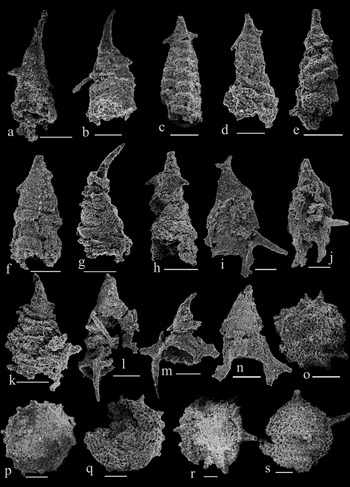
Figure 13a–h
1980 Albaillella sp. B. Ishiga & Imoto, Reference Ishiga and Imoto1980, plate 5, figs 6–10.
Radiolarians from the E-Lert Fm. (a–h) Albaillella asymmetrica Ishiga & Imoto, PRC 160–167; (i–n) Albaillella sinuata Ishiga & Watase, PRC 168–173; (o–s) Copicyntra spp., PRC 174–178. Scale bars 50 μm.

1982 Albaillella asymmetrica Ishiga & Imoto in Ishiga, Kito & Imoto, Reference Ishiga, Kito and Imoto1982, plate 3, figs 3–11.
1984 Albaillella asymmetrica Ishiga & Imoto, Reference Ishiga and Imoto1980; Ishiga & Suzuki, Reference Ishiga and Suzuki1984, plate 1, figs 9, 10, 12–15.
1986 Albaillella asymmetrica Ishiga & Imoto, Reference Ishiga and Imoto1980; Ishiga, Watase & Naka, Reference Ishiga, Watase and Naka1986, plate 1, figs 9–15.
1992 Albaillella asymmetrica Ishiga & Imoto, Reference Ishiga and Imoto1980; Blome & Reed, Reference Blome and Reed1992, figs 9.1–9.5.
1997 Albaillella asymmetrica Ishiga & Imoto, Reference Ishiga and Imoto1980; Miyamoto, Kuwazuru & Okimura, Reference Miyamoto, Kuwazuru and Okimura1997, plate 2, figs 7–11.
1998 Albaillella asymmetrica Ishiga & Imoto, Reference Ishiga and Imoto1980; Xian & Zhang, Reference Xian and Zhang1998, plate 1, figs 8–11.
2010 Albaillella asymmetrica Ishiga & Imoto, Reference Ishiga and Imoto1980; Zhang et al. Reference Zhang, Henderson, Xia, Wang and Shang2010, fig. 5S, T.
Remarks. Our specimens show the main parts of the shell; the apical cone, pseudothorax and pseudoabdomen as described in Ishiga, Kito & Imoto, Reference Ishiga, Kito and Imoto1982. The apical cone curves slightly toward the ventral side and is distally tapered into a spine. It has a flattened pseudothorax with two asymmetrical wings and the pseudoabdomen is long, flattened and traversed by 7 or more horizontal bands with a lattice–like framework.
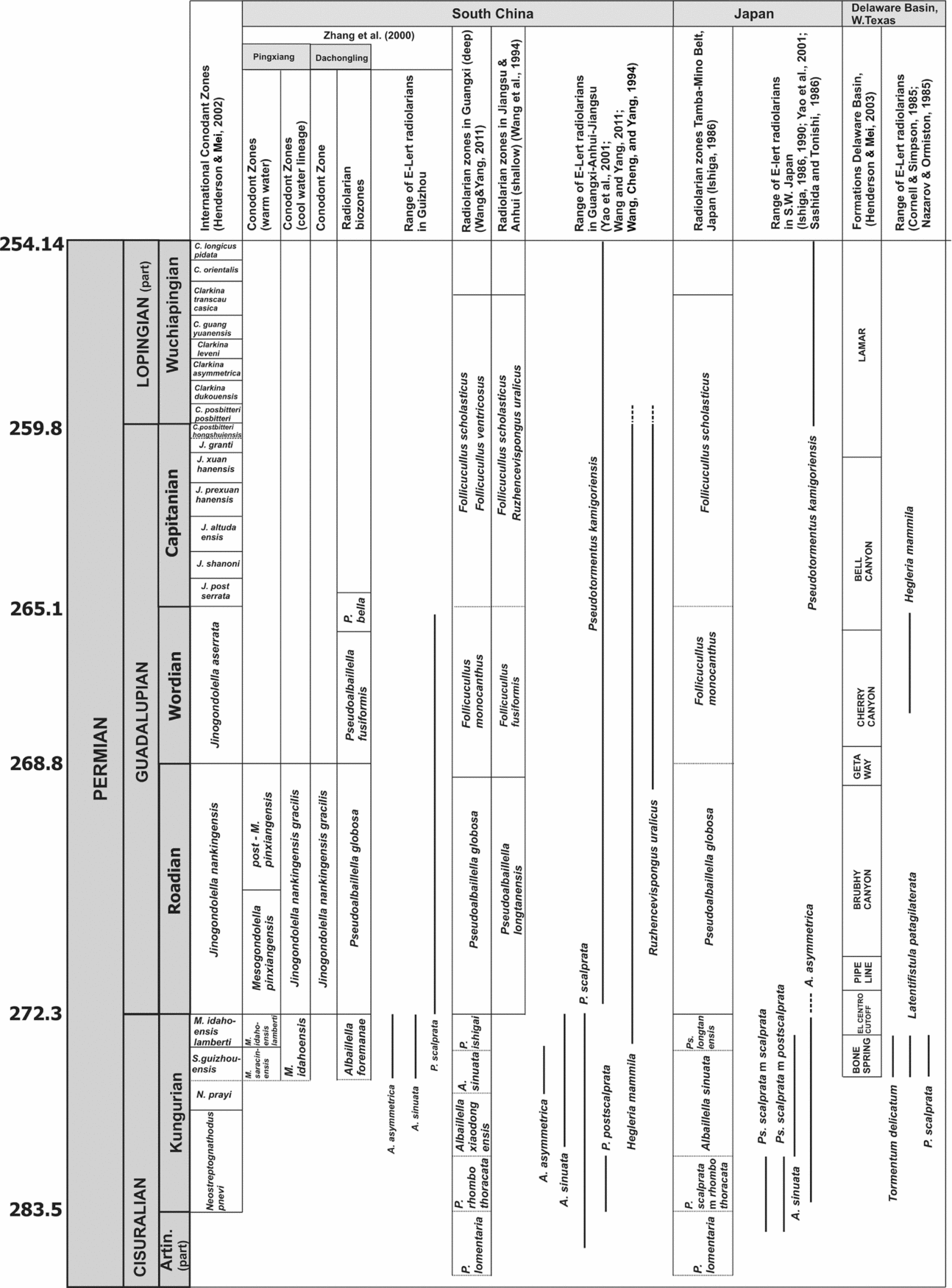
Range. Cisuralian–Guadalupian (approximately Kungurian – lower Roadian).
Occurrence. Japan, west United States, south China and NE Thailand (sample no. EL-1004, EL-1005 from E-Lert section).
Albaillella sinuata Ishiga & Watase in Ishiga, Watase & Naka, Reference Ishiga, Watase and Naka1986
Figure 13i–n
1982 Albaillella sp. D. Ishiga, Kito & Imoto, Reference Ishiga, Kito and Imoto1982, plate 1, figs 17, 18.
1984 Albaillella sp. D. Ishiga, Kito & Imoto, Reference Ishiga, Kito and Imoto1982; Ishiga & Suzuki, Reference Ishiga and Suzuki1984, plate 1, figs 1–8, 11.
1986 Albaillella sinuata Ishiga & Watase in Ishiga, Watase & Naka, Reference Ishiga, Watase and Naka1986, plate 1, figs 1–8.
1992 Albaillella sinuata Ishiga & Watase in Ishiga, Watase & Naka, Reference Ishiga, Watase and Naka1986; Blome & Reed, Reference Blome and Reed1992, plate 9, figs 6–9.
1994 Albaillella sinuata Ishiga & Watase in Ishiga, Watase & Naka, Reference Ishiga, Watase and Naka1986; Wang, Cheng & Yang, Reference Wang, Cheng and Yang1994, plate 2, figs 13, 14.
1998 Albaillella sinuata Ishiga & Watase in Ishiga, Watase & Naka, Reference Ishiga, Watase and Naka1986; Xian & Zhang, Reference Xian and Zhang1998, plate 1, figs 1–4.
2009 Albaillella sp. cf. A. sinuata Ishiga & Watase; Saesaengseerung et al. Reference Saesaengseerung, Agematsu, Sashida and Sardsud2009, figs 7.18, 7.19.
2010 Albaillella sinuata Ishiga & Watase in Ishiga, Watase & Naka, Reference Ishiga, Watase and Naka1986; Zhang et al. Reference Zhang, Henderson, Xia, Wang and Shang2010, fig. 5R.
Remarks. The shell is conical with slightly oblique segments. Shell apex curves to the ventral side. Two rod-like wings extend horizontally from both dorsal and ventral sides and protrude vertically downwards in the lower wing.
Range. Kungurian – lowermost Roadian.
Occurrence. Japan, western North America, China, east and NE Thailand (sample no. EL-1004, EL-1005 from E-Lert section).
Family FOLLICUCULLIDAE Ormiston & Babcock, Reference Ormiston and Babcock1979
Genus Pseudoalbaillella Holdsworth & Jones, Reference Holdsworth and Jones1980
Type species. Pseudoalbaillella scalprata Holdsworth & Jones, Reference Holdsworth and Jones1980
Pseudoalbaillella scalprata Holdsworth & Jones, Reference Holdsworth and Jones1980, Morphotype postscalprata Ishiga, Reference Ishiga1983
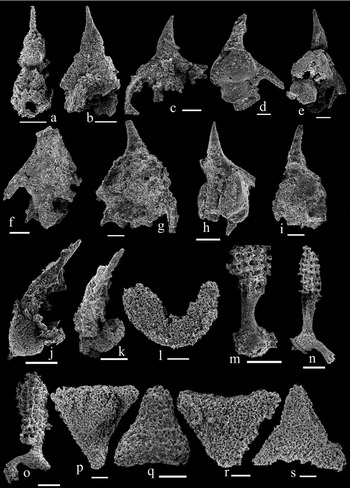
Figure 14t, u
1980 Pseudoalbaillella scalprata Holdsworth & Jones, Reference Holdsworth and Jones1980 morphotype postscalprata Ishiga, Reference Ishiga1983, plate 2, figs 1–16.
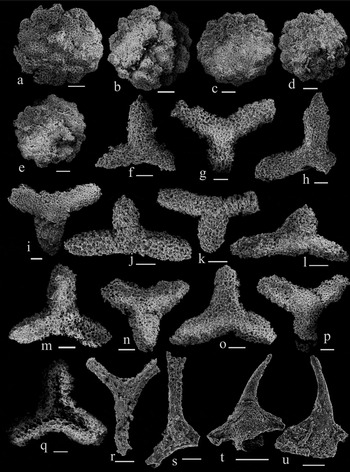
Radiolarians from the E-Lert Formation. (a–e) Hegleria mamilla (Sheng & Wang), PRC 179–183; (f–h) Latentifustula patagilaterala Nazarov & Ormiston, PRC 184–186; (i–l) Latentifustula sp. cf. L. patagilaterala Nazarov & Ormiston, PRC 187–190; (m–q) Latentifustula crux Nazarov & Ormiston, PRC 191–195; (r) Latentifustula sp. cf. L. triacanthophora Nazarov & Ormiston, PRC 196; (s) Latentifustula sp, PRC 197; (t, u) Pseudoalbaillella scalprata m. postscalprata Ishiga, PRC 198–199. Scale bars 50 μm.

1992 Pseudoalbaillella scalprata Holdsworth & Jones, Reference Holdsworth and Jones1980 morphotype postscalprata Ishiga, Reference Ishiga1983; Blome & Reed, Reference Blome and Reed1992, figs 10.13–10.17.
1997 Pseudoalbaillella scalprata Holdsworth & Jones, Reference Holdsworth and Jones1980 morphotype postscalprata Ishiga, Reference Ishiga1983; Miyamoto, Kuwazuru & Okimura, Reference Miyamoto, Kuwazuru and Okimura1997, plate 1, figs 4–6.
Remarks. This morphotype differs from Ps. scalprata m. scalprata by having a more rhombohedral pseudothorax and a longer pseudoabdomen than the latter.
Range. Cisuralian (middle–upper Wolfcampian).
Occurrence. Japan, west United States and NE Thailand (sample no. EL-1004, EL-1005 from the E-Lert section)
Pseudoalbaillella scalprata Holdsworth and Jones, Reference Holdsworth and Jones1980, Morphotype scalprata Ishiga, Reference Ishiga1983
Figure 15c, i
1980 Pseudoalbaillella scalprata Holdsworth & Jones, Reference Holdsworth and Jones1980, p. 284, appendix fig. 1A, B.
Radiolarians from the E-Lert Fm. (a–b) Pseudoalbaillella sp, PRC 200–201; (c–i) Pseudoalbaillella scalprata m. scalprata Ishiga, PRC 202–208; (j–l) Pseudoalbaillella sp. cf. Ps. u-forma m l (Ishiga et al.), PRC 209–211; (m–o) Pseudotormentus kamigoriensis De Wever & Caridroit, PRC 212–214; (p–s) Ruzhencevispongus uralicus Kozur, PRC 215–218. Scale bars 50 μm.

1980 Pseudoalbaillella sp. cf. Ps. scalprata Holdsworth & Jones Reference Holdsworth and Jones1980, plate 2, figs 4–8.
1982 Pseudoalbaillella scalprata Holdsworth & Jones, Reference Holdsworth and Jones1980; Ishiga, Kito & Imoto, Reference Ishiga, Kito and Imoto1982, plate 1, figs 11, 12;
1983 Pseudoalbaillella scalprata Holdsworth & Jones morphotype scalprata; Ishiga, Reference Ishiga1983, plate 1, figs 1–18.
1984 Pseudoalbaillella sp. aff. Ps. scalprata Holdsworth & Jones; Ishiga et al. Reference Ishiga, Imoto, Yoshida and Tanabe1984, plate 1, figs 4–8.
1985 Pseudoalbaillella scalprata Holdsworth & Jones, Reference Holdsworth and Jones1980; Ishida, Reference Ishida1985, plate 1, figs 7–9.
1985 Pseudoalbaillella scalprata Holdsworth & Jones, Reference Holdsworth and Jones1980; Sheng & Wang, Reference Sheng and Wang1985, plate 2, figs 9–12.
1985 Pseudoalbaillella scalprata Holdsworth & Jones, Reference Holdsworth and Jones1980; Yoshida & Murata, Reference Yoshida and Murata1985, plate 1, figs 8, 9.
1985 Pseudoalbaillella scalprata Holdsworth & Jones, Reference Holdsworth and Jones1980; Cornell & Simpson, Reference Cornell and Simpson1985, plate 1, fig. 5.
1992 Pseudoalbaillella scalprata Holdsworth & Jones morphotype scalprata; Blome & Reed, Reference Blome and Reed1992, figs 10.19–10.21.
1993 Pseudoalbaillella scalprata Holdsworth & Jones, Reference Holdsworth and Jones1980; Nazarov & Ormiston, Reference Nazarov, Ormiston, Blueford and Murchey1993, plate 7, fig. 10.
1994 Pseudoalbaillella scalprata Holdsworth & Jones, Reference Holdsworth and Jones1980; Wang, Cheng & Yang, Reference Wang, Ritter and Clark1994, p. 182, plate 1, figs 20–22.
1996 Pseudoalbaillella scalprata Holdsworth & Jones morphotype scalprata; Spiller, Reference Spiller1996, plate 3, figs 6, 7.
1998 Pseudoalbaillella scalprata Holdsworth & Jones, Reference Holdsworth and Jones1980; Sashida et al. Reference Sashida, Igo, Adachi, Ueno, Nakornsri and Sardsud1998, p. 13, figs 11–13.
2009 Pseudoalbaillella scalprata Holdsworth & Jones morphotype scalprata; Saesaengseerung et al. Reference Saesaengseerung, Agematsu, Sashida and Sardsud2009, figs 7.28, 7.29.
2011 Pseudoalbaillella scalprata Holdsworth & Jones morphotype scalprata; Jasin & Harun, Reference Jasin and Harun2011, plate 4, fig. 4.
Remarks. The illustrated specimens of Pseudoalbaillella scalprata by Ishiga (Reference Ishiga1983) show a rather wide variation in the length of the apical horn and pseudoabdomen and the angle between the two shoulders. Our specimens clearly show the diagnostic features of this species in having a small and slightly curved apical horn. The pseudothorax is subglobular with two slightly flattened wings. A pseudoabdomen with two flaps extends downwards.
Range. Cisuralian (approximately middle–upper Wolfcampian).
Occurrence. Japan, west Texas, Oregon, China, peninsular Malaysia, north and east Thailand (eastern seaboard) and NE Thailand (Isarn region) (sample no. EL-1004, EL-1005 from E-Lert section).
Pseudoalbaillella sp.
Figure 15a, b
Remarks. The specimens are not well-preserved. The test consists of a relatively large cone with a rod-like apical cone. The pseudothorax is inflated and spherical in outline. The pseudoabdomen is inflated, long and cylindrical. There is a constriction between the pseudoabdomen and the pseudothorax.
Range. Upper Kungurian or lower Roadian.
Occurrence. NE Thailand (sample no. EL-1004, EL-1005 from E-Lert section).
Pseudoalbaillella sp. cf. Ps. u-forma Holdsworth & Jones, Reference Holdsworth and Jones1980, morphotype I (Ishiga et al. Reference Ishiga, Imoto, Yoshida and Tanabe1984)
Figure 15j, k, l
1980 Pseudoalbaillella u-forma Holdsworth & Jones, Reference Holdsworth and Jones1980, fig. 1C.
1980 Pseudoalbaillella u-forma Holdsworth & Jones, Reference Holdsworth and Jones1980; Ishiga & Imoto, Reference Ishiga and Imoto1980, plate 1, fig. 1.
1982 Pseudoalbaillella sp. aff. Ps. u-forma; Ishiga, Reference Ishiga1982, plate 1, figs 18, 19.
1984 Pseudoalbaillella u-forma Holdsworth & Jones morphotype I; Ishiga et al. Reference Ishiga, Imoto, Yoshida and Tanabe1984, plate 1, figs 1–4.
2009 Parafollicucullus u-formus (Holdsworth & Jones) morphotype I; Saesaengseerung et al. Reference Saesaengseerung, Agematsu, Sashida and Sardsud2009, figs 7.8, 7.9.
Remarks. The examined specimens are broken and poorly preserved. They resemble Pseudoalbaillella u-forma (Holdsworth & Jones) morphotype I, in having a slender apical cone, small pseudothorax and a U-shaped pseudoabdomen.
Range. Upper Kungurian – lower Roadian.
Occurrence. NE Thailand (sample no. EL-1005 from E-Lert section).
Order LATENTIFISTULARIA Caridroit, De Wever & Dumitrica, Reference Caridroit, De Wever and Dumitrica1999
Superfamily RUZHENCEVISPONGACEA Kozur, Reference Kozur1980
Family LATENTIFISTULIDAE Nazarov & Ormiston, Reference Nazarov and Ormiston1983
Genus Latentifistula Nazarov & Ormiston, Reference Nazarov and Ormiston1983
Type species: Latentifistula crux Nazarov & Ormiston, Reference Nazarov and Ormiston1983
Latentifistula crux Nazarov & Ormiston, Reference Nazarov and Ormiston1983
Figure 14m–q
1983 Latentifistula crux Nazarov & Ormiston, Reference Nazarov and Ormiston1983, plate 1, fig. 1.
1985 Latentifistula crux Nazarov & Ormiston, Reference Nazarov and Ormiston1983; Nazarov & Ormiston, Reference Nazarov and Ormiston1985, plate 3, fig. 6.
1992 Latentifistula sp. aff. L. crux; Blome & Reed, Reference Blome and Reed1992, figs 13.2–13.5.
2006 Latentifistula crux Nazarov & Ormiston, Reference Nazarov and Ormiston1983; Feng et al. Reference Feng, He, Zhang and Gu2006, figs 6.1, 6.2.
2009 Latentifistula crux Nazarov & Ormiston, Reference Nazarov and Ormiston1983; Saesaengseerung et al. Reference Saesaengseerung, Agematsu, Sashida and Sardsud2009, figs 8.1, 8.2.
Remarks. This species is distinguished from other species of this genus by its small size, spongy layer and short, thick rays.
Range. Lower Asselian (according to Nazarov & Ormiston, Reference Nazarov and Ormiston1985) – Lopingian.
Occurrence. Urals, Oregon, Texas, south China, east and NE Thailand (sample no. EL-1004 to EL-1008 from E-Lert section).
Latentifistula patagilaterala Nazarov & Ormiston, Reference Nazarov and Ormiston1985 Figure 14f, g, h
1985 Latentifistula patagilaterala Nazarov & Ormiston, Reference Nazarov and Ormiston1985, plate 4, fig. 1.
1992 Latentifistula patagilaterala Nazarov & Ormiston, Reference Nazarov and Ormiston1985; Blome & Reed, Reference Blome and Reed1992, fig. 13.8.
1995 Latentifistula patagilaterala Nazarov & Ormiston, Reference Nazarov and Ormiston1985; Wang & Qi, Reference Wang and Qi1995, plate 4, figs 4–6.
1997 Latentifistula patagilaterala Nazarov & Ormiston, Reference Nazarov and Ormiston1985; Jasin & Ali, Reference Jasin and Ali1997, plate 1, fig. 1.
2009 Latentifistula patagilaterala Nazarov & Ormiston, Reference Nazarov and Ormiston1985; Saesaengseerung et al. Reference Saesaengseerung, Agematsu, Sashida and Sardsud2009, fig. 8.4.
Remarks. This species differs from Latentifistula crux by being larger and by having triradiate, slender spongy arms. The arms are the same size and shape. The rays of the arms expand slightly from the point of junction and have a lanceolate terminus.
Range. Upper Kungurian.
Occurrence. Urals, Oregon, Texas, south China, Malaysia, east and NE Thailand (sample no. EL-1004 to EL-1008 from the E-Lert section).
Latentifistula sp.
Figure 14s
Remarks. The frame pattern of these specifically indeterminable specimens is characterized by having a latticed shell with pores arranged in radial lines on the arms. Although our specimens are incompletely preserved, they are tentatively included in the genus Latentifistula because of its diagnostic latticed shell.
Range. Cisuralian.
Occurrence. NE Thailand (sample no. EL-1003 to EL-1009 from the E-Lert section).
Latentifistula sp. cf. L. patagilaterala Nazarov & Ormiston, Reference Nazarov and Ormiston1985
Figure 14i–l
Remarks. Several specimens were examined. These illustrated forms are characterized in having a coarse spongy shell with three long, slender, cylindrical arms. These specimens differ from Latentifistula patagilaterala by having unequal angles between the three arms. One straight arm is arranged perpendicular to the other two arms. Length and size of the specimens are variable.
Range. Cisuralian–Roadian.
Occurrence. NE Thailand (sample no. EL-1004 to EL-1006 from the E-Lert section).
Genus Latentibifistula Nazarov & Ormiston, Reference Nazarov and Ormiston1983
Type species: Latentibifistula triacanthophora Nazarov & Ormiston, Reference Nazarov and Ormiston1983
Latentibifistula sp. cf. L. triacanthophora Nazarov & Ormiston, Reference Nazarov and Ormiston1983
Figure 14r
1983 Latentibifistula triacanthophora Nazarov & Ormiston, Reference Nazarov and Ormiston1983, plate 1, figs 4, 5.
1985 Latentibifistula triacanthophora Nazarov & Ormiston, Reference Nazarov and Ormiston1983; Nazarov & Ormiston, Reference Nazarov and Ormiston1985, plate 3, figs 12–14.
1993 Latentibifistula triacanthophora Nazarov & Ormiston, Reference Nazarov and Ormiston1983; Caridroit, Reference Caridroit and Thanasuthipitak1993, plate 3, fig. 11.
1997 Latentibifistula triacanthophora Nazarov & Ormiston, Reference Nazarov and Ormiston1983; Jasin & Ali, Reference Jasin and Ali1997, plate 2, figs 3, 4.
Remarks. Our specimens resemble those illustrated by Nazarov & Ormiston (Reference Nazarov and Ormiston1983, Reference Nazarov and Ormiston1985) except that the narrow depression along the whole length of the arms is not visible and the outer spongy layer is not well preserved.
Range. Cisuralian–Roadian.
Occurrence. NE Thailand (sample no. EL-1004, EL-1005 from the E-Lert section).
Genus Tetratormentum Nazarov & Ormiston, Reference Nazarov and Ormiston1985
Type species. Tetratormentum narthecium Nazarov & Ormiston, Reference Nazarov and Ormiston1985
Tetratormentum? sp.
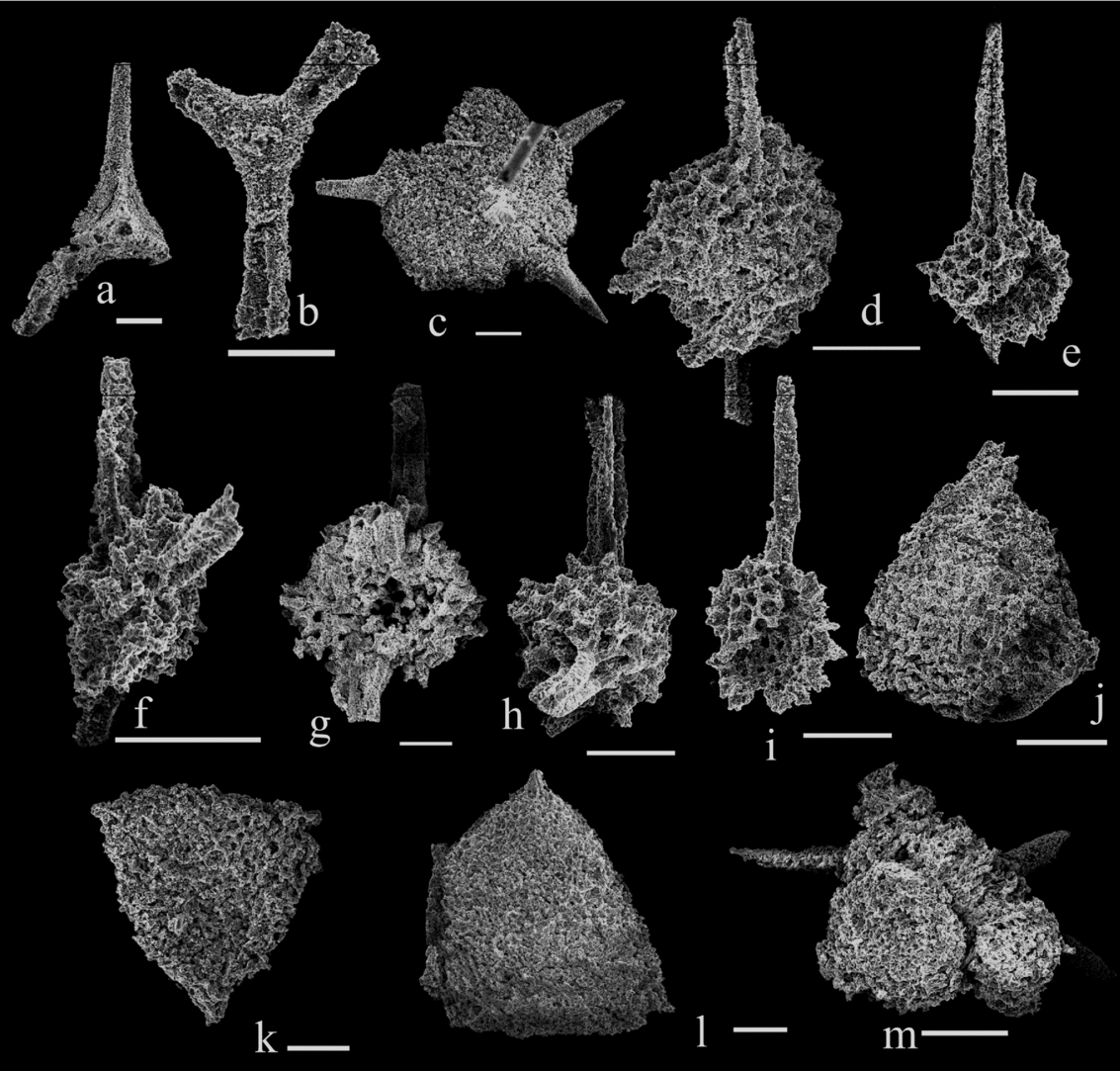
Figure 16m
Remarks. The examined specimens are tentatively assigned to Tetratormentum based on their diagnostic outline features. The outer spongy pyramid-like shell is rather large and distorted with conical terminal spines. The internal structure of the shell is not visible.
Radiolarians from the E-Lert Formation. (a, b) Raciditor spp. PRC 219–220; (c) Spumellaria gen et sp. indet., sp. A, PRC 221; (d–i) Stigmosphaerostylus sp. cf. St. itsukaichiensis (Sashida & Tonishi), PRC 222–227; (j–l) Tormentum delicatum Nazarov & Ormiston. PRC 228–231; (m) Tetratormentum? sp., PRC 231. Scale bars 50 μm.

Range. Cisuralian–Roadian.
Occurrence. NE Thailand (sample no. EL-1005 from E-Lert section).
Family RUZHENCEVISPONGIDAE Kozur, Reference Kozur1980
Genus Pseudotormentus De Wever & Caridroit, Reference De Wever and Caridroit1984
Type species. Pseudotormentus kamigoriensis De Wever & Caridroit, Reference De Wever and Caridroit1984
Pseudotormentus kamigoriensis De Wever & Caridroit, Reference De Wever and Caridroit1984
Figure 15m–o
1984 Pseudotormentus kamigoriensis De Wever & Caridroit, Reference De Wever and Caridroit1984, plate 2, figs 1–7.
1984 Nazarovispongus (?) sp. A. Ishiga & Suzuki, Reference Ishiga and Suzuki1984, plate 1, fig. 21.
1985 Pseudotormentus kamigoriensis De Wever & Caridroit, Reference De Wever and Caridroit1984; Ishiga, Reference Ishiga1985, plate 2, figs 20, 21.
1986 Pseudotormentus kamigoriensis De Wever & Caridroit, Reference De Wever and Caridroit1984; Caridroit & De Wever Reference Caridroit and De Wever1986, plate 5, figs 7–11.
1986 Pseudotormentus cf. P. kamigoriensis Sashida & Tonishi, Reference Sashida and Tonishi1986, plate 4, figs 8, 9.
1986 Pseudotormentus sp. Ishiga, Watase & Naka, Reference Ishiga, Watase and Naka1986, plate 3, figs 8, 9.
1987 Nazarovella sp. Nishimura & Ishiga, Reference Nishimura and Ishiga1987, plate 4, figs 8–10.
1992 Pseudotormentus kamigoriensis De Wever & Caridroit, Reference De Wever and Caridroit1984; Blome & Reed, Reference Blome and Reed1992, plate 12, figs 13–18, 21.
1993 Latentibifistula kamigoriensis Caridroit, Reference Caridroit and Thanasuthipitak1993, plate 1, fig. 11.
1994 Pseudotormentus kamigoriensis De Wever & Caridroit, Reference De Wever and Caridroit1984; Wang, Cheng & Yang, Reference Wang, Cheng and Yang1994, plate 3, fig. 22.
2011 Pseudotormentus kamigoriensis De Wever & Caridroit, Reference De Wever and Caridroit1984; Nakae, Reference Nakae2011, figs 7.9–7.13.
Remarks. The main characteristics of this species are a Y-shaped arm structure and a slightly spherical central portion of the test. The length of the smooth proximal parts and the lattice pore arrangement of each arm are variable. All arms narrower distally and arm spines are present.
Range. Guadalupian–Lopingian.
Occurrence. SW Japan, North America, south China, north and NE Thailand (sample no. EL-1004, EL-1005 from E-Lert section).
Genus Ruzhencevispongus Kozur, Reference Kozur1980
Type species.Ruzhencevispongus uralicus Kozur, Reference Kozur1980
Ruzhencevispongus uralicus Kozur, Reference Kozur1980
Figure 15p–s
1980 Ruzhencevispongus uralicus Kozur, Reference Kozur1980, plate 1, figs 1, 2.
1991 Ruzhencevispongus uralicus Kozur, Reference Kozur1980; Wang, Reference Wang1991, plate 4, fig. 3.
1994 Ruzhencevispongus uralicus Kozur, Reference Kozur1980; Wang, Cheng & Yang, Reference Wang, Cheng and Yang1994, plate 3, fig. 19.
1997 Ruzhencevispongus uralicus Kozur, Reference Kozur1980; Jasin & Ali, Reference Jasin and Ali1997, plate 1, fig. 12.
1998 Ruzhencevispongus uralicus Kozur, Reference Kozur1980; Xian & Zhang, Reference Xian and Zhang1998, plate 4, figs 17–20.
2006 Ruzhencevispongus uralicus Kozur, Reference Kozur1980; Feng et al. Reference Feng, He, Zhang and Gu2006, figs 6.3–6.5.
Remarks. The specimens illustrated here can be compared with Ruzhencevispongus uralicus from the Cisuralian succession of the Urals in both outline and structure.
Range. Cisuralian (Kungurian according to Kozur, Reference Kozur1980) – Lopingian.
Occurrence. Urals, south China, Peninsular Malaysia and NE Thailand (sample no. EL-1004, EL-1005 from E-Lert section).
Genus Tormentum Nazarov & Ormiston, Reference Nazarov and Ormiston1983
Type species.Tormentum proteri Nazarov & Ormiston, Reference Nazarov and Ormiston1983
Tormentum delicatum Nazarov & Ormiston, Reference Nazarov and Ormiston1985
Figure 16j–l
1985 Tormentum delicatum Nazarov & Ormiston, Reference Nazarov and Ormiston1985, plate 5, figs 4, 5.
1997 Tormentum delicatum Nazarov & Ormiston, Reference Nazarov and Ormiston1985; Jasin and Ali, Reference Jasin and Ali1997, plate 2, figs 11, 12.
Remarks. The shell is inflated and subtriangular to triangular in outline. The outer surface is spongy with three short terminal spines. Our specimens are similar to those illustrated by Nazarov & Ormiston (Reference Nazarov and Ormiston1985).
Range. Upper Kungurian.
Occurrence. Urals, Peninsular Malaysia and NE Thailand (sample no. EL-1004, EL-1005 from the E-Lert section).
Family ORMISTONELLIDAE De Wever and Caridroit, Reference De Wever and Caridroit1984
Genus Raciditor Sugiyama, Reference Sugiyama2000
Type species. Raciditor gracilis (De Wever & Caridroit, Reference De Wever and Caridroit1984) = Nazarovella gracilis De Wever & Caridroit, Reference De Wever and Caridroit1984
Raciditor sp.
Figure 16a, b
Remarks. The specimens exhibit an inflated shell and four arms disposed tetrahedrally. The fourth arm is usually rotated and slightly perpendicular to the plane of the other arms. Our specimens resemble Raciditor inflata (Sashida & Tonishi) except that they show less expansion of the tetrahedron shell.
Range. Cisuralian–Roadian.
Occurrence. NE Thailand (sample no. EL-1004, EL-1005 from E-Lert section).
Order ENTACTINARIA Kozur & Mostler, Reference Kozur and Mostler1982
Family ENTACTINIIDAE Riedel, Reference Riedel, Harland, Holland and House1967, emend. Nazarov, Reference Nazarov1975
Genus Stigmosphaerostylus Rüst, Reference Rüst1892, emend. Foreman, Reference Foreman1963
Type species: Stigmosphaerostylus notabilis Rüst, Reference Rüst1892
Stigmosphaerostylus sp. cf. St. itsukaichiensis (Sashida & Tonishi, Reference Sashida and Tonishi1985)
Figure 16d, i
1985 Entactinia itsukaichiensis Sashida & Tonishi, Reference Sashida and Tonishi1985, plate 1, figs 1–10.
1987 Unnamed entactinid, Nishimura & Ishiga, Reference Nishimura and Ishiga1987, plate 4, figs 12, 13.
1990 Entactinia itsukaichiensis Sashida & Tonishi, Reference Sashida and Tonishi1985; Ishiga, Reference Ishiga, Ichikawa, Mizutani, Hara, Hada and Yao1990, plate 1, fig. 1.
1990 Entactinia itsukaichiensis Sashida & Tonishi, Reference Sashida and Tonishi1985; Tumanda, Sato & Sashida, Reference Tumanda, Sato and Sashida1990, plate 1, fig. 16.
1992 Entactinia itsukaichiensis Sashida & Tonishi, Reference Sashida and Tonishi1985; Blome & Reed, Reference Blome and Reed1992, figs 11.2–11.5.
1998 Entactinia itsukaichiensis Sashida & Tonishi, Reference Sashida and Tonishi1985; Kuwahara & Yao, Reference Kuwahara and Yao1998, plate 2, fig. 59.
1998 Entactinia itsukaichiensis Sashida & Tonishi, Reference Sashida and Tonishi1985; Feng et al. Reference Feng, Fang, Zhang and Huang1998, fig. 3c, d.
2000 Entactinia itsukaichiensis Sashida & Tonishi, Reference Sashida and Tonishi1985; Sashida et al. Reference Sashida, Igo, Adachi, Ueno, Kajiwara, Nakornsri and Sardsud2000, fig. 7.14.
2008 Stigmosphaerostylus itsukaichiensis Kurihara & Kametaka, Reference Kurihara and Kametaka2008, fig. 5-25.
2009 Stigmosphaerostylus sp. Saesaengseerung et al. Reference Saesaengseerung, Agematsu, Sashida and Sardsud2009, figs 8.15, 8.17–8.19.
2011 Stigmosphaerostylus sp. cf. S.itsukaichiensis Nakae, Reference Nakae2011, figs 7.19–7.24.
2011 Entactinia itsukaichiensis Sashida & Tonishi, Reference Sashida and Tonishi1985; Jasin & Harun, Reference Jasin and Harun2011, plate 6, fig. 3.
Remarks. This species is characterized by possessing a small cortical shell with pores and needle-like spines at the vertices. Our specimens differ slightly from the type specimens in having slender, main spines.
Range. Cisuralian–Lopingian. This species has been reported from the Cisuralian succession of the Fukuji area, central Japan (Kurihara & Kametaka, Reference Kurihara and Kametaka2008).
Occurrence. Japan, Peninsular Malaysia, west North America, south China, north and east Thailand (eastern seaboard) and NE Thailand (Isarn) (sample no. EL-1004 to EL-1008 from E-Lert section).
Genus Hegleria Nazarov & Ormiston, Reference Nazarov and Ormiston1985
Hegleria mammila (Sheng & Wang, Reference Sheng and Wang1985)
Figure 14a–e
1985 Hegleria mammifera Nazarov & Ormiston, Reference Nazarov and Ormiston1985, plate 6, figs 3–5.
1985 Phaenicosphaera mammilla Sheng & Wang, Reference Sheng and Wang1985, plate 3, figs 1–8.
1992 Hegleria mammilla (Sheng & Wang); Blome & Reed, Reference Blome and Reed1992, plate 11, figs 10, 12, 13.
1994 Hegleria mammilla (Sheng & Wang); Wang & Li, Reference Wang and Li1994, plate 1, figs 22, 23.
1994 Hegleria mammilla (Sheng & Wang); Wang, Cheng & Yang, Reference Wang, Cheng and Yang1994, plate 2, figs 17, 18.
1997 Hegleria mammilla (Sheng & Wang); Sashida et al. Reference Sashida, Adachi, Igo, Nakornsri and Ampornmaha1997, figs 6.4, 6.5.
1998 Phaenicosphaera mammilla Sheng & Wang, Reference Sheng and Wang1985; Kozur & Krahl, Reference Kozur and Krahl1987, fig. 7a.
1998 Phaenicosphaera mammilla Sheng & Wang, Reference Sheng and Wang1985; Xian & Zhang, Reference Xian and Zhang1998, plate 5, figs 18, 19.
2011 Hegleria mammilla (Sheng & Wang); Jasin & Harun, Reference Jasin and Harun2011, plate 6, fig. 4.
Remarks. Our specimens show the main characteristics of this species in having a spherical latticed cortical shell with numerous conical mammae on the surface and a bimodular shell.
Range. Guadalupian–Lopingian.
Occurrence. South China, west North America, Sicily, Peninsular Malaysia, east and NE Thailand (sample no. EL-1004, EL-1005 from E-Lert section).
Subfamily ASTROENTACTINIINAE Nazarov & Ormiston, Reference Nazarov and Ormiston1985
Genus Copicyntra Nazarov & Ormiston, Reference Nazarov and Ormiston1985
Type species.Copicyntra acilaxa Nazarov & Ormiston, Reference Nazarov and Ormiston1985
Copicyntra sp.
Figure 13o–s
Remarks. The form illustrated here is rather common in our material. More than 20 specimens were examined by SEM and 5 of our specimens are illustrated. The test consists of several concentric spheres, and the outer shell has more than 6 subconical short spines. The pores on the shell are fine and subcircular in outline.
Range. Cisuralian.
Occurrence. NE Thailand (sample no. EL-1001 to EL-1009 from E-Lert section).
SPUMELLARIA incertae sedis
Spumellaria gen. et sp. indet., sp. A
Figure 16c
Remarks. This unnamed species is characterized by having a cortical shell with spongy layers of pore frame. It also has c. 4–6 short needle-like main spines on the shell. The internal structure of the shell is not visible due to poor preservation.
Range. Cisuralian–Roadian.
Occurrence. NE Thailand (sample no. EL-1005 from E-Lert section).
4. Biostratigraphy and correlations
4.a. Ammonoids
Ammonoids are present at two localities within the lower, dominantly mudstone–siltstone succession (Fig. 4) and consist of Neopronorites cf. darvasicus, Metaperrinites ishibashii, Prostacheoceras spp., Popanoceras cf. sobolewskayanus, Bamyaniceras loiense, Sicanites cf. notabilis, Akmilleria electraensis and Agathiceras sp. These belong to the upper Artinskian Metaperrinites Zone (Zhou & Liengjarern, Reference Zhou and Liengjarern2004).
4.b. Fusulinids
The new fusulinid species Laosella methikuli, L. parva and L.loeyensis were described from calcareous shales in a presently unknown part of the type section at Huai E-Lert. On the basis of level of evolution, these were thought to be age equivalent to the Kungurian–Kazanian or to the Word Formation (Roadian – early Wordian) of Texas (Hamada, Reference Hamada1964; Pitkapaivan, Reference Pitkapaivan1965 p. 63). Ishibashi, Fujiyama & Nakornsri (Reference Ishibashi, Fujiyama and Nakornsri1996) reported, but did not figure, Parafusulina multiseptata, Monodiexodina sp., Chusenella sp., Schubertella sp. and Pseudodoliolina ozawai from a limestone ‘olistolith’ within the E-Lert type section at Huai E-Lert and suggested an ‘early Middle Permian (Bolorian)’ age. Zhou & Liengjarern (Reference Zhou and Liengjarern2004, p. 317) stated that Pseudodoliolina ozawai at the E-lert reservoir locality ‘does provide evidence of Bolorian (Kungurian) age’. We have not as yet relocated these fusulinid localities although the P. ozawai locality is probably close to our collection locality (Fig. 4).
4.c. Radiolarian faunas and ages
The radiolarians from the upper shale/chert sequence are moderately preserved and indicate a Permian age. They are characterized by an abundance of Albaillellaria, Latentifistularia, Entactinaria and a few unidentifiable species. Twenty species of radiolarians are identified as follows:
-
Albaillella asymmetrica Ishiga & Imoto
-
Albaillella sinuata Ishiga & Watase
-
Pseudoalbaillella scalprata m. scalprata Ishiga
-
Pseudoalbaillella scalprata m. postscalprata Ishiga
-
Pseudoalbaillella sp.
-
Pseudoalbaillella sp. cf. Ps. u-forma m. I (Ishiga et al.)
-
Latentifistula crux Nazarov & Ormiston
-
Latentifistula patagilaterala Nazarov & Ormiston
-
Latentifistula sp.
-
Latentifistula sp. cf. L. patagilaterala Nazarov & Ormiston
-
Latentibifistula sp. cf. L. triacanthophora Nazarov & Ormiston
-
Tetratormentum ? sp.
-
Pseudotormentus kamigoriensis De Wever & Caridroit
-
Ruzhencevispongus uralicus Kozur
-
Tormentum delicatum Nazarov & Ormiston
-
Raciditor spp.
-
Stigmosphaerostylus sp. cf. St. itsukaichiensis (Sashida & Tonishi)
-
Hegleria mammilla (Sheng & Wang)
-
Copicyntra spp.
-
Spumellaria gen. et sp. indet., sp. A
This fauna is similar to those reported from the Cisuralian–Guadalupian succession of the Tamba district of Japan (Ishiga, Reference Ishiga1982, Reference Ishiga1986), the Fukuji area, central Japan (Kurihara & Kametaka, Reference Kurihara and Kametaka2008), Oregon, USA (Blome & Reed, Reference Blome and Reed1992), south China (Wang, Cheng & Yang, Reference Wang, Cheng and Yang1994; Xian & Zhang, Reference Xian and Zhang1998; Wang & Yang, Reference Wang and Yang2011), west Texas (Cornell and Simpson, Reference Cornell and Simpson1985), Cis-Ural (Kozur & Mostler, Reference Kozur and Mostler1989), north and east Thailand (Sashida et al. Reference Sashida, Igo, Adachi, Ueno, Nakornsri and Sardsud1998; Saesaengseerung et al. Reference Saesaengseerung, Agematsu, Sashida and Sardsud2009), and Peninsular Malaysia (Jasin & Ali, Reference Jasin and Ali1997).
Although Permian radiolarian zonations have been erected, for instance in south China and Japan, it is only recently that reliably identified and useful conodonts have been found associated with zonal radiolarians that allow direct correlation with the standard Permian stages and zones (e.g. Yao, Yao & Kuwahara, Reference Yao, Yao and Kuwahara2001; Nestell et al. Reference Nestell, Nestell, Wardlaw and Sweatt2006; Wu & Feng, Reference Wu and Feng2008; Zhang et al. Reference Zhang, Henderson, Xia, Wang and Shang2010; Nishikane et al. Reference Nishikane, Kaiho, Takahashi, Henderson, Suzuki and Kanno2011; Tsuyashi et al. Reference Tsuyashi, Zhang, Feng and Atsushi2013). Many important radiolarian faunas were described from tectonically complicated sequences such as a mélange belt in Oregon (Blome & Reed, Reference Blome and Reed1992) and from olistostromes within the extensive accretionary complex of Japan (Ishiga, Reference Ishiga1982, Reference Ishiga1986) where superpositional and successional relationships are difficult or impossible to establish. Some radiolarian species that were thought to be stratigraphically restricted were found to be long ranging (Blome & Reed, Reference Blome and Reed1992). Previous correlations between radiolarian zones and standard platform sequences were tenuous or misleading. We have therefore plotted (Fig. 17) the range of E-Lert radiolarians against zonations in south China and Japan and with formations in the Delaware Basin of Texas where there is conodont and other faunal evidence for correlation with the standard Permian ages/stages which have been defined on the basis of conodonts (Henderson, Davydov & Wardlaw, Reference Henderson, Davydov, Wardlaw, Gradstein, Ogg, Schmidt and Ogg2012).
Correlation chart for part of the Permian showing range of selected E-Lert radiolarian species in south China, Japan and in the Delaware Basin, west Texas.

Among those plotted, the most abundant and important radiolarian species for age determination are Albaillella asymmetrica Ishiga and Imoto, Albaillella sinuata Ishiga & Watase and Pseudoalbaillella scalprata m. scalprata Ishiga (Fig. 17).
Pseudoalbaillella scalprata was first described from Alaska, USA by Holdsworth & Jones (Reference Holdsworth and Jones1980). Ishiga (Reference Ishiga1983) divided this species into three well-known morphotypes (scalprata, postscalprata and rhombothoracata) based mainly on variations of the pseudothorax, pseudoabdomen and wing-pit. Ishiga (Reference Ishiga1986, Reference Ishiga, Ichikawa, Mizutani, Hara, Hada and Yao1990) defined the first occurrence of Pseudoalbaillella scalprata morphotype scalprata in the upper part of Pseudoalbaillella lomentaria assemblage Zone, which correlates with the upper Artinskian succession (Fig. 17). The co-occurrence of Albaillella asymmetrica, Pseudoalbaillella scalprata m. scalprata and Pseudoalbaillella scalprata m. postscalprata indicates the Pseudoalbaillella scalprata m. rhombothoracata assemblage Zone which is correlated with the lower Kungurian succession. However, the Pseudobaillella rhombothoracata Zone is correlated with the upper Kungurian succession by Kozur (Reference Kozur2003, fig. 1). P. scalprata is found in the P. globosa Zone in the cool-water cherty section at Dachongling, Guangxi, south China associated with conodonts identified as the Roadian Jinogondolella nankingensis, and ranges up to the upper Wordian P.bella Zone (Zhang et al. Reference Zhang, Henderson, Xia, Wang and Shang2010) showing that this is a long-ranging species (Fig. 17).
In Guangxii Albaillella sinuata and A. asymmetrica occur in the underlying A. foremanae Zone of latest Kungurian age but not in the overlying Roadian P. globosa Zone. This restricted upper Kungurian range for these two species in the A. sinuata Zone and correlates is repeated elsewhere in south China and in Japan (Fig. 17). A limited extension of the range of both A. asymmetrica and A. sinuata into the basal part of the Roadian P. globosa Zone is, however, recorded in Japan and China by Ishiga (Reference Ishiga1986) and by Wang & Yang (Reference Wang and Yang2011).
Hegleria mammilla (Sheng & Wang) ranges from the upper Kungurian to the upper Capitanian succession in south China and Pseudotormentus kamigoriensis De Wever & Caridroit from the base of the Roadian stage to the Lopingian stage (Fig. 17).
Tormentum delicatum Nazarov & Ormiston and Latentifistula patagilaterala Nazarov & Ormiston appear to have restricted stratigraphic ranges; they were initially described from and are abundant in the Bone Spring Formation of the Delaware Basin, West Texas (Nazarov & Ormiston, Reference Nazarov and Ormiston1985). The Bone Spring Formation is correlated with the upper Kungurian succession on the basis of conodonts (Kozur, Reference Kozur1998, table 1; Henderson & Mei, Reference Henderson and Mei2003, fig. 5; Henderson, Davydov & Wardlaw, Reference Henderson, Davydov, Wardlaw, Gradstein, Ogg, Schmidt and Ogg2012, fig. 24.3). However, Kozur & Mostler (Reference Kozur and Mostler1995 p. 114) consider that the radiolarians described by Cornell & Simpson (Reference Cornell and Simpson1985) and by Nazarov & Ormiston (Reference Nazarov and Ormiston1985) were not collected from the Bone Spring Formation but from the overlying Roadian Cutoff Formation. Using the ratified definition of Roadian, the lower 60% or so of the Cutoff Formation is placed in the upper Kungurian succession and the upper 40% in the Roadian (Henderson & Mei, Reference Henderson and Mei2003 fig. 5; Henderson, Davydov & Wardlaw, Reference Henderson, Davydov, Wardlaw, Gradstein, Ogg, Schmidt and Ogg2012, fig. 24.3).
The Bone Spring Formation of Cornell & Simpson (Reference Cornell and Simpson1985) is the type locality for Albaillella foremanae which gives its name to the upper Kungurian A. foremanae Zone in south China (Fig. 17) although the species A. foremanae continues into the Roadian P. globosa Zone (Zhang et al. Reference Zhang, Henderson, Xia, Wang and Shang2010). Zhang et al. (Reference Zhang, Henderson, Xia, Wang and Shang2010) note that there is a striking decline in diversity and abundance of Albaillella in the P. globosa Zone; the abundance of Albaillella in the E-Lert fauna and the absence of characteristic P. globosa species suggests a pre-P. globosa (pre-Roadian) age for the E-Lert fauna. Our E-Lert radiolarian fauna does not include species typical of Kozur's (Reference Kozur2003, fig. 2) various Guadalupian Parafollicucullus zones.
Other common radiolarian species from E-Lert are Latentifistula crux Nazarov and Ormiston and Ruzhencevispongus uralicus Kozur. These species were first reported from the Cisuralian succession of the Urals (Kozur, Reference Kozur1980; Nazarov & Ormiston, Reference Nazarov and Ormiston1985); they have since been described in Guadalupian and Lopingian successions and so add little to the age determination of the E-Lert fauna. R. uralicus first appears in the Kungurian succession, but cannot be used for correlation beyond the Cis–Urals (Kozur, Reference Kozur2003).
The abundance of Albaillella, the absence of typical P. globosa (Roadian) and Wordian species and the stratigraphically restricted Albaillella sinuata, A asymmetricus, Tormentum delicatum and Latentifistula patagilerata, along with the longer-ranging Hegleria mammilla and Pseudotormentus kamigoriensis, all suggest a latest Kungurian, or possibly an early Roadian, age for the E-Lert radiolarian fauna.
4.d. Age of the conodont assemblage
Although the radiolarian fauna suggests correlation with the upper Kungurian to possibly lowest Roadian succession, correlations and identifications of conodonts close to the Cisuralian–Guadalupian (Kungurian–Roadian) boundary are highly controversial (Kozur, Reference Kozur1994, Reference Kozur1995, Reference Kozur1998, Reference Kozur2004; Henderson, Reference Henderson2001; Kozur et al. Reference Kozur, Wardlaw, Baud, Bechennac, Marcoux and Richoz2001a ; Henderson & Mei, Reference Henderson and Mei2003; Leven, Reimers & Kozur, Reference Leven, Reimers and Kozur2007; Shen et al. Reference Shen, Yuan, Henderson, Tazawa and Zhang2013). The base of the Roadian (and Guadalupian) is defined as the FAD of the first serrated gondolellids which belong to the species Jinogondolella nankingensis which ranges through the Roadian succession. This is followed by J. aserrata which defines the base of and ranges through the Wordian succession. However, it is probable that the appearance of serrated conodonts (i.e. Jinogondolella) was diachronous (Henderson & Mei, Reference Henderson and Mei2003) and that in several places such as Sicily and south and north China the Roadian is characterized by mainly non-serrated conodonts. The identification of gondolellids is challenging. For instance Mesogondolella idahoensis lamberti identified by very experienced Permian conodont experts Mei & Henderson (Reference Mei, Henderson, Hills, Henderson and Bamber2002a , Reference Mei and Henderson b ) from the Rustaq area in Oman are regarded as Jinogondolella aserrata by very experienced Permian conodont specialists Kozur & Wardlaw (Reference Kozur and Wardlaw2010).
Two models exist for correlating successions around the Kungurian–Roadian boundary. In one model, faunas containing Mesogondollella siciliensis and Sweetognathus subsymmetricus (as in south China, Oman and in Sicily) are correlated with the Roadian–Wordian or with the Wordian based on the co-occurrence of ammonoids (particularly Waagenoceras) and fusulinids (Kozur et al. Reference Kozur, Wardlaw, Baud, Leven, Kotlyar, Wang and Wang2001b ; Kozur, Reference Kozur1993a , Reference Kozur2004; Kozur & Wardlaw, Reference Kozur and Wardlaw2010). In this model, M. siciliensis is not found in the stratotype or nearby sections of west Texas. In the second model, M. siciliensis is regarded as occurring in the upper Kungurian succession in Oman, Sicily and China (Mei & Henderson, Reference Mei and Henderson2001, Reference Mei, Henderson, Hills, Henderson and Bamber2002a ) and as ranging through the upper Kungurian succession of Texas with M. zsuzsannae in the Texas Kungurian being regarded as a junior synonym of M. siciliensis (Henderson, Reference Henderson2001; Mei & Henderson, Reference Mei and Henderson2001, Reference Mei and Henderson2002a ; Henderson & Mei, Reference Henderson and Mei2003). However, Kozur & Wardlaw (Reference Kozur and Wardlaw2010) have shown that M. siciliensis occurs with both the Wordian Jinogondolella aserrata and a Waagenoceras fauna in Oman. They report a middle Roadian – Wordian range of M. siciliensis, as M. siciliensis is reported from the probable upper Kungurian – upper Roadian stage of Guangxi (Zhang et al. Reference Zhang, Henderson, Xia, Wang and Shang2010) and from the middle Chihsian M. gujioensis Zone through the upper Chihsian M. idahoensis (sensu lato) Zone of the Nashui Section in Guizhou, south China (Wang, Reference Wang1994). If the Texan species M. zsuzsannae is indeed a junior synonym of M. siciliensis, then a maximum possible range of M. siciliensis would be upper Kungurian – Wordian. In summary, M. siciliensis either ranges from the upper Kungurian to the Roadian succession (Henderson & Mei, Reference Henderson and Mei2003) or from the middle Roadian – Wordian stage (Kozur & Wardlaw, Reference Kozur and Wardlaw2010), or has a maximum combined range of upper Kungurian – Wordian. As discussed above, some of our Pa specimens assigned to M. siciliensis are similar in platform outline and, in having a high blade and small cusp, to some M. idahoensis lamberti specimens from Oman assigned to the Wordian Jinogondolella aserrata by Kozur & Wardlaw (Reference Kozur and Wardlaw2010). A Wordian age for the E-Lert section cannot yet be ruled out.
Hindeodus gulloides occurs in the uppermost bed of the Road Canyon Formation and in the Glass Mountains of Texas (Kozur and Mostler, Reference Kozur and Mostler1995; Kozur et al. Reference Kozur, Wardlaw, Baud, Leven, Kotlyar, Wang and Wang2001b ); it is therefore Roadian in age. Kozur (Reference Kozur1998, p. 207) states that H. gulloides is not present in any well-dated pre-Roadian section. Kozur et al. (Reference Kozur, Wardlaw, Baud, Bechennac, Marcoux and Richoz2001a , Reference Kozur, Wardlaw, Baud, Leven, Kotlyar, Wang and Wang b ) also mention, but do not illustrate, its presence in the Luodian section in south China associated with Kubergandinian (either lower Roadian or middle Kungurian; Henderson & Mei, Reference Henderson and Mei2003, fig. 4; Kozur, Reference Kozur2003, fig. 3) fusulinids.
In south China, Sweetognathus subsymmetricus is found in Member II of the Chihsia Formation of Guangxi (Shen et al. Reference Shen, Wang, Henderson, Cao and Wang2007) up to the M. idahoensis Zone of the uppermost Chisian in Guizhou (Wang, Reference Wang1994) and into the lowest Roadian in Guangxi (Zhang et al. Reference Zhang, Henderson, Xia, Wang and Shang2010). Mei, Henderson & Wardlaw (Reference Mei, Henderson and Wardlaw2002) and Henderson & Mei (Reference Henderson and Mei2003) show S. subsymmetricus ranging through much of the Kungurian and Roadian successions in the Luodian section of Guizhou and Zhang et al. (Reference Zhang, Henderson, Xia, Wang and Shang2010) record it in the lower Roadian stage of Guangxi. Mei & Henderson (Reference Mei and Henderson2001) show S. subsymmetricus ranging to the uppermost Wordian succession.
Pseudohindeodus oertlii ranges through the Bolorian succession (upper Artinskian – lower Kungurian or upper Kungurian) of the Pamirs (Henderson & Mei, Reference Henderson and Mei2003, fig. 6; Kozur, Reference Kozur2003), through the lower Roadian succession of Guangxi (Zhang et al. Reference Zhang, Henderson, Xia, Wang and Shang2010) and through the Roadian and Wordian successions of Sicily (Kozur Reference Kozur1993a ).
Four of the E-Lert conodont species (P.oertlii, S.subsymmetricus, M.siciliensis and H.gulloides) are also found in the Roadian–Wordian succession of Sicily and in the lower Roadian succession of Guangxi (Kozur Reference Kozur1993a ; Zhang et al. Reference Zhang, Henderson, Xia, Wang and Shang2010).
4.e. Combined biostratigraphy
The lower siltstone mudstone succession is at least in part upper Artinskian on the basis of well-studied ammonoids (Zhou & Liengjarern, Reference Zhou and Liengjarern2004).
The conodont fauna comes from turbiditic limestones so some specimens may be reworked. When combined with the age of the overlying radiolarian fauna, an age of latest Kungurian – earliest Roadian is likely but the Roadian age of Hindeodus gulloides and the middle Roadian – Wordian age range of Mesogondolella siciliensis (following Kozur & Wardlaw, Reference Kozur and Wardlaw2010) supports a Roadian age. We therefore place our microfossil assemblages within the age range late Kungurian – Roadian, but a Wordian age cannot be excluded.
5. Palaeoecology and palaeoenvironments
5.a. Radiolarian palaeoecology
The radiolarians from the upper shale/chert sequence are characterized by an abundance of Albaillellaria, Latentifistularia and Entactinaria. On the basis of studies in the Delaware Basin of west Texas, where palaeobathymetry can be calculated with confidence, Kozur (Reference Kozur1993 b) and Meng in Yuan et al. (Reference Yuan, Crasqin–Soleau, Feng and Gu2007) suggest that samples dominated by Copicyntrinae, Entactinaria and Albaillellaria indicate palaeodepths of <50 m, 50–500 m and >500 m, respectively. At E-Lert we therefore appear to have a mixing of relatively shallow- and deeper-water radiolarians but a palaeodepth close to 500 m seems likely.
5.b. Ostracode palaeoecology
Late Palaeozoic marine ostracodes are now relatively well known from many continents and have been recovered from very-shallow-water to very-deep-water sedimentary rocks (e.g. Chen, Reference Chen1958; Sohn, Reference Sohn1971; Gründel & Kozur, Reference Gründel and Kozur1975; Kozur, Reference Kozur1985a , Reference Kozur b , Reference Kozur1991; Shi & Chen, Reference Shi and Chen1987, Reference Shi and Chen2002; Fohere, Reference Fohere1997; Crasquin–Soleau & Baud, Reference Crasquin–Soleau and Baud1998; Crasquin–Soleau et al. Reference Crasquin–Soleau, Broutin, Roger, Platel, Al Hashmi, Angiolini, Baud, Bucher and Marcoux1999, Reference Crasquin–Soleau, Vaslet and Le Nindre2005; Yuan et al. Reference Yuan, Crasqin–Soleau, Feng and Gu2007; Crasquin et al. Reference Crasquin, Forel, Feng, Yuan, Baudin and Collin2010).
Chitnarin et al. (Reference Chitnarin, Crasquin, Chonglakmani, Broutin, Grote and Thanee2008, Reference Chitnarin, Crasquin, Charoentitirat, Tepnarong and Thanee2012) investigated several localities in central Thailand and described Cisuralian–Guadalupian ostracodes from the Pha Nok Khao and Khao Khwang carbonate platforms (see Section 1). This is the first study of ostracodes from a deep-water setting in the Permian succession of Thailand. The ostracodes belong to 3 orders, 4 superfamilies, 10 families, 16 genera and 23 species. As shown in Figure 18a, the most abundant superfamily is Bairdioidea including Bairdiidae (genera Bairdia, Cryptobairdia, Bairdiacypris?, Spinocypris, Baschkirina, Pseudobythocypris), Bairdiocyprididae (genus Baschkirina), Pachydomellidae (genus Microcheilinella) and Berounellidae (genus Paraberounella), which constitute 47.82% of the assemblage. The second-most abundant family is the Paraparchitidae (genera Paraparchites, Samarella, Shemonaella and Shivaella) constituting 21.74%. The third-most abundant group is the Kirkbyoidea which includes Kirkbyidae (genus Carinaknightina), Kirkbyoidea indet. and Aechminellidae indet. which constitute 13.06%. Two species of Aparchitidae (genus Cyathus) constitute 8.70%. Cytherideidae (genus Basslerella) and Polycopidae (genus Polycope) are less diverse and constitute 4.34%. Most of these genera have been reported from the central parts of Thailand (Chitnarin et al. Reference Chitnarin, Crasquin, Chonglakmani, Broutin, Grote and Thanee2008, Reference Chitnarin, Crasquin, Charoentitirat, Tepnarong and Thanee2012), except for Pseudobythocypris, Paraberounella, Spinocypris, Shivaella and Carinaknightina which are found for the first time in Thailand. The ostracodes recovered from the E-Lert Formation at the E-Lert reservoir locality are a benthic warm-water fauna (Crasquin–Soleau & Baud, Reference Crasquin–Soleau and Baud1998; Crasquin–Soleau et al. Reference Crasquin–Soleau, Broutin, Roger, Platel, Al Hashmi, Angiolini, Baud, Bucher and Marcoux1999).
Ostracode assemblages of the E-Lert Formation: (a) number of species at family level and (b) pie chart showing the palaeoecological affinities of the ostracode families.

Ostracode carapaces usually reflect the conditions of their seafloor habitats (Pokorny, Reference Pokorny, Haq and Boersma1978; Armstrong & Brasier, Reference Armstrong and Brasier2005). The palaeoecology of ostracodes has been analysed from the relationship of facies to the recovered fauna (Peterson & Kaesler, Reference Peterson and Kaesler1980; Costanzo & Kaesler, Reference Costenzo and Kaesler1987; Melnyk & Maddock, Reference Melynk and Maddocks1988a , Reference Melnyk and Maddocks b ; Crasquin–Soleau et al. Reference Crasquin-Soleau, Galfetti, Bucher and Brayard2006) and it is now well known that members of different ostracode families and/or superfamilies had specific ecological preferences which are summarized here. The Kirkbyoidea, Kloedenelloidea and Hollinellacea inhabited euryhaline environments on the inner part of a platform (internal platform). The Paraparchidoidea, Cytherididae and Cavellinoidea lived in shallow to very shallow, euryhaline environments on the intermediate platform. The Bairdioidea could live in shallow to deep, open carbonate environments with normal salinity and oxygenation on the outer part of the platform (external platform). The Polycopidae can be found in all palaeoenvironments. In deeper environments where oxygen content, light and temperature are low, palaeopsychrospheric species are dominant (Kozur, Reference Kozur1985a ; Yuan et al. Reference Yuan, Crasqin–Soleau, Feng and Gu2007).
The ostracode families found in this study can be grouped into four palaeoecological settings (Fig. 18b). The first setting is the internal platform (subtidal, euryhaline environment) which is occupied by Kirkbyoidea (13.64%) (Carinaknightina, Kirkbyoidea indet., Aechminellidae indet.). The second setting is the intermediate platform (very shallow to shallow water, euryhaline environment) occupied by the Paraparchidoidea (genera Shivaella, Paraparchites, Shemonaella, Samarella) and Cytherididae (genus Basslerella) (36.36%). The third setting is the external platform (open carbonate environment with normal salinity and oxygenation) occupied by most of the Bairdioidea (genera Bairdia, Cryptobairdia, Bairdiacypris? Baschkirina, Pseudobythocypris, Microcheilinella) (36.36%). The fourth setting is the deeper environment down to abyssal plain which is occupied by elongate forms with delicate carapaces, commonly presenting well-developed spines such as Bairdia sp. 1, Spinocypris and Berounellidae (genus Paraberounella) (13.64%). The ostracode assemblage comprises forms which lived on the continental shelf, from the inner to outer parts of the carbonate platform. Percentages for each palaeoecological setting are 36.36% from the intermediate and external platforms and 13.64% from the internal platform and the deep-water environment. The species identified as deep-water habitants are known from Italy and south China (Kozur, Reference Kozur1991; Yuan et al. Reference Yuan, Crasqin–Soleau, Feng and Gu2007); however, the deep-water assemblage is not as diverse as found in previous studies. This may suggest that the depositional environment was not very deep, and the temperature was neither very low nor suitable for palaeopsychospheric species. According to the model of Lethiers & Raymond (Reference Lethiers and Raymond1991), if the percentage of palaeopsychrospheric ostracodes is less than 50% the environment of deposition is unlikely to be slope or abyssal plain; an upper slope environment is more likely. Kozur & Wardlaw (Reference Kozur and Wardlaw2010, p. 216) suggest that ‘palaeopsychrospheric ostracods indicate water depths below 100 m, if rare, and depths below 200–500 m if they are abundant’.
The presence of Kirkbyoidea suggests the inner part of the platform although Kloedenellid ostracodes, which are known to live in very shallow water in muddy substrates with variable conditions in a marginal marine environment, are absent. The Paraparchitidae and Aparchitidae have been recovered from limestones from several localities south of the studied section and are also found in shale-rich facies (Chitnarin et al. Reference Chitnarin, Crasquin, Charoentitirat, Tepnarong and Thanee2012).
Nearly all ostracode specimens are found with closed carapaces, indicating good preservation in a soft substrate and/or limited transport (Oertli, Reference Oertli and Oertli1971). In thin-sections, ostracodes (almost always with closed carapaces) are dispersed through the carbonate turbidites. It is likely that many, if not most, ostracodes were transported a short distance from their original platform environments to be deposited in a slope environment of perhaps 100–200m water depth.
5.c. Conodont palaeoecology
The conodont M. siciliensis obtained from the carbonate turbidites is regarded as a warm-water species by Henderson & Mei (Reference Henderson and Mei2003) and Zhang et al. (Reference Zhang, Henderson, Xia, Wang and Shang2010), but is ‘restricted to cool water facies’ of the tropics in shallow pelagic deposits at water depths of less than 200 m by Kozur (Reference Kozur1993 a, p. 81). However, Crasquin, Carcione & Martini (Reference Crasquin, Carcione and Martini2008) have found M. siciliensis in 80% of their Permian samples from Sicily containing abundant palaeopsychrospheric ostracodes, but not in their shallow-water sample that lacks palaeopsychrospheric ostracodes. This may suggest that M. siciliensis could live at palaeodepths greater than 200 m. In contrast, in the temperature-based cline model of Henderson & Mei (Reference Henderson and Mei2003) M. siciliensis has the diagnostic features of a warm-water species with a high and fused blade and a small cusp. However, M. siciliensis is common in deep-water deposits in Oman and Sicily, which makes the Henderson & Mei (Reference Henderson and Mei2003) model unlikely. These doubts concerning the Henderson & Mei (Reference Henderson and Mei2003) model are reinforced by Wardlaw's (Reference Wardlaw2001, p. 24) observation of high-bladed M. zsuzsannae (= M. siciliensis?) and low-bladed M. idahoensis (sensu lato) in the same shallow shelf facies limestones in Texas.
5.d. Summary of palaeoenvironmental interpretation
At Huai E-Lert westwards-flowing carbonate turbidity currents deposited ostracodes, derived mainly from the outer parts of a tropical carbonate platform but also some from the internal platform, into a deep-water basin at depths of 200–300 m. Carbonate deposition ceased during latest Kungurian – Roadian time, allowing the possibly uninterrupted deposition of Albaillellaria-, Latentifistularia- and Entactinaria-dominated shales and cherts deposited at palaeodepths of probably c. 500 m.
6. Conclusions
In its lower part, the E-Lert Formation consists of shales containing an upper Sakmarian ammonoid fauna. The upper part contains carbonate turbidites containing a diverse ostracode fauna and a Tethyan Mesogondolella siciliensis – Sweetognathus subsymmetricus fauna of late Kungurian – Roadian (or even Wordian) age deposited in c. 200–300m water depth. The carbonates are overlain conformably by siliceous shales and cherts containing a diverse late Kungurian – Roadian radiolarian assemblage deposited in c. 500m water depth.
We and other workers (e.g. Metcalfe & Sone, Reference Metcalfe and Sone2008) have found that conodonts are rare in the Permian platform carbonates of Indochina and often require very large samples in order to acquire a useful fauna. This is partly due to high rates of deposition and the abundance of pelmatozoan, coralline and algal debris and fusulinids in subtidal environments. Since publication of the four pioneering monographs of J. Deprat (culminating in Deprat, Reference Deprat1915), the Carboniferous–Permian limestones of Indochina and many other Tethyan areas have been mainly dated using fusulinids and correlated with the Tethyan stages (Ueno & Charoentitirat, Reference Ueno, Charoentitirat, Ridd, Barber and Crow2011). These stages have proved difficult to correlate to extra-Tethyan sequences in North America and Europe. In contrast to the platform carbonates, the E-Lert Formation and correlative deeper-water units in the Nam Duk Basin and its margins contain abundant conodont, fusulinid, ammonoid, ostracode and radiolarian faunas (Altermann et al. Reference Altermann, Grammel, Ingavat, Nakornsri, Helmcke and Bunopas1983; Zhou & Liengjarern, Reference Zhou and Liengjarern2004). Collections from marginal localities such as the E-Lert Formation, containing both deep- and shallow-water faunas, will not only help in international stage correlations and the integration of different biozonations but also in regional correlations and palaeogeographic reconstructions of the economically important Carboniferous–Permian limestones throughout Indochina.
Acknowledgements
We thank Mahasarakham University and Suranaree University of Technology for support and facilities and Khon Kaen University for provision of SEM facilities. The paper was improved by the constructive comments of Shuzhong Shen and an anonymous reviewer. We thank Lance Lambert and Bruce Wardlaw for providing literature.