(r), the flow can be unstable. The instability is similar to the Kelvin-Helmholz instability for the non-uniform flow of an incompressible neutral fluid, with the electrostatic potential playing the role of pressure. For the case of electron return current flow, the significant new feature is the presence of the partially self-neutralized magnetic field of the ion beam, which significantly affects the evolution of small-amplitude excitations. In this paper the stability properties of the flow of electrons making up the plasma return current is investigated using the macroscopic cold-fluid-Maxwell equations. It is shown that this flow may become unstable, but the instability growth rates are exponentially small. This unstable body mode is qualitatively different from previously studied surface-mode excitations of the electron plasma return current for an intense ion beam with a sharp radial boundary, which is found to be stable due to the stabilizing influence of the partially neutralized magnetic field of the ion beam.
1. INTRODUCTION
Ion beam propagation in neutralizing background plasma is of interest for many applications, including ion-beam-driven high energy density physics, and heavy ion fusion. The background plasma is needed to neutralize the ion beam space charge and beam current so that it can be transported and efficiently focused either ballistically or by the remnant unneutralized self-magnetic field or applied magnetic field (Roy et al., Reference Roy, Yu, Henestroza, Anders, Bieniosek, Coleman, Eylon, Greenway, Leitner, Logan, Waldron, Welch, Thoma, Sefkow, Gilson, Efthimion and Davidson2005; Logan et al., Reference Logan, Bieniosek, Celata, Coleman, Greenway, Henestroza, Kwan and Roy2007; Sefkow et al., Reference Sefkow, Davidson, Kaganovich, Gilson, Roy, Seidl, Yu and Barnard2007; Welch et al., Reference Welch, Rose, Thoma, Sefkow, Kaganovich, Seidl, Yu and Roy2007). The ion beam current is neutralized by the opposing background plasma electron return current (Kaganovich et al., Reference Kaganovich, Sefkow, Startsev, Davidson and Welch2007, Reference Kaganovich, Startsev and Davidson2005, Reference Kaganovich, Shvets, Startsev and Davidson2001), which implies that the plasma electrons inside the beam flow with average velocity v e0 = Z b(n b/n 0)v b relative to the electrons outside of the beam. Here, v b is the beam velocity, Z b is the charge state of the beam ions, and n b and n 0 are the beam density and background electron densities, respectively. One of the main disadvantages of using plasma to transport and focus intense ion beams is that the ion beam propagation in background plasma may be subject to collective instabilities. There is a growing body of literature dedicated to studying collective beam-plasma interactions. For a recent review of collective beam-plasma instabilities see Davidson et al. (Reference Davidson, Kaganovich, Qin, Startsev, Welch, Rose and Uhm2004, Reference Davidson, Dorf, Kaganovich, Qin, Sefkow, Startsev, Welch, Rose and Lund2009). In a recent paper (Startsev et al., Reference Startsev, Davidson and Dorf2009), we have reconsidered the stability of the background electron return current, found to be strongly unstable by many previous authors (Rose et al., Reference Rose, Genoni, Welch and Olson2003, Reference Rose, Genoni, Welch and Lee2005). We have shown that the unneutralized magnetic field in the return current layer is responsible for complete stabilization of this particular instability. In that paper (Startsev et al., Reference Startsev, Davidson and Dorf2009) we analyzed only the surface modes by making an explicit assumption that the beam radius a is much greater than the characteristic width of the layer with unneutralized magnetic field. In the present paper, we show that the return current can still support unstable body modes that are localized at the beam center. In particular, it is found that the instability develops only if the background electron flow velocity profile  (r) satisfies the two resonance conditions ω − k z
 (r 1) = − ωpe and ω − k z
 (r 2) = ωpe simultaneously at different radial locations r 1 and r 2 from the beam center. Here ω is the mode oscillation frequency, k z is the axial wave-number in the flow direction, and ωpe is the background electron plasma frequency. The first resonance condition guarantees the existence of the body-mode excitation, whereas the second resonance condition assures that the mode is unstable. The body mode has a maximum growth rate for beams with radius on the order of the collisionless electron skin depth, a ~ c/ωpe.
The analysis in the present paper makes use of the formalism developed by one of the authors (Khudik and Fedoruk, Reference Khudik and Fedoruk1995). The organization of this paper is the following. In Section 2, the Maxwell equations and cold fluid equations describing the motion of the electron fluid responding to injection of the heavy ion beam into background plasma are analyzed. We use the conservation of generalized vorticity to derive a single nonlinear vector equation for the electron fluid velocity. The steady-state solution of this equation describes the equilibrium electron flow around the beam. This nonlinear equation is linearized around the steady-state solution, and is used to show that the unstable perturbations are short-wavelength, electrostatic perturbations with a negligible perturbed magnetic field component. In Section 3, the eigenvalue equation for the electrostatic potential perturbations is derived. In Section 4 we present a detailed analysis of the eigenvalue equation in planar geometry for perturbations with zero perturbed azimuthal flow velocity. The approximate expressions for the mode frequencies are found, and an estimate of the maximum growth rate is presented. Finally, the conclusions are summarized in Section 5.
2. THEORETICAL MODEL
The analysis presented in this paper is carried out for nonrelativistic ion beams with v b2/c 2≪1. We assume that the beam propagates along the z-axis (longitudinal direction) with average velocity vb = ezv b. The equation describing the dynamics of the cold, neutralizing election background are the momentum equation for the flow velocity v of the cold electron fluid,

and Maxwell's equations for the electric field E and magnetic field B,
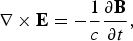


where n is the electron density, n b,vb and Z b are the ion beam density, velocity and charge state, respectively, and n 0 is the plasma ion background density. Also, the constants −e, m, and c are the electron charge, mass and speed of light, respectively. Combining the curl of Eq. (1) with Eq. (2) we obtain the equation for the generalized vortisity Θ = ∇× v − (e/mc)B, i.e.,
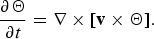
For the ion beam injected into background plasma, the generalized vorticity is zero everywhere ahead of the beam, and it follows from Eq. (5) that it remains zero everywhere, or equivalently,
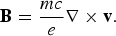
Substituting Eq. (6) into the momentum Eq. (1), we obtain
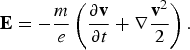
Substituting Eq. (7) into Eq. (4), we obtain the expression for electron density,

where Δ ≡ (∇·∇) is the Laplacian. Here, ωpe = (4πe 2n 0/m)1/2 is the electron plasma frequency. Finally, substituting Eqs. (6)–(8) into Eq. (3), we obtain a nonlinear equation for the electron flow velocity
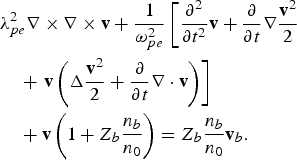
Here, λpe = c/ωpe. It follows from Eq. (9) that for (v b/c)2≪1 the steady-state solution v = ez (∂/∂ t = 0) is nonrelativistic (
 2/c 2 ≪ 1) and can be determined from

where Δ⊥ ≡ ∂ 2/∂x 2 + ∂ 2/∂y 2 is a transverse Laplacian. Here, we have assumed that n b(x⊥) and v b(x⊥) are functions of the transverse coordinates x⊥ = (x,y). From Eq. (10), we obtain an estimate for the steady-state velocity of the background electrons, i.e.,

Here, a is the radius of the injected beam, and s = 1 for planar geometry, and s = 2 for a cylindrically-symmetric beam. Note that it follows from Eq. (8) that the steady-state normalized electron density  = n/n 0 is given by
 = 1 + Z bn b/n 0, neglecting relativistic corrections.
Next, we express v = ez + v′, and derive the equation for the unstable perturbation v′ ~ exp(−iωt + ik zz) about the steady-state equilibrium
 given by Eq. (10). Linearizing Eq. (9) and neglecting terms (
 /c)2 ≪ 1, we obtain

where  pe2 = ωpe2
 . Multiplying Eq. (12) by (ωv′)*, integrating over x⊥ and taking the imaginary part, we obtain
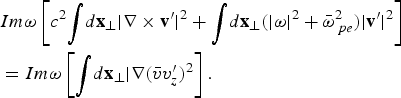
The integral on the right-hand side of Eq. (13) can be expressed as
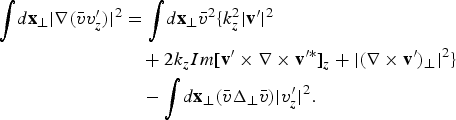
It follows from Eqs. (10) and (11) that the last term in Eq. (14) is (v b/c)2 ≪ 1 times smaller than the second term on the left-hand side of Eq. (13). Hence, it follows from Eqs. (13) and (14) that the frequency, longitudinal wave-number, and polarization for unstable perturbations with Imω > 0 must satisfy the conditions


where v m = max( ). A more detailed analysis shows that the (v m/c)2 factor in Eq. (16) should be replaced by (v m/c)4. This fact together with Eq. (15) implies that the unstable perturbations are short-wavelength [k z2c 2 > (c/v m)2(|ω|2 + ωpe2) ≫ |ω2 − ωpe2|] electrostatic perturbations with v′ ≈ ∇Φ, and that the perturbed magnetic field B′ ~ ∇× v′ is negligibly small.
3. EIGENVALUE EQUATION
The equation for electrostatic short-wavelength perturbations can be obtained by substituting v′ = ∇Φ into Eq. (12). Taking the divergence, we obtain an equation for Φ

where Ω = (ω − k z )/ωpe. Below we specialize to the case of small beam density with Z bn b/n 0 ≪ 1. In this case, it follows from Eq. (15) that ∇⊥Ω ≫ ∇⊥
 1/2. Taking this fact into account and introducing the new variable ϕ = (
 − Ω2)1/2Φ, Eq. (17) can be rewritten in the form of Schrodinger's equation

where the effective potential U is given by

Note, that the potential U is small everywhere (U ≈ f ~ (v b/c)2×(Z bn b/n 0)2(a/λpe)s for a ≪ λpe, and U ≈ f ~ (v b/c)2×(Z bn b/n 0)2(λpe/a)2 for a ≫ λpe) except at a distance d ~ |∇⊥ /ωpe|/|∇⊥Ω| ~ 1/k z from the resonant points where Ω2 ≈ 1. Therefore, the unstable mode growth rates are also small with Imω/ωpe < f 1/2/2 ≪ 1.
4. ANALYSIS OF EIGENVALUE EQUATION
For simplicity, we consider here the stability of planar flow with velocity profile  (x), which is a function of the transverse coordinate x (radial direction). We also consider only excitations with zero azimuthal velocity component v′y = 0. In this case, the eigenvalue Eq. (18) can be written as
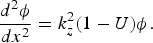
Note that Eq. (20) is equivalent in the electrostatic limit (k z2c 2 ≫ |ω2 − ωpe2|) to Eq. (20) (Startsev et al., Reference Startsev, Davidson and Dorf2009) if one makes the substitution E z = −(m/e)ωpeΩ(1 − Ω2)1/2ϕ. In (Startsev et al. (Reference Startsev, Davidson and Dorf2009), it was shown that Eq. (20) has no unstable solutions in the limit of large beam radius a ≫ λpe. Therefore, we study here the the effects of finite beam radius on the stability of the background electron flow.
We are looking for a solution of Eq. (20) which asymptotically behaves as ϕ ~ exp(k zx) for x → −∞. For arbitrary ω this solution of Eq. (20) will behave as

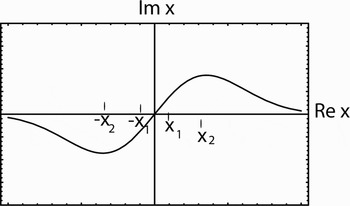
for x → ∞. The frequency of the localized mode is determined from the condition A +(ω) = 0. For a monotonic, symmetric velocity profile,  (|x|), the resonance condition where Ω2 = 1 is satisfied at four points x = ±x 1(ω) and x = ±x 2(ω) (x 2 > x 1). Let us first consider ω such that x 1(ω) ≫ 1/k z. If we analytically continue Eq. (20) into the complex x-plane, the potential U will have singularities far enough from each other that we can always go from x = −∞ to x = +∞ on the real x-axis along a path in the complex x-plane where |U| ≪ 1 [see Fig. 1]. Since along this path |(dU/dx)/U| ≥ 1/λpe ≪ k z we can use a quasi-classical approximation for the “wave-function” ϕ and obtain

everywhere along this path. Hence, the coefficient A + ≈ 1 and there are no localized modes. Now, let ω be such that x 1(ω) ~ 1/k z ≪ λpe. In this case, the two singularities of the potential at x 1 and −x 1 are too close to each other, so that the quasi-classical approximation is not applicable near those singularities. But in this region we can approximate the velocity profile as parabolic with  = v m(1 − x 2/a *2), and rewrite the eigenvalue Eq. (20) as
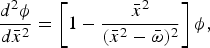
where  = k zx and
 = −(k za *)2(ωpe + ω− k zv m)/(k zv m). Here a *2 ≈ a 2 for a ≫ λpe, and
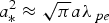 for
 . The eigenvalues of Eq. (23) are given by


where a + = −0.125…, a − = −0.00452… and  . Equation (24) gives the spectrum of symmetric modes, and Eq. (25) is the spectrum of anti-symmetric modes.
Path in the complex x-plane along which the potential |U|≪1.

The stable localized modes described by Eqs. (24) and (25) become unstable if we take into account the singularity of the potential at x = ±x 2. To obtain the expression for Imω let us multiply Eq. (17) by Φ* and integrate it over x. Taking the imaginary part, we obtain
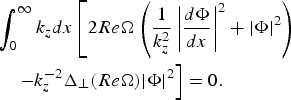
For x ~ 1/k z, ϕ ~ 1, and the function Φ is given by

and decreases exponentially as x increases. The exception is in the neighborhood of the second resonance x = x 2, where the asymptotic behavior of Φ is given by

The neighborhood of x ~ 1/k z contributes a value of ~|Φ0|2 in the integrand in Eq. (26), and the contribution from the neighborhood of x = x 2 is given by (ωp/Imω)exp(−2k zx 2). Hence, from Eq. (26) we obtain the estimate of the mode growth rate given by

Next we estimate the dependence of the maximum growth rate on the beam radius. From the resonance conditions


we obtain

For a large beam radius a ≫ λpe, the maximum growth rate will occur at the point

For a beam with small radius a ≪ λpe, we obtain
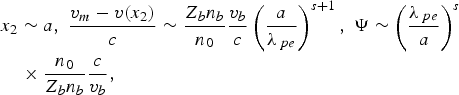
where s = 1 for planar geometry, and s = 2 for a cylindrically-symmetrical beam. Therefore, for arbitrary beam radius we can estimate the maximum growth rate as

It follows from Eq. (35) that the strongest instability corresponds to the injection of a beam with radius a ~ λpe.
5. CONCLUSIONS
In this paper, we have studied the stability of nonuniform background electron flow resulting from the injection of a long ion beam into a neutralizing plasma. We have shown that such flows can support unstable short-wavelength electrostatic perturbations with a negligible perturbed magnetic field component. The perturbations are localized near the beam center unlike the surface modes studied previously (Startsev et al., Reference Startsev, Davidson and Dorf2009), which are localized at the beam edge and had been found to be stable. Moreover, it is found that the instability develops only if the background electron flow velocity profile  (r) satisfies the two resonance conditions ω − k z
 (r 1) = −ωpe and ω − k z
 (r 2) = ωpe simultaneously at different radial locations r 1 and r 2 from the beam center. The first resonance condition guarantees the existence of the body-mode excitation, whereas the second resonance condition assures that the mode is unstable. These body modes have growth rates that are exponentially small [Eq. (35)] and are largest for beams with radius of the order of the collisionless electron skin depth, a ~ c/ωpe.
ACKNOWLEDGMENT
This research was supported by the U.S. Department of Energy.