Implications
Cows with low or no estrus expression present lower artificial insemination pregnancy rates (P/AI) in timed artificial insemination (TAI) protocols. It was intended in this study to improve the pregnancy rates for Bos indicus beef cows, without major managements modifications in TAI protocol. Animals with high estrus, evaluated with chalk aids had large dominant follicle, greater progesterone concentration and pregnancy rates, and the use of Gonadorelin (gonadotrophin-releasing hormone (GnRH)) improved pregnancy rates in cows with low or no estrus expression, thus, GnRH injection in cows with low estrus shows a simple strategy to increase pregnancy rates in postpartum beef cows submitted to progesterone–estradiol-based TAI protocols.
Introduction
The combination of progesterone and estradiol (E2) is one of the most common TAI protocols used in Brazil. Its purpose is to promote follicle atresia and consequently induce recruitment of a new follicular wave at around 4 days after hormone administration (Bo et al., Reference Bo, Adams, Pierson and Mapletoft1996). The use of estradiol benzoate (EB) and progesterone has been shown to be efficient for B. indicus females in postpartum anestrous condition because these animals do not respond satisfactorily to GnRH when used to induce ovulation at the beginning of the protocol (Barros et al., Reference Barros, Moreira, Figueiredo, Teixeira and Trinca2000).
In TAI protocols, the drugs used to induce ovulation act by positive feedback on the pulsatile release of LH (estrogen and GnRH) or directly on the follicle (human chorionic gonadotropin- HCG and LH) (Ray, Reference Ray1965; Buttrey et al., Reference Buttrey, Burns and Stevenson2010). When administered intramuscularly, GnRH induces a surge of LH similar to preovulatory wave at 2 h and ovulation between 26 and 30 h post-administration, respectively (Twagiramungu et al., Reference Twagiramungu, Guilbault, Proulx and Dufour1992; Twagiramungu et al., Reference Twagiramungu, Guilbault, Proulx and Dufour1995; Schmitt et al., Reference Schmitt, Drost, Diaz, Roomes and Thatcher1996).
Treatment with GnRH at the onset of standing estrus increased circulating concentrations of progesterone in dairy cows (Ree et al., Reference Ree, Colazo, Lamont, Kastelic, Dyck, Mapletoft, Ametaj and Ambrose2009). However, some studies with beef cows have demonstrated that pregnancy (P/AI) is not improved in cows displaying estrus with GnRH injection concurrent with artificial insemination (AI) (Perry and Perry, Reference Perry and Perry2009; Sa Filho et al., Reference Sa Filho, Santos, Ferreira, Sales and Baruselli2011) or when injected in all cows submitted to TAI (Campos et al., Reference Campos, Oliveira, de Freitas Ferreira Mohallem and dos Santos2016). It has also been determined that GnRH administration is unnecessary for cows exhibiting estrus before timed insemination (Hill et al., Reference Hill, Grieger, Olson, Jaeger, Dahlen, Crosswhite, Pereira, Underdahl, Neville, Ahola, Fischer, Seidel and Stevenson2016; Bishop et al., Reference Bishop, Thomas, Abel, Poock, Ellersieck, Smith and Patterson2017a).
Several studies have demonstrated improvement in pregnancy rates for cows expressing estrus prior to AI compared to those not detected in estrus in TAI protocols (Sa Filho et al., Reference Sa Filho, Santos, Ferreira, Sales and Baruselli2011; Richardson et al., Reference Richardson, Hill, Stevenson, Djira and Perry2016). Sa Filho et al. (Reference Sa Filho, Ayres, Ferreira, Marques, Reis, Silva, Rodrigues, Madureira, Bo and Baruselli2010) demonstrated that injection of GnRH at TAI improves synchronization of ovulation and pregnancy rates; however, Shephard et al. (Reference Shephard, Morton and Norman2014) affirms that the results of GnRH injection at AI should be limited, and the positive effect in lactating dairy cows may be mediated through improved oocyte maturation and/or improved luteal function rather than by reducing AI-to-ovulation intervals.
In our recent field trial (Nogueira et al., 2019 companion paper), the use of tail chalk and estrus/heat expression scores (HEATSC) evaluation was instrumental in identifying cows with greater estrus expression and greater P/AI in cows TAI with progesterone–estradiol-based protocols. Cows with low or no estrus expression achieved lower P/AI. We thus hypothesized that GnRH injection at TAI could improve pregnancy rates, with no additional management, despite the well-documented fact that ovulation of smaller follicles produces lower fertility/AI, possibly due to the development of smaller corpus luteum (CL) and decreased circulating progesterone concentrations, even with GnRH injection(Vasconcelos et al., Reference Vasconcelos, Sartori, Oliveira, Guenther and Wiltbank2001; Jinks et al., Reference Jinks, Smith, Atkins, Pohler, Perry, Macneil, Roberts, Waterman, Alexander and Geary2013).
Consequently, the objective of this study was to determine the effect of treatment with GnRH at TAI in cows with low or no estrus expression evaluated with HEATSC on pregnancy rates in postpartum B. indicus beef cows submitted to progesterone–estradiol-based protocols.
Material and methods
Experimental design
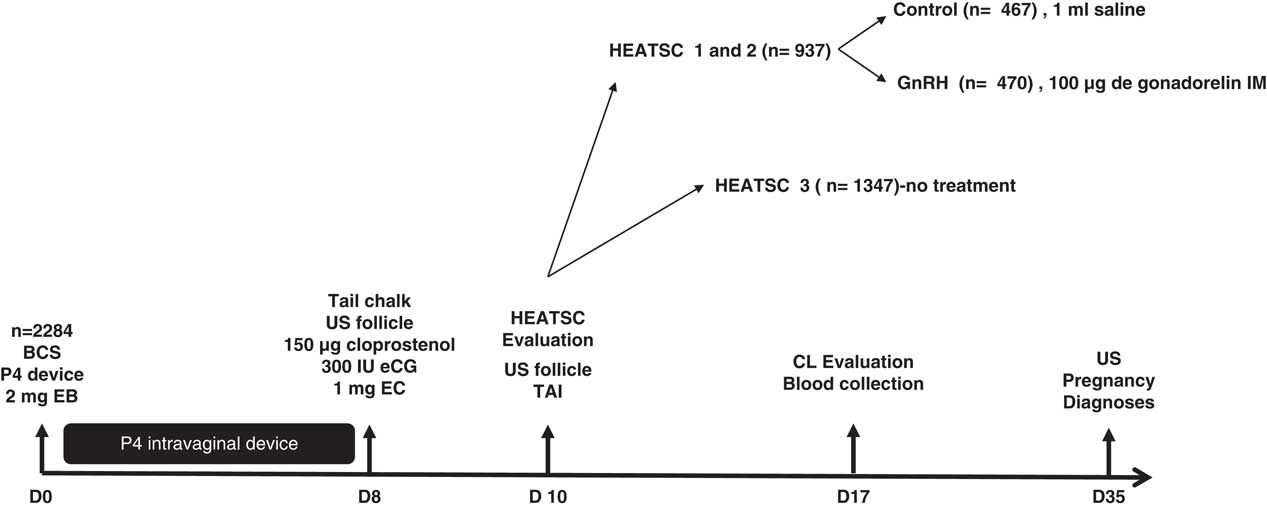
At five farms in Pantanal wetlands (two farms, 783 cows) and Planalto (three farms, 1501 cows) regions of Mato Grosso do Sul State, Brazil, 2284 multiparous (three to four parturitions), lactating Nelore cows (30 to 60 days postpartum) were submitted to TAI protocols and evaluated the expression of estrus at the TAI using HEATSC (1 to 3). On a random stage of the estrus cycle (D0), cows were body condition score (BCS, 1 to 5) and received 2 mg of EB (RIC-BE®; Agener União, São Paulo, Brazil) and a progesterone intravaginal device (Cronipress Mono Dose M-24®; Biogenesis Bagó, Curitiba, Brazil). On day 8, the device was removed, and cows were given an injection of 1 mg of estradiol cypionate (ECP®; Zoetis, São Paulo, Brazil), 150 μg of d-cloprostenol (Prolise®; Arsa, Buenos Aires, Argentina) and 300 IU of equine chorionic gonadotropin (eCG) (Folligon® 5000 UI; MSD, São Paulo, Brazil).
At the time of progesterone device removal, all cows were marked in the sacral and tail head region with chalk (Raidl-Maxi; RAIDEX GmbH, Dettingen/Erms, Germany). The chalk was placed on an imaginary line between the hook or hip bones back to and including the tail head. The rate of expression of estrus, evaluated at the TAI (day 10), was classified with ink removal in scores: HEATSC1 to HEATSC3 – where HEATSC1 – no or few chalk removal = no estrus expression; HEATSC2 – little chalk removal (<75%) = low estrus expression; HEATSC3 – near complete/complete chalk removal = high estrus expression (Silva et al., 2016). Moreover, on day 10, cows received semen from four bulls (A= 474 AI; B= 699 AI; C= 740 AI; D= 371 AI) with known fertility 50 to 54 h after implant removal, distributed equally across treatments (Figure 1).
Experimental design using Bos indicus cows. HEATSC= estrus expression scores(1 to 3, where HEATSC1 – no or few chalk removal= no estrus expression; HEATSC2 – little chalk removal (<75%)= low estrus expression; HEATSC3 – near complete/complete chalk removal= high estrus expression; GnRH= gonadotrophin-releasing hormone – 100 µg Gonadorelin); i.m.=intramuscular injection; BCS= body condition score; D0= beginning of protocol; D8= day of progesterone device removal; D10= timed artificial insemination (TAI); P4=progesterone intravaginal device (1 g); EB=estradiol benzoate injection; eCG= equine chorionic gonadotropin; EC=estradiol cypionate injection; CL=corpus luteum.

At TAI, 58.97% of the cows (n= 1347/2284) presented HEATSC3 and were designated HEAT GROUP and received no additional treatment. The remainder (n= 937) presenting HEATSC1 or HEATSC2 were randomized into Control group (n= 467) to receive 1 ml saline solution i.m., or GnRH group (n= 470) to receive100 μg gonadorelin i.m. at TAI (Farm 1= Control: 41, GnRH: 44; Farm 2= Control: 138, GnRH: 140; Farm3= Control:100, GnRH: 91; Farm4= Control: 96, GnRH: 94; Farm5= Control: 92, GnRH: 101).
Ultrasonography
On a farm at Planalto, a subset of cows (n= 300) had ovaries examined by transrectal ultrasonography to evaluate larger dominant follicular diameter (LFD) (cm) at the time of progesterone device removal (LFD8), at TAI (LFTAI), and CL area at day 17 (cm2), using a Mindray DP 20 Vet (Mindray Medical International Limited, Shenzhen, China) with transrectal linear probe (5 to 9 MHz). Corpus luteum evaluation on day 17 was also used to calculate ovulation rate, that was verified by detection of a CL in the same ovary where was observed the preovulatory follicle (and no previous CL on day 10), according Pfeifer et al. (Reference Pfeifer, Mapletoft, Kastelic, Small, Adams, Dionello and Singh2009 and Reference Pfeifer, Castro, Melo, Neves, Cestaro and Schneider2015) and Dadarwal et al. (Reference Dadarwal, Mapletoft, Adams, Pfeifer, Creelman and Singh2013). Follicular diameter was determined at the widest point of the follicle. The maximum CL area was determined using a B-mode still image and the tracing function. For CL with an anechoic fluid-filled cavity, the area of the cavity was subtracted from the total area (Kastelic et al., Reference Kastelic, Pierson and Ginther1990). Pregnancy diagnosis was performed 35 days after TAI by ultrasonography.
Blood sample collection
Blood samples were collected via venipuncture (coccygeal vein) into 10-mL Vacutainer tubes on day 17 at CL evaluation, in a subset of cows (n= 200). Blood was allowed to clot at room temperature and centrifuged at 2000×g for 20 min. Serum was harvested and stored at −20°C until serum concentrations of progesterone were determined by radioimmunoassay (RIA).
Radioimmunoassay
Serum concentrations of progesterone (ng/ml) were evaluated at the Faculty of Veterinary Medicine (FMVA) Araçatuba – UNESP Campus (Laboratory of Endocrinology, Department of Field Support, Animal Production and Health (DAPSA)) using an antibody-coated-tube RIA Kit (Diagnostic Products Corporation, Los Angeles, CA, USA). Intra- and inter-assay CV were 0.97% and 17.27%, respectively, and the assay sensitivity was 0.2 ng/ml.
Statistical analysis
Continuous variables (CL area, progesterone concentrations on day 17 and follicular diameter on day 8 (LFD8) and day 10 (LFTAI)), and Binomial variable – P/AI were evaluated with PROC GLIMMIX (SAS, 9.2). Relationship between the diameter of LFTAI, progesterone concentration, CL area and pregnancy probabilities were determined using PROC LOGISTIC (SAS, 9.2). Logistic regression curves were created using coefficients provided by interactive data analysis from SAS and the formula y=exp (̨x+b)/[1+exp(x+b)]. Farm and region were used as a random effect as well as other variables included in the models (bull, technician, BCS, parity and interactions) if appropriate (P⩽0.10). Covariates found to be insignificant (P>0.10) were removed from the statistical model. Results are expressed as means ± SE or percentages. In all analyses, differences were considered significant when P⩽0.05, whereas differences between P>0.05 and P⩽0.10 were considered trends.
Results
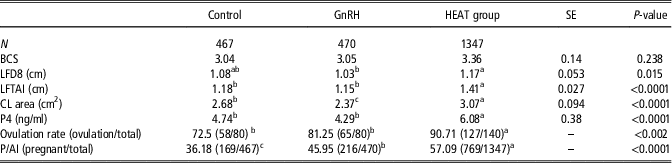
There was no difference in BCS between treatment groups (Control: 3.04, GnRH: 3.05, HEAT group: 3.36) but BCS varied according to region (Pantanal: 2.85, Planalto: 3.43; P<0.001). There was a difference in LFD8 between groups, greater in HEAT group in relation to GnRH, and intermediate in Control. Large dominant follicular diameter at TAI was also greater in HEAT group in relation to the GnRH and Control groups (Table 1).
Body condition score (BCS) (1 to 5), large dominant follicular diameter (cm) on day 8 (LFD8) and at timed artificial insemination (LFTAI), progesterone (P4) (ng/ml), CL area (cm2) and P/AI according to treatment in Bos indicus cows

BCS=body condition score (1 to 5); LFD8=large dominant follicular diameter (cm) on day 8; TAI=timed artificial insemination; LFTAI=large dominant follicular diameter at TAI; P4=progesterone concentration (ng/ml); CL=corpus luteum; P/AI=artificial insemination pregnancy rates; HEATSC=Estrus expression scores, assessed at the time of TAI (day 10), classified according to the proportion of tail chalk removed: HEATSC1 – no or few chalk removal = no estrus expression; HEATSC2 – partial chalk removal = low estrus expression; HEATSC3 – near complete/complete chalk removal= high estrus expression
Treatments: HEAT group=cows with HEATSC3 and no additional treatment; Control group=injection 1 ml saline solution i.m.; gonadotrophin-releasing hormone (GnRH) group=injection of 100 μg gonadorelin i.m. at TAI. Control and GnRH groups presented HEATSC1 and HEATSC2.
a,b,cValues with different lowercase superscript differ between lines (P<0.05).
There was a difference when LFTAI was evaluated according to HEATSC (HEATSC1= 1.02 cm, HEATSC2= 1.15 cm, HEATSC3= 1.41 cm, P<0.001) but no interaction was detected between treatments and HEATSC (P= 0.32). The CL area was larger in HEAT group, intermediary in Control and lower in GnRH group. Greater progesterone concentrations were found in HEAT group than in Control and GnRH groups There was a difference between groups regarding ovulation rate, greater in HEAT group than GnRH and Control groups (Table 1).
Artificial insemination pregnancy rates was greater in HEAT group than in Control and GNRH groups, with results showing positive effect of GnRH injection at TAI in P/AI (Control= 36.18% (169/467), GnRH= 45.95% (216/470), Table 1). There was a difference in pregnancy rate per bull (bull A= 49.4%; B= 55.1%; C= 47.1%; D= 50.5%; P= 0.0103), but no interaction between bulls and treatment was found (P= 0.6836). Farm location (Pantanal or Planalto) showed a difference in P/AI, being greater in Planalto than Pantanal (54.56 v. 42.78, respectively, P<0.001).
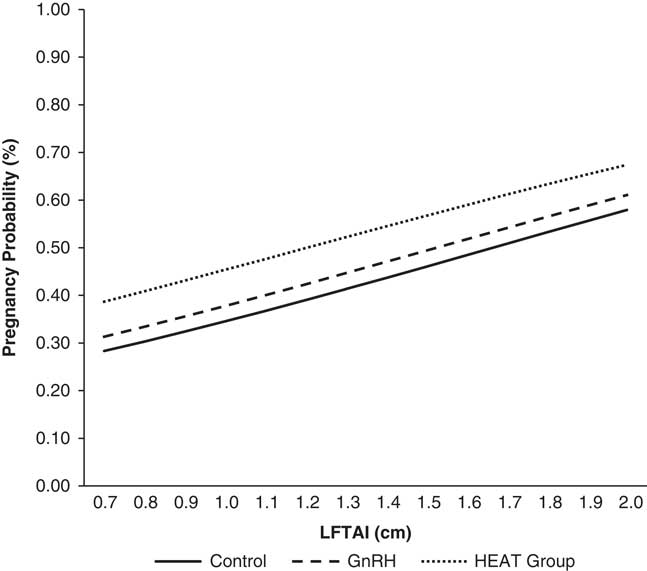
Pregnancy probability according to CL area on day 17 was not significant (P= 0.319), but pregnancy probability according to LFTAI, showed a significant effect (P= 0.05) as well as interaction between LFTAI and treatment (P= 0.008, Fig 2). Pregnancy probability according to progesterone concentration presented only a trend (P= 0.077).
Pregnancy probability on day 30 after timed artificial insemination (TAI) of cows with synchronized time of ovulation (n=300) according to the diameter of the LFTAI and treatments: HEAT group – cows with HEATSC 3 (n=1347); Control group (n= 467) – injection 1 ml saline solution i.m. (intramuscular); gonadotrophin-releasing hormone (GnRH) group (n= 470) – injection of 100 μg gonadorelin i.m. at TAI (P=0.008, n=300). HEATSC= estrus expression scores (1 to 3, where HEATSC1 – no or few chalk removal= no estrus expression; HEATSC2 – little chalk removal (<75%) = low estrus expression; HEATSC3 – near complete/complete chalk removal= high estrus expression; LFTAI=large dominant follicular diameter at TAI.

Discussion
This work is complementary to companion study by Nogueira et al. (2019; companion paper) where estrus expression, evaluated with chalk at TAI, was classified in scores according to paint removal (HEATSC): 1= no estrus expression; 2= low estrus expression; 3= high estrus expression. In the present study the results were similar, with greater P/AI in cows with HEATSC3. At TAI, HEATSC assessment was shown to be a simple strategy, useful to identify cows with greater estrus expression and consequently better pregnancy rates in TAI. Following these results, the use of GnRH in cows with absence of estrus or low estrus manifestation was evaluated.
Gonadotrophin-releasing hormone was expected to induce ovulation on a greater proportion of cows compared to Control, which occurred only partially, because despite that ovulation rate was not significantly improved with GnRH injection, an 8.75% difference was observed in favor of GnRH group. Timed AI occurring closer to the ovulation time could be another factor contributing to better pregnancy rates, as demonstrated by Kaim et al. (Reference Kaim, Bloch, Wolfenson, Braw-Tal, Rosenberg, Voet and Folman2003), that observed that injecting GnRH at onset of estrus increased LH surges, prevented delayed ovulation and may increase subsequent progesterone concentrations, increasing conception in primiparous cows during summer and in cows with lower body condition. Moreover, Sa Filho et al. (Reference Sa Filho, Ayres, Ferreira, Marques, Reis, Silva, Rodrigues, Madureira, Bo and Baruselli2010) indicate a better synchronization of ovulation in beef cows in progesterone–estradiol-based protocols when GnRH injection occurs at TAI, even in cows that would ovulate spontaneously, which may explain partially the greater pregnancy rates even with smaller CL.
Despite that, GnRH induced ovulation of small follicles promote development of smaller CL and could reduce pregnancy maintenance (Vasconcelos et al., Reference Vasconcelos, Sartori, Oliveira, Guenther and Wiltbank2001; Busch et al., Reference Busch, Atkins, Bader, Schafer, Patterson, Geary and Smith2008), in our study, GnRH injection promoted similar progesterone concentration to control animals, even with smaller CL found in GnRH group, also observed by Perry and Perry (Reference Perry and Perry2009), where injection of GnRH promoted decreased CL size on day 7 post-TAI, which was expected to promote shortened ovulation time after TAI protocol. Therefore, the positive effect of GnRH at AI may be also mediated through improved oocyte maturation and/or improved luteal function (even decreasing CL size), rather than by reducing AI-to-ovulation intervals (Shephard et al., Reference Shephard, Morton and Norman2014).
Administration of GnRH resulted in luteinization of a dominant follicle and the onset of progesterone production by granulosa cells in the follicle instead estrogen production, potentially limiting estrus expression after GnRH injection (Voss and Fortune, Reference Voss and Fortune1992; Bishop et al., Reference Bishop, Thomas, Abel, Poock, Ellersieck, Smith and Patterson2017b). Such regimen may be undesirable in protocols with delayed TAI (when the TAI was postponed and performed after GnRH injection, until 84 h post-device removal). However, such delay as verified in some experiments with non-estrus cows (Thomas et al., Reference Thomas, Lock, Poock, Ellersieck, Smith and Patterson2014; Hill et al., Reference Hill, Grieger, Olson, Jaeger, Dahlen, Crosswhite, Pereira, Underdahl, Neville, Ahola, Fischer, Seidel and Stevenson2016), even showing favorable results, requires more intensive management with animal separation, and therefore was not tested in our experiment.
Pereira et al. (Reference Pereira, Wiltbank and JLM2016), working with dairy cows, cited the importance of expression of estrus in both TAI and embryo transfer and the development of large dominant follicle to improve fertility, increase pregnancy rates and reduce embryo losses. Estrus expression had a significant effect on pregnancy rates in cows submitted to TAI with the injection of GnRH 60 and 75 h after implant removal (Hill et al., Reference Hill, Grieger, Olson, Jaeger, Dahlen, Crosswhite, Pereira, Underdahl, Neville, Ahola, Fischer, Seidel and Stevenson2016). Those data corroborate our results, where in greater estrus manifestation was fundamental to increased pregnancy rates. Richardson et al. (Reference Richardson, Hill, Stevenson, Djira and Perry2016) achieved the same results in beef cows. In addition, Sa Filho et al. (Reference Sa Filho, Ayres, Ferreira, Marques, Reis, Silva, Rodrigues, Madureira, Bo and Baruselli2010) working with eCG and GnRH injections in Nelore cows classified as positive or negative estrus, found similar results, where eCG administered at the time of Norgestomet implant removal increased growth rate of the largest follicle from implant removal to TAI, LFTAI and pregnancy rates. Furthermore, GnRH at TAI improved ovulation synchrony and pregnancy rates in postpartum Nelore cows treated with Norgestomet-based TAI protocol. Busch et al. (Reference Busch, Atkins, Bader, Schafer, Patterson, Geary and Smith2008) also found a positive effect of GnRH injection at TAI, particularly in cows with small follicles (<12 mm), leading to increased progesterone production.
Care should be taken because GnRH response may be impaired in B. indicus cattle or those with high progesterone, like demonstrated by Batista et al. (Reference Batista, Del Valle, Ortolan, Renno, Nogueira, Souza and Baruselli2017), where greater progesterone concentration at the time of GnRH injection decreased response to this hormone in LH release, with a more pronounced effect in B. indicus than Bos Taurus heifers. In addition, ovulation was reduced in animals with high progesterone levels treated with GnRH (Colazo et al., Reference Colazo, Kastelic, Davis, Rutledge, Martinez, Small and Mapletoft2008). This must be considered with regard to CL presence in cows used in these protocols. In our trials, most of the cows were in anestrous and recent postpartum, displaying low progesterone concentration due to CL absence at the beginning of the protocol, even in the protocol using progesterone implants. Therefore, strategies such as PGF2α administration before implant withdrawal in cyclic cows (Meneghetti et al., Reference Meneghetti, Sa Filho, Peres, Lamb and Vasconcelos2009) would favor the response to GnRH injection to increase pregnancy rates.
Addition of GnRH in protocols using progesterone combined with estradiol (plus eCG and PGF2α) could be an alternative to improve conception rates in B. indicus beef cows, particularly those with no or low estrus expression. In conclusion, the use of GnRH in cows with low HEATSC (1 and 2) is a simple strategy, requiring no changes in TAI management to increase pregnancy rates in postpartum beef cows submitted to progesterone–estradiol-based TAI protocols, without reaching, however, the pregnancy rates of cows that demonstrate high estrus expression at the TAI.
Acknowledgments
This research was supported by Embrapa (+ Cria project) and FUNDECT-CnPQ. Acknowledgments to Dr Guilherme de Paula Nogueira- UNESP Araçatuba, for progesterone dosages, and Farms Ventania, São Bento, Pinheirão, and Panorama-SA for support and animals. E.N. thanks EMBRAPA for visiting scholar support at the University of Missouri, Columbia.
Declaration of interest
The authors declare no conflicts of interest.
Ethics statement
The experiment was approved by the Animal Care and Use Committee of the EMBRAPA (CEUA;+Cria Project- Protocol 002/2015).
Software and data repository resources
The data/models regarding the published article are not deposited in any official repository.