A number of recent studies have explored how second-language (L2) learners process morphosyntactic information in their nonnative language during on-line sentence processing (for two recent reviews, see Frenck-Mestre, Reference Frenck-Mestre, Kroll and de Groot2005; Papadopoulou, Reference Papadopoulou2005). The results from these studies are mixed, with L2 learners’ processing exhibiting varying degrees of similarity to that of native speakers depending on the morphosyntactic structure in question, specific task demands, and individual learner variables (e.g., Havik, Roberts, van Hout, Schreuder, & Haverkort, Reference Havik, Roberts, van Hout, Schreuder and Haverkort2009; Hoover & Dwivedi, Reference Hoover and Dwivedi1998; Hopp, Reference Hopp2006; Juffs, Reference Juffs2005). To account for many of these findings, Clahsen and Felser (Reference Clahsen and Felser2006) proposed the shallow structure hypothesis, suggesting that L2 learners may not incrementally build the structure of a sentence to the same syntactic detail as native speakers of a language, and that their processing is driven primarily by lexical–semantic and pragmatic information (see also Felser, Roberts, Marinis, & Gross, Reference Felser, Roberts, Marinis and Gross2003; Papadopoulou & Clahsen, Reference Papadopoulou and Clahsen2003). Studies have examined how L2 learners use verb–subcategorization information or plausibility constraints during on-line language comprehension (e.g., Dussias & Cramer, Reference Dussias and Cramer2008; Dussias & Pinar, in press; Frenck-Mestre & Pynte, Reference Frenck-Mestre and Pynte1997; Juffs, Reference Juffs1998; Roberts & Felser, Reference Roberts and Felser2010; Williams, Reference Williams2006; Williams, Möbius & Kim, Reference Williams, Möbius and Kim2001), but L2 sentence processing research has yet to consider how lexical–semantic information in the form of noun animacy may or may not interact with morphosyntactic information, such as word order, to build the argument structure of a sentence in real time. Given that argument structure rapidly influences language processing, and animacy plays a central role in many explanatory models of how different languages assign grammatical and thematic roles (e.g., Bornkessel & Schlesewsky, Reference Bornkessel and Schlesewsky2006; Primus, Reference Primus and Siewierska1998), this factor is an important variable to consider with regard to L2 processing.Footnote 1
The present study addresses this question by examining how L2 learners of Dutch with German as their first language (L1) process subject versus object relative clauses (RCs) when the animacy of the antecedent noun phrase (NP) and the RC-internal NP is manipulated. Furthermore, given that all verbal information appears at the end of the clause in Dutch RCs, the present study also explores the extent to which L2 learners will incrementally assign grammatical roles prior to encountering crucial lexical and morphosyntactic information provided by the lexical verb and its auxiliary.
ACCESSING LEXICAL–SEMANTIC INFORMATION DURING L1 AND L2 PROCESSING
Clahsen and Felser (Reference Clahsen and Felser2006) recently proposed that L2 learners rely heavily on lexical–semantic and pragmatic information during on-line processing. In the absence of such information, L2 learners may not make the same types of incremental structural commitments when they read temporarily ambiguous sentences, leading to fewer signs of on-line reanalysis. At the same time, many L1-based models of the human parsing mechanism also stress the importance of nonsyntactic information in early stages of processing (e.g., Cuetos & Mitchell, Reference Cuetos and Mitchell1988; Hemforth, Konieczny & Scheepers, Reference Hemforth, Konieczny, Scheepers, Hemforth and Konieczny2000; MacDonald, Pearlmutter, & Seidenberg, Reference MacDonald, Pearlmutter and Seidenberg1994), and that lexical–semantic and plausibility information can impact the severity of reanalysis (e.g., Traxler & Pickering, Reference Traxler and Pickering1996). Thus, in light of research that has shown that L2 learners, like native speakers, rapidly access and use lexical–semantic information during on-line processing, and such information can strongly influence syntactic analysis and reanalysis (Dussias & Pinar, in press; Juffs, Reference Juffs1998; Roberts & Felser, Reference Roberts and Felser2010; Williams, Reference Williams2006; Williams et al., Reference Williams, Möbius and Kim2001), the following question is perhaps more important than whether L2 learners rely on lexical–semantic information during on-line processing: even in the presence of critical lexical–semantic cues, will L2 learners use nonsyntactic information in the same manner as native speakers to process L2 input incrementally and potentially recover from initial misparses?
In a related vein, the majority of L2 sentence processing research that has found more nativelike processing strategies among L2 learners, especially with regard to their ability to predict upcoming arguments in a sentence, has looked at languages like English, Spanish, or French, in which the lexical verb appears early in the sentence (e.g., Dussias & Cramer, Reference Dussias and Cramer2008; Frenck-Mestre & Pynte, Reference Frenck-Mestre and Pynte1997). However, as it relates to L2 learners’ ability to construct filler–gap relationships on-line (e.g., Dussias & Pinar, in press; Juffs, Reference Juffs2005; Williams, Reference Williams2006; Williams et al., Reference Williams, Möbius and Kim2001), Clahsen and Felser (Reference Clahsen and Felser2006) point out that, even though on-line evidence favors an account in which L2 learners can posit gaps, such effects may stem from a verb-driven rather than a structure-based gap-filling strategy (see also Marinis, Roberts, Felser, & Clahsen, Reference Marinis, Roberts, Felser and Clahsen2005).
Studies that have examined how L2 learners process temporarily ambiguous input in verb-final constructions have shown that only at near-native speaker levels may L2 learners make early commitments, such as assigning grammatical or thematic roles, prior to encountering the lexical verb (cf. Havik et al., Reference Havik, Roberts, van Hout, Schreuder and Haverkort2009; Hopp, Reference Hopp2006; Jackson, Reference Jackson2008). For example, Jackson (Reference Jackson2008) found that English L2 learners of German exhibited processing difficulties while reading less preferred object-first temporarily ambiguous wh-questions when the lexical verb appeared prior to the disambiguating region (e.g., Welche Ingenieurin traf den Chemiker gestern Nachmittag im Café? “Which engineer met the chemist yesterday afternoon in the café?”), but not with similar sentences in the present perfect tense where the lexical verb appeared at the end of the sentence. This suggests that early access to the lexical verb can influence the strength of L2 learners’ commitment to a particular sentence interpretation, and thus the relative difficulty of reanalysis when later information disambiguates the sentence to a less preferred structure. This is in contrast to a large body of L1 sentence processing research suggesting that native speakers of verb-final languages incrementally interpret sentences and assign grammatical and thematic roles independently of the lexical verb (e.g., Frazier, Reference Frazier1987; Frazier & Flores d'Arcais, Reference Frazier and Flores d'Arcais1989; Friederici & Frisch, Reference Friederici and Frisch2000; Konieczny, Hemforth, Scheepers, & Strube, Reference Konieczny, Hemforth, Scheepers and Strube1997).
Additional evidence that L2 learners may not always commit to a particular interpretation when reading temporarily ambiguous sentences comes from a study conducted by Havik et al. (Reference Havik, Roberts, van Hout, Schreuder and Haverkort2009). The authors investigated whether German L2 learners of Dutch would show an on-line preference for subject-first word order when reading temporarily ambiguous subject- and object-RC constructions, which are illustrated in Example 1, as native speakers of both German and Dutch do (e.g., Kaan, Reference Kaan1997; Schriefers, Friederici, & Kühn, Reference Schriefers, Friederici and Kühn1995).
1.


Only the native Dutch group found the less preferred object-resolved RCs more difficult to process: the L2 learners had no such on-line processing difficulty with object RCs, even though off-line, they displayed a preference for subject-resolved items, like the native speakers. This suggests that in the absence of biasing lexical–semantic information prior to syntactic disambiguation, the L2 learners did not make an on-line commitment to an analysis, even though the constructions under investigation are maximally comparable between the L1 and the L2 (see also Felser et al., Reference Felser, Roberts, Marinis and Gross2003; Papadopoulou & Clahsen, Reference Papadopoulou and Clahsen2003).
Although the studies reported here, along with other L1 sentence-processing research, point to a subject preference in both Dutch and German (e.g., Frazier, Reference Frazier1987; Frazier & Flores d’ Arcais, Reference Frazier and Flores d'Arcais1989; Gorell, Reference Gorrell, Hemforth and Konieczny2000; Kaan, Reference Kaan1997; Schriefers et al.,1995), recent work by Mak, Vonk, and Schriefers (Reference Mak, Vonk and Schriefers2002, Reference Mak, Vonk and Schriefers2006) suggests that this subject-first preference in Dutch is modulated by noun animacy. When participants in Mak et al. (Reference Mak, Vonk and Schriefers2006) read subject RCs (SubjRC) and object RCs (ObjRC) containing either an animate subject or an inanimate subject, like Examples 2–5, their reading times were longer at the past participle and subsequent segments (italicized below) on object RCs containing an inanimate subject, like Example 5, compared to subject RCs containing an inanimate subject, like Example 4. In contrast, there were no significant differences in reading times according to word order for sentences containing an animate subject, such as Examples 2 and 3.
2.
3.
4.
5.
Because syntax-first accounts of the human parsing mechanism, such as the active filler strategy (cf. Frazier, Reference Frazier1987), assume that the processor will always build a subject RC (object RCs therefore always induce reanalysis), the absence of a processing cost difference between the two conditions with an animate subject (Examples 2 and 3) led Mak et al. to conclude that additional types of nonsyntactic information must be available early in on-line processing (for parallel results in English, see also Traxler, Morris, & Seeley, Reference Traxler, Morris and Seely2002; Traxler, Williams, Blozis, & Morris, Reference Traxler, Williams, Blozis and Morris2005).Footnote 2
The question is then precisely how semantic information, like animacy, influences the processing of such temporary ambiguities. In their first experiment, Mak et al. (Reference Mak, Vonk and Schriefers2006) used only inanimate NPs, and their readers displayed the same preference for subject over object RCs. Therefore, it appears that the processor does not use the animacy information of the antecedent NP per se to build initial structure, but rather it is the difference in animacy between the antecedent and the RC-internal NP that underlies the observed effects. Mak et al. (Reference Mak, Vonk and Schriefers2006) go on to argue that, overall, readers prefer animate subjects over inanimate subjects. Similarly, readers prefer that the relative pronoun be the subject of the RC, because the RC provides additional information about the antecedent, making the antecedent the topic of the RC. Thus, in conditions where both noun animacy and topicality coincide, as in sentences like Example 2, readers immediately assign grammatical roles to each NP and no reanalysis is necessary. Grammatical roles are also immediately assigned in sentences like Example 5, in which readers encounter an animate antecedent followed by an inanimate RC-internal NP, because animacy and topicality again coincide. However, this leads to greater processing costs in the disambiguating region when morphosyntactic and semantic information in the verb cluster force a reanalysis of this initial interpretation. In contrast, in conditions where preferences based on noun animacy and topicality contradict one another, as in sentence Examples 3 and 4, readers postpone assigning grammatical roles until they read the disambiguating auxiliary verb or the past participle, leading to no processing difficulties regardless of word order.
PRESENT STUDY
Using sentences similar to those employed by Mak et al. (Reference Mak, Vonk and Schriefers2006), the present study explores whether German L2 learners of Dutch use noun animacy and topicality to incrementally assign grammatical roles when reading temporarily ambiguous subject and object RCs in Dutch. If the L2 learners rely on both noun animacy and topicality to assign grammatical roles while reading the target sentences, then reading times at the critical regions should be longest on object RCs containing an inanimate subject, as has been found in previous monolingual research (e.g., Mak et al., Reference Mak, Vonk and Schriefers2002, Reference Mak, Vonk and Schriefers2006; Traxler et al., Reference Traxler, Morris and Seely2002, Reference Traxler, Williams, Blozis and Morris2005). If, however, the L2 learners rely only on semantic information and noun animacy to assign grammatical roles, then reading times at the disambiguating region should be longer on sentences containing an inanimate subject, regardless of word order. In contrast, if the L2 learners do not use either type of information to assign grammatical roles prior to the disambiguating region, then there should be little or no evidence of on-line reanalysis at the disambiguating auxiliary verb or the past participle (cf. Havik et al., Reference Havik, Roberts, van Hout, Schreuder and Haverkort2009). Finally, by placing the auxiliary verb before the past participle (Voor de kinderen is de clown, die de taarten heeft gegooid . . . “For the children is the clown that the pies has thrown . . .”), as opposed to after the past participle, as was done by Mak et al. (Reference Mak, Vonk and Schriefers2006), the present study also assesses whether L2 learners use verb-agreement information to disambiguate temporarily ambiguous sentences independent of the lexical–semantic information provided by the past participle.
METHOD
Participants
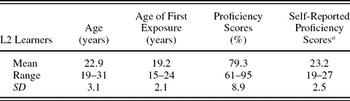
Twenty German L2 learners of Dutch (17 women) and 29 Dutch native speakers (24 women) participated in the experiment and were paid a small fee. All participants were recruited from the Radboud University, Nijmegen, and all had normal or corrected to normal vision. Even though the L2 learners had passed a university entrance exam that allowed them to follow university courses in Dutch, they undertook a Dutch cloze test containing 60 gaps to provide an additional measure of L2 proficiency. The L2 learners also filled out a language background questionnaire to elicit information about their language use, and self-rate their proficiency in Dutch on a scale from 0 to 5 (0 = no proficiency, 5 = highly proficient) in reading, writing, speaking, pronunciation, spelling, and grammar to give a total possible maximum score of 30. The L2 learners’ biographical data and proficiency test results are shown in Table 1.
Second language (L2) learners’ biographical information and results of proficiency measures

aOut of 30.
The learners reported experience with languages other than German and Dutch (French, English), but none reported that they were early bilinguals. Furthermore, their self-ratings of L2 proficiency in Dutch were higher than their self-ratings for any other L2, indicating that they all considered Dutch to be their dominant L2.Footnote 3
Materials
Twenty-four experimental RC constructions were adopted from those used by Mak et al. (Reference Mak, Vonk and Schriefers2006) so as to include only vocabulary items that would be familiar to the L2 participants.Footnote 4 All target sentences contained one animate NP and one inanimate NP. One of these nouns was singular and one was plural, such that the target sentences were ambiguous until number information on the auxiliary verb determined their grammatical role. In half of the target items, the animate noun was singular and the inanimate noun was plural and in half of the target items this pattern was reversed, thus eliminating any potential confound between animacy and number information. It is important that, unlike the original sentences used by Mak et al. (Reference Mak, Vonk and Schriefers2006), the auxiliary verb appeared prior to the past participle, such that participants encountered the disambiguating syntactic information before reading the lexical verb. Although less preferred overall, both auxiliary–past participle and past participle–auxiliary verb orders are common and licit structures in Dutch (Geerts, Haeseryn, de Rooij, & van den Toorn, Reference Geerts, Haeseryn, de Rooij and van den Toorn1984; Vandeweghe, Reference Vandeweghe2000).
6.
7.
8.
9.
Thus, the two variables under investigation were clause type (SubjRC vs. ObjRC) and animacy (animate subject vs. inanimate subject). The mean length of the animate nouns was 7.96 letters and the mean length of the inanimate nouns was 7.67, a difference that was not statistically significant, t (23) = 0.43, p = .669. The mean log frequency from the Dutch CELEX database (Baayen, Piepenbrock, & Gulikers, Reference Baayen, Piepenbrock and Gulikers1995) for the animate and inanimate nouns was also comparable (animate nouns: M = 1.16; inanimate nouns: M = 0.99), t (23) = 0.73, p = .471. The mean length of the past participles in the animate-subject conditions was 8.33 letters compared to a mean length of 9.29 letters for the inanimate-subject conditions, a difference that was not statistically significant, t (23) = 1.65, p = .113. However, there was a significant difference in the mean log frequency of the past participles, t (23) = 2.91, p < .01, because, on average, the verbs used in the animate-subject conditions were more frequent (M = 1.55) than those used in the inanimate-subject conditions (M = 1.19). Similar to the original target sentences used by Mak et al. (Reference Mak, Vonk and Schriefers2006), this difference in frequency stems from the nature of the manipulation of subject animacy. In relying on nouns that could only be interpreted as inanimate entities (in contrast to nouns like organization), the choice of possible verbs was limited, especially given the added consideration that the target words should be familiar to the L2 learners. Although this difference limits the ability to interpret any main effect of animacy from the past participle onward, it should not impact the interpretation of any effects prior to the past participle. Of more importance, it should not limit the ability to interpret any significant interactions between animacy and word order, because the crucial comparison would be between subject and object RCs within the animate-subject and within the inanimate-subject conditions, which is a comparison that could not be explained by differences in the relative frequency of the past participles themselves.
The 24 target sentences were split into four lists, such that every participant saw 6 sentences in each condition, but no one sentence more than once. These 24 target sentences were then presented in a pseudorandomized order along with 60 filler items.
Tasks and procedure
Self-paced reading task. Each participant was tested individually and sat in a dedicated experiment booth. During the self-paced reading task, the participants sat approximately 60 cm in front of a computer screen on which the experimental sentences were displayed, one word at a time. Each word appeared in the center of the screen and the participant pushed a button on a push-button box to bring up the next word, which replaced the former in the center of the screen. The final word of each sentence was indicated by a full stop. To keep participants on task, a verification statement requiring either a “yes” or a “no” response, equally distributed among all items, was presented after each of the experimental items and after half of the filler items (e.g., De kinderen zijn bij een voorstelling. “The children are at a performance.”). These verification statements never probed the experimental manipulation, namely, the subject–object roles of the ambiguous NPs. After each item (and verification statement if present) the participant pushed a button to bring up the next sentence and the participant was able to rest between trials if they wished to do so.
Acceptability judgment task. After completing the self-paced reading task, all participants completed an acceptability judgment task to measure their sensitivity to the experimental manipulations in an off-line task. Participants were prompted to rate sentences on a 1–6 scale (1 = least acceptable, 6 = most acceptable). Exactly the same experimental and filler items were used in both the self-paced reading and the acceptability judgment task, except that in the latter, five additional filler items were included that involved ungrammaticalities achieved via the wrong number agreement between the subject and the verb (e.g., *Linda komen deze winter naar Nederland om te schaatsen op het ijs en te wandelen in de sneeuw “*Linda come this winter to The Netherlands to skate on the ice and to hike in the snow”). These items should be given a very low acceptability rating and were included so that we could select only those L2 learners who would be able to detect number-agreement violations, given that this was the method of disambiguation to be used in the self-paced reading task.
RESULTS
Accuracy scores on the verification statements following the experimental items from the self-paced reading task were very high overall, with the L2 learners scoring 91.7% (SD = 7.5) and the native speakers 91.5% (SD = 8.4), and no significant difference between the two groups’ scores, t (47) = 0.61, p = .95. This indicates that the participants paid attention during the self-paced reading task and were able to comprehend the target sentences.
The judgment data from the acceptability judgment task and the reading time data from the self-paced reading task were subjected to the same analysis: an analysis of variance (ANOVA) with the within-subjects factors clause type (SubjRC vs. ObjRC) and animacy (animate subject vs. inanimate subject), and the between-participants factor group (L2 learners of Dutch vs. Dutch native speakers), which was treated as a within-items factor in the items analyses. Although all participants undertook the judgment task after the self-paced reading task, the results of the former are presented first for ease of exposition.
Acceptability judgments
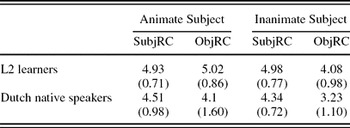
Table 2 shows the mean acceptability ratings given to the experimental items in each of the four conditions. The pattern of judgments was similar across the two groups (the factor group did not interact with any other factor, all ps > .06), but the native Dutch group was harsher in their judgments overall than the L2 learners, as indicated by a main effect of group, F 1 (1, 47) = 13.28, p < .01, partial η2 = 0.22; F 2 (1, 23) = 29.35, p < .001; partial η2 = 0.56.
Mean acceptability judgments (standard deviations)

Note: Maximum score is 6, with 1 = least acceptable and 6 = most acceptable. SubjRC, subject relative clause; ObjRC, object relative clause; L2, second language.
There was a main effect of clause type, F 1 (1, 47) = 42.41, p < .001, partial η2 = 0.47; F 2 (1, 23) = 27.38, p < .001, partial η2 = 0.54, because both groups found the subject-relative conditions more acceptable than the object-relative conditions overall. There was also a main effect of animacy, F 1 (1, 47) = 9.66, p < .01, partial η2 = 0.14; F 2 (1, 23) = 30.23, p < .001, partial η2 = 0.57, because, overall, items with animate subjects were rated more acceptable than those with inanimate subjects. There was a significant interaction between animacy and clause type, F 1 (1, 47) = 12.45, p < .01, partial η2 = 0.21; F 2 (1, 23) = 40.64, p < .001, partial η2 = 0.64. Our t test comparisons found that this interaction was because the ObjRC-inanimate subject condition elicited the lowest acceptability ratings (M = 3.57), differing significantly from the ObjRC-animate subject condition (M = 4.47), t 1 (48) = −3.56, p < .01; t 2 (23) = −5.83, p < .001, from the SubjRC-inanimate subject condition (M = 4.59), t 1 (48) = −6.32, p < .001; t 2 (23) = −7.06, p < .001, and from the SubjRC-animate subject condition (M = 4.93), t 1 (48) = −5.93, p < .001; t 2 (23) = −7.12, p < .001. In other words, the L2 learners patterned very similarly to the native speakers, showing a general dispreference for object RCs, unless the subject was animate, which then dramatically improved the rating of the sentence.
Self-paced reading study
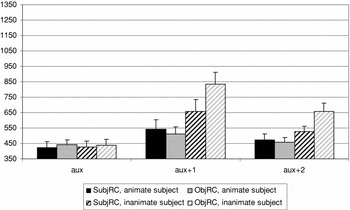
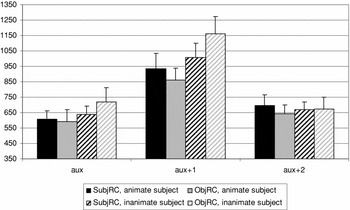
We analyzed three consecutive segments in the self-paced reading study: the critical auxiliary verb (aux), where syntactic disambiguation takes place via number information; the lexical verb (aux+1), where semantic information indicates the NPs’ likely grammatical roles; and the immediately following word (aux+2) to pick up any delayed effects, as has been observed in other reading time studies, especially for L2 learners (e.g., Marinis et al., Reference Marinis, Roberts, Felser and Clahsen2005). Before performing the statistical analyses, reading times above 3 s were removed (affecting 1.8% of the L2 learner and 1.3% of the native Dutch data) and individual reading times beyond 2 SD of each individual's mean per condition, affecting 0.79% of the L2 learner and 1.09% of the native Dutch data. Figure 1 and Figure 2 show the L2 learners’ and native speakers’ mean reading times across the three critical segments, following this procedure to remove outlying reading times.
Dutch native speakers’ (n = 29) mean reading times (ms) on the three critical segments following syntactic disambiguation.

Second language learners’ (n = 20) mean reading times (ms) on the three critical segments following syntactic disambiguation.

On the first critical segment, the auxiliary verb where syntactic disambiguation takes place, there was a main effect of animacy, F 1 (1, 47) = 4.96, p < .05, partial η2 = 0.10; F 2 (1, 23) = 2.84, p = .106, partial η2 = 0.11, and group, F 1 (1, 47) = 9.47, p < .01, partial η2 = 0.17; F 2 (1, 23) = 10.55, p < .001, partial η2 = 0.83, and a significant interaction between animacy and group, F 1 (1, 47) = 4.50, p < .04, partial η2 = 0.09; F 2 (1, 23) = 4.99, p < .05, partial η2 = 0.18. This interaction appeared to be driven by differences in the L2 learners’ reading times, in that the inanimate-subject conditions elicited longer reading times overall (M = 679 ms) than the animate-subject conditions (M = 600 ms), whereas no such effect was visible in the native speakers’ reading times (434 vs. 432 ms). There was no main effect of clause type (ps > .2) nor interactions between clause type and either group (ps > .2) or animacy (ps > .07). However, on this segment there was a significant three-way interaction between animacy, clause type, and group in the participant analysis, F 1 (1, 47) = 4.18, p < .05; partial η2 = 0.08; F 2 (1, 23) = 2.68, p = .12, partial η2 = 0.10. To explore the significant three-way interaction ANOVAs and t tests were conducted within each group. For the native speakers there were no significant effects (all ps > .2). For the L2 learners there was no main effect of clause type (ps > .2), but there was a main effect of animacy, F 1 (1, 19) = 4.89, p < .05, partial η2 = 0.20; F 2 (1, 23) = 4.88, p < .04, partial η2 = 0.18; and the interaction between clause type and animacy was marginally significant by participants, F 1 (1, 19) = 3.42, p = .08, partial η2 = 0.15; F 2 (1, 23) = 1.53, p = .23, partial η2 = 0.06. Among the L2 learners, t tests did not reveal any significant differences between the SubjRC-animate subject and the ObjRC-animate subject condition (ps > .6) or between the SubjRC-inanimate subject and the ObjRC-inanimate subject condition (ps > .2). However, t tests comparing clause type as a function of animacy showed that the animacy effect was stronger between the two ObjRC conditions, animate subject versus inanimate subject, t 1 (19) = −2.52, p < .05; t 2 (23) = −2.10, p < .05, than the two SubjRC conditions (ps > .1). Therefore, at the point of disambiguation, only the L2 learners slowed down when reading the conditions with inanimate subjects in general. Furthermore, only the ObjRC-inanimate subject condition appeared to elicit a significant processing cost relative to the SubjRC-inanimate subject condition. No differences according to clause type were apparent when the subject of the RC was animate.
In the next segment (aux+1), the lexical verb was presented and semantic information was available to indicate the grammatical roles of the ambiguous NPs. The pattern in the two groups’ reading times did not differ because there was no interaction between group and any other factor (ps > .5), although the learners were slower overall, as reflected by a main effect of group, F 1 (1, 47) = 12.93, p < .001, partial η2 = 0.22; F 2 (1, 23) = 150.55, p < .001, partial η2 = 0.87. There was also a main effect of clause type in the participant analysis, F 1 (1, 47) = 4.20, p < .05, partial η2 = 0.08; F 2 (1, 23) = 2.13, p = .16, partial η2 = 0.08; a main effect of animacy, F 1 (1, 47) = 34.06, p < .001, partial η2 = 0.42; F 2 (1, 23) = 32.95, p < .0001, partial η2 = 0.59; and an interaction between clause type and animacy, F 1 (1, 47) = 16.17, p < .001, partial η2 = 0.26; F 2 (1, 23) = 4.47, p < .05, partial η2 = 0.16. The interaction occurred because, in both subject and object RCs, sentences with an animate subject were read more quickly than those with an inanimate subject: SubjRC-animate subject (M = 704 ms) versus SubjRC-inanimate subject (M = 801 ms): t 1 (48) = −2.45, p < .05; t 2 (23) = −2.20, p < .05; ObjRC-animate subject (M = 653 ms) versus ObjRC-inanimate subject (M = 969 ms): t 1 (48) = −6.45, p < .001; t 2 (23) = −5.21, p < .001; but the effect of clause type was evident only in the comparison between the two inanimate conditions, t 1 (48) = −4.45, p < .001; t 2 (23) = −2.49, p < .05. The comparison between the two animate-subject conditions was not significant (ps > .1). Therefore, the pattern observed on the previous segment for the L2 learners alone was now in evidence for both groups: the conditions with inanimate subjects took longer to read overall, with the greatest processing cost observed in the ObjRC-inanimate subject condition, and no difference in processing costs in the two animate-subject conditions, regardless of clause type.
The next segment (aux+2) was again read more slowly by the L2 learners, as indicated by a main effect of group, F 1 (1, 47) = 5.33, p < .05, partial η2 = 0.10; F 2 (1, 23) = 37.32, p < .001, partial η2 = 0.62. There was also a main effect of animacy, F 1 (1, 47) = 7.88, p < .01, partial η2 = 0.14; F 2 (1, 23) = 7.37, p < .05, partial η2 = 0.24; and an interaction between animacy and group, F 1 (1, 47) = 7.48, p < .01, partial η2 = 0.14; F 2 (1, 23) = 6.52, p < .05, partial η2 = 0.22, because the native speakers read the items with animate subjects more quickly (M = 465 ms) than those with inanimate subjects (M = 593 ms); but there was no difference in the L2 learners’ data as a function of animacy (670 vs. 671 ms). There was no main effect of clause type (ps > .5) or an interaction between clause type and group (ps > .07), but there was a two-way interaction between animacy and clause type, significant by participants, F 1 (1, 47) = 5.32, p < .05, partial η2 = 0.22; F 2 (1, 23) = 2.42, p = .13, partial η2 = 0.10, which appeared to be driven by longer reading times for the ObjRC-inanimate subject condition (M = 665 ms) compared to both the ObjRC-animate condition (M = 533 ms): t 1 (48) = 3.76, p < .001; t 2 (23) = −3.16, p < .01, and the SubjRC-inanimate subject condition in the by-participants analysis (M = 584 ms): t 1 (48) = −2.39, p < .05; t 2 (23) = −2.00, p = .057. Although there was no significant three-way interaction among animacy, clause type, and group (ps > .3), a visual inspection of Figure 1 and Figure 2 suggest that this Animacy × Clause Type interaction was driven predominately by the Dutch native speakers’ reading times. In sum, the effects visible on earlier segments were no longer visible in the L2 learners’ data, and were weakened overall for the native speakers, although they still showed longer reading times for the dispreferred ObjRC-inanimate subject condition.
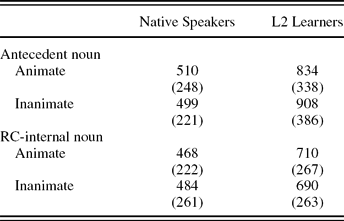
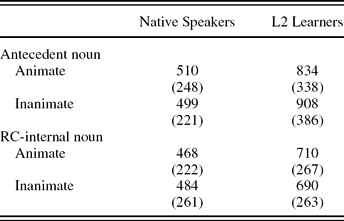
Post hoc analysis. One of the research questions of the current study was whether animacy information would be used on-line by the L2 learners to commit to an analysis. The above results show that indeed this is the case. However, because the animacy information was available on the NPs before their grammatical roles became evident at the auxiliary verb, we examined the participants’ reading times (Table 3) in a post hoc analysis to see whether any differences according to the animacy factor (animate vs. inanimate) appeared prior to disambiguation. For the purposes of these analyses, reading times on the antecedent nounsFootnote 5 and RC-internal nounsFootnote 6 were collapsed across clause type because whether the resulting sentence was a subject or an object RC was not apparent to the reader until the auxiliary verb.
Mean reading times (ms) for antecedent nouns and RC-internal nouns (standard deviations)
Note: RC, relative clause; L2, second language.
Two separate analyses were run according to the linear position of the nouns (antecedent noun vs. RC-internal noun), with the within-participants factor animacy (animate noun vs. inanimate noun) and the between-participants factor group (L2 learners of Dutch vs. Dutch native speakers), which was treated as a within-participants factor in the items analysis. Apart from a main effect of group for both analyses, antecedent nouns: F 1 (1, 47) = 19.16, p < .0001, partial η2 = 0.29; F 2 (1, 23) = 101.11, p < .001, partial η2 = 0.82; RC-internal nouns: F 1 (1, 47) = 9.81, p < .0001, partial η2 = 0.17; F 2 (1, 23) = 619.85, p < .001, partial η2 = 0.96, the only effect was found in the comparison between the two antecedent nouns, where there was an interaction between group and animacy in the participant analysis, antecedent noun: F 1 (1, 47) = 6.36, p < .05, partial η2 = 0.12; F 2 (1, 23) = 1.51, p = .23, partial η2 = 0.06; RC-internal noun: ps > .1. There was no difference in the native speakers’ reading times on the two antecedent nouns, but the L2 learners found the inanimate antecedent noun more difficult to process than the animate antecedent noun, t 1 (19) = −2.24, p < .05; t 2 (23) = −1.24, p = .229. This indicates that the L2 learners were indeed sensitive to the animacy of the NPs in the current experiment, and that they may have had a stronger preference than the native speakers for the antecedent NP to be animate.
DISCUSSION
The L2 learners of Dutch and the Dutch native speakers performed similarly in the off-line acceptability judgment task. Subject RCs were preferred overall for both groups, as were the target sentences with animate subjects, compared to those with inanimate subjects. Both groups found object RCs with an inanimate subject the least acceptable. Thus, like native speakers, the L2 learners’ preference for subject over object RCs disappeared when the subject was animate.
In the self-paced reading task, the ObjRC-inanimate subject condition elicited the longest reading times for both the L2 learners and the Dutch native speakers. However, there was evidence to suggest this effect appeared immediately at the disambiguating auxiliary verb among the L2 learners, whereas it was delayed until the next segment among the native speakers.
Following disambiguation the effect was qualitatively similar in both groups and in line both with the results of the acceptability judgment task and with previously reported results with Dutch native speakers (Mak et al., Reference Mak, Vonk and Schriefers2006). That is, no reading time differences were observed between subject and object RCs when the subject was animate and the object was inanimate.
Prior to disambiguation, the two groups’ reading time patterns differed, such that only the L2 learners showed a processing cost difference in the region of the ambiguous NPs. Specifically, inanimate antecedent NPs were read more slowly than animate antecedent NPs. No differences were observed in processing cost between the animate and inanimate RC-internal NPs for either group.
We now discuss these findings in relation to the predictions based on earlier studies and the research questions presented above.
The interaction of lexical–semantic and structural information in on-line processing
The results of an earlier study with German L2 learners of Dutch (Havik et al., Reference Havik, Roberts, van Hout, Schreuder and Haverkort2009) showed that unlike native speakers of both the learners’ L1 (German) and their L2 (Dutch), processing object-resolved RCs did not elicit higher processing costs in comparison to subject-resolved RCs when sentences were fully ambiguous until morphosyntactic information on the auxiliary verb was encountered. This lack of visible reanalysis effects suggested to the authors that the L2 learners did not incrementally assign subject and object roles to the ambiguous NPs prior to disambiguation at the auxiliary verb, even though, like native speakers, they appeared to have a preference for subject-first constructions off-line. In light of other on-line reading studies that have shown that, compared to native speakers, L2 learners may rely more on lexical–semantic and less on purely structural information when making on-line processing decisions (e.g., Felser et al., Reference Felser, Roberts, Marinis and Gross2003; Papadopoulou & Clahsen, Reference Papadopoulou and Clahsen2003), the question raised in the present study was whether L2 learners never make such on-line structural commitments when processing subject–object ambiguities or whether they would do so when lexical–semantic information is available on which to base an analysis.
In contrast to the L2 learners in Havik et al. (Reference Havik, Roberts, van Hout, Schreuder and Haverkort2009), the L2 learners in the current study showed an on-line processing disadvantage following disambiguation in object versus subject RCs, which is in line with their off-line preferences. Given that the participants were sampled from the same pool as those in the earlier study and were of a comparable age and educational background, this suggests that it is unlikely that the background of the L2 learners was responsible for this difference in performance. It is instead more likely that the presence of semantic information, in the form of noun animacy, underlies the observed effect.
However, the L2 learners did not prefer the subject-resolved sentences overall. The preference for subject RCs disappeared in sentences where the subject was animate and the object was inanimate (SubjRC-inanimate subject, ObjRC-inanimate subject). At the same time, animacy alone did not drive the L2 learners to assign grammatical roles to the ambiguous NPs. If only animacy information enabled participants to assign grammatical roles to the ambiguous NPs in an incremental manner, then one would expect that the conditions containing an inanimate subject (SubjRC-inanimate subject, ObjRC-inanimate subject) would have been more difficult to process at and beyond disambiguation, regardless of word order. That is, if participants constructed an object RC on the basis of animacy alone, then reanalysis effects would have been apparent in the SubjRC-inanimate condition, and this was not the case. Instead, mirroring findings reported by Mak et al. (Reference Mak, Vonk and Schriefers2006), the pattern of reading times in the disambiguating region and beyond was the same for the L2 learners and the native speakers, with the ObjRC-inanimate subject condition eliciting the longest reading times of all.
This lack of reanalysis effects in the ObjRC-animate subject condition is not predicted by a syntax-first account of the human parsing mechanism, such as the active filler strategy (e.g., Frazier, Reference Frazier1987), because such an account assumes that a subject RC is always constructed, independent of semantic information. Similarly, working memory based accounts that would predict greater difficulty on object RCs because of the memory load costs associated with constructing object RCs (e.g., Gibson, Reference Gibson1998), cannot account for the present findings.
As hypothesized by Mak et al. (Reference Mak, Vonk and Schriefers2006), our results support the possibility that for both the L2 learners and the Dutch native speakers, two interacting factors are at work when they process subject and object RCs in which the ambiguous NPs differ in animacy: the topicality of the antecedent NP and noun animacy. When there is conflict between these two factors, as in SubjRC-inanimate subject and ObjRC-animate subject conditions, the assignment of grammatical roles is postponed. Grammatical role assignment takes place only when both topichood and animacy coincide, that is, when the antecedent NP is animate and the RC-internal NP is inanimate (i.e., SubjRC-animate subject and ObjRC-inanimate subject conditions). Although this is the correct assignment in the SubjRC-animate subject condition, leading to no need for reanalysis at the disambiguating region, reanalysis must take place in the ObjRC-inanimate subject condition at the point of disambiguation. As such, the present results favor a parsing model in which multiple constraints, including discourse-level and lexical–semantic expectations, influence on-line parsing commitments and the relative difficulty both native speakers and L2 learners encounter when processing structures like object RCs, even when such structures should be more difficult based solely on syntactic criteria (cf. Gibson, Desmet, Grodner, Watson, & Ko, Reference Gibson, Desmet, Grodner, Watson and Ko2005; Gordon, Hendrick, & Johnson, Reference Gordon, Hendrick and Johnson2004; Kaan, Reference Kaan2001).
The interaction between animacy and clause type evidenced here could also be accounted for by the tuning hypothesis (e.g., Desmet, De Baecke, Drieghe, Brysbaert, & Vonk, Reference Desmet, De Baecke, Drieghe, Brysbaert and Vonk2006). Specifically, although RCs with animate and inanimate antecedents are equally frequent in both Dutch and German, inanimate antecedents are more often followed by object RCs, whereas animate antecedents are more often followed by subject RCs (Mak et al., Reference Mak, Vonk and Schriefers2002). This possibility is reinforced by the relatively low acceptability ratings for all of the target sentences, and especially the ObjRC-inanimate subject sentences. L2 learners, in particular, may be sensitive to the statistical frequency with which certain constructions occur in the L2 (e.g., Dussias & Sagarra, Reference Dussias and Sagarra2007), such that a tuning account of the current results cannot be ruled out. Regardless of the ultimate root of this interaction, what is important is that the L2 learners in the present study were able to use lexical–semantic information in conjunction with a more structurally based processing strategy favoring subject first constructions and, in so doing, closely approximate the strategies demonstrated by native speakers.
Further evidence for the L2 learners’ sensitivity to the interaction between topichood and animacy is observed in their reading times on the antecedent NP, in which reading times were longer for inanimate antecedent nouns compared to animate antecedent nouns. Working under the assumption that there is a general preference to build a subject RC based on topichood and that animate entities make better subjects, the interaction of these two factors would have led to an overall preference for animate antecedent nouns as the L2 learners anticipated the subsequent RC (cf. MacWhinney, Reference MacWhinney, Kroll and de Groot2005; Weckerly & Kutas, Reference Weckerly and Kutas1999). In contrast to the L2 learners and Dutch native speaker results reported by Mak et al. (Reference Mak, Vonk and Schriefers2006), the native speakers in the present study exhibited no such preference for animate antecedents overall. One possible explanation for this difference between the L2 learners and the Dutch native speakers in the present study is that the native speakers exhibited no measurable sign of difficulty at earlier points in the sentence because of overall reading speed. Alternatively, the presence of an animacy effect at the antecedent noun for the L2 learners may signal that L2 learners are more sensitive overall to such semantic factors in their on-line processing compared to native speakers (e.g., Roberts & Felser, Reference Roberts and Felser2010).Footnote 7
Resolving ambiguity without the lexical verb
Although the overall reading time effects were similar between the L2 learners and the Dutch native speakers, exactly where the first sign of on-line reanalysis appeared was different for the two groups. Specifically, there was evidence to suggest that the interaction between animacy and clause type began to have an impact immediately at the disambiguating auxiliary among the L2 learners, whereas the native speakers only showed this effect at the next segment, on the lexical verb, once semantic information was available for use in disambiguation. It is certainly possible that earlier processing difficulties among the Dutch native speakers were camouflaged by overall reading speed, although an ANOVA with mean reading speed as a covariate factor failed to find any significant effects. A second possibility is that the preferred word order in Dutch is to place the auxiliary verb after the past participle (cf. Geerts et al., Reference Geerts, Haeseryn, de Rooij and van den Toorn1984; Vandeweghe, Reference Vandeweghe2000), and this is the only licit order in German.Footnote 8 Thus, it is possible that encountering the auxiliary verb prior to the past participle may have led the L2 learners to pay more attention to the auxiliary than they might have otherwise, whereas the Dutch native speakers may have processed the verbal cluster all together at the end of the RC.Footnote 9
The finding that the L2 learners exhibited longer reading times on ObjRC-inanimate subject sentences immediately at the disambiguating auxiliary is striking because it appears that, under the right circumstances, L2 learners not only apply the same parsing strategies as native speakers but also can make use of morphosyntactic information alone to disambiguate ambiguous material. Furthermore, they did so even though their reading times overall were significantly slower than the Dutch native speakers, suggesting that their L2 Dutch had not yet reached asymptote at the time of testing. To the best of our knowledge, this is the first study to find that L2 learners can make on-line decisions when reading temporarily ambiguous sentences in the absence of the lexical verb, as well as the first study that has found an effect immediately at the auxiliary verb in the processing of RCs in Dutch. As such, it calls into question a strong version of a verb-driven parsing strategy, as proposed by Clahsen and Felser (Reference Clahsen and Felser2006), because the present results suggest that in the presence of sufficient lexical–semantic information, L2 learners can make early parsing commitments and show signs of on-line reanalysis independently of the lexical verb.
CONCLUSION
The results of the current study show that L2 learners parse ambiguous subject and object RCs like native speakers in the presence of semantic information, operationalized here via the animacy of the ambiguous NPs. Furthermore, once pushed to make an on-line commitment to a subject or object-first interpretation, L2 learners are able to use morphosyntactic information in the form of number agreement on the auxiliary verb to disambiguate temporarily ambiguous sentences, instead of waiting until the subsequent past participle forces disambiguation via semantic information and plausibility constraints alone. As such, the present study highlights ways in which lexical and syntactic information interact during even the early stages of on-line processing among both L2 learners and native speakers and, when sufficient semantic information is available, L2 learners have the ability to parse L2 sentences in ways that are remarkably similar to native speakers of a language.
ACKNOWLEDGMENTS
The research reported here was supported financially by the NWO, which is gratefully acknowledged. We also thank Anne Rijpma, Sonja Wichert, and Ilonka Petal for experimental preparation and data collection. Earlier versions of this paper were presented at Architectures and Mechanisms for Language Processing 2008 in Cambridge, England, and at the Germanic Linguistics Annual Conference 2009 in Banff, Canada. We are grateful to the attendees of these conferences for their feedback. We also thank the two anonymous Applied Psycholinguistics reviewers for their suggestions that greatly improved this paper.