Towards deliberative governance
In recent years, the theory of democracy has undergone a shift towards the theory of deliberation (Manin, Reference Manin1987; Bohman, Reference Bohman1998; Dryzek, Reference Dryzek2000). This shift reflects the growing importance of communication in politics, moving away from authoritarian codes, and opening legitimization processes based on deliberation, accommodation, or mutual influence (Habermas, Reference Habermas1996; Knight and Johnson, Reference Knight and Johnson1997). However, above all, it has meant the incorporation of individuals in politics as competent rational agents who think about their preferences in the light of open debate (Chambers, Reference Chambers2003). Parallel to the communicative shift in the theory of democracy, participatory theory has undergone a similar shift, at least for its practitioners. Little more than a decade ago, a representative sample of European countries broadened the conception of participation, advocating deliberative governance for safeguarding administrative modernization (Stoker, Reference Stoker2003; Smith, Reference Smith2009; Sintomer et al., Reference Sintomer, Ganuza, Herzberg and Röcke2011). This new conception is rooted in the search for a more horizontal and cooperative political organization (Papadopoulos, Reference Papadopoulos2003). Think of the legislative changes carried out in the United Kingdom (Local Government Act 2000), France (Proximity Democracy Law 2002), Spain (Local Government Modernisation Law 2003), Holland (Local Democracy Law 2002), or the recommendations made in this respect by the Committee of Ministers of the Council of Europe (2001) or the OECD (2001). All of these reforms sought to increase the transparency of public management in order to enhance democratic legitimacy, by (1) improving accountability, which seeks to make executive responsibility more transparent and (2) increasing participatory processes. The effect of this has been the proliferation of new participatory instruments in France (Sintomer and Maillard, Reference Sintomer and Maillard2007), in the United Kingdom (Birch, Reference Birch2002), Spain (Ganuza and Francés, Reference Ganuza and Francés2011), and many other countries (Smith, Reference Smith2009), with a substantial deliberative format, very different from prior participatory instruments (Sintomer et al., Reference Sintomer, Ganuza, Herzberg and Röcke2011).
These new institutional arrangements have been called Empowered Participatory Governance by Fung and Wright (Reference Fung and Wright2003: 5). Legislative reforms such as those mentioned above promote the deliberative role of the administration, favouring institutional arrangements that encourage elites to enter into dialogue with the public in the period between elections. Through these instruments, the administration aims at a deliberative process targeted at collectively defining policy content. The new instruments take social mobilization as far as formulating proposals. Here participation entails moving beyond the traditional definition and incorporating elements of deliberative theory. It is not a case of lobbying for a particular interest, but of establishing a dialogue throughout the spectrum of interests. The relation between those who govern and those who are governed thus becomes more horizontal, as Sintomer et al., (Reference Sintomer, Ganuza, Herzberg and Röcke2011: 15) suggests in his study on participatory budgets. This feature takes participation into an arena where the involvement of differences in the debate becomes important and emphasizes that all participants can avail themselves of language on an equal footing. Studies in Brazil on participatory budgets suggest that these cannot be justified solely by neo-Toquevillian theories, but have an institutional dimension – what Avritzer (Reference Avritzer2006: 630) calls the effectiveness of deliberative process. The crucial variable is a deliberative process in which the public may directly influence public policies. Baiocchi (Reference Baiocchi2005: 144) and Wampler (Reference Wampler2007) point out how important local institutional conditions are in explaining these experiences and their quality, which is expressed (1) in administrative efficiency (carrying out proposals debated by the citizens) and (2) in the pluralistic inclusion of citizens (participation that reflects the population and an equitable distribution of the opportunities available for influencing and deliberating).
The aim of this article was to analyse to what extent these new instruments, mainly participatory budgeting (PB), deal with two important issues in deliberative governance: (a) the inclusiveness and diversity of opinions (Knight and Johnson, Reference Knight and Johnson1994; Dryzek, Reference Dryzek2000) and (b) the allocation of deliberative opportunities (Bohman, Reference Bohman1997). We shall analyse the profiles of participants mobilized to attend public meetings on PB and, finally, of those mobilized to deliberate within public meetings in which different citizens may participate under equal conditions in a public debate. We will thus analyse deliberative performance in PB. Most studies of PB have been carried out in Brazilian cities, this study extends the topic by studying participatory budgets in Spain.
The article is divided into four sections. In the first, we describe the theoretical problems linked to deliberative governance. Second, we show how the PB processes we analyse operate, describing the participatory budgets in Brazil and Spain in more detail, and setting out our hypothesis and methodology. Third, we analyse the results of a survey of participants in public meetings held in Spain to examine the profiles of the participants mobilized and the level of deliberation achieved in the public meetings. Finally, we conclude with reflections on the problem of deliberative governance in light of the results obtained in a specific participatory experiment.
The problem of inclusion and deliberation in deliberative governance
The idea of political empowerment is central to deliberative governance. Empowering individuals generally means increasing their capacity to participate in, and share responsibility for, public affairs. One challenge for deliberative governance is to address the problem of inclusion (who can participate) and to what extent individuals may develop deliberative skills and capabilities. The new participatory instruments that have spread throughout the world (Smith, Reference Smith2009) challenge traditional participatory procedures. This is not only because they rest on a different logic (deliberation), but also because they give governments a privileged place in the organization of participatory processes, which becomes even more pronounced if we consider inclusion and the deliberative performance of those who participate. The new participatory procedures, then, raise many questions, which we sum up in terms of two problems: (1) the opposition that has often been cited between participation and deliberation and (2) the factors that really prevent the conditions of access to public debate becoming universal.
(1) Participation has always been explained (Verba and Nie, Reference Verba and Nie1972: 2; Brady, Reference Brady1999: 737; Teorell et al., Reference Teorell, Torcal and Montero2007: 336) as a preference aggregation mechanism, enabling individuals to organize themselves with respect to their particular interests, to indirectly influence decision makers (Papadopoulos and Warin, Reference Papadopoulos and Warin2007: 451). This scenario embraces participation as an act of protest and relies on the image of a society fragmented into disparate interests. Here, negotiation is given priority as a mechanism whereby citizens’ preferences are parlayed into public politics.
From this perspective, participation has been seen by many authors in contrast to deliberation. Both may have the aim of improving the legitimacy of the government, but by different means. The theory of deliberation emphasizes the process whereby preferences are formed and described, whereas participatory theory pays more attention to including the broadest categories of citizens (Papadopoulos and Warin, Reference Papadopoulos and Warin2007: 450). Criticisms of each theory stress, above all, the exclusive limits of their own dynamics. Fiorina (Reference Fiorina1999), for example, sets out what a participatory activist's profile requires, which could be a significant obstacle to involvement by the average citizen. Sanders (Reference Sanders1997), on the other hand, shows the underlying requirement of rationality that is unequally distributed throughout society. Mutz (Reference Mutz2006) suggests that participatory logic based on attaining predetermined objectives does not fit very well with deliberative logic based on dialogue between people who differ in their thinking. This dialogue, which allows an individual to make contact with viewpoints different to her own, would not be a characteristic feature of those who are active in a participatory way, as they are focused on their own interests and form part of rather homogeneous social networks (Mutz, Reference Mutz2006: 20–50).
The differences between the dynamics at work in participatory and deliberative processes have been highlighted by studying associations. Eliasoph (Reference Eliasoph1998) showed how active members of voluntary organizations in the United States of America avoided speaking about politics and therefore avoided a dialogue between different viewpoints. Hendriks (Reference Hendriks2002), in her analysis of citizen juries in Australia, shows the conflict existing between voluntary associations and a deliberative procedure open to the general public. Rui and Villechaise-Dupont (Reference Rui and Villechaise-Dupont2005) point out a similar conflict between associations and deliberative procedures in France. Such conflicts might lead us to understand that deliberation and participation, despite sharing the same aim (increasing government legitimacy), possess competing visions of democracy.
However, Papadopoulos and Warin (Reference Papadopoulos and Warin2007) minimize these differences. There is less polarization between them than between participatory theories and elitist theories, or between the theory of deliberation and standpoints that argue for an aggregative theory of democracy. It must be taken into account that the analysis of participation has been based mainly on studies of interest groups (Jordan and Maloney, Reference Jordan and Maloney1997; Eliasoph, Reference Eliasoph1998; Lichterman, Reference Lichterman2006), whereas studies of deliberation have been extensively carried out on deliberative experiments (Fishkin, Reference Fishkin1996; Smith and Wales, Reference Smith and Wales2000; Barabas, Reference Barabas2004; Font and Blanco, Reference Font and Blanco2007). Both theories have also extensively analysed features that are supposedly shared by individuals with one profile or another (Mutz, Reference Mutz2006; Maloney and Robteutscher, Reference Maloney and Robteutscher2007). This may, in part, be because of the fact that there are no clear procedures that lead participation and deliberation to converge, which in turn leads to the processes becoming estranged from each other. We might think, as Eliasoph (Reference Eliasoph1998) suggests, that the problem is the way participation occurs in a determined public space. Delli Carpini et al., (Reference Delli Carpini, Lomax and Jacobs2004: 336) think the same about deliberative processes. From this perspective, it is not only a question of abstract and universal characteristics of participation or deliberation, but rather that these depend significantly on the way participation (and deliberation) occurs. This would mean analysing both the procedures and the space in which the deliberative and participatory dynamics are generated. We should take into account not only individual characteristics, but also how the spaces are designed so that interaction may take place. From this standpoint, participation and deliberation contain considerable differences; however, participatory budgets offer an institutional design that allows the traditional participatory profile to be incorporated into a deliberative dynamic, corroborating Eliasoph's (Reference Eliasoph1998) context hypothesis. We therefore cannot pay attention only to the universal characteristics of those who participate; it is also very important to consider the space in which they do so. Wampler (Reference Wampler2007) and Avritzer (Reference Avritzer2006) have already pointed out that many differences between the experiences of PB in Brazil can be explained by the different institutional contexts in which they take place.
(2) In a way, this means that it is possible for participatory processes to include deliberation. Everything depends on how participation is organized; whether a scenario of negotiation of interests or a deliberative scenario. In this sense, the communicative feature of participation may have positive effects on the development of democracy. It would involve taking deliberation out of a merely experimental setting and projecting its effects onto participants (Thompson, Reference Thompson2008). It not only allows governments to be more accountable through deliberation, but can also take deliberation into participatory scenarios and include individuals who do not usually participate, but who are willing to become involved in a deliberative procedure.
The problem that emerges from this convergence, however, is how to ensure plural and universal access to participatory and deliberative procedures. The study will show the difficulties of organizing an impartial procedure, not so much because it is impossible to imagine participants having the skills to take part in public debate or being able to take proper advantage of their deliberative opportunities, but rather because of the difficulties they encounter in becoming involved in a participatory procedure. This indicates an obstacle for deliberative governance – one that relates not to deliberation but to participation: how will it be possible to organize participatory procedures or spaces that include a broad social plurality?
PB is aimed at the public as a whole, but that does not necessarily mean that everybody participates. Verba et al. (Reference Verba, Schlozman and Brady1995) show that when speaking about citizen participation, three factors can explain involvement: (1) whether a person really wanted to take part, (2) whether they could take part, because of material and symbolic barriers, and (3) whether they were asked to take part. The last of the above factors indicate how important it is that the public feel invited to take part. I suggest that contact with somebody or something that provides the knowledge and means to participate often precedes public involvement in politics. This is why the analysis of public mobilization has become so important (Lim, Reference Lim2010). Yet from the perspective of deliberative governance, we should also take into account whether citizens feel invited by their government. If citizens believe their government is biased, they can reject participation. PB therefore faces a challenge, in that it is a way for citizens to show confidence (or otherwise) in their government. Can governments offer an impartial participatory space to make citizen participation attractive? We will try to answer these questions through the case of Spanish PB.
From Brazilian PB to Spanish experiences
Participatory budgets are organized with the aim of discussing a part of public budgeting (Fedozzi, Reference Fedozzi2001; Baiocchi, Reference Baiocchi2003; Avritzer, Reference Avritzer2006; Sintomer et al., Reference Sintomer, Ganuza, Herzberg and Röcke2011). Such discussions take place in line with a procedure that is consultative in most European instances (Sintomer et al., Reference Sintomer, Ganuza, Herzberg and Röcke2011) in contrast to Brazilian ones (Avritzer, Reference Avritzer2006). In Spain, however, PB always presupposes a decision-making procedure (Ganuza and Francés, Reference Ganuza and Francés2011). Combining participation with a public process of decision-making presents a problem of political legitimacy, as deliberative theory asserts (Knight and Johnson, Reference Knight and Johnson1994; Christiano, Reference Christiano1997). On the one hand, a procedure must be designed that allows the public to debate and decide part of the public budget within an impartial setting that legitimates the decisions adopted; on the other hand, a participatory process that is as inclusive as possible and which can, in turn, legitimate decisions reflecting the engagement of diverse publics in an open debate must be organized.
Public decision-making processes in most Brazilian instances have been organized on the basis of a multi-stage process in which decisions are adopted progressively. Deliberative and preference-averaged procedures are mixed to obtain a measured decision. In this way, the process attempts to reduce the influence of voting, including a deliberative procedure in which citizens not only bargain for their interests, but must also evaluate the distribution of scarce resources in the best possible way within the municipality. In almost all Brazilian participatory budgets, this has included a process of deliberation based on applying criteria of distributive justice. In some cases, the citizens, and in others the administration, or sometimes both jointly, decide on criteria that will subsequently be used to prioritize citizens’ proposals. It is a procedure that brings to mind Rawls's veil of ignorance. In this way, the results will be the fruit of a deliberative process and not only a vote. This prevents snap decisions and means that priorities are considered properly. This may also give rise to frustration, as there is never a direct decision-making process. The process has several stages, and, in each, the preferences of others must be considered.
Besides the decision-making process, PB seeks to include civic diversity, that is, it legitimates by including heterogeneous citizens in the deliberative process. PB differs from other processes of public deliberation in that citizens are not directly invited to take part in the public debate. For example, in deliberative polls, participants are selected by random sampling, whereas in juries, citizens are often chosen by lottery. This fact makes the inclusion of the public a crucial problem in all the experiences organized.
The institutional design of participatory budgets, which aims at the general public, offers a participatory framework that differs from the usual protest model. In principle, the citizen's role is not a skilled one. She only has to attend a public meeting; if she wishes, she can talk and propose something, or just listen; at the end she can vote. For most participants, involvement is sporadic, in contrast to typical demands from participatory movements (Fiorina, Reference Fiorina1999). The aim of participation is also different. Here it seeks to make a collective decision in which each participant is invited to influence public decisions. This breaks up the hierarchical structures of corporate and protest groups (Jordan and Maloney, Reference Jordan and Maloney1997; Maloney and Robteutscher, Reference Maloney and Robteutscher2007). The process provides spaces for people to speak, and not only about their own preferences. Deliberation is an intrinsic part of the process, and citizens are continually invited to engage in deliberation in open public meetings. It is crucial to listen to others’ demands, and thus these experiences differ from traditional participatory structures (pursuing one's own interest) and are closer to deliberative arrangements (considering different viewpoints).
In the European context, Spain is the country where PB has been most experimented (Sintomer et al., Reference Sintomer, Ganuza, Herzberg and Röcke2011). The first experience was in 2001, in the city of Cordoba, and has now expanded to more than 50 different cities all over the country. Most PB experiences have been launched by left political parties; however, most experiences since 2007 have been launched by conservative political parties. Both left and right political parties accept PB as a decision-making process. The process is similar to the Brazilian one, as both experiences feature a step-by-step decision-making process, in which criteria of redistributive justice are applied in order to prioritize citizens’ proposals. This similarity allows us to compare the Spanish and Brazilian experiences, as they face the same problems; a collective decision-making process needs mechanisms that make open debate possible and to include public heterogeneity.
The big difference between the two countries lies in the aims pursued. Although in Brazil, PB is an instrument for achieving a more equitable distribution of public funds, and also for democratization (Avritzer, Reference Avritzer2006), in Spain, it has been mainly a tool for modernizing the state by improving relations between those who govern and those who are governed by increasing citizen engagement in public administration (Ganuza and Francés, Reference Ganuza and Francés2011). Social justice has not been a central variable in the expansion of PB in Spain, where PB is justified more as an instrument to ‘improve democracy’. It is a chance to invite more citizens to participate and to justify administrative decisions. In this sense, criteria of redistributive justice are a transparent way to prioritize citizens’ proposals, rather than achieve equitable allocations of public resources.
In Brazil, traditionally marginalized citizens who did not participate have found a channel of participation in PB (Baiocchi, Reference Baiocchi2005; Wampler, Reference Wampler2007). The socio-demographic structure in places such as Porto Alegre is very similar to the municipal population's structure (Sintomer and Gret, Reference Sintomer and Gret2003). According to Baiocchi (Reference Baiocchi1999) deliberative opportunities are well-distributed among participants, a point on which Avritzer (Reference Avritzer2006) confirms in studying other experiences in Brazil. However, Nylen (Reference Nylen2002) points out the importance of participatory background among the participants in Belo Horizonte and Betin, in that although new participants with low socio-economic status are mobilized, they still have a classic participatory profile, as many are members of associations. Nylen (Reference Nylen2002), however, analyses participants in PB councils, whereas Baiocchi (Reference Baiocchi2005) and Fedozzi (Reference Fedozzi2005), for example, analyse participants in assemblies. Even so, this difference demonstrates how important the traditional participant profile remains in these new arrangements.
We may wonder to what extent PB in Spain reproduces the results seen in Brazil, and whether the Spanish have been able to incorporate new participants or equitably distribute opportunities for influence. Considering these problems, our first hypothesis is that in Spain, without a specific selection method (e.g. a lottery), it is very likely that people who attend the new participatory spaces will be those who already participated previously and, therefore, have an active citizen profile (better educated, linked to associations, interested in politics, etc.). Our second hypothesis is that if we consider a participatory space distinct from the traditional world of protest and corporatism, even though it is occupied largely by traditional protagonists, we may expect deliberation to be possible for all participants.
The survey
Our results are drawn from a survey carried out by the IESA (Institute of Advanced Social Studies) in 2007 of eight participatory budgets. A total of 3094 people participated in the assemblies in eight municipalities. We asked them to fill out the questionnaire after the assembly. We obtained 1139 participant questionnaires. The questionnaire used was expressly designed for this purpose. It is structured and is arranged in a multi-topic format, where questions regarding the deliberative role of participants are asked. There are also questions intended to record the subject's involvement in the participatory budget, and the perception of the subjects of the political sphere.
The data-gathering process did not attempt to create a representative sample. This premise was chosen because participants were not required to reflect the demography of the municipality. Besides, the municipalities do not maintain a participation database. The intention was to sample the population structure mobilized in this process, for which there was no prior data that would allow us to infer the population characteristics. The sample design followed an exploratory logic, justified by the non-existence of precedents for surveys of this type, and the absence of data on the socio-demographic structure of participants. Open quotas were determined for gender and age for a non-probabilistic sampling, forming a final sample with 1139 cases. The aim of the survey was therefore to attempt to conduct a survey that would contain the largest possible number of citizens who had participated in the assembly processes that year. The final response rate was 36.8% of the population (1139 people completed the questionnaire of a total of 3094 people who attended the meetings in the different municipalities). Thus, although the final size of the sample may not allow us to make statistical inferences, it does at least support the analysis of a very significant number of cases in relation to the total number of subjects attending the assembly processes.
The survey was conducted with the express permission of the coordinators of each experiment, and the implementation of the field study was standardized in all municipalities: anonymous questionnaires, validated by pre-testing, and self-administered with technical assistance from the personnel in charge of the processes. In each municipality, the questionnaire was handed to all participants at the start of the public meeting (always the meeting where the participants debated and decided on proposals), and the aims of the research were briefly explained. At the end of the meeting, the participants handed in the questionnaire to the organizers.
The problem of inclusion in Spanish experiences
The total participation of citizens in Spanish PB is between 1% and 3% of the total population. This is very similar to the average participation we find, for example, in the city of Porto Alegre – a global reference for PB (Fedozzi, Reference Fedozzi2005), and is also similar to other experiences in Brazil (Avritzer, Reference Avritzer2006). This appears to be a rather small amount, but compared with other participatory processes that seek to influence the decision-making process, it is a significant figure. However, numbers tell us little about participation and inclusion.
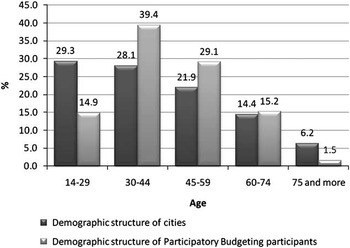
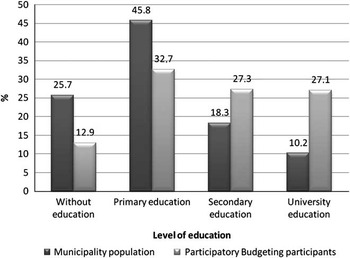
In general, socio-demographic profile matters. More men, adults, and educated people participate than women, young, or less educated individuals. However, in participatory budgets with 6 years or more of experience, women are in the majority (52.8%) compared with 44% in participatory budgets of only 2 years of duration. However, in the teams or structures of participatory budgets formed to administer the process, men form the majority. This is a very similar phenomenon to that observed in the world of associations (Montero et al., Reference Montero, Font and Torcal2006). In proportion to the population, very few young people take part compared with young adults (30–44 years old), as is also true for traditional forms of participation (Verba et al., Reference Verba, Schlozman and Brady1995; Dalton, Reference Dalton2000; Ferrer et al., Reference Ferrer, Medina and Torcal2006). Figure 1 shows the differences between the total number of participants in PB and the average population structure of our municipalities. Younger people are under-represented, whereas adults aged between 30 and 60 years are over-represented. If we take into account their level of education (Figure 2), individuals with secondary or university education are over-represented in the participatory budgets in relation to the population in municipalities, a phenomenon repeated in participatory processes involving protest.
Differences between the demographic structures of cities and participatory budgeting participants.

Level of education among the participatory budgeting participants and the municipality population.

However, participation data provide us with a static picture. If we take into account first-time participants and those who have taken part more than once, we get an idea of the population replacement of the participants, which may allow us to speak of the evolution of the participatory process. In this case, we see that among new participants, young people represent a proportion similar to that of adults, especially those aged between 45 and 59 years. This may allow us to speak of a replacement of participants by younger population cohorts.
Politically, it is interesting to learn of these participants’ previous involvement and their attitudes related to political matters. Studies conducted to date show that the individuals who participate most in associations or protests are those who already have a background of participation or a prior interest in politics (van Deth and Elff, Reference van Deth and Elff2004; Van der Meer and Van Ingen, Reference Van der Meer and Van Ingen2009), as indicated by three variables: level of involvement with associations, interest in politics, and the ideological self-description of the participants.
In the analysis, we distinguish between those who belong to a political party, to a neighbourhood or social association, or any other type of association. If we combine all types of collectives, the result shows that, for all the municipalities studied, 74.1% of those who attend PB assemblies belong to some type of association. Unfortunately, there are no data on associative involvement for each municipality, but by way of illustration, the number of people who belong to associations in PB is double that of the same group in relation to the total population of Spain, which is approximately 40% (Montero et al., Reference Montero, Font and Torcal2006; Figure 3).
Membership of organizations among the participatory budgeting participants.

The proportion of the population in the participatory budget best predicts the levels of association membership. The percentage of association members in relation to the total number of participants exceeds 80% in municipalities where less than 1% of the population has been mobilized, whereas in those where more than 1% have been mobilized, the percentage of association members falls to 68%. The budget exercises that have been running for longer are also those with a greater proportion of participants who belong to associations. Thus, we can conclude that the growth of PB clearly stems from the associative sector, which acts as a catalyst for the influx of people into the assemblies. Although the methodology is aimed at the entire population, the role played by associations is fundamental. Most participants also show a strong interest in politics (between 70% and 80% of participants express great or moderate interest in politics). Citizens who attend PB meetings show a markedly greater interest in politics (almost 50%) than the general citizenry as recorded in a Spanish survey (CIS, 2007) where 7.5% responded they were interested in politics.
With respect to the participants’ ideological profiles, the survey data indicate that the bias is very significant. On a scale of 0–10, where 0 represents the extreme left and 10 the extreme right, the average for participants in the participatory budget is 3.71. This average does not vary significantly in terms of gender, age, or level of education. We cannot compare the ideological alignment of participants with those of the general population of each locality, but we can make an approximation based on the relation between ideological orientation and the voting memory of the participants, relating this to how the different parties are represented in each town hall.
The most general result of this analysis reveals a marked ideological bias among participants in favour of the governing party. For example, in municipalities where the social democrats (Spanish Socialist Workers’ Party, PSOE) form the governing party, it is over-represented, with the exception of one municipality (Terrassa) where we find a governmental coalition of social democrats with the nationalist left. However, in municipalities where post-communists govern (United Left, IU), PSOE sympathizers are under-represented. A similar situation occurs with IU voters when social democrats govern. In the case of the conservative party (People's Party), we find this party to be under-represented in all the municipalities except one (Puerto Real), where the party has a token electoral presence. Broadening the population frame, we find ourselves in the presence of a population profile that is ideologically skewed to the left. Although approximately 65% of participants describe themselves as left-wing, in the case of the Spanish population as a whole this proportion is around 20% lower.
We can find out whether there are variations in ideology if we take into account the timescales of the different processes. In municipalities with less experience of PB, we observe that there is an increase in new participants who place themselves in the ideological centre, whereas a negative change takes place with respect to both left-wing and right-wing participants, when considering participants with previous experience of PB. In any case, this is a situation of limited variation. In municipalities with 3 years’ experience, there is an appreciable ideological renewal in the composition of new participants as compared with those who have already participated. In these municipalities, we observe an almost arithmetical replacement in terms of new participants from the ideological centre, who replace the left-wing participants at a ratio of almost 1:1. There is also a limited increase in the ratio of right-wing participants, a group that tends to consolidate in municipalities with 6 years of PB experience. These latter budgets represent a relative settling of the ideological composition of the people taking part in PB, without manifesting excessive variations between new and veteran participants. We must take into account that the number of new participants gradually decreases over time, which indicates that participant replacement diminishes, although it is true that replacement continues to be quite high (46% of new participants in budgets running for 6 years, 61% in budgets running for only 2 years).
In light of these findings, we may speak of PB as a phenomenon, which, in principle, agrees with the expectations of participatory dynamism held by people of a leftist ideology, and who are the protagonists in the first editions of the assembly process. It also shows to what extent the influence of political parties in government is important. However, the ideological bias tends to fade with successive PB sessions, allowing people of a different ideological persuasion to be included.
Deliberative performance within participatory budgets
If inclusion is biased by socio-demographic and socio-political variables, we may wonder whether participants can be involved on an equal footing in the public debate, or whether the same inequalities found in the outside world persist. Critical political theory has questioned whether all citizens can take part in a deliberative process on an equal footing (Sanders, Reference Sanders1997; Young, Reference Young1997), mainly because of the intellectual demands of participation in an open debate (Bohman, Reference Bohman1997: 322; Dryzek, Reference Dryzek2000: 58). In the following, we shall show to what extent the deliberative procedure allows influence to be equally distributed in participatory budgets in the assemblies.
To analyse this question, we shall examine the deliberative performance of the participants, ranked on a five-point scale ranging from (1) did not participate in or understand the meeting to (5) made proposals and encouraged others to vote for them. Table 1 shows the deliberative performance of participants corresponding to their actions in the assemblies. Each participant may answer any of the possible responses. In this way, we obtain a deliberative scale of the participants according to their communicative actions in the public meetings. This deliberative scale goes a little further than those usually employed to evaluate deliberation in the Brazilian experiences (Baiocchi, Reference Baiocchi1999; Avritzer, Reference Avritzer2006), which include whether the participant takes the floor or speaks in public meetings. The data demonstrate that most participants take part actively in the deliberative process.
Participants’ deliberative performance

N = 946.
Source: Institute of Advanced Social Studies, E-0705.
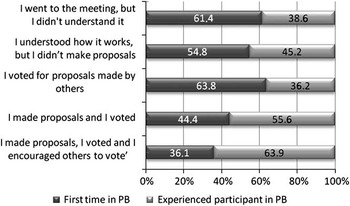
Those who take part for the first time in PB take on a less relevant role than people with experience. Of the total number of participants in the assemblies who claim not to have understood how the meetings worked, more than 60% are new (Figure 4). The greater the influence of roles in the assembly, the greater the percentage of experienced participants who perform them. This fact is not at all counterintuitive. It is logical that people who have been attending participatory budgets for years should have a better understanding of the meetings. Therefore, the results indicate something that was to be expected: that PB, although it is open to any citizen, still requires detailed knowledge of its workings if the aim of participants is to maximize their chances of influencing the decisions taken. Even so, it is still remarkable that there is a percentage, albeit small, of first-time attendees who claimed not to understand how PB works. Moreover, participatory budgets with a longer duration have a higher percentage of participants who claimed not to have understood how the assemblies worked, a category comprising both new and veteran participants. In budgets that have run for only 2 years, 3.7% of participants fall into this category, whereas in budgets with 6 years experience behind them, this percentage rises to 8%. This may mean that, in addition to participants needing to know something about the way the deliberative process works, the gradual refinement of the process through successive modifications seems to produce an assembly dynamic that is ever more sophisticated and which, to some extent, makes active citizens’ involvement slightly more difficult, at least for some.
Participants’ deliberative profile in participatory budgeting (PB) meetings and participants’ experience in PB.

The people most involved in deliberation (the citizens who are most proactive and dynamic) hold political attitudes, which we may consider ‘classic’ in terms of the theory of participation: they are interested in politics, they frequently comment on or discuss politics with other people and, finally, they work with other citizens in the neighbourhood to resolve problems. In principle, this result would be contrary to the hypothesis according to which actively participating individuals have a less deliberative profile. However, we must take into account that most participants have a prior participatory profile, therefore, the results may indicate something else. For example, in a deliberative scenario, those with an active profile also, a priori, deliberate (Nylen, Reference Nylen2002). This does not necessarily mean that citizens who do not participate in associations are mere spectators. Four out of five participants who do not belong to associations carry out some type of activity in the assemblies: voting, making proposals of their own, or encouraging others to support their ideas.
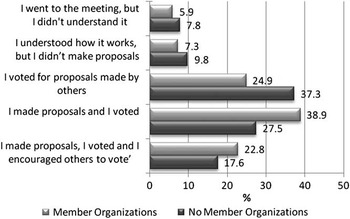
In Figure 5, we can observe the level of deliberation attained by those who declare themselves to be active members of an organization and those who say they do not belong to any public organization. The contrast between the behaviour of each is significant. The more deliberative profile (people who make proposals and vote, and also encourage others to vote for proposals) corresponds to participants who belong to any organization. Among these, 61.7% have a high deliberative profile, whereas among the non-members, this percentage is only 45%. Four out of five participants who do not belong to associations carry out some type of activity in the assemblies: voting, making proposals of their own, or encouraging others to support their ideas.
Participants’ deliberative profile in participatory budgeting meetings and association members.

In contrast, if ideology is a factor that appreciably affects the composition of those who attend the assemblies, this is not the case for deliberation. Ideological self-description does not significantly influence the deliberative action of participants in public meetings. This suggests that the deliberative procedure does not represent an obstacle to settling differences. Apart from political attitudes, socio-demographic profile does not matter at all. It is true, on the other hand, that men and women do not participate in the same way in public meetings. In activities with greater influence, those where participants make proposals and encourage others to support them, we find a higher incidence of men; however, women still play a significant deliberative role in terms of making proposals of their own. Almost half of the participants with a high deliberative profile are women. However, it must be emphasized that here we are speaking about the public assemblies. If we take into account the presence of men and women in participatory budget councils, we would find a significant quantitative difference. Although women represent almost half of those who attend the assemblies, in the councils they do not usually exceed 25% of attendees in cities such as Cordoba. In contrast, the age of participants does not seem to be crucial for inferring their behaviour in the assemblies. Young people, adults, and older citizens are distributed in a similar way in terms of their deliberative action. The same is true with regard to participants’ level of education (Figure 6), which has no significant influence on deliberative action in the assemblies. There are more people with lower levels of education who did not understand the meetings, and those with higher levels of education do adopt a slightly higher deliberative profile, although the differences have very little significance.
Participants’ deliberative profile in participatory budgeting meetings and participants’ education.

Deliberative governance: is it possible?
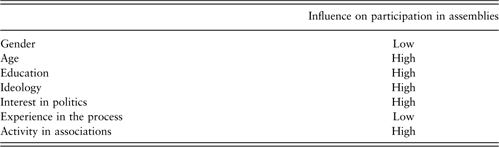
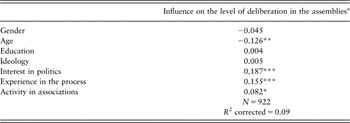
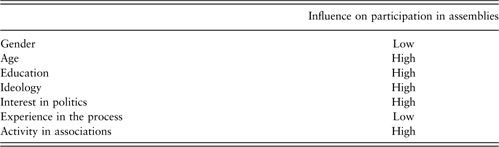
The way in which the inclusion of the public is ensured by PB has an undeniable bias in Spain, and the organization of the experience by governments significantly influences the ideological profile of the participants. In contrast, deliberation procedures seem to offer a more open public space for debate to some extent, and they allow citizens to make effective use of their deliberative opportunities (Bohman, Reference Bohman1997: 345) Table 2 shows the influence of the studied variables on citizens’ attendance in participatory budgets. Given that the survey is of subjects who have participated, it is not possible to provide a statistical analysis as such. The level of influence has been evaluated on the basis of a comparison with the data provided by censuses for some variables (gender, age, level of studies), or with secondary data from other surveys carried out on the population in general. Comparison with these data tells us that all the variables have a more or less strong influence on the attendance of participants at the public meetings. Table 3, on the other hand, shows the influence of these variables at the level of the deliberation of individuals in the assemblies. To determine this influence, a multiple regression analysis was carried out using the deliberative performance of individuals in the assemblies as a dependent variable. Of the seven variables considered, four have statistical significance for predicting variance in the level of deliberation, with the best predictors being interest in politics and experience in the process. However, we may say that neither the socio-demographic variables (gender and studies) nor ideology tell us anything about variance in participants’ deliberative capacities.
Influence of different variables on participation in assemblies
Influence of deliberative variables on the dynamics of the participatory budget

Source: Institute of Advanced Social Studies, E-0705.
aThe figures are standardized beta regression coefficients. The levels of significance are as follows: *P < 0.05; **P < 0.001; ***P < 0.001.
The study raises some questions concerning deliberative governance. On the one hand, the inclusion of citizens does not take place, or at least not at the same level as in Brazil (Fedozzi, Reference Fedozzi2005; Avritzer, Reference Avritzer2006). Participation in Spain displays two important biases: first, the profile of participants is similar to the profile of those who already participate, as Nylen (Reference Nylen2002) showed for Brazilian cases, although it is also true that 25% of the participants are individuals with no participatory experience. In contrast, the profile of participants is biased towards the ruling parties. This leads us to question the extent to which administrations are sufficiently impartial in organizing an inclusive participatory procedure that involves the plurality of citizens in determining a part of public expenditure. The access of citizens to these instruments, when there is no prior selection process, displays limits that reproduce the same biases and inequalities that occur in traditional participation (associations).
However, the study reveals that, in spite of inequalities in participation, the new instruments allow participants to develop deliberative skills so that they can take advantage of their opportunities. In other words, the differences present in participation are not reproduced within public meetings themselves. Thus, for example, in spite of being under-represented, conservatives exhibit a deliberative performance comparable with the most progressive participants. People with lower levels of education propose and deliberate in public meetings with the same intensity as people with more formal education.
We might wonder, aside from the political motivations that drive the launch of participatory budgets, whether these experiments will finally be able to attract people with different profiles. PB in Spain faces a serious problem of legitimacy. To address this, it would be necessary to think about how to mobilize citizens and how to organize the process so as to make the experience attractive not only for those who already participate, but also for those who might take part if questions of interest to them were involved. We should not forget the importance of the effectiveness of deliberative process (Avritzer, Reference Avritzer2006) in mobilization. Therefore, confronting the problem of mobilization means dealing with the organization of participatory processes. If the aim is diversity and a reduction of inequalities in participation, we believe different mobilization methods must be considered, but also different forms of administrative organization that favour the effectiveness of deliberative processes. In Spain, the PB experiences have a greater number of participants in general and of new participants in particular. In Malaga, where the administration uses new technologies to organize the experience through telephone messages and the Internet, more young people participate than in any other case. In Getafe, where the government carried out around 80% of the proposals made by citizens throughout 7 years of PB, participation between 2004 and 2011 increased by about 1000% (Ganuza and Francés, Reference Ganuza and Francés2011).
We cannot stop asking ourselves questions. It is true that a space organized for deliberation can encourage participants to develop skills and take advantage of their deliberative opportunities. The problem is not deliberation, but context, as Eliasoph (Reference Eliasoph1998) argues. The problem is how these spaces are to be organized. Can the administration really be impartial in organizing these spaces? From our perspective, this question raises many thorny problems concerning the political culture of each locus and mainly the effectiveness of deliberative processes. PB is a big challenge for government, because it offers citizens a transparent way to deal with public resources. Deliberative governance has an important obstacle to surmount, one on which much of its legitimacy will depend: is it capable of organizing deliberative political spaces as transparently and as inclusively as possible so that they approach the ideal of impartiality? Government is not neutral, so it must demonstrate that decision processes are impartial, or citizens will not accept the process.
Acknowledgements
This paper was possible thanks to the grant from the Spanish Ministry of Science and Innovation (CSO2009-12020).