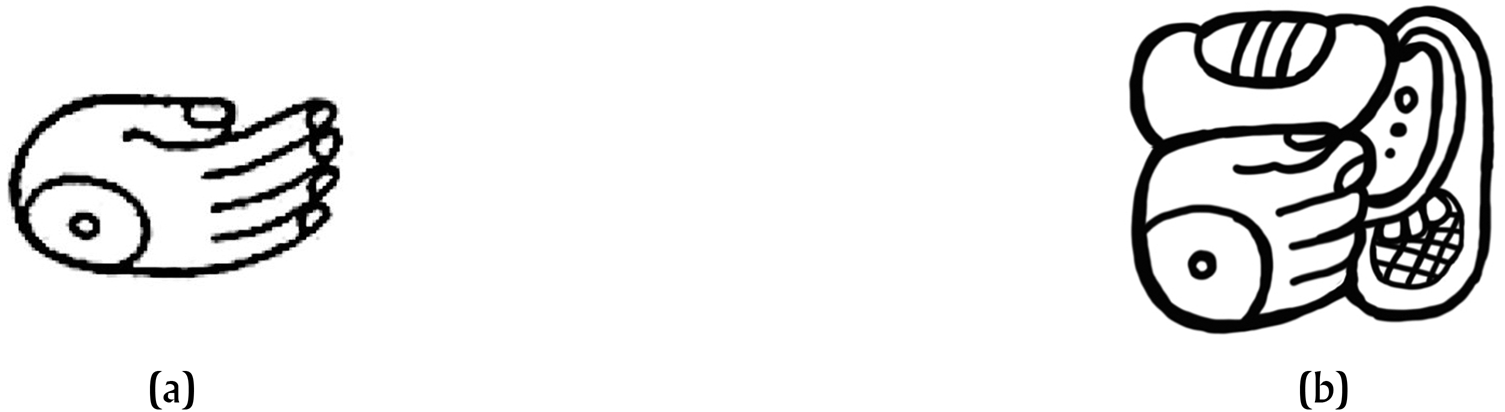
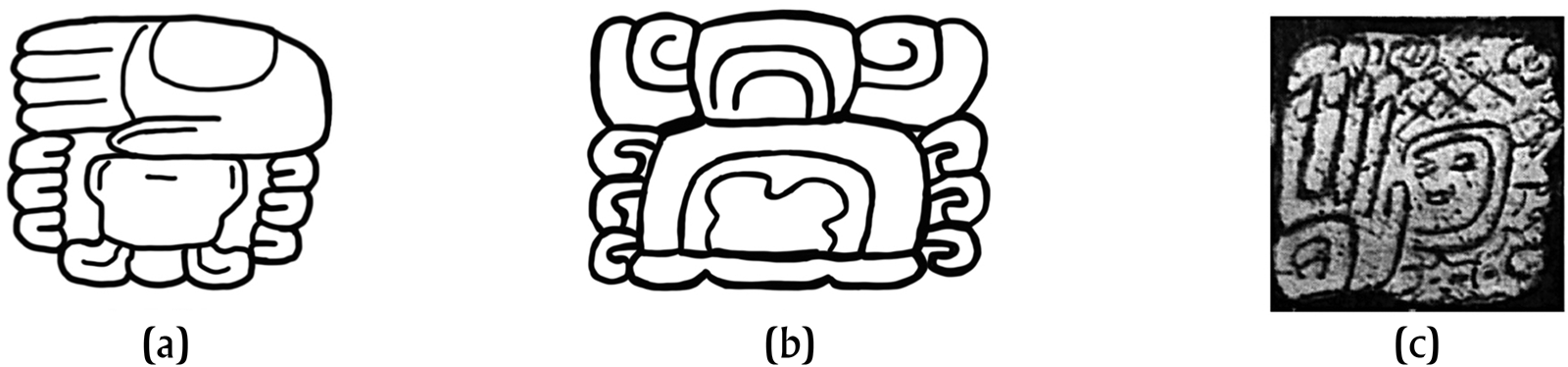
This article tests the hypothesis that the most frequent logographic value of T713 (Figure 1a), K′AL ‘to close, wrap, adorn’, is specified by means of a lexical determinative, most frequently T617/1M3, the CELT or MIRROR sign (Figure 1b). In doing so, it also addresses a question posed in Mora-Marín (Reference Mora-Marín2022a), regarding the origin and nature of lexical determinatives (or semantic determinatives), specifically, whether they develop through a process of frequent associations between the target lexeme (e.g., k′al ‘to close, wrap, adorn’) and specific syntactic arguments (e.g., typical objects).
(a) T713a in Thompson (Reference Thompson1962); (b) Cancuen area Panel 1 (COLCNCPan), glyph block A1. Drawing by author after drawing by Yuriy Polyukhovych in Looper and Macri (Reference Looper and Macri1991–2022).
I follow conventional practices for transcription and transliteration of glyphic expressions: lower-case, bold letters for Mayan values of syllabograms; upper-case, bold letters for Mayan values of logograms; upper-case letters for convenient English or Spanish labels for graphemes (whether syllabograms or logograms or other). I also provide abbreviations for texts from the Maya Hieroglyphic Database (MHD) by Looper and Macri (Reference Looper and Macri1991–2022), placed between parentheses after the initial reference to a text in the body of the article or the figure captions; these abbreviations can be used to locate the text's record in the MHD in the “objabbr” search field. Linguistic data are cited in italics and their glosses in single quotes. The International Phonetic Alphabet grapheme <ʔ> is used instead of the more common <’> used by Mayanists unless another author is cited verbatim. I will generally employ Kaufman and Norman (Reference Kaufman, Norman, Justeson and Campbell1984) for proto-Ch'olan lexical reconstructions, and Kaufman with Justeson (Reference Kaufman and Justeson2003) for proto-Mayan and subsequent stages. Proto-Ch'olan can be reconstructed with a sixth vowel, *ä, that would, in general, have been represented the same as *a in Epigraphic Mayan.
In Mora-Marín (Reference Mora-Marín2022a), the term lexical determinative is proposed to replace semantic determinative, for such signs are argued to cue specific lexemes, rather than general semantic categories. I follow such practice here. Prior work on lexical determinatives includes Hopkins (Reference Hopkins1994), Hopkins and Josserand (Reference Hopkins and Josserand1999), and Mora-Marín (Reference Mora-Marín2008). Hopkins (Reference Hopkins1994) and Hopkins and Josserand (Reference Hopkins and Josserand1999) also identified a set of signs they referred to as semantic classifiers, including signs such as the U-shaped and O-shaped elements contained within circles, which occur, for the most part, on signs depicting parts of the human body, from heads to hands to torsos. Mora-Marín (Reference Mora-Marín2008) discussed both types, semantic determinatives and classifiers, but, more recently, has redefined the latter as iconographic classifiers (Mora-Marín Reference Mora-Marín2022a), for they do not influence the value or reading of a sign, but merely categorize the sign itself (not its phonographic or logographic value) iconographically.
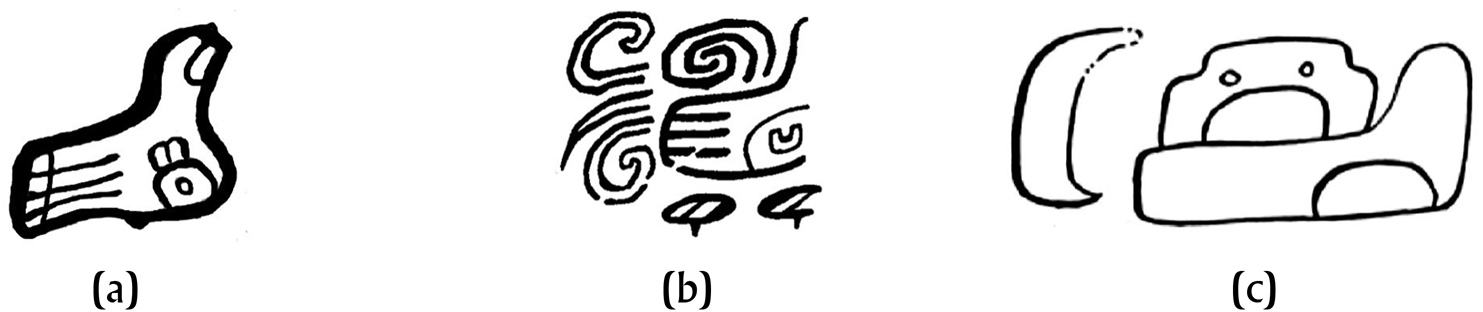
Indeed, Mora-Marín (Reference Mora-Marín2022a) has recently proposed that T670 (Figure 2a) is a polyvalent sign, whose basic logographic values are specified by means of lexical determinatives: the lexical value based on the proto-Ch'olan root *ʔal ‘child of mother’ is specified (determined) most often by a SPIRAL determinative (Figure 2b), while that based on the proto-Ch'olan root *ch'äm ‘to take, receive, grab’ is specified most often by T533/ZA1a (Figure 2c). The basis for the SPIRAL sign's use as a lexical determinative remains unclear, but recently, Nick Hopkins (personal communication 2022) suggested that perhaps the SPIRAL sign constitutes a speech scroll, and, if so, it may be explained as a rebus based on proto-Ch'olan *ʔäl ‘to say’, while Matthew Looper (personal communication 2022) suggests that it may be a depiction of a rubber ball, ZRJ, and, if so, its use with T670 could be a rebus based on proto-Ch'olan *yäl ‘to throw down’, which would be plausible, given that T670 and the SPIRAL sign together appear to depict the act of throwing down a ball. Prager (Reference Prager2020), however, has proposed that ZRJ constitutes a rolled-up bundle, possibly with a logographic value KUK, and, if so, it is unclear how it relates to T670.
(a) Example of T670 from Looper et al. (Reference Looper2022); (b) example of T670 with SPIRAL in the ya-YAL-la collocation from jade belt plaque at Museo del Jade, San José, Costa Rica; drawing by author; (c) example of T670 with T533/ZA1a in the ʔu-CH'AM collocation from incised conch shell trumpet; drawing by author.
In his conclusions, Mora-Marín (Reference Mora-Marín2022a) hypothesizes that frequent co-occurrences between a grapheme representing a verb and a grapheme representing the verb's object could lead to the type of association that gives rise to lexical determinatives: the author speculated that perhaps T533, a likely polyvalent sign with a value ʔAJAW for ‘lord, ruler’ in some contexts, may originally have been a common object of the verb ch'äm ‘to take, receive, grab’, particularly if Ch'olan also exhibited the meaning ‘sacred object’ reconstructible for the cognate term *ʔäjäw in proto-Tzeltalan. In other words, the hypothesis proposes the possibility that early scribes may have referred to the ‘taking/receiving/grabbing of the sacred object’ so frequently that the grapheme representing the term for ‘sacred object’ became intimately associated with the CH'AM value of T670, even when the verb took other nouns as objects. Alternatively, the taking of the royal scepter may have been associated with the institution of rulership to the extent that scribes began associating the CH'AM value with the concept of ʔajaw ‘lord, ruler’ and thus with T533 ʔAJAW. That author also suggested that the highly frequent occurrence of T1030 K′AWIL as the object of the CH′AM logogram could potentially result in such a process; in fact, he cites Matthew Looper's observation (personal communication 2022) that at least one case of the graphemic compound T1030:670 is followed by T1030, resulting in a doubling of T1030 K′AWIL, and suggesting that the first instance placed atop T670 may have been reanalyzed, by at least the one scribe, as a lexical determinative.
The present article examines this question in more detail by comparing three uses of T713 resulting in the values K′AB′ ‘hand, arm’, K′AL ‘to close, wrap, adorn’, and mi. This is done by means of the Maya Hieroglyphic Database (MHD) by Looper and Macri (Reference Looper and Macri1991–2022), which was used to compile a dataset of 977 cases of T713 with these three values, the majority of which (819 or 83.8 percent) correspond to the second value, which constitutes the focus of this article. Indeed, with regard to such value, it is shown that T617/1M3 likely functions as a lexical determinative, but that it did not function that way in the earliest texts; instead, it developed gradually, toward the end of the Early Classic period, and prior to that, the distinct values of T713 may not have been distinguished graphemically, by means of determinatives, but instead, only contextually (and through the use of phonetic complements). It is suggested that the T617 grapheme may have become associated with the value K′AL because of their frequent co-occurrence in the Primary Standard Sequence, where T617 functions as the main sign of the Initial Sign Collocation, and T713 often follows it immediately. More interestingly, the evidence suggests that the frequent subjects of the passivized form of the verb, k'ahlaj ‘it was closed/wrapped/adorned’ (i.e., k′a[h]l-aj-Ø-Ø close[pass]-pass-cmp-3b)—for instance, in the context of the Glyph C of the Lunar Series passage of the Initial Series—became commonly used as lexical determinatives in the context of the Primary Standard Sequence texts. There is also evidence that graphic components of likely allograms with the same logographic value (see MacLeod Reference MacLeod1990:96–99, 116, Figures 3–4) may also have been recruited as lexical determinatives when applied to T713, as recently suggested by Barbara MacLeod (personal communication 2022). These results also point to the need to conceptualize many signs functioning as lexical determinatives as polyvalent, and to pay more attention to the phenomenon of lexical or semantic determinatives in Mayan writing (cf., Mora-Marín Reference Mora-Marín2008).
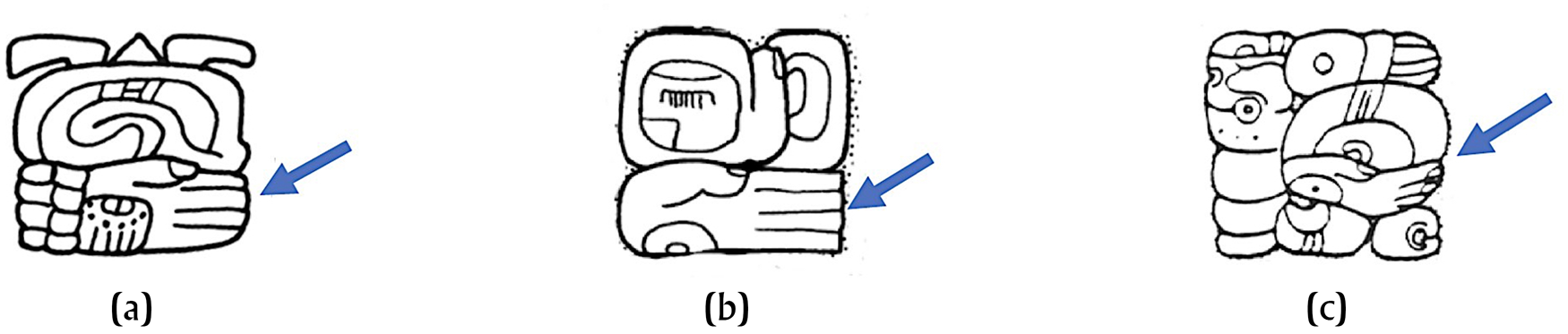
(a) Tikal Ballcourt Marker, D3; drawing #2058 by Linda Schele (http://research.famsi.org/schele.html). (b) Po Panel, Bonampak region, D2 (COLPoPan); drawing by Alexandre Safronov (https://wayeb.org/drawings/col_po_panel.png). (c) Palenque Temple of Inscriptions Tablet, West Panel, A7 (PALTIw); drawing #154 by Linda Schele (http://research.famsi.org/schele.html).
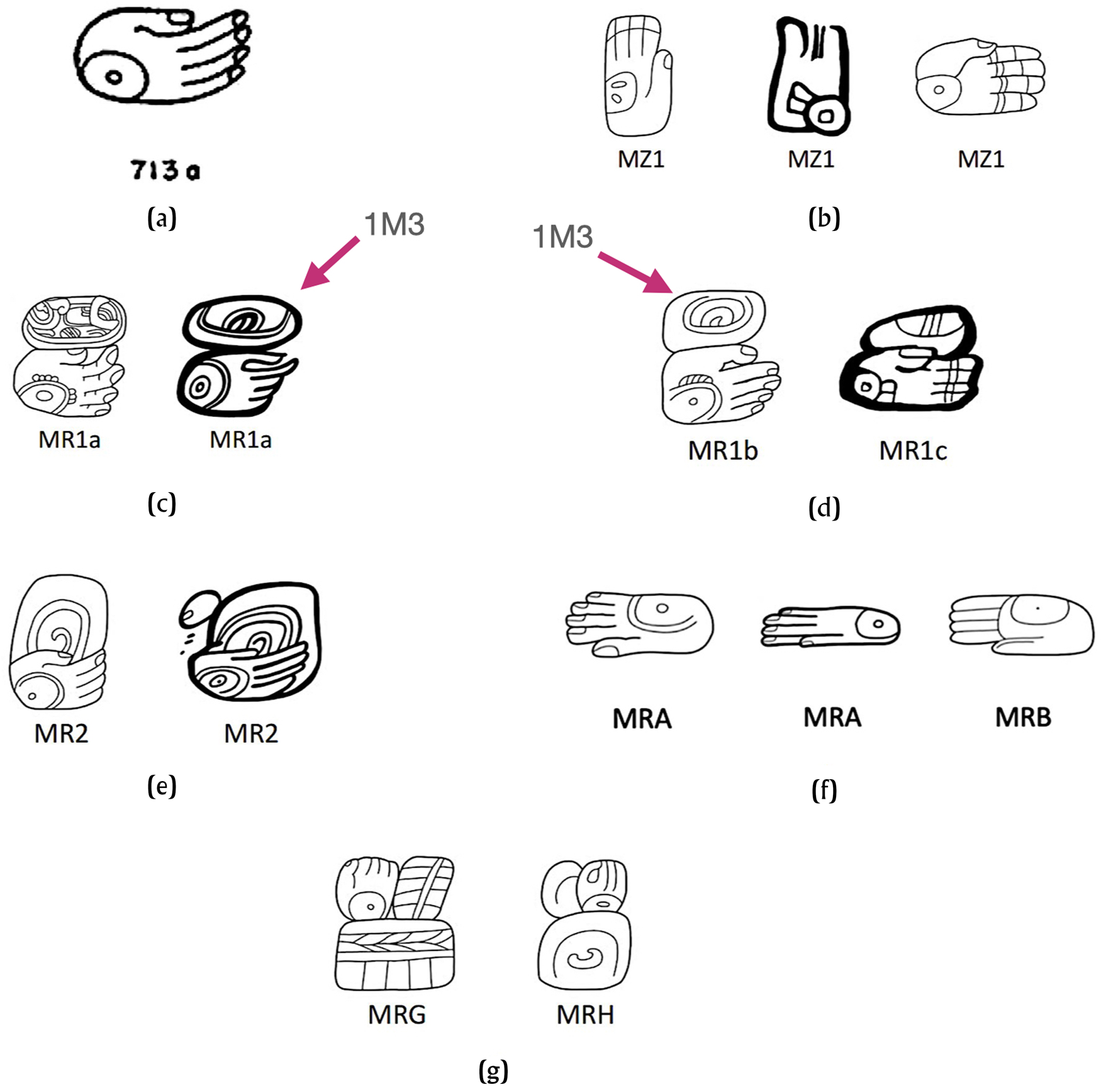
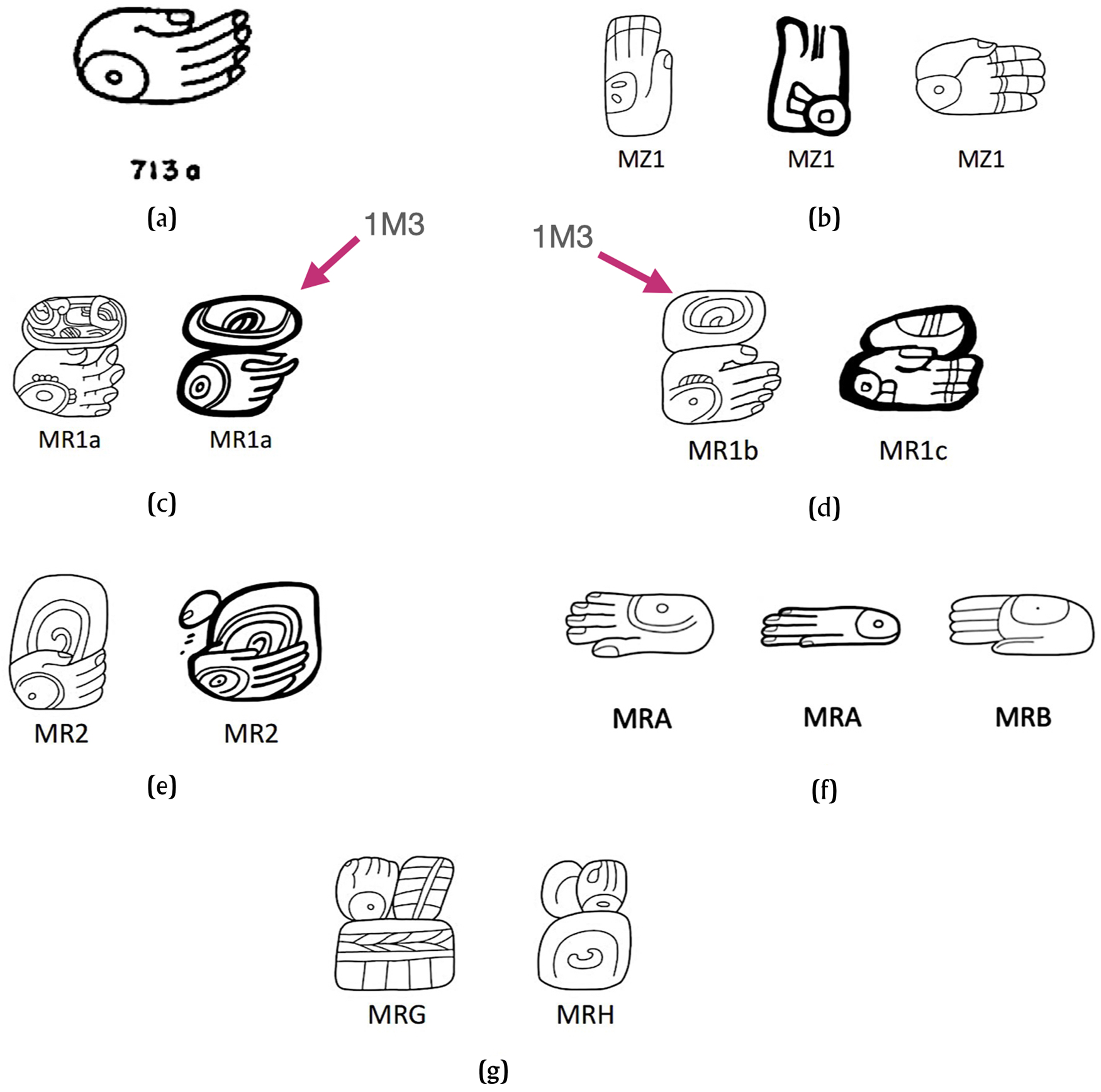
(a) Thompson's (Reference Thompson1962) T713a; (b–g) catalog codes from Looper et al. (Reference Looper2022).
The article is organized as follows. First the graphemes and grapheme codes of relevance are reviewed. Then, the methods used in this study are described and justified. The key results are then presented, some hypotheses are discussed, and finally, conclusions and remaining questions are posed.
Signs Involving T713
T713 represents a hand, typically in an open, flat gesture, with the thumb parallel to the other fingers; it may be referred to as the FLAT.HAND sign. It is used in a variety of contexts, with at least three different values, but probably more. Figure 3 shows the established values: K′AB′ for proto-Ch'olan *k′äb′ ‘hand, arm’ (suggested as early as Reference de Rosny1883 by de Rosny) in the collocation NOJ-K′AB′[b′a] for noj k′äb′ ‘left hand/arm’ (Figure 3a); K′AL for a reflex of proto-Mayan *k′al ‘to tie up, close’ in the collocation k′a[h]laj ‘s/he/it was tied, wrapped, closed, adorned (by wrapping/tying)’ (MacLeod Reference MacLeod1990:101, Figure 3–15; Mora-Marín Reference Mora-Marín, Silva, Lee and Chacon2022b:151; Schele and Looper Reference Schele and Looper1996:19–22; Stuart Reference Stuart1995:404–405, Reference Stuart1996; Werner Nahm also proposed this reading independently; Figure 3b); and the syllabogram mi (seemingly deciphered by various authors independently on the basis of substitutions with other allograms with the mi value) in the collocation ʔu-ti-mi-wa for u-tim-iw-Ø ‘s/he appeased him/her’ (Figure 3c).
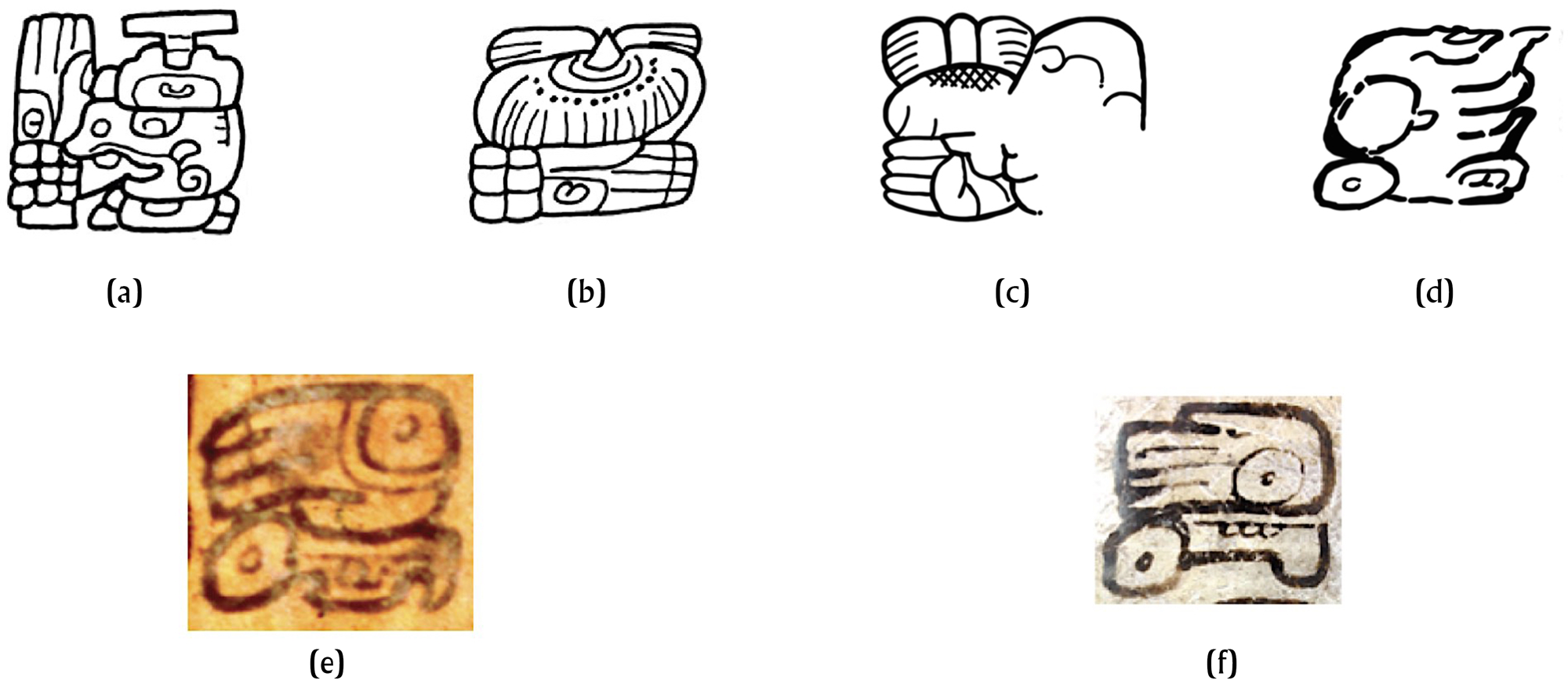
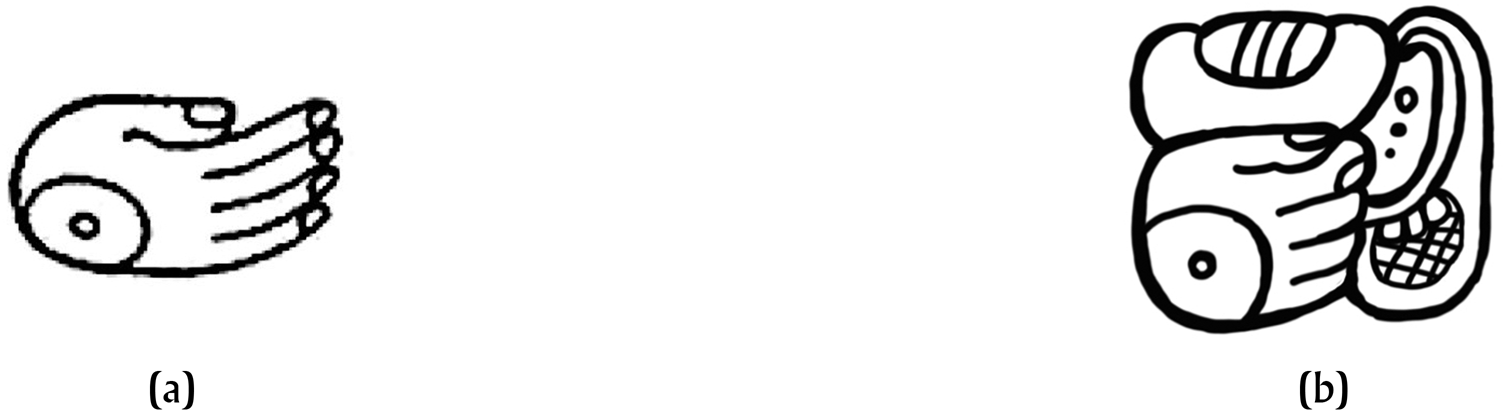
I am employing the Thompson (Reference Thompson1962) code, T713a (Figure 4a), henceforth simply T713, because the Looper et al. (Reference Looper2022) catalog distinguishes different codes for the values-specific uses of the sign: MZ1 for K′AB′ (Figure 4b), MR1a/MR1b/MR1c for K′AL (Figures 4c–4d), MR2 for mi (Figure 4e), MRA/MRB for cases where the FLAT.HAND sign appears to have a value related to ‘birth’ (Figure 4f), and one of the components of MRG/MRH (Figure 4g), a sign that may have the logographic value PAS based on the proto-Ch'olan transitive root *päs ‘to show, uproot, uncover’ and the corresponding passive stem *pahs ‘to leave, go out’ (Kaufman and Norman Reference Kaufman, Norman, Justeson and Campbell1984:128). It should be observed, too, that MR2 involves T713 seemingly holding a version of T17/T18/1B9 yi atop it. However, 1B9 yi itself resembles the SHELL sign in Figure 3a, cataloged as ZRC, and believed to have a value NOJ for proto-Ch'olan *noj ‘big, right (hand)’. The main differences between MR2 mi and ZRC NOJ include the absence of the T74 ma superfix atop ZRC (Figure 3a), also absent from both 1B9 yi. Perhaps the SHELL component of ZRC and 1B9 depict the same natural entity, a shell, and perhaps the T74 ma sign atop it in ZRC functions as a determinative, if one supposes a Mixe-Zoquean motivation—i.e., *mɨha ‘great’ (Wichmann Reference Wichmann1995:368), whose first syllable may have sounded like [ma] to a Mayan speaker, and thus the T74 ma atop ZRC could be the result of a lexical association with proto-Ch'olan *noj ‘big’.
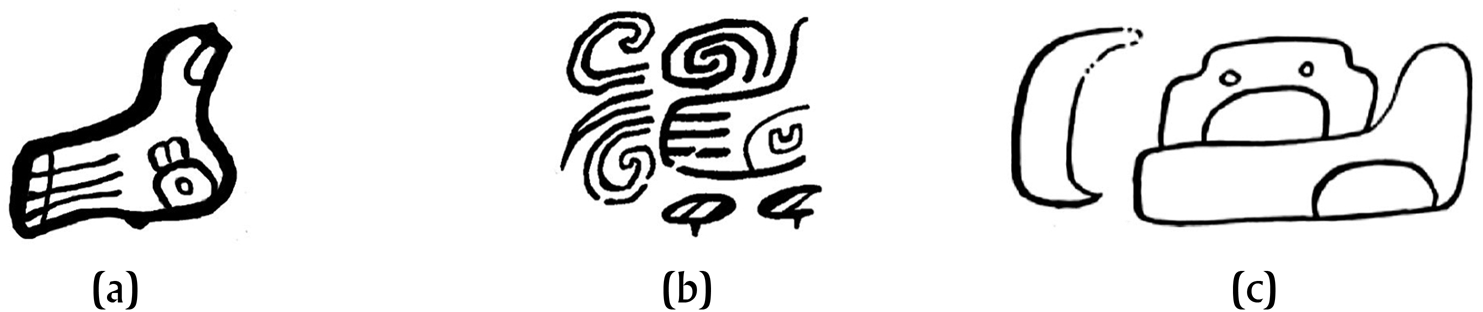
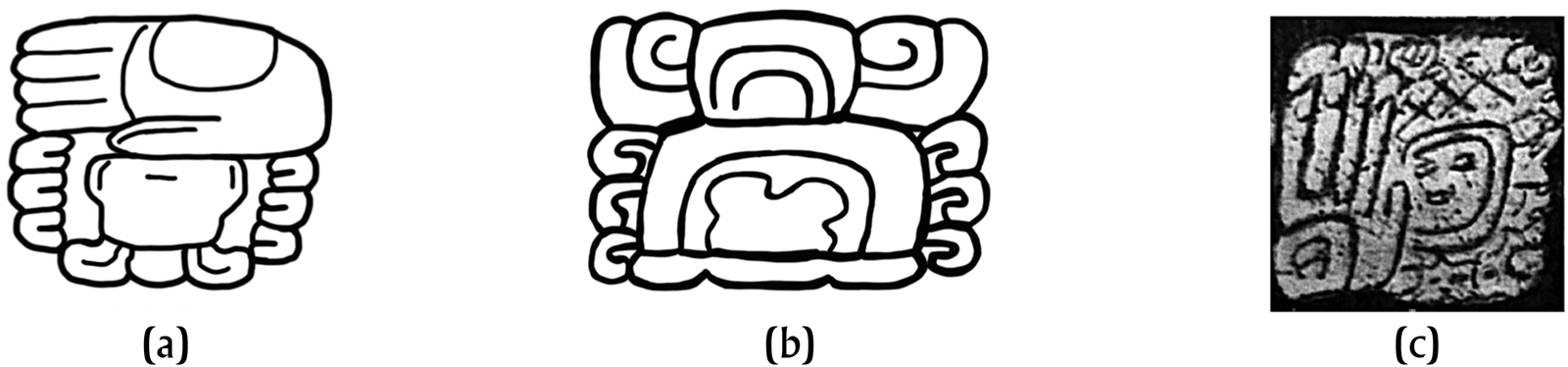
It is not clear whether all instances of MZ1 bear the value K′AB′ for ‘hand, arm’: Esparza Olguín and Velázquez García (Reference Esparza Olguín and Velázquez García2013) have suggested a value YUK representing the passive proto-Ch'olan stem *yuhk ‘to shake, move’ in the context of the frequent title yuhknoom ‘shaker’ (Figures 5a–5b); and, in at least one case, on K5454, T713 appears immediately before the logogram PAKAL for ‘shield’ (Figure 5c), which could suggest a reading pa-PAKAL, where T713 could be read as pa if derived acrophonically from its logographic value PAS ‘to show, uproot, uncover’.
Additional uses of MZ1 that may have values other than K′AB′ for k′ab′ ‘hand, arm’. (a) Resbalon Hieroglyphic Stairway 3, C14 (RSBHS03); drawing by author after drawing from Esparza Olguín and Velázquez García (Reference Esparza Olguín and Velázquez García2013:1, Figure 1a); (b) Dzibanche Monument 3-22, Structure E-13, A3 (DZBE13); drawing by author after drawing from Esparza Olguín and Velázquez García (Reference Esparza Olguín and Velázquez García2013:2, Figure 2a); (c) detail from vessel K5454; photo by Justin Kerr (http://research.mayavase.com/kerrmaya.html).
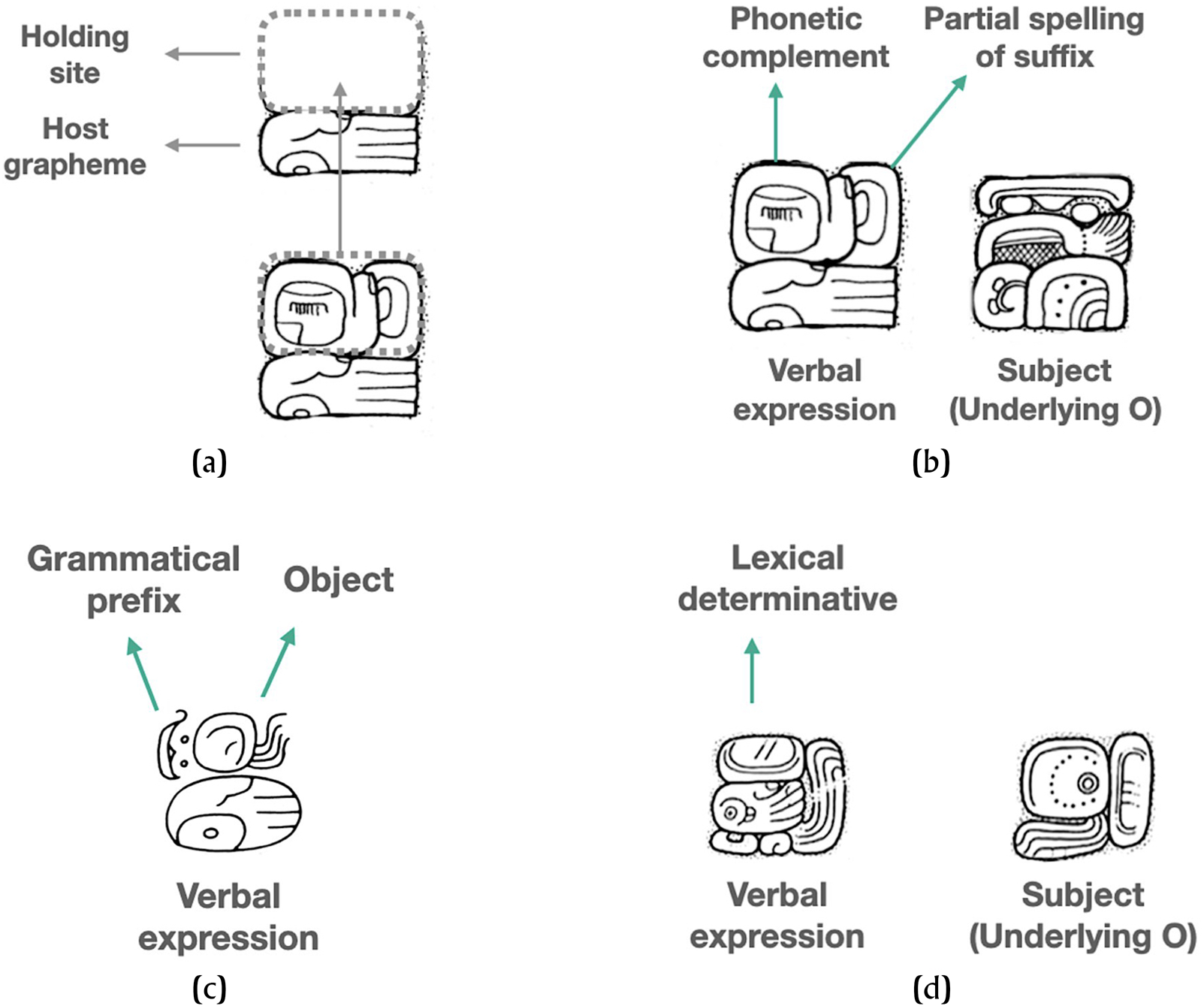
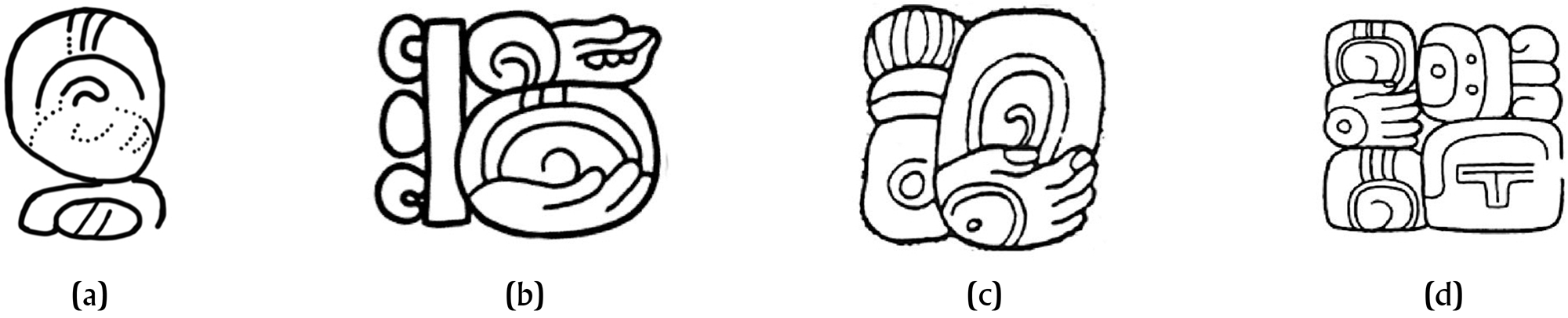
For the purposes of this article, the focus lies on cases where T713 bears one of the three more common values (MZ1 K′AB′, MR1 K′AL, MR2 mi). Of these, only one, K′AL, is characterized consistently by the presence of a variable grapheme above it (Figure 6), a location that can be characterized as a “holding site” (Figure 6a), which may include phonetic complements and/or grammatical suffix spellings (Figure 6b), grammatical prefixes and/or syntactic arguments (Figure 6c), or lexical determinatives (Figure 6d).
Holding site for T713. (a) Holding site location. (b) Holding site with phonetic complement and partial grammatical suffix spelling. (c) Holding sitewith grammatical prefix and syntactic arguments. (d) Holding site withlexical determinative.
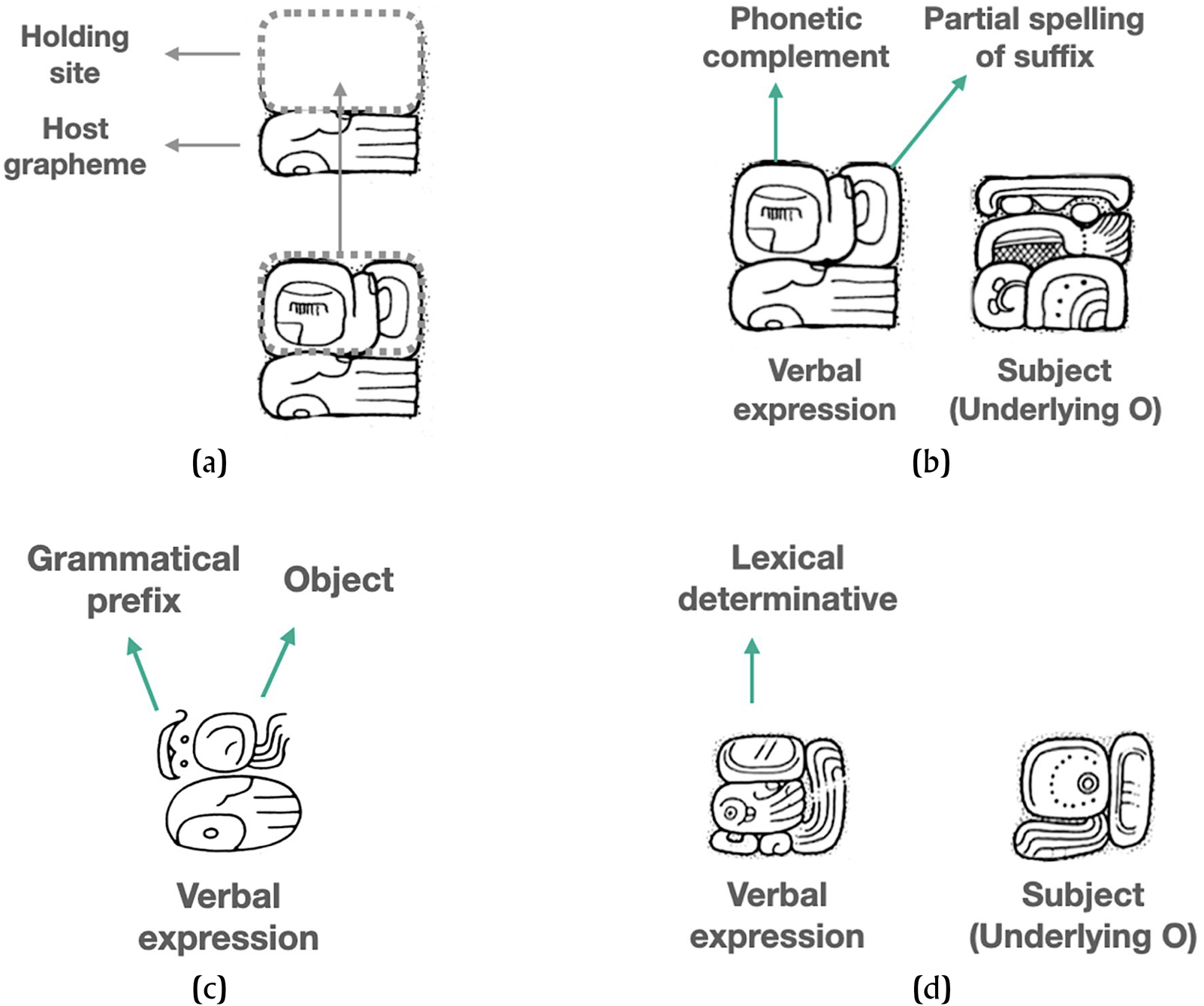
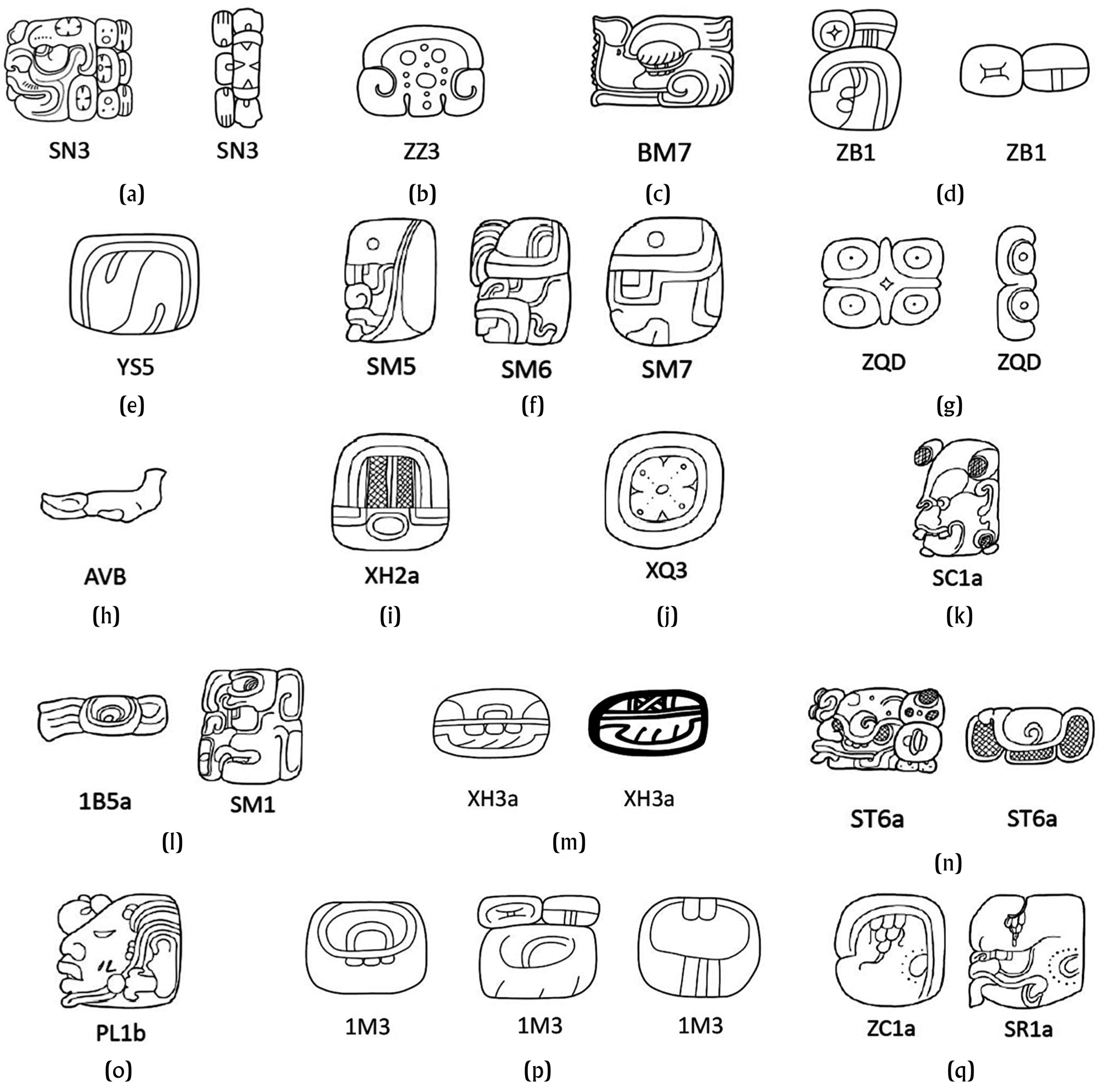
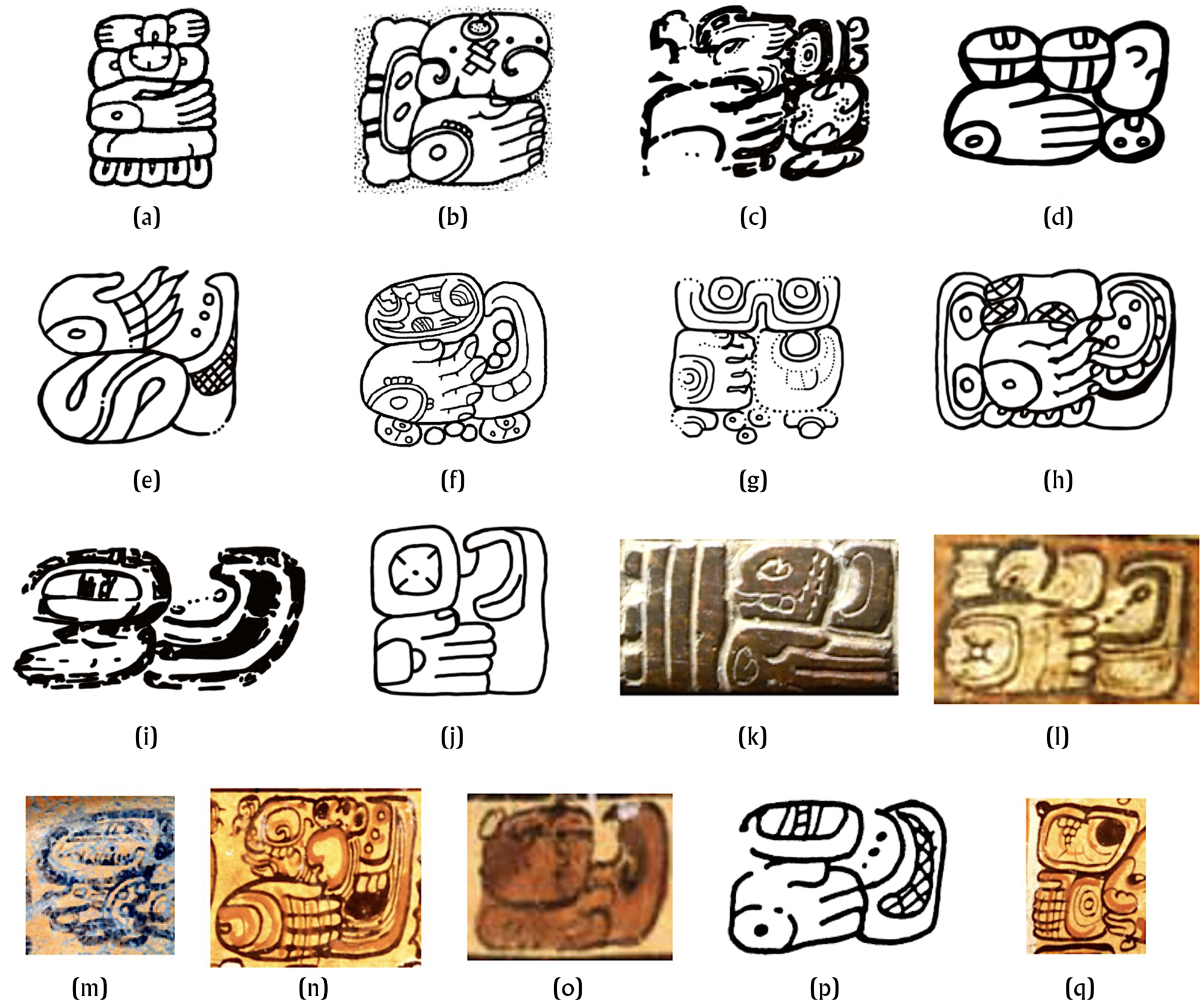
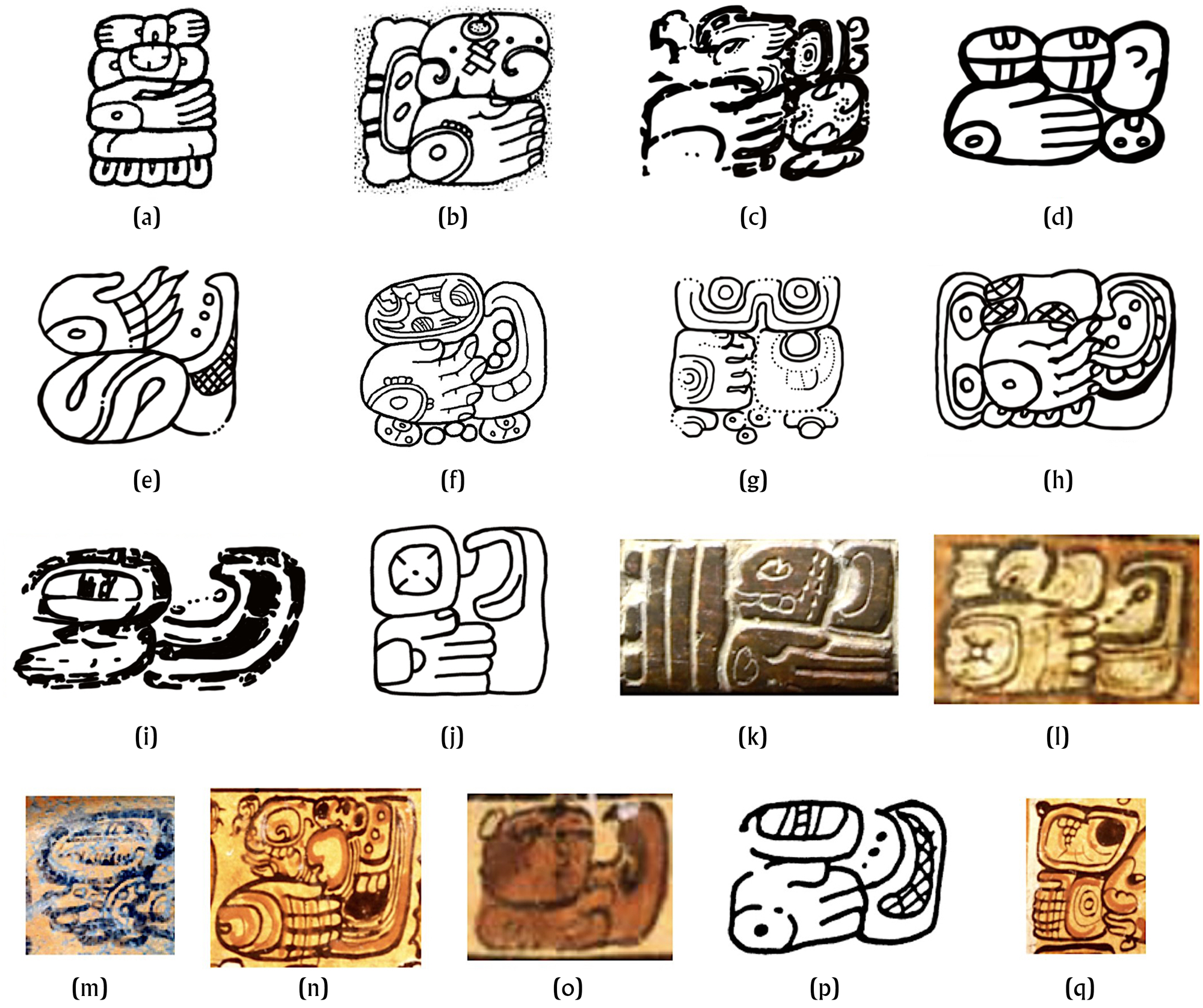
Figure 7 presents the graphemes that may be found in the holding site and their respective MHD codes (Looper et al. Reference Looper2022). I have not included in this set examples of syllabograms functioning either as phonetic complements (e.g., k'a) or spellings of required affixes (e.g., ʔu for u- ‘third person singular ergative/possessive'), only those that correspond to either syntactic arguments (e.g., TUN for tun ‘stone’) or lexical determinatives.
(a–q) Holding site graphemes. Some spell syntactic arguments or grammatical affixes, while others function as phonetic complements. Several function as lexical determinatives. All images come from Looper et al. (Reference Looper2022).

The fact that several of these signs function as a kind of graphemic unit together with T713, resulting in a lexical determinative + grapheme unit, is seen in epigraphers’ typical transcriptions of expressions containing them: in such transcriptions, the sign argued here to be a lexical determinative is often omitted.
Methods
The MHD (Looper and Macri Reference Looper and Macri1991–2022) was used to collect data on all cases of glyphic collocations employing any of the MHD codes relevant to T713: MZ1, MR1a, MR2. It is very likely that not all cases of MZ1 bear the value K′AB′, but even if that were the case, and MZ1 is polyvalent (i.e., K′AB′, PAS, pa, YUK, etc.), such values would be distinguished contextually, not graphemically, by means of lexical determinatives. In contrast, MZ1, MR1a, and MR2 are distinguished graphemically from each other: MZ1 is the unmarked form; MR1 is typically marked by one of a set of graphemes in the holding site functioning as lexical determinatives, syntactic arguments, phonetic complements, or partial spellings of grammatical affixes; and MR2 is marked by a single, specific grapheme (T17/T18/1B9) in the holding site that seems to point to MR2 having a phonetic function, and will be regarded as a phonetic determinative (a term to be distinguished, in principle, from phonetic complement), defined below.
An important question pertains to the identification of lexical determinatives. In the case at hand, with regard to the logographic expression representing a transitive verb root, K′AL, for a reflex of proto-Maya *k′al ‘to bind, tie’, whether active or intransitivized (passive, mediopassive, antipassive), the main criterion used to determine if a grapheme functions as a lexical determinative is whether an additional grapheme or collocation corresponding to the verb's subject or object follows. If so, then the grapheme in the holding site would be a good candidate for one of the following functions: a lexical determinative, a syllabogram spelling a grammatical affix, or a syllabogram functioning as a phonetic complement to the logogram. If not, then there is a good chance that the grapheme in the holding site represents the verb's subject (if the verb is passive) or object (if the verb is active transitive).
I have already introduced the term phonetic determinative, but I have not yet defined it. A phonetic determinative, not to be confused with a phonetic complement, is a grapheme that indicates that an otherwise polyvalent grapheme (e.g., T713) is functioning as a syllabogram. This is a tentative category, whose validity must be tested further. It applies in the present case to MR2, consisting of T17/18/1B9, the syllabogram yi, atop T713, yielding a new syllabogram, mi. Another way of conceptualizing this use of 1B9 yi is as a component of a digraphic sign consisting of T17 and T713. How such usage may have arisen or may have been conceptualized by scribes is not a topic considered here.
Initially, 88 cases of MZ1, 819 of MR1, and 68 of MR2 were collected. There are instances where it is not clear whether T713 was functioning as MZ1 or MR1a, and thus, such instances were culled. There are also many examples where either MR1 bears a grapheme in the holding site, but due to erosion or damage such grapheme cannot be identified with certainty, or the entire collocation is unclear (but its presence presumed from general structural patterns), and as a result such cases were culled too. After culling, 484 examples of MR1 have been retained for study. And last, two examples coded as MR2 actually consist of T713 in the mouth of T1021/AB8 (“square-nosed beastie”). In total, 30 examples were culled.
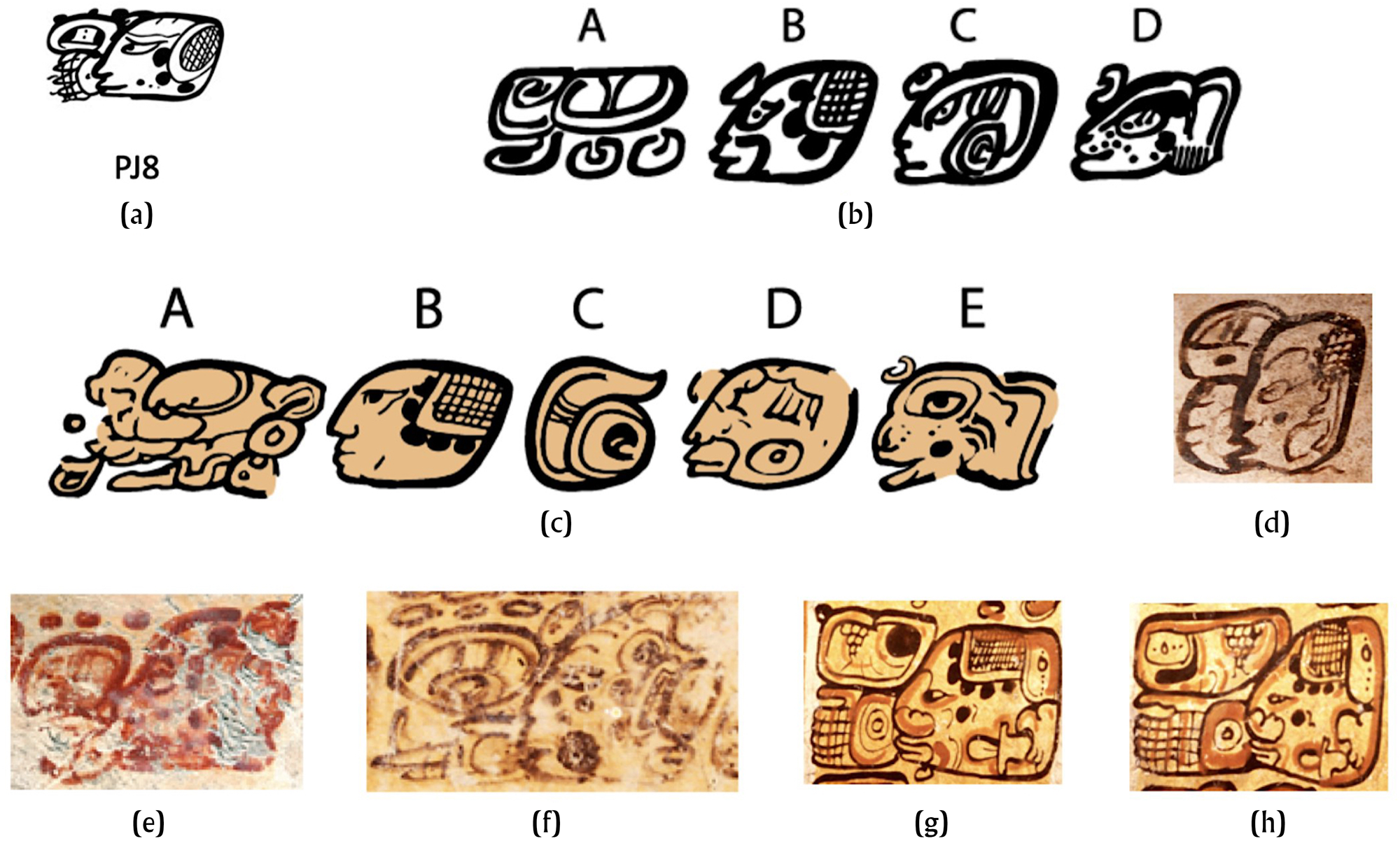
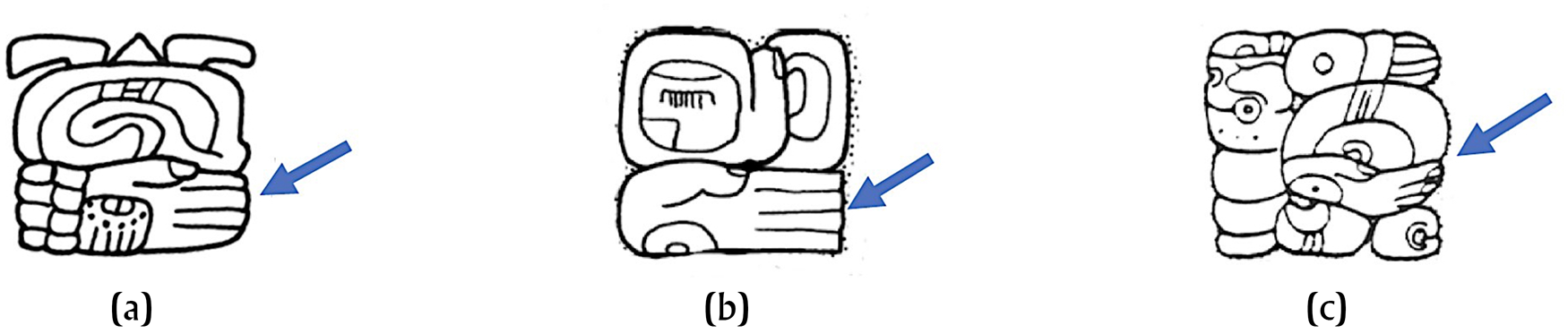
One important limitation must be observed. The authors of the MHD have regarded PJ8 (Figure 8a) to be a composite grapheme, consisting of three component signs. I regard it as two separate logograms: the first consists of MR1 with a lexical determinative in the holding site, and the second an example of PJ2/PJ3, which appears to function as a separate verbal logogram that may occur in isolation, occupying its own block, as seen in Figures 8b–8c, without an adjacent MR1. For additional arguments in favor of this analysis, see Mora-Marín (Reference Mora-Marín2020, Reference Mora-Marín2022c, Reference Mora-Marín2022d). When co-occurring with PJ2/PJ3, the MR1 collocation usually bears an instance of XH2 in the holding site (Figure 8d), sometimes even with a numeral (Figures 8e–8f), but in two cases from the same text it bears ZC1a (Figures 8g–8h). I have considered these examples in this study, which total 33 instances in the MHD, but I have tallied them separately from cases cataloged as MR1 in the MHD. Only 11 examples have been studied: these are the examples that contained a clear instance of MR1 plus its lexical determinative.
(a) PJ8 grapheme in Looper et al. (Reference Looper2022); (b) detail from Portland Art Museum bowl, 1998.42.11 (COLPAO4211), from El Zotz region; drawing by Dana Moot II (Reference Moot II2021:105); (c) detail from Nasher Museum of Art, Duke University, plate 1983.36.1 (COLMS0274); drawing by Dana Moot II (Reference Moot II2021:103); (d) example of PJ8 (MR1 + PJ2/PJ3) from K4997; photo by Justin Kerr (http://research.mayavase.com/kerrmaya.html); (e) detail from Fundación La Ruta Maya bowl, 1.2.179.9 (COLFRM1799); photo by Yuriy Polyukhovych in Looper and Macri (Reference Looper and Macri1991–2022); (f) detail from vessel K5452; (g) example of PJ8 from K1183; (h) example of PJ8 from K1183; photos 8f–8h by Justin Kerr (http://research.mayavase.com/kerrmaya.html).

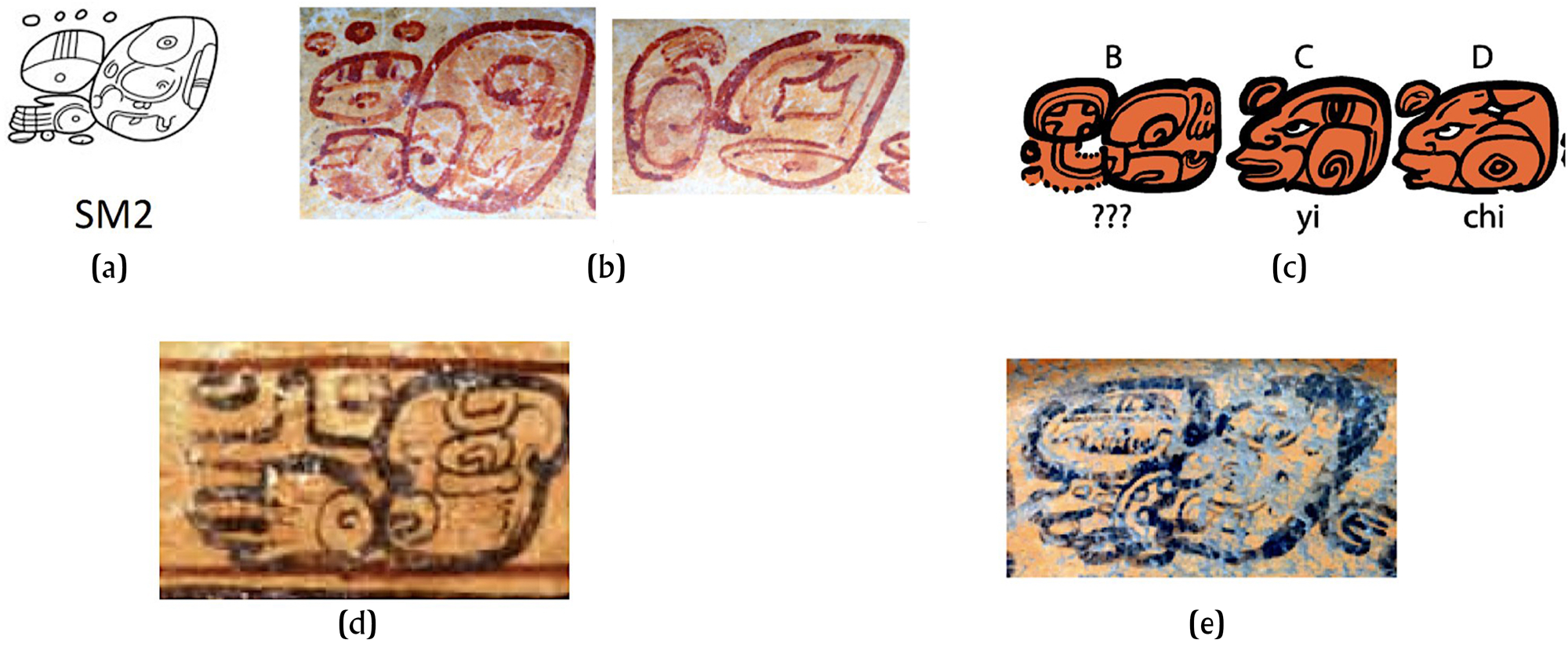
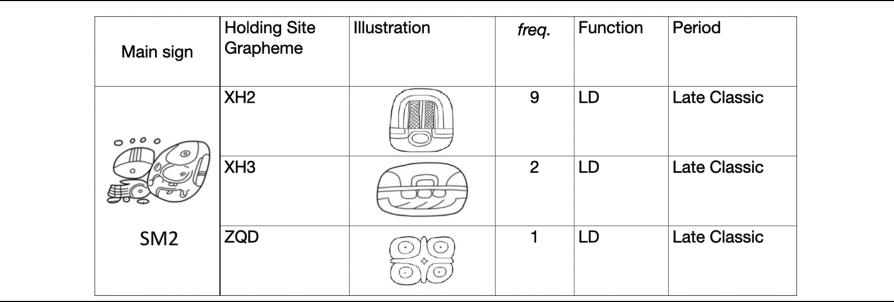
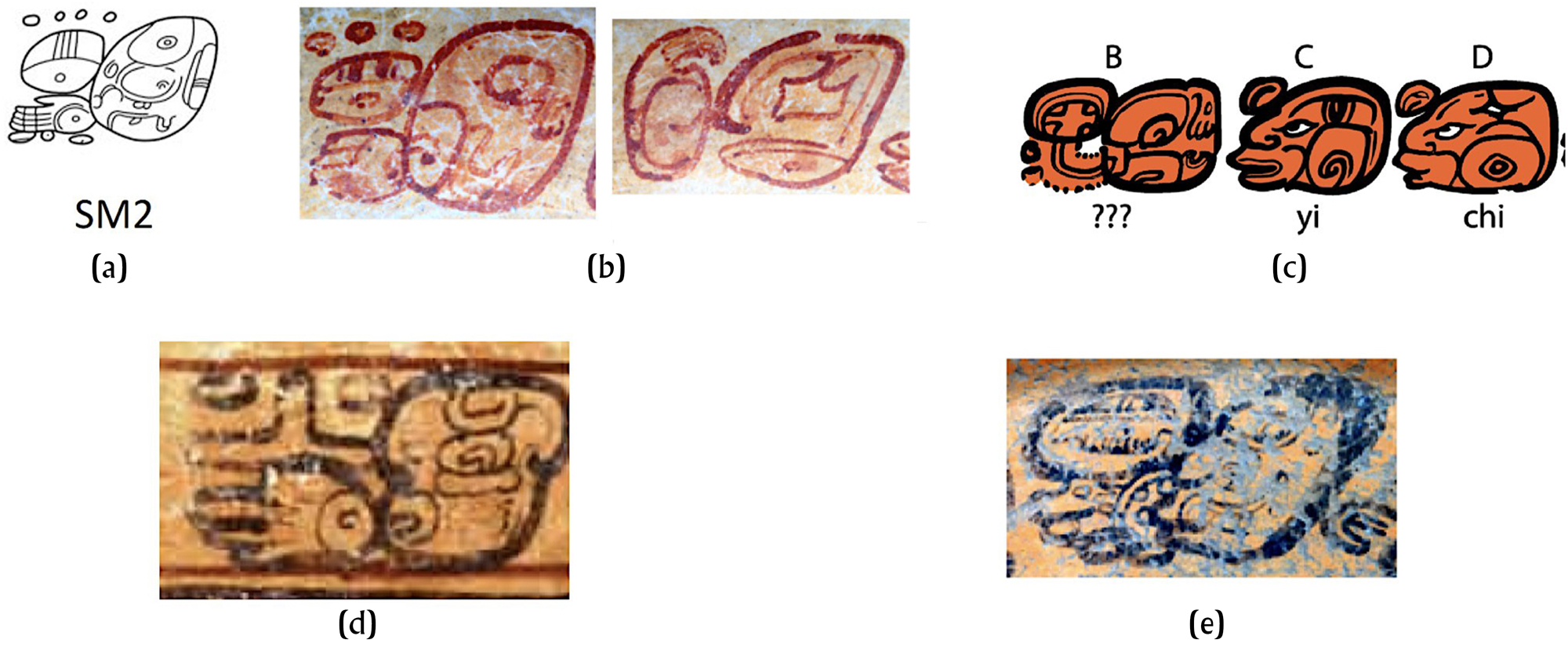
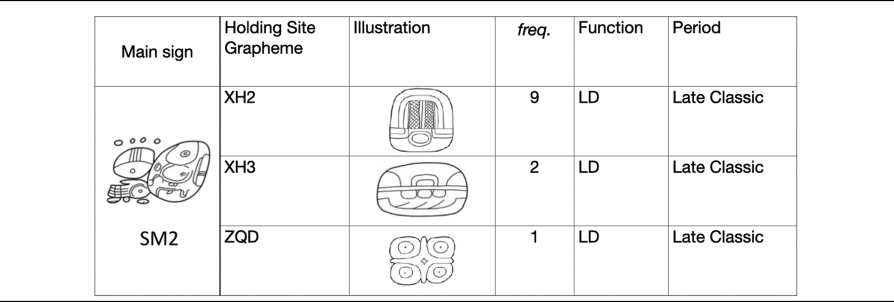
A very similar situation obtains with the case of SM2 (Figure 9a), a grapheme analyzed by the authors of the MHD as consisting of several graphic units that are themselves graphemes, and thus, as a type of digraph or even trigraph. Once again, just like PJ8, SM2 includes MR1 and either SM3 or SM7. As with the case of PJ8, I consider these to be separate graphemes, based on the same criterion: each may occur separately as verbal collocation. For instance, the example of SM2 in Figure 9b, where it is followed by yi-chi, may be compared to examples where the same main sign of SM2 appears without MR1 in a verbal expression, also followed by yi-chi, as in Figure 9c. Interestingly, when the main sign of SM2 appears in isolation, it automatically takes SG1 K′UH(UL) for ‘god(ly)’ as a graphic prefix, though it is not obvious whether SG1 is functioning here phonetically or logographically or as part of the main sign of SM2 itself. Mora-Marín (Reference Mora-Marín2020) has suggested that the main sign of SM2 in fact functions logographically, as a graphic variant of T1016 K′UH(UL) ‘god(ly)’, and therefore, that expressions like those in Figures 9c–9d would be read K′UH(UL)-yi-chi, analyzed as k′uhul-uy-i-Ø-ich ‘it already became blessed’. Mora-Marín (Reference Mora-Marín2022d) has recently presented evidence, based on the recent documentation of several pottery vessels by Looper and Polyukhovych (Reference Looper and Polyukhovych2022), that supports a logographic value for the main sign of SM2. But regardless of its value and interpretation, the important observation is that SM2 is not a distinct grapheme, but a compacted spelling of two logograms, MR1 and SM3/SM7. I am also considering these cases in this study. As with PJ8, the cases of SM2 total 33 instances in the MHD. And as with PJ8, I have only considered cases that actually include MR1 and that are clear enough to determine which grapheme is present in the holding site, leaving aside those cases where the main sign of SM2 does not occur with MR1. At least three graphemes may appear in MR1's holding site in the context of the SM2 collocation: XH2 (Figure 9b), ZQD (Figure 9d), and XH3 (Figure 9e).
(a) SM2 grapheme in Looper et al. (Reference Looper2022); (b) detail from vessel K3444, Museo Popol Vuh plate, 1117 (COLK3444); photo by Justin Kerr in Looper and Macri (Reference Looper and Macri1991–2022); (c) detail from El Zotz region vessel HAL 50417; drawing by Dana Moot II (Reference Moot II2021:106); (d) detail from K8653; photo by Justin Kerr (http://research.mayavase.com/kerrmaya.html); (e) detail from Museo Popol Vuh plate, 1104 (COLMPV1104); photo by Matthew Looper in Looper and Macri (Reference Looper and Macri1991–2022).
In the spirit of continuing the tradition of investigating hand signs (cf., Boot Reference Boot2003), some attention was paid to the shape and orientation of T713.
Finally, quantitative methods have been employed in order to assess the significance of the patterns. More specifically, descriptive and inferential statistics are employed below, applied by means of DATAtab (DATAtab Team Reference DATAtab Team2023). To this end, the downloaded MHD dataset was edited with Apple Numbers to prepare it for the analysis of metric, ordinal, and nominal variables, then copied and pasted into the online DATAtab spreadsheet.
Results
Previously, MacLeod (Reference MacLeod1990:70–71) and Boot (Reference Boot2003:8–9, 18–19) had described the formal traits of T713. MacLeod acknowledges the existence of much variation, defined on the basis of the most common form which involves “thumb on top, fingers pointing to the right (usually), left (less commonly),” and suggests that “For the Flat Hand Verb of the PSS, these are the only permissible orientations, but we will find both upended and inverted forms in other collocations.” Boot did not offer very many remarks regarding graphic variation, merely offering an overview of the basic shape and several of the values associated with the grapheme.
Of the 83 cases of MZ1 examined, all instances showing a grapheme in the holding site were cases where such grapheme has been analyzed distinctly from MZ1, typically representing a separate logogram (e.g., HE6:ZRC:MZ1 ʔu-NOH-K′AB′ for u-noh k′äb′ ‘his/her right hand/arm’). Interestingly, cases analyzed as MZ1 may appear oriented upward (Figure 10a), to the right (Figure 10b), or to the left (Figure 10c). There are also cases where T713 is shown pointing to one side, whether left or right, in which the thumb is on the bottom part of the sign. Although for some uses of MZ1 it is not clear whether this 180-degree rotation matters, for others it is clear it does not, as with the case of the K′AB′-TEʔ expression, possibly short for u-k′äb′ teʔ ‘its branch (its-hand/arm + tree)’, where MZ1 may appear horizontally with the thumb on the top (Figure 10d) or the bottom (Figure 10e). Nor does orientation matter in the context of such expression: compare Figure 10d, where MZ1 points to the right, with Figure 10f, where it points to the left.
(a) Tikal Ballcourt Marker (TIKBCM), G8; drawing #2058 by Linda Schele (http://research.famsi.org/schele.html); (b) Tikal Ballcourt Marker (TIKBCM), C4; drawing #2058 by Linda Schele (http://research.famsi.org/schele.html); (c) Yaxchilan Lintel 49 (YAXLnt49), B1; drawing by author after drawing by Ian Graham (Graham Reference Graham1979:107); (d) vessel K4996 (COLK4996); drawing by author after photo by Justin Kerr (http://research.mayavase.com/kerrmaya.html); (e) vessel K927 (COLK0927); photo by Justin Kerr (http://research.mayavase.com/kerrmaya.html); (f) vessel K7149 (COLK7149); photo by Justin Kerr (http://research.mayavase.com/kerrmaya.html).
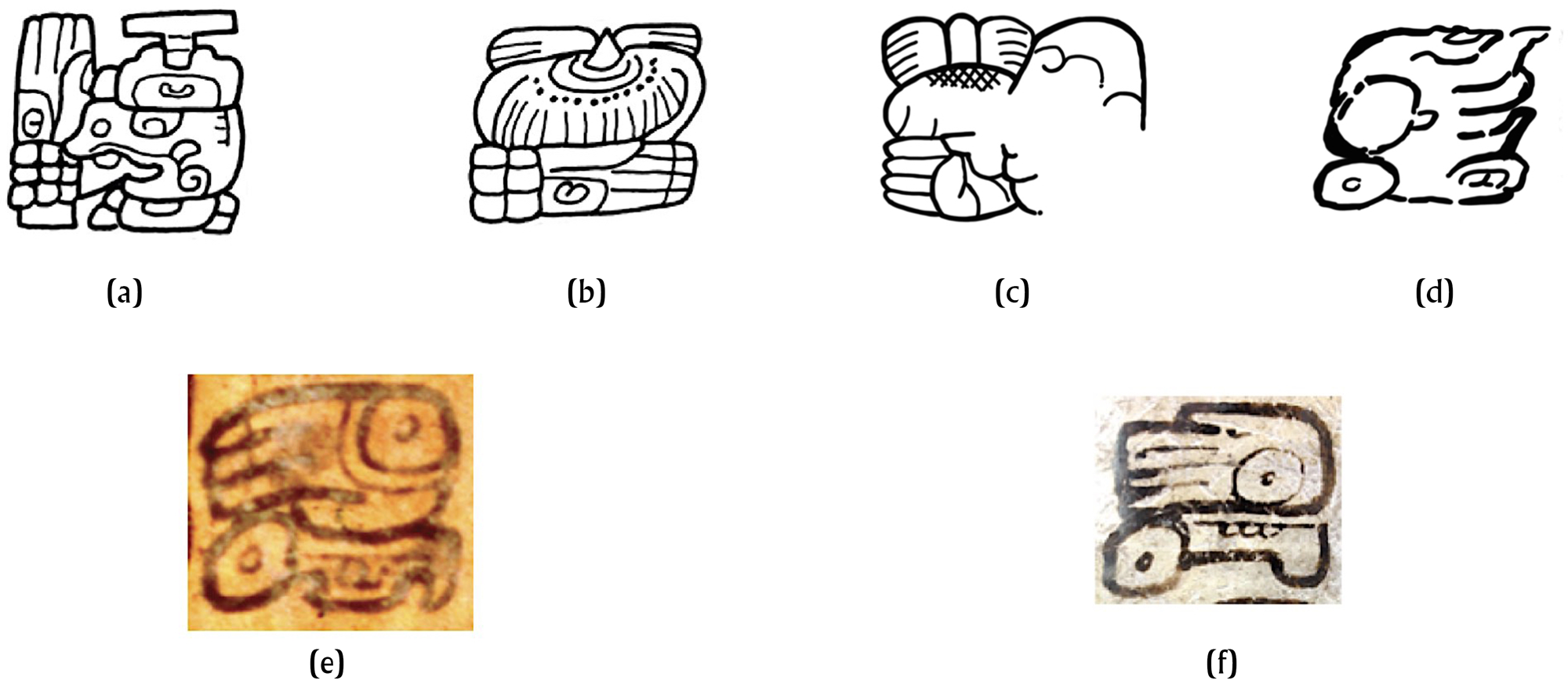
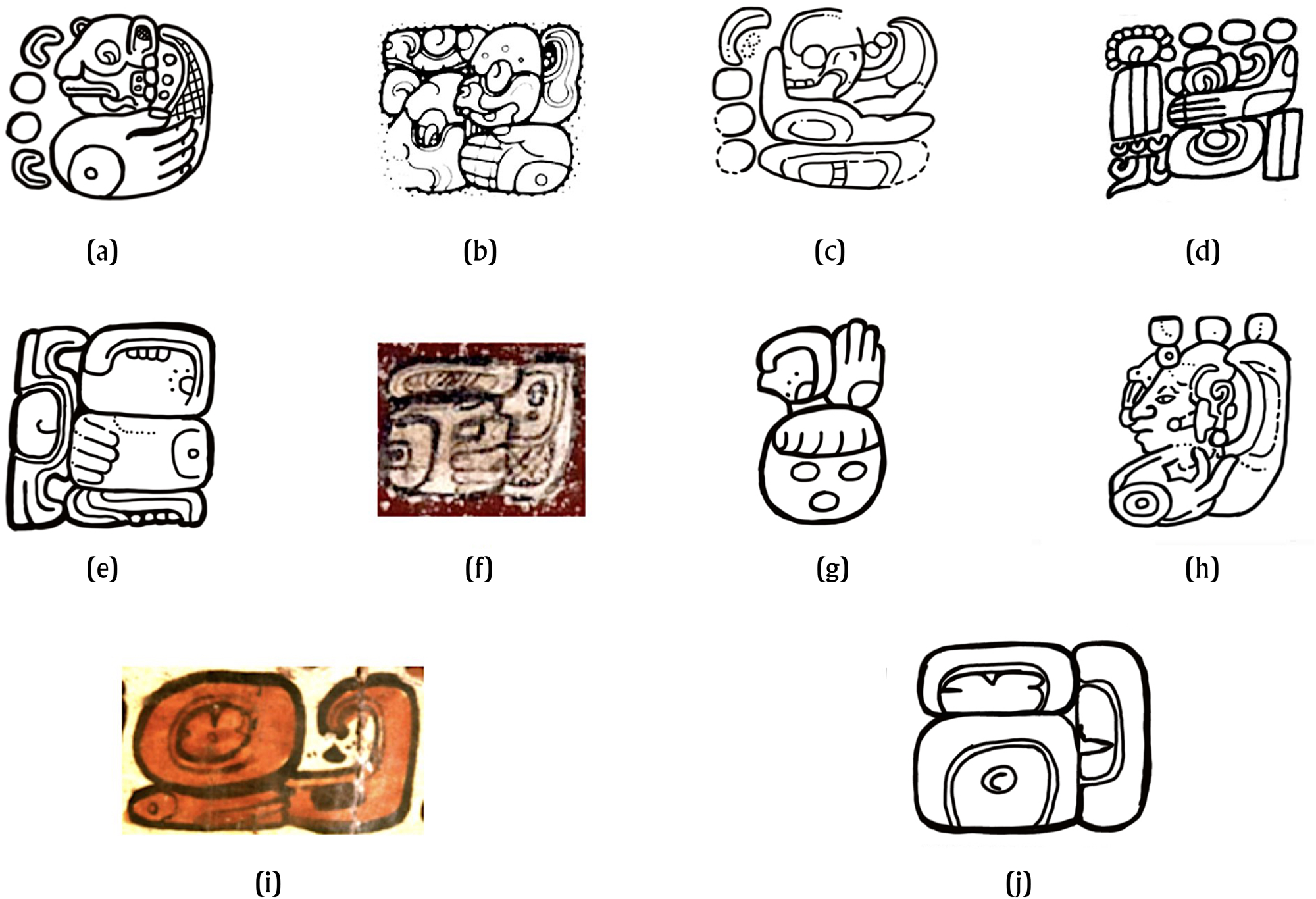
Next is MR1—in other words, cases where T713 functions as a logogram with the basic value K′AL. In this context, the hand sign may appear oriented to the right (Figure 11a) or left (Figure 11b), and it may be seen in a variety of shapes (Figures 11c–11h), in addition to the more typical FLAT.HAND shape defined above, as seen in Figures 11a–11b. Looper and Macri (Reference Looper and Macri1991–2022) also code as MR1a cases where the HAND has been dramatically abbreviated graphically, such as Figures 11i–11j. In the last case (Figure 11j), only the “human marker” (Hopkins Reference Hopkins1994; Hopkins and Josserand Reference Hopkins and Josserand1999; Mora-Marín Reference Mora-Marín2008) of T713 remains.
(a) Edzna Hieroglyphic Stairway 01 (EDZHS1), p40; drawing by author after drawing by Guido Krempel in Mayer (Reference Mayer2004); (b) Palenque Fragment, Templo Olvidado, Bodega 162d (PALOLVI), B5; drawing by Linda Schele in Schele and Mathews (Reference Schele and Mathews1979:623); (c) Tikal Stela 12 (TIKSt12), C2; drawing by author after drawing by William R. Coe in Jones and Satterthwaite (Reference Jones and Satterthwaite1982:31–32, Figures 17, 18); (d) Tikal Ballcourt Marker (TIKBCM), F6; drawing #2058 by Linda Schele (http://research.famsi.org/schele.html); (e) Machaquila Stela 7 (MQLSt07), D1; drawing by author after drawing by Ian Graham (Reference Graham1967:78, Figure 57); (f) detail from vessel K731 (COLK0731); photo by Justin Kerr (http://research.mayavase.com/kerrmaya.html); (g) Naranjo Stela 47 (NARSt47), A3; drawing by author after drawing by Simon Martin in Martin et al. (Reference Martin, Fialko, Tokovinine, Ramírez, Arroyo, Salinas and Alvarez2016); (h) Copan Stela P (CPNStP), B5b; drawing by author after drawing by Barbara Fash in Looper and Macri (Reference Looper and Macri1991–2022); (i) detail from vessel K7821 (COLK7821); photo by Justin Kerr (http://research.mayavase.com/kerrmaya.html); (j) Xculoc North Lintel (XCLNLnt), G1; drawing by author after drawing in Pollock (Reference Pollock1980:379, Figure 629).
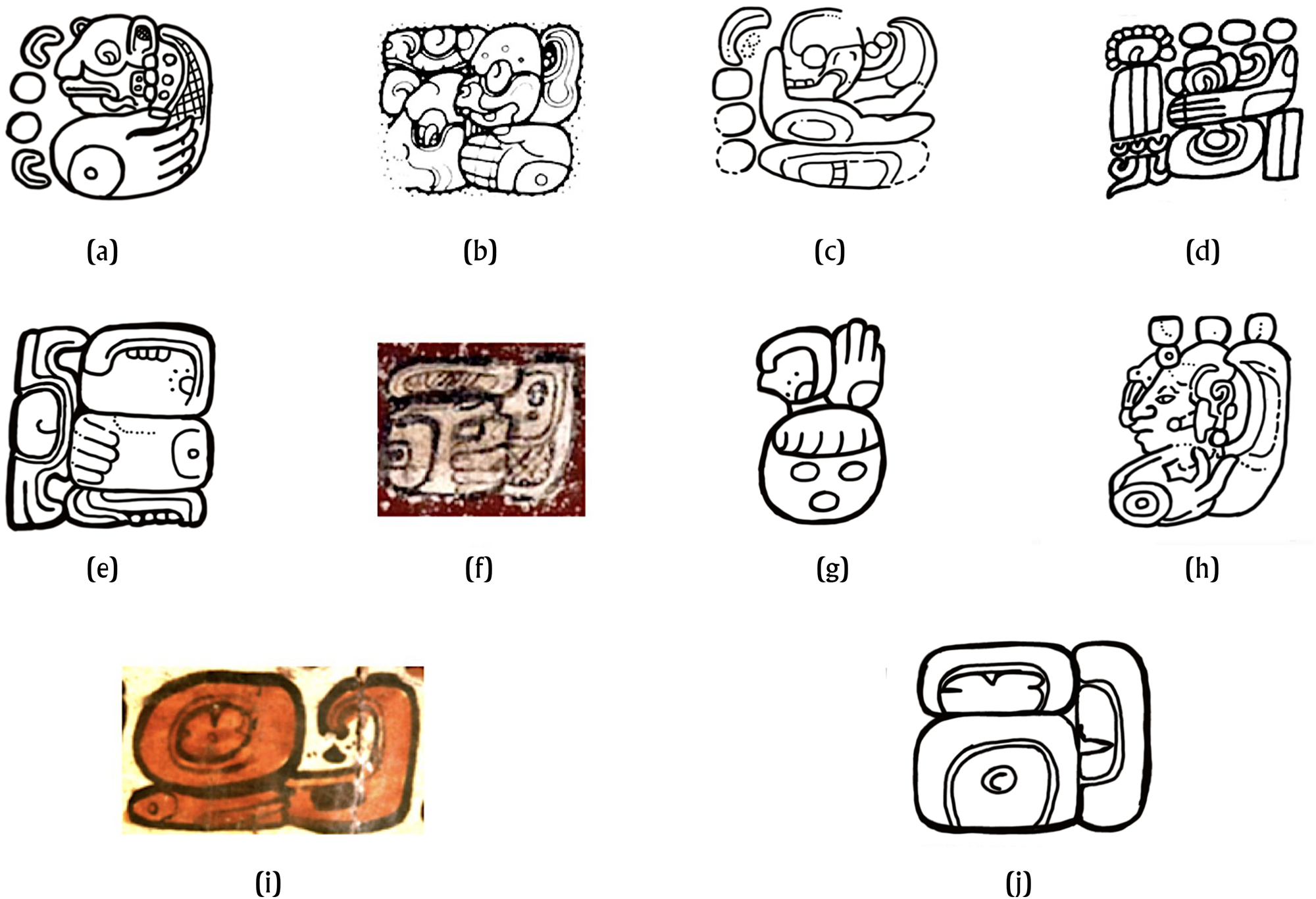
With respect to hand shapes, MR2, the syllabogram mi, is very consistent: all examples display, essentially, the same hand shape and orientation. Perhaps what is worthy of remark with regard to MR2 is the degree of graphic connection between T17/T18/1B9 yi, the sign placed on the holding site, and the T713 component. Some examples show T713 completely engulfed by 1B9 (Figures 12a–12b), others show a partial engulfing (Figure 12c), and others show them separated (Figure 12d).
(a) La Corona Altar 5 (CRNAlt05), A6; drawing by author after drawing by David Stuart in Stuart et al. (Reference Stuart, Canuto, Barrientos and González2018); (b) Copan Cylindrical Fragment (CPNCfrag), E2; drawing by Matthew Looper in Looper and Macri (Reference Looper and Macri1991–2022); (c) Palenque Temple of Inscriptions Tablet, West Panel (PALTIw), B11; drawing #154 by Linda Schele (http://research.famsi.org/schele.html); (d) Quirigua Stela E (QRGStE), B10; drawing by Matthew Looper (Reference Looper1995:361–364, Figure 5.31).
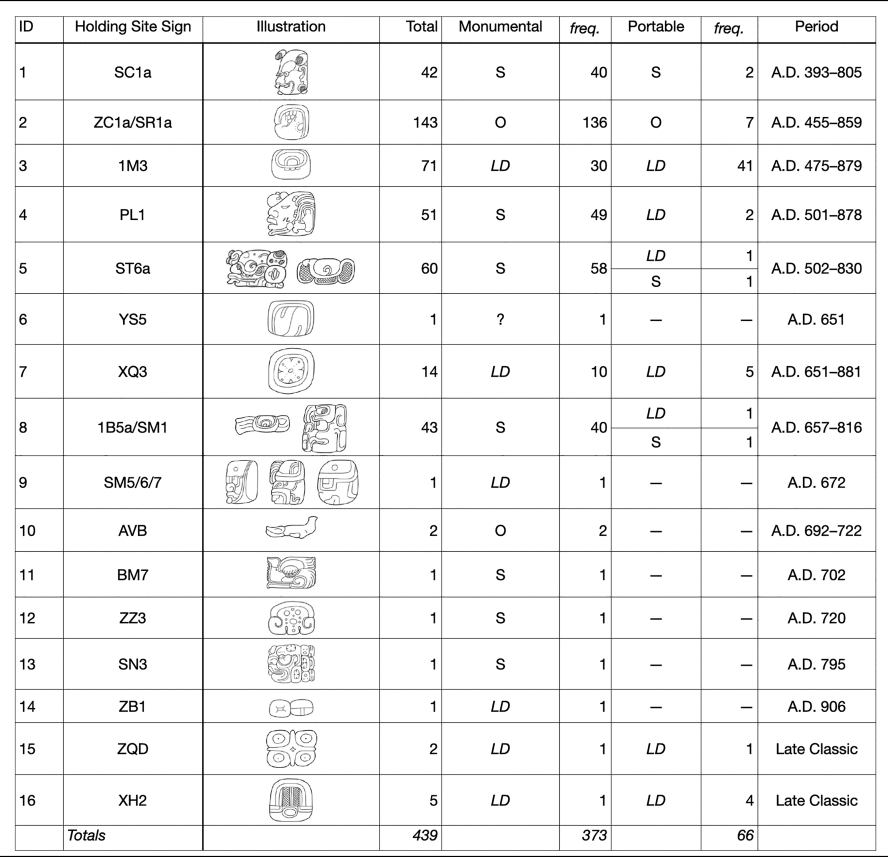
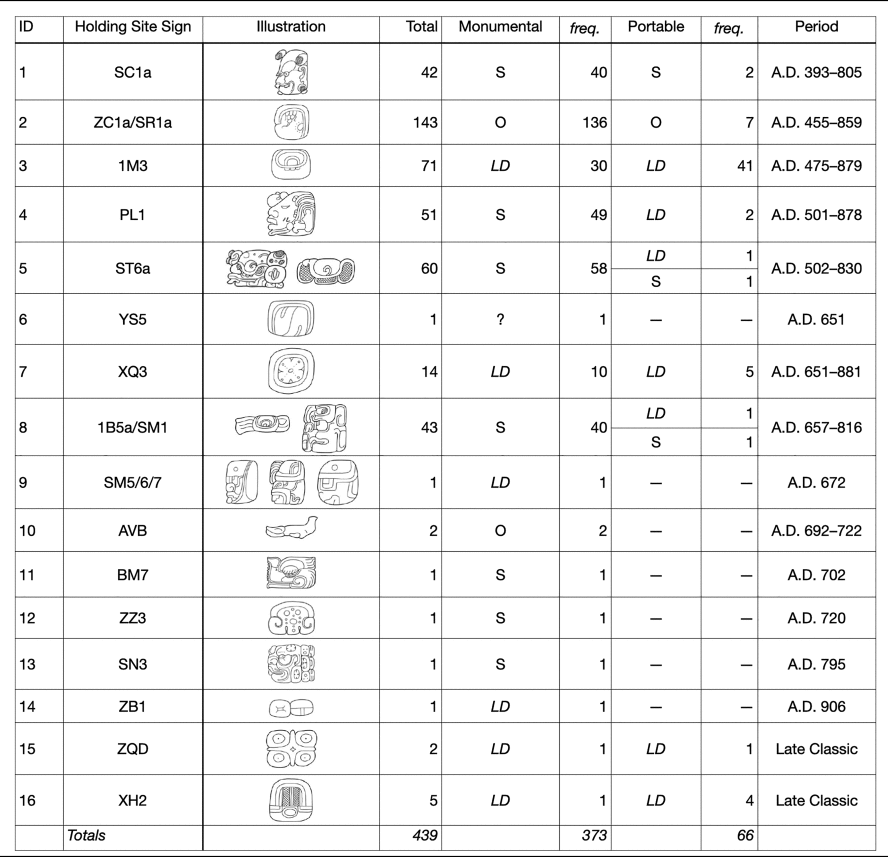
It is now time to review the results relevant to the holding site graphemes and their functions. From a practical standpoint, as already noted, this does not apply to MZ1, which is not used in conjunction with a holding site grapheme, or MR2, which uses 1B9 exclusively as the holding site grapheme. Thus, what follows pertains only to MR1. Table 1, sorted by time period, provides some basic numbers relevant to the graphemes placed within the holding site of MR1. Note the use, in Table 1, of O for Object function, S for Subject function, and LD for lexical determinative function of the graphemes in the holding site. As already noted above, I have not considered graphemes functioning as phonetic complements or partial spellings of affixes. Several holding site graphemes occur only once in the dataset: SN3, ZZ3, BM7, ZB1, YS5, SM5/6/7. All others occur at least twice. Figure 13 presents examples.
Holding site graphemes employed with MR1. (a) Quirigua Zoomorph P (QRGZP), D’01; drawing by Matthew Looper in Looper and Macri (Reference Looper and Macri1991–2022); (b) Palenque Palace Tablet (PALPT), F7; drawings #121 and #124 by Linda Schele (http://research.famsi.org/schele.html); (c) Palenque House E West Corridor Mural 01 (PALHEM1), Q1; drawing by author after photo from Callaway (Reference Callaway2008:26); (d) Uxmal Capstone 1 (UXMCST01), C1; drawing by author after drawing by Ian Graham (Graham and von Euw Reference Graham and von Euw1992:139); (e) Tortuguero Monument 8 (TRTMon08), A3; drawing by author after drawing by Sven Gronemeyer (Reference Gronemeyer2006); (f) Tonina Stucco 7 (TNAStu07); drawing by Matthew Looper in Looper and Macri (Reference Looper and Macri1991–2022); (g) Tzocchen Miscellaneous Sculpture 1 (TZCMSS1), pA2; drawing by author after drawing by Guido Krempel (Reference Krempel2015:Figure 4); (h) Palenque Temple 18 Jamb (PALT18J), B17; drawing by author after drawing by Hipólito Sánchez in Ruz Lhuillier (Reference Ruz Lhuillier1959:Figure 16); (i) Bowl (COLLCcb2112), B; drawing by author after photo by Nicholas Hellmuth in Looper and Macri (Reference Looper and Macri1991–2022); (j) Chichen Itza Temple of the Hieroglyphic Jambs Structure 6E3 East (CHNHJE), E1; drawing by author after drawing by Ruth Krochock (Reference Krochock1998:45); (k) detail from vessel K3801 (COLK3801); (l) detail from vessel K8940 (COLK8940); (m) COLMPV1104; (n) detail from vessel K1183 (COLK1183); (o) detail from vessel K8817 (COLK8817); photos 13k–13o by Justin Kerr (http://research.mayavase.com/kerrmaya.html); (p) detail from inscribed bone (COLDMA129); drawing #7320 by Linda Schele (http://research.famsi.org/schele.html); (q) detail from vessel K1183 (COLK1183); photo by Justin Kerr (http://research.mayavase.com/kerrmaya.html).
Graphemes in holding site and their functions according to time period. S = subject of verb (in some cases underlying O or patient); O = object of verb; LD = lexical determinative.
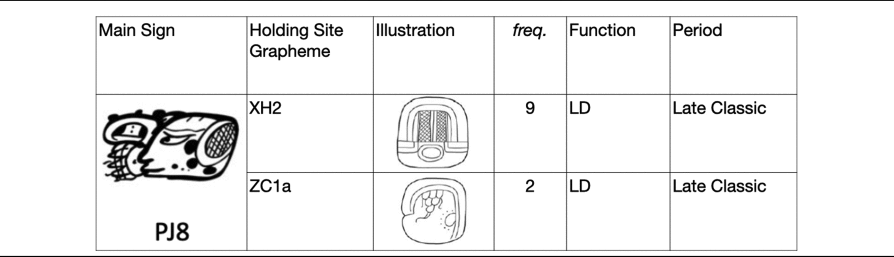
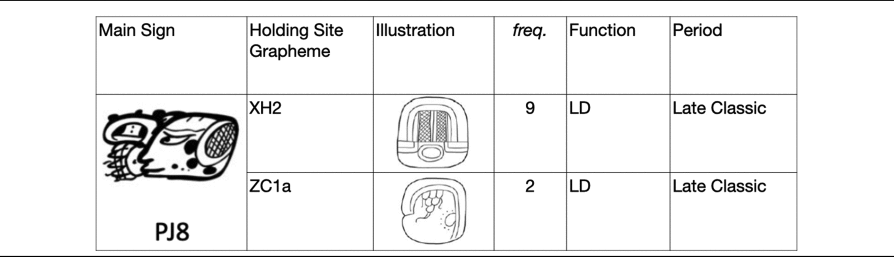
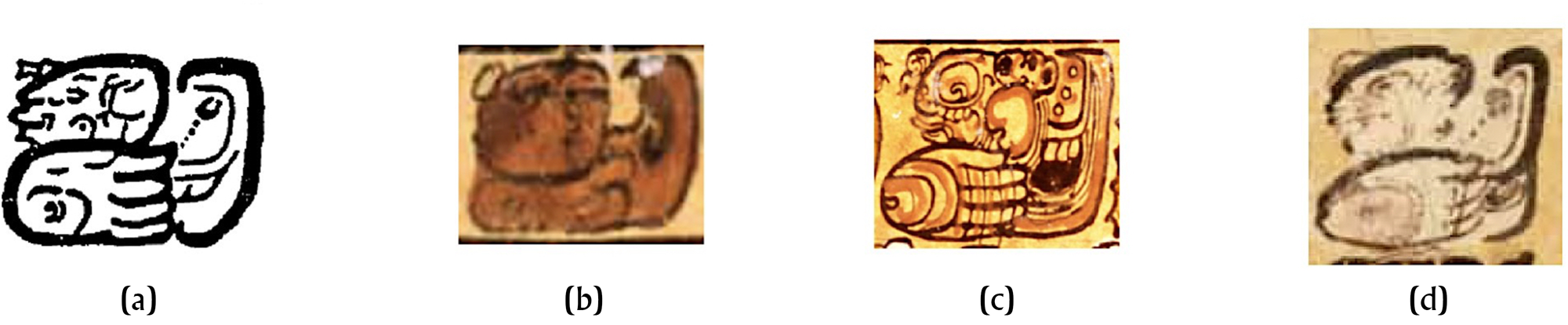
The examples defined as lexical determinatives in conjunction with MR1 collocations involve the following holding site graphemes: ZB1, SM5/6/7, ZQD, XH2, XQ3, 1B5a/SM1, PL1, ST6a, and 1M3. Overall, unsurprisingly, the majority of holding sites are taken up by ZC1a/SR1a TUN for tuun ‘stone’, functioning as a syntactic argument (underlying object, semantic patient). Given the suggestion in Mora-Marín (Reference Mora-Marín2022a), that holding site graphemes functioning as syntactic arguments could, over time, through frequent association, become reanalyzed as lexical determinatives, it is worth asking whether there are any cases in which ZC1a appears to function as a lexical determinative to MR1. Below I note (Table 2), with regard to cases cataloged in the MHD as PJ8, that the answer is yes. Nevertheless, as with the example from Mora-Marín (Reference Mora-Marín2022a), in which T1030 K′AWIL was suggested to function as a lexical determinative of T670 CH′AM in one text, both examples in which ZC1a appears to function as a lexical determinative are also found in a single text. Another such case involves 1B5a, the logogram HUN for huʔn ‘paper, paper headband’, which appears at least once as a lexical determinative in the context of the PSS, and which otherwise appears in texts as a syntactic argument (underlying object, semantic patient). Similarly, at least two (PL1, ST6a) of the three graphemes (SC1a, PL1, ST6a) involved in Glyph C (Lunar Series) collocation in conjunction with MR1 appear, in a very few cases, as lexical determinatives in the context of the PSS (Figure 14). Essentially, graphemes used to spell syntactic arguments of the k′al verb could become associated with such value for T713 (i.e., MR1), and a scribe could, in principle, utilize any of the graphemes used to represent such arguments to let the reader know that T713 was functioning as MR1 K′AL in other contexts where different syntactic arguments were called for (e.g., y-uk′-ib′).
PJ8: Graphemes in holding site of MR1.
Examples of Glyph C variants as lexical determinatives for MR1 in the PSS. (a) Detail from vase K2784; drawing by MacLeod (Reference MacLeod1990:110); (b) detail from vessel K8817 (COLK8817); (c) detail from vessel K1183 (COLK1183); (d) detail from vessel K3026 (COLK3026). (b–d) photographs by Justin Kerr (http://research.mayavase.com/kerrmaya.html).
The most important grapheme in such function is 1M3, the so-called MIRROR or CELT sign. It appears with frequency in both monumental and portable texts, and in the latter case, exclusively in standard PSS-style texts. Following 1M3, it is XQ3 that is used most frequently as a lexical determinative, with 14 cases, itself followed by XH2, with five. Both of these reappear with frequency as lexical determinatives of MR1 K′AL in examples cataloged as PJ8 and SM2.
It is now time to consider cases of the MR1 collocation contained within the PJ8 code in the MHD. All examples are found on portable media, specifically pottery vessels; the majority (21/33 or 63.6 percent) are from the El Zotz region; and all are Late Classic. In all cases, the presence of MR1 involves a lexical determinative, either XH2 or ZC1a. The two examples of ZC1a as a lexical determinative occur in the same text, K1183.
Much like the case of PJ8, all cases of SM2 are found on pottery vessels, the vast majority date to the Late Classic period, and most (23/33 or 69.7 percent) are from the El Zotz region. Of the 33 cases in the MHD, I only examined 12 examples that were clear.
It may be useful to ponder the temporal patterns at this point. Referring now to Table 3, a simple glance at the temporal ranges of the holding site graphemes and their functions in MR1 collocations (other than those discussed in connection with PJ8 and SM2), suggests that the two most wide-ranging cases are SC1a (Glyph C of Lunar Series) and ZC1a/SR1a (TUN for tuun ‘stone’). Also, the first dated example of 1M3 used as a lexical determinative to MR1 is found on Oxkintok Lintels 1/2, dated to 475 a.d. Other graphemes that were recruited to function exclusively as lexical determinatives with respect to MR1 (regardless of whatever functions they had outside of the MR1 collocation), such as XQ3, ZQD, and XH2, postdate the use of 1M3 as a lexical determinative to MR1.
SM2: Graphemes in holding site of MR1.
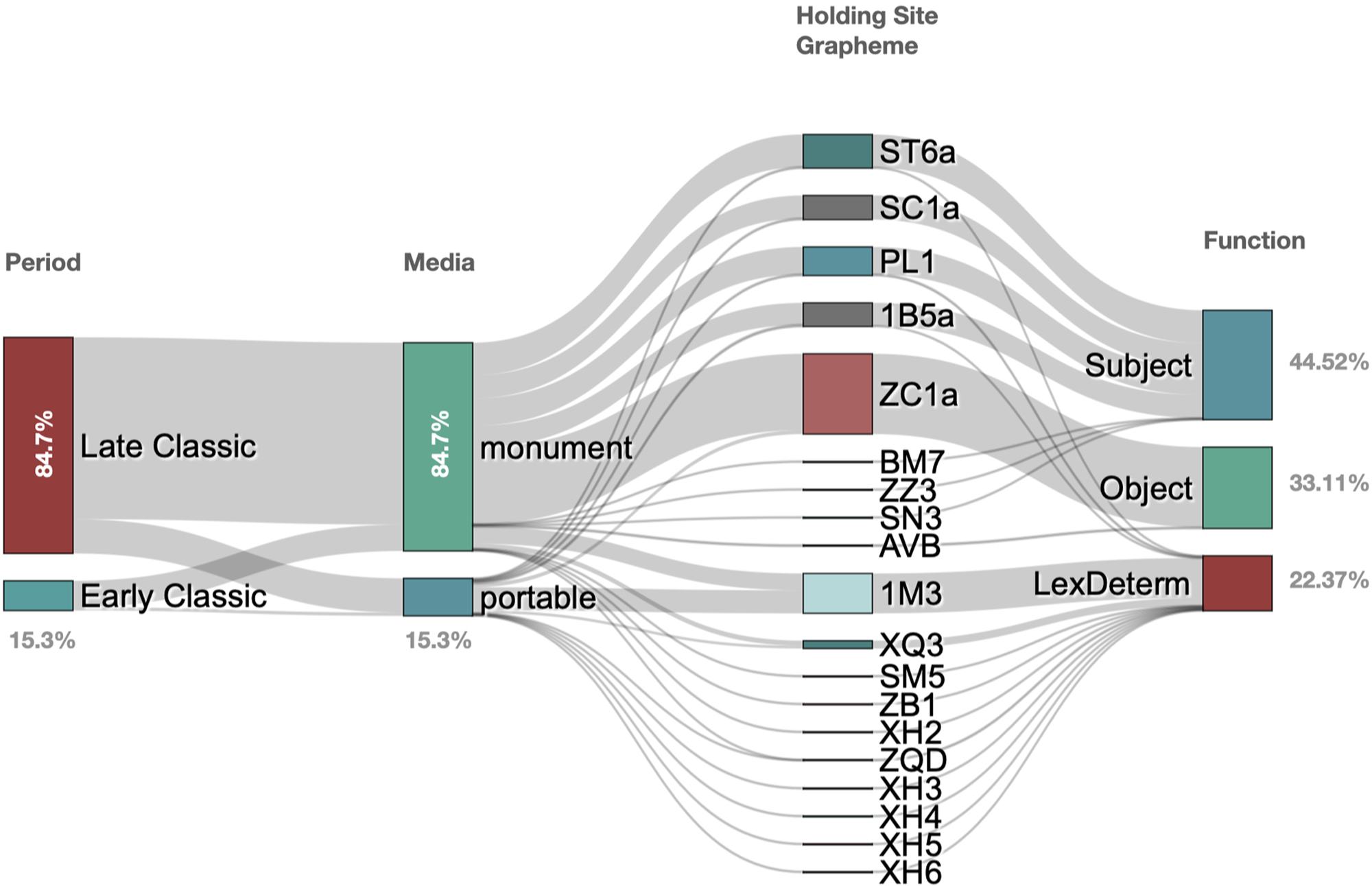
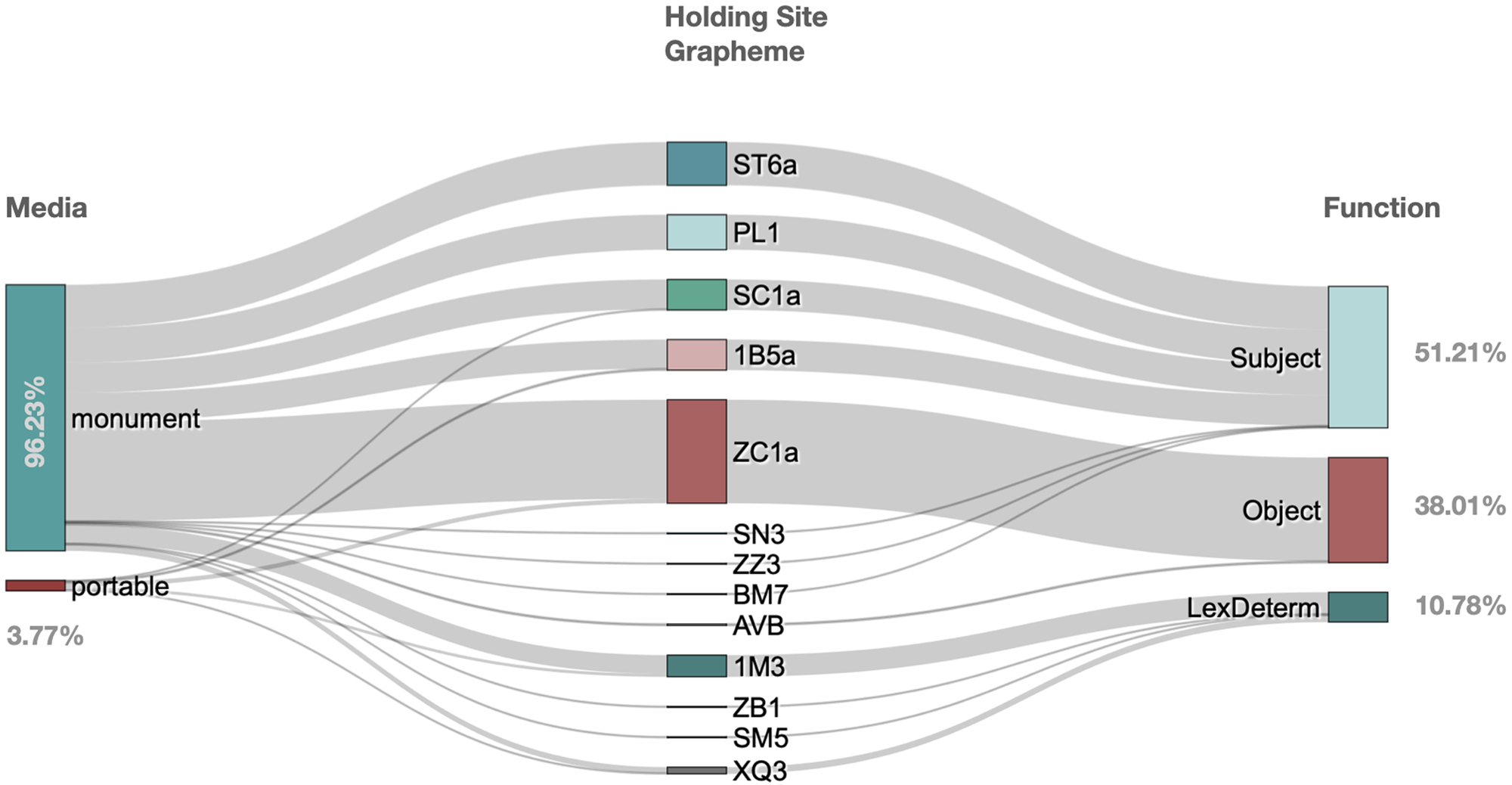
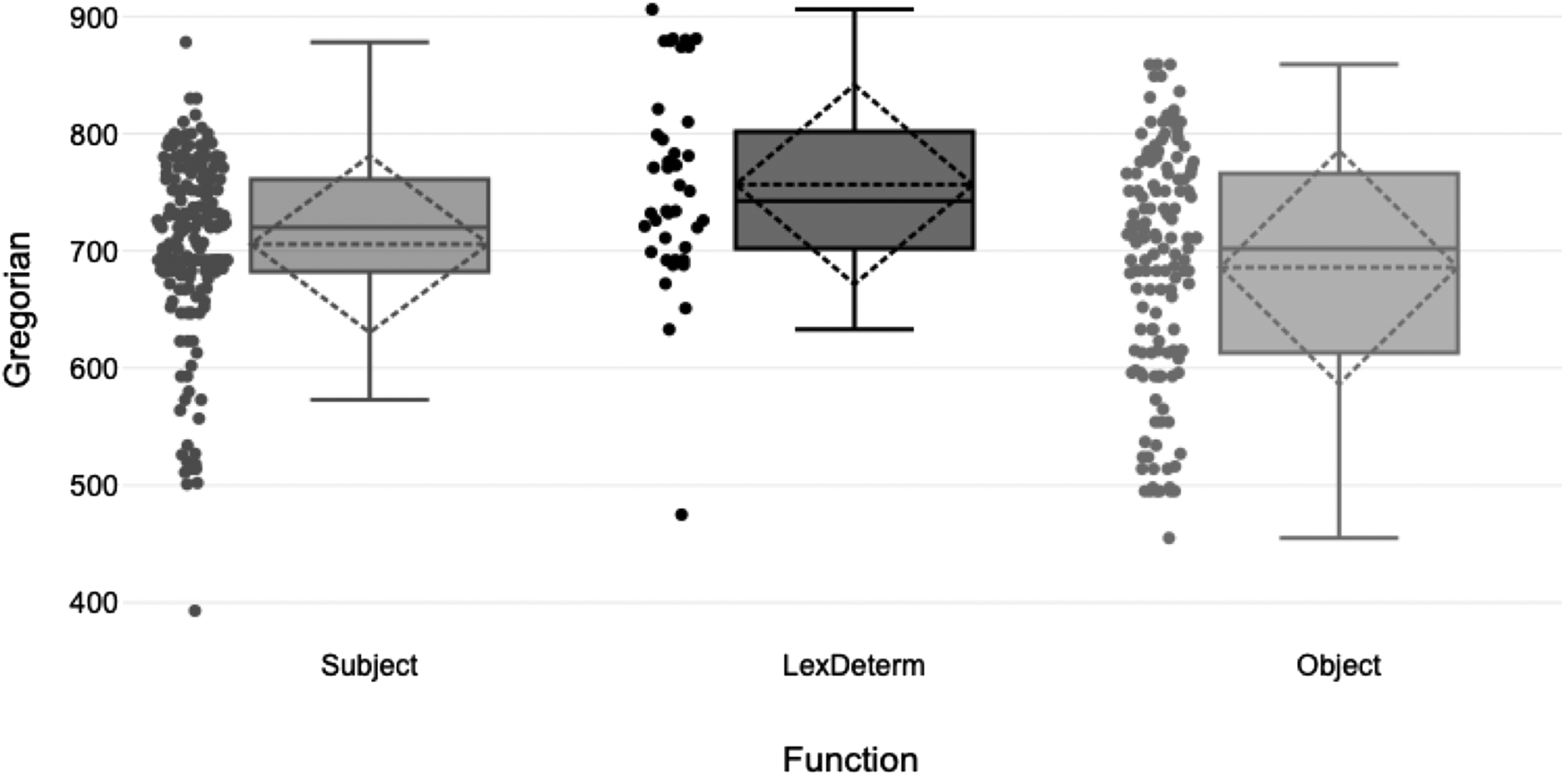
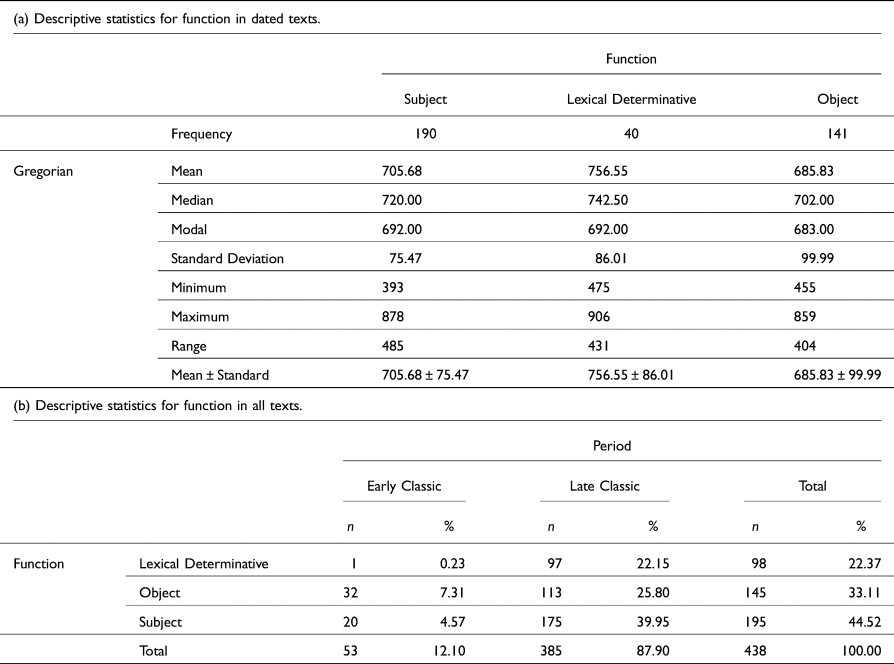
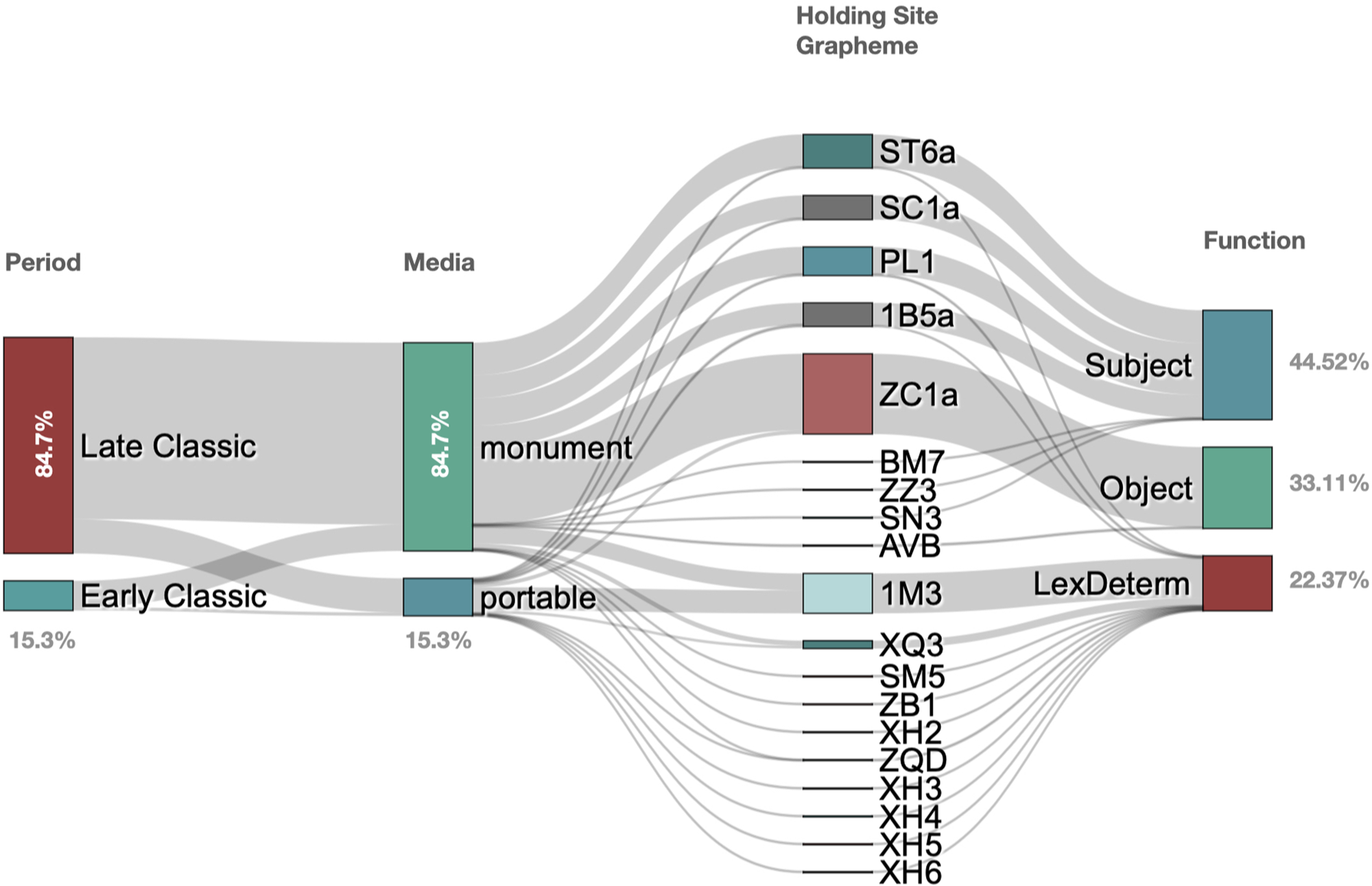
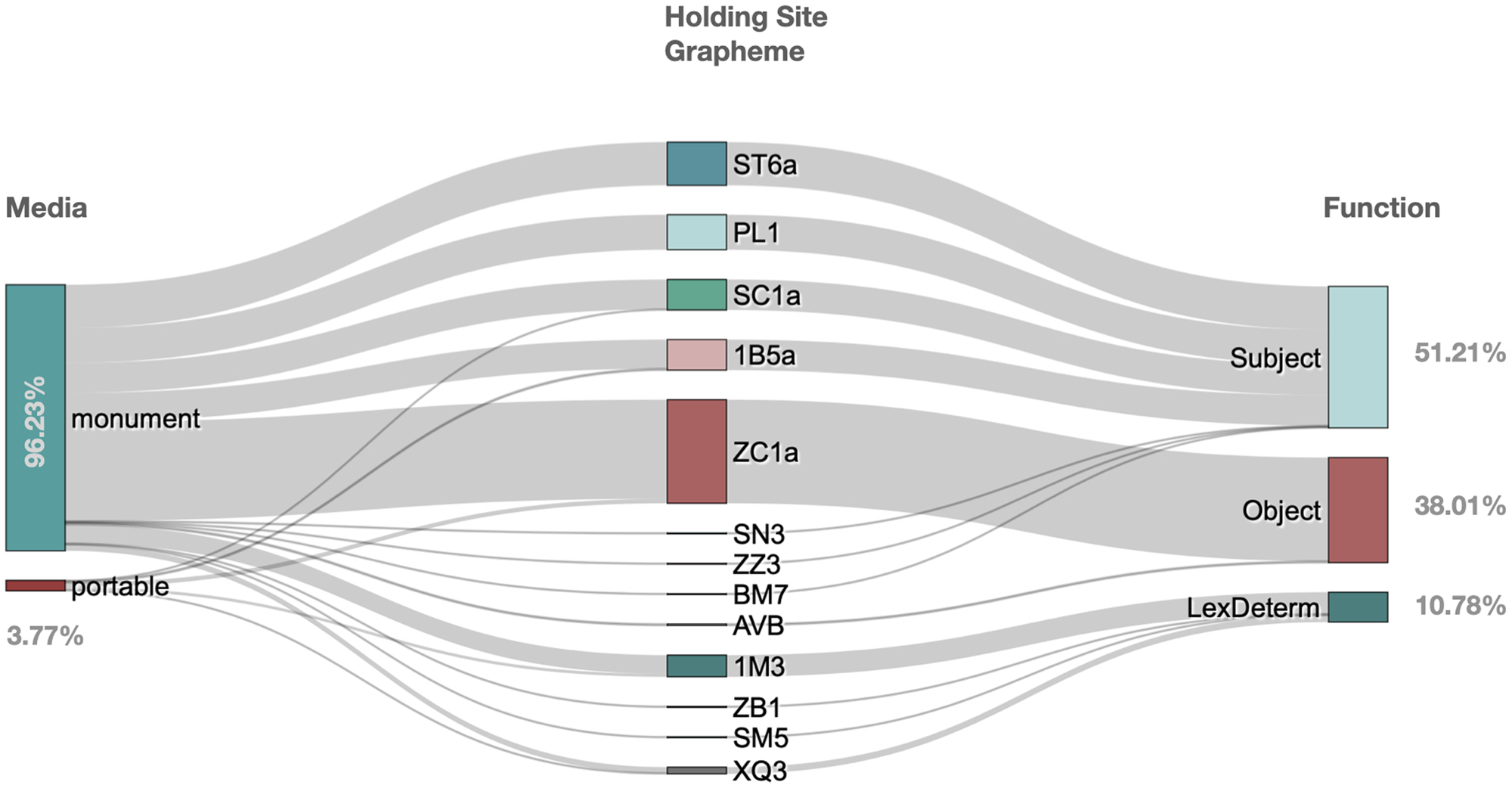
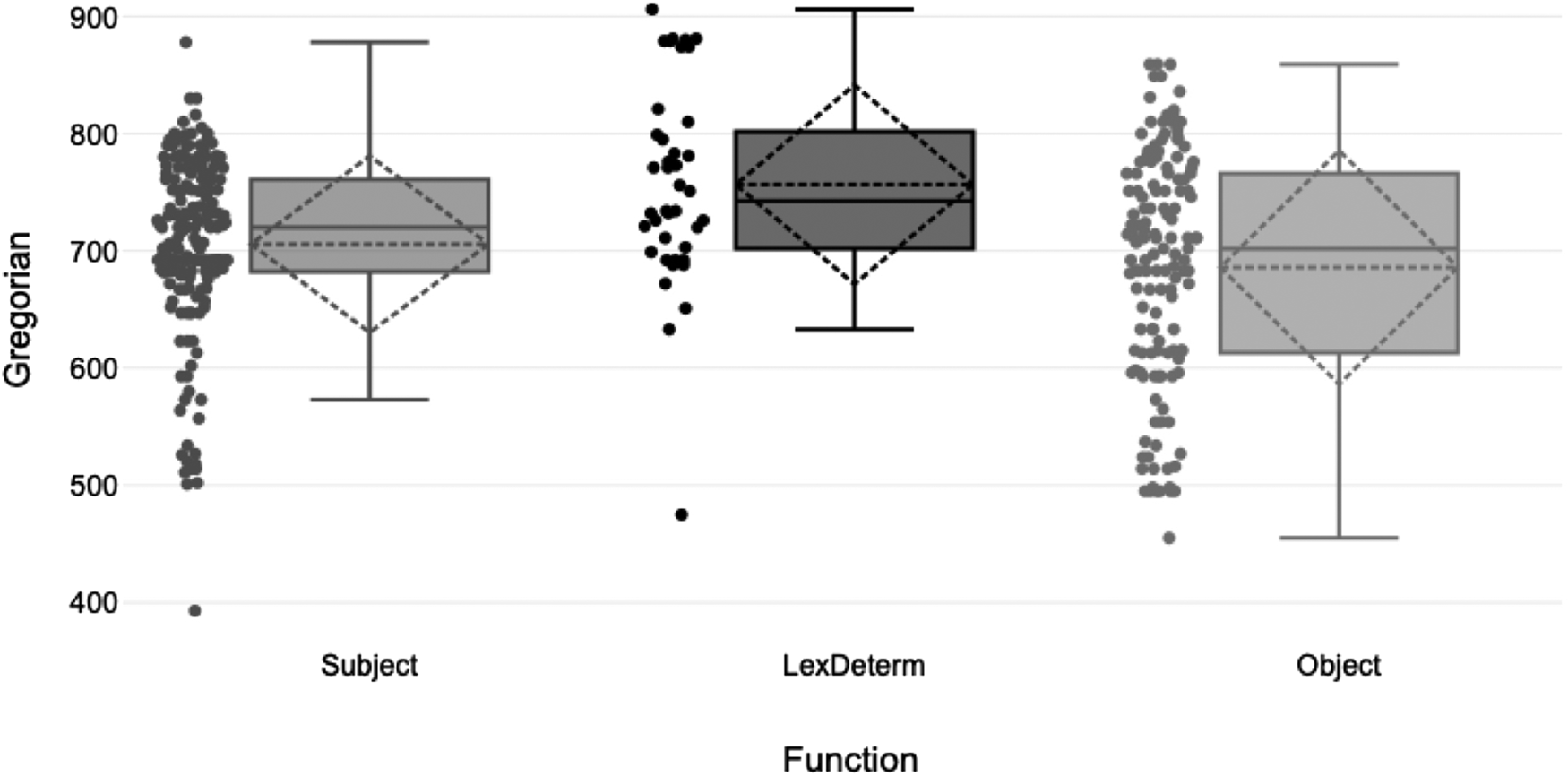
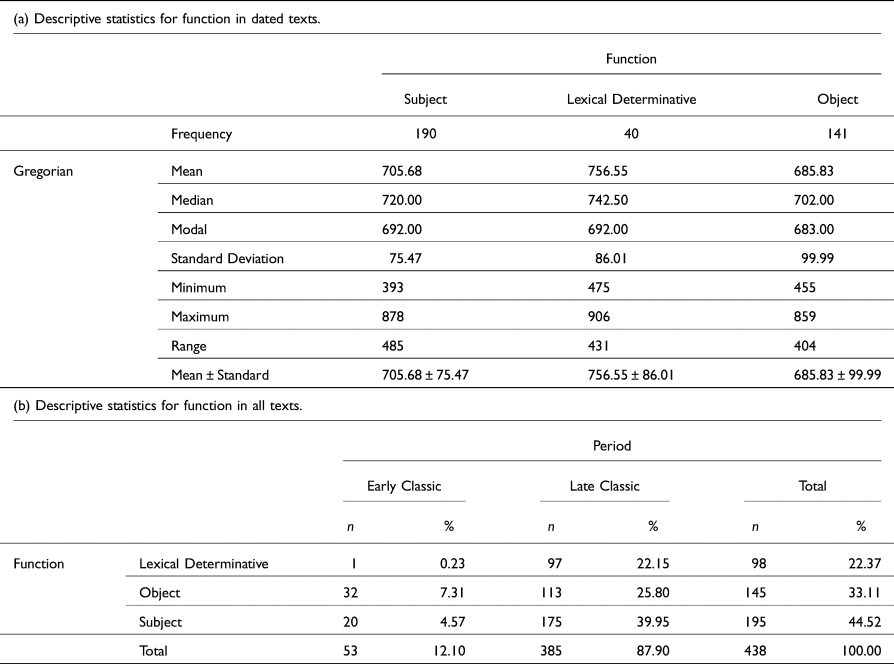
Thanks to the MHD, it is possible to use statistical methods in order to ascertain the significance of patterns involving all three of the proposed functions for the holding site graphemes (other than phonetic complements and syllabograms spelling grammatical morphemes), namely, Subject, Object, and Lexical Determinative. Two datasets were prepared: one consisting of all texts relevant to T713, whether dated or not, and the other consisting of only dated texts. Table 4 presents the descriptive statistics for both datasets, while Figures 15 and 16 illustrate the respective structures of the datasets by means of Sankey diagrams. Figure 17 provides a box plot chart of the distribution of all holding site graphemes in the dated texts dataset.
Sankey diagram showing structure of dataset for all relevant texts (with or without calendrical information) with respect to function of holding site graphemes. Prepared with DATAtab (DATAtab Team Reference DATAtab Team2023).
Sankey diagram showing structure of dataset for calendrically dated texts with respect to function of holding site graphemes. Prepared with DATAtab (DATAtab Team Reference DATAtab Team2023).
Box plot chart of distribution of functions of holding site graphemes of relevance to this study. Dashed diamonds represent standard deviations. Prepared with DATAtab (DATAtab Team Reference DATAtab Team2023).
Descriptive statistics for function of holding site grapheme. (a) Dated texts; (b) all texts.
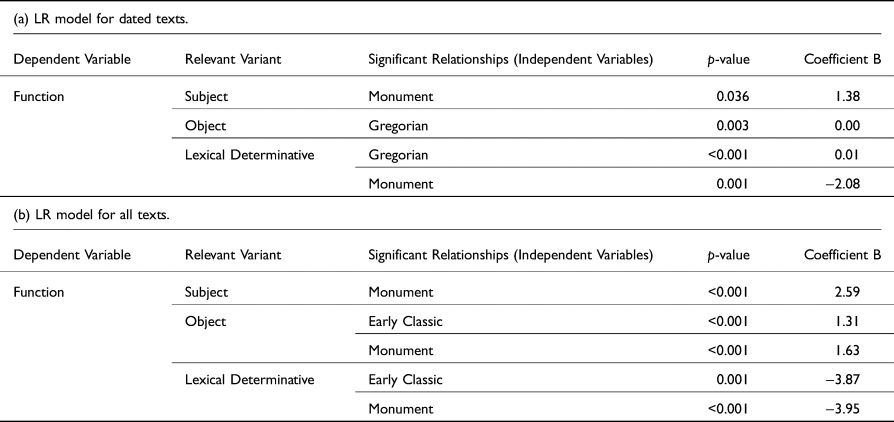
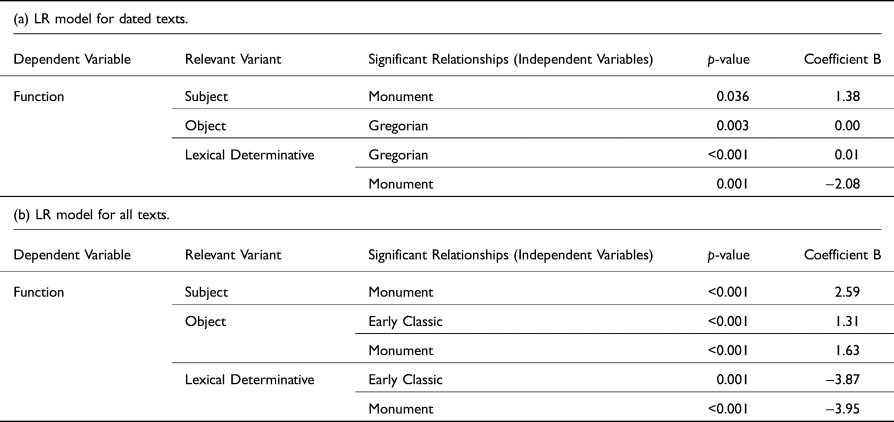
A multinomial logistic regression analysis was applied to study the possible relationships between the dependent variable function (subject, object, lexical determinative) and the independent variables time (Gregorian years for dated texts, Early Classic versus Late Classic for all texts) and media (monumental versus portable) by means of the DATAtab calculator, first to the dated texts dataset, and then to the more comprehensive dataset. The entire set of results for each analysis is present in the Supplementary Material. Table 5 summarizes the statistically significant results for each test, which suggest that the uses of holding site graphemes with a lexical determinative function increases over time and favors portable media, while the subject function remains stable through time but is correlated with monumental media, and the object function either remains stable through time (dated texts) or decreases somewhat over time (all texts, dated and undated) and may be favored on monumental media. The most important result of the logistic regression analysis is that the lexical determinative function of the holding site graphemes increases over time during the Classic period and is most strongly correlated with portable media.
Logistic regression analysis synopsis. Function as dependent variable; time and media as independent variables.
Finally, MR2, the syllabogram mi, is so consistently and exclusively seen with 1B9 yi that one may argue that 1B9 could function as a phonetic determinative: to point to T713 having a phonographic value mi whenever it is joined by 1B9. As such, its earliest-dated attestation is on La Corona Altar 5 (9.5.10.0.0, 544 a.d.). One could argue, of course, that this is a true case of a digraphic sign, instead of a situation where a determinative is used to indicate that an otherwise logographic sign is meant to be used phonetically. I will not attempt to resolve the issue, which would require a detailed look at the nature of digraphic signs across scripts, and at possible cases in Mayan writing (e.g., Lacadena García-Gallo Reference Lacadena García-Gallo, van Broekhoven, Rivera, Vis and Sachse2010), some of which have alternative, non-digraphic explanations.
Next, I review a few prior discussions of variants of the MR1 collocation by MacLeod (Reference MacLeod1990), in particular as it pertains to the Primary Standard Sequence of portable texts, and offer some hypotheses regarding the processes of development of its lexical determinatives for future testing.
Discussion and Hypotheses
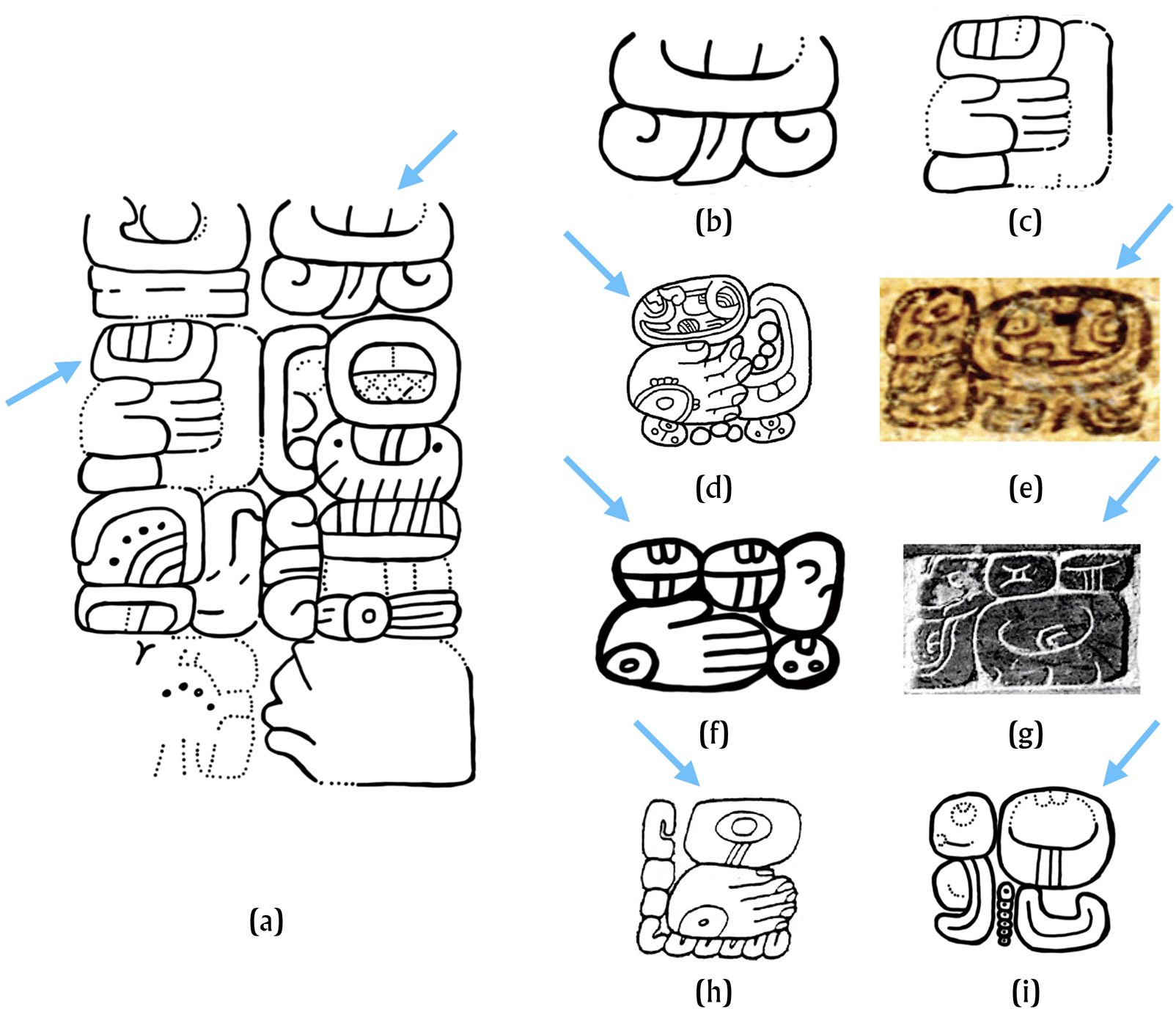
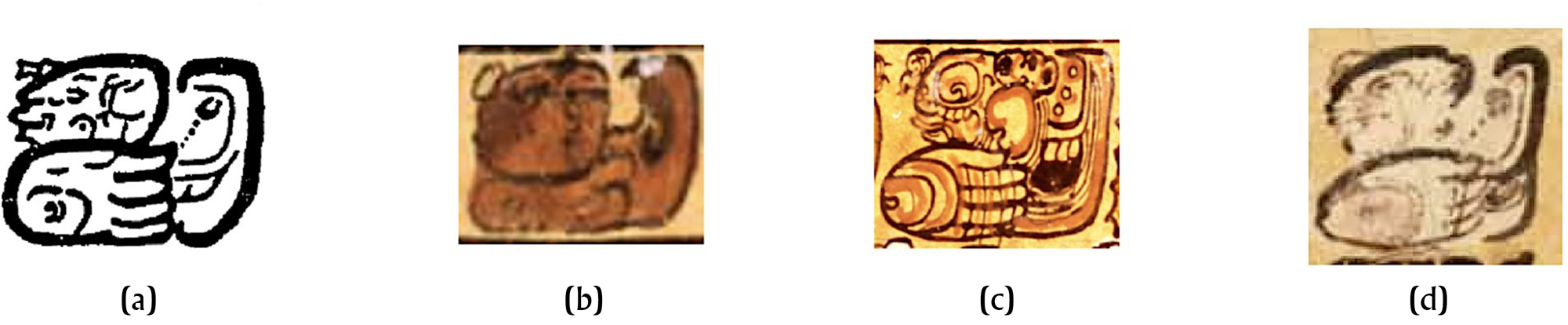
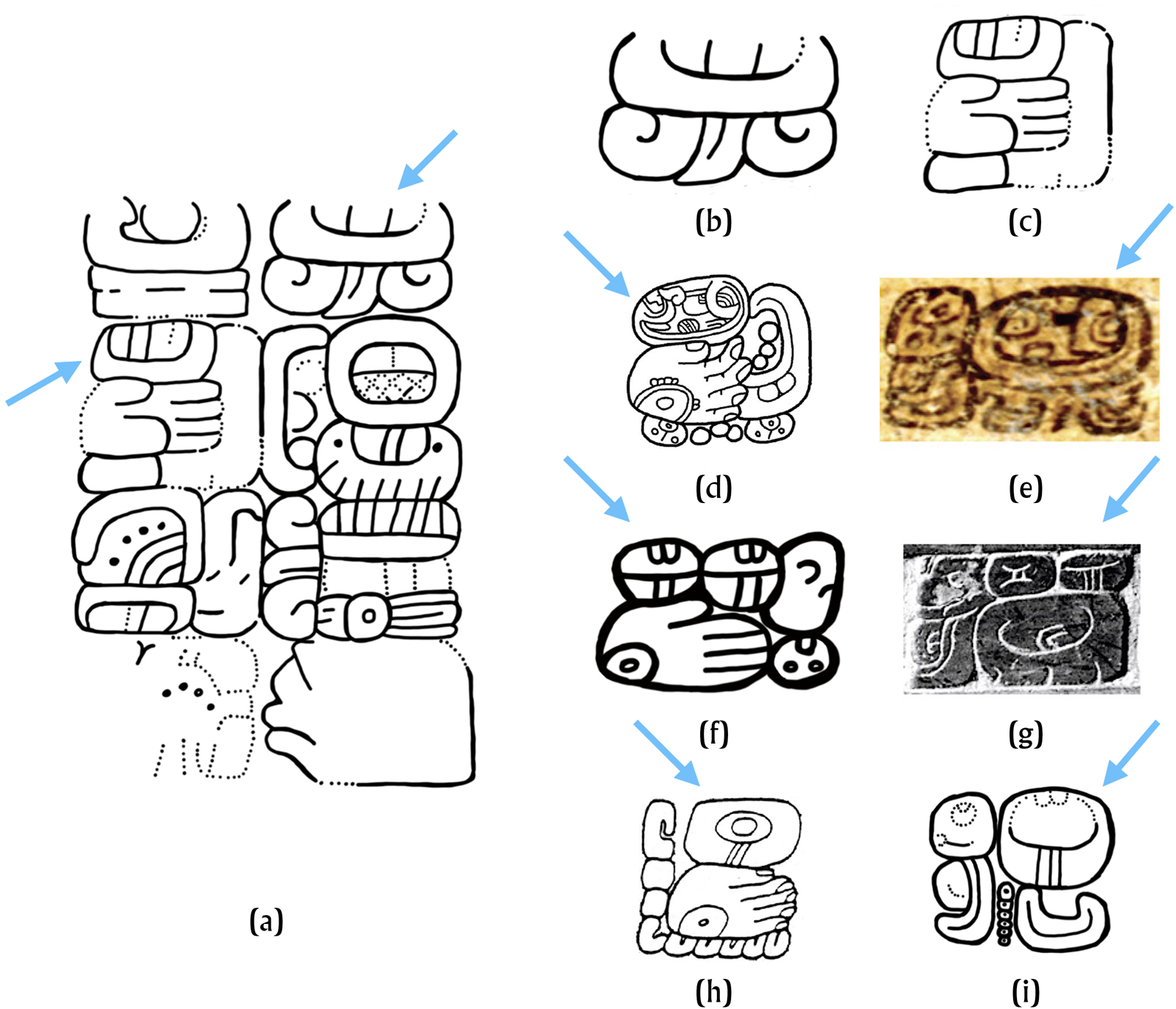
I propose that the use of 1M3 as a lexical determinative arose through contextual association, specifically, of uses of T713 with the value K′AL (MR1) in dedicatory texts, in the genre referred to as the Primary Standard Sequence (PSS) formula present in hundreds of examples on portable texts (e.g., Coe Reference Coe1973, Reference Coe1978; Grube Reference Grube and Kerr1990, Reference Grube and Robertson1991; Houston et al. Reference Houston, Stuart and Taube1989; MacLeod Reference MacLeod1990; Mora-Marín Reference Mora-Marín2004; Stuart Reference Stuart2005). In such texts, the K′AL collocation typically follows the Initial Sign Collocation (ISC): as noted by MacLeod (Reference MacLeod1990:69), “When [K′AL] appears, it follows the Initial Sign and precedes the God N/Step.” The ISC is still of controversial reading, but it begins PSS texts in close to 700 examples, 126 of which show K'AL immediately after it or two glyph blocks later. It was the association with the ISC, with its typically prominent use of 1M3, that led a scribe to start placing 1M3 in the holding site of T713. The earliest-dated text showing this juxtaposition is Oxkintok Lintel 1/2, as seen in Figure 18a, which is also the earliest-dated example of 1M3 in the holding site for MR1. Indeed, the designs of 1M3 seen in both collocations, the ISC (Figure 18b) and the MR1 collocation (Figure 18c), are identical. This connection between the ISC then became entrenched, so that other main sign graphemes used in the ISC could be used in the holding site of the MR1 collocation: Figures 18d–18e illustrate this for the SM5/6/7, Figures 18f–18g for ZB1, and Figures 18h–18i for yet another design of 1M3.
(a) Oxkintok Lintel 2 (OXKLnt02); drawing by author after drawings in García Campillo and Lacadena García-Gallo (Reference García Campillo, Lacadena García-Gallo and Rivera1990:162, Figure 2); (b) ISC on Oxkintok Lintel 2 (OXKLnt02), B1; drawing by author after drawings in García Campillo and Lacadena García-Gallo (Reference García Campillo, Lacadena García-Gallo and Rivera1990:162, Figure 2); (c) MR1 Collocation on Oxkintok Lintel 2 (OXKLnt02), A2; (d) MR1 Collocation on Tonina Stucco 7 (TNAStu07); drawing by Matthew Looper in Looper and Macri (Reference Looper and Macri1991–2022); (e) ISC on vessel K1211 (COLK1211); photograph by Justin Kerr (http://research.mayavase.com/kerrmaya.html); (f) MR1 Collocation on Uxmal Capstone 1 (UXMCST01); drawing by author after drawing by Ian Graham (Graham and von Euw Reference Graham and von Euw1992:139); (g) ISC on vessel K3199 (COLK3199); photograph by Justin Kerr (http://research.mayavase.com/kerrmaya.html); (h) MR1 Collocation on Palenque Temple of Inscriptions Tablet Middle Panel (PALTIm), I2; drawing #153 Linda Schele (http://research.famsi.org/schele.html); (i) ISC on Chichen Itza Las Monjas Lintel 04 (CHNLMLnt04), B5; drawing by author after drawing by Ian Graham in Bolles (Reference Bolles1977:271).
In fact, some cases of the ISC in the Late Classic period employ a version of ZB1, a fact that could explain other cases where instead of 1M3 it is ZB1 that is employed as a lexical determinative with MR1 (Figure 18f). The same may be argued for SM5/SM6/SM7: it appears in at least one example of the MR1 collocation as a lexical determinative, and it is also one of the Initial Sign variants in the ISC. Consequently, it can be hypothesized that the ISC collocation was emblematic of PSS contexts and that, as a result, the Initial Sign graphemes were applied to the MR1 collocation in such contexts by association, and afterwards, through extension, to contexts outside of the typical PSS.
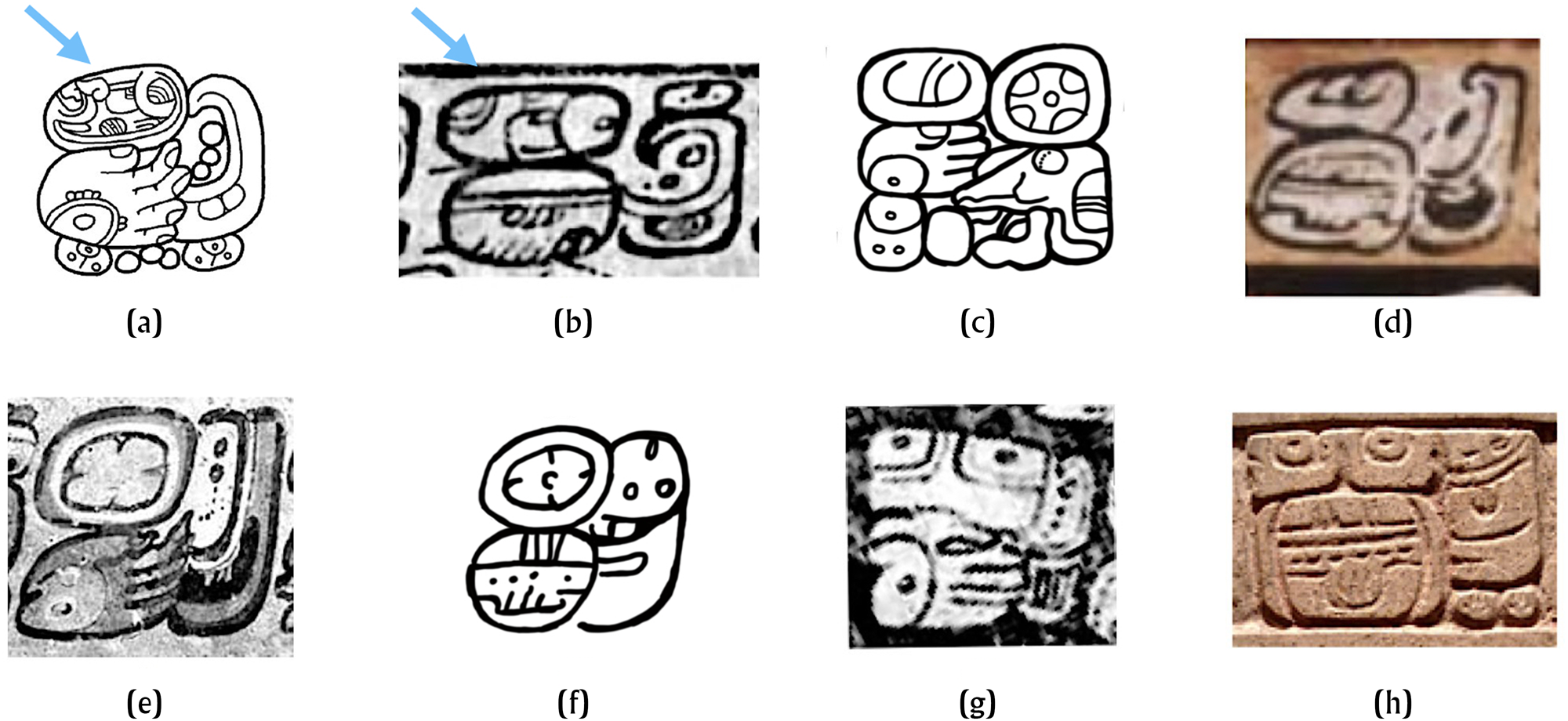
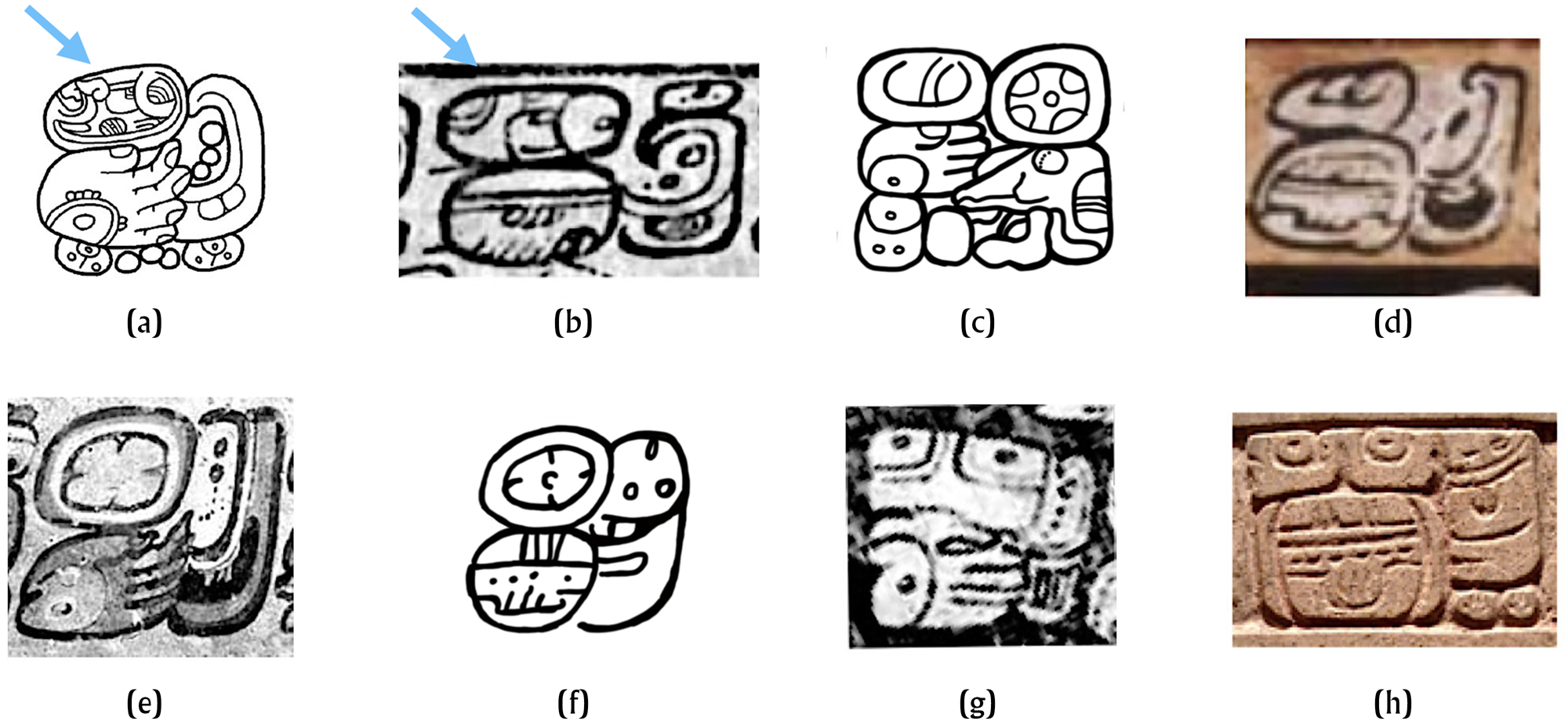
A similar type of association appears to have given rise to the use of SM5/6/7, XQ3, XH2, and ZQD as lexical determinatives (Figure 19). In this case, the association is one between MR1 (Figures 19a, 19c, 19e, 19g) and a series of signs that MacLeod (Reference MacLeod1990) had identified as allograms of the MR1/FLAT.HAND sign in the context of the PSS, signs that generally involve the XH3/T561/SKY glyph (Figures 19b, 19d, 19f, 19h), on the one hand, as well as the already noted cases of SM5/6/7 (Figures 19a–19b), 1M3/CELT/MIRROR (Figures 19c–19d), as well as several signs related to time or the heavens, such as XQ3 SUN (Figures 19e–19f), ZQD/STAR (Figures 19g–19h), and XH2/DRUM (not illustrated here).
Holding site graphemes shared between MR1 collocation and the presumably allographic XH3 SKY Collocation. (a) MR1 Collocation on Tonina Stucco 7 (TNAStu07); drawing by Matthew Looper in Looper and Macri (Reference Looper and Macri1991–2022); (b) SKY Collocation on vessel K6418 (COLK6418); (c) MR1 Collocation on Coban Stela 11 (COBSt11), pG4; drawing by author after drawing by Octavio Q. Esparza Olguín in Con Uribe and Esparza Olguín (Reference Con Uribe and Esparza Olguín2016:10, Figure 13); (d) SKY Collocation on vessel K1775 (COLK1775); (e) MR1 Collocation on vessel K4357 (COLK4357); (f) SKY Collocation on Ek Balam Miscellaneous Text 5 (EKBMT05); drawing by author after drawing by Alfonso Lacadena García-Gallo (Reference Lacadena García-Gallo2004:Figure 27); (g) MR1 Collocation on vessel K2323 (COLK2323); (h) SKY Collocation on K8740 (COLK8740). (b, d, e, g, h) Photographs by Justin Kerr (http://research.mayavase.com/kerrmaya.html).
But there are other examples, less frequent ones, where the innovation of a lexical determinative resulted from a frequent association with a syntactic argument. These are the examples of the Glyph C variable graphemes, SC1a, PL1, and ST6a. In the vast majority of instances where these graphemes are used in conjunction with MR1, it is in the context of the Lunar Series, where these variable graphemes constitute part of the spelling of the verb's subject. But interestingly, in a very few instances in the context of the PSS (Figure 14), two of these (PL1, ST6a) were shown to function not linguistically, to refer to the subject of the MR1 verb, but merely associatively, to remind the reader that in such cases T713 functions verbally (MR1 collocation), like it does in the Glyph C collocation of the Lunar Series, rather than as a noun (MZ1 collocation). Thus, they function as lexical determinatives in such a context.
Another such case, where a grapheme that otherwise spells a syntactic argument is employed purely to associate T713 to its value as a verbal lexeme (MR1), is the case of the allograms 1B5a/SM1 with the value HUN for proto-Ch′olan *hun ‘paper, book’ and Epigraphic Mayan ‘paper headband’. On two occasions (cf., Figure 13l) it is used in the context of the MR1 collocation seemingly as a lexical determinative.
Also in connection with MR1, it was suggested that T528/ZC1a, logographic TUN for proto-Ch′olan *tun ‘stone’ (also logographic CHAHUK/CHAK for proto-Ch′olan *chahuk ~ *chahk ‘lightning, thunder’, and syllabographic ku), may also have become employed as a lexical determinative through association with its highly frequent use as a syntactic argument of the MR1 value. However, the two examples come from a single text (cf., Figures 8g–8h) and their syntactic context is not completely straightforward. One of the reviewers of the article noticed that perhaps the rare use of ZC1a TUN for tun ‘stone; anniversary’ in these cases was meant as an association with XH2 HAB′ for ‘year’, a sign that occurs more often as a lexical determinative with MR1, since ZC1a also functioned as HAB′ in some contexts.
Finally, I return to MR2 mi, independently deciphered by Barbara MacLeod and Marc Zender based on substitution patterns with other mi allograms (Boot Reference Boot2003:11). This grapheme may have been innovated through the addition of a phonetic determinative, specifically 1B9 yi, used to indicate that T713 was meant to function phonetically rather than logographically. To support such a determinative usage, some sort of association should be established. For instance, 1B9 may represent a depiction of a shell (cf., Figures 3a and 3c), and, if so, it could be associated with the 1GC, the SHELL sign for ‘zero’. If one assumes mih ‘none’ to be the lexeme involved in the use of 1GC for ‘zero’ (cf., proto-Mayan *mi with reflexes showing glosses ‘no’, ‘nothing’, ‘none’, ‘no one’), hence MIH (cf., Blume Reference Blume2011; Sanz González Reference Sanz González2007), then adding a SHELL sign atop T713 could have functioned as an association with the phonetic shape of such a word, allowing readers to know that whenever 1B9 was placed atop T713, a syllabographic value mi for T713 was called for. Nonetheless, the earliest examples of 1GC, at the site of Xultun (Saturno et al. Reference Saturno, Stuart, Aveni and Rossi2012), postdate the earliest uses of MR2 by almost two centuries; nor is it a given that 1B9 depicts a shell. Michael Grofe (personal communication 2022) has also suggested that perhaps the association between T713 and MR2 mi used to spell mih ‘none’ (zero) lies in the fact that, in Epigraphic Mayan, ‘20’ was pronounced k′al (although represented by means of other signs, not T713/MR1), possibly based on the same root as k'al ‘to close, to wrap’, and that in such contexts, the completion of cycles of 20, the term could have become associated with ‘zero’ or ‘none’.
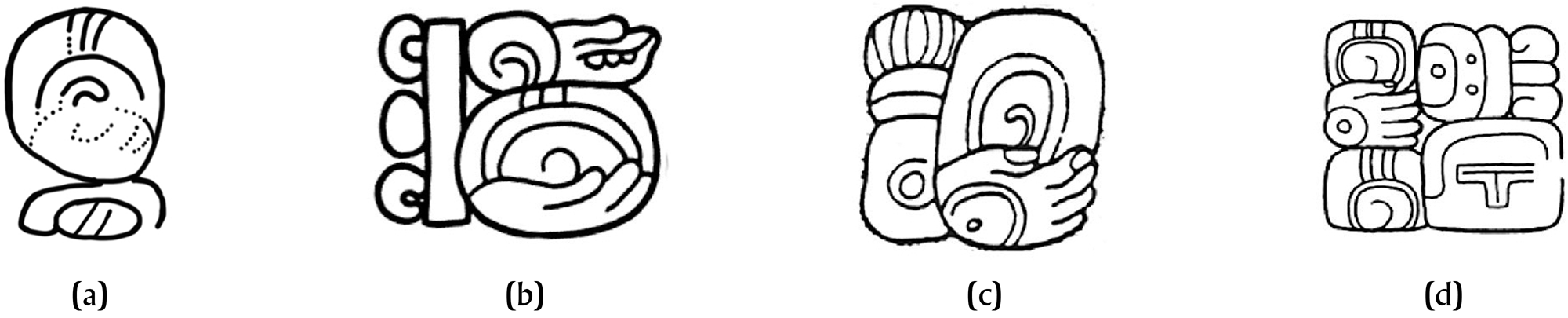
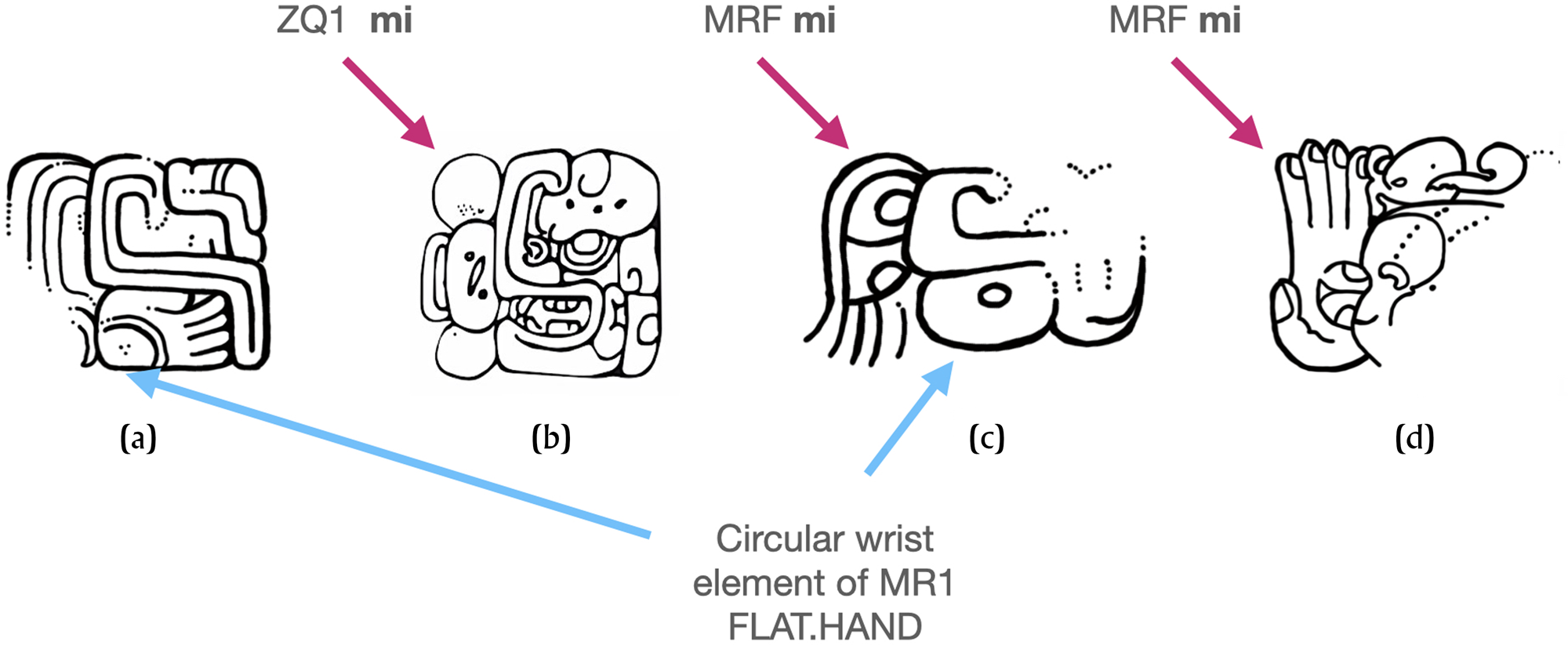
Also, to support such a hypothesis, one would expect to find cases where T713 was used on its own, without 1B9, as a syllabogram mi. One context where this alternative can be tested is the spellings of the “square-nosed beastie,” AB8, where it is very common to find T713, on its own, without the 1B9 component, in the mouth of the AB8 creature (Figure 20a). There exist at least two examples in which T173/ZQ1 mi, a different sign with the syllabographic value mi, precedes AB8 (Figure 20b), and one example where MRF mi, another sign with the syllabographic value mi, also precedes AB8 (Figure 20c). Out of a total of 28 examples of MRF mi in the MHD, one example (Figure 20d) resembles the T713 component of MR2, but it is not identical: in it, the putative MRF variant shows an ʔahk′äb′ ‘night, darkness’ infix, which MR2 never shows. This ʔahk′äb′ infix is often present in more typical examples of MRF (cf., Figure 20c).
Holding site graphemes shared between MR1 collocation and the presumably allographic XH3 SKY Collocation. (a) Naranjo Stela 24 (NARSt24), B17; drawing by author after drawing by Ian Graham in Graham and von Euw (Reference Graham and von Euw1975:63–64); (b) Palenque Temple of Inscriptions Tablet, West Panel (PALTIw), G1; drawing #154 by Linda Schele (http://research.famsi.org/schele.html); (c) Naranjo Altar 1 (NARAlt01), A9; drawing by author after drawing by Ian Graham (Reference Graham1978:104); (d) Yaxchilan Lintel 34 (YAXLnt34), C2; drawing by author after drawing by Ian Graham (Reference Graham1982:140).
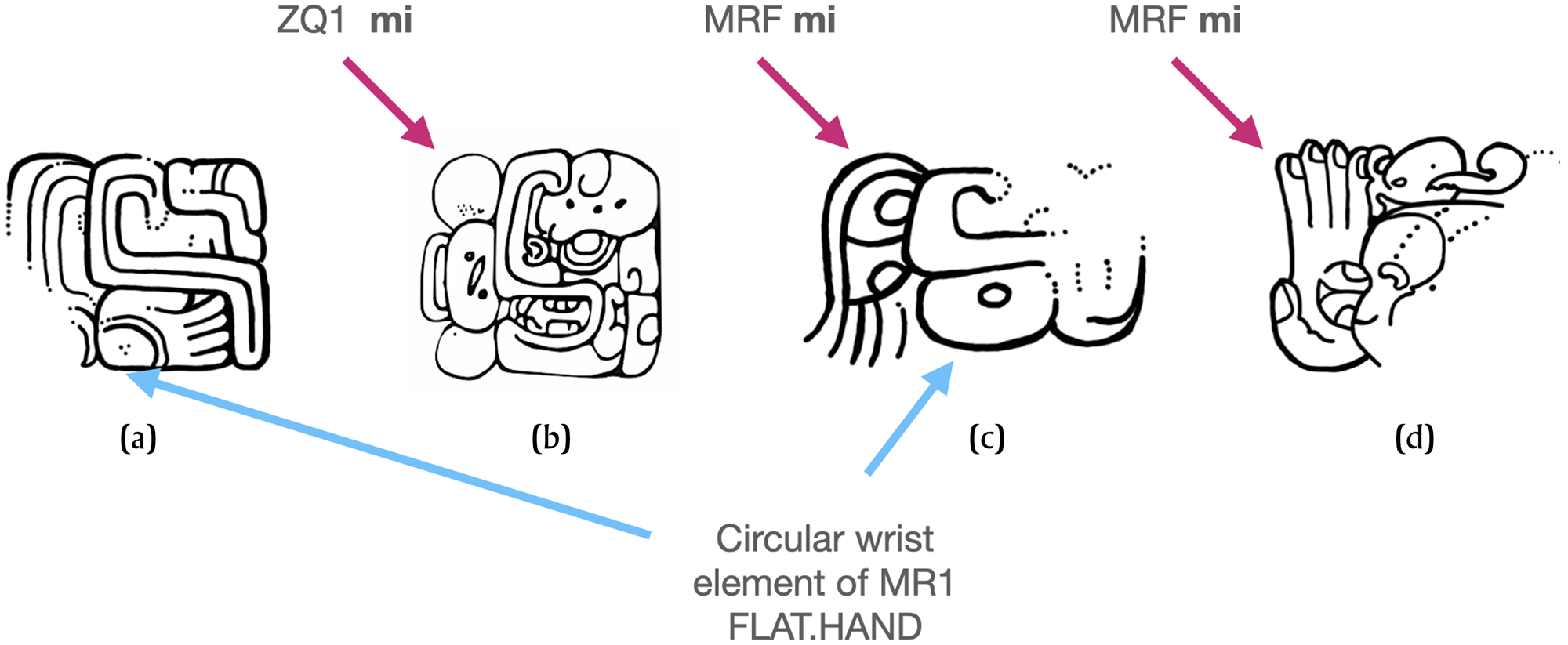
In all the instances where the T713 component of MR2 appears on its own in connection with AB8, it is always found in the mouth of the creature (cf., Figure 20a), and thus, its presence there may be iconographic (perhaps the creature has severed a person's hand/arm). In fact, in one case (Figure 20c), one even finds MRF mi before the sequence MR2 AB8, with MR2 (T713) contained within AB8 (in the beastie's mouth). In this example, T713 is abbreviated to only the ‘human marker’ (i.e., the circle with the dot inside; cf., Hopkins Reference Hopkins1994; Hopkins and Josserand Reference Hopkins and Josserand1999), as the arrow indicates, much like it was abbreviated on rare occasions in the context of the MR1 value (cf., Figure 11j). This spelling could suggest that the T713 sign contained within the “beastie” sign is not functioning phonetically, otherwise, MRF mi would not be needed; perhaps it was functioning iconographically, as a severed hand/arm in the creature's mouth. Thus, there is no strong evidence that T713, on its own, without an infixed ʔahk’äb’ sign, could function as a syllabogram mi.
Previously, Mora-Marín (Reference Mora-Marín2008) reviewed the case for semantic (lexical) determinatives and semantic classifiers in Mayan writing, following a survey of the evidence from other logophonographic writing systems (Egyptian, Sumerian, Akkadian, Elamite, Chinese). Based on such a survey, Mora-Marín (Reference Mora-Marín2008:198) proposed that the primary function of semantic determiners “is to distinguish at least one lexical orthographic value of a sign from another,” and with regard to semantic classifiers, he argued that their “primary function is to assign a spelling—whether a logographic or phonetic one—a semantic domain, possibly to accelerate the reader's ease of recognition of the intended value.” (However, recall the redefinition above of semantic classifiers as iconographic classifiers in the case of Mayan, which means that there is no longer clear evidence for true semantic classifiers in Mayan.) The semantic determiners or determinatives commonly cited by Mayanists (Hopkins Reference Hopkins1994; Hopkins and Josserand Reference Hopkins and Josserand1999; Justeson Reference Justeson1978; Schele Reference Schele1983; Zender Reference Zender1999) include the day sign cartouche and pedestal, and the royal headband. Mora-Marín (Reference Mora-Marín2008:197)further proposed that in Mayan writings semantic determinatives distinguished “between types of orthographic values, such as between a logographic value and a syllabographic value” of the same sign. He proposed a few additional examples to the list.
It is now clear that lexical determinatives in Mayan do function to distinguish between lexical values (e.g., T713 as K′AB′ for k′äb′ ‘hand/arm’ versus CELTT713 as K′AL/CH′AL for k′al/ch′al ‘to wrap, close, adorn’), and not just between types of orthographic values (e.g., logogram versus syllabogram). The latter situation would correspond to the use of 1B9 SHELL in conjunction with T713: T17 simply points to a syllabographic value of T713. Previously, though, Mora-Marín (Reference Mora-Marín2008) had suggested that in such cases it would be the lexical usage that would receive a determinative. It can now be concluded that what matters with determinatives is disambiguation: lexical determinatives point to a particular lexical value of a polyvalent sign, while phonographic determinatives, if the SHELL sign can be proven to work this way, would point to a particular phonographic value of a polyvalent sign. The presence of lexical determinatives, at least, should be no surprise, as they constitute part and parcel of logophonographic scripts.
Conclusions
MZ1, the logographic value K′AB′ of T713, did not require a determinative of any type at any point: it constitutes the basic or unmarked value of T713, as an iconic logogram. The presence of determinatives on T713, whether lexical (for MR1) or phonetic/phonographic (for MR2), became a strategy for distinguishing such alternative values of T713 from its most basic value as an iconic logogram for proto-Ch′olan *k′äb′ ‘hand, arm’.
The case of MR2 mi is not very clear. It may have been innovated through the addition of 1B9 yi as a phonetic determinative to indicate that T713 was meant to function phonetically rather than logographically. Alternatively, MR2 could simply be conceptualized as a digraphic sign, but simply labeling it as such would not account for anything, since digraphs, across writing systems, can have varied motivations, including phonetic ones; note the cases of digraphs in English involving the grapheme <h>, all involving a fricative sound, <th>, <sh>, <ph>, or a fricative articulation following a stop articulation, <ch>, with <gh> in today's English writing being mostly the result of loans from various languages, but originally representing a voiceless velar fricative in English. In either case, MR2 mi must be investigated further.
T617/1M3, the most common lexical determinative for MR1, can be established in such usage by 475 a.d. Prior to such time, the distinct values of T713 may not have been distinguished graphemically, only contextually, and of course by means of the occasional use of phonetic complements. 1M3 likely became associated with MR1 K′AL due to their frequent co-occurrence in the Primary Standard Sequence: in such context, 1M3 constitutes the most frequent main sign of the Initial Sign Collocation, and MR1 K′AL is a very common verbal expression that most often immediately follows the Initial Sign Collocation. Support for this is found in the fact that other graphemes that may occupy the main sign position of the ISC may also occupy the holding site position of MR1. This type of association may be at play not only when signs are present in close proximity (syntagmatic association), but also when different signs share the same value or function (paradigmatic association), as was shown to be the case between the MR1 collocation and the XH3 SKY collocation, previously shown to be in a likely allographic relationship (e.g., MacLeod Reference MacLeod1990:96–99, 116, Figures 3–4).
As was previously suggested in Mora-Marín (Reference Mora-Marín2022a), it appears that common graphemes used to represent syntactic arguments of verbal logograms may also become employed as lexical determinatives. This applies to two of the three variable elements of Glyph C of the Lunar Series, among others, when utilized in a context that is atypical of the norm, namely, the Primary Standard Sequence of pottery vessels.
The main conclusion from this article is that lexical determinatives constitute an important grapheme category (cf., Hopkins Reference Hopkins1994; Hopkins and Josserand Reference Hopkins and Josserand1999; Mora-Marín Reference Mora-Marín2008), that they are not likely a few isolated signs like the ruler headband and day sign cartouche (Justeson Reference Justeson1978; Schele Reference Schele1983), but a broader class, and more significantly, that they arise by means of contextual associations that scribes would have made on a regular basis. Also, it gives epigraphers another category to include in the discussion of polyvalence. Thus, not only is T713 polyvalent in terms of logographic or syllabographic values (i.e., K′AB′, K′AL, mi), depending on context or the presence/absence of certain determinatives/diacritics, but the determinatives/diacritics themselves are often polyvalent: 1M3 functions as a logogram in the context of the Initial Sign of the PSS, but as a lexical determinative when combined with T713 to yield the value K′AL. Regarding Sumerian, Michalowski defines three types of graphemes (determinatives, logograms, and syllabograms), adding that “Signs have multiple values, and some can even function in all three capacities” (Reference Michalowski and Woodard2004:25). The same applies to Egyptian, in which the same sign can function phonographically, logographically, and as a determinative, as with the case of the SEATED.MAN sign, phonographic j, logographic for zj ‘man’, rḥw ‘companion’, and determinative MAN (Loprieno Reference Loprieno and Woodard2004:192). As was the case in other logophonographic writing systems, a single Mayan grapheme could bear all possible orthographic functions in different contexts, adding to their complex beauty.
A final conclusion that can be drawn is that the Maya Hieroglyphic Database (Looper and Macri Reference Looper and Macri1991–2022), with its close to 5,000 texts spanning almost two millennia, has the potential to revolutionize the field of Mayan studies by facilitating the investigation of large datasets amenable to quantitative approaches, as well as dramatically speeding up the process of accounting for contextual associations between graphemes. Such investigation is necessary to elucidate the nature of lexical determinatives, signs that, as shown in this article, arise through contextual associations, a process that may take decades, even centuries, and which requires large datasets to be detected.
Acknowledgements
I am indebted to Matthew Looper for feedback on key aspects of this article, and to a number of epigraphers, especially Nick Hopkins, Barb MacLeod, Michael Grofe, and John Justeson, among others, for detailed comments on a version of this research presented via Zoom in mid-May of 2022. I am grateful to the three reviewers, whose feedback allowed me to significantly improve my manuscript. I also want to express gratitude to Matthew Looper, Donald Hales, Barb MacLeod, and Dana Moot for their permission to use some of their photos and/or drawings. Any lingering errors or misjudgments are, without doubt, my own.
Supplementary Material
To view supplementary material for this article, please visit https://doi.org/10.1017/S0956536122000335.