Catheter-associated urinary tract infections (CAUTIs) are a common hospital-acquired infection resulting in excess morbidity, mortality, and cost.1 Approximately 15%–25% of all patients have urinary catheters inserted during hospitalization; prolonged catheter use is one of the most important risk factors for developing a CAUTI.1 Each day an indwelling catheter remains in place, the patient has a 3%–7% risk of acquiring bacteria.Reference Lo, Nicolle and Coffin2 Urine management can be a challenging issue, particularly in women, due to limited options for control of urinary incontinence. Issues with urinary leakage and concern for subsequent skin break down as well as need for accurate assessment of urinary output often leads to indwelling catheter insertion. An external urine collection device (EUCD) is a noninvasive alternative for urine management designed specifically for adult females. Utilizing the female physiology of the labia and gluteus muscles, a soft, flexible wick is placed exterior to the body and held in place via anatomy. The superior end is attached to low, continuous suction that diverts urine to a collection reservoir. This allows for urine management in a manner that is still easily measurable and accurate and avoids an indwelling catheter. Several EUCD systems are commercially available. In the spring of 2018, our facility implemented a female EUCD as an alternative to indwelling catheters in an effort to decrease catheter days and to limit CAUTI.
Methods
This investigation was a retrospective, 32-month (January 2017–August 2019), quasi-experimental, before-and-after study. The historical control period was from January 2017 through March 2018 and the intervention period was from July 2018 through August 2019 allowing for a 3-month transition period. The test device was the PureWick female external catheter (Becton Dickinson, Franklin Lakes, NJ), which was introduced hospital-wide. CAUTI rates and catheter usage in men and women were both recorded, with men acting as a comparator group. Catheter usage and CAUTI for indwelling devices were defined according to the Center for Disease Control National Healthcare Safety Network criteria.1 Adverse events were collected via nursing incident reports. Poisson regression was used to model the rate of CAUTI (per 1,000 patient days and per 1,000 catheter days) comparing the historical control period and the intervention period.
Results
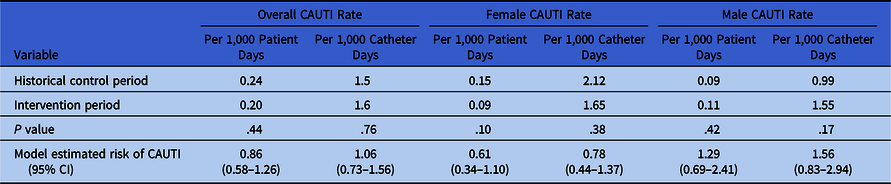
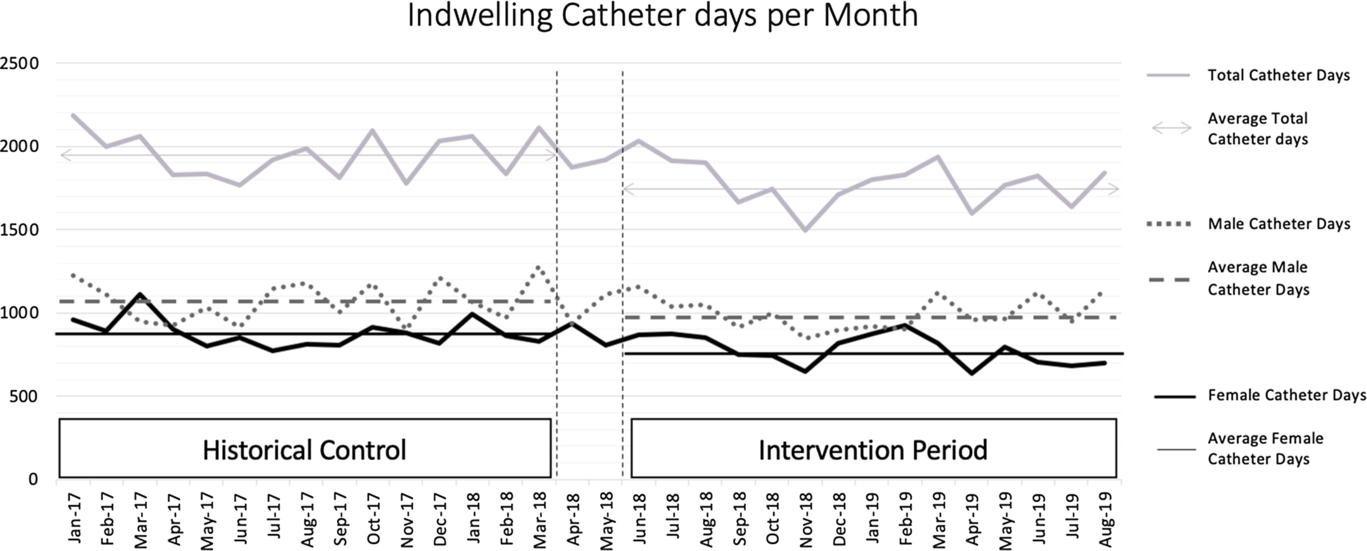
In total, 2,347 women utilized the EUCD during the study period. The overall (men and women) CAUTI rate per 1,000 patient days or per 1,000 catheter days did not show a significant change (Table 1). The overall CAUTI rate per 1,000 patient days decreased slightly from 0.24 to 0.20 (P = .44), and the rate per 1,000 catheter days increased slightly 1.5 to 1.6 (P = .76). The CAUTI rate for men increased from 0.09 to 0.11 (P = .42) and from 0.99 to 1.55 (P = .17) per 1,000 patient days and 1,000 catheter days, respectively. For women, the rate of CAUTI decreased from 0.15 to 0.09 (P = .10) and from 2.12 to 1.65 (P = .38) per 1,000 patient days and 1,000 catheter days, respectively. A significant (P < .0001) decrease in catheter utilization (catheter days per 1,000 patient days) was observed for all hospitalized patients (158.56 to 128.3), for men (87.06 to 72.15), and for women (71.49 to 56.15). Model-predicted risks of catheter utilization were 0.81 for all hospitalized patients, 0.83 for men, and 0.79 for women (Fig. 1).
CAUTI Rates Per 1,000 Patient Days and 1,000 Catheter Days

Note. CAUTI, catheter-associated urinary tract infection; CI, confidence interval.
Indwelling catheter days per month. Indwelling catheter use for women was decreasing at a rate of 1.53% per month before EUCD introduction (P = .0015). The decreasing rate of catheter utilization steepened slightly after the introduction of the EUCD (1.65% per month; P < .0001). There was no significant difference in the rate of decrease before and after EUCDs were introduced (P = .83). However, a significant difference (71.49 per 1,000 patient days compared to 56.15 per 1,000 patient days; P < .0001) was noted when comparing the rate of catheter utilization between the 2 periods. A similar decrease in the rate of catheter utilization in the total hospital population (P < .0001) and in male patients (P < .0001) was also observed.

There were 5 reported adverse events involving perineal skin breakdown and erythema. Four events resulted from malposition of the ECUD or inappropriate level of suction and 1 event was related to dermatologic allergy and EUCD use. All were nonsevere and were treated by removing the ECUD.
Discussion
Overall, there was a significant decrease in catheter days in all hospitalized patients, but we did not observe a significant change in the CAUTI rate. During the course of this study, a CAUTI reduction performance improvement project was active, and we hypothesized that the decrease in catheter days observed in men was a result of the ongoing project. We did observe a downward trend in CAUTI in women when expressed as CAUTI per 1,000 patient days. We believe this is due to a decrease in indwelling catheter use at least partially due to the introduction of the EUCD as well as the ongoing project. As expected, when the CAUTI rate for women was expressed per 1,000 catheter days a decrease in the rate associated with the introduction of the EUCD was not observed because the EUCD would not prevent a CAUTI in a woman with a need for an indwelling catheter. However, when the rate of indwelling catheter use was examined more closely, the rate of decline after EUCD introduction did not vary significantly from the pre-introduction period (Fig. 1).
Multiple strategies have been utilized to reduce CAUTI rates, including implementing practice bundles with a focus on catheter avoidance and early catheter removalReference Allen, Culbertson, Eyherabide and Geca3 and utilization of external catheter devices for men.Reference Gray, Skinner and Kaler4 Urinary management with an EUCD for women has been described previously,Reference Beeson and Davis5 but overall, data regarding EUCD use and their effect on indwelling catheter utilization and CAUTI are limited. EUCD implementation has been associated with decreased catheter days as well as decreased female CAUTI rates in smaller hospitals and specific units. Eckert et al6 introduced an EUCD in a 60-bed telemetry unit followed by use throughout the hospital (386 total beds). A decrease in CAUTI was observed in the first year that was not sustained.Reference Eckert, Mattia, Patel, Okumura, Reynolds and Stuiver6 Several studies have also demonstrated a decrease in urinary catheter utilization,Reference Dublynn and Episcopia7–Reference Mueller9 with variable effect on CAUTI rates. Beeson et alReference Beeson, Davis and Vollman8 demonstrated a decrease of 27% in CAUTIs over 6 months in a surgical intensive care unit and Dublynn et alReference Dublynn and Episcopia7 noted a 51.7% decline in CAUTIs over 1 year. Mueller et alReference Mueller9 demonstrated a significant decrease in the urinary catheter standardized utilization ratio, but the CAUTI standardized infection ratio increased nonsignificantly. However, data were reported in total with no breakdown between men and women, so it was difficult to assess whether there was separate improvement in the CAUTI rate among women only.Reference Mueller9
This was a single-center study at an academic medical center, which limits the generalizability of our results. Adverse events were reported via nursing incident reports which may have led to underreporting and may have limited patient perspective on EUCD use. Furthermore, the retrospective nature and lack of a concurrent control group may have resulted in selection bias (ie, patients receiving the EUCD were not randomized or rigorously selected) and confounding (eg, uncontrolled concurrent interventions). Additional prospective studies to more precisely determine whether the EUCD is associated with changes in UTI (both CAUTI and noncatheter UTI) and to define the cost implications of EUCD are warranted.
In summary, introduction of a female EUCD was associated with a decrease in indwelling catheter use and a trend toward a decrease in the CAUTI rate when expressed as infection per 1,000 patient days in women.
Acknowledgments
Financial support
No financial support was provided relevant to this article.
Conflicts of interest
All authors report no conflicts of interest relevant to this article.