Introduction
How does strategic consistency influence organizational performance? This question has been widely discussed in the fields of strategic management and organizational theory. However, researchers have advocated several different perspectives on the consequences of strategic consistency (Lamberg, Tikkanen, Nokelainen, & Suur-Inkeroinen, Reference Lamberg, Tikkanen, Nokelainen and Suur-Inkeroinen2009; Zhang & Rajagopalan, Reference Zhang and Rajagopalan2010), and empirical studies have also found mixed results in the relationship between strategic consistency and organizational performance (David, Reference David1986; Zajac & Kraatz, Reference Zajac and Kraatz2000; Herrmann & Nadkarni, Reference Herrmann and Nadkarni2014). Research in organizational evolution argues that strategic consistency is a necessary condition for firm survival (Hannan & Freeman, Reference Hannan and Freeman1984; Barnett & Hansen, Reference Barnett and Hansen1996; Sheth & Sisodia, Reference Sheth and Sisodia2002). A firm’s strategic action consistent with its own history helps the firm protect and strengthen its organizational structure, organizational culture, production system, and key resources (David, Reference David1986; Miller & Chen, Reference Miller and Chen1994), thus sustaining the firm’s previously established competitive advantages (Ghemawat, Reference Ghemawat1991; Sheth & Sisodia, Reference Sheth and Sisodia2002). By contrast, research in strategic change theory contends that firms should increase strategic flexibility to obtain and maintain competitive advantage (Eisenhardt & Brown, Reference Eisenhardt and Brown1998). Strategic change enhances the adaptability of firms to environmental change (Miller, Reference Miller1992; Romanelli & Tushman, Reference Romanelli and Tushman1994), increases their innovation capability (Zajac & Kraatz, Reference Zajac and Kraatz2000), and leads to financial success (Zajac & Shortell, Reference Zajac, Kraatz and Bresser1989; Jalilvand & Kim, Reference Jalilvand and Kim2013).
Prior literature has been inconclusive with regard to the impact of strategic consistency on organizational performance. However, few papers have empirically examined possible moderators on this relationship, thus causing a lack of adequate theoretical foundation for strategic consistency (Lamberg et al., Reference Lamberg, Tikkanen, Nokelainen and Suur-Inkeroinen2009; Herrmann & Nadkarni, Reference Herrmann and Nadkarni2014). Strategic planning literature claims that a firm’s strategic choice is affected not only by environmental conditions, but also by its internal resources (Mintzberg & Lampel, Reference Mintzberg and Lampel1999). Furthermore, leaders and top management teams (TMTs) significantly influence the success of a firm’s strategic position (Hambrick & Finkelstein, Reference Hambrick, Cho and Chen1987; Hambrick, Reference Hambrick2007). Kraatz and Zajac (Reference Kraatz and Zajac2001) suggested that a firm’s changing strategic behavior is dependent on the level of its organizational resources and environmental change. Lamberg et al. (Reference Lamberg, Tikkanen, Nokelainen and Suur-Inkeroinen2009) argued that the effect of strategic consistency on firm survival varies with the different competition levels among firms in a dynamic environment. Finkelstein and Hambrick (Reference Finkelstein and Hambrick1990) also noted that strategic consistency has an important implication to organizational outcome, and that leaders and TMTs play an important role in the relationship between strategic consistency and organizational performance (Rajagopalan & Spreitzer, Reference Rajagopalan and Spreitzer1996; Hambrick, Finkelstein, & Mooney, Reference Hambrick, Geletkanycz and Fredrickson2005).
In response to the abovementioned research gaps in strategic consistency, the present study adopts strategic planning, strategic change, upper echelons theory, and other literature as our theoretical foundation to propose an integrated model that examines the moderating roles of organizational slack, environmental dynamism, and TMT attributes in the relationship between strategic consistency and organizational performance.
The empirical examination of these issues requires the selection of an industry with industry-wide environmental change (Eisenhardt, Reference Eisenhardt1989; Zajac & Shortell, Reference Zajac, Kraatz and Bresser1989; Eisenhardt & Schoonhoven, Reference Eisenhardt and Schoonhoven1990; Lamberg et al., Reference Lamberg, Tikkanen, Nokelainen and Suur-Inkeroinen2009). Considering that the electronics industry is characterized by a highly competitive environment, short product life cycle, and regularly changing consumer trends and preferences (Ho, Wu, & Xu, Reference Ho, Wu and Xu2011), we select electronics companies in the Taiwanese stock market from the Taiwan Economic Journal database as sample data to test our hypotheses in this study. Based on market statistics from the Taiwan Institute of Economic Research, Taiwan has been one of the largest suppliers of electronics in the world for the past several decades. In 2010, the software market in Taiwan grew by 7.1% to reach a value of US$ 4 billion, accounting for 3.3% of the Asia-Pacific region market value. The digital content production industry grew by 15% in 2009, reaching US$ 14.03 billion. The optoelectronics industry reached a total value of US$ 69.49 billion in 2010, which was a 40% jump from 2009 and represented a fifth of the global market share. In recent years, Taiwan has ranked first in the world in both foundry services and integrated circuit (IC) packaging and testing services. Moreover, its IC design industry has earned the number two position in the world. For example, the foundry and IC packaging industries in Taiwan account for over 50% of the worldwide market share, with US$ 21.5 billion and US$ 16.0 billion revenue in 2011, respectively. IC design also reached US$ 15.1 billion worth of revenue in 2011. The Taiwan electronics industry plays an important role in the economy of Taiwan and occupies a dominant position in the global supply chain of electronic parts and products. Therefore, the industry provides an interesting forum for understanding the roles of environment, resources, and TMT attributes in firm strategy and performance in this industry.
The remainder of this paper is organized as follows. In the succeeding section, a literature review is presented and hypotheses are developed. Methods and study findings are then outlined in the subsequent sections. Lastly, the conclusion and the implications for future research and management are discussed at the end of the paper.
Theory and Hypotheses
Definition of strategic consistency
Strategic consistency is one of most important issues in strategic management and organizational theory. However, strategic consistency is sometimes confused with the concept of strategic conformity (Deephouse, Reference Deephouse1999; Delgado-Garcia & Fuente-Sabate, Reference Delgado-Garcia and Fuente-Sabate2010). Strategic consistency refers to the consistency of a firm’s own strategic behavior at different points in time, indicating the continuity levels of its strategy compared with its previous behavior (Galbraith & Schendel, Reference Galbraith and Schendel1983; Nath & Sudharshan, Reference Nath and Sudharshan1994). Conversely, strategic conformity implies that a firm’s strategy is consistent with those of other competitors in the same industry at the same points in time (Delgado-Garcia & Fuente-Sabate, Reference Delgado-Garcia and Fuente-Sabate2010). Finkelstein and Hambrick (Reference Finkelstein and Hambrick1990) defined strategic consistency as a firm strategy that remains fixed over time. Lamberg et al. (Reference Lamberg, Tikkanen, Nokelainen and Suur-Inkeroinen2009) integrated previous literature and provided a comprehensive definition of strategic consistency. From their point of view, strategic consistency is the change in magnitude and direction of a firm’s strategy at different points in time. Therefore, strategic direction and magnitude of change simultaneously determine the level of a firm’s strategic consistency (Zajac & Shortell, Reference Zajac, Kraatz and Bresser1989; Nath & Sudharshan, Reference Nath and Sudharshan1994; Lamberg et al., Reference Lamberg, Tikkanen, Nokelainen and Suur-Inkeroinen2009).
Consequences of strategic consistency
Previous studies on strategic consistency proposed diverse perspectives on the relationship between strategic consistency and organizational performance (Barnett & Hansen, Reference Barnett and Hansen1996; Lamberg et al., Reference Lamberg, Tikkanen, Nokelainen and Suur-Inkeroinen2009; Delgado-Garcia & Fuente-Sabate, Reference Delgado-Garcia and Fuente-Sabate2010). This inconclusive debate can be explained using different research streams. Research on organizational evolution considers consistency as a necessary condition for firm survival (Sheth & Sisodia, Reference Sheth and Sisodia2002). This line of thought views firm growth as path dependent, as a firm’s future behavior is dependent on its own history and current positions (David, Reference David1986; Lamberg & Tikkanen, Reference Lamberg and Tikkanen2006). A firm’s long-term investment creates its competency and competitive advantages (David, Reference David1986). Therefore, if the firm changes its strategic direction, it will encounter excessive switching costs and its core competency and competitive advantages will be damaged (Boeker, Reference Boeker1997). For example, firm strategy may change from low-cost leadership to innovative orientation, from a focus strategy to a diversification strategy, or from manufacturing and original design manufacturing to marketing and private brand development. As each type of strategic orientation requires unique and distinctive elements such as organizational resources, organizational structure, organizational culture, human capital, talents, and management systems (Porter, Reference Porter1980, Reference Porter1985; Miller, Reference Miller1992), a change in strategic direction will cause overload switching costs, and the firm will encounter several resistant barriers (Porter, Reference Porter1980, Reference Porter1985; Quinn, Reference Quinn1980; Dutton & Duncan, Reference Dutton and Duncan1987).
The second stream of literature also considers strategic consistency as beneficial to organizational performance (Johnson, Reference Johnson1988; Miles & Snow, Reference Miles and Snow1992; Rumelt, Reference Rumelt1995; Geletkanycz & Hambrick, Reference Geletkanycz and Hambrick1997; Zajac, Kraatz, & Bresser, Reference Zajac and Shortell2000). From this theoretical viewpoint, a firm will intentionally establish and maintain a good relationship with different partners in organizational networks during its development process (Powell, Reference Powell1990; Burt, Reference Burt1997; Uzzi, Reference Uzzi1997). Frequent transactions and close interactions enable the actors in the network to know one another and to share important information, thus building trust and interdependence over time (Tsai & Ghoshal, Reference Tsai and Ghoshal1998; Ozcan & Eisenhardt, Reference Ozcan and Eisenhardt2009). A strong tie among network members leads to the emergence of structural embeddedness, which sustains the common goals and interests of members and assists network survival and development (Jones, Hesterly, & Borgatti, Reference Jones, Hesterly and Borgatti1997). A firm in such network enjoys many benefits such as resources exchange, information sharing, and accumulation of social capital (Powell, Reference Powell1990; Burt, Reference Burt1997). If a firm changes its strategic orientation, the benefits obtained from networks may disappear and its relationship with its partners will be interrupted. For example, to achieve organizational objectives, a firm may seek a long-term relationship with its suppliers, customers, or other unique trading partners (Miles & Snow, Reference Miles and Snow1992; Granovetter, Reference Granovetter2005). However, when a firm changes its strategy, the new strategy may destroy its relationships with its current networks, and the firm may also encounter difficulty in seeking new suppliers, trading partners, and customers (Rumelt, Reference Rumelt1995). Therefore, strategic consistency can strengthen a firm’s established relationships within its social networks, which leads to more benefits.
By contrast, most researchers using strategic change theory contend that strategic adaptability is a necessary condition for a firm to survive and to enhance its efficiency in a rapidly changing environment (Miller, Reference Miller1992; Zajac & Kraatz, Reference Zajac and Kraatz2000; Peli, Reference Peli2009; Zhang, Tan, & Tan, Reference Zhang, Tan and Tan2015). Adaptability implies that a firm will change its strategic content and scope to adjust to different external environmental conditions and internal organizational factors (Boeker, Reference Boeker1997; Rajagopalan & Spreitzer, Reference Rajagopalan and Spreitzer1996); therefore, its strategy is a constantly adaptive behavior (Miller, Reference Miller1992; Moss, Payne, & Moore, Reference Moss, Payne and Moore2013). When a firm adopts strategic change, it can break the stronghold of inertia and adapt and innovate effectively (Romanelli & Tushman, Reference Romanelli and Tushman1994). However, if a firm continues its strategic consistency, its resources, process, organizational structure, and management system will become rigid and inflexible, and strong organizational inertia may emerge (Dutton & Duncan, Reference Dutton and Duncan1987; Miller & Chen, Reference Miller and Chen1994; Huy, Reference Huy2011). Furthermore, Rajagopalan & Spreitzer (Reference Rajagopalan and Spreitzer1996) suggested that a firm’s lack of strategic adaptability could lead to an increase in resistance, delays, and conflicts between its internal organization and external environment, which would then cause inefficiency in resource allocations, disruption in internal improvement, and innovation, or could prevent the firm from following its competitors exactly and closely (Zhang & Rajagopalan, Reference Zhang and Rajagopalan2010). Therefore, strategic consistency can hamper firm performance (Dutton & Duncan, Reference Dutton and Duncan1987; Zajac & Kraatz, Reference Zajac and Kraatz2000; Peli, Reference Peli2009).
Such varying perspectives have caused a lack of adequate theoretical foundation in the existing literature on strategic consistency, which presents a need to provide additional empirical evidence for the effects of strategic consistency on organizational performance (Timothy & Wolff, Reference Timothy and Wolff2007; Lamberg et al., Reference Lamberg, Tikkanen, Nokelainen and Suur-Inkeroinen2009). In the present study, we investigate the potential moderating effects of organizational slack, environmental dynamism, and TMT attributes on the relationship between strategic consistency and organizational performance.
The moderating role of organizational slack
Organizational slack is defined as a firm’s resources that exceed its needs (Moses, Reference Moses1992). These resources include financial, physical, human, and organizational resources that the organization cultivates and accumulates during its development and growth process (Adams & Lamont, Reference Adams and Lamont2003). Organizational slack is a key factor that determines the success of business opportunities (Cheng & Kesner, Reference Cheng and Kesner1997; Voss, Sirdeshmukh, & Voss, Reference Voss, Sirdeshmukh and Voss2008; Lin, Cheng, & Liu, Reference Lin, Cheng and Liu2009). Excess of actual or potential resources enables an organization to overcome internal or external threats (Bourgeois, Reference Bourgeois1981), thus enhancing its innovative capacity (Geiger & Makri, Reference Geiger and Makri2006). Furthermore, excess of resources improves the capability of the organization to adapt to its environment (Singh, Reference Singh1986). In sum, organizational slack plays a critical role in firm strategy and has a significant effect on firm performance (Penrose, Reference Penrose1959; George, Reference George2005).
Kraatz and Zajac (Reference Kraatz and Zajac2001) investigated the effect of organizational resources on strategic change and found that organizations with rich resources are less likely to change strategies in a highly turbulent environment. Hambrick, Geletkanycz, and Fredrickson (Reference Hambrick, Humphrey and Gupta1993) indicated that financial resources have important implications on a firm’s strategic change. In particular, firms with excessive financial resources tend to keep their strategies consistent with their previous courses of action, whereas firms with poor financial resources are more likely to change their strategic direction. Cohen and Levinthal (Reference Cohen and Levinthal1990) also noted that organizational resources affect the perception and judgment of managers by making managers less aware of environmental uncertainty, as these managers are usually confident of their capabilities for strategy planning and execution. Therefore, managers in resource-rich organizations are more resistant to change than those in firms with poor resources (Quigley & Hambrick, Reference Quigley and Hambrick2012).
Penrose (Reference Penrose1959) suggested that organizations always have a stock of unused or underused resources (e.g., physical assets, managerial talent, and reputation) that accumulate inevitably during the organizational development process. These organizational slacks primarily determine the scope and direction of firm growth (Kraatz & Zajac, Reference Kraatz and Zajac2001). When a firm continues its prior course of action, it requires massive resources to support its various activities (Park, Reference Park2007). In this case, large organizations with rich slack resources (e.g., financial reserves, marketing expertise, research and development capability, production capacity, and general management expertise) are likely to succeed in supporting their previously planned activities (Nelson & Winter, Reference Nelson and Winter1982). On the contrary, resource-poor organizations usually lack resources to provide for their various programs, preventing the firm from sustaining its long-term strategic actions (Cohen & Levinthal, Reference Cohen and Levinthal1990). A firm without an extensive bundle of resources will be unable to conduct consistent actions, the legitimacy of the firm among important stakeholders will be threatened, and the previously established advantages of the firm will be damaged because of its lack of commitment (Nelson & Winter, Reference Nelson and Winter1982). In a similar argument, Cyert and March (Reference Cyert and March1963) also suggested that firms with richer resources have greater space for decision making, possess a larger ‘production set,’ enjoy more competitive advantages, and are more likely to succeed in pursuing their prior course of actions than those with poorer resources. Organizations with poor resources have narrow options, lack support for long-term programs, and are unable to conduct necessary activities (Nelson & Winter, Reference Nelson and Winter1982). For example, when a firm continues its long-term research and development (R&D) plan for a particular product, its R&D plan is more likely to succeed if the firm has excessive slack resources to support its activities. However, if the firm lacks resources for its activities, its R&D plan will be interrupted (Geiger & Makri, Reference Geiger and Makri2006). Therefore, when organizations continue their strategic consistency, organizations with rich slack resources (compared with organizations with lower slack resources) implement their planned activities more easily and have sufficient ability to achieve their previously established objectives. Moreover, their competitive advantages are sustained over time. Therefore, the following hypothesis is developed:
Hypothesis 1: The effect of strategic consistency on firm performance will be stronger in organizations with higher slack resources than in organizations with lower slack resources.
The moderating role of environmental dynamism
Organizations that operate in a dynamic environment are influenced by several uncertain factors (Eisenhardt & Brown, Reference Eisenhardt and Brown1998). High environmental turbulence can cause unexpected events and make the achievement of final objectives difficult, as organizations cannot predict and follow the actions of their competitors and market trends (Grant, Reference Grant2003). In a highly dynamic environment, organizations must adjust their strategies to follow the pace of environmental change (Johnson, Reference Johnson1988). A flexible strategy can help organizations overcome uncertainty and complexity in their environments (Siggelkow, Reference Siggelkow2002). If organizations in a turbulent environment do not change their strategic direction or accelerate their activities to keep up with environmental change, their strategies will be outdated and the probability of organizational survival may be reduced (Siggelkow & Levinthal, Reference Siggelkow and Levinthal2003).
Moreover, studies on strategic planning have emphasized the assumption that organizations must consider the effects of both external environments and internal factors in forming and implementing their strategies (Mintzberg, Reference Mintzberg1994). In addition, organizations should adjust their strategies effectively to achieve a good fit with environmental change (Drazin & Van de Ven, Reference Drazin and Van de Ven1985; Venkatraman & Prescott Reference Venkatraman and Prescott1990). Several factors change constantly in a highly dynamic environment, such as changing consumption patterns, expanding industry boundaries, continuously transforming technologies, and severe domestic and global competition. If organizations are unable to respond quickly and effectively to their environment, a misfit between their strategy and their environment can lead to conflicts, resistance, delays, and inefficiency in resource allocations (Kraatz & Zajac, Reference Kraatz and Zajac2001; Quigley & Hambrick, Reference Quigley and Hambrick2012).
By contrast, organizations in a stable environment tend to preserve highly uniform courses of action (Hannan & Freeman, Reference Hannan and Freeman1984). In such an environment, strategic consistency benefits firm performance (Smart & Vertinsky, Reference Smart and Vertinsky1984) because environmental conditions do not change or change only incrementally. Therefore, organizations can precisely predict and interpret the competitive situation and still deal with stable environmental factors effectively (Miles & Snow, Reference Miles and Snow1978). Pfeffer and Salancik (Reference Pfeffer and Salancik1978) suggested that changing the strategic direction of an organization in a stable environment could put the organization at risk because frequently changing behaviors could decrease the legitimacy of the firm and cause unnecessary competitive actions (Meyer & Rowan, Reference Meyer and Rowan1977; Lamberg et al., Reference Lamberg, Tikkanen, Nokelainen and Suur-Inkeroinen2009), or could lead to an imbalance between organizational capabilities and current competitive actions (Miller & Chen, Reference Miller and Chen1996; Lamberg et al., Reference Lamberg, Tikkanen, Nokelainen and Suur-Inkeroinen2009). Therefore, if organizations in a stable environment do not change their strategic actions, they can avoid the unwanted responses of competitors, strengthen their capability, and sustain their established competitive advantages (Meyer & Rowan, Reference Meyer and Rowan1977). In other words, when organizations consistently follow their prior course of action, their strategic consistency can benefit organizational performance (Lamberg et al., Reference Lamberg, Tikkanen, Nokelainen and Suur-Inkeroinen2009). Therefore, we propose the following hypothesis:
Hypothesis 2: The effect of strategic consistency on firm performance will be stronger in a lowly dynamic environment than in a highly dynamic environment.
The moderating roles of TMT attributes
The strategic behaviors of organizations are usually influenced not only by external environmental factors, such as industry structure, suppliers, customers, and competitors, but also by internal organizational factors, such as organizational resources, structure, process, and culture (Porter, Reference Porter1980, Reference Porter1985). Furthermore, top executives (chief executive officers [CEOs]) are also a key factor in determining strategic choices and organizational performance (Cyert & March, Reference Cyert and March1963). Organizations are susceptible to the actions of their CEOs, but individual CEOs are only bounded rationality; therefore, organizations become reflections of their entire TMT (Hambrick & Mason, Reference Hambrick and Finkelstein1984; Hambrick, Reference Hambrick2007). The TMT of an organization is a shared activity and a collection of knowledge base, skills, and capabilities, as well as the integration of individual experiences, values, personalities, and interactions into strategic behaviors that influence organizational outcomes (Hambrick, Humphrey, & Gupta, Reference Hambrick and Mason2014).
TMT tenure
Katz (Reference Katz1982) stated that TMT tenure represents the time spent by managers in an organization. Long-tenured managers tend to display a high level of responsibility and commitment to organizations because they usually invest tremendous efforts to succeed and climb the organizational hierarchy (Finkelstein & Hambrick, Reference Finkelstein and Hambrick1990). Schein (Reference Schein2004) noted that the relationship structure of TMT becomes stronger when managers spend a long time together in organizations, and when the management system and organizational culture are shaped and influenced by the behaviors of the TMT. When managers understand one another explicitly and implicitly during long-term interaction, the common perspective of the TMT improves the efficiency of the organizational strategy (Hambrick et al., Reference Hambrick, Humphrey and Gupta1993). Moreover, the long-term efforts of managers cultivate and accumulate organizational resources, implying that the key resources and competencies of the organization are usually associated with long-tenured managers (Quigley & Hambrick, Reference Quigley and Hambrick2012). By contrast, short-tenured managers do not invest as much effort in their organizations as do long-tenured managers and usually display loose relational structure and cohesion. Furthermore, the organizational resources, capability, and social capital created by short-tenured managers may also be less than those of long-tenured managers. For example, a sales manager who has invested his/her efforts for 10 years may create more social capital than a sales manager who has spent only 1 year in the organization. Therefore, when organizations preserve their courses of action, firms with long-tenured managers are more likely to succeed because their long-established resources, competencies, and competitive advantages are strengthened and sustained (Finkelstein & Hambrick, Reference Finkelstein and Hambrick1990; Hambrick et al., Reference Hambrick, Humphrey and Gupta1993; Henderson, Miller, & Hambrick, Reference Henderson, Miller and Hambrick2006).
Penrose (Reference Penrose1959) argued that organizational learning is a trial and error process. When managers spend a long time going through different events in the organization, they learn and accumulate experiences, knowledge, skills, and managerial ability. Bergh (Reference Bergh2001) also proposed that long-tenured managers excel in judgment and decision making because they deeply understand both external environment and organizational conditions (Bergh, Reference Bergh2001; Quigley & Hambrick, Reference Quigley and Hambrick2014). On the contrary, when new managers join organizations, they must learn and adapt gradually to both the internal firm and external industry environments. Their lack of experience and familiarity with their jobs, organizations, and external environments may cause the performance of new managers to be less efficient than that of long-tenured managers (Henderson et al., Reference Henderson, Miller and Hambrick2006). For example, Miller (Reference Miller1991) found that organizations with long-tenured CEOs are more likely to obtain higher performance than organizations with short-tenured CEOs. Given these differences in experiences, skills, and managerial capability, when organizations follow a constant trajectory of action, organizations with long-tenured managers are more efficient in executing strategies and completing planned activities and achieve better performance than those with short-tenured managers. Therefore, the following hypothesis is developed:
Hypothesis 3: The effect of strategic consistency on firm performance will be stronger in organizations with long-tenured TMT than in organizations with short-tenured TMT.
TMT tenure heterogeneity
Tenure heterogeneity represents the degree of divergence of time that TMT members have spent in their organizations (Wagner, Peffer, & O’Reilly, Reference Wagner, Peffer and O’Reilly1984). Several researchers have investigated the effects of tenure heterogeneity on firm performance. Unfortunately, empirical studies have shown mixed results on the impact of TMT tenure heterogeneity (Hambrick et al., Reference Hambrick and Mason2014). On the positive side, tenure heterogeneity brings diversity and novel perspectives to organizations, enhances the capability of firms to scan and deal with environmental conditions, and increases the information processing and innovative capacity of firms (Henderson et al, Reference Henderson, Miller and Hambrick2006). For example, Hambrick, Cho, and Chen (Reference Hambrick, Finkelstein and Mooney1996) investigated the airline industry and found that TMT tenure heterogeneity is positively related to firm performance. Nadolska and Barkema (Reference Nadolska and Barkema2013) found that tenure heterogeneity affects the success of firm acquisitions. However, TMT tenure heterogeneity can also be harmful for organizations because it can increase group conflict, disrupt communication, and diminish overall cohesion among team members (Marcel, Reference Marcel2009). For example, O’Reilly, Snyder, and Boothe (Reference O’Reilly, Snyder and Boothe1993) found that tenure heterogeneity is negatively related to rapport within TMTs. Smith, Smith, Olian, Sims, O’Bannon, and Scully (Reference Smith, Smith, Olian, Sims, O’Bannon and Scully1994) also found that TMT tenure heterogeneity has a negative effect on team communication.
In consideration of the positive and negative effects of TMT tenure heterogeneity, the relationship between strategic consistency and organizational performance varies with the level of TMT tenure heterogeneity. Finkelstein and Hambrick (Reference Finkelstein and Hambrick1990) argued that strategic consistency requires a high level of commitment from TMTs. When organizations follow a constant course of action, TMT members must rely on one another to fulfill their individual responsibilities (Dess & Shaw, Reference Dess and Shaw2001). In this case, if TMT members join an organization at roughly the same time because they experience the same events, then they are likely to have similar values, shared perspectives, and common attitudes. These commonalities enhance communication and overall cohesion among team members (Pfeffer, Reference Pfeffer1983; Hambrick et al., Reference Hambrick and Mason2014). In other words, when TMT tenure heterogeneity is low, team members tend to have similar feelings and actions, strong solidarity, and common goals (Wagner et al., Reference Wagner, Peffer and O’Reilly1984). Therefore, the team must rely on one another and contribute their best efforts to achieve their common organizational objectives (Hutzschenreuter & Horstkotte, Reference Hutzschenreuter and Horstkotte2013). However, when TMT members have divergent tenures, they tend to have different perspectives and diverse motivation, and TMT cohesion diminishes because of conflict and strain (Ancona & Caldwell, Reference Ancona and Caldwell1992; Hambrick et al., Reference Hambrick and Mason2014). In this case, the planned activities of the organization will be disrupted, and team members will be unable to obtain their common goals. Therefore, the following hypothesis is developed:
Hypothesis 4: The effect of strategic consistency on firm performance will be stronger in organizations with a low level of TMT tenure heterogeneity than in organizations with a high level of TMT tenure heterogeneity.
Methods
Sample
Our sample data were collected from the electronics industry in the Taiwan Economic Journal database. The database covers publicly listed companies on the Taiwan Stock Exchange and provides the annual financial reports of firms and information on their board composition, governance, and other annual reports. The electronics companies in Taiwan Economic Journal are categorized into eight sectors: electronic components, semiconductors and photoelectric products, electronic channels, software applications, consumer electronics, general electronics, communication technologies, systematic products, and others. After merging data from these sectors, we obtained a final data of 439 companies from 2010 to 2011.
According to Taiwan Institute of Economic Research, the trough phase of the 13th business life cycle is between 2010 and 2011. In this period, electronics companies were extremely threaten by many environmental uncertain factors as well as challenges from foreign brand products (e.g., Taiwan HTC corporation’s smartphones were severely threaten by Apple’s and Samsung’s products) (Ho et al., Reference Ho, Wu and Xu2011). In such circumstances, many Taiwan electronics companies encountered an issue of strategic change (Huang, Chiu, & Wang, Reference Huang, Chiu and Wang2012). Therefore, it is more appropriate for us to observe strategic change/consistency in Taiwan electronics industry in this period.
Measures
Strategic consistency
Using the types of strategy proposed by Porter (Reference Porter1980, Reference Porter1985), we examined three generic strategy dimensions, namely, low cost, marketing differentiation, and technology differentiation. Low-cost strategy was measured using employee productivity (value added per employee) (see Hambrick, Reference Hambrick1983). Marketing differentiation was measured using advertising intensity (ratio of advertising expenditures to revenues) (see Spanos, Zaralis, & Lioukas, Reference Spanos, Zaralis and Lioukas2004). Technology differentiation was measured using technology intensity (ratio of investment in R&D to revenues) (see also Spanos et al., Reference Spanos, Zaralis and Lioukas2004). We used these three generic strategy dimensions to describe strategic consistency as follows.
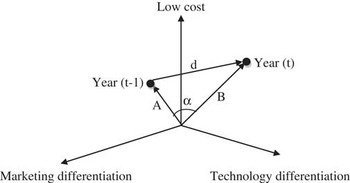
Consistent with prior empirical research on strategic consistency (Finkelstein & Hambrick, Reference Finkelstein and Hambrick1990; Lamberg et al., Reference Lamberg, Tikkanen, Nokelainen and Suur-Inkeroinen2009), strategic consistency was measured by capturing the consistent behavior of a firm at different points in time. Strategic consistency reflects the distance and direction of the firm’s strategy in year t and year (t−1). As indicated in Figure 1, the level of strategic consistency of a firm is determined simultaneously by the distance d and the angle α between two subsequent points (year t and year t−1) in a three-dimensional variable space (low cost, marketing differentiation, and technology differentiation). First, if distance d is zero and angle α is zero, the firm’s strategy is fixed. Second, if distance d is not zero and angle α is zero, the firm’s strategy changes in a consistent direction. Third, if both distance d and angle α are not zero, the firm’s strategy changes in its magnitude and direction.
Measure of strategic consistency in a three-dimensional variable space

As shown in Figure 1, strategic consistency was measured using the following formula (Lamberg et al., Reference Lamberg, Tikkanen, Nokelainen and Suur-Inkeroinen2009):
 $$C{\rm \, {\equals}\,}{{\rm 1} \over {{\rm (1{\plus}\alpha }d{\rm )}}}{\rm (0\,\lt\,}C{\rm \,\lt\,1), }$$
 $$d{\rm \, {\equals}\,}\sqrt {{\rm (}LC_{t} {\minus}LC_{{t{\minus}{\rm 1}}} {\rm )}^{{\rm 2}} {\rm {\plus}(}MD_{t} {\minus}MD_{{t{\minus}{\rm 1}}} {\rm )}^{{\rm 2}} {\rm {\plus}(}TD_{t} {\minus}TD_{{t{\minus}{\rm 1}}} {\rm )}^{{{\rm 2}\,}} ,} $$
 $${\rm Cos\alpha \, {\equals}\,}{{{\rm AB}} \over {{\rm \,\mid\,\,\mid\,A\,\mid\,\,\mid\,}{\times}{\rm \,\mid\,\,\mid\,B\,\mid\,\,\mid\,}}},$$
where C represents the level of strategic consistency; d the distance between year t and year (t−1) that is measured by the Euclidean distance; LC t , LC t−1, MD t , MD t−1, TD t and TD t−1 are the values of low-cost strategy, marketing differentiation strategy, and technology differentiation strategy in the year t and year (t−1), respectively; and α is the angle between vectors A and B. These two vectors are calculated by the distance between the origin (zero) and the two points (year t and year t−1) in the three-dimensional variable space, respectively. If the value of C is close to 1, the level of strategic consistency is high. However, if the value of C is close to 0, then the level of strategic consistency is low.
Organizational slack
Prior literature divides organizational slack into three categories: available slack, recoverable slack, and potential slack (Bourgeois, Reference Bourgeois1981; Cheng & Kesner, Reference Cheng and Kesner1997; Voss et al., Reference Voss, Sirdeshmukh and Voss2008; Lin et al., Reference Lin, Cheng and Liu2009). Following the methods of previous research, available slack was measured in the present study using the ratio of current assets to current liabilities, which indicates untapped but available resources (Bourgeois, Reference Bourgeois1981). Recoverable slack, which was measured using selling and general administrative expenses divided by sales, indicates the resources absorbed in the business activities of the firm that can be recovered to their original status (Voss et al., Reference Voss, Sirdeshmukh and Voss2008). Potential slack was measured using the ratio of equity to debt, which represents a firm’s capability to obtain external resources (Cheng & Kesner, Reference Cheng and Kesner1997). These three components of slack were then standardized and averaged to generate a composite index of organizational slack (Dehning, Dow, & Stratopoulos, Reference Dehning, Dow and Stratopoulos2004; Lin, Reference Lin2014).
Environmental dynamism
Dynamism refers to the level of environmental volatility and the unpredictability of change within an industry (Dess & Beard, Reference Dess and Beard1984). Following Keats and Hitt (Reference Keats and Hitt1998) and Heeley, King, & Covin (Reference Heeley, King and Covin2006), environmental dynamism was measured in the present study by regressing time against industry sales for a period of 5 years (2007–2011). The standard error of the regression slope coefficient was then divided by the mean sales value to obtain the value of dynamism.
TMT attributes
Upper echelons theory emphasizes the role of TMTs in shaping the strategic actions and organizational performance of an organization (Hambrick & Mason, Reference Hambrick and Finkelstein1984). Research has also linked TMT characteristics to organizational outcomes (Carpenter & Fredrickson, Reference Carpenter and Fredrickson2001; Henderson et al, Reference Henderson, Miller and Hambrick2006). In this literature stream, TMT characteristics are found to be highly related to organizational strategy and performance (Eisenhardt & Schoonhoven, Reference Eisenhardt and Schoonhoven1990; Boeker, Reference Boeker1997; Papadakis & Barwise, Reference Papadakis and Barwise2002). TMT scholars consider that demographic attributes can be used as valid proxies of the values and psychological processes of executives (Haleblian & Finkelstein, Reference Haleblian and Finkelstein1993; Hambrick, Reference Hambrick2007) because demographic indicators are reliable, objective, stable, and highly replicable (Finkelstein & Hambrick, Reference Finkelstein and Hambrick1996). Furthermore, using demographic indicators can reduce measurement errors and avoid the disadvantages of psychological measures. For example, managers are usually reluctant to agree to psychological experiments, or they intentionally offer unreliable responses (Lawrence, Reference Lawrence1997; Tihanyi, Ellstrand, Daily, & Dalton, Reference Tihanyi, Ellstrand, Daily and Dalton2000). Furthermore, Henderson et al (Reference Henderson, Miller and Hambrick2006) and Hambrick et al. (Reference Hambrick and Mason2014) pointed out that TMT tenure and tenure heterogeneity are the most prevalent attributes in empirical research on TMTs. These two attributes are the central constructs of TMT and may qualify as having the most significant theoretical footing among all demographic variables (Pfeffer, Reference Pfeffer1983; Finkelstein & Hambrick, Reference Finkelstein and Hambrick1990). They reflect the experiences, skills, diversity, and level of cohesion of top managers, and they have distinct effects on team behavior as well (Mackey, Reference Mackey2008; Hambrick et al., Reference Hambrick and Mason2014; Wowak, Hambrick, & Henderson, Reference Wowak, Hambrick and Henderson2011). Therefore, we consider TMT tenure and tenure heterogeneity as two moderators in the relationship between strategic consistency and organizational performance.
Consistent with previous studies (Wiersema & Bantel, Reference Wiersema and Bantel1992; Haleblian & Finkelstein, Reference Haleblian and Finkelstein1993; Hambrick et al., Reference Hambrick and Mason2014), TMT members included the CEO, chief operating officer, executive vice presidents, and senior vice presidents. TMT tenure was measured using the mean number of years the TMT members had spent with their firm (Michel & Hambrick, Reference Michel and Hambrick1992). TMT tenure heterogeneity was then measured as the coefficient variation of tenure in a firm for top team members (Haleblian & Finkelstein, Reference Haleblian and Finkelstein1993).
Organizational performance
The financial performance indicators used in strategic management literature can be roughly divided into market- and accounting-based measures (Zajac & Kraatz, Reference Zajac and Kraatz2000; Raymond & Bergeron, Reference Raymond and Bergeron2008). Market-based measures such as Tobin’s Q and market value are calculated based on the market value from the viewpoints of investors on specific date. Accounting-based measures are computed based on the performance derived within a time interval. Spanos et al. (Reference Spanos, Zaralis and Lioukas2004) suggested that accounting-based measures such as return on assets, return on equity, and return on sales can reflect a firm’s internal decision-making process and managers’ performance. Thus, to assess firm performance, we used three performance indicators: return on assets, return on equity, and return on sales (Haleblian & Finkelstein, Reference Haleblian and Finkelstein1993; Spanos et al., Reference Spanos, Zaralis and Lioukas2004; Henderson et al, Reference Henderson, Miller and Hambrick2006). These three variables were standardized and averaged to create a composite measure of firm performance. The Cronbach’s α of firm performance is 0.93.
Control variables
We controlled for firm size, firm age, and prior performance (Hambrick et al., Reference Hambrick and Mason2014). Firm size was measured using a natural logarithm of the average number of employees (Boeker, Reference Boeker1997). Firm age was calculated by counting the number of years since a company’s establishment (Henderson et al, Reference Henderson, Miller and Hambrick2006). Prior performance was measured using the average of standardized values of return on assets, return on equity, and return on sales in the previous year (Haleblian & Finkelstein, Reference Haleblian and Finkelstein1993).
Estimation
Previous scholars have statistically proposed two methods for testing the moderation effects (Baron & Kenny, Reference Baron and Kenny1986; Kutner, Nachtsheim, & Neter, Reference Kutner, Nachtsheim and Neter2008). The first method uses moderated regression analysis (MRA) (Baron & Kenny, Reference Baron and Kenny1986). This method tests a joint effect of the interaction between the predictor and the moderator on the response variable (Baron & Kenny, Reference Baron and Kenny1986). This method can show the occurrence of the moderation. However, using MRA may cause multicollinearity because the cross-product term between the predictor and the moderator is likely to be strongly correlated with the predictor and the moderator (Kutner et al., Reference Kutner, Nachtsheim and Neter2008). MRA also requires a large-scale test on a massive data set to assess higher order interactions (Baron & Kenny, Reference Baron and Kenny1986). Therefore, several researchers have explicitly invoked multicollinearity and large-scale tests as reasons to avoid using MRA (Arnold, Reference Arnold1982; Prescott, Reference Prescott1986; Venkatraman, Reference Venkatraman1989). The second method uses subgroup analysis (Arnold, Reference Arnold1982; Brunning & Kintz, Reference Brunning and Kintz1987). This method is often used to test the strength of moderation and provide deeper insight into the nature of the moderation effect (Venkatraman, Reference Venkatraman1989). The sample was split into groups based on the moderator variable. The relationship between the predictor and the response variable was then tested across different groups of the moderator. The strength of moderation is supported if the predictive ability of the predictor on the response variable is statistically different across groups (Brunning & Kintz, Reference Brunning and Kintz1987; Venkatraman, Reference Venkatraman1989). In the present study, we empirically tested the effect of strategic consistency on organizational performance for different conditions of organizational slack, environmental dynamism, and TMT attributes. Therefore, we used the subgroup analysis method to test the strength of moderation. We divided the sample into two groups based on the median value of each moderator variable (organizational slack, environmental dynamism, TMT tenure, and TMT tenure heterogeneity). Then, the effect of strategic consistency on organizational performance was tested across different groups.
Results
Descriptive statistics
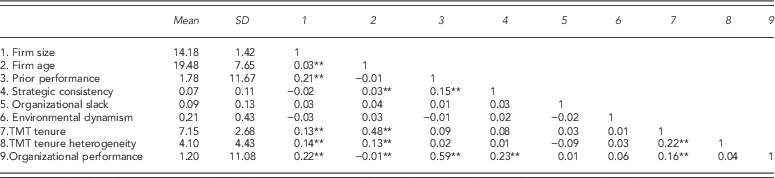
Table 1 shows the means, standard deviations, and Pearson correlations of all variables in this study. As indicated in Table 1, the only problematic collinearities observed was between firm age and TMT tenure (r=0.48, p<.01) and between prior performance and organizational performance (r=0.59, p<.01). All other correlation coefficients among variables were ⩽0.23, thus representing a low possibility of multicollinearity among study variables. Furthermore, we found that strategic consistency was significantly positively related to organizational performance (r=0.23, p<.01), as was TMT tenure (r=0.16, p<.01). However, organizational slack, environmental dynamism, and TMT tenure heterogeneity were not significantly related to organizational performance.
Means, standard deviations, and Pearson’s correlations

Note: TMT=top management team.
**p<.01.
Hypotheses testing
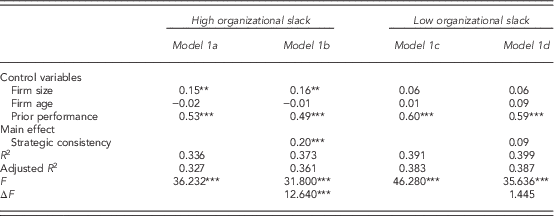
Table 2 shows the results of the moderating effect of organizational slack on the relationship between strategic consistency and organizational performance. As indicated in Model 1b, strategic consistency was significantly positively related to organizational performance in the high organizational slack group (β=0.20, p<.001). However, the results of Model 1d show that strategic consistency was not significantly related to organizational performance in the low organizational slack group (β=0.09, ns). This result implies that the effect of strategic consistency on firm performance varies with the level of slack resources in different organizations. Therefore, Hypothesis 1 is supported.
Results of the moderating role of organizational slack

Note: Response variable: organizational performance.
***p<.001; **p<.01.
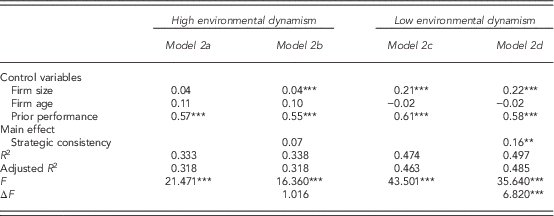
Table 3 shows the results of the moderating effect of environmental dynamism on the relationship between strategic consistency and organizational performance. The results in Model 2b indicate that strategic consistency was not significantly related to organizational performance in the high environmental dynamism group (β=0.07, ns). However, the results in Model 2d show that strategic consistency was significantly positively related to organizational performance in the low environmental dynamism group (β=0.16, p<.01). Therefore, the effect of strategic consistency on firm performance is different between high and low levels of environmental dynamism, thus supporting Hypothesis 2.
Results of the moderating role of environmental dynamism

Note: Response variable: organizational performance.
***p<.001; **p<.01.
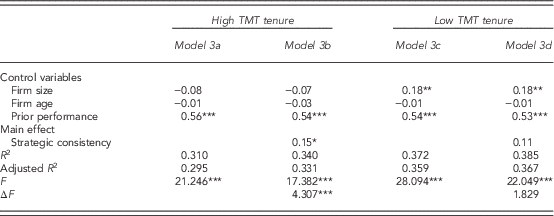
Table 4 shows the results of the moderating effect of TMT tenure on the relationship between strategic consistency and organizational performance. As shown in Model 3b, strategic consistency was significantly positively related to organizational performance in organizations with high TMT tenure (β=0.15, p<.05). However, strategic consistency was not significantly related to organizational performance in organizations with low TMT tenure (β=0.11, ns). Therefore, the effect of strategic consistency on firm performance varies between organizations with high and low TMT tenure, thus supporting Hypothesis 3.
Results of the moderating role of top management team (TMT) tenure

Note: Response variable: organizational performance.
***p<.001; **p<.01; *p<.05.
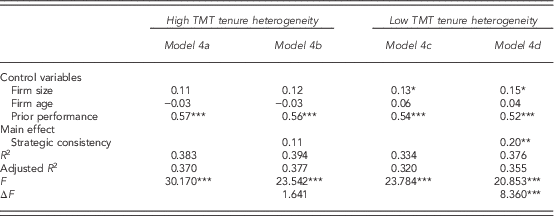
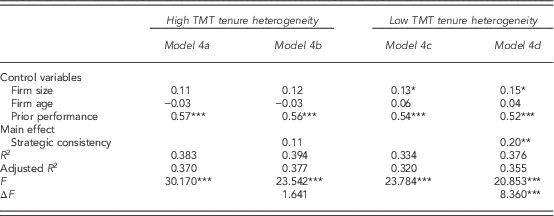
Table 5 shows the results of the moderating effect of TMT tenure heterogeneity on the relationship between strategic consistency and organizational performance. As indicated in Model 4b, strategic consistency was not significantly related to organizational performance in organizations with high TMT tenure heterogeneity (β=0.11, ns). However, strategic consistency was significantly positively related to organizational performance in organizations with low TMT tenure heterogeneity (β=0.20, p<.01). This result implies that the effect of strategic consistency on firm performance varies with the level of TMT tenure heterogeneity. Therefore, our Hypothesis 4 is supported.
Results of the moderating role of top management team (TMT) tenure heterogeneity
Note: Response variable: organizational performance.
***p<.001; **p<.01; *p<.05.
Discussion and Conclusion
This study aims to investigate the moderating roles of organizational slack, environmental dynamism, and TMT attributes in the relationship between strategic consistency and organizational performance. The results show that the effect of strategic consistency on organizational performance is positive when organizational slack is high, when environmental dynamism is low, when TMT tenure is long, and when TMT tenure heterogeneity is low. The findings of this study provide implications for both academic researchers and practitioners.
Theoretical Contribution
The findings of our study contribute to the literature on strategic consistency in several manners. First, prior literature tends to view strategic consistency based on a single perspective (Sheth & Sisodia, Reference Sheth and Sisodia2002). Accordingly, consistency is viewed through constructs such as path dependency (David, Reference David1986; Hannan & Freeman, Reference Hannan and Freeman1984), coherence (Nath & Sudharshan, Reference Nath and Sudharshan1994), inertia (Miller & Chen, Reference Miller and Chen1994), momentum (Miller & Friesen, Reference Miller and Friesen1982), or strategic change (Miller, Reference Miller1992; Rajagopalan & Spreitzer, Reference Rajagopalan and Spreitzer1996; Zajac & Kraatz, Reference Zajac and Kraatz2000). However, such a single viewpoint restricts our understanding of the impact and implication of strategic consistency on organizational outcomes and creates a lack of theoretical foundation. Therefore, the present study examines strategic consistency from different points of view based on multiple theories such as strategic planning, strategic change, upper echelons theory, and other literature. Our integrated model provides a complete theoretical background for understanding strategic consistency and offers new insights into the relationship between strategic consistency and organizational performance.
Furthermore, strategic consistency is a major issue that has sparked an inconclusive debate among researchers in strategic management and organizational theory. However, most previous researchers only discussed the impact of strategic consistency on organizational survival or organizational performance and largely ignored the possible moderator variables (Lamberg et al., Reference Lamberg, Tikkanen, Nokelainen and Suur-Inkeroinen2009; Zajac & Kraatz, Reference Zajac and Kraatz2000). In the present study, we examined the possible moderating roles of organizational slack, environmental dynamism, and TMT attributes. The findings of our study show that the impact of strategic consistency on organizational performance varies depending on the levels of these moderators. Therefore, our study sheds new light on the relationship between strategic consistency and organizational performance, and fills the gaps in the strategic consistency literature.
Second, organizational slack has been widely viewed in the literature either as an environmental buffer (Singh, Reference Singh1986; Voss et al., Reference Voss, Sirdeshmukh and Voss2008; Lin et al., Reference Lin, Cheng and Liu2009) or as an innovative facilitator (George, Reference George2005; Geiger & Makri, Reference Geiger and Makri2006). Few studies have considered the role of organizational slack in strategic consistency. The present study shows that strategic consistency is significantly positively related to organizational performance in organizations with high levels of slack resources but not to that in organizations with low levels of slack resources. This result implies that only organizations with excessive slack resources have the ability to carry out their previous courses of action, execute their long-term planned activities, and obtain their objectives. As a result, organizational slack can be viewed as a ‘resource commitment’ to the strategic continuity of the organization. Therefore, this study contributes not only to the discussion of organizational slack but also to the literature on resource leveraging to enhance performance.
Third, environment is generally seen as an important factor in strategic planning (Miller, Reference Miller1992; Miller & Chen, Reference Miller and Chen1994), strategic alignment (Zajac & Shortell, Reference Zajac, Kraatz and Bresser1989; Kraatz & Zajac, Reference Kraatz and Zajac2001), and strategic change (Rajagopalan & Spreitzer, Reference Rajagopalan and Spreitzer1996; Zhang & Rajagopalan, Reference Zhang and Rajagopalan2010). However, environment is usually determined as an antecedent rather than a moderator to a firm’s strategy and performance (Rajagopalan & Spreitzer, Reference Rajagopalan and Spreitzer1996), and most prior studies largely ignored the role of environmental dynamism in strategic consistency (Lamberg et al., Reference Lamberg, Tikkanen, Nokelainen and Suur-Inkeroinen2009). In the present study, we examined the moderating role of environmental dynamism in the relationship between strategic consistency and organizational performance. Our findings indicate that the impact of strategic consistency on organizational performance varies with the levels of environmental dynamism. Therefore, our study provides empirical evidence supporting the critical role of environmental factors in organizational strategy and performance.
Finally, according to a large body of research on upper echelons theory (Hambrick & Mason, Reference Hambrick and Finkelstein1984), although scholars have discussed the role of TMT in shaping organizations’ strategic behavior and performance, empirical studies have shown mixed results on the impact of TMT attributes on organizational outcomes (Dess & Shaw, Reference Dess and Shaw2001; Henderson et al., Reference Henderson, Miller and Hambrick2006). Several researchers found a positive influence of TMT attributes on organizational performance (Hambrick et al., Reference Hambrick, Finkelstein and Mooney1996; Henderson et al., Reference Henderson, Miller and Hambrick2006; Nadolska & Barkema, Reference Nadolska and Barkema2013), whereas others found a negative or no relationship between TMT attributes and organizational performance (Dess & Shaw, Reference Dess and Shaw2001; ; Henderson et al., Reference Henderson, Miller and Hambrick2006; Marcel, Reference Marcel2009; Nadolska & Barkema, Reference Nadolska and Barkema2013; Hambrick et al., Reference Hambrick and Mason2014). In the present study, we investigated the moderating roles of TMT tenure and tenure heterogeneity in the relationship between strategic consistency and organizational performance. Our findings indicate that strategic consistency has a different effect on organizational performance depending on the levels of TMT tenure and tenure heterogeneity. Therefore, our study offers empirical evidence to understand the different roles of TMT tenure and tenure heterogeneity in strategic consistency and organizational performance. The findings of our study offer valuable implications to further refine upper echelons theory.
Practical implication
On the basis of the empirical findings, we believe that our study will provide new implications for practical managers in several manners. First, this study found that organizations must consider the roles of organizational slack, environmental dynamism, and TMT attributes to identify whether strategic consistency improves firm performance. Therefore, when managers select change or insist on their strategy, they must thoroughly analyze and evaluate the impact of different factors, as the success of strategic planning and implementation relies on environmental conditions, organizational resources, and their leadership.
Organizational slack is critically important to organizational strategic consistency and performance. When organizations decide to continue following a constant trajectory of action, managers should consider the level of slack resources, which can play the role of ‘resource commitment’ to the organizations’ long-term activities. Organizations with excessive slack tend to achieve better performance because of their efficient support. In this case, long-term organizational programs can be executed successfully, and strategic consistency strengthens and protects the existing competitive advantages of the organization.
Environmental dynamism was found to influence strategic consistency and organizational performance. Therefore, managers should be aware of the rate of changes in the environment. When organizations face a low level of environmental dynamism, managers should follow a consistent course of action to obtain better performance. However, when the environment is in a highly turbulent condition, managers should change their strategic behaviors to follow the nature and the pace of environmental change. Therefore, a flexible strategy may be better for firms in a highly turbulent environment.
In terms of organizational leadership, we found that TMT tenure and tenure heterogeneity moderate the relationship between strategic consistency and organizational performance. Strategic consistency can improve the performance of organizations with long-tenured managers and low levels of TMT tenure heterogeneity. Therefore, before managers decide to adapt strategic consistency to enhance their performance, they should carefully consider the composition of the TMT. However, if organizations have TMTs with short-tenured managers or high levels of TMT tenure heterogeneity, managers should avoid adapting a high degree of strategic consistency.
Limitations and directions for future research
This study closely examined the data analysis. However, the analysis suffers from several limitations. First, the data used for our empirical analysis were cross-sectional data (2010–2011), which provided a less dynamic frame to observe the effect of strategic consistency on organizational performance in a longer time period. Therefore, future studies can adapt longitudinal data to investigate the effects of organizational slack, environment, and TMT attributes on strategic consistency and organizational performance. Second, the electronics firms examined in this study were suitable because they faced a highly turbulent environment and severe competition. Therefore, in this industry, determining the impacts of organizational slack, environment, and leadership on organizational strategic consistency and performance is important. However, using a single industry reduces the generalization of our findings. Therefore, future studies can use other industries or apply cross-industry comparison to extend our insight into the issue of strategic consistency. Third, we included only TMT tenure and tenure heterogeneity as the two observable variables of TMT attributes, and the roles of unobservable TMT characteristics were ignored because of the inconvenience and difficulty in directing measurement. Therefore, future studies can use psychological methods, such as experimental design or interview, to measure the cognitive bases, values, and perceptions of TMTs. Finally, this study avoided using MRA method to test the moderation due to multicolinearity concern and requirement of a large-scale test on a bigger data set. Future studies can use a bigger data set to test the moderating roles of the variables in this study.