Omicron (B.1.1.529) is a variant of COVID-19, characterized by high virulence, short incubation period, rapid transmission, and high viral load.Reference Sun, Li and Guo1, Reference Tian, Sun and Xu2 As of January 2022, 128 countries and regions have reported cases of Omicron infection,Reference Mohapatra, Kandi and Verma3 and in early March 2022, an imported transmission of Omicron occurred in Shanghai, China, with a scale of transmission second only to the Wuhan COVID-19 outbreak 2 years earlier.Reference Chen, Deng and Fang4 The Chinese government had been using a “Zero-covid policy” in response to COVID-19 before the end of 2022,Reference Cai, Deng and Yang5 which involves controlling the spread of the virus by isolating infected individuals and blocking dangerous areas.Reference Nam, Weber and Liu6, Reference Xu, Guo and Xu7 The Omicron infection situation in Shanghai was so severe that the city was forced to lock down on March 28, 2022 to prevent the spread to other cities. People were asked not to leave their homes or neighborhoods except those with special permits (e.g., health care workers), and the process lasted more than a month.Reference Xu, Lu and Zhou8
Shanghai is one of the largest cities in China, boasting a population of over 25 million.Reference Hall, Li and Chen9 This time, the Shanghai lockdown caused by the Omicron variant was the most extensive known city-wide lockdown in the world.Reference Xia, Ma and Huang10 During the Shanghai lockdown, the city’s systems could not function correctly, and citizens had to go through the community to get supplies and help. People had to stay at home because they could not go out to buy food and daily necessities, exercise, walk their dogs, or socialize.Reference Zhang, Zhang and Chen11 They had to rely on community-based unified distribution (where the government purchases the goods and then community workers come to citizens’ homes to distribute them) or community group purchasing (where individuals place orders on a shopping platform and then community workers come to their homes to distribute them) for the materials they needed to live.Reference Dong, Pan and Zhou12 Despite the Shanghai government’s best efforts to meet the citizens’ needs, the single mode of distribution, the lack of procurement sources, the prolonged isolation at home, and the anxiety about contracting COVID-19 still overwhelmed many Shanghai citizens.Reference Liu, Wu and Yang13
In this predicament, many citizens sought help through Weibo, the largest social media platform in China, where help-seekers can post and receive replies, reposts, advice, or support from others.Reference Technology14, Reference Guo, Wang and Xu15 Compared with traditional help-seeking methods, seeking help online can disseminate information about needs instantly and gain a large number of Internet users’ attention. In the process of help-seeking, the Internet can bring anonymity and security to the help-seeker and has the advantages of low cost and quick results. The citizens sought help on Weibo in various ways, including food, supplies, medicine, medical care, pets, and work.Reference Chen, Deng and Fang4, Reference Yang, Wu and Mok16 During the Shanghai city closure due to the COVID-19 outbreak, social media such as Weibo provided an open environment for social interaction with the Chinese public, providing a space for online help-seeking and a potentially positive role in addressing Shanghai citizens’ needs.
Some studies recognized that the pleas for help posted by Shanghai citizens on Weibo provided valuable research data for understanding the citywide lockdown’s specific circumstances and potential consequences.Reference Sun, Li and Guo1 Reference Xu, Guo and Xu7 For instance, Li et al. evaluated the psychological health, loneliness, and perceived stress brought about by the lockdown by analyzing help-seeking posts published by Shanghai citizens on Weibo.Reference Li, Huang and Guan18 Zhao et al. traced the emotional changes among Shanghai citizens during the lockdown by examining their Weibo posts.Reference Zhou, Zou and Yang17 However, existing studies primarily focused on the psychological health of Shanghai citizens. Generally, they did not consider the material and social needs reflected in the citizens’ help-seeking Weibo posts, nor the urgency of these varying needs.Reference Yonemoto and Kawashima19 This research gap made it difficult for policymakers and emergency responders to detect some of the urgent needs of citizens, potentially delaying the allocation of critical resources and the implementation of necessary measures. The study aims to fill this gap by conducting an in-depth analysis of the help-seeking Weibo posts published by Shanghai citizens during the lockdown, systematically categorizing the types of needs and assessing their levels of urgency, thereby offering implications for policymakers and emergency response actors in similar future scenarios.Reference Ogrodniczuk, Rice and Kealy20 The research questions are:
Q1. What main issues were citizens’ seeking help with during the city closure in Shanghai? Which needs were more urgent?
Q2. From whom did they seek help? What are the characteristics in terms of expression? What are the intended beneficiaries of the help?
Q3. What are the characteristics of these help-seeking Weibo posts regarding position and emotion?
Methods
Data Collection
The lockdown of Shanghai due to the Omicron variant began on March 28, 2022, and was not lifted until April 27, 2022.Reference Nam, Weber and Liu6 During this period, Shanghai residents spontaneously created the hashtag “#Shanghai Anti-epidemic Help (in Chinese: #上海抗疫求助)” on Weibo. Under this hashtag, they posted their needs and problems to attract attention and receive assistance. Therefore, this study used self-written Python code to collect Weibo posts under the hashtag “#Shanghai Anti-epidemic Help,” posted from March 28 to April 27, 2022, during the Shanghai lockdown.Reference Gao, Guo and Wu21, Reference Zhu, Li and Wang22 We collected only Weibo posts posted during the lockdown period to identify citizens’ actual needs under these conditions more accurately. We initially downloaded 3618 Weibo posts, containing information about the publisher, posting time, location, and content. Then, we reviewed the content of these 3618 Weibo posts individually and manually removed those unrelated to help-seeking (including advertisements, pure emojis, and other content not involving help requests), ultimately obtaining a valid sample of 1040 Weibo posts.
Content Analysis
This paper used content analysis to analyze the samples, and the question items and indicators were set based on the results of previous studies and the sample characteristics of this study.Reference Shi23–Reference Ybarra and Suman25 Table 1 is the coding table for the content analysis, and 2 coders worked independently. Then, Scott’s Pi Coefficient (π) was used for the reliability test, and the evaluation consistency between the 2 coders was high (π > 0.75).Reference Hayes and Krippendorff26
Rules of coding

Results
The Content of Shanghai Citizens’ Seeking Help (Q1)
From the coding results of the help-seeking content (Table 2), the highest number of complaints were about community, isolation, and personal freedom. Many people (N = 362) could not tolerate prolonged home and community confinement and believed it was unscientific to confine infected and healthy people in the same community. Weibo posts about isolation (N = 113) were also numerous, with most pointing to dissatisfaction with the isolation and conditions. For example, one citizen stated, “Being in home isolation has made me feel a bit depressed and frustrated. I hope all of this ends soon.”
Coding results for the help sought

The number of Weibo posts expressing the need for food, medicine, and medical treatment was also high. Food (N = 126) was in the majority, with most requests for foods such as rice, flour, fresh vegetables, and fruits. Seventy-nine Weibo posts wanted medical supplies to treat COVID-19, and 81 wanted medical support to treat or suppress other diseases. In addition, 55 Weibo posts indicated the need for pharmaceutical support, such as ibuprofen, aspirin, etc.
Some Weibo posts request help involving mothers and babies, pets, etc. Thirty Weibo posts wanted access to mother and baby supplies such as formula, diapers, sippy cups, bottles, etc. Thirty-one Weibo publishers expressed a need for pet food and medicine, along with opportunities to walk their pets. They believed that keeping pets confined at home for an extended period could make the pets depressed. One pet dog owner said, “My dog urinates in the lawn on the left side of the neighborhood every time, and now it is not allowed to go out. It keeps holding urine, and its bladder is about to explode.”
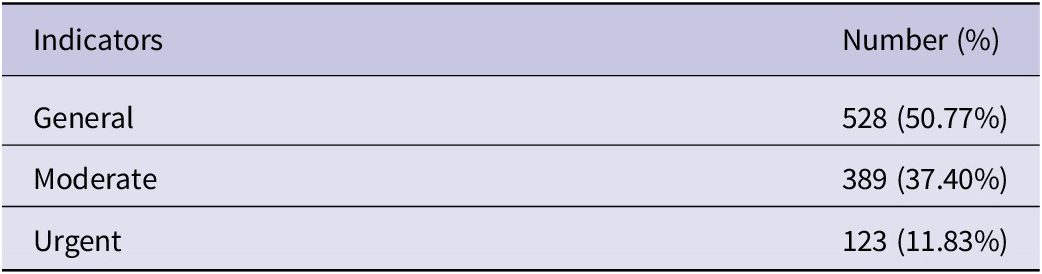
From the results of coding the level of urgency (Table 3): the most significant challenge during the Shanghai closure was the lack of supplies and the health care system that was shut down due to the city lockdown.
Coding results for level of urgency

Most help-seeking posts (N = 528) had a general level of urgency, and these samples were primarily complaints about community, isolation, and travel. Three hundred eighty-nine entries in the model were moderate, mainly related to food and drug shortages. A small number of help-seeking posts (N = 123) were urgent, and most of these requests for help were related to access to medical care, for example, cancer chemotherapy, intracranial surgery, and delivery of pregnant women.
Help-Seeking Relationships and Expressions of Shanghai Citizens (Q2)
From the coding results of whom to ask for help and for whom help was sought (Tables 4–5), we can understand the relationship among the Weibo publisher, the intended beneficiary, and the potential helper.
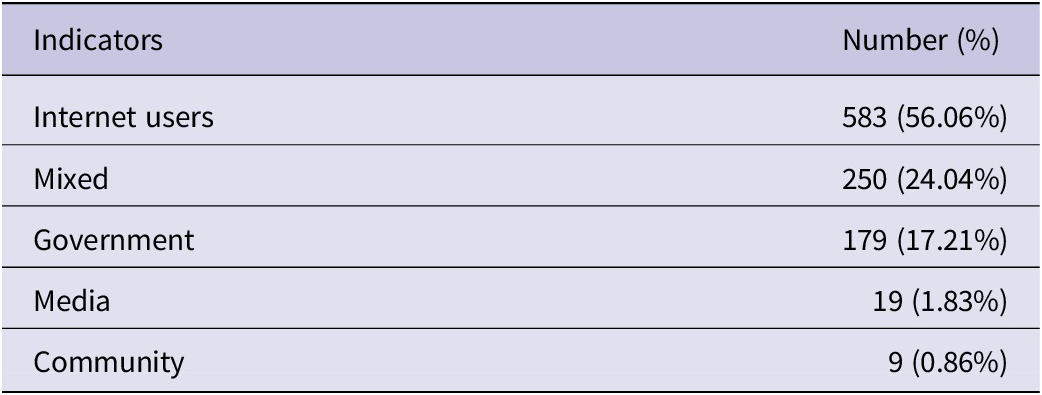
Coding results for help recipient

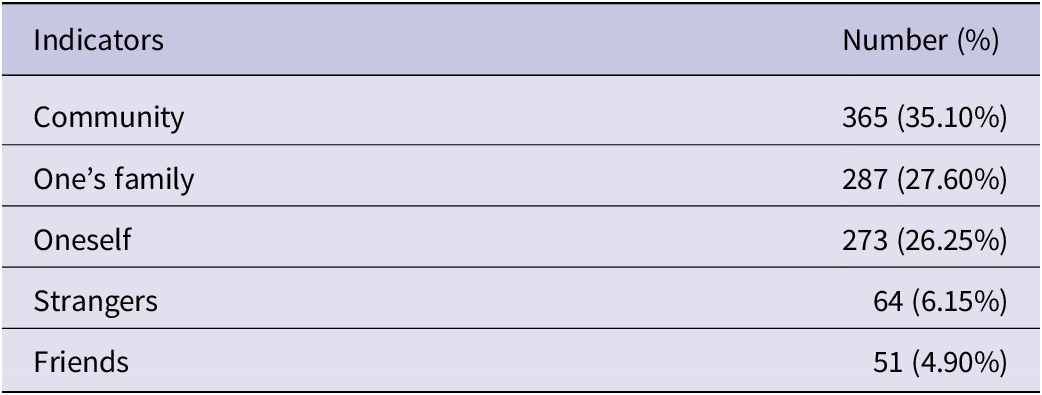
Coding results for intended beneficiary of the help

Most Weibo posts (N = 583) sought help from ordinary individuals through the Internet, viewing Weibo as a channel to maintain interpersonal support. There were 179 Weibo posts who sought help from the government to distribute more supplies, especially food and medicine. A small number of Weibo posts (N = 19) turned to the media for help, hoping they would report on their crisis and dilemma so that more people would see their needs. A small number of Weibo posts (N = 9) turned to the community for help, hoping that community workers would fulfill their duty to provide each household with the necessary supplies. In addition to this, 250 Weibo posts asked for help from multiple actors. In these samples, Weibo posts that turn to the media and the community for help often also turn to the government for help. For example, a pregnant woman who was about to give birth could not reach any hospitals, so her family issued calls for help online to the local community, the district government, and the media.
Most Weibo posts sought help for themselves (i.e., the publisher themselves) (N = 273) and their families (N = 287). Those who sought help for the community (N = 365) did not want to be isolated or closed off. Additionally, in the initial days of the Shanghai lockdown, numerous stores were shuttered, compelling people to rely on smartphones for group shopping to procure essential food and supplies. However, some elderly and disabled individuals were unfamiliar with smartphone usage, making them unable to purchase necessities promptly. Some people noted such problems and posted Weibo posts to seek support for strangers (N = 64), giving a voice to the elderly and disabled who could not use smartphones. Furthermore, 51 Weibo posts asked for help for their friends. By looking at the sample, we found that most of the publishers who asked for help for their friends were not in Shanghai (e.g., a person in Beijing asking for help for their friends in Shanghai).
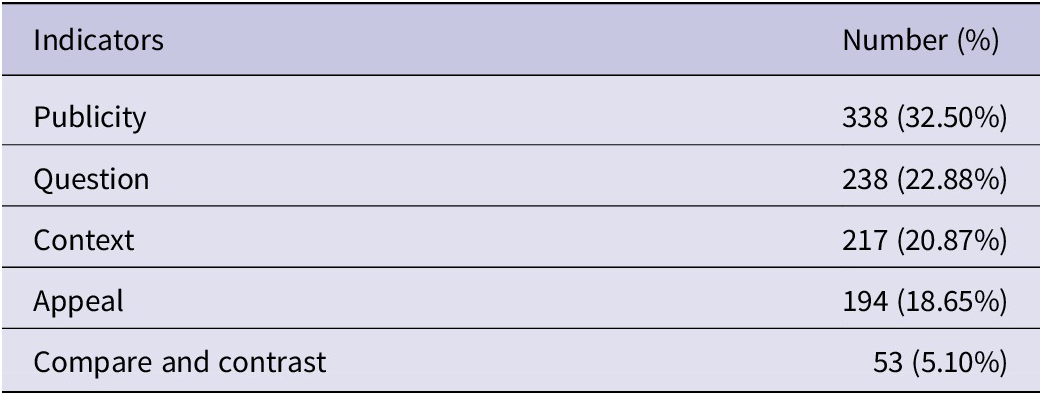
From the results of the coding of expression (Table 6): most of the help seekers did not use overly complex words. More direct phrases such as “publicity” (N = 338) and “question” (N = 238) were more common. There are 217 Weibo posts that use the expression “context.” The Weibo posts in “question” detail the difficulties they have encountered since the closure of the city and the reasons why they had to ask for help via the Internet. There are 194 that use the expression “appeal.” The relevant Weibo posts aim to call the attention of different actors to their needs and offer possible help. In addition, a small number of Weibo posts (N = 53) used the expression “compare and contrast.” Relevant Weibo posts compare their situation to others, emphasizing the dilemmas or problem they face. For example, Some publishers compared the supplies they received with others, arguing that they received less vegetables and rice than others.
Coding results for expression

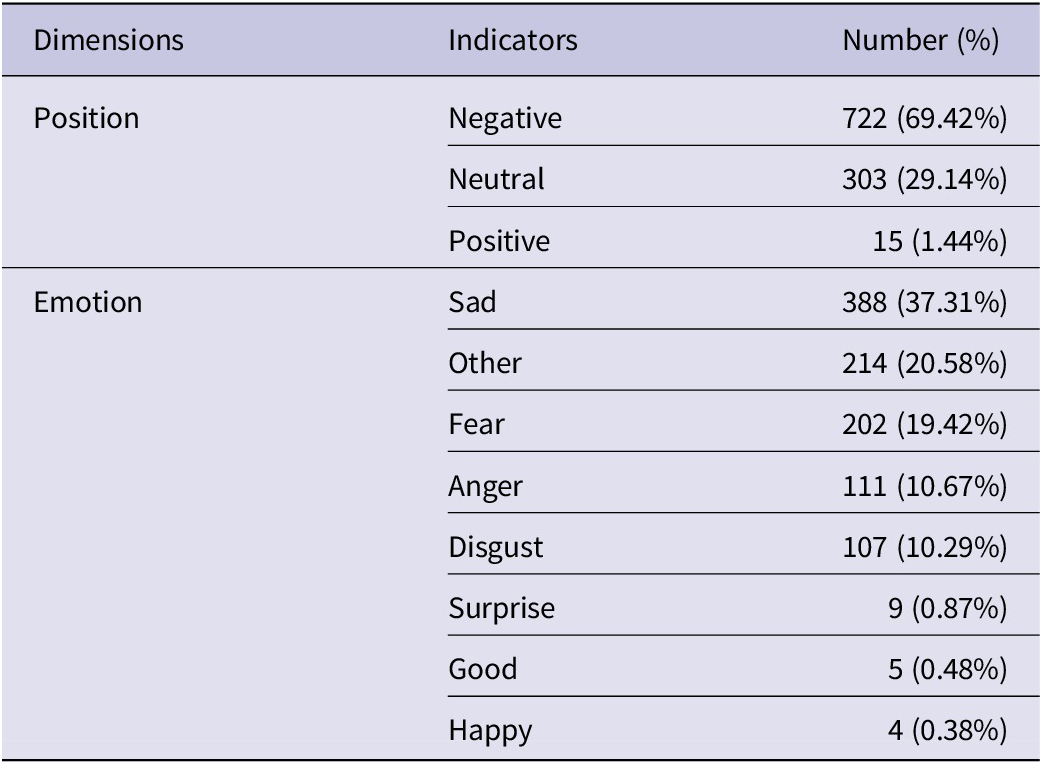
Coding results for position and emotion

The Position and Emotion of the Help-Seeking Weibos (Q3)
From the results of the position coding (Table 7), most of the Weibo posts (N = 722) have a negative stance and are full of negative comments. For example, one Weibo said, “There is an old man (COVID-19 positive) who lives alone and is also a Parkinson’s patient. Now for unknown reasons, older man cannot urinate and is unconscious. We are asking for an ambulance to save the old man’s life.” Some of the Weibo posts (N = 303) were of a neutral position, for example, “I would like to ask, if the grandmother in the family is antigen positive, how do I have to dispense my grandmother’s medication when it is about to be cut off?” There were also very few publishers in a problematic situation, but still maintaining a positive mindset (N = 15). For example, one Weibo said, “I believe we can all carry through! By the way, when will Putuo District distribute the supplies? Thanks!”
From the results of the coding of emotion (Table 7): Negative emotions (e.g., Sad, Disgust, Fear, Anger, etc.) overwhelmingly outnumber positive or neutral emotions. Many Weibo posts (N = 388) contained sad emotions, such as, “I’m discouraged and powerless! Why did they force my grandparents to quarantine at the field hospital? They were locked up in a tiny classroom in the pod hospital with no showers or hot water! Even the washbasin and toothpaste were used by the last batch!” In addition, 202 Weibo posts expressed fear, such as, “Because my father has a basic disease, I am afraid that if he is taken to the hospital, he will be infected twice, and his condition will worsen.” Many Weibo posts also expressed disgust (N = 107) and anger (N = 111) with the government, policies, communities, and community workers, blaming their work and lives for the city closure. There were a small number of Weibo posts that were surprised (N = 9), happy (N = 4), and good (N = 5), expressing mainly gratitude to the netizens who assisted. In addition, some Weibo posts (N = 214) contained multiple emotions or had an insignificant emotional profile.
Discussion
This paper uses content analysis to examine the social media (Weibo) help-seeking of Shanghai citizens during the city closure to understand the material needs and psychological state of citizens during the emergency.Reference Hall, Li and Chen9
The study found that most public requests were not for supplies, but for complaints about community work and isolation policies. The relevant content focused on dissatisfaction with long-term home confinement and significant disagreements on how to handle COVID-19-infected individuals. Some members of the public advocated for isolating infected individuals due to concerns about the risk of coming into contact with them when going out. However, others raised objections, arguing that elderly individuals (with underlying diseases), disabled people, and children who cannot take care of themselves need proper care from the community, and taking them into quarantine would bring them closer to death. Of course, there were a few requests for food, medicine, mother-and-child supplies, etc. Requests for help related to illness often had a high degree of urgency. Among them, medical needs for primary diseases (e.g., blood pressure medications, heart disease medications, insulin, dialysis, etc.) exceeded those related to COVID-19.Reference Zhou, Li and Qin27 It is evident that the impact of the city lockdown was more strongly reflected in the restriction of personal freedom for Shanghai citizens and the danger it posed to those with underlying diseases.Reference Xu, Lu and Zhou8 Therefore, this paper recommends that during crises such as city lockdowns, in addition to providing material resources, the government and relevant agencies should strengthen communication with citizens, particularly by addressing dissatisfaction with policy implementation promptly. Such 2-way communication helps alleviate public discontent and allows the government and emergency management departments to adjust policies better, ensuring a more humane approach to risk management.
Most of the Weibo posts are seeking help from netizens, and few are seeking help from the government or others. It can be seen that the help-seeking relationship is complex, and many help-seekers do not know whom to turn to, so they send requests to both the government and netizens at the same time.Reference Su, Jin and Zhu28 They are desperate for their needs to be noticed and for someone to help them in real-world situations. Over half of the Weibo posts are asking for help for themselves, their friends, or their families; 35.10% are asking for help for their community, and 6.15% are asking for help for strangers. There are also urgent requests (e.g., sudden illness requiring medical attention, pregnant women giving birth, food shortages, etc.) where the individual is unable or uncomfortable going online, and often friends, family, or Internet users post the request on their behalf. These phenomena reflect the helplessness and complex emotions of citizens when facing emergencies. Many are unsure who to seek help from, leading them to request assistance from multiple sources. This paper argues that emergency managers should ensure the diversity of information access and help-seeking pathways available to citizens when formulating policies, such as establishing more efficient official help-seeking platforms.
Overall, most of the Weibo posts reflect a negative or neutral stance. Weibo users seeking help express emotions such as sadness, disgust, fear, anger, and other related feelings. On the one hand, they are dissatisfied with the actions of the community.Reference Wu, Yang and Qin29 They believe that the lockdown action has negatively impacted their work and life. Some also doubt the effectiveness of the lockdown and believe that it has failed to curb the spread of COVID-19. On the other hand, they express dissatisfaction with their living conditions and concern for their and their family’s mental health after experiencing prolonged home quarantine. Multiple studies have examined and confirmed that prolonged isolation and solitude may harm mental health.Reference Saltzman, Hansel and Bordnick30 In this study, some netizens also expressed that long-term home quarantine has severely impacted their mental health. Policymakers and crisis responders should be alert to the fact that chronic social isolation caused by COVID-19 can lead to feelings of loneliness.Reference Killgore, Cloonan and Taylor31
Limitations
This paper has several limitations. Firstly, the samples in this paper are all from Weibo, which may not represent all Shanghai residents. In future research, we need to expand the sample sources, for example, by adding interviews with older citizens or those without Internet access. Secondly, content analysis was used to identify the content, expressions, and other aspects of Shanghai citizens’ help-seeking behavior. While the coding options covered most of the sample well, further refinement of the coding rules is necessary. Finally, the study focused on the content of Weibo posts throughout the entire event without examining changes in Weibo posts over time. Our sample size was 1040, which is moderate. During the study, we attempted to analyze the variation in coding results over time. However, due to the limitation of the sample size, we did not find significant associations between the coding results and time. In future studies, we will address the acknowledged limitations by expanding the sample size, conducting longitudinal studies, comparing multiple events, and exploring help-seeking behaviors across different social media platforms to improve research methods.
Conclusions
This paper examines the public’s online help-seeking during the city closure in Shanghai across 7 dimensions: the help sought, level of urgency, help recipient, the intended beneficiary of the help, expression, position, and emotion. The study found that personal freedom, food, and medical care were the most frequently sought forms of help, and most of the public’s positions and emotions were pessimistic. The long-term home isolation and city closure caused the public to suffer various adverse physical and mental health effects.
This paper’s findings reveal the public’s needs and status during the city closure. They provide a reference for emergency preparedness in public health events or emergencies. Shanghai’s experience can also serve as an inspiration for countries worldwide to develop appropriate policies and respond effectively when dealing with emergencies.Reference Li, Huang and Guan18
Competing interest
No potential conflict of interest was reported by the author (s).