Introduction
Affective lability may be defined as frequent and intense fluctuations of affect in response to both pleasant and unpleasant events (Thompson et al. Reference Thompson, Berenbaum and Bredemeier2011). It has been proposed as a core dimension of several mental disorders, including bipolar disorders (BD) (Goodman et al. Reference Goodman, Weiss, Koenigsberg, Kotlyarevsky, New, Mitropoulou, Silverman, O'Flynn and Siever2003; Henry et al. Reference Henry, Van den Bulke, Bellivier, Roy, Swendsen, M'Bailara, Siever and Leboyer2008; Aminoff et al. Reference Aminoff, Jensen, Lagerberg, Hellvin, Sundet, Andreassen and Melle2012; Aas et al. Reference Aas, Pedersen, Henry, Bjella, Bellivier, Leboyer, Kahn, Cohen, Gard, Aminoff, Lagerberg, Andreassen, Melle and Etain2015). Affective lability is associated with greater severity/complexity in the clinical expression of BD: more frequent suicide attempts, an earlier age at onset, and more frequent lifetime co-morbidities of anxiety disorders and substance use disorders (Henry et al. Reference Henry, Van den Bulke, Bellivier, Roy, Swendsen, M'Bailara, Siever and Leboyer2008). Moreover, affective lability is also observed in healthy individuals at risk for BD (Birmaher et al. Reference Birmaher, Goldstein, Axelson, Monk, Hickey, Fan, Iyengar, Ha, Diler, Goldstein, Brent, Ladouceur, Sakolsky and Kupfer2013; Aas et al. Reference Aas, Pedersen, Henry, Bjella, Bellivier, Leboyer, Kahn, Cohen, Gard, Aminoff, Lagerberg, Andreassen, Melle and Etain2015; Faedda et al. Reference Faedda, Marangoni, Serra, Salvatore, Sani, Vázquez, Tondo, Girardi, Baldessarini and Koukopoulos2015) and is thus likely to belong to a constellation of symptoms that are observed prior to the development of the disorder (Leopold et al. Reference Leopold, Ritter, Correll, Marx, Ozgurdal, Juckel, Bauer and Pfennig2012).
Several risk factors might be related to affective lability. Studies in twins have demonstrated that the heritability of affective lability is low (approximately 25% of the variance), indicating that this dimension might be driven mainly by environmental risk factors (Coccaro et al. Reference Coccaro, Ong, Seroczynski and Bergeman2012). Among the environmental factors that might be investigated, childhood trauma (specifically emotional abuse) is a relevant one; preliminary findings from our research groups support this hypothesis in BD (Etain et al. Reference Etain, Henry, Bellivier, Mathieu and Leboyer2008; Aas et al. Reference Aas, Aminoff, Vik, Etain, Agartz, Andreassen and Melle2014a ). Results from other studies of affective disorders (Marwaha et al. Reference Marwaha, Gordon-Smith, Broome, Briley, Perry, Forty, Craddock, Jones and Jones2016) or personality disorders (Goodman et al. Reference Goodman, Weiss, Koenigsberg, Kotlyarevsky, New, Mitropoulou, Silverman, O'Flynn and Siever2003) also support this hypothesis.
Other studies have demonstrated that a history of childhood trauma is more frequently reported in patients with bipolar disorders than in healthy controls (Etain et al. Reference Etain, Aas, Andreassen, Lorentzen, Dieset, Gard, Kahn, Bellivier, Leboyer, Melle and Henry2013a ) and increases the severity/complexity of the clinical expression of BD with symptoms including increased risk of suicide attempts, an earlier age at onset, and rapid cycling/mixed episodes (Etain et al. Reference Etain, Henry, Bellivier, Mathieu and Leboyer2008, Reference Etain, Mathieu, Henry, Raust, Roy, Germain, Leboyer and Bellivier2010, Reference Etain, Aas, Andreassen, Lorentzen, Dieset, Gard, Kahn, Bellivier, Leboyer, Melle and Henry2013a ; Daruy-Filho et al. Reference Daruy-Filho, Brietzke, Lafer and Grassi-Oliveira2011; Erten et al. Reference Erten, Funda, Saatcioglu, Ozdemir, Fistikci and Cakmak2014). Interestingly, there is an apparent overlap between most clinical variables associated with both childhood trauma (Agnew-Blais & Danese, Reference Agnew-Blais and Danese2016) and higher affective lability, suggesting the existence of a path leading from childhood trauma to clinical outcomes through affective lability.
In that context, we hypothesize that affective lability may act as a mediator of the link between childhood trauma and some clinical outcomes of BD. Eligibility criteria identify whether a variable is a candidate for consideration as a potential mediator mainly based on associations and temporal precedence (Kraemer et al. Reference Kraemer, Kiernan, Essex and Kupfer2008). Pairwise associations between childhood trauma, affective lability and clinical outcomes of BD have been shown as above-mentioned, this being a necessary but not sufficient criterion. The temporal precedence criterion implies a time-based model of events in which affective lability is developing in a temporal window between childhood trauma and the outcomes of BD. This has been suggested in longitudinal studies using samples of maltreated children and individuals at-risk of BD. Using a sample of maltreated and non-maltreated children followed up from ages 7 to 10 years, Kim-Spoon et al. (Reference Kim-Spoon, Cicchetti and Rogosch2013) demonstrated that early maltreatment was associated with high emotion lability-negativity (age 7) that contributed to poor emotion regulation (age 8), which in turn was predictive of increases in internalizing symptomatology (from ages 8 to 9 years). In the longitudinal study of offspring of parents with BD, Hafeman et al. (Reference Hafeman, Merranko, Axelson, Goldstein, Goldstein, Monk, Hickey, Sakolsky, Diler, Iyengar, Brent, Kupfer and Birmaher2016) showed that affective lability (assessed using the Child Affective Lability Scale) was one of the strongest predictors of new-onset bipolar spectrum disorders. In their review, Leopold et al. (Reference Leopold, Ritter, Correll, Marx, Ozgurdal, Juckel, Bauer and Pfennig2012) concluded that affective lability is likely to belong to a constellation of symptoms that are observed prior to the development of BD. Therefore, it can be suggested that affective lability develops after childhood trauma but before the onset of BD, thus fulfilling the temporal precedence criterion. Finally, it should be mentioned that the Baron & Kenny (Reference Baron and Kenny1986) approach for mediation analyses could be applied in cross-sectional or retrospective studies (Kraemer et al. Reference Kraemer, Kiernan, Essex and Kupfer2008) even though a causality cannot be definitely inferred.
The need for providing more comprehensive models that integrate childhood trauma, affective lability and the clinical expression of BD has been claimed. For example, Marwaha et al. (Reference Marwaha, Gordon-Smith, Broome, Briley, Perry, Forty, Craddock, Jones and Jones2016) have proposed that investigations of these links should benefit from formal path analytic statistical techniques in order to ascertain direction of effects and more precisely the potential mediation role of affective lability (Marwaha et al. Reference Marwaha, Gordon-Smith, Broome, Briley, Perry, Forty, Craddock, Jones and Jones2016). Therefore, we tested whether affective lability [as measured by the Affective Lability Scale – Short Form (ALS-SF] mediates associations between childhood trauma and the indicators of severity and/or complexity of BD, including an earlier age at onset, suicide attempts, more co-morbidities with anxiety disorders, and rapid cycling and mixed episodes.
Method
Participants
In total, 300 patients were recruited in France from three French university-affiliated departments of psychiatry (Paris/Créteil, Bordeaux, Nancy). An additional 42 patients from Norway were included as part of an ongoing study of severe psychiatric disorders called NORMENT [Thematically Organized Psychosis (TOP) Study] and were recruited from psychiatric in- and out-patient units at three major hospitals in Oslo. For inclusion in the study, all patients had to have a diagnosis of a BD (types I, II or NOS) according to DSM-IV criteria (APA, 1994). The current sample is a subsample of that previously described and studied for childhood trauma (Aas et al. Reference Aas, Etain, Bellivier, Henry, Lagerberg, Ringen, Agartz, Gard, Kahn, Leboyer, Andreassen and Melle2014b ; Etain et al. Reference Etain, Aas, Andreassen, Lorentzen, Dieset, Gard, Kahn, Bellivier, Leboyer, Melle and Henry2013a ). The local institutional review boards approved the French study. The Norwegian project was approved by the Regional Committee for Medical Research Ethics and the Data Inspectorate. Written informed consent for participating in the study was obtained from all participants. When a participant was under the age of 18, consent was signed by the participant and both parents as directed by the Ethics committee.
Clinical assessment
In each country, clinical assessment was carried out by trained psychiatrists, MDs or psychiatrists-in-training and clinical psychologists. The French patients were interviewed using the French version of the Diagnostic Interview for Genetic Studies (DIGS; Nurnberger et al. Reference Nurnberger, Blehar, Kaufmann, York-Cooler, Simpson, Harkavy-Friedman, Severe, Malaspina and Reich1994), which provides lifetime DSM-IV Axis I diagnoses. French patients were euthymic at inclusion [i.e. having Young Mania Rating Scale (YMRS) and Montgomery–Asberg Depression Rating Scale (MADRS) scores of no more than 5]. A similar approach was performed in the Norwegian sample using the Structured Clinical Interview for DSM-IV Axis I disorders (SCID-I) and was cross-checked with medical charts.
Several clinical variables were collected during the clinical assessment and selected a priori: age at onset, lifetime history of rapid cycling, lifetime history of mixed episodes, suicide attempts and anxiety disorders. We selected these five clinical variables for the following reasons: (i) they are indicators of the complexity and/or severity of the clinical expression of BD; and (ii) they have been previously associated with childhood trauma in our previous studies (Etain et al. Reference Etain, Aas, Andreassen, Lorentzen, Dieset, Gard, Kahn, Bellivier, Leboyer, Melle and Henry2013a ); or (iii) they have been previously associated with higher ALS scores (Henry et al. Reference Henry, Van den Bulke, Bellivier, Roy, Swendsen, M'Bailara, Siever and Leboyer2008; Parmentier et al. Reference Parmentier, Etain, Yon, Misson, Mathieu, Lajnef, Cochet, Raust, Kahn, Wajsbrot-Elgrabli, Cohen, Henry, Leboyer and Bellivier2012). The overlap between these three criteria led us to select age at onset, rapid cycling, co-morbid anxiety disorders, mixed episodes and suicide attempts as potentially relevant variables to explore.
The two sites used the same definition of age at onset as the age when the subject first met DSM-IV criteria for a major depressive, manic, hypomanic, or mixed episode. The duration of illness was calculated by current age at time of assessment minus age at onset. Lifetime presences of mixed episodes and rapid cycling were scored ‘yes’ if the patient had fulfilled the DSM-IV criteria for such characteristics at any moment over the course of the disorder. Lifetime presence of anxiety disorders was defined as meeting the DSM-IV criteria for any anxiety disorder (panic disorder, social phobia, obsessive compulsive disorders, general anxiety disorder or agoraphobia) during the course of the disorder. Lifetime presence of any suicide attempt was obtained by the appropriate section of the DIGS (section O: suicidal behaviour) for the French sample (the item is ‘Have you ever tried to kill yourself?’). In the Norwegian sample, the assessment was performed by asking the patients during the SCID interview if they had ever made a suicidal attempt, and their answer was cross-checked with medical charts. All data were available in both samples (except data on anxiety disorders and rapid cycling that were available in the French sample only).
Affective lability
Affective lability may be defined as frequent and intense fluctuations of affect in response to both pleasant and unpleasant events (Thompson et al. Reference Thompson, Berenbaum and Bredemeier2011), and can be measured with the Affective Lability Scale (ALS). The original ALS 54-item version measures an individual's proneness to rapid shifts from normality to different emotional states of anxiety, depression, anger, and hypomania. It also measures rapid shifts between anxiety and depression, and hypomania and depression (Harvey et al. Reference Harvey, Greenberg and Serper1989). A recent short version, the ALS-18 version (ALS-SF) developed by (Oliver & Simons, Reference Oliver and Simons2004) and recently validated in BD (Aas et al. Reference Aas, Pedersen, Henry, Bjella, Bellivier, Leboyer, Kahn, Cohen, Gard, Aminoff, Lagerberg, Andreassen, Melle and Etain2015), has been proposed as an alternative to the original 54-item version.
In this study, we used the total score, the anxiety/depression subscale, the depression/elation subscale, and the anger subscale were used (Aas et al. Reference Aas, Pedersen, Henry, Bjella, Bellivier, Leboyer, Kahn, Cohen, Gard, Aminoff, Lagerberg, Andreassen, Melle and Etain2015).
The ALS-SF includes questions rated from 0 to 3 and is divided into three sections that examine affective variations between euthymia and depression, elation, anger and anxiety. It also examines oscillations between anxiety and depression and between depression and elation. The total score is the sum of all item scores divided by 18, thus ranging from 0 to 3, with a score closer to 3 indicating greater affective lability. In addition to a total score, scores on three subscales were calculated: Depression/Anxiety (variation between anxiety and depression), Depression/Elation (variation between depression and elation), and Anger (variation between normal mood and anger). To calculate the domain ratings, all scores classified as being part of that specific dimension were added together and then divided by the number of questions per dimension. The ALS-SF shows a good ability to discriminate between patients with BD, first-degree relatives, and healthy controls (Aas et al. Reference Aas, Pedersen, Henry, Bjella, Bellivier, Leboyer, Kahn, Cohen, Gard, Aminoff, Lagerberg, Andreassen, Melle and Etain2015) and has been found to be highly correlated with the original version (r = 0.94) (Oliver & Simons, Reference Oliver and Simons2004; Aas et al. Reference Aas, Pedersen, Henry, Bjella, Bellivier, Leboyer, Kahn, Cohen, Gard, Aminoff, Lagerberg, Andreassen, Melle and Etain2015). It has also been found to have similar or better psychometric properties compared to the latter (Oliver & Simons, Reference Oliver and Simons2004; Aas et al. Reference Aas, Pedersen, Henry, Bjella, Bellivier, Leboyer, Kahn, Cohen, Gard, Aminoff, Lagerberg, Andreassen, Melle and Etain2015). The ALS-SF is less time-consuming for the participant and thus is more easily administered in large clinical samples.
Childhood Trauma Questionnaire (CTQ)
To measure adverse childhood events, we used the CTQ, a retrospective questionnaire enquiring about traumatic experiences in childhood with answers ranging from ‘never true’, ‘rarely true’, ‘sometimes true’, ‘often true’, to ‘very true’, yielding a total score, as well as five subscores: physical, emotional abuse, sexual abuse, physical neglect, and emotional neglect (Bernstein et al. Reference Bernstein, Fink, Handelsman, Foote, Lovejoy, Wenzel, Sapareto and Ruggiero1994). The reliability and validity of the CTQ have been demonstrated previously (Bernstein et al. Reference Bernstein, Fink, Handelsman, Foote, Lovejoy, Wenzel, Sapareto and Ruggiero1994). In this study, the short version (28-item version) of the CTQ translated to Norwegian or previously validated in French was used (Paquette et al. Reference Paquette, Laporte, Bigras and Zoccolillo2004). We used only continuous subscores in this study (Bernstein & Fink, Reference Bernstein and Fink1998).
Statistical analyses
All statistical analyses were performed using SPSS v. 23 (IBM Corp., USA). Univariate analyses were performed using Mann–Whitney tests and Spearman's correlations because most variables were not normally distributed. We used the process macro for SPSS to perform the mediation analysis (Hayes, Reference Hayes2012). process allows for dichotomous outcomes and estimates the coefficients of the model accordingly using logistic regression.
Mediation implies a situation where the effect of the independent variable on the dependent variable can best be explained using one or several mediator variables that are caused by the independent variable and are themselves a cause for the dependent variable. This means that instead of X causing Y directly, X is causing the mediator M, and M is in turn causing Y. The causal relationship between X and Y in this case is said to be indirect.
The model was as follows: X was the score of childhood trauma, and Y was the clinical variable related to BD (age at onset, lifetime presence of suicide attempts, mixed episodes, rapid cycling, or co-morbid anxiety disorders). Because process allows including several mediators in a serial model, we included affective lability and number of major mood episodes as potential mediators. Even if the number of major mood episodes was not associated with affective lability in our previous results (Henry et al. Reference Henry, Van den Bulke, Bellivier, Roy, Swendsen, M'Bailara, Siever and Leboyer2008), this parameter was included as a mediator because it might have influenced several of the studied clinical variables used as Y.
The relationships between the independent variable, the mediator, and the dependent variables are depicted in the form of a path diagram/model. For each path, the regression coefficients (betas) indicating the direction and magnitude of the effect of one variable on the other are shown. Bootstrapping, a nonparametric resampling procedure that does not impose the assumption of normality of the sampling distribution, was conducted. Mediation analyses were tested using the bootstrapping method with bias-corrected confidence estimates. In the present study, the 95% confidence interval of the direct and indirect effects was obtained with 10 000 bootstrap samples. Indirect effects are significant if confidence intervals do not contain a zero value. ‘Site’ was added as a covariate when necessary.
A p value <0.01 has been defined as significant. This correction for multiple testing is based on the selection of five potential clinical outcomes focusing on ALS and CTQ total scores. Subdomains were investigated secondary only if the total scores were found to be significant.
Results
Socio-demographics and clinical variables
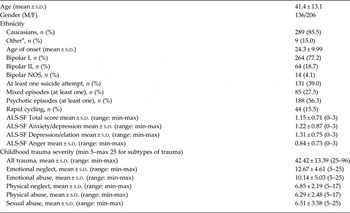
A total of 342 patients were included in this study (n = 300 from France and n = 42 from Norway). Two hundred and sixty-four patients (77.2%) met DSM-IV criteria for type I bipolar disorder, and 56.3% had at least one episode with psychotic features. The mean ± s.d. age at interview was 41.4 ± 13.2 years (range 14–77). The sex ratio was 60/40 (female/male). The mean age at onset was 24.3 ± 10.0 years (range 10–67). The mean number of hospitalizations per patient was 3.4 ± 3.6 (range 0–20). One hundred and thirty-one patients (39%) had attempted suicide at least once. There was a lifetime Axis I co-morbidity of any DSM anxiety disorders in 125 patients (46.1%).
The mean ± s.d. childhood trauma total score was 42.4 ± 13.4 (range 25–96) with emotional neglect and emotional abuse being the most frequently reported, reaching levels of moderate to severe in 34% and 29% of the patients, respectively.
Some differences between sites were observed. The French patients were older at inclusion, had a higher frequency of lifetime suicide attempts, scored higher on all ALS scores and had a longer duration of illness (DUI) compared to the Norwegian sample (see Supplementary Table S1). Samples were similar for other variables (gender distribution, BD subtypes distribution, lifetime presence of mixed episodes, all CTQ scores). Therefore, when relevant, site was added as a covariate in the analyses (Table 1).
Patients demographic and clinical characteristics (n = 342)

NOS, Not otherwise specified; ALS-SF, Affective Lability Scale – Short Form.
a ‘Other category’ includes non-Caucasians and mix (‘mix’ defined as fewer than three grandparents of Caucasian origin). Data on any anxiety disorders were available for 79.2% of the sample (N = 271); Data on suicide attempt were available for 98.2% of the sample (N = 336); Data on mixed episodes were available for 90.4% of the sample (N = 309); data on at least one psychotic episode were available for 97.7% of the sample (N = 334). Data on rapid cycling was available for 82.7% of the sample (N = 283). All patients had data on ALS and Childhood Trauma Questionnaire.
A higher score of CTQ was associated with greater ALS-SF (both total score and subdomains). Primary associations were found between emotional and sexual abuse and all subdomains of ALS-SF. No association was found for physical trauma (see Supplementary Table S1). ALS-SF (both total score and subdomains) was associated with more severe clinical features, including increased risk of lifetime suicide attempts, having at least one mixed episode, and co-morbid anxiety disorders (see Supplementary Table S2). No association between ALS scores and age at onset or rapid cycling were found.
Mediation analysis
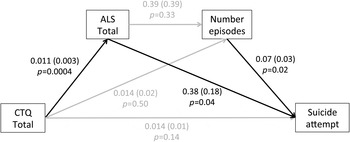
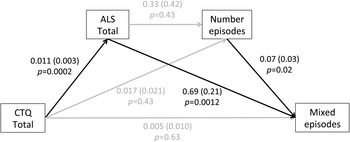
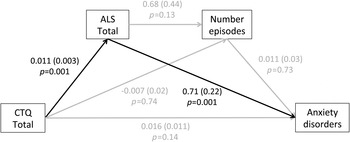
Because no association was observed between rapid cycling or age at onset and ALS-SF, no mediation model was required. For the mediation analysis, we initially focused on ALS-SF and CTQ total scores. The total number of major mood episodes was used as a second mediator to adjust for illness severity and course. As shown in Figs 1–3 (models A–C), we found associations between CTQ and ALS-SF total scores, and between ALS-SF total scores and suicide attempts, mixed episodes and anxiety disorders. For these three clinical variables, the indirect paths from CTQ total score through the mediator (ALS-SF total score) were significant. Also for the three variables, the direct paths from CTQ total score to the clinical variables were not significant, meaning there was no direct effect (see Supplementary Table S4 for effects and 95% confidence intervals) and therefore suggesting a full mediation model. The paths from CTQ total score to the clinical variables through the number of episodes were not significant, as shown in Figs 1–3.
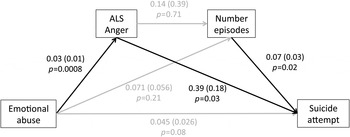
Model A. Path diagram of the mediation model (X = CTQ total score, Y = suicide attempts; ALS total score and number of major episodes as mediators). Each association shows coefficients (standard errors) and p values. Black arrows represent significant associations; grey arrows represent non-significant associations. CTQ, Childhood Trauma Questionnaire; ALS, Affective Lability Scale.

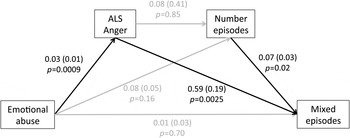
Model B. Path diagram of the mediation model (X = CTQ total score, Y = mixed episodes; ALS total score and number of major episodes as mediators). Each association shows coefficients (standard errors) and p values. Black arrows represent significant associations; grey arrows represent non-significant associations. CTQ, Childhood Trauma Questionnaire; ALS, Affective Lability Scale.

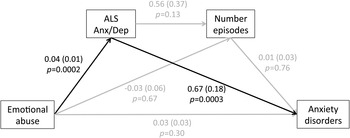
Model C. Path diagram of the mediation model (X = CTQ total score, Y = anxiety disorders; ALS total score and number of major episodes as mediators). Each association shows coefficients (standard errors) and p values. Black arrows represent significant associations; grey arrows represent non-significant associations. CTQ, Childhood Trauma Questionnaire; ALS, Affective Lability Scale.

The univariate analyses showed some preferential associations when considering CTQ subscores and ALS-SF subscores: between emotional abuse and all ALS subscores, between suicide attempts or mixed episodes and the ALS anger subscore, and between anxiety disorders and ALS Anxiety/Depression subscore. We then provided three additional models [A(i), B(i), C(i)] (Figs 4–6), each with emotional abuse as the independent variable and with the ALS-SF anger subscore as mediator for suicide attempts and mixed episodes, and the ALS-SF Anxiety/Depression subscore for anxiety disorders. Path diagrams are displayed in Figs 4–6. ALS-SF anger mediated the effect of emotional abuse on suicide attempts and mixed episodes. The ALS-SF Anxiety/Depression subscore mediated the effect of emotional abuse on anxiety disorders. For these three additional models, no direct effects were observed (see Supplementary Table S4)
Model A(i). Path diagram of the mediation model (X = Emotional abuse, Y = suicide attempts; ALS Anger subscore and number of major episodes as mediators). Each association shows coefficients (standard errors) and p values. Black arrows represent significant associations; grey arrows represent non-significant associations. ALS, Affective Lability Scale.

Model B(i). Path diagram of the mediation model (X = Emotional abuse, Y = mixed episodes; ALS anger subscore and number of major episodes as mediators). Each association shows coefficients (standard errors) and p values. Black arrows represent significant associations; grey arrows represent non-significant associations. ALS, Affective Lability Scale.

Model C(i). Path diagram of the mediation model (X = emotional abuse, Y = anxiety disorders; ALS anxiety/depression and number of major episodes as mediators). Each association shows coefficients (standard errors) and p values. Black arrows represent significant associations; grey arrows represent non-significant associations. ALS, Affective Lability Scale.

Discussion
Our study shows that higher scores on the short version of the ALS are associated with more severe clinical features of BD, particularly increased risk of lifetime suicide attempts, mixed episodes, and co-morbid anxiety disorders. The ALS-SF, both its total score and subscores, was associated with childhood traumatic events, in which the strongest associations were observed for emotional abuse, emotional neglect and sexual abuse. Our study is the first to suggest that affective lability might be considered as a mediator between childhood trauma and several clinical variables in BD, such as lifetime presence of suicide attempts, mixed episodes, or co-morbid anxiety disorders. This mediation effect appeared not to depend on the number of major mood episodes.
Our findings that affective lability appears to mediate the association between childhood trauma and increased risk of suicide attempts, mixed episodes, and anxiety disorders support the hypothesis of a pathway from childhood trauma, through psychopathological dimensions to clinical indicators of severity/complexity of bipolar disorders. Such links have been proposed in other psychiatric disorders. For example, childhood trauma was found to influence the severity of alcohol dependency by a direct effect but also through neuroticism and impulsivity (Schwandt et al. Reference Schwandt, Heilig, Hommer, George and Ramchandani2013). Another example is the relationship between childhood maltreatment and psychosis that is partly mediated by adult attachment style (Van Dam et al. Reference Van Dam, Korver-Nieberg, Velthorst, Meijer and de Haan2014). Thus, future research should explore the underlying psychological factors between childhood trauma and increased risk and severity of later psychopathology.
Our study also suggested emotional abuse as an important risk factor in BD severity/complexity via increased affective lability and preferentially by the anger subdomain, rendering the individual vulnerable to increased risk of suicide attempts. Examples of statements included in the anger domain include: ‘I frequently switch from being able to control my temper very well to not being able to control it very well at all’; and ‘There are times when I feel perfectly calm one minute and then the next minute the least little thing makes me furious’. As shown by (Look et al. Reference Look, Flory, Harvey and Siever2010), Anger is specifically linked to Cluster B personality traits, characterized by dramatic, emotional, and erratic traits. Disorders in this cluster are characterized by decreased impulse control and emotional dysregulation. Based on links between suicide attempts and anger, we suggest that emotional abuse might be a risk factor for internalized anger and hostility in BD. This has already been shown using different assessment tools for suicide attempts in BD (Parmentier et al. Reference Parmentier, Etain, Yon, Misson, Mathieu, Lajnef, Cochet, Raust, Kahn, Wajsbrot-Elgrabli, Cohen, Henry, Leboyer and Bellivier2012). The present results are also consistent with some links we have previously reported between the dimension of impulsivity and mixed episodes (Etain et al. Reference Etain, Mathieu, Liquet, Raust, Cochet, Richard, Gard, Zanouy, Kahn, Cohen, Bougerol, Henry, Leboyer and Bellivier2013b ). Externalized anger and hostility, such as violent behaviour towards others, should also be investigated as a potential long-term effect of emotional abuse in BD.
Affective lability has been defined by Harvey et al. (Reference Harvey, Greenberg and Serper1989) as an individual's proneness to rapid shifts from normality to different emotional states of anxiety, depression, anger, and hypomania. It might be considered as an inherited temperamental trait modulated by developmental experiences predisposing to mood disorders (Marwaha et al. Reference Marwaha, Gordon-Smith, Broome, Briley, Perry, Forty, Craddock, Jones and Jones2016), and is assumed to be a ‘trait-like’ dimension. Stabilization of affect regulation is generally thought to occur in a developmental progression. It has been proposed that as children mature cognitively, socially, and morally, their observed reactions to environmental stimuli become more predictable and stable (Gerson et al. Reference Gerson, Gerring, Freund, Joshi, Capozzoli, Brady and Denckla1996). During childhood and adolescence, individuals learn strategies to regulate emotional reactions, such as emotional distancing or reappraisal. Greater affective lability in adulthood might predispose subjects to inappropriately regulate emotional outputs that occur due to stressors or even in absence of any triggering factors. This potentially amplifies the amplification or exacerbation of baseline affect fluctuations that might be an essential component leading to the risk of suicidal behaviour, anxiety symptoms or mood lability (Links et al. Reference Links, Boggild and Sarin2000). Longitudinal studies have suggested that emotion lability-negativity might be a precursor of later internalizing symptomatology (depressive and anxiety symptoms) (Kim-Spoon et al. Reference Kim-Spoon, Cicchetti and Rogosch2013) or a predictor of new-onset bipolar spectrum disorders among offspring of parents with BD (Hafeman et al. Reference Hafeman, Merranko, Axelson, Goldstein, Goldstein, Monk, Hickey, Sakolsky, Diler, Iyengar, Brent, Kupfer and Birmaher2016). Data from a large (n = 1065) prospective study of adolescents suggests that emotional dysregulation (including affective and mood lability) leads to a multitude of psychiatric pathologies but that it was not primarily a consequence of psychopathology (McLaughlin et al. Reference McLaughlin, Hatzenbuehler, Mennin and Nolen-Hoeksema2011). First, this suggests that the clinical expression of BD might be hypothesized as an outcome of affective lability but not a consequence of a more complex expression of the disorder. Second, this suggests that affective lability cannot be considered to be disorder specific (Marwaha et al. Reference Marwaha, He, Broome, Singh, Scott, Eyden and Wolke2014) since also observed in borderline personality and attention deficit hyperactivity disorder (Henry et al. Reference Henry, Mitropoulou, New, Koenigsberg, Silverman and Siever2001; Reich et al. Reference Reich, Zanarini and Fitzmaurice2012; Richard-Lepouriel et al. Reference Richard-Lepouriel, Etain, Hasler, Bellivier, Gard, Kahn, Prada, Nicastro, Ardu, Dayer, Leboyer, Aubry, Perroud and Henry2016). Further studies should thus investigate whether the pathways that we suggested in this study are general or specific to a particular type of disorder.
One limitation of this study relies on the mediation model that we have used in a cross-sectional design. Indeed, given the results available in the literature, the association and temporal precedence criteria were fulfilled for affective lability to be considered as a potential mediator in the links between childhood trauma and outcomes in BD. Using specific eligibility and analytic criteria to establish whether variables are mediators is an important first step toward demonstrating a potential casual role of mediators in explanatory chains of variables, but never sufficient to establish causality (Kraemer et al. Reference Kraemer, Kiernan, Essex and Kupfer2008). Results of mediation analyses can only provide support for or against hypotheses. Even if the Baron & Kenny approach can be applied to cross-sectional studies, further investigation of affective lability as a mediator would imply the necessity of using longitudinal studies to allow for the examination of events over time.
We also have selected a priori five markers of severity/complexity of BD that have been associated both with childhood trauma and with higher ALS scores (meeting thus one of the criteria for a meditational role). These markers were indicators of complexity (mixed states, rapid cycling, co-morbid anxiety) (Malhi et al. Reference Malhi, Bargh, Cashman, Frye and Gitlin2012) or proposed course specifiers (early age at onset) (Colom & Vieta, Reference Colom and Vieta2009). All correlated with greater illness severity, worse global functioning and higher risk for suicide attempt (Post, Reference Post2010; Fountoulakis et al. Reference Fountoulakis, Kontis, Gonda and Yatham2013; Joslyn et al. Reference Joslyn, Hawes, Hunt and Mitchell2016), however, they cannot be considered as direct measures of severity but rather proxies of severity. In this study, we did not use any direct measures of current symptom severity. Indeed, the majority of the current sample studied was euthymic at time of assessment (i.e. scores lower than five for both the MADRS and the YMRS). We found affective lability not to be correlated with current mood symptoms severity (ρ = 0.16 for MADRS and ρ = −0.14 for YMRS). Moreover, using the density of events (number per year of duration of the disorder) as a more direct measure of illness severity, we found no association with affective lability (ρ = −0.03 for density of hospitalizations and ρ = −0.04 for density of major episodes). Nevertheless, we have included the total number of major mood episodes (that was used as a second mediator) in the mediation models to adjust for illness severity and course. This was made to counterbalance the lack of direct measures of severity when using only the a priori defined markers of complexity.
There are other limitations in the present study. Our data on childhood trauma were collected retrospectively, hence not exempt from potential uncontrolled recall biases. Nevertheless, a previous study has shown that individuals with severe mental illness are able to reliably report in adulthood on experiences of abuse during childhood (Fisher et al. Reference Fisher, Craig, Fearon, Morgan, Dazzan, Lappin, Hutchinson, Doody, Jones, McGuffin, Murray, Leff and Morgan2011), while another study demonstrated similar findings specifically in patients with BD (Shannon et al. Reference Shannon, Hanna, Tumelty, Waldron, Maguire, Mowlds, Meenagh and Mulholland2016). Although of a reasonable size, our sample size might have been modest for identifying other mediation effects such as those explored for co-morbid anxiety disorders and mixed episodes. The levels of affective symptoms were not controlled for in the Norwegian subsample; however, a validation of the ALS-SF in Norway and in France (all euthymic in the French sample) has been found satisfactory (Aas et al. Reference Aas, Pedersen, Henry, Bjella, Bellivier, Leboyer, Kahn, Cohen, Gard, Aminoff, Lagerberg, Andreassen, Melle and Etain2015). Based on some clinical differences between sites, site was added as a covariate in the analysis. Although some differences between sites were observed (higher ALS scores in the French group, longer DUI in the French sample, and more frequent reports of suicide attempts in the French sample) the findings described in the result section were still significant when site was added as covariate in the analyses. We also acknowledge that the variable ‘lifetime presence/absence of suicide attempts’ has a low resolution to explore the complexity of suicidal behaviours in BD. We were not able to further explore more comprehensive indicators of suicidality (such as age at onset, number, intentionality and lethality) since only the presence/absence of suicide attempts was available across sites. We strongly recommend that our results should be extended to other clinical variables that would provide a greater resolution of the suicidal phenotype, and/or to use specifically designed scales such as the Columbia-Suicide Severity Rating Scale (lifetime version for example) (Posner et al. Reference Posner, Brown, Stanley, Brent, Yershova, Oquendo, Currier, Melvin, Greenhill, Shen and Mann2011).
Clinical implications: It has previously been reported that childhood abuse is often not well assessed in psychiatric clinics (Read & Fraser, Reference Read and Fraser1998), and this should be an important part of the overall assessment process. Secondly, addressing and treating the sequelae of childhood maltreatment should be a focus of early intervention strategies and approaches in clinics with the aim of reducing affect lability and the severity of the illness, including risk of suicide attempts, mixed episodes and anxiety disorders.
Conclusion
Our data suggest that affective lability might be a trait mediating the links between childhood trauma experiences and severe clinical features of BD, particularly increased risk of suicide attempts, mixed episodes and co-morbid anxiety disorders.
Supplementary material
The supplementary material for this article can be found at https://doi.org/10.1017/S0033291716003081
Acknowledgements
France: This work was supported by INSERM, Assistance Publique - Hôpitaux de Paris, ENBREC (European Network of Bipolar Research Expert Centre), RTRS Santé Mentale (Fondation Fondamental), Agence Nationale pour la Recherche (ANR), Fondation pour la Recherche sur le Cerveau (FRC) and the National Alliance for Research on Schizophrenia and Depression (NARSAD). We thank E. Abadie and J. R. Richard for their assistance. We thank the clinical psychologists who participated in the clinical assessment of patients in France (A. Raust and B. Cochet in Créteil, L. Zanouy in Bordeaux, R. F. Cohen and O. Wajsbrot-Elgrabli in Nancy). We thank the patients for their participation.
We thank the patients who took part in the study and the NORMENT/TOP study researchers who contributed to the data collection.
This research was funded by INSERM, AP-HP, ANR and FRC. These organizations had no role in the design of the study, the collection, analysis and interpretation of data, the writing of the report or in the decision to submit the paper for publication. This study was also funded by a grant from the University of Oslo, South-Eastern Norway Health Authority (no. 2013088), the Research Council of Norway and the KG Jebsen Foundation.
Declaration of Interest
None.