Introduction
Fetal programming by diets containing either inadequate or excess amounts of nutrients during pregnancy compromises fetal development and affects the ability of offspring to adapt to the postnatal environment.Reference Gluckman and Hanson1–Reference Barker4 The Predictive Adaptive Responses (PARs) hypothesis suggests that when a pre- and postnatal nutrient mismatch occurs, such that the offspring are exposed to a diet that is substantially different from that consumed by the mother, the risk of chronic disease is increased.Reference Gluckman, Hanson and Spencer2 Although the PARs hypothesis is primarily based on the consequences of limiting energy and macronutrients of the pregnant mothers on the offspring, diets fed during pregnancy that are obesogenic,Reference Matsuzaki, Milne, Aitken and Wallace5, Reference Beall, El Haddad, Gayle, Desai and Ross6 high in protein,Reference Thone-Reineke, Kalk and Dorn7, Reference Zimanyi, Bertram and Black8 high in saturated fatty acidsReference Siemelink, Verhoef, Dormans, Span and Piersma9, Reference Guo and Jen10 or high in multivitaminsReference Szeto, Aziz and Das11, Reference Szeto, Das, Aziz and Anderson12 result in offspring that are more likely to express characteristics of the metabolic syndrome, including obesity, hypertension and insulin resistance.
Therefore, a logical extension of the PARs hypothesis is that offspring exposed to excess micronutrients in utero would be less able to adapt to a low-micronutrient environment. Partial support of this hypothesis is provided by observations of rat offspring born to dams fed a high multivitamin diet (HV), and weaned to diets that contain the recommended vitamin (RV) levelReference Szeto, Aziz and Das11 or obesogenic.Reference Szeto, Das, Aziz and Anderson12 Compared with pups born to control dams, those born to dams fed the HV diet exhibited higher weight gain, abdominal adiposity, hyperphagia and characteristics of metabolic syndrome.Reference Szeto, Aziz and Das11, Reference Szeto, Das, Aziz and Anderson12 The mechanisms of fetal programming by vitamin content of the maternal diet have been related to their role in the in utero development of gene expression.Reference Wolff, Kodell, Moore and Cooney13, Reference Cooney, Dave and Wolff14
The hypothesis of this study was that increasing the mismatch in the gestational and pup diets created by feeding rat offspring a low or deficient vitamin diet at weaning would amplify the effect of HV intakes during pregnancy on the development of characteristics of metabolic syndrome in the offspring.
Methods
Animals and diets
Virgin pregnant Wistar rats were purchased from Charles River Inc. (Montreal, QC, Canada). Upon arrival, at day 3 of pregnancy, they were housed individually in ventilated, plastic, transparent cages with bedding in a 12-h light–dark cycle (lights on at 6 am), at a temperature of 22 ± 1°C. The pregnant rats had free access to water by an automated water system. The University of Toronto Animal Care Committee approved the protocols and maintenance of the animals, conforming to the guidelines of the Canadian Council on Animal Care.
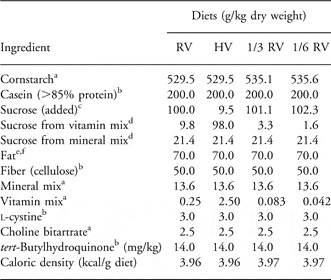
From day 3 of pregnancy to term (21–22 days), dams were fed the AIN-93G dietReference Reeves15 containing either the recommended vitamins (RV) or 10 times higher vitamin (HV) content by addition of the AIN-93 vitamin mix (Table 1). The composition of the vitamin mixture (in mg/kg RV diet) was nicotinic acid (30), calcium pantothenate (16), pyridoxine-HCl (7), thiamin-HCl (6), riboflavin (6), folic acid (2), d-biotin (0.2), vitamin B12 (25), vitamin E as all-rac-α-tocopheryl acetate (15), vitamin A as all-trans-retinyl palmitate (8), vitamin D3 (2.5), vitamin K-1 (0.75) and powdered sucrose (9750). The vitamin additions used in the HV diet were well below the level expected to have teratogenic effect in rats.Reference Achon, Alonso-Aperte, Reyes, Ubeda and Varela-Moreiras16, 17 To account for the sucrose added as the carrier for the multivitamin mix in the HV diets, an equal amount (88.7 g/kg) of free sucrose was removed from the diet. In Experiment 1, offspring were weaned (3 weeks after birth) to either the RV or the 1/3 RV diet with one-third the vitamin content of the RV diet. Therefore, the four offspring groups were (by gestational-pup diet): RV–RV (control group), RV–1/3 RV, HV–RV and HV–1/3 RV. In Experiment 2, male and female offspring were weaned to either the RV diet or the 1/6 RV diet with one-sixth the vitamin content of the RV diet, and the four offspring groups were RV–RV, RV–1/6 RV, HV–RV and HV–1/6 RV. The diets were provided in glass cups secured onto a stainless steel tray to reduce spillage. All gestational and pup diets were provided ad libitum in both Experiments 1 and 2.
Composition of the experimental diets

RV, recommended vitamin diet; HV, high vitamin diet; 1/3 RV, diet with one-third the vitamin content of the RV diet; 1/6 RV, diet with one-sixth the vitamin content of the RV diet.
aDyets, Inc. (Bethlehem, PA).
bHarlan Teklad (Madison, WI).
cAllied Food Service (Toronto, ON).
dVitamin and mineral mix contain sucrose as carrier. Values represent the absolute amount of minerals in the mineral mix, and vitamins in the vitamin mix, without the sucrose carrier.
eLoblaws (Toronto, ON).
fFat in the RV, HV, 1/3 RV and 1/6 RV diets was derived from soybean oil.
Design
This study consisted of two experiments. In both experiments, two groups of pregnant female rats (n = 10 per group) were fed either the RV or HV diet from day 3 of pregnancy until labor (21–22 days). At birth, each litter was culled to 10 pups to minimize the difference of lactation. Litters of less than 10 pups were excluded. During lactation, the dams were fed only the RV diet.
Experiment 1: The effect of HV intake during pregnancy on male offspring fed a weaning diet with 1/3 RV content
At weaning (3 weeks after birth), at least one male offspring from each dam fed the RV or HV diets was randomly assigned to either the RV diet or the 1/3 RV diet (n = 14/pup diet). Offspring were individually caged and body weight (BW) was measured weekly from weaning to 12 weeks post weaning. Food intake for 24 h was measured once every 3 weeks from 1 to 12 weeks post weaning.
At 12 weeks post weaning, after a 10-h overnight fast, rats were randomly gavaged with either a glucose preload (0.375 g glucose/ml, 5 g glucose/kg BW) or a water preload with the same volume. Thirty minutes after the gavage, food intake was measured for 1 h. The rats were then provided 24 h access to food, then fasted overnight and again gavaged, but with the opposite preload, and food intake for 1 h was measured.
An oral glucose tolerance test was performed at 9 weeks post weaning. After a 10-h overnight fast, a blood sample was withdrawn from the capillary bed of the rat tail tip, and baseline glucose concentration was assayed using a commercial glucometer (MediSense Precision Xtra, Abbott Laboratories, Abbott Park, IL, USA). The rats were then gavaged (0.375 g glucose/ml, 5 g glucose/kg BW), and blood glucose concentrations were measured 15, 30 and 60 min later.
Experiment 2: The effect of HV intake during pregnancy on male and female offspring fed a weaning diet with 1/6 RV content
Owing to the lack of effect of the 1/3 RV diet on any measures in Experiment 1, the vitamin content of the weaning diet was reduced to one-sixth of the RV diet to exaggerate the mismatch between prenatal and postweaning vitamin intake, and female offspring were included to determine the role of sex as a factor. The duration of the study was extended to 35 weeks post weaning, an age when rats reach full maturity and begin their middle age.
At birth (after culling), the average BW of pups born to the same dam was recorded.Reference Wainwright18 At weaning, 10 male and 10 female pups, one from each dam, were randomly allocated to either the RV or 1/6 RV diet. All offspring were individually caged from weaning to 35 weeks post weaning. BW was measured at birth, and weekly from weaning to 35 weeks post weaning. Food intake was measured continuously from weaning to 25 weeks post weaning.
At 1, 2 and 3 weeks post weaning, after a 10-h overnight fast, food intake was measured for 1 h. At 6, 12 and 24 weeks post weaning, after a 10-h overnight fast, rats were gavaged with a glucose preload (0.375 g glucose/ml, 5 g glucose/kg BW), and 30 min after the gavage food intake was measured for 1 h. An oral glucose tolerance test was performed at 9 and 30 weeks post weaning (0.375 g glucose/ml, 5 g glucose/kg BW). At 30 weeks post weaning, a 100 μl blood sample was collected (fasting, 15, 30 and 60 min after gavage) and plasma insulin concentration was measured by enzyme immunoassay (catalog no. 80-INSRT-E10, Alpco Diagnostics, Salem, NH). Blood glucose concentration was measured by a handheld commercial glucometer at each time. Fat pad mass of males (epididymal, perirenal and abdominal) and females (perirenal and abdominal) were weighed at sacrifice at 35 weeks post weaning.
Statistical analysis
For the oral glucose tolerance test, blood glucose response and plasma insulin response were calculated as the net incremental area under the curve (iAUC) of their respective concentrations from 0 to 60 min after the glucose gavage. Insulin resistance index was calculated as fasting glucose multiplied by fasting insulin.Reference Cutfield, Jefferies, Jackson, Robinson and Hofman19 In Experiment 1, cumulative food intake was calculated as the sum of the five 24-h food intake measurements.
Treatment effects on weight gain, cumulative food intake (Experiment 1) and short-term food intake (Experiment 1), total food intake (Experiment 2), insulin resistance index and fat pad mass were analyzed using the PROC MIXED procedure in SAS (version 9.1, SAS Institute, Cary, NC) with gestational and pup diets as main factors. Treatment effects on short-term food intake (Experiment 2), glucose and insulin response during the oral glucose tolerance test in the offspring were analyzed with the PROC MIXED procedure with gestational diets, pup diets and time as main factors. If an interaction was found between the effects of gestational diets, pup diets and/or time, a one-way ANOVA with post hoc Tukey's test was performed to identify the effect of individual diets. Significance of difference was declared if P < 0.05. All data were expressed as means ± s.e.m.
Results
Experiment 1: The effect of HV intake during pregnancy on male offspring fed a weaning diet with 1/3 RV content
Gestational diet had no effect on litter size (HV = 13.0 ± 0.5 v. RV = 13.1 ± 0.6 pups per litter). However, at weaning, male offspring from the HV dams had 5% lower BW (HV = 69.2 ± 0.9 g v. RV = 72.5 ± 0.8 g, n = 28 per group) than those from the RV dams (P < 0.01).
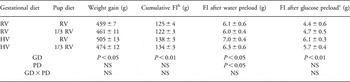
Postweaning weight gain (P < 0.05) and food intake (P < 0.01) were affected by gestational diet (Table 2). Male pups from HV dams gained 6% more weight and consumed 10% more food over the 12-week postweaning period compared with those from RV dams.
Experiment 1: Weight gain, cumulative and short-term food intake in male offspring at 12 weeks post weaningFootnote a

FI, food intake; RV, recommended vitamin diet; HV, high vitamin diet; 1/3 RV, diet with one-third the vitamin content of the RV diet; GD, gestational diet; PD, pup diet; NS, not significant.
a Data are means ± s.e.m.; n = 12–14 per group. Data were analyzed using the PROC MIXED procedure with gestational diet and pup diet as main factors.
b Cumulative food intake = sum of five 24-h food intake measurements.
c Glucose was given by gavage (0.375 g glucose/ml) at 5 g/kg body weight, and the water preload was the same volume.
Short-term food intake over 1 h following an overnight fast and gavaged with the water preload at 12 weeks post weaning was affected by gestational diet (P < 0.05) and pup diet (P < 0.05; Table 2). Pups from the HV dams consumed 10% more than those from RV dams; however, pups on the 1/3 RV diet consumed 5% less than those on the RV diet. Food intake after glucose preloads was also affected by gestational diet (P < 0.01). Pups from the HV dams consumed 30% more than those from RV dams, suggesting that they were less sensitive to the food intake suppressing effect of glucose gavage.
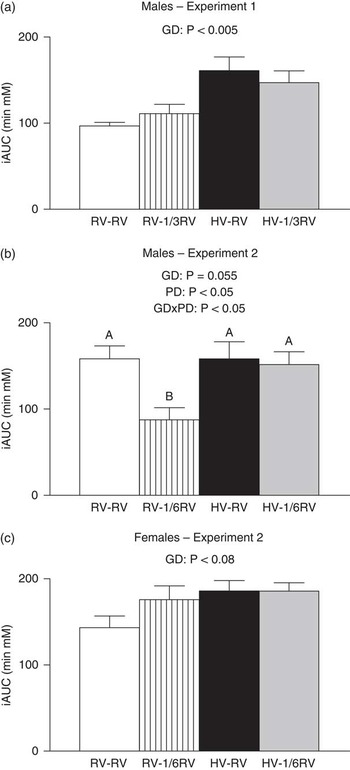
Blood glucose iAUC following the glucose preload was 40% higher in rats from the HV dams (P < 0.005) at 9 weeks post weaning (Fig. 1a).
Glucose response (incremental area under the curve, iAUC) after a glucose load (5 g/kg) at 9 weeks post weaning. Data are means ± s.e.m.; n = 7–10 per group in Experiment 1, n = 8–10 per group in Experiment 2. Data were analyzed using the PROC MIXED procedure with gestational diet and pup diet as main factors, followed by post hoc Tukey's test if an interaction was found, P < 0.01. RV, recommended vitamin diet; HV, high vitamin diet; 1/3 RV, diet with one-third the vitamin content of the RV diet; 1/6 RV, diet with one-sixth the vitamin content of the RV diet; GD, gestational diet; PD, pup diet.

Experiment 2: The effect of HV intake during pregnancy on male and female offspring fed a weaning diet with 1/6 RV content
As in Experiment 1, gestational diet had no effect on litter size (HV = 13.9 ± 1.1 v. RV = 13.4 ± 0.9 pups per litter), or on birth weights (HV = 6.6 ± 0.1 g v. RV = 6.8 ± 0.1 g, n = 10 per group), or on weaning weights of males (HV = 64.5 ± 0.8 g v. RV = 65.9 ± 0.8 g, n = 20 per group) and females (HV = 61.1 ± 0.8 v. RV = 62.9 ± 0.7, n = 20 per group).
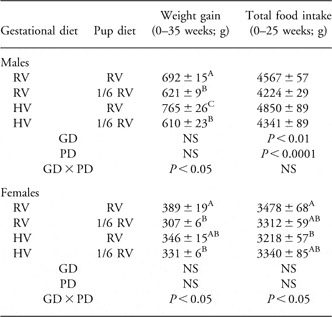
Weight gain of the male pups did not show a major effect of either gestational diet or pup diet; however, a significant interaction was found between gestational diet and pup diet (P < 0.05; Table 3). The interaction arose because males from HV dams weaned to RV diet (HV–RV) gained 11% more weight than RV–RV males from 0 to 35 weeks post weaning (P < 0.0001), whereas no difference was found in weight gain between RV–1/6 RV and HV–1/6 RV males. The 1/6 RV pup diet led to a 16% less weight gain in males (P < 0.0001). Similarly, in female pups, weight gain did not show a major effect of either gestational or pup diet; however, an interaction was found between gestational and pup diets (P < 0.05) (Table 3). RV–1/6 RV female pups gained 21% less weight compared with RV–RV females (P < 0.05), whereas no difference was found in weight gain due to pup diets between HV–RV and HV–1/6 RV females.
Experiment 2: Weight gain and total food intake in offspringFootnote a

RV, recommended vitamin diet; HV, high vitamin diet; 1/6 RV, diet with one-sixth the vitamin content of the RV diet; GD, gestational diet; PD, pup diet; NS, not significant.
a Data are means ± s.e.m.; n = 9–10 means per group. Data were analyzed using the PROC MIXED procedure with gestational diet and pup diet as main factors, followed by post hoc Tukey's test if an interaction was found. Values with different superscripts are significantly different, P < 0.0001 (males), P < 0.05 (females).
The total food intake of male offspring was affected by both gestational diet (P < 0.01) and pup diet (P < 0.0001) (Table 3). Males from HV dams consumed 5% more food compared with those from RV dams, even though the male pups fed the 1/6 RV diet consumed on average 9% less food than those fed the RV diet. In the female offspring, there was no main effect of gestational diet or pup diet, but a significant interaction was found (P < 0.05). HV–RV females had 7% less total food intake than RV–RV females (P < 0.05), but no difference was found between RV–1/6 RV and HV–1/6 RV females.
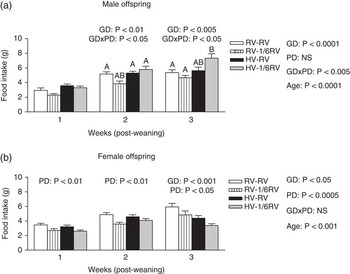
One-hour food intake after an overnight fast in males was affected by gestational diet (P < 0.0001) and age (P < 0.0001) from 1 to 3 weeks post weaning (Fig. 2a). Males from HV dams consumed 23% and 28% more at 2 and 3 weeks post weaning, respectively, compared with those from RV dams. In addition, an interaction was observed between gestational and pup diets (P < 0.005). HV–1/6 RV males consumed 55% more in 1 h at 3 weeks (P < 0.05) post weaning, respectively, than RV–1/6 RV males (Fig. 2a); however, no difference was observed between HV–RV and RV–RV males. In the female offspring, gestational diet (P < 0.05) and pup diet (P < 0.0005) also affected one-hour food intake (Fig. 2b), and an interaction was observed between gestational diet and age (P < 0.001). One-hour food intake was lower in females born to HV dams than those born to RV dams, with the effect of the gestational diet increasing with age. At 3 weeks post weaning, females born to the HV dams consumed 27% less food in 1-h than those born to the RV dams (P < 0.001). Females fed the 1/6 RV diet consumed 21%, 17% and 20% less at 1, 2 and 3 weeks post weaning, respectively, compared with those fed the RV diet (Fig. 2b).
Experiment 2: Food intake (1 h) after an overnight fast. Data are means ± s.e.m.; n = 9–10 per group. Data were analyzed using the PROC MIXED procedure with gestational diet, pup diet and age as main factors, with statistical significance displayed to the right of each figure. Data were further analyzed with gestational diet and pup diet as main factors in every week, with statistical significance shown on the graph. Post hoc Tukey's test if an interaction was found within each week, P < 0.05. RV, recommended vitamin diet; HV, high vitamin diet; 1/6 RV, diet with one-sixth the vitamin content of the RV diet; GD, gestational diet; PD, pup diet; NS, not significant.

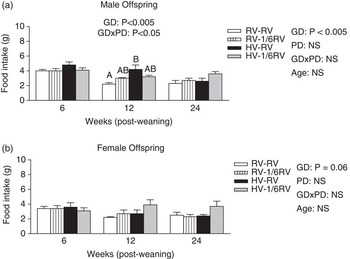
One-hour food intake of the males after glucose preloads were given at 6, 12 and 24 weeks post weaning was affected by gestational diet (P < 0.005) (Fig. 3a). After the glucose preloads, food intake of males born to HV dams was on average 24% higher than those born to RV dams. Similarly, one-hour food intake in females born to HV dams was 15% higher (P = 0.06) than those born to RV dams, but there was no pup diet effect or interaction (Fig. 3b).
Experiment 2: Effects of glucose preloads on food intake (1 h) after an overnight fast. Data are means ± s.e.m.; n = 9–10 per group. Data were analyzed using the PROC MIXED procedure with gestational diet, pup diet and age as main factors, with statistical significance displayed to the right of each figure. Data were further analyzed with gestational diet and pup diet as main factors in every week, with statistical significance shown on the graph. Post hoc Tukey's test was performed if an interaction was found within each week, P < 0.05. Glucose was given by gavage (0.375 g glucose/ml) at 5 g/kg body weight. RV, recommended vitamin diet; HV, high vitamin diet; 1/6 RV, diet with one-sixth the vitamin content of the RV diet; GD, gestational diet; PD, pup diet; NS, not significant.

Blood glucose response (iAUC) after an oral glucose load at 9 weeks post weaning was 26% higher in males born to the HV dams than those born to the RV dams (P = 0.055), even though the glucose response was on average 24% lower in males on the 1/6 RV diet compared with those on the RV diet (P < 0.05) (Fig. 1b). A significant interaction occurred (P < 0.05) between gestational diet and pup diet, in which HV–1/6 RV males had a 73% higher glucose response than RV–1/6 RV males (P < 0.01); however, no difference was observed between HV–RV and RV–RV males. In female offspring, neither gestational diet (P = 0.08) nor pup diet affected the glucose response (Fig. 1c).
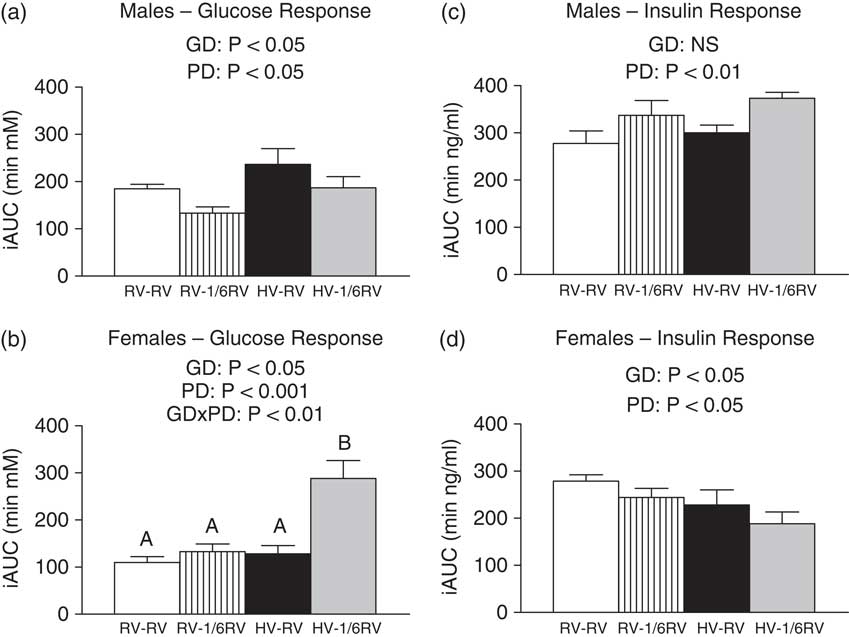
Similarly, in males at 30 weeks post weaning, blood glucose response was affected by gestational diet (P < 0.05) and pup diet (P < 0.05) (Fig. 4a). Males born to the HV dams had 33% higher iAUC than those born to the RV dams, although iAUC was again on average 24% lower in males on the 1/6 RV diet compared with those on the RV diet. In female offspring, and in contrast to the absence of effect at 9 weeks post weaning, blood glucose response at 30 weeks post weaning was affected by gestational diet (P < 0.05) and pup diet (P < 0.001), and a significant interaction between them (P < 0.01) (Fig. 4b). HV–1/6 RV females had 117% higher iAUC than RV–1/6 RV females (P < 0.05); however, no difference was found between HV-RV and RV-RV females.
Experiment 2: Glucose and insulin response (1 h) after a glucose load (5 g/kg) at 30 weeks post weaning. Data are means ± s.e.m.; n = 9–10 per group. Data were analyzed using the PROC MIXED procedure with gestational diet and pup diet as main factors, followed by post hoc Tukey's test if an interaction was found, P < 0.05. Glucose was given by gavage (0.375 g glucose/ml) at 5 g/kg body weight. RV, recommended vitamin diet; HV, high vitamin diet; 1/6 RV, diet with one-sixth the vitamin content of the RV diet; GD, gestational diet; PD, pup diet; NS, not significant.
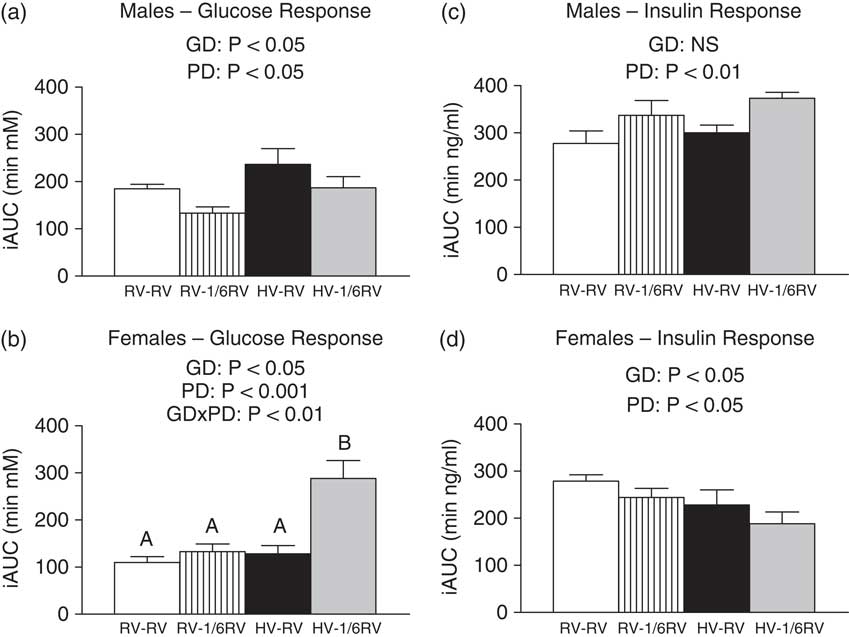
Plasma insulin response to the glucose load in male offspring was affected by pup diet (P < 0.01) at 30 weeks post weaning (Fig. 4c). Males on the 1/6 RV diet had 23% higher iAUC than those on the RV diet. In females, those born to the HV dams had 20% lower insulin response than those from the RV dams (P < 0.05), and females on the 1/6 RV diet had 15% lower insulin response than those on the RV diet (P < 0.05) (Fig. 4d).
Insulin resistance index in male offspring at 30 weeks post weaning (RV–RV: 7.8 ± 1.1, RV–1/6 RV: 8.4 ± 1.8, HV–RV: 13.7 ± 2.5, HV–1/6 RV: 7.8 ± 1.0 mm·ng/ml) was not affected by gestational or pup diets, although there was a trend toward an interaction (P = 0.06). Insulin resistance index in female offspring (RV–RV: 6.9 ± 1.1, RV–1/6 RV: 5.7 ± 1.1, HV–RV: 5.5 ± 0.7, HV–1/6 RV: 3.5 ± 0.4 mm·ng/ml) was neither affected by gestational diet (P = 0.07) nor pup diet. Fat pad mass in male offspring at 35 weeks post weaning (RV–RV: 60.2 ± 6.2, RV–1/6 RV: 43.5 ± 3.1, HV–RV: 69.7 ± 9.8, HV–1/6 RV: 39.8 ± 2.6 g) was affected by pup diet (P < 0.05), but not gestational diet. Fat pad mass in female offspring (RV–RV: 30.3 ± 3.5, RV–1/6 RV: 19.9 ± 3.2, HV–RV: 28.1 ± 3.5, HV–1/6 RV: 26.8 ± 2.2 g) was not affected by gestational or pup diets.
Discussion
The results of these studies do not support the hypothesis that Wistar rat offspring born to dams fed a HV during pregnancy and weaned to low-vitamin diets exhibit an exaggerated expression of obesity and characteristics of the metabolic syndrome.
Consistent with previous studies,Reference Szeto, Aziz and Das11, Reference Szeto, Das, Aziz and Anderson12 male rats born to dams fed the gestational HV diet exhibited higher weight gain and long-term food intake, consumed more in 1 h after an overnight fast or after a glucose preload, and had higher blood glucose response following glucose gavage. Surprisingly, these characteristics of metabolic syndrome in male rats born to the HV dams were modified little despite an extreme reduction in vitamin content of the postweaning diet, suggesting that the programming effect of the gestational HV diet is apparent. In contrast and as shown previously,Reference Szeto, Aziz and Das11 female rats born to HV dams did not show increased weight gain or long-term food intake, but had increased short-term appetite and hyperglycemia later in life.
The modest effect of the low-vitamin pup diets on the weight gain and food intake, independent of the gestational diets, is surprising and a confounding factor in interpreting the outcomes. The vitamin content of the recommended AIN-93G growth dietReference Reeves15 exceeds that required for growth by several fold,17 as shown by the absence of effect of the 1/3 RV diet and the limited consequences of the 1/6 RV diet on growth. Notably, in the AIN-93G diet, vitamins A, B12, D and E are 11-, 500-, 100- and 8-fold higher than that required by the growing rat, respectively.17 The rationale for the initial investigation of the effect of the 1/3 RV diet was based on two observations. First, it has been suggested that low-vitamin intake leads to overeating and obesity in humans.Reference Major, Doucet and Jacqmain20 Second, when an obesogenic diet was given to pups,Reference Szeto, Das, Aziz and Anderson12 both male and female offspring from HV dams became obese much more quickly and more extremely than if they were weaned to the RV diet.Reference Szeto, Aziz and Das11 The obesogenic diet had a lower ratio of micronutrients to energy intake by approximately 50%, suggesting that reduced micronutrient intake may have been a factor in increasing food intake. Clearly, from this study, it was not the case as shown by the minimal effects from the 1/3 RV and 1/6 RV pup diets.
A strong evidence that gestational HV diet led to in utero programming of food intake regulation is the altered short-term food intake in early age. In males, gestational HV diet led to a higher 1-h food intake after an overnight fast, which was further exaggerated by the 1/6 RV diet (Fig. 2). In our previous study, we observed that the fasting plasma concentration of ghrelin, an orexigenic hormone,Reference Murphy and Bloom21 was 26% higher in males born to HV dams compared with those born to RV dams at weaning,Reference Szeto, Das, Aziz and Anderson12 suggesting a programmed hyperphagia phenotype in male offspring that persisted into adulthood. In females, however, the opposite was observed where females born to HV dams had a lower 1-h food intake during the first 3 weeks post weaning, and the 1/6 RV diet further lowered it. However, beginning at 6 weeks post weaning, the feeding pattern changed where the females born to HV dams consumed more in 1 h after a glucose load, suggesting a more complicated in utero programming of short-term food intake regulation that involved with caloric compensation over time.
This study, for the third time, showed that male pups born to HV dams had impaired glucose tolerance and higher insulin resistance index in adulthood.Reference Szeto, Aziz and Das11, Reference Szeto, Das, Aziz and Anderson12 However, their glucose response, but not insulin response, after an oral glucose load was higher compared with those born to RV dams, suggesting that males born to HV dams had a lower peripheral glucose disposal capability and a sign of insulin resistance development.Reference Leahy, Bonner-Weir and Weir22 In contrast, the low-vitamin pup diet (1/6 RV) led to lower glucose and higher insulin response after the glucose load regardless of the gestational diet, possibly because of its effect on lowering weight gain by 16% (Table 3) and abdominal fat pad mass by 35% (1/6 RV: 41.6 ± 2.0 g, RV: 64.9 ± 5.9 g; P < 0.05), and thus higher lean mass and better glucose disposal. In the female offspring, the gestational HV diet had the opposite effect of a higher glucose and lower insulin response to the oral glucose load, indicating that the stimulation of insulin secretion by glucose was suppressed, a possible sign of impaired beta cell glucose sensitivity.Reference Mari, Tura and Natali23 This effect of the HV diet of the dams was further exaggerated by the 1/6 RV pup diet in the female offspring, as shown by the two-fold higher glucose response and 25% lower insulin response compared with all the other groups.
The sex of the offspring played a significant role in the phenotypic programming by the gestational and pup diets, where the effects in males arose primarily in long-term BW and food intake, whereas females exhibited more changes in short-term food intake and glucose regulations. These results are consistent with studies showing that male rats are more susceptible to manipulation in gestational diets,Reference Sugden and Holness24–Reference Fernandez-Twinn, Wayman and Ekizoglou26 possibly because of their faster growth rate and higher nutrient demands than females.Reference Lucas, Godfrey and Barker3, Reference Langley-Evans27 In addition, males, but not females, born to HV dams had higher concentration of saturates and monounsaturates, higher total fat in muscle and higher n-6 to n-3 fatty acids ratio in muscle in early adulthood,Reference Reza-Lopez, Anderson, Szeto, Taha and Ma28 suggesting that males would develop insulin resistance earlier in life than females. In our previous study, female rats born to HV dams developed characteristics of metabolic syndrome only when they were weaned to an obesogenic diet,Reference Szeto, Das, Aziz and Anderson12 but not to a regular AIN-93G powdered diet.Reference Szeto, Aziz and Das11
Although this study leads to the suggestion that the consequences of feeding the dams an HV diet were little affected by the vitamin content of the pup diets, a more direct test of the PARs hypothesis would include weaning the pups from dams fed the HV diet to a HV diet,Reference Gluckman and Hanson1, Reference Gluckman, Hanson and Spencer2 and such a study is required before it can be concluded that vitamin content of the pup diets is not a factor. In addition, future studies should examine the role of high intake of single vitamin or a combination of vitamins during pregnancy to pinpoint the function of each vitamin singly or synergistically. Furthermore, the magnitude of the characteristics of the metabolic syndrome may be different if the gestational diet was extended to the preconception and lactation periods.Reference Lucas, Godfrey and Barker3, Reference Barker4, Reference Thone-Reineke, Kalk and Dorn7, Reference Budge, Gnanalingham and Gardner29 In rodents, the development of food intake regulatory systems in the hypothalamus and gastrointestinal tracts takes place in late gestation and early postnatal period,Reference McMillen, Adam and Muhlhausler30 and providing multivitamin supplementation at this critical period may induce stronger programming effects in the offspring, and a greater dependence in the vitamin content of the pup diet. Such enquiry is relevant to human application for two reasons. First, low micronutrient intake is associated with higher risk of obesity and overeating,Reference Major, Doucet and Jacqmain20 which suggests that chronic, insufficient consumption of vitamins and/or minerals relative to caloric intake can compromise energy homeostasis. Second, in developing countries, more mothers are receiving micronutrient supplements during pregnancy and lactation. Many studies have been examining the effects of maternal supplementation on birth outcomes.Reference Fall, Fisher, Osmond and Margetts31–Reference Christian, Jiang and Khatry34 However, little attention has been placed on the infants after 1 year of age, who are highly unlikely to receive micronutrient sufficient diets. This is a situation that parallels our present study.
In conclusion, the exposure of rat offspring to low-vitamin postweaning diets does not amplify the expression of characteristics of the metabolic syndrome observed in rats born to dams fed HV.
Acknowledgments
This work was supported by the Canadian Institute of Health Research, Institute of Nutrition, Metabolism and Diabetes Strategic Initiative (CIHR-INMD): ‘Excellence, Innovation and Advancement in the Study of Obesity and Healthy Body Weight’ (Grant number: OOP-77980) and the Bristol-Myers Squibb/Mead Johnson Freedom to Discover Grant.