

Although the proportion of marriages that will end in divorce in Western countries can be almost as high as one half (e.g., United States of America: Popenoe & Whitehead, Reference Popenoe and Whitehead2004) or one third (e.g., Australia: Australian Bureau of Statistics, 2007), the proportion of non-marital relationships that break up is much greater. In a sample of university students, almost 66% had experienced a non-marital relationship breakup (Field, Diego, Pelaez, Deeds, & Delgado, Reference Field, Diego, Pelaez, Deeds and Delgado2009), and of those students, the distress experienced following the breakup was related to symptoms of depression and anxiety (Field et al., Reference Field, Diego, Pelaez, Deeds and Delgado2009). The potential negative impact of a non-marital breakup on mental health extends beyond elevated levels of distress; the experience of a relationship breakup has been found to predict the initial onset of major depressive disorder in adolescents (Monroe, Rohde, Seeley, & Lewinsohn, Reference Monroe, Rohde, Seeley and Lewinsohn1999). Following the dissolution of a dating relationship, many people may even experience posttraumatic stress symptoms, such as intrusive thoughts and avoidance behaviour (Chung et al., Reference Chung, Farmer, Grant, Newton, Payne, Perry and Stone2002). In fact, Chung et al. (Reference Chung, Farmer, Grant, Newton, Payne, Perry and Stone2002) found that almost three quarters of their sample of individuals who had experienced a relationship breakup scored high on a measure of posttraumatic stress symptoms (the Impact of Event Scale; Horowitz, Wilner, & Alvarez, Reference Horowitz, Wilner and Alvarez1979).
Although non-marital breakups are frequent in occurrence and can lead to negative mental health outcomes, there is a lack of research attention focused on non-marital breakups compared with divorce (refer to Fine & Harvey, Reference Fine and Harvey2006), and thus it is important to identify factors that may predict better psychological adjustment specifically to a non-marital breakup. In terms of demographic factors that may predict better adjustment following a non-marital breakup, some studies have found that females report greater breakup distress than males (e.g., Field et al., Reference Field, Diego, Pelaez, Deeds and Delgado2009), while others have found that males report greater difficulty than females in recovering from a broken heart (e.g., Knox, Zusman, Kaluzny, & Cooper, Reference Knox, Zusman, Kaluzny and Cooper2000). Regarding the context of the breakup, factors such as a greater time since the breakup (Field et al., Reference Field, Diego, Pelaez, Deeds and Delgado2009), being the partner that initiated the breakup (Perilloux & Buss, Reference Perilloux and Buss2008), and dating again (Tashiro & Frazier, Reference Tashiro and Frazier2003) have been linked to less distress. Although these findings provide some insight into the factors that may predict less distress in adolescents and young adults following a non-marital breakup, there remains a dearth of empirical research on factors that may relate to the possible positive adjustment outcomes following a non-marital relationship breakup.
The aim of the positive psychology movement, which is to restore balance in psychological research by examining both negative and positive aspects of human functioning (Linley, Joseph, Harrington, & Wood, Reference Linley, Joseph, Harrington and Wood2006), supports the need to examine both the positive and negative adjustment outcomes of a non-marital relationship breakup. Examining indicators of positive adjustment following a non-marital breakup is important because even in the most dire life circumstances, positive emotions can co-occur with negative ones (Folkman & Moskowitz, Reference Folkman and Moskowitz2000). Positive emotions have also been found to be more than simply markers of optimal wellbeing (Fredrickson, Reference Fredrickson2004). Empirical evidence has been accumulating to support the theory that positive emotions broaden a person's attentional focus and behavioural repertoires and build his or her enduring personal resources (Fredrickson, Reference Fredrickson2004). It is therefore important to identify factors that may predict such positive indicators of adjustment to a non-marital breakup because if such factors can be enhanced, this will likely be beneficial for the formation of future relationships, as well as the quality of those future relationships.
Revisions of traditional stress and coping theory have proposed that meaning-focused coping, such as searching for and finding benefits or positives in a stressful life event, supports positive emotions (Folkman, Reference Folkman and Folkman2011; Folkman & Moskowitz, Reference Folkman and Moskowitz2000). Specifically, meaning making theories, which have been integrated by Park (Reference Park2010, Reference Park and Folkman2011), hold that distress ensues when our fundamental assumptions about the self and the world are discrepant with our appraisal of a stressful life event, such as a non-marital breakup. This distress is thought to drive a search for meaning, which can include trying to make sense of the experience (sense making) and searching for benefits or positives in the experience (benefit finding) (Davis, Nolen-Hoeksema, & Larson, Reference Davis, Nolen-Hoeksema and Larson1998). Sense making following a breakup may involve making breakup attributions. Certain breakup attributions, such as attributing the breakup to the ex-partner or to environmental factors (e.g., work stress) have been related to greater distress (Tashiro & Frazier, Reference Tashiro and Frazier2003). Although sense making has had differential relations with adjustment in the broader stress and coping literature, benefit finding has more consistently been linked to positive adjustment outcomes (see Helgeson, Reynolds, & Tomich, Reference Helgeson, Reynolds and Tomich2006 for a review of benefit finding).
Although Tashiro and Frazier (Reference Tashiro and Frazier2003) found that following a breakup undergraduate students reported on average five positive changes or benefits, such as improved friendships, greater focus on university work, and personal growth (e.g., ‘I am more self-confident’), we could find no study that specifically examined the relationship between the finding of benefits and adjustment following a non-marital breakup using a standardised measure of benefit finding. There is, however, research that supports the role finding meaning in divorce plays in subjective wellbeing (Bevvino & Sharkin, Reference Bevvino and Sharkin2003), and positively focused writing following a breakup has been related to increased positive emotions (Lewandowski Jr., Reference Lewandowski2009). Further, a meta-analysis examining a range of highly stressful life events and ongoing stressors, such as chronic illness and bereavement, found that finding benefits in the experience was related to greater positive affect and less depression (Helgeson et al., Reference Helgeson, Reynolds and Tomich2006). Thus, we may expect that finding benefits in a non-marital relationship breakup not only mitigates the negative effects of a breakup but also promotes greater positive emotionality; however, due to the lack of empirical evidence specific to non-marital breakups, it is important to empirically examine the propitious effects of benefit finding in a sample of people who have experienced a non-marital breakup and the factors that may moderate the benefit finding–adjustment relationship.
In the stress and coping literature, researchers have demonstrated that benefit finding moderates the relationship between the impact of the event and adjustment outcomes. For example, a related construct, posttraumatic growth, was found to buffer the perceived impact of the stressor (Park, Chmielewski, & Blank, Reference Park, Chmielewski and Blank2010) and intrusive thoughts about the stressor in samples of cancer patients (Silva, Moreira, & Canavarro, Reference Silva, Moreira and Canavarro2012). Posttraumatic growth was also found to buffer the effects of secondary traumatic stress on adjustment in trauma therapists (Samios, Rodzik, & Abel, Reference Samios, Rodzik and Abel2012). Of course, the reverse may also be plausible, such that the impact of the event (i.e., the subjective degree of distress experienced) may moderate the relationship between benefit finding and adjustment. As a certain level of distress is purported to be necessary to propel a search for meaning (Park, Reference Park2010), it is possible that following a breakup, some people experience no or little sense of crisis, and that this lack of a sense of crisis means that that the individuals will likely neither feel distressed nor find benefits (Lechner, Carver, Antoni, Weaver, & Phillips, Reference Lechner, Carver, Antoni, Weaver and Phillips2006). Therefore, it is likely that finding benefits following the breakup may be helpful for those who the breakup has had a greater impact on, perhaps evident by greater posttraumatic stress symptoms, such as greater intrusive thoughts about the breakup and the avoidance of stimuli associated with the breakup or relationship that ended.
The dearth of research that has examined the relationship between benefit finding and adjustment for persons who have experienced a non-marital relationship breakup, suggests the need for greater research in this area. Although we expect the finding of benefits or positive changes following a non-marital breakup to be similar in effect to that of divorce, non-marital breakups are important in their own right (e.g., see Sbarra & Emery, Reference Sbarra and Emery2005) and it is thus important to empirically examine benefit finding following a non-marital breakup. Thus, the present study examined the relationship between benefit finding and a range of indicators of adjustment, including both positive (e.g., positive affect) and negative indicators (e.g., depression), in a sample of 140 undergraduate students and university community members who experienced a non-marital relationship breakup in the previous 12 months. In order to carefully examine the role of benefit finding in adjustment, we controlled for demographic variables, relationship breakup context variables, and breakup attributions in our analyses. Further, we tested whether the benefit finding–adjustment relationship would be moderated by the impact of the event. We hypothesised that after controlling for relevant covariates, higher scores on benefit finding following a breakup would relate to better adjustment and that this relationship would be stronger for persons who experienced the breakup with relatively high levels of subjective distress.
Method
Participants
One hundred and forty persons from a university community in Queensland, Australia who had experienced a non-marital relationship breakup in the previous 12 months participated in the study. The bulk of the sample (61%) consisted of students who participated in the study for extra course credit. Consistent with research by Tashiro and Frazier (Reference Tashiro and Frazier2003), we recruited university students for the study because they tend to be unmarried and experience relationship breakups as they develop their relational skills. We also recruited participants from the university community to broaden the generalisability of the findings. The participants were on average 21.57 years of age (SD = 2.75; range = 17 to 34) and most were female (72.9%). The bulk of the sample said they were not religious (64%) and most participants’ ethnicity was North-west European (64%). The remaining participants reported that their ethnicity was South-east European (10%), Asian (8%), North African and Middle Eastern (2%), Australian Aboriginal or Torres Strait Islander (2%), and mixed ethnicity (14%).
The bulk of the relationship breakups reported on were heterosexual (97.1%) and not engaged to be married (95.0%). The duration of the previous relationship was on average 2.03 years (SD = 1.70) and it was on average 6.43 months (SD = 4.10) since the breakup. The level of commitment to the previous relationship reported on a one-item scale from 1 (not at all) to 7 (very committed) was comparable to that reported by participants in previous research by Tashiro and Frazier (Reference Tashiro and Frazier2003) where the level of commitment to the previous relationship was on average ‘fairly committed’ (M = 5.61, SD = 1.27). Almost half of the sample (47.1%) reported that they initiated the breakup; almost one third reported that their partner had initiated the breakup (30.0%); and the remainder (22.9%) reported that the breakup was mutual. Approximately half of the participants were dating again (49.3%) and half were not (50.7%).
Measures
Demographics and relationship breakup context
Forced-choice questions were used to elicit information on participant demographics, including age, gender, religious beliefs, and ethnicity. Forced-choice questions were also used to elicit information about the context of the relationship breakup. These context-relevant questions asked about the duration and level of commitment of the reported relationship, in addition to sexual orientation, breakup initiator status, time since the breakup and whether the participant was subsequently dating.
Breakup attributions
To control for breakup attributions, the 48-item Attributions scale was used to measure participants’ perceived reasons behind their romantic relationship decline and breakdown (Tashiro & Frazier, Reference Tashiro and Frazier2003). The measure consists of four 12-item subscales: person, other, relational, and environmental. The person attribution subscale measures causal attributions with regards to one's own personal traits, physical characteristics, abilities and beliefs (e.g., the individual's mood). The other attribution subscale measures causal conditions with regards to the partner's personal traits, physical characteristics, ability and beliefs (e.g., partner's insensitivity). The relational attribution subscale represents a combination of both person and other (e.g., communication problems). Finally, the environmental attribution subscale measures environmental factors that may have led to the breakdown of the relationship (e.g., work stress). Participants rated each attribution statement from 0 (not at all a cause) to 5 (very much of a cause). Mean scores were calculated for each of the subscales. Tashiro and Frazier (Reference Tashiro and Frazier2003) reported adequate psychometric properties for the scale. For the current study, the Cronbach's alpha was adequate for the other (.82), relational (.78), and environmental (.80) attribution subscales. However, the personal attribution subscale obtained an alpha of .68. This alpha improved to .70, an acceptable internal consistency (Nunnally, Reference Nunnally1978), when item 10 ‘My need to be in a relationship’ was excluded, and thus, this item was not included in the computation of the scale score for personal attribution. As Carson and Cupach (Reference Carson and Cupach2000) note, participants may be hesitant to admit that their happiness in life is dependent on having a successful relationship.
Impact of the event
The subjective level of impact of the breakup was measured using the 22-item Impact of Event Scale — Revised (Weiss & Marmar, Reference Weiss, Marmar, Wilson and Keane1997). The revised version of the original Impact of Event Scale (Horowitz et al., Reference Horowitz, Wilner and Alvarez1979) assesses the subjective degree of distress associated with a range of trauma symptoms that fall into categories of intrusive thoughts, avoidance, and hyperarousal. Respondents in this sample were asked to indicate from 0 (not at all) to 4 (extremely) the extent to which each statement, such as ‘Any reminder brought back feelings about it’ applied to them during the past 7 days with regard to their most recent romantic relationship breakup. For this study, a mean score was calculated using all items. Adequate psychometric properties have been demonstrated for the scale (Weiss & Marmar, Reference Weiss, Marmar, Wilson and Keane1997) with an observed Cronbach's alpha coefficient of .91 in the present study.
Benefit finding
The Perceived Benefit Scales (McMillen & Fisher, Reference McMillen and Fisher1998) were used to measure overall benefit finding following the relationship breakup. The 38-item Perceived Benefit Scales assess positive life changes following exposure to a stressful life event. This scale consists of 30 positive-change items and 8 negative change items designed to avoid bias in responding. Respondents rated the items, such as ‘This event has taught me I can handle anything’, from 0 (not at all like my experience) to 4 (very much like my experience). Because we were interested in participants’ overall benefit finding following the breakup, a mean score was computed using participants’ ratings of the 30 positive change items rather than computing mean scores for each of the eight subscales. The Perceived Benefit Scales have demonstrated adequate psychometric properties (McMillen & Fisher, Reference McMillen and Fisher1998) and the 30 positive-change items demonstrated good internal consistency in the current study (observed Cronbach's alpha = .94).
Adjustment
The 7-item depression and anxiety subscales of the 21-item Depression, Anxiety and Stress Scales (Lovibond & Lovibond, Reference Lovibond and Lovibond1995) were used as negative indicators of adjustment. Participants rated each statement, such as ‘I felt that I had nothing to look forward to’ from 0 (not at all) to 3 (very much/most of the time). The subscale scores for depression and anxiety were multiplied by 2 to be equivalent to the full 42-item version. Internal consistency was good for depression (observed Cronbach's alpha = .92) and anxiety (observed Cronbach's alpha = .82) in this sample. The five-item Satisfaction with Life Scale (Diener, Emmons, Larsen, & Griffin, Reference Diener, Emmons, Larsen and Griffin1985) was used to measure life satisfaction. Participants rated each item, such as ‘In most ways my life is close to ideal’ from 1 (strongly disagree) to 7 (strongly agree). The observed Cronbach's alpha for the Satisfaction with Life Scale was .91. Positive affect was measured by the five positive affect items of the Bradburn Affect Balance Scale (Bradburn, Reference Bradburn1969). This scale asked participants to rate how often they felt each of five positive affect items such as ‘that things were going your way’ in the past few weeks on a scale from 1 (not at all) to 5 (very often). Internal consistency was good in the present study (observed Cronbach's alpha = .92).
Procedure
After obtaining ethics approval for the study from the university's human research ethics committee, students enrolled in a psychology course were invited to participate in the study via a poster displayed on the university's psychology research notice board, and other members of the university community were invited to participate in the study through an online social networking site (Facebook). Inclusion criteria were that participants had experienced a relationship breakup in the previous 12 months and that the relationship that broke down was not a marital relationship. Participants either completed a hard copy (n = 82) of the survey or completed the survey online (n = 58) through a secure internet-based survey site. Participants who completed the hard copy either on campus or at home were provided with an explanatory statement about the study and a reply-paid envelope to return the completed survey. Eighty-six hard copy surveys were distributed and 82 were returned, yielding a response rate of 96% for hard copy surveys. The response rate was difficult to determine for the online survey; 89 individuals initially responded, with 57 completing all scales, indicating a response rate of 64%. There were no significant differences on key study variables for psychology students and university community members.
Results
Preliminary analyses examined the zero-order relationships among benefit finding, the impact of the event, and adjustment variables. Following preliminary analyses, hierarchical multiple regression analyses were conducted to examine the role of benefit finding in adjustment and whether the impact of the event moderated the relationship between benefit finding and adjustment indicators. For significant interactions, simple slopes were plotted and examined for high and low levels of impact of the event according to guidelines put forward by Aiken and West (Reference Aiken and West1991). Prior to conducting analyses, the data were checked for data entry errors. A missing value analysis using SPSS 20.0 demonstrated that there was less than 5% missing data, and as such, missing values were imputed using mean substitution. The examination of scatterplots indicated that in this sample the relationships between key study variables were linear.
Preliminary Analyses
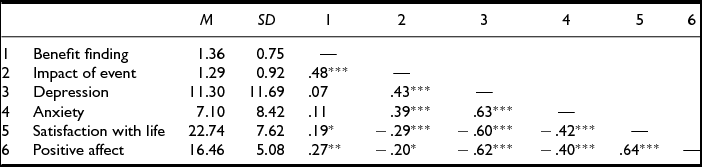
Bivariate correlations among benefit finding, the impact of the event, and the four indicators of adjustment are displayed in Table 1. The impact of the event was moderately correlated with benefit finding, such that participants who rated their intrusive thoughts, avoidance and hyperarousal symptoms following the breakup as more distressing found greater benefit following the breakup. Those who found greater benefit also reported better adjustment when adjustment was conceptualised as satisfaction with life and positive affect; however, benefit finding was not related to depression or anxiety. As expected, the impact of the event was positively related to the negative indicators of adjustment (depression and anxiety) and negatively related to the positive indicators of adjustment (satisfaction with life and positive affect), suggesting that the greater the impact of the breakup, the poorer the adjustment.
Descriptive Statistics and Bivariate Correlations for Key Study Variables
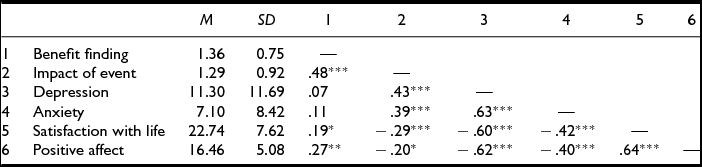
Note: N = 140, *p < .05, **p < .01, ***p < .001.
Hierarchical Multiple Regression Analyses
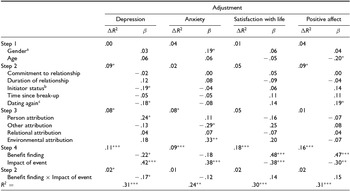
In order to examine the role of benefit finding in adjustment to a breakup as a function of the impact of the event, four hierarchical multiple regression analyses were performed, each predicting a different indicator of adjustment (depression, anxiety, satisfaction with life, positive affect). Prior to the entry of the key study variables into the regression equation we controlled for key demographic variables (age and gender) at Step 1 followed by breakup context variables at Step 2. Regarding breakup context variables, we controlled for participants’ rating of their perceived level of commitment to the relationship prior to the breakup, the duration of the relationship, who initiated the breakup, time since the breakup, and whether they were dating again. Because causal attributions about the breakup have been related to both a measure of positive change following a breakup (posttraumatic growth) and adjustment in previous research (Tashiro & Frazier, Reference Tashiro and Frazier2003), and all attributions (person, other, relational, and environmental) were positively related to both benefit finding and the impact of the event at the bivariate level, we entered the four attribution variables into the equation at Step 3. Benefit finding and the impact of the event were entered at Step 4, followed by their interaction term (benefit finding × impact of the event) on the last step, Step 5. All continuous variables were grand mean centred for entry into the regression analysis and the interaction term was formed with the centred benefit finding and centred impact of the event variables to guard against multicollinearity. The results for the regression analyses are summarised in Table 2.
Results of Hierarchical Multiple Regression Analyses Predicting Adjustment

Note: R 2 presented for the full model. Beta weights presented for point of entry into the regression equation. N = 140.aGender coded 1 (female), -1(male); bInitiator status coded 1(self-initated or mutual), -1(partner initiated); cDating again coded 1(yes), -1(no). *p < .05, **p < .01, ***p < .001.
The findings indicate that females are more anxious than males in this sample and that older participants have lower scores on positive affect. Those participants whose partner initiated the breakup scored higher on depression and those who were dating again post-breakup had less depression and greater positive affect. There was a significant positive relationship between person attribution and depression, such that those who attributed the breakup to something about themselves reported greater depression. Attributing the breakup to the other person (other attribution) was related to less anxiety, and attributing the breakup to something in the environment (environmental attribution) was related to greater anxiety. As expected, higher scores on benefit finding were related to better adjustment; however, this was only when adjustment was conceptualised as depression, satisfaction with life, and positive affect. Benefit finding was not significantly related to anxiety. The impact of the event was a significant predictor of all indicators of adjustment, such that higher scores on impact of the event were related to higher scores on depression and anxiety and lower scores on satisfaction with life and positive affect. The benefit finding by impact of the event interaction term was a significant predictor of depression only.
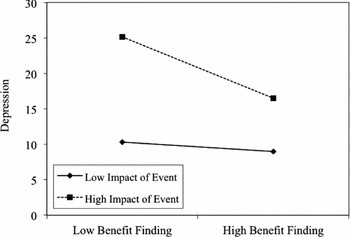
The significant interaction between benefit finding and the impact of the event is depicted in Figure 1 where it can be seen that for those who scored relatively high on impact of the event there is a significant negative slope (β = −.37, p = .002), but for participants with low scores on impact of the event, the slope did not differ significantly from zero (β = −.06, p = .633). This indicates that for participants who experienced the breakup as relatively distressing, benefit finding relates to less depression. However, for participants who experienced the breakup as relatively less distressing, benefit finding does not relate to depression.
The impact of the event moderated the relationship between benefit finding and depression. Depicted are slopes for 1 standard deviation above and 1 standard deviation below the mean for impact of the event.

Discussion
The purpose of this study was to examine whether finding benefits in a non-marital relationship breakup relates to better adjustment and whether this effect is moderated by the impact of the event. After controlling for demographic, breakup context and breakup attribution variables, we found that finding benefits was indeed related to better adjustment for all indicators of adjustment except anxiety. These results are consistent with previous research, such as that reviewed by Helgeson and colleagues (Reference Helgeson, Reynolds and Tomich2006), in which benefit finding was related to less depression and greater positive wellbeing, and unrelated to anxiety. The relationship between benefit finding and better adjustment for the sample participants provides support for the applicability of the integrated meaning making model (Park, Reference Park2010) to the experience of a non-marital breakup. Although the findings indicate that benefit finding following a non-marital relationship breakup plays a role in better psychological adjustment, it is possible that benefit finding may be an indicator of psychological resources or may even be an adjustment outcome in its own right. As such, benefit finding may be a positive outcome that is helpful for adolescents and young adults in terms of their likelihood of hoping for future relationship success, which may in turn increase their chances of experiencing the benefits of intimacy (Weber, Reference Weber and Cupach1998).
In order to examine the context in which benefit finding following a non-marital breakup may be most helpful, we examined the relationship between the impact of the breakup and benefit finding in addition to whether the impact of the breakup moderated the association between benefit finding and adjustment. At the bivariate level we found a positive correlation between the impact of the event and benefit finding, which is consistent with theoretical frameworks (e.g., assumptive worlds theory; Janoff-Bulman & Yopyk, Reference Janoff-Bulman, Yopyk, Greenberg, Koole and Pyszczynski2004) that purport that a certain degree of distress is necessary to drive a search for positive meaning (refer to Park, Reference Park2010 for a review). When adjustment was conceptualised as depression, we found that the impact of the breakup moderated the relationship between benefit finding and adjustment. Specifically, the findings indicate that benefit finding following a breakup is helpful in alleviating depression only in the case that the breakup was appraised to be highly stressful, as indicated by greater impact of the event. It may be that persons who experience greater impact of the event, including posttraumatric stress symptoms such as intrusive thoughts about the breakup, felt rejected or abandoned by their partner, and as such, benefit finding was helpful in alleviating depressive symptoms, such as feelings of worthlessness and inappropriate guilt (American Psychiatric Association, 1994).
Despite providing empirical evidence for the adaptive role benefit finding may play for an individual following a non-marital breakup, this study has a number of limitations. These limitations include the cross-sectional design, which limits inferences regarding the direction of the relationships reported, and the use of non-random sampling of individuals who have experienced a breakup, which may limit the generalisability of the findings. One particular implication of the non-random sampling in this study is that the sample is almost three-quarters female. Although we controlled for gender in the regression analyses, females have been found to find greater benefits than men following a range of stressors (see Helgeson et al., Reference Helgeson, Reynolds and Tomich2006 for a review) and the results of the present study are likely most representative of the female experience following a non-marital breakup. Nevertheless, this study has several methodological strengths, including the examination of a broad range of indicators of adjustment, the conceptualisation of benefit finding within an integrated theoretical framework, and the examination of adjustment to a non-marital breakup where the bulk of the relationship dissolution literature has focused on the breakdown of marital relationships. Non-marital relationship breakups are not only important to examine due to their frequency, but also due to the fact that they are important experiences that influence future dating and relationship choices (Weber, Reference Weber and Cupach1998).
Future research on the adjustment to non-marital relationship breakups should examine benefit finding and adjustment using a longitudinal framework in which specific benefit or growth categories following a relationship breakup are quantitatively examined. Following a breakup, a range of growth categories have been identified by Tashiro and Frazier (Reference Tashiro and Frazier2003), including person positives (e.g., I am more self-confident) and other positives (e.g., I now know what I want in a woman), which may have differential relationships with adjustment. In addition to examining different categories of benefit finding, it would be useful to examine the potential role of other indicators of meaning found, such as having ‘made sense’ of the breakup, on adjustment. The relationships found between different breakup attributions and adjustment in the present study indicate that this would be a fruitful avenue for future research. Breakup attributions may also be examined as mediators for the relationship between posttraumatic growth and adjustment in future research to examine the possible mechanism through which posttraumatic growth influences adjustment following a breakup. Finally, because people do not find meaning in a non-marital breakup in social isolation, future research could employ dyadic data analytic techniques (see Kenny, Kashy, & Cook, Reference Kenny, Kashy and Cook2006) to examine how a person finds meaning in their breakup through interpersonal processes, such as conversing with a close family member or friend about the breakup.
Given the dearth of research that examines the link between benefit finding and psychological adjustment outcomes following a non-marital relationship breakup, and in particular the role of the impact of the event in moderating the benefit finding-adjustment relationship, this study has provided empirical support for the beneficial role of benefit finding in the adjustment to relationship dissolution. Although further research is required, writing about the positive changes that an individual perceives following a non-marital breakup may be helpful (Lewandowski Jr., Reference Lewandowski2009). Such an approach may be most useful when the breakup is experienced by the person as particularly stressful, as indicated by posttraumatic stress symptoms, such as intrusive thoughts about the breakup and avoidance of stimuli associated with the breakup. In this respect, this research suggests the potential utility of meaning-focused counselling following a non-marital relationship breakup (e.g., Wong, Reference Wong, Wong and Fry1998).