Introduction
The genus Reptalus (Hemiptera: Cixiidae) includes 11 recognised species distributed in the temperate areas of central and southern Europe and the Mediterranean basin (Hoch, Reference Hoch2004 available online at ‘http://www.faunaeur.org’).
Though phylogenetic relationships between Reptalus and the other cixiid genera have been recently clarified (Ceotto & Bourgoin, Reference Ceotto and Bourgoin2008; Ceotto et al., Reference Ceotto, Kergoat, Rasplus and Bourgoin2008), the biology and behaviour of the Reptalus species remain poorly known because of the peculiar characteristics of this planthopper family. The lifecycle of cixiids is closely related to their host plants, which are exploited for feeding, mating and oviposition and serve as protection against predators (Wilson et al., Reference Wilson, Mitter, Denno, Wilson, Denno and Perfect1994; Sforza & Bourgoin, Reference Sforza and Bourgoin1998). Adult females lay eggs in the soil near the base of a host plant, and the five nymphal instars live underground and feed on its roots. Newly emerged adults fly to leaves and shoots for feeding and mating (Wilson & Tsai, Reference Wilson and Tsai1982; O'Brien & Wilson, Reference O'Brien, Wilson, Nault and Rodriguez1985). A broad host-plant range has been identified, and the available data indicate that different cixiid species belonging to the same genus may feed on distantly related plant families (Wilson et al., Reference Wilson, Mitter, Denno, Wilson, Denno and Perfect1994). The cixiids are mostly phloem-feeders, and their sap-sucking habit makes them potential vectors of phloem-inhabiting plant pathogens. Indeed, several species are known as vectors of viruses, bacterium-like organisms and phytoplasmas (Julia et al., Reference Julia, Dollet, Randles and Calvez1985; Danet et al., Reference Danet, Foissac, Zreik, Salar, Verdin, Nourrisseau and Garnier2003; Weintraub & Beanland, Reference Weintraub and Beanland2006). In Europe, several crops (beet, maize, strawberry, solanaceous and grapevine) are affected by different diseases vectored by cixiids (Sforza et al., Reference Sforza, Clair, Daire, Larrue and Boudon-Padieu1998; Danet et al., Reference Danet, Foissac, Zreik, Salar, Verdin, Nourrisseau and Garnier2003; Březíková & Linhartová, Reference Březíková and Linhartová2007; Jović et al., Reference Jović, Cvrković, Mitrović, Krnjajić, Redinbaugh, Pratt, Gingery, Hogenhout and Toševski2007; Bressan et al., Reference Bressan, Sémétey, Nusillard, Clair and Boudon-Padieu2008).
Within the genus Reptalus, some species have recently been noted as potential vectors of phytoplasmas belonging to the stolbur group (Candidatus Phytoplasma solani, 16SrXII-A genetic group). Individuals of Reptalus panzeri (Löw) collected in maize fields affected by maize redness, a disease recently associated to a phytoplasma infection (Duduk & Bertaccini, Reference Duduk and Bertaccini2006), tested positive for stolbur in PCR assays. In further studies, the efficiency of this species to transmit stolbur to healthy maize plants was confirmed by transmission trials in mesh cages (Jović et al., Reference Jović, Cvrković, Mitrović, Krnjajić, Redinbaugh, Pratt, Gingery, Hogenhout and Toševski2007). Some Reptalus species are also suspected to be vectors of a serious grapevine yellow, known as bois noir (BN). BN is an endemic stolbur disease of grape-growing areas in Europe, Asia Minor and the Mediterranean basin and has shown an increasing economic importance over the past years (Maixner, Reference Maixner2006). Although the only confirmed vector of BN is the cixiid Hyalesthes obsoletus (Signoret), R. panzeri and Reptalus quinquecostatus (Dufour) collected in affected vineyards have been found positive to stolbur phytoplasma (Palermo et al., Reference Palermo, Elekes, Botti, Ember, Alma, Orosz, Bertaccini and Kölber2004; Trivellone et al., Reference Trivellone, Pinzauti and Bagnoli2005; Riedle-Bauer et al., Reference Riedle-Bauer, Tiefenbrunner, Otreba, Hanak, Schildberger and Regner2006). It has also been demonstrated that R. quinquecostatus can successfully inoculate BN into an artificial feeding medium through parafilm (Pinzauti et al., Reference Pinzauti, Trivellone and Bagnoli2008). The potential involvement of Reptalus in phytoplasma transmission has prompted an active monitoring practice. The epidemiological studies and application of control strategies rely on careful surveys of the spread of cixiid species. The reliable identification of each species becomes essential, but may sometimes produce uncertain results. Identification of cixiids, including Reptalus, is based on morphological characteristics and restricted to a small number of specialist entomologists with broad experience of this insect family. Even for experts, the morphological distinction of closely related species remains difficult. Furthermore, the main taxonomic characteristics concern the male genitalia, thus hampering the identification of juveniles and adult females.
DNA-based approaches offer valuable support to traditional taxonomic methods and nowadays are widely employed for insect species identification. Considering both chromosomal and extra-chromosomal DNA, the ribosomal and mitochondrial regions have proven informative for taxonomic purposes. Notably, the internal transcribed spacer regions (ITS1 and 2) of the ribosomal operons are highly polymorphic and support phylogenetic analyses at species level (Li, Reference Li2007; Roe & Sperling, Reference Roe and Sperling2007). Among the mitochondrial sequences, the cytochrome oxidase I gene (COI) is frequently employed (Behere et al., Reference Behere, Tay, Russell and Batterham2008; Sinclair & Gresens, Reference Sinclair and Gresens2008) and has been chosen as the reference point for DNA barcoding, a universal system of animal species identification. DNA barcoding is based on the premise that sequence diversity within a short, standardised segment of the genome (on average 600–800 bp) can provide a ‘biological barcode’ that enables identification to the species level (Hebert et al., Reference Hebert, Cywinska, Ball and deWaard2003; Hebert & Gregory, Reference Hebert and Gregory2005). Previous studies have shown that the COI polymorphism can effectively resolve species recognition (Hebert et al., Reference Hebert, Penton, Burns, Janzen and Hallwachs2004; Hogg & Hebert, Reference Hebert, Penton, Burns, Janzen and Hallwachs2004; Smith et al., Reference Smith, Fisher and Hebert2005).
The aim of this study was to provide a molecular identification key of the most common European Reptalus species (Holzinger et al., Reference Holzinger, Kammerlander and Nickel2003; Hoch, Reference Hoch2004). We tested the reliability of both ITS2 and COI DNA polymorphisms for the identification of four species, R. quinquecostatus (subgenus Reptalus), Reptalus cuspidatus (Fieber) (subgenus Trepalus), R. panzeri (subgenus Reptalus) and Reptalus melanochaetus (Fieber) (subgenus Reptalus) and correlated morphological characteristics of the different species with species-specific DNA profiles.
Material and methods
Samples collection
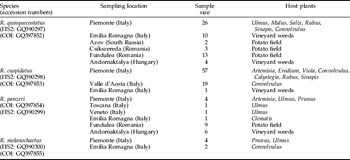
Adults of R. quinquecostatus (n=58), R. cuspidatus (n=77), R. panzeri (n=22) and R. melanochaetus (n=6) were field-collected from different Italian and eastern European regions during the summers of 2007 and 2008. Field surveys were mainly targeted at those plants known as potential hosts of the Reptalus species (Holzinger et al., Reference Holzinger, Kammerlander and Nickel2003; Mazzoni, Reference Mazzoni2005) and those potentially infected by stolbur phytoplasma (table 1).
Field-collected samples and their host plants.

Specimens of both sexes were preserved in absolute ethanol until their morphological identification and/or DNA extraction.
Morphological species identification
Specimens were individually identified with a stereo microscope and the external morphological features were used to determine family and genus. For species identification, male genitalia (aedeagus, parameres and anal tube) were carefully dissected and placed in a 10% potassium hydroxide solution for about one day in order to remove membranous soft tissues. This procedure also turns the male genitalia semi-diaphanous, which allows better visualisation of all the shape details (H. Hoch, personal communication).
DNA extraction
Total genomic DNA was extracted from individual planthoppers following the protocol described in Bosco et al. (Reference Bosco, Palermo, Mason, Tedeschi, Marzachì and Boccardo2002). Briefly, the ethanol-preserved adults were dried onto filter paper and homogenised in a CTAB-based buffer (2% w/v cetyl-trimethyl-ammonium-bromide (CTAB); 1.4 M NaCl; 20 mM EDTA pH 8.0; 100 mM Tris-HC1 pH 8.0; 0.2% mercaptoethanol). The male specimens were homogenised after removal of the aedeagus for morphological observation and species identification. After incubation at 65°C for 30 min, DNA was extracted with one volume of chloroform:isoamylalchool 24:1 solution and then precipitated with the addition of two volumes of absolute ethanol. The DNA pellet was then washed with 70% ethanol, vacuum dried and resuspended in 100 μl TE pH 8.0.
PCR and sequencing analyses
The amplification of the ITS2 region was carried out with the primers ITS2fw (5′-TGTGAACTGCAGGACACATG-3′) and ITS2rv (5′-ATGCTTAAATTTAGGGGGTA-3′), which respectively anneal on 5.8S and 28S ribosomal regions (Collins & Paskewitz, Reference Collins and Paskewitz1996). PCR was performed in 25 μl reaction volume containing: 1×PCR buffer (20 mM Tris-HCl pH 8.4, 50 mM KCl), 1.5 mM MgCl2, 200 μM of each dNTP, 0.5 μM of each primer, 1 unit of Taq polymerase (Invitrogen, Carlsbad, CA) and 50–150 ng of template DNA. The thermo-cycling conditions consisted of an initial denaturation cycle at 94°C for 5 min, 35 cycles at 94°C for 30 s, 58°C for 45 s and 72°C for 1 min and a final cycle at 72°C for 10 min.
A fragment of COI mitochondrial gene was amplified using the primers C1-J-2195 (5′-TTGATTTTTTGGTCATCCAGAAGT-3′) and TL2-N-3014 (5′-TCCAATGCACTAATCTGCCATATTA-3′) (Simon et al., Reference Simon, Frati, Beckenbach, Crespi, Liu and Flook1994). The PCR conditions were the same as described for ITS2 amplification, except the MgCl2 content (increased to 2.5 mM) and the annealing step (54°C for 1 min).
Products of both PCR assays were separated by electrophoresis onto a 1% (w/v) agarose gel and then directly purified from the amplification tube using the PureLinkTM PCR Purification Kit (Invitrogen, Carlsbad, CA, USA). The ITS2 and COI purified products were sequenced (Bio-Fab Research, Pomezia, Italy) in both directions using the respective forward and reverse primers. The mitochondrial and ribosomal consensus sequences of each Reptalus species have been deposited in GenBank (National Centre for Biotechnology Information, NCBI). Accession numbers for ITS2 sequences: GQ390297–GQ390300; accession numbers for COI sequences: GQ397852–GQ397855 (table 1). COI sequences are also available in Barcode of Life databank.
RFLP analysis
Restriction sites on both ITS2 and COI sequences were predicted using Webcutter 2.0 (available online at ‘http://rna.lundberg.gu.se/cutter2/’). The ITS2 fragments amplified from the R. cuspidatus and R. panzeri species were digested with the TaqI restriction enzyme at 65°C for 2 h. COI amplicons from all tested species were subjected to AluI restriction activity at 37°C for 2 h.
For both ITS2 and COI samples, 5 μl of PCR product was digested with one unit of the proper enzyme in a 15 μl reaction volume, according to the manufacturer's instructions (Invitrogen, Carlsbad, CA, USA). The restriction fragments were separated by electrophoresis on 2% (w/v) 1×TBE agarose gels (MetaPhore agarose for resolution of small nucleic acids; Cambrex, Rockland, ME, USA) at 70 V for 2 h and stained with ethidium bromide.
Results
Morphological species identification
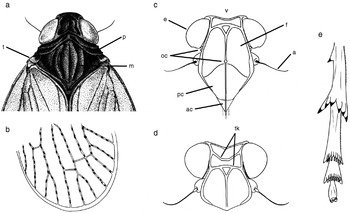
A brief review of the external characteristics for identifying cixiids among the different Auchenorrhyncha taxa is given. The main features of the infraorder Fulgoromorpha are (i) the presence of a tegula at the base of each forewing (fig. 1a) and (ii) two typically ‘Y-shaped’ anal veins on the clavus. A short anteclypeus and the median coxae clearly separated at the base are also present.
External morphological features of Reptalus genus: (a) head and thorax; t, tegula; p, pronotum; m, mesothorax with five evident carinae; (b) tip of a forewing showing the veins with tubercles; (c) head of R. quinquecostatus in frontal view; a, antenna; ac, anteclypeus; e, eye; f, front; oc, ocelli; pc, postclypeus; v, vertex; (d) detail of vertex; tk, transverse keels; (e) hind tarsus of R. cuspidatus (subgenus Trepalus) showing the first segment with spines bearing platellae.

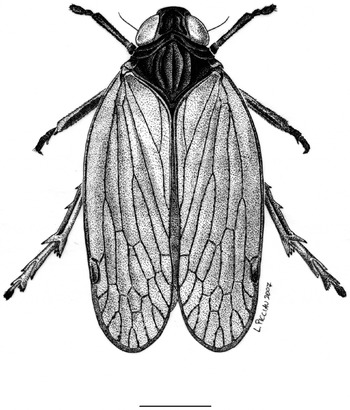
The family Cixiidae is quite easily distinguishable from the other Fulgoromorpha by the large and transparent forewings, surpassing the tip of the abdomen, with distinct venations, often with tubercles (fig. 1b). These forewings are held roof-like in the rest position and sometimes overlap slightly apically. The frons is wide, with three keels giving a distinctive aspect to the species belonging to this family. Three ocelli are normally present, two laterally and one in the middle on the frons (fig. 1c). The pronotum is short and collar-like. The mesonotum is quite large, subtriangular and bears three or five longitudinal carinae (fig. 1a). The hind tibiae have a row of apical spines and no movable spurs. The genus Reptalus differs from the other genera principally by bearing five distinct longitudinal carinae on the mesonotum (fig. 1a), and two transverse keels on the head (fig. 1d). The size of the body normally exceeds 5 mm in length. The first segment of the hind tarsus bears apical spines with platellae (macrochaetae) in the subgenus Trepalus (fig. 1e); platellae are absent in the subgenus Reptalus. Finally, the head in lateral view appears obtuse (Ossiannilsson, Reference Ossiannilsson1978; Holzinger et al., Reference Holzinger, Kammerlander and Nickel2003; Wilson, Reference Wilson2005). An overview of the insect body is given for R. quinquecostatus (fig. 2).
Reptalus quinquecostatus: habitus in dorsal view. Scale bar: 1 mm.

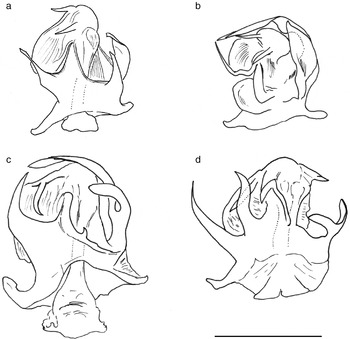
The Reptalus species identification mainly relies on the shape of the aedeagus. The drawings representing the aedeagi of the four considered species are provided in fig. 3 in order to show the distinctive features. Parameters and anal tube are omitted.
Aedeagi of the four Reptalus species: (a) R. quinquecostatus, ventral view. (b) R. cuspidatus, ventral view. (c) R. panzeri, ventral view. (d) R. melanochaetus, ventral view. Scale bar: 0.5 mm.

ITS2 sequence: PCR and RFLP analyses
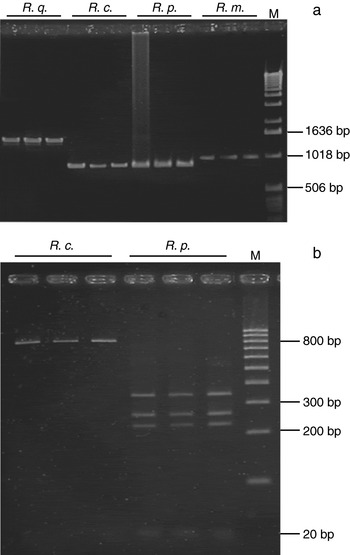
The ITS2 region was successfully amplified from each of the four Reptalus species, providing fragments with the following sizes: 1450 bp for R. quinquecostatus; 850 bp for R. cuspidatus and R. panzeri; and 960 bp for R. melanochaetus (fig. 4a). The four species shared a similar sequence within the first 200 bp and the last 550 bp of the ITS2 region (range of similarity scores: 89–93%); a diverse number of repeats occurred between these two ends, leading to different fragment lengths.
(a) agarose gel electrophoresis of ITS2 PCR products from the four Reptalus species. R.q., R. quinquecostatus; R.c., R. cuspidatus; R.p., R. panzeri; R.m., R. melanochaetus; M: molecular weight marker (1 kb ladder); (b) RFLP profile after TaqI digestion of the ITS2-PCR product for the two species R. cuspidatus and R. panzeri. R.c.: R. cuspidatus; R.p.: R. panzeri; M: molecular weight marker (100 bp ladder).

The sequence analysis revealed no polymorphism among the individuals belonging to the same species and, consequently, no differences amenable to the geographical origin, host plant or sex were noticed. The absence of polymorphism at the intra-specific level led us to exclude any variability among the different ribosomal units within the same individual genome.
The ITS2 amplicon length polymorphism did not enable us to distinguish between the R. cuspidatus and R. panzeri species. In this case, the correct species identification was achieved by further performing a RFLP assay. The TaqI digestion produced four restriction fragments for R. panzeri (∼20 bp, ∼230 bp, ∼260 bp, ∼340 bp), while no TaqI restriction sites were present within the R. cuspidatus sequence (fig. 4b).
COI sequence: PCR and RFLP analyses
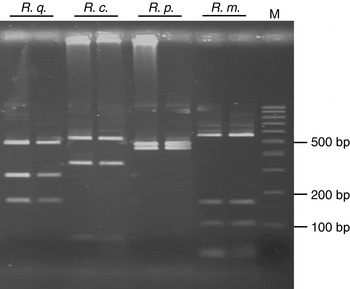
Amplification of the mitochondrial COI gene from all tested individuals always provided a 920 bp fragment. The alignment of the COI sequences revealed a certain degree of polymorphism among the four different species, while no variability was recorded within the same species. Polymorphisms were found at the AluI recognition site (AGCT), generating species-specific digestion patterns (fig. 5). According to the mutation points revealed by sequencing, the endonuclease activity produced three restriction fragments for R. quinquecostatus (∼170 bp, ∼260 bp, ∼490 bp) and R. cuspidatus (∼80 bp, ∼330 bp, ∼510 bp), two restriction fragments for R. panzeri (∼440 bp, ∼480 bp) and four restriction fragments for R. melanochaetus (∼60 bp, ∼120 bp, ∼170 bp, ∼570 bp) (fig. 6). The smallest fragments (60 bp for R. melanochaetus and 80 bp for R. cuspidatus), even though faint, could be detected by agarose gel electrophoresis. The RFLP patterns were constant within each species, confirming the absence of variability at an intra-specific level.
AluI restriction sites of the four Reptalus species.

RFLP profile after AluI digestion of the COI-PCR product for the four Reptalus species. R.q., R. quinquecostatus; R.c., R. cuspidatus; R.p., R. panzeri; R.m., R. melanochaetus; M: molecular weight marker (100 bp ladder).

Discussion
This study provides a comprehensive description of both morphological and molecular tools for species discrimination within the genus Reptalus. R. cuspidatus and R. panzeri were abundant in Italy and eastern Europe, respectively, while R. quinquecostatus was widespread in all the considered areas. R. melanochaetus was shown to be less represented in the investigated areas, according to Mazzoni (Reference Mazzoni2005), who did not report this species in his recent surveys of Auchenorrhyncha in Tuscany, Central Italy.
Two different DNA regions, ribosomal ITS2 and mitochondrial COI, allowed discrimination at the species level. Both sequences diverged among the four Reptalus species and were suitable for correctly assigning the individuals to each species in accordance with the previous morphological identification. The absence of within-species polymorphisms proves the species-specificity of both ITS2 and COI markers.
The ITS2 PCR allowed us to recognise two of the four Reptalus species directly by amplicon size polymorphism. A further RFLP analysis was required when an 850 bp fragment, corresponding to both the R. cuspidatus and R. panzeri species, was amplified. Despite their length polymorphism, ITS2 sequences possess similar regions in all of the four species. It is possible that such conserved domains were part of a precursor rRNA and have been differently truncated or extended during rDNA duplication. This could have produced diverse sequences or alleles then become fixed separately during speciation (Koekemoer et al., Reference Koekemoer, Misiani, Hunt, Kent, Norris and Coetzee2009).
Hence, the ITS2 region provided the simplest tool for rapid Reptalus identification because the PCR assay was sufficient for recognising at least two species. Unambiguous species discrimination also can be achieved by routinely performing RFLP assays on COI-PCR products. In this case, the sole AluI enzyme allowed clear differentiation of the four species with a unique restriction reaction.
The reliability of the ITS2 and COI markers has been tested on different populations from different sites in Italy and eastern Europe and no polymorphisms ascribable to the geographic origins have been noticed. The two regions also showed stable PCR or RFLP patterns irrespective of the different plants hosting the insects. Given their conservation and specificity, both ribosomal and mitochondrial regions can be considered potential identification keys. These new tools require rapid and handy procedures and may contribute to broadening the current handful of competent scientists in cixiid identification. Furthermore, the variation in Reptalus COI gene should be considered for future DNA barcode analyses on cixiid species. The correspondence between morphological and COI-based identifications suggests that this short DNA fragment can be a good identifier for this insect family. The presence of cixiids in barcoding databases has been restricted to very few species, and the uploading of Reptalus COI sequences may enrich this universal and easily accessible identification system.
Both COI and ITS2 sequences can be efficiently applied to the species identification of juveniles and females, for which a morphological identification tool is unavailable. From this perspective, this work represents a useful contribution to faunal studies and insect vector monitoring. First, the ability to correctly identify nymphs allows the collection period to be extended to the whole year, making possible a longer monitoring activity from the current couple of months when adults are present. Second, while adults tend to rapidly disperse and can have a more polyphagous feeding habit, nymphs are harboured exclusively on the root system, making feasible the unambiguous association with their actual host plants. So far, breeding plants of R. cuspidatus, R. melanochaetus, R. panzeri and R. quinquecostatus are unknown and, during our surveys, we were able to definitely associate R. cuspidatus with Artemisia verlotiorum Lamotte since many larvae were found on its roots.
The correct identification of the Reptalus host plants, together with the identification of plants that can act as a reservoir of plant pathogens for crop species, is of fundamental importance in designing a rational control strategy. The same total DNA preparations from Reptalus spp. can serve as a PCR template for insect species and stolbur phytoplasma identification (data not shown).
In conclusion, this study provides fast and reliable assays for the correct identification of four Reptalus species. Morphological features are suggested for genus identification while species discrimination within the genus can be easily achieved with ITS2 and/or COI sequence analysis. The integration of morphological and molecular approaches provides useful help in monitoring activities and the rational control of potential vector species.
Acknowledgements
The authors would like to thank all the people who kindly helped in sample collection, particularly Mirko Bacchiavini and Pasquale Mazzio (Consorzio Fitosanitario Provinciale of Reggio Emilia), Ruggero Mazzilli, Paolo Fontana and Mauro Daccordi. The authors also thank Federica Tota for helping in laboratory analysis and Prof. Hannelore Hoch for her precious advices. This work was supported by the Piemonte Region and the MIUR-PRIN 2008.