INTRODUCTION
For decades, nature conservation in Africa was driven almost exclusively by a top-down, centrally planned approach, often in the form of socially exclusive national parks and protected wilderness areas (Inamdar et al. Reference Inamdar, de Jode, Lindsay and Cobb1999). Consequently, the people living in such areas lost their entitlements to the natural resources. Harvesting natural resources became illegal and was fined. In many cases, this ‘fences and fines’ approach adversely affected nature conservation because people lost the incentive to manage resources sustainably (see, for instance, Murombedzi Reference Murombedzi1998). This conservation approach was dominant up to the third quarter of the 20th century. Thereafter, purely protectionist approaches to nature conservation became less popular (Inamdar et al. Reference Inamdar, de Jode, Lindsay and Cobb1999) and there was a shift in the dominant narrative of ‘fortress’ conservation to a new narrative; namely ‘community-based conservation’ (Adams & Hulme Reference Adams and Hulme2001). Baldus (Reference Baldus1987) and Murphree (Reference Murphree1996, Reference Murphree, Baldus and Siege2001) state that incorporating communities in the conservation of nature started in the 1980s. This approach has become known as ‘conservation with the people’.Footnote 1 It is worth mentioning that the focus on the community was in line with the general paradigm shift in development towards the inclusive approaches advocated at the beginning of the 1980s, as a result of the perceived general failure of top-down approaches. For once, the ‘community’Footnote 2 that hitherto had mostly been perceived as a hindrance to conservation and social change was re-positioned as the key to decentralised development, meaningful participation and the long-term sustainable management of natural resources (Agrawal & Gibson Reference Agrawal and Gibson1999). In recognition of some of the failures associated with exclusive and centrally planned protected area conservation, community-based conservation, despite being expensive and showing ambiguous conservation benefits, was lauded as a win-win approach. Community-based conservation normally entails three objectives: (1) sustainable tenure of nature by (2) involving indigenous peoples and local institutions and legitimising local knowledge and traditional property rights; and (3) equitable sharing of natural resource management benefits. Adhering to these objectives ought to facilitate poverty alleviation and natural resource conservation (Schlager & Ostrom Reference Schlager and Ostrom1992; Inamdar et al. Reference Inamdar, de Jode, Lindsay and Cobb1999; Kellert et al. Reference Kellert, Mehta, Ebbin and Lichtenfeld2000; Hulme & Murphree Reference Murphree, Baldus and Siege2001; Igoe Reference Igoe2006).
While a romantic view of the concept of community seems to be maintained by its proponents based on its purported contribution to sustainable development, poverty alleviation and the management of natural resources, practical implementation has frequently fallen short of expectations (Leach et al. Reference Leach, Mearns and Scoones1999; Ndenecho Reference Ndenecho2007). Supportive empirical evidence remains sparse and, at best, mixed (Inamdar et al. Reference Inamdar, de Jode, Lindsay and Cobb1999). Yet Baldus (Reference Baldus2009) rightly claims that community-based conservation strategies reflect socio-economic principles, which are of universal relevance for broad-based, people-centered and poverty-oriented development. As such, this new paradigm, although not always working in the way and at the speed that one would like, should not be abandoned too easily and too quickly. In fact, it should be asked more frequently if and how we have overlooked ways of strengthening this presumed win-win approach.
Information on intra-community dynamics with regard to exclusive behaviour is hard to find (Agarwal Reference Agarwal2001) and existing differences in perceptions, conservation practices and livelihoods between households that are directly involved in the natural resource management institutionsFootnote 3 and those that are not are extremely scarce. Exceptions include, for instance, Cartwright (Reference Cartwright1991) and the comprehensive work of Hulme & Murphree (Reference Murphree, Baldus and Siege2001) on community participation and wildlife conservation. Recently, empirical results have been made available from the research programme on the stability of rainforest margins in Indonesia, concisely compiled by Stietenroth et al. (Reference Stietenroth, Wolfram, Tarigan and Malik2005). In addition, Baldus (Reference Baldus2009) summarises the experiences and lessons learnt from three decades of community-based wildlife conservation in Africa.
This paper focuses on the impact of community-based forest management on livelihoods and wildlife conservation around the Kilum-Ijim Mountain Forest in Cameroon. It analyses comparatively the socio-cultural, economic and institutional situation for a random sample of households from six communities in two divisions of Northwest Cameroon (Elak and Jikijem in Bui division; Mbessa, Ajung, Mbi and Anyajua in Boyo division) currently involved in community forest management in the Kilum-Ijim Mountain Forest area. Wildlife (bushmeat) consumption patterns and perceptions about wildlife domestication are analysed and discussed in order to identify intra-community differences with regard to the appropriation or conservation of resource units in the community forest. The focus on bushmeat consumption is deliberate. It arises from the premise that in many developing countries, particularly in forest-adjacent communities, people often resort to wildlife to meet their meat and protein demands (Wilkie et al. Reference Wilkie, Starkey, Abernethy, Nstame Effa, Telfer and Godoy2005). For instance, in Cameroon, Ivory Coast and Liberia, sections of the population depend on bushmeat for up to 70% of their protein needs (Geisendorf et al. Reference Geisendorf, Gronemann and Hampicke1998; Ndenecho Reference Ndenecho2007). Why these people eat wildlife is debated and can be rooted in price and/or socio-cultural factors such as bushmeat being familiar, conferring prestige, and tasting good. Wilkie et al. (Reference Wilkie, Starkey, Abernethy, Nstame Effa, Telfer and Godoy2005) found for Gabon that consumption of meat, among others bushmeat, responds to changes in household wealth and bushmeat prices. Consumption of bushmeat rose with household wealth and fell when the price of bushmeat increased. Consequently, they suggest regulating unsustainable exploitation of forests in terms of wildlife through economic levers.
Of particular interest in this paper is an assessment of any differences between households that are members of forest management institutionsFootnote 4 and thus legally manage the community forest (supposedly having more access to and control over forest resources) and those that are not, with a focus on wildlife consumption and conservation.
The paper is organised as follows. The concept of community will be briefly reviewed in the next section. The background and history of the Kilum-Ijim Mountain Forest and the studied community forests will then be discussed, followed by the applied methodology and the results. The final section concludes.
THE CONCEPT OF COMMUNITY RE-VISITED
Far from being an innovation, bringing the community back into the research and policy agendas in the second half of the 20th century was a deliberate attempt to re-attribute relevance to an established theory. The concept of community dates back to the works of 19th century scholars such as the German sociologist, Ferdinard Tönnies. Tönnies (Reference Tönnies1887) distinguished between Gemeinschaft (‘community’) and Gesellschaft (‘society’ or ‘association’). Tönnies argued that Gemeinschaft (‘community’), on the one hand, should be perceived to be a tighter and more cohesive social entity due to the presence of a unity of will. Family, kinship, place or belief could also result in Gemeinschaft (‘community’). Gesellschaft (‘society’ or ‘association’) on the other hand denotes a group in which the individuals who make up that group are motivated to take part in its functioning purely by self-interest (Agrawal & Gibson Reference Agrawal and Gibson1999). Self-interest was predicted to accompany the modern society and dominated scholarly thinking in the 19th and early 20th century. Community was therefore seen as a threat to conservation. This strongly influenced development thinking at the time (ibid.). Thus the concept of community as networks of shared social understanding has been applied to multiple cultures in many places throughout history, gaining importance in the latter part of the 19th century.
The industrial revolution and the evolution of modern society that characterised the early 20th century eroded the concept of community in favour of marketisation and urbanisation (Berkes Reference Berkes2004). People were seen to be a threat to conservation, and the Leviathan spiritFootnote 5 – in the sense that a ‘strong decision maker’ is an indispensable component of any successful social contract – was considered to be the true solution to avoiding resource degradation. In addition, as society evolved towards modernisation, tradition, charisma, community spirit and religion increasingly gave way to modernity, equality, rationality and scientific temper. Social change theorisation ‘automatically pits community against [evolving] markets, since marketisation, urbanisation [and modernisation] erode community’ (Agrawal & Gibson Reference Agrawal and Gibson1999: 630). A more conventional emphasis on a centralised, command-and-control resource system was based on a mechanistic view of nature. The emerging view was aimed at reducing natural variation and making ecosystems more productive, predictable and controllable. Social change would liberate humanity from the coercive and limiting idiocy of rural life to which community adheres. In other words, the community was expected to disappear with modernisation (Agrawal & Gibson Reference Agrawal and Gibson1999; Berkes Reference Berkes2004). The outcome of this ideology on natural resource management was an enforcement of top-down approaches backed by international conservation agencies and protected areas (such as national parks), often moderated by international conventions and national legal frameworks.
Although it is now fashionable and apparently politically correct to adhere to community-based nature conservation, Baldus et al. (Reference Baldus, Hahn, Kaggi, Kaihula, Murphree, Mahundi, Roettcher, Siege and Zacharia2001) and Baldus (Reference Baldus2009) rightly point out that, although failures exist, national parks and protected areas with finite borders can work, not everywhere in Africa, but in many places – Tanzania being a prominent example. Nevertheless, purely protectionist approaches to nature conservation have become less popular (Inamdar et al. Reference Inamdar, de Jode, Lindsay and Cobb1999) and community-based conservation took off in the 1980s (Baldus Reference Baldus2009). Since then the ‘community’ has occupied the locus of conservation thinking. In this paradigm, increased attention has been focused on the interactions between communities and natural systems, and there has been a deviation from considering people as mere managers or stressors of socio-ecological and natural systems (Hulme & Murphree Reference Murphree, Baldus and Siege2001; Berkes Reference Berkes2004). The limited capacity of states and markets to enforce unpopular development and conservation programmes was often overly emphasised, and pro-community scholars increasingly demonstrated the potential of community participation in the management of natural resources as a sustainable alternative to states and markets in the local commons (Ostrom Reference Ostrom1990; Cartwright Reference Cartwright1991; Leach et al. Reference Leach, Mearns and Scoones1999). According to these scholars (and respectively the property rights and governance theory), whenever communities are involved in conservation, the benefits they receive create incentives for them to become good stewards of sustainable resource management. The latter part of the 20th century, therefore, saw a policy shift towards the devolution of conservation to local communities both at the level of policy making and actual implementation. Thus, bringing the community back into the conservation debate was recognition of the need to reconsider human beings and their interactions with the nature on which they depended for a substantial part of their livelihoods. The ‘new’ concept of the community and its seemingly theoretical attractiveness created overly ambitious expectations. As reported by Baldus et al. (Reference Baldus, Hahn, Kaggi, Kaihula, Murphree, Mahundi, Roettcher, Siege and Zacharia2001: 3), ‘expectations [were] sometimes unrealistic, and some agencies which have propagated ‘fences and fines’ for decades were jumping to the other extreme: Forget the stick, offer carrots on a silver plate and people will protect their wildlife. Unfortunately, it is not that easy [in practice].’
However, the return of the community into the political and scholarly debate was flawed with conceptual problems. The community was construed either as a spatial unit, a homogeneous social structure, or an entity with shared interests and norms (Agrawal & Gibson Reference Agrawal and Gibson1999). In other words, community was conceptualised either as people living together, endowed with similar assets and incomes, having internalised norms of behaviour or as various combinations of individual conceptualisations. This affected both the implementation outcomes of community resource management, and the level of analysis. Consequently, the concept of community as applied needs to be carefully defined in each case, as the term community or community-based conservation embraces a glossary for a multiple scale complexity (Berkes Reference Berkes2004). The outcome was an emergence of complex analytical and devolutionary approaches encompassing multiple actors, local level processes and institutions for community level conservation (Ostrom Reference Ostrom1990; Schlager & Ostrom Reference Schlager and Ostrom1992; Leach et al. Reference Leach, Mearns and Scoones1999; Williamson Reference Williamson2000). New community-oriented frameworks for analysis such as the Nature, Wealth and Power Framework (Decker & Raik Reference Decker and Raik2007) were consequently developed and applied in various communities and an increase of empirical evidence for successful community resource management emerged in the literature (Coldham Reference Coldham1995; Kellert et al. Reference Kellert, Mehta, Ebbin and Lichtenfeld2000; Agarwal Reference Agarwal2001; Hulme & Murphree Reference Murphree, Baldus and Siege2001; Springate-Baginski et al. Reference Springate-Baginski, Dev, Yadav and Soussan2003; Stietenroth et al. Reference Stietenroth, Wolfram, Tarigan and Malik2005; Ellis & Porter-Bolland Reference Ellis and Porter-Bolland2008).
The Cameroonian 1994 Forestry Law perceives community as a spatial unit. According to this law, a community forest is ‘a forest forming part of the non-permanent forest, which is covered by a management agreement between a village community and the Forestry Administration. Management of such forests is the responsibility of the village communities concerned, with the help of technical assistance of the Forestry Administration’ (Ministry of Environment and Forestry, Cameroon 1998: 9). Subsequently, this paper adopts the view of community as meaning a spatial unit.
COMMUNITY FOREST MANAGEMENT AROUND THE KILUM-IJIM MOUNTAIN FOREST IN CAMEROON: HISTORY AND CONTEXT
Empirical evidence about the impact of community forests on livelihoods and conservation have been mixed. Kellert et al. (Reference Kellert, Mehta, Ebbin and Lichtenfeld2000), for instance, report that community-based conservation in Kenya and Nepal did not result in an equitable distribution of power and economic benefits, nor did it reduce conflict or enhance sustainable natural resource management or the protection of biodiversity. Cartwright (Reference Cartwright1991) presents the implications of community participation for conservation on the African continent. Coldham (Reference Coldham1995) and Hulme & Murphree (Reference Murphree, Baldus and Siege2001) discuss this issue at length, reporting successes as well as problems encountered by implementing the approach in Eastern Africa. Ellis & Porter-Bolland (Reference Ellis and Porter-Bolland2008) conclude that community-managed forests were more effective than state-protected areas in the central Yucatan Peninsula, Mexico. Studies that seek to understand intra-community dynamics in community resource management are scarce. In her study of community forest groups in India and Nepal, Agarwal (Reference Agarwal2001) demonstrates that women were excluded. Research on intra-community dynamics can therefore allow for a deeper understanding of the successes or failures of, and inequalities attributable to, community forest management. This empirical research contributes to this literature by examining differences in households between those that do and those that do not have access to the forest management institutions responsible for community forest management. These households live in six villages around the Kilum-Ijim Mountain Forest Reserve on the massif of Mount Oku and its foothills in Northwest Cameroon.
The Kilum-Ijim Mountain Forest is the largest remaining representative fragment of Afro-montane forest in West Africa, covering a total area of over 20,000 hectares. It is a globally important centre of endemism (Penn & Gardner Reference Penn and Gardner2000; Maisels et al. Reference Maisels, Cheek and Wild2000, Reference Maisels, Kerning, Kernei and Toh2001; Ndenecho Reference Ndenecho2007). The large and ever-growing population around the forest reachable within a day's walk was estimated at around 370,000 inhabitants in 2011 (up from about 300,000 persons in 2001) and is spread over 34 different communities. This population has been heavily dependent on the forest for an important part of its livelihood resources. Initial attempts to conserve this forest date back to 1931 when the conservator for the Bamenda division proposed a boundary for the then Oku Mountain Forest. Subsequent efforts by the government to gazette the area failed due to objections from adjacent populations. Conservation efforts were understood locally to be depriving the rural and indigenous populations of the resource base, including access to bushmeat, necessary for survival (Ngwa & Fonjong Reference Ngwa and Fonjong2002). However, in 1975 a boundary was forcefully established but, as could be expected, was not universally respected by the adjacent populations (Penn & Gardner Reference Penn and Gardner2000; Cheo Reference Cheo2011). So it came as no surprise that by 1986 the forest had reduced in size by 50% of its 1963 area – primarily due to agricultural exploitation (Penn & Gardner Reference Penn and Gardner2000; Ndenecho Reference Ndenecho2007).
In the spirit of the time, the Kilum-Ijim Mountain Forest Project was launched in 1987 to work with local communities (see note 1 for the chronology of approaches in nature conservation). The aim was to conserve the remaining forest and stop the depletion of the associated resources in collaboration with traditional authorities and the government. Preliminary studies by the Kilum-Ijim Mountain Forest Project (a joint project of Bird Life International – UK and the Cameroon government) confirmed that the forest was still host to a large number of rare plants and animals, including 15 montane bird species endemic to Cameroon and six species of mammals, 11 amphibians and 40 plant species endemic to the Cameroon Highlands (Maisels et al. Reference Maisels, Cheek and Wild2000, Reference Maisels, Kerning, Kernei and Toh2001; Penn & Gardner Reference Penn and Gardner2000). Most mammals are considered edible by the local people and many species are also used in traditional medicine or for ceremonies. Maisels et al. (Reference Maisels, Kerning, Kernei and Toh2001) pessimistically state that no sustainable off-take of wild animals will ever be possible in the Kilum-Ijim Forest beyond a few grams of bushmeat per person per year. Nevertheless, the indigenous desire for bushmeat consumption has continued to be a prime motivation for community-based conservation in the research region as a result of its special taste and attractive market price compared with other meat (Wilkie et al. Reference Wilkie, Starkey, Abernethy, Nstame Effa, Telfer and Godoy2005). In addition, the reinforcement of existing forests with Pygeum africanum – a plant whose bark is extracted for medicinal purposes – is perceived alongside predicted eco-tourism potential to be a long-term income-generating activity which communities engaged in community forest management expect to benefit from continuously in the future.
The Kilum-Ijim Mountain Forest Project became operational between 1987 and 1992 with the double objective of including local community participation in forest management and respecting the government's intention of gazetting the forest as a State reserve. By 1994, a Forestry Law (Republic of Cameroon 1994; Ministry of Environment and Forestry, Cameroon 1998) was promulgated, providing a legal framework for the establishment of legally recognised community forests in Cameroon. According to this law (and its accompanying decree of 1995), the government services in charge of forestry were to freely support interested communities to obtain legal approval for community forests, based on approved forest management plans and respecting the conditions laid down in the 1994 Forestry Law. Since then, communities have legally established community forests managed by elected community members, based on management plans approved by the appropriate government service. This article focuses on the sustainable livelihoods dynamics in six legalised community forests in the Kilum-Ijim Mountain Forest area.
RESEARCH METHODOLOGY
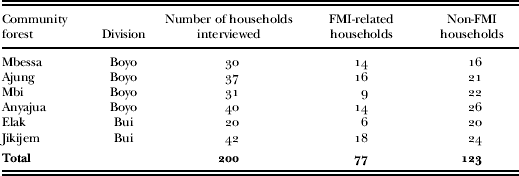
Although a broad-based socio-economic research approach was implemented, increased attention was placed on bushmeat because of its well-known importance as a key source of protein and income for forest-adjacent communities (Geisendorf et al. Reference Geisendorf, Gronemann and Hampicke1998; Mockrin et al. Reference Mockrin, Miranda, Bennett and LaBruna2005; Wilkie et al. Reference Wilkie, Starkey, Abernethy, Nstame Effa, Telfer and Godoy2005; Ndenecho Reference Ndenecho2007). Empirical research was carried out between December 2010 and March 2011 in six forest-adjacent villages in two Divisions (Bui and Boyo) forming part of the Kilum-Ijim Mountain Forest Project in the Northwest Region of Cameroon. The randomly selected survey villages were all actively involved in community forest management and had existing community forests with demarcated boundaries legally approved by the Cameroon government. The population of interest included households situated in villages involved in community-based forest management. The sampling unit was the household. In the first survey round, a standardised socio-economic questionnaireFootnote 6 was employed to collect primary data on 200 random households from the six villages (namely: Elak and Jikijem in Bui division; Mbessa, Ajung, Mbi and Anyajua in Boyo division; see Table 1 for exact number of households). The households were drawn from a list of names drawn up with the help of traditional leaders in the six communities. All other households were placed on a replacement list, in case a randomly selected household could not be interviewed. This survey procedure excludes the coverage error by relying on a complete list of all households in the survey villages. It was felt that the non-response error could be neglected because recourse to the replacement list was infrequent given that only five randomly selected households could not be interviewed. As described below, the questionnaire modules were well tested and the interviewers well trained. Furthermore, the questions were posed in the local language. Therefore, confidence that measurement errors were negligible during the survey is justified.
Household sample
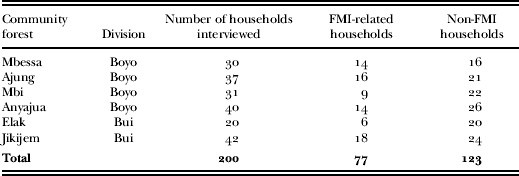
Source: Authors’ survey.
Note: FMI, Forest Management Institution.
The sample of 200 randomly interviewed households was made up of both households which were members of a community forest management institution (77 households: the test sample) and households which were non-members (123 households: the matching sample). This ratio of member to non-member households follows the recommendation of Henry et al. (Reference Henry, Sharma, Lapenu and Zeller2003) who suggest a ratio of about 2 : 3. Thus, this sample of observations allows the analysis of whether having access to the forest management institution and the related greater control over resources creates incentives for rent seeking.
The basic socio-economic questionnaire for the survey has been used and tested several times, including in the Cameroonian context. Gosh & Glewwe (Reference Gosh and Glewwe2000) is a major academic source in this context. Overall, the topical structure of the questionnaire follows the concept of sustainable livelihoods (Chambers & Conway Reference Chambers and Conway1992; Carney Reference Carney1998). The module for the comparative poverty assessment was based on Henry et al. (Reference Henry, Sharma, Lapenu and Zeller2003). Well-tested questionnaire modules allowing for community-sensitive poverty assessment appeared ideal for the research question at hand. The new module referring to community-based forest management and bushmeat dynamics solicited information related to natural, physical and social capital. The questions with regard to natural capital served to determine whether the land and its yield was sufficient to support the family: knowledge about physical capital, including the animal stock (i.e. the stock of giant cane rats if any) is crucial for evaluating the present wealth status and future prospects. The questions on social capital explored whether it actually can open the door to resources from the community-managed forest. Additional questions dealt with the perceptions related to bushmeat harvesting, consumption and long-term food security as well as the rules (institutions) behind the community-based forest management. The full questionnaire is obtainable from the authors on request.
A structured interview guide was used for qualitative data collection during the second survey round amongst representatives of forest management institutions, hunters, bushmeat traders and other local resource persons. Secondary data on the legal framework for community forests in Cameroon was obtained from government and non-governmental organisations (NGOs) with working experience in community forestry. Specific information on species nomenclature was provided by a former ecological monitoring technician of the Kilum-Ijim and Bamenda Highlands projects.
It is worth mentioning that research in the Kilum-Ijim area cannot be easily situated within a systematic or structured research or policy agenda in spite of the tremendous work that has been done in this area in the past.Footnote 7 This research can, however, be placed under the currently observed government-led institutional change process towards decentralisation and the gradual transfer of power to local branches of government. Understanding local level dynamics can enhance the decentralisation process.
The t-test for equality of means (using SPSS version 17) is employed because this is a straightforward statistical approach that best suits the qualitative nature of the topic with regard to interpreting power. The results are related to theory and to earlier empirical findings. Within the t-test for equality of means, member households (test sample) and non-member households (matching sample) of the community forest management institution are compared. Due to time and cost limitations, the sample was restricted to 200 households which form over 50% of the test sample and about 5% of the total (control) population in the survey villages. Nevertheless, the sample was randomly drawn from the complete list of households in the survey villages. The test statistics that are presented include sample means, standard deviations, standard errors and p-values. The threshold p-value for differences being significant is set at p ⩽ 0·05.
ISSUES ON COMMUNITY FORESTS: EMPIRICAL RESULTS FROM KILUM-IJIM MOUNTAIN FOREST
Based on the research methodology described above, this section begins with a differentiated analysis of the socio-economic situation of community forest inhabitants – whether or not they are participating in the community-based forest management institutions. This is followed by a discussion of social capital, an important expression of community life, related to access questions of wildlife consumption and conservation (see also Ribot & Peluso Reference Ribot and Peluso2003 on this issue of social relations and access). The section concludes with a discussion on the potentials of bushmeat (particularly the giant cane rat) domestication for achieving both livelihoods and conservation objectives.
Socio-economic characteristics of households from forest communities in the Kilum-Ijim Mountain Forest Reserve
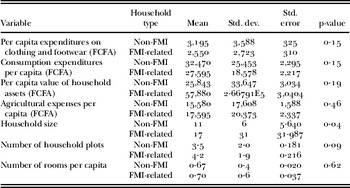
Human capital was assessed based on the literacy of the household head and the household's labour force. Although the literacy rate (assessed as a cumulative percentage of those who completed primary school or higher) was generally lower than the national average of 94% (World Resource Institute 2006), more household heads participating in forest management institutions (70·8%) were literate compared with the matching households (66·7%). This difference suggests that more literate community members are elected into the forest management institution. Interestingly, the size of households participating in forest management institutions is larger (average 17 persons) than in matching households (average 11 persons) (Table 2). This is certainly linked to a higher mean number of spouses (1·6 versus 1·3) per household head in the forest management institution. It seems logical to assume that because larger households have higher needs for forest resources, and can therefore exert more pressure on forest resources, strategically they tend to be more likely to be asked to join a forest management institution.
Socio-economic analysis by household type

Source: Authors’ survey.
Notes: FMI, Forest Management Institution. Number of non-FMI households: 123; FMI-related households: 77. 1 Euro corresponds to 655·957 FCFA in the first quarter of 2011 (http://www.oanda.com/lang/de/currency/historical-rates/).
The average household size of members in forest management institutions is generally far higher than in other parts of the region. For instance, Balgah & Buchenrieder (Reference Balgah and Buchenrieder2011a, Reference Balgah and Buchenrieder2011b) found an average household size of almost five for fish farming and disaster-affected households in the Northwest Region respectively. This larger than average (regional) household size could be attributed to the generally rich fertile soils around the Kilum-Ijim Mountain and the relative abundance of livelihood resources appropriated from the conserved forest (Penn & Gardner Reference Penn and Gardner2000; Ndenecho Reference Ndenecho2007). Nevertheless, a higher percentage of households in forest management institutions were primarily occupied in subsistence agriculture (85·7%) as compared with the matching households (77·2%). The consequence is that the former tend to have larger farms and more plots than the latter since more mouths have to be fed (Table 2).
An assessment of other socio-economic variables capturing household assets, such as per capita expenditures on clothing and footwear, consumption expenditures per capita and agricultural expenses per capita are presented in Table 2. On a per capita consumption expenditure basis, the households in forest management institutions are generally lower but not very different from the general population. This is explained by the larger mean household sizes that reduce the value of assets per capita for larger households. Thus, although households participating in forest management institutions are generally better off in terms of human capital (as demonstrated by the higher educational levels of household heads and larger household sizes), this difference seems to be partially offset by the lower average level of assets per capita.
Analysing institutional differences: a community-based social capital perspective
The development theory literature emphasises that social capital can compensate for the lack of classical production factors, such as labour or land. As nature conservation does to some degree take away the use rights of people on the land, one can ask whether social capital may be compensating for this loss somewhat. Therefore, it seems appropriate to analyse differences in access to forest management institutions – institutions that facilitate access to the natural resource – by applying a social capital approach.Footnote 8 However, the social capital concept is often criticised for being too broad and thus being analytically weak (Coleman Reference Coleman1988; Woolcock & Narayan Reference Woolcock and Narayan2000; Grootaert et al. Reference Grootaert, Narayan, Jones and Woolcock2004; Buchenrieder Reference Buchenrieder, Buchenrieder and Dufhues2006). Consequently it is necessary to specify a contextual definition. Obviously, social capital is not a homogeneous entity. Social capital can be categorised into three different forms: bonding, bridging and linking. Bonding and bridging social capital are distinguished by tie strength, i.e. strong and weak ties respectively (Woolcock & Narayan Reference Woolcock and Narayan2000). Weak ties are characteristic of the infrequent interactions and peripheral relationships amongst more or less dissimilar individuals (e.g. membership in groups) and strong ties of the intimate social circle of individuals with rather similar characteristics, for example relatives (Lin Reference Lin, Marsden and Lin1982). Linking social capital is distinguished by social distance. This type of social capital refers to a person's ties to people in positions of authority, such as representatives of public (for example, police or wildlife management) and private institutions (for example, banks) (Dufhues et al. Reference Dufhues, Buchenrieder, Euler and Munkung2011). Thus depending on the structure of social capital (Coleman Reference Coleman1988; Lin Reference Lin1999), it can facilitate certain actions or in other words, open up certain resources. So it is the resource (e.g. access to benefits from community-based conservation institutions) that turns the social structure (e.g. ties to community-based conservation institutions) into social capital. Social capital, and its underlying social ties and interactions, strongly influences a person's level of trust. Barber (Reference Barber1983: 165) defines trust as ‘socially learned and socially confirmed expectations that people have of each other, of the organisations and institutions in which they live, and of the natural and moral social orders, that set the fundamental understandings for their lives’. According to this definition, social capital often generates trusting relationships, and the trust generated in turn produces social capital. Trust is both a source and an effect (Adler & Kwon Reference Adler, Kwon and Lesser2000). Consequently, social capital and the resulting trust facilitate collective action (Grootaert et al. Reference Grootaert, Narayan, Jones and Woolcock2004; Buchenrieder Reference Buchenrieder, Buchenrieder and Dufhues2006). Household types with more and more diverse social capital are assumed to be better off than those with less and more narrowly structured social capital. Here membership in groups and networks, both within and outside the community, trust and collective action aiming at accessing resources are considered.
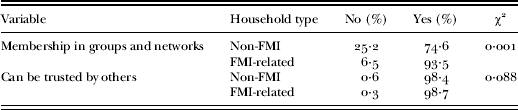
Table 3 indicates that a higher percentage of households in forest management institutions (almost 94%) belong to groups and networks, and believe that they can be trusted by others (almost 99%) compared with the general population (almost 75% and 98% respectively). The level of trust is, however, quite high for both groups. The number of close friends within the same village and out of the village – proxies for bonding and bridging social capital – was the same for both household types (mean equal to 3). All sampled households stated that they had participated in collective action projects within the twelve-month period preceding the research. This generalised high level of collective action at the community level is important for community-based forest management.Footnote 9 Most households agreed that they would be willing to participate in projects of a public nature without sanctions (Likert scale: 1–5, 5 indicating maximum willingness to participate; mean score of 3·12 for both household types). Households would contribute willingly to joint projects of interest to the households and the entire community (4·21 and 3·96 for households in forest management institutions and otherwise). Thus, the households in the forest management institutions can be said to have the same social capital level as the general population in the village, except for their membership in the forest management institution. In this sense, the households in the forest management institution are not very different from the general population. This is an indication that overall social capital is very high in the community.
Analysis of institutional differences from a social capital perspective
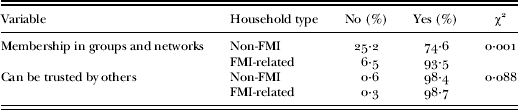
Source: Authors’ survey.
Notes: FMI, Forest management institution. Number of non-FMI households, 123; FMI-related households, 77.
Forest and livelihoods: a snapshot of wildlife consumption and conservation
In this section, a differentiated analysis of the appropriation of wildlife units for household consumption is discussed. Based on unique data available from one (Ajung) community forest, the population dynamics of wildlife by species is examined. A short discourse on perceptions and potentials for bushmeat domestication (particularly the giant cane rat) for forest-adjacent households concludes the subsection.
Bushmeat consumption dynamics
The importance of forest resources, particularly meat from wildlife – commonly called ‘bushmeat’ – for forest-adjacent communities has been recognised in many studies (Geisendorf et al. Reference Geisendorf, Gronemann and Hampicke1998; Hulme & Murphree Reference Murphree, Baldus and Siege2001; Mockrin et al. Reference Mockrin, Miranda, Bennett and LaBruna2005; Wilkie et al. Reference Wilkie, Starkey, Abernethy, Nstame Effa, Telfer and Godoy2005; LeBreton et al. Reference LeBreton, Prosser, Tamoufe, Sateren, Mpoudi-Ngole, Diffo, Burke and Wolfe2006; Willcox & Nambu Reference Willcox and Nambu2007; Ndenecho Reference Ndenecho2007; Cheo Reference Cheo2011). For instance, LeBreton et al. (Reference LeBreton, Prosser, Tamoufe, Sateren, Mpoudi-Ngole, Diffo, Burke and Wolfe2006) expect that the hunting of wildlife will continue at current levels, although even subsistence hunting has become unsustainable due to changes in traditional hunting patterns. This pattern may remain unchanged unless domestic animal production increases. This argument would support the notion of promoting wildlife domestication, i.e. the breeding and farming of the giant cane rat. Nevertheless, many Cameroonians prefer bushmeat to meat from farm livestock if given a choice (Njiforti Reference Njiforti1996). Moreover, Willcox & Nambu (Reference Willcox and Nambu2007) reveal that bushmeat is less expensive in terms of purchase price than other meat for households in the Bayangi and Mbo area in Southwestern Cameroon, providing cheaper animal protein to community members. Thus when price is a more important variable than taste, home-produced bushmeat may have an even higher local preference over wild meat. Furthermore, a high proportion of individuals involved in the hunting, butchering or eating of bushmeat perceive a risk of disease infection. Yet, they go on taking the risk (Apetrei et al. Reference Apetrei, Michael, Richardson, Ling, Paul, Reed, David, Robertson and Preston2005; LeBreton et al. Reference LeBreton, Prosser, Tamoufe, Sateren, Mpoudi-Ngole, Diffo, Burke and Wolfe2006). LeBreton et al. (Reference LeBreton, Prosser, Tamoufe, Sateren, Mpoudi-Ngole, Diffo, Burke and Wolfe2006) explain this by stating that the perceived risk may in fact be cultural or mystical rather than medical. In addition, the perceived risk may be outweighed by the economic and nutritional benefits. In the end however, individuals face a health risk, specifically from zoonotic infections from the bites and scratches of live animals and from direct contact with fresh blood from animals that have been hunted or transported, as well as from blood and body fluids during the butchering process (LeBreton et al. Reference LeBreton, Prosser, Tamoufe, Sateren, Mpoudi-Ngole, Diffo, Burke and Wolfe2006).
A differentiated analysis of these and other aspects amongst households active or not in a forest management institution of the targeted community forests around Kilum-Ijim Mountain Forest is attempted. Most households in the research region did not have prior knowledge of the risk of disease infections from bushmeat consumption. However, a higher percentage of households in the forest management institution (25%) were informed compared with the matching households (17%). This suggests that exposure to capacity building from, and external networks with, government and NGOs working with the communities probably accounts for this difference amongst the two household types. The main reasons reported for extracting bushmeat resources from the forest were for own consumption (50%), followed by both consumption and income from selling bushmeat (29·5%) and lastly, solely for sale (20·5%). These figures differ slightly from the findings of LeBreton et al. (Reference LeBreton, Prosser, Tamoufe, Sateren, Mpoudi-Ngole, Diffo, Burke and Wolfe2006) with 96% of their sample eating bushmeat and only 10% hunting for sale or barter.
Wildlife domestication was completely absent, since none of the households was rearing any form of wildlife. The consumption of bushmeat per capita per month was on average slightly above 100 g for households participating in the forest management institutions and less than 100 g for the general population (see also Table 4 for consumption figures). This consumption level does not only appear low at first sight, but is also unsustainable according to Maisels et al. (Reference Maisels, Kerning, Kernei and Toh2001). All the bushmeat consumed in the communities at household level was captured either from the conserved forest (using recommended traps) or caught in the farming areas.Footnote 10
Differences in bushmeat consumption by household type

Source: Authors’ survey.
Notes: FMI, Forest management institution. Number of non-FMI households, 123; FMI-related households, 77. 1 Euro corresponds to 655·957 FCFA in the first quarter of 2011 (http://www.oanda.com/lang/de/currency/historical-rates/).
Population dynamics of wildlife
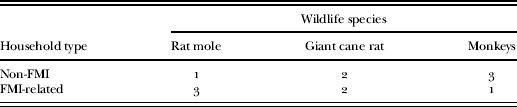
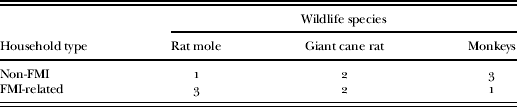
Extraction of bushmeat is said to influence the population dynamics of wildlife. The most commonly consumed wildlife species as reported by the different household types are shown in Table 5. The rat mole, also known as the Mount Oku mouse (Lamottemys okuensis) was the most important wildlife species consumed by households not participating in forest management institutions. Monkey species – comprising mainly of the black colobus (Colobus satanus), black and white monkey (Colobus guereza) and the Preuss's monkey (Circopithecus preussi) were ranked first by households with membership in the forest management institutions. The giant cane rat (Thryonomys swinderianus) was important for both household types and was ranked in the second position. These three wildlife species are the species most frequently consumed in the community. Unfortunately, all three monkey species mentioned above have been declared endangered under the framework of the Convention on International Trade in Endangered Species (CITES; Western Highlands Conservation Network 2007), accentuating the importance of focusing on wildlife domestication for livelihoods and wildlife conservation in the research region.
Ranking of wildlife species consumed by household type
Source: Authors’ survey.
Notes: FMI, Forest management institution. Number of non-FMI households, 123; FMI-related households, 77.
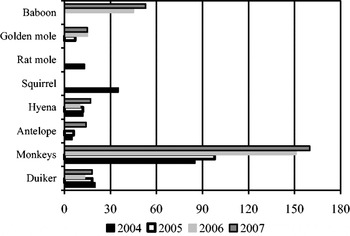
Although the general extraction of wildlife species to meet household needs per capita per month appears low as mentioned in the section above, it affects the overall population dynamics of wildlife species in the community forests. Data from the Ajung community forest seem to confirm this conjecture. The population of the rat mole (Mount Oku rat, Lamottemys okuensis) decreased in the community forest between 2004 and 2005 (Figure 1) and completely disappeared from the forest monitoring records thereafter. However, numbers of the black and white monkey (Colobus guereza) grew steadily between 2004 and 2007. The growth in the population has been supported by general government restrictions on hunting the endangered monkey species in the community forests.Footnote 11 The olive baboon (Papio anubis), which was originally not part of the resource system, emerged in 2005 and the population increased more than twofold in 2006 and 2007. Since the Ajung community forest is just one of the many community forests that constitute the 20,000 hectares of Kilum-Ijim Mountain Forest, immigration of the olive baboons into this forest suggests habitat disturbance or poor management in other, probably neighbouring community forests. The giant cane rat is completely missing in the statistics. This is a clear indication of the pressure on this species that occupies second position in bushmeat consumption for all household types.Footnote 12 The Cooper's mountain squirrel (Paraxerus cooperi) completely disappeared from 2005. The populations of other wildlife such as the hyena (locally called ‘bush dog’), the golden mole (known traditionally as the ‘Kemfung’) and the duiker (falsely identified locally as the ‘deer’ and/or ‘frotambo’) remained more or less stable over the period. These results clearly challenge the optimistic expectations for conservation as an outcome of community participation as discussed by, for instance, Cartwright (Reference Cartwright1991) and Hulme & Murphree (Reference Murphree, Baldus and Siege2001) for other African countries.
Population dynamics of wildlife species in the Ajung community forest from 2004–2007 Source: Authors’ survey, based on data from the Ajung Community Forest Management Institution. Note: Various species of monkeys are present in the Ajung community forest. They include the black colobus (Colobus satanus), black and white monkey (Colobus guereza) and the Preuss's monkey (Circopithecus preussi).

Wildlife domestication: potential for giant cane rat farming in the Kilum-Ijim
Unsustainable harvesting of wildlife resources stimulated the initial discussion on wildlife farming as an alternative to wildlife harvesting or hunting in Africa (Mossman Reference Mossman1975; Mockrin et al. Reference Mockrin, Miranda, Bennett and LaBruna2005). The giant cane rat (Thryonomys swinderianus) became one of the first wildlife species to be successfully domesticated and promoted for farming at the household level in many African countries including Cameroon (Jori et al. Reference Jori, Mensah and Adjanohoun1995; Fa et al. Reference Fa, Seymour, Dupain, Amin, Albrechtsen and Macdonald2006; Wanzie & Balgah Reference Wanzie and Balgah2007). Its domestication was favoured for a number of reasons. Firstly, the species adapts easily under domestication and is highly prolific (two litters per year with litter sizes of between two and twelve). Secondly, adults can weigh up to 8 kilograms and, as a rodent, it depends mainly on a forage feeding regime. Thirdly, it is a well-cherished bushmeat in many African communities and is socially accepted in most communities (Adu et al. Reference Adu, Alhassan and Nelson1999; Fa et al. Reference Fa, Currie and Meeuwig2003; Reference Fa, Seymour, Dupain, Amin, Albrechtsen and Macdonald2006; Wanzie & Balgah Reference Wanzie and Balgah2007).
The potential for giant cane rat domestication in the forest communities in Kilum-Ijim is enormous. For instance, there is strong interest at the community level for participating in a domestication programme. This stems from the fact that the giant cane rat is, as mentioned, amongst the three most cherished and consumed wildlife species in the research area. Also, there is ample experience in cane rat breeding and domestication, given that the National Institute for Research in Agriculture and Development (IRAD) Cameroon has carried out successful research on the species since 2000 (Wanzie & Balgah Reference Wanzie and Balgah2007) and it is not yet a protected species under the Cameroon Forestry Law (Republic of Cameroon 1994, Ministry of Environment and Forestry, Cameroon 1998). As shown in Figure 1, the absence of this species in the Ajung community forest monitoring sheets suggests that its domestication could indirectly lead to a positive effect in terms of numbers of the very limited (or absent) population in the wild. Also, the fact that the species is highly consumed locally indicates a ready market outlet for any production surplus to household consumption. Thus giant cane rat domestication has the potential for livelihood improvements by directly putting food on the table and cash in the pockets of poor households in the research region. It would indirectly stimulate an increase in the wildlife populations in natural habitats, or directly re-introduce the species into natural habitats, thus promoting wildlife conservation for community forests currently managed by indigenous, adjacent communities in the Kilum-Ijim Mountain Forest in Cameroon. However, because the giant cane rat is often considered to be a notorious pest for many crops in many African countries, its re-introduction into the wild must be validated from the perspectives of net social and economic benefits by the local communities concerned.
CONCLUSIONS
The concept of the community as the locus of conservation has dominated natural resource conservation thinking, especially the central role that community occupies in sustaining livelihoods for concerned communities while conserving nature. However, empirical evidence remains mixed and specific studies on intra-community dynamics are hard to find. Using a case study of 200 households from six forest communities in the Kilum-Ijim Mountain Forest of Cameroon, this paper has contributed to this gap in the literature, by making a differentiated analysis of households who directly participate in the community forest management institutions and non-participating households.
Households in forest management institutions were found to be generally better off in human capital terms than the matching households. This trend persists, but in a mixed manner, in the analysis of household assets. Since participating in a forest management institution is voluntary and not remunerated, this seems to suggest that these households ‘waste their time’ for the interest of the entire community, while other community members ‘get busy’ developing their own asset stocks. In any case, the institutional analysis suggests that households in forest management institutions are connected to more social networks than the matching households. Networking provides such households with access to information (as demonstrated by their better knowledge on the correlation between bushmeat consumption and zoonotic infections) that may be limited for other households in the research communities.
Appropriation of bushmeat resources for household consumption was generally low per capita for all households, and the population dynamics of wildlife species in community forests as exemplified by available monitoring data from one community forest, showed a mixed picture. Some new species immigrated into the examined forest, suggesting good conservation practices. At the same time, two of the three most favoured and highly consumed species at community level (i.e. the giant cane rat and the rat mole) were disappointing in terms of population dynamics in the community forest. This result questions the theoretical supposition that bringing the community back into resource management can effectively reconcile poverty alleviation and conservation objectives in our case study.
Our study has a number of conclusions of relevance for research and policy. Firstly, the romantic image of the community appears illusional in our case study. Quite a mixed picture was found – with community harvesting being at least partly responsible for disappearing wildlife species. This does not coincide with the notion of community as the locus of conservation thinking. At the same time, new species immigrated into the forest system. While this should be seen as a sign of good community resource management, the fact that the one example (Ajung community forest) is part of a larger montane forest with numerous communities managing different portions will suggest that for animals to immigrate into the recipient (community) forest, they would have emigrated from other community forests where conservation practices are unsuitable to the habitat needs of migrating wildlife species. Thus, a closer analysis at individual community level would be necessary to identify favourable and unfavourable practices that need to be maintained or changed in specific community forests to achieve the double objectives of sustaining livelihoods and conserving biodiversity in the Kilum-Ijim Mountain Forest. Only then can answers be provided as to why some communities are managing their forests in a sustainable manner and others are not, or why the generally good perception of the role of community in sustainable natural resource management remains wishful thinking in our case study. Such insights are essential for policy orientation towards attaining community-based conservation and sustainable livelihoods.
Secondly, wildlife domestication, starting with the giant cane rat, is a policy objective that needs to be considered immediately for households around the Kilum-Ijim Mountain Forest. The current complete lack of domestication and the generally downward trends in wildlife populations in the research region question the tremendous work reportedly done by the Cameroonian government and the original Kilum-Ijim Mountain Forest Project to promote community-based forest management in the Bamenda Highlands of Cameroon. The work of the National Research Institutes in Cameroon towards conserving, domesticating and extending the cultivation of the giant cane rat in Cameroon has not yet had any impact around the Kilum-Ijim Mountain Forest where it is badly needed, as no single household farmed the giant cane rat during the research period. The current approaches of the National Research Institutes and associated extension services seem to focus on ‘interested farmers’, neglecting very needy and highly motivated households, such as those in forest-adjacent communities within the Kilum-Ijim Mountain Forest reserve. A paradigm shift in conception and implementation of the giant cane rat domestication programme towards the needy in forest-adjacent communities such as those around Kilum-Ijim may have a greater potential for achieving both poverty alleviation and wildlife conservation, with the community at the centre of conservation. Only then can the full potential of involving communities in sustainable conservation and livelihood development be realised and wildlife and humans will be able to co-habit harmoniously in the Kilum-Ijim Mountain Forest of Cameroon. For instance, it seems logical to hypothesise that the low average consumption per capita per month of bushmeat currently assessed at 100 g in the research communities would be increased sufficiently through the introduction of a giant cane rat domestication programme. The suggestion of developing rural ecotourism potentials in the Kilum-Ijim area (Ndenecho Reference Ndenecho2010) seems plausible in order to attain conservation and livelihood objectives, as this might likely create a market niche for nature friendly tourists and ecologists who would support the local economy. For this to happen, however, further consultations at the local level would be needed. This is crucial and success demands that the institutions must be adapted and wildlife populations need to be increased to encourage tourist activities such as animal watching and game hunting in the long run.