Over the last 20 years, the flow of south-south development cooperation (SSDC), defined as aid provided by developing countries, has increased. Although often underreported and sometimes hard to quantify, the United Nations has estimated that SSDC exceeded $20 billion in 2013 (UNGA 2015).Footnote 1 Although this number includes loans, it was 19.5 percent of the total bilateral aid provided by traditional donors that year, according to data from the Organization of Economic Development and Cooperation’s (OECD) Creditor Reporting System (CRS). Furthermore, SSDC has been increasing ever since. Just in 2016, the UN Development Program (UNDP) counted more than 500 south-south development projects involving 127 countries (UNDP 2016).
Why are developing countries engaging more and more in these activities? What are the motives behind the provision of foreign aid among countries from the Global South? From a foreign policy tool to advance political objectives (Morgenthau 1962) to a humane internationalist identity (Lumsdaine Reference Lumsdaine1993), foreign aid has been understood as driven by either self-interest or altruism (Pauselli Reference Pauselli, Olivié and Pérez2019). The literature on aid allocation shows that many factors influence donors’ decision to provide or withhold aid, among them strategic interests, punishment for undemocratic behavior, normative factors, bureaucratic politics, and domestic politics. However, our knowledge about foreign aid allocation is based on foreign aid from developed to developing countries. This article aims to study developing countries’ motivations to provide aid.
Despite increasing in the last decades, SSDC has received little to no attention in the literature of international political economy and international relations. This article argues that the literature on foreign aid focuses mainly on North-South relations, and it contains assumptions that do not apply to South-South relations. When SSDC has been studied, scholars have focused only on case studies that are hard to generalize to all developing countries or quantitative analysis that pools developing countries with new donors from developed economies. Because of its distinct characteristics and circumstances, it is puzzling to explain the existence of (minuscule) SSDC. This article argues that domestic allies and foes are the main drivers of SSDC in Latin America. This argument will be tested by conducting an empirical analysis of the allocation of SSDC projects in the region.
The article proceeds as follows. First it reviews the literature on foreign aid motivations and highlights its limits when applied to south-south development cooperation. Second, it theorizes the role of allies and foes of SSDC in southern countries and why their strength in governments can explain the intensity of SSDC. This section includes a series of hypotheses derived from this argument and the literature on foreign aid by traditional donors. Third, it presents a research design to test whether the strength of civil society actors and nationalist groups can predict the number of SSDC activities offered by Latin American countries in the period between 2007 and 2017. The final section offers conclusions and questions for further research.
Foreign Aid Motivations
Why would a country spend scarce resources with the declared goal of advancing development in another country? Both selfish and altruistic motivations have been the endpoints of a continuum of reasons that countries supposedly decide to become aid donors and allocate resources in specific countries.
One prominent reason is to use foreign aid as a foreign policy tool to advance the donor’s strategic and security interests, as explained by prominent Realist scholars (Mogenthau 1962).Footnote 2 During the Cold War, for example, foreign aid was part of the political competition between the capitalist and communist worlds: capitalist developed countries spent resources in developing countries to prevent Communist influence from increasing in those regions (Baldwin Reference Baldwin1966). Schraeder et al. provide evidence that strategic and ideological factors related to the Cold War strategic dispute influenced decisions of four donors to allocate foreign aid in African countries, and they also highlight the importance of economic, particularly trade, interests in northern aid calculations (Schraeder et al. Reference Schraeder, Steven and Bruce1998). Others have also argued that political and strategic considerations, colonial ties, and political alliances dictate the direction of foreign aid (Alesina and Dollar 2000). Other scholars point to the search for new markets for exports or imports (Brazys Reference Brazys2013). The literature on SSDC has also highlighted selfish and strategic motives behind the provision of aid (Quadir Reference Quadir2013).
Furthermore, contrary to their verbal commitment or their support from domestic public opinion (Allendoerfer Reference Allendoerfer2017), donor countries do not seem to consistently reward respect for human rights in their foreign aid allocations (Neumayer Reference Neumayer2003). A large volume of aid still goes to corrupt and autocratic governments and to countries other than those that need aid the most (Easterly and Pfutze 2008). In sum, according to this literature, aid is a function of donors’ pursuit of selfish interests. Under this framework, it is implicit that donors have the economic capacity to disburse enough financial resources to “buy” the political will of the recipient or to prevent the recipient from doing something it would otherwise not do. This assumption of resource abundance, however, is not possible for donor countries that, at the same time, are developing economies.
Another branch of the literature argues that foreign aid is a foreign policy tool that could potentially serve multiple interests. However, motivations for aid allocation are determined domestically, and variation among donors is explained by interactions among different domestic actors and institutions that influence aid decisions. These actors are usually government bureaucracies or private actors that derive material gain from foreign aid. Hence, states’ motivations are a function of societal groups and public opinion preferences. The state is not a unified actor and does not necessarily have an agency role; it provides the policy outcomes of preference by different actors determined within the domestic institutional framework.
Vast empirical work on foreign aid allocation has provided support for the effect of local actors and institutions on the provision of foreign aid. Lancaster argues that bureaucratic politics, especially the existence of a strong and independent bureaucracy of development cooperation (agency), creates a strong advocate for the provision of more foreign aid (Lancaster Reference Lancaster2006). In the case of south-south cooperation, the role of domestic bureaucracy might be even stronger than it is among traditional donors. At the multilateral level, no single organization plays a role similar to that of the OECD for developed countries. In part, this is because southern donors have been reluctant to accept standards for giving aid (Kern and Pauselli 2017). However, it should be noted that the state’s institutional strength in developing countries is weaker than in developed countries. Because of this, this theory needs to be further tested in the context of SSDC.
Other studies have shown that a key component to understanding foreign aid allocation is domestic politics. Specifically, the economic interests of domestic organized actors with access to political power, the ideology of political parties (Thérien and Nöel 2000; Bueno de Mesquita and Smith 2009; Milner and Tingley 2010; Lundsgaarde Reference Lundsgaarde2013), or the donor’s political economy orientation (Dietrich Reference Dietrich2016) affect aid allocation decisions. These works usually predict both selfish and altruistic uses of foreign aid, depending on how the coalitions are formed domestically (Heinrich Reference Heinrich2013). Domestic actors maximize their gains if the state provides aid: either they increase their economic well-being or they report satisfaction by helping those that need aid the most. However, these studies assume either that the amount of aid given is large enough to generate economic benefits for some domestic actors in the donor country or that the donor aid activities are known by the general public in order to receive support as a humanitarian endeavor. Neither of these assumptions applies to developing countries, as will be shown here.
A third group of scholars focuses on the influence of ideas, norms, and identities to explain states’ behavior at the international level. Specifically, shared norms and ideas shape actors’ preferences to adjust to prosocial behavior (Wendt Reference Wendt1999). These scholars have argued that normative factors, such as helping those countries that are the neediest, have influenced donors’ decisions to provide aid (Lumsdaine Reference Lumsdaine1993; Neumayer Reference Neumayer2005; Van der Veen Reference Van der Veen2011). The literature on SSDC has also pointed out humanitarian motives behind the provision of aid among developing countries (Bergamaschi and Tickner 2017). However, empirical studies have shown that donors pursue mixed goals, some of them aligned with a focus on the recipients’ needs while others distant from the requirements of those that most need the aid (Thiele et al. Reference Thiele, Peter and Axel2007).
Similar to other works in the literature, these arguments assume that the donor has the economic capacity to make a significant contribution to the recipient country. Moreover, and more important, these arguments assume that the donor country has no, or at least many fewer, domestic challenges that can focus its attention on helping noncitizens beyond its borders. For example, many donors from the Global South spend resources on fighting hunger in another developing country when domestically a significant proportion of the population is jobless and lives below the poverty line. Again, these assumptions do not hold for developing countries that are, at the same time, donors of aid.
What has the literature said about SSDC? The academic literature on SSDC has studied new donors’ motivations mostly through case studies, which makes it hard to compare results and draw generalizable conclusions. In addition, the most-studied cases have been Brazil, China, and India, which are, in turn, the biggest economies in the developing world. Despite these issues, the literature has characterized these countries’ aid practices as taking recipients’ needs and governance into account in their aid allocation decisions (Semrau and Thiele 2017; Fuchs and Rudyak 2019), containing patriarchal and colonial rationales (Carrasco Miró 2019), and pursuing national security goals (Leal and Moraes Reference Leal and Moraes2018). Similar to traditional donors, China’s allocation of aid seems to be shaped by political considerations (Dreher and Fuchs 2015) and the objective of promoting trade with developing countries (Fuchs and Vadlamannati Reference Fuchs and Vadlamannati2012; Fuchs and Rudyak 2019). These arguments can easily be read through the lenses of theories of foreign aid developed to explain traditional donors’ allocation of resources.
An exception to the study of single donors is Dreher et al. Reference Dreher, Peter and Rainer2011, which compared the allocation behavior of new donors to old ones. The authors found that new and traditional donors behave similarly in the sense that both groups of donors incorporate commercial self-interest in their aid allocation decision. However, they differ in that new donors do not take governance variables into account (Dreher et al. Reference Dreher, Peter and Rainer2011). Although it was the first attempt to show regularities empirically among new donors, Dreher et al. consider both southern and DAC countries.Footnote 3 Among these new donors are four DAC donors and eight non-DAC countries that report their development cooperation policies to the DAC. Because of this, the study’s results narrowly focus on wealthier new donors that also are more willing to cooperate with DAC policies.Footnote 4
On the one hand, some scholars argue that for southern donors, SSDC’s goal is to advance the donor’s political objectives and that the dominant prerogatives have to do with economics and national security (Bry Reference Bry2017). Among Latin American donors, evidence seems to suggest that some donors do indeed pursue selfish goals. It has been argued that Brazilian cooperation is used as a tool to foster change in international relations (Santander and Alonso Reference Santander and Alonso2018) and to achieve broader foreign policy objectives (Inoue and Costa Vaz 2012).Footnote 5 Mexico has also used its role as donor to challenge the international development regime (Villanueva Ulfgard and López Chacón 2017). This is not the case for all southern donors: Colombia has tried to accommodate its aid to northern standards in order to reap reputational benefits as a consolidated donor and economy (Bergamaschi et al. Reference Bergamaschi, Arlene and Jimena2017). On the other hand, studies have highlighted that SSDC seeks to shift aid relationships from dependency, imperialism, militarization, and conditionality to a framework of solidarity with the neediest recipients (Appe Reference Appe2018). Venezuela has been cited as an example of ideological SSDC (Santander and Alonso Reference Santander and Alonso2018).
Still other studies argue that bureaucracies are the drivers of SSDC. In the case of Brazil, a study has shown the influence of civil servants in the provision of development aid. However, the role of bureaucracies might be in tension with the preferences of the executive. Furthermore, other domestic actors can constrain the executive’s ability to invest in foreign aid. According to van der Westhuizen and Milani (2019), some constituencies (especially the parliament and mass media) are key stakeholders in the oriented-for-results aid, since they can urge or discourage governments to engage in aid programs when issues become salient.
The argument here is that developing countries that give foreign aid do not pursue altruistic or self-interested goals, nor are their bureaucracies strong enough to be able to push through their own agenda successfully. These developing countries still have domestic challenges to overcome, and they do not provide aid in a context where their budgets allow them to make significant financial contributions to buy a recipient. Both the altruistic and self-interest arguments rely on the assumption the countries have enough resources to make a positive impact in the recipient country or successfully to advance their self-interest goals by buying or rewarding allies or strategic partners.
Furthermore, most developing countries do not spend a considerable amount of resources on aid, which should prevent the emergence of strong bureaucracies able to have an impact on foreign policy decisions. For example, Colombia and Chile are two of the most prominent donors in Latin America. According to data from Dreher et al. (Reference Dreher, Peter and Rainer2011), Chile provided aid at a value of 400,000 USD in the period 2007—8 and Colombia 2,560,000 USD from 2002 to 2008. These amounts represented 0.19 percent and 1.23 percent, respectively, of the total aid provided by Portugal, one of the smallest donors in the CRS-DAC system, only in 2008.Footnote 6 Most of SSDC is technical cooperation, which, according to the definition provided by the OECD (2003), is “the transfer of technical and managerial skills or of technology for the purpose of building up general national capacity.”
Not only do developing countries need to be more strategic with how they spend scarce resources because of material constraints, they are unable to pursue multiple goals, and they need to focus on a few of them. For this reason, the argument that most developing countries will have motivations similar to those of traditional donors seems unconvincing. Analyzing SSDC is an important test for theories that predict that foreign aid is an instrument for pursuing self-interested or altruistic goals: it is by assessing the scarcity of resources that we should be able to see whether a country uses foreign aid to try to attain a worthwhile goal, such as to promote its own security or economic interests or advance another actor’s well-being. Because nontraditional donors are usually developing countries, they still face many development challenges domestically. For this reason, providing resources to other developing countries while showing solidarity with other societies’ needs can raise domestic opposition. Thus, these countries’ efforts to provide technical and development cooperation to other developing countries raise questions regarding the potential strategic benefits these countries can gain from SSDC.
Aid Among Southern Countries: Domestic Allies and Foes
Foreign aid is widely accepted as a tool to promote or advance foreign policy goals. The literature on foreign aid identifies many policy objectives, such as increasing the donor’s strategic and security interests, opening new foreign markets, gaining access to natural resources, or compliance with an international social norm that requires richer countries to help poorer countries. However, part of all these objectives requires donors to have access to and influence on the domestic and foreign affairs of the recipient country (Apodaca Reference Apodaca2006). In order to promote geostrategic interests, further economic interests, or prevent or offset the effects of global negative externalities that can potentially affect a donor country, aid should be large enough to achieve these goals. Insignificant amounts of aid would be a waste of resources if it did not achieve the intended goals. Although both North-South and South-South development cooperation are genuine transfers of resources and capacities from one country to another, the latter does not imply a significant transfer of resources; it usually is manifest in the form of technical cooperation.
This raises questions about how aid provided by southern donors responds to the motives already identified in the literature for northern donors. In other words, national and international pressures (low degree of development, international power hierarchy) limit what a country can do (Konary Reference Konary1984). Developing countries have traditionally been the recipients of foreign aid. They have been those in the most need, facing developmental challenges they could not overcome by themselves. Their level of development constrains these countries from allocating significant resources to many policy objectives besides the most basic ones (for example, education, health, bureaucracy, and security). Sometimes even these most basic objectives are not met. Foreign aid, in these cases, would not be a useful foreign policy tool as it is for resource-rich countries. However, we do see south-south aid activities.
The argument advanced in this article is that giving aid to another developing country under the label of south-south cooperation is a function of the strength of certain domestic actors. Specifically, nationalist actors are expected to reduce a country’s involvement in SSDC. At the same time, the strength of civil society organizations will tend to increase a country’s role as a donor of SSDC.
To understand the role aid plays in developing countries’ foreign policies, it is necessary to look at the goals of governments. Most leaders want to survive. In many developing countries, they took office after winning elections by making promises to their constituencies. Development cooperation offered by developing countries is a function of governments’ domestic agenda, and it depends on the support of domestic actors. Following Milner and Tingley (2010), I argue that there are domestic actors who support and oppose foreign aid. However, unlike their argument, my argument is that these actors do not support or oppose foreign aid activities based on the domestic distributional consequences of aid: SSDC is mainly a technical activity that does not generate significant domestic distributional consequences. However, it can be aligned or at odds with certain domestic narratives on how to engage with the rest of the world. This argument might potentially apply to traditional donors, and there is experimental evidence that points to the relevance of “friends” and “foes” of foreign aid (Heinrich et al. Reference Heinrich, Yoshiharu and Leah2018).
The literature on SSDC has recognized the role of domestic actors in the provision of aid from southern donors. However, it has not theorized or empirically tested their influence. It is argued here that the strength of domestic allies and foes explains the intensity of SSDC. Domestic allies are actors that are likely to be involved in SSDC activities, and foes are those that oppose cooperative activities with other countries for ideological reasons. The main source of influence for these groups is their strength or influence within the government: the more access to decisionmaking processes friends and foes of SSDC have, the more they will be able to push for policy aligned with their own preferences regarding SSDC. Specifically, the literature identifies civil society organizations as allies of SSDC and nationalist groups as opponents of SSDC.
Civil society organizations (CSOs) can be principle-oriented or profit-oriented. Either way, their work is supported by state actors (foreign donors or their home state). In contexts where they can influence state policies, they will probably become interest groups, advancing policies from which they can reap benefits (tangible, like economic, or intangible, such as promoting a specific agenda of their interest). I theorize that CSOs play an important role in the supply of SSDC: when the state is more open to inputs from civil society organizations, we should expect greater SSDC activities. Case studies from Latin American donors seem to provide qualitative evidence to support this relationship and illustrate the theorized mechanisms. In the technical cooperation offered by Argentina, Brazil, Chile, and Mexico, CSOs are involved in either the design or the provision of SSDC initiatives.
Nonstate organizations are key actors in the provision of aid, even among southern donors. The case of Chile exemplifies this. According to data from the Chilean Agency for International Cooperation, in 2018, 76 nonstate organizations participated in the design and implementation of bilateral and triangular SSDC initiatives. Universities and civil society organizations represented most of these actors. Furthermore, only 53 percent of the total Chilean aid has been executed by state agencies (AGCID 2019). More specifically, 60 percent of one of the leading Chilean SSDC programs, Chile Fund Against Hunger and Poverty, has been implemented by Chilean NGOs (Pérez Gaete 2020).
Civil society organizations can also play a key role in the advancement of new agendas. At the domestic level, they are usually involved in pushing for reforms. Once new policies are incorporated domestically, the ground gained by these organizations on a specific issue can be easily translated into the promotion of this agenda overseas through SSDC. As documented by Sorensen (Reference Sorensen2018), the Mexican Agency of International Cooperation for Development (AMEXCID) has struggled to transform general laws of gender equality and women’s access to a life free of violence into concrete work plans and training activities and to incorporate them as part of Mexico’s international development cooperation. Civil society organizations have worked with AMEXCID to introduce new themes by actively promoting translation in many different directions.
In the case of Brazil, civil society organizations are involved in providing external technical cooperation (Inoue and Costa Vaz 2012). The country’s SSDC became a priority because of growing mobilization by domestic actors, including CSOs (Dolcetti Marcolini 2014; Costa Leite et al. 2015). The ability of nonstate actors to influence Brazil’s foreign policy priorities has also allowed the private sector to shape the aid offered (Scoones et al. Reference Scoones, Kojo, Arilson and Gubo2016). In the case of Haiti, the presence of the United Nations Stabilization Mission in Haiti (MINUSTAH) facilitated the entry and activities of Brazil-based NGOs working on different aspects of socioeconomic development, which, in turn, empowered them to foster Brazilian aid in the country. The implementing institutions of Brazilian aid in Haiti were both state-owned corporations (the Brazilian Agricultural Research Corporation, EMBRAPA) and civil society organizations, such as the Oswaldo Cruz Foundation, which focuses on public health, and SENAI and SEBRAE, focused on vocational training and professional education (Abdenur Reference Abdenur2017).Footnote 7
Given that foreign aid is government intervention into the (international) marketplace, it fits well into globalist worldviews and poorly into nationalist worldviews (Milner and Tingley 2013). Thus, we should expect nationalist groups to oppose having an active role in development cooperation. Nationalist groups vary from state to state, but a proxy of the strength of these groups in a government is the government’s nationalist ideology. The more pressure from nationalist groups, the more nationalist the promoted ideology would be, and the fewer resources to aid foreign actors would be spent. Furthermore, nationalist groups are keen to invest resources in military capabilities rather than in globalist projects. Thus, in the context of scarce resources, SSDC should have less relative importance than investment in national capabilities.Footnote 8
SSDC is a tool used by states and other actors, such as civil society, the private sector, and academia, to collaborate and share knowledge, skills, and successful initiatives in specific areas. It is well documented that many successful stories of south-south development cooperation have involved civil society organizations or business firms (Teegen et al. Reference Teegen, Jonathan and Sushil2004; Shankland and Gonçalves 2016). For example, Follér (Reference Follér2010) has argued that in the case of Brazil’s AIDS south-south initiative, domestic civil society actors played a critical role.Footnote 9 Moreover, among new donors, a negative relationship between domestic CSOs and the government can also affect the country’s development position (Szabó and Szent-Iványi 2019).
The case of Argentina illustrates this argument. In 2015 a new government, led by Mauricio Macri, took office and diminished the number of SSDC activities the country provided. Although many commentators pointed out the new government’s ideological nature (right-wing), qualitative data collected by the author during fieldwork in 2018 suggest that this trend was a consequence of the weak relationship between the government and civil society organizations. A high-ranking official in foreign aid stated that “development cooperation is a state policy that is maintained even during times of adjustment. It relies on alliances with CSOs” (Interview 23). However, the first years of the new administration experienced a decrease in the number of projects. NGO leaders confirmed that “the new government has a strained relationship with CSOs, and this significantly affected its foreign policy” (Interview 14). A high-ranking subnational official stated that “although there is a lot of expertise in the area, the government is not using it. During the previous administration, the government knew how to exploit it: through a close relationship with CSOs” (Interview 10).
On the role of CSOs in generating demand for SSDC, a leader from an NGO that has participated in many SSDC activities explained that usually, “the interest in asking for Argentine aid is generated by us [the NGO]” (Interview 28). Furthermore, a Congress member, talking about nationalist groups, stated that there were many things the government was doing in terms of development cooperation and humanitarianism, especially related to refugees, but he was skeptical about whether this could be publicized because of fear of backlash (Interview 8).
Thus, according to the argument about domestic friends and foes, we should expect domestic actors, such as civil society organizations, to be active supporters of SSDC initiatives. From this argument can be derived the following hypotheses:
H1a. The stronger civil society organizations are in a potential donor, the more likely that the government will provide aid.
H1b. The stronger nationalist groups are in a potential donor’s government, the less likely that the government will provide aid.
The argument advanced here, that domestic actors are key in government’s decisions regarding foreign policy issues, is novel in the foreign aid literature but established in the literature on trade (Rogowski Reference Rogowski1987; Kim Reference Kim2017; Osgood Reference Osgood2017) and human rights (Simmons Reference Simmons2009).
Alternative explanations for why developing countries give aid to other countries can be derived from the existing literature on foreign aid. As summarized above, the literature expects that a country will offer aid when the recipient is important for its security implications, has developmental needs, is a political ally, presents potential trade opportunities, and has domestic actors that lobby in favor of offering aid. The following hypotheses cover selfish, altruistic, institutional, and ideological motivations.
H2. The geographically closer a potential recipient is, the more likely it is to receive aid from a potential donor.
H3. Neighbors are more likely to receive aid than non-neighbors.
H4. The less developed a potential recipient is, the more likely it is to receive aid from a potential donor.
H5. The politically closer a potential donor and recipient are, the more likely it is that the potential recipient will receive aid.
H6. The smaller the trade interdependency between a potential recipient and donor, the greater the likelihood the potential recipient will receive aid.
H7. The existence of a domestic bureaucracy focused on foreign aid increases the likelihood that a country will provide aid.
Research Design
This study uses quantitative data on SSDC actions in Latin America to test the stated hypotheses. Latin America is a region where levels of development vary and large economies share the territory with smaller ones. To focus on a single region makes sense in the context of this project, since we should not expect southern donors to be able to provide aid in all regions of the world as traditional donors do, given their economic limitations. By focusing on the whole world, we would be penalizing smaller countries that provide aid mainly in their own regions. Furthermore, Latin America is a region where comparable data are available on SSDC for all countries.
The hypotheses were tested via a panel analysis of the number of SSDC activities in each dyad-year in Latin America in the period 2007—17. Data on SSDC projects were retrieved from the Iberoamerican General Secretariat (Secretaría General Iberoamericana, SEGIB).Footnote 10 This regional organization compiles yearly the number of projects that each country in the region has executed in every other Latin American country, based on information provided by development cooperation agencies or donor countries’ ministries of foreign affairs. Since 2007, the SEGIB has compiled intraregional SSDC activities. According to the SEGIB, SSDC is an activity that facilitates the transfer of successful policies implemented in one country to be implemented in another country (Xalma Reference Xalma2007). The main instrument by which these policies are transferred is technical cooperation. This instrument gives more importance to human resources than to financial resources and implies a relatively lower cost than traditional foreign aid.
I acknowledge that the number of SSDC activities might not fully reflect the resources spent on SSDC. However, the quantification of new donors’ aid, especially donors that do not report to the OECD CRS, is highly problematic. A new report from the UN Conference on Trade and Development (UNCTAD) recognizes that developing countries do not subscribe to common definitions and reporting parameters for their aid. According to this report, measurement efforts are hindered by the lack of a common conceptual framework, shared standards, and consistent recording by different national agencies and ministries (Besherati and MacFeely 2019). Lack of aid data comparable across developing countries makes it difficult to draw conclusions that could be generalizable to more countries in the Global South.
SEGIB data are unique in their type, since they allow the comparison of a significant number of countries across an important period of time. In 2017, Latin American countries were involved as donors in 880 activities in intra-Latin American SSDC. Based on the data published by SEGIB and financial contributions declared by two Latin American donors (Chile and Mexico), each SSDC activity represents an average cost of USD 68,300. This number, although not insignificant, especially given that donors are developing economies, is less than that reported by OECD donors. According to OECD-CRS data, DAC donors supported 71,923 activities in 2018 (excluding data on debt relief, humanitarian assistance, and support to international organizations). This represented, on average, USD 606,200 per activity.
SEGIB data are limited in terms of quantifying the economic cost each donor has spent on the SSDC provided, and there are reasons to believe that there is no uniformity in average cost across donors in Latin America. Although the use of data on the count of activities has many limitations, they are the best data available that are standardized across countries and time and are not biased based on how each country decides to economically quantify its aid, given the absence of shared standards to report SSDC (Kern and Pauselli 2017). Furthermore, the financial cost a donor incurs in supporting an activity does not necessarily correlate with the positive impact the aid might have in the recipient country (Boone Reference Boone1996; Easterly Reference Easterly2006; Angeles and Neanidis 2009).
Latin American SSDC has been distributed unevenly across countries. Major donors are Argentina, Cuba, and Mexico, while major recipients have been El Salvador, Paraguay, and Venezuela. However, there does not seem to be a pattern in terms of who gets more aid or who provides more aid. Small economies like Cuba are among the top donors, while big economies like Venezuela are among the top SSDC recipients. In intra-Latin American SSDC, Brazil, Argentina, and Mexico have been the key actors, while other net donors (those who offered more SSDC than received) have been central in this network. Interestingly, net recipients that have offered significant aid (e.g., Peru, Ecuador) are placed in a secondary position in the network. In contrast, net recipients that have not offered significant aid (e.g., the Dominican Republic, Paraguay, Panama) are placed at the edges of the network.
The unit of analysis in this study is the number of SSDC activities in each directed dyad-year of donors and recipients. Given the 19 Latin American countries from which SEGIB published data in the 11 years between 2007 and 2017, the total number of observations is 19 (potential donors) x 18 (potential recipients) x 11 (years) = 3,762. Poisson regressions with mixed effects are used for the models, due to the nature of the dependent variable (count of positive integers) and its positive skew distribution. This distribution also implies the existence of outliers. Two strategies are introduced to control for the potential bias caused by outliers. First, subsetting the data using 1—a of the data. Second, transforming the dependent variable as its logarithm + 1 and then running a mixed-effects linear regression.
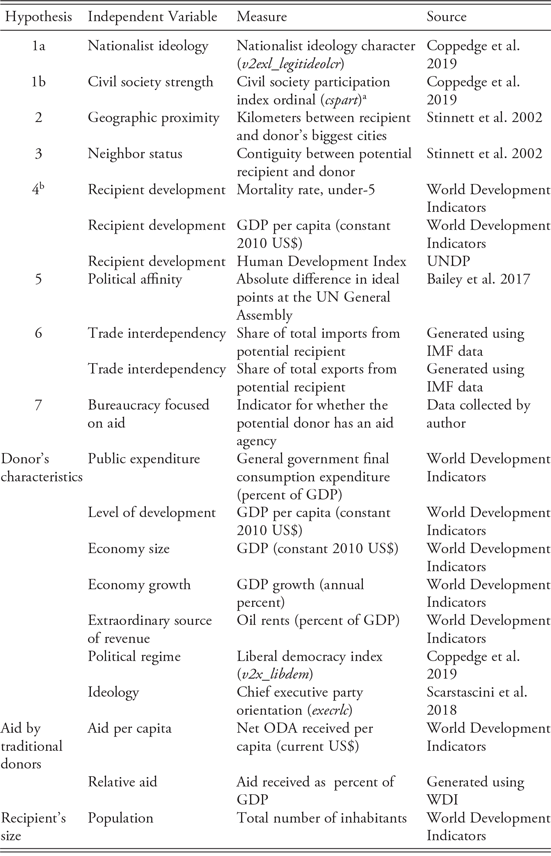
Hypotheses from alternative explanations stated above were tested using data retrieved from sources shown in table 1. Models control for the potential donor’s capacity to give aid, its political regime, political ideology, and aid received by traditional donors and donor’s political regime. For the main independent variable in this study, data were retrieved from the V-Dem project. Specifically, the power of nationalist groups within a government was measured by the government’s nationalist ideology, which characterizes the level on which a government promotes a nationalist ideology. Civil society’s strength was measured using the civil society participation index, which captures whether civil society organizations are routinely consulted by policymakers. For this index, CSOs include interest groups, labor unions, religious organizations engaged in civic or political activities, social movements, professional associations, charities, and other nongovernmental organizations (Coppedge et al. Reference Coppedge and John2019).
Operationalization of Independent Variables

a This index measures whether policymakers routinely consult CSOs, how large is the involvement of people in CSOs, whether women are prevented from participating in CSOs, and whether legislative candidate nomination in political parties is decentralized. See Coppedge et al. (Reference Coppedge and John2019, 47, 90) for more information about how the civil society index is constructed.
b To test the altruistic hypothesis, I follow standard practices in the aid literature and use data on GDP per capita (Boschini and Olofsgard Reference Boschini and Olofsgard2007; Dreher et al. Reference Dreher, Peter and Rainer2011; Lundsgaarde et al. Reference Lundsgaarde, Christian and Aseem2007; Mosley Reference Mosley1985; Round and Odedokun 2004), the UNDP HDI, and child mortality (Boschini and Olofsgard Reference Boschini and Olofsgard2007). If donors are altruistic and pursue humanitarian goals through foreign aid, we should expect the countries with the highest need to receive the most aid. This operationalization of altruist behavior is commonly used in the foreign aid literature (Fuchs et al. Reference Fuchs, Axel and Peter2014).
Two variables are included to control for concepts related to but different from the independent variables in the theory. Although civil society’s strength could be related to the level of democracy of left-wing ideology, this study is specifically interested in the potential influence of CSOs in a government. Similarly, nationalism in the context of Latin America could be capturing a right-wing ideology that, as many scholars have noted, is more reticent to SSDC. However, conceptually, these two variables are different, so the analysis includes a measure of both right-wing and leftwing ideology, using data from Scartascini et al. (Reference Scartascini, Cesi and Philip2018).
Results
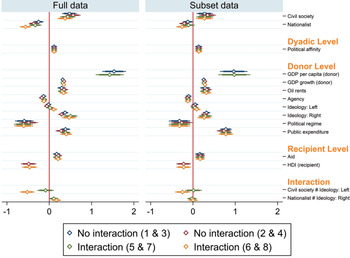
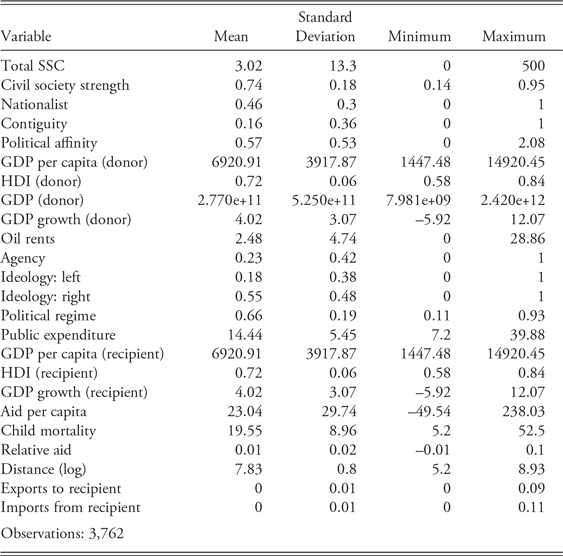
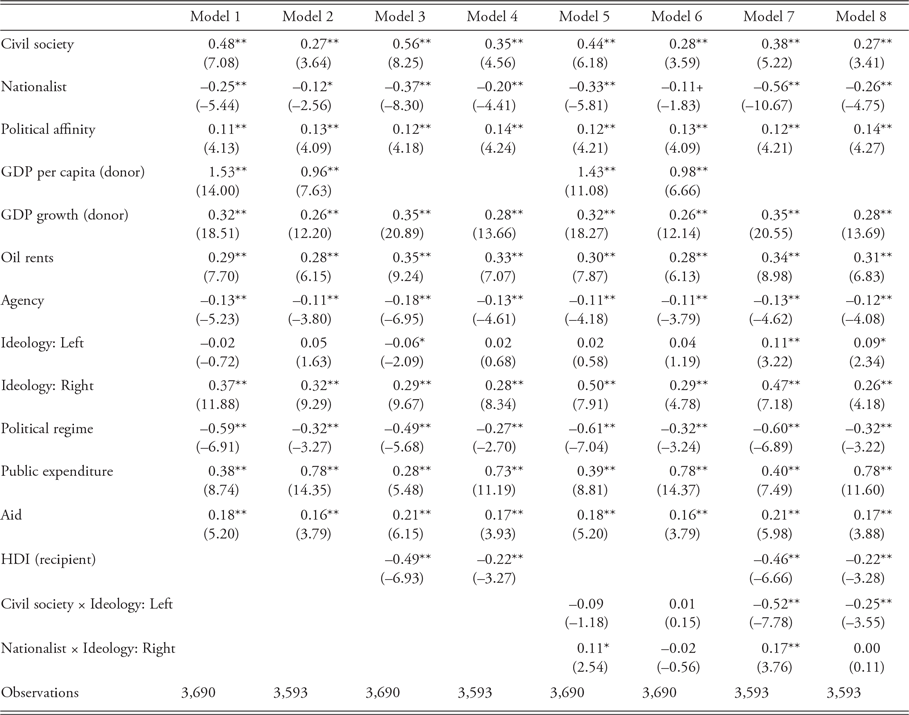
Figure 1 displays the results of the statistical models with standardized values.Footnote 11 The results are standardized in figure 1 to make it possible to compare the magnitude of effects on the intensity of SSDC relationships across variables and models. Predicted effects should be read as the change in the number of SSDC activities that result from a one standard deviation increase in the respective independent variable (see the appendix for summary statistics of the variables included in the models and the full regression table).
Predicted Effect of Variables on Number of SSDC Activities

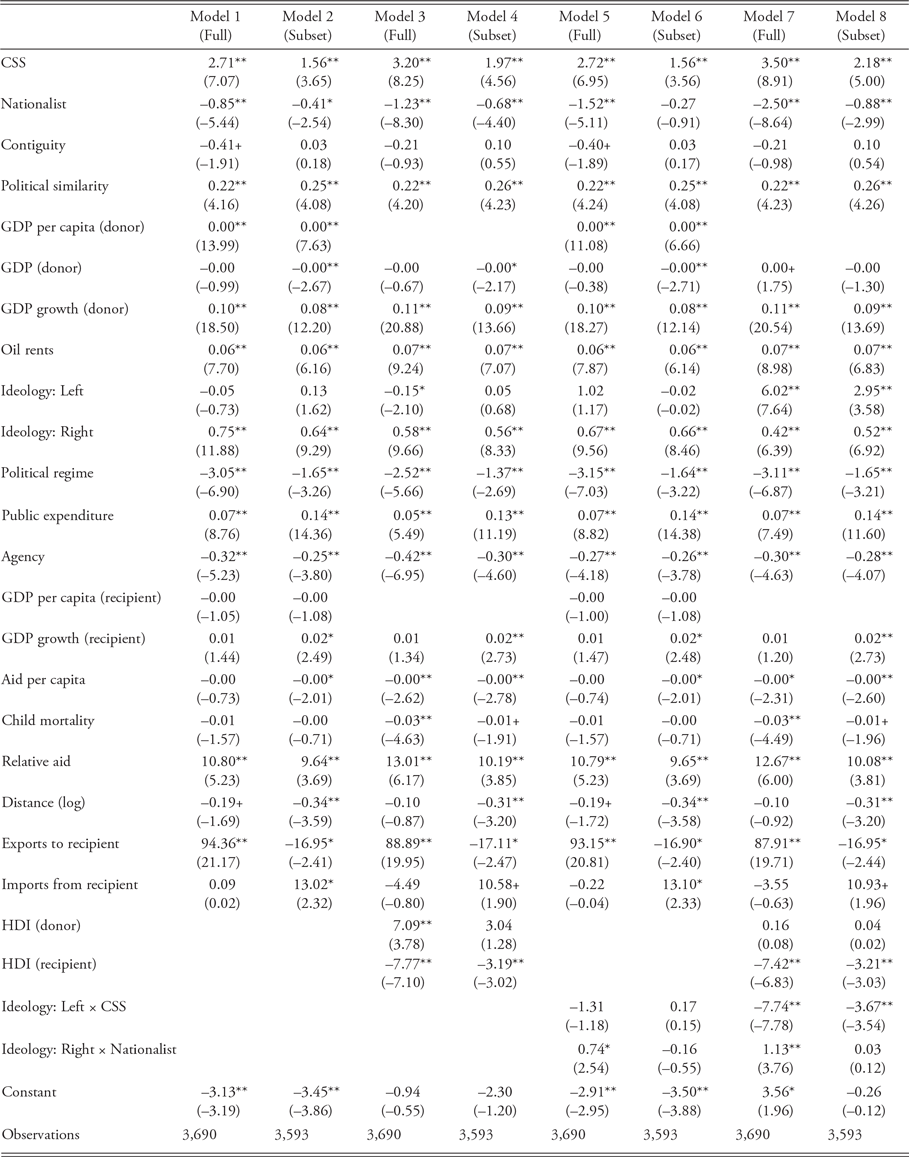
Models 1 and 2 include GDP per capita as a measure of donor’s and recipient’s level of development. In contrast, models 3 and 4 use the Human Development Index (HDI) as a measure of countries’ level of development. To control for the potential bias of outliers, models 2 and 4 analyze only a subset of the data, leaving out the 2.5 percent of observations with higher values in the dependent variable. Models 5 to 8 replicate the first four models while including interactions between the two main independent variables and indicators for left and right ideology of government.
Both Civil society strength (CSS) and Nationalist ideology are correlated as expected with the number of south-south cooperation activities offered by a donor. In seven out of eight models, Nationalist’s coefficient is statistically different from zero at the 0.01 level. This variable fails to be statistically significant at the 0.05 level in only one model, but the negative sign is maintained and significant at the 0.1 level. Civil society strength is positive and different from zero in all models. This is strong evidence in favor of hypotheses 1a and 1b. The greater the strength of nationalist groups, the smaller the number of SSDC activities a country offers. Similarly, the greater the strength of civil society groups, the greater the number of SSDC activities a country offers.
A country’s level of development (both in the form of GDP per capita and HDI), GDP growth, level of public expenditure, and oil revenue predict higher numbers of SSDC activities. This relationship is consistent with the idea that in order to provide aid, a potential donor must have the capacity to do so. The higher its capacity, the more likely that it will become a donor.
The statistical analysis provides suggestive empirical evidence to support many of the alternative explanations discussed. Yet most of these alternative explanations are not consistently supported across the different models. Evidence is weak for the selfish motivation hypotheses, since distance to a potential recipient, neighbor status, and the relative size of exports or imports do not seem to be consistently related to the number of SSDC activities. Political similarity, on the other hand, is positively correlated with a higher number of SSDC, although the size of its effect is small.
Regarding humanitarian goals, the empirical evidence suggests that potential recipients receive more aid the lower their level of development. However, only HDI coefficients are consistently different from zero at the a = 0.05 level.
The ideology of the donor’s government does not seem to consistently predict the number of SSDC activities, while the strength of CSO or nationalist groups does. However, right-wing ideology is positively associated with a greater number of SSDC activities. Although not theorized here, this finding would require further research. Evidence for the theory presented here is even stronger when we consider the interaction between these variables. If the main independent variables were just a proxy for government ideology, when interacted with ideology, the coefficient for these interactions should be significantly different from zero, positive, and considerably larger than the coefficients of these variables without interaction. As figure 1 shows, this is not the case.
Although the coefficients of many alternative explanations’ coefficients differ from zero in all eight models (political affinity, donor’s GDP growth, oil rents, agency, aid, and recipient’s HDI), one standard deviation of these variables predicts little change in the number of SSDC activities: this change ranges between 0.11 and 0.49 activities. This small predicted change in SSDC activities contrasts with the predicted change by the main independent variables in this study. In the case of civil society, a change in one standard deviation is correlated with between 0.27 and 0.56 SSDC activities, a larger effect than most variables in the models. Moreover, a change of one standard deviation in the strength of nationalist groups within a government predicts a change between 0.12 and 0.56 fewer SSDC activities. For the size of the effect, it is important to keep in mind that the average number of SSDC in a dyad is 3.02.
The largest coefficients in the models presented in figure 1 are related to the donor’s material capacity to provide aid. A one standard deviation increase in the donor’s GDP per capita is associated with up to 1.53 more SSDC activities. Furthermore, a one standard deviation change in the percentage of public expenditure relative to the donor’s GDP size increases up to 0.78 SSDC activities. Finally, a one standard deviation increase in the liberal democracy index predicts between 0.27 and 0.61 fewer SSDC activities (see regression table in appendix table 3).
Not only is the strength of civil society organizations or nationalist groups statistically significant to predict the intensity of SSDC relations, but the strength of these groups can predict a change in a greater number of SSDC activities than many alternative explanations. Furthermore, the strength of civil society and nationalist groups is a powerful predictor, as well as the main control variables related to the donor’s material capacity to provide aid.
Conclusions
This article began by asking about the motivations behind the provision of aid by developing countries and by presenting the puzzle behind the provision of SSDC. First, most developing countries do not possess a budget large enough to commit resources that could eventually attain the goals indicated by the literature. Second, developing countries face their own domestic challenges that need to be addressed and that make it even more costly for democratic leaders to spend resources in advancing the well-being of noncitizens beyond the donor’s borders. Furthermore, although the literature is rich in case studies, no generalizable analysis has been provided until now. Given these limitations of the literature, I argue that development cooperation between developing countries can be explained by the strength of friends and foes of development cooperation. Certain domestic actors, such as civil society organizations, are directly involved in SSDC activities and are expected to lobby in favor of more SSDC activities. Other domestic actors, such as nationalist groups, are ideologically opposed to a greater provision of resources to another country. The strength of these actors in the decisionmaking process is key to translating these preferences into policy decisions.
This argument assumes that leaders rely on support from domestic groups, which have their own agendas. If the relative strength of certain groups is larger in a government, we should expect their preferences to be translated into policy to a larger extent than the preferences of politically weaker domestic actors. Therefore, this article expected development cooperation offered by developing countries to be a function of governments’ relative distribution of power among domestic actors and their access to governments’ decisionmaking.
The argument was tested using data on SSDC activities in Latin America. To the author’s knowledge, this is the first large-A study on SSDC that analyzes more than ten developing countries’ behavior. The results of the empirical analysis support the argument and suggest that south-south aid can be understood as part of the relative influence of domestic actors in the government. Traditional explanations of foreign aid motivations, including selfish and altruistic goals, receive weak support in the empirical analysis.
These results are limited to intraregional SSDC in Latin America. Further research is needed to understand the factors that influence extraregional SSDC. Also, by using counts of SSDC activities, this article has provided generalizable evidence of SSDC in Latin America, but it does not take into account the financial cost incurred by Latin American donors when providing aid. In future studies, better measures of SSDC (such as monetary contributions) than are currently available could allow us to understand the magnitude of resources spent in SSDC.
Appendix: Statistics and Results
Descriptive Statistics

Results from Regression Models 1–8

+ p < 0.1, *p < 0.05, **p < 0.01
Donor and year coefficients omitted
Coefficients from Models in Figure 1

+ p < 0.1, * p < 0.05, ** p < 0.01
Coefficients that fail to be significant in most models, donor, and year are omitted.
Supporting Information
For replication data, see the author’s file on the Harvard Dataverse website: https://data-verse.harvard.edu/dataverse/laps