As soon as the contradiction ceases, life, too, comes to an end, and death steps in.
Paul Dessau, quoting Engels (Anti-Düring)Footnote 1
In his writings, Paul Dessau returns again and again to the idea of music as hard work for the composer (producer), the performer (interpreter), and the listener (recipient). This hard work is based on the idea of confronting, and potentially resolving, contradictions of the kind referred to by Engels in Anti-Düring. As Dessau noted in 1957 in a brief text entitled ‘On Dissonances’:
On closer inspection it has to be said that moments of tension, which is how I like to refer to dissonances, are nothing other than contradictions, without which nothing works in music, in any art form, or indeed in life itself.Footnote 2
The principal source for these moments of tension, contradiction, and dissonance in Dessau's mature work is his encounter with the two figures who came to dominate his musical theory and practice: Arnold Schoenberg and Bertolt Brecht. No other composer made a more concerted or enduring effort than Dessau to synthesize the two modernisms represented by Schoenberg and Brecht: the aesthetic on the one hand and the political on the other. This has made his music unpalatable for many. To cite just one example: a substantial review on 12 October 1962, in the GDR's daily newspaper Neues Deutschland, of the oratorio Appeal of the Working Class (Appell der Arbeiterklasse, 1960), a work to which I will return in what follows, censured the ‘preponderance of aggressive, complicated rhythms, piercingly dissonant sound clusters’ and an indiscriminate use of ‘distorted melodies’, finally accusing Dessau of deriving his entire musical idiom from a concept of ‘human annihilation’ when in fact ‘the appeal of the workers’ parties and the draft programme of the CPSU are grounded in an optimistic awareness that the fate of the world is today determined by the strength of socialism!’Footnote 3 Even Eisler, who in his Hollywood Songbook (1938–43) set a number of Brecht poems in the manner of Schoenberg, did not consistently attempt such a daring fusion of formalism and materialism: his song cycle, for example, for all its eclecticism is very much in the tradition of the modern Lied and there is no programmatic attempt to integrate or fuse Schoenberg's serialism and Brecht's materialism within single works. Eisler's career in the GDR, with notable exceptions such as the Serious Songs (Ernste Gesänge) of 1962, demonstrates that his approach tended to be to alternate between different approaches and styles diachronically, rather than synchronically; in his Letter to West Germany (Brief an Westdeutschland) of 1951, the year which also saw the publication of a number of his ‘easily graspable’ New German Folk Songs (Neue Deutsche Volkslieder),Footnote 4 Eisler explained this alternation in the following terms: ‘Listeners and composers must learn to distinguish between genres which can easily be understood and genres which make things difficult for the listener, even demanding a little preparation.’Footnote 5 Speaking in interview about the New German Folk Songs themselves, he stressed the importance of keeping each individual genre ‘pure and not mixing it with other types of art’.Footnote 6
Dessau, on the other hand, favoured mixing musical genres and styles. In a public statement delivered in 1964 – entitled ‘Creating the Golden Present’ in its published form – Dessau refers with assent to both Brecht and Schoenberg in setting out, in typically unambiguous and straightforward terms, his political and artistic programme. It is one based on contradiction and struggle:
Schoenberg once told me, in the context of his String Trio opus 46 [sic], that for him all music was programme music. For our part, we must make every effort to ensure that the impulses and insights of our age become the programme for our creative work!
I don't doubt that every one of us is, in some way, steeped in the revolutionary spirit of our age. But let us not forget that there is no method of working that is not born of contradiction. Long live contradictions! They are at the root of all the creative impulses that spring from the work we undertake in the new age of socialism that has dawned here, in our Germany! In this Germany there is no place for the existential fear under which so many people are still forced to work.
That alone should spur us on to transform what Brecht, in The Cultivation of Millet, referred to as ‘the golden someday’ into a golden present.Footnote 7
According to Dessau, and as already noted above, an artwork is not just a product of labour, but also requires labour on the part of its performers and listeners. Both production and reception are work processes: art, he claimed, ‘is not a “finished product” but an “experiment” in Brecht's sense of the word’; it demands that a piece of music is ‘co-created in the listener’.Footnote 8
Brecht himself articulated these ideas most explicitly in his learning plays (Lehrstücke), and it is perhaps not coincidental that Dessau's first encounter with his later friend, albeit at this point only from afar, was at the 1929 Baden-Baden Music Festival where Brecht's Learning Play (Lehrstück), with music by Paul Hindemith and later renamed The Baden-Baden Lesson on Consent (Das Badener Lehrstück vom Einverständnis), was premiered. The learning plays were a formative influence for Dessau, who composed his own version for children, The Railway Game (Das Eisenbahnspiel), in June of the following year. In the GDR he would also compose music for a revival of parts of the The Baden-Baden Lesson on Consent by the Berliner Ensemble in 1949.
Brecht's play is modernist and aesthetically innovative on the one hand, comic, absurdist, blatant even on the other. This not only makes it exceptionally difficult to classify – comparable in this to Schoenberg's much-misunderstood and underrated comic opera Von heute auf morgen Op. 32, also of 1929 – but also quite disconcerting to listen to, as sacred cows of modernism encounter clowning, buffoonery, and broad slapstick. The Baden-Baden Lesson on Consent embraces a diverse assortment of different styles, genres, and registers from the liturgical to clowning, from blank verse to prose commentary, from Zen-like aphorisms to biblical rhetoric and blatant propaganda. In the original production it also incorporated still and moving image projection (of photographs and a dance performed by Valeska Gert).
With the political upheavals in Europe of the 1930s, and consequent loss of a coherent framework and audience for his more radical, modernist dramatic experiments, Brecht abandoned the learning play project, leaving what might have been its apotheosis, Downfall of the Egoist Johann Fatzer (Untergang des Egoisten Johann Fatzer, 1926–30), unfinished. Although he did very briefly return to the learning play in the early years of the GDR – for example, as a possible model for the Berliner Ensemble's outreach work in factories – Brecht concentrated for the remainder of his career on the Schaustück – a play presented as a spectacle in a more-or-less traditional way – rather than the Lehrstück. I would suggest that it is in fact Dessau who, right through to his death in 1979, continued and expanded Brecht's abandoned project of synthesizing formal experimentation with Marxism.
One of the things that is striking about Dessau's synthesizing modernist programme is the way in which it re-positions or re-frames his mentors: Schoenberg's musical innovations are stripped of the autonomy so prized by Theodor W. Adorno in Philosophy of New Music – on occasion, for example, they are employed in the service of Gebrauchsmusik (functional music or ‘music for use’), as in a particularly challenging, twelve-tone celebration of the new socialist age Hymn to the Beginning of a New History of Humanity (Hymne auf den Beginn einer neuen Geschichte der Menschheit, 1959 to a text of Johannes R. Becher) which, according to one official report at least, baffled the factory workers for whom it was performed, although they were very taken by the composer himself;Footnote 9 the laconic directness and political candour of Brecht's post-learning play works, on the other hand, are often set against considerable melodic, harmonic, and rhythmic complexity – for example, in the songs for The Caucasian Chalk Circle (Der kaukasische Kreidekreis, 1952–55), which even Brecht had reservations about.Footnote 10 Put at its simplest, one senses that Dessau wants to de-mystify Schoenberg and to complicate Brecht.
Demystification on the one hand, complication on the other: the common denominator is what might be termed ‘refunctioning’ – the destabilization and disruption of existing forms, ideas, and expectations. Perhaps unsurprisingly the frame-of-mind that Dessau most explicitly rejects is comfort:
Art is never comfortable. Art can't be comfortable. It makes demands and it forces you to think. And thinking is famously uncomfortable. For heaven's sake, we don't even need to discuss these things. We have to do a lot of things that are uncomfortable. Building Socialism isn't comfortable. We are making a huge effort and we will achieve it. That's why I am for uncomfortable things.Footnote 11
For Dessau, discomfort could come in the form of musical complexity – in an unpublished text entitled ‘Progress in Music and Musicology’ (‘Fortschritt in der Musik und Musikwissenschaft’) he lists expanded concepts of tonality, emancipation of the dissonance (and cadence), the enrichment of rhythmical elements – or in the guise of disconcerting simplicity;Footnote 12 for example, his first GDR opera, The Condemnation of Lukullus (1950), was immediately followed by the semi-staged cantata Report from Herrnburg (Herrnburger Bericht, 1951), a programmatically simple (but not simplistic) counterpart to the dense and complex opera which preceded it.Footnote 13 Moreover, Dessau was never reluctant to characterize himself, with disarming straightforwardness, as an uncomplicated socialist realist – ‘I am a socialist and I work in a realist manner, I know for whom I am working and that I want to be understood, so I am indeed a socialist realist artist’Footnote 14 – and it is in what Matthias Tischer has termed Dessau's ‘compositional gestures of commitment’ to the party and state, and in his film scores, that what might be termed the Zhdanovist aspect of his music is most readily heard.Footnote 15 For example, the use of folk, workers’, and soldiers’ songs in the score to Andrew and Annelie Thorndike's ‘Stalinist blockbuster’ The German Story (Du und mancher Kamerad. . .) of 1956, complies with the socialist realist demand for popular forms (Volkstümlichkeit) and the primacy of vocal music.Footnote 16 A number of occasional pieces, from the 1950s in particular, announce their commitment forthrightly in their titles – Funeral March on the Death of the People's Policeman Helmut Just Treacherously Murdered by the Warmongers for Large Wind Orchestra (Trauermarsch auf den Tod des von den Kriegshetzern meuchlings ermordeten Volkspolizisten Helmut Just für großes Blasorchester) of 1953 is an obvious example, although when it was released on an Eterna record in 1960, alongside Ruth Zechlin's Lidice Cantata (Lidice-Kantate, 1958) and Karl-Heinz Dieckmann's Buchenwald Poem (Buchenwald-Poem, 1958), it bore the slightly more sober title Symphonic Funeral March in Honour of the Murdered People's Policeman Helmut Just (Sinfonischer Trauermarsch zu Ehren des Ermordeten Volkspolizisten Helmut Just).Footnote 17 In his book on Dessau's work in the GDR, Tischer notes that although Dessau's gestures of commitment become less frequent after the 1950s, they remain a constant in his output through to the 1970s, and he indeed cites Choral Music No. 5 (Chormusik Nr 5) of 1976, discussed in this article, as a late example.Footnote 18
However, despite this partial avowal of simplicity, and the composition of uncomplicated, occasional pieces, Dessau remained, as a devoted disciple of Schoenberg, a staunch and outspoken advocate of modernist complexity as an aesthetic complement to progressive socialism. In this he was not only firmly rooted in what film scholars usefully term the ‘political modernism’ of the interwar years, but also an avant-gardist of the kind who, according to art historian Peter Bürger, fights for the ‘integration (Aufhebung) of art into the praxis of everyday life’.Footnote 19 This, paradoxically, allows for the reading of socialist realism's call for popular forms, often entailing literal quotation of well-known literary and musical material, as an avant-garde practice.
Quotation was a technique Dessau used extensively and one he understood, in the manner of Brecht and Walter Benjamin, in unambiguously political terms. In a substantial 1963 essay on his encounters with Brecht, Dessau credits his friend and collaborator with introducing him to the fine art of plagiarism, as he terms it, during the composition of the music for Mother Courage and her Children: ‘At the time this kind of plagiarism [Plagiierung] was quite alien to me. Now it seems to me not only legitimate, but also entirely natural and productive.’Footnote 20 Plagiarism in the sense it is used by Brecht and Dessau is not a short cut or a symptom of laziness or lack of inspiration, but a technique of refunctioning.Footnote 21 For Brecht ‘it is precisely the innovators who will expropriate, commit plagiarism’, and he called for ‘training in the art of quotation’.Footnote 22
Tellingly, it is also a key feature of the very first works in which Dessau experimented with synthesizing the two modernisms, a few years before he met Schoenberg and Brecht in person, but at a time when he already knew their work from a distance. A paradigmatic example of this experimental synthesis, and one which turns to quotation for its musical material, coincides with the composer's first experiments in serialism under the tutelage of René Leibowitz whilst in exile in Paris: the short dodecaphonic solo piano piece Guernica of 1937. It has been identified by a number of commentators, including Daniela Reinhold and Thomas Phleps,Footnote 23 as a seminal work in Dessau's oeuvre, not just in its serialism – which Till Knipper has interpreted as an act of anti-totalitarian resistanceFootnote 24 – but also in its intensity of expression, brevity and ellipsis, and explicit reference, in both its title and musical argument, to contemporary political struggle, the bombing of the Basque town of the title by German and Italian bombers on 26 April 1937 under the code name ‘Operation Rügen’.
Guernica, initially inspired according to its composer by Picasso's famous painting, is also paradigmatic in its use of quotation, its intertextuality: as Phleps has convincingly demonstrated in his substantial study of Dessau's piece, there are quotations from the composer's own first Brecht setting, ‘The Battle Song of the Black Straw Hats’ (‘Kampflied der schwarzen Strohhüte’) of 1936, the ‘Internationale’ (Pierre de Geyter to words of Eugène Pottier, 1888), and Eisler/Brecht's ‘United Front Song’ (‘Einheitsfrontlied’, 1934).Footnote 25
Thirty-three years later, in what by then had become a characteristic act of self-citation, Dessau quotes Guernica alongside his music for Brecht's Mother Courage in the short solo piano piece For Helli (Für Helli) in memoriam Helene Weigel, who had died on 6 May 1971. Composed for her funeral, and performed by Dessau himself during the ceremony, it not only reworks Guernica, but also quotes the ballad with which Weigel became synonymous, ‘The Song of Mother Courage’ (‘Lied der Mutter Courage’, also known as the ‘Geschäftslied [business song] der Mutter Courage’) from Dessau's music to Brecht's play. These quotations, which constitute the principal musical material of this brief piece, not only evoke – for those able to recognize them of course – the joint experience of exile and shared political commitment, but also celebrate Weigel's most celebrated role at the Berliner Ensemble in Berlin. The intertextuality of For Helli, which it shares with many other works Dessau composed in East Germany, including the near-contemporaneous Orchestral Music No. 4 (Orchestermusik Nr. 4, 1972–73) with its myriad Bach quotations, supports the claim made by Kyle Frackman and Larson Powell that pieces like this ‘contain in their own internal contradictions the difficult balancing act GDR composers had to perform between musical modernity and politically motivated accessibility’.Footnote 26 As an example they cite a composition apparently also admired by Dessau's friend Luigi Nono, Quattrodramma for four celli, two pianos and two percussionists of 1965, which alongside self-quotations also incorporates a passage from Hans Werner Henze's Being Beautious (1963).Footnote 27 Dessau's earlier compositions including Guernica (published by Breitkopf & Härtel in the FRG in 1958 and the GDR in 1979) and, for example, two exile works he was particularly keen to see performed in the GDR, the twelve-tone Verlaine setting Les Voix of 1939 and the large-scale Brecht setting Deutsches Miserere of 1946 (premiered in Leipzig under Herbert Kegel in 1966),Footnote 28 suggest that the contradictions are more than just a response to specific pressures experienced under one regime (the GDR), as is implied by Frackman and Powell – they are a fundamental principle guiding Dessau's musical thinking and compositional practice. From Guernica onwards he retained a tenacious and combative faith in progress both artistic and sociopolitical, the one inseparable from the other, together with an acute sense of being on a musical and pedagogical mission to enlighten, to educate, and to challenge: ‘Progress entails experimentation!’ as he laconically put it in a draft speech in the 1950s.Footnote 29 The consistency and drive underpinning this programme is manifest in the tendency of individual works, especially later ones – For Helli is paradigmatic in this respect – to function as reiterations of musical and political preoccupations, a characteristic accentuated by the insistent use of quotation. In what follows I intend to discuss the generative interplay of Marxism and formal experimentation – manifest as quotation and reiteration – in Dessau's use, across a twenty-five-year period, of a simple-but-striking party-political cryptogram.
Within the context of Dessau's GDR work, the Condemnation of Lukullus, referred to already as the complex ‘other’ of Report From Herrnburg, is a paradigmatic example of what Nina Noeske has termed Dessau's ‘unique synthesis of progressive art with political and pedagogical resolve’.Footnote 30 Following its controversial premiere in 1951, it became the object of a fierce ‘formalism debate’, documented since unification in numerous articles and a substantial volume edited by Joachim Lucchesi.Footnote 31 This debate, a confrontation between political modernism and socialist realist orthodoxy, is, I would suggest, pre-figured in the opera's brief coda which follows the furious, Trautonium-accompanied denunciation of Lukullus-Hitler in the final scene where the dictator is ritualistically banished to Hell: ‘Oh yes, let him and all like him be cast into Nothingness!’ Woven into the dense texture of this coda is a set of complex variations on a three-note motif which, in German notation, spells out the initials of the GDR's Socialist Unity Party, the SED (Sozialistische Einheitspartei Deutschlands): E♭ [Es], E, D. This motif is treated in a manner akin to serialism: it appears in its original form, inverse, retrograde, and inverse retrograde. What we have here, of course, is a classic example of musical cryptography, a practice of which Dessau was particularly fond. One of his last works before leaving the United States was a Piano Piece on B-A-C-H (Klavierstück über B-A-C-H, dated 30 July 1948) and his Bach Variations (Bach-Variationen, 1963) – the most celebrated, and performed, piece of orchestral New Music in the GDR – opens with an intricate interweaving of ciphers for Bach and Schoenberg.
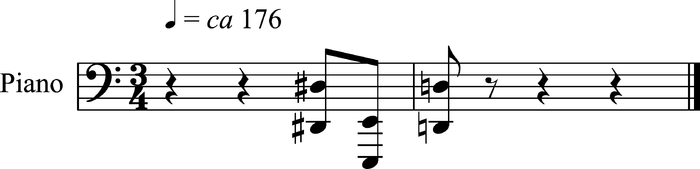
In 1951 the S-E-D cryptogram was not just a coded celebration of the party, but also an acronym for the GDR's call for unification under socialism with the slogan ‘Germans Unify!’, ‘Seid einig, Deutsche!’, also SeD. As Fritz Hennenberg wrote in 1963 in an analysis of Lukullus: ‘the warmongers must be stripped of their power through a workers’ united front’.Footnote 32 Although this second implication of the S-E-D motif is a product of the early years of the GDR, the cryptogram itself, as a party moniker, becomes something of an idée fixe across twenty-five years of Dessau's work in the GDR, reappearing – programmatically unchanged to signal continued loyalty – in numerous pieces and also, at least in a manuscript in the Paul-Dessau-Archiv in Berlin, as the opening three tones of a twelve-tone row in a row table dated around 1975 (see Example 1).Footnote 33 In obsessively reusing the motif Dessau pays homage not only to his party, but also to his two modernist mentors: Brecht, with whom it is inevitably associated through Lukullus, and Schoenberg who, as H. H. Stuckenschmidt has convincingly argued, himself reused a basic three-note cell, the so-called Urzelle, across his entire career: from Verklärte Nacht Op. 4 and the First Chamber Symphony Op. 9, through the row of Von heute auf morgen – where it is combined with the cryptogram AS – to the Violin Concerto Op. 36 and beyond.Footnote 34 I would also suggest a parallel to the three-note pizzicato chord in bb. 52 and 232 of the String Trio Op. 45, which Schoenberg subsequently told Thomas Mann ‘represented his illness and medical treatment’, a life-saving injection.Footnote 35 An analogy can be drawn between the role of the SED within the divided body of post-war Germany and the injection that saved Schoenberg's life in Los Angeles in spring 1946. Dessau knew Schoenberg's String Trio very well: later that year, when he was not only in regular personal contact with the composer, but also occasionally working for him in Los Angeles, he paid Schoenberg ten dollars for a photocopy of the piece, which he analysed and corrected before making Schoenberg aware of some mistakes. Schoenberg apparently responded that corrections would only make things worse.Footnote 36
Tone row from a row table in the Paul-Dessau-Archiv, c. 1975. AdK, Berlin, PDA 1.74.1113.1-8. Used with permission.

Within Dessau's post-Lukullus works, the S-E-D cryptogram becomes a leitmotif: shortly after the composition of the opera it reappears in the cantata To the Mothers and To the Teachers (An die Mütter und an die Lehrer, 1950); in the substantial oratorio Appeal of the Working Class (1960), which is in part twelve-tone (deploying the so-called ‘Puntila-row’); in Act 2 Scene 7 of the opera Einstein (1971–73; see Example 2), in the context of a plea for peace in the nuclear age which echoes the Appeal; and in the Choral Music No. 5, to which I will now turn for the remainder of this essay.Footnote 37
Paul Dessau, Einstein (piano reduction), Act 2 Scene 7 (section 154, bb. 3–4). © Henschel Verlag für Musik, Kassel. Used with permission.

On 21 January 1976 Neues Deutschland published a text by Dessau about a forthcoming piece for the 9th Party Congress to be held in May:
First I am a communist, then a composer. To be a model as a communist – in my political attitude and artistic approach – is my constant aim.
For encouragement to write a piece of music for the 9th Party Congress (and I sincerely hope I will succeed) I am indebted to the support and respect of many comrades and in particular the faith my Party places in me, to which I hope to do justice with this work.Footnote 38
In his brief statement of party loyalty, Dessau stresses that the goals set out in the new statute for the 9th Party Congress are ambitious and that their implementation will demand ‘not only revolutionary drive, but also conscious discipline’. For Dessau, moreover, political and artistic struggle are here analogous insofar as both depend on a combination of dynamism, on the one hand, and strict organisation, on the other.
Dessau, as we have seen, derives from Schoenberg and Brecht a theory and practice of composition which combines (or juxtaposes) modernist difficulty with accessibility; musical complexity requires simplicity – or even blatancy, as in the case of the S-E-D motif – as a constructive and constitutive other. Brecht's poem ‘In Praise of Communism’ (‘Lob des Kommunismus’, BFA 11, 234) describes its object as ‘the simple thing / That is hard to achieve’, and it is possible that Dessau had this in mind when he noted in his diary on 1 February 1976 that Choral Music No. 5 was simple, but had required ‘a lot of work’.Footnote 39 For the listener the dialectic of simplicity and complexity in this piece is manifest in two quite straightforward ways. First, in the alternation between musically complex passages characterized by abrupt changes of style, dense counterpoint, and unexpected caesuras with the simple and insistent repetition of the S-E-D motif. Here the piece echoes the compositions from which the cryptogram is quoted – the cantata To the Mothers and To the Teachers, the oratorio Appeal of the Working Class, and the opera Einstein. In all the works the cipher is readily identifiable, even to the untrained ear, in a way it is not within the dense coda to Lukullus. The second manifestation of the dialectic of simplicity and complexity is even more blatant than the one operating on the musical level: the disparity between the transparently propagandistic text and the complexity of the musical setting.
In Less Than Nothing: Hegel and the Shadow of Dialectical Materialism, Slavoj Žižek describes Heiner Müller's poem in Choral Music No. 5, a collage of quotations from a speech of Erich Honecker from June 1975, as an ‘obscenity’, noting an ‘extreme disparity, tension even, between the thoroughly modernist, non-melodic, atonal music, and the utter banality of the text’ and concludes that the ‘frontier between the (state byzantine) Sublime and the ridiculous is here effectively indecipherable’.Footnote 40
Like the persistently repeated S-E-D cryptogram, which structures the piece across the fifty-one pages of the score, Heiner Müller's text is certainly simple in its socialist rhetoric: ‘GREAT THINGS HAVE BEEN ACHIEVED / Through the power of the people and for the benefit of the people / In collaboration with the Soviet Union’ (‘GROSSES WURDE VOLLBRACHT / Mit der Kraft des Volkes und zum Wohl des Volkes / In Bruderbund mit der Sowjetunion’).Footnote 41 However, it is not straightforward either when heard in Dessau's polyvalent setting or read in the context of the critique of ideology in Müller's famous play Hamlet Machine (Die Hamletmaschine) of the following year.Footnote 42 In the fourth scene of that work the Hamlet Actor (Hamletdarsteller) declares, ‘I am the type-writer . . . I am the data bank’; towards the end of the scene, a stage direction calls for the ‘Tearing of a photograph of the author’.Footnote 43 If ‘Hamlet machine’ is a cryptic allusion to ‘Heiner Müller’, then I would suggest there is an antecedent in Choral Music No. 5 for which Müller functions as a ‘Honecker machine’. The full title of the poem, reinstated in the latest edition of Müller's collected poems, reads:
For the IX. Party Conference of the SED in May 1976
From a speech of the General Secretary of the Central Committee of the German Socialist Unity Party and President of the State Council of the German Democratic Republic, Erich Honecker, arranged by Heiner MüllerFootnote 44
A comparison of the poem with Honecker's speech, published under the title ‘On the Announcement of the IX. Party Congress of the German Socialist Unity Party’ (‘Zur Einberufung des IX. Parteitages der Sozialistischen Einheitspartei Deutschlands’) in Neues Deutschland on 6 June 1975,Footnote 45 reveals that the poetic text contains not a single original word of Müller himself: it is an abbreviation, reduction, or, to retain the computing analogy from Müller's play, a ‘compressed file’ of Honecker's three thousand or so words. In a study of Müller's poetry and its sources, Katharina Ebrecht has termed this kind of poem a ‘distilled end product’ and ‘transformation of the source text into gestural language’.Footnote 46 Her characterisation of Müller's method as ‘writing through quotation and condensing [verdichten]’ could indeed also be applied to Dessau's compositional technique, especially in his later works.Footnote 47
The omnipresence of Honecker's voice in ‘GREAT THINGS HAVE BEEN ACHIEVED’ may well explain why the published score of 1984 uses the cautious phase ‘arranged by Heiner Müller’ (‘eingerichtet von Heiner Müller’), whilst a note on the score in Dessau's hand dated February 1976, in the Paul-Dessau-Archiv, has ‘written by Heiner Müller’ (‘gedichtet von Heiner Müller’).Footnote 48 The comparison shows that Müller took forty-two syntactic units from twelve of the speech's thirty-five paragraphs, with the samples lifted from across the entire text – as the Hamlet Actor puts it: ‘I feed the computer with my data.’Footnote 49 Whether the poem is thus, as Žižek suggests, an ironic allusion to Honecker's reputation in the GDR as a would-be poet remains a matter of speculation, as does the interesting claim made by Corinne Holtz in her biography of director Ruth Berghaus that the homophonous choral repetitions of the bass line amount to a caricature of the parroting of party propaganda. I shall return to this question at the end of this article.Footnote 50
The composition of Müller's poem can, manifestly (and in the spirit of Holtz), be read as an act of authorial self-renunciation or self-denial: Müller serves merely as a mouthpiece, puppet, or parrot of the general secretary of the Socialist Unity Party. Conversely, however, it could also be understood as an act of self-constitution or identity formation through quotation (or plagiarism) of the political kind advocated by Brecht, Benjamin, and Dessau himself. The same can, of course, be said of the music, at least insofar as the confident S-E-D motif derived from Lukullus via To the Mothers and To the Teachers, Appeal of the Working Class and Einstein is concerned. As Dessau wrote in a text to accompany his near-contemporary Orchestral Music No. 4, ‘since I don't believe in “originality” I go for continuity’.Footnote 51 Müller, for his part, put it rather more bluntly: ‘I don't have any ideas. I never have had any ideas . . . I copy so much that no one person can spot it.’Footnote 52 Revealingly, in the context of (non-) authorship, or rather co-authorship, Müller's poem was re-published in 1987 as the only ‘foreign text’ (‘Fremdtext’)Footnote 53 in a volume of Honecker's collected thoughts on culture in a limited and luxury edition of 333 copies.Footnote 54 Moreover, in the light of the recent publication of Müller's complete poetry – which provides ample evidence to support the view that, counter to many post-modern and post-GDR interpretations of his work, he remained committed to aspects of Marxism throughout his career – there is no obvious reason to assume that the poem is either ironic or a deconstruction of Honecker's speech. If it is, then the latter roundly misunderstood it in having it included in his collected thoughts on art and culture.Footnote 55
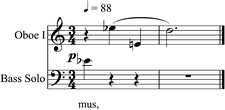
The musical language of Choral Music No. 5 both reflects and offsets the (ideological) simplicity of the text it sets. It is in C major but with harshly dissonant passages setting off the serial repetition of the three-note S-E-D motif, which in bb. 120–1 finally occurs in its original, un-transposed form following the ecstatic utterance of the word ‘Communism’, divided up into ‘Kommunis-mus’, the suffix ‘-mus’ being a homonym in German for ‘muß’, ‘must’ (see Example 3).
Paul Dessau, Choral Music No. 5 (bb. 120–1). ©1981 by Edition Peters, Leipzig. Reproduced by kind permission of Peters Edition Limited, London.

For all its emotional intensity – Žižek refers to ‘harsh declarations and injunctions, accompanied by rather brutal drum beatings’Footnote 56 – instructions in the score also include ‘light, springing’ [b. 38], ‘elegant’ [b. 45], and ‘extremely tender’ [b. 52], attributes perhaps not generally associated with Dessau's gestures of commitment. Again this suggests musical conflict, tension, and dialectics. Moreover, the complexity of the music inevitably challenges, deconstructs even, the blatancy of the poetic text it sets, transforming it into something unresolved, indicating perhaps that Honecker's straightforward-sounding communist utopia – laid bare by Müller's poem – is, as Brecht put it in the Baden-Baden Lesson on Consent, if not ‘the unreachable’ then certainly ‘the / Not-as-yet reached’.Footnote 57
In The Difficulties of Modernism, Leonard Diepeveen refers to difficulty as ‘high culture's default position’.Footnote 58 In his ‘balancing act between loyalty to the GDR, an impetus to enlighten and artistic truthfulness’,Footnote 59 as well as his unstinting faith in socialism and the modernism represented by Schoenberg and Brecht, Dessau believed that New Music had to be simultaneously progressive and pedagogical, high culture in dialogue with the masses. In a letter to his own former teacher René Leibowitz of 2 January 1950, Dessau wrote out the coda of Lukullus in short score, extracting the S-E-D cryptogram and adding the note ‘A Celebration of the “SED.”’Footnote 60 For the next twenty-five years Dessau would embed this simple cipher within complex, sometimes difficult musical contexts as a shorthand declaration of continued allegiance to the two modernisms, aesthetic and political, discussed in this article.Footnote 61 As such, it functioned not only as an audible (and readable) quotation – one of those ‘old things’ which, in his own words, he frequently ‘rolled out and deliberately transformed . . . into something new’Footnote 62 – but also as a reminder of what the party had ‘Not-as-yet reached’.
In his notes to Orchestral Music No. 4 quoted above, Dessau refers to his use of quotation in a range of pieces, noting that he had woven references to Bach and Jan Pieterszoon Sweelinck into Lukullus and citing Mozart's The Marriage of Figaro K. 492 as an antecedent for his own citational practice, concluding: ‘when it came to “quotation” Mozart was clearly as “lax” as Brecht’.Footnote 63 Having acknowledged his own preference for continuity over originality – this passage has already been cited – Dessau describes his method of quotation as ‘“sublating” (in the Hegelian sense) existing material and trying to remould it’.Footnote 64 The German term used by Dessau here is aufheben, a remarkable concept insofar as it embraces a range of seemingly incompatible meanings, something which evidently added to its appeal for Hegel: it can mean to preserve, to save, to suspend, to integrate, to neutralize, to reverse, to cancel, to rescind, to negate, to unmake, as well as to sublate in the philosophical sense.
I would suggest, in conclusion, that Aufhebung is a fitting term for Dessau's musical programme as discussed in this essay through the example of Choral Music No. 5; contingent on the hard work of production, performance, and reception, it is a programme which embraces the ostensibly contradictory principles of consonance and dissonance, simplicity and complexity, originality and quotation, innovation and replication. In Dessau's remarkable synthesis of political and aesthetic modernism, socialist rhetoric is preserved, suspended, and potentially unmade in its reiteration.